Article

Equipment, Safety Routines and Attitudes Towards Safety in Forestry Work Among Swedish Non-Industrial Private Forest Owners


Department of Forest Bioeconomy and Technology, Swedish University of Agricultural Sciences, SE-90183 Umeå, Sweden
Forests 2026, 17(9), 1100; https://doi.org/10.3390/f17091100
Submission received: 12 August 2026 / Revised: 11 September 2026 / Accepted: 12 September 2026 / Published: 16 September 2026
(This article belongs to the Section Forest Operations and Engineering)

Abstract

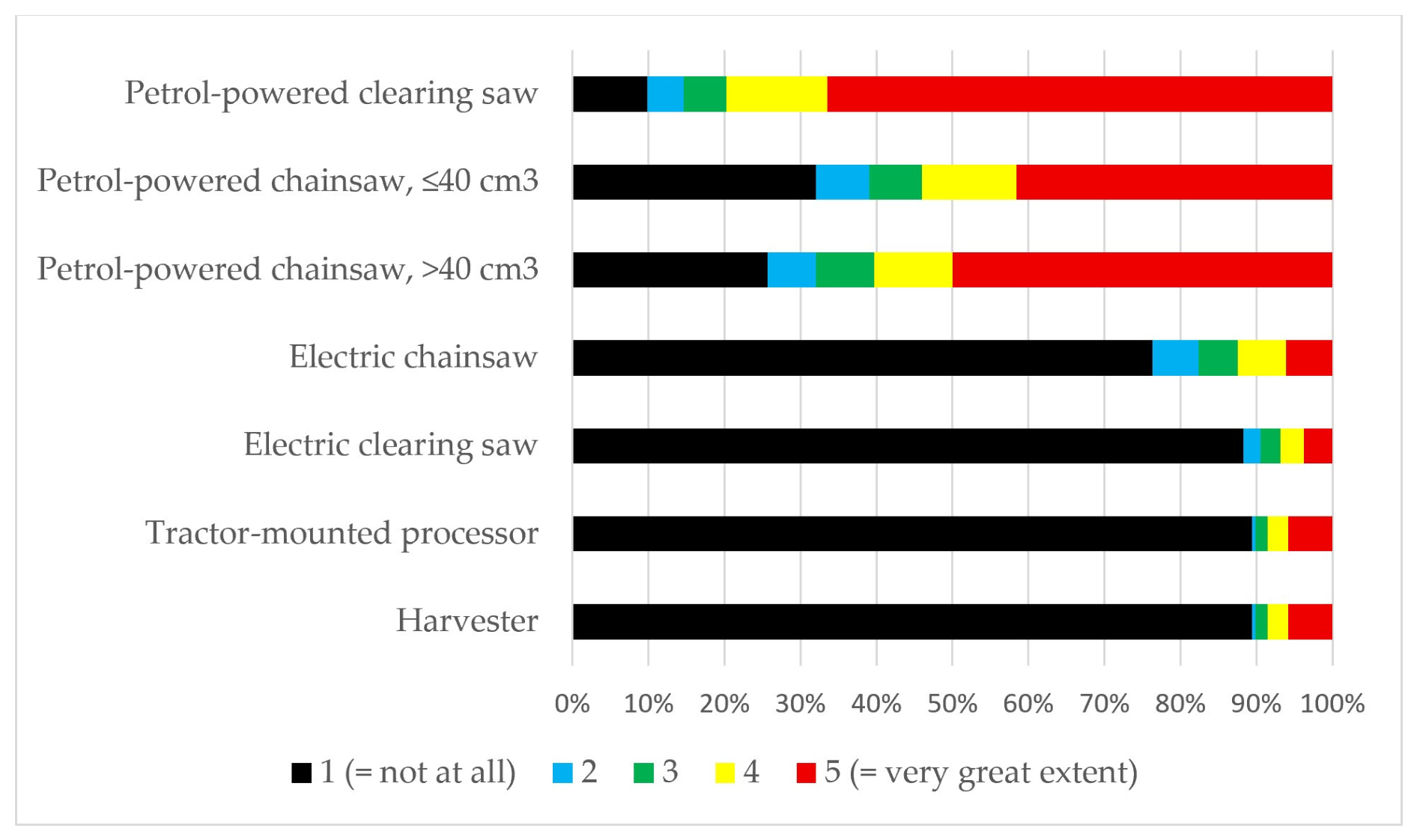
Forestry is an accident-prone industry, and more needs to be done to reduce the number of accidents. Through a survey sent to 1494 Swedish non-industrial private forest owners (FO), this study investigated their safety routines and attitudes, and what equipment they use in forestry. Responses from 429 FOs were analyzed, and the results show that there are associations between FOs’ attitudes and how they act. The results show that FOs who reported higher risk awareness and greater safety proficiency also reported taking more safety measures when working in the forest. The highest risk acceptance was found among male FOs who frequently worked in the forest. When working in the forest, 74% of respondents were often or always alone, but only 17% of respondents had a routine of usually or always arranging for someone to check on their well-being during work. Petrol-powered chainsaws and clearing saws were the most common tools used for felling trees, with 93% of FOs having a petrol-powered clearing saw in their possession. Electric tools were still relatively uncommon among FOs, as 77% of respondents did not have an electric chainsaw and 87% did not have an electric clearing saw. The study concludes that there is room for improvement regarding FOs’ safety procedures, and by identifying how different types of FOs relate to safety, the results of this study can help increase the accuracy of educational and information efforts to reduce accidents in small-scale forestry.
Keywords: work safety; occupational health; family forest owner; self-employment; forestry tools work safety; occupational health; family forest owner; self-employment; forestry tools