Article

Equipment, Safety Routines and Attitudes Towards Safety in Forestry Work Among Swedish Non-Industrial Private Forest Owners


Department of Forest Bioeconomy and Technology, Swedish University of Agricultural Sciences, SE-90183 Umeå, Sweden
Forests 2026, 17(9), 1100; https://doi.org/10.3390/f17091100
Submission received: 12 August 2026 / Revised: 11 September 2026 / Accepted: 12 September 2026 / Published: 16 September 2026
(This article belongs to the Section Forest Operations and Engineering)

Abstract

Forestry is an accident-prone industry, and more needs to be done to reduce the number of accidents. Through a survey sent to 1494 Swedish non-industrial private forest owners (FO), this study investigated their safety routines and attitudes, and what equipment they use in forestry. Responses from 429 FOs were analyzed, and the results show that there are associations between FOs’ attitudes and how they act. The results show that FOs who reported higher risk awareness and greater safety proficiency also reported taking more safety measures when working in the forest. The highest risk acceptance was found among male FOs who frequently worked in the forest. When working in the forest, 74% of respondents were often or always alone, but only 17% of respondents had a routine of usually or always arranging for someone to check on their well-being during work. Petrol-powered chainsaws and clearing saws were the most common tools used for felling trees, with 93% of FOs having a petrol-powered clearing saw in their possession. Electric tools were still relatively uncommon among FOs, as 77% of respondents did not have an electric chainsaw and 87% did not have an electric clearing saw. The study concludes that there is room for improvement regarding FOs’ safety procedures, and by identifying how different types of FOs relate to safety, the results of this study can help increase the accuracy of educational and information efforts to reduce accidents in small-scale forestry.

1. Introduction

Sweden has around 300,000 non-industrial private forest owners (FO) who together own and manage approximately 11.3 million hectares of productive forest land, corresponding to 48% of Sweden’s productive forest land [1]. Each year, they spend more than 11 million working hours on forest management activities [2]. For example, approximately half of all pre-commercial thinning and a quarter of all planting work is today carried out by FOs themselves [3]. One risk of FOs working in the forest is that they can get injured, and a significant proportion of those who work in the forest will have experienced some form of accident or incident that has led or could have led to injuries [4]. In fact, forestry is a relatively dangerous activity, and the number of work-related deaths is high in relation to other types of employment [5,6]. One reason for this is that the work is often done in rough terrain and with equipment that can easily cause serious injuries if handled incorrectly or carelessly. For example, many accidents occur in connection with working with a chainsaw, even though the chainsaw itself is often not the direct cause of injury. Some of the most common accidents occur through falls, someone being hit by a falling or rolling tree in connection with cutting or being injured by a moving machine. This often leads to injured fingers, bone fractures, tooth injuries, cuts and other soft tissue injuries [5,6,7]. Working with a chainsaw for a long time also puts the body under physical stress, which can lead to injuries [8]. In Swedish forestry, the number of reported accidents that have led to sick leave has been around 100 per year in recent years, of which half of the injured are absent from work for more than 14 days [9,10]. However, the actual number of occupational accidents is estimated to be higher since the propensity of reporting is low among, for example, self-employed forestry workers [9]. In the case of self-employed forestry workers, the hidden number is likely to be large due to weaker follow-up routines compared to those found in larger companies. Many registers of injuries and accidents also do not indicate whether the person is a self-employed FO or not [7]. However, the exact number is less relevant in this case; what is important is to increase understanding of how preventive work can be improved and how more injuries can be avoided in the future. In addition to the harm that accidents cause to the individual, the injuries also have a social cost due to the healthcare costs and sick leave that accidents lead to [11].
To reduce the number of accidents and deaths in the forest, Klun and Medved [12] argued that an integrated strategy for appropriate training and the use of appropriate organizational and technical solutions is necessary. In other words, a holistic perspective must be used. The fact that the number of accidents remains at approximately the same level from year to year shows that there is still great development potential for safety work in forestry. Some efforts have been made to improve safety in forestry, but overall neither the research efforts nor the interest shown by the authorities have been on par with the number of injuries that occur [7]. An example of such an effort in Sweden was the introduction of a chainsaw license (although not a requirement when working in your own forest), which had some effect on safety awareness among FOs, but far from everyone has changed their behavior as a result. In a survey of chainsaw license holders, only a third of the participants stated that after completing the training, they use more safety equipment than before, and among those who only worked on their own land, only one in five had increased their use [13]. The type of safety equipment they used and what the increased use consisted of were not clear from that survey. As Edlund [14] has shown, participants in this type of training often gain a greater awareness of risk, but this knowledge is a perishable commodity that can be quickly forgotten.
Recent surveys among forestry contractors have shown that many companies do not meet the current requirements of systematic occupational health and safety work or have a culture that does not value safety as highly as it should [15,16,17,18]. It could thus be assumed that not all small-scale FOs always have such routines in place either. However, FOs’ safety routines and attitudes towards safety in forestry work have received relatively little attention [19], and of the relevant studies that exist, several are a couple of decades old [4,11,20]. It would therefore be valuable to gain more knowledge about what equipment FOs use today and what types of safety measures they apply in connection with forestry work. Furthermore, understanding the attitudes of FOs today is important because previous research in other industries shows that there are associations between workers’ attitudes and accidents [21,22,23].
Since statistics on equipment for small-scale forestry are not regularly collected or openly reported, this type of information is primarily available through individual studies. As far as is known, it has been a long time since the last survey was conducted [20], so it would thus be useful to identify the latest trends. It is highly likely that there have been changes in supply and demand in the market. For example, technological development has progressed in the last 20 years, which has led to an increase in the proportion of electrically powered tools [24], and the FO community (i.e., the users) has changed over time [25]. Changes in the characteristics of FOs may also affect prevailing attitudes towards security, as these are often linked to individual traits [26]. Mapping the equipment used while examining routines and attitudes is natural, as equipment can be both a risk factor and a prerequisite for safe forestry work. Therefore, the objective of this study was to provide a current picture of Swedish FOs’ equipment, safety routines and attitudes towards safety in forestry work. For this, the following questions were explored:
  • What attitudes do FOs have towards safety and different types of risks in forestry work?
  • What safety routines do FOs apply when working in the forest?
  • What equipment do FOs have, and to what extent are different types of tools used when working in the forest?
  • Are there differences in attitudes, safety routines and equipment that can be associated with the characteristics of the FOs?
The results from this study can be used for future policy work as well as information and education efforts aimed at specific FO groups who need to be informed about the importance of safety.

2. Materials and Methods

2.1. Sample

A random sample of 1500 FOs was drawn with the help of the Swedish Forest Agency. The information retrieved was the FO’s name, identity number, residential address, hectares of forest owned and the forest’s property designation. Only individuals who owned more than five hectares of forest, were resident in Sweden and were at least 18 years old were included in the sample. After removing a few duplicates, the final sample consisted of 1494 cases. Of these, 69% were male FOs, which was slightly more than in the general FO population, where the proportion of male owners is approximately 60% [1]. The average property size was 43 hectares.

2.2. Data Collection

A questionnaire was developed for data collection. The first part of the questionnaire (see Supplementary Materials) consisted of questions about the respondents’ sex, age, place of residence, size of forest property, their forest activities and yearly income. Income was considered relevant as it could affect their equipment purchases, while the others are characteristics that previous studies have often found to influence FOs’ attitudes and forest management activities [27,28]. To investigate FOs’ attitudes towards safety, respondents were asked to rate a total of 17 statements on a Likert-type scale of 1 (strongly disagree) to 7 (strongly agree). Many of the statements were adopted from Henning et al. [26] and Lundstrom et al. [16]. Using questions that have been validated through previous studies reduces the risk of error and makes it easier to compare results between studies. The adopted statements were translated (by the author of this paper) into Swedish and, when necessary, slightly modified to fit the context. Furthermore, FOs were asked about their routines when working in the forest. In the last parts of the questionnaire, questions were asked about the type of equipment that the FOs have and to what extent they use it when working in the forest. The extent of their use was measured on a five-point Likert-type scale, where 1 indicated “not at all” and 5 “to a very high extent”. To limit the scope of the questionnaire, smaller tools such as axes and knives were excluded.
Before the questionnaire was completed, a FO and an expert in forest technology were asked to review it. They were instructed to leave comments if any question was unclear, or if any concept or name of the equipment mentioned could create confusion for the FO. Based on their feedback, some minor changes were made to the questions and answer options. No formal ethical review was required under Swedish law, as no sensitive personal data would be collected.
The questionnaire was distributed by postal mail in November 2025. In a cover letter accompanying the questionnaire, FOs were informed about the purpose of the study, the voluntary nature of participation, the legal basis for processing personal data and how the collected data would be processed. FOs were also informed that they had the option of either answering the survey online via Netigate or completing the paper version and returning it by postal mail, free of charge. The last responses were received in February 2026. In total, about 480 FOs (32%) responded, but not everyone had filled out the questionnaire. For example, because they did not do any forestry work themselves. If the respondent had only completed a few questions, mainly background questions, these were omitted from the analysis. The final data set included 429 cases, corresponding to 29% of the contacted FOs.

2.3. Analysis and Data

The collected data was analyzed using IBM (Armonk, NY, USA) SPSS Statistics software (version 31). When applicable, differences between groups were analyzed using Chi-square tests for categorical variables, and t-tests and ANOVA to compare averages between groups. Correlations between variables are reported as Pearson’s correlation coefficients. The Likert-scale items were treated as continuous variables, which is common practice for numerical scales with five or more categories [29]. With a total sample of 429 and subgroup sizes generally above 40, the t-test and ANOVA are robust to moderate violations of normality. For the categorical group variables, chi-square tests were used, which do not require distributional assumptions.
Principal components analysis (PCA) was used to identify the underlying factor structure of the 17 items measuring FOs’ attitudes towards safety and thereby facilitate group comparisons linked to different safety dimensions. Before performing PCA, the suitability of the data for factor analysis was assessed [30]. The Kaiser–Meyer–Olkin value was 0.73, and Bartlett’s test of sphericity reached statistical significance (p < 0.001), indicating that PCA was applicable. PCA revealed the presence of five components with eigenvalues exceeding 1, explaining 18.7%, 15.6%, 11.0%, 7.0%, and 6.4% of the variance, respectively. The scree plot showed a clear break after the third component, and therefore it was decided to retain three components for further investigation. The three-component solution explained a total of 45.3% of the variance, with component 1 contributing 18.7%, component 2 contributing 15.6%, and component 3 contributing 11.0%. Oblimin rotation was performed to aid in the interpretation of the three components. Only variables with a loading above 0.4 were included in the components to facilitate their interpretation. In cases where items had a loading of at least 0.4 on more than one component, they were assigned to the component where the loading was highest. Two items with loadings below 0.4 were not assigned to any component but were analyzed separately because they capture distinct attitudes (personal responsibility and perceived controllability of risk) that were considered relevant to the discussion. Component 1 had a small negative correlation with component 2 (r = −0.02) and component 3 (r = −0.02), while there was a small positive correlation between component 2 and 3 (r = 0.04). For each of the three components (safety dimensions), the average value of the respondents’ answers to the constituent parts was calculated. These scores were then used in analyses of how safety routines during forestry work were related to their attitudes. Being means of five items, the dimension scores were treated as approximately continuous variables. Internal consistency for the three components was checked using Cronbach’s alpha, which was 0.78 for risk acceptance, 0.61 for risk awareness and 0.59 for safety proficiency. The alpha for risk awareness and safety proficiency was thus somewhat low (<0.7), which is not unusual for scales consisting of few items. Therefore, the mean inter-item correlation was also checked for those two dimensions. This value should optimally be between 0.2 and 0.4 [30], and for risk awareness it was 0.23 and for safety proficiency 0.25. All three dimensions were therefore considered appropriate to include in the analysis.
Most respondents were males (89%), meaning they were significantly overrepresented compared to women (p < 0.001). As shown in Table 1, the respondents were, on average, about 64 years old, had been FOs for 29 years and had a forest property of 172 hectares. In recent years, most of the respondents had carried out forestry work in a forest that was close to their home, but some respondents had a very long distance to the forest, which raised the average value. Male respondents worked in the forest 34 days per year, on average, which was significantly more than females who spent about 12 days a year on forestry work (p < 0.001). The respondents’ annual income was in 28% of cases SEK 300,000 or less (in August 2026, one Swedish krona was equivalent to approximately 0.09 euros), 36% had an income of 301,000–500,000, and the remaining 36% earned more than that. About 32% of the respondents lived in Norrland (northern Sweden), 23% in Svealand (central Sweden) and 46% in Götaland (southern Sweden). Most of them (82%) lived in a shared household, while 18% lived in a single-person household. The most common forestry tasks performed by the FOs themselves were logging for household needs (72%), followed by taking care of damaged/storm-fallen trees (67%), pre-commercial thinning in young forest stands (66%), sowing/planting (43%), clearing undergrowth before felling (42%), and thinning (36%). Less commonly performed activities were final-felling (19%), felling of seed trees (15%) and soil scarification (8%).

3. Results

3.1. Attitudes

Overall, FOs were aware of risks, as demonstrated by their relatively high level of agreement with statements linked to risk factors in forestry work (e.g., weather and work pace). The proportion of FOs who stated that they consciously expose themselves to risks in forestry work was also relatively low, as indicated by low mean values on questions where safety is valued against higher productivity in the work. On about half of the statements there were significant differences between male and female respondents’ perceptions (Table 2). Through PCA, three dimensions of safety attitudes could be identified, and these were labeled as risk acceptance, risk awareness and safety proficiency (Table 3).

3.1.1. Risk Acceptance

The first dimension was interpreted as risk acceptance, as it was linked to questions about how willing the respondents were to accept risks and deliberately expose themselves to greater risks to achieve higher productivity (Table 3). It was found that male respondents were significantly more prone to compromise with their own safety compared to females, with average dimension scores of 2.3 and 1.8, respectively (p = 0.003). Moreover, there was a significant difference in relation to the respondent’s income (p = 0.007), where those in the lowest income group scored higher (avg. 2.5) on this dimension than those in the middle-income group (avg. 2.1), while those in the high-income group (avg. 2.3) did not differ significantly from the others. In addition, there was a positive correlation between the respondent’s risk acceptance and the number of working days per year in the forest (r = 0.20; p < 0.01). This was also clear when looking at the specific variables within this dimension as the number of working days correlated with the respondents’ degree of pride in performing work that is perceived as dangerous (r = 0.16), that injuries are a natural part of the job (r = 0.18), that it is sometimes necessary to take shortcuts (r = 0.10), that it sometimes is necessary to deviate from safety regulations (r = 0.13), and to take risks that compromise safety to get the job done (r = 0.17) (p < 0.05).
Respondents in the highest income group differed from those in the middle group in feeling pride in performing a dangerous job (p = 0.020), and in that they were more likely to consider it sometimes necessary to deviate from safety regulations to achieve higher productivity (p = 0.034). Regarding the sense of pride, the groups’ mean responses, from lowest income to highest, were 2.7, 2.2 and 2.7, and for deviation from safety regulations 2.1, 1.7 and 2.2. Compared to the middle-income group, those in the low-income group also perceived to a higher extent that injuries were a natural part of the job (p = 0.037), with average values of 2.3 and 1.9, respectively, while those in the highest income group (avg. 1.9) did not differ significantly from the others.

3.1.2. Risk Awareness

The second safety dimension was interpreted as respondents’ risk awareness and addressed issues such as knowledge of work hazards and the factors that increase risks, such as weather conditions and work pace. Female respondents reported greater risk awareness than males, with average dimension scores of 5.6 and 5.1, respectively (p = 0.001). There was also a positive correlation between respondents’ age and risk awareness (r = 0.14; p < 0.01).
Looking at the specific constituents of this safety dimension, female respondents agreed more than males with the statement that close call incidents often occur during forestry work (Table 2). There was a regional difference regarding the statement that forestry work is more dangerous than other practical outdoor work (p = 0.011), with respondents living in Svealand agreeing to a higher extent (avg. 5.6) than those living in Norrland (avg. 5.0), while those living in Götaland (avg. 5.3) did not differ significantly from the others. Moreover, older respondents agreed to a greater extent that working too fast (r = 0.15) or in bad weather (r = 0.13) poses a higher risk (p < 0.01).
Respondents in the lowest income group were less likely to believe that forestry work is more dangerous than other practical jobs than those in the middle-income group, while those in the highest income group did not differ significantly from the others, with average scores of 5.0, 5.5 and 5.3, respectively (p = 0.037).

3.1.3. Safety Proficiency

The third dimension was interpreted as safety proficiency, as it included items dealing with knowledge about rules and regulations, understanding of safety practices, and the importance of using the right tools and safety equipment, as well as avoiding accidents by paying attention to what one is doing when working in the forest. This dimension had positive correlations with respondents’ age (r = 0.11), duration of ownership (r = 0.10), and the number of working days per year (r = 0.16) (p < 0.05). Those living in shared households also rated this safety dimension slightly higher than those in single households, with average dimension scores of 5.6 and 5.4, respectively (p = 0.050).
Female respondents agreed to a greater extent than males that it is important to have the right personal safety equipment and good training. On two statements about the ability to avoid injuries during forestry work through one’s own actions and knowledge, male respondents were more confident in their ability than females (Table 2).
Older respondents considered themselves to have better knowledge of safety guidelines (r = 0.14; p < 0.01). Moreover, respondents with long ownership periods were more likely to feel they knew the risks and how to protect themselves (r = 0.11), as well as having better knowledge of safety guidelines (r = 0.19) (p < 0.05).
Respondents who worked more days per year in the forest also felt they had better knowledge of the safety regulations (r = 0.14) and how to protect themselves in the forest (r = 0.16) and believed to a greater extent that they would not be harmed as long as they are aware of what they are doing in the forest (r = 0.12) (p < 0.05).
Male respondents agreed to a greater extent that sometimes self-employed FOs must take shortcuts to get the job done and that injuries are a natural part of the job (Table 2).

3.1.4. Other Variables

A couple of the statements that respondents took a position on could not be linked to any of the three safety dimensions above (Table 3). One was whether the damage that occurs most often is the FO’s own fault, which male respondents agreed with to a greater extent than females, and they also had a stronger view that there is not much that can be done to make self-employed forestry safer (Table 2). Respondents in the lowest income group were more likely than others to believe that not much can be done to increase safety, with an average response of 3.5 compared to 2.8 among those with the highest income and 2.9 in the middle group (p = 0.004). Furthermore, respondents living in Svealand agreed to a greater extent than those in Norrland that injuries typically are the FOs' own fault, while the responses from those living in Götaland did not differ significantly from the others. Here the average responses were 4.8, 5.3 and 5.0, respectively (p = 0.045).

3.2. Safety Routines

Three out of four FOs (74%) reported that they often or always work alone in the forest. Among female FOs, however, 81% rarely or never worked alone in the forest, while 81% of male FOs often or always did so (p < 0.001). There was also a geographical difference (p = 0.021), with FOs in Norrland working alone to the greatest extent (80%) while FOs in Svealand did so to the lowest extent (64%) and those in Götaland were in line with the overall proportion (75%). Those who often or always worked alone had a higher average safety proficiency score than others, with averages of 5.6 and 5.3, respectively (p = 0.005).
A safety measure that most FOs often take is to notify someone that they are going to the forest to work, but about 16% rarely or never do so. Those who often did so had a higher safety proficiency score than others, with averages of 5.6 and 5.3, respectively (p = 0.007). Female respondents were slightly less likely to notify someone compared to males (p = 0.038). Furthermore, in the lowest income group, 26% never or rarely notified someone, while it was 11% among those with the highest income and 15% in the middle group (p = 0.006). Among those who lived alone, 57% usually or always notified someone, while this was 90% among those who lived in a shared household. In 79% of all cases, the notified person was someone living in the same household as the FO, and another 14% usually notified a close relative who was not living in the same household. Thus, few contacted anyone outside the family, such as a friend, neighbor or work colleague.
If someone was notified before leaving for the forest, 90% of the respondents usually also notified them after returning home. However, again, FOs living alone and those in the lowest income group were less frequently doing so compared to others (p = 0.008). The proportion who never or rarely reported after returning home was twice as high in the lowest income group (18%) compared to the middle group (9%) and three times as high compared to those with the highest incomes (6%). Among single-person households, the proportion was 23% compared to 8% among others (p < 0.001). Those who never or rarely notified anyone after returning home had a higher risk acceptance score than others, 2.6 vs. 2.2 (p = 0.034), and a lower safety proficiency score, 5.2 vs. 5.6 (p = 0.002).
It was unusual for FOs to ask someone to check on them while they were out working in the forest by calling at certain times, or for it to be agreed that FOs would contact them at certain times and inform them that the work had proceeded without incident. Most respondents never or rarely did this, while 17% did it often or always. Those who often or always did this had higher risk awareness, with an average score of 5.4 compared to 5.1 for others (p = 0.016). They also had a higher safety proficiency score than others, with 5.8 vs. 5.5 (p = 0.002). A significant difference was found in relation to the distance between the FOs’ home and the forest, where those who more often made these kinds of arrangements lived closer to the forest than others (p < 0.001). The average distances for the two groups were 19 and 65 km, respectively.
Almost all respondents (98%) had their mobile phone with them during forest work, and with only a few exceptions, they usually kept it in their pants or jacket pocket or a similar place so that they could always reach it. Of the ten respondents who kept it in another location, five usually had it within 30 m of the workplace and the other five further away. About half of the respondents (57%) had the 112-application, which connects directly to the emergency dispatch, installed on their mobile phones. It was significantly less common that FOs in the low-income group had it installed (45%) compared to those in the middle (63%) and high-income groups (61%; p = 0.008). Moreover, it was unusual for FOs to have knowledge of the coordinates of the work site to be able to provide these to rescue personnel in the event of an emergency. Those who usually knew the coordinates (14% of the respondents) had a higher safety proficiency score than others, with 5.8 vs. 5.5 (p = 0.004).
Nine out of ten FOs often or always checked that their equipment was in good order before leaving for the forest, and those who did so had a higher safety proficiency score than others, with averages of 5.6 and 5.0, respectively (p < 0.001). Those in single-person households were less likely than others to check their equipment before forestry work, with 15% rarely or never doing so compared to 8% among others (p = 0.040).
Regarding the use of personal protective equipment, it was found that ear protection was always used by almost everyone when working with a chainsaw or clearing saw. However, FOs were generally more careful about wearing protective clothing when using a chainsaw than when using a clearing saw (Figure 1).
For all types of personal protective equipment except gloves, those who always wore them when using a chainsaw or clearing saw had a significantly higher safety proficiency score than those who did not always do so. In addition, those who always used safety glasses or a visor when working with a chainsaw had a higher risk awareness score than those who did not. The relatively small group that did not wear a helmet when using a chainsaw had a significantly higher risk acceptance score than the others. Regarding gloves, those who always wore gloves without saw protection when using a clearing saw had a higher safety proficiency score compared to others. In addition, those who always wore gloves with saw protection had lower risk acceptance scores than others, which was the case for both chainsaw and clearing saw use.
Of the respondents, a total of 41% had completed some level of chainsaw training and obtained a chainsaw license. Those who had a chainsaw license had a slightly higher safety proficiency score than those who did not, with averages of 5.7 and 5.5, respectively (p = 0.021). Of those who had a chainsaw license, three out of four had the basic categories A and B. In addition, 24% had completed level C, 9% level D, and 8% had some other level or type of license. There was a significant geographical difference, as 54% of respondents in Götaland had a chainsaw license, while the proportion in the other two regions was 23% (p = 0.002). Moreover, only 26% of female respondents had a chainsaw license, compared to 43% among males (p = 0.032). FOs with a chainsaw license were younger, lived closer to the forest and spent more time on forestry work (Table 4).
When asked if they use a chainsaw to perform tasks for which they have not been trained, 40% responded that they do so sometimes and 22% do so often. These had a higher risk acceptance score (avg. 2.5) than those who did not use chainsaws for things for which they had no training (avg. 2.0; p < 0.001). This could also be other training than courses for a chainsaw license. However, among those with a chainsaw license, only 2% often performed tasks for which they had no training, but 51% did it sometimes. Among those without a chainsaw license, 33% stated that they do not usually perform tasks for which they have not received training. Male respondents were more likely than females to use the chainsaw for tasks for which they were not trained (p < 0.001). In addition to chainsaw training, 34% of the respondents stated that they had participated in other forms of training with a focus on safety or the work environment in relation to forestry.

3.3. Equipment

As shown in Table 5, the most common type of equipment among respondents was petrol-powered clearing saws, which 93% had, and many had more than one. Many also owned petrol-powered chainsaws, while electric chainsaws and clearing saws were less widespread. Compared to petrol-powered tools, these were also significantly newer on average. Many FOs (68%) had a farm tractor, with an average age of about 26 years. Only large forwarders were older on average, but a very small percentage of respondents had forwarders, harvesters or mini skidders. Approximately half of the respondents had an ATV, and on average these were just under 10 years old, which was also the case for cars and light trucks (used in connection with forestry). More respondents had a log trailer with a grapple loader compared to how many had carts without a grapple loader. Both trailer types had a relatively high average age, 17 and 23 years, respectively.
Regarding the age of the equipment, respondents in Götaland had newer cars (avg. 8.6) than those in Norrland (avg. 11.7), while those in Svealand (avg. 10.0) did not differ from the other groups (p = 0.012).
There were negative correlations between the number of working days and the age of petrol-powered clearing saws (r = −0.15), and small (r = −0.15) and large petrol-powered chainsaws (r = −0.22), meaning that the more active FOs had newer equipment for felling trees (p < 0.05). However, the age of cars and snowmobiles was higher the more active the FOs were, with correlations of 0.17 and 0.26, respectively (p < 0.05). Larger FOs had newer tractors (r = −0.21), and petrol-powered clearing saws (r = −0.14) and smaller chainsaws (r = −0.15) were also significantly newer the larger the owner (p < 0.05). For log trailers without grapple loaders, there was a negative correlation with the distance between the forest and the respondent’s home (r = −0.24; p < 0.05).

3.4. Use of Equipment

3.4.1. Felling of Trees

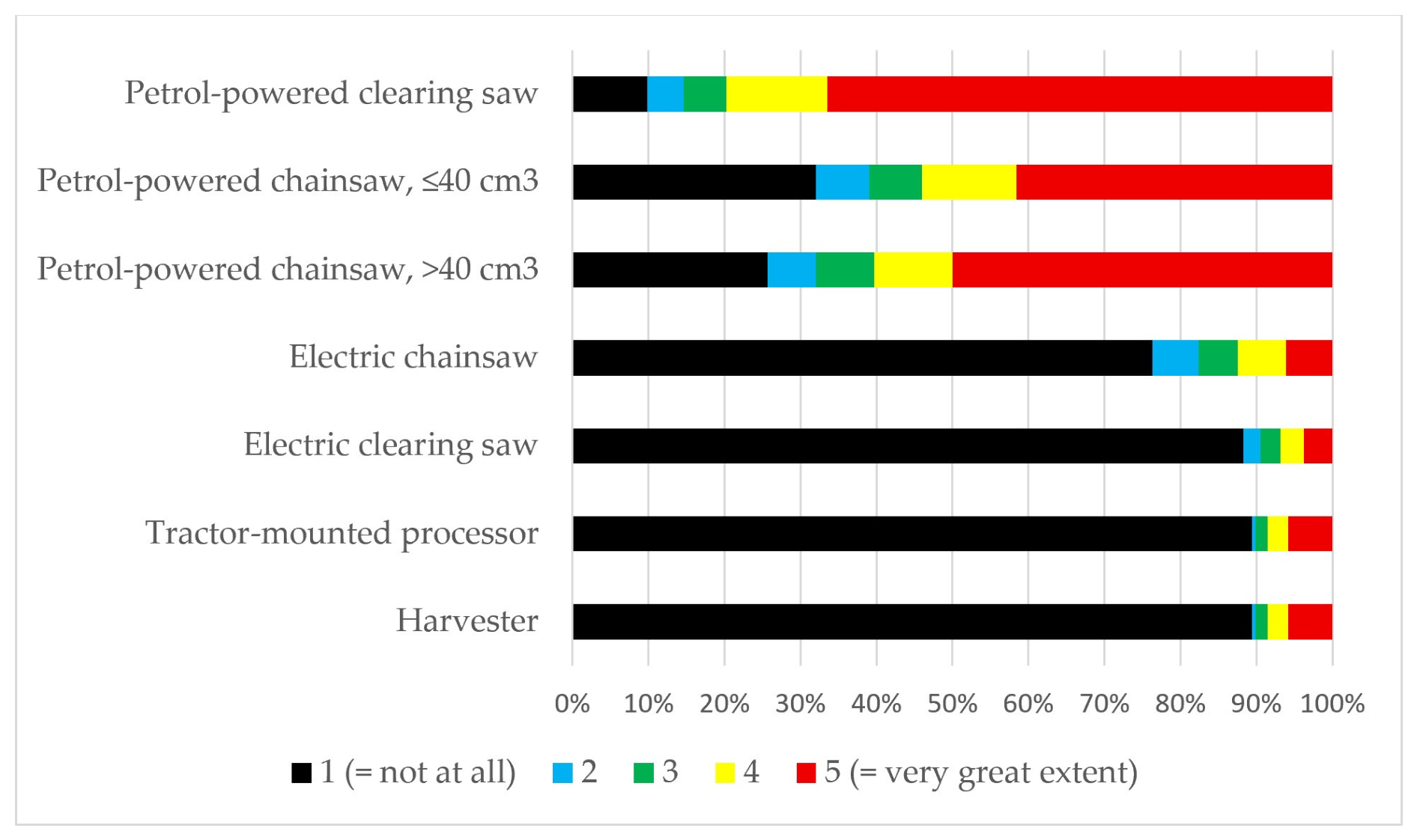
Respondents were asked to what extent, on a scale of 1–5, they used different types of equipment for felling trees, and the equipment most used was petrol-powered clearing saws and chainsaws. Battery-powered power tools and heavier machinery such as harvesters or tractor processors were used extensively by a relatively small proportion of respondents (Figure 2). No female respondent reported using harvesters, and their use was also significantly lower for petrol-powered chainsaws and electric clearing saws. The female respondents’ average responses were for harvesters 1.0, small chainsaws 2.45, large chainsaws 2.0 and electric clearing saws 1.1, while for men it was 1.3, 3.3, 3.7 and 1.3, respectively (p < 0.01). Furthermore, there were positive correlations between the respondent’s working days per year and the use of large chainsaws (r = 0.26), tractor-mounted processors (r = 0.18), and harvesters (r = 0.21) (p < 0.01). Regarding the use of large chainsaws, there was also a positive correlation with how long the respondent had been a FO (r = 0.13), while use was significantly lower (r = −0.18) the further away from the property the FO lived (p < 0.01). There was also a geographical difference, with respondents in Götaland using petrol-powered clearing saws to a lesser extent than in other regions, with an average of 4.0 compared to 4.4 in both other regions (p = 0.004). However, those in Götaland used electric clearing saws to a greater extent than those in Norrland, although the use in both regions was low, with averages of 1.5 and 1.2, respectively (p = 0.018).

3.4.2. Transport of Timber

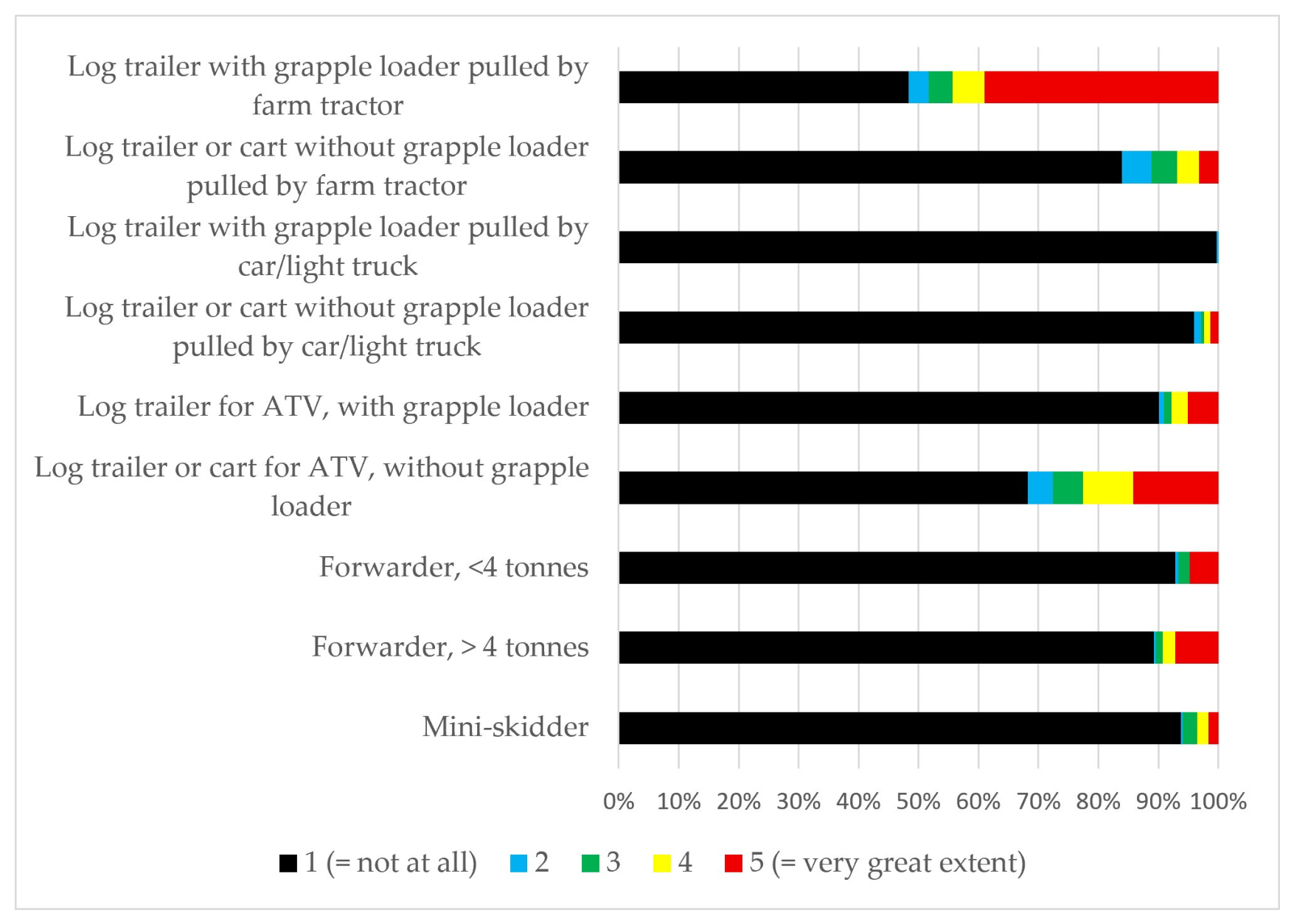
The type of equipment that was most frequently used for transport of timber from the forest was log trailers with grapple loaders pulled by a farm tractor. After that, the most used means of timber transport were log trailers or carts without grapple loaders pulled by ATVs or tractors. Small forwarders (weighing 4 tonnes or less) were used less frequently than larger forwarders, but just one tenth of the respondents used these extensively. Few used mini-skidders or trailers for cars/light trucks to transport timber from the forest (Figure 3).
No female respondent used mini-skidders or small forwarders, and they also used log trailers with grapple loaders pulled by tractors to a lesser extent than male respondents, with an average of 1.9 vs. 2.9 on the five-point scale (p < 0.001). Log trailers without grapple loaders pulled by ATVs were less often used by respondents in single-person households (avg. 1.6) than respondents with shared households (avg. 2.0; p = 0.024). Regarding geographical differences, log trailers with grapple loaders pulled by farm tractors were used to a greater extent in Götaland (avg. 3.2) than in Norrland (avg. 2.3), while Svealand (avg. 2.8) did not differ significantly from the others (p < 0.001). In Götaland, however, the use of log trailers without grapple loaders pulled by ATV was less frequently used compared to both Norrland and Svealand, with averages of 1.6, 2.3 and 2.1, respectively (p < 0.001). Large forwarders were used more by respondents in the lowest income group than in others, with an average of 1.7 compared to 1.3 in the high-income group and 1.2 in the middle group (p = 0.007).
The number of working days per year was positively correlated with the use of log trailers with grapple loaders pulled by tractors (r = 0.20) and by ATVs (r = 0.14), as well as with the use of forwarders, both larger (r = 0.16) and smaller (0.13) ones (p < 0.05). Furthermore, those with longer tenure as FOs were more frequent users of log trailers with grapple loaders pulled by tractors (r = 0.17), while respondents who lived further away from the property were less frequent users of this type of equipment (r = −0.15) (p < 0.01).

3.4.3. Use of Vehicles

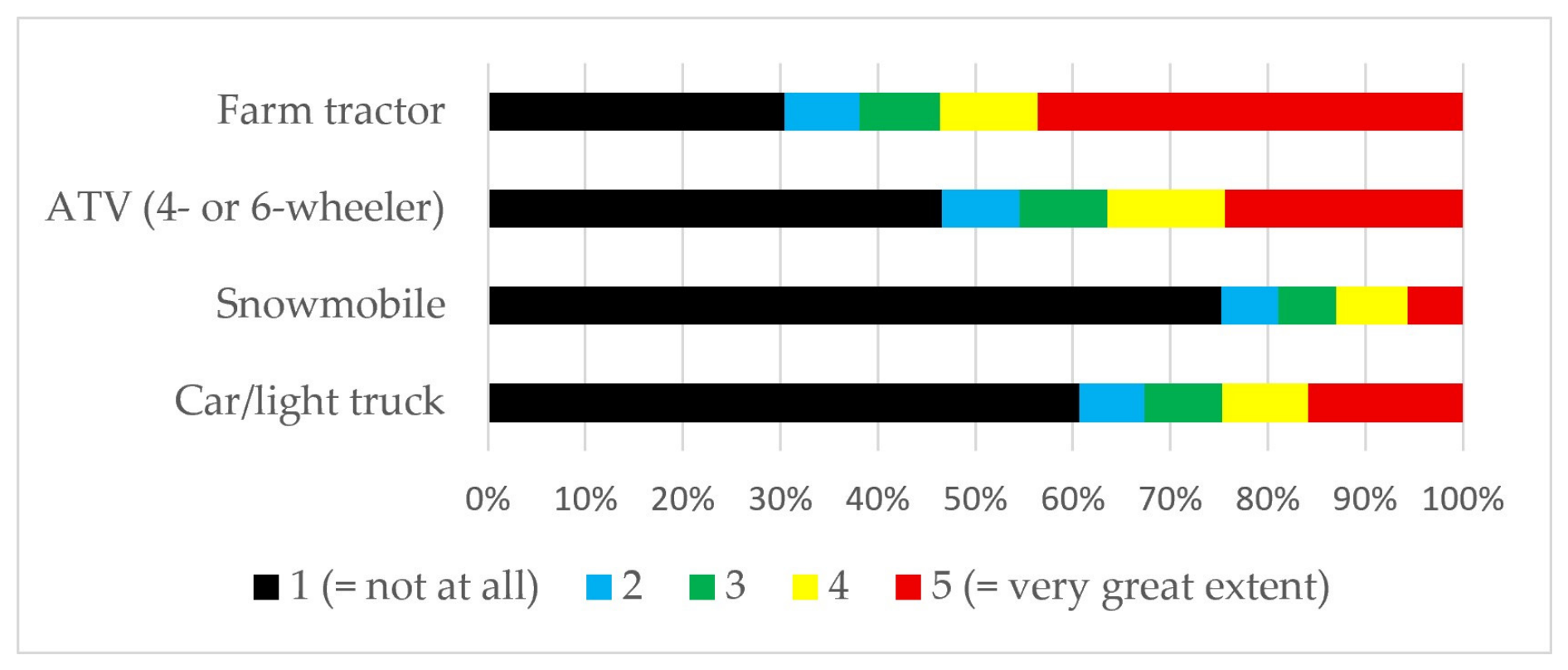
More than half of the respondents used farm tractors to a great or very high extent in connection with forestry. ATVs were frequently used by approximately a third of the respondents and cars or light trucks by a quarter. Snowmobiles were used to the lowest extent (Figure 4). Male respondents used tractors more often than females, with an average of 3.4 compared to 2.1 (p < 0.001), and they also used snowmobiles to a slightly greater extent, with averages of 1.7 and 1.3 (p = 0.014), respectively. Regarding tractor use, there were positive correlations with the respondents’ duration of forest ownership (r = 0.22) and the time spent on forestry (r = 0.24), but a negative correlation with the distance to the forest (r = −0.20) (p < 0.01). Furthermore, there was a difference linked to income (p = 0.015), where those with the lowest incomes had significantly higher use of farm tractors (avg. 3.7) than those with the highest incomes (avg. 3.0), while the middle group (avg. 3.2) did not differ significantly from the others. Furthermore, farm tractors were used more in Götaland than in Norrland, with averages of 3.6 and 3.0, respectively (p = 0.006). However, snowmobiles and ATVs were used to a lesser extent in Götaland (avg. 2.3) than in Norrland (avg. 2.9; p = 0.013). Snowmobile use was also lower in Götaland (avg. 1.1) than in both the more northern regions of Svealand (avg. 1.5) and Norrland (avg. 2.5; p < 0.001). Furthermore, snowmobile use correlated positively with property size (r = 0.10), but negatively with the number of working days per year (r = −0.11) (p < 0.05). Regarding car use, older FOs used them to a lower extent (r = −0.16; p < 0.01). However, there was a slight positive correlation between use of cars and property size (0.11; p < 0.05). In addition, ATVs were used to a slightly lesser extent by respondents who lived alone, with an average of 2.2 compared to 2.7 for those in shared households (p = 0.032).

4. Discussion

This study investigated FOs’ equipment, safety routines and attitudes towards safety when performing self-employed forestry work. The study thus contributes current knowledge to a field that receives relatively little attention given how accident-prone the forestry industry still is [5,7].
In this study, the proportion of male respondents (89%) was significantly higher compared to the general population of FOs and higher than in other survey studies aimed at FOs [28]. This is most likely because male FOs are more likely than female FOs to engage in self-employed forestry work [20]. This was also something that was expressed by some of the FOs who did not want to participate. Furthermore, the results also show that female respondents worked in the forest themselves to a lesser extent and used chainsaws or clearing saws less often than males. This is in line with previous findings showing that there is still a clear gender segregation within the industry regarding the type of work performed [31].

4.1. Attitudes

Safety attitudes are linked to individual differences in personality traits and beliefs [26], and it was thus expected that different types of FOs would have different views on safety. Understanding and improving FOs’ safety attitudes is important since previous studies have found significant relationships between workers’ safety attitudes and the occurrence of accidents [21,22,23]. The results show that attitudes towards safety have several dimensions, and a key finding was that those with the highest degree of risk acceptance were male FOs who frequently worked in the forest. The gender gap was also reinforced by the fact that female FOs expressed higher risk awareness. For example, they perceived more situations as close call incidents, which suggests that they assess situations differently based on their own attitudes and previous experience. However, it is not possible to determine from the results whether willingness to take risks is a prerequisite for wanting to work frequently in the forest, which is known to be a dangerous job, or whether this is something that is built up during the time one works. Because it is natural that someone who has worked a lot in the forest is more likely to have ended up in situations where they had to take risks to get the job done, which may then have been reflected in the answers to the questions included in the dimension. It may also be the case that FOs become more careless and overestimate their abilities the more they have worked in the forest. This is suggested by the results showing that those who worked a lot in the forest were more likely to believe that they would not be harmed as long as they were attentive to what they were doing.
Male FOs, who in this study worked more in the forest and showed higher risk acceptance, are also the group most often affected by deaths and serious accidents in the forestry sector [7]. To reduce the number of accidents in the forest, work to increase risk awareness and reduce risk-taking among male FOs should therefore be intensified. For example, the results showed that male FOs do not place as much value on having the right personal protective equipment as female FOs do, which is a concrete attitudinal issue that can be addressed. This should also be in the interest of retailers.

4.2. Safety Routines

Working alone is common in forestry both in Sweden and internationally, including among the respondents in this study, which previous studies have shown increases the risk of injuries and fatal accidents [32,33]. The results also showed that many FOs often take certain safety measures in connection with this, but they are largely unattended during the actual work. It can therefore take a long time before someone discovers that an accident has occurred. For example, they end up under a falling tree, which is one of the most common causes of deaths and severe injuries in forestry work [7]. A safety measure recommended by the Swedish Work Environment Authority is thus that when carrying out dangerous solo work, there could be a designated person to report to at agreed times [34], but this was usually not implemented by the FOs. More information is therefore required for FOs to increase the proportion of those who take this action. Future research and development work could also focus on finding technical solutions to this problem, such as camera surveillance or an alarm function where the FO needs to indicate on their phone at regular intervals that they are okay. A clear improvement in forest worker safety that has occurred in recent decades is the availability of mobile phones during forest work, and the mobile phone network connection has also improved over time and today covers 90% of the country’s land area [35]. In a study carried out in 2001 [4], about half of the workers always carried a mobile phone in the forest, and in this study, almost everyone did. Today’s phones are also more advanced, and FOs can install applications that can, for example, help with positioning. However, only half of the respondents had installed the most common emergency application, which means that there is room for improvement in this area. Furthermore, having an application that can automatically provide the coordinates of the accident site is recommended because the results show that FOs themselves are rarely aware of them. More targeted information efforts towards self-employed FOs regarding this would therefore be desirable, as this is a free and simple safety-enhancing measure for the FO to take.
The results show that the categories of protective clothing that are highest and lowest in terms of how often they are used today are largely the same as in the early 2000s [4]. However, it may be that the equipment itself has become better and thus provides better protection today than before. Still, an obvious improvement measure would be to get more FOs to switch to using gloves with saw protection when using chainsaws and clearing saws.
The FOs’ perceived knowledge of rules and guidelines regarding safety was slightly above average (5.0 on a seven-point scale), and they stated to about the same extent that they knew how to protect themselves in the forest. However, this was lower than how important they thought it was to have a good education. One area where more FOs could be persuaded to train is in chainsaw handling, as it increases knowledge and skills [14]. In this study, fewer than half (41%) had obtained a chainsaw license, and even fewer in the northern parts of the country. Whether this is due to a lack of training providers in the north or other reasons would be interesting to investigate in more detail in future studies.

4.3. Equipment

It was common among FOs to use farm tractors in connection with forestry work, while very few had forestry machinery built specifically for that purpose. Farm tractors are cheaper and can be used for more tasks than a forestry machine [36], which suits small-scale FOs, although they are often inferior from a safety perspective [33,37]. The average age of respondents’ machines and trailers also indicates that few are prepared to invest in the newest and most modern machinery, which is reasonable considering that most FOs work relatively few days per year in the forest.
The result that the number of large chainsaws is on average greater than the number of small ones is in line with previous findings [20], although the ratio between them was more even in this study. However, it is not possible to determine whether this is a change in FOs’ preferences or just coincidence. Furthermore, electric chainsaws and clearing saws have not yet become widely used. Since this study did not investigate why FOs had invested in specific types of equipment, it is only possible to hypothesize their underlying motives. Previous studies have shown that under certain circumstances there is no difference in work efficiency between electric and petrol-driven chainsaws, while exposing the operator to less noise and vibration, which is to their advantage from a work environment perspective [38]. By being more energy efficient, they could also appeal to FOs who want to be environmentally conscious. However, battery capacity has been an obstacle to their implementation in forestry. Especially for FOs who work longer hours and therefore need multiple batteries to get through a full working day, it can appear as an expensive and complicated alternative compared to a petrol-powered chainsaw. It should also be considered that Swedish FOs often work in cold weather, which can further impair battery capacity and thus the attractiveness of this type of tool. In addition, the average age of petrol-powered tools, which was 6–8 years, also indicates that FOs do not make new purchases that often and that it therefore takes time for new products to enter the market.

4.4. Methodology and Study Limitations

The results are based on data collected through a self-administered survey. In such a case, there is a risk that respondents will answer according to what they perceive to be socially desirable instead of how they really think or do. In this case, it could, for example, be expressed by respondents exaggerating how good their safety routines are in order to appear as responsible individuals. This risk was mainly reduced by allowing FOs to answer the survey anonymously. The nature of the questions was generally not particularly sensitive, which also reduces this risk, and the questions were also designed as neutral as possible. The questionnaire was validated by having a forest owner and an expert review the questions before it was finalized. However, a larger pilot test of the survey before distribution could have revealed more shortcomings but was not possible due to time and financial reasons. Another risk when collecting data via questionnaires is that the FOs’ responses are affected by recall bias, but this risk is considered to be small because the questions did not concern specific events far back in time. For the questions about equipment, forest owners also had the opportunity to review what they have at hand and think about how they use it without time pressure. This therefore increases the likelihood that the reported values are correct.
The response rate (29%) for this survey is fairly in line with previous studies aimed at Swedish FOs. However, the relatively low number of respondents is still a weakness, as it affects the strength of the analyses and the possibilities of comparing subgroups of FOs. Especially when it comes to differences between the sexes, as the number of female respondents was significantly lower than the number of male respondents. Therefore, generalization of the results must be made with caution. Increasing the size of the sample or sending reminders to non-responders would have been ways to increase the number of responses but was not possible for financial reasons. It is also uncertain how much a reminder would have helped since, for example, Lidestav and Westin [28] only reached a response rate of 34% despite sending reminders. The cost of each extra response therefore risks being very high when there is no possibility of sending reminders via email or text message but only via post.
Regarding the representativeness of the respondents for forest owners in general, it should also be noted that this survey was primarily aimed at FOs who carry out forest work themselves. FOs who do not carry out forest work themselves do not need equipment or safety routines and therefore have few incentives to respond to a survey focusing on such questions. However, since the primary target group is not found in any separate register, a random selection of FOs was contacted. The selection criteria used also screened out the smallest FOs, who are numerous in number but own only a small proportion of the country’s forests [1], which leads to respondents having larger forests than the average forest owner in Sweden. Regarding representativeness, it should therefore primarily be assessed whether the respondents are representative of self-employed FOs, and not how well they reflect the demographic distribution among all FOs. Since it is known that male FOs and FOs with larger properties perform more forestry work, it is natural that they constitute a larger proportion of the respondents to this survey. However, it is not possible to determine exactly how well the respondents represent self-employed FOs based on this study.

5. Conclusions

In conclusion, this study found consistent associations between the safety attitudes of different FO groups and their reported safety routines and equipment use. Moreover, the study highlights that there is still room for improvement both in terms of FOs’ routines when working in the forest, especially when working alone, and in terms of the personal protective equipment they use. A practical implication of this is that information and training efforts aimed at FOs need to continue to be developed to help more FOs realize the importance of working safely. The study also showed that the average age of machinery and equipment was quite high and only a small proportion of FOs had acquired electric chainsaws and clearing saws, which indicates that the renewal of the machinery and tools used is taking place slowly. However, although the study shows which equipment is commonly used and to what extent it is used for certain tasks, it does not show how FOs handle tools and machinery in the forest. More observational studies would therefore be welcome to create a greater understanding of forest owners’ behavior during forest work and to what extent this is governed by their attitudes.

Supplementary Materials

The following supporting information can be downloaded at: https://www.mdpi.com/article/10.3390/f17091100/s1. Survey questionnaire.

Funding

This research was funded by Stiftelsen SLO-fonden, grant number SLh2024–0012.

Institutional Review Board Statement

No formal ethical review was required under Swedish law since no information classified as sensitive personal data would be collected or processed in this study.

Informed Consent Statement

The contacted forest owners were informed about the purpose of the study, the voluntary nature of participation, the legal basis for processing personal data and how collected data would be processed before completing the questionnaire. This ensured informed consent from the study participants.

Data Availability Statement

The data presented in this study are available on request from the corresponding author due to ethical reasons.

Acknowledgments

The author thanks everyone who took the time to answer the survey, as well as the anonymous reviewers for their valuable contributions.

Conflicts of Interest

The author declares no conflicts of interest. The funders had no role in the design of the study; in the collection, analysis, or interpretation of data; in the writing of the manuscript; or in the decision to publish the results.

References

  1. Swedish Forest Agency. Statistik om Fastigheter och Ägare. Available online: https://www.skogsstyrelsen.se/statistik/fastighets--och-agarstruktur/ (accessed on 17 March 2026).
  2. Roberge, C. Sysselsättning i Skogsbruket; Swedish Forest Agency: Jönköping, Sweden, 2018. [Google Scholar]
  3. Swedish Forest Agency. Sysselsättningsstatistik i Skogsbruket. Available online: https://www.skogsstyrelsen.se/statistik/arbetskraft/sysselsattning-i-skogsbruket/ (accessed on 17 March 2026).
  4. Neely, G.; Wilhelmson, E. Self-reported incidents, accidents, and use of protective gear among small-scale forestry workers in Sweden. Saf. Sci. 2006, 44, 723–732. [Google Scholar] [CrossRef] [Scilit]
  5. Garland, J. Accident Reporting and Analysis in Forestry: Guidance on Increasing the Safety of Forest Work; Food and Agriculture Organization of the United Nations: Rome, Italy, 2018; pp. 1–77. [Google Scholar]
  6. Swedish Work Environment Authority. Occupational Accidents and Work-Related Diseases; Swedish Work Environment Authority: Solna, Sweden, 2025. Available online: https://www.av.se/globalassets/filer/statistik/arbetsskador-2025/arbetsmiljostatistik-arbetsskador-2025.pdf (accessed on 11 August 2026).
  7. Lindroos, O.; Burström, L. Accident rates and types among self-employed private forest owners. Accid. Anal. Prev. 2010, 42, 1729–1735. [Google Scholar] [CrossRef] [Scilit] [PubMed]
  8. Staněk, L.; Neruda, J.; Nevrkla, P. The magnitude of fatigue recorded in individual body parts of chainsaw operators after work. Forests 2023, 14, 2023. [Google Scholar] [CrossRef] [Scilit]
  9. Swedish Forest Agency. Statistik om Arbetsskador. Available online: https://www.skogsstyrelsen.se/statistik/arbetskraft/arbetolyckor-och-arbetssjukdomar/ (accessed on 17 March 2026).
  10. Swedish Work Environment Authority. Occupational Accidents and Work-Related Diseases—Appendix; Swedish Work Environment Authority: Solna, Sweden, 2025. Available online: https://www.av.se/globalassets/filer/statistik/arbetsskador-2025/arbetsmiljostatistik-arbetsskador-2025-tabellbilaga.pdf (accessed on 11 August 2026).
  11. Wilhelmson, E.; Staal Wästerlund, D.; Burström, L.; Bylund, P.-O. Public health effects of accidents in self-employed forestry work. Small-Scale For. Econ. Manag. Policy 2005, 4, 427–436. [Google Scholar] [CrossRef] [Scilit]
  12. Klun, J.; Medved, M. Fatal accidents in forestry in some European countries. Croat. J. For. Eng. 2007, 28, 55–62. [Google Scholar]
  13. Fernlund, E. Utvärdering av Motorsågskörkortet. Bachelor’s Thesis, Swedish University of Agricultural Sciences, Skinnskatteberg, Sweden, 2016. [Google Scholar]
  14. Edlund, B. Safety Interventions in Swedish Small-Scale Forestry. Doctoral Dissertation, Swedish University of Agricultural Sciences, Umeå, Sweden, 2019. [Google Scholar]
  15. Wilmsen, C.; Bush, D.; Barton-Antonio, D. Working in the shadows: Safety and health in forestry services in Southern Oregon. J. For. 2015, 113, 315–324. [Google Scholar] [CrossRef] [Scilit] [PubMed]
  16. Lundstrom, E.W.; Myers, D.J.; Lundstrom, W.J.; Rauscher, K.J.; Fullen, M. A comparison of owner/operator and worker perspectives on workplace safety in the West Virgina logging industry. Am. J. Ind. Med. 2020, 64, 301–309. [Google Scholar] [CrossRef] [Scilit] [PubMed]
  17. Yovi, E.Y.; Abbas, D.; Takahashi, T. Safety climate and risk perception of forestry workers: A case study of motor-manual tree felling in Indonesia. Int. J. Occup. Saf. Ergon. 2022, 28, 2193–2201. [Google Scholar] [CrossRef] [Scilit] [PubMed]
  18. Kronholm, T.; Olsson, R.; Thyrel, M.; Häggström, C. Characterization of Swedish forestry contractors’ practices regarding occupational safety and health management. Forests 2024, 15, 545. [Google Scholar] [CrossRef] [Scilit]
  19. Butler, B.J.; Butler, S.M.; Floress, K. Studies of family forest owners in the USA: A systematic review of literature from 2000 through 2019. Small-Scale For. 2023, 22, 1–35. [Google Scholar] [CrossRef] [Scilit]
  20. Lindroos, O.; Lidestav, G.; Nordfjell, T. Swedish non-industrial private forest owners: A survey of self-employment and equipment investments. Small-Scale For. Econ. Manag. Policy 2005, 4, 409–426. [Google Scholar] [CrossRef] [Scilit]
  21. Monazam, M.; Soltanzadeh, A. The relationship between worker’s safety attitude and registered accidents. J. Res. Health Sci. 2009, 9, 17–20. [Google Scholar]
  22. Samaei, S.E.; Raadabadi, M.; Khanjani, N.; Heravizadeh, O.; Hosseinabadi, M.B.; Pirani, S. Safety attitude among nurses and its relationship with occupational accidents: A questionnaire based study. Int. J. Occup. Hyg. 2015, 7, 177–186. [Google Scholar]
  23. Rau, P.L.P.; Liao, P.C.; Guo, Z.; Zheng, J.; Jing, B. Personality factors and safety attitudes predict safety behaviour and accidents in elevator workers. Int. J. Occup. Saf. Ergon. 2020, 4, 719–727. [Google Scholar] [CrossRef] [Scilit] [PubMed]
  24. Mawdsley, I.; Helbig, T. Kartläggning av Eldrivna Arbetsmaskiner; Sveriges Meteorologiska och Hydrologiska Institut: Norrköping, Sweden, 2021. [Google Scholar]
  25. Haugen, K.; Karlsson, S.; Westin, K. New forest owners: Change and continuity in the characteristics of Swedish non-industrial private forest owners (NIPF Owners) 1990–2010. Small-Scale For. 2016, 15, 533–550. [Google Scholar] [CrossRef] [Scilit]
  26. Henning, J.B.; Stufft, C.J.; Payne, S.C.; Bergman, M.E.; Mannan, M.S.; Keren, N. The influence of individual differences on organizational safety attitudes. Saf. Sci. 2009, 47, 337–345. [Google Scholar] [CrossRef] [Scilit]
  27. Eggers, J.; Lämås, T.; Lind, T.; Öhman, K. Factors influencing the choice of management strategy among small-scale private forest owners in Sweden. Forests 2014, 5, 1695–1716. [Google Scholar] [CrossRef] [Scilit]
  28. Lidestav, G.; Westin, K. The impact of Swedish forest owners’ values and objectives on management practices and forest policy accomplishment. Small-Scale For. 2023, 22, 435–456. [Google Scholar] [CrossRef] [Scilit]
  29. Harpe, S.E. How to analyze Likert and other rating scale data. Curr. Pharm. Teach. Learn. 2015, 7, 836–850. [Google Scholar] [CrossRef] [Scilit]
  30. Pallant, J. SPSS Survival Manual, 4th ed.; McGraw-Hill Education: Maidenhead, UK, 2010; pp. 181–201.
  31. Andersson, E.; Johansson, M. Revisiting the gendered division of labour in Swedish forestry: What has changed the last decade? For. Policy Econ. 2025, 174, 103477. [Google Scholar] [CrossRef] [Scilit]
  32. Etienne, A.J.; Field, W.E.; Ehlers, S.G.; Tormoehlen, R.; Haslett, N.J. The climate of working alone in agriculture. J. Agric. Saf. Health 2025, 31, 93–108. [Google Scholar] [CrossRef] [Scilit] [PubMed]
  33. Tormoehlen, S.A.; Field, W.E.; Ehlers, S.G.; Ferraro, K.F. Indiana farm occasional wood cutter fatalities involving individuals 55 years and older. J. Agric. Saf. Health 2020, 26, 77–92. [Google Scholar] [CrossRef] [Scilit] [PubMed]
  34. Swedish Work Environment Authority. Ensamarbete. Available online: https://www.av.se/halsa-och-sakerhet/ensamarbete/# (accessed on 22 June 2026).
  35. Häggquist, E.; Holmström, O.; Desax, T. Mobiltäcknings- och Bredbandskartläggningen 2025: Geografisk Översikt av Tillgången till Bredband och Mobiltelefoni i Sverige; Post- och Telestyrelsen: Stockholm, Sweden, 2026; pp. 1–31. [Google Scholar]
  36. Akay, A. Using farm tractors in small-scale forest harvesting operations. J. App. Sci. Res. 2005, 1, 196–199. [Google Scholar]
  37. Machado, J.S.; Schettino, S.; Colen, F.; Pereira, S. Ergonomic evaluation of agricultural tractors used in forestry operations. Rev. Eng. NA Agric.—REVENG 2020, 28, 435–445. [Google Scholar] [CrossRef] [Scilit]
  38. Poje, A.; Potočnik, I.; Mihelič, M. Comparison of electric and petrol chainsaws in terms of efficiency and safety when used in young spruce stands in small-scale private forests. Small-Scale For. 2018, 17, 411–422. [Google Scholar] [CrossRef] [Scilit]
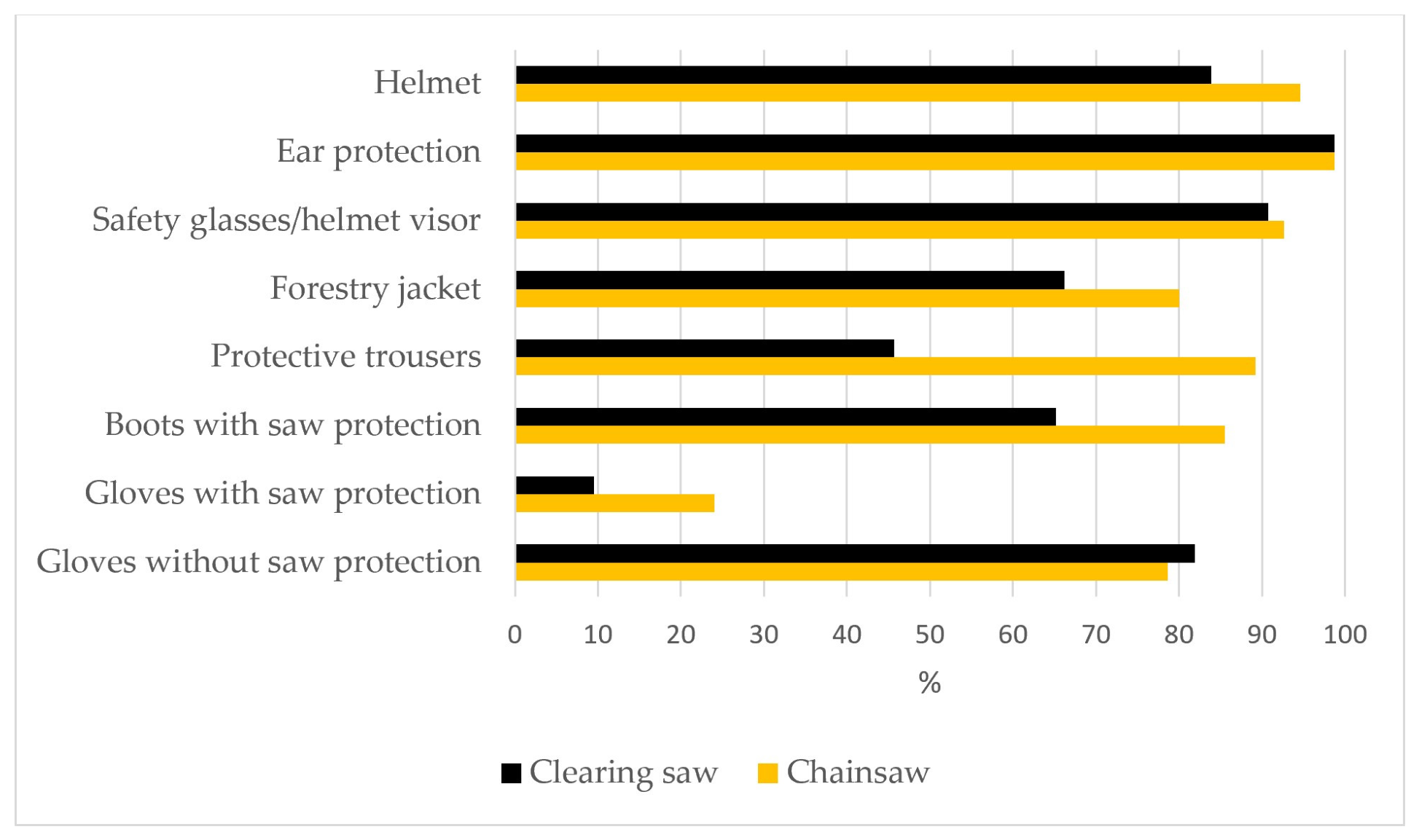
Figure 1. Proportion of respondents who always use a certain type of personal protective equipment when working with a chainsaw or a clearing saw.
Forests 17 01100 g001
Figure 2. Percentage of respondents who used a certain type of equipment to fell trees.
Forests 17 01100 g002
Figure 3. Percentage of respondents who used a certain type of equipment for transporting timber.
Forests 17 01100 g003
Figure 4. Percentage of respondents who used a certain type of vehicle in forestry.
Forests 17 01100 g004
Table 1. Respondents’ average age, duration of ownership, property size, number of working days per year and distance to the property where most forestry work has been carried out in recent years. The median and the 25th and 75th percentiles are given to show the distribution of respondents.
CharacteristicMeanSD25th PercentileMedian75th Percentile
Age (years)64.512.357.565.073.0
Duration of ownership (years)28.615.115.030.040.0
Size of forest property (hectares)171.7324.436.576.0182.0
Distance to the forest where most work has been done in recent years (kilometers)55.5170.31.03.023.5
Working days per year31.438.410.020.035.0
Table 2. Respondents’ average responses to statements about safety on a scale of 1–7, where 7 indicates that they agree and 1 indicates that they disagree. Significant differences between male and female respondents in bold (p < 0.05).
StatementsMalesFemalesAll
MeanSDMeanSDMeanSD
Self-employed forestry work is more dangerous than other practical outdoor work.5.21.55.61.55.31.5
During a work shift in the forest, it is common for “close call” incidents to occur that under other circumstances could have led to injuries.3.21.54.51.83.31.6
As long as I pay attention to what I’m doing, I won’t get hurt while doing self-employed forestry work.4.71.64.01.84.61.6
There is not much that can be done to make self-employed forestry work safer.3.11.62.61.73.11.7
I am confident that I know the risks of self-employed forestry work and how to protect myself in the forest.5.21.44.41.95.11.5
I get a sense of pride from doing work that I know is dangerous.2.51.62.21.62.51.6
To get the job done, I sometimes need to take risks that jeopardize my safety.2.51.52.01.72.51.6
Sometimes it is necessary to take shortcuts.2.51.51.71.32.41.5
Sometimes it is necessary to deviate from safety regulations in favor of higher work productivity.2.11.41.61.22.01.4
Working in bad weather (rain, snow, strong wind, cold or heat) means an increased risk of injury for me.5.91.46.01.45.91.4
Working too quickly is common in self-employed forestry work and this poses a clear risk of injury.5.41.75.71.75.51.7
Injuries are a natural part of forestry work and this is something that must be accepted if you are going to be a self-employed forest owner.2.11.51.51.02.01.5
When a self-employed forest owner is injured, it is usually their own fault.5.11.54.11.85.01.6
Having good training is important for safety in self-employed forestry.5.81.46.41.05.81.4
Using tools and machinery that are in good condition is important for staying safe when doing self-employed forestry.6.40.96.60.86.50.9
Using the right safety devices and personal protective equipment is important to stay safe when doing self-employed forestry.6.40.96.80.66.50.9
I have a good knowledge of the rules and safety regulations regarding self-employed forestry work.5.11.64.81.75.01.6
Table 3. Pattern and structure matrix for principal component analysis (PCA) with Oblimin rotation of a three-factor solution of items that measured attitudes towards risk. Only items with a loading of at least 0.4 on at least one component were included in the composite dimension scores. Items that loaded above 0.4 on more than one component were assigned to the component where the loading was highest. Bold indicates which component each item was assigned to.
ItemPattern CoefficientsStructure CoefficientsCommunalities
Risk AcceptanceRisk AwarenessSafety ProficiencyRisk AcceptanceRisk AwarenessSafety Proficiency
To get the job done, I sometimes need to take risks that jeopardize my safety.0.800.14−0.140.800.12−0.150.67
Sometimes it is necessary to take shortcuts.0.780.01−0.100.790.00−0.110.63
Sometimes it is necessary to deviate from safety regulations in favor of higher work productivity.0.780.03−0.100.780.01−0.110.61
I get a sense of pride from doing work that I know is dangerous.0.640.020.180.630.010.170.43
Injuries are a natural part of forestry work and this is something that must be accepted if you are going to be a self-employed forest owner.0.58−0.020.060.58−0.030.040.34
There is not much that can be done to make self-employed forestry work safer.0.35−0.350.080.35−0.350.060.25
Working in bad weather (rain, snow, strong wind, cold or heat) means an increased risk of injury for me.−0.050.61−0.02−0.060.610.010.37
During a work shift in the forest, it is common for “close call” incidents to occur that under other circumstances could have led to injuries.0.310.57−0.290.310.56−0.270.49
Self-employed forestry work is more dangerous than other practical outdoor work.0.080.56−0.030.070.56−0.010.32
Working too quickly is common in self-employed forestry work and this poses a clear risk of injury.0.130.56−0.020.120.560.000.33
Having good training is important for safety in self-employed forestry−0.160.530.46−0.180.550.490.54
I have a good knowledge of the rules and safety regulations regarding self-employed forestry work.−0.050.080.71−0.070.110.720.52
I am confident that I know the risks of self-employed forestry work and how to protect myself in the forest.0.09−0.250.660.08−0.230.650.49
Using the right safety devices and personal protective equipment is important to stay safe when doing self-employed forestry.−0.160.520.57−0.180.550.590.65
Using tools and machinery that are in good condition is important for staying safe when doing self-employed forestry.−0.120.540.54−0.140.570.570.63
As long as I pay attention to what I’m doing, I won’t get hurt while doing self-employed forestry work.0.06−0.310.510.06−0.290.500.35
When a self-employed forest owner is injured, it is usually their own fault.0.190.070.190.180.080.190.08
Table 4. Respondents’ average age, distance to forest and number of working days per year according to whether they have a chainsaw license or not.
VariableHave Chainsaw LicenseHave No Chainsaw Licensep-Value
MeanSDMedianMeanSDMedian
Age (years)62.712.364.065.812.267.00.010
Distance to the forest where most of the work has been done in recent years (kilometers)24.096.62.077.6205.25.0<0.001
Number of days of forestry work per year37.740.925.027.536.415.00.009
Table 5. Proportion of respondents by number of units and type of equipment they had for forestry, the average number of units respondents had, and the average age of their equipment.
EquipmentPercentage of Respondents by Number of Units and Equipment TypeMean Number of UnitsSDMean AgeSD
01234≥5
Petrol-powered clearing saw7.440.239.310.21.71.21.60.98.16.1
Petrol-powered chainsaw, ≤40 cm336.032.223.46.41.40.51.11.06.16.1
Petrol-powered chainsaw, >40 cm334.029.722.211.02.40.61.21.27.66.0
Electric chainsaw76.621.11.70.7000.30.54.14.0
Electric clearing saw87.311.51.20000.10.42.71.7
Cars/light truck 44.644.28.82.10.200.70.710.16.4
Farm tractor31.546.116.73.60.71.41.01.126.416.4
ATV (4- or 6-wheeler)48.045.85.80.20.200.60.69.56.4
Snowmobile77.016.84.61.20.500.30.614.28.7
Harvester97.12.60.2000<0.10.218.414.9
Forwarder, ≤4 tonnes95.05.000000.10.212.06.9
Forwarder, >4 tonnes92.36.90.50.2000.10.326.815.1
Mini-skidder96.43.60000<0.10.223.414.1
Log trailer or cart without grapple loader72.223.73.80.2000.30.622.616.4
Log trailer with grapple loader54.443.91.70000.50.516.710.8
Disclaimer/Publisher’s Note: The statements, opinions and data contained in all publications are solely those of the individual author(s) and contributor(s) and not of MDPI and/or the editor(s). MDPI and/or the editor(s) disclaim responsibility for any injury to people or property resulting from any ideas, methods, instructions or products referred to in the content.