Determinants of Local Communities’ Willingness to Engage in the Non-Timber Forest Products Industry near Nature Reserves: Evidence from China


Abstract
1. Introduction
- (1)
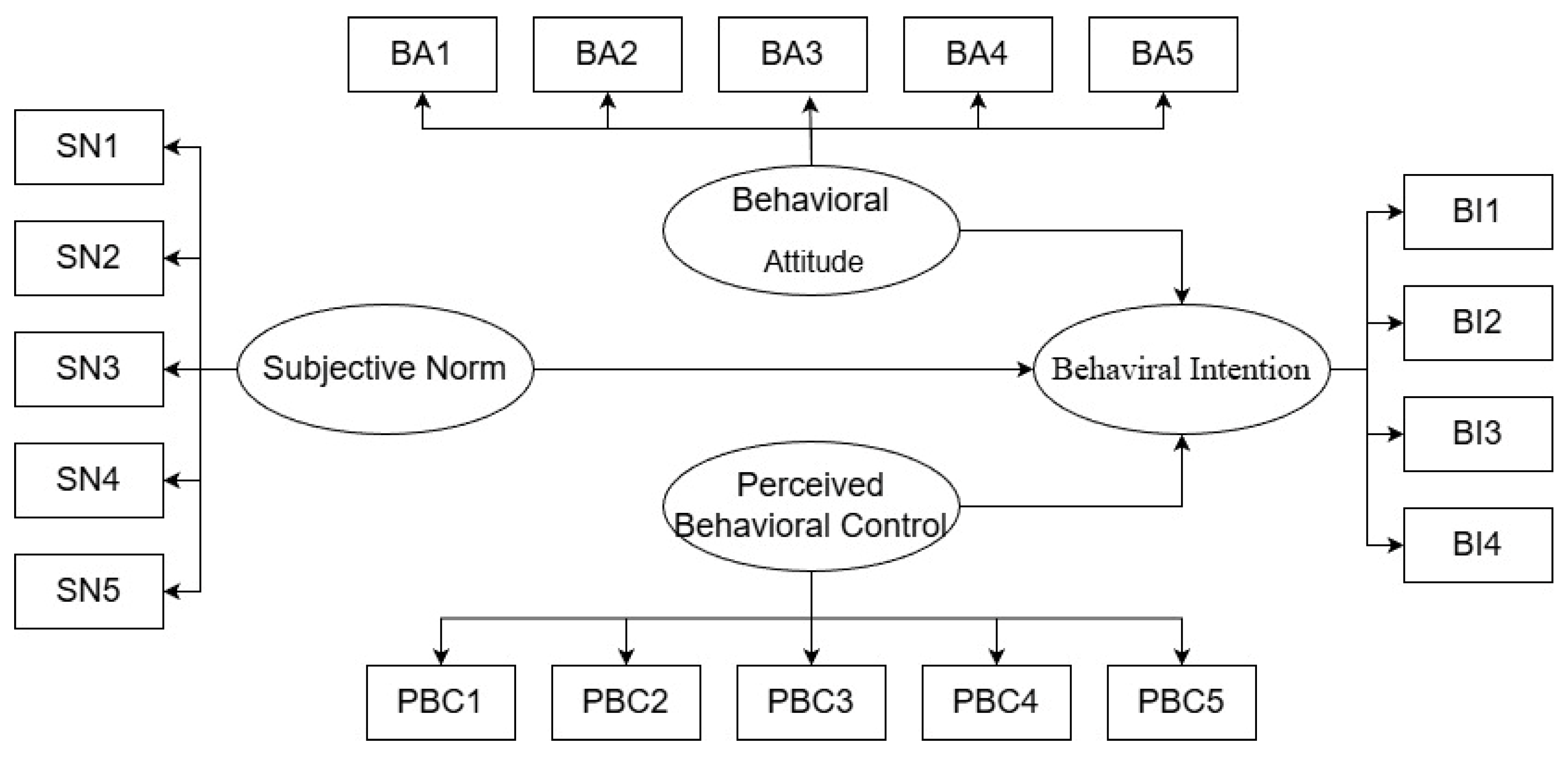
- At the theoretical level, this study introduces the Theory of Planned Behavior (TPB). It aims to clarify the key psychological antecedents of farmers’ willingness to participate in the NTFPs industry.
- (2)
- At the empirical level, this study uses the structural equation model (SEM). The model quantifies the effect size and path differences of each influencing factor. It also clarifies their relative importance.
- (3)
- At the practical level, based on the research findings, this study will provide scientific support. This support is intended for the precise design of community co-management policies in the protected area.
2. Materials and Methods
2.1. Study Area
2.2. Data Sources and Sampling Method
2.3. Theoretical Foundation
2.3.1. Theory of Planned Behavior
2.3.2. Application of the TPB in the Study of Farmers’ Behaviors
2.3.3. Proof of the Applicability of the Theoretical Model
2.4. Research Hypotheses
2.4.1. Behavioral Attitude (BA)
2.4.2. Subjective Norm (SN)
2.4.3. Perceived Behavioral Control (PBC)
2.5. Scale Design
3. Results
3.1. Sample Description
3.2. Reliability and Validity Test
3.3. Empirical Results and Analysis
3.3.1. Model Fit
3.3.2. Convergent Validity and Composite Reliability
3.3.3. Discriminant Validity
3.3.4. Path Analysis and Hypothesis Testing
4. Discussion
5. Conclusions
6. Recommendations
6.1. Strengthen the External Support System and Establish a Channel for Transforming Behavioral Attitude into Participation Intentions
6.2. Make Good Use of Social Network Resources to Maximize the Release of Positive Driving Forces of Subjective Norm
6.3. Precisely Enhance Perceptual Behavioral Control and Consolidate the Internal Driving Force for Farmers’ Participation
Author Contributions
Funding
Institutional Review Board Statement
Informed Consent Statement
Data Availability Statement
Acknowledgments
Conflicts of Interest
Abbreviations
| NTFPs | Non-timber Forest Products |
| TPB | Theory of Planned Behavior |
| SEM | Structural Equation Model |
| BA | Behavioral Attitude |
| SN | Subjective Norm |
| PBC | Perceived Behavioral Control |
Appendix A

References
- Guo, X.; Huang, Z.; Bai, Y.; Lian, Y.; Yang, W.; Lu, X.; Shi, W.; Wu, N.; Turi, M. The cooperative development relationship between Nature Reserves and local communities. Integr. Conserv. 2024, 2, 187–200. [Google Scholar]
- Wang, C.; Li, A. Analysis of perceptions of community co-management by households in the surrounding communities of protected areas: Empirical study of Xishuangbanna National Nature Reserves in China. Land 2025, 14, 1181. [Google Scholar] [CrossRef]
- Wang, C.; Zhang, W.; Gao, Y.; Sun, J. The impact of geographical location of households’ residences on the livelihoods of households surrounding protected areas: An empirical analysis of seven nature reserves across three provinces in China. Land 2025, 14, 1231. [Google Scholar] [CrossRef]
- Song, W.; Li, G.; Han, X. Analysis of the conflict between ecological protection in nature reserves and farmers’ development intentions: Based on the survey data of 660 farmers around national nature reserves in Shaanxi Province. China Popul. Resour. Environ. 2015, 25, 139–149. [Google Scholar]
- Wang, Z.; Wang, M. Evolution analysis of environmentally friendly agricultural industrial organization model around nature reserves: Taking the Juyan Reserve as an example. Ecol. Econ. 2016, 32, 192–197. [Google Scholar]
- Canavire-Bacarreza, G. Estimating the impacts of Bolivia’s protected areas on poverty. World Dev. 2013, 41, 265–285. [Google Scholar]
- Wu, W.; Liu, Q.; Liu, Z.; Tian, L.; Li, Q. Analysis of the main factors affecting farmers’ attitudes towards the construction of nature reserves in surrounding communities. J. Zhejiang A&F Univ. 2014, 31, 97–104. [Google Scholar]
- Shoo, A.R.; Songorwa, N.A. Contribution of eco-tourism to nature conservation and improvement of livelihoods around Amani nature reserve, Tanzania. J. Ecotourism 2013, 12, 75–89. [Google Scholar]
- Duan, W.; Zhao, Z.; Ma, B.; Wen, Y. Analysis of farmers’ perceptions of ecological protection benefits and losses around protected areas. Resour. Sci. 2015, 37, 2471–2479. [Google Scholar]
- Wang, C. What have China’s nature reserves given to surrounding communities?—Based on the survey data of farmers in Shaanxi, Sichuan and Gansu provinces from 1998 to 2014. J. Manag. World 2017, 3, 63–75. [Google Scholar]
- Li, J. Forest understory economy: Letting people get rich without cutting trees. Qiushi 2015, 7, 40–41. [Google Scholar]
- Wang, B.; Dou, Y.; Chen, X.; Li, Y. Research on the high-quality development path of forest understory economy in Yunnan Province based on efficiency measurement. J. West China For. Sci. 2025, 54, 135–142. [Google Scholar]
- Piras, F.; Santoro, A. Land use changes in globally important cultural forests: The case of two traditionally managed forests for non-wood forest products (NWFPs) in China and Japan. Biodivers. Conserv. 2023, 34, 3281–3303. [Google Scholar] [CrossRef]
- Peerzada, I.A.; Islam, M.A.; Chamberlain, J.; Dhyani, S.; Reddy, M.; Saha, S. Potential of NTFP based bioeconomy in livelihood security and income inequality mitigation in Kashmir Himalayas. Sustainability 2022, 14, 2281. [Google Scholar] [CrossRef]
- Kujur, D.; Dutta, J.; Ranga, M.M. Non Wood Forest Products for Rural Livelihood and Sustainable Forestry with Special Reference to Chhattisgarh, India. J. Environ. Sociobiol. 2019, 16, 231–237. [Google Scholar]
- Karthick, V.; Revathi, R.; Balaji, P. Value chain analysis of non-wood forest products. Int. J. Agric. Sci. 2020, 12, 9621–9626. [Google Scholar]
- Dou, Y.; Zhao, L.; Wang, Y.; Wang, J.; Chen, Y. Forest understory economy: Conceptual analysis and evolution of its core meaning. World For. Res. 2024, 37, 1–7. [Google Scholar]
- Wu, W.; Xu, H.; Wang, F.; Xiong, L. Effective carrier and practice of the “Two Mountains” concept: Economic effects, environmental effects and synergistic logic of forest understory economy. Chin. Rural Econ. 2023, 10, 158–174. [Google Scholar]
- Chen, X. The origin, development and outlook of forest understory economics. J. Nanjing For. Univ. Nat. Sci. Ed. 2022, 46, 105–114. [Google Scholar]
- Yang, Q.; Li, X. Research progress of the forest understory crop Polygonatum. J. Guizhou Norm. Univ. Nat. Sci. 2024, 42, 1–34. [Google Scholar]
- Chen, X.; Dou, Y. High-quality development of forest understory economy: Strategic essentials, technological breakthroughs and key measures. Sci. Silvae Sin. 2025, 61, 59–71. [Google Scholar]
- Li, J.; Guo, L.; Wang, Z.; Hong, Z.; Li, H. Analysis of the sustainable development of forest understory economy based on energy value method: A case study of forest understory planting. Ecol. Econ. 2022, 38, 131–136. [Google Scholar]
- Yamane, T. Statistics: An Introductory Analysis, 2nd ed; Harper and Row: New York, NY, USA, 1967. [Google Scholar]
- Fishbein, M. An investigation of the relationships between beliefs about an object and the attitude toward that object. Hum. Relat. 1963, 16, 233–239. [Google Scholar] [CrossRef]
- Ajzen, I. From intentions to actions: A theory of planned behavior. In Action-Control: From Cognition to Behavio; Springer: Berlin/Heidelberg, Germany, 1985. [Google Scholar]
- Shi, H.; Wang, Z.; Yan, L. The impact of ecological cognition on farmers‘ forest restoration and afforestation behaviors: Based on the theory of planned behavior and multi-group structural equation model. China Land Sci. 2019, 33, 42–49. [Google Scholar]
- Taylor, S.; Todd, P.A. Understanding information technology usage: A test of competing models. Inf. Syst. Res. 1995, 6, 144–176. [Google Scholar] [CrossRef]
- Wang, H.; Qiao, J.; Li, B. The willingness of farmers to participate in the construction of standardized livestock farms and its influencing factors: Based on the survey data of pig farmers in four provinces (municipalities). China Rural Surv. 2019, 4, 111–127. [Google Scholar] [CrossRef] [PubMed]
- Cao, J.; Sun, H.; Ding, M. How to motivate residents’ behavioral intention to engage in household waste sorting? An integrated perspective based on the technology acceptance model and the theory of planned behavior. Front. Psychol. 2026, 17, 1817955. [Google Scholar] [CrossRef] [PubMed]
- Alwedyan, S.; Sarayrah, H.; AbuAwad, R. The role of personal moral obligation and policy and social propaganda on the pro-environmental intentions and behaviors of Jordanian households: An extension of the theory of planned behavior. Energy Effic. 2025, 18, 110. [Google Scholar] [CrossRef]
- Bibi, G.; Hashmi, H.; Nauman, S.; Abbass, K.; Song, H. Perspective of the theory of planned behavior and self-determination theory on sustainable hospitality: How green human resource management influences pro-environmental behavior via employee perceptions and motivation. J. Environ. Manag. 2025, 396, 127889. [Google Scholar] [CrossRef] [PubMed]
- Zhao, W.; Peng, P.; Liu, H.; Wang, S.; Liu, W. How job satisfaction affects professionalization behavior of new-generation construction workers: A model based on theory of planned behavior. Eng. Constr. Archit. Manag. 2025, 32, 2672–2696. [Google Scholar]
- Khor, T.E.; Chan, L.; Seow, P. Students’ Use and Perception of Educational GenAI Chatbot in High School Computing: Insights from the Decomposed Theory of Planned Behavior. Educ. Sci. 2025, 15, 1569. [Google Scholar] [CrossRef]
- Jia, Q.; Hernández, M.C.; Martínez, P.J. Mapping the Integration of Theory of Planned Behavior and Self-Determination Theory in Education: A Scoping Review on Teachers’ Behavioral Intentions. Educ. Sci. 2025, 15, 1529. [Google Scholar] [CrossRef]
- Fan, H.; Li, J.; Wu, Y.; Li, M.; Zhao, L. Research on the influencing mechanism of farmers’ willingness to convert farmland from grain production to non-grain production based on the theory of planned behavior: A case study of Henan Province. Chin. J. Agric. Resour. Reg. Plan. 2025, 46, 172–182. [Google Scholar]
- Song, Y.; Yang, Y.; Wang, J.; Ke, X. Influencing factors of farmers‘ decision-making on “non-grain conversion” of farmland based on the theory of planned behavior. J. China Agric. Univ. 2023, 28, 247–259. [Google Scholar]
- Chen, Q. Analyzing Farmers’ Cultivated-Land-Abandonment Behavior: Integrating the Theory of Planned Behavior and a Structural Equation Model. Land 2022, 11, 1777. [Google Scholar] [CrossRef]
- Zhang, T.; Li, J.; Wang, Y. Effects of Livelihood Capital on the Farmers’ Behavioral Intention of Rural Residential Land Development Right Transfer: Evidence from Wujin District, Changzhou City, China. Land 2023, 12, 1207. [Google Scholar] [CrossRef]
- Adenuga, A.H.; Jack, C.; McCarry, R. Behavioural drivers of long-term land leasing adoption: Application of an extended theory of planned behaviour. Environ. Dev. Sustain. 2024, 27, 16819–16839. [Google Scholar] [CrossRef]
- Paparella, A.; Perrin, J.; Williams, J.; Wenzel, B.; Borrello, M.; Kehlenbeck, H.; Winkler, J.; Cembalo, L.; Cook, S.; Ninkovic, V.; et al. Better safe than sorry? European farmers’ perceptions on agroecological practices: A theory of planned behaviour case study. Front. Agron. 2026, 8, 1713813. [Google Scholar] [CrossRef]
- Uikey, A.; Mishra, D.; Marak, Z.; Saraswat, P. Pesticide knowledge and farmers’ safety behaviours: Insights from the theory of planned behaviour. Sustain. Futures 2025, 10, 101079. [Google Scholar] [CrossRef]
- Swallow, N.; Barkemeyer, R. Examining farmers’ motivations to engage in low-carbon agricultural practices: A study of New Zealand dairy farmers. J. Rural Stud. 2024, 111, 103440. [Google Scholar] [CrossRef]
- Larvoe, N.; Mustapa, C.A.M.; Herralde, D.F.; Kallas, Z. Predicting EU orchard farmers’ adoption intentions for pesticide-reducing innovations using an extended theory of planned behavior. Crop Prot. 2026, 200, 107460. [Google Scholar] [CrossRef]
- Liu, T.; Du, L.; Hou, J.; Zeng, X.; Zhang, W.; Xu, H. The influences of China’s cultivated land fertility protection subsidy policy on farmers’ agro-eco-environmental protection behavior: An application of the extended theory of planned behavior. J. Environ. Manag. 2025, 394, 127219. [Google Scholar] [CrossRef] [PubMed]
- Kamali, F.; Kerachian, R.; Nikoo, R.M. Extending the theory of planned behavior for conserving agricultural land use in suburban areas. Environ. Dev. 2025, 56, 101265. [Google Scholar] [CrossRef]
- Ali, S.; Nawaz, M.; Ali, J.; Cong, L. The role of conservation commitment: Extending the theory of planned behavior for visitors in the high-altitude protected area of Deosai National Park, Pakistan. Front. For. Glob. Change 2026, 9, 1770186. [Google Scholar] [CrossRef]
- Zhang, Q.; Liu, J.; Pi, Z.; Zhu, D.; Zhang, C. Research on the influence mechanism of community farmers’ willingness to participate in nature reserve management behavior: Taking Yunnan Jiaozishan National Nature Reserve as an example. Temp. For. Res. 2026, 9, 58–66. [Google Scholar]
- Liu, Z.; Xu, B.; Ning, Y. Can ecological compensation enhance farmers‘ awareness of protecting the environment? A study based on survey data from three national nature reserves in Yunnan and Hunan provinces. Nat. Prot. Areas 2024, 4, 53–73. [Google Scholar]
- Cheng, Y.; Zeng, W.Z.; Hu, Y. Analysis of Influencing Factors of Farmers’ Willingness to Participate in Under-Forest Economy Based on the Theory of Planned Behavior. Rural Econ. 2021, 11, 62–69. [Google Scholar]
- Pabba, A.; Ponnusamy, K.; Sankhala, G.; Niranjan, D. Modeling the behavioural intentions of farmers towards active participation in Farmer Producer Companies (FPCs): An extended Theory of Planned Behaviour. Humanit. Soc. Sci. Commun. 2026, 13, 384. [Google Scholar] [CrossRef]
- Etongo, D.; Labrosse, J.; Serret, L.; Sinon, S. Using the theory of planned behavior to assess Seychellois farmers’ intentions to adopt agroforestry. Land Use Policy 2026, 164, 107943. [Google Scholar] [CrossRef]
- Hou, B.; Ying, R. Research on decisions of dispersed farmers on low-carbon production behaviors: An empirical analysis based on TPB and SEM. J. Agrotech. Econ. 2015, 2, 4–13. [Google Scholar]
- Zhao, X.; Jiang, W.; Cheng, W. Research on the willingness of rural residents to participate in environmental governance based on the theory of planned behavior: A case study of Xinjiang. J. Ecol. Rural Environ. 2021, 37, 439–447. [Google Scholar]
- Gan, C.; Tan, Y.; Chen, L.; Chen, Y.; Ren, L. The impact of farmers’ cognition on their willingness to transfer farmland based on the TPB framework. China Popul. Resour. Environ. 2018, 28, 152–159. [Google Scholar]
- Zhang, H.; Tian, M.F. Application of Reliability Analysis in Questionnaire Design. Stat. Decis. 2007, 21, 25–27. [Google Scholar]
- Chai, H. Researches on Reliability and Validity of Inspection Procedure in Questionnaire Design. World Sci. Technol. Res. Dev. 2010, 32, 548–550. [Google Scholar]
- Liu, J.; Zou, Y.J.; Liu, Z.X. Analysis of Influencing Factors of Consumers’ Purchase Intention in E-commerce Live Streaming Based on SEM Model. Stat. Decis. 2021, 37, 94–97. [Google Scholar]
- Wang, C.; Wang, D.; Zhao, X. The Comparision of Goodness Index of Structural Equation Model. Mod. Prev. Med. 2010, 37, 7–9. [Google Scholar]
- Hair, J.F. Multivariate Data Analysis, 7th ed.; Pearson: Harlow, UK, 2009. [Google Scholar]
- Bagozzi, R.P.; Yi, Y. On the evaluation of structural equation models. J. Acad. Mark. Sci. 1988, 16, 74–94. [Google Scholar] [CrossRef]
- Rong, T.S. AMOS and Research Methods; Chongqing University Press: Chongqing, China, 2009. [Google Scholar]
- Fornell, C.; Larcker, D.F. Evaluating structural equation models with unobservable variables and measurement error. J. Mark. Res. 1981, 18, 39–50. [Google Scholar] [CrossRef]
- Rafiee, Z.; Breen, J.; Kilcline, K.; Mohammadrezaei, M. Factors affecting farmers’ intentions to adopt of small-scale afforestation measures in Ireland: An application of the theory of planned behaviour. For. Policy Econ. 2025, 178, 103577. [Google Scholar] [CrossRef]
- Abe, T.; Tsunekawa, A.; Haregeweyn, N.; Tsubo, M.; Fenta, A.; Nigussie, Z.; Tadesse, N.; Kassa, S.; Terefe, Z.; Wodaju, A. Interpersonal information drives intentional change in smallholder farmers’ adoption of sustainable land management technologies. J. Environ. Manag. 2025, 393, 127230. [Google Scholar] [CrossRef] [PubMed]
- Mohammad, B.; Matin, M.; Mehdi, G. Analysis of factors influencing farmers’ sustainable environmental behavior in agriculture activities: Integration of the planned behavior and the protection motivation theories. Environ. Dev. Sustain. 2022, 25, 9903–9934. [Google Scholar] [CrossRef]

| Variable Type | Latent Variable | Observational Variable | Coding | Assignment |
|---|---|---|---|---|
| Independent Variable | Behavioral Attitude | Developing the NTFPs industry is an effective way to increase your family’s income. | BA1 | 1 = Strongly Disagree 2 = Disagree 3 = Neutral 4 = Agree 5 = Strongly Agree |
| Developing the NTFPs industry is beneficial for protecting the ecological environment of Yunling Provincial Nature Reserve. | BA2 | |||
| Developing the NTFPs industry can bring more development opportunities to our village. | BA3 | |||
| After participating in the NTFPs industry, your family’s income will increase significantly in the next two years. | BA4 | |||
| You think that developing the NTFPs industry is a good thing with more advantages than disadvantages. | BA5 | |||
| Subjective Norm | Your family supports you in participating in the NTFPs industry. | SN1 | ||
| Most of your relatives and friends agree with your participation in the NTFPs industry. | SN2 | |||
| You can feel the encouragement from the government/protected area administration for villagers to participate in the NTFPs industry. | SN3 | |||
| There are people in the village or nearby who have made money through the NTFPs industry. You also want to give it a try. | SN4 | |||
| The village officials or government departments believe that villagers should participate in the NTFPs industry. | SN5 | |||
| Perceived Behavioral Control | Without the help of others, you can also do well in the NTFPs industry by yourself. | PBC1 | ||
| The current forest reform policies guarantee your right to develop the NTFPs industry. | PBC2 | |||
| You are clear about what can and cannot be done near Yunling Provincial Nature Reserve. | PBC3 | |||
| For you, there is no problem in selling the produce, and there is a place to collect it. | PBC4 | |||
| The risks of the NTFPs industry are ones that you can bear and handle. | PBC5 | |||
| Dependent Variable | Behavioral Intention | You are willing to try participating in the NTFPs industry within the next year. | BI1 | |
| You are willing to invest the necessary time, funds and effort in developing the NTFPs industry. | BI2 | |||
| You are willing to participate in the technical training related to the NTFPs industry. | BI3 | |||
| You are willing to recommend participating in the NTFPs industry to your relatives and friends. | BI4 |
| Indicator | Option | Frequency/Count | Frequency/% | Indicator | Option | Frequency/Count | Frequency/% |
|---|---|---|---|---|---|---|---|
| Gender | Male | 216 | 59.8 | Ethnicity | Bai ethnic group | 147 | 40.7 |
| Female | 145 | 40.2 | Pumi ethnic group | 29 | 8 | ||
| Age Group | 18–30 | 12 | 3.3 | Yi ethnic group | 33 | 9.1 | |
| 31–40 | 72 | 19.9 | Lisu ethnic group | 134 | 37.1 | ||
| 41–50 | 140 | 38.8 | Han ethnicity | 13 | 3.6 | ||
| 51–60 | 111 | 30.7 | Others | 5 | 1.4 | ||
| >60 | 26 | 7.2 | Labor Force (Person) | 1 | 87 | 24.1 | |
| Total Income (in ten thousand yuan) | <2 | 238 | 65.9 | 2 | 169 | 46.8 | |
| 2–4 | 103 | 28.5 | 3 | 57 | 15.8 | ||
| 4–6 | 16 | 4.4 | 4 | 40 | 11.1 | ||
| 6–8 | 2 | 0.6 | >5 | 8 | 2.2 | ||
| >8 | 2 | 0.6 | Health Situation | Unable to engage in labor | 25 | 6.9 | |
| Educational Level | Primary School and Below | 218 | 60.4 | Can only participate in light labor | 71 | 19.7 | |
| Junior High School | 122 | 33.8 | Can participate in regular labor | 167 | 46.3 | ||
| High School/Vocational School | 17 | 4.7 | Can participate in moderate labor | 80 | 22.2 | ||
| Associate Degree/Bachelor’s Degree | 4 | 1.1 | Labor capacity is unrestricted | 18 | 5 |
| Latent Variable | Coding | N | Mean | Std. Deviation |
|---|---|---|---|---|
| Behavioral Attitude | BA1 | 361 | 3.34 | 1.187 |
| BA2 | 361 | 3.04 | 0.971 | |
| BA3 | 361 | 2.93 | 0.946 | |
| BA4 | 361 | 3.04 | 0.971 | |
| BA5 | 361 | 3.04 | 0.971 | |
| Subjective Norm | SN1 | 361 | 3.54 | 1.227 |
| SN2 | 361 | 2.95 | 0.997 | |
| SN3 | 361 | 3.02 | 0.960 | |
| SN4 | 361 | 3.01 | 0.992 | |
| SN5 | 361 | 3.01 | 0.996 | |
| Perceived Behavioral Control | PBC1 | 361 | 3.17 | 1.250 |
| PBC2 | 361 | 2.87 | 1.015 | |
| PBC3 | 361 | 2.78 | 0.997 | |
| PBC4 | 361 | 2.83 | 1.006 | |
| PBC5 | 361 | 2.75 | 0.963 | |
| Behavioral Intention | BI1 | 361 | 3.27 | 1.178 |
| BI2 | 361 | 2.89 | 1.006 | |
| BI3 | 361 | 2.94 | 0.970 | |
| BI4 | 361 | 2.96 | 0.939 |
| Latent Variable | Coding | KMO | CITC | Cronbach’s α | Totality |
|---|---|---|---|---|---|
| Behavioral Attitude | BA1 | 0.819 | 0.773 | 0.767 | 0.839 |
| BA2 | 0.624 | 0.811 | |||
| BA3 | 0.588 | 0.821 | |||
| BA4 | 0.618 | 0.813 | |||
| BA5 | 0.618 | 0.813 | |||
| Subjective Norm | SN1 | 0.795 | 0.831 | 0.729 | 0.830 |
| SN2 | 0.579 | 0.810 | |||
| SN3 | 0.608 | 0.802 | |||
| SN4 | 0.600 | 0.804 | |||
| SN5 | 0.538 | 0.821 | |||
| Perceived Behavioral Control | PBC1 | 0.805 | 0.806 | 0.738 | 0.830 |
| PBC2 | 0.668 | 0.785 | |||
| PBC3 | 0.567 | 0.812 | |||
| PBC4 | 0.556 | 0.815 | |||
| PBC5 | 0.557 | 0.815 | |||
| Behavioral Intention | BI1 | 0.774 | 0.787 | 0.718 | 0.828 |
| BI2 | 0.673 | 0.775 | |||
| BI3 | 0.608 | 0.804 | |||
| BI4 | 0.568 | 0.820 |
| Indicator | Reference Standard | Actual Fitted Value | Model Goodness of Fit |
|---|---|---|---|
| CMIN/DF | 1–3 is excellent, 3–5 is good | 1.423 | Satisfaction |
| RMSEA | <0.05 is excellent, <0.08 is good | 0.034 | Satisfaction |
| RMR | <0.05 is excellent, <0.08 is good | 0.043 | Satisfaction |
| IFI | >0.9 is excellent, >0.8 is good | 0.980 | Satisfaction |
| TLI | >0.9 is excellent, >0.8 is good | 0.977 | Satisfaction |
| CFI | >0.9 is excellent, 0.8–0.9 is acceptable | 0.980 | Satisfaction |
| GFI | >0.9 is excellent, 0.8–0.9 is acceptable | 0.942 | Satisfaction |
| AGFI | >0.9 is excellent, 0.8–0.9 is acceptable | 0.924 | Satisfaction |
| Latent Variable | Coding | Std. Est. | S.E. | p | SMC | CR | AVE |
|---|---|---|---|---|---|---|---|
| Behavioral Attitude | BA1 | 0.927 | 0.859 | 0.834 | 0.508 | ||
| BA2 | 0.677 | 0.042 | *** | 0.458 | |||
| BA3 | 0.584 | 0.045 | *** | 0.341 | |||
| BA4 | 0.662 | 0.043 | *** | 0.438 | |||
| BA5 | 0.667 | 0.043 | *** | 0.445 | |||
| Subjective Norm | SN1 | 0.978 | 0.956 | 0.834 | 0.512 | ||
| SN2 | 0.644 | 0.036 | *** | 0.415 | |||
| SN3 | 0.651 | 0.036 | *** | 0.424 | |||
| SN4 | 0.653 | 0.036 | *** | 0.426 | |||
| SN5 | 0.581 | 0.038 | *** | 0.338 | |||
| Perceived Behavioral Control | PBC1 | 0.965 | 0.931 | 0.829 | 0.501 | ||
| PBC2 | 0.676 | 0.04 | *** | 0.457 | |||
| PBC3 | 0.636 | 0.038 | *** | 0.404 | |||
| PBC4 | 0.585 | 0.04 | *** | 0.342 | |||
| PBC5 | 0.61 | 0.037 | *** | 0.372 | |||
| Behavioral Intention | BI1 | 0.973 | 0.947 | 0.827 | 0.553 | ||
| BI2 | 0.7 | 0.04 | *** | 0.490 | |||
| BI3 | 0.639 | 0.039 | *** | 0.408 | |||
| BI4 | 0.607 | 0.039 | *** | 0.368 |
| Latent Variable | AVE | Behavioral Attitude | Subjective Norm | Perceived Behavioral Control | Behavioral Intention |
|---|---|---|---|---|---|
| Behavioral Attitude | 0.508 | 0.713 | |||
| Subjective Norm | 0.512 | 0.562 | 0.715 | ||
| Perceived Behavioral Control | 0.501 | 0.370 | 0.578 | 0.708 | |
| Behavioral Intention | 0.553 | 0.438 | 0.653 | 0.567 | 0.744 |
| Hypothesis | Path Relationship | Std. Est | S.E. | p | Result | ||
|---|---|---|---|---|---|---|---|
| H1 | Behavioral Intention | ← | Behavioral Attitude | 0.085 | 0.056 | 0.112 | Not valid |
| H2 | Behavioral Intention | ← | Subjective Norm | 0.444 | 0.135 | *** | Valid |
| H3 | Behavioral Intention | ← | Perceived Behavioral Control | 0.279 | 0.110 | *** | Valid |
Disclaimer/Publisher’s Note: The statements, opinions and data contained in all publications are solely those of the individual author(s) and contributor(s) and not of MDPI and/or the editor(s). MDPI and/or the editor(s) disclaim responsibility for any injury to people or property resulting from any ideas, methods, instructions or products referred to in the content. |
© 2026 by the authors. Licensee MDPI, Basel, Switzerland. This article is an open access article distributed under the terms and conditions of the Creative Commons Attribution (CC BY) license.
Share and Cite
Duan, L.; Li, Y.; Cheng, J.; Liu, Y.; Gao, Y. Determinants of Local Communities’ Willingness to Engage in the Non-Timber Forest Products Industry near Nature Reserves: Evidence from China. Forests 2026, 17, 926. https://doi.org/10.3390/f17080926
Duan L, Li Y, Cheng J, Liu Y, Gao Y. Determinants of Local Communities’ Willingness to Engage in the Non-Timber Forest Products Industry near Nature Reserves: Evidence from China. Forests. 2026; 17(8):926. https://doi.org/10.3390/f17080926
Chicago/Turabian StyleDuan, Linxin, Ya Li, Jingjun Cheng, Yongqin Liu, and Yunxia Gao. 2026. "Determinants of Local Communities’ Willingness to Engage in the Non-Timber Forest Products Industry near Nature Reserves: Evidence from China" Forests 17, no. 8: 926. https://doi.org/10.3390/f17080926
APA StyleDuan, L., Li, Y., Cheng, J., Liu, Y., & Gao, Y. (2026). Determinants of Local Communities’ Willingness to Engage in the Non-Timber Forest Products Industry near Nature Reserves: Evidence from China. Forests, 17(8), 926. https://doi.org/10.3390/f17080926