Article

The Impact of Warming on Three Dominant Tree Species Along an Elevation Gradient on Mt. Yulong, Southwest China


1
Department of Economic Plants and Biotechnology, Yunnan Key Laboratory for Wild Plant Resources, Kunming Institute of Botany, Chinese Academy of Sciences, Kunming 650201, China
2
University of Chinese Academy of Sciences, Beijing 100049, China
*
Authors to whom correspondence should be addressed.
Forests 2026, 17(7), 736; https://doi.org/10.3390/f17070736
Submission received: 12 May 2026 / Revised: 13 June 2026 / Accepted: 23 June 2026 / Published: 24 June 2026
(This article belongs to the Section Forest Meteorology and Climate Change)

Abstract

Mountain forests are critical for carbon sequestration, yet the effects of rapid warming on tree growth and climate sensitivity across elevational gradients remain poorly understood. Here, we focus on the largest mountain coniferous forests in southwest China and collected tree-ring cores from three key afforestation tree species, Picea likiangensis, Abies georgei, and Pinus yunnanensis, from 2600 m a.s.l. to 4100 m a.s.l. in Lijiang. Basal area increment (BAI) and Pearson correlation analyses were employed to evaluate long-term productivity trends and constrain the factors limiting tree growth, respectively. Across all elevational belts, tree growth is primarily limited by low dry-season moisture availability, with the strength of this limitation varying across the three species. Abies georgei shows the strongest positive correlation between tree-ring width and Standardized Precipitation Evapotranspiration Index, followed by Picea likiangensis, while Pinus yunnanensis exhibits the weakest correlation. We further found that tree productivity began to decline at the beginning of the twenty-first century, with larger declines in higher-elevation fir and spruce species, albeit not statistically significant. Future warming and warm-induced drought may exert more pronounced adverse effects on these three species. These results provide reference data for the potential sustainable management of mountain forests in southwest China.

1. Introduction

Global climate change is dramatically altering the productivity of terrestrial forests, which can absorb atmospheric CO2 and sequester it in long-term woody biomass pools [1,2]. Thus, understanding how climate change affects forest productivity and carbon sequestration potential is crucial. However, mountain forest ecosystems are particularly vulnerable to ongoing warming and increasing interannual variability in precipitation [3]. Persistent growth declines under climate stress may risk critical transitions and tip the system into alternative states [4]. Thus, it is important to understand how mountain forest growth will respond to ongoing warming.
Mountain environments exhibit distinct elevational gradients in temperature and precipitation, with high elevations typically experiencing lower temperatures and higher precipitation, and the opposite pattern at low elevations [5,6]. Consequently, tree growth at low elevations is predominantly limited by moisture availability, whereas growth at high elevations is primarily constrained by temperature. The response patterns have been observed in studies conducted on the southeastern Tibetan Plateau [7,8], the Mediterranean [9], and the Rocky Mountains [10]. However, climate diversity tends to decrease at lower elevations and increase at higher elevations [11]. This asymmetry disrupts the growth-limiting patterns, resulting in diverse tree growth patterns across elevations worldwide. As for tree growth at low altitudes in the Crimean Mountains, weaker climatic responses were observed than in high-altitude stands [12]. In the Mt. Everest region, trees may be negatively affected by climate warming at middle and low elevations [13]. Notably, while such elevational divergences in growth–climate relationships under recent warming have been increasingly recognized, most existing studies have focused on temperate and boreal forests [14,15,16]. Tropical and sub-tropical regions (0–30° N) harbor approximately 25% of global vegetation carbon stocks [17,18]. However, comprehensive studies on how warming affects the growth trends of these forests remain scarce. Thus, there is a critical need to evaluate the growth trajectories and climate responses of these low-latitude mountain forests.
Species are the basic components of mountain forest ecosystems. Thus, assessing species-specific growth–climate is a critical prerequisite for fully understanding how forest ecosystems respond to ongoing global climate change. Existing research has documented that tree species exhibit divergent climate–growth patterns due to their varied physiological traits, including water-use efficiency, drought tolerance, and photosynthetic capacity [19,20,21]. In mountain regions, the physiological traits of tree species further vary with increasing elevation [22,23,24], which may generate intraspecific differentiation in climate–growth responses across elevation gradients [25,26]. Therefore, studying the responses of multiple tree species to climate change along elevation gradients is valuable for precise predictions of how mountain forests respond to ongoing climate change.
The Mountains of Southwest China are among the global biodiversity hotspots [27,28]. This region exhibits a prominent elevational range with a maximum vertical relief exceeding 6500 m [29,30], providing a natural experimental platform for assessing climate change impacts on tree growth along the elevation gradient [4]. Furthermore, as China’s second-largest natural forest region, the Southwest China Forest Region is a crucial national carbon sink [31,32]. Recent studies indicate that the mountains of Southwest China are undergoing rapid climate warming, accompanied by increased frequency and magnitude of drought events [33,34]. Notably, this warming trend is strongly elevation-dependent, with higher elevations experiencing greater temperature increases than lower elevations [34,35]. This may lead to more favorable growth conditions for tree species living at higher-elevation sites and increase their productivity but limit the growth of tree species living at lower-elevation sites [13,36,37,38]. Understanding tree growth responses to ongoing climate change throughout their entire elevation gradient is essential for biodiversity conservation and natural resource management.
A growing body of studies conducted in the mountains of Southwest China demonstrates that tree growth responses to climate conditions vary among species and site elevations [39,40,41,42]. Generally, trees growing at their lower distributional limits are more sensitive to precipitation, while those at their upper distributional limits are more sensitive to temperature [36,43,44]. However, some studies suggest that trees growing in temperature-limited regions may consistently benefit from warming, leading to increased tree growth, whereas trees growing in moisture-limited regions may be consistently limited by moisture conditions, even resulting in a significant decline in the growth trend [45,46]. Nevertheless, existing studies have largely focused on single tree species, with no systematic comparative analysis of multiple species across distinct elevational zones and their full elevational ranges in this critical region. This critical knowledge gap severely limits our ability to predict forest ecosystem dynamics under future climate change accurately.
Picea likiangensis, Abies georgei, and Pinus yunnanensis are three dominant tree species distributed across distinct elevational zones in the mountains of Southwest China [47]. They also serve as important timber species in the region and are major afforestation species. Previous studies have assessed the responses of the three dominant tree species to climate change separately across their elevation ranges. Still, conclusive evidence is lacking due to diverse growth trends and climate–growth patterns. For instance, Pinus yunnanensis growth is mainly limited by spring moisture availability at different elevations in Lijiang [48], but limited by spring moisture availability at low and high elevations and by spring temperature at middle elevations in Jinsha Valley [49]. The growth of Picea likiangensis is consistently limited by seasonal temperature in Baima [50] and the Shika Snow Mountains [51]. For Abies georgei, growth is consistently limited by summer temperatures along the elevation gradient in Baima and Shika Snow Mountains [7], but by winter temperatures at high-elevation sites and by low moisture availability at lower-elevation sites in the Haba Snow Mountain [52]. More importantly, no study has simultaneously analyzed how climate change affects their growth on the same mountain.
Here, we collected tree-ring cores of Picea likiangensis, Abies georgei, and Pinus yunnanensis from Yulong Snow Mountain in Yunnan, southwest China. We aim to (1) test dominant climate factors influencing the growth of trees; (2) identify the species-specific response to climate variables at elevation gradients; (3) determine the regulating effect of elevation on tree growth; (4) investigate the variability of climate–growth responses and the trend of tree radial growth with abrupt climate change among different species. In this paper, we aim to clarify the divergence in tree growth among species across elevation gradients and provide crucial information to guide strategies for climate adaptation of forest ecosystems.

2. Materials and Methods

2.1. Study Area

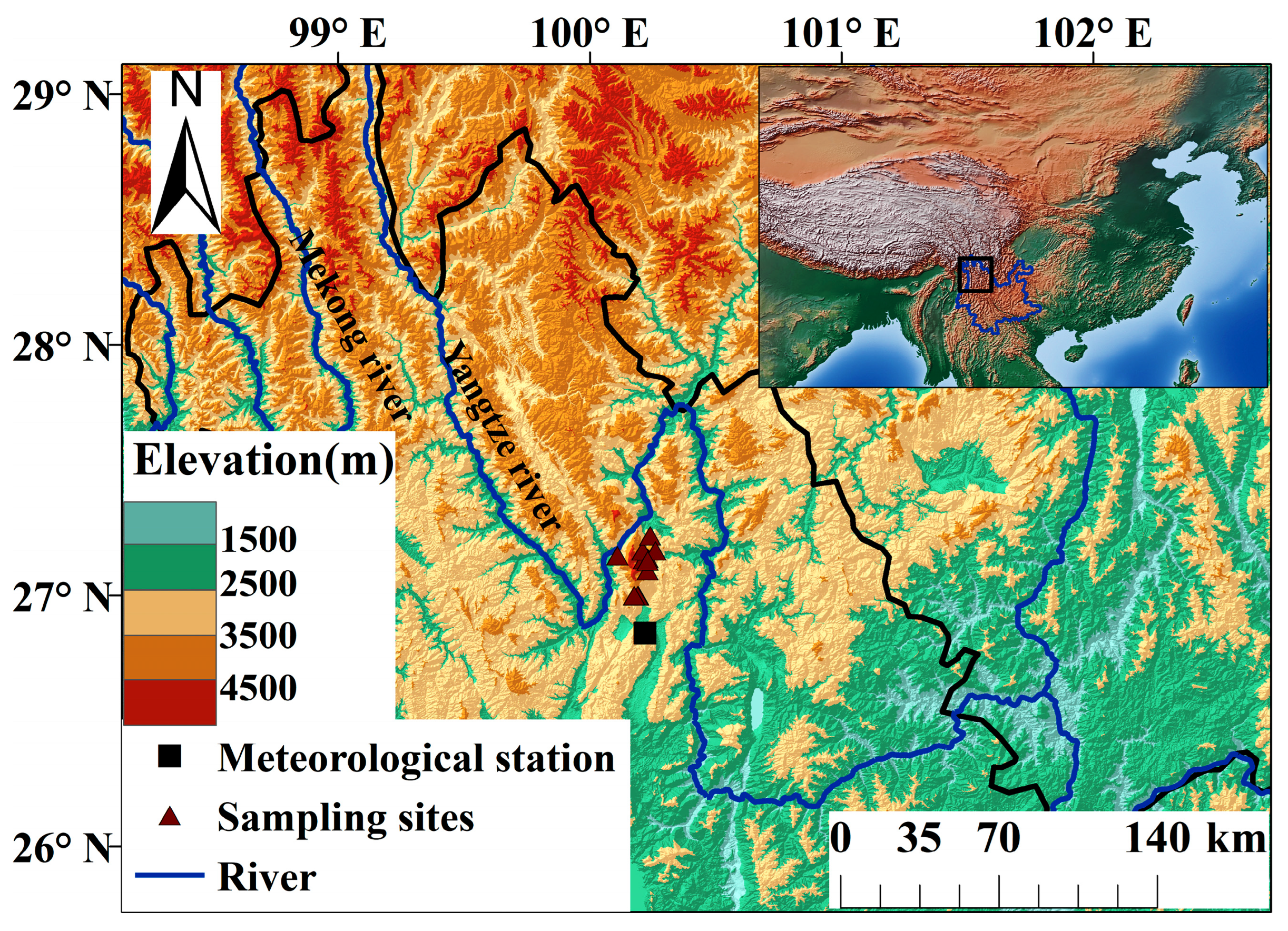
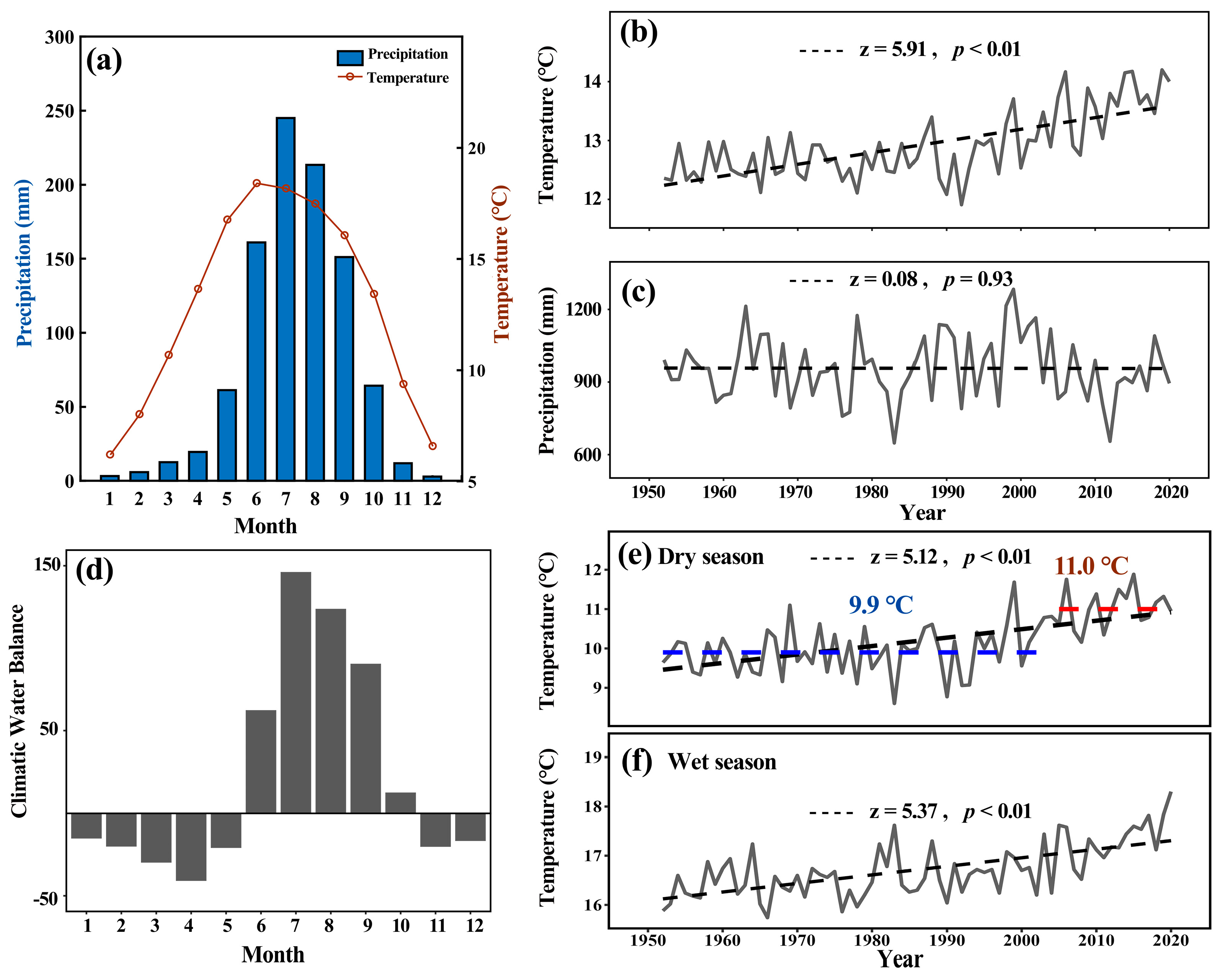
The sampling sites (red triangle in Figure 1) are located in the Yulong Snow Mountains in Yunnan, in the southern part of the Southwest China Mountains. The elevation of Mt. Yulong ranges from 1500 m a.s.l. at the lowest point (near the Jinsha River) to 5596 m a.s.l. at its summit. The climate of Mt. Yulong is primarily influenced by the southwest summer monsoon in summer and westerly winds in winter [53,54], resulting in a distinct wet season from July to October, and dry season from November to May (Figure 2a,d). According to the climate data from the Lijiang Meteorological Station, the coldest and warmest temperatures occur in January (6.2 °C) and July (18.4 °C), respectively. The observed annual total precipitation from 1951 to 2020 was 955.0 mm. Over the past seven decades, significant warming has been observed in annual mean temperature, with a warming rate of 0.3 °C per decade (Figure 2b). Although precipitation did not show a clear trend over the past seven decades (Figure 2c), it has declined since 2000 CE. Thus, the climate in the study area will be severely dry due to increasing evaporation induced by warming and reduced precipitation.

2.2. Tree-Ring Sampling and Chronology Development

Tree-ring samples were collected in 2015 and 2022 CE. The three sites (AG3400, AG3800, AG4100) were sampled in 2015 CE, and the other sites (AG3200, AG3600, PL2800, PL3000, PL3200, PL3400, PL3600, PY2600, PY2800, PY3000, PY3200, and PY3400) were sampled in May 2022 CE. The sampling covered the entire elevation range of Abies georgei, Picea likiangensis, and Pinus yunnanensis up to the upper treeline, with at least 200 metres of elevation difference between sampling sites (Table 1). We selected five sites for each species according to the altitude range. Specifically, samples of Picea likiangensis were collected at elevations from 2800 to 3600 m. Samples of Abies georgei were collected at elevations ranging from 3200 to 4100 m a.s.l., and samples of Pinus yunnanensis were collected from 2600 m a.s.l. to 3400 m a.s.l. At each site, at least 15 trees were sampled. Following dendrochronological sampling procedures, one or two cores were extracted from different directions at breast height (1.3 m) of a tree using increment borers (Haglof, Sweden). The cores were sampled parallel to the contour slope whenever possible. A total of 791 increment cores were collected from 465 trees across 15 sampling sites. Furthermore, to avoid interference from interactions among the three tree species, we selected only sampling sites that contained a single dominant tree species. All tree-ring samples were collected from trees in natural forest stands without evidence of fire, insect damage, or human disturbance (Table 1).
All tree-ring samples were processed following standard dendrochronological techniques. Specifically, all samples were returned to the laboratory and glued onto wooden mounts with the transverse axis upward after air-drying under natural conditions. The wood was polished with progressively finer sandpapers. The samples were then visually dated using a microscope. Ring width was then measured using a LINTAB II measuring system (Rinntech Inc., Heidelberg, Germany) with a precision of 0.001 mm. Dates for all cores were cross-validated using pattern matching, and statistical tests were conducted using the software package. The quality of the cross-dating was further checked using TSAP (Version 4.68e) and COFECHA (Version 6.03) [55].
Raw ring-width measurements were detrended using the ARSTAN (Version 44xp) program [56]. A cubic smoothing spline with a 50% frequency cut-off that is equal to 67% of the series length was used to remove non-climatic signals [57]. Finally, all the detrended series were averaged together into a mean chronology using the bi-weight robust mean. We used the Keith Briffa Rbar-weighted approach to stabilize the variance of the chronologies [58]. The standard chronology was then chosen for subsequent analysis as it retains more high and low-frequency signals (Figure S1). The most reliable time span of each site chronology was determined by using a threshold subsample signal strength (SSS) value of 0.85 for at least 10 trees [59].

2.3. Climate Data

For investigating the climatic response of tree growth, climate data from the nearest meteorological stations are desirable. Therefore, monthly temperature and precipitation records at Lijiang meteorological station (26.85° N, 100.22° E, 2380 m a.s.l.) from 1951 to 2020 CE were downloaded from the China Meteorological Data Sharing Service System (http://data.cma.cn/, accessed on 19 July 2024). We used the Mann–Kendall (MK) test to detect long-term trends in annual temperature and precipitation, dry- and wet-season temperatures, and abrupt changes in mean dry-season temperature. The MK test is a non-parametric method for trend detection [60,61]. It can be used to identify monotonic trends and detect abrupt changes in time series of meteorological elements. MK test indicates that the mean temperature during the dry season has shown significant shifts since 2004; the average temperature from 2005 to 2020 CE increased by 1.1 °C compared with that from 1952 to 2004 CE (Figure S2 and Figure 2e). Given the strong spatiotemporal heterogeneity of drought in the mountains of Southwest China, we further analyzed its impact on tree growth. Here, we chose the Standardized Precipitation-Evapotranspiration Index (SPEI) to indicate drought conditions. The SPEI can be used to quantify wet/dry conditions at multiple time scales under global warming [62], which was calculated using the “SPEI” package in R based on monthly temperature and precipitation recorded at Lijiang meteorological station. In general, the 3-month SPEI (SPEI03) can effectively capture the influence of drought on tree radial growth over short time scales. We thus used the SPEI03 in our subsequent analysis.

2.4. Statistical Assessment of Climate–Growth Responses

Pearson correlation coefficients were calculated between tree-ring standard chronologies and climate variables (both original and first-order difference values) for the common period of 1978–2015 CE. Correlations were calculated for a 14-month climatic window starting from the previous September to the current October. Seasonal influence of climate was also checked for six seasons: winter (p12–c2), spring (c3–c5), summer (c6–c8), autumn (c9–c10), dry (p11–c5), and wet seasons (c6–c10). To explore the modulation of elevation on climate sensitivity, we also calculated the linear trend of the correlations between tree growth and the seasonal climate variables (dry seasons (p11–c5)) at site levels. Furthermore, the MK test has shown an abrupt shift in the mean temperature in the dry season after 2004 CE. Thus, we calculated the Pearson correlation coefficients and the bootstrapped correlation (1000 iterations) in two periods (1978–2004 CE and 2005–2015 CE) to explore the effect of abrupt temperature change on tree growth. The differences in tree growth response of the two periods (p < 0.05) were identified using the Wilcoxon rank-sum test.

2.5. Basal Area Increments and Long-Term Growth Trends

Basal area increment (BAI) is a useful measure of long-term trends in tree growth, as it reflects total biomass production and provides a stable representation of growth [63]. Therefore, Ring-width measurements of three tree species (Abies georgei, Picea likiangensis, and Pinus yunnanensis) were converted to annual BAI (mm2 year−1) from the bark to the pith, using ring widths as the initial value. BAI was estimated using the following formula with the function ‘bai.out’ in the R package ‘dplR 1.7.8’ in R (Version 4.5.1) [64]:
BAI = π × (R2n − R2n−1)
where Rn and Rn−1 are the radial radius at year n and n − 1, respectively. To remove size or age trends in the BAI series, generalized additive mixed models (GAMMs) were applied. This approach is based on the modeling of BAI as a function of cambial age and tree basal area [20,65,66]. BAI values were log-transformed to improve the normality of their distributions. The fitted GAMM took on the following form:
log (BAIit) = log(BAit) + s(Ageit) + (TreeIDi) + corAR1i
where i denotes the individual tree and t denotes the year. BAIit is the basal area increment of tree i at specific year t, BAit is the basal area of tree i at specific year t, and Ageit is the cambial age of tree i at year t. AR1i was added to account for temporal autocorrelation. TreeID is considered a random effect. The s represented the cubic regression splines. The BAI residuals represent the detrended tree growth series. Finally, the BAI chronologies were computed by averaging the detrended individual-tree values.

3. Results

3.1. Statistics of Chronologies

All 15 tree-ring chronologies had EPS values above 0.85, confirming their stability and robustness. All three tree species exhibit high dendroclimatic utility, with moderate mean sensitivity (MS), high EPS, and moderate Rbar (Table 2), indicating that all chronologies are suitable for studying the growth–climate relationship. There are no persistent trends in the chronology statistics (Rbar and EPS) across the elevation gradient (Figure S3).

3.2. Climate–Growth Relationships

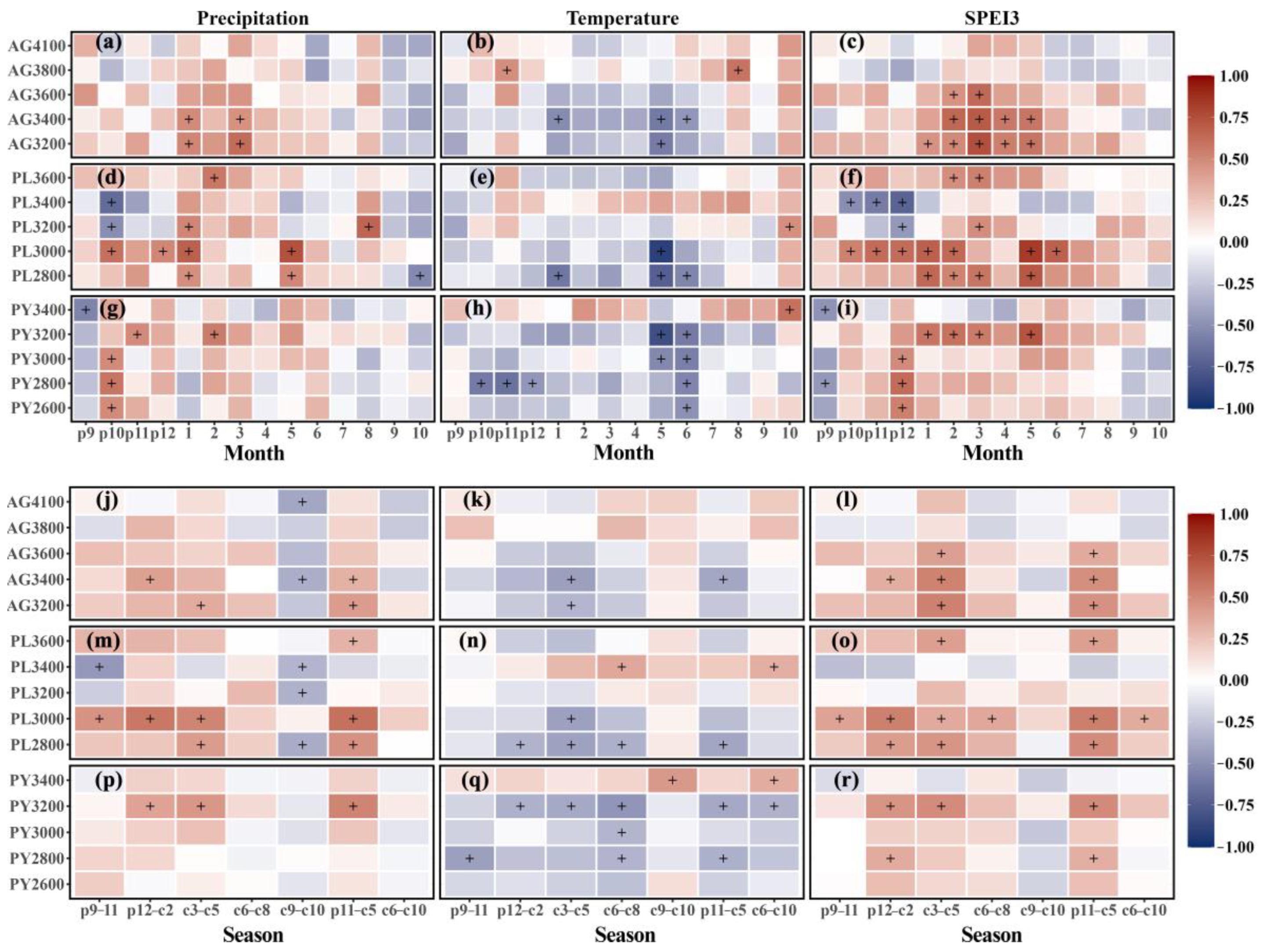
The radial growth of three tree species in Mt. Yulong shows a similar climate–growth response pattern across all elevational belts. Specifically, tree-ring width positively and significantly correlated with precipitation from December to May (Figure 3a,d,g) and negatively and significantly correlated with mean temperatures from May to June (Figure 3b,e,h). Furthermore, we found a significant and positive correlation between the tree-ring width and the SPEI from December to May (Figure 3c,f,i). These findings collectively suggest that the radial growth of three tree species was mainly controlled by moisture conditions in the dry season (Figure 3 and Figure S4).
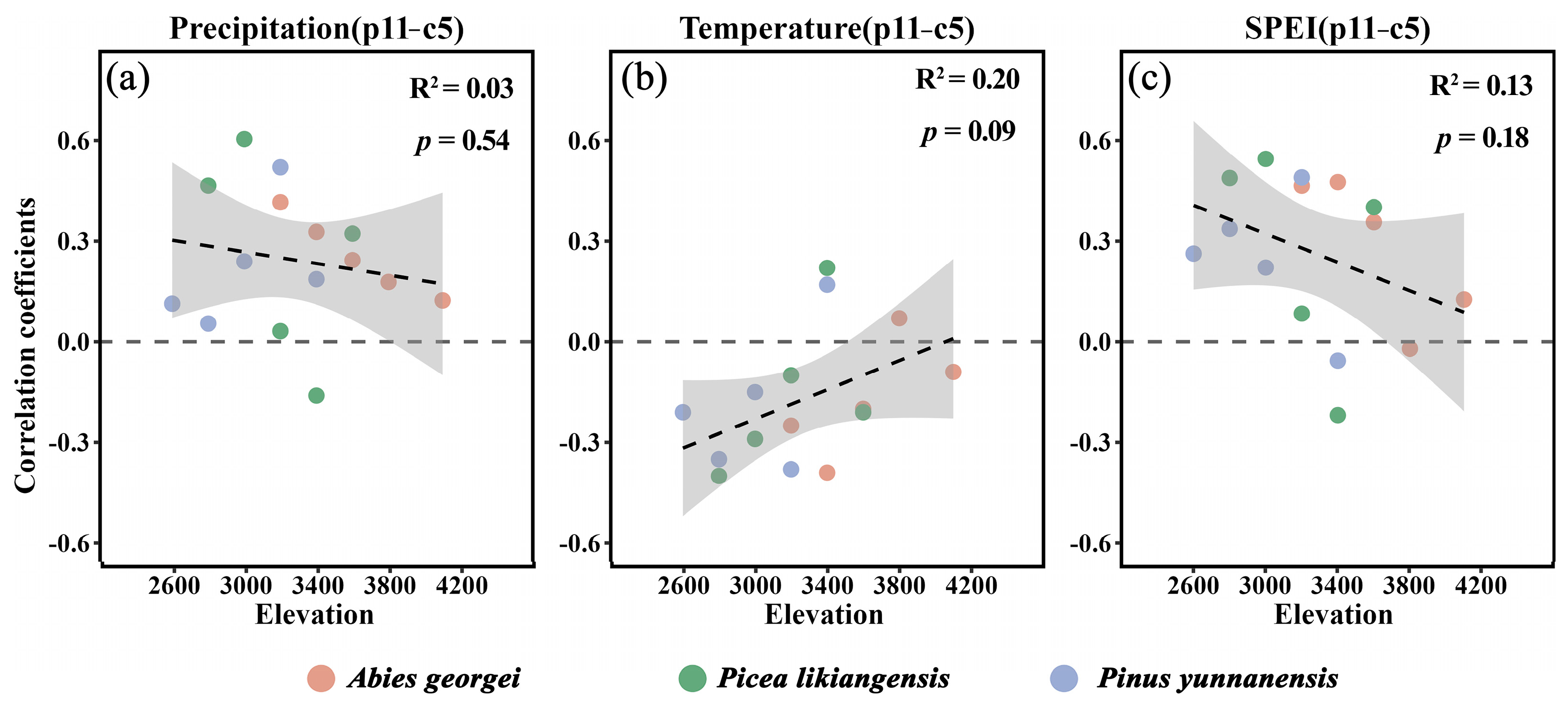
We further found that the sensitivity of tree-ring width to dry-season SPEI weakened with rising elevation (Figure 4c). This elevational trend, however, was not statistically significant. This result demonstrates that the radial growth of the three tree species was consistently limited by dry-season moisture availability across the regional elevational gradient, which does not support our hypothesis that tree growth is highly sensitive to changes in moisture availability at lower elevations and to temperature at higher elevations. The non-significant elevational trend reflects the influence of shared climate drivers on tree growth responses and further indicates that enhanced drought stress has imposed consistent limits on tree growth across all elevations.
Regarding species, the highest correlation coefficients between tree-ring widths and dry-season SPEI/precipitation were observed for Abies georgei, followed by Picea likiangensis and then Pinus yunnanensis (Figure 3). This finding suggests that Pinus yunnanensis’s sensitivity to moisture availability during the dry season is lower than that of the other two tree species in this region (Figure 3 and Figure 4). In contrast, the radial growth of Pinus yunnanensis shows higher sensitivity to mean temperature from May to June (Figure 3q). In addition, compared with the correlation coefficients between radial growth and SPEI over the entire dry season from the previous November to the current May, Abies georgei growth exhibited higher correlation coefficients with SPEI in the late dry season, i.e., spring. Picea likiangensis growth, by contrast, showed a higher positive correlation with SPEI in the mid-dry season, i.e., winter.

3.3. Climate–Growth Relationships Before and After the Abrupt Temperature Change

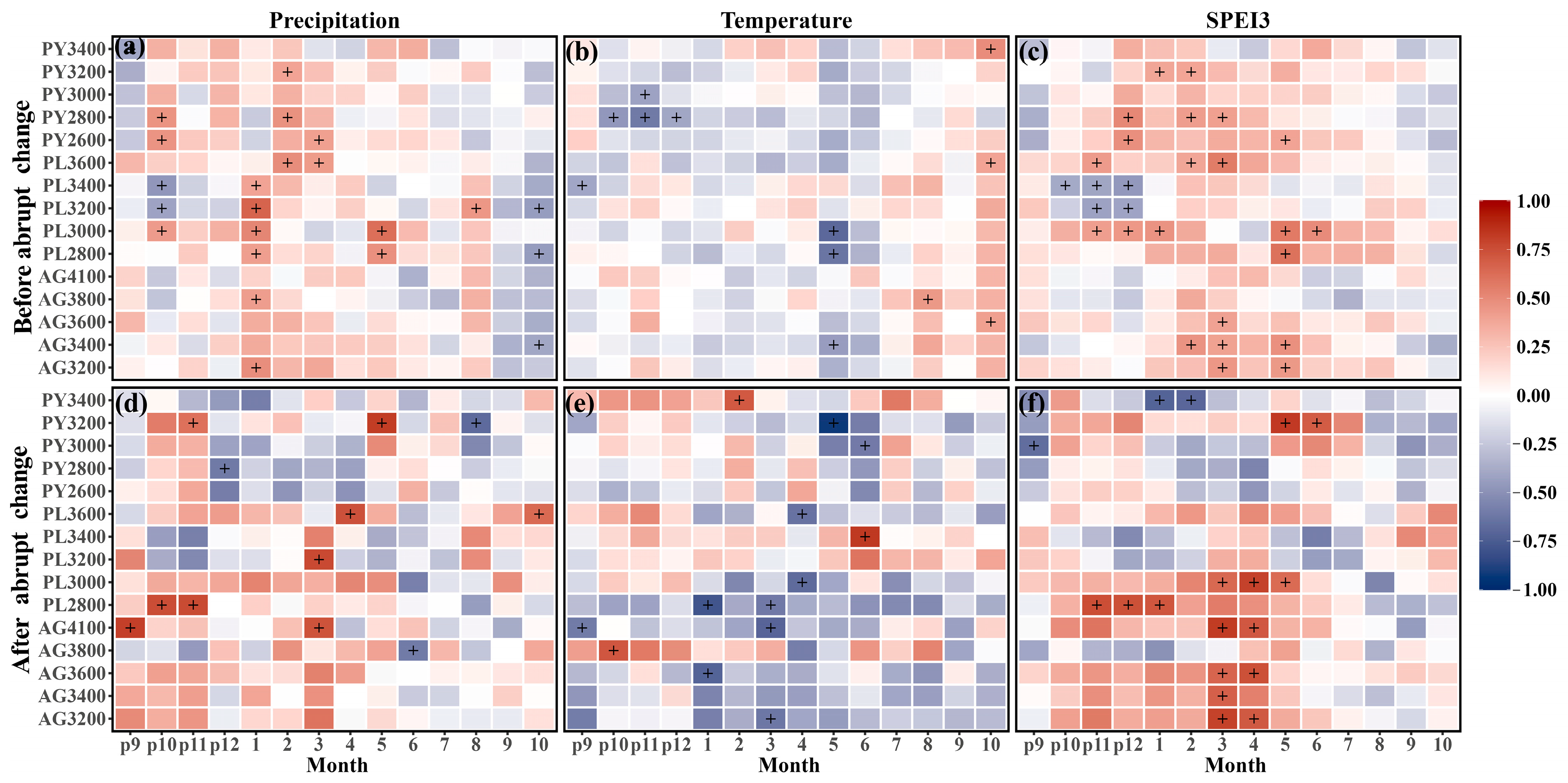
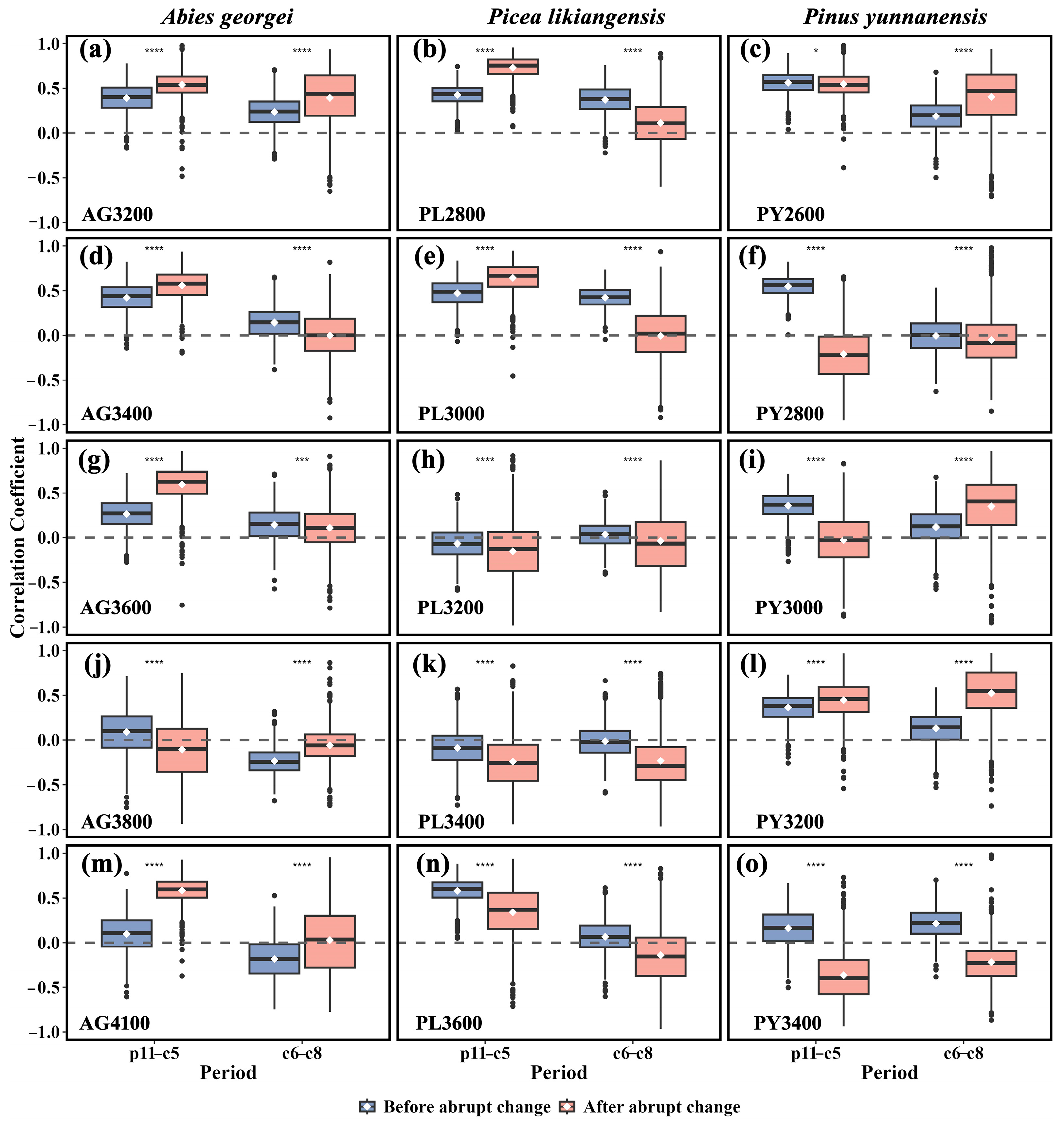
Further analysis of the climate–growth relationships between the periods of 1978–2004 (before the abrupt temperature change) and 2005–2015 CE (after the abrupt temperature change) found that dry-season SPEI consistently showed the strongest correlation with the radial growth of all three tree species across both time periods (Figure 5). Further analysis revealed significant species-specific differences in the magnitude of correlation coefficients between radial growth and dry-season SPEI between the two periods (Figure 6). Specifically, the correlation between Abies georgei radial growth and dry-season SPEI was consistently and significantly higher in 2005–2015 CE than that in the 1978–2004 CE. Furthermore, a significant diversity in the elevation of tree growth response was detected for the dry-season SPEI. For Picea likiangensis, the correlation between radial growth and dry-season SPEI increased significantly from 1978–2004 CE to 2005–2015 CE at low-elevation sites (2800–3000 m a.s.l.), while the correlation decreased significantly over the same time interval at the remaining three elevational gradients (3200–3600 m a.s.l.). For Pinus yunnanensis, the correlation between tree growth and dry-season SPEI increased significantly from 1978–2004 to 2005–2015 CE at high elevations (3200–3400 m a.s.l.), and decreased significantly over the same interval at low-to-middle elevations (2600–3000 m a.s.l.).

3.4. Long-Term Growth Trends

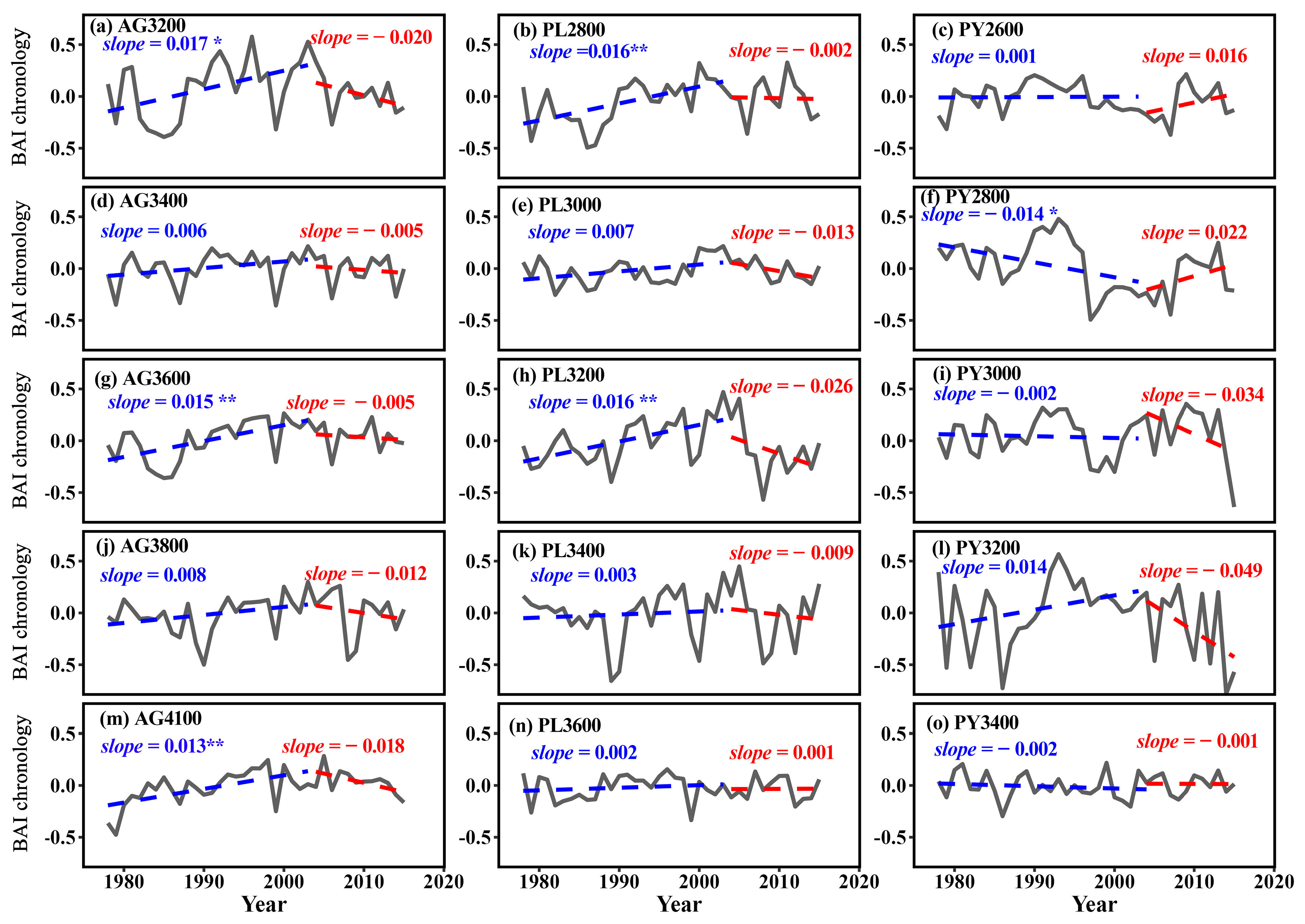
Our further investigation demonstrated that tree growth exhibited divergent long-term trends between 1978–2005 CE and 2005–2015 CE. Approximately 80.0% (n = 15) of the BAI chronologies (Figure 7) show an increasing trend before 2005 CE. This increasing trend is statistically significant for 41.7% of the sites. Regarding species, this long-term growth trend before 2005 CE further varies slightly among species. The growth of Abies georgei and Picea likiangensis consistently shows an increasing trend across all the elevations. While the long-term growth trend of Pinus yunnanensis further depends on elevation. Its growth shows a decreasing trend at low to high elevations, but an increasing trend at the lowest- and second-highest-elevation belts (PY2600 and PY3200).
In contrast, approximately 73.3% (n = 15) of the BAI chronologies (Figure 7) and standard chronology (Figure S5) show a decreasing trend since 2005 CE, although this decreasing trend was not statistically significant. We further found that the direction of these long-term growth trends during 2005–2015 CE differed among the three species studied. Specifically, Abies georgei has shown a consistent decline since 2005 across all elevational belts (Figure 7). The rate of this decrease further declined with increasing elevation, as indicated by the regression slope. For Picea likiangensis, growth decreased since 2005 CE in low- to middle-elevation belts (2800–3200 m a.s.l.), but increased in high-elevation belts (3600 m a.s.l.). In contrast to Picea likiangensis, the growth of Pinus yunnanensis showed an increasing trend at the lower-elevation belts (2600–2800 m a.s.l.) since 2005 CE, while trees showed a decreasing trend at the middle-to-high elevation belts (3200–3400 m a.s.l.).

4. Discussion

4.1. The Primary Limitation of Dry-Season Moisture for Tree Growth

The radial growth of Abies georgei, Picea likiangensis, and Pinus yunnanensis is primarily limited by dry-season moisture availability in the mountains of southwest China. Sufficient water availability promoted radial growth in these trees, whereas water deficit significantly inhibited it. These findings align well with previous studies carried out in nearby regions across a range of tree species [48,52,67,68,69,70,71,72]. Insufficient soil moisture during the dry season cannot sustain normal root water uptake, thereby delaying the onset of xylogenesis [73,74]. Long-term cambial phenology data from southwest China further support this, showing that dry-season water deficit prolongs local tree dormancy [73]. This extended dormancy in turn shortens the effective growing season and ultimately restricts tree radial growth. Furthermore, insufficient moisture availability during the dry season (the early growing season) may cause xylem/vessel cavitation, thereby reducing the tree’s hydraulic conductivity [75]. Lastly, inadequate water availability may also reduce the rate of photosynthesis, ultimately limiting tree growth [76]. This result indicates that moisture availability before the growing season predominantly influences the annual incremental growth of trees and is further supported by studies conducted worldwide, including the Himalayan region [77], the Carpathian arc [78], and the Rocky Mountains [10].

4.2. Consistent Dry-Season Moisture Limitation of Tree Growth Along Elevational Gradients

The correlation coefficient between tree growth and dry-season SPEI shows an insignificant negative trend as elevation increases (Figure 4). This finding confirms that dry-season moisture availability is a consistent limiting factor for tree growth across the study area’s elevation gradient. Similar elevational climate response patterns have been widely reported in previous studies across surrounding regions [48,79,80]. For instance, Juniperus tibetica at the southern Tibetan Plateau also shows no significant effect of elevation [79]. In parallel, the growth of Pinus yunnanensis across the same biogeographic region is also consistently limited by dry-season moisture availability across different elevational belts [48]. Similar tree growth and responses to climate across different elevations may reveal the profound impact of shared climatic limiting factors at regional scales, which may also indicate increased stress on trees with elevation.

4.3. Differential Growth Responses to Dry-Season Moisture Across Species

The correlation coefficients between tree growth and dry-season SPEI were highest for Abies georgei, lowest for Pinus yunnanensis, and intermediate for Picea likiangensis (Figure 3). This finding suggests that the growth of Abies georgei is more sensitive to moisture availability during the dry season. It also implies that Abies georgei will face a higher risk of growth decline than the two species in the future, against the background of regional warming and drying. This result is consistent with previous research conclusions on Abies species in high-elevation regions and cold ecosystems [13,40,52,68,81]. Thus, targeted conservation and management measures are needed for this species.
The diverse response is also well documented across species analyses in the southeastern Tibetan Plateau [82], Northern Limestone Alps [83], Central Europe [84], and Brazil [85]. The interspecific differences in the magnitude of tree growth responses to dry-season moisture conditions are likely related to the physiological traits and the elevational ranges of the focal species [83,86]. Compared with Abies georgei and Picea likiangensis, the weaker response of Pinus yunnanensis to dry-season moisture conditions is mainly attributed to its deep-rooted trait, which enables it to adapt to dry environments [47]. During drought, Pinus yunnanensis can access deep soil water through its well-developed deep root system. In contrast, Abies georgei and Picea species have shallower root systems. They, thus, cannot absorb water from deep soil layers to maintain stomatal conductance and photosynthesis [87,88]. In addition, pine trees may have higher drought tolerance than the other two species [89,90]. The elevational range of Pinus yunnanensis is lower than that of Abies georgei and Picea likiangensis. It is well known that the climate is generally hot and dry in low-elevation regions. To adapt to this environment, Pinus yunnanensis exhibits high drought tolerance, especially in individuals inhabiting its lowest elevational range [91]. Therefore, during the dry season, Pinus yunnanensis prioritizes allocating limited water to basic metabolism (e.g., leaf transpiration and cellular activity) over radial growth and xylem development.

4.4. Effects of Abrupt Temperature Rises on Tree Radial Growth

The growth of three tree species across most elevation belts has declined consistently since 2005 CE (abrupt temperature change). This widespread decline in growth can be largely attributed to reduced availability of dry-season moisture following temperature increases (Figure 6 and Figure 7). Tree growth in the study is primarily limited by dry-season moisture during the two periods (1978–2004 CE, 2005–2015 CE); thus, they may experience greater drought stress as temperatures rise. This temperature-induced drought stress is thought to shorten the growing season and limit growth by slowing leaf hydraulic conductance, stem xylem activity, and photosynthetic rate [92], ultimately reducing tree productivity. The negative trajectory of tree growth has been frequently reported in numerous published studies, including the southeastern Tibetan Plateau [7], the Himalayan region [13], the European continent [36], and worldwide [93]. These findings collectively suggest that tree growth generally declines under global warming.
We further found that the tree growth trend after 2005 CE further differs by species. Specifically, the radial growth of Abies georgei across all elevational belts and of Picea likiangensis across nearly all elevational belts has declined consistently as temperatures have risen (Figure 7). In contrast, Pinus yunnanensis exhibits divergent growth patterns along the elevation gradient. Trees at lower elevational belts from 2600 m to 2800 m show a slight increasing trend, while those at higher elevational belts from 3000 m to 3400 m exhibit clear growth declines (Figure 7 and Figure S5). These divergent growth responses between Pinus yunnanensis and the other two species at their lower elevational distribution belts can be explained by interspecific differences in functional traits, including drought resistance [94,95]. The negative change in the global growth trend was significantly influenced by drought resistance, which was significantly lower for drought-tolerant species [93]. Compared with Abies georgei and Picea likiangensis, Pinus yunnanensis exhibited greater growth variability, which could enable it to adjust its physiological traits to resist and adapt to high temperatures and drought [96,97,98].
Abies georgei, Picea likiangensis, and Pinus yunnanensis are three dominant tree species in mountain forests in southwest China [47]. These species play a crucial role in water conservation, soil protection, and greenhouse gas sequestration. The negative growth trajectory observed for Abies georgei and Picea likiangensis along the elevation gradient and for Pinus yunnanensis at middle-to-high elevation sites, coupled with their strong positive sensitivity to SPEI, further implies that ongoing regional warming in southwest China likely intensifies drought stress, posing potential risks of compromised tree vitality and sustained growth decline. This expected shift in forest growth dynamics may, in turn, profoundly alter the long-term growth dynamics and carbon sink capacity of forests across our study region. Future research must integrate broader mountain tree-ring networks better to understand their growth trajectories and climate response mechanisms.

4.5. Limitations and Perspectives

It is important to keep in mind that mountain environments exhibit distinct elevational gradients in temperature and precipitation [5,6]. However, there is a lack of long-term meteorological monitoring networks in our sampling area. Although gridded climate products exist, they fail to accurately capture climatic variations across large elevation gradients in the mountains of Southwest China. This limitation arises from insufficient elevational weighting in interpolation algorithms, compounded by scarce validation stations [99], rendering these datasets too biased for detailed climate-response analysis. Consequently, we had to rely on observations from the nearest meteorological station. Furthermore, due to high mountain climate heterogeneity, even simple lapse-rate corrections are unreliable [11,29,30]; thus, we applied no elevation correction to the station data. Future research should involve consistent meteorological monitoring networks to provide a more comprehensive understanding of tree growth response across large elevation gradients in mountain areas.
Abrupt warming significantly alters tree growth. Based on a detected climate regime shift (Mann–Kendall test), we deliberately divided the analysis into two unequal periods to capture this ecological reality, rather than forcing equal-length periods. While the resulting short time span complicates distinguishing long-term climatic trends from short-term weather variability, we mitigated this by employing bootstrapped correlations and non-parametric comparisons to stabilize our estimates. Ultimately, this limitation highlights the need for a more mechanistic approach; future research must integrate microclimatic conditions, soil properties, and tree functional traits to elucidate the physiological mechanisms underlying growth responses to climate change.

5. Conclusions

Coniferous forests, including fir, pine, and spruce species, are the key component of mountain forests in southwest China. However, little attention has been given to how these forests respond to climate warming along elevation gradients. Based on tree-ring cores of Picea likiangensis, Abies georgei, and Pinus yunnanensis from the Yulong Snow Mountains, we find that dry-season moisture availability is the dominant limiting factor for tree growth. The linear trend in correlations between tree growth and dry-season moisture indicates that radial growth of the three tree species was consistently limited by dry-season moisture availability across the region’s elevational gradient. The strongest limitation was observed for Abies georgei, which was distributed at higher elevations, followed by Picea likiangensis, and the lowest for Pinus yunnanensis, although the overall elevational trend was not statistically significant. The positive relationship between tree radial growth and the SPEI along all elevations after the abrupt temperature change further implies that radial growth of the three target species across most elevational belts may be continuously suppressed by ongoing regional warming and associated warming-induced drought events in southwest China, especially for Abies georgei. Furthermore, our assessments of productivity trends in Abies georgei, Picea likiangensis, and Pinus yunnanensis suggest that productivity in these three species began to decline since 2005 CE (with abrupt temperature rises) across most elevational belts.
In this study, we present a tree-ring network spanning multiple species across large elevation gradients in the Yulong Snow Mountains. Notably, our analyses reveal that trees’ adaptive strategies to climate change exhibit species-specific and elevation-dependent differences. To comprehensively understand the mechanisms driving tree growth responses to climate warming and changing hydroclimate conditions, further investigations should focus on stem diameter variation, sap flow measurements, cambial activity, and tree eco-physiological responses across multiple tree species in the mountainous regions of southwestern China.

Supplementary Materials

The following supporting information can be downloaded at https://www.mdpi.com/article/10.3390/f17070736/s1. Figure S1: The standard chronologies and sample size of the 15 tree-ring widths. The standard chronologies of Abies georgei (a–e), Picea likiangensis (f–j), and Pinus yunnanensis (f–o). The grey shade indicates the reliable portion of the chronology (SSS > 0.85); Figure S2: Mann–Kendall test of the dry-season temperature from 1952 to 2020 CE with forward statistic UF (red line) and backward statistic UB (blue line) at the 0.05 significance level (dotted horizontal black lines). The intersection of UF and UB lines indicates the abrupt change point (2004 CE); Figure S3: Statistical characteristics of the chronologies. MS, mean sensitivity; R1, mean inter-series correlation coefficient; SRN, signal–noise ratio; EPS, expressed population signal; AC1, first-order autocorrelation; Figure S4: First-order difference correlation between tree-ring chronology and monthly precipitation, temperature, and SPEI from previous September to current October (a–c); correlation between tree-ring chronology and seasonal precipitation, temperature, and SPEI (d–f). p indicates the previous year, and c indicates the current year. The + indicates a 0.05 confidence level; Figure S5: Long-term trends in tree growth (STD) across different elevations of the three species. Linear trend of Abies georgei (a,d,g,j,m), Picea likiangensis (b,e,h,k,n), and Pinus yunnanensis (c,f,i,l,o). The blue dotted line indicates the tree growth trend during 1978–2004 and the red dotted line indicates the tree growth trend during 2005–2015 CE. The * and ** indicate that the linear trend (increasing or decreasing trend) is statistically significant: ** p < 0.01; * p < 0.05. The slope values represent the linear regression model for each period.

Author Contributions

Conceptualization, methodology, formal analysis, writing—original draft preparation, Q.L.; investigation, B.L.; writing—review and editing, Y.B.; supervision, J.X.; funding acquisition, Y.B. All authors have read and agreed to the published version of the manuscript.

Funding

This project was supported by the Natural Science Foundation of Yunnan Province (Grant no. 202401AT070228), Yunnan Revitalization Talent Support Program ‘Young Talent’ Project.

Data Availability Statement

The original contributions presented in this study are included in the article and Supplementary Material. Further inquiries can be directed to the corresponding author.

Acknowledgments

We would like to thank all co-authors for their contributions to the research and manuscript preparation.

Conflicts of Interest

The authors declare no conflicts of interest.

References

  1. Cui, J.; Deng, O.; Zheng, M.; Zhang, X.; Bian, Z.; Pan, N.; Tian, H.; Xu, J.; Gu, B. Warming Exacerbates Global Inequality in Forest Carbon and Nitrogen Cycles. Nat. Commun. 2024, 15, 9185. [Google Scholar] [CrossRef] [Scilit] [PubMed]
  2. Bennett, A.C.; Rodrigues de Sousa, T.; Monteagudo-Mendoza, A.; Esquivel-Muelbert, A.; Morandi, P.S.; Coelho de Souza, F.; Castro, W.; Duque, L.F.; Flores Llampazo, G.; Manoel dos Santos, R.; et al. Sensitivity of South American Tropical Forests to an Extreme Climate Anomaly. Nat. Clim. Change 2023, 13, 967–974. [Google Scholar] [CrossRef] [Scilit]
  3. Yang, C.; Xu, H.; Li, Q.; Wang, X.; Tang, B.; Chen, J.; Tu, W.; Zhang, Y.; Shi, T.; Chen, M. Global Loss of Mountain Vegetated Landscapes and Its Impact on Biodiversity Conservation. Nat. Commun. 2025, 16, 8971. [Google Scholar] [CrossRef] [Scilit] [PubMed]
  4. Albrich, K.; Rammer, W.; Seidl, R. Climate Change Causes Critical Transitions and Irreversible Alterations of Mountain Forests. Glob. Change Biol. 2020, 26, 4013–4027. [Google Scholar] [CrossRef] [Scilit] [PubMed]
  5. Barry, R.G. Mountain Weather and Climate, 3rd ed.; Cambridge University Press: Cambridge, UK, 2008. [Google Scholar]
  6. Guo, Q.; Kelt, D.A.; Sun, Z.; Liu, H.; Hu, L.; Ren, H.; Wen, J. Global Variation in Elevational Diversity Patterns. Sci. Rep. 2013, 3, 3007. [Google Scholar] [CrossRef] [Scilit] [PubMed]
  7. Panthi, S.; Bräuning, A.; Zhou, Z.K.; Fan, Z.X. Growth Response of Abies georgei to Climate Increases with Elevation in the Central Hengduan Mountains, Southwestern China. Dendrochronologia 2018, 47, 1–9. [Google Scholar] [CrossRef] [Scilit]
  8. Gao, L.; Gou, X.; Deng, Y.; Yang, M.; Zhang, F. Assessing the Influences of Tree Species, Elevation and Climate on Tree-Ring Growth in the Qilian Mountains of Northwest China. Trees-Struct. Funct. 2017, 31, 393–404. [Google Scholar] [CrossRef] [Scilit]
  9. Köse, N.; Güner, H.T. The Effect of Temperature and Precipitation on the Intra-Annual Radial Growth of Fagus Orientalis Lipsky in Artvin, Turkey. Turk. J. Agric. For. 2012, 36, 501–509. [Google Scholar] [CrossRef] [Scilit]
  10. Maher, C.T.; Nelson, C.R.; Larson, A.J. Winter Damage Is More Important than Summer Temperature for Maintaining the Krummholz Growth Form above Alpine Treeline. J. Ecol. 2020, 108, 1074–1087. [Google Scholar] [CrossRef] [Scilit]
  11. Guan, Y.; Liu, J.; Cui, W.; Chen, D.; Zhang, J.; Lu, H.; Maeda, E.E.; Zeng, Z.; Beck, H.E. Elevation Regulates the Response of Climate Heterogeneity to Climate Change. Geophys. Res. Lett. 2024, 51, e2024GL109483. [Google Scholar] [CrossRef] [Scilit]
  12. Devi, N.M.; Kukarskih, V.V.; Bubnov, M.O. Elevational Changes in Climate Response of Pinus nigra pallasiana Tree-Rings on the Crimean Peninsula. Dendrochronologia 2023, 79, 126092. [Google Scholar] [CrossRef] [Scilit]
  13. Gaire, N.P.; Zaw, Z.; Bräuning, A.; Grießinger, J.; Sharma, B.; Rana, P.; Bhandari, S.; Basnet, S.; Fan, Z.X. The Impact of Warming Climate on Himalayan Silver Fir Growth along an Elevation Gradient in the Mt. Everest Region. Agric. For. Meteorol. 2023, 339, 109575. [Google Scholar] [CrossRef] [Scilit]
  14. Bonan, G.B. Forests and Climate Change: Forcings, Feedbacks, and the Climate Benefits of Forests. Science 2008, 320, 1444–1449. [Google Scholar] [CrossRef] [Scilit] [PubMed]
  15. Tang, Y.; Du, E.; Xue, B.; Peñuelas, J.; Reich, P.B. Reversibility of Interannual Tree Growth Variability in Southern Boreal Forest. Glob. Change Biol. 2026, 32, e70696. [Google Scholar] [CrossRef] [Scilit] [PubMed]
  16. Gao, S.; Liang, E.; Liu, R.; Babst, F.; Camarero, J.J.; Fu, Y.H.; Piao, S.; Rossi, S.; Shen, M.; Wang, T.; et al. An Earlier Start of the Thermal Growing Season Enhances Tree Growth in Cold Humid Areas but Not in Dry Areas. Nat. Ecol. Evol. 2022, 6, 397–404. [Google Scholar] [CrossRef] [Scilit] [PubMed]
  17. Meister, K.; Ashton, M.S.; Craven, D.; Griscom, H. Carbon Dynamics of Tropical Forests BT. In Managing Forest Carbon in a Changing Climate; Ashton, M.S., Tyrrell, M.L., Spalding, D., Gentry, B., Eds.; Springer: Dordrecht, The Netherlands, 2012; pp. 51–75. [Google Scholar]
  18. Pan, Y.; Birdsey, R.A.; Fang, J.; Houghton, R.; Kauppi, P.E.; Kurz, W.A.; Phillips, O.L.; Shvidenko, A.; Lewis, S.L.; Canadell, J.G.; et al. A Large and Persistent Carbon Sink in the World’s Forests. Science 2011, 333, 988–993. [Google Scholar] [CrossRef] [Scilit] [PubMed]
  19. Li, X.; Piao, S.; Wang, K.; Wang, X.; Wang, T.; Ciais, P.; Chen, A.; Lian, X.; Peng, S.; Peñuelas, J. Temporal Trade-Off Between Gymnosperm Resistance and Resilience Increases Forest Sensitivity to Extreme Drought. Nat. Ecol. Evol. 2020, 4, 1075–1083. [Google Scholar] [CrossRef] [Scilit] [PubMed]
  20. Marchand, W.; Girardin, M.P.; Hartmann, H.; Bergeron, Y. Taxonomy, Together with Ontogeny and Growing Conditions, Drives Needleleaf Species’ Sensitivity to Climate in Boreal North America. Glob. Change Biol. 2019, 25, 2793–2809. [Google Scholar] [CrossRef] [Scilit] [PubMed]
  21. Yin, J.; Bauerle, T.L. A Global Analysis of Plant Recovery Performance from Water Stress. Oikos 2017, 126, 1377–1388. [Google Scholar] [CrossRef] [Scilit]
  22. King, G.M.; Gugerli, F.; Fonti, P.; Frank, D.C. Tree Growth Response Along an Elevational Gradient: Climate or Genetics? Oecologia 2013, 173, 1587–1600. [Google Scholar] [CrossRef] [Scilit] [PubMed]
  23. Peng, X.; Du, J.; Yang, B.; Xiao, S.; Li, G. Elevation-Influenced Variation in Canopy and Stem Phenology of Qinghai Spruce, Central Qilian Mountains, Northeastern Tibetan Plateau. Trees-Struct. Funct. 2019, 33, 707–717. [Google Scholar] [CrossRef] [Scilit]
  24. Yuan, X.; Xu, C.; Zhang, J.; Wang, X.; Liao, J.; Du, M.; Zhang, X. Elevation-Dependent Responses of Xylem Lumen Traits to Competition–Climate Interactions in Temperate Forests. Agric. For. Meteorol. 2026, 378, 111011. [Google Scholar] [CrossRef] [Scilit]
  25. Feng, X.; Lin, P.; Zhao, W. The Physiological Constraints of Alpine Treeline in Qilian Mountains. For. Ecol. Manag. 2022, 503, 119761. [Google Scholar] [CrossRef] [Scilit]
  26. Xu, G.; Chen, T.; Liu, X.; Wen, T.; Wang, W.; Wang, X.; Yao, Q.; Wu, G.; Zhao, C. Spruce Trees Have Stronger Drought Sensitivity at Low- than High-Elevation Sites across China’s Aridity Zones. Glob. Ecol. Conserv. 2024, 53, e03000. [Google Scholar] [CrossRef] [Scilit]
  27. Cheng, Z.J.; Weng, C.Y.; Guo, J.Q.; Dai, L.; Zhou, Z.Z. Vegetation Responses to Late Quaternary Climate Change in a Biodiversity Hotspot, the Three Parallel Rivers Region in Southwestern China. Palaeogeogr. Palaeoclimatol. Palaeoecol. 2018, 491, 10–20. [Google Scholar] [CrossRef] [Scilit]
  28. Wang, Y.; Lin, X.; Zheng, P.; Hou, Y.; Wang, G.; Gong, Y.; Shu, G.; Jiang, J.; Ran, J.; Xie, F. Species Richness, Composition, Distribution and Conservation Status of Herpetofauna in a Global Hotspot: The Mountains of Southwest China. Glob. Ecol. Conserv. 2024, 54, e03122. [Google Scholar] [CrossRef] [Scilit]
  29. Huo, H.; Sun, C. Spatiotemporal Variation and Influencing Factors of Vegetation Dynamics Based on Geodetector: A Case Study of the Northwestern Yunnan Plateau, China. Ecol. Indic. 2021, 130, 108005. [Google Scholar] [CrossRef] [Scilit]
  30. Zu, K.; Luo, A.; Shrestha, N.; Liu, B.; Wang, Z.; Zhu, X. Altitudinal Biodiversity Patterns of Seed Plants along Gongga Mountain in the Southeastern Qinghai–Tibetan Plateau. Ecol. Evol. 2019, 9, 9586–9596. [Google Scholar] [CrossRef] [Scilit] [PubMed]
  31. Ma, D.; Yu, Y.; Gong, M.; Zhang, Z.; Kannenberg, S.A. Recent Widespread Forest Expansion and Densification in Southwest China. Geogr. Sustain. 2026, 7, 100404. [Google Scholar] [CrossRef] [Scilit]
  32. Chen, S.; Lu, N.; Fu, B.; Wang, S.; Deng, L.; Wang, L. Current and Future Carbon Stocks of Natural Forests in China. For. Ecol. Manag. 2022, 511, 120137. [Google Scholar] [CrossRef] [Scilit]
  33. Gao, L.; Han, X.; Chen, X.; Liu, B.; Li, Y. The Spring Drought in Yunnan Province of China: Variation Characteristics, Leading Impact Factors, and Physical Mechanisms. Atmosphere 2023, 14, 294. [Google Scholar] [CrossRef] [Scilit]
  34. Pepin, N.; Bradley, R.S.; Diaz, H.F.; Baraer, M.; Caceres, E.B.; Forsythe, N.; Fowler, H.; Greenwood, G.; Hashmi, M.Z.; Liu, X.D.; et al. Elevation-Dependent Warming in Mountain Regions of the World. Nat. Clim. Change 2015, 5, 424–430. [Google Scholar] [CrossRef] [Scilit]
  35. Rangwala, I.; Miller, J.R. Climate Change in Mountains: A Review of Elevation-Dependent Warming and Its Possible Causes. Clim. Change 2012, 114, 527–547. [Google Scholar] [CrossRef] [Scilit]
  36. Garamszegi, B.; Grabner, M.; Wächter, E.; Gadermaier, J.; Katzensteiner, K. Site and Environmental Legacies Shape the Growth–Climate Response of Silver Fir along a Climatic and Elevational Gradient in Austria. Dendrochronologia 2025, 93, 126384. [Google Scholar] [CrossRef] [Scilit]
  37. Guo, M.; Zhang, Y.; Liu, S.; Gu, F.; Wang, X.; Li, Z.; Shi, C.; Fan, Z. Divergent Growth Between Spruce and Fir at Alpine Treelines on the East Edge of the Tibetan Plateau in Response to Recent Climate Warming. Agric. For. Meteorol. 2019, 276–277, 107631. [Google Scholar] [CrossRef] [Scilit]
  38. Song, W.; Klesse, S.; Gampe, D.; Camarero, J.J.; Mencuccini, M.; Cherubini, P.; Li, Z.; Liu, H.; Wang, X.; Wu, X. Climate Warming Exacerbates Moisture Limitations of Tree Growth in Water-Limited Forests and for Drought-Adapted Tree Species. Agric. For. Meteorol. 2026, 382, 111119. [Google Scholar] [CrossRef] [Scilit]
  39. Xie, S.; Yan, T.; Sun, X.; Chen, H.; Sun, M.; Zhang, Y. Radial Growth Response of Pinus yunnanensis to Climate in High Mountain Forests of Northwestern Yunnan, Southwestern China. Front. For. Glob. Change 2024, 7, 1343730. [Google Scholar] [CrossRef] [Scilit]
  40. Zhang, W.G.; Xiao, D.R.; Tian, K.; Chen, G.L.; He, R.H.; Zhang, Y. Response of Radial Growth of Three Conifer Species to Climate at Their Respective Upper Distributional Limits on Yulong Snow Mountain. Acta Ecol. Sin. 2017, 37, 3796–3804. [Google Scholar] [CrossRef] [Scilit]
  41. Zhang, Y.; Yin, D.; Sun, M.; Wang, H.; Tian, K.; Xiao, D.; Zhang, W. Variations of Climate-Growth Response of Major Conifers at Upper Distributional Limits in Shika Snow Mountain, Northwestern Yunnan Plateau, China. Forests 2017, 8, 377. [Google Scholar] [CrossRef] [Scilit]
  42. Zhang, Y.; Yin, D.; Tian, K.; He, R.; He, M.; Li, Y.; Sun, D.; Zhang, W. Relationship Between Radial Growth of Abies georgei and Climate Factors at Different Altitudes on the Eastern Slope of Yulong Snow Mountain, China. Chin. J. Appl. Ecol. 2018, 29, 2355–2361. [Google Scholar]
  43. Babst, F.; Poulter, B.; Trouet, V.; Tan, K.; Neuwirth, B.; Wilson, R.; Carrer, M.; Grabner, M.; Tegel, W.; Levanic, T.; et al. Site- and Species-Specific Responses of Forest Growth to Climate Across the European Continent. Glob. Ecol. Biogeogr. 2013, 22, 706–717. [Google Scholar] [CrossRef] [Scilit]
  44. Körner, C. Alpine Treelines: Functional Ecology of the Global High Elevation Tree Limits; Springer: Basel, Switzerland, 2012. [Google Scholar]
  45. Zhang, Z.; Zhou, L.; Lu, C.; Fu, Y.; Gu, Z.; Chen, Y.; Zhang, G.; Zhou, X. Drought-Induced Decrease in Tree Productivity Mainly Mediated by the Maximum Growth Rate and Growing-Season Length in a Subtropical Forest. For. Ecol. Manag. 2024, 563, 121985. [Google Scholar] [CrossRef] [Scilit]
  46. Gao, G.; Kuerban, A.; Xu, H. Response of Radial Growth of Siberian Larch to Climate Change in Different River Valleys of Southern Altai Mountains. Dendrochronologia 2025, 94, 126441. [Google Scholar] [CrossRef] [Scilit]
  47. Wu, Z. Vegetation in Yunnan; Science Press: Beijing, China, 1987. [Google Scholar]
  48. Yang, R.; Fan, Z.; Li, Z.; Wen, Q. Radial Growth of Pinus yunnanensis at Different Elevations and Their Responses to Climatic Factors in the Yulong Snow Mountain, Northwest Yunnan, China. Acta Ecol. Sin. 2018, 38, 8983–8991. [Google Scholar] [CrossRef] [Scilit]
  49. Zhou, Y.; Yi, Y.; Liu, H.; Song, J.; Jia, W.; Zhang, S. Altitudinal Trends in Climate Change Result in Radial Growth Variation of Pinus yunnanensis at an Arid-Hot Valley of Southwest China. Dendrochronologia 2022, 71, 125914. [Google Scholar] [CrossRef] [Scilit]
  50. Xie, S.; Zhang, Y.; Kang, Y.; Yan, T.; Yue, H. The Growth–Climate Relationships of Three Dominant Subalpine Conifers on the Baima Snow Mountain in the Southeastern Tibetan Plateau. Plants 2024, 13, 1645. [Google Scholar] [CrossRef] [Scilit] [PubMed]
  51. Zhang, Y.; Cao, R.; Yin, J.; Tian, K.; Xiao, D.; Zhang, W.; Yin, D. Radial Growth Response of Major Conifers to Climate Change on Haba Snow Mountain, Southwestern China. Dendrochronologia 2020, 60, 125682. [Google Scholar] [CrossRef] [Scilit]
  52. Sun, M.; Li, J.; Cao, R.; Tian, K.; Zhang, W.; Yin, D.; Zhang, Y. Climate-Growth Relations of Abies georgei Along an Altitudinal Gradient in Haba Snow Mountain, Southwestern China. Forests 2021, 12, 1569. [Google Scholar] [CrossRef] [Scilit]
  53. Yan, X.; Ma, J.; Ma, X.; Wang, S.; Chen, P.; He, Y. Accelerated Glacier Mass Loss with Atmospheric Changes on Mt. Yulong, Southeastern Tibetan Plateau. J. Hydrol. 2021, 603, 126931. [Google Scholar] [CrossRef] [Scilit]
  54. Shi, X.; Risi, C.; Pu, T.; Lacour, J.L.; Kong, Y.; Wang, K.; He, Y.; Xia, D. Variability of Isotope Composition of Precipitation in the Southeastern Tibetan Plateau from the Synoptic to Seasonal Time Scale. J. Geophys. Res. Atmos. 2020, 125, e2019JD031751. [Google Scholar] [CrossRef] [Scilit]
  55. Holmes, R. Computer-Assisted Quality Control in Tree-Ring Dating and Measurement. Tree-Ring Bull. 1983, 43, 69–78. [Google Scholar]
  56. Cook, E.R. A Time Series Analysis Approach to Tree Ring Standardization; University of Arizona: Tucson, AZ, USA, 1985. [Google Scholar]
  57. Cook, E.R.; Kairiukstis, L.A. Methods of Dendrochronology: Applications in the Environmental Sciences; Springer Science & Business Media: New York, NY, USA, 2013. [Google Scholar]
  58. Osborn, T.J.; Briffa, K.R.; Jones, P.D. Adjusting Variance for Sample-Size in Tree-Ring Chronologies and Other Regional Mean Timeseries. Dendrochronologia 1997, 15, 89–99. [Google Scholar]
  59. Wigley, T.; Briffa, K.R.; Jones, P.D. On the Average Value of Correlated Time Series, with Applications in Dendroclimatology and Hydrometeorology. J. Clim. Appl. Meteorol. 1984, 23, 201–213. [Google Scholar] [CrossRef] [Scilit]
  60. Mann, H.B. Nonparametric Tests Against Trend. Econometrica 1945, 13, 245–259. [Google Scholar] [CrossRef] [Scilit]
  61. Kendall, M. Rank Correlation Methods; Charles Griffin: London, UK, 1975. [Google Scholar]
  62. Vicente-Serrano, S.M.; Beguería, S.; López-Moreno, J.I. A Multiscalar Drought Index Sensitive to Global Warming: The Standardized Precipitation Evapotranspiration Index. J. Clim. 2010, 23, 1696–1718. [Google Scholar] [CrossRef] [Scilit]
  63. Biondi, F.; Qeadan, F. A Theory-Driven Approach to Tree-Ring Standardization Defining the Biological Trend Expected Basal Area Increment. Tree-Ring Res. 2008, 64, 81–96. [Google Scholar] [CrossRef] [Scilit]
  64. Bunn, A.G. A Dendrochronology Program Library in R (DplR). Dendrochronologia 2008, 26, 115–124. [Google Scholar] [CrossRef] [Scilit]
  65. Girardin, M.P.; Bouriaud, O.; Hogg, E.H.; Kurz, W.; Zimmermann, N.E.; Metsaranta, J.M.; De Jong, R.; Frank, D.C.; Esper, J.; Büntgen, U.; et al. No Growth Stimulation of Canada’s Boreal Forest under Half-Century of Combined Warming and CO2 Fertilization. Proc. Natl. Acad. Sci. USA 2016, 113, E8406–E8414. [Google Scholar] [CrossRef] [Scilit] [PubMed]
  66. Klesse, S.; Bigler, C. Growth Trends in Basal Area Increments: The Underlying Problem, Consequences for Research and Best Practices. Dendrochronologia 2025, 90, 126296. [Google Scholar] [CrossRef] [Scilit]
  67. Bi, Y.; Xu, J.; Gebrekirstos, A.; Guo, L.; Zhao, M.; Liang, E.; Yang, X. Assessing Drought Variability since 1650 AD from Tree-Rings on the Jade Dragon Snow Mountain, Southwest China. Int. J. Climatol. 2015, 35, 4057–4065. [Google Scholar] [CrossRef] [Scilit]
  68. Fan, Z.; Bräuning, A.; Cao, K. Tree-Ring Based Drought Reconstruction in the Central Hengduan Mountains Region (China) since A.D. 1655. Int. J. Climatol. 2008, 28, 1879–1887. [Google Scholar] [CrossRef] [Scilit]
  69. Jiang, Y.M.; Li, Z.S.; Fan, Z.X. Tree-Ring Based February–April Relative Humidity Reconstruction since A.D. 1695 in the Gaoligong Mountains, Southeastern Tibetan Plateau. Asian Geogr. 2017, 34, 59–70. [Google Scholar] [CrossRef] [Scilit]
  70. Li, J.; Shi, J.; Zhang, D.D.; Yang, B.; Fang, K.; Yue, P.H. Moisture Increase in Response to High-Altitude Warming Evidenced by Tree-Rings on the Southeastern Tibetan Plateau. Clim. Dyn. 2017, 48, 649–660. [Google Scholar] [CrossRef] [Scilit]
  71. Zhao, F.; Fan, Z.; Su, T.; Li, S.; Tang, H.; Spicer, T.E.V.; Zhou, Z. Tree-Ring δ18 O Inferred Spring Drought Variability over the Past 200 Years in the Hengduan Mountains, Southwest China. Palaeogeogr. Palaeoclimatol. Palaeoecol. 2019, 518, 22–33. [Google Scholar] [CrossRef] [Scilit]
  72. Zhou, Q.; Fang, K.; Zhou, F.; Gao, J.; Wu, H. Pluvial Conditions Increased the Risk of Debris Flows over the Southern Hengduan Mountains: Evidence from Tree-Ring Blue Intensity and Historical Documents. Catena 2025, 249, 108690. [Google Scholar] [CrossRef] [Scilit]
  73. Ren, P.; Rossi, S.; Camarero, J.J.; Ellison, A.M.; Liang, E.; Peñuelas, J. Critical Temperature and Precipitation Thresholds for the Onset of Xylogenesis of Juniperus Przewalskii in a Semi-Arid Area of the North-Eastern Tibetan Plateau. Ann. Bot. 2018, 121, 617–624. [Google Scholar] [CrossRef] [Scilit] [PubMed]
  74. Li, X.; Liang, E.; Gričar, J.; Rossi, S.; Čufar, K.; Ellison, A.M. Critical Minimum Temperature Limits Xylogenesis and Maintains Treelines on the Southeastern Tibetan Plateau. Sci. Bull. 2017, 62, 804–812. [Google Scholar] [CrossRef] [Scilit] [PubMed]
  75. Tardif, J.C.; Conciatori, F. Influence of Climate on Tree Rings and Vessel Features in Red Oak and White Oak Growing near Their Northern Distribution Limit, Southwestern Quebec, Canada. Can. J. For. Res. 2006, 36, 2317–2330. [Google Scholar] [CrossRef] [Scilit]
  76. Körner, C. Paradigm Shift in Plant Growth Control. Curr. Opin. Plant Biol. 2015, 25, 107–114. [Google Scholar] [CrossRef] [Scilit] [PubMed]
  77. Zheng, L.; Shi, P.; Song, M.; Zhou, T.; Zong, N.; Zhang, X. Climate Sensitivity of High Altitude Tree Growth Across the Hindu Kush Himalaya. For. Ecol. Manag. 2021, 486, 118963. [Google Scholar] [CrossRef] [Scilit]
  78. Schurman, J.S.; Babst, F.; Björklund, J.; Rydval, M.; Bače, R.; Čada, V.; Janda, P.; Mikolas, M.; Saulnier, M.; Trotsiuk, V.; et al. The Climatic Drivers of Primary Picea Forest Growth along the Carpathian Arc Are Changing under Rising Temperatures. Glob. Change Biol. 2019, 25, 3136–3150. [Google Scholar] [CrossRef] [Scilit] [PubMed]
  79. He, M.; Yang, B.; Bräuning, A. Tree Growth-Climate Relationships of Juniperus Tibetica along an Altitudinal Gradient on the Southern Tibetan Plateau. Trees-Struct. Funct. 2013, 27, 429–439. [Google Scholar] [CrossRef] [Scilit]
  80. Sun, L.; Cai, Y.; Zhou, Y.; Shi, S.; Zhao, Y.; Gunnarson, B.E.; Jaramillo, F. Radial Growth Responses to Climate of Pinus yunnanensis at Low Elevations of the Hengduan Mountains, China. Forests 2020, 11, 1066. [Google Scholar] [CrossRef] [Scilit]
  81. Sigdel, S.R.; Wang, Y.; Camarero, J.J.; Zhu, H.; Liang, E.; Peñuelas, J. Moisture-Mediated Responsiveness of Treeline Shifts to Global Warming in the Himalayas. Glob. Change Biol. 2018, 24, 5549–5559. [Google Scholar] [CrossRef] [Scilit] [PubMed]
  82. Deng, G.; Li, M.; Hao, Z.; Shao, X.; Xoplaki, E. Elevational Gradients and Species Similarities of Climate Responses for Conifers in the Southeastern Tibetan Plateau. For. Ecol. Manag. 2025, 586, 122723. [Google Scholar] [CrossRef] [Scilit]
  83. Hartl-Meier, C.; Dittmar, C.; Zang, C.; Rothe, A. Mountain Forest Growth Response to Climate Change in the Northern Limestone Alps. Trees-Struct. Funct. 2014, 28, 819–829. [Google Scholar] [CrossRef] [Scilit]
  84. Treml, V.; Mašek, J.; Tumajer, J.; Rydval, M.; Čada, V.; Ledvinka, O.; Svoboda, M. Trends in Climatically Driven Extreme Growth Reductions of Picea abies and Pinus sylvestris in Central Europe. Glob. Change Biol. 2022, 28, 557–570. [Google Scholar] [CrossRef] [Scilit] [PubMed]
  85. Costa, C.M.; Pagotto, M.A.; Aragão, J.R.V.; Lisi, C.S. Differences in Climate-Growth Relationships Between Two Tree Species That Co-Occur in a Seasonally Dry Tropical Forest in Northeastern Brazil. Dendrochronologia 2023, 79, 126072. [Google Scholar] [CrossRef] [Scilit]
  86. Cabon, A.; Peters, R.L.; Fonti, P.; Martínez-Vilalta, J.; De Cáceres, M. Temperature and Water Potential Co-Limit Stem Cambial Activity Along a Steep Elevational Gradient. New Phytol. 2020, 226, 1325–1340. [Google Scholar] [CrossRef] [Scilit] [PubMed]
  87. Fan, Y.; Miguez-Macho, G.; Jobbágy, E.G.; Jackson, R.B.; Otero-Casal, C. Hydrologic Regulation of Plant Rooting Depth. Proc. Natl. Acad. Sci. USA 2017, 114, 10572–10577. [Google Scholar] [CrossRef] [Scilit] [PubMed]
  88. Song, Y.; Sterck, F.; Sass-Klaassen, U.; Li, C.; Poorter, L. Growth Resilience of Conifer Species Decreases with Early, Long-Lasting and Intense Droughts but Cannot Be Explained by Hydraulic Traits. J. Ecol. 2022, 110, 2088–2104. [Google Scholar] [CrossRef] [Scilit]
  89. Zhong, S.; Wang, Z.; Zhang, D.; Luo, T.; Wang, X.; Mi, T. Simulation of Radial Growth of Mongolian Pine (Pinus sylvestris Var. mongolica) and Dahurian Larch (Larix gmelinii) Using the Vaganov–Shashkin Model in the Greater Khingan Range, Northeast China. Forests 2024, 15, 243. [Google Scholar] [CrossRef] [Scilit]
  90. Xue, R.; Jiao, L.; Zhang, P.; Wang, X.; Li, Q.; Yuan, X.; Guo, Z.; Zhang, L.; Qin, Y. Climatic Habitat Regulates the Radial Growth Sensitivity of Two Conifers in Response to Climate Change. For. Ecosyst. 2025, 12, 100282. [Google Scholar] [CrossRef] [Scilit]
  91. Duan, X.; Zhao, Y. Growth and Biomass of Pinus yunnanensis Seedlings Under Water Control. J. Fujian For. Sci. Technol. 2015, 42, 87–92. [Google Scholar]
  92. Liu, Q.; Fu, Y.H.; Zhu, Z.; Liu, Y.; Liu, Z.; Huang, M.; Janssens, I.A.; Piao, S. Delayed Autumn Phenology in the Northern Hemisphere Is Related to Change in Both Climate and Spring Phenology. Glob. Change Biol. 2016, 22, 3702–3711. [Google Scholar] [CrossRef] [Scilit] [PubMed]
  93. Sergeant, L.; Pinto, P.E.; Castagneyrol, B.; Gégout, J.C.; Jactel, H.; Pederson, N.; Rathgeber, C.; Bonal, D. Climate Change Has Impacted Tree Growth in Temperate and Boreal Forests Since the Beginning of the 21st Century, a Meta-Analysis Tells Us. Glob. Ecol. Biogeogr. 2026, 35, e70239. [Google Scholar] [CrossRef] [Scilit]
  94. Jiang, Y.; Marchand, W.; Rydval, M.; Matula, R.; Janda, P.; Begović, K.; Thom, D.; Fruleux, A.; Buechling, A.; Pavlin, J.; et al. Drought Resistance of Major Tree Species in the Czech Republic. Agric. For. Meteorol. 2024, 348, 109933. [Google Scholar] [CrossRef] [Scilit]
  95. Bréda, N.; Hucb, R.; Graniera, A.; Dreyer, E. Temperate Forest Trees and Stands under Severe Drought: A Review of Ecophysiological Responses, Adaptation Processes and Long-Term Consequences. Ann. For. Sci. 2006, 63, 625–644. [Google Scholar] [CrossRef] [Scilit]
  96. Kullberg, A.T.; Milano, A.; Poretti, A.; Ma, Y.; Favre, P.; Johnson, K.M.; Bortolami, G.; Bergström, M.; Juillard, T.; Wu, J.; et al. Hydraulic Stress Limits Thermal Acclimation in Trees under Chronic Drought. Proc. Natl. Acad. Sci. USA 2026, 123, e2531865123. [Google Scholar] [CrossRef] [Scilit] [PubMed]
  97. Manzi, O.J.L.; Mujawamariya, M.; Tarvainen, L.; Ziegler, C.; Andersson, M.X.; Dusenge, M.E.; Fridell, A.; Reese, H.; Spetea, C.; Uwizeye, F.K.; et al. Photosynthetic Heat Tolerance Partially Acclimates to Growth Temperature in Tropical Montane Tree Species. Plant Cell Environ. 2025, 48, 7848–7861. [Google Scholar] [CrossRef] [Scilit] [PubMed]
  98. Wang, X.; Wang, X. Hotter Drought and Trade-Off Between Fast and Slow Growth Strategies as Major Drivers of Tree-Ring Growth Variability of Global Conifers. J. Ecol. 2024, 112, 1123–1139. [Google Scholar] [CrossRef] [Scilit]
  99. Peng, S.; Ding, Y.; Liu, W.; Li, Z. 1km Monthly Temperature and Precipitation Dataset for China from 1901 to 2017. Earth Syst. Sci. Data 2019, 11, 1931–1946. [Google Scholar] [CrossRef] [Scilit]
Figure 1. Locations of the sampling sites (red triangle), the nearby meteorological station (the black rectangle). The black−boxed area in the small figure in the upper right corner represents the study area.
Forests 17 00736 g001
Figure 2. Monthly mean temperature, total precipitation, and climatic water balance variations at the Lijiang Meteorological Stations from 1951 to 2020 CE (a,d); long-term changes in mean temperature (b) and total precipitation (c). Long-term temperature changes during the dry season (e) and wet season (f). The z indicated the trend of the climate series. z > 0 indicates an upward trend; z < 0 indicates a downward trend. |z| > 1.96 represents the 0.05 significance level.
Forests 17 00736 g002
Figure 3. Correlation coefficients between tree-ring chronology and monthly (a–i) and seasonal (j–r) precipitation, temperature, and the Standardized Precipitation Evapotranspiration Index (SPEI) from previous September to current October. p indicates the previous year, c indicates the current year. The + indicates significance at the 0.05 level.
Forests 17 00736 g003
Figure 4. Linear scatter plot between chronology and precipitation (a), temperature (b), and the Standardized Precipitation Evapotranspiration Index (SPEI) (c) in the dry season among different species. The grey shade indicated the 0.05 confidence level.
Forests 17 00736 g004
Figure 5. Correlation between tree-ring chronology and monthly temperature, precipitation, and SPEI. Correlation between tree-ring chronology and monthly temperature (a), precipitation (b), and SPEI (c) during the period 1978–2004 CE, and the Correlation between tree-ring chronology and monthly temperature (d), precipitation (e), and SPEI (f) during the period 2005–2015 CE. p indicates the previous year, c indicates the current year. The + indicates a 0.05 confidence level.
Forests 17 00736 g005
Figure 6. Species-specific growth responses to seasonal drought before and after the abrupt temperature shift. Bootstrapped correlations between tree-ring chronologies and seasonal SPEI across different elevations of Abies georgei (a,d,g,j,m), Picea likiangensis (b,e,h,k,n), and Pinus yunnanensis (c,f,i,l,o). Blue boxplots represent the correlation during the period before the abrupt temperature shift, while red boxplots represent the correlation after the shift. p11−c5 indicates the dry season (previous November to current May), and c6−c8 indicates the summer season (current June to August). Asterisks indicate that the difference in correlation between the two periods (before and after the abrupt temperature shift) is statistically significant: **** p < 0.0001, *** p < 0.001, * p < 0.05.
Forests 17 00736 g006
Figure 7. Long-term trends in tree growth (BAI index) across different elevations of the three species. Linear trend of Abies georgei (a,d,g,j,m), Picea likiangensis (b,e,h,k,n), and Pinus yunnanensis (c,f,i,l,o). The blue dotted line indicates the tree growth trend during 1978–2004 and the red dotted line indicates the tree growth trend during 2005–2015 CE. The * and ** indicate that the linear trend (increasing or decreasing trend) is statistically significant: ** p < 0.01; * p < 0.05. The slope values represent the linear regression model for each period.
Forests 17 00736 g007
Table 1. Information on the sampling sites.
SiteElevation
(m)
Lat (°N)/
Lon (°E)
SpeciesSample/
Cores
AG3200320027.15/100.23Abies georgei23/43
AG3400340027.18/100.21Abies georgei43/86
AG3600360027.14/100.21Abies georgei15/27
AG3800380027.18/100.21Abies georgei64/128
AG4100410027.18/100.21Abies georgei62/120
PL2800280027.14/100.21Picea likiangensis29/53
PL3000300027.14/100.2Picea likiangensis30/55
PL3200320027.14/100.18Picea likiangensis32/52
PL3400340027.14/100.17Picea likiangensis18/34
PL3600360027.14/100.23Picea likiangensis28/57
PY2600260027.47/99.72Pinus yunnanensis25/54
PY2800280026.99/100.19Pinus yunnanensis22/49
PY3000300027/100.19Pinus yunnanensis24/44
PY3200320027/100.17Pinus yunnanensis28/54
PY3400340027/100.17Pinus yunnanensis22/41
Table 2. Tree-ring chronology statistics.
SiteMS 1AC1 2Rbar 3EPS 4SNR 5SSS 6 > 0.85 (CE)
AG32000.3130.5640.3550.93414.1971955–2021
AG34000.2610.3220.1810.9477.9131945–2015
AG36000.2270.3420.2250.8797.2391954–2021
AG38000.2130.4330.3030.97946.8591926–2015
AG41000.1860.4680.2630.97234.8981935–2015
PL28000.2850.2800.2360.93313.8851969–2021
PL30000.1970.2550.2660.94617.4351971–2021
PL32000.2420.7080.3040.91010.0641630–2021
PL34000.2760.7150.260.8757.0321637–2021
PL36000.2170.2190.2980.94316.5481963–2021
PY26000.2710.4150.1950.91110.1811961–2021
PY28000.2940.4160.4820.97437.2001952–2021
PY30000.2880.4750.2660.93414.1511934–2021
PY32000.4180.3740.4030.96729.7191931–2021
PY34000.2340.2940.2320.91410.5741978–2021
1 MS, mean sensitivity; 2 AC1: First order autocorrelation; 3 Rbar, mean inter-series correlation coefficients; 4 EPS, expressed population signal; 5 SRN, signal–noise ratio; 6 SSS, Subsample signal strength.
Disclaimer/Publisher’s Note: The statements, opinions and data contained in all publications are solely those of the individual author(s) and contributor(s) and not of MDPI and/or the editor(s). MDPI and/or the editor(s) disclaim responsibility for any injury to people or property resulting from any ideas, methods, instructions or products referred to in the content.