Review

Forest Decline of the Genus Abies Due to Climate Change: Evidence from a Literature Review

by
Pablo Martínez-Gil
1,
David Cibrián-Tovar
1,
Antonio Villanueva-Morales
1,*,
José Luis Gallardo-Salazar
2 and
Alejandro Ismael Monterroso-Rivas
3
1
División de Ciencias Forestales, Universidad Autónoma Chapingo, Carretera México-Texcoco km 38.5, Chapingo, Texcoco 56230, Estado de México, Mexico
2
Centro Académico Regional—Morelia, Universidad Autónoma Chapingo, Periférico Paseo de la República 1000, Morelia 58170, Michoacán, Mexico
3
Departamento de Suelos, Universidad Autónoma Chapingo, Carretera México-Texcoco km 38.5, Chapingo, Texcoco 56230, Estado de México, Mexico
*
Author to whom correspondence should be addressed.
Forests 2026, 17(7), 732; https://doi.org/10.3390/f17070732
Submission received: 22 May 2026 / Revised: 19 June 2026 / Accepted: 22 June 2026 / Published: 24 June 2026
(This article belongs to the Section Forest Meteorology and Climate Change)

Abstract

Forest decline in genus Abies has been increasingly associated with drought, warming, pollution, and biotic disturbances. However, the importance of these drivers and the degree to which drought–bark beetles’ interactions have been studied in Abies remain insufficiently documented. This review aimed to identify the main reported causes of decline in Abies species worldwide and to assess the current state of knowledge on the drought–bark beetles’ interaction, with special attention to sacred fir (Abies religiosa) because of its ecological importance in Mexico and its role as a winter habitat for the monarch butterfly (Danaus plexippus). We reviewed 237 articles indexed in Scopus and complemented this analysis with bibliometric indicators and keyword co-occurrence maps generated using the Bibliometrix R package (version 5.4.1) and VOSviewer (version 1.6.12). The main causes of decline were drought, pollution, and rising temperatures, affecting 41 taxa in 28 countries. Although drought has been reported throughout the study period (1977–2026), publications linking drought and warming to Abies decline have increased markedly during the last 15 years. Bibliometric results indicate that drought–bark beetles’ interactions have been extensively studied in Pinus and Picea, whereas comparable evidence for Abies remains limited. Future management should integrate monitoring, stand-density regulation, pest surveillance, and climate-adaptation strategies implemented by forest managers, conservation agencies, and local communities.

1. Introduction

The genus Abies comprises fir species distributed mainly in temperate and mountainous regions of the Northern Hemisphere, where they contribute to timber production, watershed protection, carbon storage, biodiversity conservation, and high-elevation forest structure [1,2,3,4]. Several species, including A. alba Mill., A. balsamea (L.) Mill., A. concolor (Gordon & Glend.) Lindl. ex Hildebr., A. koreana E.H.Wilson, A. pinsapo Boiss., and A. religiosa (Kunth) Schltdl. & Cham., have been reported in studies of decline, although the drivers and intensity of research vary among regions [5,6,7,8]. Sacred fir forest (A. religiosa) in Mexico provides numerous ecosystem services, both timber and non-timber products, such as scenic beauty, aquifer recharge, biodiversity, timber for construction, and ecotourism, that serve as a source of income for local communities [1,2]. In the reviewed literature, A. alba was the most frequently studied species, followed by A. balsamea, A. pinsapo, A. koreana, and A. religiosa, while the main reported causes of decline were drought, pollution, and rising temperature. Bark beetles associated with firs remain less studied than those affecting Pinus and Picea, but genera such as Scolytus and Pseudohylesinus are relevant in Mexican A. religiosa forests [6,9,10,11,12,13].
A. religiosa is one of the ten taxa within the genus found in Mexico, and it has been the most studied due to its ecological importance, as it serves as a key habitat for the conservation of biodiversity [3,4]. However, it faces an unfavorable situation due to climate change, which has led to a decline in its population [14]. Forest decline is a progressive process of physiological weakening that may involve reduced growth, crown transparency, defoliation, loss of vigor, and, in severe cases, tree mortality. This process is rarely caused by a single factor; rather, it usually results from the interaction of predisposing, inciting, and contributing factors. In fir forests, drought and rising temperature are particularly relevant because they increase atmospheric water demand, reduce tree water status, and can intensify vulnerability to secondary biotic agents such as bark beetles and pathogens. Therefore, understanding Abies decline requires an integrated analysis of both abiotic stressors and biotic interactions [15,16,17,18].
Drought-induced mortality in trees is commonly explained through two non-exclusive physiological mechanisms: hydraulic failure and carbon starvation. Hydraulic failure occurs when high xylem tension increases cavitation and reduces water transport, whereas carbon starvation may occur when prolonged stomatal closure limits photosynthesis and depletes carbohydrate reserves. These physiological constraints can also reduce tree defensive capacity, making drought-stressed trees more susceptible to bark beetles and associated fungi. Because warming can increase vapor pressure deficit, extend insect activity periods, and accelerate insect development, drought and bark beetles may interact as complementary drivers of forest decline [19].
Climate change is increasingly affecting forest ecosystems through rising temperatures, greater atmospheric evaporative demand, and more severe drought events [15,17,18,20]. These changes have been associated with increasing reports of forest decline and tree mortality across different biomes, with potential consequences for carbon storage, hydrological regulation, disturbance regimes, and ecosystem services [15,21,22,23,24].
Several species, including A. alba, A. balsamea, A. concolor, A. koreana, A. pinsapo, and A. religiosa, have been reported in studies of decline, although the relative importance of drought, pollution, herbivory, pathogens, and bark beetles varies among regions. In Mexico, special attention has been given to sacred fir (A. religiosa) because it forms high-elevation forests of ecological and social relevance and provides the main overwintering habitat for the monarch butterfly (Danaus plexippus L). This makes A. religiosa a regionally important case within the broader global context of Abies decline [5,6,7,8,9,25,26,27].
In addition to drought, bark beetles as Dendroctonus, Ips, Scolytus and Pseudohylesinus, are a major biotic factor in conifers that turn physiological weakness into mass mortality [10]. Their activity is enhanced by high temperatures, which shorten their life cycle, increase their reproduction, and prolong their attack period [11,12]. In A. alba, it has been documented that trees with lower historical growth and greater defoliation are more susceptible to attacks by bark beetles [13]. Despite the extensive literature linking drought to outbreaks of bark beetles in species of the genus Pinus, there is a significant gap in our understanding of the combined impact of these factors on Abies forests. This is particularly relevant given that Abies species tend to exhibit lower resilience to drought compared to other conifers, making them potential early indicators of ecological imbalance under climate change scenarios. Therefore, a critical review of the interaction between water stress and biotic agents, particularly bark beetles, is required. This interaction compromises the health and persistence of Abies forests in various regions of the world.
The objective of this review was to document the main reported causes of decline in species of the genus Abies worldwide, including climatic, biotic, anthropogenic, and soil-related drivers, and to evaluate the current state of knowledge regarding drought–bark beetles’ interactions as a potential but still understudied mechanism of decline in Abies forests. Special attention was given to A. religiosa as a regionally important Mexican species because of its ecological role, conservation relevance, and association with monarch butterfly overwintering habitat.

2. Materials and Methods

This review was structured in two phases. The first phase involved the selection and analysis of studies on forest decline in Abies forests, with a focus on A. religiosa, a Mexican species of ecological, economic, and social importance; the second phase consisted of a bibliometric analysis of the scientific literature.
Phase One: Review
A search for scientific articles was conducted in the Scopus scientific database using the following Boolean search string: (TITLE-ABS-KEY(forest decline) AND TITLE-ABS-KEY(abies) AND NOT TITLE-ABS-KEY(picea abies)) AND (LIMIT-TO (DOCTYPE,“ar”)) [28]. Using these search criteria, 449 scientific articles were retrieved from the Scopus database. Then we used the AI program ChatGPT 5.5 on those articles to filter for studies on the decline of any Abies species. 237 articles resulted from this filtering. After this, ChatGPT 5.5 was also used to extract key information from each of the filtered articles, such as the reported causes of decline, the countries where the studies were conducted, and whether bark beetles were involved in the decline. This information was then verified and used to create an Excel spreadsheet for each document. It should be noted that for articles that were not open access, only the abstracts were reviewed. The information in the spreadsheet was used to compile the results of the first phase. Additionally, ChatGPT 5.5 was used to generate the R code to create a world map of countries and their causes of Abies decline (Figure 1).
Phase Two: Bibliometric Analysis
A comprehensive literature search was conducted in the Scopus scientific database, using various combinations of keywords relevant to the topic. The search strategy included key terms such as “forest decline,” “tree mortality,” “Abies,” “drought,” and “bark beetles,” applied to the title, abstract, and keywords fields (TITLE-ABS-KEY) up to July 2025. Multiple Boolean combinations were explored, with and without the exclusion of non-target species such as Picea abies, to limit the results exclusively to species of Abies other than the European spruce, which has already been extensively studied.
The search queries for the bibliometric analysis were:
Base search: (TITLE-ABS-KEY(“forest decline” OR “tree mortality”) AND TITLE-ABS-KEY(drought OR “bark beetles”)) AND (LIMIT-TO (DOCTYPE,“ar”)), yielding 1894 scientific articles.
Narrowed search: (TITLE-ABS-KEY(“forest decline” OR “tree mortality”) AND TITLE-ABS-KEY(abies and not “picea abies”)) AND (LIMIT-TO (DOCTYPE,“ar”)) with 383 articles.
The results of these searches were exported in CSV format for further analysis. They were analyzed using two specialized tools:
VOSviewer was used to generate keyword co-occurrence maps, identifying the predominant thematic clusters in each database. Two distinct maps were generated, corresponding to the main search combinations, which made it possible to visualize the research approaches within the field.
The co-occurrence map illustrates the relationship between keywords used in scientific publications indexed in the analyzed database. Each node represents a keyword, and its size indicates how frequently that keyword appears in the documents. The lines connecting the nodes represent the strength of co-occurrence between terms, that is, how often they appear together in the same articles. The colors represent thematic groupings (clusters).
Bibliometric indicators were obtained using the Bibliometrix package in R, via its graphical interface Biblioshiny [29]. These included annual publication productivity; the most productive journals on the topic; and impact indices such as the H-index of journals, which indicates the minimum number of articles that received that same number of citations [30]. These indicators allowed for a quantitative characterization of publication dynamics surrounding the topic.
The H-index indicates that a journal, author, or dataset has h publications that have each received at least h citations [30]. In this study, it was used as a bibliometric indicator of journal influence within the analyzed dataset [29].
Because drought–bark beetles’ interactions have been studied more extensively in Pinus and Picea than in Abies, the broader bibliometric search was used only to contextualize the general development of this research field. Conclusions regarding Abies decline were based on the narrowed search and the screened review articles focused on the genus Abies.

3. Results

3.1. Review

The reviewed studies were distributed across 28 countries, with the highest number of records from Spain, United States of America, South Korea, Mexico, China, Germany, Italy, Poland, Russia, Canada and Japan. 41 affected taxa were identified across different countries; the most frequently cited were A. alba (99 articles), A. balsamea (17), A. pinsapo (16), A. koreana (16), and A. religiosa (13), with these species accounting for 62% of the studies worldwide. Other species of interest to Mexico are A. concolor and A. hickelii Flous & Gaussen; however, in that country, there are only 1 and 2 studies on the decline of these species, respectively.
The causes of decline vary widely in type and origin (Table 1); however, it was found that the most significant cause was drought, reported in 118 articles; in second place was pollution (64 articles); and in third place was rising temperatures (61). These findings support the impact that climate change has on the decline of Abies.
Although drought, pollution, and rising temperature were the most frequently reported causes, herbivory also emerged as an important biotic factor in Abies decline, particularly through its effects on regeneration. Deer browsing can reduce seedling survival, alter recruitment patterns, and compromise long-term stand replacement, especially in European A. alba forests. Therefore, herbivory should not be interpreted only as direct foliage damage but also as a factor that can affect population structure and forest persistence through regeneration failure [26,27].
The relatively low number of articles reporting bark beetles as a direct cause of decline may be underrepresented in this category because they are frequently described as secondary agents, associated organisms, or contributors to mortality rather than as the primary driver of decline. Moreover, some studies report bark beetle damage or pest potential without explicitly using decline-related terminology, which may reduce their representation in searches focused on forest decline and tree mortality.
Because publication records are influenced by research interest, funding priorities, and the broader scientific attention given to climate change, the observed increase in articles could be interpreted as an increase in reported scientific attention rather than as a direct quantitative measure of the frequency or severity of decline events.
The spatial distribution of the reviewed studies revealed clear regional differences in both research intensity and reported causes of decline. Spain had the highest number of studies, mainly associated with drought and rising temperatures in A. alba, whereas studies from Mexico were more frequently associated with pollution and, to a lesser extent, drought in A. religiosa (Figure 1).

3.1.1. Climate Change and the Decline of Abies

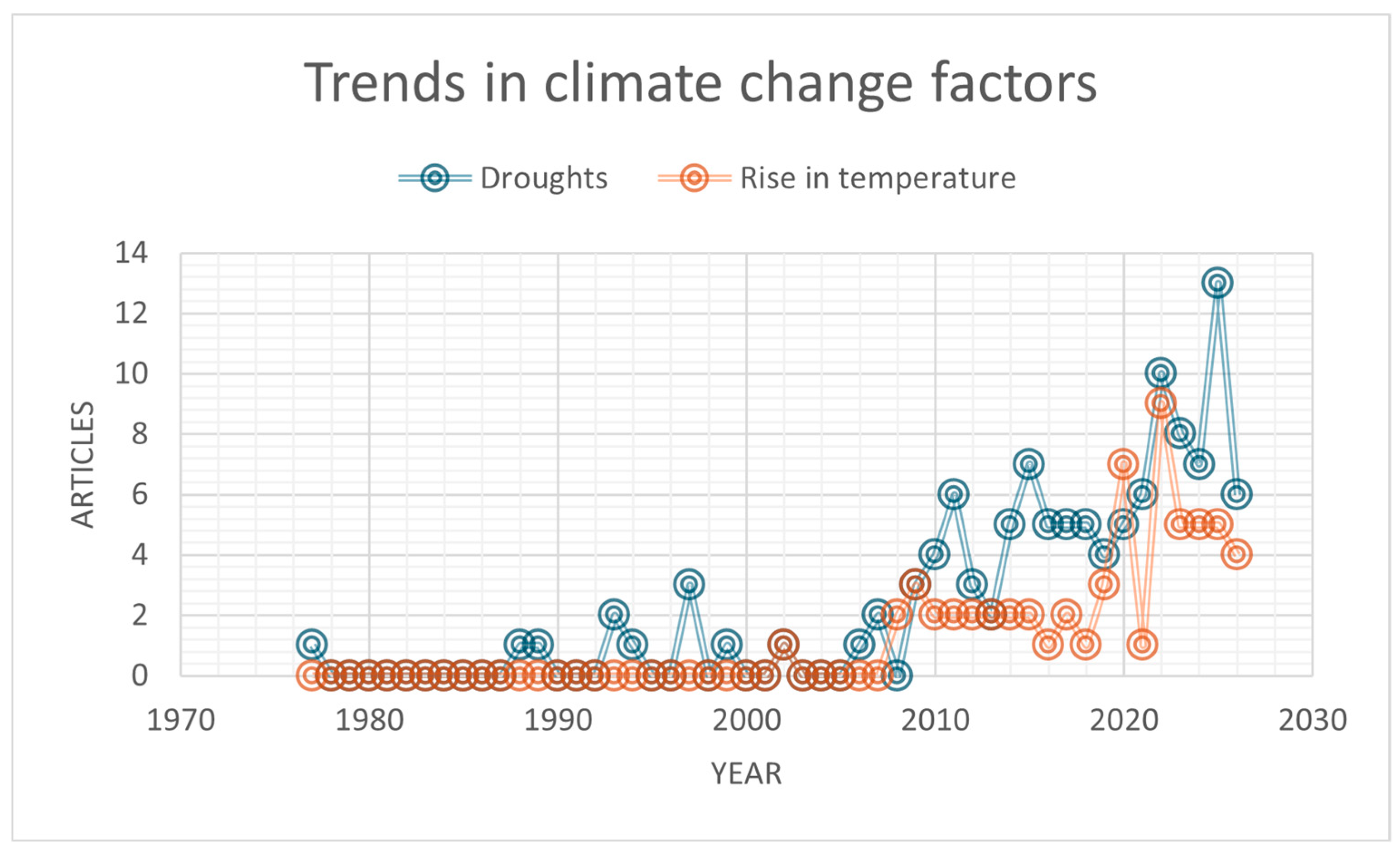
Drought and rising temperatures generally follow the same trend over time, and although they are present throughout most of the study period, they have intensified since the 2010s, reaching significant peaks in 2022 and 2025, with the latter year marking the highest peak in studies reporting drought as a factor in the decline of Abies (Figure 2). It should be noted that the years covered by the studies lag the actual drought events due to publication timelines. For example, in Mexico, there were extreme and exceptional droughts in 2024, which subsided in 2025 [31]; however, the decline due to drought is reported up to 2025 because of the time required for research and publication.
This pattern indicates increasing scientific attention to drought and rising temperatures as reported drivers of Abies decline, although publication trends are not necessarily a direct measure of ecological impact.

3.1.2. Physiology of Tree Mortality

Physiological research has identified two main mechanisms that explain tree death under water stress: water failure and carbon starvation. Negative xylem pressure is a normal condition in transpiring trees and should not be interpreted as an indicator of poor tree condition by itself. However, increasingly negative water potentials reflect greater xylem tension and, under drought conditions, may be associated with increased vulnerability to cavitation, loss of hydraulic conductivity and hydraulic failure. Therefore, in this study, more negative water potential values were interpreted as evidence of higher hydraulic stress rather than as a direct indicator of tree decline [19]. Studies such as those by [32,33] demonstrate that most tree species operate near their water safety thresholds, and that a loss of more than 60% of water conductivity represents a universal physiological threshold for mortality. On the other hand, carbon starvation, caused by a sustained reduction in photosynthesis and increased respiratory consumption, can deplete the tree’s carbohydrate reserves, especially under high temperatures [19,34].
Temperature not only increases evaporation but also acts as a drought amplifier by raising the vapor pressure deficit (VPD), forcing stomatal closure and disrupting water transport. Ref. [12] demonstrated that VPD is a key predictor of forest mortality in the southwestern United States and that the FDSI index, which integrates winter precipitation and warm VPD, accurately predicts tree stress and death. These thermal effects extend to continental scales, as evidenced by mass mortality events in Central Europe during the 2018 drought [35].

3.1.3. Biotic Interactions

Drought also weakens trees’ defenses and makes them more vulnerable to insects and fungi. Bark beetles, for example, have been responsible for massive mortality events in coniferous forests in North America and Europe [9,11,36]. Ref. [36] shows that warming extends the attack window, increases the insects’ winter survival, and favors more aggressive fungal symbionts. This synergy between water stress and pests has triggered large-scale transformations in forest structure, such as the massive loss of Pinus albicaulis Engelm. in alpine areas [36].
Drought not only directly affects the growth of A. religiosa but also increases its vulnerability to pests. In the Reserva de la Biosfera Mariposa Monarca (RBMM), Ref. [6] reported a significant increase in bark beetle outbreaks between 2011 and 2021, with more than 2700 cases in the latter. These outbreaks correlate with droughts that occurred up to two years earlier, suggesting a delayed effect of water stress. The high density of the species in some stands (up to 822 trees per hectare) facilitates the spread of pests such as Scolytus mundus Wood, Pseudohylesinus variegatus Bland. and Pityophthorus sp.
However, Ref. [37] found no direct relationship between the measured climatic variables and the severity of beetle damage, suggesting that factors such as human activity or ecological interactions may play a more decisive role. Ref. [38] found that chlorosis and reddening of foliage in A. religiosa forests are associated with deficiencies in nitrogen, phosphorus, potassium, magnesium, and manganese, possibly exacerbated by air pollution, particularly ozone, which weakens the trees’ resistance to drought and pests.

3.1.4. Global Vulnerability

Even in the absence of extreme events, background mortality is increasing in many regions, as documented by [39] for conifers in the western United States and by [40] for Canada’s boreal forests. These increases correlate with regional warming and growing water deficits, indicating that trees are dying at higher rates due to climate, not competition or direct disturbances.
The meta-analysis by [41] shows that vulnerability to cavitation (P50) and water safety margins account for much of the variability in mortality across species. While gymnosperms tend to rely more on wide margins, angiosperms often exhibit riskier strategies that could prove lethal if droughts intensify. In tropical rainforests such as the Amazon, long-term experimental studies reveal that the mortality of large trees is primarily due to hydraulic collapse, not carbon starvation, underscoring the universality of the hydraulic mechanism [16].

3.1.5. Implications for Modeling

The incorporation of explicit physiological mechanisms into climate and vegetation models is essential. Ref. [42] proposes a version of Darcy’s law adapted to the canopy to predict the decline in hydraulic conductance under increasing VPD. Refs. [17,33] agree that current models underestimate the threat because they poorly represent mortality processes. Adaptive management, including thinning, selection of resistant genotypes, and physiological monitoring, becomes critical for increasing forest resilience.

3.1.6. Response of Abies religiosa and Other Species

A. religiosa, known as the oyamel or Sacred Fir, is a dominant species in the high-mountain temperate forests of central Mexico, forming dense and diverse communities that provide important ecosystem services. These forests perform critical functions such as water catchment, soil protection, carbon storage, and the provision of habitat for numerous species, including the monarch butterfly (D. plexippus), which uses these forests as a winter refuge [6]. Their presence in protected natural areas, such as the RBMM and El Parque Nacional El Chico, underscores their ecological, economic, social, and cultural significance.
In Eastern Europe, Ref. [5] evaluated the drought response of six Abies species and ten provenances of A. alba and examined whether wood properties and climate of origin influence this response. Six drought events were identified between 1970 and 2011, characterized by the Standardized Precipitation Index (SPI), and metrics such as resistance, recovery, and resilience were analyzed. The results showed that the response depends on when the drought occurs; events at the beginning of the season reduce growth by up to 50%, while late droughts have a lesser impact. Among species, A. nordmanniana Steven Spach showed the greatest resistance and A. cephalonica Loud. the best recovery, while A. alba exhibited internal variability without stable patterns.
In Mexico, studies of A. durangensis Mart. in the Sierra Madre Occidental reveal that the species is sensitive to extreme temperatures and positively depends on winter precipitation, showing good resilience, although with limited adaptability to a warmer and drier climate [43]. Meanwhile, A. hickelii, endemic to southern Mexico, has specific environmental requirements, being concentrated at elevations above 3050 m and preferring open canopies and moist soils; its natural regeneration is low and dependent on optimal microenvironmental conditions [7].

3.1.7. Historical Evidence of Droughts in A. religiosa Forests

In El Parque Nacional Pico de Tancítaro, Ref. [44] reconstructed annual precipitation from 1884 to 2010 using growth rings from A. religiosa. These drought periods were not evenly spaced, indicating that severe drought occurrence was episodic rather than strictly periodic. This chronology showed significant correlations between radial growth and precipitation, validating the species as a climate indicator. A growth reduction event linked to the eruption of the Paricutín volcano was also documented, illustrating how non-hydrological disturbances can alter forest productivity.

3.1.8. The Influence of Pollution and Atmospheric Nitrogen

In a broader context, Ref. [45] analyzed how drought and nitrogen deposition affect the regeneration of various conifer species in Europe. Although this study did not include A. religiosa, its findings are relevant: silver fir (A. alba) showed increased growth under high nitrogen loads even under drought conditions, due to its ability to reduce ammonium uptake and avoid toxicity. This type of interaction suggests that Abies’ response to drought could be modulated by nutrient availability, an aspect that has been little explored in A. religiosa and that could influence its future management.
Historically, acid rain and atmospheric deposition were also considered important contributors to forest decline in several temperate regions, particularly through soil acidification, nutrient imbalance, and increased susceptibility to additional stressors. Although current research has shifted toward drought, warming, ozone, and nitrogen deposition, acid rain remains relevant as part of the broader legacy of pollution-related forest decline [46,47,48,49].

3.1.9. Conservation and Management Strategies

Climate change projects a critical scenario for A. religiosa. Ref. [25] modeled the near-total loss of suitable climatic conditions for the species within the RBMM by the end of the 21st century. In response, they evaluated assisted migration on Nevado de Toluca by planting Sacred Fir at different elevations (3400–4000 m). Although survival and growth decreased with altitude, acceptable survival (68%) was recorded at 3800 m, opening the possibility of creating new climatic refuges for the monarch butterfly.
Forest management also influences the structure and regeneration of the species. Ref. [50] showed that in Hidalgo, populations of A. religiosa exhibit different regeneration patterns depending on the degree of management intervention. Protected areas or those with moderate management retain inverted “J” structures, indicative of active regeneration, while intensive management generates clearings with an abundance of seedlings but lower richness of accompanying species. An inverted J-shaped structure refers to a diameter distribution with many small individuals and progressively fewer large trees. This pattern is commonly interpreted as evidence of continuous recruitment and active regeneration in uneven-aged stands.

3.2. Bibliometric Analysis

3.2.1. Production

A comparative bibliometric analysis of three datasets reveals significant differences in the evolution, characteristics, and scope of research on forest decline and mortality in Abies. The first dataset represents the broadest research on forest decline and mortality in general, while the second focuses exclusively on Abies, excluding P. abies, allowing for a more specific analysis of less-studied species (Table 2). This differentiation made it possible to contrast general scientific output on forest mortality with the specific development of knowledge regarding Abies species.
The dataset from the narrowed search reveals lower productivity, with 383 documents from 136 sources, as well as a lower growth rate (5.64%) and a higher average document age (14 years), suggesting that this is a more specialized field with fewer recent publications (Table 2). Nevertheless, this dataset remains relevant as it allows for the study of species of the genus Abies that are underrepresented in studies dominated by P. abies.
In terms of academic impact, the full database yields the highest average number of citations per document (53.21). The reduced database shows a lower average (37.66), which can be attributed to its smaller volume, narrower subject focus, and the age of its publications (Table 2).
Regarding content and thematic density, a similar trend is observed: broader searches contain a greater number of both author and indexed keywords (“Plus”), indicating greater thematic diversity. However, narrower searches offer a more limited but specialized scope, useful for in-depth exploration. Finally, it is observed that the proportion of documents with a single author is significantly lower across all databases, confirming the trend toward collaborative and multidisciplinary research in this field (Table 2).
Although the study of forest decline is a well-established and expanding field, research focused on Abies represents a specific niche that, while smaller in scope, is of growing interest, particularly in the context of climate change and biotic pressures such as bark beetles.

3.2.2. Co-Occurrence Maps

Base Search
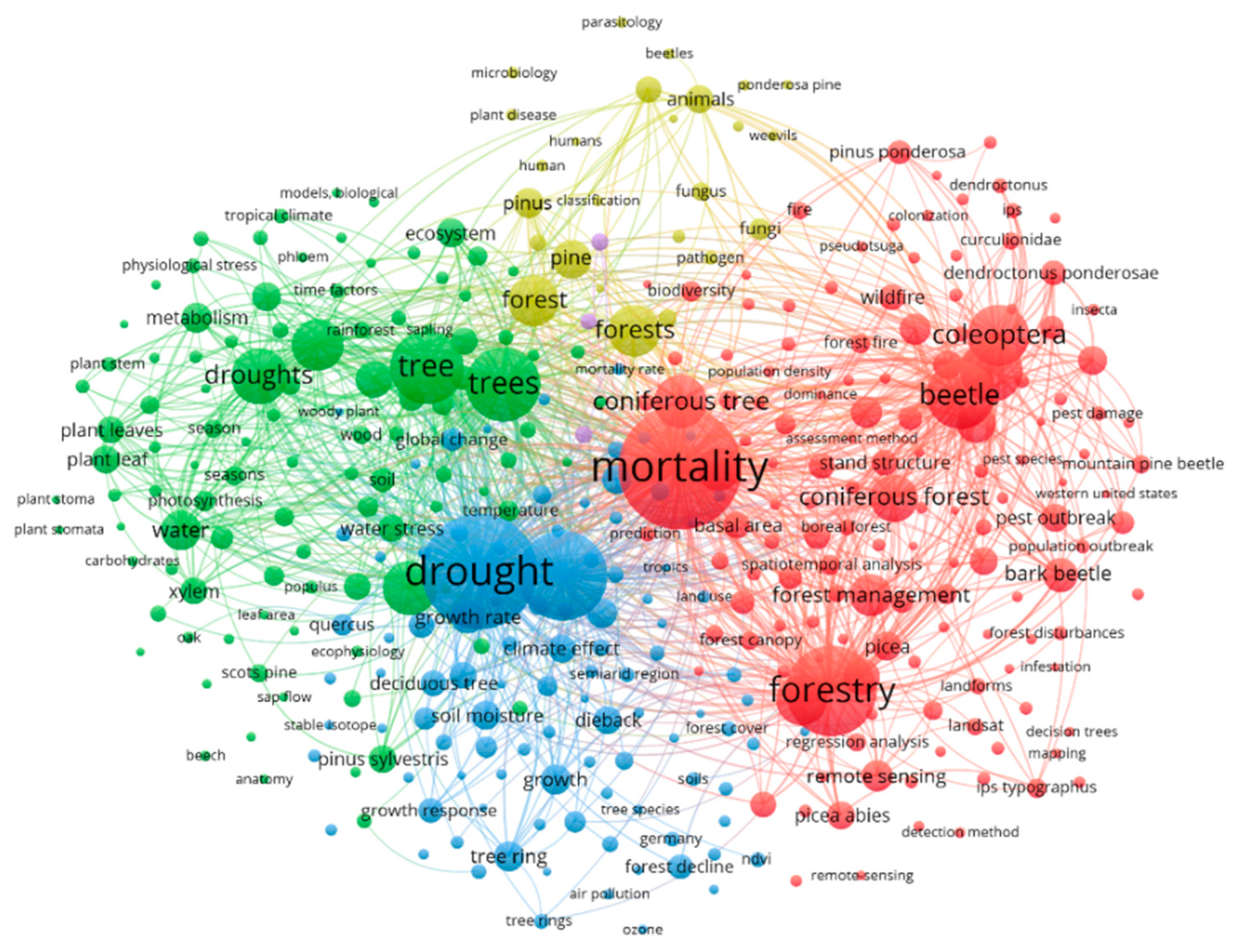
Red cluster (forest insect dynamics and biotic disturbances): This group is dominated by terms such as bark beetle, beetle, Coleoptera, pest outbreak, Dendroctonus, coniferous forest, and forest management, and reflects a strong line of research focused on bark beetles as agents of forest disturbance. A strong association with P. abies is observed, confirming the literature’s bias toward this species within the study of biotic attacks.
Blue cluster (physiological effects of drought): This group is led by the terms “drought,” “soil moisture,” “water stress,” “growth rate,” and “tree ring,” indicating a more ecophysiological focus on the impact of water stress on trees.
Green cluster (ecosystem functioning and plant physiology): This cluster encompasses terms such as “trees,” “metabolism,” “photosynthesis,” “plant leaves,” and “water,” and represents a broader approach to plant physiology, metabolism, and response to climate change. It focuses on experimental studies regarding the vulnerability of trees to drought and their physiological responses, such as cavitation and stomatal regulation.
Yellow cluster (biodiversity and associated organisms): Although smaller, this group includes terms such as pine, fungus, pathogen, and animals. This cluster appears to represent a more biological approach or one focused on trophic interactions.
Although the literature on P. abies dominates the study of bark beetles, there is an under-explored area where drought, mortality, and the genus Abies converge (Figure 3).
Narrowed Search
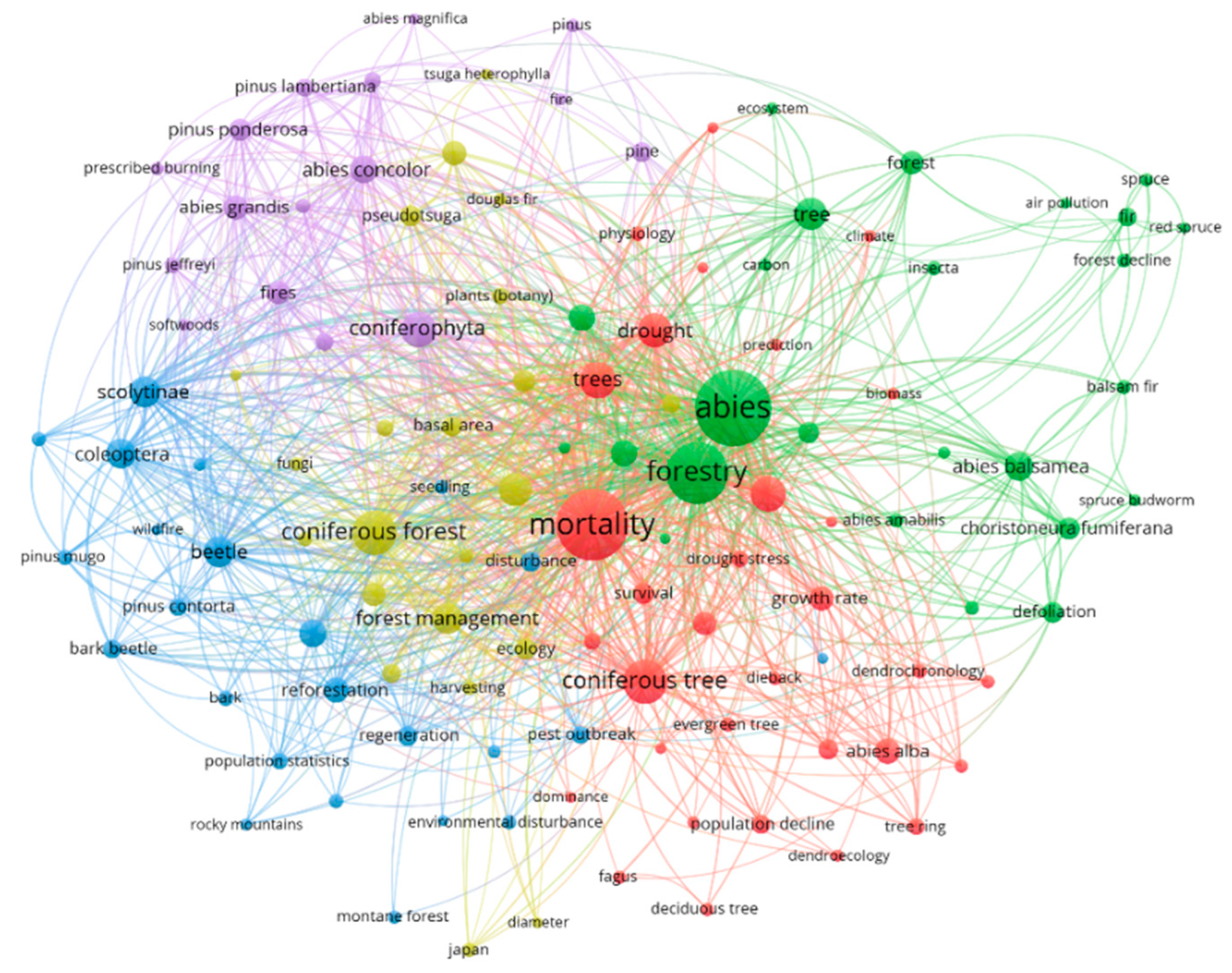
Green Cluster (Abies as the central thematic core): This cluster is organized around the keywords Abies, forestry, tree, forest, and drought. It reflects literature’s primary focus on the interaction between climate change and the ecology of species within the genus, such as A. balsamea, A. grandis (Douglas ex D. Don) Lindl., A. concolor, A. amabilis (Douglas) Forbes, and A. alba. It is noteworthy that this cluster shows a clear integration between the themes of forest management and abiotic stress, suggesting that studies on Abies have an applied and ecological focus, in addition to a physiological one.
Red cluster (forest mortality, stress, and decline): This group is characterized by terms such as mortality, drought stress, decline, defoliation, dieback, and tree ring. It is a cluster clearly focused on the effects of environmental stress on the health of conifers, especially Abies species.
Blue cluster (biotic disturbances and bark beetles): This cluster includes terms such as bark beetle, beetle, Coleoptera, Scolytinae, pest outbreak, coniferous forest, and forest management. It represents the biotic dimension of forest mortality, focusing on bark beetles as agents contributing to forest collapse. Host species such as Pinus contorta Douglas ex Loudon and P. ponderosa P.Lawson & C.Lawson stand out, indicating that, even within a framework centered on Abies, much of the knowledge stems from studies conducted in mixed or pine-dominated forests.
Purple cluster (conifer species diversity and adaptation to disturbances): This cluster groups taxonomic keywords such as Abies grandis, A. concolor, Pseudotsuga, Tsuga heterophylla (Raf.) Sarg., and P. lambertiana Douglas. Here, a more taxonomic and biogeographic focus is observed, with an emphasis on conifers from western North America. It also includes terms such as “fires” and “prescribed burning,” indicating that these species are being studied in the context of multiple disturbances, not just drought or insects.
Yellow cluster (regenerative processes and forest management): This group is associated with regeneration, reforestation, harvesting, ecosystem, seedling, and basal area. It is a cluster that focuses on recovery processes and forest management following decline events.
This map shows that, by focusing specifically on the genus Abies, more specialized themes emerge that are less saturated by studies on P. abies or Pinus. A central thematic core in Abies linked to forest mortality, drought, and forest management is clearly visible (Figure 4).

3.2.3. Bibliometric Indicators

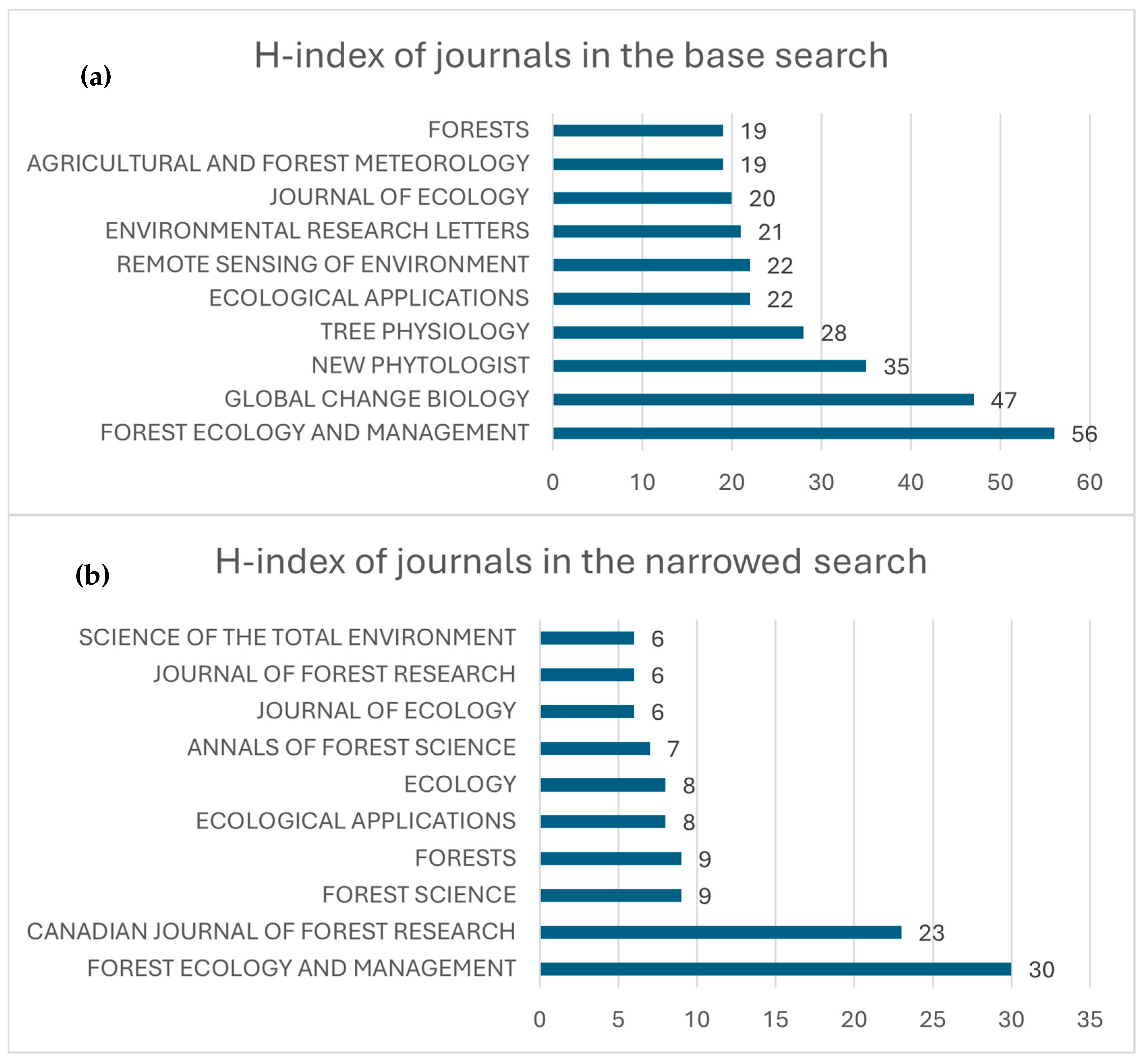
The bibliometric indicators found show that this is an under-researched area with research potential and growing relevance due to the climate-related problems caused by climate change in the world’s natural forests (Table 2, Figure 3 and Figure 4). Clearly, a higher impact factor is observed with the H-index in journals from the broader searches compared to the narrower search, which indicates more restricted research; however, the journals overlap, and in all cases, Forest Ecology and Management leads with the highest impact within the field of study (Figure 5).

4. Discussion

The evidence gathered confirms that Abies is vulnerable to climate change, with effects that are both direct, on its growth, water stress and mortality, and indirect, through increased pest infestations and physiological deterioration [51,52,53,54,55]. The time lag between drought and beetle mortality indicates that water stress has a cumulative effect, gradually weakening the tree’s defenses. Compared to other Abies species, Mexican species are more critical due to their limited geographic range and the convergence of climatic, biotic, and anthropogenic threats [8,46,56,57].
In contrast, species such as A. alba and A. durangensis exhibit variability or greater resilience in their recovery, although they also face adaptive limits [43,50]. A. hickelii, for its part, illustrates how very specific ecological requirements can limit natural regeneration under changing conditions [52,53].
A. religiosa is particularly susceptible to air pollution; most of the literature on the decline of this species focuses on this stress factor, and there have even been reports of a possible reduction in ring width and a decrease in the size of tracheid due to pollution [46,47,48,49].
The temporal distribution of studies on climatic factors, particularly rising temperatures and drought, reflects a growing scientific focus on the recent intensification of these phenomena and their effects on forest ecosystems. Recent global studies have shown that the severity of droughts has increased over the past century and that atmospheric evaporative demand associated with warming has contributed significantly to this increase [20,21]. Likewise, it has been documented that droughts preceding tree mortality events are becoming increasingly prolonged and intense, especially in dry biomes [22], and that warm drought events constitute a climate signal directly associated with forest mortality on a global scale [18]. Taken together, this evidence reinforces the current importance of climate change in the forest sector, where tree decline, loss of vigor, and mortality are recognized as increasingly frequent processes linked to the interaction between warming, water deficit, and other biotic and abiotic disturbances [22,23,24].
On the other hand, the combined effect of drought and bark beetles on Abies has been studied very little as a whole; even when considered separately, bark beetles have not been studied extensively compared to those affecting pine trees or P. abies; however, they are a biotic factor of growing importance because climate change enhances their ability to cause mortality; in central Mexico, examples of this phenomenon have already begun to be observed in A. religiosa [6,9].
Nevertheless, drought–bark beetle interactions should not be interpreted as a uniform mechanism across species or regions. Tree-level mortality during extreme drought and concurrent bark beetle outbreaks can show few generalizable patterns, reflecting the influence of host species, local climate, stand structure, beetle population dynamics, and tree physiological condition [58].
Conservation efforts for A. religiosa must incorporate dendroclimatic monitoring to anticipate droughts, active pest and disease management, control of illegal or poorly regulated human pressures, and adaptive strategies such as assisted migration, as well as the use of shade-providing shrubs for species susceptible to direct sunlight [25,59]. This multiscale approach is essential not only for preserving the species, but also for ensuring the continued provision of ecosystem and economic services to the communities that depend on it.
The reviewed literature indicates that Abies decline is a multifactorial process whose dominant drivers vary among regions and species. In Europe, decline studies are strongly represented by A. alba, where drought, warming, defoliation, browsing, and stand history have been frequently examined [5,13,26,27]. In North America, research includes species such as A. balsamea, A. concolor, and A. lasiocarpa, often in relation to drought, wildfire, and stand dynamics [8,39,40,41]. In Asia, studies on species such as A. koreana and A. fabri emphasize warming, drought sensitivity, and restricted mountain distributions [52]. In Mexico, research has focused mainly on A. religiosa, where pollution, drought, bark beetles, and conservation concerns linked to the monarch butterfly make the species particularly relevant [6,14,25,46,47,48,49]. These regional contrasts suggest that Abies decline cannot be explained by a single mechanism and that future studies should distinguish between broad climatic drivers and local predisposing factors such as stand density, regeneration failure, air pollution, herbivory, and pest pressure.
Although this review addresses decline across the genus Abies at a global scale, special attention is given to A. religiosa because it is a dominant fir species in the high-elevation forests of central Mexico, has ecological and forestry relevance, and provides critical winter habitat for the monarch butterfly [1,2,3,4,14,25,50]. In addition, A. religiosa has been repeatedly associated with decline processes involving drought, pollution, forest management, and bark beetles, making it a regionally important case for understanding the interaction between climatic stress and biotic agents in Abies forests [6,9,10,46,47,49]. This focus is not intended to overrepresent its global distribution, but to highlight a regionally important and comparatively understudied case within the broader context of Abies decline.

Research Gaps

The analysis reveals significant gaps in scientific literature. First, there is little information on the population dynamics and life cycles of specific bark beetles in A. religiosa forests, particularly under scenarios of rising temperatures. Second, there is limited integration between ecophysiological studies of hydraulic vulnerability and models of susceptibility to biotic attacks.
Furthermore, although remote sensing is emerging as a tool, its application using high-resolution UAV platforms for the early monitoring of decline in A. religiosa remains under-explored. Finally, the functional relationship between the structural degradation of the oyamel canopy and the microclimatic stability necessary for the migratory phenomenon of Danaus plexippus constitutes a critical line of research that remains insufficiently developed.

5. Conclusions

The scientific evidence documented in this review includes the frequency of reported decline causes across 237 screened articles, regional patterns in reported drivers, and bibliometric co-occurrence patterns showing that drought, warming, and bark beetles are unevenly represented across conifer genera.
This review shows that decline in the genus Abies is a global and multifactorial phenomenon, with drought, pollution, and rising temperature emerging as the most frequently reported causes. However, the relative importance of these drivers varies among regions and species, reflecting differences in climate, stand structure, management history, disturbance regimes, and local biotic pressures. Although drought–bark beetles’ interactions have been extensively studied in other conifer genera, comparable evidence for Abies remains limited, indicating a relevant research gap.
Future studies should integrate dendroecology, ecophysiology, pest monitoring, remote sensing, and long-term field observations to distinguish local decline processes from broader climate-driven trends.
In Mexico, A. religiosa represents a particularly important case because of its ecological role, conservation value, and increasing exposure to drought and biotic stressors.

Author Contributions

Conceptualization, P.M.-G., D.C.-T. and A.I.M.-R.; methodology, P.M.-G. and A.I.M.-R.; validation, D.C.-T., A.V.-M., J.L.G.-S. and A.I.M.-R.; formal analysis, P.M.-G. and A.V.-M.; investigation, P.M.-G. and J.L.G.-S.; data curation, P.M.-G.; writing—original draft preparation, P.M.-G. and D.C.-T.; writing—review and editing, P.M.-G., D.C.-T., A.I.M.-R., J.L.G.-S. and A.V.-M.; visualization, D.C.-T.; supervision, A.I.M.-R.; project administration, A.I.M.-R.; funding acquisition, A.V.-M. All authors have read and agreed to the published version of the manuscript.

Funding

This research received no external funding. P.M-G. received a scholarship from the Secretaría de Ciencias, Humanidades, Tecnología e Innovación (SECIHTI). The APC was funded by the DGIP program at Universidad Autónoma Chapingo.

Data Availability Statement

The original contributions presented in this study are included in the article. Further inquiries can be directed to the corresponding author.

Acknowledgments

We would like to express our gratitude for the scholarship awarded to P.M.-G. by the Secretaría de Ciencias, Humanidades, Tecnología e Innovación (SECIHTI) and the DGIPS program at Universidad Autónoma Chapingo for the APC. During the preparation of this manuscript/study, the authors used ChatGPT (version 5.5) for the purposes of improving the literature review and streamlining code generation in R Studio (version 4.5.3) for the creation of a global map of causes of decline. The authors have reviewed and edited the output and take full responsibility for the content of this publication.

Conflicts of Interest

The authors declare no conflicts of interest.

References

  1. Flores García, A. Producción maderable de Abies religiosa (Kunth) Schltdl. & Cham. en zonas de movimiento de germoplasma. Rev. Mex. Cienc. For. 2019, 10, 238–247. [Google Scholar] [CrossRef] [Scilit]
  2. Manzur Chávez, N.; Rodríguez Laguna, R.; Razo Zárate, R.; Acevedo Sandoval, O.A.; Octavio Aguilar, P. Biomasa aérea y radicular en etapa de brinzal de Abies religiosa (Kunth) Schltdl. & Cham. en Hidalgo. Rev. Mex. Cienc. For. 2024, 16, 28–47. [Google Scholar] [CrossRef] [Scilit]
  3. Martínez-Méndez, N.; Aguirre-Planter, E.; Eguiarte, L.E.; Jaramillo-Correa, J.P. Modelado de nicho ecológico de las especies del género Abies (Pinaceae) en México: Algunas implicaciones taxonómicas y para la conservación. Bot. Sci. 2016, 94, 5–14. [Google Scholar] [CrossRef] [Scilit]
  4. Rosales-Islas, E.; Barrera-Tello, D.; Sánchez-González, A.; Galván-Hernández, D.M.; Hernández-León, S.; Octavio-Aguilar, P. Caracterización morfológica y genética de las poblaciones de Abies en Hidalgo, México: Importancia de la identidad taxonómica para el aprovechamiento forestal. Bot. Sci. 2023, 101, 417–434. [Google Scholar] [CrossRef] [Scilit]
  5. George, J.P.; Schueler, S.; Karanitsch-Ackerl, S.; Mayer, K.; Klumpp, R.T.; Grabner, M. Inter- and intra-specific variation in drought sensitivity in Abies spec. and its relation to wood density and growth traits. Agric. For. Meteorol. 2015, 214–215, 430–443. [Google Scholar] [CrossRef] [Scilit] [PubMed]
  6. Gómez-Pineda, E.; Sáenz-Romero, C.; Salinas-Melgoza, M.Á.; Ramírez, M.I. Drought occurrence and forest management: Interrelated drivers of sanitary logging in central México temperate forests. Trees For. People 2023, 13, 100413. [Google Scholar] [CrossRef] [Scilit]
  7. Gutiérrez, E.; Trejo, I. La respuesta de Abies hickelii a los factores ambientales en el sur de México. Madera Bosques 2023, 29, e2932452. [Google Scholar] [CrossRef] [Scilit]
  8. Savage, M. The role of anthropogenic influences in a mixed-conifer forest mortality episode. J. Veg. Sci. 1997, 8, 95–104. [Google Scholar] [CrossRef] [Scilit]
  9. Gómez-Pineda, E.; Hammond, W.M.; Trejo-Ramírez, O.; Gil-Fernández, M.; Allen, C.D.; Blanco-García, A.; Sáenz-Romero, C. Drought years promote bark beetle outbreaks in Mexican forests of Abies religiosa and Pinus pseudostrobus. For. Ecol. Manag. 2022, 505, 119944. [Google Scholar] [CrossRef] [Scilit]
  10. Del-Val, E.; Sáenz-Romero, C. Insectos descortezadores (Coleoptera: Curculionidae) y cambio climático: Problemática actual y perspectivas en los bosques templados. TIP Rev. Espec. Cienc. Quím.-Biol. 2017, 20, 53–60. [Google Scholar] [CrossRef] [Scilit]
  11. Singh, V.V.; Naseer, A.; Mogilicherla, K.; Trubin, A.; Zabihi, K.; Roy, A.; Jakuš, R.; Erbilgin, N. Understanding bark beetle outbreaks: Exploring the impact of changing temperature regimes, droughts, forest structure, and prospects for future forest pest management. Rev. Environ. Sci. Bio-Technol. 2024, 23, 257–290. [Google Scholar] [CrossRef] [Scilit]
  12. Williams, A.P.; Allen, C.D.; Macalady, A.K.; Griffin, D.; Woodhouse, C.A.; Meko, D.M.; Swetnam, T.W.; Rauscher, S.A.; Seager, R.; Grissino-Mayer, H.D.; et al. Temperature as a potent driver of regional forest drought stress and tree mortality. Nat. Clim. Chang. 2013, 3, 292–297. [Google Scholar] [CrossRef] [Scilit]
  13. Durand-Gillmann, M.; Cailleret, M.; Boivin, T.; Nageleisen, L.-M.; Davi, H. Individual vulnerability factors of Silver fir (Abies alba Mill.) to parasitism by two contrasting biotic agents: Mistletoe (Viscum album L. ssp. abietis) and bark beetles (Coleoptera: Curculionidae: Scolytinae) during a decline process. Ann. For. Sci. 2014, 71, 659–673. [Google Scholar] [CrossRef] [Scilit]
  14. Sáenz-Romero, C.; Rehfeldt, G.E.; Duval, P.; Lindig-Cisneros, R.A. Abies religiosa habitat prediction in climatic change scenarios and implications for monarch butterfly conservation in Mexico. For. Ecol. Manag. 2012, 275, 98–106. [Google Scholar] [CrossRef] [Scilit]
  15. Allen, C.D.; Macalady, A.K.; Chenchouni, H.; Bachelet, D.; McDowell, N.; Vennetier, M.; Kitzberger, T.; Rigling, A.; Breshears, D.D.; Hogg, E.H.; et al. A global overview of drought and heat-induced tree mortality reveals emerging climate change risks for forests. For. Ecol. Manag. 2010, 259, 660–684. [Google Scholar] [CrossRef] [Scilit]
  16. Rowland, L.; Costa, A.C.L.; Galbraith, D.R.; Oliveira, R.S.; Binks, O.J.; Oliveira, A.A.R.; Pullen, A.M.; Doughty, C.E.; Metcalfe, D.B.; Vasconcelos, S.S.; et al. Death from drought in tropical forests is triggered by hydraulics not carbon starvation. Nature 2015, 528, 119–122. [Google Scholar] [CrossRef] [Scilit] [PubMed]
  17. Allen, C.D.; Breshears, D.D.; McDowell, N.G. On underestimation of global vulnerability to tree mortality and forest die-off from hotter drought in the Anthropocene. Ecosphere 2015, 6, 129. [Google Scholar] [CrossRef] [Scilit]
  18. Hammond, W.M.; Williams, A.P.; Abatzoglou, J.T.; Adams, H.D.; Klein, T.; López, R.; Sáenz-Romero, C.; Hartmann, H.; Breshears, D.D.; Allen, C.D. Global field observations of tree die-off reveal hotter-drought fingerprint for Earth’s forests. Nat. Commun. 2022, 13, 1761. [Google Scholar] [CrossRef] [Scilit] [PubMed]
  19. Sevanto, S.; McDowell, N.G.; Dickman, L.T.; Pangle, R.; Pockman, W.T. How do trees die? A test of the hydraulic failure and carbon starvation hypotheses. Plant Cell Environ. 2014, 37, 153–161. [Google Scholar] [CrossRef] [Scilit] [PubMed]
  20. Gebrechorkos, S.H.; Sheffield, J.; Vicente-Serrano, S.M.; Funk, C.; Miralles, D.G.; Peng, J.; Dyer, E.; Talib, J.; Beck, H.E.; Singer, M.B.; et al. Warming accelerates global drought severity. Nature 2025, 642, 628–635. [Google Scholar] [CrossRef] [Scilit] [PubMed]
  21. Gazol, A.; Pizarro, M.; Hammond, W.M.; Allen, C.D.; Camarero, J.J. Droughts preceding tree mortality events have increased in duration and intensity, especially in dry biomes. Nat. Commun. 2025, 16, 5779. [Google Scholar] [CrossRef] [Scilit] [PubMed]
  22. Xu, C.; Liu, H.; Ciais, P.; Hartmann, H.; Camarero, J.J.; Wu, X.; Hammond, W.H.; Allen, C.D.; Chen, F. Enhanced drought exposure increasingly threatens more forests than observed. Earth’s Future 2024, 12, e2023EF003705. [Google Scholar] [CrossRef] [Scilit]
  23. International Tree Mortality Network. Towards a global understanding of tree mortality. New Phytol. 2025, 245, 2377–2392. [Google Scholar] [CrossRef] [Scilit]
  24. Dudney, J.; Edwards, J.; Harvey, B.J.; Seidl, R. Climate change effects on interacting disturbances in forest ecosystems. Annu. Rev. Ecol. Evol. Syst. 2025, 56, 393–420. [Google Scholar] [CrossRef] [Scilit]
  25. Sáenz-Romero, C.; Osuna-Vallejo, V.; Herrejón-Calderón, P.; Pérez-Cruz, L.A.; Joaquín-Juan, M.G.; Cruzado-Vargas, A.L.; O’Neill, G.A.; Zacarías-Correa, A.G.; Manzanilla-Quijada, G.E.; Lindig-Cisneros, R.; et al. Establishing monarch butterfly overwintering sites for future climates: Abies religiosa upper altitudinal limit expansion by assisted migration. Front. For. Glob. Chang. 2024, 7, 1440517. [Google Scholar] [CrossRef] [Scilit]
  26. Konôpka, B.; Šebeň, V. Positive impact of large wild herbivore exclusion on silver fir regeneration: A case study from the Poľana Mountains, Central Slovakia. Cent. Eur. For. J. 2024, 70, 248–262. [Google Scholar] [CrossRef] [Scilit]
  27. Šebeň, V.; Konôpka, B. Assessing the influence of ruminating ungulates on forest regeneration and young stands in Slovakia: Results from the National Forest Inventory. Cent. Eur. For. J. 2024, 70, 222–234. [Google Scholar] [CrossRef] [Scilit]
  28. Elsevier. Scopus Search: Identify Trends for Key Topics. Available online: https://www.elsevier.com/products/scopus/search (accessed on 14 June 2026).
  29. Aria, M.; Cuccurullo, C. Bibliometrix: An R-tool for comprehensive science mapping analysis. J. Informetr. 2017, 11, 959–975. [Google Scholar] [CrossRef] [Scilit]
  30. Túñez-López, M.; Valarezo-González, K.; Marín-Gutiérrez, I. The impact of research and researchers on communication in Latin America: The h-index for scientific journals. Palabra Clave 2014, 17, 895–919. [Google Scholar] [CrossRef] [Scilit]
  31. Comisión Nacional del Agua. Monitor de Sequía de México: Al 31 de Mayo de 2026. Available online: https://smn.conagua.gob.mx/es/climatologia/monitor-de-sequia/monitor-de-sequia-en-mexico (accessed on 18 June 2026).
  32. Choat, B.; Jansen, S.; Brodribb, T.J.; Cochard, H.; Delzon, S.; Bhaskar, R.; Bucci, S.J.; Feild, T.S.; Gleason, S.M.; Hacke, U.G.; et al. Global convergence in the vulnerability of forests to drought. Nature 2012, 491, 752–755. [Google Scholar] [CrossRef] [Scilit] [PubMed]
  33. Adams, H.D.; Zeppel, M.J.B.; Anderegg, W.R.L.; Hartmann, H.; Landhäusser, S.M.; Tissue, D.T.; Huxman, T.E.; Hudson, P.J.; Franz, T.E.; Allen, C.D.; et al. A multi-species synthesis of physiological mechanisms in drought-induced tree mortality. Nat. Ecol. Evol. 2017, 1, 1285–1291. [Google Scholar] [CrossRef] [Scilit] [PubMed]
  34. Adams, H.D.; Guardiola-Claramonte, M.; Barron-Gafford, G.A.; Villegas, J.C.; Breshears, D.D.; Zou, C.B.; Troch, P.A.; Huxman, T.E. Temperature sensitivity of drought-induced tree mortality portends increased regional die-off under global-change-type drought. Proc. Natl. Acad. Sci. USA 2009, 106, 7063–7066. [Google Scholar] [CrossRef] [Scilit] [PubMed]
  35. Schuldt, B.; Buras, A.; Arend, M.; Vitasse, Y.; Beierkuhnlein, C.; Damm, A.; Gharun, M.; Grams, T.E.E.; Hauck, M.; Hajek, P.; et al. A first assessment of the impact of the extreme 2018 summer drought on Central European forests. Basic Appl. Ecol. 2020, 45, 86–103. [Google Scholar] [CrossRef] [Scilit]
  36. Bentz, B.J.; Régnière, J.; Fettig, C.J.; Hansen, E.M.; Hayes, J.L.; Hicke, J.A.; Kelsey, R.G.; Negrón, J.F.; Seybold, S.J. Climate change and bark beetles of the western United States and Canada: Direct and indirect effects. BioScience 2010, 60, 602–613. [Google Scholar] [CrossRef] [Scilit]
  37. López-Gómez, V.; Arriola Padilla, V.J.; Pérez Miranda, R. Daños por factores abióticos y bióticos en bosques de oyamel (Abies religiosa (Kunth) Schltdl. et Cham.) de la Reserva de la Biósfera Mariposa Monarca. Rev. Mex. Cienc. For. 2015, 6, 56–73. Available online: http://www.scielo.org.mx/scielo.php?script=sci_arttext&pid=S2007-11322015000300005&lng=es&tlng=es (accessed on 21 June 2026).
  38. Rivera-Amaro, R.; López-López, M.; Campos-Bolaños, R. Nutrición y síntomas de declinación de Abies religiosa (H.B.K.) Schl. et Cham. en el Desierto de los Leones, D.F. Rev. Chapingo Ser. Cienc. For. Ambient 2007, 12, 145–150. Available online: https://www.redalyc.org/articulo.oa?id=62912208 (accessed on 21 June 2026).
  39. Van Mantgem, P.J.; Stephenson, N.L.; Byrne, J.C.; Daniels, L.D.; Franklin, J.F.; Fulé, P.Z.; Harmon, M.E.; Larson, A.J.; Smith, J.M.; Taylor, A.H.; et al. Widespread increase of tree mortality rates in the western United States. Science 2009, 323, 521–524. [Google Scholar] [CrossRef] [Scilit] [PubMed]
  40. Peng, C.; Ma, Z.; Lei, X.; Zhu, Q.; Chen, H.; Wang, W.; Liu, S.; Li, W.; Fang, X.; Zhou, X. A drought-induced pervasive increase in tree mortality across Canada’s boreal forests. Nat. Clim. Chang. 2011, 1, 467–471. [Google Scholar] [CrossRef] [Scilit]
  41. Anderegg, W.R.L.; Klein, T.; Bartlett, M.; Sack, L.; Pellegrini, A.F.A.; Choat, B. Meta-analysis reveals that hydraulic traits explain cross-species patterns of drought-induced tree mortality across the globe. Proc. Natl. Acad. Sci. USA 2016, 113, 5024–5029. [Google Scholar] [CrossRef] [Scilit] [PubMed]
  42. McDowell, N.G.; Allen, C.D. Darcy’s law predicts widespread forest mortality under climate warming. Nat. Clim. Chang. 2015, 5, 669–672. [Google Scholar] [CrossRef] [Scilit]
  43. Martínez-Rivas, J.A.; Acosta-Hernández, A.C.; Vivar-Vivar, E.D.; Silva-Ávila, N. Resiliencia de Abies durangensis Martínez a sequías en el suroeste de Durango mediante proxies dendroecológicos. Polibotanica 2025, 59, 97–115. [Google Scholar] [CrossRef] [Scilit]
  44. Cerano-Paredes, J.; Villanueva-Díaz, J.; Cervantes-Martínez, R.; Trucios-Caciano, R.; Guerrero-Soto, J.L. Reconstruction of severe droughts in “Pico de Tancítaro” National Park, Michoacán. Rev. Chapingo Ser. Zon. Áridas 2013, 12, 57–62. [Google Scholar] [CrossRef] [Scilit]
  45. Dietrich, V.; Lauritz, M.; Roggenhofer, M.M.; Redlin-Weiß, J.; Huber, M.; Schulte, J.; Wanninger, A.; Niederberger, J.; Hauck, M. Drought effects on growth and density of temperate tree regeneration under different levels of nitrogen deposition. For. Ecol. Manag. 2024, 559, 121825. [Google Scholar] [CrossRef] [Scilit]
  46. De Bauer, M.L.; Hernández-Tejeda, T. A review of ozone-induced effects on the forests of central Mexico. Environ. Pollut. 2007, 147, 446–453. [Google Scholar] [CrossRef] [Scilit] [PubMed]
  47. Cibrián-Tovar, D. Air pollution and forest decline near Mexico City. Environ. Monit. Assess. 1989, 12, 49–58. [Google Scholar] [CrossRef] [Scilit] [PubMed]
  48. Bernal-Salazar, S.; Terrazas, T.; Alvarado, D. Impact of air pollution on ring width and tracheid dimensions in Abies religiosa in the Mexico City Basin. IAWA J. 2004, 25, 205–215. [Google Scholar] [CrossRef] [Scilit]
  49. Reyes-Galindo, V.; Jaramillo-Correa, J.P.; Shishkova, S.; Sandoval-Zapotitla, E.; Flores-Ortiz, C.M.; Piñero, D.; Spurgin, L.G.; Martin, C.A.; Torres-Jardón, R.; Zamora-Callejas, C.; et al. Histologic, metabolomic, and transcriptomic differences in fir trees from a peri-urban forest under chronic ozone exposure. Ecol. Evol. 2024, 14, e11343. [Google Scholar] [CrossRef] [Scilit] [PubMed]
  50. Hernández-Álvarez, A.G.; Reyes-Ortiz, J.L.; Villanueva-Díaz, J.; Sánchez-González, A. Variación en la estructura del bosque de Abies religiosa (Pinaceae), en diferentes condiciones de manejo y disturbio. Acta Bot. Mex. 2021, 128, e1752. [Google Scholar] [CrossRef] [Scilit]
  51. Marcis, P.; Vido, J.; Kurjak, D.; Lestianska, A.; Poltak, D.; Rybar, J.; Bosela, M. A combined effect of heat and drought limits the growth of Central European silver fir. Agric. For. Meteorol. 2025, 371, 110610. [Google Scholar] [CrossRef] [Scilit]
  52. Zveushe, O.K.; Granda, E.; Camarero, J.J.; Dong, F.; Han, Y.; Resco de Dios, V. Drivers of forest dieback and growth decline in mountain Abies fabri forests (Gongga Mountain, SW China). Forests 2025, 16, 1222. [Google Scholar] [CrossRef] [Scilit]
  53. Schwarz, J.; Skiadaresis, G.; Reinhart, A.-L.; Bauhus, J. Increased drought mortality in fast-growing silver fir trees in the Black Forest. For. Ecol. Manag. 2025, 578, 122441. [Google Scholar] [CrossRef] [Scilit]
  54. García-García, I.; Méndez-Cea, B.; Gallego, F.J.; Linares, J.C.; Horreo, J.L. Genomic insights into climate change-induced forest dieback in Abies alba hotspots of decline. Eur. J. For. Res. 2025, 144, 1–12. [Google Scholar] [CrossRef] [Scilit]
  55. Crespo-Antia, J.P.; González de Andrés, E.; Gazol, A.; Camarero, J.J.; Linares, J.C. Tree-level climate sensitivity reveals size effects and impending growth decline in silver fir affected by dieback. Forests 2024, 15, 999. [Google Scholar] [CrossRef] [Scilit]
  56. Gutiérrez, E.; Trejo, I. Efecto del cambio climático en la distribución potencial de cinco especies arbóreas de bosque templado en México. Rev. Mex. Biodivers. 2014, 85, 179–188. [Google Scholar] [CrossRef] [Scilit]
  57. Vázquez-Ramírez, J.; Narave Flores, H.V.; Cházaro Basañez, M.J. Unexpected consequences of taxonomic misidentification for the conservation of an endangered species. Conserv. Sci. Pract. 2025, 7, e70180. [Google Scholar] [CrossRef] [Scilit]
  58. Reed, C.C.; Hood, S.M. Few generalizable patterns of tree-level mortality during extreme drought and concurrent bark beetle outbreaks. Sci. Total Environ. 2021, 750, 141306. [Google Scholar] [CrossRef] [Scilit] [PubMed]
  59. Pérez-Cruz, L.A.; Baltazar-Cruz, L.E.; Osuna-Vallejo, V.; Joaquín-Juan, M.G.; Sáenz-Romero, C.; Blanco-García, A.; López-Toledo, L.; Zacarías-Correa, A.G. Desempeño de arbustos nodriza plantados en la Reserva de la Biosfera Mariposa Monarca, para mejorar reforestaciones de Abies religiosa (Pinaceae). Acta Bot. Mex. 2026, 133, e2503. [Google Scholar] [CrossRef] [Scilit]
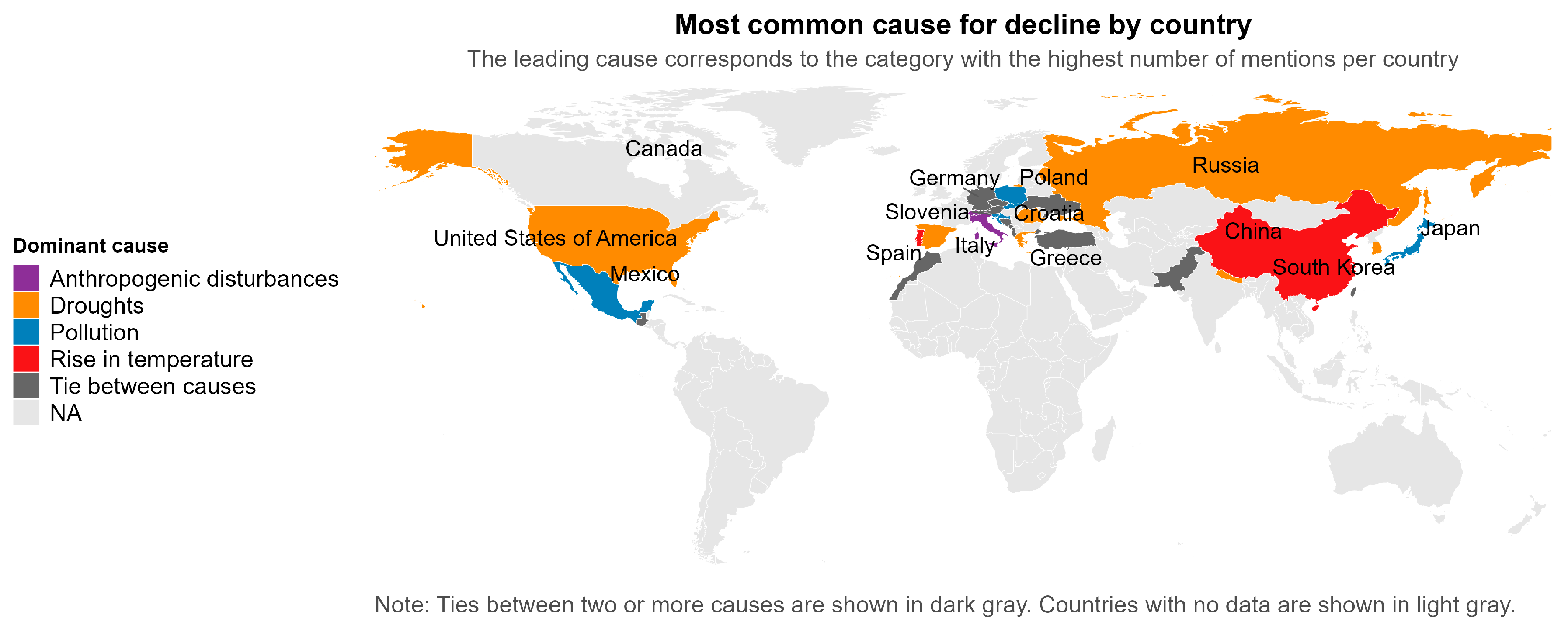
Figure 1. Geographic distribution of studies reporting decline in species of the genus Abies and the dominant reported cause of decline by country. Colors indicate the cause with the highest number of mentions in the reviewed articles for each country. Dark gray indicates countries where two or more causes had the same number of records. Light gray indicates countries with no records in the reviewed Scopus dataset. Data are based on the 237 articles retained after screening.
Forests 17 00732 g001
Figure 2. Annual number of reviewed articles reporting drought and/or rising temperature as causes or contributing factors of decline in Abies species. Data are based on the 237 articles retained from the Scopus search. The final year represents records available up to the search date and should be interpreted as a partial year.
Forests 17 00732 g002
Figure 3. Keyword co-occurrence map for the base Scopus search on forest decline or tree mortality associated with drought or bark beetles. The dataset included articles published between 1975 and 2025. Node size represents keyword frequency, links indicate co-occurrence strength, and colors represent thematic clusters generated in VOSviewer.
Forests 17 00732 g003
Figure 4. Keyword co-occurrence map for the narrowed Scopus search focused on Abies and forest decline or tree mortality, excluding records dominated by Picea abies. The dataset included articles published between 1983 and 2025. Node size represents keyword frequency, links indicate co-occurrence strength, and colors represent thematic clusters generated in VOSviewer.
Forests 17 00732 g004
Figure 5. H-index of the most influential journals in the Scopus dataset used for the bibliometric analysis of forest decline, tree mortality, drought, bark beetles, and Abies. The H-index represents the number of articles from a journal that have received at least the same number of citations within the analyzed dataset. Data were processed using Bibliometrix/Biblioshiny.
Forests 17 00732 g005
Table 1. Reported causes of decline in species of the genus Abies based on the 237 articles retained after screening. Values indicate the number of articles in which each factor was reported as a cause or contributing factor of decline. Because several studies reported more than one factor, categories are not mutually exclusive.
OriginCause for DeclineArticles
Climate/NaturalDroughts118
Severe frosts6
Excessive precipitation4
Changes in the microclimate6
Rise in temperature61
Wind10
NaturalRecurring wildfires15
Geographic isolation and low genetic diversity6
Forest aging11
Changes in forest composition17
Avalanches1
AnthropogenicPollution64
Inadequate forest management25
Anthropogenic disturbances32
Change in land use8
Overgrazing12
Aridification9
Water extraction2
Deforestation11
Intensive logging9
BioticHerbivory18
Bark beetles10
Invasive species8
High density (competition)25
Pathogens29
Leaf-eating insects9
Parasitic plants7
Seed pathogens, loss of viability, loss of regeneration20
Root diseases9
Sucking insects3
DegradationSoil degradation14
Nutritional deficiencies19
Soil acidification9
Soil eutrophication4
Table 2. Main bibliometric indicators for the Scopus datasets used to compare general research on forest decline and tree mortality with research specifically focused on Abies. The base search included literature on forest decline or tree mortality.
DescriptionBase SearchNarrowed Search
Period1975:20251983:2025
Source (Scientific journals)392136
Documents1894383
Annual growth rate (%)9.545.64
Average age of documents8.9214
Average citations per document53.2137.66
References102,18818,150
Keywords Plus70302378
Author keywords45771123
Authors65841203
Authors of single-author documents9032
Documents by a single author9732
Co-authors per document5.714.14
International co-authorship (%)33.6314.88
Articles1894383
Disclaimer/Publisher’s Note: The statements, opinions and data contained in all publications are solely those of the individual author(s) and contributor(s) and not of MDPI and/or the editor(s). MDPI and/or the editor(s) disclaim responsibility for any injury to people or property resulting from any ideas, methods, instructions or products referred to in the content.