Article

The Mitigating Effect of Urban Forest Landscape Structure on Urban Heat Islands: Nonlinear Response and Interaction Effect


1
Guangdong Provincial Observation and Research Station for Urban Agglomeration Ecosystem in Guangdong-Hong Kong-Macao Greater Bay Area, Guangzhou Institute of Geography, Guangdong Academy of Sciences, Guangzhou 510070, China
2
Research Institute of Tropical Forestry, Chinese Academy of Forestry, Guangzhou 510520, China
3
Fuxin Forestry Development Service Center, Fuxin 123000, China
*
Author to whom correspondence should be addressed.
Forests 2026, 17(6), 694; https://doi.org/10.3390/f17060694 (registering DOI)
Submission received: 13 May 2026 / Revised: 7 June 2026 / Accepted: 8 June 2026 / Published: 11 June 2026
(This article belongs to the Special Issue Urban Forests and Ecosystem Services)

Abstract

Investigating the spatiotemporal dynamics of urban heat islands and their responses to urban forest (UF) landscape patterns is crucial for mitigating urban thermal stress. However, the nonlinear influence and conditional constraints of UF landscape composition and configuration on the warming effects across varying urbanization gradients remain inadequately understood. By integrating land use/cover data, MODIS-derived land surface temperature (LST), and meteorological datasets, this study employed the XGBoost-SHAP model to quantify the nonlinear and interaction effects of UF landscape patterns on developed and developing urban regions of the Pearl River Delta. The results indicate that (1) spatial clustering patterns of warming varied significantly between the two regions, with substantial seasonal heterogeneities (p < 0.05). Summer exhibited the most intense warming, characterized by more rapid temperature increase in developed areas than in developing regions. (2) Relative to UF landscape metrics, the proportion of impervious surfaces, precipitation, and temperature exerted greater influence on regional warming. Coverage area, fragmentation, and connectivity of UFs emerged as the primary landscape drivers modulating warming. In developed areas, spatial configuration metrics exerted greater influence on LST than compositional metrics. (3) The responses of LST to diverse UF landscape patterns are characterized by nonlinearity and pronounced threshold effects. These landscape thresholds vary by season, revealing critical tipping points for warming suppression; however, this regulatory effect is highly context-dependent. Specifically, under high percentages of impervious surface, the warming-suppression capacity of UFs intensifies with increasing percentage of UF area or core. Our findings highlight the necessity of strategic UF planning and forest fragmentation mitigation for developing effective climate resilience strategies. These results provide a foundation for adaptive planning tailored to specific urbanization stages and the implementation of targeted UF cooling strategies.

1. Introduction

Rapid global urbanization has facilitated the conversion of natural landscape into impervious surface (IS), profoundly altering surface–atmosphere energy exchange processes [1,2,3]. Compared to natural substrates, artificial surfaces—characterized by high thermal admittance and low heat capacity—facilitate rapid radiative heating, thereby exacerbating urban thermal degradation and intensifying the urban heat island (UHI) effect [4]. The synergy between UHI effects and heatwaves poses severe threats to public health [5], increases energy demand [6], and impairs urban vegetation vigor [7]. Among these phenomena, the surface UHI, primarily represented by land surface temperature (LST), warrants particular attention because of its direct impact on human livelihoods and daily activities [8,9]. Consequently, characterizing spatiotemporal LST dynamics in high-density urban environments is essential for informing climate-resilient urban planning, mitigating thermal stress, and safeguarding public health.
LST characterizes the potential of the land surface to store and release heat driven by solar radiation [10], and is modulated by diverse urban ecosystem factors including climate [11], topography [12], land use/cover dynamics [13], building morphology [14], human activities [15], and green infrastructure patterns [16]. The hydrothermal properties and albedo of underlying surfaces differ significantly across land-use types such as vegetation, water bodies, and buildings; water bodies and vegetation generally exert cooling effects, whereas buildings and ISs exacerbate surface warming [17,18]. Vegetation reduces solar radiation reaching the surface and increases latent heat flux via canopy shading and transpiration, thereby exerting dual cooling and humidifying effects on the local climate [19]. Compact building structures and high building densities impede wind circulation and reduce heat dissipation [20]. Nevertheless, LST responses to changing spatial patterns of these factors are complex, with relationships varying significantly across climatic zones and levels of anthropogenic activity [12]. Therefore, investigating key factors influencing LST under rapid urbanization is essential for optimizing spatial planning, mitigating extreme climate impacts, and promoting urban environmental sustainability.
Urban forests (UFs) constitute the primary component of urban ecological space and play a crucial role in mitigating the UHI effect. Extensive research has examined how the composition and spatial configuration of UFs or green space modulate the urban thermal environment [21]. Some studies indicate that compositional metrics, such as total coverage area, correlate negatively with LST [22], whereas the relationship between configurational metrics and LST is complex; edge density increases LST [16], yet other studies emphasize that increased connectivity and patch shape complexity confer cooling benefits [23]. Furthermore, the influence of green space composition and spatial configuration on LST is nonlinear. For example, Tong et al. [24] reported that green space coverage must exceed 61% to achieve significant cooling. Liu et al. [16] found significant cooling effects when the landscape division index falls below 0.34–0.68. This phenomenon arises from the complex interplay among landscape patterns, human activities, and climatic conditions. Traditional linear models often fail to capture the nonlinearity between UF patterns and LST or to uncover complex variable interactions. To address this limitation, machine learning combined with explainable algorithms—such as the eXtreme Gradient Boosting and SHapley Additive exPlanations (XGBoost-SHAP) model—provides a robust framework for identifying these nonlinearities and threshold effects [25]. Although previous studies have elucidated the nonlinear responses and threshold effects of LST to UF morphology, the conditional constraints governing their cooling efficacy have received limited attention. Moreover, spatial heterogeneity is a fundamental driver of the geographic distribution and diversity of natural elements [26]. Although various studies have employed local models to characterize spatial variations in LST [27], significant uncertainties persist due to substantial global heterogeneity in natural environments and socioeconomic conditions. Consequently, investigating the regulating role of UFs on LST across diverse ecological contexts and development stages provides essential scientific evidence for precise mitigation of the urban thermal environment.
As a representative highly urbanized region both in China and globally, the Pearl River Delta (PRD) faces acute challenges in the urban thermal environment. Intensive anthropogenic activities and climate change have exacerbated the compound risks of UHI effects and extreme heat events. Recent research indicates that IS expansion significantly elevates LST in highly urbanized regions, whereas forests exhibit substantial cooling potential. However, how UF patterns mitigate warming induced by land use/cover change across urbanization gradients, and how these effects vary seasonally, remain unclear. Furthermore, whether the influence of UF landscape patterns on the warming effect is constrained by IS percentage or climatic factors requires further investigation. Accordingly, this study investigates the influence of UF patterns on LST in high-density urban areas across urbanization gradients using a multi-factor integration approach, aiming to inform UF planning and thermal mitigation strategies for the PRD and comparable regions. Specifically, the objectives of this study are: (1) to characterize the spatiotemporal dynamics of the UHI effect and UF patterns in the PRD from 2000 to 2020; (2) to quantify spatial and seasonal variations in the relative importance of UF landscape patterns on LST; and (3) to reveal the nonlinear and interaction effects of UF landscape patterns on LST.

2. Materials and Methods

2.1. Study Area

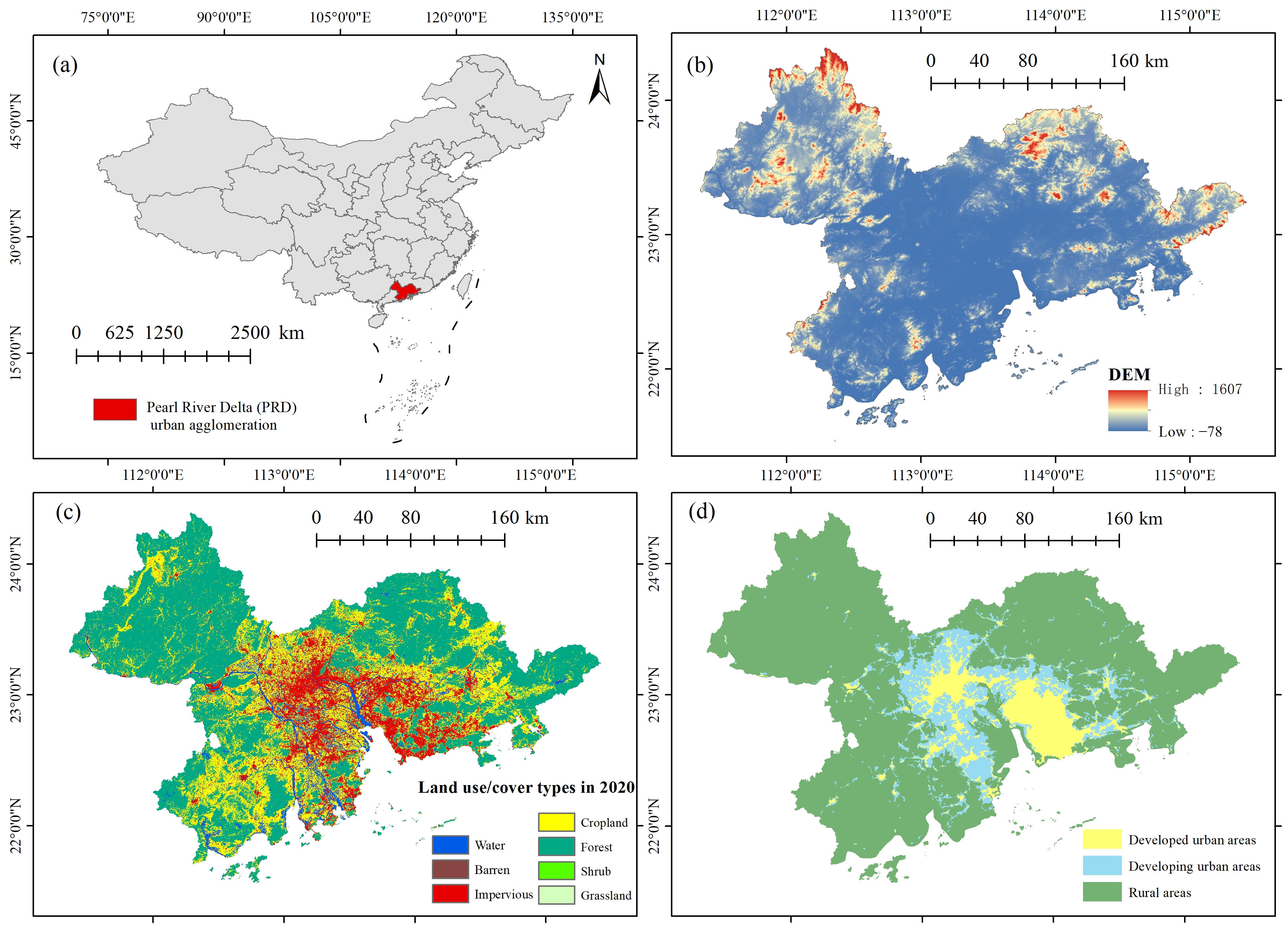
The PRD urban agglomeration is located in central and southern Guangdong Province, China, and the lower reaches of the Pearl River Basin (21°28′–25°31′ N, 111°03′–116°13′ E; Figure 1a). This region encompasses 9 cities within Guangdong Province, covering approximately 55,368.7 km2. The study area lies in the southern subtropical monsoon climate zone, characterized by hot, humid conditions year-round. Precipitation is concentrated in summer, with mean annual precipitation exceeding 1500 mm and mean annual temperature ranging from 21 °C to 23 °C [28]. Elevation decreases gradually from north to south (Figure 1b). Construction land and forestland are the dominant land-use types (Figure 1c), and vegetation is dominated by evergreen broad-leaved forests. The PRD is densely populated and economically developed [29]. Under global warming, the frequency of extreme heat events and prolonged heatwaves in this region is expected to continue increasing [30].

2.2. Data Source and Processing

2.2.1. Data Sources

To investigate the regulating effect of UFs on the LST, data including land use/cover (LULC), digital elevation model (DEM), MODIS LST, precipitation, temperature, and urban built-up area data were collected. The Google Earth Engine platform was used to acquire 1 km resolution, 8-day composite LST data from the MODIS Land series product (MOD11A2). Seasonal mean daytime LST was derived by calculating the pixel-wise average of multiple 8-day composites per season (Winter: December–February; Spring: March–May; Summer: June–August; Autumn: September–November). The China Land Cover Dataset (CLCD) was used to characterize UF spatial patterns [31]. With an overall accuracy of 79.30% ± 1.99%, this dataset demonstrates stable and reliable performance. The LULC in the PRD is classified into eight categories: forestland, shrubland, grassland, cropland, water, impervious land, wetland, and barren land. In this study, UFs were defined by reclassifying forest and shrubland categories within urban areas. The FABDEM V1.2 dataset (30 m resolution), which provides DEM data with building and vegetation heights removed, was employed. Urban built-up area data for China (30 m resolution) and monthly precipitation and temperature data (1 km resolution) were obtained from the National Tibetan Plateau Data Center (https://data.tpdc.ac.cn). Datasets for LST, LULC, precipitation, and temperature were compiled for 2000, 2010, and 2020. To harmonize varying native resolutions, a 1 km × 1 km grid system was established in ArcGIS 10.8, upon which all subsequent analyses were conducted. Grids that are too small risk homogenizing landscape patterns or introducing noise, while excessively large grids reduce sample size and lose landscape pattern details. Based on the spatial resolution of LST data, the grid side length should be an integral multiple of 1 km. Previous studies have identified 660 m and 720 m as optimal scales for quantifying the relationship between LST and landscape composition [32]. Therefore, based on the pixel size of the research data and previous studies, this study adopted a 1 km grid. LST, DEM, precipitation, and temperature data were aggregated to the 1 km grid by averaging all pixels whose centers fell within each grid cell. CLCD data were processed at their native 30 m resolution to compute the IS percentages and UF landscape metrics, which were then aggregated to the 1 km grid via cell-level averaging. This approach avoids multi-resolution resampling while preserving sub-grid heterogeneity, thereby facilitating consistent comparisons across different variables [14].

2.2.2. Urbanization Partition

Urban built-up area data for China in 2000 and 2020 were used to delineate urban-rural boundaries [33]. Based on these boundaries, the study area was categorized into three sub-regions reflecting distinct urbanization levels—developed, developing, and rural—to assess how the LST-regulating capacity of UFs varies by urbanization status (Figure 1d). Specifically, developed urban areas include regions classified as urban in both 2000 and 2020; developing urban areas comprise regions that transitioned from rural to urban status between 2000 and 2020; and rural areas encompass regions that remained classified as rural in both 2000 and 2020 [29].

2.2.3. Relative Surface Temperature Change

The mean–standard deviation method was adopted to classify LST, which has been shown to effectively delineate distinct thermal patches [13]. Initially, LST data were standardized via Equation (S1) [34]. Subsequently, LST values were ranked and classified into five tiers: high-, sub-high-, medium-, sub-low-, and low-temperature areas (Table S1). In this study, the “warming effect” is defined as the LST increase resulting from the conversion of native ecological lands (i.e., forests and grasslands) into ISs or farmland. At the 1 km grid scale, we quantified the warming effect by calculating the difference between urban and rural LST. We first determined the mean elevation of both developed and developing urban regions. Next, we identified rural grid cells with >90% forest and grassland cover within the same elevation ranges to calculate the average temperature as the baseline reference temperature. Finally, the relative change in LST for each grid cell was derived using Equation (S2). The specific calculation formula can be found in the Supplementary Materials.

2.2.4. Selection and Calculation of UF Landscape Pattern Indicators

Drawing on our previous work, seven metrics were selected to quantify UF landscape patterns: Percentage of Landscape (UF_PLAND), Patch Density (UF_PD), Edge Density (UF_ED), Mean Nearest-neighbor Distance (UF_ENN), Mean Patch Size (UF_MPS), Cohesion Index (UF_COHESION), and Effective Mesh Size (UF_MESH) [26,35]. These metrics represent the composition, quantity, edge, size, aggregation, and fragmentation features of UFs (Table S2). All metrics were computed using Fragstats 4.2. To address the limitations of traditional landscape indices in reflecting ecological significance within the patch–corridor–matrix paradigm, we supplemented the analysis with Morphological Spatial Pattern Analysis (MSPA). MSPA is an image processing technique utilizing mathematical morphology to identify spatial patterns based on connectivity. This method uses binary images to categorize foreground pixels into seven distinct spatial pattern types: UF_Core, UF_Islet, UF_Perforation, UF_Edge, UF_Loop, UF_Bridge, and UF_Branch (Table S2). We defined UFs as the foreground and all other land types as the background, performing the MSPA in GuidosToolbox 2.8. Referring to Li et al. [35] and Li et al. [36], the UF_Edge width was set to 30 m. Given their ecological functions, the UF_Loop, UF_Bridge, and UF_Branch classes were aggregated into a “UF_Corridor” category for further analysis.

2.3. Methods

2.3.1. Spatial Heterogeneity Patterns of LST and UFs

Spatial heterogeneity manifests as varying degrees of spatial autocorrelation, which can be captured by statistical measures describing the relationships between neighboring objects [37]. We utilized global and local Moran’s I (ranging from −1 to 1, where positive values denote positive correlation and negative values denote negative correlation) within the exploratory spatial data analysis framework to characterize global and local clustering patterns of LST. Global Moran’s I was employed to assess overall spatial autocorrelation and regional characteristics [38], while local Moran’s I was used to identify local variations and detect specific spatial clusters [39]. Local Moran’s I was categorized into four cluster types: High–High, Low–Low, High–Low, and Low–High [40].

2.3.2. Quantifying the Nonlinear Relationships and Threshold Effects Between Land Surface Temperature and UF Pattern Indicators Based on the XGBoost-SHAP Model

This study employs the XGBoost model to quantify the effect of UF landscape patterns on LST. As a machine learning algorithm based on gradient-boosting decision trees, XGBoost is particularly well suited to high-dimensional ecological data. Compared with conventional regression models, it offers superior computational efficiency, predictive accuracy, and robust regularization that mitigates overfitting [41]. The model effectively captures complex nonlinear relationships and exhibits exceptional flexibility, precision, and scalability [42]. An XGBoost regression framework was used to evaluate the relative importance and marginal effects of two categories of landscape metrics on LST across distinct urbanization gradients. Feature relative importance quantifies the contribution of each predictor to overall predictive performance. Marginal effect analysis characterizes the functional relationship between specific landscape metrics and the target variable (LST). This approach estimates the average change in LST associated with incremental shifts in a given landscape predictor, holding other variables constant. The dataset was partitioned into training (developed area: 6830; developing area: 10,358) and testing (developed area: 1708; developing area: 2590) subsets using an 80/20 split ratio. To account for spatial autocorrelation, a spatial stratification verification framework was adopted to mitigate overfitting and spatial bias. Observational data were clustered based on spatial identifiers, thereby ensuring spatial independence between training and test data [43]. Model optimization was achieved by fine-tuning five key hyperparameters (nround, max_depth, subsample, colsample_bytree, and learning_rate) via 5-fold spatial cross-validation to maximize predictive performance. The optimized hyperparameter configurations for the final model are detailed in Table S3. Model performance was assessed using the coefficient of determination (R2) and root mean square error (RMSE). In addition, a k-nearest-neighbor spatial weight matrix was used to calculate the global Moran’s I for model residuals after cross-validation to test for residual spatial autocorrelation [43].
To enhance model interpretability and transparency, the SHAP algorithm was used to quantify the individual and aggregate influences of features on LST. Rooted in cooperative game theory, the SHAP framework employs an additive feature attribution method to provide robust interpretation of complex machine learning models. By applying Shapley values, this method allocates marginal contributions of each feature, enabling simultaneous assessment of global feature importance, directional local effects, and complex feature interactions. This approach is particularly useful for elucidating the nonlinear contributions of landscape drivers and their synergistic effects on thermal regulation. SHAP values provide a comprehensive metric for both the magnitude and direction of individual feature effects on model predictions. Higher absolute SHAP values signify a stronger contribution of the feature to the predicted deviation from the mean. Positive and negative SHAP values indicate positive or negative contributions to the LST, respectively. The computational approach for deriving Shapley values follows the methodology described by Chen and Guo [14]. All XGBoost and SHAP analyses were conducted in R (version 4.5.1), utilizing the “xgboost”, “shapviz”, and “SHAPforxgboost” packages.

3. Results

3.1. Seasonal Dynamics and Spatial Distribution of LST

3.1.1. Spatiotemporal Dynamics of LST at Different Levels

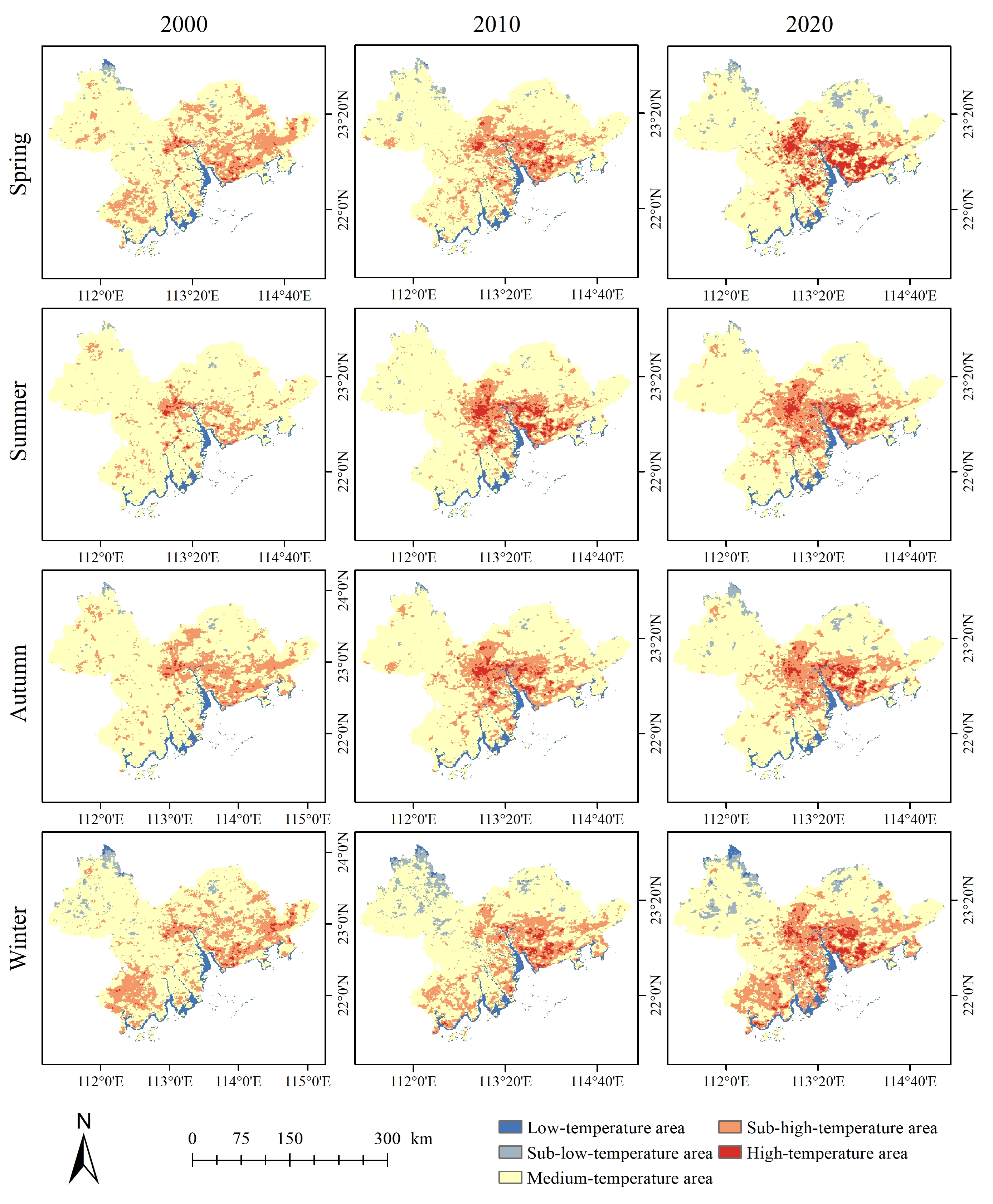
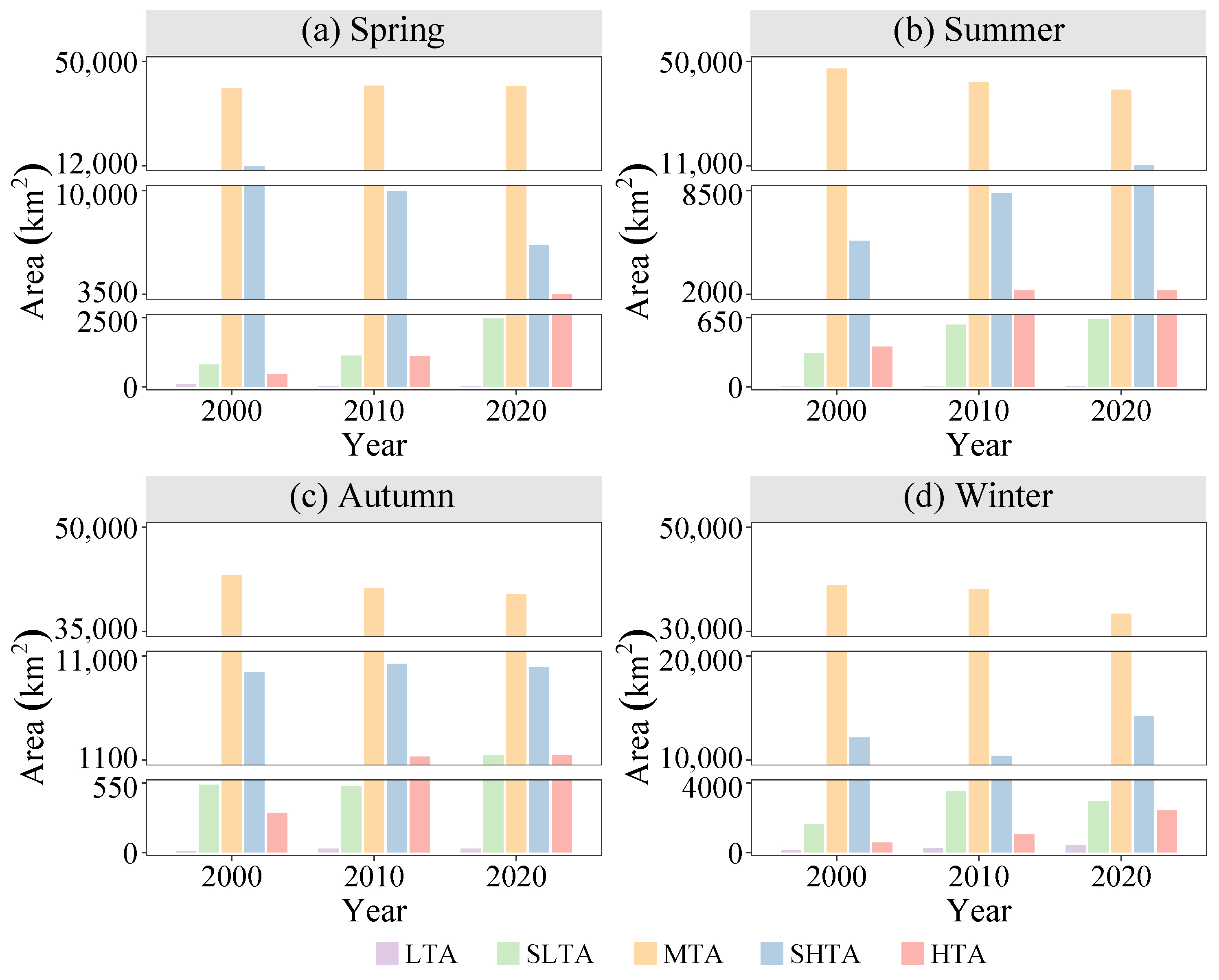
The mean LST in the PRD from 2000 to 2020 was 25.23 °C (spring), 28.33 °C (summer), 24.41 °C (autumn), and 18.11 °C (winter) (Figure S1). Between 2000 and 2020, maximum temperatures increased across all seasons by 3.04%, 5.43%, 6.48%, and 20.12%, respectively, with winter exhibiting the most pronounced interannual increase. From 2000 to 2020, high-temperature areas evolved from scattered patterns to clustered distributions, with expanding coverage primarily within the central and southeastern core urban regions near the Pearl River Estuary. Conversely, low-temperature areas were predominantly located along the southeastern coastline and in the northwestern mountainous regions (Figure 2). Across all seasons, medium-temperature areas predominated (62.54%–88.70%), followed by sub-high-temperature areas (10.01%–26.62%) (Figure 3). Between 2000 and 2020, the area of medium-temperature regions in spring remained relatively stable; meanwhile, low- and sub-high-temperature areas decreased by 280.00% and 80.29%, whereas high- and sub-low-temperature areas increased by 663.12% and 207.38%, respectively, suggesting a rapid shift toward warmer thermal states (Figure 3a). From summer through winter, the area of medium-temperature regions consistently declined, with the greatest reduction in summer (20.11%), followed by winter (16.74%) and autumn (6.87%); conversely, the areas of the other four temperature classes increased, most notably the high-temperature area, which expanded by 505.04% during summer (Figure 3b–d).

3.1.2. Seasonal Dynamics and Spatial Distribution of the Warming Effect

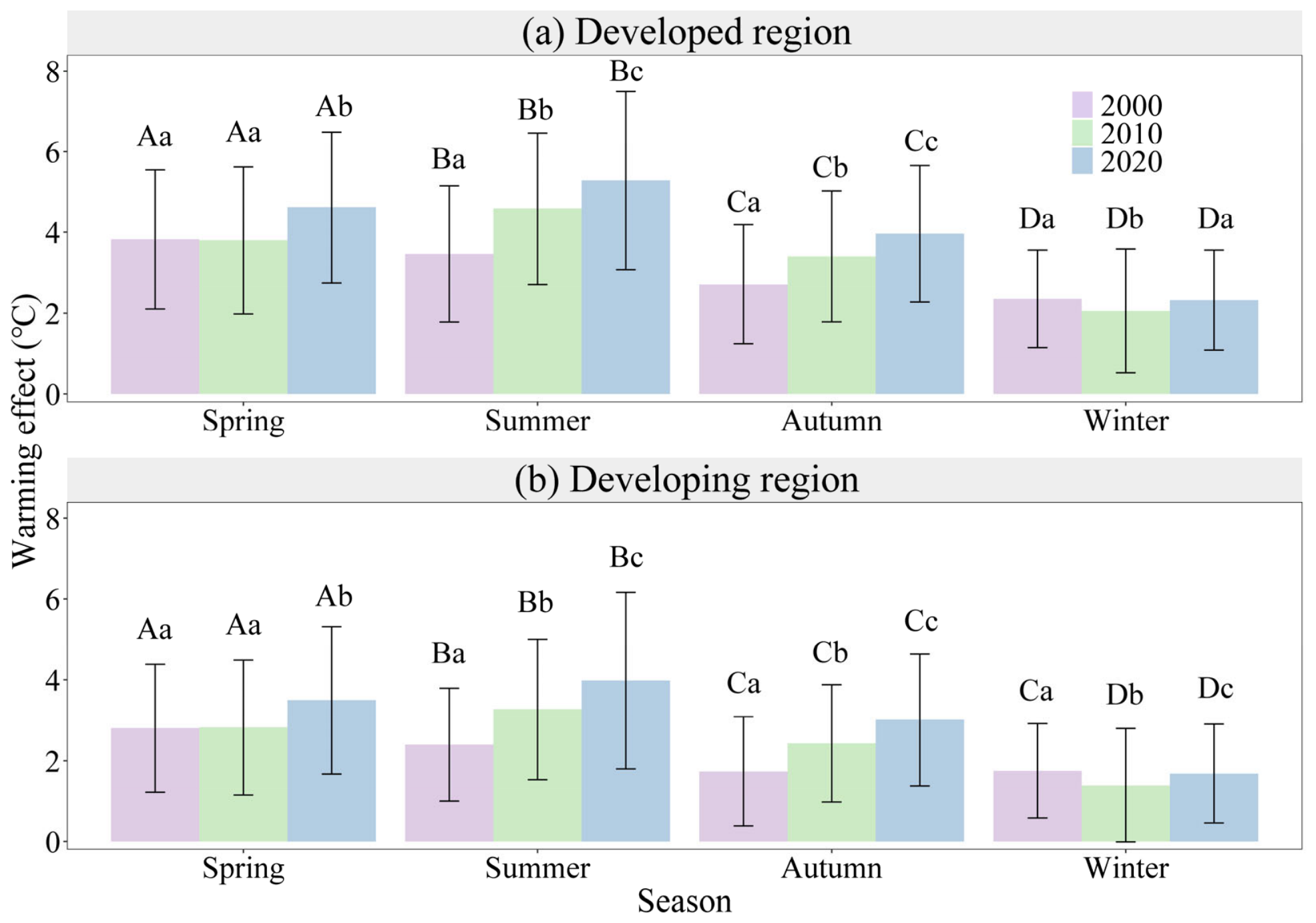
Seasonal warming or cooling effects were evaluated by calculating temperature differentials. As shown in Figure 4, both regions consistently exhibited warming effects across all seasons, with the intensity significantly escalating over the 20-year study period. Warming intensity exhibited significant seasonal variation, with summer experiencing the most pronounced warming effects (p < 0.05). Specifically, in developed regions, warming increments ranged from 3.80 to 4.62 °C (spring), 3.46 to 5.29 °C (summer), 2.71 to 3.96 °C (autumn), and 2.05 to 2.35 °C (winter). Between 2000 and 2020, excluding winter, warming intensities in all other seasons rose significantly by 20.81%, 52.55%, and 46.04% (p < 0.05), with summer exhibiting the highest rate (Figure 4a). In developing regions, warming ranges were 2.80–3.49 °C (spring), 2.39–3.98 °C (summer), 1.73–3.01 °C (autumn), and 1.39–1.75 °C (winter). Over the 20-year period, warming increments in spring, summer, and autumn increased significantly by 24.69%, 66.21%, and 73.48% (p < 0.05), respectively, with summer and autumn showing markedly higher warming than spring (Figure 4b).
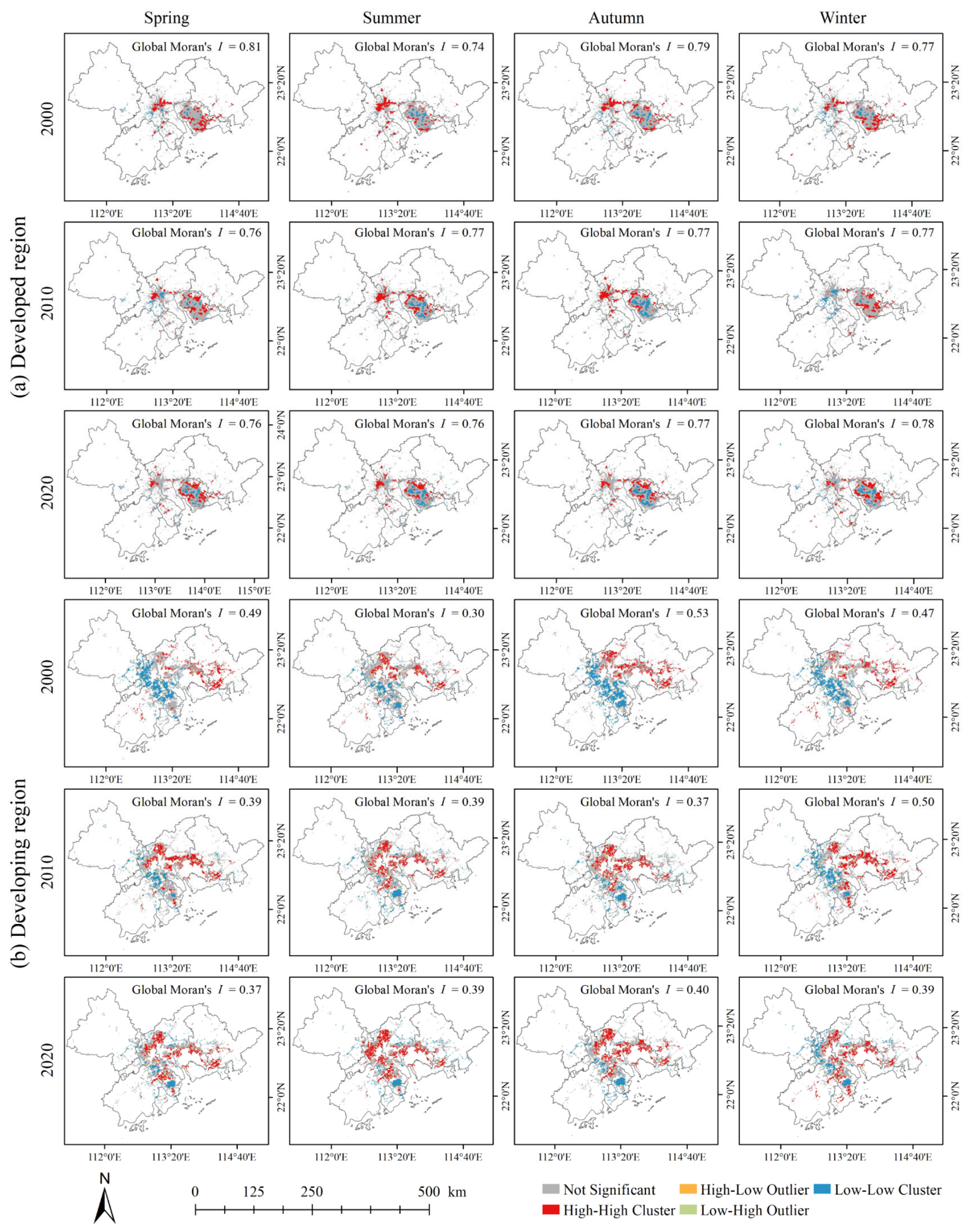
The global and local Moran’s I statistics were employed to analyze the spatial clustering of warming effect from 2000 to 2020. The global Moran’s I in the developed areas ranged from 0.74 to 0.81, whereas those in the developing areas ranged from 0.30 and 0.53. The local Moran’s I revealed distinct clustering patterns between developed and developing regions, characterized by overall interannual expansion of high–high clusters and contraction of low–low clusters (Figure 5). Specifically, high–high and low–low clusters in developed areas exhibited a mosaic, discrete distribution. The average proportions of high–high and low–low clusters were 13.80% and 12.37%, respectively. High–high and low–low clusters formed a dual-core distribution pattern at the Guangzhou–Foshan and Dongguan–Shenzhen intersections, subsequently expanding radially (Figure 5a). Developing areas generally displayed an “east-high, west-low” clustering pattern. The average proportions of high–high and low–low clusters were 24.64% and 22.51%, respectively (Figure 5b). From 2000 to 2020, high–high clusters in developing areas were primarily located at the junctions of Guangzhou–Foshan, Guangzhou–Dongguan, and Dongguan–Huizhou, with progressive southward expansion; low–low clusters transitioned from an aggregated to a discrete distribution, shifting from west to east. Interannually, summer high–high clusters exhibited the greatest expansion (30.50%).

3.2. Spatial Distribution Pattern of UF

UF_core, UF_PLAND, UF_MPS, UF_COHESION, and UF_MESH values were significantly lower in developed urban areas than in developing areas, indicating more severe forest fragmentation in the former (Table 1). Temporally, UF_PLAND remained relatively stable in both regions (fluctuating by <1%), exhibiting an initial increase followed by a decrease. Regarding landscape structure, UF_PD, UF_ED, and proportions of UF_Corridor and UF_Islet areas declined, suggesting reduced UF fragmentation. This was further corroborated by increases in UF_core proportions and UF_MPS, particularly in developed areas, indicating gradual expansion of forest patch scale. Notably, despite decreasing UF_ENN, post-2010 decline in UF_COHESION and UF_MESH indicate that UF connectivity did not improve significantly. Overall, UFs in both developed and developing regions remain highly fragmented, dominated by UF_Islet patches (24.43%–40.5%), whereas core area accounts for only 16.29%–21.42% (Table 1).
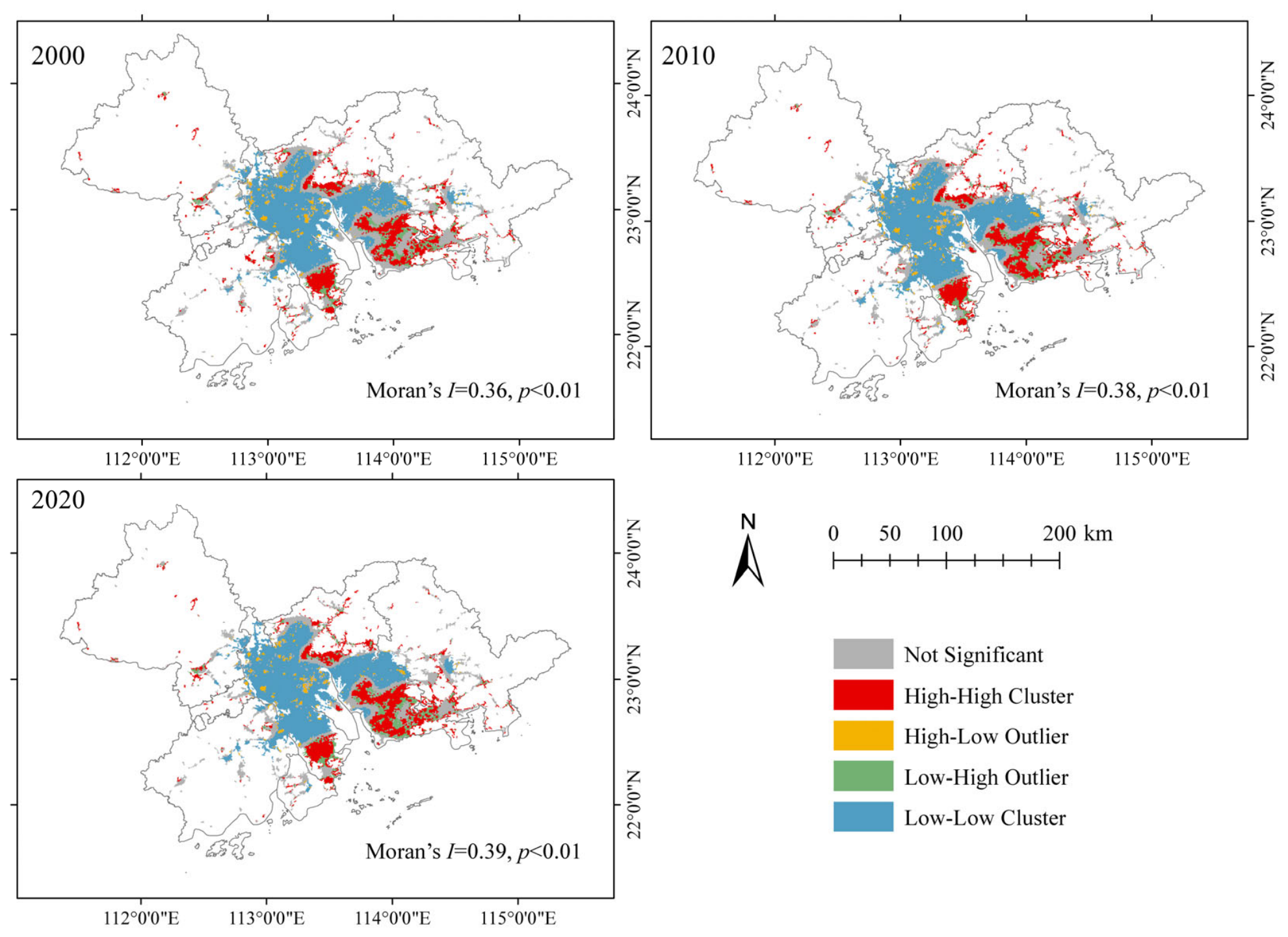
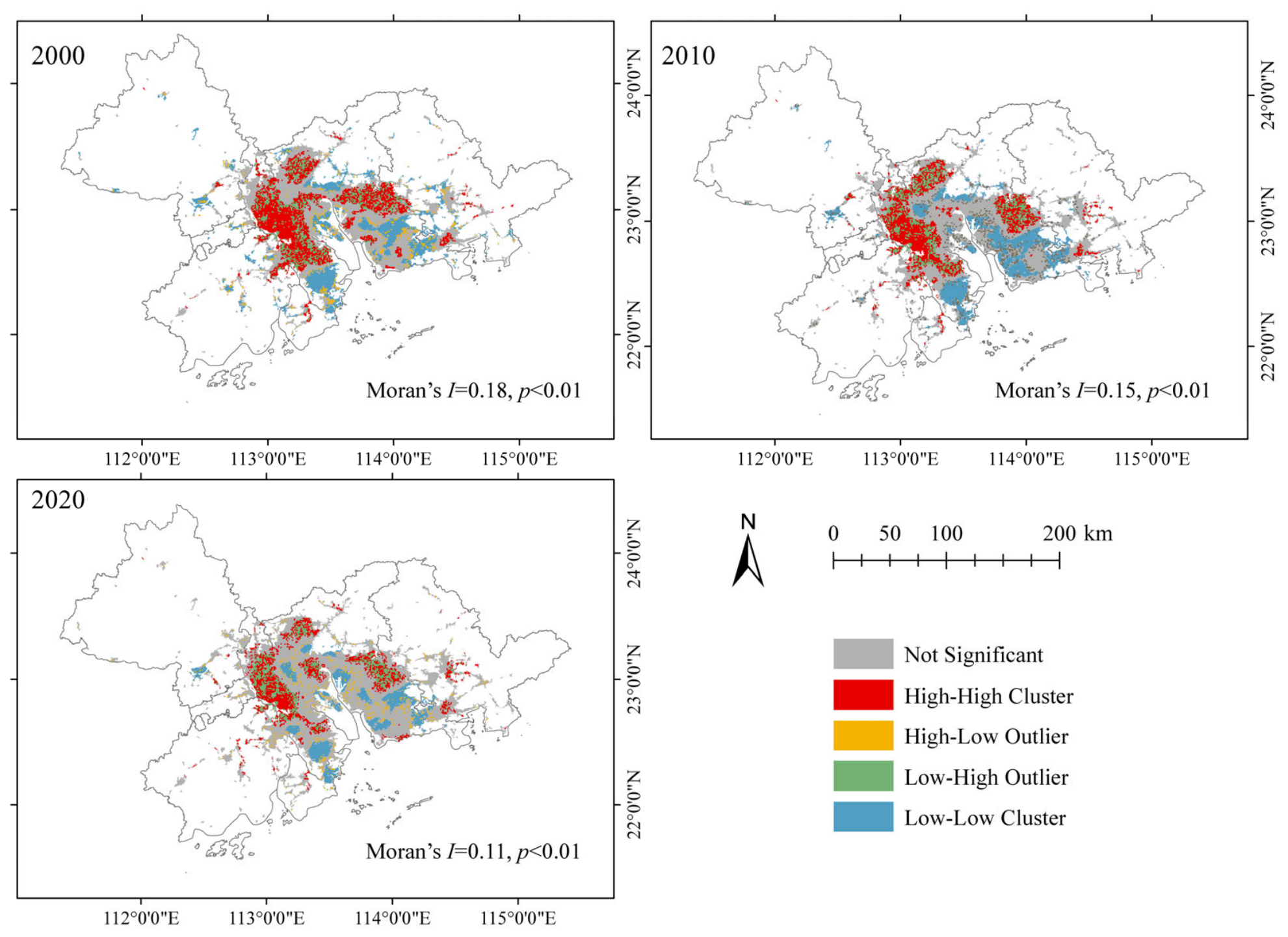
UF landscapes distributions exhibited significant spatial heterogeneity (Figure 6 and Figure 7 and Figure S2). UF_core proportions exhibited distinct spatial clustering (Moran’s I = 0.36–0.39, p < 0.01). High values were primarily concentrated in central Guangzhou, central Zhongshan, and the Shenzhen–Dongguan boundary region (Figure 6). UF_Islet proportions exhibited weak spatial autocorrelation. Over time, Moran’s I declined from 0.18 to 0.11, indicating gradual weakening of spatial autocorrelation. High-value areas diminished significantly (Figure 7).

3.3. Response of LST to Various Factors and the Interaction Effects

3.3.1. Identification of Influencing Factors of LST Based on the XGBoost-SHAP Model

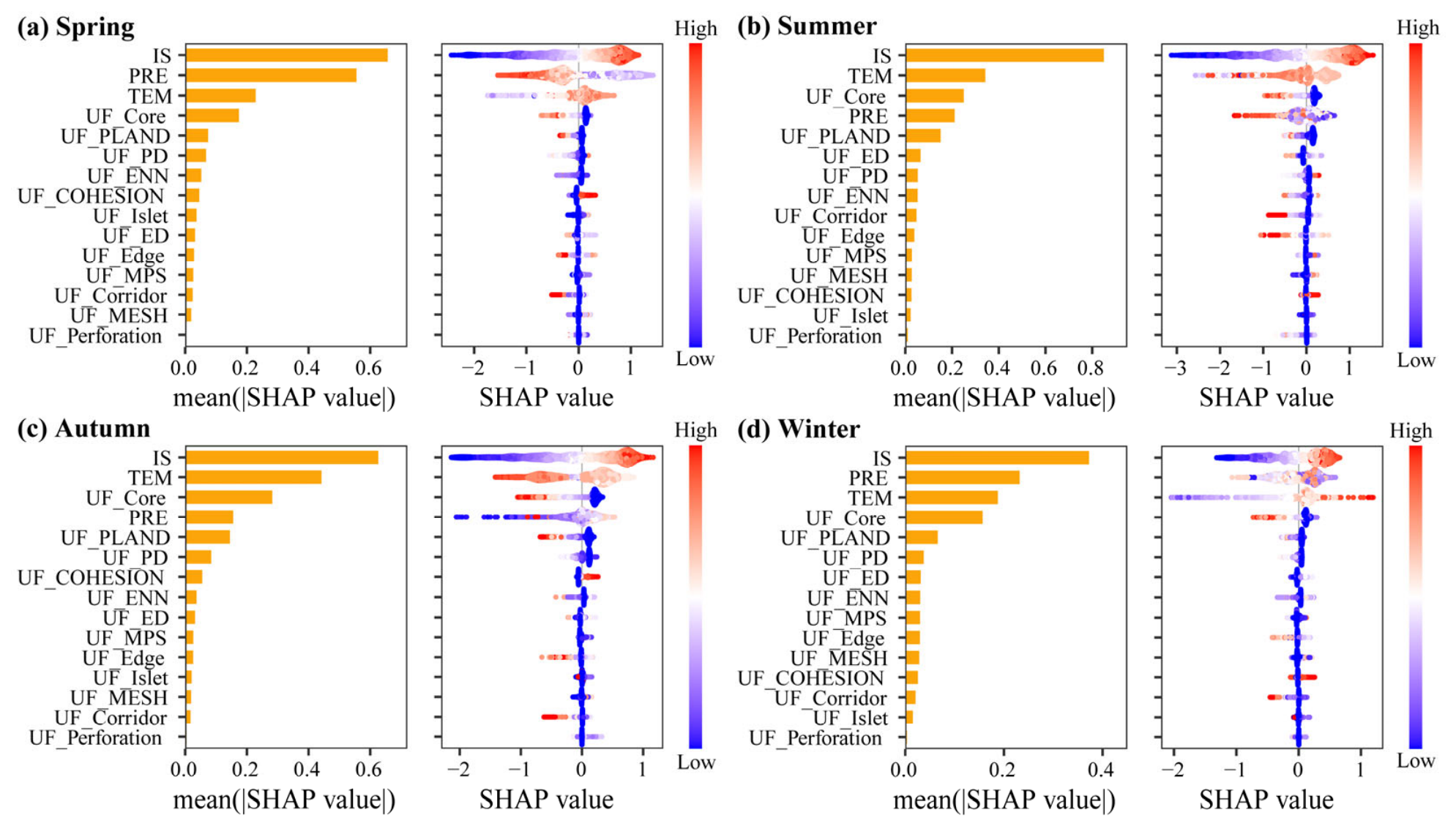
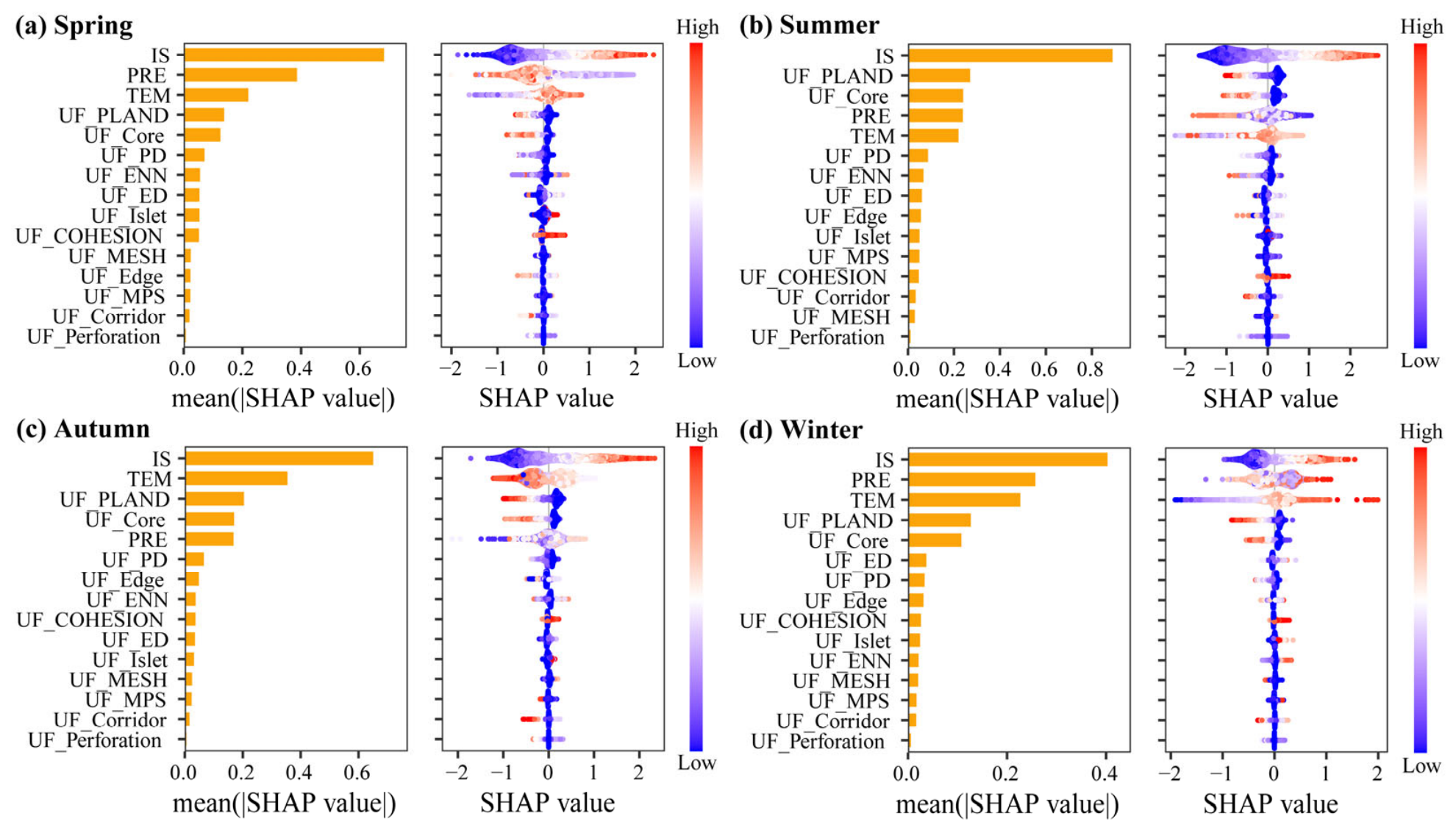
The XGBoost-SHAP model achieved R2 values of 0.38–0.57 and RMSE values of 0.87–1.50, indicating robust performance. The results reveal significant seasonal variations in the influence of meteorological and landscape factors on warming across developed and developing areas from 2000 to 2020 (Figure 8 and Figure 9 and Figures S3–S6). Overall, IS percentage, precipitation, and temperature were of greater relative importance for warming than were UF landscape metrics. Post-2010, the relative importance of UF landscape metrics on warming during summer and autumn increasingly surpassed that of precipitation and temperature, a trend that became particularly pronounced by 2020 (Figure 8b,c and Figure 9b,c).
Regarding UF landscape patterns in developed areas (2000–2020), UF_Corridor, UF_Core, and UF_PLAND exhibited the highest relative importance for spring warming, all exhibiting consistent negative contributions (Figure 8a, Figures S3a and S4a). In summer, UF_Core exhibited the highest relative importance, followed by UF_PLAND and UF_Islet or UF_Corridor/UF_ED; UF_Core, UF_PLAND, UF_Corridor, and UF_ED mitigated warming, whereas UF_Islet exerted a warming effect (Figure 8b, Figures S3b and S4b). In autumn, UF_Islet, UF_PLAND, and UF_Core were the most influential, with only UF_Islet promoting warming (Figure 8c, Figures S3c and S4c). In winter, UF_MPS and UF_Core exhibited the most substantial cooling effects (Figure 8d, Figures S3d and S4d). These results demonstrate that increasing UF cover and patch size while enhancing connectivity contributes to mitigating warming effects. Generally, UF_Core and UF_PLAND strongly influence warming across all seasons—particularly in summer and autumn—and this effect intensified over time. For instance, in autumn, their relative importance rose from 9.66% and 6.90% in 2010 to 14.31% and 7.35% in 2020, with UF_Core exhibiting a 48.14% increase. This suggests that in developed regions characterized by a high percentage of IS, optimizing UF spatial configuration is more effective for UHI mitigation than simply increasing forest coverage. In developing regions, fragmentation-related metrics are also vital for regulating warming effects. For instance, for UF_Core and UF_Islet in summer, and UF_Corridor and UF_Core in autumn, UF_Corridor and UF_Core exhibited strong negative contributions on warming, whereas UF_Islet showed a strong positive contribution (Figure 9b,c, Figures S5b,c and S6b,c), underscoring the role of reduced forest fragmentation in mitigating the UHI. Notably, the relative influence of UF_PLAND has increasingly surpassed that of structural metrics over time.

3.3.2. Effects of Interactions Between the Main Drivers on LST in Different Seasons

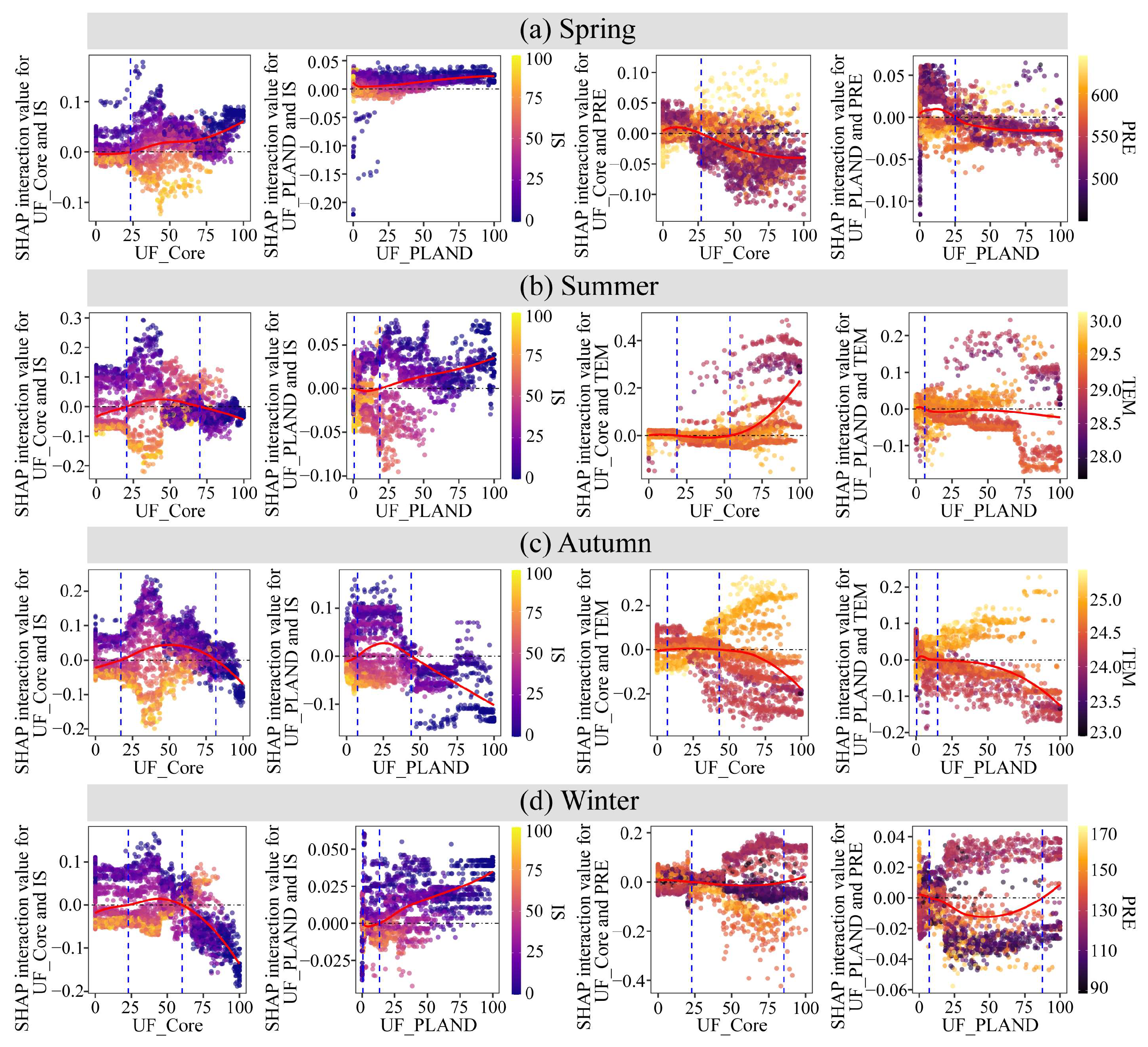
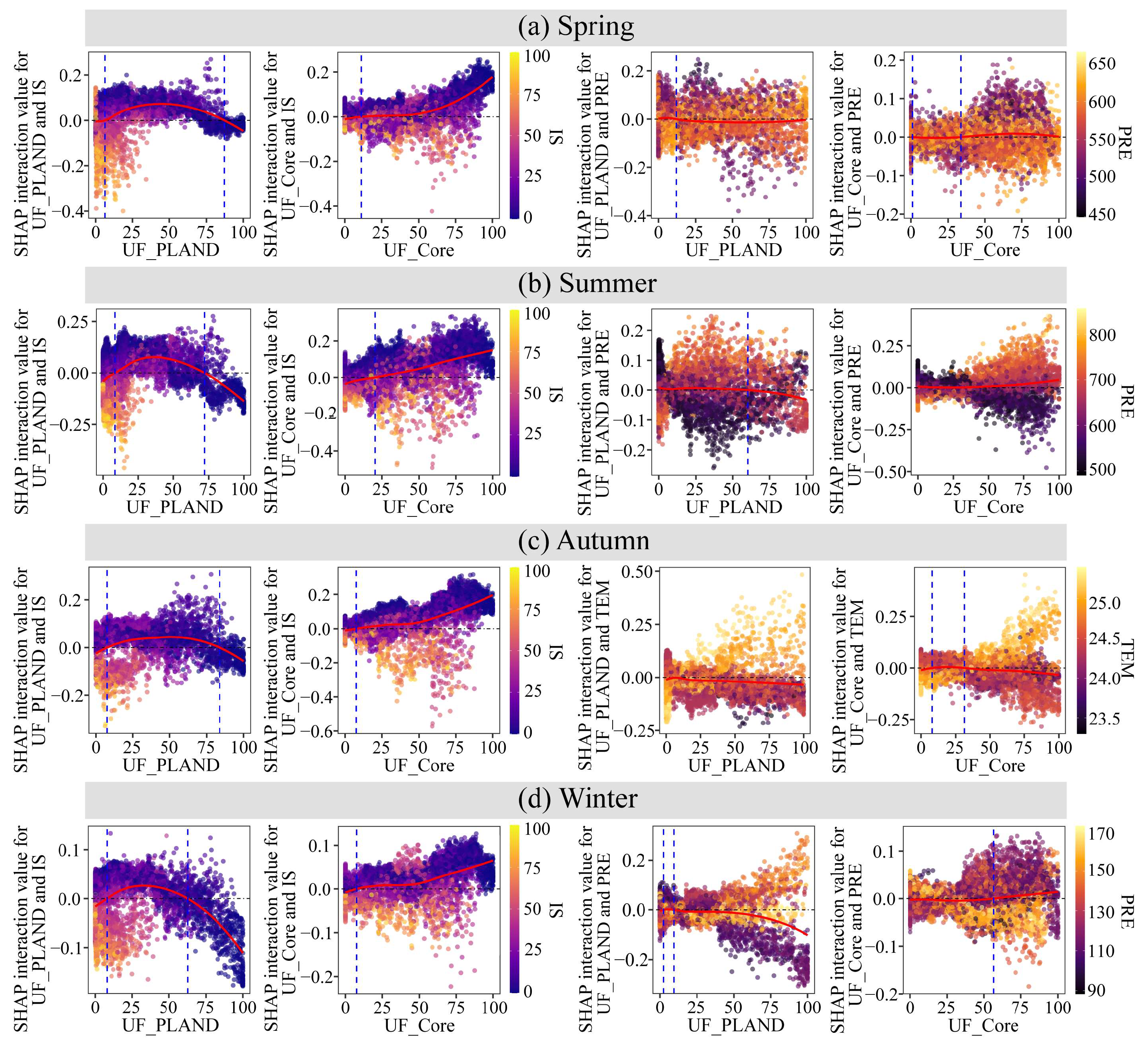
The responses of LST to IS percentage, climatic factors, and primary UF landscape metrics, alongside their interactive effects, are illustrated in Figure 10 and Figure 11 and Figures S7–S10. For instance, in developed areas during the spring of 2020, UF_Core values exceeding 27.10% interacted with low precipitation to induce a warming-suppression effect (Figure 10a). In developing areas during the winter of 2020, under low precipitation conditions and with UF_PLAND exceeding 9.44%, the warming-suppression effect intensified with increasing UF_PLAND (Figure 11d). Under high-temperature conditions, the cooling capacity of UF landscape patterns was constrained, as evidenced by the interactions of UF_PLAND and UF_Core with temperature in developed areas during autumn (Figure 10c). Conversely, UF_PLAND (>15.01%) and UF_Core (>43.09%) demonstrated a marked warming-suppression effect under lower temperatures (Figure 10c). In developing areas during autumn, the warming-suppression capacity of both UF_PLAND and UF_Core was similarly constrained under high temperature.
Regarding the interactions between UF_Core and IS percentage in developed areas, once UF_Core exceeded a specific threshold (e.g., 20.66%–70.11% during summer 2020; Figure 10b), its warming-suppression effect intensified with increasing UF_Core in regions with high IS percentages. UF_PLAND exhibited similar interactions with IS percentage. For instance, during summer 2020, UF_PLAND values ranging from 0.75% to 18.92% demonstrated robust warming suppression in regions with high IS percentages, whereas in regions with low IS percentages, this suppressive effect diminished considerably as UF_PLAND increased (Figure 10b). Similar interactive patterns were observed in developing areas (Figure 11). Overall, driven by complex interactions among various factors, the relationship between the UF landscape patterns and LST is nonlinear and highly context-dependent.

4. Discussion

4.1. Impermeable Surfaces Dominate the Spatiotemporal Pattern of the Urban Heat Island Effect

Urban landscape characteristics profoundly influence the UHI effect. This study reveals that the LST in urban areas of the PRD is significantly higher than in rural areas, indicating a pronounced warming effect (Figure 2 and Figure 5). The XGBoost-SHAP model results further highlight the dominant role of ISs in driving the warming effect (Figure 8, Figure 9, Figure 10 and Figure 11 and Figures S3–S10). Consistent with Zhang et al. [13] and Xu et al. [44], these findings confirm that the UHI effect is closely associated with the expansion of ISs and vegetation loss. Driven by population growth and economic development, the PRD urban agglomeration has undergone rapid urbanization since 1978, resulting in substantial expansion of ISs at the expense of cropland, forestland, grassland, and water bodies [26]. Although this trend is evident in major urban agglomerations worldwide, the scale and magnitude of expansion in the PRD significantly exceed those of other global counterparts (e.g., New York, San Francisco, and Tokyo) [13]. Developed urban areas exhibit a stronger warming effect, attributable to a higher proportion of ISs and scarce, fragmented vegetation cover. Zhang et al. [45] demonstrated that the spatial morphology of ISs exerts a substantially greater influence on LST in high-density urban areas of the PRD than in low-density, vegetation-dominated areas. Similarly, Zhou et al. [46] identified the dominant influence of ISs on LST in northern semi-arid cities. Dense high-rise buildings form urban canyons that reduce convection exchange, thereby trapping heat and hindering the dissipation of terrestrial longwave radiation [47]. Furthermore, this study reveals that summer exhibits the greatest temperature increase and the widest thermal range. On one hand, exposed soil and impermeable surfaces have a strong ability to store and re-radiate heat during the summer due to the intense direct solar radiation [43]. On the other hand, waste heat emissions from building air conditioners during summer further exacerbate the UHI effect [48]. These findings highlight the necessity for rational land-cover planning to mitigate the potential adverse impacts associated with urban expansion.

4.2. The Rational Spatial Configuration of Urban Forest Landscapes Is an Effective Strategy for Consolidating and Enhancing Their Cooling Capacity

Although the regulating capacity of urban blue-green infrastructure on LST has been well documented, UFs exhibit a more pronounced cooling effect than water bodies, whose cooling potential is frequently constrained by spatial scope. This superior cooling capacity is primarily attributed to canopy shading, evapotranspiration, and their extensive spatial distribution across urban areas [13]. Consequently, in addition to tree species selection and vegetation types, the landscape pattern of UFs emerges as a critical determinant of cooling efficacy. SHAP results reveal that UF_PLAND negatively affects LST (Figure 8 and Figure 9 and Figures S3–S6). Previous studies have similarly demonstrated that higher proportions of urban green space correlate with enhanced cooling performance [49,50]. However, spatial configuration metrics associated with fragmentation and connectivity (e.g., UF_Core) exert a stronger l influence on LST than UF_PLAND, particularly during summer and in developed urban regions (Figure 8, Figures S3 and S4). Our findings indicate that fragmented and isolated UFs fail to effectively mitigate warming effects induced by ISs. This finding is consistent with previous studies [51,52]. This phenomenon can be explained by several mechanisms. On one hand, high-density urban areas typically exhibit severe fragmentation and low UF coverage. Such fragmentation severely constrains canopy shading efficacy, particularly under intense daytime solar radiation, thereby limiting cooling [53]; consequently, isolated patches exhibit a positive correlation with LST. In contrast, relatively large and well-connected forest patches mitigate LST more effectively. Sun et al. [52] demonstrated that in the core urban area of Beijing, a significant summer cooling effect emerges only when green space proportion exceeds 44.5%, and specific spatial configuration metrics—such as the largest patch index and mean patch size—are required to effectively regulate LST. On the other hand, forest cooling capacity primarily depends on two core functions: evapotranspiration and canopy shading, both of which achieve peak efficiency during summer [54]. High summer temperatures significantly accelerate vegetation transpiration, converting liquid water into vapor; this process absorbs substantial latent heat from the surface, thereby facilitating efficient cooling [45]. Furthermore, during summer, when the solar elevation angle is maximal, dense canopy cover maximizes the shading effect [52]. Ultimately, intense summer heat accentuates the UF cool island effect.
Given the irreversibility of urbanization, strategies that rely on increasing the proportional coverage of UFs to enhance cooling effects are increasingly challenging, particularly in land-scarce developed areas. Regarding the overall spatial pattern, UFs in developed areas, although more fragmented, exhibit greater spatial aggregation than those in developing areas (Table 1). This indicates that UFs, particularly core types, tend to cluster within specific zones, rendering widespread spatial distribution difficult. This also explains that in developed urban areas, the configuration indicators of urban forest landscapes have a greater relative importance for LST compared to the area ratio. This underscores the urgent need to optimize the spatial configuration of urban green landscapes to consolidate and enhance cooling capacity. Shen et al. [55] demonstrated that the conversion of core UF types to other classes, coupled with landscape fragmentation, induces pronounced warming. This finding is consistent with the empirical results of this study. Consequently, in addition to conserving existing forest patches, it is essential to mitigate fragmentation and maintain forest interior integrity to ensure optimal cooling performance. Simultaneously, the shape complexity of these forest patches should be enhanced. The analysis reveals that UF_ED negatively affects LST (Figure 8, Figure 9 and Figures S3–S6). Relative to natural forest counterparts, UFs generally exhibit more regular boundaries. Complex forest patches characterized by longer edges and irregular shapes facilitate greater thermal exchange with the surrounding environment, thereby amplifying their cooling efficacy [56].

4.3. The Regulatory Effect of Urban Forests on LST Exhibits Pronounced Conditional Characteristics

This study demonstrates that LST responses to diverse UF landscape patterns are characterized by nonlinearity. Furthermore, analysis of interactions among factors reveals that the influence of UF patterns on LST is highly context-dependent. This indicates that changes in certain landscape structure metrics not only directly affect LST but may also indirectly enhance or inhibit the influence of other metrics on LST. For instance, in regions with high IS percentages, the warming-suppression effect of UFs intensifies as UF_PLAND or UF_Core increases. Sun et al. [52] and Ren et al. [56] demonstrated that when green space coverage exceeds a specific threshold, it becomes negatively correlated with LST; however, as green space coverage increases further, cooling efficiency declines. This trend reflects the principle of diminishing marginal effects. High-density buildings and ISs typically coincide with scarce UFs. In such settings, the cooling benefits of limited UFs are easily overwhelmed by the UHI effect [46]. Conversely, once the UF coverage surpasses a critical threshold, its cooling capacity becomes sufficient to offset the warming effect induced by ISs [56]. In vegetation-scarce areas, even a single small forest patch can function as a prominent cool island, exhibiting exceptionally high marginal cooling efficiency. This cooling effect is further amplified as UF coverage increases. In contrast, in areas with low IS percentages, UFs are distributed more evenly, resulting in smaller spatial variations in the overall thermal environment; consequently, the cooling contribution of any specific structural metric becomes less pronounced.
Meanwhile, the nonlinear relationship implies that meaningful impacts on LST occur only when forest coverage or specific structural attributes surpass critical thresholds. For instance, in areas with high IS proportions, achieving cooling requires at least 17.11%–23.35% of UF_Core (Developed regions) or 6.21%–8.67% of UF_PLAND (developing regions). Furthermore, these thresholds vary across seasons, a phenomenon primarily attributed to seasonal variations in solar radiation [52]. Compared with winter, due to higher levels of solar radiation, a higher proportion or larger scale of UFs is required during the spring, summer and autumn seasons to effectively mitigate the UHI effect (Figure 10 and Figure 11 and Figures S7–S10). Although our findings indicate that larger and better-connected forest patches are more effective cooling, they also reveal that metrics such as UF_PD and UF_Islet exert a cooling effect once they exceed specific thresholds (Figures S7, S9 and S10). This occurs because fragmented forest patches can still reduce landscape-level temperatures by enhancing local precipitation and air humidity via the “vegetation breeze” phenomenon [57]. From this perspective, prioritizing decentralized, small-scale green spaces (e.g., pocket parks) within urban core areas serves as a viable and effective strategy for mitigating the UHI effect.
Overall, effective UHI mitigation strategies must account for the contextual constraints imposed by varying environmental conditions on the cooling capacity of UFs, thereby facilitating targeted green infrastructure planning. Landscape ecology findings are highly relevant to spatial conservation planning. The XGBoost-SHAP model employed in this study effectively captures these complex nonlinear relationships. Although landscape ecology thresholds inherently possess considerable uncertainty, these identified thresholds serve as early warning signals for predicting shifts in ecosystem states, offering valuable reference points for environmental management. However, due to the significant conditionality of the interaction effects, environmental managers must employ mathematical optimization within complex models to optimize landscape structure [46].

4.4. Research Limitations

This study reveals the nonlinear influence of UF landscape patterns on LST and their interaction effects. Notably, these interaction effects exhibit significant conditional characteristics, which have rarely been addressed in previous studies. Overall, this study provides insights into how UF landscape patterns regulate the thermal environment in highly urbanized areas. These findings underscore that optimizing UF morphology and spatial configuration enhance the capacity of urban green infrastructure to regulate LST, even with limited UF coverage. Nevertheless, several limitations should be acknowledged. First, the analysis focused exclusively on two-dimensional (2D) landscape metrics, omitting the three-dimensional (3D) morphological characteristics of UFs. Recent studies have increasingly emphasized the influence of 3D urban green space morphology on LST [45]. Given the difficulty of expanding vegetation coverage in high-density built-up areas, optimizing the 3D structure of urban green spaces represents a promising strategy to enhance cooling capacity. Second, the analyses were conducted at a fixed grid resolution of 1 km × 1 km, precluding examination of the spatial scale effect of the relationship between landscape pattern and LST. Consequently, the analytical framework may have overlooked the local cooling effects of small UFs and pocket parks. Although the results indicate the role of fragmented UF patches, further verification at the block scale is warranted. Third, the analysis primarily addressed seasonal variations in daytime LST while overlooking diurnal differences (day vs. night) and extreme heat events. As UF cooling performance is modulated by multiple external factors, the relationship between UF landscape patterns and LST likely exhibits complex dynamics across interannual, seasonal, diurnal, and extreme weather conditions. Future studies should systematically integrate both 2D and 3D morphological metrics with diverse constraining factors, and adopt multi-spatiotemporal scale analyses to comprehensively elucidate the mechanisms underlying the effects of UF landscape patterns on LST.

5. Conclusions

Using the PRD urban agglomeration as a case study, this research analyzed how UF landscape patterns mitigate the UHI effect across different seasons and explored the interactive effects among factors on LST, providing insights for urban planning. From 2000 to 2020, pronounced warming effects were observed in both developed and developing urban areas, particularly during the summer. The magnitude of warming in developed areas exceeded that in developing areas, with significant spatial agglomeration. Over time, although UF coverage, patch scale, and connectivity improved slightly, overall fragmentation remained high, particularly in developed areas. Overall, IS percentages and climatic factors exerted stronger influence on LST than did UF landscape patterns. In terms of landscape metrics, UF_PLAND and UF_Core emerged as the primary metrics influencing LST, exhibiting negative contributions during the summer and autumn. Notably, the influence of UF_Core on LST in developed areas exceeded that of UF_PLAND. In addition to increasing UF coverage, mitigating forest fragmentation is essential for regulating LST. UF spatial patterns exhibited pronounced threshold effects. Furthermore, the effects of UF spatial patterns on LST were constrained or facilitated by other interacting variables. For instance, under high IS percentages, the warming-suppression effect of UFs intensified as UF_PLAND or UF_Core increased. Consequently, the regulatory capacity of UFs on LST is highly context-dependent. These findings underscore that optimizing UF morphology and spatial configuration enhances the capacity of urban green infrastructure to regulate LST, even with limited UF coverage.

Supplementary Materials

The following supporting information can be downloaded at https://www.mdpi.com/article/10.3390/f17060694/s1. Figure S1: Spatial distribution of land surface temperature in the Pearl River Delta region from 2000 to 2020; Figure S2: Spatial pattern of MSPA types in the urban forests from 2000–2020; Figure S3: Ranking of the importance of influencing factors on land surface temperature (LST) in developed regions during different seasons in 2000 based on the XGBoost-SHAP model; Figure S4: Ranking of the importance of influencing factors on land surface temperature (LST) in developed regions during different seasons in 2010 based on the XGBoost-SHAP model; Figure S5: Ranking of the importance of influencing factors on land surface temperature (LST) in developing regions during different seasons in 2000 based on the XGBoost-SHAP model; Figure S6: Ranking of the importance of influencing factors on land surface temperature (LST) in developing regions during different seasons in 2010 based on the XGBoost-SHAP model; Figure S7: SHAP interaction plots between main green space indicators and meteorological and human activity factors in different seasons of developed regions in 2000; Figure S8: SHAP interaction plots between main green space indicators and meteorological and human activity factors in different seasons of developed regions in 2010; Figure S9: SHAP interaction plots between main green space indicators and meteorological and human activity factors in different seasons of developing regions in 2000; Figure S10: SHAP interaction plots between main green space indicators and meteorological and human activity factors in different seasons of developing regions in 2010; Table S1: Temperature classification criteria; Table S2: Description of the landscape metrics selected in the study;Table S3: The optimized hyperparameter configurations for the final XGBoost-SHAP model; Equation (S1): LST standardization; Equation (S2): The relative change in LST for each grid cell.

Author Contributions

Conceptualization, N.W. and L.L.; methodology, N.W. and L.L.; validation, N.W. and S.J.; formal analysis, N.W. and L.L.; investigation, N.W., L.L. and S.J.; data curation, L.Z.; writing—original draft preparation, N.W.; writing—review and editing, N.W. and L.L.; visualization, N.W.; supervision, L.Z.; project administration, L.Z.; funding acquisition, L.Z. All authors have read and agreed to the published version of the manuscript.

Funding

This research was funded by the GDAS Project of Science and Technology Development (No. 2023GDASZH-2023010101).

Data Availability Statement

The data supporting the findings of this study are included within the article. Further data is available from the corresponding author upon reasonable request.

Conflicts of Interest

The authors declare no conflicts of interest.

References

  1. Domingo, D.; van Vliet, J.; Hersperger, A.M. Long-term changes in 3D urban form in four Spanish cities. Landsc. Urban Plan. 2023, 230, 104624. [Google Scholar] [CrossRef]
  2. Estoque, R.C.; Murayama, Y.; Myint, S.W. Effects of landscape composition and pattern on land surface temperature: An urban heat island study in the megacities of Southeast Asia. Sci. Total Environ. 2017, 577, 349–359. [Google Scholar] [CrossRef]
  3. Feng, M.; Zhao, R.; Huang, H.; Xiao, L.; Xie, Z.; Zhang, L.; Sun, J.; Chuai, X. Water–energy–carbon nexus of different land use types: The case of Zhengzhou, China. Ecol. Indic. 2022, 141, 109073. [Google Scholar] [CrossRef]
  4. Zheng, Y.; Weng, Q. High spatial- and temporal-resolution anthropogenic heat discharge estimation in Los Angeles County, California. J. Environ. Manag. 2018, 206, 1274–1286. [Google Scholar] [CrossRef]
  5. He, B.-J.; Wang, J.; Liu, H.; Ulpiani, G. Localized synergies between heat waves and urban heat islands: Implications on human thermal comfort and urban heat management. Environ. Res. 2021, 193, 110584. [Google Scholar] [CrossRef]
  6. Li, X.; Zhou, Y.; Yu, S.; Jia, G.; Li, H.; Li, W. Urban heat island impacts on building energy consumption: A review of approaches and findings. Energy 2019, 174, 407–419. [Google Scholar] [CrossRef]
  7. Kabano, P.; Lindley, S.; Harris, A. Evidence of urban heat island impacts on the vegetation growing season length in a tropical city. Landsc. Urban Plan. 2021, 206, 103989. [Google Scholar] [CrossRef]
  8. Taleghani, M. Outdoor thermal comfort by different heat mitigation strategies—A review. Renew. Sustain. Energy Rev. 2018, 81, 2011–2018. [Google Scholar] [CrossRef]
  9. Xiang, Y.; Cen, Q.; Peng, C.; Huang, C.; Wu, C.; Teng, M.; Zhou, Z. Surface urban heat island mitigation network construction utilizing source-sink theory and local climate zones. Build. Environ. 2023, 243, 110717. [Google Scholar] [CrossRef]
  10. Chen, X.; Wang, Z.; Bao, Y.; Luo, Q.; Wei, W. Combined impacts of buildings and urban remnant mountains on thermal environment in multi-mountainous city. Sustain. Cities Soc. 2022, 87, 104247. [Google Scholar] [CrossRef]
  11. Shafizadeh-Moghadam, H.; Xu, T.; Murayama, Y. Climate-specific trends in urban land surface temperature: A global analysis of 432 cities (2014–2024). J. Environ. Manag. 2025, 395, 127789. [Google Scholar] [CrossRef]
  12. Li, M.; Xu, C.; Hu, Y.; Zou, Z.; Wang, X.; Chen, F.; Feng, Z.; Zhu, Z.; Huang, H.; Geng, X.; et al. Spatiotemporal impact mechanisms of urban multidimensional form on land surface temperature: A case study of representative cities in five climate zones of China. Hum. Settl. Sustain. 2025, 1, 275–289. [Google Scholar] [CrossRef]
  13. Zhang, Q.; Guan, Y.; Wu, X.; Zhang, J.; Li, R.; Lin, K.; Wang, Y. Revealing the dynamic effects of land cover change on land surface temperature in global major bay areas. Build. Environ. 2025, 267, 112266. [Google Scholar] [CrossRef]
  14. Chen, L.; Guo, G. Exploring the nonlinear interactions and threshold effects of urban building morphology and green space on land surface temperature in high-density areas: A cross-city comparative study. Sustain. Cities Soc. 2026, 136, 107069. [Google Scholar] [CrossRef]
  15. Wang, S.; Wang, M.; Wang, C.; Liu, X.; Yu, J.; Li, Y.; Liu, Q. The day-night asymmetric and nonlinear impacts of human activity and 3D urban morphology on land surface temperature: Threshold mechanisms and spatial heterogeneity. Sustain. Cities Soc. 2026, 143, 107346. [Google Scholar] [CrossRef]
  16. Liu, S.; Wang, Z.; Kumilamba, G.; Yu, L. Optimizing green space configuration for mitigating land surface temperature: A case study of karst mountainous cities. Sustain. Cities Soc. 2025, 125, 106345. [Google Scholar] [CrossRef]
  17. Dai, Z.; Guldmann, J.-M.; Hu, Y. Thermal impacts of greenery, water, and impervious structures in Beijing’s Olympic area: A spatial regression approach. Ecol. Indic. 2019, 97, 77–88. [Google Scholar] [CrossRef]
  18. Xu, Y.; Yang, J.; Zheng, Y.; Li, W. Impacts of two-dimensional and three-dimensional urban morphology on urban thermal environments in high-density cities: A case study of Hong Kong. Build. Environ. 2024, 252, 111249. [Google Scholar] [CrossRef]
  19. Moss, J.L.; Doick, K.J.; Smith, S.; Shahrestani, M. Influence of evaporative cooling by urban forests on cooling demand in cities. Urban For. Urban Green. 2019, 37, 65–73. [Google Scholar] [CrossRef]
  20. Chen, Y.; Wu, J.; Yu, K.; Wang, D. Evaluating the impact of the building density and height on the block surface temperature. Build. Environ. 2020, 168, 106493. [Google Scholar] [CrossRef]
  21. Greene, C.S.; Kedron, P.J. Beyond fractional coverage: A multilevel approach to analyzing the impact of urban tree canopy structure on surface urban heat islands. Appl. Geogr. 2018, 95, 45–53. [Google Scholar] [CrossRef]
  22. Cui, P.; Xv, D.; Tang, J.; Lu, J.; Wu, Y. Assessing the effects of urban green spaces metrics and spatial structure on LST and carbon sinks in Harbin, a cold region city in China. Sustain. Cities Soc. 2024, 113, 105659. [Google Scholar] [CrossRef]
  23. Kumar, M.; Bhadwal, S.; Sahu, N. Role of urban green space structure and configuration in regulating land surface temperature in NCT Delhi using explainable artificial intelligence. Urban Clim. 2026, 65, 102736. [Google Scholar] [CrossRef]
  24. Tong, H.; Wang, Q.; Li, Y. The impact of urban green space pattern on land surface temperature in a valley city. Sustain. Cities Soc. 2025, 135, 106993. [Google Scholar] [CrossRef]
  25. Li, T.; Liu, Y.; Zheng, Z.; Li, S.; Zheng, X.; Wei, G.; He, B. The mitigating effects of urban resilience on surface urban heat islands: Nonlinear responses, threshold effects, and spatial heterogeneity. Sustain. Cities Soc. 2025, 131, 106722. [Google Scholar] [CrossRef]
  26. Li, L.; Wang, N.; Hao, Z.; Sun, B.; Gao, B.; Gou, M.; Wang, P.; Pei, N. Urbanization intensifies the imbalance between human development and biodiversity conservation: Insights from the coupling analysis of human activities and habitat quality. Land Degrad. Dev. 2024, 35, 3606–3626. [Google Scholar] [CrossRef]
  27. Deilami, K.; Kamruzzaman, M. Modelling the urban heat island effect of smart growth policy scenarios in Brisbane. Land Use Policy 2017, 64, 38–55. [Google Scholar] [CrossRef]
  28. Liu, W.; Meng, Q.; Allam, M.; Zhang, L.; Hu, D.; Menenti, M. Driving Factors of Land Surface Temperature in Urban Agglomerations: A Case Study in the Pearl River Delta, China. Remote Sens. 2021, 13, 2858. [Google Scholar] [CrossRef]
  29. Zhang, Z.; Peng, J.; Xu, Z.; Wang, X.; Meersmans, J. Ecosystem services supply and demand response to urbanization: A case study of the Pearl River Delta, China. Ecosyst. Serv. 2021, 49, 101274. [Google Scholar] [CrossRef]
  30. Wu, Y.; Che, Y.; Liao, W.; Liu, X. The impact of urban morphology on land surface temperature across urban-rural gradients in the Pearl River Delta, China. Build. Environ. 2025, 267, 112215. [Google Scholar] [CrossRef]
  31. Yang, J.; Huang, X. The 30 m annual land cover dataset and its dynamics in China from 1990 to 2019. Earth Syst. Sci. Data 2021, 13, 3907–3925. [Google Scholar] [CrossRef]
  32. Song, J.; Du, S.; Feng, X.; Guo, L. The relationships between landscape compositions and land surface temperature: Quantifying their resolution sensitivity with spatial regression models. Landsc. Urban Plan. 2014, 123, 145–157. [Google Scholar] [CrossRef]
  33. He, C.; Liu, Z.; Xu, M.; Lu, W. Dataset of Urban Built-Up Area in China (1992–2020) V1.0; Institute of Tibetan Plateau Research, CAS: Beijing, China, 2022. [Google Scholar] [CrossRef]
  34. Wang, Y.; Zhang, Q.; Lin, K.; Liu, Z.; Liang, Y.-S.; Liu, Y.; Li, C. A novel framework for urban flood risk assessment: Multiple perspectives and causal analysis. Water Res. 2024, 256, 121591. [Google Scholar] [CrossRef]
  35. Li, L.; Gou, M.; Wang, N.; La, L.; Liu, C. Do ecological restoration programs reduce forest fragmentation? Case study of the Three Gorges Reservoir Area, China. Ecol. Eng. 2021, 172, 106410. [Google Scholar] [CrossRef]
  36. Li, L.; Zhang, C.Y.; Pei, N.C.; Gao, B.T.; Wang, N.; Li, J.R.; Wu, R.C.; Hao, Z.Z. Correlation analysis of urban green landscape patterns and bird diversity based on passive acoustic monitoring technology. Biodivers. Sci. 2024, 32, 24296. [Google Scholar] [CrossRef]
  37. Anselin, L. Local indicators of spatial association—LISA. Geogr. Anal. 1995, 27, 93–115. [Google Scholar] [CrossRef]
  38. Moran, P.A.P. Notes on continuous stochastic phenomena. Biometrika 1950, 37, 17–23. [Google Scholar] [CrossRef]
  39. Ord, J.K.; Getis, A. Local spatial autocorrelation statistics: Distributional issues and an application. Geogr. Anal. 1995, 27, 286–306. [Google Scholar] [CrossRef]
  40. Anselin, L.; Syabri, I.; Kho, Y. GeoDa: An introduction to spatial data analysis. Geogr. Anal. 2006, 38, 5–22. [Google Scholar] [CrossRef]
  41. Lin, A.; Wu, H.; Luo, W.; Fan, K.; Liu, H. How does urban heat island differ across urban functional zones? Insights from 2D/3D urban morphology using geospatial big data. Urban Clim. 2024, 53, 101787. [Google Scholar] [CrossRef]
  42. Zhang, J.; Ma, X.; Zhang, J.; Sun, D.; Zhou, X.; Mi, C.; Wen, H. Insights into geospatial heterogeneity of landslide susceptibility based on the SHAP-XGBoost model. J. Environ. Manag. 2023, 332, 117357. [Google Scholar] [CrossRef]
  43. Kundu, A.; Mukherjee, S.; Mukhopadhyay, S. Seasonal drivers of urban heat and their implications for sustainable spatial planning: A case study from a rapidly developing city of eastern India. Sustain. Cities Soc. 2026, 140, 107246. [Google Scholar] [CrossRef]
  44. Xu, H.; Yang, C.; Sun, X.; Tu, W.; Chen, J.; Liu, X.; Li, Q. Hillside urbanization induced vertical warming effect. Habitat Int. 2026, 171, 103778. [Google Scholar] [CrossRef]
  45. Zhang, J.; Hong, S.; Shi, S.; Chen, B.; Wu, S. Synergistic impacts of 2D/3D grey-green spatial morphology on land surface temperature across local climate zones in the Guangdong-Hong Kong-Macao Greater Bay Area. Sustain. Cities Soc. 2026, 139, 107231. [Google Scholar] [CrossRef]
  46. Zhou, L.; Hu, F.; Wang, B.; Wei, C.; Sun, D.; Wang, S. Relationship between urban landscape structure and land surface temperature: Spatial hierarchy and interaction effects. Sustain. Cities Soc. 2022, 80, 103795. [Google Scholar] [CrossRef]
  47. Wang, H.; Chen, C. Quantifying the contributions of urban spatial morphology on the river cold island effect: Taking Changsha, China, as an example. Sustain. Cities Soc. 2025, 122, 106256. [Google Scholar] [CrossRef]
  48. Wang, S.; Oiu, K.; Gao, Z.; Wang, H.; Xu, F.; Shen, J. Effects of anthropogenic heat on the urban wind-thermal environment in typical residential neighborhoods in Nanjing, China. Energy Built Environ. 2026. [Google Scholar] [CrossRef]
  49. Pramanik, S.; Punia, M. Assessment of green space cooling effects in dense urban landscape: A case study of Delhi, India. Model. Earth Syst. Environ. 2019, 5, 867–884. [Google Scholar] [CrossRef]
  50. Wang, X.; Meng, Q.; Zhang, L.; Hu, D. Evaluation of urban green space in terms of thermal environmental benefits using geographical detector analysis. Int. J. Appl. Earth Obs. Geoinf. 2021, 105, 102610. [Google Scholar] [CrossRef]
  51. Basu, T.; Das, A. Urbanization induced degradation of urban green space and its association to the land surface temperature in a medium-class city in India. Sustain. Cities Soc. 2023, 90, 104373. [Google Scholar] [CrossRef]
  52. Sun, X.; Fang, P.; Huang, S.; Liang, Y.; Zhang, J.; Wang, J. Impact of urban green space morphology and vegetation composition on seasonal land surface temperature: A case study of Beijing’s urban core. Urban Clim. 2025, 60, 102367. [Google Scholar] [CrossRef]
  53. Bi, S.; Tian, Z.; Zhang, Y.; Dai, F. The role of urban green space morphology and threshold in cooling efficiency: Evidence from five cities, China. J. Clean. Prod. 2025, 509, 145580. [Google Scholar] [CrossRef]
  54. He, T.; Hu, Y.; Guo, A.; Chen, Y.; Yang, J.; Li, M. Quantifying the impact of urban trees on land surface temperature in global cities. ISPRS J. Photogramm. Remote Sens. 2024, 210, 69–79. [Google Scholar] [CrossRef]
  55. Shen, W.; Liu, Q.; Ji, M.; He, J.; He, T.; Huang, C. Impacts of urban forests and landscape characteristics on land surface temperature in two urban agglomeration areas of China. Sustain. Cities Soc. 2023, 99, 104909. [Google Scholar] [CrossRef]
  56. Ren, Z.; Wang, C.; Guo, Y.; Hong, S.; Zhang, P.; Ma, Z.; Hong, W.; Wang, X.; Geng, R.; Meng, F. The cooling capacity of urban vegetation and its driving force under extreme hot weather: A comparative study between dry-hot and humid-hot cities. Build. Environ. 2024, 263, 111901. [Google Scholar] [CrossRef]
  57. Cochrane, M.A.; Laurance, W.F. Synergisms among fire, land use, and climate change in the Amazon. AMBIO J. Hum. Environ. 2008, 37, 522–527. [Google Scholar] [CrossRef]
Figure 1. Geographic location (a), elevation (b), land use/cover (c), and urbanization partition (d) of the PRD.
Forests 17 00694 g001
Figure 2. The seasonal spatial distribution of LST in the Pearl River Delta from 2000 to 2020.
Forests 17 00694 g002
Figure 3. The area of each season’s LST within different levels in the Pearl River Delta from 2000 to 2020. HTA, high-temperature area; SHTA, sub-high-temperature area; MTA, medium-temperature area; SLTA, sub-low-temperature area; LTA, low-temperature area.
Forests 17 00694 g003
Figure 4. Relative warming effect of different seasons in the Pearl River Delta during 2000–2020. Values are presented as mean ± SD. The significance of the seasonal and interannual differences was assessed by one-way ANOVA with Tukey’s post hoc test (p < 0.05). Different lowercase letters indicate significant differences between different years for the same season, while different uppercase letters indicate significant differences between different seasons within the same year.
Forests 17 00694 g004
Figure 5. Local Moran’s I of warming effect in developed and developing regions of the Pearl River Delta during different seasons from 2000 to 2020.
Forests 17 00694 g005
Figure 6. Spatial distribution pattern of UF_Core in developed and developing regions of the Pearl River Delta from 2000 to 2020.
Forests 17 00694 g006
Figure 7. Spatial distribution pattern of UF_Islet in developed and developing regions of the Pearl River Delta from 2000 to 2020.
Forests 17 00694 g007
Figure 8. Ranking of the importance of influencing factors on land surface temperature (LST) in developed regions during different seasons in 2020 based on the XGBoost-SHAP model. IS, impervious surface; PRE, precipitation; TEM, temperature; UF, urban forest; PLAND, Percentage of Landscape; PD, Patch Density; ED, Edge Density, ENN, Mean Nearest-neighbor Distance; MPS, Mean Patch Size; COHESION, Cohesion Index; MESH, Effective Mesh Size.
Forests 17 00694 g008
Figure 9. Ranking of the importance of influencing factors on land surface temperature (LST) in developing regions during different seasons in 2020 based on the XGBoost-SHAP model. IS, impervious surface; PRE, precipitation; TEM, temperature; UF, urban forest; PLAND, Percentage of Landscape; PD, Patch Density; ED, Edge Density, ENN, Mean Nearest-neighbor Distance; MPS, Mean Patch Size; COHESION, Cohesion Index; MESH, Effective Mesh Size.
Forests 17 00694 g009
Figure 10. SHAP interaction plots between main UF landscape indicators and meteorological and human activity factors in different seasons of developed regions in 2020. IS, impervious surface; PRE, precipitation; TEM, temperature; UF, urban forest; PLAND, Percentage of Landscape.
Forests 17 00694 g010
Figure 11. SHAP interaction plots between main UF landscape indicators and meteorological and human activity factors in different seasons of developing regions in 2020. IS, impervious surface; PRE, precipitation; TEM, temperature; UF, urban forest; PLAND, Percentage of Landscape.
Forests 17 00694 g011
Table 1. The mean and standard deviation of urban forest landscape metrics in developed and developing urban areas from 2000 to 2020.
YearDeveloped Urban AreasDeveloping Urban AreasDeveloped Urban AreasDeveloping Urban AreasDeveloped Urban AreasDeveloping Urban Areas
 UF_PLAND (%)UF_PD (N/100 ha)UF_ED (m/ha)
200010.75 ± 20.9414.87 ± 25.163.93 ± 4.943.99 ± 4.7320.53 ± 28.5023.73 ± 30.08
201011.61 ± 22.2915.17 ± 24.902.97 ± 3.713.72 ± 4.2918.38 ± 25.7923.74 ± 29.79
202011.16 ± 22.1413.78 ± 23.732.31 ± 3.052.93 ± 3.6415.11 ± 22.1619.05 ± 25.23
 UF_MPS (ha)UF_ENN (m)UF_ COHESION 
20003.65 ± 13.175.77 ± 17.0592.23 ± 135.5497.44 ± 140.1641.59 ± 40.0247.32 ± 40.72
20105.05 ± 15.696.06 ± 16.9791.55 ± 142.7197.95 ± 141.7743.48 ± 40.9349.13 ± 41.04
20205.29 ± 16.135.79 ± 16.2883.11 ± 143.0987.44 ± 135.2441.20 ± 41.6845.41 ± 42.19
 UF_MESH (%)UF_Core (%)UF_Islet (%)
20004.80 ± 15.867.46 ± 19.7617.00 ± 26.2121.42 ± 29.5240.50 ± 44.4736.57 ± 43.87
20105.57 ± 17.257.43 ± 19.3417.28 ± 27.3520.80 ± 29.3730.96 ± 42.9231.86 ± 42.80
20205.48 ± 17.216.57 ± 18.0018.31 ± 28.2921.27 ± 29.8624.43 ± 39.9925.09 ± 39.96
 UF_ Corridor (%)UF_Edge (%)  
200010.11 ± 15.8310.06 ± 15.5012.21 ± 15.9412.73 ± 15.69  
20108.61 ± 15.469.36 ± 15.3511.56 ± 16.5212.32 ± 15.87  
20206.86 ± 13.747.18 ± 13.3812.36 ± 17.8713.00 ± 17.20  
Disclaimer/Publisher’s Note: The statements, opinions and data contained in all publications are solely those of the individual author(s) and contributor(s) and not of MDPI and/or the editor(s). MDPI and/or the editor(s) disclaim responsibility for any injury to people or property resulting from any ideas, methods, instructions or products referred to in the content.