Exploring the Critical Thresholds of Environmental Factors on Net Primary Productivity in the Yellow River Basin

Abstract
1. Introduction
2. Materials and Methods
2.1. Study Area
2.2. Data Source
- (1)
- NPP data
- (2)
- Land use type data
- (3)
- Influencing factors data
2.3. Methods
2.3.1. Trend Analysis and Significance Test
2.3.2. Fitting NPP Based on Machine Learning Algorithms
- (1)
- AdaBoost (adaptive boosting) is an effective ensemble learning algorithm that improves the overall prediction performance by combining multiple weak regression models [51]. Its basic principle is to gradually train each model so that the new model focuses on samples that are predicted incorrectly by the previous model and to enhance the learning ability of the model by adjusting the sample weights. The prediction results of each weak model are weighed according to their accuracy, and finally a strong regression model is formed.
- (2)
- Random forest is an ensemble learning method that improves the accuracy of classification and regression by constructing multiple decision trees and combining their results [52]. Its basic principles include the following four steps: ① sample sampling, using the bootstrap method to randomly extract multiple subsample sets from the training set. Each tree is trained using a different sample set. ② Feature selection, where during the splitting process of each node, a part of the features is randomly selected instead of using all the features. This randomness increases the diversity of the model and reduces the risk of overfitting. ③ Decision tree construction, where a decision tree is constructed for each subsample set, and pruning is usually not performed to retain more information. ④ Ensemble prediction, where for classification tasks, random forest determines the final classification result by voting; for regression tasks, the average of the prediction values of each tree is taken as the final output [53]. As a flexible and efficient tool, random forest plays an important role in the field of machine learning and data mining.
- (3)
- XGBoost (extreme gradient boosting) is an efficient gradient boosting algorithm that optimizes the model by gradually building a decision tree [54]. Its core principle is to use the gradient and second-order derivative information of the loss function to achieve fast model training through Taylor expansion. XGBoost also introduces regularization technology to control the complexity of the model, thereby effectively preventing overfitting. In addition, XGBoost supports parallel computing, which significantly improves the training speed. Studies have shown that this method performs well in a variety of tasks, especially when processing large-scale data [55]. These features make XGBoost an important tool in the field of machine learning.
2.3.3. Response of NPP to Various Factors
2.3.4. Definition and Identification of Critical Thresholds
3. Results
3.1. Spatial and Temporal Changes in NPP in the YRB
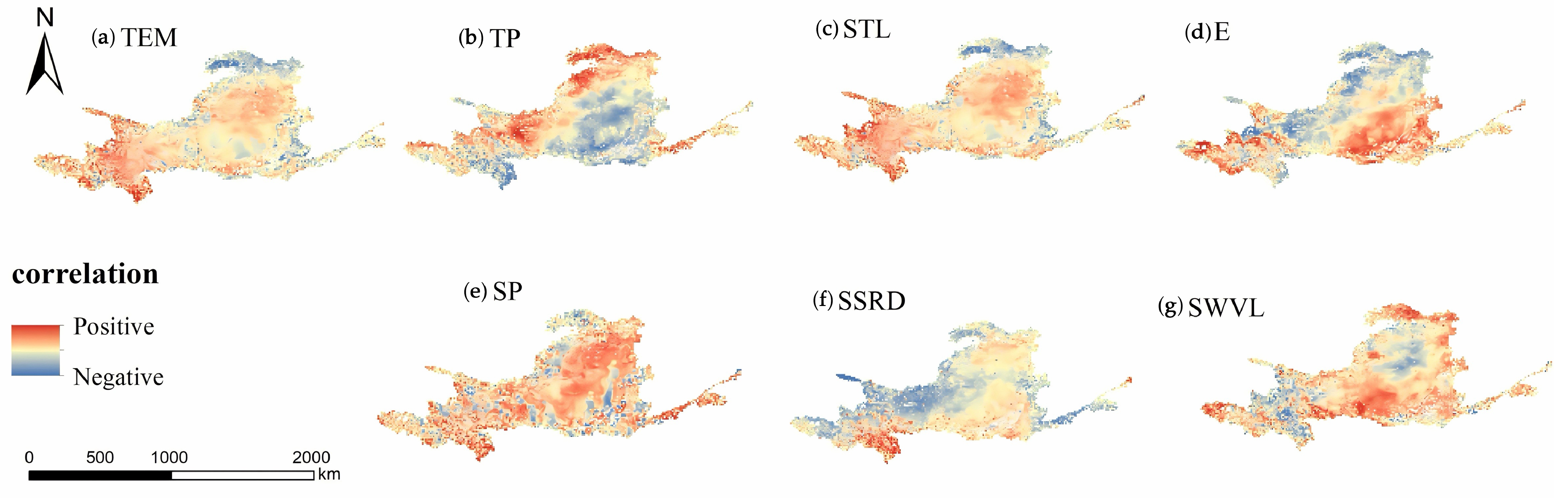
3.2. The Spatial Distribution of Factors and Correlations
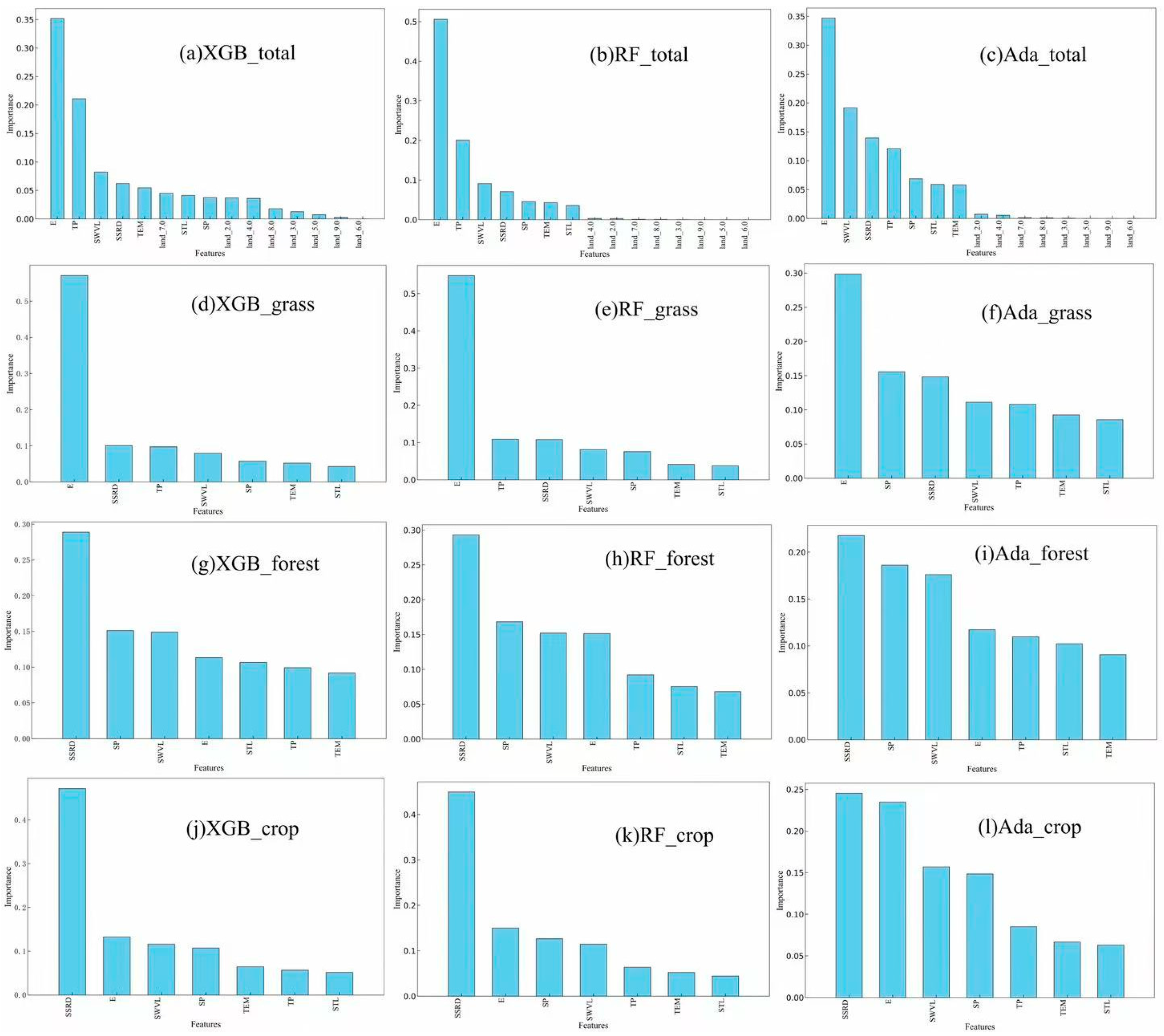
3.3. NPP Fitting Based on Machine Learning
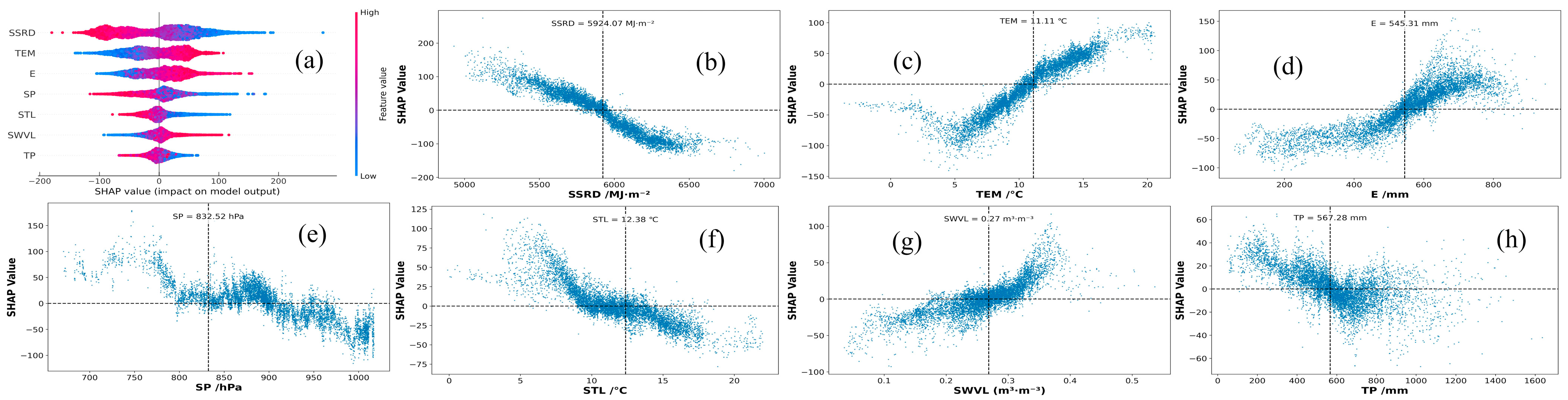
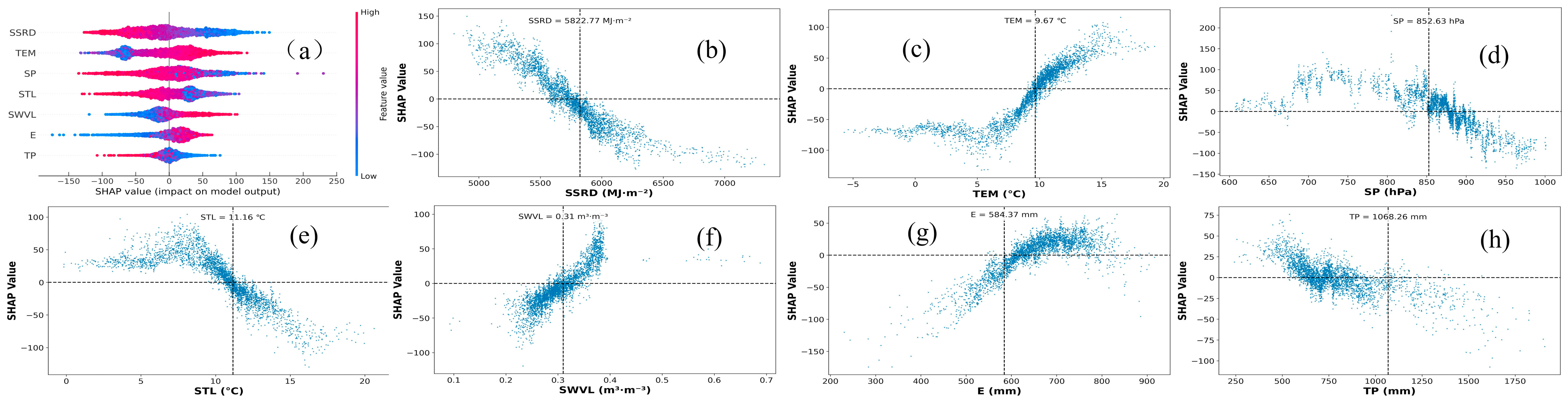
3.4. Explanation of the Model Based on the SHAP Method
4. Discussion
4.1. Distribution and Trend of NPP in the YRB from 2001 to 2020
4.2. Feasibility of Machine Learning Models for NPP Simulation
4.3. Analysis of Influencing Factors of NPP Based on Machine Learning Algorithms
4.4. Regional Heterogeneity, Scale Dependence, and Ecological Interpretation
4.5. Uncertainty and Limitations
5. Conclusions
- (1)
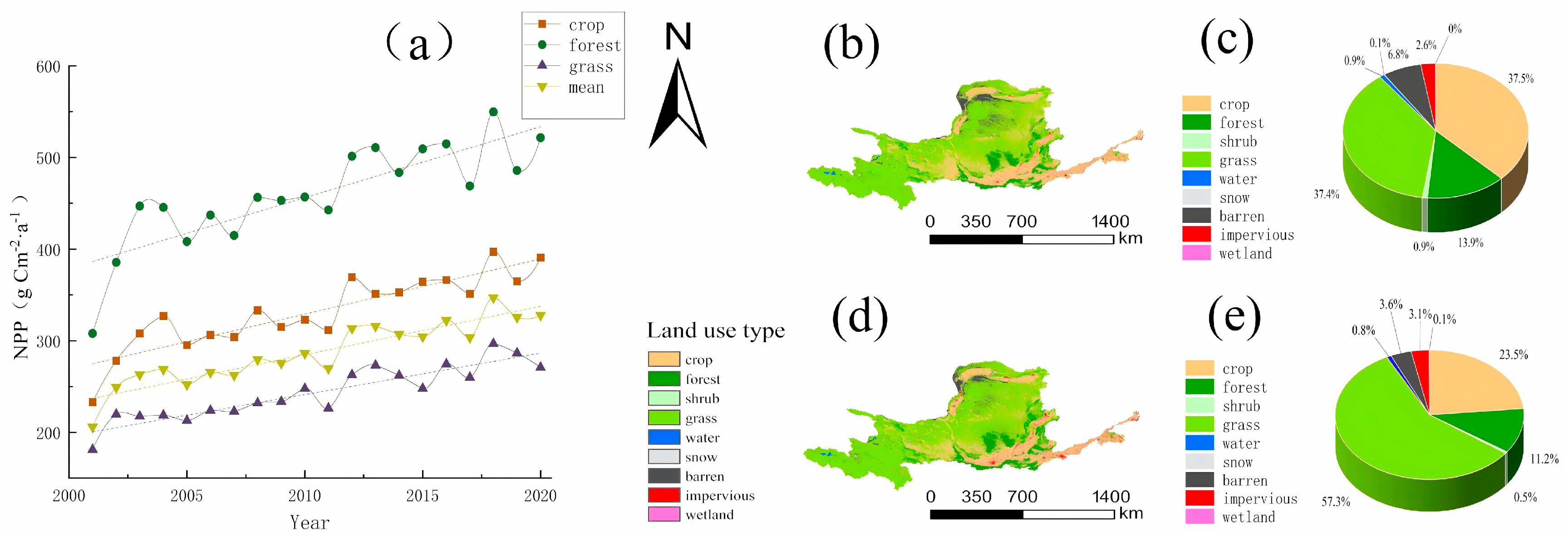
- The annual average NPP, cropland annual average NPP, forest annual average NPP, and grassland annual average NPP in the YRB all fluctuated and increased. The policy of returning cropland to grassland and the development and utilization of wasteland have made certain contributions to the increase in NPP in the YRB.
- (2)
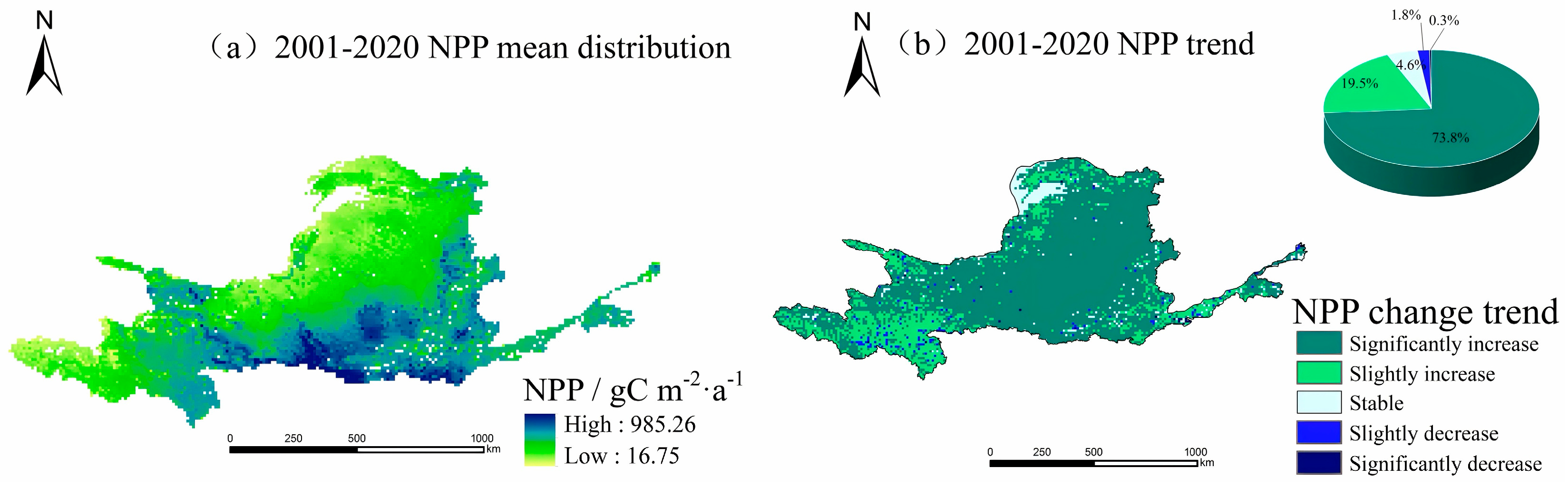
- NPP in the YRB is higher in the south and lower in the north, and NPP in most areas increases in different degrees during the study period.
- (3)
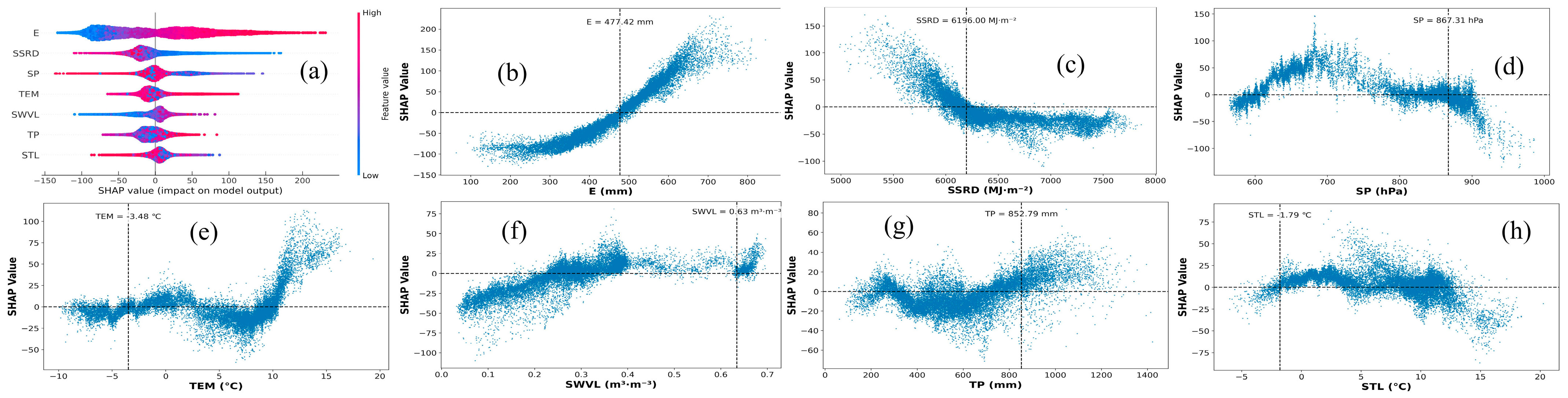
- For the entire YRB, moisture-related variables contributed more strongly to model-predicted NPP variations than thermal variables. For different ecosystem types, the main contributing factors varied. Surface solar radiation downwards (SSRD) made the largest contribution to model-predicted NPP variations in cropland and forest ecosystems and was generally negatively associated with NPP. In contrast, evapotranspiration (E) contributed most strongly to model-predicted NPP variations in grassland ecosystems and was positively associated with NPP. The SHAP dependence results further indicated that the relationships between NPP and environmental factors were nonlinear and ecosystem-dependent. The identified thresholds should be interpreted as SHAP-derived response thresholds within the machine learning framework rather than direct evidence of ecological tipping points or regime shifts.
Author Contributions
Funding
Data Availability Statement
Conflicts of Interest
References
- Field, C.B.; Behrenfeld, M.J.; Randerson, J.T.; Falkowski, P. Primary production of the biosphere: Integrating terrestrial and oceanic components. Science 1998, 281, 237–240. [Google Scholar] [CrossRef]
- Luo, Z.; Wu, W.; Yu, X.; Song, Q.; Yang, J.; Wu, J.; Zhang, H. Variation of Net Primary Production and Its Correlation with Climate Change and Anthropogenic Activities over the Tibetan Plateau. Remote Sens. 2018, 10, 1352. [Google Scholar] [CrossRef]
- Zhang, S.; Chen, Y.; Guo, H.; Lu, Y.; Guo, X.; Liu, C.; Zhou, X.; Zhang, Y. Changes in dryland areas and net primary productivity in China from 1980 to 2020. J. Earth Syst. Sci. 2023, 132, 83. [Google Scholar] [CrossRef]
- Sun, R.; Wang, J.; Xiao, Z.; Zhu, A.; Wang, M.; Yu, T. Estimation of global net primary productivity from 1981 to 2018 with remote sensing data. In IGARSS 2020-2020 IEEE International Geoscience and Remote Sensing Symposium; IEEE: Piscataway, NJ, USA, 2020; pp. 4331–4334. [Google Scholar] [CrossRef]
- Zhao, M.S.; Heinsch, F.A.; Nemani, R.R.; Running, S.W. Improvements of the MODIS terrestrial gross and net primary production global data set. Remote Sens. Environ. 2005, 95, 164–176. [Google Scholar] [CrossRef]
- Castaneda-Moya, E.; Twilley, R.R.; Rivera-Monroy, V.H. Allocation of biomass and net primary productivity of mangrove forests along environmental gradients in the Florida Coastal Everglades, USA. For. Ecol. Manag. 2013, 307, 226–241. [Google Scholar] [CrossRef]
- Wen, Y.; Liu, X.; Bai, Y.; Sun, Y.; Yang, J.; Lin, K.; Pei, F.; Yan, Y. Determining the impacts of climate change and urban expansion on terrestrial net primary production in China. J. Environ. Manag. 2019, 240, 75–83. [Google Scholar] [CrossRef] [PubMed]
- Sun, H.; Wang, W.J.; Liu, Z.; Ballantyne, A.P.; Yu, K.; Bao, S.G.; Ba, S.; Wang, L.; Cong, Y.; He, H.S. Enhanced productivity and evapotranspiration dominated by woody plant encroachment-induced vegetation greening in boreal wetland ecosystems. Gisci. Remote Sens. 2024, 61, 2391144. [Google Scholar] [CrossRef]
- Aubinet, M.; Vesala, T.; Papale, D. (Eds.) Eddy Covariance: A Practical Guide to Measurement and Data Analysis; Springer: Dordrecht, The Netherlands, 2012. [Google Scholar] [CrossRef]
- Ochoa-Sanchez, A.; Crespo, P.; Carrillo-Rojas, G.; Sucozhanay, A.; Celleri, R. Actual Evapotranspiration in the High Andean Grasslands: A Comparison of Measurement and Estimation Methods. Front. Earth Sci. 2019, 7, 55. [Google Scholar] [CrossRef]
- Guo, H.; Zhou, X.; Dong, Y.; Wang, Y.; Li, S. On the use of machine learning methods to improve the estimation of gross primary productivity of maize field with drip irrigation. Ecol. Model. 2023, 476, 110250. [Google Scholar] [CrossRef]
- Potter, C.S.; Randerson, J.T.; Field, C.B.; Matson, P.A.; Vitousek, P.M.; Mooney, H.A.; Klooster, S.A. Terrestrial ecosystem production: A process model based on global satellite and surface data. Glob. Biogeochem. Cycles 1993, 7, 811–841. [Google Scholar] [CrossRef]
- Zheng, Z.; Zhu, W.; Zhang, Y. Seasonally and spatially varied controls of climatic factors on net primary productivity in alpine grasslands on the Tibetan Plateau. Glob. Ecol. Conserv. 2020, 21, e00814. [Google Scholar] [CrossRef]
- Bai, Y.; Liang, S.; Yuan, W. Estimating Global Gross Primary Production from Sun-Induced Chlorophyll Fluorescence Data and Auxiliary Information Using Machine Learning Methods. Remote Sens. 2021, 13, 963. [Google Scholar] [CrossRef]
- Liang, Y.; Zhao, H.; Yuan, Z.; Wei, D.; Wang, X. Ecological Restoration Projects Adapt Response of Net Primary Productivity of Alpine Grasslands to Climate Change across the Tibetan Plateau. Remote Sens. 2024, 16, 4444. [Google Scholar] [CrossRef]
- Yaghmaei, L.; Koupaei, S.S.; Jafari, R. Spatiotemporal Response of Rangeland NPP to Drought in Central Iran based on SPDI Index. Contemp. Probl. Ecol. 2020, 13, 694–707. [Google Scholar] [CrossRef]
- Potter, C.; Pass, S. Changes in the net primary production of ecosystems across Western Europe from 2015 to 2022 in response to historic drought events. Carbon Balance Manag. 2024, 19, 32. [Google Scholar] [CrossRef] [PubMed]
- Berberoglu, S.; Donmez, C.; Cilek, A. Modelling climate change impacts on regional net primary productivity in Turkey. Environ. Monit. Assess. 2021, 193, 242. [Google Scholar] [CrossRef]
- Sun, J.; Yue, Y.; Niu, H. Evaluation of NPP using three models compared with MODIS-NPP data over China. PLoS ONE 2021, 16, e0252149. [Google Scholar] [CrossRef]
- Hicke, J.A.; Asner, G.P.; Randerson, J.T.; Tucker, C.; Los, S.; Birdsey, R.; Jenkins, J.C.; Field, C. Trends in North American net primary productivity derived from satellite observations, 1982–1998. Glob. Biogeochem. Cycles 2002, 16, 2-1–2-14. [Google Scholar] [CrossRef]
- Liu, J.; Shen, L.; Chen, Z.; Ni, J.; Huang, Y. Assessing the Response of the Net Primary Productivity to Snow Phenology Changes in the Tibetan Plateau: Trends and Environmental Drivers. Remote Sens. 2024, 16, 3566. [Google Scholar] [CrossRef]
- Duan, Y.; Pei, X.; Luo, J.; Zhang, X.; Luo, L. Disentangling the Spatiotemporal Dynamics, Drivers, and Recovery of NPP in Co-Seismic Landslides: A Case Study of the 2017 Jiuzhaigou Earthquake, China. Forests 2024, 15, 1381. [Google Scholar] [CrossRef]
- Liu, Y.; Huang, C.; Chen, C.; Yang, C.; Huang, W. Spatiotemporal Variation and Driving Factors Analysis of Net Primary Productivity in the Qinling Mountains. Contemp. Probl. Ecol. 2024, 17, 936–947. [Google Scholar] [CrossRef]
- Gong, E.; Zhang, J.; Wang, Z.; Wang, J. Estimating the dynamics and driving factors of gross primary productivity over the Chinese Loess Plateau by the modified vegetation photosynthesis model. Ecol. Inform. 2024, 83, 102838. [Google Scholar] [CrossRef]
- Baldocchi, D.; Chu, H.; Reichstein, M. Inter-annual variability of net and gross ecosystem carbon fluxes: A review. Agric. For. Meteorol. 2018, 249, 520–533. [Google Scholar] [CrossRef]
- Liu, Q.; Fu, Y.H.; Zhu, Z.; Liu, Y.; Liu, Z.; Huang, M.; Janssens, I.A.; Piao, S. Delayed autumn phenology in the Northern Hemisphere is related to change in both climate and spring phenology. Glob. Change Biol. 2016, 22, 3702–3711. [Google Scholar] [CrossRef]
- Zeppel, M.J.B.; Wilks, J.V.; Lewis, J.D. Impacts of extreme precipitation and seasonal changes in precipitation on plants. Biogeosciences 2014, 11, 3083–3093. [Google Scholar] [CrossRef]
- Carrillo-Rojas, G.; Silva, B.; Rollenbeck, R.; Celleri, R.; Bendix, J. The breathing of the Andean highlands: Net ecosystem exchange and evapotranspiration over the paramo of southern Ecuador. Agric. For. Meteorol. 2019, 265, 30–47. [Google Scholar] [CrossRef]
- Urgiles, C.; Orellana-Alvear, J.; Crespo, P.; Carrillo-Rojas, G. Gross primary productivity estimation through remote sensing and machine learning techniques in the high Andean Region of Ecuador. Int. J. Biometeorol. 2024, 69, 541–556. [Google Scholar] [CrossRef] [PubMed]
- Wang, M.; Sun, K.; Jia, J.; Wu, F.; Gao, Y. Climate Change Drove the Decline in Yangtze Estuary Net Primary Production over the Past Two Decades. Environ. Sci. Technol. 2024, 58, 19305–19314. [Google Scholar] [CrossRef]
- Yuan, D.; Zhang, S.; Li, H.; Zhang, J.; Yang, S.; Bai, Y. Improving the Gross Primary Productivity Estimate by Simulating the Maximum Carboxylation Rate of the Crop Using Machine Learning Algorithms. IEEE Trans. Geosci. Remote Sens. 2022, 60, 4413115. [Google Scholar] [CrossRef]
- Zhang, S.; Hao, X.; Zhao, Z.; Zhang, J.; Fan, X.; Li, X. Natural Vegetation Succession Under Climate Change and the Combined Effects on Net Primary Productivity. Earths Future 2023, 11, e2023EF003903. [Google Scholar] [CrossRef]
- Li, M.; Zhu, Z.; Ren, W.; Wang, Y. Predicting Gross Primary Productivity under Future Climate Change for the Tibetan Plateau Based on Convolutional Neural Networks. Remote Sens. 2024, 16, 3723. [Google Scholar] [CrossRef]
- Liu, N.; Hao, Z.; Zhao, P. Explainable deep learning insights into the history and future of net primary productivity in China. Ecol. Indic. 2024, 166, 112394. [Google Scholar] [CrossRef]
- Lu, Q.; Liu, H.; Wei, L.; Zhong, Y.; Zhou, Z. Global prediction of gross primary productivity under future climate change. Sci. Total Environ. 2024, 912, 169239. [Google Scholar] [CrossRef]
- Jia, L.; Zhang, B. Simulating the Vegetation Gross Primary Productivity by the Biome-BGC Model in the Yellow River Basin of China. Water 2024, 16, 3468. [Google Scholar] [CrossRef]
- Lv, M.; Ma, Z.; Li, M.; Zheng, Z. Quantitative Analysis of Terrestrial Water Storage Changes Under the Grain for Green Program in the Yellow River Basin. J. Geophys. Res.-Atmos. 2019, 124, 1336–1351. [Google Scholar] [CrossRef]
- Jiang, C.; Guo, H.; Wei, Y.; Yang, Z.; Wang, X.; Wen, M.; Yang, L.; Zhao, L.; Zhang, H.; Zhou, P. Ecological restoration is not sufficient for reconciling the trade-off between soil retention and water yield: A contrasting study from catchment governance perspective. Sci. Total Environ. 2021, 754, 142139. [Google Scholar] [CrossRef]
- Wang, X.; He, W.; Huang, Y.; Wu, X.; Zhang, X.; Zhang, B. Exploring Spatial Non-Stationarity and Scale Effects of Natural and Anthropogenic Factors on Net Primary Productivity of Vegetation in the Yellow River Basin. Remote Sens. 2024, 16, 3156. [Google Scholar] [CrossRef]
- Li, X.; Yu, K.-X.; Xu, G.-C.; Li, P.; Li, Z.-B.; Shi, P. Spatial Characteristics and Driving Factors of Net Primary Productivity of Vegetation in the Upper and Middle Yellow River Basin. Huan Jing Ke Xue 2024, 45, 6448–6457. [Google Scholar] [CrossRef] [PubMed]
- Tian, K.; Liu, X.; Zhang, B.; Wang, Z.; Xu, G.; Chang, K.; Xu, P.; Han, B. Analysis of Spatiotemporal Evolution and Influencing Factors of Vegetation Net Primary Productivity in the Yellow River Basin from 2000 to 2022. Sustainability 2024, 16, 381. [Google Scholar] [CrossRef]
- Cao, Y.; Li, H.; Liu, Y.; Zhang, Y.; Jiang, Y.; Dai, W.; Shen, M.; Guo, X.; Qi, W.; Li, L.; et al. Regional Contribution and Attribution of the Interannual Variation of Net Primary Production in the Yellow River Basin, China. Remote Sens. 2023, 15, 5212. [Google Scholar] [CrossRef]
- Lin, Z.; Liu, Y.; Wen, Z.; Chen, X.; Han, P.; Zheng, C.; Yao, H.; Wang, Z.; Shi, H. Spatial-Temporal Variation Characteristics and Driving Factors of Net Primary Production in the Yellow River Basin over Multiple Time Scales. Remote Sens. 2023, 15, 5273. [Google Scholar] [CrossRef]
- Wu, Z.; Borzee, A.; Qian, T.; Dai, W.; Li, S.; Wang, J. Spatial non-stationarity effect of determinants regulates variation in amphibian species richness. Ecol. Indic. 2023, 150, 110268. [Google Scholar] [CrossRef]
- Das, P.; Zhang, Z.; Ghosh, S.; Lu, J.; Ayugi, B.; Ojara, M.A.; Guo, X. Historical and projected changes in Extreme High Temperature events over East Africa and associated with meteorological conditions using CMIP6 models. Glob. Planet. Change 2023, 222, 104068. [Google Scholar] [CrossRef]
- Theil, H. A rank-invariant method of linear and polynomial regression analysis. In Henri Theil’s Contributions to Economics and Econometrics. Advanced Studies in Theoretical and Applied Econometrics; Springer: Dordrecht, The Netherlands, 1992. [Google Scholar]
- Sen, P.K. Estimates of the regression coefficient based on Kendall’s tau. J. Am. Stat. Assoc. 1968, 63, 1379–1389. [Google Scholar] [CrossRef]
- Kendall, M.G. A new measure of rank correlation. Biometrika 1938, 30, 81–93. [Google Scholar] [CrossRef]
- Chen, Y.; Guo, D.; Cao, W.; Li, Y. Changes in Net Primary Productivity and Factor Detection in China’s Yellow River Basin from 2000 to 2019. Remote Sens. 2023, 15, 2798. [Google Scholar] [CrossRef]
- Movchan, D.; Kostyuchenko, Y.V. Regional dynamics of terrestrial vegetation productivity and climate feedbacks for territory of Ukraine. Int. J. Geogr. Inf. Sci. 2015, 29, 1490–1505. [Google Scholar] [CrossRef]
- Nie, W.; Gu, J.; Li, B.; Wen, X.; Nie, X. Quantitative lithology prediction from seismic data using deep learning. Comput. Geosci. 2025, 196, 105821. [Google Scholar] [CrossRef]
- Rodriguez-Galiano, V.; Sanchez-Castillo, M.; Chica-Olmo, M.; Chica-Rivas, M. Machine learning predictive models for mineral prospectivity: An evaluation of neural networks, random forest, regression trees and support vector machines. Ore Geol. Rev. 2015, 71, 804–818. [Google Scholar] [CrossRef]
- Su, N.; Weng, S.; Wang, L.; Xu, T. Reflectance Spectroscopy with Multivariate Methods for Non-Destructive Discrimination of Edible Oil Adulteration. Biosensors 2021, 11, 492. [Google Scholar] [CrossRef]
- Qi, Y.-P.; He, P.-J.; Lan, D.-Y.; Lue, F.; Zhang, H. Novel method for predicting concentrations of incineration flue gas based on waste composition and machine learning. J. Environ. Manag. 2025, 373, 123588. [Google Scholar] [CrossRef] [PubMed]
- Yan, Y.; Yang, Y. Revealing the synergistic spatial effects in soil heavy metal pollution with explainable machine learning models. J. Hazard. Mater. 2024, 482, 136578. [Google Scholar] [CrossRef]
- Wang, Z.; Zhou, R.; Rui, J.; Yu, Y. Revealing the impact of urban spatial morphology on land surface temperature in plain and plateau cities using explainable machine learning. Sustain. Cities Soc. 2025, 118, 106046. [Google Scholar] [CrossRef]
- Lundberg, S.M.; Erion, G.; Chen, H.; DeGrave, A.; Prutkin, J.M.; Nair, B.; Katz, R.; Himmelfarb, J.; Bansal, N.; Lee, S.-I. From local explanations to global understanding with explainable AI for trees. Nat. Mach. Intell. 2020, 2, 56–67. [Google Scholar] [CrossRef]
- Zhang, L.; Li, X.; Liu, X.; Lian, Z.; Zhang, G.; Liu, Z.; An, S.; Ren, Y.; Li, Y.; Liu, S. Dynamic monitoring and drivers of ecological environmental quality in the Three-North region, China: Insights based on remote sensing ecological index. Ecol. Inform. 2025, 85, 102936. [Google Scholar] [CrossRef]
- Dai, L.; Li, S.; Zhou, W.; Qi, L.; Zhou, L.; Wei, Y.; Li, J.; Shao, G.; Yu, D. Opportunities and challenges for the protection and ecological functions promotion of natural forests in China. For. Ecol. Manag. 2018, 410, 187–192. [Google Scholar] [CrossRef]
- Liu, Y.; Zhang, T.; Yuan, L.; Zimini, Y.; Zhou, R.; Lin, Z.; Zheng, C.; Wen, Z. Interannual asymmetric transitions of gross primary productivity in the grasslands of Northern China. Ecol. Indic. 2024, 167, 112631. [Google Scholar] [CrossRef]



| Abbreviation | Full Name |
|---|---|
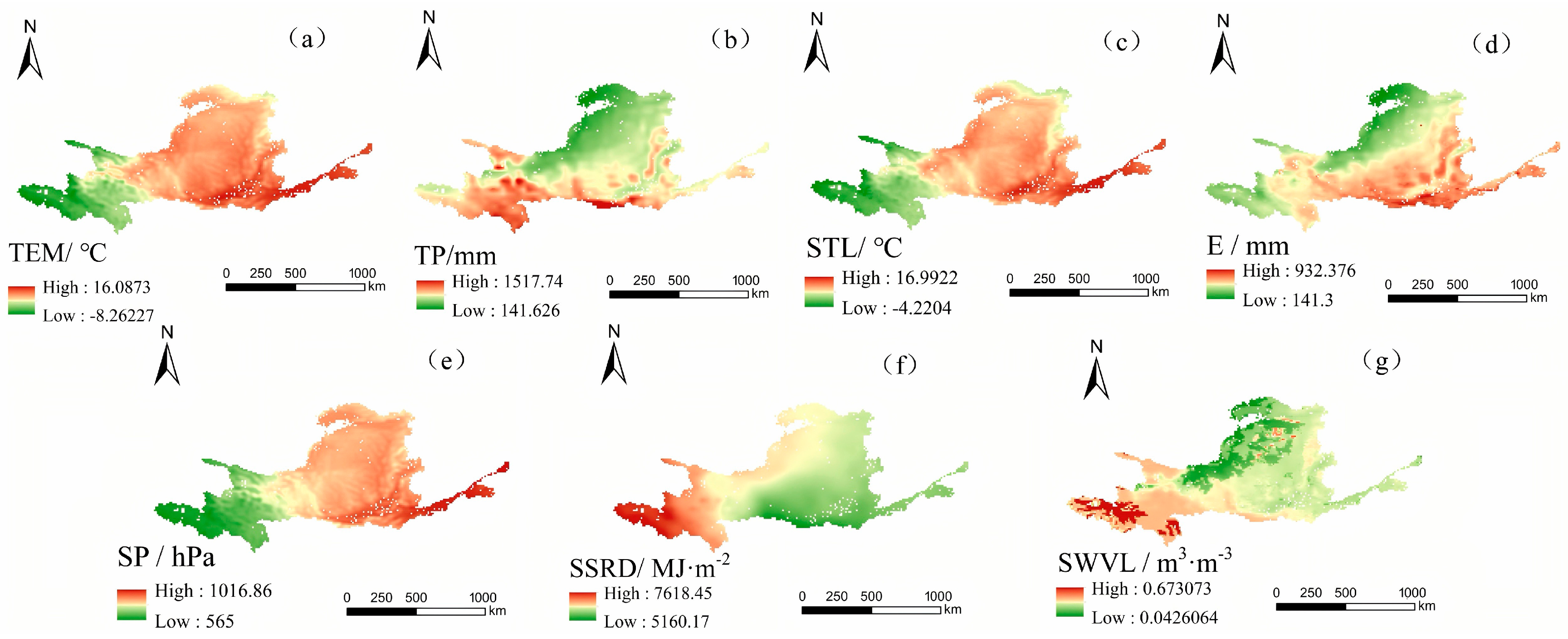
| TEM | Temperature/°C |
| TP | Total precipitation/mm |
| E | Evapotranspiration/mm |
| STL | Soil temperature level 1 (0–7 cm)/°C |
| SP | Surface pressure/hPa |
| SSRD | Surface solar radiation downwards/MJ·m−2 |
| SWVL | Volumetric soil water layer 1 (0–7 cm)/m3·m−3 |
| Slope | Trend | |
|---|---|---|
| Slope > 0 | Significantly increase | |
| ≤ 1.96 | Slightly increase | |
| Slope = 0 | ≤ 1.96 | Stable |
| Slope < 0 | < 0 | Slightly decrease |
| < −1.96 | Significantly decrease |
| Model | Hyperparameter | Value |
|---|---|---|
| AdaBoost | n_estimators | 100 |
| AdaBoost | learning_rate | 0.1 |
| AdaBoost | loss | linear |
| Random Forest | n_estimators | 200 |
| Random Forest | max_depth | 15 |
| Random Forest | min_samples_split | 5 |
| Random Forest | min_samples_leaf | 2 |
| Random Forest | max_features | sqrt |
| XGBoost | n_estimators | 200 |
| XGBoost | learning_rate | 0.05 |
| XGBoost | max_depth | 8 |
| XGBoost | subsample | 0.8 |
| XGBoost | colsample_bytree | 0.8 |
| XGBoost | objective | reg:squarederror |
| Land Use Type | Area in 2001/km2 | Percentage in 2001/% | Area in 2020/km2 | Percentage in 2020/% | Change/km2 |
|---|---|---|---|---|---|
| Grassland | 458,312.52 | 57.49 | 461,940.35 | 57.95 | 3627.82 |
| Cropland | 201,797.22 | 25.31 | 184,798.53 | 23.18 | −16,998.69 |
| Forest | 79,052.52 | 9.92 | 92,316.97 | 11.58 | 13,264.45 |
| Bare land | 34,757.23 | 4.36 | 25,141.49 | 3.15 | −9615.74 |
| Impervious surface | 12,786.21 | 1.60 | 22,224.30 | 2.79 | 9438.09 |
| Shrub | 5283.69 | 0.66 | 3772.02 | 0.47 | −1511.67 |
| Water | 4711.29 | 0.59 | 6268.32 | 0.79 | 1557.02 |
| Snow/Ice | 286.61 | 0.04 | 249.40 | 0.03 | −37.21 |
| Wetland | 185.32 | 0.02 | 461.24 | 0.06 | 275.92 |
| Factor | Entire YRB | Cropland | Forest | Grassland |
|---|---|---|---|---|
| TEM | 0.32 | 0.28 | 0.35 | 0.26 |
| TP | 0.18 | −0.05 | −0.12 | 0.22 |
| E | 0.41 | 0.35 | 0.30 | 0.48 |
| STL | 0.29 | 0.25 | 0.33 | 0.23 |
| SP | −0.15 | −0.18 | −0.10 | −0.20 |
| SSRD | −0.38 | −0.45 | −0.42 | −0.33 |
| SWVL | 0.35 | 0.22 | 0.28 | 0.40 |
| Type | Random Forest | XGBoost | AdaBoost | |||
|---|---|---|---|---|---|---|
| R2 | RMSE | R2 | RMSE | R2 | RMSE | |
| Total samples | 0.842 | 43.4 | 0.835 | 44.4 | 0.844 | 43.1 |
| Grass samples | 0.831 | 49.3 | 0.819 | 51.1 | 0.833 | 49.0 |
| Crop samples | 0.757 | 62.3 | 0.745 | 63.8 | 0.764 | 61.3 |
| Forest samples | 0.600 | 82.2 | 0.598 | 82.0 | 0.615 | 80.2 |
Disclaimer/Publisher’s Note: The statements, opinions and data contained in all publications are solely those of the individual author(s) and contributor(s) and not of MDPI and/or the editor(s). MDPI and/or the editor(s) disclaim responsibility for any injury to people or property resulting from any ideas, methods, instructions or products referred to in the content. |
© 2026 by the authors. Licensee MDPI, Basel, Switzerland. This article is an open access article distributed under the terms and conditions of the Creative Commons Attribution (CC BY) license.
Share and Cite
Lan, Y.; Zheng, Z.; Xie, D.; Ding, X. Exploring the Critical Thresholds of Environmental Factors on Net Primary Productivity in the Yellow River Basin. Forests 2026, 17, 674. https://doi.org/10.3390/f17060674
Lan Y, Zheng Z, Xie D, Ding X. Exploring the Critical Thresholds of Environmental Factors on Net Primary Productivity in the Yellow River Basin. Forests. 2026; 17(6):674. https://doi.org/10.3390/f17060674
Chicago/Turabian StyleLan, Yu, Zhaopei Zheng, Dewei Xie, and Xin Ding. 2026. "Exploring the Critical Thresholds of Environmental Factors on Net Primary Productivity in the Yellow River Basin" Forests 17, no. 6: 674. https://doi.org/10.3390/f17060674
APA StyleLan, Y., Zheng, Z., Xie, D., & Ding, X. (2026). Exploring the Critical Thresholds of Environmental Factors on Net Primary Productivity in the Yellow River Basin. Forests, 17(6), 674. https://doi.org/10.3390/f17060674