Review

Chemical Terroir in Forest Understories: Hypothesis, Ecological Co-Cultivation, and Research Priorities for Saponin-Rich Medicinal Plants


1
Faculty of Biology, Vinh University, 182 Le Duan Street, Truong Vinh Ward, Vinh City 43131, Nghe An Province, Vietnam
2
Faculty of Early Childhood Education, Nghe An University, 51 Ly Tu Trong Street, Vinh Phu Ward, Ho Chi Minh City 43134, Nghe An Province, Vietnam
*
Author to whom correspondence should be addressed.
Forests 2026, 17(6), 643; https://doi.org/10.3390/f17060643
Submission received: 25 April 2026 / Revised: 18 May 2026 / Accepted: 21 May 2026 / Published: 25 May 2026
(This article belongs to the Section Forest Ecology and Management)

Abstract

Medicinal plants grown outside their native forest habitat may produce phytochemical profiles that differ from wild-harvested material, yet the ecological mechanisms underlying these differences remain poorly synthesized across disciplines. This review proposes that the forest understory functions as a multi-signal elicitation system in which canopy light filtering, arbuscular mycorrhizal fungi (AMF), and above-ground biotic interactions collectively shape secondary metabolite profiles. AMF-mediated induced systemic resistance and above-ground biotic interactions operate through confirmed jasmonate-mediated pathways. Sunfleck-driven reactive oxygen species signaling is hypothesized but untested, and the red-to-far-red ratio modulated phytochrome B pathway characterized in Arabidopsis remains unconfirmed in shade-tolerant species. Using three saponin-rich medicinal plants (Panax vietnamensis, Panex quinquefolius, and Paris polyphylla) as case studies, we formalize this as a testable chemical terroir hypothesis with three falsifiable predictions. We also translate it into an ecological co-cultivation design principle with three production levels and a two-step operational framework, and identify priority experiments, analytical methods, and implementation challenges needed for validation. These contributions bridge forest ecology and medicinal plant science while identifying critical evidence gaps requiring resolution before field implementation.

1. Introduction

1.1. The Forest-to-Field Quality Problem of Medicinal Plants

Forest understory medicinal species sustain rural livelihoods as non-timber forest products (NTFPs) in tropical and subtropical regions [1,2]. Increasing demand drives both overexploitation of wild populations and transfer of production to conventional cultivation systems. When medicinal plants native to forest understories are transferred to open-field or greenhouse settings, their phytochemical profiles may change [3,4]. However, which metabolites are affected and what ecological factors drive these changes remain open questions. Moreover, the relevant evidence spans forest ecology, mycorrhizal biology, and phytochemistry, but has not been integrated across these disciplines. This review aims to address these gaps.

1.2. Three Case Studies

We selected three saponin-rich understory species to illustrate the relationship between growing environment and phytochemical profiles. Saponins are a useful test case because they form complex multi-component profiles that are both commercially important and analytically tractable. Each species was chosen for a distinct type of evidence: Panax vietnamensis for geographic restriction and environmental specificity, P. quinquefolius for genotype × environment partitioning, and Paris polyphylla for direct metabolomic comparison between forest and non-forest conditions.
Panax vietnamensis Ha & Grushv. (Araliaceae) is restricted to Vietnamese montane forests at 1500–2100 m and produces a distinctive ocotillol-type-dominated saponin profile, with majonoside-R2 as the characteristic principal saponin distinguishing it from other Panax species [5]. Saponin content increased with plant age in material acclimatized to lower elevations in Lam Dong Province [4], though whether this reflects the acclimatized environment, ontogeny, or both cannot be determined from the study design. Thus, the effect of relocation on the characteristic ocotillol-type profile has not been tested.
Panax quinquefolius L. (American ginseng) exhibits wide ginsenoside variation driven by both population origin and growing environment [6]. In a study of eight wild populations transplanted to two forest garden locations in North America, different ginsenosides responded to genotype, location, or both in this observational transplant design, and plants at the more intensively managed site showed lower ginsenoside levels despite higher growth [6]. Forest-grown (“woods-grown”) and wild-simulated roots command 10–100× price premiums over field-cultivated material [7], reflecting a market-recognized quality distinction, though the phytochemical basis for this premium is not fully characterized.
Paris polyphylla Sm. (Melanthiaceae) provides the most direct forest-versus-greenhouse comparison. Yan et al. [8] used untargeted metabolomics (UPLC-MS/MS) to compare 8-year-old rhizomes from natural forest (observational comparison; environmental factors not independently manipulated) understory and greenhouse conditions. Of 1182 secondary metabolites identified, 372 were differentially accumulated between the two growing environments. Steroidal saponins, flavonoids, flavonols, lipids, and vitamins were significantly enriched in understory-grown plants, though the majority of differentially accumulated metabolites (256 of 372) were more abundant in greenhouse material.
Collectively, these case studies indicate that phytochemical profiles respond to growing environment, but the nature and direction of the response vary among species and studies. The mechanisms driving these differences have not been identified in any of the three systems, motivating the mechanistic synthesis in Section 2.

1.3. Gaps in Existing Literature

What ecological mechanisms generate forest-specific phytochemical profiles? This question has attracted attention from several disciplines, but largely in isolation from one another. Agroforestry reviews (e.g., [2,3]) describe understory production without examining the underlying mechanisms. AMF reviews (e.g., [9,10]) document effects on secondary metabolism but almost exclusively in greenhouse pots. Elicitation reviews (e.g., [11,12]) examine exogenous chemical or physical treatments applied to cell cultures or whole plants, but do not connect these interventions to the natural ecological signals operating in forest understories. The Chinese daodi (道地) concept links geographic origin to medicinal quality [13] but does not trace the ecological signaling pathways through which growing conditions shape specific metabolite profiles. Climate change reviews (e.g., [14]) address species distributions and vulnerability without integrating forest microclimate ecology.
We integrate these separate literatures by pursuing three specific objectives.
1. Synthesize evidence on how forest understory conditions modulate secondary metabolite profiles, and formalize this understanding as a testable chemical terroir hypothesis (Section 2).
2. Translate ecological mechanisms into an ecological co-cultivation design principle with three production levels, a two-step operational framework, and explicit failure scenarios (Section 3).
3. Identify the experiments, analytical methods, and implementation challenges needed to validate the chemical terroir hypothesis (Section 4).

1.4. Scope, Search Strategy, and Evidence Standards

This review takes the form of a critical narrative synthesis rather than a systematic review. This approach is suited to integrating evidence across disciplines with distinct research traditions and terminologies. A glossary of specialized terms is provided in Table A1.
We searched Web of Science, Scopus, PubMed, and Google Scholar (last search: January 2025). Queries used pairwise combinations of forest ecology terms (“forest understory,” “canopy,” “microclimate”) with phytochemistry and cultivation terms (“medicinal plants,” “secondary metabolites,” “AMF,” “defense priming,” “agroforestry”). We prioritized peer-reviewed publications from 2015 to 2025 but included earlier foundational studies where they established key concepts or provided the only available evidence. No language restriction was applied, though the final reference list is predominantly English-language. The scope focuses on understory herbaceous medicinal species in tropical and temperate forests, with extensions to other growth forms and biomes discussed in Section 4.3. Consistent with the narrative-review framing, we did not apply formal PRISMA-style accounting; titles and abstracts were screened for relevance to forest ecological signals, AMF or biotic priming mechanisms, or the three case-study species, with backward and forward citation tracing from the included primary studies. The final reference list reflects the modest empirical evidence base in this cross-disciplinary field and prioritizes primary case-study sources, foundational mechanistic literature, and the most-cited reviews in each contributing discipline.
We classify all cited evidence into two categories used throughout the review. Causal evidence comes from controlled experiments with randomized treatment assignment. Correlative evidence comes from observational field comparisons where multiple variables differ simultaneously. Most understory production studies fall into the correlative category, comparing systems that differ in light, temperature, humidity, soil microbiology, and herbivore pressure. Where no controlled experiment has isolated individual factors, we state this explicitly and avoid causal language.
The forest understory production literature is subject to publication bias, as studies reporting positive effects of forest conditions on secondary metabolites may be more readily published than those reporting null or negative results. Karst et al. [15] documented positive citation bias in common mycorrhizal network (CMN) research in forests; a similar bias likely affects the forest understory production literature reviewed here. We found no published study reporting non-significant effects of understory growing conditions on saponin content in Panax or Paris. This absence is unlikely to reflect the true distribution of outcomes given the variability inherent in field systems. Reported effect sizes should therefore be interpreted cautiously. In particular, the quantitative analysis by Yuan et al. [9] did not include funnel plot analysis or trim-and-fill correction, so its pooled estimates (+68% flavonoids, +53% terpenoids) may overstate true effects. More broadly, statistical rigor varies sharply across the evidence base. Yuan et al. [9] reported 95% confidence intervals and heterogeneity statistics (I2, Q) for the pooled estimates, but most species-level studies in the underlying literature report only point estimates and p-values, without confidence intervals or variance estimates that would permit formal effect-size pooling. The present review is therefore constrained to point estimates accompanied by hedging language and explicit evidence-type annotation, rather than uncertainty intervals around pooled effects; per-study quality indicators are documented in the Appendix A and Appendix B.

2. Ecological Drivers of Secondary Metabolism in the Forest Understory

2.1. Canopy Light Environment

A closed canopy filters sunlight, reducing photosynthetically active radiation (PAR) to 0.4%–4% of above-canopy levels in lowland tropical rainforest [16,17]. These values vary with forest type, latitude, and canopy structure. The canopy also shifts the red-to-far-red ratio (R:FR) from approximately 1.2 in open sunlight to 0.1–0.5 beneath dense canopy, depending on tree species composition, leaf area index, and season [18]. Tree canopies buffer understory temperatures by several degrees, cooling the understory when ambient temperatures are high and warming it when temperatures are low [19]. Species-rich canopies increase this buffering [20]. These are the major abiotic modifications shaping the signal environment experienced by understory medicinal plants.
However, this low-light environment is not uniform. Sunflecks (transient direct-light patches) punctuate the shade, contributing 10%–80% of the daily PAR that reaches the forest floor [21,22]. Each sunfleck episode transiently generates excess excitation energy and reactive oxygen species (ROS) in the chloroplast. By analogy with the stress-induced over-reduction mechanism described for drought [23], the resulting surplus of reduction equivalents could potentially be channeled into NADPH-consuming biosynthetic pathways, enhancing production of phenylpropanoids, terpenoids, and alkaloids. This extrapolation from drought to sunfleck stress has not been experimentally validated in any understory species.
In shade-avoiding Arabidopsis, low R:FR (typically R:FR ≤ 0.5 in shade-simulation experiments, compared with R:FR ~1.1–1.2 in open sunlight) suppresses jasmonate-mediated defense [24,25], creating an apparent contradiction: if low R:FR suppresses defense, how do understory species accumulate defense compounds? We consider the most likely resolution to be that defense metabolite accumulation in shade-tolerant species is driven primarily by R:FR-independent inputs. The strongest candidates are AMF-mediated induced systemic resistance (ISR), for which the canonical mechanistic review by Pieterse and colleagues [26] is developed in Section 2.2, and chronic above-ground biotic interactions—including herbivore-induced plant volatile priming, for which the canonical review by Heil and Karban [27] is developed in Section 2.3. No functional data on shade-defense signaling exist for any forest medicinal species, and light quality effects on medicinal plant metabolites remain species-specific and inconsistent [28,29]. A detailed discussion of the phytochrome B signaling cascade and its uncertain relevance to shade-tolerant species is provided in Appendix B.3.
Empirical data on light–metabolite relationships in medicinal species remain limited. Recent work on Scutellaria baicalensis Georgi demonstrated light-quality modulation of flavonoid content and proposed photoreceptor crosstalk (cryptochromes, phototropins, red–blue antagonism) as the underlying mechanism [28], though molecular-level validation within this species remains pending. Jaroszewicz et al. [29] analyzed polyphenol content in six European forest medicinal plant species and found species-specific responses to forest stand characteristics: canopy openness positively affected total polyphenol content in two of four species assessed for total phenolics, while other factors (stand diversity, soil pH, C/N ratio) had divergent effects across species and compounds. No dose–response curve relating R:FR to saponin accumulation has been published for any medicinal species. Without such data, the link between canopy light quality and the phytochemical profiles central to this review remains qualitative.

2.2. Arbuscular Mycorrhizal Fungi and Soil Microbiome

AMF are the most extensively studied soil microorganisms in relation to medicinal plant secondary metabolism [9,30]. Yuan et al. [9] compiled 233 observations from controlled pot and greenhouse experiments in a quantitative analysis. The analysis used a random-effects model and reported 95% confidence intervals and heterogeneity statistics (I2, Q) for the pooled estimates, but did not report funnel plot or trim-and-fill corrections. The overall pooled effect of AMF inoculation on medicinal active ingredients was +27% (95% CI [19,31]), with belowground organs responding more strongly (+34%, 95% CI [24,32]) than aboveground organs (+18%, 95% CI [5,33]). By compound class, AMF inoculation enhanced flavonoid content by a pooled mean of 68% and terpenoid content by 53%; per-class 95% confidence intervals are shown in Figure 4A of the source paper [9] but were not reported as numerical values, precluding their reproduction here. Both pooled means are likely upper-bound estimates given publication bias (Section 1.4). The alkaloid response was non-significant and trended negative. This compound-class selectivity is consistent with AMF-activated ISR operating through the jasmonate/ethylene axis [26].
Species-specific studies reinforce the AMF–saponin link. In Panax notoginseng, AMF inoculation and exogenous MeJA each increased saponin accumulation relative to controls, but their combination weakened the AMF effect [34] (causal, pot). This suggests that exogenous MeJA may saturate the jasmonate pathway already activated by AMF. In Panax ginseng, AMF–phosphate-solubilizing bacteria interactions reshaped ginsenoside ratios via C:N:P stoichiometry shifts [33] (causal, pot experiment). In P. quinquefolius, understory planting increased ginsenoside accumulation concomitant with increased AMF colonization [35] (correlative; AMF and other variables confounded). Fungicide suppression of AMF altered ginsenoside profiles in P. ginseng [30] (causal, supporting a direct role for AMF in ginsenoside production). These studies indicate that AMF influence both total saponin concentration and compositional ratios.
The negative alkaloid result from quantitative analysis performed by Yuan et al. [9] raises the question of which microbes drive secondary metabolism in alkaloid-producing species. For these species, endophytic fungi may play a more important role than AMF in modulating alkaloid biosynthesis. Fungal endophytes boosted vindoline in Catharanthus roseus by up to 403% [36] (causal, greenhouse). The chemical terroir hypothesis (Section 2.4) therefore requires modification for alkaloid producers, where endophytic community composition rather than AMF colonization may be the primary microbial driver.
Three critical limitations constrain the AMF evidence base. First, all 233 observations in Yuan et al. [9] quantitative analysis derive from controlled pot and greenhouse experiments. To our knowledge, no study has examined AMF effects on medicinal plant metabolites under a natural forest canopy. Second, commercial AMF inoculants contain cosmopolitan species, while forest soils harbor diverse native communities that may function differently from commercial strains. Third, citation bias documented in the related CMN literature [15] plausibly affects AMF–secondary metabolite studies as well, potentially inflating reported effect sizes (Section 1.4). These limitations mean that the AMF contribution to chemical terroir, while plausible, remains unconfirmed under natural forest conditions with native fungal communities.

2.3. Above-Ground Biotic Interactions and Defense Priming

Compared with open-field monocultures, forest understories expose plants to a richer array of above-ground biological interactions, including herbivores, pathogens, and competitors. Direct herbivory and pathogen attack activate jasmonate and salicylate signaling, respectively, both of which upregulate secondary metabolite biosynthesis. Herbivore-induced plant volatiles (HIPVs) further prime defense in neighboring plants [27], and the low-wind conditions typical of closed canopies, in which mean wind speeds are reduced to a small fraction of above-canopy values [37], would be expected to increase local HIPV concentrations. However, the canopy concentration of HIPVs has not been directly measured in forest understories and remains an untested assumption of the chemical terroir hypothesis.
Defense priming provides a key mechanism by which repeated above-ground biotic encounters translate into sustained metabolite accumulation. A primed plant mounts faster, stronger defense upon subsequent challenge while paying minimal growth costs [31]. The molecular basis includes epigenetic modifications at defense gene promoters, which create a chromatin-level memory of prior stress exposure [38]. This priming mechanism is distinct from the below-ground AMF-mediated ISR discussed in Section 2.2, though both may operate simultaneously in the forest understory (Section 2.4).
Above-ground biotic interactions thus provide a plausible but largely untested signal category for the chemical terroir hypothesis. The mechanistic logic is sound, because herbivory and pathogen attack activate known defense pathways, but no study has quantified the contribution of above-ground biotic exposure to medicinal plant phytochemical profiles under forest conditions.
Table 1 summarizes each ecological signal category, its sensing mechanism, and reported or hypothesized effects on secondary metabolite classes.

2.4. Signal Integration and the Chemical Terroir Hypothesis

Section 2.1, Section 2.2 and Section 2.3 treated each signal category separately (Table 1), but in the forest understory they operate simultaneously (Figure 1). AMF-mediated ISR and herbivore-induced defense both operate through the jasmonate pathway [26], while pathogen-triggered systemic acquired resistance (SAR) operates primarily through the salicylate pathway. Whether the canopy light signal also intersects defense signaling, as characterized in Arabidopsis ([24,25]; Appendix B.3), remains unconfirmed in shade-tolerant species (Section 2.1). We propose that the integration of these inputs constitutes chemical terroir: the process by which combined ecological conditions of a particular forest habitat generate a site-specific phytochemical fingerprint distinct from what any single signal produces in isolation. These inputs include AMF-mediated ISR (supported by causal evidence from pot experiments), above-ground biotic interactions including herbivory and HIPV-mediated defense priming (mechanistically plausible but untested under forest conditions), sunfleck-driven ROS (hypothesized by analogy), and potentially the light quality signal.
Chemical terroir must be distinguished from related existing concepts. The term borrows from viticulture [39,40] and relates to the Chinese daodi concept [13]. We use it differently from traditional enological usage in three respects. First, chemical terroir specifies measurable ecological parameters (R:FR, sunfleck regime, AMF community composition, herbivore and pathogen pressure) as putative drivers. Second, its output is assessed through quantifiable metabolite profiles rather than sensory evaluation. Third, it is amenable to G × E partitioning through common garden trials. In this methodological stance, our framework aligns with recent calls by Brillante et al. [40] within viticulture itself for unbiased, mechanism-based terroir science grounded in quantitative measurement rather than marketing narrative. The critical distinction from standard G × E analysis rests on Prediction 3 below, which specifies the multi-signal integration test required to justify the hypothesis as more than well-designed G × E. The term would retain communicative value for bridging forest ecology and phytochemistry regardless of the outcome.
Three testable predictions distinguish chemical terroir from simpler explanations.
  • Forest effect prediction. When plants from a single source population are grown under forest canopy and in paired open-field controls, forest-grown material should differ significantly in phytochemical profile from its paired open-field control at each site, with the forest effect consistent in direction across ecologically distinct sites.
  • Profile plasticity prediction. The phytochemical profile of plants established at a forest site should progressively converge toward that site’s phytochemical fingerprint over time, demonstrating that chemical terroir operates through ongoing ecological signaling rather than a fixed developmental imprint.
  • Multi-signal integration prediction. Multivariate phytochemical profile distance from wild-harvested reference material should increase as ecological signals deviate from intact forest (with canopy filtering, native microbiome, and natural above-ground biotic diversity) through simplified production systems to open-field cultivation.
These predictions entail specific falsification criteria. If forest-grown plants do not show consistently different phytochemical profiles from their paired open-field controls (Prediction 1 is refuted), the chemical terroir hypothesis should be abandoned in favor of standard provenance terminology, and cultivation strategy would shift toward breeding programs rather than environmental management.
If Prediction 1 is supported but forest-grown plants show distinct profiles that do not converge toward the site phytochemical fingerprint over time (Prediction 2 is refuted), cultivation strategy would prioritize site selection for early establishment over long-term forest management.
If Predictions 1 and 2 are supported but phytochemical profile distance from the wild-harvested reference does not increase as ecological signals deviate from intact forest conditions (Prediction 3 fails), forest conditions shape phytochemical profiles through individual factors rather than integrated signal effects. The chemical terroir hypothesis would still inform cultivation design, but would not represent a distinct ecological process beyond standard G × E interaction.
If all three predictions are supported, chemical terroir would be established as a distinct ecological process in which integrated forest signals generate site-specific phytochemical fingerprints that no single factor or simplified production system can replicate. These four scenarios cover the main logical chain, but other outcome combinations are possible. For example, Predictions 1 and 3 could be supported while Prediction 2 fails, indicating that integrated forest signals shape the phytochemical profile during an early developmental window rather than through continuous signaling. The experiments proposed in Section 4.1 should be designed to distinguish among all outcome combinations.
The mechanistic basis for Prediction 3 rests on signal-level reasoning. AMF-mediated ISR and sunfleck-driven ROS operate through distinct mechanisms [23,26], so their simultaneous operation under forest canopy may affect phytochemical profiles differently from either signal alone. The interaction between AMF and above-ground biotic stress could be synergistic if below-ground and above-ground defense responses activate complementary pathways, though antagonistic interactions are equally plausible [26]. The weakened AMF effect observed when exogenous MeJA was combined with AMF in P. notoginseng (Section 2.2; Dai et al. [34]) illustrates that signal interactions can be negative rather than additive. Whether these interactions are synergistic, antagonistic, or additive under natural forest conditions has not been determined. The production level gradient defined in Section 3 can test whether integrated signals produce distinct phytochemical fingerprints (Section 4.1), but cannot isolate the nature of individual signal interactions.
Testing these predictions requires controlling for plant age, a confound that modulates metabolite accumulation independently of ecological signals. Forest-based production typically requires longer harvest cycles than field systems. Ontogenetic defense accumulation is well-documented in Panax species. For example, rhizome saponins in P. vietnamensis increase approximately three-fold between ages two and five [41]. Separating ecological signals from age effects requires same-age comparisons across environments, a design that has seldom been implemented. The P. polyphylla comparison by Yan et al. [8] used age-matched plants (8 years) and still found significant metabolite differences, suggesting that age alone does not account for the observed patterns. Nevertheless, age-matched designs should be a minimum requirement for the experiments proposed in Section 4.1.
The chemical terroir hypothesis must also be reconciled with the growth–defense trade-off. This trade-off predicts that intermediate resource availability maximizes secondary metabolite allocation [42], and forest understory conditions may position plants in this zone. The signals hypothesized to drive chemical terroir (sunfleck-driven ROS bursts, low-level HIPV exposure, and chronic but sub-lethal biotic pressure) are all mild and intermittent rather than sustained. Such stimuli correspond to eustress (Table A1), in which low-dose stressors prime defense metabolism without imposing sustained growth penalties, as distinct from the distress that overwhelms plant function (Section 3.3). However, some understory production studies report simultaneous increases in both growth and metabolite content, apparently violating the trade-off. Several mechanisms could explain such outcomes. Candidate mechanisms include AMF-mediated relaxation of resource constraints, reallocation among metabolite classes rather than increased total defense investment (e.g., berberine increased but coptisine declined in understory-grown Coptis chinensis [43]), or confounded observational designs. Lundberg et al. [44] showed that a laboratory-measured growth–defense trade-off in Arabidopsis vanished under field conditions, reinforcing that the growth–defense trade-off may not be the dominant constraint in ecologically complex systems.
Table 2 compiles species-specific effect sizes from individual studies, classified by evidence type (causal vs. correlative). Table A2 extends this compilation with additional quality indicators including sample sizes, replication, controls, and data availability.

3. Translating Mechanisms into Production Design

3.1. Three Levels of Forest-Based Production

If integrated understory signals shape phytochemical profiles as the chemical terroir hypothesis proposes (Section 2), then production systems should preserve those signals rather than override them. We classify forest-based production into three levels by how much native understory signaling is retained (Table 3). The design principle underlying Levels 1–2, which we term the ecological co-cultivation, involves harnessing natural forest processes to maintain the ecological conditions hypothesized to shape the phytochemical profiles of understory medicinal plants. Traditional understory production is an ancient and widespread practice. Ecological co-cultivation principle differs from traditional approaches in its explicit grounding in the mechanistic understanding developed in Section 2.

3.2. Operational Framework for Ecological Co-Cultivation

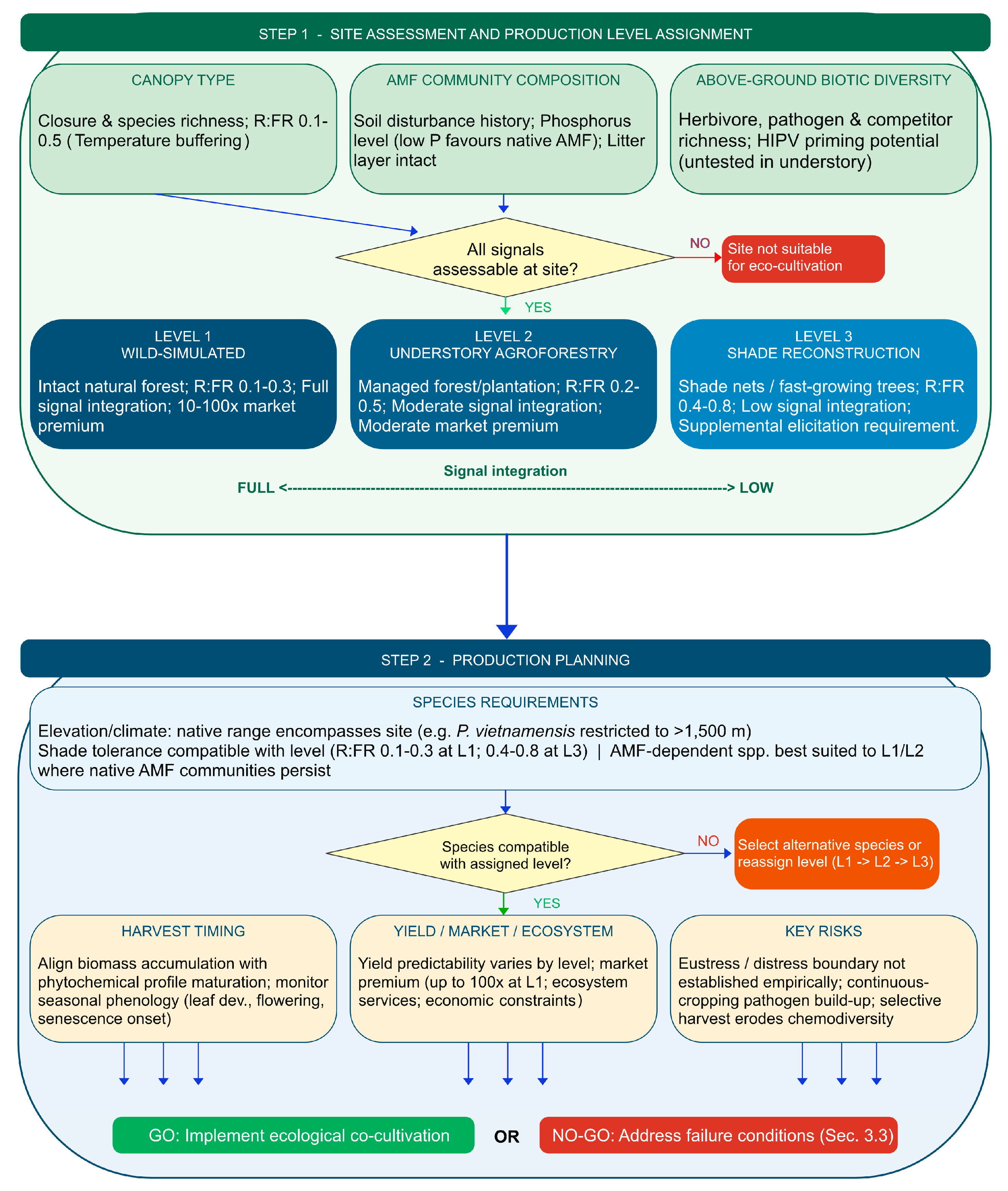
The ecological co-cultivation principle requires a practical operational framework. We propose two sequential steps corresponding to the two parameter blocks in Table 3: ecological site assessment (which assigns a production level based on the chemical terroir hypothesis) and production planning (which addresses species selection, harvest timing, yield, and market considerations) (Figure 2).
The first step evaluates how much of the three core ecological signals of the chemical terroir hypothesis (Section 2.1, Section 2.2 and Section 2.3) are retained at the candidate site. Table 3 characterizes each production level by three ecological parameters: canopy type (with R:FR as a derivative indicator of filtering quality), AMF community composition, and above-ground biotic diversity. Canopy closure is the primary and most readily measurable field criterion, because it determines most other parameters. A closed, species-rich natural canopy simultaneously reduces R:FR below the open-sunlight value of ~1.2 [18], provides temperature buffering [20], and maintains an intact litter layer that supports native AMF communities. AMF community composition cannot be inferred from canopy condition alone and requires separate soil assessment. Low soil phosphorus and intact litter layers favor native AMF colonization, while high phosphorus suppresses mycorrhizal colonization [47]. Sites with recent tillage history or pesticide residues may retain adequate canopy but lack the native AMF communities needed for defense signaling [9,26]. Above-ground biotic diversity also requires assessment. Intact forest supports diverse herbivores, pathogens, and competitors that drive the defense priming central to Section 2.3. Field indicators include the presence of herbivory damage on understory vegetation, visible fungal pathogens, and a diverse competitor community in the herb and shrub layers. Forest fragmentation, recent clearing of adjacent land, and pesticide use in surrounding areas reduce biotic diversity even when canopy and soil remain intact. Managed or reconstructed systems typically support simplified biotic communities with fewer natural defense-priming interactions.
These three parameters together determine the production level assignment (Table 3). Where parameters are partially degraded (Level 2), conservation management becomes the priority, including minimizing further disturbance, limiting phosphate fertilization, and maintaining biotic refugia. Signal integration completeness decreases from Level 1 to Level 3 in proportion to the number of ecological signals that must be artificially replaced.
The second step is production planning. Once the production level is assigned, this step addresses the operational parameters in the lower block of Table 3: species requirements, harvest timing, yield expectation, market premium, ecosystem services, and key risks.
Species selection evaluates whether a candidate species is compatible with the level-specific conditions at the assigned site. Three primary criteria apply. (1) Elevation and climate: the species’ native range must encompass the site’s elevation, temperature regime, and precipitation pattern. Montane specialists such as P. vietnamensis, restricted to forests above 1500 m [41], are incompatible with lowland sites regardless of other site conditions. (2) Shade tolerance: the species must tolerate the light regime characteristic of the assigned level, from deep shade at Level 1 (R:FR 0.1–0.3) to moderate shade at Level 3 (R:FR 0.4–0.8; Table 3). For understory cultivation of shade-tolerant medicinal plants, we suggest targeting R:FR of 0.15–0.35, excluding the deepest shade where PAR limits growth and the lightest shade where spectral filtering is minimal. However, no dose–response curve relating R:FR to defense metabolite accumulation has been published for any medicinal species, so this range is provisional. (3) Mycorrhizal dependency: species that require AMF for nutrient acquisition and defense signaling are best suited to Level 1 or Level 2 where native communities persist, and may underperform at Level 3 where only commercial inoculants are available. Species tolerance to above-ground biotic pressure is also relevant, as herbivory and pathogen exposure increase at higher signal integration levels (Table 3), though this criterion is less readily quantified than the preceding three. Where a species is compatible with more than one level, the choice involves trade-offs among the remaining operational parameters (Table 3), weighed against market objectives and economic constraints (Section 4.1).
Harvest timing identifies the optimal harvest window by aligning biomass accumulation, phytochemical profile development, and seasonal phenology. Biomass accumulation of the target organ follows a species-specific growth curve over months to years depending on the species and production level. Phytochemical accumulation follows a separate trajectory that may or may not parallel biomass, and may plateau before the harvestable organ reaches maximum size (Section 2.4). The chemical terroir hypothesis predicts that production level affects phytochemical profile complexity. At Level 1, where the full signal suite operates continuously, the phytochemical profile may require longer to mature but should more closely approximate the natural forest reference. At Level 3, where signals are partially replaced, the resulting profile is expected to be less complex. Whether observed metabolite plateaus at any production level reflect true profile maturity or merely concentration saturation has not been tested.
Seasonal phenology adds a within-year dimension, as metabolite concentrations fluctuate seasonally. Practitioners should use observable markers such as leaf development, flowering, and senescence onset as field indicators of harvest readiness, since direct phytochemical assessment is impractical. The relationship between phenological stage and phytochemical status at each production level remains a research priority (Section 4.1).
Yield expectation, market premium, ecosystem services, and key risks vary systematically across production levels (Table 3). Table 3 reports yield expectation as ordinal categories (‘Low predictability/Moderate/High/Highest’) because no published study provides quantitative yield-per-area data permitting direct comparison across the three production levels for any of the case-study species. The one quantitative anchor available is the 10–100 × market premium for woods-grown American ginseng under Level 1/wild-simulated management [7], discussed in Section 1.2 and Section 3.4. Higher signal integration (Levels 1–2) is associated with lower yield predictability and longer harvest timelines, but commands higher market premiums and delivers greater ecosystem services. These trade-offs must be evaluated against site-specific economic conditions, for which no published cost–benefit analysis currently exists (Section 4.1).
This two-step operational framework differs from conventional understory cultivation guidance in two respects. First, it derives site selection criteria directly from the ecological signals that constitute chemical terroir (Section 2), rather than from agronomic yield optimization alone. Second, it treats phytochemical profile development as a harvest criterion alongside biomass, linking production planning explicitly to the multi-signal integration that the chemical terroir hypothesis proposes. The framework applies primarily to Levels 1 and 2, where the forest understory itself serves as the elicitation system and maintaining natural ecological conditions is the primary management objective. Level 3 systems, which require canopy reconstruction and supplemental elicitation, present additional design challenges discussed in Section 3.3.
Conventional alternatives such as shade-house cultivation, controlled-environment agriculture (CEA), and exogenous elicitor application fall outside this framework entirely (Table 3). These systems can manipulate individual signals with high precision. LEDs can deliver specific R:FR ratios, commercial inoculants can introduce selected AMF strains, and methyl jasmonate can trigger defense responses on demand. Yet this signal-by-signal approach fundamentally differs from the chemical terroir process, in which canopy filtering, native AMF communities, and diverse above-ground biotic interactions operate simultaneously and continuously over years. Alternatives offer maximum yield predictability and shortest harvest timelines, but at the cost of the integrated ecological context that the chemical terroir hypothesis identifies as irreplaceable. Whether alternatives can approximate forest-derived phytochemical fingerprints through optimized combinations of individual signals is itself a testable question that Prediction 3 (Section 2.4) is designed to resolve.

3.3. Failure Conditions, Exceptions, and Sustainability

Ecological signal integration can be disrupted under field conditions. Several failure modes limit the chemical terroir process.
The first category concerns site assessment failures (Step 1), where ecological conditions fall outside the operational framework’s operating range. Under the growth–defense trade-off [42], very low resource availability constrains both growth and secondary metabolism because insufficient carbon is available for either process. In over-dense canopies, PAR reduction may cross this threshold, and the sunfleck regime hypothesized to drive ROS-mediated biosynthesis (Section 2.1) is also eliminated. Selective canopy thinning may restore adequate light. However, temperature buffering increases with canopy species richness [20] and spectral filtering depends on canopy density [18], so thinning inevitably weakens the ecological signals that the chemical terroir process depends on. The degree of thinning that balances light availability against signal preservation has not been determined for any medicinal species. Shade trees can also negatively affect understory crops through competition for light, water, and nutrients [48]. This competition may be particularly relevant in ectomycorrhizal-dominated forests, where canopy trees and AMF-dependent understory plants operate on separate mycorrhizal networks. Forest soils harbor pathogens alongside beneficial microbes. Continuous-cropping disease is a well-documented problem in field-cultivated Panax, where pathogen accumulation renders soil unsuitable for replanting within a decade [49]. Whether forest microbial diversity suppresses pathogen buildup, which would be a potential advantage over field systems, has not been investigated.
The second category concerns production planning failures (Step 2). The chemical terroir hypothesis in its current form applies to AMF-associated species. Non-mycorrhizal species, those in ectomycorrhizal-dominated forests, and alkaloid producers fall outside its scope (Section 2.2). The boundary between beneficial stress (eustress) and damaging stress (distress) also varies by species. Severe drought, extreme heat events, or heavy herbivory overwhelm plant defenses and reduce both growth and metabolite content. Identifying this boundary empirically for each target species is essential before scaling up production. At Level 3, where ecological signals must be artificially reconstructed, validated shade tree–medicinal plant combinations remain scarce, and reduced biotic complexity limits natural defense priming. Supplemental elicitation is an option, but exogenous elicitors can interfere with AMF-mediated signaling (Section 2.2; [34]), and in vitro efficacy frequently does not translate to in vivo whole-plant application [12].
Sustainability constraints cut across both steps. Harvest rates must remain below recruitment capacity to sustain wild and semi-wild populations [1]. Harvesting underground organs is inherently destructive for all three case study species. It removes the individual plant, disturbs soil structure, disrupts AMF hyphal networks, and can alter local biotic interactions, directly degrading the ecological signals that the chemical terroir process requires. Practitioners should also avoid selectively harvesting high-chemotype individuals, which risks eroding chemodiversity over generations. These constraints mean that maximizing short-term yield is incompatible with sustaining the chemical terroir process over time. Quantitative evidence on these sustainability constraints is limited: the only published quantitative analyses are Souther and McGraw [50] on synergistic harvest-climate effects in wild P. quinquefolius and Sheban et al. [7] on the 10–100× market premium for woods-grown American ginseng. Quantitative data on harvest-impact magnitudes (AMF hyphal network disruption, recruitment-capacity thresholds), chemodiversity erosion rates from selective harvest, cost–benefit comparisons across production levels, and validated shade-tree–medicinal-plant combinations for Level 3 systems are research priorities (Section 4.1) rather than current empirical anchors.

3.4. Species-Specific Case Studies

Panax vietnamensis Ha & Grushv. on Ngoc Linh, Vietnam, illustrates Level 1 production in primary montane forest. The site retains intact canopy, undisturbed soil with native AMF community composition, and high above-ground biotic diversity. At production planning (Step 2), the species matches the site’s high-elevation conditions (above 1500 m [41]. The ontogenetic data indicate that saponin content plateaus at approximately five years [41], though whether this plateau reflects full phytochemical profile maturity remains unknown. Majonoside-R2 is the principal saponin of this species [5]. The species has received geographical indication (GI) certification, though the certification verifies geographic origin rather than phytochemical quality. Several challenges constrain this system. The narrow elevational range limits site availability, and no systematic multi-year quality data. Most critically, whether the quality advantage derives from ecological conditions, genetic factors, or their interaction remains unresolved. The Predictions 1–3 framework (Section 2.4) has not been tested for this species.
Woods-grown P. quinquefolius L. in eastern North America represents Level 1–2 production under temperate deciduous forest dominated by Quercus, Carya, and Acer [7]. The 10–100× price premium for woods-grown material (Section 1.2) and the inverse relationship between growth and ginsenoside content [6] illustrate the quality–quantity trade-off central to harvest timing in Step 2. An unresolved question for the chemical terroir hypothesis is that the dominant canopy trees (Quercus, Carya) form ectomycorrhizal associations [51], yet Panax is AMF-dependent [30]. Whether AMF community composition and ISR signaling differ under ectomycorrhizal vs. AMF-associated canopies has not been investigated. Souther and McGraw [50] demonstrated that harvest pressure and climate change interact synergistically in wild P. quinquefolius populations, compounding the sustainability constraints discussed in Section 3.3.
Paris polyphylla Sm. under forest canopy in China provides the clearest metabolomic comparison between production levels. The 372 differentially abundant metabolites identified by Yan et al. [8] between understory and greenhouse material (Section 1.2) approximate a Level 1 vs. Alternatives contrast (Table 3). The evidence is correlative, as the natural and greenhouse environments differed in multiple uncontrolled variables.
Collectively, these case studies show that forest-grown material differs phytochemically from field- or greenhouse-grown material, but none provides the controlled experimental evidence needed to validate the chemical terroir hypothesis. The quality–quantity trade-off observed in P. quinquefolius [6] is consistent with harvest timing logic in Step 2, and the metabolomic contrast in P. polyphylla [8] supports Prediction 1 (forest effect) at a correlative level. However, Prediction 2 (profile plasticity) and Prediction 3 (multi-signal integration) remain untested for all three species. The priority experiments proposed in Section 4.1 are designed to address these gaps.

4. Validation, Limitations, and Implementation

4.1. Priority Experiments for Chemical Terroir Validation

Testing the three predictions and their falsification criteria (Section 2.4) requires three complementary experiments.
The first experiment is a common garden trial testing Predictions 1 (forest effect) and 2 (profile plasticity). Candidate species should have documented phytochemical differences between forest-grown and conventionally produced material, and sites spanning a range of ecological conditions should be accessible. Panax quinquefolius in temperate deciduous forests and Panax vietnamensis in tropical montane forests both meet these criteria and would test the predictions across contrasting biomes. Plants should be derived from a single source population to minimize genetic variation. Plants from the source population should be planted simultaneously at all sites, so that all replicate plants are age-matched within and across environments at each sampling time point. This requirement is essential for separating age effects from ecological-signal effects, in line with the principle stated at Section 2.4. Phytochemical profiles should be measured at multiple phenological stages per year for at least three years, with concurrent monitoring of the ecological signals identified in Section 2.
The second experiment tests Prediction 3 (multi-signal integration). Independent manipulation of individual ecological signals is not feasible for perennial species under forest field conditions, because soil sterilization cannot be maintained and above-ground biotic exclusion introduces microclimate artifacts over multi-year timescales. Comparing phytochemical profiles across the production levels defined in Table 3 provides a practical alternative, testing whether signal deviation from intact forest progressively shifts profiles away from wild-harvested reference material.
The third experiment is an AMF community comparison. Native forest AMF communities should be compared with commercial inoculants under intact canopy using paired metagenomics and metabolomics. This experiment would determine whether commercial inoculation can substitute for native forest soil biota in shaping phytochemical profiles.
All three experiments should incorporate economic data collection, because no published cost–benefit analysis exists for any forest-based medicinal plant production system.

4.2. Analytical Methods for Chemical Terroir Validation

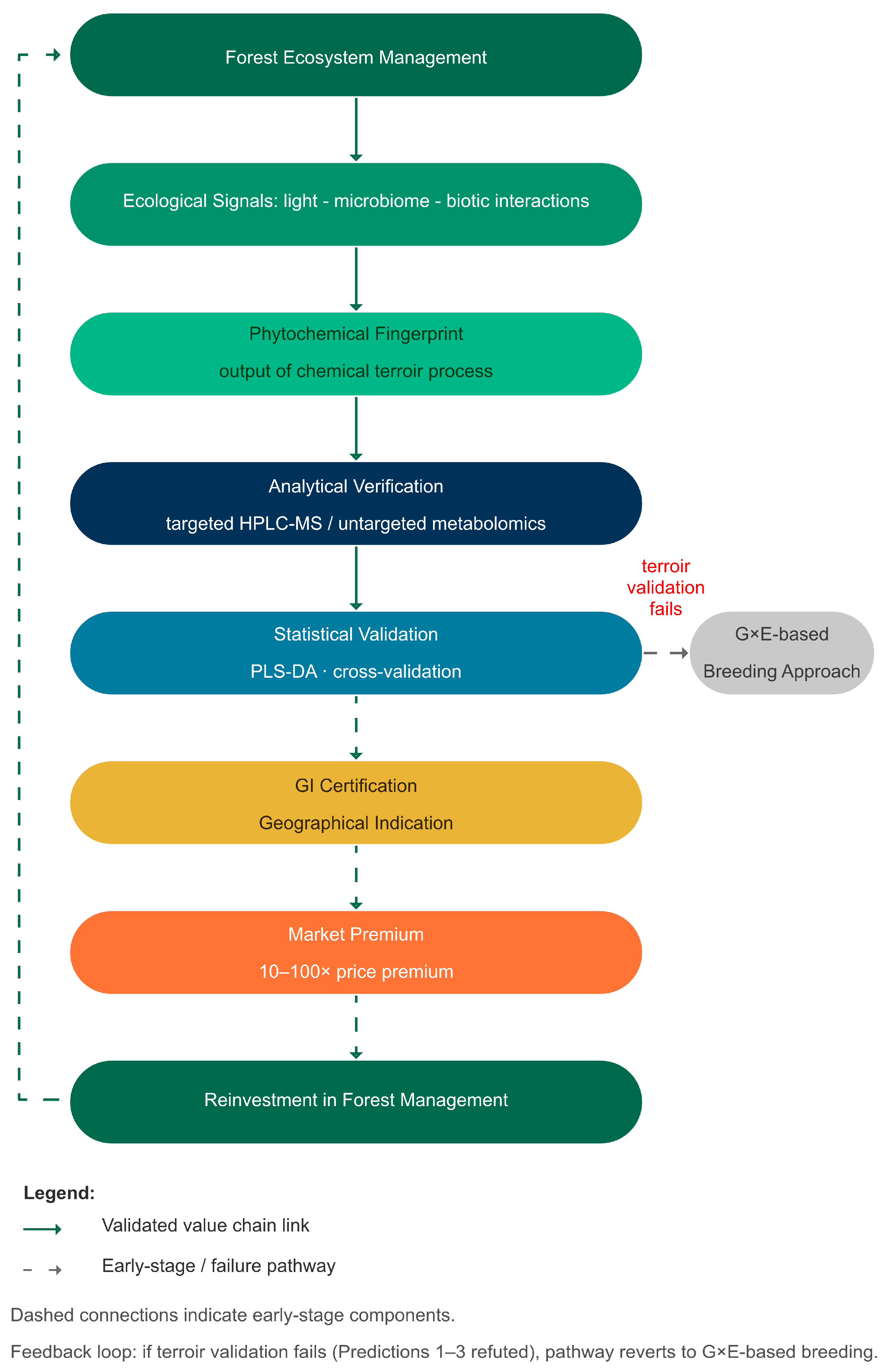
Evaluating the outcomes of these experiments depends on analytical methods that can detect multi-component profile differences between ecological conditions. Two complementary approaches are available. Targeted HPLC-MS quantifies specific known compounds with high sensitivity but cannot detect unexpected metabolites. Untargeted metabolomics captures the full profile complexity that chemical terroir predicts but requires larger sample sizes and more complex statistical validation (e.g., partial least squares discriminant analysis (PLS-DA), see Figure 3 caption for analytical workflow). Combining both approaches would confirm whether key marker concentrations differ while simultaneously revealing whether the broader metabolite profile shifts as predicted. To our knowledge, no study of forest-grown medicinal plants has yet applied this combined approach to compare production systems differing in signal integration.
Two practical barriers currently limit this combined approach. First, standardized analytical protocols across laboratories are absent, preventing inter-site comparison of metabolite profiles. Second, most published comparisons are cross-sectional snapshots that cannot establish whether phytochemical fingerprints remain stable across seasons and years. The experiments proposed in Section 4.1 should address both gaps by incorporating longitudinal sampling and harmonized protocols from the outset.

4.3. Limitations, Threats, and Implementation Challenges

The framework currently rests on correlative evidence from AMF-associated, saponin-rich medicinal plants in Asian and North American forests. Extension requires testing across metabolite classes, mycorrhizal types, growth forms, and forest biomes (Table 4).
If the chemical terroir hypothesis is validated, translating it into practice requires mechanisms that link phytochemical quality to market value and forest conservation. Geographical indication (GI) offers one such mechanism by linking price premiums to verified ecological origin [7]. The conservation logic becomes self-reinforcing because quality depends on forest integrity and the premium for verified quality finances forest management. Figure 3 summarizes this quality-verification-to-market-premium pathway and its feedback to forest management. However, implementation faces challenges including institutional capacity, analytical standardization (Section 4.2), digital traceability [52], and ethical considerations (Table A3). Policy implications and alignment with the Sustainable Development Goals are discussed in Appendix B.2.
The chemical terroir hypothesis also faces a climate vulnerability because climate change is expected to alter forest microclimates and canopy structure [53], which in turn may affect the ecological signals that Section 2 identifies as drivers of the process. A signal-by-signal vulnerability assessment with adaptation strategies is provided in Appendix B.1. Integrating climate monitoring into the field trials proposed in Section 4.1 would enable adaptive management as conditions shift.
Addressing these limitations requires research across multiple scales. Table 5 organizes priority questions from molecular to policy levels.

5. Conclusions

Chemical terroir is the hypothesized process by which three integrated ecological signals (canopy light filtering, native soil microbiome, and above-ground biotic interactions) generate site-specific phytochemical fingerprints in forest-grown medicinal plants that no single signal can replicate. Ecological co-cultivation is the design principle that translates this hypothesis into practice by harnessing natural forest processes rather than overriding them.
The available evidence is consistent with these concepts but does not confirm them. Phytochemical differences between forest-grown and conventionally produced material have been documented for the three case study species, and the ecological mechanisms proposed are individually plausible. However, no study has experimentally tested whether forest ecological signals cause these differences, and the evidence base is correlative and taxonomically narrow.
Two specific limitations warrant explicit mention. First, the canopy light-signaling pathway central to the chemical terroir hypothesis has not been field-tested in any shade-tolerant medicinal species: the sunfleck-driven ROS pathway is hypothesized by analogy from drought stress, and the phytochrome B–DELLA–JAZ cascade characterized in Arabidopsis remains unconfirmed in the shade-tolerant species that the hypothesis targets (Section 2.1; Appendix B.3). Second, no published cost–benefit analysis exists for any forest-based medicinal plant production system, so the economic dimension of the operational framework (Section 3.2 and Section 4.1) rests on the single 10–100 × market premium anchor for woods-grown American ginseng [7] rather than on cross-system economic data.
Three falsifiable predictions structure the path forward. If forest-grown plants do not consistently differ in phytochemical profile from paired open-field controls (Prediction 1, forest effect), the chemical terroir hypothesis should be abandoned. If phytochemical profiles do not converge toward the site phytochemical fingerprint over time (Prediction 2, profile plasticity), site selection matters more than ongoing forest management. If phytochemical profiles do not shift as ecological signals deviate from intact forest conditions (Prediction 3, multi-signal integration), forest conditions shape phytochemistry through individual factors rather than integrated signal effects. Each outcome redirects cultivation strategy differently, ensuring that the research program generates actionable information regardless of whether the hypothesis is confirmed or refuted.
The two-step operational framework offers a practical contribution by deriving site assessment and production planning criteria directly from the ecological signals that constitute the chemical terroir process. Notably, it treats phytochemical profile development as a harvest criterion alongside biomass, connecting production planning to the ecological signaling that the hypothesis proposes. This framework should be understood as a research agenda rather than a production recommendation until the predictions are tested through the experiments proposed.
If all three predictions are supported, chemical terroir provides a scientific basis for linking medicinal plant quality to forest ecological integrity, with geographical indication as a potential market mechanism to finance conservation. If refuted, the hypothesis yields to standard G × E approaches, but the ecological data generated would still inform sustainable forest management for medicinal plant production. Validation of Predictions 1–3 would not by itself demonstrate that ecologically shaped phytochemical fingerprints produce superior clinical outcomes; that is a separate empirical question requiring in vivo pharmacological and clinical research outside the scope of the present review.

Author Contributions

Conceptualization, Q.V.L.; methodology, Q.V.L. and T.M.C.D.; validation, Q.V.L., T.M.C.D. and A.D.N.; formal analysis, Q.V.L. and T.T.N.; investigation, Q.V.L., T.M.C.D., A.D.N., T.T.N. and T.B.L.N.; resources, Q.V.L. and T.B.L.N.; data curation, T.M.C.D. and T.T.N.; writing, original draft preparation, Q.V.L.; writing, review and editing, T.M.C.D., A.D.N., T.T.N. and T.B.L.N.; visualization, Q.V.L. and T.T.N.; supervision, Q.V.L.; project administration, Q.V.L.; funding acquisition, Q.V.L. and T.B.L.N. All authors have read and agreed to the published version of the manuscript.

Funding

This research was funded by Vietnam’s Ministry of Education and Training under grant No. B2024-TDV-09.

Data Availability Statement

No new data were created or analyzed in this study. Data sharing is not applicable to this article.

Acknowledgments

During the preparation of this manuscript, the authors used large language models (Claude and Gemini) solely to enhance linguistic clarity, refine grammatical structures, and improve the flow of academic expression. SciSpace and Perplexity were used to assist in identifying and verifying relevant literature during the preliminary review phase. All conceptual frameworks, data analysis, interpretation of results, and the synthesis of the chemical terroir hypothesis were conceived and executed entirely by the human authors. The final manuscript was rigorously reviewed and edited by the authors to ensure scientific accuracy and integrity. The authors take full responsibility for the content and originality of the work.

Conflicts of Interest

The authors declare no conflicts of interest. The funders had no role in the design of the study; in the collection, analyses, or interpretation of data; in the writing of the manuscript; or in the decision to publish the results.

Appendix A

Table A1. Glossary of specialized terms.
TermDefinition
AMFArbuscular mycorrhizal fungi; obligate plant symbionts (subphylum Glomeromycotina, formerly treated as phylum Glomeromycota) that colonize roots and enhance nutrient uptake, particularly phosphorus. In controlled greenhouse experiments, AMF can modulate plant secondary metabolism through induced systemic resistance (ISR) via the jasmonate/ethylene signaling axis [9,26]. Whether this modulation operates comparably under natural forest canopy conditions remains untested (see Section 2.2, main text).
Chemical terroirTerm borrowed from viticulture [39,40] and adapted in this review as a testable mechanistic hypothesis. Defined here as the process by which integrated forest ecological conditions (canopy light filtering, native soil microbiome, above-ground biotic interactions, edaphic context) generate a site-specific phytochemical fingerprint in forest-grown medicinal plants, distinct from what any single signal produces in isolation (multi-signal integration). Related to the Chinese daodi (道地) concept [13] but differs in specifying measurable ecological parameters as putative drivers and quantifiable phytochemical profiles as outputs. Distinguished from standard G × E interaction by three testable predictions; if G × E partitioning shows genotype dominates over site, the terroir framing should be abandoned (see Section 2.4, main text).
Daodi
(道地)
Concept in traditional Chinese medicine designating medicinal materials from specific canonical production regions as authentic and therapeutically superior [13]. First documented over 700 years ago and systematized during the Ming Dynasty (1368–1644), daodi integrates geographic origin, ecological growing conditions, harvest timing, and traditional processing into a holistic quality framework. The daodi system and the chemical terroir hypothesis proposed in this review share the premise that place of origin shapes medicinal quality, but differ in epistemological approach: daodi is grounded in long clinical and empirical tradition, while chemical terroir specifies ecological signaling pathways and testable predictions amenable to experimental refutation (see Section 1.3 and Section 2.4, main text).
DELLA proteinsNuclear growth-repressor proteins degraded via the gibberellin (GA) pathway. DELLAs positively regulate jasmonate signaling by competitively binding JAZ proteins, thereby freeing MYC2 transcription factors to activate defense genes [24]. In Arabidopsis thaliana, low R:FR triggers DELLA degradation through GA-dependent signaling and independently stabilizes the JAZ10 protein; both mechanisms converge to dampen jasmonate sensitivity during shade-avoidance responses [25]. Whether this DELLA–JAZ regulatory module functions in shade-tolerant medicinal species remains untested (see Section 2.1, main text).
Ecological co-cultivationDesign principle proposed in this review for forest-based medicinal plant production, defined as harnessing natural forest processes rather than overriding them (see Section 3.1, main text). Distinguished from traditional understory cultivation, which is an ancient and widespread practice, by the explicit objective of preserving multi-signal ecological environments (canopy light filtering, native soil microbiome, biotic interactions) to maintain characteristic phytochemical fingerprints, guided by the mechanistic understanding developed in Section 2. Serves as the practical counterpart of the chemical terroir hypothesis. The principle primarily underlies Level 1 (wild-simulated) and Level 2 (understory agroforestry) production systems; Level 3 (shade reconstruction) retains the design intent but with reduced ecological signal integrity (Table 3, main text).
EustressIn plant biology, a positive stress response in which low doses or mild intensities of a stressor enhance plant performance, as opposed to distress, in which high doses or chronic exposure impair function [54,55]. The concept derives from Selye’s [56] general adaptation syndrome in animal physiology. Eustress is closely related to hormesis (see Hormesis entry) but emphasizes the organism’s adaptive response rather than the dose–response curve of the stressor. In this review, eustress is used more narrowly to denote mild, intermittent stress that primes defense metabolite accumulation without sustained growth penalties (see Section 2.4, main text). In forest understory contexts, sunfleck-driven ROS bursts and low-level HIPV exposure may represent eustress. The boundary between eustress and distress is species-specific and site-specific, and must be determined empirically for each target species before scaling up cultivation (see Section 3.3, main text).
G × EGenotype × environment interaction; the phenomenon whereby different genotypes respond differently to different environments, resulting in phenotypic variation that cannot be attributed to either genetic or environmental effects alone. Detected and partitioned using statistical methods (ANOVA, multivariate approaches) applied to common-garden experiments, ideally using plants from a single source population to minimize genetic variation. In this review, G × E partitioning is the critical test for chemical terroir: the hypothesis predicts that metabolite profiles cluster by site more strongly than by genotype (Prediction 1, Section 2.4). However, chemical terroir is not merely G × E under a different label. It additionally predicts multi-signal integration from ecological signals (Prediction 3). If G × E partitioning shows genotype dominates over site, the chemical terroir hypothesis should be abandoned in favor of standard provenance terminology and breeding-based strategies (Section 2.4, main text).
GIGeographical indication; a legal instrument that identifies a product as originating in a specific territory where a given quality, reputation, or other characteristic is essentially attributable to its geographic origin. In this review, GI serves a specific function within the self-reinforcing value chain (Figure 3, main text). By linking price premiums to verified ecological origin, GI creates market incentives for forest conservation. Examples relevant to this review include Ngoc Linh ginseng (P. vietnamensis, Vietnam) and “woods-grown” American ginseng (P. quinquefolius, North America), which commands 10–100× premiums over field-cultivated material [7]. The chemical terroir hypothesis, if validated, would provide the scientific basis for GI quality claims. GI implementation faces challenges including institutional capacity gaps, verification standardization, and traceability limitations (see Section 4.2 and Table A3).
HIPVsHerbivore-induced plant volatiles; complex blends of airborne chemicals released by plants under herbivore attack, typically comprising green leaf volatiles (C6 aldehydes and alcohols), mono- and sesquiterpenoids, and methyl salicylate, among other compounds. HIPVs serve multiple ecological functions: direct defense (repelling herbivores), indirect defense (attracting natural enemies of herbivores), within-plant signaling (priming defenses in distal undamaged tissues), and between-plant signaling (priming defenses in neighboring plants) [27]. In the context of this review, low-wind conditions beneath closed canopies would be expected to increase local HIPV concentrations, potentially enhancing defense priming in understory plants. However, neither HIPV concentrations nor their priming effects have been directly measured in forest understories, representing an important empirical gap (see Section 2.3, main text).
HormesisBiphasic dose–response phenomenon in which low doses of a stressor stimulate beneficial responses while high doses inhibit. Related to but distinct from defense priming (see Martinez-Medina et al. [31], for priming criteria). Hormesis describes the dose–response relationship of the stressor, while priming describes the sensitization of the plant’s defense capacity by a prior stimulus. Low-dose exposure can act as a priming stimulus through a hormetic mechanism. In this review, hormesis is relevant as a potential mechanism by which mild, intermittent understory stressors (e.g., sunfleck ROS bursts, low-level HIPV exposure) could prime defense metabolite production. This mechanism remains speculative and has not been directly tested in forest understory medicinal species. Related to eustress (see Eustress entry).
ISRInduced systemic resistance; broad-spectrum defense response activated by beneficial soil microorganisms (particularly AMF and plant growth-promoting rhizobacteria), mediated through jasmonate/ethylene signaling pathways [26]. Distinguished from SAR (see SAR entry), which is pathogen-triggered and mediated through salicylic acid. In forest understories, ISR and SAR may operate simultaneously, with interactions ranging from synergistic to antagonistic depending on timing and intensity [26] (Section 2.4, main text). In this review, AMF-mediated ISR is proposed as the primary mechanism explaining the compound-class selectivity observed in AMF studies: enhancement of flavonoids and terpenoids (jasmonate-responsive classes) but not alkaloids (Section 2.2, main text). This mechanism has been demonstrated in greenhouse experiments but remains untested under natural forest canopy conditions.
JAZ proteinsJasmonate ZIM-domain proteins; transcriptional repressors that suppress jasmonate-responsive gene expression by binding and inactivating MYC2 transcription factors. In the presence of bioactive jasmonate (JA-Ile), JAZ proteins are degraded via the SCFCOI1 ubiquitin–proteasome pathway, releasing MYC2 to activate defense genes. DELLA proteins can sequester JAZ proteins through competitive binding, thereby promoting jasmonate signaling [24]. In Arabidopsis thaliana, low R:FR stabilizes JAZ10 protein, contributing to the suppression of jasmonate sensitivity during shade-avoidance responses [25]. Whether JAZ regulation operates similarly in shade-tolerant medicinal species is unknown.
MeJAMethyl jasmonate; the volatile methyl ester of jasmonic acid. Used as an exogenous elicitor to activate jasmonate-dependent defense pathways and enhance secondary metabolite production in medicinal plants. Typical application: foliar-spray concentrations for in vivo studies commonly range from 10−4 to 4 mM, with 0.1–0.5 mM frequently reported for medicinal and aromatic species [12]. In this review, MeJA supplementation is considered primarily relevant for Level 3 (shade reconstruction) systems, where reduced biotic complexity limits natural defense priming (Section 3.2, main text). In P. notoginseng, both AMF alone and MeJA alone increased saponin accumulation, but their combination weakened the AMF effect, suggesting that exogenous MeJA may saturate the endogenous jasmonate pathway already activated by AMF(Dai et al. [34]; causal, pot). In vitro elicitation efficacy frequently does not translate to in vivo whole-plant application [12], and field-scale dose optimization remains a prerequisite for production-level application.
NTFPNon-timber forest product; any biological resource obtained from forests other than timber, including medicinal plants, resins, fibers, and mushrooms. Forest-origin medicinal plants constitute an economically important NTFP category. The demand that makes NTFPs valuable also drives overexploitation, threatening both ecological viability and future supply [1]. This tension between harvesting pressure and ecological sustainability motivates the ecological co-cultivation design principle proposed in this review (Section 1.1 and Section 3, main text). Sustainable harvest rates must remain below recruitment capacity [1].
OPLS-DAOrthogonal partial least squares discriminant analysis; extension of PLS-DA that partitions variation into a predictive component (correlated with group membership) and orthogonal components (uncorrelated systematic variation). This separation improves model interpretability compared with standard PLS-DA by isolating the metabolomic variation driving group discrimination. Used as an alternative or complement to PLS-DA for discriminating samples by geographic origin or cultivation system. Requires the same validation procedures as PLS-DA: permutation testing and cross-validation (see PLS-DA entry and Section 4.1, main text).
PARPhotosynthetically active radiation; photon flux in the 400–700 nm waveband used by plants for photosynthesis. Under closed canopy, PAR is reduced to 0.4%–4% of above-canopy levels [16,17]. This reduction is not uniform: sunflecks (transient direct-light patches) punctuate the shade, contributing 10%–80% of the daily PAR that reaches the understory [21,22]. In this review, sunfleck-driven PAR fluctuations are hypothesized to generate transient ROS bursts that channel reduction equivalents into secondary metabolite biosynthesis (Section 2.1, main text). Below approximately 1% PAR, carbon limitation reduces both growth and secondary metabolism, representing a failure threshold for the ecological co-cultivation framework (Section 3.3, main text).
PhyBPhytochrome B; a red/far-red photoreceptor that senses the R:FR ratio. In Arabidopsis thaliana, phyB inactivation under low R:FR promotes DELLA degradation and JAZ10 stabilization, both of which suppress jasmonate-mediated defense during shade-avoidance responses [25]. This creates an apparent contradiction for understory medicinal species: if low R:FR suppresses jasmonate-mediated defense, how do these species accumulate defense compounds beneath closed canopies? The main text (Section 2.1) proposes that defense metabolite accumulation in shade-tolerant species is driven primarily by R:FR-independent inputs (AMF-mediated ISR, above-ground biotic interactions) rather than by the phyB–JAZ module characterized in Arabidopsis. No phyB or JAZ functional data exist for any forest medicinal species.
PLS-DAPartial least squares discriminant analysis; supervised multivariate classification method that maximizes separation between pre-defined groups. In this review, PLS-DA is the proposed method for testing Prediction 1 (forest effect): if metabolite profiles cluster by site rather than by genotype in common-garden experiments, the chemical terroir hypothesis is supported (Section 2.4, main text). Requires validation by permutation testing (≥1000 permutations) and k-fold cross-validation, with adequate sample sizes (generally ≥ 30 per group) for robust classification (Section 4.1, main text). Variable importance in projection (VIP) scores derived from PLS-DA identify which metabolites most strongly drive group discrimination (see VIP entry).
R:FR ratioRed-to-far-red ratio; ratio of photon flux at 660 nm (red) to 730 nm (far-red). Ranges from ~1.1–1.2 in open sunlight to 0.1–0.5 under dense canopy, depending on tree species composition, leaf area index, and season [18]. Sensed by phytochrome photoreceptors, particularly phyB (see PhyB entry). A provisional target R:FR range for ecological co-cultivation is discussed in Section 3.2 of the main text. No dose–response curve relating R:FR to saponin or other defense metabolite accumulation has been published for any medicinal species, and the link between canopy spectral quality and the phytochemical profiles central to this review remains qualitative (Section 2.1, main text).
ROSReactive oxygen species; chemically reactive molecules containing oxygen (e.g., superoxide, hydrogen peroxide). In forest understories, ROS are generated transiently during sunfleck episodes when excess excitation energy overwhelms the photosynthetic electron transport chain. By analogy with the drought-induced over-reduction mechanism [23], this review hypothesizes that sunfleck-generated ROS may channel surplus reduction equivalents into NADPH-consuming biosynthetic pathways, enhancing production of phenylpropanoids, terpenoids, and alkaloids (Section 2.1, main text). This extrapolation from drought to sunfleck stress has not been experimentally validated in any understory species. Transient sunfleck ROS bursts are proposed as a form of eustress (see Eustress entry) that primes defense metabolism without sustained growth penalties.
SARSystemic acquired resistance; pathogen-triggered defense response involving salicylic acid (SA) signaling, typically providing resistance against biotrophic and hemibiotrophic pathogens. Distinguished from ISR (see ISR entry) by its triggering stimulus (pathogen attack rather than beneficial microorganisms) and signaling pathway (SA rather than JA/ET). In the review’s three-signal framework (Figure 1, main text), SAR is positioned within the above-ground biotic interactions signal category. In forest understories, SAR and ISR may operate simultaneously, with interactions ranging from synergistic (if they activate complementary defense sectors) to antagonistic (through SA-JA crosstalk), depending on timing and intensity [26] (Section 2.4, main text).
VIP scoreVariable importance in projection; metric derived from PLS-DA or OPLS-DA models indicating which variables (metabolites) most strongly contribute to group discrimination. VIP > 1.0 is commonly used as a selection threshold, since a value of 1.0 represents the average contribution across all variables; metabolites exceeding this threshold contribute more than average to group separation. In this review, VIP scores would identify the specific metabolites that constitute the chemical terroir fingerprint—those driving the discrimination between forest-grown and non-forest material (Section 4.1, main text).
Table A2. Empirical studies on understory cultivation and microbial effects on secondary metabolite content, with design classification, effect sizes, and quality indicators.
#ReferenceSpeciesComparisonDesign TypeSample SizeReplicationControls ReportedAge ControlledEffect SizeAnalytical and Statistical Methodsp-ValueData AvailabilityQuality Rating
1[9]Multiple spp. (quantitative analysis)AMF vs. controlCausal (pot): quantitative analysis (233 obs., 28 papers)233 pooledMultiple studiesVariedVaried+68% (flavonoids), +53% (terpenoids), NS (alkaloids)Random-effects model<0.05 (flav., terp.)Not assessedModerate (no funnel plot or trim-and-fill correction)
2[8]Paris polyphyllaForest understory vs. greenhouseCorrelative: observational comparison3 per groupNot reportedGreenhouse controlYes (8-year-old rhizomes)Steroidal saponins, flavonoids, flavonols enriched in understory; other classes higher in greenhousePCA, OPLS-DA (UPLC-MS/MS platform)<0.05Not reportedLow (small sample size, multiple confounders)
3[6]Panax quinquefoliusPopulation × forest garden location × sampling time (T0/T2)Transplant experiment (8 populations × 2 forest gardens)8 populationsYes (populations)Two forest gardens differing in management intensityYes (T0 vs. T2)Variable by population; lower ginsenosides at more intensively managed forest garden despite higher growthANOVA<0.05 (some)Not reportedModerate
4[35]P. quinquefoliusUnderstory vs. fieldCorrelative: observational + microbiomeNRNRField plantingNRIncreased ginsenosides; correlated with AMF colonizationCorrelation + metabolomics<0.05NRLow–Moderate (AMF and other variables confounded)
5[34]P. notoginsengAMF + MeJA interactionCausal (pot): multi-treatment experimentNRNRNon-inoculated, no MeJA (CK)N/A (pot)AMF alone and MeJA alone each increased saponins vs. CK; combination weakened AMF effect (consistent with jasmonate pathway saturation)HPLC + transcriptomics<0.05NRModerate
6[33]P. ginsengAMF × PSB interactionCausal (pot): factorial experiment4 per treatment4 replicates × 4 treatmentsNon-inoculated + single-inoculation controlsN/A (pot)PPD/PPT ratio (above-ground) increased 0.52 → 1.09 in co-inoculation; total ginsenoside (underground) + 39.2%; individual ginsenosides (Rd, Rb2, Rb3, Rg1) increased and Rc, Re decreased; proposed mechanism via C:N:P stoichiometry shiftsHPLC + ANOVA (Tukey’s test); 16S rRNA sequencing<0.05Partial public (NCBI SRA PRJNA936811)Moderate
7[30]P. ginsengFungicide (AMF suppression)Causal: fungicide experiment (setting unverified)NRNRUntreated controlNRAltered ginsenoside profileHPLC comparison<0.05NRLow–Moderate
8[28]Scutellaria baicalensis8 LED spectral treatments (UV-A, green, blue/red combinations)Causal (controlled): light manipulation32 (morphology); 4 (flavonoids)Yes (synchronized transplant, 120 d cultivation)Full-spectrum controlN/AMonochromatic blue light promoted baicalin and wogonoside accumulation; UV-A and green decreased flavonoids; red × blue mixtures reduced flavonoid accumulation relative to monochromatic treatments; photoreceptor crosstalk proposed as mechanism (not molecularly validated within species)ANOVA<0.05In article/SM onlyModerate
9[29]European forest medicinal plants (multi-spp.)Canopy openness gradientCorrelative: observational gradient (90 plots)90 plotsYes (plots)Gradient designNot applicableSpecies-specific: canopy openness positively affected TPC in 2 of 4 species; other factors (stand diversity, pH, C/N) showed divergent effects across speciesGeneralized linear models (AIC-based selection)VariableNRModerate–High
10[45]Coptis chinensisUnderstory vs. scaffoldCorrelative: observational + microbiomeNRNRScaffold cultivationNRHigher berberine and total alkaloids under understoryHPLC + 16S rRNA<0.05NRLow–Moderate (confounded)
11[43]Coptis chinensisUnderstory (Cunninghamia lanceolata) vs. controlCorrelative: observational + transcriptomic10 plants/system (phenotype); 3 bio reps (RNA-seq)3 biological replicatesNon-understory controlYes (2-yr seedlings, common planting date)Increased viability, yield, berberine, palmatine, epiberberine; coptisine declinedTranscriptomics + HPLC; ANOVA + Duncan’s test; Pearson’s correlation<0.05GSA BioProject CRA012562 (transcriptome)Moderate (apparent growth–defense trade-off violation)
12[36]Catharanthus roseusEndophyte inoculationCausal (pot): inoculation experiment3 (vindoline); 6 (growth)3 biological × 3 technical replicatesNon-inoculatedN/A+403% vindoline (max)ANOVA (Duncan’s test); HPLC + qRT-PCR<0.05GenBank (KT001517, KT001518) + article/SMModerate
13[41]P. vietnamensisAge series (2–7 yr)Correlative: observational age series (age confound)5 per age groupSingle siteNo non-forest controlAge as variable~3-fold saponins (age 2 → 5)Student’s t-test; HPLC-UV/ELSD<0.05Open access + SMLow (single site, no non-forest control)
14[4]P. vietnamensisAcclimatized to lower elevation (Lam Dong Province)Correlative: observational age series5 per age groupSingle site, 4 age groupsNo native Ngoc Linh comparisonAge as variableSaponin content increased with plant ageANOVA (Dunnett’s test)<0.05In article/SMLow (no systematic comparison with native population profiles)
15[32]P. notoginsengTree-neighbor intercroppingCausal (pot): randomized block greenhouse experiment6 per treatment6 biological replicatesMonoculture controlNRIncreased saponins with specific tree speciesANOVA (Turkey HSD); LC-MS/MS metabolomics<0.05Open accessModerate
16[46]Atractylodes lanceaUnderstory vs. openCorrelative: field + metabolomicsNRNROpen-field controlNRAltered sesquiterpenoid and polyacetylene profilesUntargeted metabolomics<0.05NRModerate
17[44]Arabidopsis thalianaLab vs. field growth–defense trade-offsCausal (controlled + field)ReportedYesMultiple controlsN/AMajor growth–defense trade-off vanished under field conditionsMixed models<0.05PublicHigh
This table compiles studies cited in the review that report original empirical data on the effects of understory cultivation, arbuscular mycorrhizal fungi (AMF) inoculation, or related microbial and elicitor treatments on secondary metabolite accumulation. It extends Table 2 from the main text by including additional entries and providing quality indicators not reported there (replication, controls, age matching, data availability, quality rating). Studies focused on analytical authentication or chemical fingerprinting, ecological mechanisms without metabolite data (e.g., forest microclimate, HIPV signaling), population ecology (e.g., [50]), or review-level synthesis are excluded. Design type follows the causal vs. correlative classification defined in Section 1.4 of the main text. Effect sizes should be treated as upper-bound estimates given likely citation bias in the related mycorrhizal literature ([15]; see Section 1.4, main text). Quality Rating Criteria. High = adequate sample size reported, randomized or controlled design, replicated, major confounders addressed, data publicly available. Moderate = some but not all criteria met. Low = small or unreported sample size, no randomization, confounders not addressed. These are qualitative assessments; readers should consult individual study designs for detailed evaluation. Abbreviations. AIC, Akaike information criterion; AMF, arbuscular mycorrhizal fungi; ANOVA, analysis of variance; bio reps, biological replicates; C:N:P, carbon-to-nitrogen-to-phosphorus stoichiometry; CK, untreated control (Chinese: duizhao; standard control designation in the cited literature); ELSD, evaporative light-scattering detection; ginsenosides Rb1, Rb2, Rb3, Rc, Rd, Re, Rg1, individual dammarane-type triterpene saponins of Panax species (standard nomenclature); GSA, Genome Sequence Archive (China National Center for Bioinformation); HPLC, high-performance liquid chromatography; HPLC-UV/ELSD, high-performance liquid chromatography with ultraviolet and evaporative light-scattering detection; LC-MS/MS, liquid chromatography–tandem mass spectrometry; LED, light-emitting diode; MeJA, methyl jasmonate; N/A, not applicable (used where a quality criterion does not apply to the study design, e.g., age matching in pot experiments); NCBI, National Center for Biotechnology Information; NR, not reported in the original publication; NS, not significant; OPLS-DA, orthogonal partial least squares discriminant analysis; PCA, principal component analysis; PPD, protopanaxadiol-type ginsenoside (parent aglycone class); PPT, protopanaxatriol-type ginsenoside (parent aglycone class); PSB, phosphate-solubilizing bacteria; qRT-PCR, quantitative reverse-transcription polymerase chain reaction; RNA-seq, RNA sequencing; 16S rRNA, 16S ribosomal RNA gene (bacterial community marker); SM, Supplementary Materials; SRA, Sequence Read Archive (NCBI); T0/T2, sampling time points (T0, initial; T2, after two seasons); TPC, total phenolic content; Tukey HSD, Tukey’s honestly significant difference test; UPLC-MS/MS, ultra-high-performance liquid chromatography–tandem mass spectrometry; UV-A, ultraviolet-A radiation (315–400 nm). Key observations. (1) A recurring limitation across the evidence base is failure to report sample sizes, replication details, and error estimates. Only 2 of 17 entries [43,44] made data publicly available; data availability was not assessed for the pooled studies in Yuan et al.’s [9] quantitative analysis. This lack of reporting transparency limits confidence in quantitative effect sizes. (2) All 233 observations in Yuan et al.’s [9] quantitative analysis derive from controlled pot and greenhouse experiments; no study has examined AMF effects on medicinal plant metabolites under a natural forest canopy (see Section 2.2, main text). (3) Most forest-versus-field comparisons are confounded by plant age (Section 2.4, main text). The “Age Controlled” column highlights where this limitation applies. (4) This table cannot substitute for formal meta-analysis; heterogeneity in designs, species, and metrics precludes pooling beyond Yuan et al.’s [9] quantitative analysis.
Table A3. Regulatory frameworks, equity risks, and implementation requirements for ethical ecological co-cultivation of forest medicinal plants.
CategoryItemDescriptionRelevance to This Review
entry 1datadata
Regulatory frameworkNagoya Protocol (CBD, 2010)Governs access to genetic resources and equitable benefit-sharing from their utilization; requires prior informed consent (PIC) and mutually agreed terms (MAT)Applies when genetic material from forest medicinal plants is used for research or commercial development; relevant to all three case study species, particularly P. vietnamensis (Vietnamese endemic)
Regulatory frameworkCali Fund (CBD COP16 Decision 16/2, 2024)Multilateral benefit-sharing mechanism for digital sequence information (DSI) deposited in public databases; launched February 2025Relevant when genomic, transcriptomic, or metabolomic data from forest medicinal species are deposited in public databases; the data availability recommendations in Section 4.1 of the main text should comply with this framework
Regulatory frameworkFairWild Standard (FairWild Foundation, 2024)Certification for sustainable wild collection and enrichment planting (version 3.0)Covers wild harvest and enrichment planting but does not currently address intentional understory cultivation; extension of FairWild criteria to Level 1 wild-simulated systems (Table 3, main text) would be a practical step
Regulatory frameworkCBD Article 8(j) (CBD, 1992)Requires respect for and maintenance of traditional knowledge and equitable sharing of benefits arising from its useDirectly relevant to the daodi concept [13] discussed in Section 1.3 and Section 2.4 of the main text
GI equity riskAccess barriersSmallholder growers and ethnic minority communities may lack institutional capacity to apply for or enforce GI protections, risking exclusion from premium markets their stewardship creates [1]Particularly acute for P. vietnamensis on Ngoc Linh, where indigenous Xê Đăng (Sedang) communities have historically managed the species
GI equity riskGovernance imbalanceGI governance structure determines benefit distribution; state authorities, private companies, cooperatives, and indigenous communities have unequal powerThe self-reinforcing value chain (Figure 3, main text) functions equitably only if governance is inclusive
GI equity riskKnowledge commodificationGI systems can inadvertently commodify traditional knowledge without fair compensation to knowledge holdersThe chemical terroir framework, by emphasizing measurable ecological conditions over proprietary knowledge, may partially mitigate this risk but does not eliminate it
GI equity riskLocation privacyFor high-value species (hundreds to thousands of USD per kg), publicizing precise GPS coordinates creates theft risk for smallholder growersTraceability systems [52] must balance verification needs against location security; identified as a practical constraint in the P. vietnamensis case study (Section 3.4, main text)
Implementation requirementFree, prior, and informed consent (FPIC)Obtain FPIC from indigenous and local communities before any commercialization of forest-based medicinal plant systemsPrerequisite for all three production levels (Table 3, main text); must precede field trial design (Section 4.1); consistent with Nagoya Protocol provisions
Implementation requirementEquitable premium distributionDistribute GI-derived price premiums equitably along the value chain, with particular attention to communities whose forest stewardship creates the ecological conditions underlying qualityApplies to the 10–100× price premiums reported for woods-grown ginseng ([7]; Section 3.4, main text)
Implementation requirementInstitutional capacity buildingProvide institutional support for community-based certification bodies capable of managing GI applications and enforcementNeeded to address the access barrier identified above
Implementation requirementKnowledge protectionProtect against unauthorized appropriation of traditional cultivation knowledge, including knowledge embedded in site selection, species matching, and harvest timing practicesComplements CBD Article 8(j) provisions
Implementation requirementTransparent governanceEnsure community representation at decision-making levels in GI governance structuresAddresses the governance imbalance identified above; should be integrated into policy frameworks (Appendix B.2)
Regulatory framework descriptions are derived from the official treaty or standard texts identified in the item column. GI equity risks and implementation requirements represent the authors’ analytical assessment based on the review’s three case study species and the ethical dimensions of the ecological co-cultivation framework developed in Section 3 of the main text; they are recommendations, not established regulatory provisions.
These considerations should be integrated into the design of field trials proposed in Section 4.1 and into the policy frameworks discussed in Appendix B.2 of the main text.

Appendix B

Appendix B.1. Climate Change Vulnerability Assessment

Each ecological signal category identified in the main text (Section 2) faces distinct climate change vulnerabilities. Section 4.3 of the main text introduces these threats; this note provides signal-by-signal vulnerability ratings with mechanistic explanations, followed by an assessment of compounding risks and prioritized adaptation strategies.
Vulnerability ratings reflect the combined assessment of exposure likelihood, potential severity for medicinal plant phytochemical quality, and reversibility. High = likely exposure, severe quality impact, slow or irreversible recovery. Moderate = plausible exposure, partial quality impact, recoverable with management. Low–Moderate = plausible but slow-onset exposure, minor to partial quality impact, generally recoverable. Low = unlikely or slow-onset exposure, minor quality impact, readily recoverable.

Appendix B.1.1. Signal-Specific Vulnerability Ratings

Table A4. Signal-by-signal vulnerability of the chemical terroir framework to climate change, with qualitative ratings and mechanistic explanations.
Ecological SignalClimate ThreatVulnerabilityMechanism
Canopy light regime (R:FR)Tree mortality from drought, heat, pest outbreaksHighCanopy loss alters spectral filtering; gap formation shifts R:FR toward open-field values (0.1–0.5 → ~1.2), eliminating the phytochrome-mediated signaling described in Section 2.1; climate change is projected to alter forest microclimates and canopy structure more broadly [53]
Temperature bufferingExtreme heat events exceeding canopy buffering capacityModerateForest canopies buffer understory temperatures by approximately 4 °C (cooling of maxima) and 1 °C (warming of minima) globally, with the offset magnified under more extreme macroclimate temperatures [19]; extreme events can overwhelm this buffering capacity
AMF communitiesDrought-induced disruption of hyphal networks; altered soil chemistry under changed precipitationHighAMF depend on soil moisture continuity for hyphal network maintenance; drought fragments networks and reduces the ISR signaling described in Section 2.2
HIPVs and biotic interactionsPhenological mismatches; changing herbivore assemblages under warmingModerateHerbivore emergence timing may decouple from plant phenology (projected from general climate–phenology trends); novel pest species may arrive, altering the defense priming regime described in Section 2.3
Edaphic contextAltered decomposition rates; nutrient cycling changes under warming and altered precipitationLow–ModerateFaster decomposition at higher temperatures may alter litter-derived allelochemical inputs (Section 2.3, main text); potential nutrient pulse or depletion depending on moisture

Appendix B.1.2. Compounding Risks

Climate change may alter multiple signals simultaneously, undermining the multi-signal integration that the chemical terroir hypothesis identifies as the source of characteristic phytochemical profiles (Section 2.4, main text). For P. vietnamensis Ha & Grushv. (restricted to >1500 m in Vietnamese montane forests), three compounding pressures are anticipated. First, upward range compression against mountain summits leaves no higher-elevation habitat available for retreat. Second, altered cloud immersion patterns may affect humidity, spectral quality, and the sunfleck regime critical to ROS-mediated biosynthesis (Section 2.1, main text). Third, changed fire regimes in montane forests could eliminate established populations and their associated native AMF communities.
Souther and McGraw [50] demonstrated that harvest pressure and climate change interact synergistically for wild P. quinquefolius L., making the combined risk greater than the sum of individual threats. This synergistic interaction is directly relevant to Level 1 wild-simulated systems (Table 3, main text), where both climate exposure and harvest pressure operate simultaneously.

Appendix B.1.3. Adaptation Strategies

The following strategies address the vulnerabilities identified in the table above, listed from near-term interventions that can be implemented within existing cultivation systems to longer-term strategies requiring sustained research investment. Parenthetical references indicate which signal vulnerabilities each strategy primarily targets.
  • Assisted migration (all signals; addresses range-wide habitat loss). Establish cultivated populations at slightly higher elevations than current natural range limits to pre-empt range compression. This is particularly urgent for montane specialists such as P. vietnamensis with narrow elevational ranges.
  • Canopy diversification (canopy light regime, temperature buffering). Mixed-species canopies provide greater thermal buffering than monocultures [20]. Species-rich stands may also confer greater resilience when individual canopy species are lost to drought or pests, though this inference has not been directly tested. This aligns with the site selection guidance in Section 3.2 of the main text.
  • Chemodiversity conservation (all signals). Maintain genetic and chemical diversity within cultivated populations to provide adaptive capacity. Selective harvest of high-chemotype individuals may erode chemodiversity over generations, though this hypothesis has not been empirically tested in medicinal plant populations (Section 3.2 and Table 5, main text).
  • Monitoring infrastructure (all signals). Deploy IoT sensor networks [57] for real-time microclimate monitoring, enabling adaptive management. Such networks are currently absent from forest medicinal plant systems (Section 4.3, main text).
  • Long-term research (all signals). Establish permanent monitoring plots tracking both microclimate parameters and metabolite profiles over decadal timescales. Integrate climate monitoring into the field trials proposed in Section 4.1 of the main text.

Appendix B.2. Policy Implications and SDG Alignment

This note outlines the alignment of the ecological co-cultivation framework (Section 3, main text) with the UN Sustainable Development Goals, identifies policy needs for implementation at scale, and summarizes broader societal impacts. The policy recommendations below represent the authors’ assessment based on the review’s findings; they are not derived from formal policy analysis.

Appendix B.2.1. SDG Alignment

Table A5. Sustainable Development Goal (SDG) alignment of the chemical terroir framework.
SDGRelevanceMechanism
SDG 3 (Good Health and Well-Being)Improved quality assurance for botanical medicinesChemical fingerprinting and GI certification (Section 4, main text) provide analytical verification of therapeutic quality beyond pharmacopoeial minimums (Section 4.2)
SDG 12 (Responsible Consumption and Production)Sustainable production systems that avoid overexploitation of wild populationsEcological co-cultivation provides supply while maintaining forest integrity; harvest rates maintained below recruitment capacity [1] (Section 3.2, main text)
SDG 13 (Climate Action)Forest-based systems buffer climate extremesMaintained forest cover in cultivation landscapes contributes to microclimate regulation [19]; adaptation strategies outlined in Appendix B.1.
SDG 15 (Life on Land)Conservation of forest biodiversity and ecosystem servicesEcological co-cultivation depends on forest integrity, creating economic incentives for conservation through the self-reinforcing value chain [7] (Figure 3, main text)

Appendix B.2.2. Policy Needs

Effective implementation of ecological co-cultivation at scale requires policy support at multiple levels.
At the national level, forestry policies should recognize and accommodate medicinal plant cultivation within forest management plans, including clear tenure arrangements, use permits, and legal frameworks distinguishing ecological co-cultivation from extractive harvesting. Policies should differentiate among the three production levels (Table 3, main text), as each has different implications for forest integrity.
At the international level, trade frameworks should facilitate market access for quality-verified forest products while ensuring compliance with access and benefit-sharing obligations. The Nagoya Protocol and Cali Fund provisions (Table A3) should be integrated into trade certification mechanisms alongside GI designations.
Research funding should prioritize the multi-site, multi-species field trials identified in Section 4.1 of the main text, particularly the reciprocal transplant trial (Predictions 1 and 2), the full factorial field trial (Prediction 3), and the AMF community comparison. Economic data collection should be incorporated into all field trials to address the cost–benefit gap identified in Section 4.1.
Intellectual property regimes should protect traditional knowledge while enabling innovation, particularly regarding GI designations. The equity considerations in Table A3 should inform IP policy design.
Payment for ecosystem services (PES) schemes should value medicinal forest provisioning alongside carbon sequestration, biodiversity conservation, and watershed protection. Because Level 1 and 2 systems (Table 3, main text) maintain forest integrity, they are expected to deliver ecosystem services beyond medicinal plant production, though these co-benefits have not been quantified for medicinal plant cultivation systems specifically.

Appendix B.2.3. Broader Societal Impacts

In terms of public health, analytical verification through chemical fingerprinting (Section 4, main text) could improve quality assurance for botanical medicines beyond current pharmacopoeial minimums, which cannot distinguish forest-grown from lower-grade material (Section 4.2, main text).
For rural development, the 10–100× price premiums reported for woods-grown ginseng [7] demonstrate the economic potential of quality-based value chains, though rigorous cost–benefit analyses remain absent (Section 4.1, main text). Equitable benefit-sharing is a prerequisite (Table A3).
Regarding cultural preservation, ecological co-cultivation systems are compatible with traditional forest management practices, including the daodi concept linking geographic origin to medicinal quality [13], rather than replacing them with industrial production methods.
Finally, for conservation finance, quality-based price premiums could provide sustainable funding for forest conservation through the self-reinforcing value chain described in Section 4.3 and Figure 3 of the main text. This mechanism functions only if chemical terroir is validated (Predictions 1–3); if refuted, the conservation linkage weakens and alternative financing mechanisms would be needed.

Appendix B.3. Phytochrome B–JAZ–DELLA Signaling and Its Uncertain Relevance to Shade-Tolerant Medicinal Species

The main text (Section 2.1) identifies an apparent contradiction between low R:FR-mediated suppression of jasmonate defense in shade-avoiding species and the accumulation of defense metabolites in understory medicinal species, and proposes that R:FR-independent inputs are the most likely resolution. This note introduces the molecular components of the phytochrome B signaling cascade—including JAZ (jasmonate ZIM-domain) and DELLA proteins—and evaluates their uncertain relevance to shade-tolerant medicinal species.

Appendix B.3.1. The PhyB–JAZ–DELLA Cascade in Shade-Avoiding Species

In Arabidopsis thaliana, the shade-avoidance response is mediated through phytochrome B (phyB), a red/far-red photoreceptor [58]. Under low R:FR (as occurs beneath a forest canopy), phyB is inactivated, triggering two convergent mechanisms that suppress jasmonate-mediated defense. First, low R:FR promotes DELLA protein degradation through gibberellin-dependent signaling [25]. DELLA proteins normally sequester JAZ repressors through competitive binding, thereby freeing MYC2 transcription factors to activate defense genes [24]. When DELLAs are degraded, JAZ proteins are released to re-suppress MYC2 targets. Second, low R:FR independently stabilizes the JAZ10 protein, further reinforcing jasmonate insensitivity [25]. The combined effect is a coordinated suppression of jasmonate-mediated defense under shade, consistent with the shade-avoidance syndrome in which plants prioritize elongation growth over defense when competing for light [58].

Appendix B.3.2. Why This Mechanism May Not Apply to Shade-Tolerant Medicinal Species

Two non-exclusive explanations may account for the apparent contradiction between this mechanism and the observed defense metabolite accumulation in understory plants.
The first possibility is that the phyB–JAZ regulatory module functions differently in shade-tolerant species, maintaining jasmonate sensitivity under low R:FR. Shade-tolerant species have evolved under persistent low R:FR and do not exhibit shade-avoidance responses. Their phytochrome signaling, DELLA stability, and JAZ regulation may differ fundamentally from those of shade-avoiding Arabidopsis. However, this remains entirely speculative. No phyB or JAZ functional data exist for any forest medicinal species, including the three focal species of this review (Panax vietnamensis, P. quinquefolius, Paris polyphylla).
The second and better-supported possibility is that defense metabolite accumulation in shade-tolerant understory species is driven primarily by R:FR-independent inputs rather than by the phyB–JAZ module. Three lines of evidence favor this explanation:
  • Taxonomic limitation of the evidence. The phyB–JAZ cascade has been characterized exclusively in shade-avoiding Arabidopsis thaliana and close relatives. Extrapolation to shade-tolerant herbaceous monocots and basal eudicots (the taxonomic positions of the focal species) requires caution.
  • Stronger evidence for alternative pathways. AMF-mediated induced systemic resistance (ISR) operates through the jasmonate/ethylene axis [26] and is supported by quantitative evidence across multiple species [9] (Section 2.2, main text). Chronic biotic interactions (herbivory, pathogen pressure) activate jasmonate and salicylate signaling directly (Section 2.3, main text). These R:FR-independent inputs may override or compensate for any phyB-mediated suppression.
  • Context-dependent trade-offs. Lundberg et al. [44] demonstrated that a major growth–defense trade-off measured in laboratory Arabidopsis vanished under field conditions. While this finding does not directly address phyB signaling, it illustrates the principle that molecular mechanisms characterized in controlled environments may not predict outcomes in ecologically complex settings.

Appendix B.3.3. Implications for the Chemical Terroir Hypothesis

The resolution of this apparent contradiction shapes how the chemical terroir hypothesis weights different ecological signals. If the phyB–JAZ module is largely irrelevant to shade-tolerant species (as we consider more likely), then the canopy light signal contributes to chemical terroir primarily through PAR reduction and sunfleck-driven ROS generation (Section 2.1, main text) rather than through spectral quality sensing. The AMF-mediated ISR and above-ground biotic interaction signals would then be the dominant jasmonate-pathway activators in the understory, consistent with the compound-class selectivity observed in the AMF literature (flavonoids and terpenoids enhanced, alkaloids not; [9]).
Resolving this question experimentally would require functional characterization of phyB, JAZ, and DELLA orthologs in at least one shade-tolerant medicinal species, combined with R:FR manipulation experiments measuring both jasmonate pathway activity and secondary metabolite profiles. This represents a medium-priority research need (Table 5, main text).

References

  1. Ticktin, T. The ecological implications of harvesting non-timber forest products. J. Appl. Ecol. 2004, 41, 11–21. [Google Scholar] [CrossRef]
  2. Rao, M.R.; Palada, M.C.; Becker, B.N. Medicinal and aromatic plants in agroforestry systems. Agrofor. Syst. 2004, 61–62, 107–122. [Google Scholar] [CrossRef]
  3. Li, X.; Liang, H.; Liang, J.; Ma, J.; Huang, Y.; Liang, Y. Understory cultivation of medicinal plants promotes sustainable forestry development. Agrofor. Syst. 2025, 99, 39. [Google Scholar] [CrossRef]
  4. Nguyen, H.T.; Vu-Huynh, K.L.; Nguyen, H.M.; Le, H.T.; Le, T.H.V.; Park, J.H.; Nguyen, M.D. Evaluation of the saponin content in Panax vietnamensis acclimatized to Lam Dong province by HPLC–UV/CAD. Molecules 2021, 26, 5373. [Google Scholar] [CrossRef]
  5. Le, T.H.V.; Lee, G.J.; Vu, H.K.L.; Kwon, S.W.; Nguyen, N.K.; Park, J.H. Ginseng saponins in different parts of Panax vietnamensis. Chem. Pharm. Bull. 2015, 63, 950–954. [Google Scholar] [CrossRef]
  6. Lim, W.; Mudge, K.W.; Vermeylen, F. Effects of population, age, and cultivation methods on ginsenoside content of wild American ginseng (Panax quinquefolium). J. Agric. Food Chem. 2005, 53, 8498–8505. [Google Scholar] [CrossRef]
  7. Sheban, K.C.; Woodbury, D.J.; Duguid, M.C. Importance of environmental factors on plantings of wild-simulated American Ginseng. Agrofor. Syst. 2022, 96, 147–160. [Google Scholar] [CrossRef]
  8. Yan, X.; Wang, D.; Zhang, A.; Xia, J.; Jiao, J.; Ghanim, M.; Xiaokun, O.; He, X.; Shi, R. Understory growth of Paris polyphylla accumulates a reservoir of secondary metabolites of plants. Front. Microbiol. 2024, 15, 1400616. [Google Scholar] [CrossRef]
  9. Yuan, M.L.; Zhang, M.H.; Shi, Z.Y.; Yang, S.; Zhang, M.G.; Wang, Z.; Wu, S.W.; Gao, J.K. Arbuscular mycorrhizal fungi enhance active ingredients of medicinal plants: A quantitative analysis. Front. Plant Sci. 2023, 14, 1276918. [Google Scholar] [CrossRef] [PubMed]
  10. Zhao, Y.; Cartabia, A.; Lalaymia, I.; Declerck, S. Arbuscular mycorrhizal fungi and production of secondary metabolites in medicinal plants. Mycorrhiza 2022, 32, 221–256. [Google Scholar] [CrossRef] [PubMed]
  11. Selwal, N.; Goutam, U.; Akhtar, N.; Sood, M.; Kukreja, S. Elicitation: “A Trump Card” for enhancing secondary metabolites in plants. J. Plant Growth Regul. 2024, 43, 3027–3047. [Google Scholar] [CrossRef]
  12. Kandoudi, W.; Németh-Zámboriné, É. Stimulating secondary compound accumulation by elicitation: Is it a realistic tool in medicinal plants in vivo? Phytochem. Rev. 2022, 21, 2007–2025. [Google Scholar] [CrossRef]
  13. Liu, X.; Zhang, Y.; Wu, M.; Ma, Z.; Huang, Z.; Tian, F.; Dong, S.; Luo, S.; Zhou, Y.; Zhang, J.; et al. The scientific elucidation of daodi medicinal materials. Chin. Med. 2020, 15, 86. [Google Scholar] [CrossRef] [PubMed]
  14. Mykhailenko, O.; Jalil, B.; McGaw, L.J.; Echeverría, J.; Takubessi, M.; Heinrich, M. Climate change and the sustainable use of medicinal plants: A call for “new” research strategies. Front. Pharmacol. 2025, 15, 1496792. [Google Scholar] [CrossRef]
  15. Karst, J.; Jones, M.D.; Hoeksema, J.D. Positive citation bias and overinterpreted results lead to misinformation on common mycorrhizal networks in forests. Nat. Ecol. Evol. 2023, 7, 501–511. [Google Scholar] [CrossRef]
  16. Chazdon, R.L.; Fetcher, N. Photosynthetic light environments in a lowland tropical rain forest in Costa Rica. J. Ecol. 1984, 72, 553. [Google Scholar] [CrossRef]
  17. Chazdon, R.L.; Fetcher, N. Light environments of tropical forests. In Physiological Ecology of Plants of the Wet Tropics; Medina, E., Mooney, H.A., Vázquez-Yánes, C., Eds.; Springer: Dordrecht, The Netherlands, 1984; pp. 27–36. [Google Scholar]
  18. Smith, H. Light quality, photoperception, and plant strategy. Annu. Rev. Plant Physiol. 1982, 33, 481–518. [Google Scholar] [CrossRef]
  19. De Frenne, P.; Zellweger, F.; Rodríguez-Sánchez, F.; Scheffers, B.R.; Hylander, K.; Luoto, K.; Vellend, M.; Verheyen, K.; Lenoir, J. Global buffering of temperatures under forest canopies. Nat. Ecol. Evol. 2019, 3, 744–749. [Google Scholar] [CrossRef] [PubMed]
  20. Schnabel, F.; Beugnon, R.; Yang, B.; Richter, R.; Eisenhauer, N.; Huang, Y.; Liu, X.; Wirth, C.; Cesarz, S.; Fichtner, A.; et al. Tree diversity increases forest temperature buffering via enhancing canopy density and structural diversity. Ecol. Lett. 2025, 28, e70096. [Google Scholar] [CrossRef]
  21. Chazdon, R.L. Sunflecks and their importance to forest understorey plants. In Advances in Ecological Research; Elsevier: Amsterdam, The Netherlands, 1988; pp. 1–63. [Google Scholar]
  22. Pearcy, R.W. Sunflecks and photosynthesis in plant canopies. Annu. Rev. Plant Physiol. Plant Mol. Biol. 1990, 41, 421–453. [Google Scholar] [CrossRef]
  23. Selmar, D.; Kleinwächter, M. Stress enhances the synthesis of secondary plant products: The impact of stress-related over-reduction on the accumulation of natural products. Plant Cell Physiol. 2013, 54, 817–826. [Google Scholar] [CrossRef]
  24. Hou, X.; Lee, L.Y.C.; Xia, K.; Yan, Y.; Yu, H. DELLAs modulate jasmonate signaling via competitive binding to JAZs. Dev. Cell 2010, 19, 884–894. [Google Scholar] [CrossRef]
  25. Leone, M.; Keller, M.M.; Cerrudo, I.; Ballaré, C.L. To grow or defend? Low red: Far-red ratios reduce jasmonate sensitivity in Arabidopsis seedlings by promoting DELLA degradation and increasing JAZ 10 stability. New Phytol. 2014, 204, 355–367. [Google Scholar] [CrossRef]
  26. Pieterse, C.M.J.; Zamioudis, C.; Berendsen, R.L.; Weller, D.M.; Van Wees, S.C.M.; Bakker, P.A.H.M. Induced systemic resistance by beneficial microbes. Annu. Rev. Phytopathol. 2014, 52, 347–375. [Google Scholar] [CrossRef]
  27. Heil, M.; Karban, R. Explaining evolution of plant communication by airborne signals. Trends Ecol. Evol. 2010, 25, 137–144. [Google Scholar] [CrossRef] [PubMed]
  28. Ma, J.; Zhang, J.; Xie, L.; Ye, J.; Zhou, L.; Yu, D.; Wang, Q.-W. Light quality regulates growth and flavonoid content in a widespread forest understorey medicinal species Scutellaria baicalensis Georgi. Front. Plant Sci. 2024, 15, 1488649. [Google Scholar] [CrossRef]
  29. Jaroszewicz, B.; Stojek, K.; Bruelheide, H.; Ponette, Q.; Scherer-Lorenzen, M.; Verheyen, K.; Kiss, A.K. Canopy openness, proportion of deciduous trees and topsoil C/N ratio drive the yield, but their effect on the polyphenol content of medicinal plants is species-specific. Eur. J. For. Res. 2024, 143, 1759–1771. [Google Scholar] [CrossRef]
  30. Eo, J.-K.; Eom, A.-H. The effect of benomyl treatments on ginsenosides and arbuscular mycorrhizal symbiosis in roots of Panax ginseng. J. Ginseng Res. 2009, 33, 256–259. [Google Scholar] [CrossRef]
  31. Martinez-Medina, A.; Flors, V.; Heil, M.; Mauch-Mani, B.; Pieterse, C.M.J.; Pozo, M.J.; Ton, J.; van Dam, N.M.; Conrath, U. Recognizing plant defense priming. Trends Plant Sci. 2016, 21, 818–822. [Google Scholar] [CrossRef] [PubMed]
  32. Wang, C.; Mao, G.; Li, Y.; Zi, W.; Wang, Q.; Huang, H.; Yang, M.; Du, F.; Mei, X.; Deng, W.; et al. Tree root-mediated soil metabolome in agroforestry enhancing the growth and quality of Panax notoginseng. Plant Soil. 2025, 507, 497–518. [Google Scholar] [CrossRef]
  33. Mu, P.; Ding, G.; Zhang, Y.; Jin, Q.; Liu, Z.; Guan, Y.; Zhang, L.; Liang, C.; Zhou, F.; Liu, N. Interactions between arbuscular mycorrhizal fungi and phosphate-soluble bacteria affect ginsenoside compositions by modulating the C:N:P stoichiometry in Panax ginseng. Front. Microbiol. 2024, 15, 1426440. [Google Scholar] [CrossRef]
  34. Dai, H.-Y.; Zhang, X.-K.; Bi, Y.; Chen, D.; Long, X.-N.; Wu, Y.; Cao, G.-H.; He, S. Improvement of Panax notoginseng saponin accumulation triggered by methyl jasmonate under arbuscular mycorrhizal fungi. Front. Plant Sci. 2024, 15, 1360919. [Google Scholar] [CrossRef] [PubMed]
  35. Wang, Y.; Liu, Z.; Wang, R.; Yu, H.; Fang, L.; Guo, L.; Zhou, J. Effects of understory planting patterns on the accumulation of secondary metabolites in Panax quinquefolius L. and their possible mechanisms. Physiol. Plant. 2025, 177, e70394. [Google Scholar] [CrossRef]
  36. Pandey, S.S.; Singh, S.; Babu, C.S.V.; Shanker, K.; Srivastava, N.K.; Shukla, A.K.; Kalra, A. Fungal endophytes of Catharanthus roseus enhance vindoline content by modulating structural and regulatory genes related to terpenoid indole alkaloid biosynthesis. Sci. Rep. 2016, 6, 26583. [Google Scholar] [CrossRef] [PubMed]
  37. Raupach, M.R.; Thom, A.S. Turbulence in and above Plant Canopies. Annu. Rev. Fluid Mech. 1981, 13, 97–129. [Google Scholar] [CrossRef]
  38. Jaskiewicz, M.; Conrath, U.; Peterhänsel, C. Chromatin modification acts as a memory for systemic acquired resistance in the plant stress response. EMBO Rep. 2011, 12, 50–55. [Google Scholar] [CrossRef]
  39. Van Leeuwen, C.; Seguin, G. The concept of terroir in viticulture. J. Wine Res. 2006, 17, 1–10. [Google Scholar] [CrossRef]
  40. Brillante, L.; Bonfante, A.; Bramley, R.G.V.; Tardaguila, J.; Priori, S. Unbiased scientific approaches to the study of terroir are needed! Front. Earth Sci. 2020, 8, 539377. [Google Scholar] [CrossRef]
  41. Vu-Huynh, K.L.; Nguyen, H.T.; Van Le, T.H.; Ma, C.T.; Lee, G.J.; Kwon, S.W.; Park, J.H.; Nguyen, M.D. Accumulation of saponins in underground parts of Panax vietnamensis at different ages analyzed by HPLC-UV/ELSD. Molecules 2020, 25, 3086. [Google Scholar] [CrossRef]
  42. Herms, D.A.; Mattson, W.J. The dilemma of plants: To grow or defend. Q. Rev. Biol. 1992, 67, 283–335. [Google Scholar] [CrossRef]
  43. Duan, Y.; You, J.; Wang, J.; Tang, T.; Guo, X.; Wang, F.; Wang, X.; Mu, S.; Wang, Q.; Niu, X.; et al. Transcriptome analysis reveals the potential mechanism of altering viability, yield, and isoquinoline alkaloids in Coptis chinensis through Cunninghamia lanceolata understory cultivation. Chem. Biol. Technol. Agric. 2024, 11, 24. [Google Scholar] [CrossRef]
  44. Lundberg, D.S.; Kersten, S.; Mehmetoğlu Boz, E.; Ayutthaya, P.P.N.; Zhu, W.; Poersch, K.; Yuan, W.; Swartz, S.; Müller, D.; Bezrukov, I.; et al. A major trade-off between growth and defense in Arabidopsis thaliana can vanish in field conditions. PLoS Biol. 2025, 23, e3003237. [Google Scholar] [CrossRef] [PubMed]
  45. Wang, Y.; Mo, Y.R.; Tan, J.; Wu, L.X.; Pan, Y.; Chen, X.D. Effects of growing Coptis chinensis Franch in the natural understory vs. under a manmade scaffold on its growth, alkaloid contents, and rhizosphere soil microenvironment. PeerJ 2022, 10, e13676. [Google Scholar] [CrossRef] [PubMed]
  46. Wu, Y.; Ye, Y.; Wang, S.; Yang, Z.; Shen, H.; Li, A.; Gan, Y.; Gu, W. Habitat-specific modulation of sesquiterpenoid and polyacetylene biosynthesis in Atractylodes lancea (Thunb.) DC under understory cultivations: Implication for optimized plant morphology and bioactivity. Ind. Crops Prod. 2025, 232, 121209. [Google Scholar] [CrossRef]
  47. Proctor, J.T.A.; Bailey, W.G. Ginseng: Industry, botany, and culture. In Horticultural Reviews; Janick, J., Ed.; Wiley: Hoboken, NJ, USA, 1987; pp. 187–236. [Google Scholar]
  48. Isaac, M.E.; Gagliardi, S.; Ordoñez, J.C.; Sauvadet, M. Shade tree trait diversity and functions in agroforestry systems: A review of which traits matter. J. Appl. Ecol. 2024, 61, 1159–1173. [Google Scholar] [CrossRef]
  49. Westerveld, S.M.; Shi, F. The history, etiology, and management of ginseng replant disease: A Canadian perspective in review. Can. J. Plant Sci. 2021, 101, 886–901. [Google Scholar] [CrossRef]
  50. Souther, S.; McGraw, J.B. Synergistic effects of climate change and harvest on extinction risk of American ginseng. Ecol. Appl. 2014, 24, 1463–1477. [Google Scholar] [CrossRef]
  51. Wilgan, R.; Leski, T. Ectomycorrhizal assemblages of invasive Quercus rubra L. and non-invasive Carya Nutt. trees under common garden conditions in Europe. Forests 2022, 13, 676. [Google Scholar] [CrossRef]
  52. Yik, M.H.-Y.; Wong, V.C.-W.T.; Wong, T.-H.; Shaw, P.-C. HerBChain, a blockchain-based informative platform for quality assurance and quality control of herbal products. J. Tradit. Complement. Med. 2021, 11, 598–600. [Google Scholar] [CrossRef]
  53. De Frenne, P.; Lenoir, J.; Luoto, M.; Scheffers, B.R.; Zellweger, F.; Aalto, J.; Ashcroft, M.B.; Christiansen, D.M.; Decocq, G.; De Pauw, K.; et al. Forest microclimates and climate change: Importance, drivers and future research agenda. Glob. Change Biol. 2021, 27, 2279–2297. [Google Scholar] [CrossRef]
  54. Kranner, I.; Minibayeva, F.V.; Beckett, R.P.; Seal, C.E. What is stress? Concepts, definitions and applications in seed science. New Phytol. 2010, 188, 655–673. [Google Scholar] [CrossRef]
  55. Lichtenthaler, H.K. Vegetation stress: An introduction to the stress concept in plants. J. Plant Physiol. 1996, 148, 4–14. [Google Scholar] [CrossRef]
  56. Selye, H. A Syndrome produced by Diverse Nocuous Agents. Nature 1936, 138, 32. [Google Scholar] [CrossRef]
  57. Fuentes-Peñailillo, F.; Gutter, K.; Vega, R.; Silva, G.C. Transformative technologies in digital agriculture: Leveraging internet of things, remote sensing, and artificial intelligence for smart crop management. J. Sens. Actuator Netw. 2024, 13, 39. [Google Scholar] [CrossRef]
  58. Casal, J.J. Photoreceptor signaling networks in plant responses to shade. Annu. Rev. Plant Biol. 2013, 64, 403–427. [Google Scholar] [CrossRef]
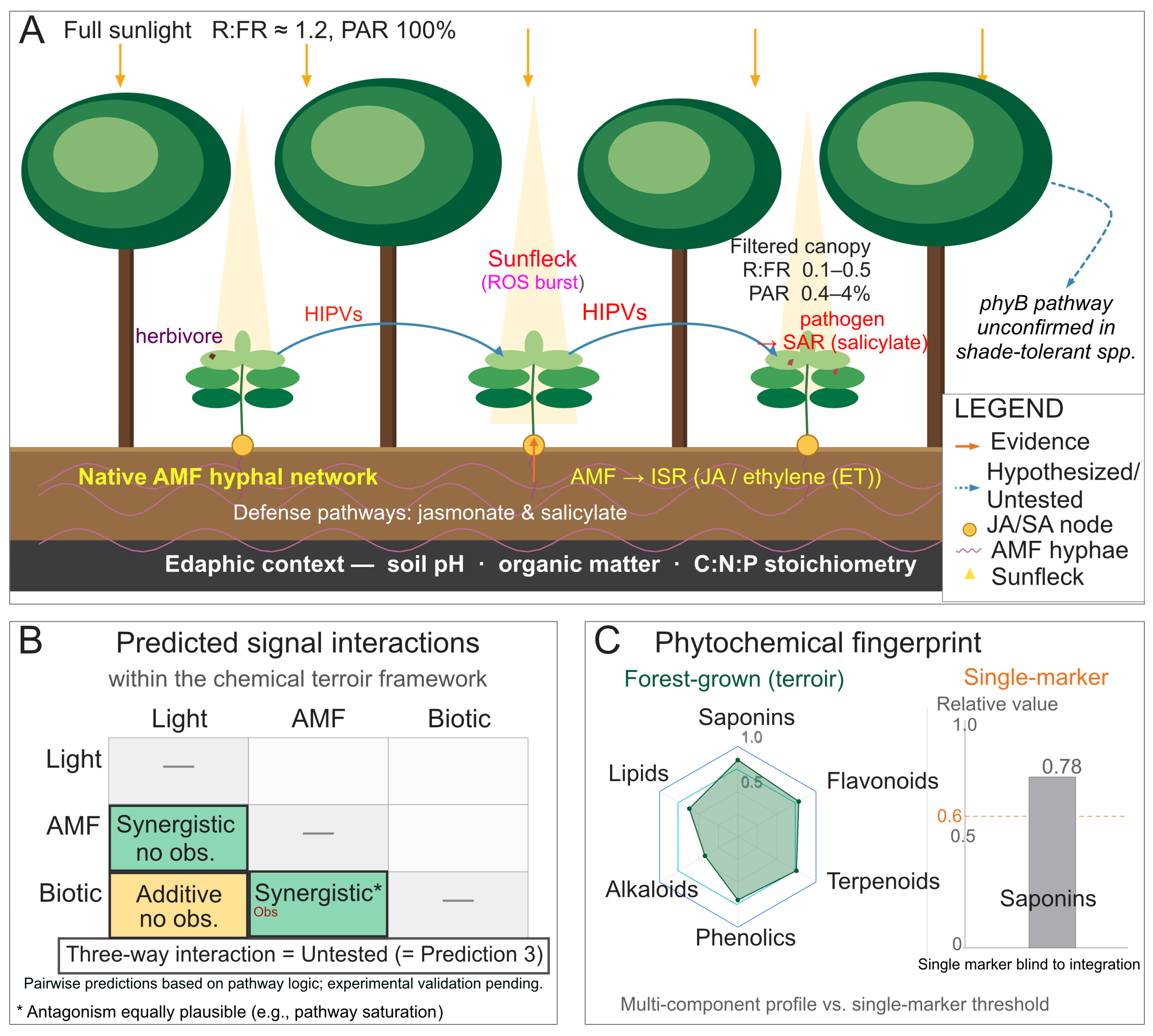
Figure 1. Forest understory as a multi-signal elicitation system. Multi-panel conceptual diagram. (A) Forest cross-section showing three ecological signals: canopy light environment (sunfleck-driven reactive oxygen species (ROS) signaling; phytochrome B (phyB) pathway unconfirmed in shade-tolerant species, see Appendix B.3), soil microbiome (arbuscular mycorrhizal fungi (AMF)/induced systemic resistance (ISR) through jasmonic acid (JA)/ethylene (ET) axis), and chronic above-ground biotic interactions (herbivore-induced plant volatiles (HIPVs)/systemic acquired resistance (SAR)), modulated by edaphic conditions (soil pH, organic matter, C:N:P), converging on overlapping defense signaling pathways (jasmonate and salicylate). Dashed arrows indicate hypothesized but untested interactions. PAR is expressed as percent transmission of above-canopy values because absolute PAR depends on solar zenith angle, season, latitude, cloud cover, and canopy phenology. For field calibration, the baseline canopy range (0.4%–4%) corresponds to approximately 8–80 µmol photons m−2 s−1 under canopy when above-canopy PAR is ~2000 µmol photons m−2 s−1 (typical clear-sky solar-noon conditions in lowland tropical forest); for temperate-zone solar-noon conditions, the corresponding under-canopy range is approximately 6–60 µmol photons m−2 s−1 at above-canopy PAR ~1500 µmol photons m−2 s−1. (B) Predicted signal interaction matrix: light × AMF (predicted synergistic), light × biotic (predicted additive), AMF × biotic (predicted synergistic but antagonism plausible), and three-way (untested, = Prediction 3). All pairwise predictions are based on pathway logic and require experimental validation. (C) Site-specific phytochemical fingerprint (output of chemical terroir) contrasted with single-marker approaches.
Forests 17 00643 g001
Figure 2. Operational framework for ecological co-cultivation. Flowchart guiding practitioners through two sequential steps derived from the chemical terroir hypothesis. Step 1 (site assessment and production level assignment): canopy type (closure, species richness, R:FR), AMF community composition (soil disturbance history, phosphorus level), and above-ground biotic diversity (herbivore, pathogen, and competitor diversity) jointly determine the production level (Table 3). Step 2 (production planning): species requirements evaluated against level-specific conditions (elevation/climate range, shade tolerance, mycorrhizal dependency); harvest timing determined by aligning biomass accumulation, phytochemical profile development, and seasonal phenology; yield expectation, market premium, ecosystem services, and key risks assessed against site-specific economic conditions. Go/no-go decision nodes at each step. Level 3 design challenges (shade tree selection, supplemental elicitation) and sustainability constraints are addressed in Section 3.3.
Forests 17 00643 g002
Figure 3. Quality verification and self-reinforcing value chain. Flowchart showing: forest ecosystem management → ecological signals (light, microbiome, biotic interactions) → phytochemical fingerprint (output of chemical terroir process) → analytical verification (targeted HPLC-MS/untargeted metabolomics) → statistical validation (partial least squares discriminant analysis (PLS-DA), cross-validation) → geographical indication (GI) certification → market premium → reinvestment in forest management. Dashed connections indicate early-stage components. Feedback loop: if terroir validation fails (Predictions 1–3 refuted), pathway reverts to genotype × environment (G × E)-based breeding approach.
Forests 17 00643 g003
Table 1. Forest understory ecological parameters, sensing mechanisms, and reported or hypothesized effects on secondary metabolite classes in medicinal plants (1).
ParameterUnderstoryOpen-FieldSensing MechanismMetabolite Classes AffectedEvidence TypeRefs.
R:FR ratio0.1–0.51.1–1.2PhyB → DELLA–JAZ (in Arabidopsis; unconfirmed in shade-tolerant spp.)Flavonoids (species-dependent direction)Causal (Arabidopsis); Speculative (medicinal spp.)[18,24,25]
PAR intensity0.4%–4% (lowland tropical; varies by forest type)100%Chloroplast redox (by analogy with drought; untested for sunflecks)Phenylpropanoids, terpenoids, alkaloidsCausal (drought mechanism); Speculative (sunfleck application)[16,17,23]
TemperatureBuffered (several °C offset)Full extremesEnzyme kinetics, ROSTerpenoids, phenolicsCausal (buffering); Correlative (metabolites)[19,20]
AMF community compositionHigh diversity, nativeLow diversity, tillage-disruptedRoot colonization → ISR (JA/ET)Flavonoids (pooled mean + 68%), terpenoids (pooled mean + 53%); alkaloids NS. Upper-bound estimates.Causal (greenhouse quantitative analysis)[9,26]
HIPVsHigher diversity, low-wind retention (untested)Lower diversity, wind-dispersedVolatile perception → JA/SA primingTerpenoids, phenolicsCausal (priming mechanism); Speculative (canopy concentration)[27]
(1) NS = not significant. “Understory” and “Open-field” columns indicate typical parameter values under closed forest canopy and conventional open cultivation, respectively. PAR intensity is expressed as percent transmission of above-canopy values; this corresponds to approximately 8–80 µmol photons m−2 s−1 under canopy when above-canopy PAR is ~2000 µmol photons m−2 s−1 (clear-sky solar-noon, lowland tropical forest), and approximately 6–60 µmol photons m−2 s−1 at above-canopy PAR ~1500 µmol photons m−2 s−1 for temperate-zone conditions. Evidence type indicates the strongest available evidence. The dual-annotation ‘Causal (X); Speculative or Correlative (Y)’ format reads as ‘strongest evidence for X; weaker or no direct evidence for Y’ and is used in four senses across the table: (i) different species (Arabidopsis vs. medicinal spp., R:FR row); (ii) different stress conditions (drought stress vs. sunflecks, PAR row); (iii) different aspects of the same phenomenon (buffering mechanism vs. metabolite consequences, Temperature row); (iv) different scales (laboratory priming vs. canopy-condition concentration, HIPVs row). Pooled means for AMF are likely upper-bound estimates given publication bias (see Section 1.4). Abbreviations: AMF, arbuscular mycorrhizal fungi; DELLA, DELLA protein (gibberellin signaling repressor); ET, ethylene; HIPVs, herbivore-induced plant volatiles; ISR, induced systemic resistance; JA, jasmonic acid; JAZ, jasmonate ZIM-domain protein; PAR, photosynthetically active radiation; phyB, phytochrome B; R:FR, red-to-far-red ratio; ROS, reactive oxygen species; SA, salicylic acid.
Table 2. Effect sizes or qualitative outcomes of understory production and arbuscular mycorrhizal fungi (AMF) inoculation on secondary metabolite content, classified by evidence type (causal vs. correlative). Direct comparison of effect sizes across rows is not warranted given heterogeneity in designs and metrics; the table is intended for within-evidence-type browsing rather than pooled estimation.
SpeciesComparisonDesignnKey MetabolitesEffect (% Change or Fold)pEvidence TypeRef.
Multiple spp. (quantitative analysis)AMF vs. controlPooled (233 obs.)233FlavonoidsPooled mean + 68% (upper-bound estimate)<0.05Causal (pot)[9]
Multiple spp. (quantitative analysis)AMF vs. controlPooled (233 obs.)233TerpenoidsPooled mean + 53% (upper-bound estimate)<0.05Causal (pot)[9]
Multiple spp. (quantitative analysis)AMF vs. controlPooled (233 obs.)233AlkaloidsNS (negative trend)NSCausal (pot)[9]
P. polyphyllaForest vs. greenhouseObservational3 per groupSteroidal saponins, flavonoids, flavonols, lipids, vitaminsEnriched in understory (372 differentially accumulated of 1182 total)<0.05Correlative[8]
P. quinquefoliusMulti-population × forest garden locationTransplant experiment (8 populations × 2 gardens; T0 vs. T2)8 populationsRb1, Rg1, Re, Rc, Rb2, RdGinsenoside levels lower at more intensively managed forest garden despite higher growth; genotype/environment effects differ by ginsenoside<0.05
(some)
Correlative (transplant)[6]
P. quinquefoliusUnderstory vs. fieldObservational + microbiomeNRGinsenosidesIncreased; correlated with AMF colonization<0.05Correlative[35]
P. notoginsengAMF + MeJA interactionMulti-treatment potNRSaponinsAMF alone and MeJA alone each increased vs. CK; combination weakened AMF effect<0.05Causal (pot)[34]
P. ginsengAMF × PSB interactionPot experimentn = 4 per treatmentTotal ginsenosides, PPD/PPT ratio, 9 ginsenosidesPPD/PPT 0.52 → 1.09 (above-ground); total ginsenoside + 39.2% (underground) in co-inoculation<0.05Causal (pot)[33]
P. ginsengFungicide (AMF suppression)Fungicide experimentNRGinsenosidesAltered composition (opposing-direction shifts) 1<0.05Causal (setting unverified)[30]
S. baicalensis8 LED spectral treatments (UV-A, green, blue/red combinations)Controlled environmentn = 32 (morphology); n = 4 (flavonoids)Baicalin, wogonoside, baicalein, wogoninMonochromatic blue promoted flavonoids; red × blue mixtures reduced accumulation<0.05Causal (controlled)[28]
European medicinal plants (multi-spp.)Canopy openness gradientObservational (90 plots)90PolyphenolsSpecies-specific (see §2.1)VariableCorrelative[29]
C. chinensisUnderstory vs. scaffoldObservational + microbiomeNRBerberine, total alkaloidsHigher under understory<0.05Correlative[45]
C. roseusEndophyte inoculationPot experimentn = 3 (vindoline)Vindoline+403% (max)<0.05Causal (pot)[36]
P. vietnamensisAge series (2–7 yr)Observationaln = 5 per age groupTotal saponins~3-fold (age 2 → 5)<0.05Correlative (age confound)[41]
P. notoginsengTree-neighbor intercroppingPot experimentn = 6SaponinsIncreased with specific tree spp.<0.05Causal (pot)[32]
A. lanceaUnderstory vs. openField + untargeted metabolomicsNRSesquiterpenoids, polyacetylenesMultivariate separation (untargeted metabolomics) 1<0.05Correlative[46]
1 Entries reporting compound-level shifts in opposing directions, or multivariate metabolomic separation without single-compound effect sizes, are described qualitatively in the Effect column rather than reduced to a single direction or magnitude. The primary publications themselves did not collapse the qualitative compositional shift to a single effect-size statistic. NR = not reported in original publication (a recurring limitation; 5 of 13 species-specific entries lack reported sample sizes, indicating a systemic transparency weakness in this field). NS = not significant. PSB = phosphate-solubilizing bacteria. This table cannot substitute for formal meta-analysis; heterogeneity in designs, species, and metrics precludes pooling beyond Yuan et al. [9] quantitative analysis. Quantitative effect sizes should be treated as upper-bound estimates given likely publication bias. A formal meta-analysis of forest-understory production effects on phytochemical profiles is a research priority for future work once primary studies report sample sizes and effect-size variance consistently.
Table 3. Forest-based medicinal plant production systems (Levels 1–3) compared with conventional alternatives across ecological and operational parameters.
ParameterLevel 1: Wild-SimulatedLevel 2: Understory AgroforestryLevel 3: Shade ReconstructionAlternatives (Shade-House/CEA/Elicitors)
Canopy type (1)Intact natural forest (R:FR 0.1–0.3; highest signal integration)Managed forest or plantation (R:FR 0.2–0.5; moderate signal integration)Shade nets/fast-growing trees (R:FR 0.4–0.8; low signal integration)Artificial shade or LED (adjustable; minimal signal integration)
AMF community compositionNative, locally adaptedPartially intactDisturbed; poorly compatible with native medicinal plant associationsStandardized or absent; non-native if inoculated
Above-ground biotic diversityFull (herbivores, pathogens, competitors)ReducedMinimalManaged pest pressure only
Species requirementsShade-tolerant, AMF-dependent, native range matchModerate shade tolerance, AMF-beneficialBroad shade toleranceFlexible
Harvest timingLongestLongModerateShortest
Yield expectationLow predictabilityModerateHighHighest
Market premium10–100× (woods-grown ginseng [7])ModerateLowCommodity pricing
Ecosystem servicesFull suitePartialMinimalNone
(1) R:FR values are estimates based on Smith [18]. Signal integration refers to the completeness of the chemical terroir process (Section 2.4). Levels 1–3 represent a continuum of signal-integration completeness rather than discrete categories. The species-suitability constraints—shade tolerance, AMF-dependence, and elevation/climate range—vary continuously rather than in steps, and individual species may occupy intermediate positions or span adjacent Levels depending on site conditions (e.g., woods-grown Panax quinquefolius in eastern North America is best characterized as Level 1–2 production; see Section 3.4). The overlapping R:FR ranges in the Canopy-type row reflect this continuity directly. Where a species is compatible with more than one Level, the choice involves trade-offs among yield predictability, harvest timeline, market premium, and ecosystem services (Section 3.2 trade-off statement; Section 4.1 economic data collection).
Table 4. Predicted applicability and research priority for extending the chemical terroir hypothesis beyond saponin-rich, AMF-associated understory plants.
DimensionPredicted
Applicability
BasisPriorityKey Refs.
Flavonoids/phenolicsHighAMF promotes flavonoid accumulation; ROS from sunflecks activates phenylpropanoid precursorsMedium[9,23]
AlkaloidsLow–ModerateAMF effect NS; endophytes may be primary driversHigh[9,36]
Ectomycorrhizal hostsUnknownWhether ECM triggers ISR analogous to AMF is poorly characterizedHigh[26]
Woody speciesLow–ModerateDifferent carbon allocation patterns; bark/wood chemistry differs from herbaceous secondary metabolismMedium
Tropical lowland forestsModerateCanopy structure and light transmission vary widely across sites; distinct temperature regime from temperate forests; AMF community composition likely differs from temperate forests but tropical-specific data are scarceMedium[17,19]
Temperate deciduousModerateSeasonal R:FR shifts from deciduous canopy; ECM-dominated soilsHigh (P. quinquefolius)[7]
BorealUnknownECM dominance; very short growing season; limited understory herb diversityLow
NS = not significant. ECM = ectomycorrhizal. AMF = arbuscular mycorrhizal fungi; ROS = reactive oxygen species; ISR = induced systemic resistance. Other abbreviations as in Table 1 and Table 2.
Table 5. Priority research questions for testing, extending, and implementing the chemical terroir hypothesis.
LevelCore QuestionPriority ApproachTimeline
MicrobiomeDo native forest AMF communities produce different metabolite profiles than commercial inoculants?Paired metagenomics–metabolomics under intact canopy2–5 yr
SystemsDo forest ecological signals generate distinctive phytochemical fingerprints (Predictions 1–3)?Multi-site common garden + production level gradient3–7 yr
PopulationDoes selective harvest of high-chemotype individuals erode chemodiversity?Population genomics, comparative metabolomics3–7 yr
ExtensionDoes the chemical terroir hypothesis apply beyond saponin-rich, AMF-associated plants (Table 4)?Multi-species, multi-biome field trials5–10 yr
ImplementationCan GI certification and analytical standardization sustain a forest conservation value chain?Ecosystem service valuation, benefit-sharing design5–15 yr
Disclaimer/Publisher’s Note: The statements, opinions and data contained in all publications are solely those of the individual author(s) and contributor(s) and not of MDPI and/or the editor(s). MDPI and/or the editor(s) disclaim responsibility for any injury to people or property resulting from any ideas, methods, instructions or products referred to in the content.