Chemical Terroir in Forest Understories: Hypothesis, Ecological Co-Cultivation, and Research Priorities for Saponin-Rich Medicinal Plants

 , and
, and
Abstract
1. Introduction
1.1. The Forest-to-Field Quality Problem of Medicinal Plants
1.2. Three Case Studies
1.3. Gaps in Existing Literature
1.4. Scope, Search Strategy, and Evidence Standards
2. Ecological Drivers of Secondary Metabolism in the Forest Understory
2.1. Canopy Light Environment
2.2. Arbuscular Mycorrhizal Fungi and Soil Microbiome
2.3. Above-Ground Biotic Interactions and Defense Priming
2.4. Signal Integration and the Chemical Terroir Hypothesis
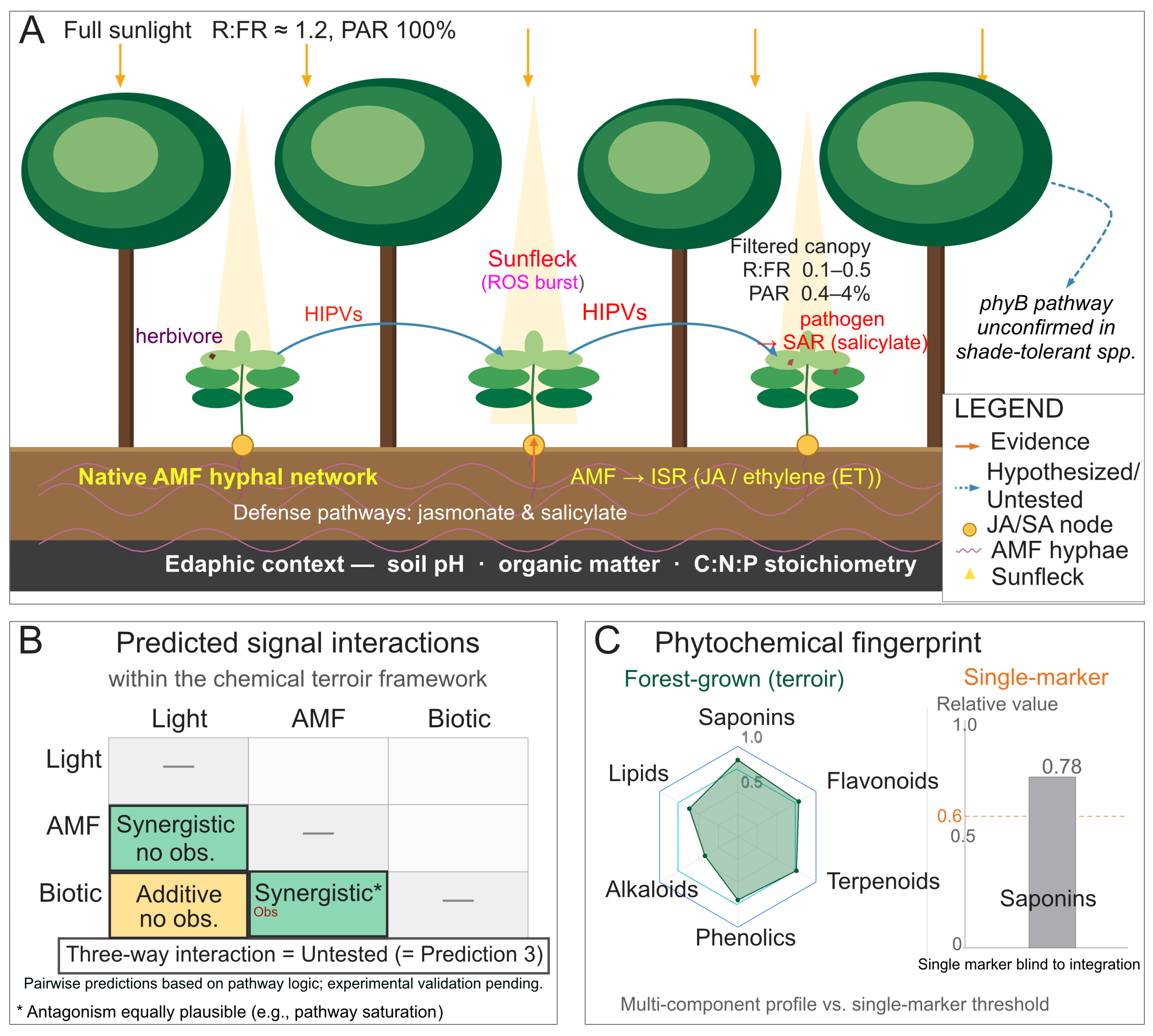
- Forest effect prediction. When plants from a single source population are grown under forest canopy and in paired open-field controls, forest-grown material should differ significantly in phytochemical profile from its paired open-field control at each site, with the forest effect consistent in direction across ecologically distinct sites.
- Profile plasticity prediction. The phytochemical profile of plants established at a forest site should progressively converge toward that site’s phytochemical fingerprint over time, demonstrating that chemical terroir operates through ongoing ecological signaling rather than a fixed developmental imprint.
- Multi-signal integration prediction. Multivariate phytochemical profile distance from wild-harvested reference material should increase as ecological signals deviate from intact forest (with canopy filtering, native microbiome, and natural above-ground biotic diversity) through simplified production systems to open-field cultivation.
3. Translating Mechanisms into Production Design
3.1. Three Levels of Forest-Based Production
3.2. Operational Framework for Ecological Co-Cultivation
3.3. Failure Conditions, Exceptions, and Sustainability
3.4. Species-Specific Case Studies
4. Validation, Limitations, and Implementation
4.1. Priority Experiments for Chemical Terroir Validation
4.2. Analytical Methods for Chemical Terroir Validation
4.3. Limitations, Threats, and Implementation Challenges
5. Conclusions
Author Contributions
Funding
Data Availability Statement
Acknowledgments
Conflicts of Interest
Appendix A

| Term | Definition |
|---|---|
| AMF | Arbuscular mycorrhizal fungi; obligate plant symbionts (subphylum Glomeromycotina, formerly treated as phylum Glomeromycota) that colonize roots and enhance nutrient uptake, particularly phosphorus. In controlled greenhouse experiments, AMF can modulate plant secondary metabolism through induced systemic resistance (ISR) via the jasmonate/ethylene signaling axis [9,26]. Whether this modulation operates comparably under natural forest canopy conditions remains untested (see Section 2.2, main text). |
| Chemical terroir | Term borrowed from viticulture [39,40] and adapted in this review as a testable mechanistic hypothesis. Defined here as the process by which integrated forest ecological conditions (canopy light filtering, native soil microbiome, above-ground biotic interactions, edaphic context) generate a site-specific phytochemical fingerprint in forest-grown medicinal plants, distinct from what any single signal produces in isolation (multi-signal integration). Related to the Chinese daodi (道地) concept [13] but differs in specifying measurable ecological parameters as putative drivers and quantifiable phytochemical profiles as outputs. Distinguished from standard G × E interaction by three testable predictions; if G × E partitioning shows genotype dominates over site, the terroir framing should be abandoned (see Section 2.4, main text). |
| Daodi (道地) | Concept in traditional Chinese medicine designating medicinal materials from specific canonical production regions as authentic and therapeutically superior [13]. First documented over 700 years ago and systematized during the Ming Dynasty (1368–1644), daodi integrates geographic origin, ecological growing conditions, harvest timing, and traditional processing into a holistic quality framework. The daodi system and the chemical terroir hypothesis proposed in this review share the premise that place of origin shapes medicinal quality, but differ in epistemological approach: daodi is grounded in long clinical and empirical tradition, while chemical terroir specifies ecological signaling pathways and testable predictions amenable to experimental refutation (see Section 1.3 and Section 2.4, main text). |
| DELLA proteins | Nuclear growth-repressor proteins degraded via the gibberellin (GA) pathway. DELLAs positively regulate jasmonate signaling by competitively binding JAZ proteins, thereby freeing MYC2 transcription factors to activate defense genes [24]. In Arabidopsis thaliana, low R:FR triggers DELLA degradation through GA-dependent signaling and independently stabilizes the JAZ10 protein; both mechanisms converge to dampen jasmonate sensitivity during shade-avoidance responses [25]. Whether this DELLA–JAZ regulatory module functions in shade-tolerant medicinal species remains untested (see Section 2.1, main text). |
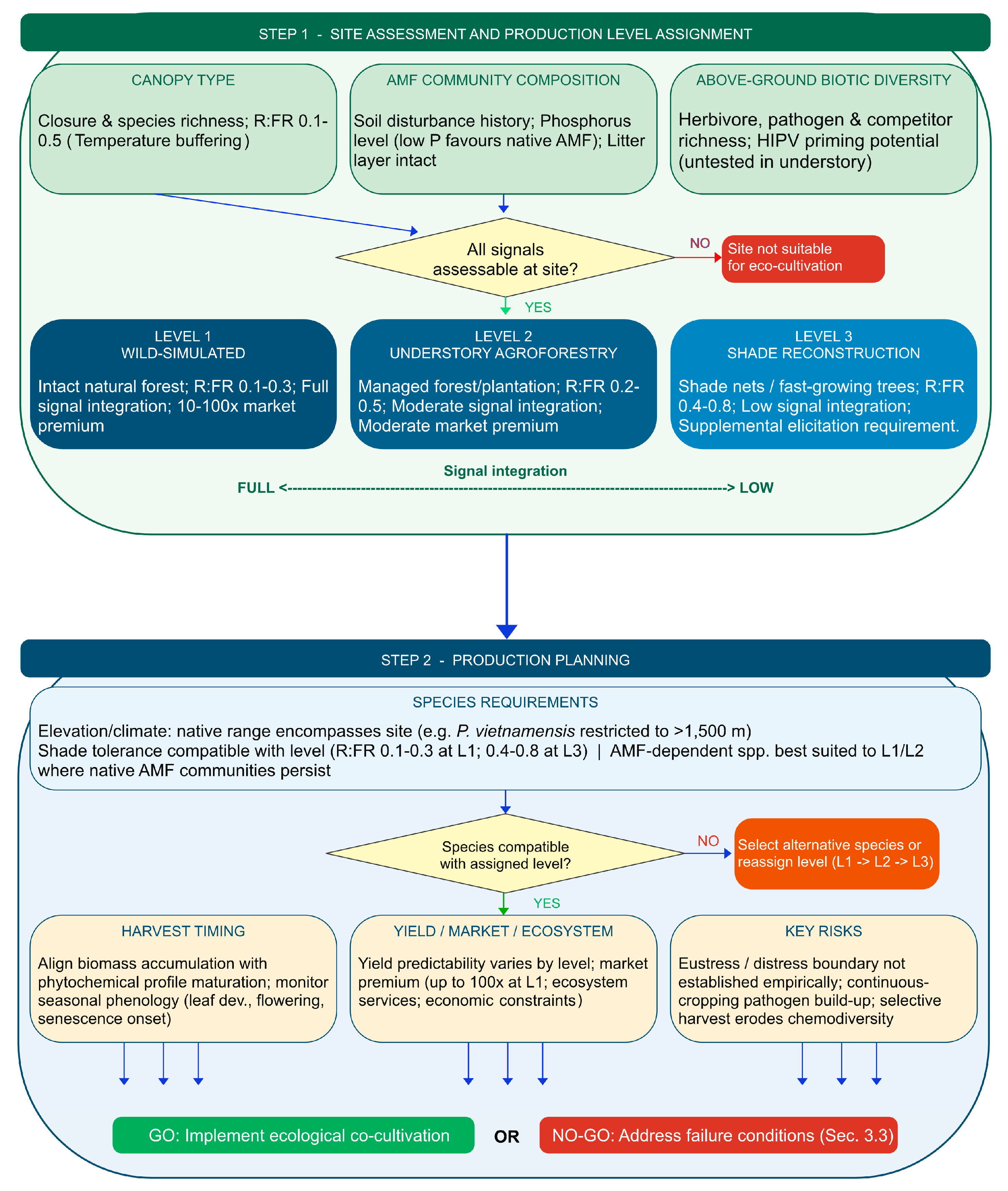
| Ecological co-cultivation | Design principle proposed in this review for forest-based medicinal plant production, defined as harnessing natural forest processes rather than overriding them (see Section 3.1, main text). Distinguished from traditional understory cultivation, which is an ancient and widespread practice, by the explicit objective of preserving multi-signal ecological environments (canopy light filtering, native soil microbiome, biotic interactions) to maintain characteristic phytochemical fingerprints, guided by the mechanistic understanding developed in Section 2. Serves as the practical counterpart of the chemical terroir hypothesis. The principle primarily underlies Level 1 (wild-simulated) and Level 2 (understory agroforestry) production systems; Level 3 (shade reconstruction) retains the design intent but with reduced ecological signal integrity (Table 3, main text). |
| Eustress | In plant biology, a positive stress response in which low doses or mild intensities of a stressor enhance plant performance, as opposed to distress, in which high doses or chronic exposure impair function [54,55]. The concept derives from Selye’s [56] general adaptation syndrome in animal physiology. Eustress is closely related to hormesis (see Hormesis entry) but emphasizes the organism’s adaptive response rather than the dose–response curve of the stressor. In this review, eustress is used more narrowly to denote mild, intermittent stress that primes defense metabolite accumulation without sustained growth penalties (see Section 2.4, main text). In forest understory contexts, sunfleck-driven ROS bursts and low-level HIPV exposure may represent eustress. The boundary between eustress and distress is species-specific and site-specific, and must be determined empirically for each target species before scaling up cultivation (see Section 3.3, main text). |
| G × E | Genotype × environment interaction; the phenomenon whereby different genotypes respond differently to different environments, resulting in phenotypic variation that cannot be attributed to either genetic or environmental effects alone. Detected and partitioned using statistical methods (ANOVA, multivariate approaches) applied to common-garden experiments, ideally using plants from a single source population to minimize genetic variation. In this review, G × E partitioning is the critical test for chemical terroir: the hypothesis predicts that metabolite profiles cluster by site more strongly than by genotype (Prediction 1, Section 2.4). However, chemical terroir is not merely G × E under a different label. It additionally predicts multi-signal integration from ecological signals (Prediction 3). If G × E partitioning shows genotype dominates over site, the chemical terroir hypothesis should be abandoned in favor of standard provenance terminology and breeding-based strategies (Section 2.4, main text). |
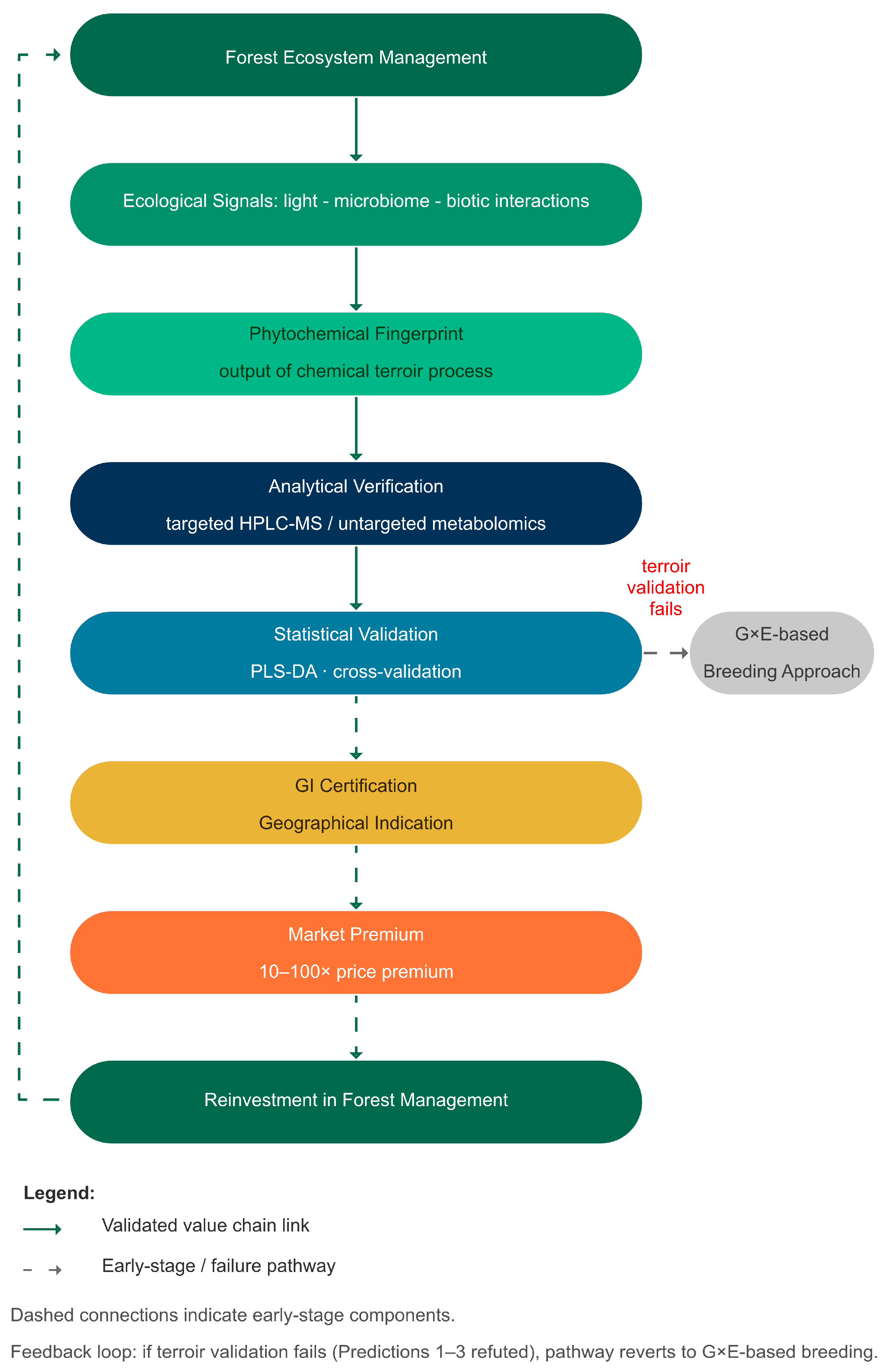
| GI | Geographical indication; a legal instrument that identifies a product as originating in a specific territory where a given quality, reputation, or other characteristic is essentially attributable to its geographic origin. In this review, GI serves a specific function within the self-reinforcing value chain (Figure 3, main text). By linking price premiums to verified ecological origin, GI creates market incentives for forest conservation. Examples relevant to this review include Ngoc Linh ginseng (P. vietnamensis, Vietnam) and “woods-grown” American ginseng (P. quinquefolius, North America), which commands 10–100× premiums over field-cultivated material [7]. The chemical terroir hypothesis, if validated, would provide the scientific basis for GI quality claims. GI implementation faces challenges including institutional capacity gaps, verification standardization, and traceability limitations (see Section 4.2 and Table A3). |
| HIPVs | Herbivore-induced plant volatiles; complex blends of airborne chemicals released by plants under herbivore attack, typically comprising green leaf volatiles (C6 aldehydes and alcohols), mono- and sesquiterpenoids, and methyl salicylate, among other compounds. HIPVs serve multiple ecological functions: direct defense (repelling herbivores), indirect defense (attracting natural enemies of herbivores), within-plant signaling (priming defenses in distal undamaged tissues), and between-plant signaling (priming defenses in neighboring plants) [27]. In the context of this review, low-wind conditions beneath closed canopies would be expected to increase local HIPV concentrations, potentially enhancing defense priming in understory plants. However, neither HIPV concentrations nor their priming effects have been directly measured in forest understories, representing an important empirical gap (see Section 2.3, main text). |
| Hormesis | Biphasic dose–response phenomenon in which low doses of a stressor stimulate beneficial responses while high doses inhibit. Related to but distinct from defense priming (see Martinez-Medina et al. [31], for priming criteria). Hormesis describes the dose–response relationship of the stressor, while priming describes the sensitization of the plant’s defense capacity by a prior stimulus. Low-dose exposure can act as a priming stimulus through a hormetic mechanism. In this review, hormesis is relevant as a potential mechanism by which mild, intermittent understory stressors (e.g., sunfleck ROS bursts, low-level HIPV exposure) could prime defense metabolite production. This mechanism remains speculative and has not been directly tested in forest understory medicinal species. Related to eustress (see Eustress entry). |
| ISR | Induced systemic resistance; broad-spectrum defense response activated by beneficial soil microorganisms (particularly AMF and plant growth-promoting rhizobacteria), mediated through jasmonate/ethylene signaling pathways [26]. Distinguished from SAR (see SAR entry), which is pathogen-triggered and mediated through salicylic acid. In forest understories, ISR and SAR may operate simultaneously, with interactions ranging from synergistic to antagonistic depending on timing and intensity [26] (Section 2.4, main text). In this review, AMF-mediated ISR is proposed as the primary mechanism explaining the compound-class selectivity observed in AMF studies: enhancement of flavonoids and terpenoids (jasmonate-responsive classes) but not alkaloids (Section 2.2, main text). This mechanism has been demonstrated in greenhouse experiments but remains untested under natural forest canopy conditions. |
| JAZ proteins | Jasmonate ZIM-domain proteins; transcriptional repressors that suppress jasmonate-responsive gene expression by binding and inactivating MYC2 transcription factors. In the presence of bioactive jasmonate (JA-Ile), JAZ proteins are degraded via the SCFCOI1 ubiquitin–proteasome pathway, releasing MYC2 to activate defense genes. DELLA proteins can sequester JAZ proteins through competitive binding, thereby promoting jasmonate signaling [24]. In Arabidopsis thaliana, low R:FR stabilizes JAZ10 protein, contributing to the suppression of jasmonate sensitivity during shade-avoidance responses [25]. Whether JAZ regulation operates similarly in shade-tolerant medicinal species is unknown. |
| MeJA | Methyl jasmonate; the volatile methyl ester of jasmonic acid. Used as an exogenous elicitor to activate jasmonate-dependent defense pathways and enhance secondary metabolite production in medicinal plants. Typical application: foliar-spray concentrations for in vivo studies commonly range from 10−4 to 4 mM, with 0.1–0.5 mM frequently reported for medicinal and aromatic species [12]. In this review, MeJA supplementation is considered primarily relevant for Level 3 (shade reconstruction) systems, where reduced biotic complexity limits natural defense priming (Section 3.2, main text). In P. notoginseng, both AMF alone and MeJA alone increased saponin accumulation, but their combination weakened the AMF effect, suggesting that exogenous MeJA may saturate the endogenous jasmonate pathway already activated by AMF(Dai et al. [34]; causal, pot). In vitro elicitation efficacy frequently does not translate to in vivo whole-plant application [12], and field-scale dose optimization remains a prerequisite for production-level application. |
| NTFP | Non-timber forest product; any biological resource obtained from forests other than timber, including medicinal plants, resins, fibers, and mushrooms. Forest-origin medicinal plants constitute an economically important NTFP category. The demand that makes NTFPs valuable also drives overexploitation, threatening both ecological viability and future supply [1]. This tension between harvesting pressure and ecological sustainability motivates the ecological co-cultivation design principle proposed in this review (Section 1.1 and Section 3, main text). Sustainable harvest rates must remain below recruitment capacity [1]. |
| OPLS-DA | Orthogonal partial least squares discriminant analysis; extension of PLS-DA that partitions variation into a predictive component (correlated with group membership) and orthogonal components (uncorrelated systematic variation). This separation improves model interpretability compared with standard PLS-DA by isolating the metabolomic variation driving group discrimination. Used as an alternative or complement to PLS-DA for discriminating samples by geographic origin or cultivation system. Requires the same validation procedures as PLS-DA: permutation testing and cross-validation (see PLS-DA entry and Section 4.1, main text). |
| PAR | Photosynthetically active radiation; photon flux in the 400–700 nm waveband used by plants for photosynthesis. Under closed canopy, PAR is reduced to 0.4%–4% of above-canopy levels [16,17]. This reduction is not uniform: sunflecks (transient direct-light patches) punctuate the shade, contributing 10%–80% of the daily PAR that reaches the understory [21,22]. In this review, sunfleck-driven PAR fluctuations are hypothesized to generate transient ROS bursts that channel reduction equivalents into secondary metabolite biosynthesis (Section 2.1, main text). Below approximately 1% PAR, carbon limitation reduces both growth and secondary metabolism, representing a failure threshold for the ecological co-cultivation framework (Section 3.3, main text). |
| PhyB | Phytochrome B; a red/far-red photoreceptor that senses the R:FR ratio. In Arabidopsis thaliana, phyB inactivation under low R:FR promotes DELLA degradation and JAZ10 stabilization, both of which suppress jasmonate-mediated defense during shade-avoidance responses [25]. This creates an apparent contradiction for understory medicinal species: if low R:FR suppresses jasmonate-mediated defense, how do these species accumulate defense compounds beneath closed canopies? The main text (Section 2.1) proposes that defense metabolite accumulation in shade-tolerant species is driven primarily by R:FR-independent inputs (AMF-mediated ISR, above-ground biotic interactions) rather than by the phyB–JAZ module characterized in Arabidopsis. No phyB or JAZ functional data exist for any forest medicinal species. |
| PLS-DA | Partial least squares discriminant analysis; supervised multivariate classification method that maximizes separation between pre-defined groups. In this review, PLS-DA is the proposed method for testing Prediction 1 (forest effect): if metabolite profiles cluster by site rather than by genotype in common-garden experiments, the chemical terroir hypothesis is supported (Section 2.4, main text). Requires validation by permutation testing (≥1000 permutations) and k-fold cross-validation, with adequate sample sizes (generally ≥ 30 per group) for robust classification (Section 4.1, main text). Variable importance in projection (VIP) scores derived from PLS-DA identify which metabolites most strongly drive group discrimination (see VIP entry). |
| R:FR ratio | Red-to-far-red ratio; ratio of photon flux at 660 nm (red) to 730 nm (far-red). Ranges from ~1.1–1.2 in open sunlight to 0.1–0.5 under dense canopy, depending on tree species composition, leaf area index, and season [18]. Sensed by phytochrome photoreceptors, particularly phyB (see PhyB entry). A provisional target R:FR range for ecological co-cultivation is discussed in Section 3.2 of the main text. No dose–response curve relating R:FR to saponin or other defense metabolite accumulation has been published for any medicinal species, and the link between canopy spectral quality and the phytochemical profiles central to this review remains qualitative (Section 2.1, main text). |
| ROS | Reactive oxygen species; chemically reactive molecules containing oxygen (e.g., superoxide, hydrogen peroxide). In forest understories, ROS are generated transiently during sunfleck episodes when excess excitation energy overwhelms the photosynthetic electron transport chain. By analogy with the drought-induced over-reduction mechanism [23], this review hypothesizes that sunfleck-generated ROS may channel surplus reduction equivalents into NADPH-consuming biosynthetic pathways, enhancing production of phenylpropanoids, terpenoids, and alkaloids (Section 2.1, main text). This extrapolation from drought to sunfleck stress has not been experimentally validated in any understory species. Transient sunfleck ROS bursts are proposed as a form of eustress (see Eustress entry) that primes defense metabolism without sustained growth penalties. |
| SAR | Systemic acquired resistance; pathogen-triggered defense response involving salicylic acid (SA) signaling, typically providing resistance against biotrophic and hemibiotrophic pathogens. Distinguished from ISR (see ISR entry) by its triggering stimulus (pathogen attack rather than beneficial microorganisms) and signaling pathway (SA rather than JA/ET). In the review’s three-signal framework (Figure 1, main text), SAR is positioned within the above-ground biotic interactions signal category. In forest understories, SAR and ISR may operate simultaneously, with interactions ranging from synergistic (if they activate complementary defense sectors) to antagonistic (through SA-JA crosstalk), depending on timing and intensity [26] (Section 2.4, main text). |
| VIP score | Variable importance in projection; metric derived from PLS-DA or OPLS-DA models indicating which variables (metabolites) most strongly contribute to group discrimination. VIP > 1.0 is commonly used as a selection threshold, since a value of 1.0 represents the average contribution across all variables; metabolites exceeding this threshold contribute more than average to group separation. In this review, VIP scores would identify the specific metabolites that constitute the chemical terroir fingerprint—those driving the discrimination between forest-grown and non-forest material (Section 4.1, main text). |
| # | Reference | Species | Comparison | Design Type | Sample Size | Replication | Controls Reported | Age Controlled | Effect Size | Analytical and Statistical Methods | p-Value | Data Availability | Quality Rating |
|---|---|---|---|---|---|---|---|---|---|---|---|---|---|
| 1 | [9] | Multiple spp. (quantitative analysis) | AMF vs. control | Causal (pot): quantitative analysis (233 obs., 28 papers) | 233 pooled | Multiple studies | Varied | Varied | +68% (flavonoids), +53% (terpenoids), NS (alkaloids) | Random-effects model | <0.05 (flav., terp.) | Not assessed | Moderate (no funnel plot or trim-and-fill correction) |
| 2 | [8] | Paris polyphylla | Forest understory vs. greenhouse | Correlative: observational comparison | 3 per group | Not reported | Greenhouse control | Yes (8-year-old rhizomes) | Steroidal saponins, flavonoids, flavonols enriched in understory; other classes higher in greenhouse | PCA, OPLS-DA (UPLC-MS/MS platform) | <0.05 | Not reported | Low (small sample size, multiple confounders) |
| 3 | [6] | Panax quinquefolius | Population × forest garden location × sampling time (T0/T2) | Transplant experiment (8 populations × 2 forest gardens) | 8 populations | Yes (populations) | Two forest gardens differing in management intensity | Yes (T0 vs. T2) | Variable by population; lower ginsenosides at more intensively managed forest garden despite higher growth | ANOVA | <0.05 (some) | Not reported | Moderate |
| 4 | [35] | P. quinquefolius | Understory vs. field | Correlative: observational + microbiome | NR | NR | Field planting | NR | Increased ginsenosides; correlated with AMF colonization | Correlation + metabolomics | <0.05 | NR | Low–Moderate (AMF and other variables confounded) |
| 5 | [34] | P. notoginseng | AMF + MeJA interaction | Causal (pot): multi-treatment experiment | NR | NR | Non-inoculated, no MeJA (CK) | N/A (pot) | AMF alone and MeJA alone each increased saponins vs. CK; combination weakened AMF effect (consistent with jasmonate pathway saturation) | HPLC + transcriptomics | <0.05 | NR | Moderate |
| 6 | [33] | P. ginseng | AMF × PSB interaction | Causal (pot): factorial experiment | 4 per treatment | 4 replicates × 4 treatments | Non-inoculated + single-inoculation controls | N/A (pot) | PPD/PPT ratio (above-ground) increased 0.52 → 1.09 in co-inoculation; total ginsenoside (underground) + 39.2%; individual ginsenosides (Rd, Rb2, Rb3, Rg1) increased and Rc, Re decreased; proposed mechanism via C:N:P stoichiometry shifts | HPLC + ANOVA (Tukey’s test); 16S rRNA sequencing | <0.05 | Partial public (NCBI SRA PRJNA936811) | Moderate |
| 7 | [30] | P. ginseng | Fungicide (AMF suppression) | Causal: fungicide experiment (setting unverified) | NR | NR | Untreated control | NR | Altered ginsenoside profile | HPLC comparison | <0.05 | NR | Low–Moderate |
| 8 | [28] | Scutellaria baicalensis | 8 LED spectral treatments (UV-A, green, blue/red combinations) | Causal (controlled): light manipulation | 32 (morphology); 4 (flavonoids) | Yes (synchronized transplant, 120 d cultivation) | Full-spectrum control | N/A | Monochromatic blue light promoted baicalin and wogonoside accumulation; UV-A and green decreased flavonoids; red × blue mixtures reduced flavonoid accumulation relative to monochromatic treatments; photoreceptor crosstalk proposed as mechanism (not molecularly validated within species) | ANOVA | <0.05 | In article/SM only | Moderate |
| 9 | [29] | European forest medicinal plants (multi-spp.) | Canopy openness gradient | Correlative: observational gradient (90 plots) | 90 plots | Yes (plots) | Gradient design | Not applicable | Species-specific: canopy openness positively affected TPC in 2 of 4 species; other factors (stand diversity, pH, C/N) showed divergent effects across species | Generalized linear models (AIC-based selection) | Variable | NR | Moderate–High |
| 10 | [45] | Coptis chinensis | Understory vs. scaffold | Correlative: observational + microbiome | NR | NR | Scaffold cultivation | NR | Higher berberine and total alkaloids under understory | HPLC + 16S rRNA | <0.05 | NR | Low–Moderate (confounded) |
| 11 | [43] | Coptis chinensis | Understory (Cunninghamia lanceolata) vs. control | Correlative: observational + transcriptomic | 10 plants/system (phenotype); 3 bio reps (RNA-seq) | 3 biological replicates | Non-understory control | Yes (2-yr seedlings, common planting date) | Increased viability, yield, berberine, palmatine, epiberberine; coptisine declined | Transcriptomics + HPLC; ANOVA + Duncan’s test; Pearson’s correlation | <0.05 | GSA BioProject CRA012562 (transcriptome) | Moderate (apparent growth–defense trade-off violation) |
| 12 | [36] | Catharanthus roseus | Endophyte inoculation | Causal (pot): inoculation experiment | 3 (vindoline); 6 (growth) | 3 biological × 3 technical replicates | Non-inoculated | N/A | +403% vindoline (max) | ANOVA (Duncan’s test); HPLC + qRT-PCR | <0.05 | GenBank (KT001517, KT001518) + article/SM | Moderate |
| 13 | [41] | P. vietnamensis | Age series (2–7 yr) | Correlative: observational age series (age confound) | 5 per age group | Single site | No non-forest control | Age as variable | ~3-fold saponins (age 2 → 5) | Student’s t-test; HPLC-UV/ELSD | <0.05 | Open access + SM | Low (single site, no non-forest control) |
| 14 | [4] | P. vietnamensis | Acclimatized to lower elevation (Lam Dong Province) | Correlative: observational age series | 5 per age group | Single site, 4 age groups | No native Ngoc Linh comparison | Age as variable | Saponin content increased with plant age | ANOVA (Dunnett’s test) | <0.05 | In article/SM | Low (no systematic comparison with native population profiles) |
| 15 | [32] | P. notoginseng | Tree-neighbor intercropping | Causal (pot): randomized block greenhouse experiment | 6 per treatment | 6 biological replicates | Monoculture control | NR | Increased saponins with specific tree species | ANOVA (Turkey HSD); LC-MS/MS metabolomics | <0.05 | Open access | Moderate |
| 16 | [46] | Atractylodes lancea | Understory vs. open | Correlative: field + metabolomics | NR | NR | Open-field control | NR | Altered sesquiterpenoid and polyacetylene profiles | Untargeted metabolomics | <0.05 | NR | Moderate |
| 17 | [44] | Arabidopsis thaliana | Lab vs. field growth–defense trade-offs | Causal (controlled + field) | Reported | Yes | Multiple controls | N/A | Major growth–defense trade-off vanished under field conditions | Mixed models | <0.05 | Public | High |
| Category | Item | Description | Relevance to This Review |
|---|---|---|---|
| entry 1 | data | data | |
| Regulatory framework | Nagoya Protocol (CBD, 2010) | Governs access to genetic resources and equitable benefit-sharing from their utilization; requires prior informed consent (PIC) and mutually agreed terms (MAT) | Applies when genetic material from forest medicinal plants is used for research or commercial development; relevant to all three case study species, particularly P. vietnamensis (Vietnamese endemic) |
| Regulatory framework | Cali Fund (CBD COP16 Decision 16/2, 2024) | Multilateral benefit-sharing mechanism for digital sequence information (DSI) deposited in public databases; launched February 2025 | Relevant when genomic, transcriptomic, or metabolomic data from forest medicinal species are deposited in public databases; the data availability recommendations in Section 4.1 of the main text should comply with this framework |
| Regulatory framework | FairWild Standard (FairWild Foundation, 2024) | Certification for sustainable wild collection and enrichment planting (version 3.0) | Covers wild harvest and enrichment planting but does not currently address intentional understory cultivation; extension of FairWild criteria to Level 1 wild-simulated systems (Table 3, main text) would be a practical step |
| Regulatory framework | CBD Article 8(j) (CBD, 1992) | Requires respect for and maintenance of traditional knowledge and equitable sharing of benefits arising from its use | Directly relevant to the daodi concept [13] discussed in Section 1.3 and Section 2.4 of the main text |
| GI equity risk | Access barriers | Smallholder growers and ethnic minority communities may lack institutional capacity to apply for or enforce GI protections, risking exclusion from premium markets their stewardship creates [1] | Particularly acute for P. vietnamensis on Ngoc Linh, where indigenous Xê Đăng (Sedang) communities have historically managed the species |
| GI equity risk | Governance imbalance | GI governance structure determines benefit distribution; state authorities, private companies, cooperatives, and indigenous communities have unequal power | The self-reinforcing value chain (Figure 3, main text) functions equitably only if governance is inclusive |
| GI equity risk | Knowledge commodification | GI systems can inadvertently commodify traditional knowledge without fair compensation to knowledge holders | The chemical terroir framework, by emphasizing measurable ecological conditions over proprietary knowledge, may partially mitigate this risk but does not eliminate it |
| GI equity risk | Location privacy | For high-value species (hundreds to thousands of USD per kg), publicizing precise GPS coordinates creates theft risk for smallholder growers | Traceability systems [52] must balance verification needs against location security; identified as a practical constraint in the P. vietnamensis case study (Section 3.4, main text) |
| Implementation requirement | Free, prior, and informed consent (FPIC) | Obtain FPIC from indigenous and local communities before any commercialization of forest-based medicinal plant systems | Prerequisite for all three production levels (Table 3, main text); must precede field trial design (Section 4.1); consistent with Nagoya Protocol provisions |
| Implementation requirement | Equitable premium distribution | Distribute GI-derived price premiums equitably along the value chain, with particular attention to communities whose forest stewardship creates the ecological conditions underlying quality | Applies to the 10–100× price premiums reported for woods-grown ginseng ([7]; Section 3.4, main text) |
| Implementation requirement | Institutional capacity building | Provide institutional support for community-based certification bodies capable of managing GI applications and enforcement | Needed to address the access barrier identified above |
| Implementation requirement | Knowledge protection | Protect against unauthorized appropriation of traditional cultivation knowledge, including knowledge embedded in site selection, species matching, and harvest timing practices | Complements CBD Article 8(j) provisions |
| Implementation requirement | Transparent governance | Ensure community representation at decision-making levels in GI governance structures | Addresses the governance imbalance identified above; should be integrated into policy frameworks (Appendix B.2) |
Appendix B
Appendix B.1. Climate Change Vulnerability Assessment
Appendix B.1.1. Signal-Specific Vulnerability Ratings
| Ecological Signal | Climate Threat | Vulnerability | Mechanism |
|---|---|---|---|
| Canopy light regime (R:FR) | Tree mortality from drought, heat, pest outbreaks | High | Canopy loss alters spectral filtering; gap formation shifts R:FR toward open-field values (0.1–0.5 → ~1.2), eliminating the phytochrome-mediated signaling described in Section 2.1; climate change is projected to alter forest microclimates and canopy structure more broadly [53] |
| Temperature buffering | Extreme heat events exceeding canopy buffering capacity | Moderate | Forest canopies buffer understory temperatures by approximately 4 °C (cooling of maxima) and 1 °C (warming of minima) globally, with the offset magnified under more extreme macroclimate temperatures [19]; extreme events can overwhelm this buffering capacity |
| AMF communities | Drought-induced disruption of hyphal networks; altered soil chemistry under changed precipitation | High | AMF depend on soil moisture continuity for hyphal network maintenance; drought fragments networks and reduces the ISR signaling described in Section 2.2 |
| HIPVs and biotic interactions | Phenological mismatches; changing herbivore assemblages under warming | Moderate | Herbivore emergence timing may decouple from plant phenology (projected from general climate–phenology trends); novel pest species may arrive, altering the defense priming regime described in Section 2.3 |
| Edaphic context | Altered decomposition rates; nutrient cycling changes under warming and altered precipitation | Low–Moderate | Faster decomposition at higher temperatures may alter litter-derived allelochemical inputs (Section 2.3, main text); potential nutrient pulse or depletion depending on moisture |
Appendix B.1.2. Compounding Risks
Appendix B.1.3. Adaptation Strategies
- Assisted migration (all signals; addresses range-wide habitat loss). Establish cultivated populations at slightly higher elevations than current natural range limits to pre-empt range compression. This is particularly urgent for montane specialists such as P. vietnamensis with narrow elevational ranges.
- Canopy diversification (canopy light regime, temperature buffering). Mixed-species canopies provide greater thermal buffering than monocultures [20]. Species-rich stands may also confer greater resilience when individual canopy species are lost to drought or pests, though this inference has not been directly tested. This aligns with the site selection guidance in Section 3.2 of the main text.
- Chemodiversity conservation (all signals). Maintain genetic and chemical diversity within cultivated populations to provide adaptive capacity. Selective harvest of high-chemotype individuals may erode chemodiversity over generations, though this hypothesis has not been empirically tested in medicinal plant populations (Section 3.2 and Table 5, main text).
- Monitoring infrastructure (all signals). Deploy IoT sensor networks [57] for real-time microclimate monitoring, enabling adaptive management. Such networks are currently absent from forest medicinal plant systems (Section 4.3, main text).
- Long-term research (all signals). Establish permanent monitoring plots tracking both microclimate parameters and metabolite profiles over decadal timescales. Integrate climate monitoring into the field trials proposed in Section 4.1 of the main text.
Appendix B.2. Policy Implications and SDG Alignment
Appendix B.2.1. SDG Alignment
| SDG | Relevance | Mechanism |
|---|---|---|
| SDG 3 (Good Health and Well-Being) | Improved quality assurance for botanical medicines | Chemical fingerprinting and GI certification (Section 4, main text) provide analytical verification of therapeutic quality beyond pharmacopoeial minimums (Section 4.2) |
| SDG 12 (Responsible Consumption and Production) | Sustainable production systems that avoid overexploitation of wild populations | Ecological co-cultivation provides supply while maintaining forest integrity; harvest rates maintained below recruitment capacity [1] (Section 3.2, main text) |
| SDG 13 (Climate Action) | Forest-based systems buffer climate extremes | Maintained forest cover in cultivation landscapes contributes to microclimate regulation [19]; adaptation strategies outlined in Appendix B.1. |
| SDG 15 (Life on Land) | Conservation of forest biodiversity and ecosystem services | Ecological co-cultivation depends on forest integrity, creating economic incentives for conservation through the self-reinforcing value chain [7] (Figure 3, main text) |
Appendix B.2.2. Policy Needs
Appendix B.2.3. Broader Societal Impacts
Appendix B.3. Phytochrome B–JAZ–DELLA Signaling and Its Uncertain Relevance to Shade-Tolerant Medicinal Species
Appendix B.3.1. The PhyB–JAZ–DELLA Cascade in Shade-Avoiding Species
Appendix B.3.2. Why This Mechanism May Not Apply to Shade-Tolerant Medicinal Species
- Taxonomic limitation of the evidence. The phyB–JAZ cascade has been characterized exclusively in shade-avoiding Arabidopsis thaliana and close relatives. Extrapolation to shade-tolerant herbaceous monocots and basal eudicots (the taxonomic positions of the focal species) requires caution.
- Stronger evidence for alternative pathways. AMF-mediated induced systemic resistance (ISR) operates through the jasmonate/ethylene axis [26] and is supported by quantitative evidence across multiple species [9] (Section 2.2, main text). Chronic biotic interactions (herbivory, pathogen pressure) activate jasmonate and salicylate signaling directly (Section 2.3, main text). These R:FR-independent inputs may override or compensate for any phyB-mediated suppression.
- Context-dependent trade-offs. Lundberg et al. [44] demonstrated that a major growth–defense trade-off measured in laboratory Arabidopsis vanished under field conditions. While this finding does not directly address phyB signaling, it illustrates the principle that molecular mechanisms characterized in controlled environments may not predict outcomes in ecologically complex settings.
Appendix B.3.3. Implications for the Chemical Terroir Hypothesis
References
- Ticktin, T. The ecological implications of harvesting non-timber forest products. J. Appl. Ecol. 2004, 41, 11–21. [Google Scholar] [CrossRef]
- Rao, M.R.; Palada, M.C.; Becker, B.N. Medicinal and aromatic plants in agroforestry systems. Agrofor. Syst. 2004, 61–62, 107–122. [Google Scholar] [CrossRef]
- Li, X.; Liang, H.; Liang, J.; Ma, J.; Huang, Y.; Liang, Y. Understory cultivation of medicinal plants promotes sustainable forestry development. Agrofor. Syst. 2025, 99, 39. [Google Scholar] [CrossRef]
- Nguyen, H.T.; Vu-Huynh, K.L.; Nguyen, H.M.; Le, H.T.; Le, T.H.V.; Park, J.H.; Nguyen, M.D. Evaluation of the saponin content in Panax vietnamensis acclimatized to Lam Dong province by HPLC–UV/CAD. Molecules 2021, 26, 5373. [Google Scholar] [CrossRef]
- Le, T.H.V.; Lee, G.J.; Vu, H.K.L.; Kwon, S.W.; Nguyen, N.K.; Park, J.H. Ginseng saponins in different parts of Panax vietnamensis. Chem. Pharm. Bull. 2015, 63, 950–954. [Google Scholar] [CrossRef]
- Lim, W.; Mudge, K.W.; Vermeylen, F. Effects of population, age, and cultivation methods on ginsenoside content of wild American ginseng (Panax quinquefolium). J. Agric. Food Chem. 2005, 53, 8498–8505. [Google Scholar] [CrossRef]
- Sheban, K.C.; Woodbury, D.J.; Duguid, M.C. Importance of environmental factors on plantings of wild-simulated American Ginseng. Agrofor. Syst. 2022, 96, 147–160. [Google Scholar] [CrossRef]
- Yan, X.; Wang, D.; Zhang, A.; Xia, J.; Jiao, J.; Ghanim, M.; Xiaokun, O.; He, X.; Shi, R. Understory growth of Paris polyphylla accumulates a reservoir of secondary metabolites of plants. Front. Microbiol. 2024, 15, 1400616. [Google Scholar] [CrossRef]
- Yuan, M.L.; Zhang, M.H.; Shi, Z.Y.; Yang, S.; Zhang, M.G.; Wang, Z.; Wu, S.W.; Gao, J.K. Arbuscular mycorrhizal fungi enhance active ingredients of medicinal plants: A quantitative analysis. Front. Plant Sci. 2023, 14, 1276918. [Google Scholar] [CrossRef] [PubMed]
- Zhao, Y.; Cartabia, A.; Lalaymia, I.; Declerck, S. Arbuscular mycorrhizal fungi and production of secondary metabolites in medicinal plants. Mycorrhiza 2022, 32, 221–256. [Google Scholar] [CrossRef] [PubMed]
- Selwal, N.; Goutam, U.; Akhtar, N.; Sood, M.; Kukreja, S. Elicitation: “A Trump Card” for enhancing secondary metabolites in plants. J. Plant Growth Regul. 2024, 43, 3027–3047. [Google Scholar] [CrossRef]
- Kandoudi, W.; Németh-Zámboriné, É. Stimulating secondary compound accumulation by elicitation: Is it a realistic tool in medicinal plants in vivo? Phytochem. Rev. 2022, 21, 2007–2025. [Google Scholar] [CrossRef]
- Liu, X.; Zhang, Y.; Wu, M.; Ma, Z.; Huang, Z.; Tian, F.; Dong, S.; Luo, S.; Zhou, Y.; Zhang, J.; et al. The scientific elucidation of daodi medicinal materials. Chin. Med. 2020, 15, 86. [Google Scholar] [CrossRef] [PubMed]
- Mykhailenko, O.; Jalil, B.; McGaw, L.J.; Echeverría, J.; Takubessi, M.; Heinrich, M. Climate change and the sustainable use of medicinal plants: A call for “new” research strategies. Front. Pharmacol. 2025, 15, 1496792. [Google Scholar] [CrossRef]
- Karst, J.; Jones, M.D.; Hoeksema, J.D. Positive citation bias and overinterpreted results lead to misinformation on common mycorrhizal networks in forests. Nat. Ecol. Evol. 2023, 7, 501–511. [Google Scholar] [CrossRef]
- Chazdon, R.L.; Fetcher, N. Photosynthetic light environments in a lowland tropical rain forest in Costa Rica. J. Ecol. 1984, 72, 553. [Google Scholar] [CrossRef]
- Chazdon, R.L.; Fetcher, N. Light environments of tropical forests. In Physiological Ecology of Plants of the Wet Tropics; Medina, E., Mooney, H.A., Vázquez-Yánes, C., Eds.; Springer: Dordrecht, The Netherlands, 1984; pp. 27–36. [Google Scholar]
- Smith, H. Light quality, photoperception, and plant strategy. Annu. Rev. Plant Physiol. 1982, 33, 481–518. [Google Scholar] [CrossRef]
- De Frenne, P.; Zellweger, F.; Rodríguez-Sánchez, F.; Scheffers, B.R.; Hylander, K.; Luoto, K.; Vellend, M.; Verheyen, K.; Lenoir, J. Global buffering of temperatures under forest canopies. Nat. Ecol. Evol. 2019, 3, 744–749. [Google Scholar] [CrossRef] [PubMed]
- Schnabel, F.; Beugnon, R.; Yang, B.; Richter, R.; Eisenhauer, N.; Huang, Y.; Liu, X.; Wirth, C.; Cesarz, S.; Fichtner, A.; et al. Tree diversity increases forest temperature buffering via enhancing canopy density and structural diversity. Ecol. Lett. 2025, 28, e70096. [Google Scholar] [CrossRef]
- Chazdon, R.L. Sunflecks and their importance to forest understorey plants. In Advances in Ecological Research; Elsevier: Amsterdam, The Netherlands, 1988; pp. 1–63. [Google Scholar]
- Pearcy, R.W. Sunflecks and photosynthesis in plant canopies. Annu. Rev. Plant Physiol. Plant Mol. Biol. 1990, 41, 421–453. [Google Scholar] [CrossRef]
- Selmar, D.; Kleinwächter, M. Stress enhances the synthesis of secondary plant products: The impact of stress-related over-reduction on the accumulation of natural products. Plant Cell Physiol. 2013, 54, 817–826. [Google Scholar] [CrossRef]
- Hou, X.; Lee, L.Y.C.; Xia, K.; Yan, Y.; Yu, H. DELLAs modulate jasmonate signaling via competitive binding to JAZs. Dev. Cell 2010, 19, 884–894. [Google Scholar] [CrossRef]
- Leone, M.; Keller, M.M.; Cerrudo, I.; Ballaré, C.L. To grow or defend? Low red: Far-red ratios reduce jasmonate sensitivity in Arabidopsis seedlings by promoting DELLA degradation and increasing JAZ 10 stability. New Phytol. 2014, 204, 355–367. [Google Scholar] [CrossRef]
- Pieterse, C.M.J.; Zamioudis, C.; Berendsen, R.L.; Weller, D.M.; Van Wees, S.C.M.; Bakker, P.A.H.M. Induced systemic resistance by beneficial microbes. Annu. Rev. Phytopathol. 2014, 52, 347–375. [Google Scholar] [CrossRef]
- Heil, M.; Karban, R. Explaining evolution of plant communication by airborne signals. Trends Ecol. Evol. 2010, 25, 137–144. [Google Scholar] [CrossRef] [PubMed]
- Ma, J.; Zhang, J.; Xie, L.; Ye, J.; Zhou, L.; Yu, D.; Wang, Q.-W. Light quality regulates growth and flavonoid content in a widespread forest understorey medicinal species Scutellaria baicalensis Georgi. Front. Plant Sci. 2024, 15, 1488649. [Google Scholar] [CrossRef]
- Jaroszewicz, B.; Stojek, K.; Bruelheide, H.; Ponette, Q.; Scherer-Lorenzen, M.; Verheyen, K.; Kiss, A.K. Canopy openness, proportion of deciduous trees and topsoil C/N ratio drive the yield, but their effect on the polyphenol content of medicinal plants is species-specific. Eur. J. For. Res. 2024, 143, 1759–1771. [Google Scholar] [CrossRef]
- Eo, J.-K.; Eom, A.-H. The effect of benomyl treatments on ginsenosides and arbuscular mycorrhizal symbiosis in roots of Panax ginseng. J. Ginseng Res. 2009, 33, 256–259. [Google Scholar] [CrossRef]
- Martinez-Medina, A.; Flors, V.; Heil, M.; Mauch-Mani, B.; Pieterse, C.M.J.; Pozo, M.J.; Ton, J.; van Dam, N.M.; Conrath, U. Recognizing plant defense priming. Trends Plant Sci. 2016, 21, 818–822. [Google Scholar] [CrossRef] [PubMed]
- Wang, C.; Mao, G.; Li, Y.; Zi, W.; Wang, Q.; Huang, H.; Yang, M.; Du, F.; Mei, X.; Deng, W.; et al. Tree root-mediated soil metabolome in agroforestry enhancing the growth and quality of Panax notoginseng. Plant Soil. 2025, 507, 497–518. [Google Scholar] [CrossRef]
- Mu, P.; Ding, G.; Zhang, Y.; Jin, Q.; Liu, Z.; Guan, Y.; Zhang, L.; Liang, C.; Zhou, F.; Liu, N. Interactions between arbuscular mycorrhizal fungi and phosphate-soluble bacteria affect ginsenoside compositions by modulating the C:N:P stoichiometry in Panax ginseng. Front. Microbiol. 2024, 15, 1426440. [Google Scholar] [CrossRef]
- Dai, H.-Y.; Zhang, X.-K.; Bi, Y.; Chen, D.; Long, X.-N.; Wu, Y.; Cao, G.-H.; He, S. Improvement of Panax notoginseng saponin accumulation triggered by methyl jasmonate under arbuscular mycorrhizal fungi. Front. Plant Sci. 2024, 15, 1360919. [Google Scholar] [CrossRef] [PubMed]
- Wang, Y.; Liu, Z.; Wang, R.; Yu, H.; Fang, L.; Guo, L.; Zhou, J. Effects of understory planting patterns on the accumulation of secondary metabolites in Panax quinquefolius L. and their possible mechanisms. Physiol. Plant. 2025, 177, e70394. [Google Scholar] [CrossRef]
- Pandey, S.S.; Singh, S.; Babu, C.S.V.; Shanker, K.; Srivastava, N.K.; Shukla, A.K.; Kalra, A. Fungal endophytes of Catharanthus roseus enhance vindoline content by modulating structural and regulatory genes related to terpenoid indole alkaloid biosynthesis. Sci. Rep. 2016, 6, 26583. [Google Scholar] [CrossRef] [PubMed]
- Raupach, M.R.; Thom, A.S. Turbulence in and above Plant Canopies. Annu. Rev. Fluid Mech. 1981, 13, 97–129. [Google Scholar] [CrossRef]
- Jaskiewicz, M.; Conrath, U.; Peterhänsel, C. Chromatin modification acts as a memory for systemic acquired resistance in the plant stress response. EMBO Rep. 2011, 12, 50–55. [Google Scholar] [CrossRef]
- Van Leeuwen, C.; Seguin, G. The concept of terroir in viticulture. J. Wine Res. 2006, 17, 1–10. [Google Scholar] [CrossRef]
- Brillante, L.; Bonfante, A.; Bramley, R.G.V.; Tardaguila, J.; Priori, S. Unbiased scientific approaches to the study of terroir are needed! Front. Earth Sci. 2020, 8, 539377. [Google Scholar] [CrossRef]
- Vu-Huynh, K.L.; Nguyen, H.T.; Van Le, T.H.; Ma, C.T.; Lee, G.J.; Kwon, S.W.; Park, J.H.; Nguyen, M.D. Accumulation of saponins in underground parts of Panax vietnamensis at different ages analyzed by HPLC-UV/ELSD. Molecules 2020, 25, 3086. [Google Scholar] [CrossRef]
- Herms, D.A.; Mattson, W.J. The dilemma of plants: To grow or defend. Q. Rev. Biol. 1992, 67, 283–335. [Google Scholar] [CrossRef]
- Duan, Y.; You, J.; Wang, J.; Tang, T.; Guo, X.; Wang, F.; Wang, X.; Mu, S.; Wang, Q.; Niu, X.; et al. Transcriptome analysis reveals the potential mechanism of altering viability, yield, and isoquinoline alkaloids in Coptis chinensis through Cunninghamia lanceolata understory cultivation. Chem. Biol. Technol. Agric. 2024, 11, 24. [Google Scholar] [CrossRef]
- Lundberg, D.S.; Kersten, S.; Mehmetoğlu Boz, E.; Ayutthaya, P.P.N.; Zhu, W.; Poersch, K.; Yuan, W.; Swartz, S.; Müller, D.; Bezrukov, I.; et al. A major trade-off between growth and defense in Arabidopsis thaliana can vanish in field conditions. PLoS Biol. 2025, 23, e3003237. [Google Scholar] [CrossRef] [PubMed]
- Wang, Y.; Mo, Y.R.; Tan, J.; Wu, L.X.; Pan, Y.; Chen, X.D. Effects of growing Coptis chinensis Franch in the natural understory vs. under a manmade scaffold on its growth, alkaloid contents, and rhizosphere soil microenvironment. PeerJ 2022, 10, e13676. [Google Scholar] [CrossRef] [PubMed]
- Wu, Y.; Ye, Y.; Wang, S.; Yang, Z.; Shen, H.; Li, A.; Gan, Y.; Gu, W. Habitat-specific modulation of sesquiterpenoid and polyacetylene biosynthesis in Atractylodes lancea (Thunb.) DC under understory cultivations: Implication for optimized plant morphology and bioactivity. Ind. Crops Prod. 2025, 232, 121209. [Google Scholar] [CrossRef]
- Proctor, J.T.A.; Bailey, W.G. Ginseng: Industry, botany, and culture. In Horticultural Reviews; Janick, J., Ed.; Wiley: Hoboken, NJ, USA, 1987; pp. 187–236. [Google Scholar]
- Isaac, M.E.; Gagliardi, S.; Ordoñez, J.C.; Sauvadet, M. Shade tree trait diversity and functions in agroforestry systems: A review of which traits matter. J. Appl. Ecol. 2024, 61, 1159–1173. [Google Scholar] [CrossRef]
- Westerveld, S.M.; Shi, F. The history, etiology, and management of ginseng replant disease: A Canadian perspective in review. Can. J. Plant Sci. 2021, 101, 886–901. [Google Scholar] [CrossRef]
- Souther, S.; McGraw, J.B. Synergistic effects of climate change and harvest on extinction risk of American ginseng. Ecol. Appl. 2014, 24, 1463–1477. [Google Scholar] [CrossRef]
- Wilgan, R.; Leski, T. Ectomycorrhizal assemblages of invasive Quercus rubra L. and non-invasive Carya Nutt. trees under common garden conditions in Europe. Forests 2022, 13, 676. [Google Scholar] [CrossRef]
- Yik, M.H.-Y.; Wong, V.C.-W.T.; Wong, T.-H.; Shaw, P.-C. HerBChain, a blockchain-based informative platform for quality assurance and quality control of herbal products. J. Tradit. Complement. Med. 2021, 11, 598–600. [Google Scholar] [CrossRef]
- De Frenne, P.; Lenoir, J.; Luoto, M.; Scheffers, B.R.; Zellweger, F.; Aalto, J.; Ashcroft, M.B.; Christiansen, D.M.; Decocq, G.; De Pauw, K.; et al. Forest microclimates and climate change: Importance, drivers and future research agenda. Glob. Change Biol. 2021, 27, 2279–2297. [Google Scholar] [CrossRef]
- Kranner, I.; Minibayeva, F.V.; Beckett, R.P.; Seal, C.E. What is stress? Concepts, definitions and applications in seed science. New Phytol. 2010, 188, 655–673. [Google Scholar] [CrossRef]
- Lichtenthaler, H.K. Vegetation stress: An introduction to the stress concept in plants. J. Plant Physiol. 1996, 148, 4–14. [Google Scholar] [CrossRef]
- Selye, H. A Syndrome produced by Diverse Nocuous Agents. Nature 1936, 138, 32. [Google Scholar] [CrossRef]
- Fuentes-Peñailillo, F.; Gutter, K.; Vega, R.; Silva, G.C. Transformative technologies in digital agriculture: Leveraging internet of things, remote sensing, and artificial intelligence for smart crop management. J. Sens. Actuator Netw. 2024, 13, 39. [Google Scholar] [CrossRef]
- Casal, J.J. Photoreceptor signaling networks in plant responses to shade. Annu. Rev. Plant Biol. 2013, 64, 403–427. [Google Scholar] [CrossRef]

| Parameter | Understory | Open-Field | Sensing Mechanism | Metabolite Classes Affected | Evidence Type | Refs. |
|---|---|---|---|---|---|---|
| R:FR ratio | 0.1–0.5 | 1.1–1.2 | PhyB → DELLA–JAZ (in Arabidopsis; unconfirmed in shade-tolerant spp.) | Flavonoids (species-dependent direction) | Causal (Arabidopsis); Speculative (medicinal spp.) | [18,24,25] |
| PAR intensity | 0.4%–4% (lowland tropical; varies by forest type) | 100% | Chloroplast redox (by analogy with drought; untested for sunflecks) | Phenylpropanoids, terpenoids, alkaloids | Causal (drought mechanism); Speculative (sunfleck application) | [16,17,23] |
| Temperature | Buffered (several °C offset) | Full extremes | Enzyme kinetics, ROS | Terpenoids, phenolics | Causal (buffering); Correlative (metabolites) | [19,20] |
| AMF community composition | High diversity, native | Low diversity, tillage-disrupted | Root colonization → ISR (JA/ET) | Flavonoids (pooled mean + 68%), terpenoids (pooled mean + 53%); alkaloids NS. Upper-bound estimates. | Causal (greenhouse quantitative analysis) | [9,26] |
| HIPVs | Higher diversity, low-wind retention (untested) | Lower diversity, wind-dispersed | Volatile perception → JA/SA priming | Terpenoids, phenolics | Causal (priming mechanism); Speculative (canopy concentration) | [27] |
| Species | Comparison | Design | n | Key Metabolites | Effect (% Change or Fold) | p | Evidence Type | Ref. |
|---|---|---|---|---|---|---|---|---|
| Multiple spp. (quantitative analysis) | AMF vs. control | Pooled (233 obs.) | 233 | Flavonoids | Pooled mean + 68% (upper-bound estimate) | <0.05 | Causal (pot) | [9] |
| Multiple spp. (quantitative analysis) | AMF vs. control | Pooled (233 obs.) | 233 | Terpenoids | Pooled mean + 53% (upper-bound estimate) | <0.05 | Causal (pot) | [9] |
| Multiple spp. (quantitative analysis) | AMF vs. control | Pooled (233 obs.) | 233 | Alkaloids | NS (negative trend) | NS | Causal (pot) | [9] |
| P. polyphylla | Forest vs. greenhouse | Observational | 3 per group | Steroidal saponins, flavonoids, flavonols, lipids, vitamins | Enriched in understory (372 differentially accumulated of 1182 total) | <0.05 | Correlative | [8] |
| P. quinquefolius | Multi-population × forest garden location | Transplant experiment (8 populations × 2 gardens; T0 vs. T2) | 8 populations | Rb1, Rg1, Re, Rc, Rb2, Rd | Ginsenoside levels lower at more intensively managed forest garden despite higher growth; genotype/environment effects differ by ginsenoside | <0.05 (some) | Correlative (transplant) | [6] |
| P. quinquefolius | Understory vs. field | Observational + microbiome | NR | Ginsenosides | Increased; correlated with AMF colonization | <0.05 | Correlative | [35] |
| P. notoginseng | AMF + MeJA interaction | Multi-treatment pot | NR | Saponins | AMF alone and MeJA alone each increased vs. CK; combination weakened AMF effect | <0.05 | Causal (pot) | [34] |
| P. ginseng | AMF × PSB interaction | Pot experiment | n = 4 per treatment | Total ginsenosides, PPD/PPT ratio, 9 ginsenosides | PPD/PPT 0.52 → 1.09 (above-ground); total ginsenoside + 39.2% (underground) in co-inoculation | <0.05 | Causal (pot) | [33] |
| P. ginseng | Fungicide (AMF suppression) | Fungicide experiment | NR | Ginsenosides | Altered composition (opposing-direction shifts) 1 | <0.05 | Causal (setting unverified) | [30] |
| S. baicalensis | 8 LED spectral treatments (UV-A, green, blue/red combinations) | Controlled environment | n = 32 (morphology); n = 4 (flavonoids) | Baicalin, wogonoside, baicalein, wogonin | Monochromatic blue promoted flavonoids; red × blue mixtures reduced accumulation | <0.05 | Causal (controlled) | [28] |
| European medicinal plants (multi-spp.) | Canopy openness gradient | Observational (90 plots) | 90 | Polyphenols | Species-specific (see §2.1) | Variable | Correlative | [29] |
| C. chinensis | Understory vs. scaffold | Observational + microbiome | NR | Berberine, total alkaloids | Higher under understory | <0.05 | Correlative | [45] |
| C. roseus | Endophyte inoculation | Pot experiment | n = 3 (vindoline) | Vindoline | +403% (max) | <0.05 | Causal (pot) | [36] |
| P. vietnamensis | Age series (2–7 yr) | Observational | n = 5 per age group | Total saponins | ~3-fold (age 2 → 5) | <0.05 | Correlative (age confound) | [41] |
| P. notoginseng | Tree-neighbor intercropping | Pot experiment | n = 6 | Saponins | Increased with specific tree spp. | <0.05 | Causal (pot) | [32] |
| A. lancea | Understory vs. open | Field + untargeted metabolomics | NR | Sesquiterpenoids, polyacetylenes | Multivariate separation (untargeted metabolomics) 1 | <0.05 | Correlative | [46] |
| Parameter | Level 1: Wild-Simulated | Level 2: Understory Agroforestry | Level 3: Shade Reconstruction | Alternatives (Shade-House/CEA/Elicitors) |
|---|---|---|---|---|
| Canopy type (1) | Intact natural forest (R:FR 0.1–0.3; highest signal integration) | Managed forest or plantation (R:FR 0.2–0.5; moderate signal integration) | Shade nets/fast-growing trees (R:FR 0.4–0.8; low signal integration) | Artificial shade or LED (adjustable; minimal signal integration) |
| AMF community composition | Native, locally adapted | Partially intact | Disturbed; poorly compatible with native medicinal plant associations | Standardized or absent; non-native if inoculated |
| Above-ground biotic diversity | Full (herbivores, pathogens, competitors) | Reduced | Minimal | Managed pest pressure only |
| Species requirements | Shade-tolerant, AMF-dependent, native range match | Moderate shade tolerance, AMF-beneficial | Broad shade tolerance | Flexible |
| Harvest timing | Longest | Long | Moderate | Shortest |
| Yield expectation | Low predictability | Moderate | High | Highest |
| Market premium | 10–100× (woods-grown ginseng [7]) | Moderate | Low | Commodity pricing |
| Ecosystem services | Full suite | Partial | Minimal | None |
| Dimension | Predicted Applicability | Basis | Priority | Key Refs. |
|---|---|---|---|---|
| Flavonoids/phenolics | High | AMF promotes flavonoid accumulation; ROS from sunflecks activates phenylpropanoid precursors | Medium | [9,23] |
| Alkaloids | Low–Moderate | AMF effect NS; endophytes may be primary drivers | High | [9,36] |
| Ectomycorrhizal hosts | Unknown | Whether ECM triggers ISR analogous to AMF is poorly characterized | High | [26] |
| Woody species | Low–Moderate | Different carbon allocation patterns; bark/wood chemistry differs from herbaceous secondary metabolism | Medium | — |
| Tropical lowland forests | Moderate | Canopy structure and light transmission vary widely across sites; distinct temperature regime from temperate forests; AMF community composition likely differs from temperate forests but tropical-specific data are scarce | Medium | [17,19] |
| Temperate deciduous | Moderate | Seasonal R:FR shifts from deciduous canopy; ECM-dominated soils | High (P. quinquefolius) | [7] |
| Boreal | Unknown | ECM dominance; very short growing season; limited understory herb diversity | Low | — |
| Level | Core Question | Priority Approach | Timeline |
|---|---|---|---|
| Microbiome | Do native forest AMF communities produce different metabolite profiles than commercial inoculants? | Paired metagenomics–metabolomics under intact canopy | 2–5 yr |
| Systems | Do forest ecological signals generate distinctive phytochemical fingerprints (Predictions 1–3)? | Multi-site common garden + production level gradient | 3–7 yr |
| Population | Does selective harvest of high-chemotype individuals erode chemodiversity? | Population genomics, comparative metabolomics | 3–7 yr |
| Extension | Does the chemical terroir hypothesis apply beyond saponin-rich, AMF-associated plants (Table 4)? | Multi-species, multi-biome field trials | 5–10 yr |
| Implementation | Can GI certification and analytical standardization sustain a forest conservation value chain? | Ecosystem service valuation, benefit-sharing design | 5–15 yr |
Disclaimer/Publisher’s Note: The statements, opinions and data contained in all publications are solely those of the individual author(s) and contributor(s) and not of MDPI and/or the editor(s). MDPI and/or the editor(s) disclaim responsibility for any injury to people or property resulting from any ideas, methods, instructions or products referred to in the content. |
© 2026 by the authors. Licensee MDPI, Basel, Switzerland. This article is an open access article distributed under the terms and conditions of the Creative Commons Attribution (CC BY) license.
Share and Cite
Le, Q.V.; Dao, T.M.C.; Nguyen, A.D.; Nguyen, T.T.; Nguyen, T.B.L. Chemical Terroir in Forest Understories: Hypothesis, Ecological Co-Cultivation, and Research Priorities for Saponin-Rich Medicinal Plants. Forests 2026, 17, 643. https://doi.org/10.3390/f17060643
Le QV, Dao TMC, Nguyen AD, Nguyen TT, Nguyen TBL. Chemical Terroir in Forest Understories: Hypothesis, Ecological Co-Cultivation, and Research Priorities for Saponin-Rich Medicinal Plants. Forests. 2026; 17(6):643. https://doi.org/10.3390/f17060643
Chicago/Turabian StyleLe, Quang Vuong, Thi Minh Chau Dao, Anh Dung Nguyen, Thi Thao Nguyen, and Thi Bich Lien Nguyen. 2026. "Chemical Terroir in Forest Understories: Hypothesis, Ecological Co-Cultivation, and Research Priorities for Saponin-Rich Medicinal Plants" Forests 17, no. 6: 643. https://doi.org/10.3390/f17060643
APA StyleLe, Q. V., Dao, T. M. C., Nguyen, A. D., Nguyen, T. T., & Nguyen, T. B. L. (2026). Chemical Terroir in Forest Understories: Hypothesis, Ecological Co-Cultivation, and Research Priorities for Saponin-Rich Medicinal Plants. Forests, 17(6), 643. https://doi.org/10.3390/f17060643