Review

Overview the Roles of Wood Vinegar in Plant Disease Resistance, Plant Growth Promotion, and Soil Improvement


1
State Key Laboratory of Efficient Production of Forest Resources, Beijing Forestry University, Beijing 100083, China
2
College of Continuing Education, Beijing Forestry University, Beijing 100083, China
*
Author to whom correspondence should be addressed.
Forests 2026, 17(6), 637; https://doi.org/10.3390/f17060637 (registering DOI)
Submission received: 14 April 2026 / Revised: 20 May 2026 / Accepted: 21 May 2026 / Published: 23 May 2026
(This article belongs to the Special Issue Forest Fungal Diseases Detection, Diagnosis and Control)

Abstract

Wood vinegar is a naturally acidic liquid produced during the pyrolysis of agricultural and forestry residues, which contains a complex mixture of bioactive components, including organic acids, phenolics, ketones and so on. As a multifunctional biomass-derived product with considerable potential, wood vinegar has attracted widespread attention in agroforestry and environmental research. This review summarizes recent research progress on the roles of wood vinegar in plant disease resistance, plant growth promotion, and soil improvement. The inhibitory effects of wood vinegar against various plant pathogens and the potential mechanisms involved are discussed, as well as two major pathways through which wood vinegar promotes plant growth. In addition, the roles of wood vinegar in improving soil fertility are examined, particularly through regulating soil salinity and enhancing soil chemical and biological properties. Recent advances in its practical applications across different agricultural fields are also summarized, and safety considerations associated with its use are analyzed. Despite these advances, current studies remain largely focused on phenomenological observations, with limited investigation in forestry applications. Furthermore, the molecular mechanisms underlying the biological activities of wood vinegar and the long-term ecological risks associated with repeated applications remain insufficiently understood. This review provides perspectives on further exploration of the mechanisms of action of wood vinegar and the potential risks associated with its long-term application, with the aim of providing a scientific reference for the safe and efficient utilization of wood vinegar in sustainable agriculture and ecological restoration.

1. Introduction

Wood vinegar is a reddish-brown acidic liquid produced during the pyrolysis of biomass derived from agricultural and forestry residues [1,2]. It is typically generated as a by-product during the carbonization or pyrolytic processing of lignocellulosic materials. The biomass feedstocks used for its production mainly originate from agricultural and forestry waste streams, including agricultural residues (e.g., peanut shells, bagasse, corn leaves, and coconut shells), agro-industrial by-products generated during the processing of materials such as rice husks, peanut shells, and coffee husks, and forestry residues such as stumps and leaves remaining after timber harvesting [3]. China possesses abundant crop straw resources, and the national production of forestry residues reached approximately 381 million tons in 2023 [4,5]. With the increasing accumulation of agricultural and forestry residues and the inefficiency of current management practices, these materials have become a major global environmental concern [6]. Wood vinegar, produced from agricultural and forestry residues as biomass feedstocks, is a natural and renewable resource that promotes waste valorization and supports sustainable development.
Wood vinegar possesses a complex chemical composition, comprising organic acids, ketones, phenolic compounds [7], aldehydes, alcohols, and micronutrients [8]. These constituents collectively contribute to its diverse biological activities, including antimicrobial effects, plant growth promotion, and soil improvement, thereby highlighting the potential of wood vinegar for pest and disease management. In recent years, major agricultural pests and diseases have shown increasing occurrence frequency and longer outbreak durations, leading to substantial economic losses in the agriculture and forestry sectors [9]. In China, for instance, 23 major pests and diseases affecting major crops were projected to pose a high recurrence risk in 2025, with the affected area expected to reach 167.865 million ha, representing a 6.2% increase compared with 2024 [10].
Although previous reviews have provided a fundamental understanding of the preparation processes, compositional characteristics, and functional properties of wood vinegar, the integrated mechanisms underlying disease suppression, plant growth promotion, and soil improvement remain inadequately understood. Moreover, the potential ecological risks associated with its field-scale application have not yet been fully elucidated. To address these research gaps, we integrated recent advances of wood vinegar in enhancing disease resistance and promoting plant growth. In addition to evaluating its progress in practical applications, this review provides an in-depth analysis of the environmental impacts and safety aspects of wood vinegar.
Compared with previous reviews, this review provides a more comprehensive functional perspective by integrating the roles of wood vinegar in disease resistance, plant growth promotion, and soil improvement. It also critically evaluates current research limitations, potential risks, and future directions for sustainable applications. Furthermore, by integrating mechanistic insights with applied evidence, this review establishes a comprehensive framework to support future mechanistic investigations. Therefore, this review not only summarizes current research progress but also provides an integrated perspective on the multifunctional roles of wood vinegar in agricultural systems, thereby providing a scientific basis for future mechanistic studies and the development of safer and more efficient applications.

2. Roles and Mechanisms of Wood Vinegar in Plant Disease Resistance and Growth Promotion

Wood vinegar derived from various biomass feedstocks exhibits both shared characteristics and notable differences in physicochemical properties and chemical composition. Moreover, these differences contribute to diverse biological activities and mechanisms of action, thereby enabling the application of wood vinegar across a wide range of fields. We summarized the pH, component categories, major compounds, and their relative proportions in wood vinegar produced from ten types of raw materials based on Gas Chromatography–Mass Spectrometry (GC–MS) analysis (Table 1). Overall, wood vinegar exhibits weakly acidic properties, and its chemical constituents can be broadly classified into three major categories: acids, phenols, and other compounds. Acetic acid, phenol, and 3-methyl-1,2-cyclopentanedione are commonly reported as major constituents of wood vinegar derived from various biomass feedstocks. Among these, acetic acid, an environmentally friendly and low-cost weak organic acid, has been shown to enhance crop tolerance to abiotic stresses such as drought, salinity, and heavy metal toxicity, indicating its considerable potential for agricultural applications [11]. Phenolic compounds are major contributors to the antioxidant activity of wood vinegar and play a pivotal role in plant stress responses [12]. In addition, 3-methyl-1,2-cyclopentanedione, also identified in coffee, has been reported to possess anti-inflammatory activity [13].
Existing studies have demonstrated that wood vinegar can inhibit pathogen growth, reduce disease incidence, and promote plant growth. It is effective against a variety of pathogens, including fungi and bacteria, while also enhancing plant tolerance to environmental stresses. The following sections discuss the plant disease-suppressive and growth-promoting effects of wood vinegar and the mechanisms underlying these activities.

2.1. Action Mechanisms of Wood Vinegar in Antimicrobial Activity

2.1.1. Antimicrobial Effects of Wood Vinegar

The complex composition of wood vinegar confers its broad-spectrum antimicrobial activity. Wood vinegar derived from different biomass feedstocks can inhibit a variety of pathogenic microorganisms. A single wood vinegar may suppress multiple bacterial or fungal species, and some types can simultaneously inhibit both fungi and bacteria. Wood vinegar derived from the pits of Cornus officinalis fruits exhibited inhibitory activity against Escherichia coli, Shigella dysenteriae, and Staphylococcus aureus. Overall, the inhibitory activity was more pronounced against Gram-negative bacteria than against Gram-positive bacteria [24]. Wood vinegar derived from peach shells exhibited inhibitory activity against seven plant pathogenic fungi, including Fusarium equiseti, F. solani, Coniothyrium populicola, F. oxysporum, F. culmorum, F. tricinctum, and Alternaria alternata. Among them, the strongest antifungal activity was observed against F. culmorum, with an EC50 value of 4.98 μL·mL−1 [25]. A 300-fold dilution of wood vinegar derived from Cyclobalanopsis glauca can simultaneously inhibit Pseudomonas solanacearum Smith and F. oxysporum f. sp. lycopersici [26].
Wood vinegar not only inhibits mycelial growth and spore germination of pathogenic fungi but also interferes with their colonization. Li et al. [27] reported that wood vinegar significantly inhibited the mycelial growth and spore production of Botrytis cinerea, with complete inhibition achieved at a concentration of 2% (v/v). Furthermore, the protective efficacy of wood vinegar on detached grape leaves reached 89.69%. Rubber sheets prepared using wood vinegar derived from rubberwood, bamboo, and eucalyptus biomass as coagulants exhibited significantly reduced colonization by fungi such as Aspergillus, Penicillium, Fusarium, Trichoderma, and Paecilomyces. These results indicate that wood vinegar from these biomass sources possesses antifungal activity. At a 10% concentration, eucalyptus-, rubberwood-, and bamboo-derived wood vinegar achieved inhibition rates of 97%, 91%, and 89%, respectively, against fungal colonization on raw rubber sheets [28].
In addition, wood vinegar has been reported to exhibit nematicidal activity. The co-pyrolysis wood vinegar from eucalyptus and Origanum majorana at concentrations of 1.25% and 5% inhibited the egg hatching rate of gastrointestinal nematodes (GIN) by 97% and 100%, respectively [29].

2.1.2. Antimicrobial Mechanisms of Wood Vinegar

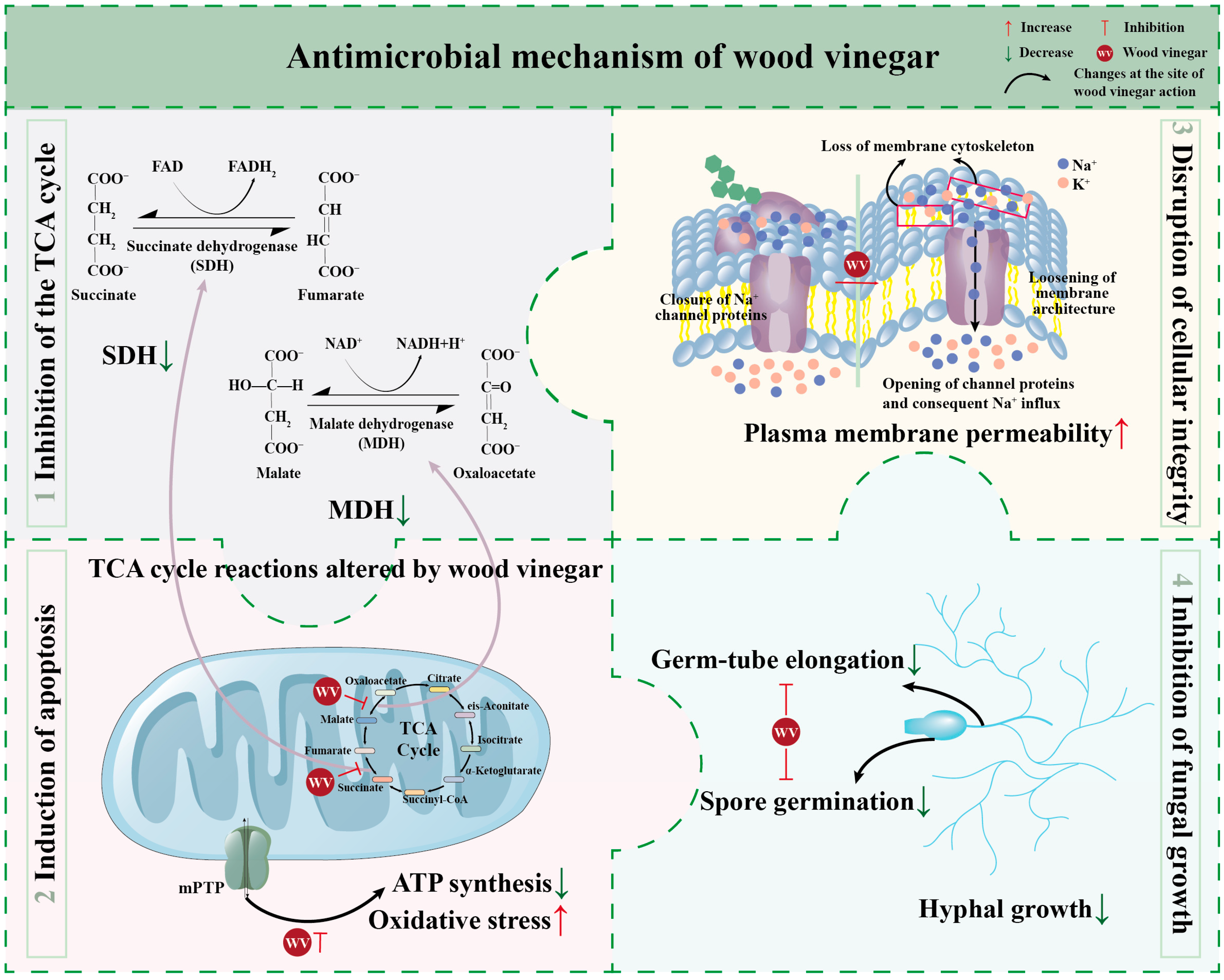
Existing studies indicate that the antimicrobial and disease-resistance mechanisms of wood vinegar operate at both cellular and molecular levels, including disruption of cell integrity and induction of oxidative stress, as summarized in Figure 1. At the cellular level, wood vinegar disrupts the structural integrity of pathogenic bacterial cells and interferes with cellular energy metabolism. Wood vinegar has been reported to inhibit the respiratory rate of F. culmorum, thereby disrupting the tricarboxylic acid (TCA) cycle and cellular energy metabolism [30]. Reed wood vinegar can severely disrupt the cell membrane of E. coli, induce morphological changes in bacterial cells, significantly reduce adenosine triphosphate (ATP) content, inhibit normal physiological activities of E. coli, and ultimately lead to bacterial lysis and death. These findings are consistent with molecular-level experimental results: in E. coli treated with reed wood vinegar, the expression of biofilm-associated genes (including motA, motB, and flgB) at the mRNA level, as well as the expression of genes related to ATP synthesis pathways (such as ydiM, nanC, and mdtO), were significantly suppressed [31].
At the molecular level, wood vinegar may exert its effects during pathogen–plant interactions by regulating the expression or activity of specific genes and proteins. Walnut shell–derived wood vinegar can alleviate oxidative damage in tobacco leaves caused by Pseudomonas syringae pv. tabaci infection by upregulating the expression of POD2 and GPX2 genes, which are the key genes of antioxidant enzymes [32]. Protein–protein interaction (PPI) network analysis of active components in wood vinegar derived from Spiraea hypericifolia leaves and targets related to superficial fungal infections suggests that its antifungal activity may be mediated through regulation of key protein targets, including JAK2, PARP1, and ESR1. Among these, JAK2 plays a pivotal role in im-mune signal transduction; PARP1 is closely associated with the regulation of apoptosis; and ESR1, as a nuclear receptor, is involved in diverse pathological processes [17].

2.2. Plant Growth Promoting Effects of Wood Vinegar and Their Underlying Mechanisms

2.2.1. Plant Growth Promoting Effects of Wood Vinegar

Wood vinegar can improve plant performance and soil conditions, thereby promoting plant growth and increasing crop yield. The effects of wood vinegar derived from identical biomass feedstocks on soil properties and plant development are summarized in Table 2. In a pot experiment, the application of wood vinegar derived from peach shells at an appropriate rate significantly increased the plant height, stem diameter, and fresh weight of cotton seedlings [33]. Soaking seeds in poplar-derived wood vinegar at an appropriate concentration can significantly promote seed germination and improve seedling vigor by increasing root length and underground dry weight. In addition, seed priming with poplar wood vinegar diluted 1000-fold can enhance the emergence rate and several agronomic traits of oilseed rape under field conditions, leading to a 14.4% increase in final yield [34]. The application of wood vinegar diluted 100-fold can promote forage grass growth, resulting in a 12.15% increase in the aboveground biomass of ryegrass [35]. Studies have shown that the combined application of biochar and wood vinegar can enhance nutrient uptake and accumulation in winter wheat, thereby increasing grain yield. Specifically, the total accumulation of nitrogen (N), phosphorus (P), and potassium (K) in winter wheat increased by 4.6%, 12.3%, and 3.2%, respectively [36].
The combined application of wood vinegar and biochar in plant–soil systems can improve the saline-alkali soil environment within the same growing season, significantly increase soil organic matter content, regulate soil pH and ionic balance, and effectively alleviate salt–alkali stress in sugar beet, thereby markedly enhancing root yield and quality [37]. Combined laboratory simulations and field experiments revealed that a wood vinegar-humic acid regulator can improve soil environmental conditions by reducing soil salinity and alkalinity, optimizing soil structure, and enhancing microbial activity. These improvements were closely associated with increased wheat productivity, reflected in a significant 17.2% increase in average plant height [38].
Table 2. Effects of wood vinegar on soil properties and plant growth across different studies.
Raw Materials of Wood VinegarTreatment MethodSoil TypeSoil EffectsPlant SpeciesPlant EffectsReferences
1Rice huskCombined application of biochar and wood vinegar.Abandoned soilIncreased soil pH, electrical conductivity (EC), and dissolved organic carbon (DOC) contents.Chinese cabbage (Brassica chinensis L.)Increased plant height, leaf number, and shoot biomass; significantly increased vitamin C, soluble protein, and soluble sugar contents.[39]
2UnknownSingle or combined application of humic acid and micro-silica.Saline–alkali soils, predominantly loamAs a soil conditioner.MaizeUnder saline–alkali stress, decreased malondialdehyde (MDA) content, enhanced free radical scavenging capacity, increased antioxidant enzyme activities, etc.[40]
3The tree pistachioSoilless cultivation media combined with pistachio wood vinegar.Not assessedCucumber seedlingIncreased root length and lateral root formation, intensified root development, increased root and shoot biomass, etc.[41]
4Peanut shellLayered application of wood vinegar to soil.Typical saline–sodic soda soil of the western Songnen PlainAmeliorated saline–alkali soil pH (stabilized at 9.2–9.54), increased soil organic matter and available phosphorus, enhanced rhizosphere alkaline and acid phosphatase and phytase activities, etc.Phaseolus vulgaris L.Improved seedling height, stem diameter, and other growth parameters vs. control, enhanced root elongation and absorptive capacity, alleviated saline–alkali stress, etc.[42,43,44]
5Walnut shellApplication of 500 mL walnut shell wood vinegar (1:100 dilution) to the root zone.Replantation soilAltered soil organic matter, total nitrogen, alkali-hydrolyzable nitrogen, available phosphorus, and readily available potassium contents; increased sucrase, urease, and catalase activities; decreased rhizosphere pathogenic fungi (Fusarium, Ilyonectria, Alternaria) in summer and autumn, etc.Malus micromalusIncreased annual increments in seedling height, ground diameter, and leaf area.[45]
6Peanut shellRoot drenching with wood vinegar (600-fold dilution).Saline–alkali soil with pH 8–9Acidic soil conditions.StrawberryIncreased strawberry soluble sugar content; enhanced yield and fruit quality.[46]
7The residue of spent mushroom substrateSoil surface spraying with wood vinegar.The Cd–Zn multiple contaminated soilIncreased available P, exchangeable Cd and Zn, total N, and alkali-hydrolyzable N; enhanced enzyme activities; enriched plant growth-promoting and metal-mobilizing bacteria (Bacillus, Gemmatimonas, Streptomyce, etc.).Sedum alfrediiSignificantly increased plant height and root length.[47]
8Apple woodUniform soil surface spraying followed by soil incorporation.Takyr-like saline–alkali soilDecreased soil alkalinity and surface salt content; increased soil enzyme activities.Oil sunflowerImproved seedling emergence, survival rate, plant height, and disk diameter vs. control.[48]

2.2.2. Enhancement of Plant Stress Resistance by Wood Vinegar

Wood vinegar can regulate plant physiological metabolism in multiple ways, including enhancing photosynthetic performance and increasing the content and activity of antioxidant enzymes, which are closely associated with improved stress resistance in plants. Studies have shown that wood vinegar can significantly improve the growth indices of Taraxacum mongolicum and Pimpinella brachycarpa, accompanied by increases in leaf relative chlorophyll content (SPAD values), soluble sugar content, and soluble protein content in both species [49]. Wood vinegar can regulate stomatal conductance and chlorophyll content in rice, thereby increasing the net photosynthetic rate by 27.3%, enhancing photosynthetic performance, and promoting the accumulation of total soluble sugars to 9.71 mg·g−1. These effects ultimately lead to a yield increase of up to 32.4%, a 62.88% improvement in head rice milling rate, and a marked reduction in grain chalkiness. In addition, wood vinegar increases the total phenolic content of rice from 1.3 to 2.4 mg·g−1, potentially enhancing plant health through improved antioxidant capacity and thereby contributing to both higher yield and improved grain quality [50].
Foliar application of wood vinegar diluted 400-fold increased the chlorophyll content of Isatis indigotica by 11.99%, while the photosynthetic rate, transpiration rate, and stomatal conductance increased by 23.58%, 57.14%, and 28%, respectively. The treatment also reduced MDA content and modulated antioxidant enzyme activities in I. indigotica under drought stress, thereby mitigating drought-induced damage [51]. Foliar application of pistachio-derived wood vinegar effectively alleviated salt stress in cucumber seedlings, reducing reactive oxygen species (ROS) and MDA levels by 7% and 10%, respectively. In addition, the carotenoid content of cucumber seedlings increased by 56%, while fresh root weight and leaf area increased by 41% and 34%, respectively [52]. Pot experiments showed that soil application of wood vinegar increased soil nutrient content and enhanced the activities of nitrate reductase (NR), superoxide dismutase (SOD), and catalase (CAT) in cotton leaves, thereby improving plant stress resistance [53]. Wood vinegar can also improve the rhizosphere soil microenvironment of continuously cropped tomato and enhance the resistance of tomato root systems, thereby helping to alleviate the problems associated with tomato monoculture [26].

3. Soil Improvement Effects of Wood Vinegar

Soil salinization and alkalization severely impair soil health, reduce crop productivity, and pose significant threats to global food security, environmental sustainability, and socioeconomic development [54]. Salt accumulation leads to the deterioration of soil properties, reduces the productive potential of soils, and impairs their ecological functions. Microorganisms constitute a critical component of saline soils, suggesting that microbial remediation represents a promising strategy for the improvement of salt-affected soils [55]. Previous studies indicate that wood vinegar has soil-ameliorating properties that enhance soil fertility by regulating soil salinity and improving soil physicochemical and biological characteristics. The following sections discuss in detail the specific ameliorative effects of wood vinegar on plant–soil systems.

3.1. Effects of Wood Vinegar on Soil Salinity

Soil salinity variation is primarily reflected in changes in the composition and concentration of ions in the soil solution, whereas fluctuations in soil pH may also indicate transformations in salt forms in saline–alkaline soils. Wood vinegar has been shown to effectively reduce the pH and salinity of saline-alkaline soils. When applied in combination with biochar, saline-alkaline soils pH decreased from 10.31 to 9.97, while soil salt content declined from 3.28 g·kg−1 to 2.93 g·kg−1 [56]. The application of peach shell–derived wood vinegar reduced the total water-soluble salt content in saline–alkaline soils from Xinjiang [33]. Field experiments showed that the combined application of 15 t·hm−2 biochar and 450 kg·hm−2 wood vinegar reduced the electrical conductivity of saline–alkaline cropland soil by 13.0% [36].

3.2. Improvement of Soil Chemical and Biological Properties by Wood Vinegar

Wood vinegar can enhance soil chemical fertility by increasing macronutrient availability and improve soil biological activity by modulating microbial community structure and stimulating the activity of enzymes involved in nutrient transformation. Previous studies have shown that wood vinegar can significantly activate the soil phosphorus pool, increase available phosphorus content by nearly 50%, and enhance phosphatase activity as well as microbial biomass phosphorus [56]. The application of peach shell derived wood vinegar significantly increased available phosphorus and available potassium contents in saline-alkaline soils from Xinjiang. In addition, the activities of soil polyphenol oxidase (S-PPO) and soil alkaline phosphatase (S-AKP) increased significantly by 16.65% and 17.80%, respectively [33].
The relative abundance of Ascomycota increased in the rhizosphere soil of continuously cropped tomato after treatment with wood vinegar at different dilution levels. The abundances of dominant fungal genera, including Neocosmospora, Aspergillus, Penicillium, Trichoderma, Chaetomium, and Fusarium, were also elevated. These findings suggest that wood vinegar application can enrich beneficial soil microorganisms and improve the rhizosphere ecological environment in continuous tomato cropping systems [26]. Treated with wood vinegar, the phospholipid fatty acid (PLFA) ratio of fungi to bacteria (F/B) in the mixed substrate of coal gangue and raw soil increased significantly, whereas the ratio of Gram-positive to Gram-negative bacteria (GP/GN) decreased. In addition, the ratio of straight-chain saturated fatty acids to monounsaturated fatty acids (SAT/MONO) increased significantly. An elevated F/B ratio suggests greater microbial community stability, while a lower GP/GN ratio together with a higher SAT/MONO ratio indicates improved nutrient status of the substrate [57]. Appropriate concentrations of wood vinegar significantly increase the Chao1 index and abundance-based coverage estimator (ACE) as well as the Shannon diversity index of bacterial communities in tomato rhizosphere soil. This treatment enhances bacterial richness while maintaining community stability, promotes beneficial microorganisms, and improves soil nutrient status [58].

4. Progress in the Practical Applications of Wood Vinegar

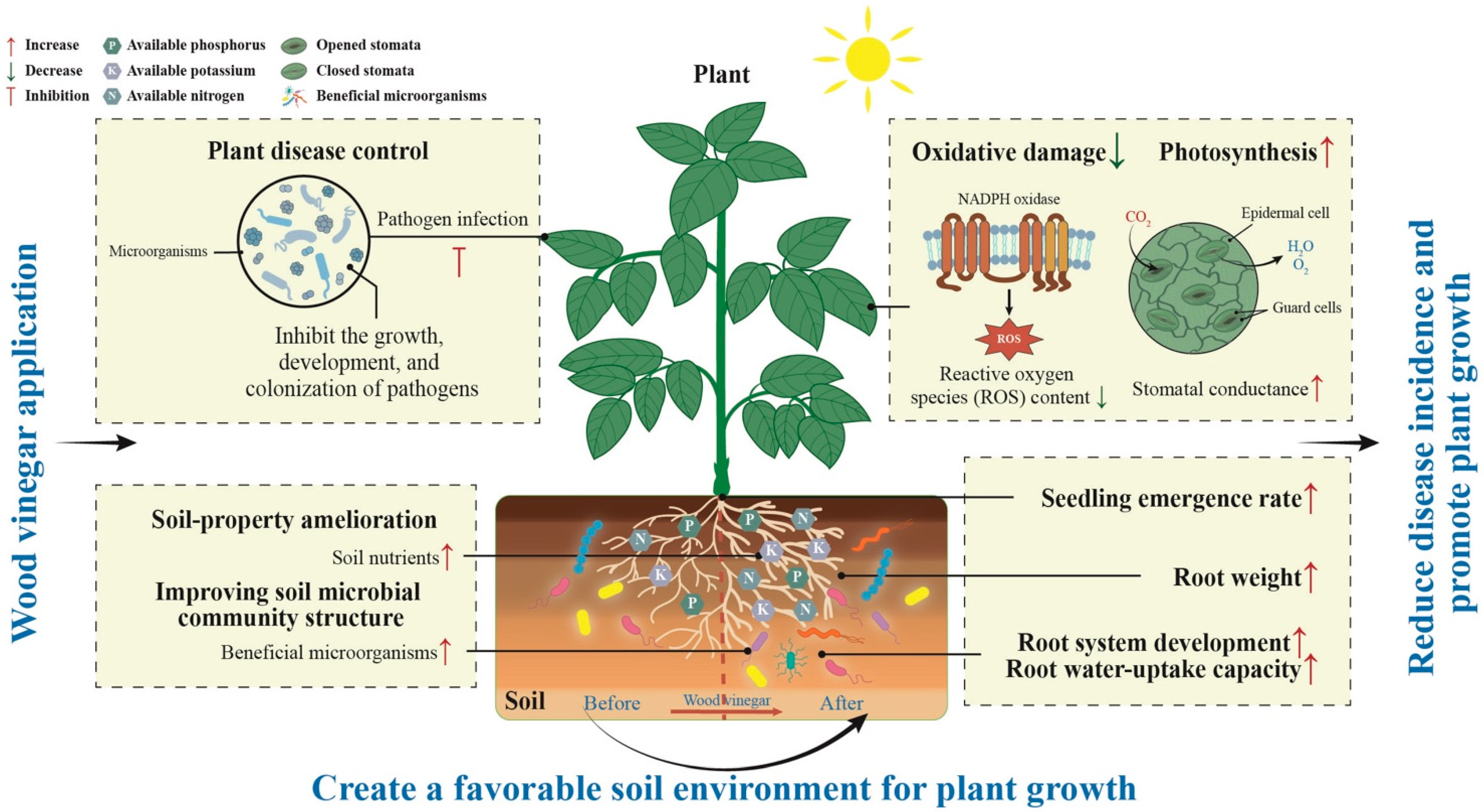
The multifunctional bioactivity of wood vinegar provides broad potential for diverse applications. In agricultural production, it has been widely explored as a green control agent, plant growth promoter, and synergistic enhancer [59]. Its antimicrobial activity, plant growth-promoting functions, and soil-conditioning effects are closely interconnected rather than functioning as independent processes, as illustrated in Figure 2. The following sections discuss recent advances in the applications of wood vinegar from different functional perspectives.

4.1. Applications of Wood Vinegar in Biological Disease Control

As a green control agent, wood vinegar produced from mixed biomass sources (grape residues, Chinese fir, and corn straw) has been reported to reduce the incidence of tomato wilt disease. In particular, application of 0.9% wood vinegar decreased the disease index by 100%, 96%, 84%, and 81% across four consecutive tomato cultivation cycles [60]. Owing to its complex mixture of organic compounds, wood vinegar may exhibit multiple biological functions. Current studies have demonstrated that wood vinegar can simultaneously enhance plant disease resistance and promote plant growth, highlighting its considerable potential as a sustainable agricultural input. For example, wood vinegar effectively suppresses clubroot disease in Chinese cabbage while simultaneously promoting plant growth. The control efficacy increases with increasing concentration, and treatment with a 200-fold dilution of wood vinegar resulted in a clubroot incidence of 14.42% with a control efficacy of 68.72% [61]. Similarly, wood vinegar has been reported to significantly suppress infection by Meloidogyne incognita in strawberry plants while improving their commercial quality traits [62]. Nevertheless, current research and applications of wood vinegar have been predominantly centered on the agricultural sector, while its potential utilization in forestry production systems remains insufficiently explored.

4.2. Applications of Wood Vinegar as a Pesticide Synergist

In practical disease management, wood vinegar can function as a synergist when combined with conventional pesticides. Such combined applications can reduce reliance on chemical pesticides while promoting more sustainable and efficient disease control strategies. Studies have shown that pine wood vinegar effectively controls tomato bacterial wilt and gray mold. When combined with pesticides, it enhances pesticide efficacy, and comparable control can be achieved even with reduced pesticide dosages relative to pesticide application alone [63]. In addition, the combined application of wood vinegar-biogas slurry with biopesticides achieved control efficiencies of 86.7%, 90.4%, and 96.7% against powdery mildew, aphids, and spider mites, respectively, which were significantly higher than those obtained with wood vinegar or biogas slurry alone [64].

4.3. Applications of Wood Vinegar in Weed Management

Wood vinegar can also be utilized for weed management, demonstrating its potential as an environmentally friendly herbicide. For instance, the herbicidal efficacy of apple wood vinegar against Leonurus cardiaca L., Bidens pilosa L., and Festuca arundinacea L. increased with application rate, with half-maximal inhibitory (IC50) values of 1911 L·ha−1 and 653 L·ha−1 for L. cardiaca and B. pilosa, respectively [65]. Similarly, field experiments showed that elm wood vinegar exhibited herbicidal activity against several broadleaf weeds, including Perilla frutescens, Oxalis corniculata, and Geranium carolinianum. Application at 4000 L·ha−1 achieved complete control of P. frutescens and up to 82% control of O. corniculate and G. carolinianum, indicating the potential of wood vinegar as a natural herbicide for broadleaf weed management [14].

5. Environmental Impacts and Safety Concern of Wood Vinegar

As a novel environmentally friendly resource [59], the safety of wood vinegar in practical applications has attracted increasing attention. The effects of wood vinegar on soil properties, plant growth, and other organisms directly influence the feasibility of its large-scale application. This section evaluates the potential ecological risks associated with wood vinegar use from three perspectives: soil safety, phytotoxicity, and the safety of non-target organisms.

5.1. Soil Environmental Safety

Wood vinegar, as a weakly acidic liquid, is widely applied for the amelioration of saline-alkaline soils; however, its acidity and complex chemical composition may also produce adverse effects in neutral or acidic soils. Studies have shown that 100-fold diluted oak wood vinegar may negatively affect the physicochemical properties of tomato rhizosphere soil due to the presence of phenolic and acidic compounds as well as unstable organic constituents, resulting in significant reductions in soil organic matter, available potassium, available phosphorus, and nitrate nitrogen contents [58]. Therefore, appropriate application concentrations of wood vinegar should be tailored to specific soil types to ensure soil safety.

5.2. Plant Safety

During the application of wood vinegar for the management of annual plants in weed communities, it not only inhibits the growth of certain species but also eliminates some species, such as Bromus spp., Calendula arvensis, and Carduus pycnocephalus [66]. A 10% concentration of wood vinegar completely inhibited root growth in Eruca sativa, whereas undiluted (100%) wood vinegar entirely suppressed root development in five plant species, including Eruca sativa, Lactuca sativa, Lens culinaris, Lolium multiflorum, and Solanum lycopersicum. These results suggest that untreated wood vinegar exhibits strong phytotoxic effects [62]. Studies have shown that eucalyptus wood vinegar inhibits seed germination and root growth of Allium cepa (a monocotyledon), with EC50 values of 5.556 g·L−1 and 3.436 g·L−1, respectively [67]. Wood vinegars derived from coconut shell and acacia inhibit Fusarium oxysporum f. sp. Cubense Tropical Race 4 (Foc TR4), but may also affect banana growth. At low concentrations (2% v/v), they promote plant growth, whereas higher concentrations (≥4% v/v) induce phytotoxic symptoms such as leaf necrosis and chlorosis [68]. These findings suggest that wood vinegar exhibits phytotoxic effects at high concentrations and that its biological activity is strongly concentration-dependent. The phytotoxicity threshold is primarily influenced by the properties of the original wood vinegar. However, considerable variability exists among different wood vinegar preparations, highlighting the necessity of conducting efficacy and safety evaluations prior to their practical application.

5.3. Safety for Other Biota

Besides soil and plants, wood vinegar may also affect other non-target organisms. For example, wood vinegar at concentrations of 0.5% and 1% has been reported to impair reproduction in Eisenia fetida, significantly reducing cocoon production and juvenile hatching rates [69]. Acute toxicity assays using Daphnia magna indicate that wood vinegar derived from eucalyptus wood fines, a by-product of sulfate pulp production, can exert harmful effects on aquatic organisms [67].

6. Conclusions

Wood vinegar, as a multifunctional biomass derived product, has shown considerable potential in disease control, plant growth promotion, and soil improvement. However, substantial gaps remain in understanding its mechanisms of action, forestry-related applications, and long-term ecological impacts within agricultural systems. Therefore, future research should focus on the following aspects.
(a)
Molecular-level mechanistic elucidation of disease resistance and growth promoting effects of wood vinegar.
Current studies on the antimicrobial and disease resistance effects of wood vinegar have largely concentrated on plate inhibition assays and disease control efficacy evaluations. Nevertheless, the molecular mechanisms through which its active constituents interact with pathogenic microorganisms and activate plant immune signaling pathways remain largely unresolved. Future studies may employ multi-omics approaches to elucidate the interactions between key bioactive components of wood vinegar and plants, thereby revealing the signaling pathways involved in the induction of plant resistance. In addition, the stress resistance and growth promoting effects of wood vinegar are often closely interconnected; however, the coordinated regulatory mechanisms underlying these effects remain largely unexplored.
(b)
Extension of wood vinegar application from agricultural to forestry systems.
Current research on wood vinegar has primarily focused on crops and annual herbaceous plants, whereas woody plants have rarely been selected as target species. Compared with crops and annual herbaceous plants, woody plants experience longer growth cycles, greater environmental variability, more complex secondary growth processes, and more sophisticated stress defense mechanisms. Therefore, whether wood vinegar can exert similarly beneficial effects in forestry production as those reported in agricultural systems remains unclear and requires further investigation. Future studies should place greater emphasis on forestry applications by selecting forest trees and other woody species to systematically evaluate the efficacy of wood vinegar.
(c)
Long-term ecological safety assessment of wood vinegar in agricultural ecosystems.
Our research group evaluated the antimicrobial activity of wood vinegar derived from bamboo and observed non-selective inhibitory effects on both pathogenic and beneficial fungi (unpublished data). This result suggests potential safety concerns regarding its application, which is consistent with previous reports. Although previous studies have preliminarily evaluated the safety of wood vinegar with respect to soil properties, plants, and other organisms, most investigations have primarily focused on short-term acute toxicity tests. Consequently, comprehensive assessments of the potential ecological risks associated with long-term and repeated applications remain limited. For example, the persistence and accumulation of complex components derived from wood vinegar in soil, as well as their chronic toxic effects on non-target organisms, including plants and other biota, remain poorly understood. Moreover, systematic investigations into potential disturbances to population dynamics within agricultural ecosystems are still lacking. Future studies could integrate ecotoxicological approaches with long-term field monitoring programs to comprehensively evaluate the ecological impacts of wood vinegar application. Furthermore, efforts are needed to develop effective risk mitigation strategies, such as optimizing compound combinations and refining application methods, to minimize potential risks associated with its agricultural use.
In summary, research on the disease resistance and growth-promoting effects of wood vinegar is gradually shifting from phenomenological observations toward mechanistic elucidation, with its applications expanding from agriculture to forestry, while increasing attention is being directed toward its ecological safety. Future studies should integrate multiple disciplines, including chemistry, ecology, biology, and agronomy, to elucidate the molecular mechanisms underlying the biological activities of wood vinegar while conducting comprehensive ecological safety assessments. By integrating mechanistic investigations with safety evaluations, such interdisciplinary efforts will provide a solid scientific basis for the safe and effective application of wood vinegar, thereby facilitating its broader utilization in sustainable agriculture and forestry.

Author Contributions

H.F., X.W. and D.X. proposed the content framework of this review. H.F. wrote the draft manuscript. D.X. and C.T. revised the manuscript. D.X. acquired the funding. All authors have read and agreed to the published version of the manuscript.

Funding

This work was supported by the National Key Research and Development Program (2023YFD1401300).

Data Availability Statement

No new data were created or analyzed in this study. Data sharing is not applicable to this article.

Conflicts of Interest

The authors declare no any conflict of interests.

References

  1. Zhang, L.D.; Huo, P.J.; Liang, J.M.; Guo, T.; Fan, X.L.; Sun, S.L. Research progress on preparation process and synergistic technology of biomass-based wood vinegar. J. For. Eng. 2023, 8, 27–36. [Google Scholar] [CrossRef]
  2. Lu, S.N.; Zhou, L.; Wang, L.J.; Liu, L.; Zhang, H.M. Research progress on preparation of wood vinegar and its application in agriculture. J. Shanxi Agric. Sci. 2023, 51, 225–232. [Google Scholar] [CrossRef]
  3. Thorenz, A.; Wietschel, L.; Stindt, D.; Tuma, A. Assessment of agroforestry residue potentials for the bioeconomy in the European Union. J. Clean. Prod. 2018, 176, 348–359. [Google Scholar] [CrossRef]
  4. Zhang, X.Q.; Wang, Z.F.; Can, M.Y.; Bai, H.H.; Ta, N. Analysis of yield and current comprehensive utilization of crop straws in China. J. China Agric. Univ. 2021, 26, 30–41. [Google Scholar] [CrossRef]
  5. Li, J.Y. Long-term effects of recycling forestry processing residuals on rural economic benefits. Agric. Ind. 2025, 4, 59–61. Available online: https://kns.cnki.net/kcms2/article/abstract?v=K7S5TI5vrASVFt3N_WysSSMqje9jHw-cNsi-cAi_14z2jY-bRwRECV3AA9NS2-0tQXRJ5GmX2AaWsrvf5Xi2yud7UD0fcUy2QtK6RS-Kvvd4GCwZCnLmwcvYchYPNLiw-XPbL9feF22ranqKDHLYUx7hTWHvxU03lqxN1VHhLfi_zV65u2aBBD-uidikJUwh&uniplatform=NZKPT&language=CHS (accessed on 13 April 2026).
  6. Gupta, J.; Kumari, M.; Mishra, A.; Swati; Akram, M.; Thakur, I.S. Agro-forestry waste management—A review. Chemosphere 2022, 287, 14. [Google Scholar] [CrossRef]
  7. Liu, H.Y.; Zhang, S.Y.; Wang, C.W.; Hu, N.; Song, X.B.; Sun, M.Y. A comparative study on the components of liquid phase products and pryolytic wood vinegar in cotton stalk hydrothermal process. Acta Energiae Solaris Sin. 2021, 42, 367–372. [Google Scholar] [CrossRef]
  8. Yu, L.J.; Liang, C.L.; Li, Z.; Chen, X.Y.; Wang, G.D. Preliminary application of pyracetic acid on fruit tree. J. Fruit Resour. Guoshu 2021, 2, 80–82. [Google Scholar] [CrossRef]
  9. Li, D.; Tang, Q.G.; Wang, H.B.; Qiu, W.; Xiong, W. Current status and trends of research on early warning and emergency control technology for major crop pests and diseases. J. Intell. Agric. Mech. 2025, 6, 25–40. [Google Scholar] [CrossRef]
  10. Liu, J.; Bian, Y.; Zhang, Y.Y.; Meng, Z.H.; Huang, C.; Zeng, J. Analysis of occurrence trends and causes of major crop diseases and pests in China in 2025. China Plant Prot. 2025, 45, 26–29+44. [Google Scholar] [CrossRef]
  11. Rahman, M.M.; Keya, S.S.; Sahu, A.; Gupta, A.; Dhingra, A.; Tran, L.S.P.; Mostofa, M.G. Acetic acid: A cheap but chief metabolic regulator for abiotic stress tolerance in plants. Stress Biol. 2024, 4, 17. [Google Scholar] [CrossRef]
  12. Kołton, A.; Długosz-Grochowska, O.; Wojciechowska, R.; Czaja, M. Biosynthesis regulation of folates and phenols in plants. Sci. Hortic. 2022, 291, 110561. [Google Scholar] [CrossRef]
  13. Choi, S.Y.; Chung, J.H.; Kim, D.H.; Chung, S.W.; Kim, J.Y.; Yu, B.P.; Chung, H.Y. Peroxisome proliferator-activated receptor gamma agonist action of 3-methyl-1,2-cyclopentanedione. Biochim. Biophys. Acta 2007, 1770, 1612–1619. [Google Scholar] [CrossRef]
  14. Liu, X.; Zhan, Y.; Li, X.; Li, Y.; Feng, X.; Bagavathiannan, M.; Zhang, C.; Qu, M.; Yu, J.E. The use of wood vinegar as a non-synthetic herbicide for control of broadleaf weeds. Ind. Crops Prod. 2021, 173, 114105. [Google Scholar] [CrossRef]
  15. Liu, X.Y.; Wang, J.A.; Feng, X.H.; Yu, J.L. Wood vinegar resulting from the pyrolysis of apple tree branches for annual bluegrass control. Ind. Crops Prod. 2021, 174, 11. [Google Scholar] [CrossRef]
  16. Lu, X.; Jiang, J.; He, J.; Sun, K.; Sun, Y. Effect of pyrolysis temperature on the characteristics of wood vinegar derived from chinese fir waste: A comprehensive study on its growth regulation performance and mechanism. ACS Omega 2019, 4, 19054–19062. [Google Scholar] [CrossRef] [PubMed]
  17. Meng, X.Q.; Kizaibek, M.L.T. Exploring the mechanism of action of Spiraea hypericifolia wood vinegar against superficial fungal diseases by combining GC-MS with network pharmacology. Guangdong Chem. Ind. 2025, 52, 151–156. [Google Scholar]
  18. Mungkunkamchao, T.; Kesmala, T.; Pimratch, S.; Toomsan, B.; Jothityangkoon, D. Wood vinegar and fermented bioextracts: Natural products to enhance growth and yield of tomato (Solanum lycopersicum L.). Sci. Hortic. 2013, 154, 66–72. [Google Scholar] [CrossRef]
  19. Wang, H.F.; Wang, J.L.; Wang, C.; Zhang, W.M.; Liu, J.X.; Dai, B. Effect of bamboo vinegar as an antibiotic alternative on growth performance and fecal bacterial communities of weaned piglets. Livest. Sci. 2012, 144, 173–180. [Google Scholar] [CrossRef]
  20. Wei, Q.; Ma, X.H.; Dong, J.E. Preparation, chemical constituents and antimicrobial activity of pyroligneous acids from walnut tree branches. J. Anal. Appl. Pyrolysis 2010, 87, 24–28. [Google Scholar] [CrossRef]
  21. Wei, Q.; Ma, X.H.; Zhao, Z.; Zhang, S.S.; Liu, S.C. Antioxidant activities and chemical profiles of pyroligneous acids from walnut shell. J. Anal. Appl. Pyrolysis 2010, 88, 149–154. [Google Scholar] [CrossRef]
  22. Mathew, S.; Zakaria, Z.A.; Musa, N.F. Antioxidant property and chemical profile of pyroligneous acid from pineapple plant waste biomass. Process Biochem. 2015, 50, 1985–1992. [Google Scholar] [CrossRef]
  23. Mohd Amnan, M.A.; Teo, W.F.A.; Aizat, W.M.; Khaidizar, F.D.; Tan, B.C. Application of oil palm wood vinegar enhances Pandanus amaryllifolius tolerance under drought stress. Plants 2023, 12, 22. [Google Scholar] [CrossRef] [PubMed]
  24. Zhang, H.K.; Guo, S.; Shang, E.X.; Zhang, S.; Yan, H.; Qian, D.W.; Gao, S.; Li, J.K.; Duan, J.A. Chemical constituent analysis and antibacterial activity evaluation of wood vinegar prepared from waste produced in the processing of Corni fructus. Chin. Tradit. Herb. Drugs 2022, 53, 1372–1381. [Google Scholar]
  25. Li, Y.X.; Ding, D.D.; He, J.; Zhang, J.H.; Zhao, J.T.; Zhao, Q.; Hou, C.X.; Zhu, Z. Antifungal activity and mechanism of wood vinegar against several plant pathogenic fungi. Acta Agric. Zhejiangensis 2023, 35, 2149–2159. [Google Scholar]
  26. Xiao, J.; Tan, J.J.; Lin, Z.Y.; Lin, Q.; Yang, S.D.; Tan, H.W. Antibacterial activity of wood vinegar and its effect on microecology in rhizospheres of tomatoes under continuous cropping system. J. Huazhong Agric. Univ. 2024, 43, 40–51. [Google Scholar] [CrossRef]
  27. Li, H.Y.; Bao, M.H.; Wang, H.J.; Zhang, T.; Zhang, Y.Y.; Zheng, R. Inhibitory effect of wood vinegar on grape gray mold pathogen. South-Cent. Agric. Sci. Technol. 2024, 45, 15–18. [Google Scholar]
  28. Wattana, W.; Lakachaiworakun, P.; Rachsiriwatcharabul, N.; Eakvanich, V.; Dangwilailux, P.; Kalasee, W. Thin-layer drying model and antifungal properties of rubber sheets produced with wood vinegar as a substitute for formic and acetic acids. Polymers 2025, 17, 1201. [Google Scholar] [CrossRef] [PubMed]
  29. da Mota, Y.T.R.; Pimenta, A.S.; de Oliveira, M.F.; França, A.K.A.; Pereira, A.M.S.; de Melo, R.R.; Monteiro, T.; Fasciotti, M.; de Medeiros, L.C.D.; Suassuna Bezerra, A.C.D. Ovicidal effect of eucalyptus wood vinegar on gastrointestinal nematodes’ eggs from sheep. Vet. World 2025, 18, 1156–1167. [Google Scholar] [CrossRef]
  30. Li, Y.X.; Ding, D.D.; He, J.; Zhang, J.H.; Zhao, J.T.; Zhao, Q.; Hou, C.X.; Zhu, Z. Effect of wood vinegar on respiration of plant pathogenic fungi. Agric. Eng. 2023, 13, 138–143. [Google Scholar] [CrossRef]
  31. Bai, B.; Wang, M.; Zhang, Z.; Guo, Q.; Yao, J. Mechanistic investigation of the pyrolysis temperature of reed wood vinegar for maximising the antibacterial activity of Escherichia coli and its inhibitory activity. Biology 2024, 13, 912. [Google Scholar] [CrossRef]
  32. Yuan, Y.; Sun, H.W.; Wang, Y.; Xu, Z.S.; Han, S.X.; He, G.Q.; Yin, K.D.; Zhang, H.H. Wood vinegar alleviates photosynthetic inhibition and oxidative damage caused by Pseudomonas syringae pv. tabaci (Pst) infection in tobacco leaves. J. Plant Interact. 2022, 17, 801–811. [Google Scholar]
  33. Chen, M.; Ding, X.; Liu, J.; Zhang, Y.S.; Han, B.B.; Tang, G.M.; Xu, W.L. Effects of wood vinegar and chelated Ca combined application on soil properties and growth of cotton seedlings in saline-alkali soil. Agric. Res. Arid Areas 2025, 43, 69–78. [Google Scholar] [CrossRef]
  34. Qu, Z.J.; Zhu, K.M.; Hu, L.L.; Zhou, Y.; Yuan, B.Z.; Hu, L.Y. Effects of treating seeds compositely with wood vinegar and biochar on germination, growth, yield and quality of rapeseed. J. Huazhong Agric. Univ. 2025, 44, 24–34. [Google Scholar] [CrossRef]
  35. Zhou, X.Y.; Qi, L.B.; Duo, J.; Sun, B.H.; Liu, S.L.; Liu, H.T.; Liu, F.; Zhao, Y. Enhanced remediation of Cd-contaminated calcareous soil with herbage by wood vinegar. J. Agric. Resour. Environ. 2025, 42, 301–310. [Google Scholar] [CrossRef]
  36. Zhang, M.; Wang, G.E.; Li, Y.H.; Zhao, Y.; Zhang, Y.C.; Guo, L. Effects of biochar combined with wood vinegar on salinity soil nutrients and salt tolerance of winter wheat. J. Agro-Environ. Sci. 2025, 44, 1334–1342. [Google Scholar] [CrossRef]
  37. Yang, X.F.; Li, W.S.; Wang, S.F.; Wang, C.; Zhao, L.H.; Yu, X.R.; Zhuang, Y.L.; Wang, Y.B.; Zhang, P.F.; Li, C.F. Effects of wood vinegar combined with biochar application on physicochemical properties of saline alkali soil of sugar beet in season. Soil Fertil. Sci. China 2024, 113–119. [Google Scholar] [CrossRef]
  38. Yu, G.Q.; Song, Y.F.; Wang, P.; Zhang, H.; Xiao, H.; Zhong, L. Study on the effects of wood vinegar-humic acid regulator on salinity and wheat yield in coastal saline-alkali land. Environ. Ecol. 2025, 7, 61–66. [Google Scholar] [CrossRef]
  39. He, L.; Geng, K.; Li, B.; Li, S.; Gustave, W.; Wang, J.; Jeyakumar, P.; Zhang, X.; Wang, H. Enhancement of nutrient use efficiency with biochar and wood vinegar: A promising strategy for improving soil productivity. J. Sci. Food Agric. 2025, 105, 465–472. [Google Scholar] [CrossRef]
  40. He, W.W.; Yue, J.M.; Wang, F.Q.; Li, Y.; Ma, G.J.; Guo, J.Y. Effect of soil conditioner on alleviating saline-alkali stress damage of maize. Ying Yong Sheng Tai Xue Bao 2024, 35, 3053–3062. [Google Scholar] [CrossRef]
  41. Afsharipour, S.; Dastjerdi, A.M.; Seyedi, A. Optimizing Cucumis sativus seedling vigor: The role of pistachio wood vinegar and date palm compost in nutrient mobilization. BMC Plant Biol. 2024, 24, 407. [Google Scholar] [CrossRef]
  42. Chang, D.S.; Yu, L.H.; Yu, S.; Xu, H.; Yang, H.L.; Lian, Z.H.; Guo, X.X. Effects of wood vinegar on chemical properties and growth of commonbean of saline-alkali soil. J. Heilongjiang Bayi Agric. Univ. 2025, 37, 1–7. [Google Scholar] [CrossRef]
  43. Yu, S.; Lian, Z.H.; Yang, H.L.; Chang, D.S.; Yu, L.H. Effects of wood acetic acid on phosphatase and gene abundance of phaseolusvulgaris rhizosphere soil in saline-alkali environment. J. Heilongjiang Bayi Agric. Univ. 2025, 37, 8–14. [Google Scholar] [CrossRef]
  44. Liang, H.Y.; Yu, S.; Yu, L.H. Effects of wood vinegar solution on seed germination and growth of commonbean in saline-alkali condition. J. Heilongjiang Bayi Agric. Univ. 2023, 35, 8–12. [Google Scholar] [CrossRef]
  45. Lu, X.Y.; Wang, Z.Y.; Han, J.W.; Xu, L.; Zhang, X.F.; Han, J.; Wang, Z.G.; Liu, Y.; Suo, X.M.; Yan, A.H. Effects of pyroligneous acids on the growth and main characteristics of replanted soil of Malus angustifolia. Acta Agric. Boreali-Sin. 2022, 37, 175–185. [Google Scholar] [CrossRef]
  46. Zhang, L.Y.; Liu, X.; Shi, H.; Li, J.K. Effects of wood vinegar on soil ph, chlorophyll content, quality, and yield of greenhouse strawberries. South-Cent. Agric. Sci. Technol. 2022, 43, 22–23+27. [Google Scholar] [CrossRef]
  47. Zhou, X.; Shi, A.; Rensing, C.; Yang, J.; Ni, W.; Xing, S.; Yang, W. Wood vinegar facilitated growth and Cd/Zn phytoextraction of Sedum alfredii Hance by improving rhizosphere chemical properties and regulating bacterial community. Environ. Pollut. 2022, 305, 119266. [Google Scholar] [CrossRef]
  48. Wang, Z.; Sun, Z.J.; El-Sawy, S.; Wang, Z.; He, J.; Han, L.; Zou, B.T. Effects of Enteromorpha prolifera biochar and wood vinegar co-application ontakyric solonetz improvement and yield of oil sunflower. Environ. Sci. 2021, 42, 6078–6090. [Google Scholar] [CrossRef]
  49. Zhou, M.H.; Li, F.F.; Liu, C.; Wang, Y.X. Effects of foliar spraying of wood vinegar on the growth of Taraxacum mongolicum and Pimpinella brachycarpa seedlings. Anhui Agric. Sci. Bull. 2025, 31, 83–86. [Google Scholar] [CrossRef]
  50. Hur, G.; Ashraf, M.; Nadeem, M.Y.; Rehman, R.S.; Thwin, H.M.; Shakoor, K.; Seleiman, M.F.; Alotaibi, M.; Yuan, B.Z. Exogenous application of wood vinegar improves rice yield and quality by elevating photosynthetic efficiency and enhancing the accumulation of total soluble sugars. Plant Physiol. Biochem. 2025, 218, 109306. [Google Scholar] [CrossRef]
  51. Huang, Y.B.; Han, J.; Xia, Y.; Jing, Y.L.; Yang, S.; Gao, Y.G. Effects of spraying wood vinegar on growth and physiology of Isatis indigotica at seedling stage. North. Hortic. 2024, 15, 96–103. [Google Scholar] [CrossRef]
  52. Afsharipour, S.; Seyedi, A.; Dastjerdi, A.M. Salinity tolerance in Cucumis sativus seedlings: The role of pistachio wood vinegar on the improvement of biochemical parameters and seedlings vigor. BMC Plant Biol. 2025, 25, 224. [Google Scholar] [CrossRef]
  53. Yang, L.; Tang, G.; Xu, W.; Zhang, Y.; Ning, S.; Yu, P.; Zhu, J.; Wu, Q.; Yu, P. Effect of combined application of wood vinegar solution and biochar on saline soil properties and cotton stress tolerance. Plants 2024, 13, 2427. [Google Scholar] [CrossRef]
  54. Wang, X.; Xu, L.; Qi, X.; Huang, J.; Han, M.; Wang, C.; Li, X.; Jiang, H. Microbial assembly and stress-tolerance mechanisms in salt-adapted plants along the shore of a Salt Lake: Implications for saline–alkaline soil remediation. Microorganisms 2025, 13, 1942. [Google Scholar] [CrossRef]
  55. Pan, J.; Xue, X.; Huang, C.H.; You, Q.A.; Guo, P.L.; Yang, R.Q.; Da, F.; Duan, Z.W.; Peng, F. Effect of salinization on soil properties and mechanisms beneficial to microorganisms in salinized soil remediation-a review. Res. Cold Arid Reg. 2024, 16, 121–128. [Google Scholar] [CrossRef]
  56. Zhao, W.; Zhao, H.; Sun, X.; Wang, H.; Sun, Y.; Liang, Y.; Wang, D. Biochar and wood vinegar altered the composition of inorganic phosphorus bacteria community in saline-alkali soils and promoted the bioavailability of phosphorus. J. Environ. Manag. 2024, 370, 122501. [Google Scholar] [CrossRef]
  57. Zhang, R.Q.; Geng, Y.Q.; Chen, L.; Zhang, C.Y.; Han, X.N. Effects of irrigating wood vinegar and adding fly ash on the microbial community of gangue substrate. Soil Fertil. Sci. China 2025, 203–212. [Google Scholar] [CrossRef]
  58. Zhang, F.; Xie, C.; Xiao, B.Y.; Liu, S.W.; Wu, C.Y.; Zhang, Y.B.; Wang, W. Effects of wood vinegar on physicochemical properties and bacterialcommunity diversity of tomato rhizosphere soil. J. Jilin Agric. Univ. 2022, 1–8. [Google Scholar] [CrossRef]
  59. Yang, L.; Tang, G.M.; Zhang, Y.S.; Liu, J.; Ma, H.G.; Xu, W.L. Research progress on agricultural application of pyrolysis wood vinegar from agricultural and forestry waste. Jiangsu Agric. Sci. 2024, 52, 18–25. [Google Scholar] [CrossRef]
  60. Zhou, H.; Fu, K.; Shen, Y.; Li, R.; Su, Y.; Deng, Y.; Xia, Y.; Zhang, N. Physiological and biochemical mechanisms of wood vinegar-induced stress response against tomato fusarium wilt disease. Plants 2024, 13, 157. [Google Scholar] [CrossRef]
  61. Fu, K.J.; Zhou, H.Y.; Zhang, N.M.; Zhang, J.L.; Deng, Y.S.; Huang, J.K.; Feng, Y.X.; Su, Y.B. Control effect of chinese cabbage clubroot by wood vinegar. China Veg. 2024, 75–83. [Google Scholar] [CrossRef]
  62. Iacomino, G.; Idbella, M.; Staropoli, A.; Nanni, B.; Bertoli, T.; Vinale, F.; Bonanomi, G. Exploring the potential of wood vinegar: Chemical composition and biological effects on crops and pests. Agronomy 2024, 14, 114. [Google Scholar] [CrossRef]
  63. Xiao, H.; Cheng, W.J.; Zhang, P.; Zhang, H.; Jiao, R.M.; Wang, L.Y.; Zhao, J.; Pan, J. Control effects of combination of wood vinegar and fungicide on tomato fusarium wilt and gray mold. Jiangsu Agric. Sci. 2021, 49, 82–87. [Google Scholar] [CrossRef]
  64. Xi, X.M.; Qiu, L.; Qiu, H.C.; Liu, Z.; Yang, X.M. Control effect of wood acetic acid-biogas slurry coupled s1praying on diseases and insect pests of apple tree. Jiangsu Agric. Sci. 2019, 47, 101–103. [Google Scholar] [CrossRef]
  65. Chu, L.; Liu, H.; Zhang, Z.; Zhan, Y.; Wang, K.; Yang, D.; Liu, Z.; Yu, J. Evaluation of wood vinegar as an herbicide for weed control. Agronomy 2022, 12, 3120. [Google Scholar] [CrossRef]
  66. Aguirre, J.L.; Baena, J.; Martín, M.T.; González, S.; Manjón, J.L.; Peinado, M. Herbicidal effects of wood vinegar on nitrophilous plant communities. Food Energy Secur. 2020, 9, e253. [Google Scholar] [CrossRef]
  67. de Lima, G.G.; Mendes, C.; de Marchi, G.; Vicari, T.; Cestari, M.M.; Gomes, M.F.; Ramsdorf, W.A.; Magalhaes, W.L.E.; Hansel, F.A.; Leme, D.M. The evaluation of the potential ecotoxicity of pyroligneous acid obtained from fast pyrolysis. Ecotoxicol. Environ. Saf. 2019, 180, 616–623. [Google Scholar] [CrossRef]
  68. Anggrayni, D.; Purnama, I.; Saidi, N.B.; Novianti, F.; Baharum, N.A.; Mutamima, A.; Razali, N.A.S.B.; Boukherroub, R. Antifungal and phytotoxicity of wood vinegar from biomass waste against Fusarium oxysporum f. sp. cubense TR4 infecting banana plants. Discov. Food 2025, 5, 98. [Google Scholar] [CrossRef]
  69. Sivaram, A.K.; Mukunthan, K.; Megharaj, M. Effects of pyroligneous acid on acute, chronic, and cyto-genotoxicity to earthworms (Eisenia fetida). J. Environ. Sci. Health Part A-Toxic/Hazard. Subst. Environ. Eng. 2024, 59, 125–129. [Google Scholar] [CrossRef]
Figure 1. Multiple mechanisms underlying the suppression of phytopathogens by wood vinegar.
Forests 17 00637 g001
Figure 2. Ecological effects of wood vinegar in disease suppression and growth promotion.
Forests 17 00637 g002
Table 1. Major Chemical Components of Wood Vinegar Derived from Different Biomass Feedstocks.
Biomass FeedstockspHCompound GroupsRelative Proportion (%)Major CompoundsReferences
1Dragon’s claw elm (Ulmus pumila ‘Pendula’) and European white elm (Ulmus laevis Pall.) pruning waste3.3Acids26.43Acetic acid, 4-Hydroxybutanoic acid[14]
Phenols39.33Phenol, 2-Μethoxyphenol, 4-Εthylphenol
Other compounds≤11.733-Methyl-1,2-cyclopentanedione, 4-Hydroxy-3,5-dimethoxytoluene, Cyclopropylmethanol, etc.
2The apple tree branches3.46Acids24.20Acetic acid, 4-Hydroxybutanoic acid[15]
Phenols41.862,6-Dimethoxyphenol, Phenol, 4-Εthylphenol, 2-Methoxyphenol, 4-Ethyl-2-methoxyphenol
Other compounds33.943-Methyl-1,2-cyclopentanedione, Cyclopropylmethanol, 4-Hydroxy-3,5-dimethoxytoluene
3Chinese fir (Cunninghamia lanceolate (Lamb.) Hook) waste3.04Acids64.84Pentanoic acid, Heptanoic acid, 3-methoxy-4-hydroxybenzoic acid, acetic acid[16]
Phenols30.09Phenol, 1,2-Benzenediol, 4-Methylbenzene-1,2-diol, 2-Methoxyphenol, 3-Methyl-1,2-benzenediol
Other compounds5.074-Hydroxy-3-methoxyphenethyl alcohol
4Fresh stems of Spiraea hypericifoliaUnknownAcids1.22/[17]
Phenols42.172,6-Dimethoxyphenol, 1,2-Benzenediol, 4-Ethyl-2,6-dimethoxyphenol
Other compounds56.61Furfural, Methyl eugenol, 1-Hydroxy-2-propanone, etc.
5Eucalyptus wood3.09Acids36.47Acetic acid, Propanoic acid[18]
Phenols22.33Phenol, 2-Μethoxyphenol, 2-Methoxy-4-methylphenol
Other compounds37.653-Methyl-1,2-cyclopentanedione, 3-Methylpyridine, Furfural, etc.
6BambooUnknownAcids0.40/[19]
Phenols25.70Phenol, 2,6-Dimethoxyphenol, 2-Methoxyphenol, 1,2-Benzenediol, 4-Methylphenol, 4-Ethylphenol
Other compounds73.80Furfural, 1-Hydroxy-2-butanone, γ-Butyrolactone, etc.
7Walnut tree branches3.32Acids30.78Acetic acid, 2-Methylpropanoic anhydride[20]
Phenols30.592,6-Dimethoxyphenol, 1,2-Benzenediol, 2-Methoxyphenol, 2-Methoxy-4-methylphenol, 3-Methoxy-1,2-benzenediol
Other compounds33.693-Methyl-1,2-cyclopentanedione, 1,2,4-Trimethoxybenzene, 1,2,3-Trimethoxy-5-methylbenzene
8Walnut shells3.32Acids8.02Acetic acid[21]
Phenols58.42Phenol, 2,6-Dimethoxyphenol, 1,2-Benzenediol, 3-Methoxy-1,2-benzenediol, 4-Methyl-1,2-benzenediol, 2-Methoxyphenol
Other compounds18.341,2,4-Trimethoxybenzene, 1-(4-Hydroxy-3-methoxyphenyl)-2-propanone, 3-Methyl-2-hydroxy-2-cyclopenten-1-one
9Pineapple plant waste biomassUnknownAcids2.67/[22]
Phenols69.58Phenol, 2,6-Dimethoxyphenol, 1,2-Benzenediol, 3-Methoxy-1,2-benzenediol, 4-Methylphenol, 2-Methoxy-4-methylphenol
Other compounds27.411,2,4-Trimethoxybenzene, 1-(4-Hydroxy-3,5-dimethoxyphenyl)-ethanone, 1,4:3,6-Dianhydro-α-D-glucopyranose, etc.
10Oil palmUnknownAcids//[23]
Phenols25.36Phenol, 2-Methoxyphenol, 2,6-Dimethoxyphenol,
Other compounds74.64Phenyl carbamate, 2,4,6-Τrimethylpyridine, 2-(2′,4′,4′,6′,6′,8′,8′-Heptamethyltetrasiloxan-2′-yloxy)-2,4,4,6,6,8,8,10,10-nonamethylcyclopentasiloxane, etc.
Relative proportion (%): calculated from the relative peak areas of identifiable compounds detected by GC–MS.
Disclaimer/Publisher’s Note: The statements, opinions and data contained in all publications are solely those of the individual author(s) and contributor(s) and not of MDPI and/or the editor(s). MDPI and/or the editor(s) disclaim responsibility for any injury to people or property resulting from any ideas, methods, instructions or products referred to in the content.