1. Introduction
The growing demand for chestnut (
Castanea sativa Mill.) products [
1] and the containment of the Asian gall wasp (
Dryocosmus kuriphilus Yas.) epidemic [
2] have encouraged many Italian owners to bring back into production previously abandoned chestnut orchards. Given the longevity and vitality of chestnut trees, restoration can achieve good results even after decades of abandonment [
3], thus expanding the available acreage beyond those orchards that were abandoned for few years only. While many of the 800,000 hectares surveyed at the beginning of the 20th century are now gone for good [
4], there is still a wide gap between the 145,000 ha of 1970 and the 30,000 ha of today [
5]. Italy is still the second largest exporter of chestnut products at the global level, and the first in Europe, far exceeding the business volumes of all other EU countries [
6]. While sourcing the main share of its raw material from domestic orchards, the Italian chestnut product industry has become increasingly reliant on imports [
7]. The main issue is that global demand is growing while domestic production has shrunk dramatically since the Asian gall wasp epidemics, threatening the Italian chestnut products industry and denying an ideal opportunity to local farmers. However, things are changing, and astute farmers are considering this new opportunity with great interest.
Legacy orchards are a pervasive feature of mountain landscapes in most Italian regions [
8,
9] and many of them can be effectively restored to production. This requires a few targeted interventions, starting with the removal of invasive vegetation [
10] that colonizes these widely spaced orchards as soon as regular tending is discontinued [
11,
12]. Next is pruning, aimed at boosting vital branches through the removal of weak or diseased portions of the tree [
13]. Reforming the tree crown generally involves a significant alteration in the tree architecture and results in a strong reduction in its mass and complexity. Both the removal of invasives and pruning result in a dramatic increase in lighting. Trees receive much more light than they have received for many years, and at the same time they must react to the imbalance created by pruning. Latent buds buried inside chestnut tree tissues are triggered, generating dozens of stem suckers, typically concentrated near the root collar and at the base of the main branches, below and above the graft union.
Stem suckers represent a drain on productive branches; this is proportionally heavier and potentially more damaging for more vital trees that have the strength to produce lots of nuts or lots of suckers, but not both at once [
14]. For that reason, stem suckers must be promptly removed, and this operation must be repeated more than once in the early years after restoration [
15]. Contrary to pruning, stem sucker removal does not require any special knowledge about tree physiology or growing techniques: severing all suckers at their base is all one needs to do [
16]. Therefore, this task can be safely performed by most amateur part-time farmers, including those owners who have a very tenuous connection with the farming business and have returned to tending their small orchards in order to supply family and friends, or gain a small subsidiary revenue.
This technical ease does not make sucker removal less tiresome, especially if each tree sprouts 50, 60 or more suckers. Then, even a small orchard may present a significant challenge, augmented by the increasing age of most Italian chestnut owners [
17]. Today, new tools can boost productivity and alleviate the workload of pruning jobs that were once conducted using simple manual tools. In particular, the market offers new battery-powered saws that are fast, safe and affordable. Compared with conventional petrol-powered chainsaws, the new battery-powered models are lighter, easier to use and maintain, and emit much less noise and no exhaust gases, which makes them very user-friendly. This new equipment is already quite popular among olive tree farmers, who use it for routine pruning: it is just a small step to expand its use to chestnut orchards, despite the many differences between the two orchard types.
Therefore, the goal of this study was to test the use of a battery-powered pruner on a restored chestnut orchard and compare its performance with that of traditional manual tools. The specific objectives were: (1) determine the productivity and cost of sucker removal, performed alternatively with traditional manual tools and new battery-powered pruners; (2) determine and compare the physiological workload imposed on the user by both tool types; and (3) estimate the minimum number of trees that would justify the additional investment in a battery-powered pruner.
2. Materials and Methods
A two-day trial was conducted on 18 and 19 March 2026, in the pilot orchard installed by CNR and the University of Florence at Palummaro (Pidgeon Loft, GPS Coordinates 39°36′13.4″ N 15°59′16.5″ E) in the municipality of Sant’Agata d’Esaro (Cosenza), Southern Italy. The pilot orchard is located at 634 m asl in the coastal range of north-western Calabria, which offers ideal pedo-climatic conditions for chestnut cultivation [
18]. Until a few decades ago, chestnut production was a thriving business that supported local communities; this can be easily guessed when observing the many orchards that still cover the landscape, often abandoned or woefully converted to coppice. Today, the main legacy of those times is found in the Chestnut Fairs that fill local villages with tourists in the months of October and November and often exhaust the dwindling local production.
The pilot orchard is located on gently sloping ground (mean slope gradient = 16%), measures 1.51 ha and contains 46 chestnut trees, all surveyed, geopositioned and painted with highly visible ID codes. Their age was not determined but judging from their size (
Table 1) they must be at least 100 years old. Restoration of the old semi-abandoned orchard was initiated in January 2023 by removing a dense crop of invasive Italian alder (
Alnus cordata Loisel.), cutting eight old dead chestnut trees and pruning the rest. The wide clearings were replanted with 170 new chestnut tree seedlings, while the sprouts shooting out of the cut stumps and a few good-quality wildings were grafted with the local nut cultivar (i.e., ‘Nzerta). The old fence was renewed to keep game and cattle out and protect the scientific gauges installed on the pilot site (i.e., weather station, surveillance cameras and dendrometers).
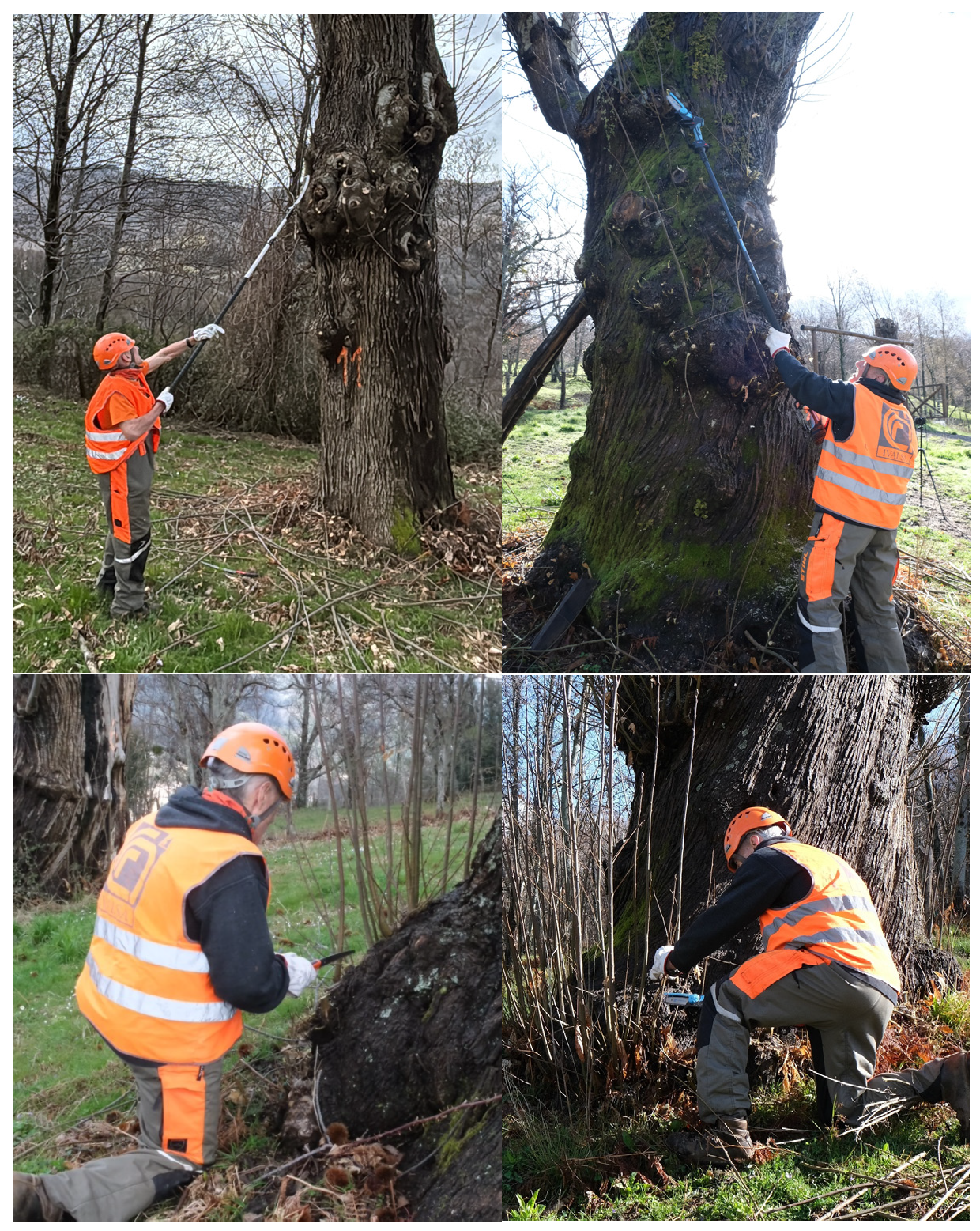
For the purpose of the test, two alternative sets of tools were acquired to represent the alternative technologies: manual and semi-mechanized. The former consisted of a Castellari PO35 P pruning saw (Castellari, Imola, Italy) fitted with its ATO 4 telescoping pole (from 210 cm to 370 cm), while the latter consisted of a battery-powered chainsaw pruner, Campagnola Fury XM (Campagnola, Bologna, Italy,), fitted with a detachable telescoping pole (from 140 to 200 cm) for reaching suckers positioned higher along the tree trunk. Total weight and cost were 0.4 kg (plus additional 1.3 kg for the pole) and €107 for the manual equipment set, and 1.3 kg (twice that when the extension pole was fitted) and €512 for the semi-mechanized equipment set, including four batteries (
Figure 1).
Four workers were selected for the test, all representative of the aging local workforce (
Table 2). For the purpose of the study, trees were (almost) equally subdivided between treatments and workers, with each combination being randomly assigned four to six trees. Workers randomly alternated work with the two equipment sets until all trees were treated.
Researchers recorded the time taken to remove all suckers from each tree, separating productive time from unproductive time [
19]. In turn, productive time was subdivided into “low removal” and “high removal”, depending on whether the suckers could be reached with the short or the extended tool, respectively; unproductive time was measured separately for the following occurrences: moving, resting, changing batteries, jams and other delays. The relatively few observations, their typically erratic occurrence and the random alternation between treatments and operators made it very difficult to safely attribute exact unproductive time figures to the specific treatments; eventually, the cumulated general incidence of unproductive time over total time was used to convert productive time into total worksite time. The total time taken was determined with a classic mechanical time-study board [
20], but most of the work was also videorecorded so that doubtful attributions could eventually be solved by revisiting the footage.
The productivity study lasted 11 h 39 min, of which 60% was represented by cutting time proper and 40% by unproductive time. Therefore, each work hour would consist of 36 min of productive (i.e., cutting) time and 24 min of unproductive time (i.e., accessory work and delays). For all following estimates, the working day was assumed to include 1 h of preparation and main breaks and 7 h of actual work, with each of those 7 h consisting of 36 min of actual productive work.
Each time record was associated with the tree ID and the total number of suckers that were actually cut, separately counted as low (i.e., root collar and mid-stem) and high suckers. Furthermore, eight suckers were randomly collected from the lot laying under each tree after the work and their base diameter was determined with a ruler to probe sucker size, which may vary with individual tree vigor and could possibly affect the time and effort invested in cutting.
Costs were estimated using an assumed depreciation period of 4 years. Maintenance was assumed to be 30% of depreciation for the battery-powered pruner and 10% for the manual one. Energy consumption was calculated based on the nominal figures reported by the manufacturers for voltage (V) and electric charge capacity (Ah). Labor cost was assumed to be 9 € per scheduled work hour, which is the minimum wage agreed by the National Unions of farm workers [
21] and represents a good indicator of the opportunity cost of self-employed owners.
Physiological workload was estimated based on heart rate measurements, which are commonly used to gauge the physiological strain of workers under field conditions where more accurate direct indicators (e.g., VO2 max) are too difficult to measure [
22]. In this case, relative heart rate was used to gauge how deeply the assigned work task tapped into the worker’s physiological reserve [
23,
24]. Readings were taken immediately upon completion of the task (i.e., cleaning one tree) using a simple stopwatch. Resting heart rate was obtained for each worker in the evening, after relaxing on a couch for at least 15 min. Maximum safe heart rate was estimated according to Åstrand and Rodahl [
25] as HRmax = 220 – age in years. Relative heart rate was computed using Vitalis’ formula [
26] as shown below (Equation (1)):
where
%HRR = relative heart rate at work, as a percentage;
HRwork = heart rate at work (at the end of the work activity);
HRrest = heart rate at rest;
HRmax = maximum heart rate.
Furthermore, all workers were interviewed right at the end of the test in order to collect their subjective evaluations of the two alternative toolsets. The interview followed a semi-structured format that included a table for rating the technical difficulty and the perceived effort for the de-suckering task, with separate ratings taken for the two toolsets and for high and low suckers.
Before analysis, the data set was subjected to nonparametric bootstrapping in order to generate a large number (≥4000) of proxy samples; that allowed for all statistics and models to be computed without strictly relying on parametric assumptions, which are not fulfilled by the small number of replications achieved with this study [
27]. While well-established in other disciplines [
28], the use of the bootstrapping technique in forest engineering is quite recent; it has only appeared in the last few years [
29,
30]. Resampling was done using a dedicated script (Linux Python 3.12—pandas data handling and preparation package), which yielded a new extended dataset. This was fed to the classic SAS Statview statistical software, which offers good transparency and extreme simplicity of use [
31]. Given that bootstrapping does not alter the original data distribution, non-normal data were either normalized through LOG transformation or analyzed with non-parametric techniques. The former strategy was adopted before the analysis of variance (AnOVa), the latter when conducting simpler pairwise or multiple comparisons (i.e., Mann–Whitney and Kruskal–Wallis tests, respectively). Regression analysis was used to check the statistical significance of the relationship between time consumption and tree characteristics (diameter, number of suckers, base diameter of suckers, etc.). The effect of the treatment difference was tested by introducing an indicator variable for semi-mechanized pruning. The chosen significance level was α < 0.05 for all tests.
Overall, the test lasted two days and involved four workers using two different tool types: manual and semi-mechanized. Suckers were removed from 36 trees, i.e., 4 or 5 trees for each of the eight combinations of worker and treatment. A single tree represented the observation unit. Collected data included time per tree, number of suckers, diameter at the base of the suckers and workers’ heart rates at the end of the task.
3. Results
A quick look at the tree data reported in
Table 1 highlights the large size of the trees, suggesting a proportionally old age. That would also explain why one third of the test trees were hollow, which added to their aesthetic quality and habitat value without detracting much from vitality. In fact, most trees reacted to pruning by producing a very large number of stem suckers, especially near the root collar and around the base of the main branches (old pollarding points). Statistical analysis showed that neither tree size (i.e., diameter at breast height—DBH) nor tree conditions (hollow or sound) were significantly associated with sucker production or vigor, as represented by the sucker count and diameter at the base, respectively. On the other hand, hollow trees were significantly larger than sound ones (median DBH 127 cm vs. 109 cm;
p = 0.0203 according to Scheffe’s post hoc test) suggesting the presence of multiple age classes. Overall, the average tree carried ca. 100 stem suckers with a mean diameter at the base below 20 mm, although the diameter of the largest suckers occasionally reached 30 or even 40 mm. This should be borne in mind during equipment selection.
Cutting time varied from 82 s to 1661 s per tree, with medians at 743 s and 422 s, respectively, for the manual and the semi-mechanized treatments (
Table 3). Statistical analysis showed that all treatment differences were highly significant (
p < 0.0001). Since the number of suckers per tree was significantly different between treatments, the comparison was made after recalculating time per tree based on the median cutting rate with 90 suckers per tree. That yielded 13.7 and 8.2 min per tree, respectively, for the manual and the semi-mechanized treatments. Assuming 36 min of productive work per hour and 7 work hours per day, the estimates amount to 18 and 31 trees per day, respectively, for the manual and the semi-mechanized treatments. Shifting from a handsaw to a battery-powered chainsaw boosts productivity by 67% (2/3).
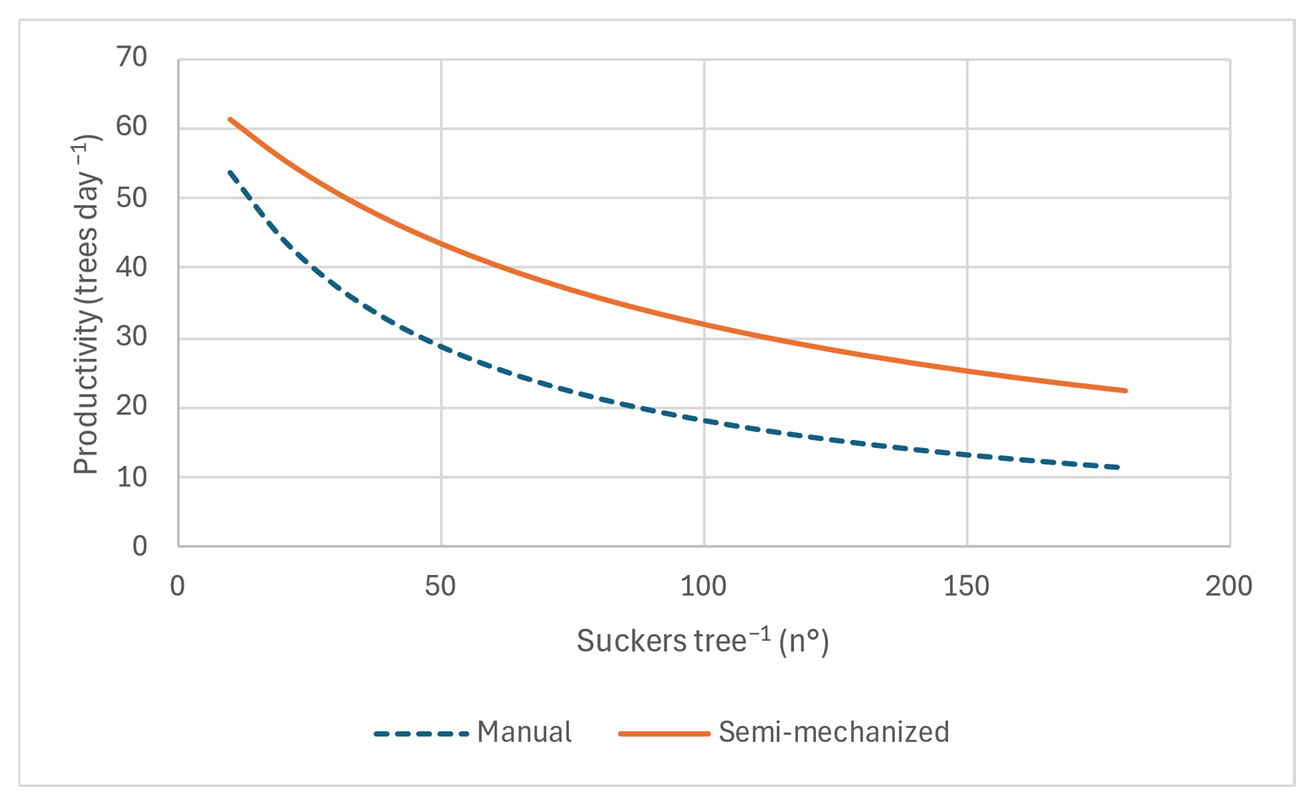
While this simple procedure may yield a roughly correct estimate of the time needed to de-sucker the average tree, it may miss the mark when the number of suckers per tree approaches extremes. Therefore, the regression model reported in
Table 4 offers a better all-round cutting time prediction model (
Figure 2).
Figure 2 shows a new estimate for the number of trees that can be de-suckered in a standard work day, obtained by recalculating cutting time using the model shown in
Table 4 and then applying the same methods used previously to integrate the effects of unproductive time and the duration of the working day. The new curve allows for a better estimate of daily production for a whole range of tree vigor conditions (as expressed by the number of suckers).
In fact, cutting time may vary widely with work conditions, as the analysis of variance (AnOVa) clearly shows (
Table 5).
The ANOVA of the LOG-transformed cutting time data indicated that the variable “treatment” explains a relatively small proportion (10%) of the total variation within the database. Worker selection is equally important and accounts for a similar-sized effect. Interaction effects were tested and were found to be quite weak. They were reported for the “time per sucker” only, as this shows how the performance of different workers was boosted by semi-mechanization to different degrees. Expectedly, the AnOVa also showed that cutting time was affected by the number of suckers and by the diameter of their base. Further analysis indicated that sucker position also affected cutting time, with high suckers needing more time than low suckers, the latter being much easier to reach. Although significant, the difference was relatively small and is not reported here, in order to keep this paper as simple and concise as possible.
Table 6 shows how different workers reacted differently to the change in technology, in terms of both productivity and workload. There is indeed a shared general trend, where the introduction of semi-mechanized technology lowers both cutting time and workload; however, the rates of decrease are highly individual, ranging between −13% and −44% for cutting time, and between −4% and −71% for physiological workload.
A closer look at the data may suggest the following: first, workers C and D obtained the smallest productivity benefit and the highest workload reduction when shifting from manual to battery-powered tools, in contrast to workers A and B, who achieved the exact opposite outcome. It seems as though workers C and D paced themselves, while workers A and B started out more aggressively, using the additional power of the new tool primarily to increase productivity rather than to save effort. This could be consistent with their individual backgrounds, whereby wise professional farmers (C and D) may prefer to keep a slower and steadier pace, thinking about their long-term workload, whereas part-timers may accept being exhausted after a few days’ work provided the work is done quickly and they can return to more sedentary occupations. Second, the workload reduction experienced with the power tool is higher for the less fit workers (A and C) and those who have a higher heart rate at rest. That makes sense in both physiological and mathematical terms, since the impact of any reduction in heart rate at work will be proportionally larger the narrower the heart rate reserve. Overall, the results indicate that shifting to the new power technology alone is not enough to reduce the workload to below the 40% HRR value capable of preventing long-term fatigue; it can indeed contribute to that, but prevention requires a deliberate effort on the part of the users. In fact, a heavy workload was only recorded for the part-timers, who are not engaged in farm work on a permanent basis and therefore may be less concerned with the long-term fatigue that may arise from it.
The interviews showed that all test workers found the task quite simple, rating it as 2 on a 5-point scale that ranged from “very simple” (rating = 1) to “extremely difficult” (rating = 5). The rating was the same regardless of the treatment and sucker position—low or high. On the other hand, workers found the task somewhat tiresome, especially when performed manually. On a scale from 1 (“effortless”) to 5 (“extremely taxing”), they rated the manual treatment 3.7 and the semi-mechanized one 2.7; unsurprisingly, the job was considered significantly more taxing when cutting high suckers compared with low suckers.
Our simple costing exercise indicated that investing in a simple battery-powered pruner is financially justified when treating at least 100 trees per year, consecutively, for four years. In that case, de-suckering will cost €3.9 tree−1 for the manual treatment and €3.8 tree−1 for the semi-mechanized one.
4. Discussion and Conclusions
A meaningful discussion of the study results can only be held after addressing its main limitations, namely, the short duration, the inclusion of four workers only, and the use of one make and model for each tool type. The short duration made it impossible to obtain many repetitions for each combination of treatment and worker (2 × 4 = 8), but that limitation was overcome through bootstrapping, which generated a synthetically amplified dataset and allowed for the development of robust models of cutting time. However, bootstrapping could not compensate for the erratic distribution of unproductive time events. Hence, the decision was made to adopt a general delay estimate, which would omit equipment-type effects if they occurred. Regarding the limited range of workers and machine models, the proposed solution was to select representative specimens based on existing knowledge of sector demographics and the equipment market. While those solutions are too raw to yield proper productivity norms [
32], they are hopefully good enough to estimate the effects of an eventual technology upgrade, while offering a viable proxy for such norms until they are developed.
Although not accurate enough to establish a norm, the figures reported in this study offer a reliable benchmark that can be used to correctly budget orchard restoration, especially for return owners who lack specific knowledge about chestnut farming. In fact, the same information could prove useful to regulators when issuing public aid measures to support chestnut orchard restoration.
Dedicated knowledge is not only needed for managing and/or regulating, but also for effectively selecting and operating old and new pruning equipment. In technical terms, this study offers at least two important lessons: first, a semi-professional electric pruner offers a relatively short battery charge duration and can go through four batteries within few hours. After working through the morning, the operator will need to change tool or task, or return to the base to recharge the batteries and come back in the afternoon. A full day’s work would require at least four more batteries at a cost of additional 200 € or further upgrading to a fully professional pruner. Therefore, a battery-powered toolset capable of running all day would exceed the €512 investment indicated in
Section 2 and reach €700 or more. For professional operation over a long work season, such an investment would be fully justified. The alternative for small part-time operators would consist of making a collective purchase and sharing the same tools, which would make it possible to depreciate a more expensive toolset. One could also envisage a system in which spare batteries are shared so that one could run the smaller and cheaper saw over a full working day by borrowing extra batteries from one’s neighbors and then lending one’s own batteries to them in return.
The second lesson is that users must learn to pace their work according to the size and goal of the job. If manual work is a main component of one’s occupation, then minimizing physiological workload is crucial to avoiding long-term fatigue. In contrast, if such work is performed only occasionally, fatigue may not be an issue, but poor conditioning might—hence the importance of showing some restraint and not yielding to enthusiasm or time pressures. All workers found their work especially taxing when targeting those suckers that grew at the insertion of the main branches to the stem, 4 m or more above ground: the obvious challenges presented by overhead work could be mitigated by an exoskeleton. Such an aid is already used in olive tree farming, but commercial models are still too expensive for part-time users. However, exoskeletons are the subject of extensive research, which may soon lead to the development of more affordable products [
33].
Finally, the results of our costing exercise are strongly dependent on its base assumptions, which may not be true in all cases. Changes in equipment model selection, service life and reference labor wage can dramatically alter that result. However, it would not be difficult to produce new estimates by using the fundamental information yielded by this study. It suffices to say that shifting to a semi-mechanized toolset can reduce work time per tree to 60% compared with what can be achieved with manual equipment. If 60% of the original work hours are required to achieve the same result, then breakeven is achieved when the cumulated saving in work hours match the increase in capital cost. Anyone can repeat this exercise for their chosen capital and labor cost figures.
Future research should be aimed at determining the impact of delay time with more accuracy than was possible with this study and at exploring the potential of exoskeletons or other motorial aids to relieve worker fatigue and occupational risk.