1. Introduction
Scots pine (
Pinus sylvestris L.) is the dominant forest-forming tree species in Poland, covering more than half of the forest area and playing a crucial role in the production, ecological, and protective functions of forest ecosystems [
1,
2,
3]. The health condition of pine stands strongly influences both ecosystem stability and the quality and economic value of timber resources [
4]. Among the biotic factors affecting wood quality, wood-decaying fungi represent one of the most important groups responsible for the deterioration of timber properties [
5,
6].
One of the most important pathogens causing heartwood decay in Scots pine is
Porodaedalea pini (syn.
Phellinus pini (Brot.) Bondartsev & Singer), the causal agent of white pocket rot. The significance of this disease in forest ecosystems has been recognized since the pioneering work of Hartig [
7] and remains well documented in modern forest pathology [
8]. The fungus infects living trees mainly through dead branches and knots, colonizing the heartwood and leading to the formation of characteristic elongated pockets of cellulose within degraded lignified tissues [
6]. White pocket rot is characterized by the formation of discrete cavities within the heartwood resulting from selective delignification, leaving relatively intact cellulose-rich zones [
6,
8]. These pockets typically occur as elongated, irregular structures distributed along the grain and may vary in size from a few millimetres to several centimetres, depending on the stage of decay [
6,
8]. The restriction of decay to heartwood is consistent with the fundamental physiological differences between sapwood and heartwood. Sapwood represents an active defence zone with living cells capable of responding to infection, whereas heartwood lacks such mechanisms and provides a more suitable substrate for long-term fungal colonization [
5,
8]. Because decay develops primarily in the heartwood while the sapwood remains functional, infected trees may remain asymptomatic for many years [
9]. External symptoms such as perennial basidiocarps typically appear only after a long incubation period, making early detection difficult [
8].
White pocket rot caused by
P. pini is widely distributed in coniferous forests of the Northern Hemisphere and represents an important factor reducing timber quality in mature stands [
6,
10]. The proportion of infected trees tends to increase with stand age, and decay frequently affects the lower stem, where the most valuable timber assortments are located. As a consequence, infection often leads to downgrading of timber classes and significant economic losses [
11].
In addition to its economic impact, fungal wood decomposition plays a key role in nutrient cycling and carbon dynamics in forest ecosystems [
12,
13]. Wood-decaying fungi drive the decomposition of coarse woody debris and contribute to carbon fluxes through the mineralization of woody biomass [
14,
15]. Moreover, they influence microbial community structure and ecosystem functioning under changing environmental conditions [
16]. Therefore, understanding the occurrence and activity of wood-decaying fungi such as
P. pini is important not only from a forest pathology perspective but also in the context of ecosystem processes.
Despite numerous reports on the occurrence of
P. pini in European forests, quantitative assessments of the proportion of decayed wood in managed Scots pine stands remain limited. In particular, studies evaluating the extent of internal decay and its impact on timber assortments under operational forest conditions are still scarce. This is partly due to the fact that decay may develop internally for many years without visible symptoms, leading to the underestimation of its actual extent [
6,
17]. A better understanding of the proportion of timber affected by white pocket rot and its implications for timber quality is therefore essential for improving forest management and assessing the economic and ecological consequences of wood decay [
18]. Despite numerous studies on the biology of
Porodaedalea pini, quantitative assessments of decay incidence in relation to stand age and its direct implications for timber assortments in managed Scots pine stands remain poorly quantified, particularly under Central European conditions. From a forest management perspective, determining the optimal rotation age is a key factor influencing both economic returns and stand health. Extending rotation periods may increase timber volume, but it can also elevate the risk of defects such as heartwood decay, leading to potential reductions in timber quality and value. Therefore, understanding the relationship between stand age and decay occurrence is essential for informed decision-making in forest management. Incorporating decay risk into planning strategies may support more balanced and economically efficient management of Scots pine stands.
The aim of this study was to quantify the occurrence and proportion of timber affected by Porodaedalea pini in managed Scots pine stands, examine its relationship with stand age, and provide an indicative assessment of its implications for timber quality and potential economic losses. We expected that decay would reduce timber quality and contribute to economic losses and that the occurrence and extent of decay would vary among stands depending on stand characteristics, particularly stand age. This study provides one of the few stand-level, operational-scale quantifications of internal decay based on harvesting data, offering a direct estimate of timber loss under real-world forest management conditions.
2. Materials and Methods
2.1. Study Area
The study was conducted in managed Scots pine (Pinus sylvestris) stands located in five forest districts in northern Poland: Świerczyna, Trzebież, Czerwony Dwór, Górowo Iławeckie, and Świdwin. These forest districts represent typical lowland forest ecosystems dominated by Scots pine and managed within the silvicultural system of the State Forests National Forest Holding. Thus, the analysed stands represent managed forest ecosystems rather than natural forest systems. The approximate geographic coordinates of the forest districts are as follows: Świerczyna (53.403° N, 16.210° E), Trzebież (53.664° N, 14.490° E), Czerwony Dwór (54.109° N, 21.995° E), Górowo Iławeckie (54.287° N, 20.487° E), and Świdwin (53.776° N, 15.776° E).
The region is characterized by a temperate climate with mean annual temperatures of approximately 7–8 °C and annual precipitation ranging from 550 to 700 mm. A total of 31 forest compartments were analysed. Stand age ranged from 61 to 167 years, representing mature and overmature stands. The analysed stands occurred on several forest site types typical for northern Poland, including fresh coniferous forest (Bśw), fresh mixed coniferous forest (BMśw), fresh mixed broadleaved forest (LMśw), fresh broadleaved forest (Lśw), and moist mixed broadleaved forest (LMw). In all the analysed stands, Scots pine constituted the dominant tree species. Detailed characteristics of the analysed stands are provided in
Supplementary Table S1.
2.2. Data Collection and Sampling Design
Data were collected during operational harvesting activities carried out in 31 forest compartments. Each compartment was treated as a single observational unit, and all variables were aggregated at the stand level based on the total harvested timber volume. The analysed stands represented different forest districts, site types, and stand ages, allowing for the evaluation of the influence of stand-level and environmental factors on the occurrence of heartwood decay. Because the analysed compartments represent heterogeneous environmental conditions, the results should be interpreted as general stand-level trends rather than strictly comparable site-level outcomes.
The dataset included stand age and the volume of logs affected by internal decay. The analysed stands covered a wide range of age classes, allowing for the assessment of age-related trends in decay occurrence.
During harvesting operations, randomly selected compartments were assessed to determine the volume of timber affected by white pocket rot. All felled trees within each compartment were included in the assessment. The volume of logs affected by decay was estimated under operational conditions based on visual inspection of stem cross-sections. No pre-selection of trees based on external symptoms was applied. All trees felled within the harvesting areas were included in the analysis and assessed for the presence of internal decay based on cross-sectional inspection.
Timber was classified according to the Polish quality and size classification standards (KJW). For the purpose of estimating economic loss, classification was first performed without considering decay defects, allowing the potential value of sound timber to be determined. Subsequently, wood affected by decay was assigned to the lowest quality class (S4), reflecting its reduced technical and economic value. Class S4 corresponds to low-quality stacked roundwood, typically used for energy purposes with only limited technical applications and substantially reduced economic value.
The share of logs affected by decay (%) was calculated for each compartment as the ratio of the volume of logs affected by decay to the total harvested timber volume. The financial loss was estimated as the difference between the market value of the originally assigned timber assortments and the value of the downgraded S4 assortments, multiplied by the volume of decayed wood.
The assessment of decay occurrence and identification of white pocket rot symptoms were conducted by an experienced forest pathologist (author), ensuring consistency and reliability of field observations. All assessments were performed using consistent criteria across all sites.
Data were collected over multiple harvesting seasons. In each season, data were collected from different forest districts, allowing for the inclusion of stands representing a range of environmental conditions; however, temporal variation was not explicitly included in the statistical models.
The sample size (n = 31) reflects the availability of operational harvesting data and may limit the statistical power of the analyses.
2.3. Assessment of Wood Decay
The occurrence of internal decay was assessed through visual inspection of stem cross-sections during harvesting operations. The assessment was based on macroscopic visual inspection, as white pocket rot produces characteristic structural changes that can be reliably identified without microscopic analysis. Decay assessment followed standard operational procedures, where the basal cross-section of the stem was examined first. If decay was detected, additional cross-sections were made at approximately 1 m intervals along the stem to determine the vertical extent of decay. The presence of decay in the basal section was not assumed to indicate infection of the entire stem, and additional cuts were used to verify the actual extent of decay. The assessment was limited to cross-sections exposed during harvesting operations and therefore did not involve continuous inspection of the entire stem. Decay was identified based on characteristic features of white pocket rot associated with Porodaedalea pini, including discoloration, structural degradation, and the presence of typical pocket-like decay patterns in the heartwood.
In addition, the presence of fruiting bodies was recorded for each sampled tree during the field assessment. The variable “trees with fruiting bodies (%)” represents the proportion of trees bearing visible basidiocarps consistent with P. pini.
While visual inspection may underestimate early or incipient stages of decay, this method reflects standard operational forestry practice and provides realistic estimates of timber quality loss under real harvesting conditions.
2.4. Economic Estimation
An approximate economic impact of decay was estimated based on the difference in assumed market value between sound timber and timber affected by decay. The economic loss was estimated by multiplying the volume of logs affected by decay by the assumed difference in unit price between sound timber and degraded wood. Logs affected by decay were assumed to correspond to lower-quality assortments or fuelwood, characterized by substantially reduced market value compared to sound timber.
The calculations were based on simplified assumptions regarding timber prices and did not account for variability in assortment structure or market conditions. Timber price assumptions were based on data reported for the Polish State Forests. The average timber price reached approximately 360 PLN m
−3 (≈80 EUR m
−3) in 2022, with lower values observed in earlier years (e.g., 264 PLN m
−3, ≈58 EUR m
−3). Prices varied depending on assortment, ranging from below 50 PLN m
−3 (≈11 EUR m
−3) to over 250 PLN m
−3 (≈55 EUR m
−3) [
19]. Currency conversion was performed using an approximate exchange rate of 1 EUR = 4.5 PLN.
Therefore, the economic results should be interpreted as indicative estimates rather than precise valuations, as the approach does not account for detailed assortment structure or temporal variability in timber prices.
2.5. Statistical Analysis
All statistical analyses were performed using Statistica software (version 13.3; TIBCO Software Inc., Palo Alto, CA, USA).
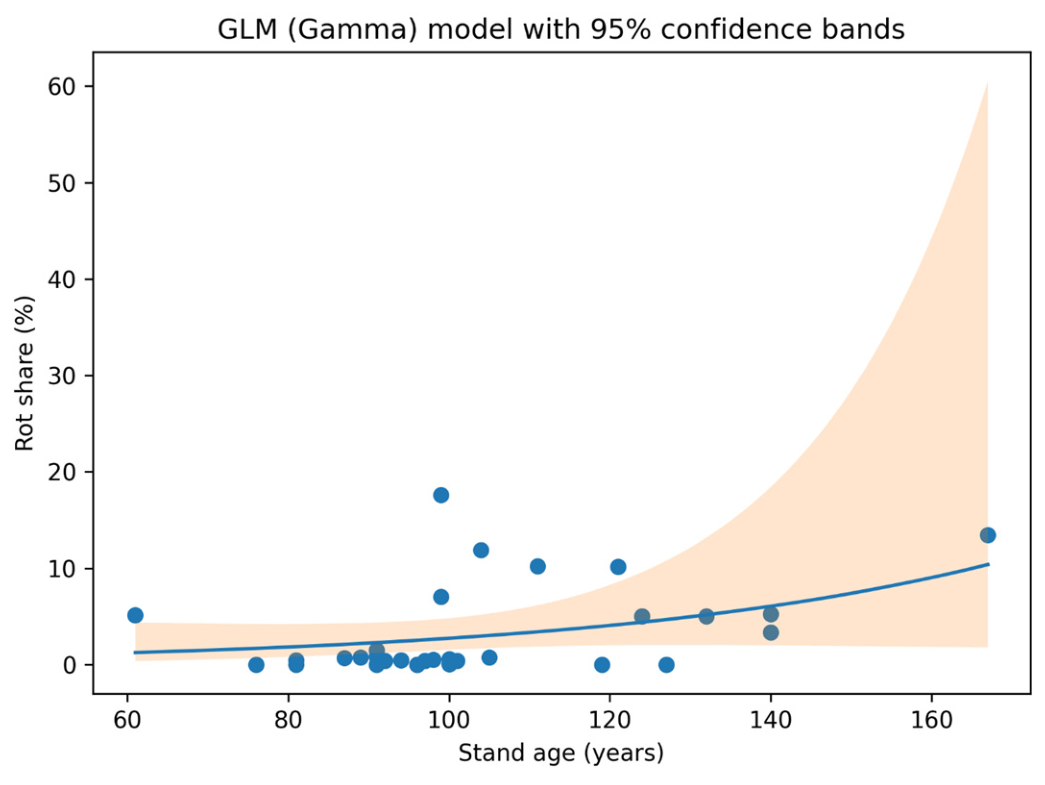
The relationship between stand age and decay occurrence was analysed using Pearson correlation and linear regression. In addition, generalized linear models (GLMs) were applied to account for the distributional properties of the response variable. A Gamma distribution with a log link function was selected due to the continuous and right-skewed nature of the decay share data, which is consistent with standard approaches in ecological and forestry studies [
20,
21].
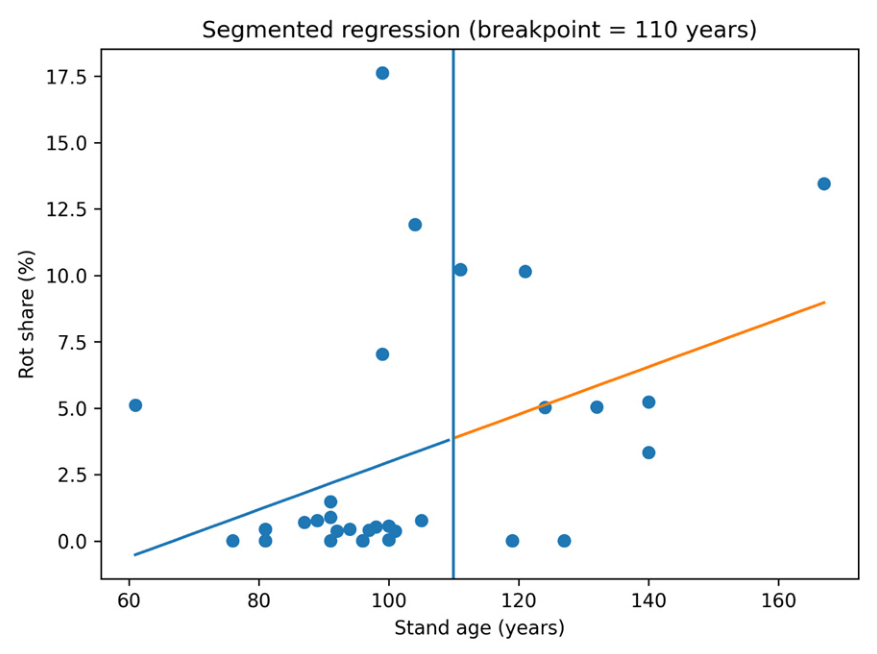
To explore potential nonlinear relationships, segmented regression was applied to identify possible breakpoints in the relationship between stand age and decay occurrence. Breakpoints were estimated iteratively based on model fit.
Due to data availability, additional stand-level variables such as site productivity, stand density, and management history were not included in the models. Therefore, the results should be interpreted as reflecting general trends rather than causal relationships.
Given the relatively small sample size and high variability among stands, the statistical power of the analyses may be limited, and the results should be interpreted with caution. Since some observations included zero values, a small constant (0.001) was added to the decay share variable prior to fitting the Gamma GLM.
In addition to the main analyses, two supplementary approaches were applied to further explore the relationship between stand age and decay occurrence.
First, a binary variable was created to indicate the presence or absence of decay at the stand level (0 = no decay, 1 = decay present), and logistic regression was used to assess the effect of stand age on the probability of decay occurrence.
Then, stands were grouped into two age classes based on the breakpoint identified in the segmented regression analysis (younger: <110 years; older: ≥110 years). Differences in decay share between these groups were evaluated using non-parametric tests (Mann–Whitney U test) due to the non-normal distribution of the data. Statistical significance was assessed at α = 0.05.
4. Discussion
The results of this study confirm that white pocket rot caused by
Porodaedalea pini is an important factor influencing timber quality in mature Scots pine stands [
18]. Although the average share of decayed wood was relatively low (3.29%), several compartments exceeded 10%, indicating high spatial variability. This heterogeneity likely reflects differences in infection history, stand structure, and the accumulation of infection pathways rather than uniform decay processes.
The observed patterns are consistent with the biology of heartwood-decaying fungi. Wood-inhabiting fungi colonize internal tissues slowly and may remain undetected for long periods due to the absence of external symptoms [
5,
6,
22]. In the case of
P. pini, infection typically occurs through exposed wood surfaces such as branch stubs or mechanical injuries, followed by gradual spread within the heartwood [
8,
23,
24]. Consequently, assessments based solely on external indicators, such as fruiting bodies, are likely to underestimate the actual extent of decay [
18], which is consistent with previous studies indicating that visual detection methods may fail to identify all affected trees, especially at early stages of infection [
25]. It should also be noted that the absence of visible white pocket rot symptoms on a given cross-section does not necessarily indicate that the tree is entirely free from infection. In early or incipient stages, decay may be localized or not yet visible at the inspected surface, which may lead to underestimation of the actual extent of infection [
5,
6], particularly in cases where decay is localized or at an early stage of development. Therefore, the applied method likely provides a conservative estimate of decay occurrence under operational conditions [
5,
6].
One of the key findings of this study is the positive relationship between stand age and decay occurrence. Both correlation and regression analyses indicate that the proportion of decayed wood increases with increasing stand age, which is consistent with the long-term development of heartwood decay and the accumulation of infection courts over time [
5,
6,
8]. However, the relatively low explanatory power (R
2 = 0.17) suggests that additional factors, such as site conditions, stand density, and management history, also play an important role. This study intentionally focused on stand age as a primary explanatory variable; however, it is acknowledged that decay processes are influenced by multiple interacting factors, including site conditions, stand structure, and management history.
Segmented regression indicated a potential breakpoint at approximately 110 years, suggesting an increase in decay risk in older stands. The identified breakpoint around 110–120 years should not be interpreted as a strict biological threshold, but rather as an operationally relevant point at which the effects of heartwood decay become more apparent. This likely reflects the cumulative nature of infection and decay progression over time. In the case of
Porodaedalea pini, infection may occur decades before it becomes detectable, and the fungus develops slowly within the heartwood. As a result, younger stands may already contain infected trees in early stages of decay that remain undetected, whereas in older stands, the decay has progressed to a level that is visible and measurable during harvesting operations. Therefore, the observed increase in decay occurrence in older stands may primarily reflect the accumulation and detectability of decay rather than a sudden increase in the infection rate. This threshold should be interpreted cautiously due to the limited sample size and high variability, but it may have practical relevance for forest management. Extending rotation age beyond this range may increase the probability of internal decay and associated timber quality losses, consistent with the concept of pathological rotation age reported in previous studies [
8,
23,
24,
26].
The supplementary analyses provide additional insight into the role of stand age. While decay occurrence (presence/absence) was not significantly related to stand age, the proportion of decayed wood tended to be higher in older stands. This suggests that stand age may be more strongly associated with the intensity of decay rather than its mere occurrence, which is consistent with the gradual development of heartwood decay over time.
It should be noted that the generalized linear model did not confirm a statistically significant effect of stand age, despite significant correlations. This discrepancy likely reflects limited statistical power and high variability among stands [
27], and therefore the relationship should be interpreted as a general trend rather than a predictive model.
Compared to previous studies, this work provides one of the few quantitative estimates of internal decay at the stand level under operational harvesting conditions. Most earlier studies relied on indirect indicators such as fruiting bodies or experimental plots [
18,
28,
29], whereas the present approach offers a more direct assessment of timber loss.
Although the overall decay share was moderate, its impact on timber quality may be substantial due to the downgrading of affected wood [
6]. Even relatively small proportions of decayed timber can result in measurable economic losses, highlighting the importance of incorporating decay risk into forest management decisions [
12,
29].
At the same time,
P. pini plays an important ecological role in forest ecosystems. By decomposing lignocellulosic tissues, wood-decay fungi contribute to nutrient cycling and the formation of dead wood habitats that support biodiversity [
5,
13,
30,
31]. Thus, decay should be considered not only a loss factor but also a natural component of forest ecosystem functioning. Together, these studies emphasize the fundamental role of fungal-mediated wood decomposition processes in shaping forest ecosystem functioning and biodiversity patterns [
32,
33,
34,
35].
Several limitations of this study should be acknowledged. The relatively small sample size (n = 31), the lack of additional stand-level variables, and the use of visual assessment may limit the accuracy of decay detection, particularly at early stages [
6]. Future studies should incorporate larger datasets, additional explanatory variables, and more advanced diagnostic methods to improve understanding of decay dynamics.
Future research should focus on expanding the dataset to include a larger number of stands and additional explanatory variables, such as site productivity, stand density, and management history. The application of advanced diagnostic methods, including non-destructive techniques (e.g., acoustic tomography), could improve the detection of early decay stages. Long-term monitoring studies would also help to better understand the dynamics of decay development and improve predictive modelling of timber quality loss.
From a practical perspective, the results suggest that incorporating decay risk into forest management planning may improve decision-making regarding rotation age and timber utilization. In particular, the observed increase in decay occurrence in stands older than approximately 110 years indicates that extending rotation periods may lead to higher economic losses due to timber degradation.
The findings also highlight the importance of including internal decay assessments during harvesting operations, as reliance solely on external indicators may underestimate timber quality loss. Implementing risk-based management strategies and adapting timber sorting practices could help reduce economic losses associated with heartwood decay.