


Spatiotemporal Patterns of Carbon Storage in Hainan Bamen Bay Mangroves Based on a Decision Tree Classification
Abstract
1. Introduction
- (1)
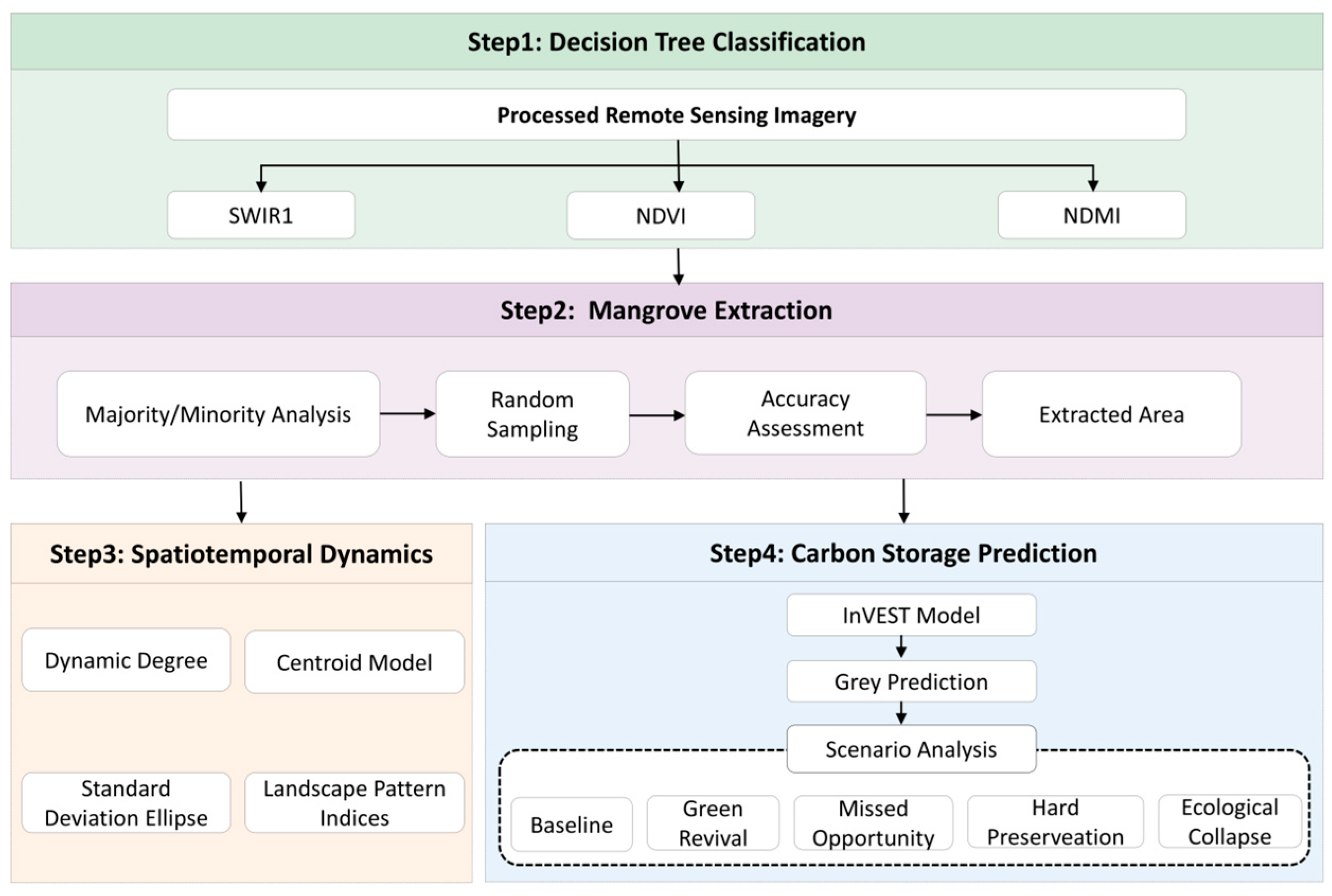
- To develop a decision tree classification method integrating SWIR1, NDVI, and NDMI for high-precision mangrove mapping;
- (2)
- To systematically analyze the spatiotemporal evolution of mangrove distribution over the past two decades by integrating the dynamic degree model, standard deviation ellipse, centroid model, and landscape pattern indices;
- (3)
- To quantify carbon storage changes and predict future trends by combining the InVEST model, grey prediction model, and scenario analysis, thereby revealing potential development pathways under different management scenarios.
2. Study Area and Datasets
2.1. Study Area
2.2. Data Sources and Preprocessing
3. Methods
3.1. Analytical Framework
3.2. Decision Tree Classification
3.3. The Dynamic Degree Model
3.4. Standard Deviation Ellipse and Centroid Analysis
3.5. Selected Landscape Pattern Indices
3.6. Mangrove Carbon Storage Calculation Method
3.7. Grey Prediction Model
4. Results
4.1. Accuracy Assessment of Mangrove Extraction
4.2. Temporal Changes in Mangroves
4.3. Spatial Changes in Mangroves
4.3.1. Overall Spatial Evolution of Mangroves
4.3.2. Standard Deviation Ellipse
4.3.3. Landscape Pattern Indices
4.4. Evolution and Prediction of Carbon Storage in Bamen Bay Mangroves
4.4.1. Carbon Storage Evolution
4.4.2. Carbon Storage Prediction
5. Discussion
5.1. Comparison with Previous Studies and Implications of Findings
5.1.1. Comparison of Mangrove Area Estimates
5.1.2. Implications of Spatiotemporal Dynamics
5.1.3. Implications of Carbon Storage Trends
5.2. Drivers of Mangrove Dynamics in Bamen Bay
5.2.1. Drivers of Area Expansion
5.2.2. Factors Influencing Spatial Pattern Evolution
5.2.3. Implications of Landscape Pattern Changes
5.3. Methodological Contributions and Model Performance
5.3.1. Decision Tree Classification Method
5.3.2. Performance of the Grey Prediction Model
5.3.3. Methodological Advancements
5.4. Limitations and Future Research Directions
5.4.1. Remote Sensing Data
5.4.2. Classification Methods
5.4.3. Prediction Model
5.4.4. Assumption of Proportional Area-Carbon Relationship
5.4.5. Uncertainty Quantification
5.5. Management Implications and Future Perspectives
6. Conclusions
- (1)
- The proposed decision tree classification model based on SWIR1, NDVI, and NDMI achieved high accuracy. This performance demonstrates competitive accuracy compared to a previous SVM application in the same region [29], though direct comparability is limited by differences in training data and classification parameters, thereby validating the effectiveness of this combination of spectral indices as a robust alternative for mangrove extraction.
- (2)
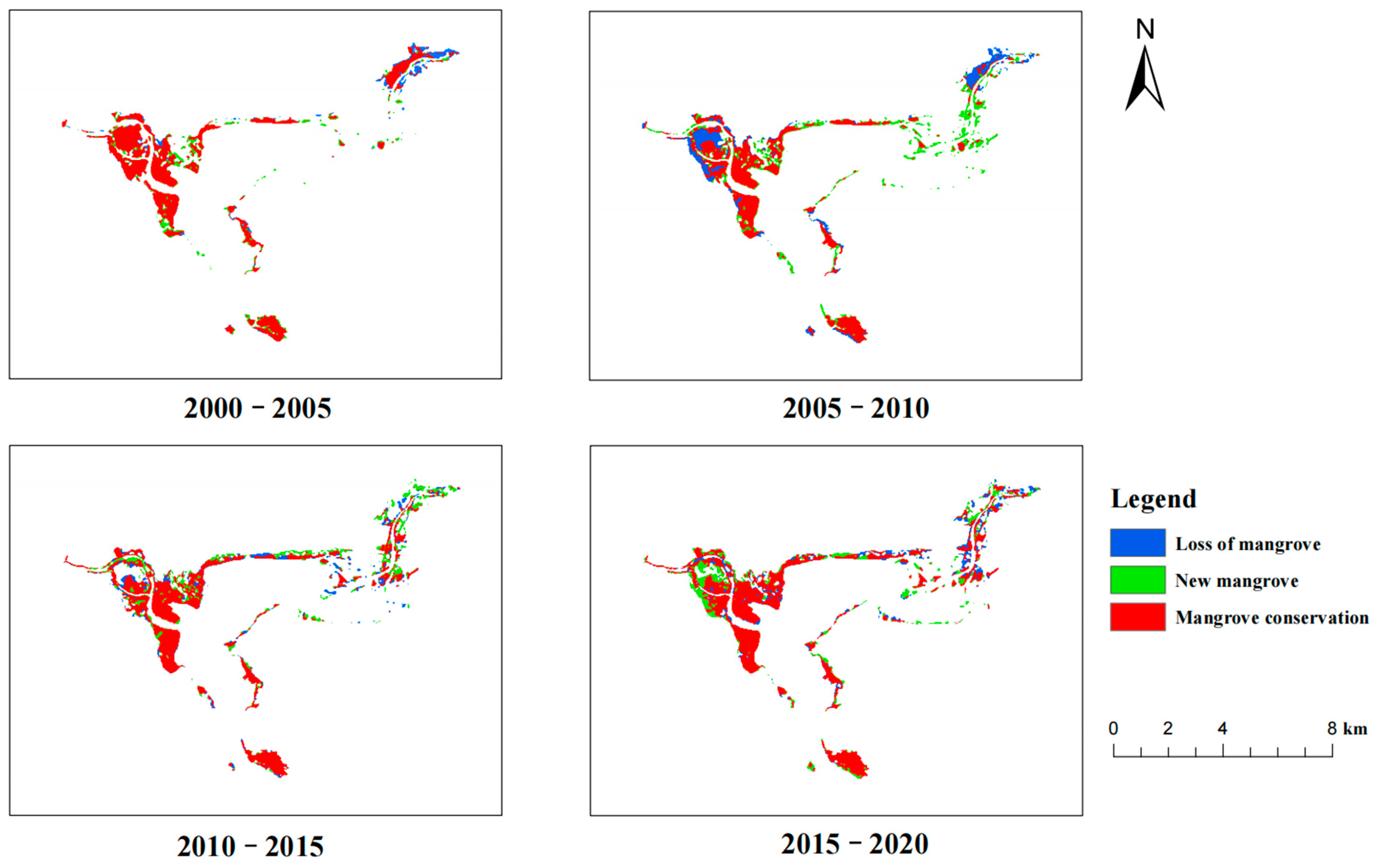
- From 2000 to 2020, the area of mangroves in Bamen Bay showed a continuous growth trend, with an increase of 38.35%. The overall dynamics reached 1.92%, indicating that the mangrove ecosystem in the region is in a stable recovery stage.
- (3)
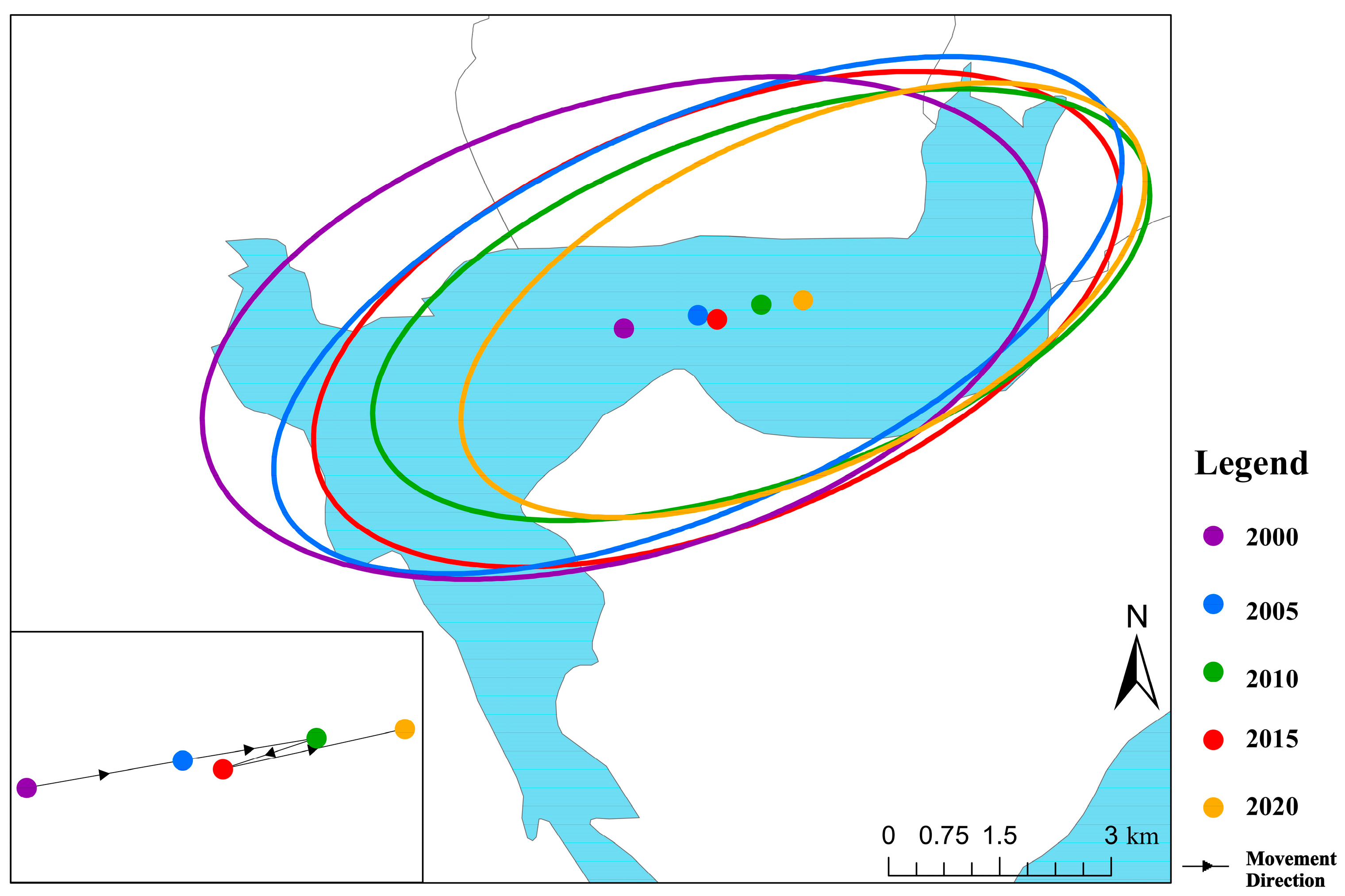
- Over the past 20 years, the area of the standard deviation ellipse has decreased, while the orientation angle has generally shown a declining trend. The distribution of mangroves is more concentrated, and the expansion of the western region is obvious. The centroid moves to the northeast as a whole. Although landscape fragmentation remains a problem, it has been partially alleviated through continuous conservation measures.
- (4)
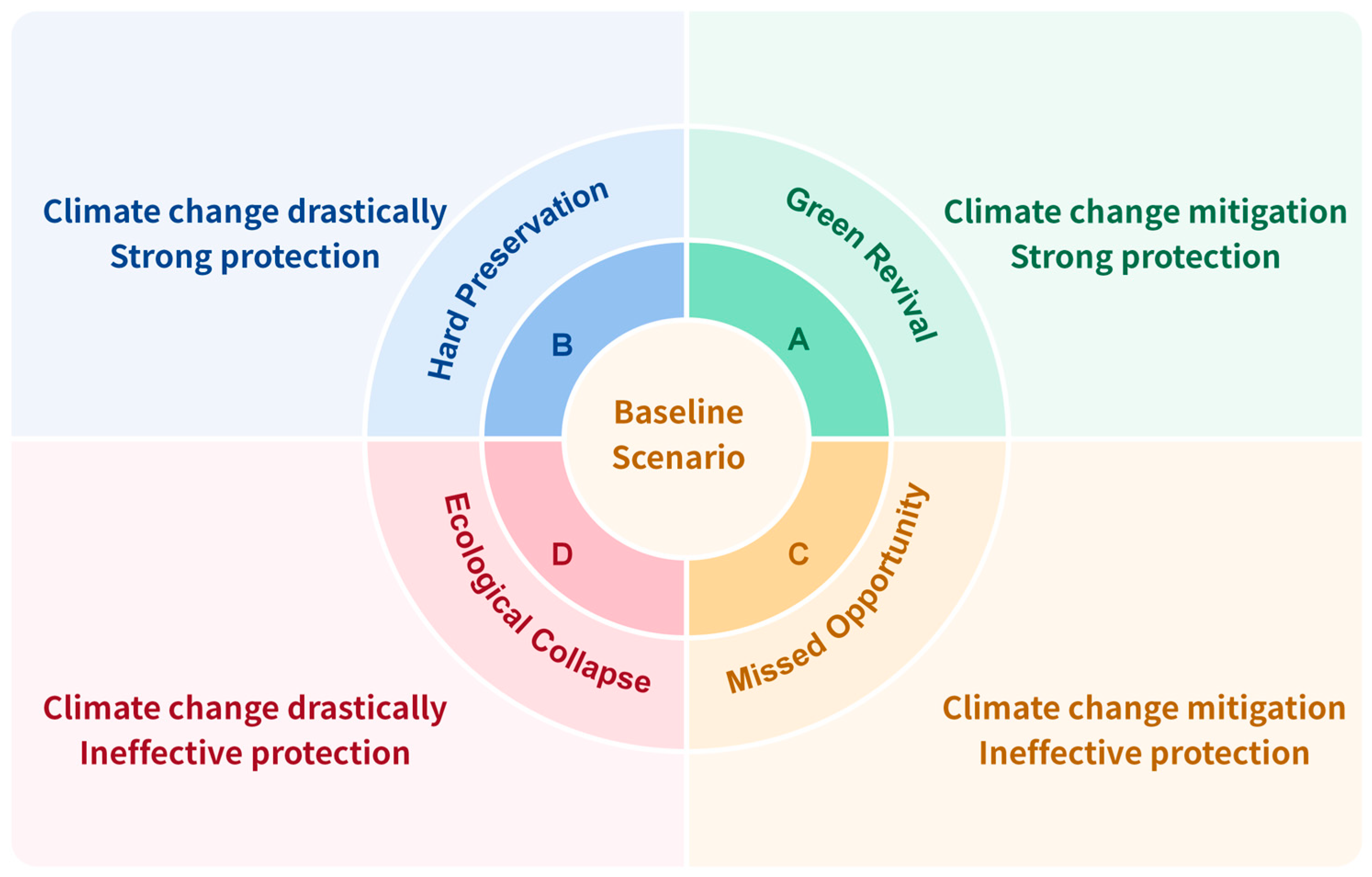
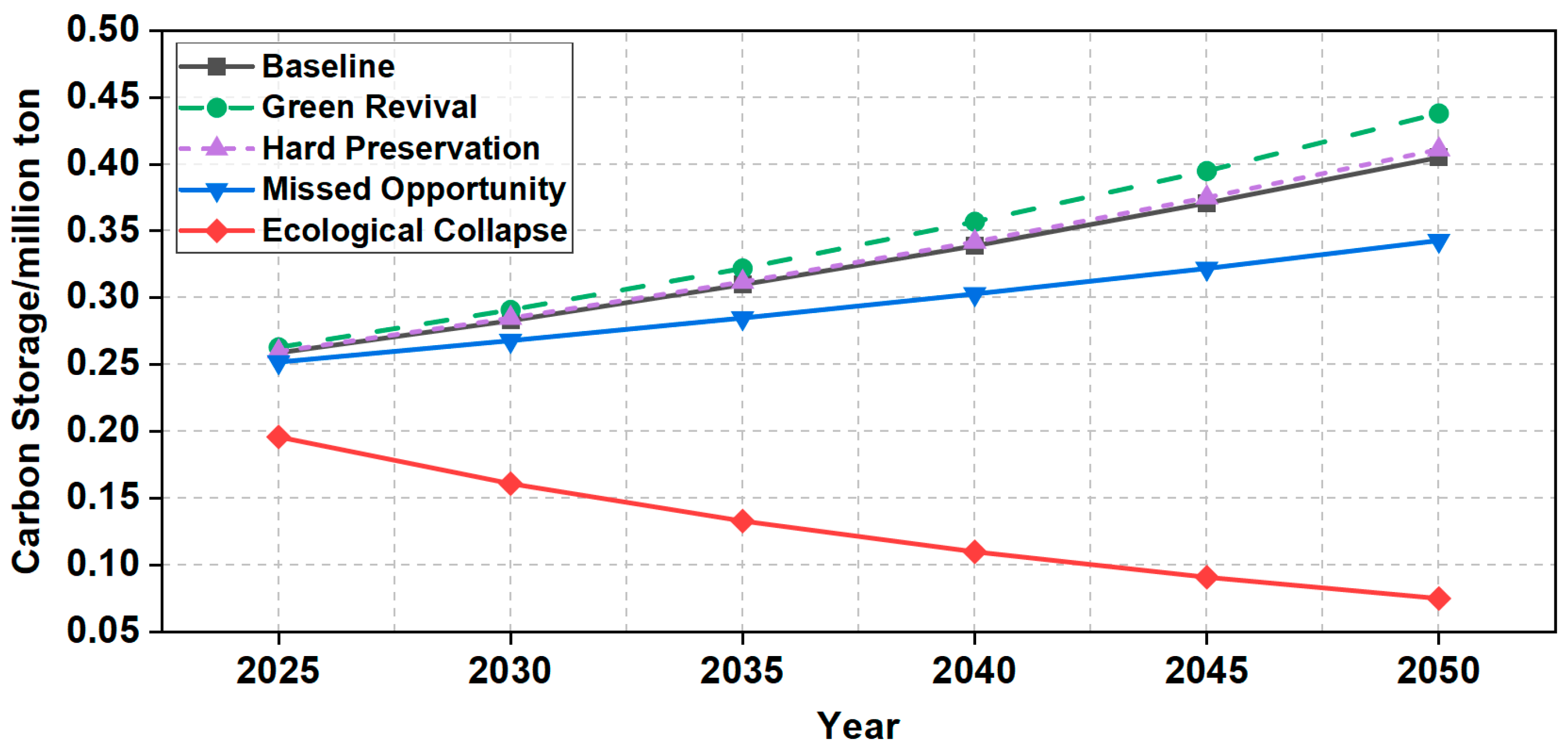
- Under the baseline scenario, carbon storage is expected to reach 0.405 million tons by 2050, assuming continuation of historical trends and no habitat saturation. Under the Green Revival scenario, carbon storage will exceed the baseline, reaching 0.438 million tons. The Hard Preservation yields 0.411 million tons, which is slightly higher than the baseline. In the Missed Opportunity scenario, carbon storage will drop to 0.343 million tons, below the baseline. The result of the Ecological Collapse scenario is only 0.075 million tons, far below the baseline, and shows a continuous downward trend.
Author Contributions
Funding
Data Availability Statement
Acknowledgments
Conflicts of Interest
Abbreviations
| SWIR | Short-Wave Infrared |
| NDVI | Normalized Difference Vegetation Index |
| NDMI | Normalized Difference Moisture Index |
| TM | Thematic Mapper |
| ETM+ | Enhanced Thematic Mapper Plus |
| OLI/TIRS | Operational Land Imager/Thermal Infrared Sensor |
| DN | Digital Number |
| NP | Number of Patches |
| PD | Patch Density |
| AI | Aggregation Index |
| LSI | Landscape Shape Index |
| ED | Edge Density |
| GM(1,1) | Grey Prediction Model (1,1) |
| AGO | Accumulated Generating Operation |
| IAGO | Inverse Accumulating Generation Operation |
| SVM | Support Vector Machine |
References
- Liu, Z.; Yin, Z.; Zhao, W.; Feng, Z.; Pei, H.; Grimaldi, P.; Qiu, Z. Spatiotemporal Patterns of Aboveground Carbon Storage in Hainan Mangroves Based on Machine Learning and Multi-Source Remote Sensing Data. Forests 2026, 17, 131. [Google Scholar] [CrossRef]
- Zhang, X.; Yin, Z.; Chen, Y.; Liu, J.; Liu, S.; Li, F.; Fu, C.; Wang, Y. Carbon Stock Spatial Patterns in Mangroves of Shankou, Guangxi. IEEE J. Sel. Top. Appl. Earth Obs. Remote Sens. 2026, 19, 3402–3413. [Google Scholar] [CrossRef]
- Kairo, J.G.; Mbatha, A.; Wanyoike, G.N.; Mungai, F.; Githinji, B.K.; Lang’at, J.K.S.; Kinya, G.; Kosgei, G.K.; Mary, K.; Oming’o, L. Blue Carbon Investment Potential in Lamu and Kwale Counties of Kenya: Carbon Inventory and Market Prospects. Forests 2025, 16, 1717. [Google Scholar] [CrossRef]
- Alongi, D.M. Carbon Cycling and Storage in Mangrove Forests. Annu. Rev. Mar. Sci. 2014, 6, 195–219. [Google Scholar] [CrossRef]
- Karimi, A.; Abtahi, B.; Kabiri, K. Mapping and Estimating Blue Carbon in Mangrove Forests Using Drone and Field-Based Tree Height Data: A Cost-Effective Tool for Conservation and Management. Forests 2025, 16, 1196. [Google Scholar] [CrossRef]
- Choudhary, B.; Dhar, V.; Pawase, A.S. Blue Carbon and the Role of Mangroves in Carbon Sequestration: Its Mechanisms, Estimation, Human Impacts and Conservation Strategies for Economic Incentives. J. Sea Res. 2024, 199, 102504. [Google Scholar] [CrossRef]
- Dong, D.; Huang, H.; Gao, Q.; Li, K.; Zhang, S.; Yan, R. Integrating Remote Sensing and Field Data to Quantify Mangrove Biomass Carbon Hotspots and Protection Gaps in Guangdong, China. Forests 2025, 16, 1612. [Google Scholar] [CrossRef]
- Jiang, L.; Yang, T.; Yu, J. Global Trends and Prospects of Blue Carbon Sinks: A Bibliometric Analysis. Environ. Sci. Pollut. Res. 2022, 29, 65924–65939. [Google Scholar] [CrossRef] [PubMed]
- Hilmi, E.; Parengrengi; Vikaliana, R.; Kusmana, C.; Iskandar; Sari, L.K.; Setijanto. The Carbon Conservation of Mangrove Ecosystem Applied REDD Program. Reg. Stud. Mar. Sci. 2017, 16, 152–161. [Google Scholar] [CrossRef]
- Amelia, R.; Basyuni, M.; Alfinsyahri, A.; Sulistiyono, N.; Slamet, B.; Bimantara, Y.; Harahap, S.S.H.; Harahap, M.; Harahap, I.M.; Al Mustaniroh, S.S.; et al. Evaluation of Plant Growth and Potential of Carbon Storage in the Restored Mangrove of an Abandoned Pond in Lubuk Kertang, North Sumatra, Indonesia. Forests 2023, 14, 158. [Google Scholar] [CrossRef]
- Walcker, R.; Gandois, L.; Proisy, C.; Corenblit, D.; Mougin, É.; Laplanche, C.; Ray, R.; Fromard, F. Control of “Blue Carbon” Storage by Mangrove Ageing: Evidence from a 66-year Chronosequence in French Guiana. Glob. Change Biol. 2018, 24, 2325–2338. [Google Scholar] [CrossRef]
- Sasmito, S.D.; Sillanpää, M.; Hayes, M.A.; Bachri, S.; Saragi-Sasmito, M.F.; Sidik, F.; Hanggara, B.B.; Mofu, W.Y.; Rumbiak, V.I.; Hendri; et al. Mangrove Blue Carbon Stocks and Dynamics Are Controlled by Hydrogeomorphic Settings and Land-use Change. Glob. Change Biol. 2020, 26, 3028–3039. [Google Scholar] [CrossRef]
- Ballut-Dajud, G.; Sandoval Herazo, L.C.; Osorio-Martínez, I.M.; Báez-García, W.; Marín-Muñiz, J.L.; Betanzo Torres, E.A. Comparison of Carbon Storage in Forested and Non-Forested Soils in Tropical Wetlands of Caimanera, Colombia, and Llano, Mexico. Sustainability 2024, 16, 4966. [Google Scholar] [CrossRef]
- Jayarathne, M.; Morimoto, T.; Ranagalage, M. Bibliometric Analysis of Highly Cited Publications on Mangrove Sustainability. Forests 2026, 17, 240. [Google Scholar] [CrossRef]
- Nishma, F.P.K.; Ansar, C.P.; Murshitha, P.M. Mangroves and Climate Change: Carbon Sequestration Implications. A Review. J. Res. Environ. Earth Sci. 2025, 11, 39–44. [Google Scholar] [CrossRef]
- Mohan, M.; Selvam, P.P.; Ewane, E.B.; Moussa, L.G.; Asbridge, E.F.; Trevathan-Tackett, S.M.; Macreadie, P.I.; Watt, M.S.; Gillis, L.G.; Cabada-Blanco, F.; et al. Eco-Friendly Structures for Sustainable Mangrove Restoration. Sci. Total Environ. 2025, 978, 179393. [Google Scholar] [CrossRef]
- Hamilton, S.E.; Casey, D. Creation of a High Spatio-temporal Resolution Global Database of Continuous Mangrove Forest Cover for the 21st Century (CGMFC-21). Glob. Ecol. Biogeogr. 2016, 25, 729–738. [Google Scholar] [CrossRef]
- Umar, M.; Abbas, S. Advancing Mangrove Mapping with the Integrated Mangrove Index (IMI) and the Role of Tidal Dynamics. Int. J. Remote Sens. 2025, 46, 4409–4429. [Google Scholar] [CrossRef]
- Akbar, M.R.; Arisanto, P.A.A.; Sukirno, B.A.; Merdeka, P.H.; Priadhi, M.M.; Zallesa, S. Mangrove Vegetation Health Index Analysis by Implementing NDVI (Normalized Difference Vegetation Index) Classification Method on Sentinel-2 Image Data Case Study: Segara Anakan, Kabupaten Cilacap. IOP Conf. Ser. Earth Environ. Sci. 2020, 584, 012069. [Google Scholar] [CrossRef]
- Sukuryadi; Johari, H.I.; Ibrahim; Adiansyah, J.S.; Nurhayati. Assessing Mangrove Forest Changes Using Vegetation Index Algorithm in Southern West Lombok. IOP Conf. Ser. Earth Environ. Sci. 2025, 1441, 012002. [Google Scholar] [CrossRef]
- Singgalen, Y.A.; Gudiato, C.; Prasetyo, S.Y.J.; Fibriani, C. Mangrove Monitoring Using Normalized Difference Vegetation Index (Ndvi): Case Study in North Halmahera, Indonesia. J. Ilmu Dan Teknol. Kelaut. Trop. 2021, 13, 219–239. [Google Scholar] [CrossRef]
- Shi, T.; Liu, J.; Hu, Z.; Liu, H.; Wang, J.; Wu, G. New Spectral Metrics for Mangrove Forest Identification. Remote Sens. Lett. 2016, 7, 885–894. [Google Scholar] [CrossRef]
- Maurya, K.; Mahajan, S.; Chaube, N. Decision Tree (DT) and Stacked Vegetation Indices Based Mangrove and Non-Mangrove Discrimination Using AVIRIS-NG Hyperspectral Data: A Study at Marine National Park (MNP) Jamnagar, Gulf of Kutch. Wetl. Ecol. Manag. 2023, 31, 805–823. [Google Scholar] [CrossRef]
- Li, M.; Tian, Y.; Yin, P.; Duan, X.; Zhan, J.; Li, X.; Zhang, Y. Remote sensing monitoring and analysis based on multi-sourced data of mangroves in Pearl Bay. Mar. Geol. Front. 2025, 41, 82–92. [Google Scholar] [CrossRef]
- Wu, K.; Gao, W.; Zhao, G.; Zhang, Y.; Wu, Y.; Yang, N.; Yu, Q.; Lin, J.; Lu, C. Landscape Pattern Changes in Dongzhaigang National Nature Reserve Based on Sentinel-2 Images and Its Driving Forces. J. Chifeng Univ. (Nat. Sci. Ed.) 2024, 40, 1–7. [Google Scholar] [CrossRef]
- Wang, R.; Dai, Z.; Wu, T.; Huang, H.; Ou, Y.; Zhou, T. Study on dynamic changes of mangrove spatial distribution in the Jingujiang River, Guangxi. Adv. Mar. Sci. 2025, 43, 487–500. [Google Scholar]
- Li, Q.; Li, S.; Zhang, Y.; Xu, D.; Xiong, D.; Liao, G. Landscape Pattern Changes in Dongzhaigang National Nature Reserve Based on Sentinel-2 Images and Its Driving Forces. Ocean Dev. Manag. 2024, 41, 91–101. [Google Scholar] [CrossRef]
- Tang, D.; Xing, C.; Chen, N.; Liu, X.; Zhang, L. Mangrove forest fragmentation and its ecological service value in Tongming Sea of Zhanjiang, Guangdong, China during 2000–2018. Chin. J. Appl. Ecol. 2023, 34, 415–422. [Google Scholar] [CrossRef]
- Xue, Z.; Tian, Z.; Zhu, J.; Zhao, Y. Monitoring of inter-annual variations in mangrove forests in the Bamen Bay area based on Google Earth Engine. Remote Sens. Nat. Resour. 2024, 36, 279–286. [Google Scholar]
- Zhen, J.; Liao, J.; Sheng, G. Remote Sensing Monitoring and Analysis on the Dynamics of Mangrove Forests in Qinglan Habor of Hainan Province since 1987. Wetl. Sci. 2019, 17, 44–51. [Google Scholar] [CrossRef]
- Zhang, C.; Ren, G.; Wu, P.; Hu, Y.; Ma, Y.; Yan, Y.; Zhang, J. Mangrove species classification in the Hainan Bamen Bay based on GF optics and fully polarimetric SAR. J. Trop. Oceanogr. 2023, 42, 153–168. [Google Scholar]
- Liu, K.; Peng, L.; Li, X.; Tan, M.; Wang, S. Monitoring the inter-annual Change of mangrove based on the Google Earth Engine. J. Geo-Inf. Sci. 2019, 21, 731–739. [Google Scholar]
- Singh, A.; Bruzzone, L. SIGAN: Spectral Index Generative Adversarial Network for Data Augmentation in Multispectral Remote Sensing Images. IEEE Geosci. Remote Sens. Lett. 2022, 19, 6003305. [Google Scholar] [CrossRef]
- Wilson, E.H.; Sader, S.A. Detection of Forest Harvest Type Using Multiple Dates of Landsat TM Imagery. Remote Sens. Environ. 2002, 80, 385–396. [Google Scholar] [CrossRef]
- Xue, J.; Cao, L.; Zhang, X.; Ding, Z. Analysis of factors affecting carbon emissions from urban construction land in the Yellow River Basin based on nighttime light data and peak prediction. J. Shenyang Agric. Univ. 2025, 56, 148–162. [Google Scholar]
- Wang, H.; Ren, G.; Wu, P.; Liu, A.; Pan, L.; Ma, Y.; Ma, Y.; Wang, J. Analysis on the Remote Sensing Monitoring and Landscape Pattern Change of Mangrove in China from 1990 to 2019. J. Ocean Technol. 2020, 39, 1–12. [Google Scholar]
- Hu, Z.; Liu, J.; Pan, S.; Zhang, Z.; Li, Y. Spatial—Temporal Characteristics and Driving Factors of Landscape Fragmentation in Huzhou City. Environ. Sci. Manag. 2024, 49, 148–153. [Google Scholar]
- Hu, W.; Li, G.; Gao, Z.; Jia, G.; Wang, Z.; Li, Y. Assessment of the Impact of the Poplar Ecological Retreat Project on Water Conservation in the Dongting Lake Wetland Region Using the InVEST Model. Sci. Total Environ. 2020, 733, 139423. [Google Scholar] [CrossRef]
- Zhou, M. Study on the Distribution and Carbon Storage Changes of Mangroves in Hainan Island in the Past 30 Years. Master’s Thesis, Hainan Tropical Ocean University, Sanya, China, 2025. [Google Scholar] [CrossRef]
- Guo, Z.; Xi, W.; Hu, J. Research on Surface Deformation Prediction Based on SBAS-InSAR Technology and Grey Prediction Model. Jiangxi Sci. 2025, 43, 609–614. [Google Scholar] [CrossRef]
- Li, Y.; Wen, H.; Wang, F. Analysis of the Evolution of Mangrove Landscape Patterns and Their Drivers in Hainan Island from 2000 to 2020. Sustainability 2023, 15, 759. [Google Scholar] [CrossRef]

| Year | Datasets | Number of Scenes |
|---|---|---|
| 2000 | Landsat 5 TM | 1 |
| 2005 | Landsat 5 TM | 1 |
| 2010 | Landsat 5 TM | 1 |
| 2015 | Landsat 7 ETM+ | 1 |
| 2020 | Landsat 8 OLI/TIRS | 1 |
| Index | Formula | Description of Symbols | Description and Ecological Interpretation |
|---|---|---|---|
| NP | NP = N | N = total number of patches of mangroves | Total number of patches. Higher NP indicates greater fragmentation. |
| PD | PD = (N/A) × 100 | N = number of patches A = total landscape area | Patches per 100 hm2. Eliminates area effect; higher PD = more fragmented. |
| AI | = number of like adjacencies = maximum possible like adjacencies given the patch size | Reflects the aggregation or dispersion degree among patches. Higher AI = more aggregated (less fragmented). | |
| LSI | E = total edge length CA= total class area | Reflects the shape complexity of a specific patch type. Higher LSI = more irregular shape. | |
| ED | pij = length of edge between patch i and j M = number of patch types A = total landscape area | Indicates the level of landscape division. Higher ED indicates more habitat boundary, often associated with higher fragmentation or edge effects. |
| Year | 2000 | 2005 | 2010 | 2015 | 2020 |
|---|---|---|---|---|---|
| Overall Accuracy | 96% | 96% | 94.5% | 95% | 96.5% |
| Kappa Coefficient | 0.9131 | 0.9235 | 0.9074 | 0.9164 | 0.9332 |
| User’s accuracy | 100% | 100% | 98.41% | 96.7% | 99.13% |
| Producer’s accuracy | 87.8% | 92.65% | 88.57% | 95.65% | 98.28% |
| Year | Area (hm2) | Area Change (hm2) | Dynamic Degree (%) |
|---|---|---|---|
| 2000 | 756.54 | — | — |
| 2005 | 804.51 | +47.97 | 1.27 |
| 2010 | 870.48 | +65.97 | 1.64 |
| 2015 | 964.26 | +93.78 | 2.15 |
| 2020 | 1046.7 | +82.44 | 1.71 |
| Year | 2000 | 2005 | 2010 | 2015 | 2020 |
|---|---|---|---|---|---|
| Ellipse Area (hm2) | 5611.11 | 5024.19 | 4112.92 | 4966.65 | 3536.88 |
| Orientation Angle (°) | 72.94 | 65.45 | 70.39 | 68.06 | 65.31 |
| Year | NP (Patches) | PD (Patches/100 hm2) | AI (%) | LSI (m/hm2) | ED (m/hm2) |
|---|---|---|---|---|---|
| 2000 | 79 | 10.44 | 88.51 | 11.38 | 38.97 |
| 2010 | 117 | 13.44 | 85.23 | 15.36 | 59.88 |
| 2020 | 106 | 10.13 | 86.87 | 15.01 | 58.01 |
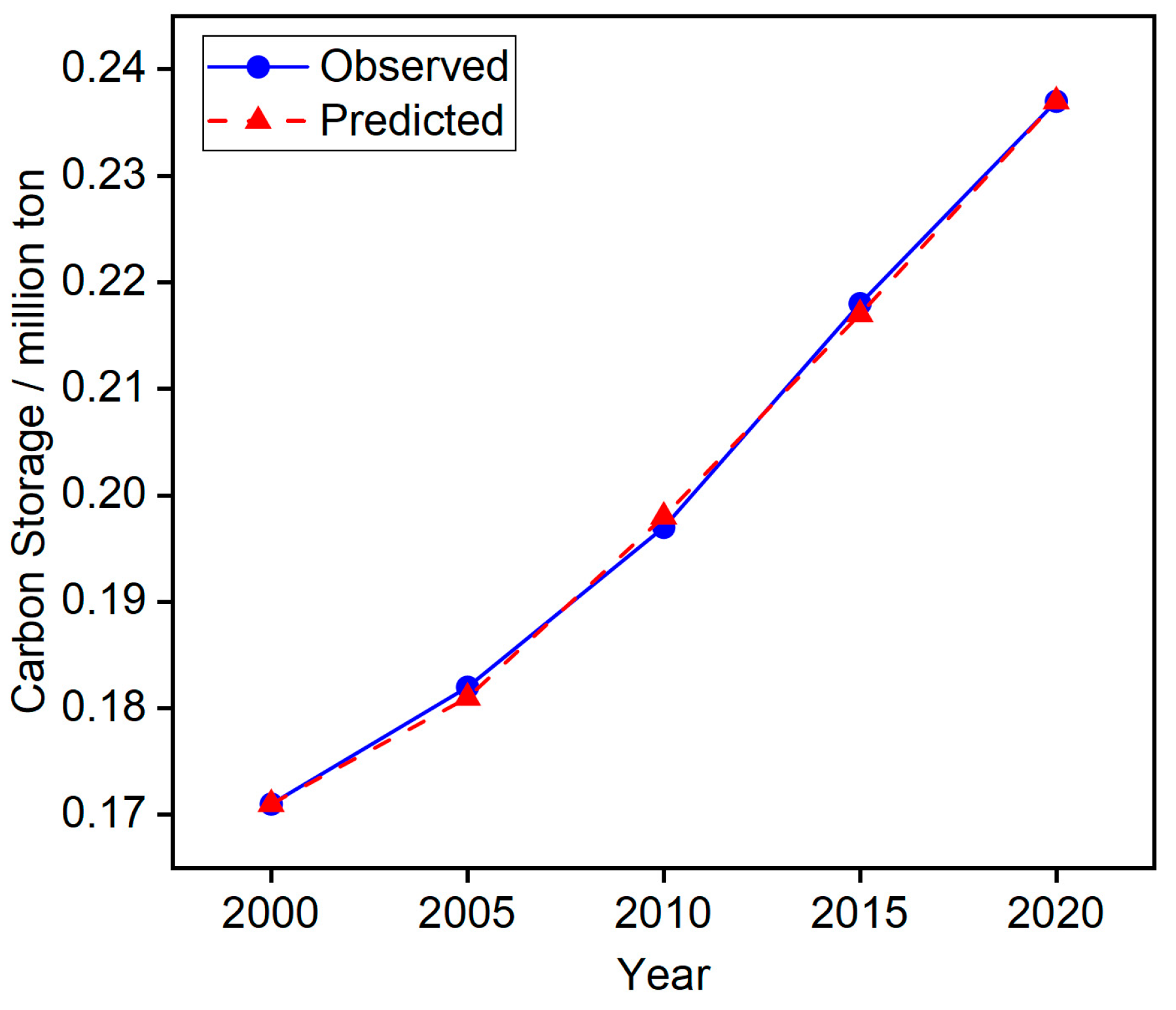
| Year | Observed (Million Metric Tons) | Predicted (Million Metric Tons) | Relative Error (%) | Grade Ratio Deviation |
|---|---|---|---|---|
| 2000 | 0.171 | 0.171 | — | — |
| 2005 | 0.182 | 0.181 | 0.55 | 0.027 |
| 2010 | 0.197 | 0.198 | 0.51 | 0.01 |
| 2015 | 0.218 | 0.217 | 0.46 | 0.012 |
| 2020 | 0.237 | 0.237 | 0 | 0.006 |
Disclaimer/Publisher’s Note: The statements, opinions and data contained in all publications are solely those of the individual author(s) and contributor(s) and not of MDPI and/or the editor(s). MDPI and/or the editor(s) disclaim responsibility for any injury to people or property resulting from any ideas, methods, instructions or products referred to in the content. |
© 2026 by the authors. Licensee MDPI, Basel, Switzerland. This article is an open access article distributed under the terms and conditions of the Creative Commons Attribution (CC BY) license.
Share and Cite
Wang, Y.; Guo, X.; Zhu, H.; Wang, F. Spatiotemporal Patterns of Carbon Storage in Hainan Bamen Bay Mangroves Based on a Decision Tree Classification. Forests 2026, 17, 540. https://doi.org/10.3390/f17050540
Wang Y, Guo X, Zhu H, Wang F. Spatiotemporal Patterns of Carbon Storage in Hainan Bamen Bay Mangroves Based on a Decision Tree Classification. Forests. 2026; 17(5):540. https://doi.org/10.3390/f17050540
Chicago/Turabian StyleWang, Yiwen, Xiyu Guo, Hui Zhu, and Fengxia Wang. 2026. "Spatiotemporal Patterns of Carbon Storage in Hainan Bamen Bay Mangroves Based on a Decision Tree Classification" Forests 17, no. 5: 540. https://doi.org/10.3390/f17050540
APA StyleWang, Y., Guo, X., Zhu, H., & Wang, F. (2026). Spatiotemporal Patterns of Carbon Storage in Hainan Bamen Bay Mangroves Based on a Decision Tree Classification. Forests, 17(5), 540. https://doi.org/10.3390/f17050540

