1. Introduction
Terrestrial ecosystems are increasingly exposed to multiple and interacting disturbances, and these pressures have substantially increased the uncertainty and risk associated with ecosystem states. Given that vegetation is a central regulator of land–atmosphere interactions, understanding its capacity to maintain functioning and recover from external perturbations is a key scientific challenge for elucidating ecosystem stability dynamics and informing appropriate mitigation strategies [
1].
Since the concept of ecological resilience was introduced [
2], its definition and quantitative assessment have remained central to ecological research [
3]. From a methodological perspective, the theory of critical slowing down (CSD) provides a classical framework for indirectly quantifying resilience. As a system approaches a critical threshold, its recovery rate following disturbance declines, typically accompanied by statistical signals such as increasing autocorrelation and variance [
4,
5]. Accordingly, autocorrelation-based metrics—particularly the first-order autoregressive coefficient AR(1)—have been widely used to characterize changes in ecosystem resilience [
3,
6]. However, AR(1) captures a statistical signal of slowing recovery and therefore serves as a proxy for resilience rather than a direct observation of the ecosystem’s immediate recovery speed; its interpretation may also be influenced by the type of observational data, vegetation structure, and preprocessing procedures [
6,
7]. In remote-sensing studies of vegetation resilience based on time-series data, the choice of vegetation-state indicator can directly affect the stability and reliability of resilience estimates. Previous studies have shown that kNDVI is more closely related to vegetation productivity and performs better in terms of resistance to saturation, robustness to noise, and spatiotemporal stability; it has therefore been increasingly used to characterize vegetation ecosystem states [
8,
9]. More importantly, a growing number of recent studies have used kNDVI time series as the basis for deriving resilience metrics such as temporal autocorrelation, AR(1), and TAC to assess vegetation resilience across different regions and ecosystems. For example, Forzieri et al. used kNDVI-based anomaly series to evaluate changes in global forest resilience [
10], Wang et al. combined kNDVI with AR(1) to examine the relationship between vegetation greening and resilience on the Loess Plateau [
9], and Wu et al. used the lag-one autocorrelation of kNDVI to characterize grassland resilience on the Mongolian Plateau [
11]. In addition, Smith and Boers included kNDVI in a global multi-dataset comparison and showed that it can provide reliable resilience estimates under appropriate biomass conditions [
7]. Therefore, kNDVI was used in this study to characterize vegetation state and to derive resilience metrics accordingly.
Satellite observations provide extensive evidence that vegetation resilience has declined over broad areas, though this decline is far from spatially uniform, showing pronounced heterogeneity [
10,
12,
13,
14,
15]. At the global scale, decreasing resilience has been repeatedly reported for forests and terrestrial ecosystems, whereas studies from China and other regional settings likewise reveal marked differences in resilience changes under contrasting drought types, ecological backgrounds, and event characteristics [
16,
17,
18]. In addition, existing evidence suggests that both climatic mean states and climate variability jointly shape ecosystem recovery processes, with water availability, precipitation variability, warming conditions, and drought characteristics acting as major controls on resilience patterns and trends [
13,
14]. Meanwhile, rising atmospheric CO
2 and persistent warming may partially buffer unfavorable climatic influences in some regions, but such buffering effects are neither stable nor spatially universal, and they are often constrained by regional hydrothermal conditions and ecosystem background [
19,
20]. Vegetation responses to climatic stress are also strongly scale-dependent: different biomes show contrasting sensitivities to short- and long-term drought, seasonal processes, and interannual variability [
21,
22]. In particular, semi-arid regions and ecological transition zones tend to contribute disproportionately to interannual ecosystem variability and, therefore, often exhibit more evident shifts in resilience [
17,
18]. It should also be noted that different Earth observation-based resilience metrics do not always yield consistent conclusions, and that seasonal dynamics, long-term trends, and observational noise may all be embedded in vegetation signals, complicating the interpretation of CSD-based resilience indicators [
23]. Taken together, current studies have provided a relatively clear picture of the broad patterns and spatial heterogeneity of vegetation resilience changes, but substantial uncertainty remains regarding the mechanisms underlying these patterns.
In response, increasing attention has turned to identifying the drivers of vegetation resilience. Recent studies have also emphasized that predictive or correlational relationships should not be directly equated with causal attribution [
24,
25,
26,
27]. Existing work at global, national, and regional scales suggests that vegetation resilience is jointly shaped by hydroclimatic conditions and variability, carbon-related background processes, and human influences, although the dominant drivers often differ across biomes, ecoregions, and drought contexts [
13,
16,
17,
18,
28]. Methodologically, most of these studies still rely on correlation analysis, regression-based coefficients, residual trend analysis, explanatory or relative-importance metrics, or interpretable machine learning approaches such as random forests, BRT, and SHAP to identify dominant factors, compare their relative contributions, and characterize nonlinear relationships [
17,
18,
28,
29]. While these approaches have substantially advanced driver diagnosis, they still mainly operate at the level of associative, explanatory, or predictive attribution rather than strict causal attribution. Classical statistical and ecological studies have long distinguished description, prediction, explanation, and causal inference as different inferential goals; accordingly, strong explanatory power or predictive performance does not itself justify causal claims, especially in observational settings where confounding, unobserved confounding, shared background forcing, lagged responses, and scale mismatch are common [
24,
26,
27]. For vegetation resilience, these challenges are particularly acute because multiple climatic, biogeochemical, and anthropogenic controls often covary in space and time. As a result, existing approaches are generally able to identify which factors are associated with resilience changes, but they are much less able to determine through which pathways these drivers act or how large their conditional net effects remain once correlated background conditions are considered. Thus, the central unresolved issue is not simply to continue ranking potential drivers but to move from driver identification toward a causal attribution framework that can distinguish driver identity, pathway interpretation, and effect magnitude [
30,
31].
Recent reviews emphasize that causal questions must be distinguished from correlations, predictions, and general mechanistic explanations, because these differ in their goals, identifying assumptions, and interpretations [
27,
32,
33]. On this basis, the causal literature is commonly organized around two major branches. The first is causal discovery, which seeks to identify latent structural relationships, directions of influence, and causal networks from observational data. The second is causal inference or causal effect estimation, which focuses on quantifying the net effects of specific drivers and their heterogeneity under explicit identification assumptions [
32,
34]. Within causal discovery, methodological development has broadly proceeded along three major lines: constraint-based methods, which rely on conditional independence relations; score-based methods, which learn graph structures via optimization and scoring; and functional causal models, which identify directions through asymmetries in functional form and noise structure. Representative methods include PC, FCI, GES/FGES, LiNGAM, and ANM [
34,
35]. In parallel, causal effect estimation has evolved from earlier approaches such as matching, propensity score methods, inverse probability weighting, g-computation, and instrumental variables toward TMLE and, more recently, high-dimensional causal machine learning approaches such as DML and causal forests. This evolution reflects a broader shift from constructing more credible counterfactual comparisons to estimating average and heterogeneous effects more robustly under complex covariate structures [
32,
36].
As research has increasingly shifted from static to dynamic systems, causal analysis has further expanded into time-series and non-stationary settings, where the main challenges include temporal dependence, lagged pathways, contemporaneous effects, hidden confounding, and structural relations that may change over time [
37]. In this line of work, one of the earliest and most influential approaches was Granger causality, followed by multivariate time-series causal discovery methods such as PCMCI, as well as CCM/cross-mapping for complex nonlinear dynamical systems. When attention shifted from dynamic linkage to possible regime-dependent change, non-stationary causal approaches such as CD-NOD and its later extensions were developed to address structural breaks and mechanism reorganization [
34,
37]. In ecology and environmental science, this methodological development has been accompanied by a parallel expansion in application: research has moved from experimental and quasi-experimental identification toward observational causal inference based on long-term monitoring and multi-source data, and further into Earth-system, biogeochemical, and remote-sensing attribution studies. In these settings, the key challenge is no longer simply whether variables are associated but, rather, how to make more credible attribution statements under multivariate coupling, measurement error, scale mismatch, and dynamic non-stationarity [
26,
27,
33,
37]. From this perspective, the central challenge for large-scale vegetation resilience studies is not merely to identify correlates of change but to simultaneously recover structural clues about potential dominant drivers, estimate their conditional net effects, and determine whether driver–vegetation relationships exhibit lagged propagation and stage-dependent reorganization. This provides the methodological basis for introducing different analytical tools in the subsequent sections.
Over the past 25 years, China has undergone pronounced climate change alongside rapid socioeconomic development. In this context, understanding the spatiotemporal dynamics and driving mechanisms of vegetation resilience is essential for clarifying how ecosystem stability has evolved and why it varies across regions. Previous studies have made substantial progress in characterizing resilience patterns, detecting early warning signals, assessing the impacts of extreme events, and examining multiple environmental drivers. Nevertheless, several key challenges remain in the context of large-scale resilience attribution. First, under high-dimensional covariate co-variation, the net effects of individual environmental drivers are still difficult to distinguish robustly. Second, the spatial heterogeneity of underlying mechanisms has not yet been systematically resolved. Third, under potential structural shifts and non-stationary conditions, it remains unclear whether driver–vegetation relationships undergo stage-dependent reorganization. At the same time, the rapid accumulation of publicly available remote-sensing products has created new opportunities for investigating vegetation resilience at large spatial extents and relatively fine spatial resolutions.
Considering these issues, this study conducts a nationwide analysis at a 1 km spatial resolution. Compared with coarser-resolution data, this scale represents differences in vegetation types more explicitly and reduces the influence of mixed pixels, thereby providing a stronger basis for detecting vegetation responses and spatial variability. However, finer-resolution data also introduce stronger spatial autocorrelation and higher observational noise, which place greater demands on methodological robustness.
Accordingly, this study focuses on three main scientific questions:
- (1)
What are the spatial patterns, long-term trends, and stage-dependent differences in vegetation resilience across China, and how does the relationship between vegetation resilience and vegetation state vary under different ecological contexts?
- (2)
Under high-dimensional covariate co-variation and spatial dependence, what are the magnitudes and directions of the net effects of major climatic and environmental drivers on the resilience proxy, and do these effects exhibit pronounced spatial heterogeneity and ecological-zone dependence?
- (3)
Under potential structural changes and non-stationary conditions, do driver–vegetation relationships show lagged propagation and stage-dependent reorganization, and if so, what are the key variables, dominant pathways, and spatial characteristics of these transitions?
To address these questions, we use the AR(1) coefficient as a statistical proxy for vegetation resilience, and then characterize its spatiotemporal dynamics at a fine spatial scale. We combine spatial causal screening, high-dimensional causal effect estimation, and breakpoint-constrained dynamic mechanism analysis to evaluate structural clues, conditional net effects, and stage-dependent reorganization among potential drivers.
3. Results
3.1. Spatial Pattern of Vegetation Resilience
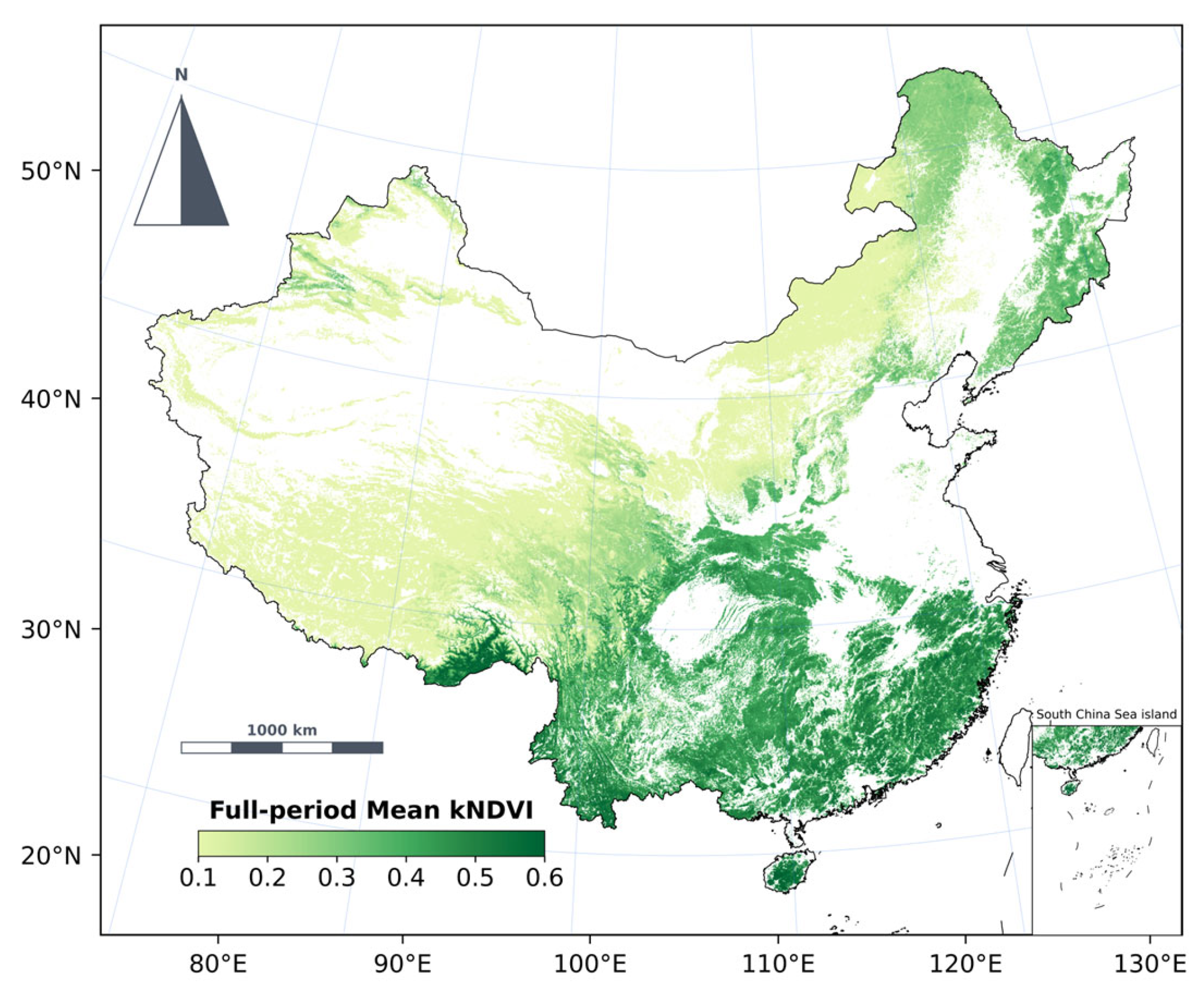
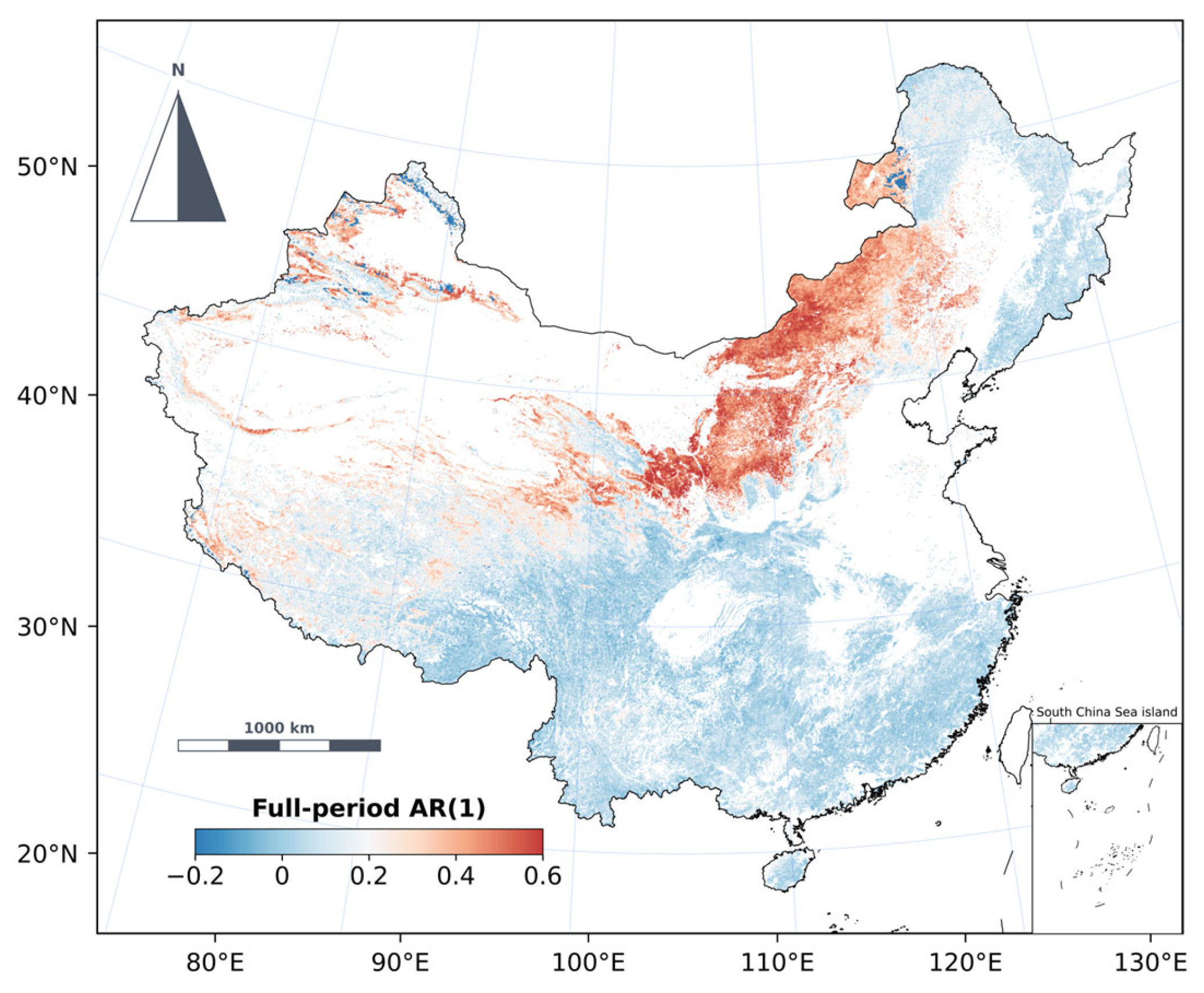
From 2000 to 2024, both vegetation state and the resilience proxy showed pronounced spatial heterogeneity across China (
Figure 2). The multi-year mean kNDVI generally decreased from southeast to northwest. Higher kNDVI values were mainly found in humid and semi-humid regions of southeastern China, especially in areas with dense forest cover and favorable hydrothermal conditions, where the values were mostly around 0.3–0.6. In contrast, lower kNDVI values were concentrated in the arid northwest and high-elevation regions, where they were generally within the range of 0.1–0.3. Overall, this pattern is broadly consistent with regional differences in hydrothermal conditions and vegetation growth background, and it provides the ecological context for interpreting the resilience pattern.
Compared with kNDVI, the spatial pattern of AR(1) (
Figure 3) showed stronger local heterogeneity and more pronounced transition-zone features. Low AR(1) values still dominated across most of the country and were mainly associated with regions with better vegetation conditions and relatively stable ecosystems. Higher AR(1) values, in contrast, were more likely to occur in ecologically fragile areas, climatic transition zones, and regions that are more sensitive to environmental change, often appearing as patchy or belt-like clusters. Because AR(1) is used here as a proxy for vegetation resilience, higher AR(1) generally indicates stronger temporal persistence and more evident critical slowing down, thereby corresponding to lower resilience.
In general, higher kNDVI values were often associated with lower AR(1), but this relationship was not universal across China. Some areas with relatively high vegetation cover still showed elevated AR(1), indicating that greater greenness does not necessarily imply higher resilience. In other words, vegetation state and resilience were related, but they were not equivalent. This result suggests that, at the national scale, ecological stability cannot be inferred from vegetation greenness or productivity alone, and that further causal analysis is needed to identify the key drivers underlying spatial differences in resilience.
3.2. Nonlinear Changes in Vegetation Resilience
3.2.1. Spatiotemporal Distribution of BFAST Breakpoint Years
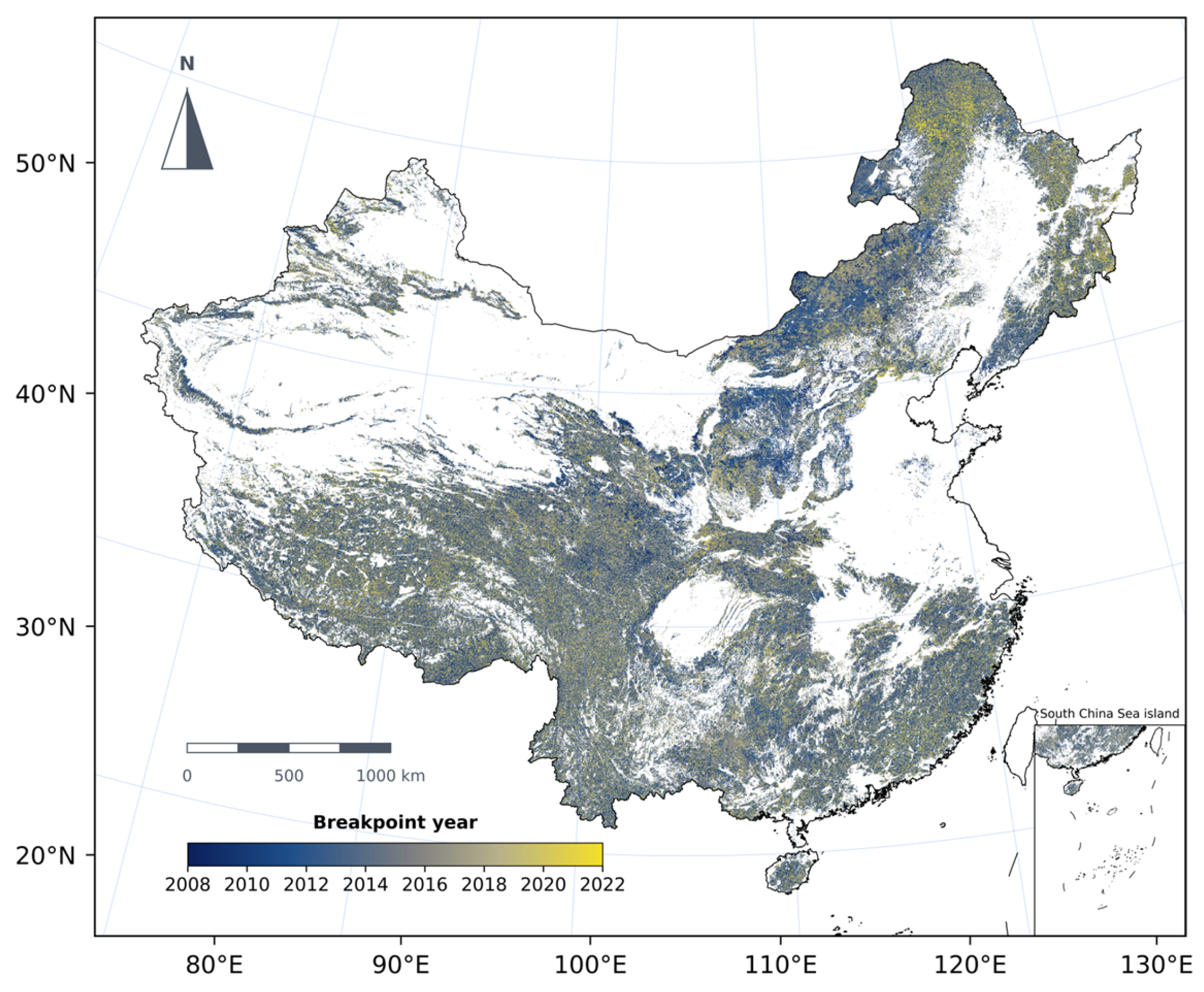
AR(1) is used as an indicator of vegetation resilience, and structural breakpoints can be interpreted as shifts in resilience states. Breakpoint years vary considerably across China (
Figure 4), ranging from 2008 to 2021.
Breakpoint years are distributed across most regions, although some areas exhibit localized patch-like or banded clusters. Most breakpoints occurred between 2010 and 2018. In contrast, northeastern China and parts of the northern interior experienced relatively later transitions, mainly during 2018–2021. These differences indicate that resilience shifts were not fully synchronized nationwide; instead, the transition timing varied across regions while still showing partial temporal coherence.
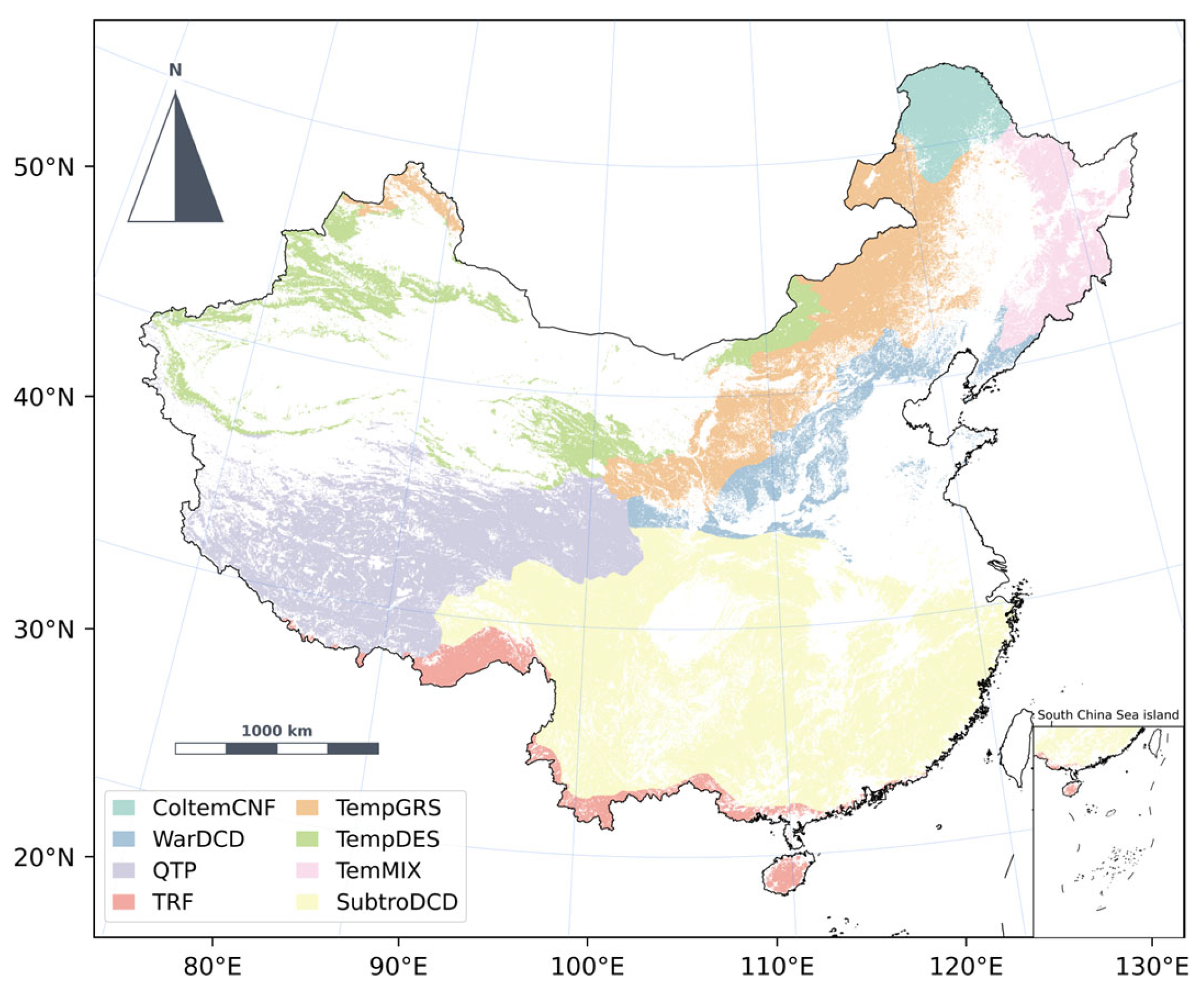
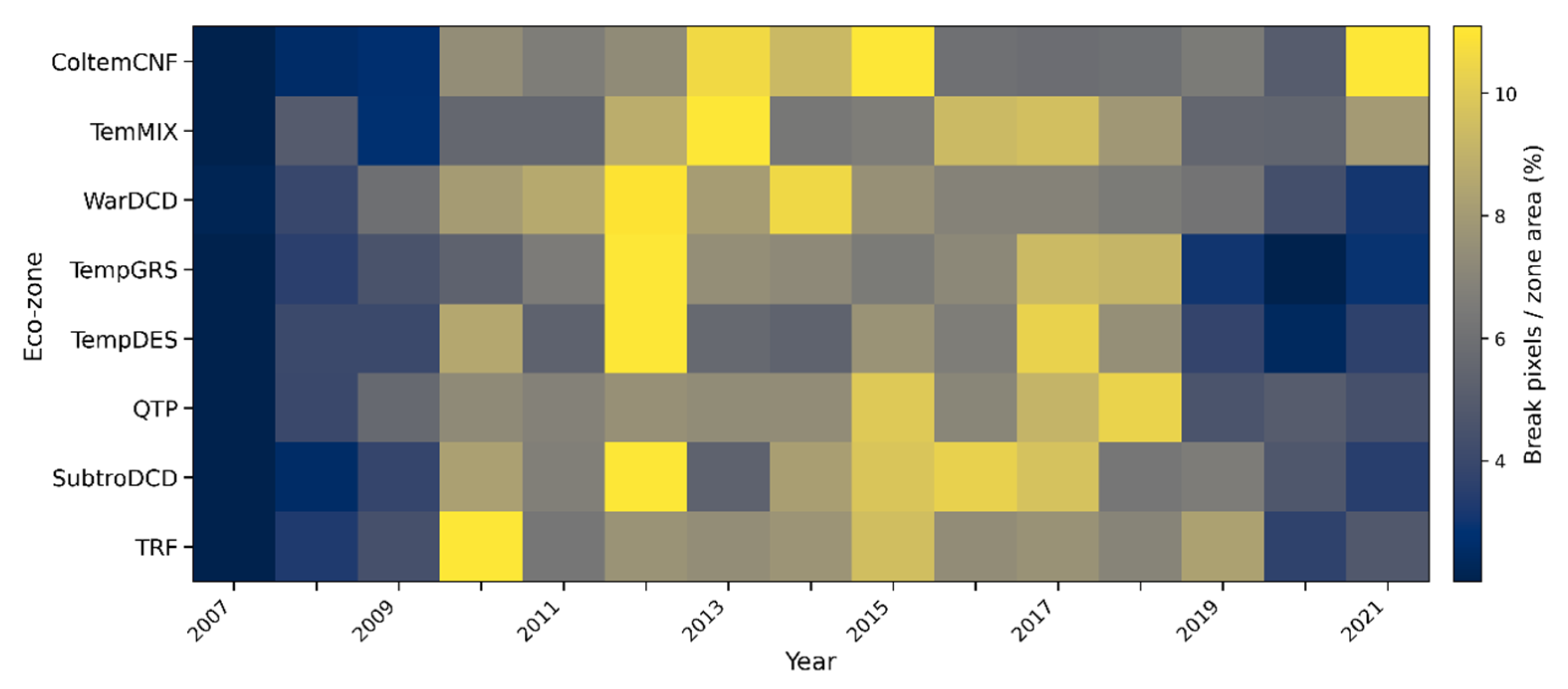
Breakpoint intensity was quantified by aggregating breakpoint pixels within each of the eight terrestrial ecoregions and expressing them as a proportion of the total pixels in each region (
Figure 5). This proportion reflects the relative concentration of structural shifts.
In all of the regions, breakpoint activity exhibited pronounced interannual clustering. A clear synchronous peak occurred in 2012, when several ecoregions recorded proportions exceeding 10%. Another active period was observed between 2015 and 2018, during which most regions showed sustained moderate-to-high breakpoint levels. In contrast, activity remained relatively weak during 2007–2009, and again in 2020–2021.
Temporal dynamics differed among the eight terrestrial ecoregions. Northern forest systems (ColtemCNF and TemMIX) displayed strong activity between 2012 and 2015, with elevated levels persisting locally until 2021. Transitional regions (WarDCD and TempGRS) peaked in 2012 and remained relatively active through 2014–2018. Breakpoints in high-altitude and arid zones (QTP and TempDES) were more concentrated during 2015–2018. In comparison, humid southern regions (SubtroDCD and TRF) exhibited relatively continuous breakpoint occurrences between 2010 and 2016, indicating repeated resilience adjustments over multiple years.
Overall, the breakpoints are not randomly distributed in time. Instead, they are concentrated within key temporal windows—particularly 2012 and 2015–2018—while exhibiting region-specific peak timing and persistence. These findings indicate that resilience shifts are characterized by cross-ecoregional synchrony superimposed on distinct regional response patterns.
3.2.2. Trend Patterns of Vegetation Resilience Before and After Breakpoints
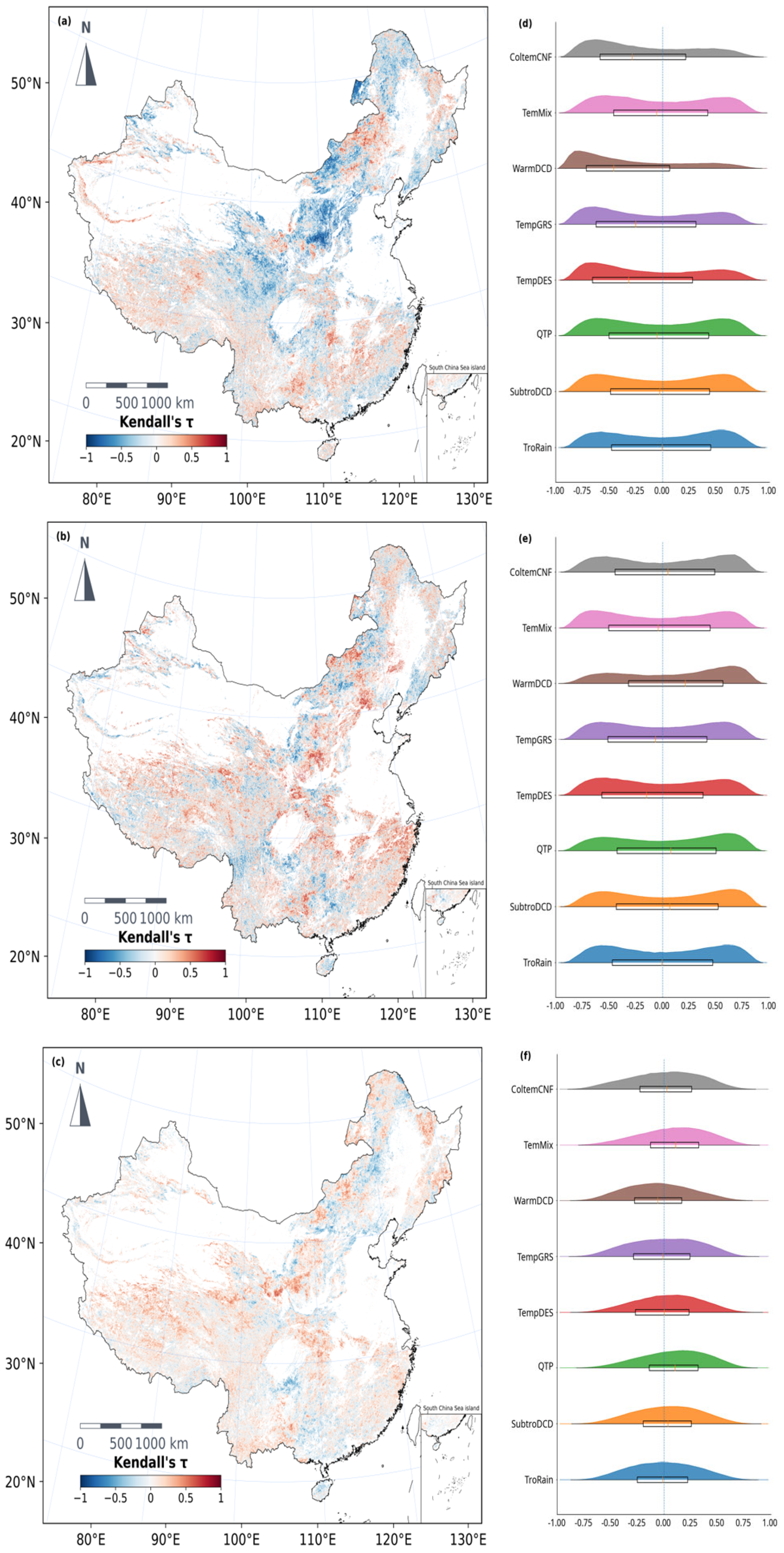
At the national scale, the spatial distribution of Kendall’s τ for AR(1) differs markedly before and after the identified breakpoints (
Figure 6). During the pre-break phase, negative τ values (τ < 0), indicating decreasing AR(1), dominate the mid-latitude transitional belt of northern China and several inland regions. In contrast, during the post-break phase, the proportion of significant pixels with positive τ (τ > 0) increases in multiple regions, particularly in eastern and parts of central China.
The spatial pattern derived from the full study period (2000–2024) appears comparatively weaker and more spatially fragmented. This suggests that the resilience dynamics followed stage-dependent evolutionary pathways across the breakpoint, rather than a single monotonic long-term trend.
At the ecoregional scale, the τ distributions reveal a clear northward shift from predominantly negative skewness to more positive skewness after the breakpoint, whereas arid regions remain largely negatively skewed. Before the identified structural breakpoints, northern ecoregions—including Cold–Temperate Coniferous Forest (ColtemCNF), Warm–Temperate Deciduous Forest (WarDCD), Temperate Grassland (TempGRS), and Temperate Desert (TempDES)—show τ distributions that are generally skewed toward negative values, with medians below zero in most cases. This pattern reflects a tendency for AR(1) to decline more frequently during this stage (i.e., resilience increasing). Humid southern ecoregions, i.e., Subtropical Evergreen Forest (SubtroDCD) and Tropical Monsoon Rainforest (TRF), display τ values clustered closer to zero, implying comparatively limited directional change over the same period. After the breakpoint, the τ distributions shift toward positive values in several forested and high-altitude ecoregions, particularly in WarDCD, parts of ColtemCNF, and the Qinghai–Tibet Plateau (QTP). This shift indicates an increased prevalence of rising AR(1) (i.e., resilience decreasing) after the structural transition. In contrast, Temperate Desert (TempDES) and portions of Temperate Grassland (TempGRS) retain predominantly negative or near-zero τ distributions, suggesting that arid and semi-arid systems did not synchronously transition toward increasing AR(1) after the breakpoint.
Across both pre-break and post-break phases, the relatively wide distribution ranges of τ indicate substantial internal spatial heterogeneity within each ecoregion. Over the full study period, 56.52% of statistically significant pixels exhibited τ > 0, indicating that resilience declined across the majority of regions during the past 25 years.
3.3. Causal Inference Based on GCCM
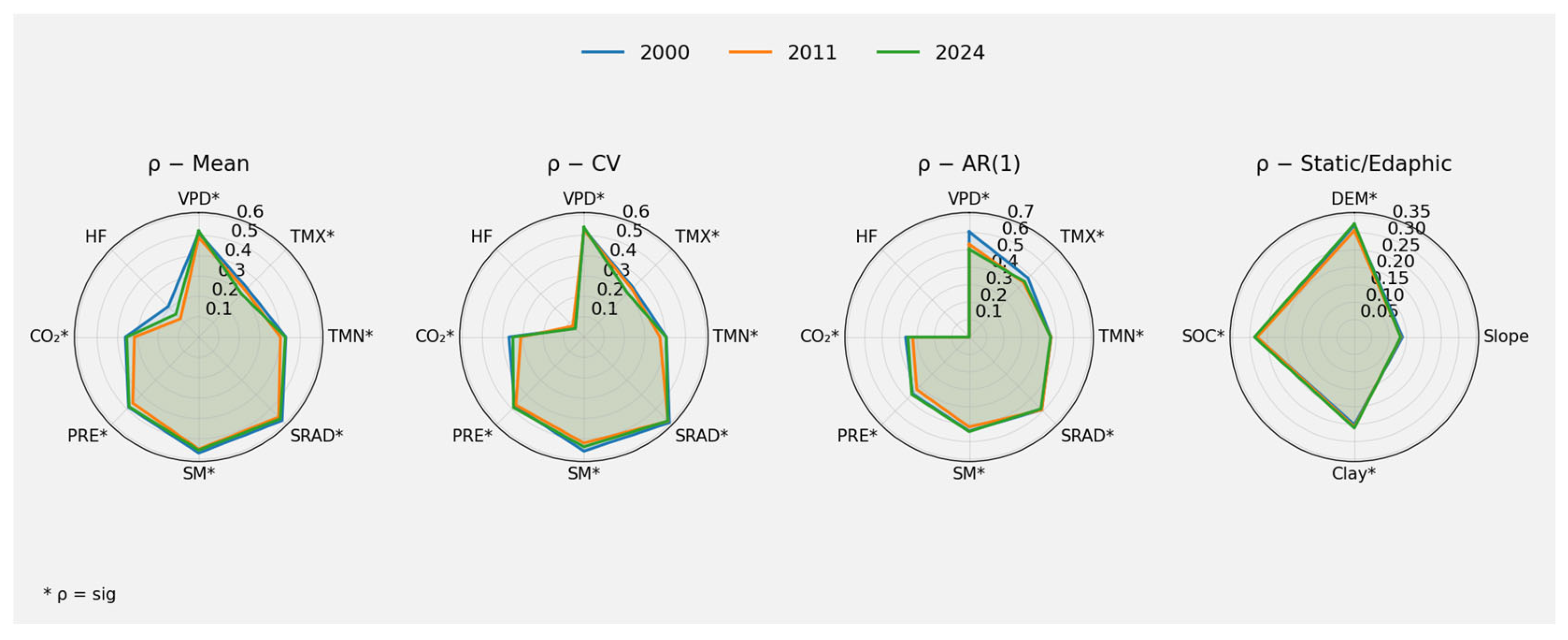
The results of GCCM (
Figure 7) show that PRE, TMN, TMX, VPD, SOIL(SM), SRAD, and CO
2 exhibit relatively high convergent cross-mapping coefficients (
ρ > 0.3) with statistical significance (
p < 0.01), suggesting strong nonlinear coupling with vegetation resilience. In contrast, evaluation (DEM), CLAY, and SOC show moderate convergence strength (
ρ between 0.2 and 0.3,
p < 0.01), indicating intermediate levels of causal association.
For most climatic drivers, the X → Y mapping direction shows consistently higher ρ values than the reverse Y → X mapping, supporting a dominant directional influence from environmental drivers to AR(1) rather than strong feedback effects.
Slope (SLOPE) exhibits relatively weak
X →
Y convergence (
ρ ≈ 0.12–0.15 across the three temporal snapshots), while the reverse mapping remains negligible. The weak and unstable convergence suggests only secondary or indirect influence, potentially reflecting spatial co-variation rather than a robust causal effect; therefore, SLOPE was excluded from subsequent analyses. The human footprint index (HF), used as a proxy for anthropogenic pressure, displays relatively low convergence values (
ρ < 0.25) with noticeable fluctuation and no clear increasing trend along library size (
L). The convergence weakens with increasing
L, and partial intersections between the
X →
Y and
Y →
X curves are observed. The pattern indicates relatively weak coupling and may, in certain cases, reflect bidirectional effects. Part of this signal could stem from spatial heterogeneity as well as the discrete structure of the data. Even so, HF was kept in subsequent analyses to assess whether anthropogenic disturbance plays a measurable role in vegetation resilience dynamics. The spatial distribution maps of SLOPE and HF are provided in
Supplementary Material S3.
We further examined the temporal evolution of
ρ across three representative time slices between 2000 and 2024 (
Table 2). The coupling strength exhibited clear differentiation among drivers. We can see that most variables showed a declining coupling strength over time, whereas only a small number exhibited slight increases.
The most pronounced declines occur in temperature-related variables. For example, TMX_mean decreases from 0.338 to 0.298, TMX_cv from 0.343 to 0.305, and TMX_AR(1) from 0.479 to 0.451. Similarly, VPD_AR(1) declines markedly, from 0.604 to 0.504.
Radiation- and CO2-related variables also show moderate decreases, including SRAD_mean (0.581 to 0.568), SRAD_cv (0.595 to 0.584), SRAD_AR(1) (0.589 to 0.583), CO2_mean (0.361 to 0.355), CO2_cv (0.370 to 0.350), and CO2_AR(1) (0.365 to 0.351). Soil-related variables such as SM_mean (0.570 to 0.556) and SM_cv (0.561 to 0.540) likewise exhibit gradual reductions.
In contrast, increasing trends are observed mainly in precipitation variability and certain soil attributes. Specifically, PRE_cv increases from 0.481 to 0.490 and PRE_AR(1) from 0.460 to 0.466, while soil texture and organic carbon variables (clay and SOC) show slight increases (from 0.251 to 0.261 and 0.281 to 0.287, respectively). Meanwhile, VPD_mean and VPD_cv display modest upward shifts (0.513 to 0.522 and 0.532 to 0.540, respectively).
In summary, the GCCM results suggest that, from 2000 to 2024, the inferred coupling strength between AR(1) and temperature-related variables—particularly TMX—and the memory component of VPD has weakened most clearly, whereas precipitation variability and soil-related coupling exhibit slight enhancements.
3.4. Causal Forest Analysis
3.4.1. Distribution of Estimated Average Treatment Effects (ATE) for Each Drive
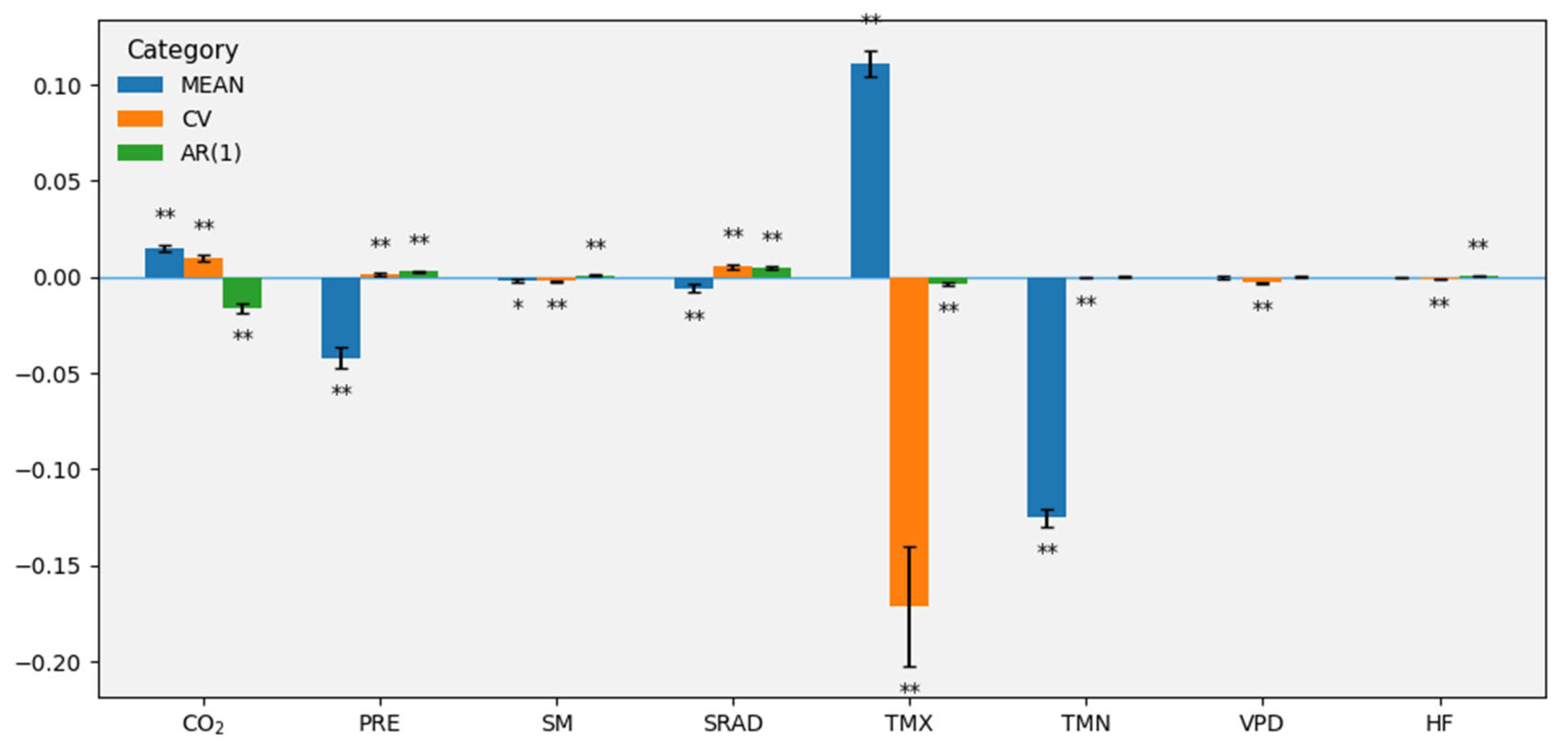
The Causal Forest-estimated average treatment effects (ATEs) reveal a clear dominance of temperature-related variables, whereas other drivers exhibit smaller but often statistically significant effects.
Because increasing AR(1) corresponds to declining resilience under the critical slowing down framework, positive ATE values indicate resilience reduction (AR(1) increase), while negative ATE values indicate resilience enhancement (AR(1) decrease).
The average treatment effects show that temperature-related factors exert the strongest influences on vegetation resilience (
Figure 8). TMX_mean has the largest resilience-reducing effect (ATE = +0.1111, 95% CI [0.0984, 0.1254],
p < 0.001), whereas TMX_cv shows the largest absolute resilience-enhancing effect (ATE = −0.1712, 95% CI [−0.2363, −0.1125],
p < 0.001). TMN_mean also significantly enhances resilience (ATE = −0.1251, 95% CI [−0.1335, −0.1161],
p < 0.001). In comparison, moisture-, radiation-, CO
2-, and human-activity-related variables generally show weaker effects, although many remain statistically significant. For example, PRE_mean enhances resilience, whereas PRE_cv and PRE_AR(1) show small resilience-reducing effects. CO
2-related variables display mixed behavior, with CO
2_mean and CO
2_cv reducing resilience but CO
2_AR(1) enhancing it.
In summary, except for the TMX/TMN mean terms and TMX_cv, most ATE magnitudes are below 0.02 in absolute value, indicating that temperature exerts the dominant national-scale influence on resilience, whereas other drivers contribute secondary but statistically robust effects. A sensitivity experiment excluding the HF variable group yields nearly identical ATE distributions; these results are provided in
Supplementary Material S1.
3.4.2. Pixel-Level Dominant Environmental Drivers
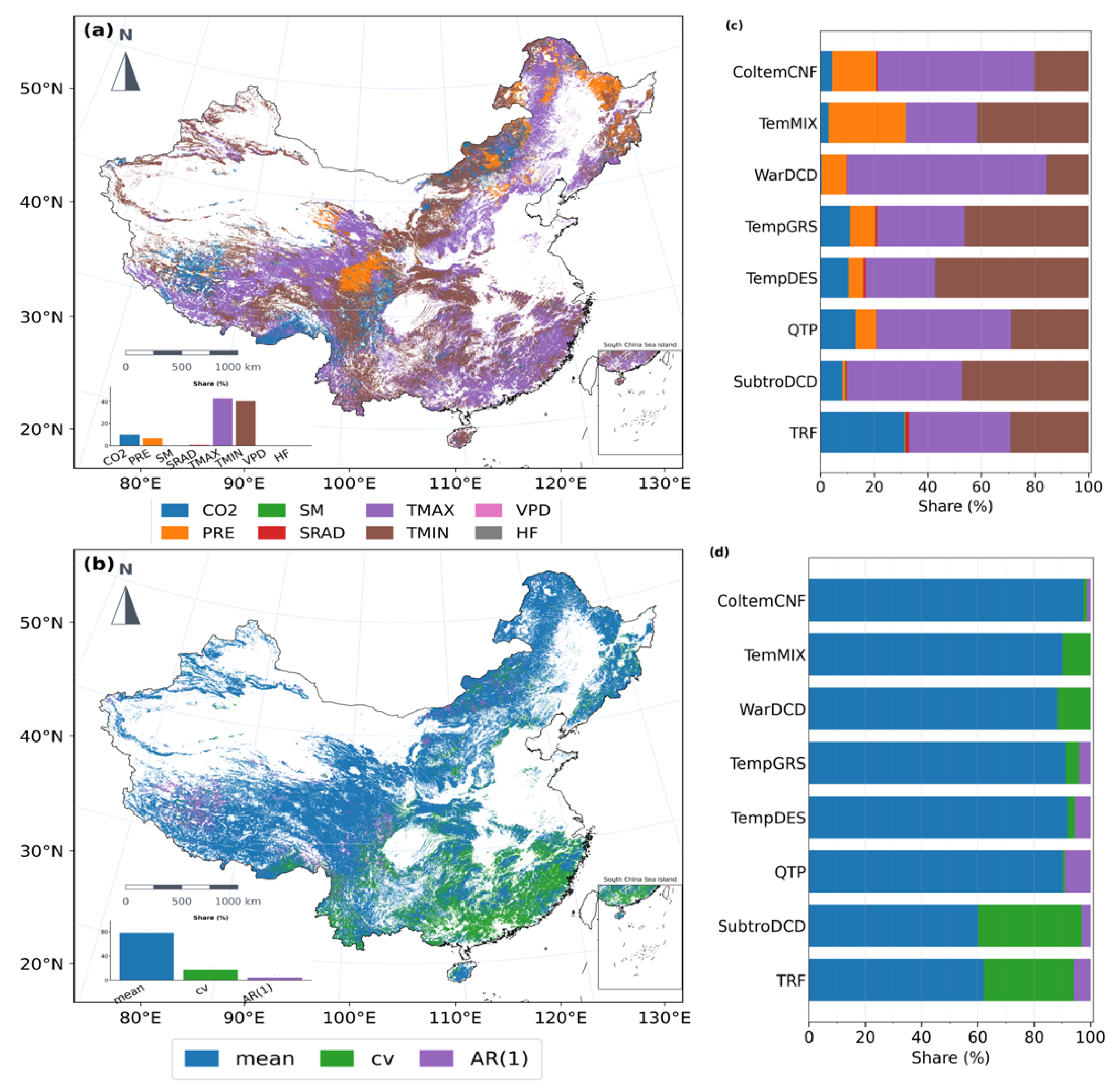
At the national scale, dominant drivers exhibited a clear temperature-dominated pattern (
Figure 9a). TMX and TMN together dominated the vegetation resilience changes in most areas, accounting for 83.21% of pixels, followed by CO
2 (9.80%) and precipitation (6.45%). In contrast, radiation (0.43%), soil moisture and soil-related variables (0.10%), and VPD (0.001%) rarely constituted the dominant drivers.
Spatially, temperature dominance forms a broad and continuous national-scale background. CO2 and precipitation dominance appear in more fragmented, patch-like distributions. CO2 dominance is more concentrated along the southwestern plateau margins and mountainous regions, whereas precipitation dominance clusters in the northeastern and northern transitional zones.
The dominant drivers are primarily associated with mean-state information rather than variability or memory terms (
Figure 9b). Nationally, mean-type variables account for 78.32% of dominant pixels, cv-type variables for 17.25%, and AR(1)-type variables for only 4.42%. Within climate drivers, dominance is overwhelmingly driven by mean and variability terms (climate_mean: 74.06%; climate_cv: 15.99%; climate_AR(1): 0.15%). In contrast, CO
2 dominance shows substantial participation of the memory component: CO
2_mean and CO
2_AR(1) each account for 4.27%, indicating that when CO
2 becomes dominant, its temporal autocorrelation structure frequently contributes alongside mean-state effects.
There were clear differences in dominant drivers among the eight terrestrial ecoregions, and these differences showed a broad north–south pattern (ColtemCNF → TemMIX → WarDCD → TempGRS → TempDES → QTP → SubtroDCD → TRF). Overall, temperature-related variables dominated in most ecoregions, but the leading temperature component varied across regions. In the northern and mid-latitude ecoregions, vegetation resilience was more often controlled by daytime maximum temperature. WarDCD was the clearest example, and ColtemCNF also showed strong TMX dominance. In contrast, TempGRS and TempDES were more strongly controlled by TMN, suggesting a greater role of minimum-temperature conditions in grassland and arid systems. TemMIX showed a different pattern; in this region, precipitation made a much larger contribution and, together with TMN, formed a more balanced temperature–moisture control. This suggests that ecosystems in this transitional zone are more sensitive to joint changes in water and heat conditions. On the Qinghai–Tibet Plateau, temperature still played the leading role, but the contribution of CO
2 was relatively high, indicating stronger CO
2 sensitivity in high-elevation ecosystems. TRF was the most distinct region. Although temperature-related variables remained important, the contribution of CO
2 was much higher than in other ecoregions and was close to that of temperature. Precipitation and soil moisture rarely acted as the dominant drivers there. The dominant variable types also differed strongly among ecoregions (
Figure 9d). ColtemCNF was almost entirely dominated by mean-type variables, indicating that vegetation resilience in this region mainly responded to changes in average climate conditions. In contrast, the contribution of cv-type variables increased clearly in SubtroDCD and TRF. This suggests that climate variability itself more often becomes the dominant signal in humid southern ecosystems. AR(1)-type variables were most prominent in QTP and were also relatively important in TempDES and TRF. This pattern suggests that vegetation resilience in plateau and some arid systems is more strongly influenced by temporal memory effects and persistent processes. In summary, national-scale dominance is centered on temperature mean-state effects. Although CO
2 dominance accounts for roughly 10% nationally, it becomes substantially stronger in TRF and QTP and frequently involves temporal memory (AR(1)). Meanwhile, variability-type dominance increases in subtropical and tropical systems, highlighting differentiated dominant information structures between ecosystem types.
3.5. Causal Mechanism Reorganization on CD-NOTS
To characterize the breakpoint-related reorganization of driver–vegetation interactions, we analyzed CD-NOTS outputs in three dimensions: First, we examined dominant-driver reorganization, including changes in dominant-driver composition, transition matrices, and spatial hotspots of key transitions. Then, we quantified the structural reorganization of significant driver edges using edge-presence indicators derived from , and we summarized keep/gain/loss/none categories and network connectivity (degree). Thirdly, we assessed response-timescale reorganization using lag shifts () and their magnitude distributions for pixels with significant edges in both periods (keep pixels).
3.5.1. National-Scale Changes in Dominant Driver Composition and Transition Patterns
For each segment (pre- and post-breakpoint), we ran CD-NOTS independently and used the association-strength raster bestcoef (pre/post) to quantify the conditional association strength of each driver at its optimal lag (as indicated by bestlag_(pre/post)). At each valid pixel, the dominant driver was defined as the variable with the largest absolute conditional association magnitude among drivers showing a significant vegetation link; pixels without any significant driver–vegetation link were labeled as “none”. Unless otherwise stated, national-scale statistics were computed over all valid pixels (n = 4,654,452), with composition percentages additionally reported after normalization to pixels with definable dominant drivers in given segment; transition probabilities were computed on pixels with definable dominant drivers (definable pixels).
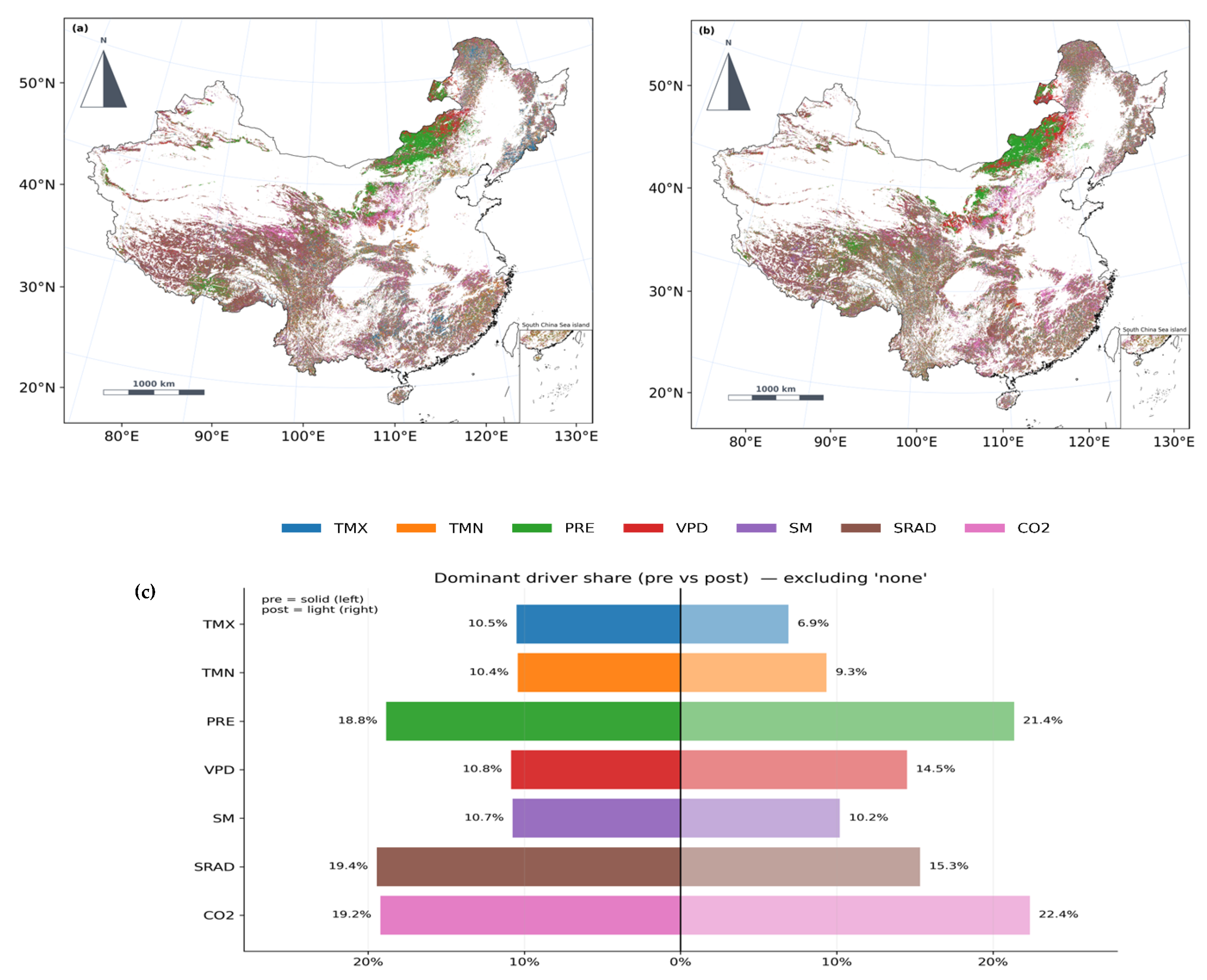
Before the breakpoint, the national-scale dominant-driver composition (excluding “none” and normalized over pixels with definable dominant drivers in the pre-breakpoint period; n = 3,907,436) exhibits a pattern of joint dominance by energy- and carbon–water-related controls (
Figure 10c). SRAD (19.4%) is the most prevalent category, followed closely by CO
2 (19.2%) and precipitation (PRE; 18.8%), which together form the leading group. The remaining drivers contribute comparable shares, including VPD (10.8%), soil moisture (SM; 10.7%), maximum temperature (TMX; 10.5%), and minimum temperature (TMN; 10.4%).
After the breakpoint, the dominant-driver composition undergoes a clear reorganization (
Figure 10c). In terms of coverage, the number of pixels with a definable dominant driver decreases from 3,907,436 (83.95%) in the pre-breakpoint period to 3,754,157 (80.66%) in the post-breakpoint period, and the “none” category increases accordingly from 16.05% to 19.34% (+3.29 percentage points). Considering definable pixels only (excluding “none”), the post-breakpoint composition shifts toward stronger water- and carbon-related dominance and weaker energy- and heat-related dominance: CO
2 increases from 19.2% to 22.4% (+3.2), PRE from 18.8% to 21.4% (+2.6), and VPD from 10.8% to 14.5% (+3.7). In contrast, SRAD declines from 19.4% to 15.3% (−4.1), and TMX decreases from 10.5% to 6.9% (−3.6), with smaller decreases for TMN (10.4% → 9.3%; −1.1) and SM (10.7% → 10.2%; −0.5).
The dominant mechanism displays a pronounced patchy–banded spatial pattern (
Figure 10a,b). The agro-pastoral ecotone of northern China and the arid–semi-arid transition zone emerge as the most active hotspots of dominant-driver reorganization. In contrast, the southwestern plateau and adjacent mountainous regions exhibit more spatially coherent and contiguous dominance structures, primarily linked to SRAD, SM, and CO
2.
To quantify dominant-driver switching, we define the transition probability as
where
is the count of pixels transitioning from category i (pre) to category j (post), and
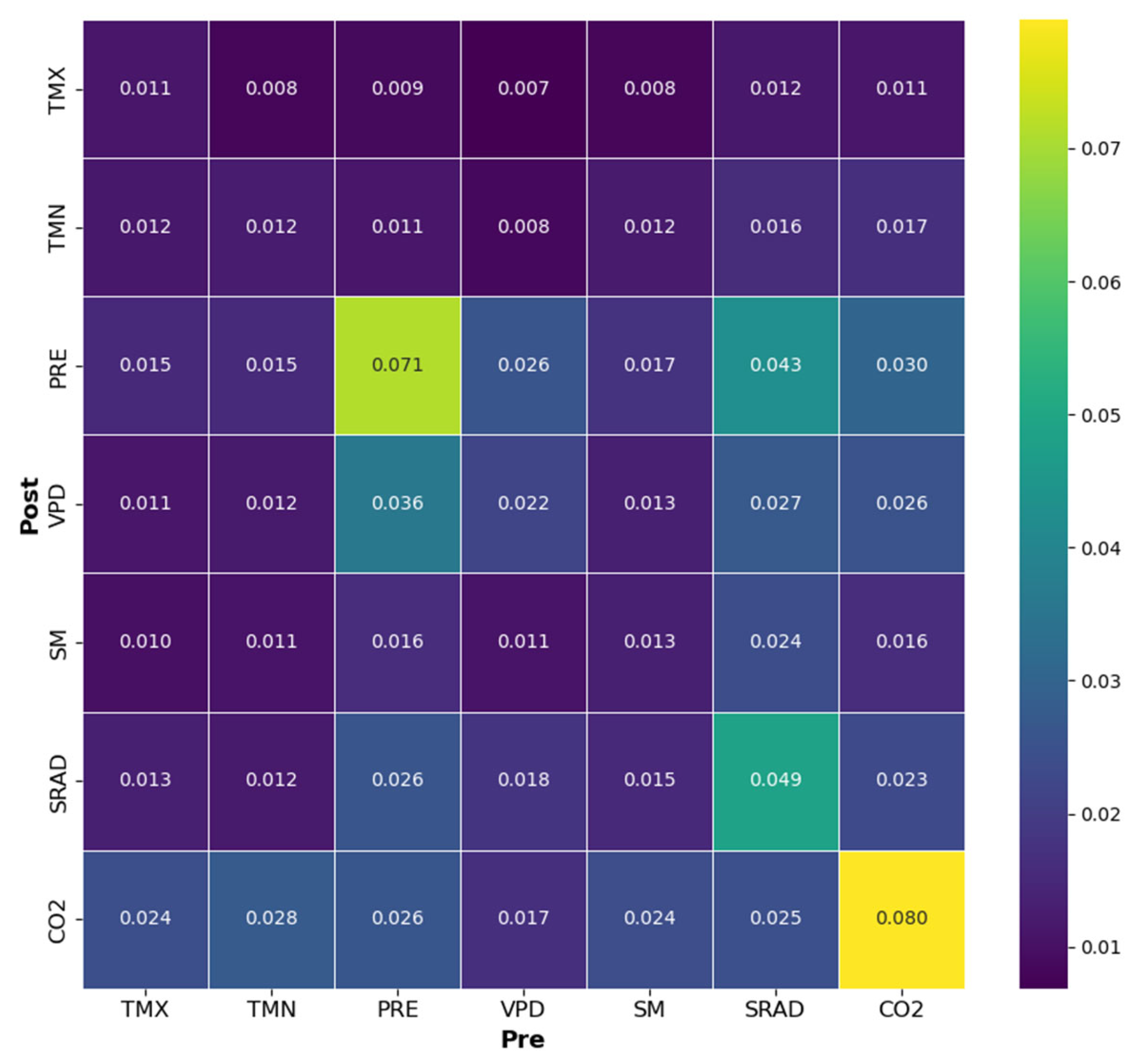
is the number of pixels with definable dominant drivers in both stages. The transition matrix highlights pronounced reorganization of dominant drivers (
Figure 11). Diagonal entries account for 25.83% of pixels, indicating that only about one-quarter retain the same dominant category across the breakpoint, whereas most pixels shift in dominant control.
Excluding self-transitions, SRAD → PRE (4.29%) is the largest single cross-category shift, meaning that a big number of pixels switch from radiation control to precipitation control. This aligns with the overall compositional change after the breakpoint—SRAD becomes less prevalent while PRE gains share. At the same time, PRE and VPD show strong two-way switching—PRE → VPD (3.61%) and VPD → PRE (2.58%)—reflecting alternating dominance between water-supply limitation and atmospheric evaporative demand across dry–wet transition zones. CO2 and PRE also exchange frequently in both directions (CO2 → PRE: 3.05%; PRE → CO2: 2.63%), suggesting tight coupling—and mutual replacement—between hydroclimatic regulation and CO2-related background effects across the breakpoint. In addition, TMN → CO2 (2.75%) is another major pathway, indicating that, in some regions, CO2-related control strengthens after the breakpoint and replaces minimum-temperature dominance in a non-trivial fraction of pixels.
To characterize the spatial concentration of driver switching, we applied a 2° × 2° grid-based hotspot counting and ranking analysis for the main transition types (
Table 3). Hotspots of PRE → VPD are concentrated mainly within 112–118° E and 42–46° N. One representative grid cell at 116° E/44° N alone accounts for 8.76% of this transition, forming a continuous high-frequency belt from Inner Mongolia to the southern margin of northeast China. A secondary hotspot appears over the northern Loess Plateau (around 106° E, 36–38° N). The reverse shift, VPD → PRE, also clusters strongly along the same belt and in parts of the Loess Plateau, and the strong overlap between the two directions points to active back-and-forth switching between precipitation control and aridity control in this transition zone. Hotspots of SRAD → PRE show a clear two-center pattern: one in the high-latitude north (e.g., 116° E, 48–50° N) and another across several grids in the western plateau–arid region (e.g., 88–90° E, 28–30° N). This suggests that shifts from radiation dominance to precipitation dominance occur both along the northern transition belt and in parts of the plateau and nearby arid areas. In contrast, transitions into CO
2 dominance (e.g., TMX → CO
2, TMN → CO
2, SM → CO
2) are more scattered and multi-centered, spanning the Loess Plateau–Inner Mongolia belt, the northeastern Tibetan Plateau margin, the Yunnan–Guizhou Plateau and southwestern mountains, and parts of the eastern monsoon region. This implies that CO
2 dominance is expanding beyond a single climatic belt and manifests across multiple eco-climatic transition zones.
In summary, dominant drivers reorganize strongly across the breakpoint, with a stability (self-transition) of only 25.83%. Compositionally, SRAD and TMX lose importance after the breakpoint, while VPD, PRE, and CO
2 gain. Spatially, these changes are concentrated in major eco-climatic transition belts, especially Inner Mongolia–southern northeast China, the Loess Plateau, and the western plateau–arid regions (
Figure 10 and
Figure 11;
Table 3).
3.5.2. Spatial Reorganization of Significant Driver Edges
We quantified driver-edge reorganization using the pixel-wise outputs of CD-NOTS run separately for the pre- and post-breakpoint segments. For each driver
, a significant edge (driver
resilience) at a pixel was defined when CD-NOTS detected a significant link for that driver in the corresponding segment (bestlag_d
−1); otherwise, the edge was treated as absent. Analyses were restricted to the same valid-pixel domain as in
Section 3.5.1 (skip_reason = 0,
). For each driver, we constructed binary edge-presence sets
and
, and we classified the pixel-wise changes as keep (
), gain (
), loss (
), and none (absent in both periods). The union (%) in
Table 3 was computed as
, while pct_keep/pct_gain/pct_loss are reported within the union set for each driver. Network connectivity (degree) was defined as the number of significant driver edges (across the seven drivers) connected to the resilience node at each pixel, and Δdegree was calculated as
−
and then summarized by ecoregion.
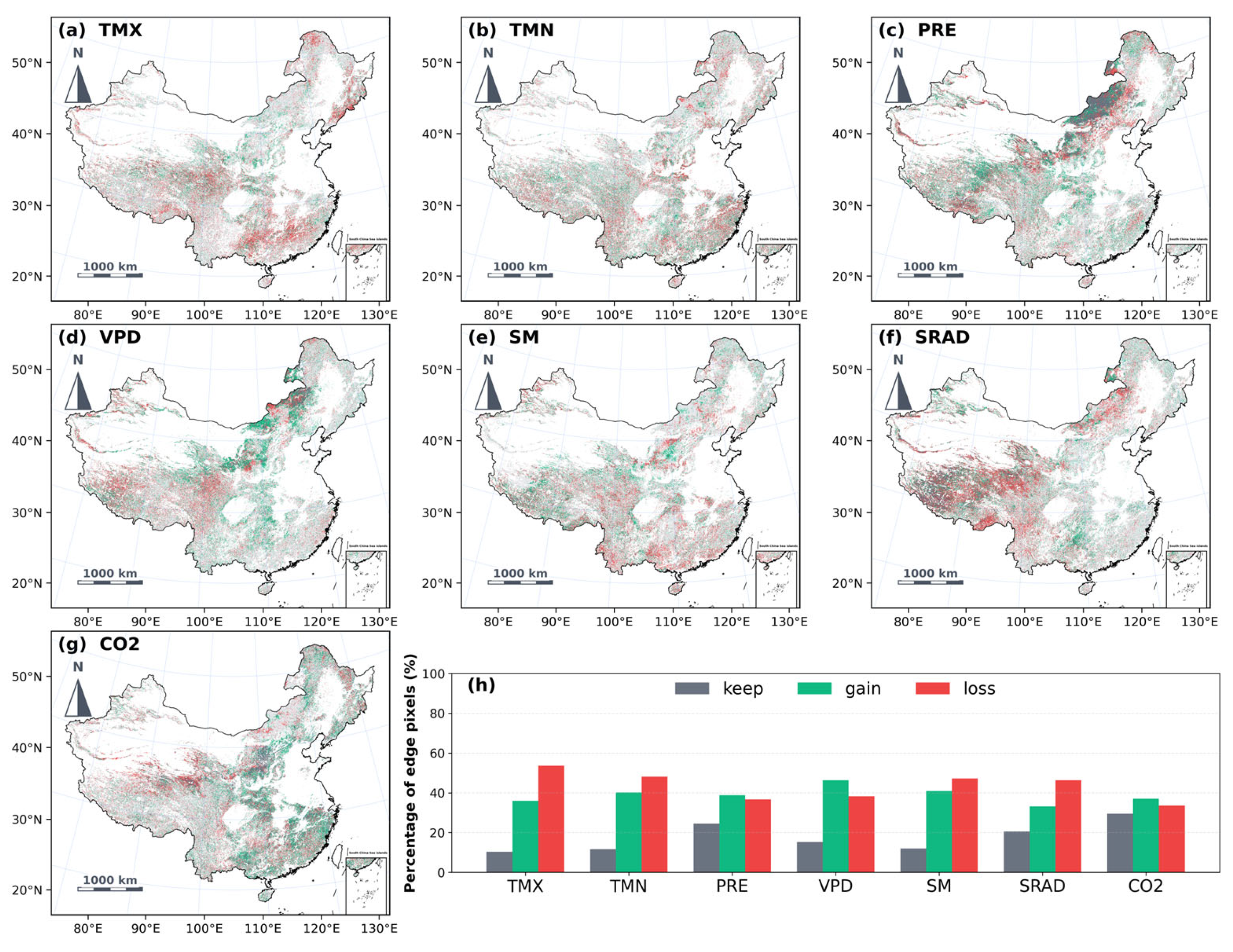
At the national scale, significant driver-edge reorganization shows clear differences among drivers (
Table 4). The share of pixels with at least one significant edge in either period (union) ranges from 30.87% to 45.96%. Precipitation (45.96%) and CO
2 (44.54%) have the broadest spatial coverage, followed by SRAD (42.14%), whereas TMX is much more limited (30.87%). In other words, precipitation- and carbon-related edges are detected across a wider portion of the study area, while temperature-related edges are confined to a smaller spatial domain.
Within the union set, the relative shares of keep, gain, and loss (
Table 4) vary substantially across drivers. The keep proportion ranges from 10.40% to 29.47%, being the highest for CO
2 (29.47%) and precipitation (24.53%), intermediate for SRAD (20.56%), and lowest for TMX (10.40%), TMN (11.66%), and SM (11.93%). The lower keep values indicate weaker cross-breakpoint persistence and more pronounced reorganization in these drivers.
Comparing gain and loss, VPD, CO2, and precipitation show an overall expansion tendency, whereas TMX, SRAD, TMN, and SM tend to contract. This pattern is better described as a redistribution within the driver network than as the uniform strengthening of any single driver. Expansion is concentrated in VPD-related, CO2-related, and precipitation-related edges, whereas SRAD-related and TMX-related edges contract more strongly. At the same time, CO2 and precipitation retain a relatively larger share of persistent edges across periods.
While the national statistics summarize the overall direction of change,
Figure 12 shows where keep, gain, and loss are concentrated for each driver. For TMX, loss is the dominant class (53.57%) and keep is low (10.40%), indicating a broad post-breakpoint reduction in significant TMX-related edges. Spatially, loss is concentrated across northeast China and extends over large parts of eastern and southern China. TMN shows a similar contraction pattern. Loss (48.14%) is slightly higher than gain (40.20%), while keep remains low (11.66%). In the maps, gain and loss form alternating belt-like patterns across northern and northeastern China. Precipitation (PRE) has a relatively high keep proportion (24.53%), suggesting stronger cross-period persistence than most other drivers. A coherent retained cluster is visible in northeast China, whereas gain and loss are more scattered in other regions. VPD shows the clearest expansion signal. Gain reaches 46.38%, and the national increase in edge prevalence is the largest among all drivers. Newly emerged significant edges are mainly clustered in northeast China and the northern transition zone. Soil moisture (SM) tends to contract overall, with loss concentrated in southern and eastern China. Gain pixels are sparse and scattered, suggesting mostly localized adjustments rather than broad expansion. SRAD also shows marked contraction, with loss clearly exceeding gain and the strongest national decline in edge prevalence. Loss is concentrated in the southwestern mountains and along the eastern margin of the Tibetan Plateau. CO
2 combines relatively high keep (29.47%) with an overall expansion tendency. Gain pixels are concentrated in southeastern and southern China, while retained edges remain widely distributed.
As shown by the driver-specific keep/gain/loss patterns in
Figure 12, these shifts are not spatially uniform, motivating a further comparison across the eight terrestrial ecoregions. To compare how these national-scale shifts vary among ecosystems, we examined edge reorganization and changes in network connectivity (Δdegree) across the eight terrestrial ecoregions. Here, degree was defined as the number of significant driver edges connected to the resilience node (across the seven candidate drivers) at each pixel, and Δdegree was calculated as the post-breakpoint degree minus the pre-breakpoint degree, and then summarized at the ecoregion level. Edge reorganization is evident in all ecoregions, but its magnitude differs; ColtemCNF and TemMIX show stronger restructuring, whereas TempGRS is comparatively weaker.
Network connectivity exhibits pronounced heterogeneity across ecoregions (
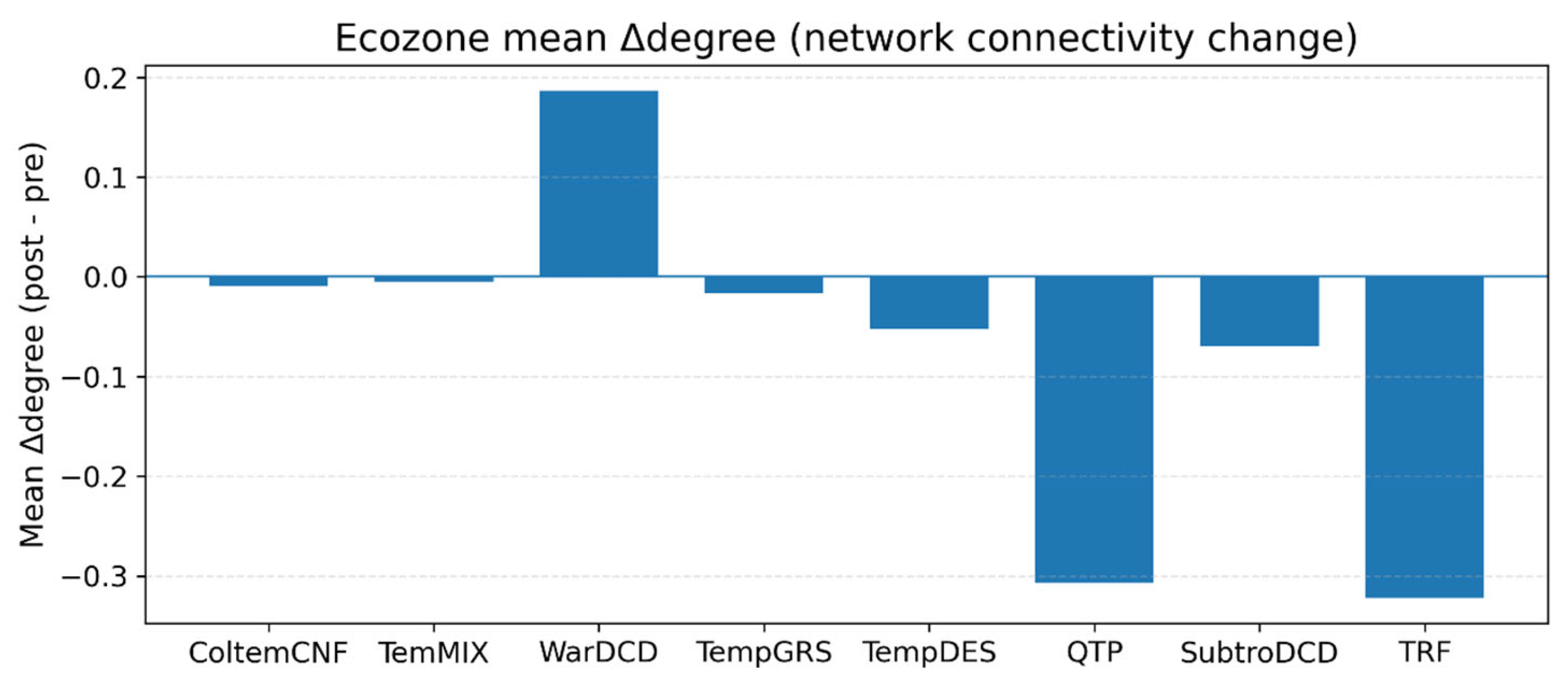
Figure 13). After the breakpoint, connectivity declines in most regions, with the largest decreases observed in TRF (−0.322) and QTP (−0.307), indicating substantial network sparsification. SubtroDCD (−0.070) and TempDES (−0.052) show only modest reductions, whereas WarDCD is the only ecoregion displaying increased connectivity (+0.187), suggesting a trend toward network densification.
Notably, connectivity changes are not uniform across regions. In ColtemCNF and TemMIX, overall connectivity remains nearly stable (Δdegree close to zero), indicating that structural adjustments occurred without large-scale loss of connections. In contrast, TRF and QTP exhibit clear connectivity declines accompanied by pronounced sparsification.
In summary, the driver–response network undergoes substantial but uneven structural shifts following the breakpoint. Some regions maintain relatively stable connection patterns, while others experience marked reductions in connectivity. These contrasting responses indicate that ecoregions follow distinct structural pathways under breakpoint influence. The breakpoint is therefore associated not only with changes in dominant drivers but also with broader spatial differentiation in the structural configuration of driver–response networks across ecosystems.
3.5.3. Driver–Response Timescale Reorganization and Lag-Shift Patterns
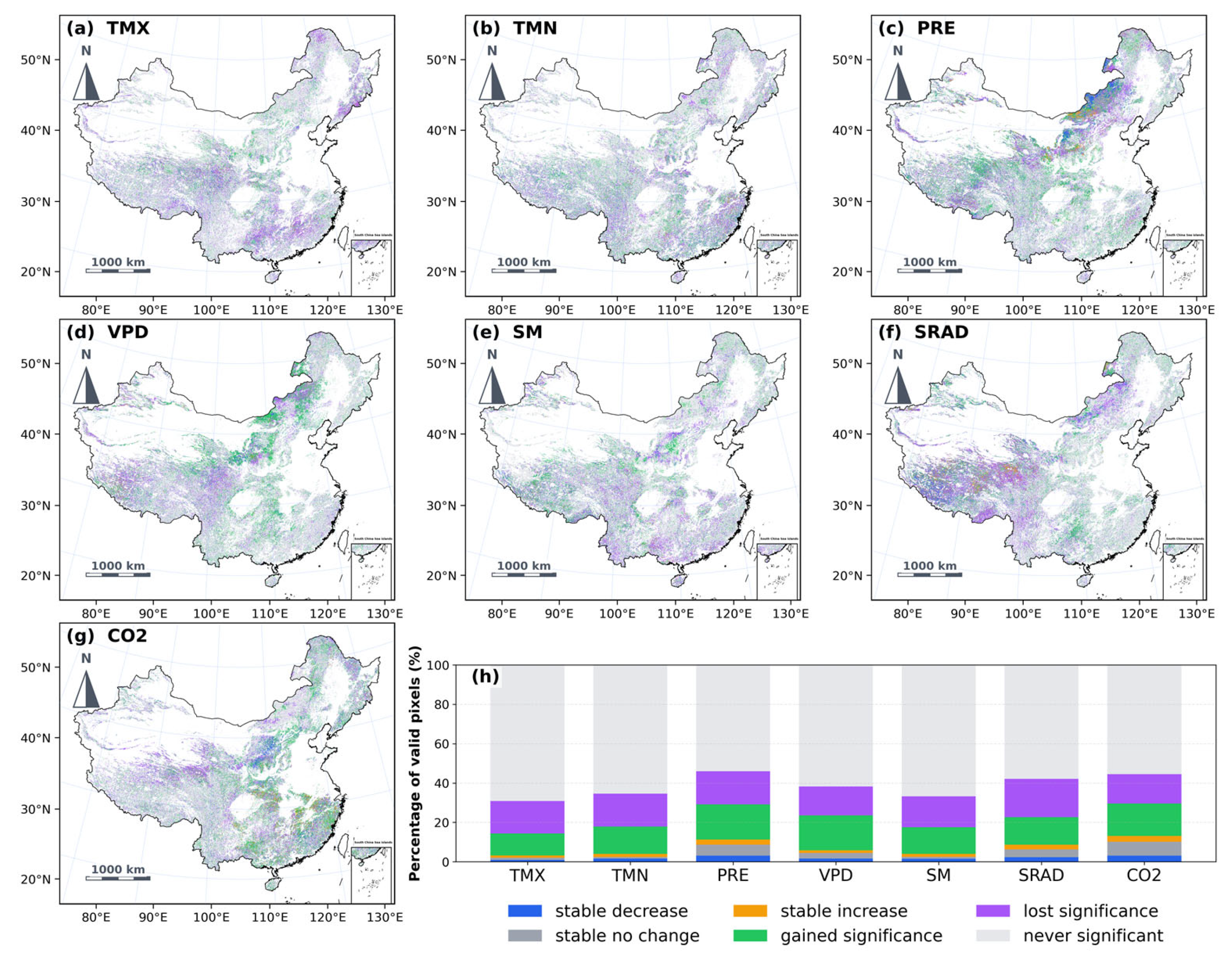
Using the optimal lag order (best lag) determined separately for the pre- and post-breakpoint periods, lag responses were evaluated for valid pixels. Each driver was subsequently classified into one of six categories (
Figure 14): stable decrease (significant in both periods with Δlag < 0), stable no change (Δlag = 0 in both periods), stable increase (Δlag > 0 in both periods), gained significance (not significant before but significant after the breakpoint), lost significance (significant before but not after), or never significant (non-significant in both periods).
The sum of the three stable classes represents pixels that remain statistically significant in both periods (hereafter referred to as the stable significant zone). Lag-direction comparisons (Δlag) are meaningful only within this intersection set. Gained and lost significance describe turnover in statistical detectability, whereas never significant represents the dominant background, where no significant causal edge is identified in either period.
At the national scale, never significant ranges from 54.04% to 69.13% across drivers (mean: 61.49%). TMX shows the highest proportion (69.13%), whereas PRE shows the lowest (54.04%). This indicates that, for most regions and most drivers, no statistically significant causal edge is detected in either period. Consequently, lag comparisons are restricted to a relatively limited subset of stable significant pixels (
Figure 14a–g).
At the national scale, the proportions of gained significance and lost significance generally exceed that of the stable significant zone, indicating that breakpoint-related restructuring is primarily expressed as changes in statistical significance rather than lag adjustment. Gained significance ranges from 11.12% to 17.86% (mean: 14.95%), with the highest values for PRE (17.86%) and VPD (17.72%), and the lowest for TMX (11.12%). Lost significance ranges from 14.63% to 19.50% (mean: 16.40%), peaking in SRAD (19.50%) and reaching its minimum in VPD (14.63%). Most drivers exhibit lost ≥ gained (e.g., SRAD, TMN, TMX), whereas VPD and (to a lesser extent) PRE show a slight dominance of gained significance.
In contrast, the proportion of the stable significant zone is relatively small, ranging from 3.21% to 13.13%, with substantial inter-driver variability. CO2 accounts for the largest area of stable significance (13.13%), followed by precipitation (11.27%), while SRAD occupies an intermediate position (8.66%). In contrast, TMX shows the smallest stable area (3.21%), with SM (3.97%) and TMN (4.03%) remaining comparatively limited.
Interpretation of lag direction (Δlag < 0, =0, or >0) applies only to pixels that are significant in both periods. Accordingly, conclusions regarding lag reconfiguration refer to a spatially restricted subset.
Spatial patterns further reveal three recurring structural configurations across drivers:
- (1)
Significance contraction pattern (e.g., TMX and SRAD).
For these drivers, lost pixels equal or exceed gained pixels, and stable significant areas remain limited. Breakpoint-related change is therefore expressed mainly as contraction of statistically detectable edges, rather than as adjustment of lag. In TMX, never-significant pixels dominate (69.13%), the proportion of lost pixels (16.54%) exceeds that of gained pixels (11.12%), and the stable zone is small (3.21%). SRAD shows a similar tendency, with the highest lost proportion among drivers (19.50%). In both cases, lag-direction analysis is restricted by the limited spatial extent of stable significant pixels.
- (2)
Pronounced lag heterogeneity (e.g., TMN and SM).
Although stable significant coverage is small (TMN: 4.03%; SM: 3.97%), lag adjustment within that subset is substantial. For TMN, negative (39.45%) and positive (40.38%) Δlag are nearly balanced, while unchanged lag accounts for 20.17%, indicating strong but bidirectional reorganization. SM follows a comparable pattern, with Δlag = 0 representing 25.20% and a high change_intensity (0.748). In both cases, the lag structure shifts considerably without a clear dominant direction.
- (3)
Expansion with relative stabilization (CO2, PRE, and VPD).
These drivers combine relatively broad, stable significant zones with higher shares of unchanged lag. CO2 exhibits the largest stable area (13.13%) and the highest proportion of Δlag = 0 within that area (53.94%), together with the lowest change_intensity (0.461). PRE shows a similar configuration (stable zone: 11.27%; Δlag = 0: 49.44%), with a slight tendency toward negative lag shifts. VPD displays moderate stable coverage (5.85%), but gained pixels exceed lost pixels, suggesting that change is expressed primarily through the expansion of statistical detectability rather than substantial lag adjustment.
Across drivers, breakpoint-related restructuring is more strongly reflected in shifts in statistical significance than in lag modification. Lag reorganization is concentrated in pixels that remain significant in both periods. CO2 and precipitation show the greatest spatial persistence and relatively stable temporal alignment, whereas temperature- and soil-moisture-related drivers exhibit stronger but more spatially restricted lag restructuring.
4. Discussion
4.1. Spatial Vulnerability Patterns and Breakpoint Clustering of AR(1)-Based Resilience
The spatial pattern of AR(1), used here as a proxy for vegetation resilience, exhibited clear spatial differentiation. Lower AR(1) values were generally observed in humid southern regions and parts of southwestern China, whereas elevated values formed clustered and banded structures across the northern mid–high-latitude transition belt and several inland areas. Recent studies have increasingly used kNDVI-based time series to characterize vegetation resilience in China and surrounding dryland–forest transition systems. For example, research on the Loess Plateau showed that resilience derived from kNDVI and AR(1) did not increase consistently with vegetation greening, indicating that higher greenness does not necessarily imply stronger resilience [
9]. Similar kNDVI-based resilience analyses on the Mongolian Plateau, in subtropical evergreen forests of southern China, and in southwest China have also reported pronounced spatial heterogeneity and region-dependent shifts in resilience dynamics [
11,
51,
52]. These findings are broadly consistent with our results, in which vegetation state and resilience show related but non-equivalent spatial patterns, while breakpoint timing and post-break trajectories differ substantially among ecoregions.
The banded aggregation of elevated AR(1) values in northern China is best explained by the combined effect of hydroclimatic constraints and amplified interannual variability. Extensive research indicates that semi-arid and transitional ecosystems are highly sensitive to precipitation deficits and atmospheric drought, often exhibiting pronounced vegetation responses at relatively short drought timescales [
21,
53]. These regions also play a disproportionate role in regulating the interannual variability in the global terrestrial carbon sink, implying that their ecological dynamics are more tightly coupled with climate fluctuations [
54,
55]. Consistent with this interpretation, northern ecoregions such as ColtemCNF and TemMIX show not only prominent breakpoint peaks during 2012–2015 in the breakpoint heatmap (
Figure 5) but also localized resurgence in later years (e.g., 2021). This pattern likely reflects that high-latitude forest and transition systems may experience delayed or multi-phase breakpoint clustering. Accordingly, the elevated AR(1) signals identified in the northern transition zone are most plausibly explained by semi-arid sensitivity combined with amplified interannual variability. In contrast, interpreting resilience signals in high-biomass regions such as TRF requires greater emphasis on relative changes and multi-source validation, including joint interpretation with subsequent analyses of mechanism–network reorganization.
Consistent with this interpretation, northern ecoregions such as ColtemCNF and TemMIX show not only prominent breakpoint peaks during 2012–2015 in the breakpoint heatmap (
Figure 5) but also localized resurgence in later years (e.g., 2021). This pattern likely reflects that high-latitude forest and transition systems may experience delayed or multi-phase breakpoint clustering. Accordingly, the elevated AR(1) signals identified in the northern transition zone are most plausibly explained by semi-arid sensitivity combined with amplified interannual variability. In contrast, interpreting resilience signals in high-biomass regions such as TRF requires greater emphasis on relative changes and multi-source validation, including joint interpretation with subsequent analyses of mechanism–network reorganization.
This pattern aligns with the documented intensification of compound climate extremes in China in recent decades, including heatwave–drought interactions and abrupt dry–wet transitions. For example, comprehensive analyses of the strong 2015–2016 El Niño event report increased drought frequency in northeastern China (summer 2015), northwestern China (spring 2016), and across large areas during the winter of 2015 [
56]. Meanwhile, the prolonged and severe drought in southwestern China during 2009–2010 had significant effects on vegetation indices and productivity [
57].
4.2. Interdecadal Shifts in GCCM Coupling Signals
For screening plausible causal signals, GCCM indicates that multiple climatic and environmental variables exhibit relatively strong and statistically significant convergence in the driver → AR(1) direction. Precipitation, TMN, TMX, VPD, soil moisture, shortwave radiation, and CO
2 generally show ρ values > 0.3, with significant convergence as the library size increases. Topographic and soil variables (DEM, clay, and SOC) show moderate coupling strength. Although the human footprint (HF) yields lower ρ values and less consistent bidirectional patterns, it was retained as an indicator of anthropogenic pressure to facilitate comparison with subsequent effect-estimation results [
43].
Temperature-related metrics exhibit the most pronounced declines, particularly the mean, coefficient of variation, and AR(1) of TMX. The AR(1) of VPD also decreases substantially. Radiation- and CO
2-related statistics show overall weakening. In comparison, precipitation-related variability increases slightly. Particularly, temperature-related coupling and atmospheric drought-related memory coupling appear to weaken, whereas variability-related water constraints and background soil controls become relatively more prominent. This pattern is consistent with previous evidence suggesting a broad-scale shift from energy limitation toward water limitation in many temperate and high-latitude ecosystems of the Northern Hemisphere [
58,
59], as well as with studies documenting inhibitory effects of increasing VPD on vegetation growth, photosynthesis, and interannual variability in terrestrial carbon sinks. However, GCCM-derived ρ reflects nonlinear coupling strength and directional clues in spatial cross-sections, and it should not be interpreted as direct proof of net causal effect magnitude under controlled confounding [
60,
61,
62,
63].
Comparison with the dominant-driver shifts derived from CD-NOTS (
Figure 10c) suggests partial convergence across methods. Although the two approaches target different ecological dimensions, both are anchored in vegetation system dynamics. Specifically, CD-NOTS characterizes shifts in the dominant controls on vegetation state as reflected by kNDVI, whereas GCCM and the subsequent effect-estimation framework focus on changes in the coupling structure and estimated effects associated with vegetation resilience, for which AR(1) is used here as a proxy. In this context, the broad consistency in directional change before and after the breakpoint is still informative: TMX-, TMN-, and SRAD-related signals tend to weaken under both approaches, whereas increases in precipitation- and VPD-related dominance appear to be linked mainly to stronger variability or background-state coupling. These cross-method consistencies support the interpretation of stage-specific reorganization of vegetation–climate relationships, while also highlighting clear methodological boundaries [
63,
64].
4.3. DML–Causal Forest Estimates of Conditional Net Effects
4.3.1. Background Climatic Controls and Regional Divergence of Dominant Mechanisms
At the national scale, vegetation resilience responses are most strongly associated with the thermal background state. The multi-year mean of maximum temperature (TMX_mean) shows a significant positive effect on AR(1), is associated with higher AR(1) values and, under the AR(1)-based proxy framework, is consistent with slower system adjustment. In contrast, the multi-year mean of minimum temperature (TMN_mean) exhibits a negative effect on AR(1), is associated with lower AR(1) values, and may be consistent with faster adjustment under the resilience-proxy interpretation [
10].
In contrast, higher minimum temperatures may reduce cold stress and extend the effective growing season in temperature-limited regions, thereby lowering temporal autocorrelation and accelerating recovery. This interpretation is consistent with studies showing that diurnal asymmetric warming can exert contrasting ecological effects, with daytime heat stress often constraining productivity, while moderate nighttime warming may relieve low-temperature limitations [
65,
66]. Previous global-scale analyses of forest resilience have emphasized the role of heat stress and evaporative demand in shaping resilience decline under ongoing warming [
10]. Experimental and observational studies further highlight the importance of evaporative demand and atmospheric dryness in regulating vegetation productivity [
67,
68].
The strong negative national effect of the TMX variability metric (TMX_cv; −0.1712) warrants a more careful interpretation. Decomposition of weighted contributions across ecoregions shows that the Tropical Monsoon Rainforest (TRF) contributes −0.1520, accounting for approximately 88.8% of the total national negative effect, whereas other regions—such as TempGRS (−0.0109) and TemMIX (−0.0063)—contribute comparatively little. The national mean effect therefore reflects pronounced spatial heterogeneity rather than a uniformly distributed response. A more appropriate formulation is that the impact of the TMX variability indicator on AR(1) is strongly ecoregion-dependent, with the aggregate signal largely driven by TRF, where water-related variables are rarely identified as dominant drivers in the present effect-estimation framework. Instead, ecosystem dynamics are more sensitive to variability in radiation, cloud cover, and monsoon-driven alternations between overcast and high-radiation conditions. Under these conditions, the coefficient-of-variation metric of TMX may function partially as a proxy for high-frequency atmospheric forcing and radiative fluctuations. Stronger high-frequency external forcing can modify the statistical structure of vegetation residuals (after STL decomposition), potentially reducing temporal autocorrelation. In such cases, a reduced AR(1) may reflect changes in residual memory structure rather than a genuine acceleration of ecological recovery. Methodological considerations further support this cautious interpretation. Dense, high-biomass tropical forests are prone to optical index saturation and complex noise structures. AR(1)-based resilience proxies derived from remotely sensed vegetation indices may therefore be more sensitive to observational noise and external variability in these systems [
10]. Consequently, the pronounced negative coefficient of TMX_cv in TRF may partially capture changes in residual time-memory properties induced by external high-frequency forcing, rather than a substantial enhancement of intrinsic ecosystem resilience.
Pixel-level dominant-driver attribution provides additional insight into spatial control patterns. At the national scale, temperature-related mechanisms account for the majority of dominant effects. Metrics linked to maximum and minimum temperature together represent 83.21% of the dominant contributions, followed by CO
2-related mechanisms (9.80%) and precipitation-related mechanisms (6.45%). Across all dominant metrics, background climatic states constitute the primary control dimension (78.32%), whereas variability regimes account for 17.25%, and autocorrelation structures contribute only 4.42%. Ecoregion-level decomposition further reveals regional pathway divergence underlying the national-scale patterns. WarDCD is characterized by an exceptionally high TMX dominance (74.51%), indicating that vegetation in this warm, dry region is more directly affected by excessive daytime temperature. In contrast, TemMIX shows a much larger precipitation contribution (28.85%), suggesting that vegetation dynamics there are more strongly regulated by moisture availability and hydroclimatic fluctuations. In QTP, the higher share of CO
2 dominance (12.98%) may be associated with the particular environmental sensitivity of alpine ecosystems, where gradual background changes can have amplified ecological effects. TRF shows the strongest CO
2 signal (31.22%), which may reflect the fact that in humid forest systems, where direct water limitation is weaker, long-term background forcing related to CO
2 becomes relatively more prominent than short-term hydrothermal constraints. These spatial contrasts align with two established lines of evidence: First, global greening attribution studies highlight the importance of CO
2 fertilization in enhancing long-term vegetation productivity [
20]. Second, the spatial partitioning of limiting factors (energy vs. water limitation) implies that identical external forcing may manifest through distinct pathways across ecosystems [
60,
61,
62,
69].
4.3.2. Robustness of Causal Estimation
Independent subsample validation shows close agreement between training and test ATEs across treatments. Placebo permutation tests provide further evidence, as randomly shuffled treatments produce effect estimates centered near zero (
Supplementary Material S2, Table S3). Spatial block bootstrap analyses across aggregation scales from 75 to 400 km reveal a clear hierarchy of robustness [
70,
71]. A substantial group of core variables—including thermal metrics (TMX-related metrics and TMN_mean), CO
2 metrics (mean, variability, and autocorrelation), VPD variability, precipitation mean and autocorrelation, soil moisture variability, radiation autocorrelation, and the variability/persistence components of HF—remain significant at both the 95% and 99% confidence levels across all tested block sizes. Their stability across scales suggests that these effects are not driven by localized clustering or residual spatial autocorrelation but instead reflect broadly distributed structural controls (
Supplementary Material S2, Table S5).
Other variables exhibit progressive attenuation as spatial aggregation becomes coarser, pointing to regionally concentrated rather than nationwide influence. Precipitation variability (PRE_cv), for example, remains significant at both the 95% and 99% levels up to 250 km, weakens to 95%–only significance at 300 km, and becomes non-significant at 350–400 km. A similar pattern appears for the radiation mean (SRAD_mean), which loses significance under coarser aggregation. The soil moisture mean (SM_mean) represents the most marginal case: it is only weakly significant at the primary 200 km scale (95% but not 99%,
p ≈ 0.047) and becomes non-significant at ≥250 km. These patterns indicate that attenuation under larger block sizes is concentrated in secondary hydroclimatic background metrics and reflects limited effect magnitude and spatial concentration, rather than instability of the overall causal framework (
Supplementary Material S2, Table S5).
Multiple-testing correction using the Benjamini–Hochberg false discovery rate (BH-FDR) procedure [
72] further confirmed that the principal effects remain statistically robust after controlling for multiplicity (
Supplementary Material S2, Table S4).
In summary, these robustness analyses demonstrate that the identified causal effect structure is not an artifact of model specification, sample partitioning, or spatial dependence assumptions. Vegetation resilience dynamics, as proxied by AR(1), exhibit a stable climate-dominated control architecture across samples and spatial scales, with thermal and carbon-related drivers showing the strongest structural autocorrelation, consistent with recent global-scale resilience evidence [
10].
4.3.3. Anthropogenic Effects and Metric Sensitivity
In contrast to the robustness assessment above, the evaluation of anthropogenic influence addresses a distinct mechanistic question. The GCCM framework did not detect significant convergent causal relationships between human footprint (HF) variables and AR(1). However, within the DML–Causal Forest framework—after adjusting for climatic and environmental covariates—certain HF metrics exhibit weak but statistically detectable net effects.
This apparent discrepancy arises from methodological differences in causal identification. GCCM (and related convergent cross-mapping approaches) relies on state-space reconstruction and convergence properties, detecting dynamic embedding-based causal dependence and, therefore, favoring strong dynamical coupling relationships [
73]. In contrast, Causal Forest estimates conditional average treatment effects under controlled covariate adjustment, capturing conditional net effects after covariate adjustment. A variable may lack strong dynamic reconstructability while still exerting a weak but consistent conditional statistical effect.
Specifically, HF_mean remains non-significant at the national scale, whereas HF_cv shows a small resilience-enhancing effect and HF_AR(1) produces a slight resilience-reducing effect. Importantly, these effects are approximately two orders of magnitude smaller than those associated with dominant thermal drivers; thus, even when statistically detectable, the HF-related effects are structurally marginal relative to background climatic forcing.
This interpretation is also consistent with previous evidence showing that anthropogenic influences on vegetation dynamics can be substantial in some regions but are highly pathway- and region-dependent, with both positive and negative effects depending on land-use management, restoration, and disturbance regimes [
74,
75]. In summary, the differences between GCCM and Causal Forest are better viewed as complementary rather than contradictory.
4.4. CD-NOTS Evidence for Breakpoint-Associated Causal Network Reorganization
4.4.1. Dominant Drivers Switching Across Breakpoints
Within the set of pixels where dominant drivers are identifiable in both periods, the sum of diagonal entries in the transition matrix is 25.83%, exhibiting a change in dominant-driver category across the breakpoint.
Among off-diagonal transitions, SRAD → PRE(4.29%) represents the largest single pathway. Bidirectional exchanges between VPD and PRE (PRE → VPD: 3.61%; VPD→ PRE: 2.58%) suggest recurring shifts between precipitation supply and atmospheric demand constraints. Transitions between PRE and CO2 are also notable (CO2 → PRE: 3.05%; PRE→ CO2: 2.63%), which may reflect redistribution between water limitation and background carbon forcing.
These transition patterns can be more plausibly interpreted as shifts in dominant constraint signals rather than simple strengthening or weakening of individual drivers. The relatively frequent PRE → SRAD transitions suggest reorganization between water- and energy-limited regimes [
62]. In northern transitional zones, two-way substitution between VPD and PRE may indicate alternating dominance of supply- vs. demand-side water constraints—a pattern that is compatible with the documented role of VPD in regulating vegetation growth, photosynthesis, and carbon sink variability [
61]. The spatial clustering of dominant transitions in transition belts and plateau margins may further reflect sensitivity to regional climate background and extreme-event exposure.
4.4.2. Edge Reorganization and Pathway Rewiring
Across drivers, edge reorganization is widespread, but the balance among keep, gain, and loss differs clearly. Within the union set (pixels with at least one significant edge in either period), CO2 (29.47%) and precipitation (24.53%) show the highest keep proportions, indicating relatively stronger cross-breakpoint persistence. SRAD is intermediate (20.56%), whereas TMX (10.40%), TMN (11.66%), and SM (11.93%) show much lower keep values, suggesting that temperature- and soil-moisture-related edges are more frequently replaced after the breakpoint.
Differences in the gain–loss balance further indicate contrasting directions of reorganization among drivers. VPD shows the highest gain share (46.38%) and a larger gain than loss (38.31%), pointing to the expansion of statistically detectable VPD-related edges in many regions. CO2 also shows relatively strong persistence together with substantial gain (36.97%) and lower loss (33.56%), while precipitation combines high keep (24.53%) with a near-balanced but slightly gain-dominant pattern (38.87% gain vs. 36.60% loss). In contrast, TMX is strongly loss-dominated (53.57% loss vs. 36.02% gain), and SRAD also shows a clear loss-dominant pattern (46.29% vs. 33.15%). TMN (48.14% vs. 40.20%) and SM (47.21% vs. 40.86%) follow the same general tendency.
These patterns support a post-breakpoint redistribution of inferred driver–response pathways rather than uniform strengthening of a single control factor. In particularly, water- and carbon- related pathways (PRE/VPD/CO
2) are more often retained or gained, whereas radiation- and TMX-related edges are more often lost or replaced. This interpretation is broadly consistent with evidence for increasing water limitation [
69], and with studies showing that elevated VPD can suppress vegetation productivity and carbon uptake [
76,
77,
78].
4.4.3. Reorganization of Driver–Response Timescales
CO2-related and precipitation-related links show larger stable–significant domains and higher lag persistence, implying that some broad-scale driver–response linkages remain relatively temporally coherent even when the surrounding network structure is rewired.
This pattern is ecologically plausible because vegetation responses to climate forcing are well known to be timescale-dependent and biome-specific, rather than being governed by a single universal response window. Global evidence has shown that vegetation’s sensitivity to drought depends on characteristic drought timescales across biomes, with different systems responding preferentially to short vs. longer drought persistence [
21]. In parallel, timescale dependence has also been emphasized in Earth-observation-based vegetation productivity relationships, indicating that apparent driver–response linkages may differ substantially between seasonal, interannual, and longer timescales and should not be assumed invariant [
22].
The VPD-related and heat-related lag reorganization is also noteworthy in the context of warming-induced atmospheric demand. Previous global studies have shown that rising VPD can suppress vegetation growth and offset part of the greening signal or CO
2 fertilization gains [
60]. More recently, evidence from compound hot–dry events indicates that elevated VPD can prolong ecosystem recovery time and, in some contexts, outweigh the role of low soil moisture in explaining recovery-time differences, especially in drylands [
79]. These findings provide a useful ecological interpretation for why VPD/TMX pathways in our study often exhibit strong significance turnover and localized lag reconfiguration around breakpoints.
The lag-shift results should be interpreted cautiously. In this study, lag categories were derived from the lag among significant edges under the CD-NOTS framework. A transition from “stable no change” to “loss” (or “gain”) does not necessarily mean that the ecological process vanished (or newly appeared) in a strict mechanistic sense; it may also indicate that the process became weaker, redistributed across correlated pathways, or moved outside the tested lag range under a changed background state. This is precisely why the lag analysis is most informative when interpreted jointly with dominant-driver transitions and edge turnover, rather than in isolation. Together, these results suggest that breakpoint periods in China’s vegetation resilience may be characterized by multi-dimensional causal reorganization rather than a single monotonic intensification of climate stress.
4.5. Coupled Evidence Across GCCM, DML–Causal Forest, and CD-NOTS
Geographical CCM, DML–Causal Forest, and CD-NOTS address complementary causal targets under different data windows and assumptions. GCCM is applied to multiple temporal snapshots and provides predictability-based, directional coupling clues in spatial cross-sections, making it useful for screening plausible drivers and diagnosing stage-dependent shifts in coupling centrality. DML–Causal Forest, in contrast, estimates conditional net effects under explicit covariate adjustment over the full study period, allowing direct comparison of effect magnitudes across drivers and across statistical descriptors (mean/CV/AR(1)), while accounting for nonlinearities and treatment–effect heterogeneity. CD-NOTS further targets non-stationary mechanism changes by learning lagged causal structures separately before and after breakpoints, thereby quantifying dominant-driver switching, edge turnover, and lag-scale reorganization that cannot be captured by time-invariant effect summaries.
Despite their different estimands, several consistent patterns emerge when the three lines of evidence are interpreted jointly. First, temperature-related controls remain central at the national scale: both screening and effect estimation highlight the importance of thermal background states, while CD-NOTS indicates that temperature-related pathways are among those with strong post-breakpoint turnover, suggesting that thermal dominance can coexist with substantial structural rewiring. Second, multiple results converge on a breakpoint-related redistribution toward water- and carbon-related regulation. GCCM shows interdecadal weakening in temperature-related coupling and relatively stronger water-related variability signals, while CD-NOTS documents a post-breakpoint increase in precipitation/VPD/CO2 dominance and widespread dominant-driver replacement. Third, transition belts emerge as mechanistically sensitive hotspots: dominant-driver switching and bidirectional substitutions between precipitation supply and atmospheric demand are spatially clustered in agro-pastoral and arid–semi-arid transition zones, consistent with the notion of limiting-factor switching under non-stationary climate backgrounds.
Importantly, discrepancies across methods are expected and diagnostically meaningful. High GCCM coupling does not necessarily imply a large controlled net effect, and a stable average net effect can coexist with major network rewiring if the dominant pathways or lag structures shift across regimes. Therefore, the most defensible interpretation is based on triangulation: GCCM provides directional screening and stage-dependent coupling context, DML–Causal Forest quantifies conditional net contributions and their heterogeneity, and CD-NOTS reveals how these mechanisms reorganize across breakpoint-defined regimes.
4.6. Limitations
AR(1) is a statistical proxy motivated by the critical slowing down framework, not a direct measurement of ecological recovery. Changes in AR(1) may track recovery-related dynamics, but they can also be influenced by preprocessing choices, external forcing, and the temporal scale of analysis. The conclusions in this study therefore concern shifts in resilience-proxy signals rather than definitive changes in ecological resilience itself.
Breakpoint detection and causal effect estimates are also sensitive to model specification and variable coverage. Rolling-window design, BFAST parameter settings, spatial blocking strategies, and the set of available drivers can affect both breakpoint timing and estimated effect magnitude. Unobserved disturbances and measurement error may still contribute to uncertainty.
In addition, GCCM, CD-NOTS, and DML–Causal Forest address different aspects of the system—nonlinear coupling, structural reorganization, and conditional net effects, respectively. Unlike conventional regression, which is mainly used to characterize associations, these methods are better suited to the exploration of potential causal mechanisms. As a result, agreement across methods supports the broader interpretation, whereas discrepancies are not unexpected and should be understood in light of their different inferential aims.
These considerations limit the scope of interpretation, but they do not change the main empirical pattern observed in this study: the resilience proxy exhibits stage-wise transitions and structured driver reorganization at the national scale. Further validation using multi-source observations and process-based models would improve confidence in the ecological interpretation.
5. Conclusions
At a 1 km resolution across China (2000–2024), this study combines vegetation-state dynamics, AR(1)-based resilience-proxy analysis, breakpoint detection, causal screening, counterfactual estimation, and non-stationary structural learning within a unified framework; several findings emerge:
- (1)
Spatial asymmetry and prevailing resilience decline
Vegetation greenness follows a broad southeast–northwest gradient, whereas AR(1) shows a different spatial organization, with higher temporal autocorrelation concentrated in northern transitional belts and parts of inland China. Although greenness and AR(1) generally conform to a “high greenness–low AR(1)” pattern, their relationship is clearly nonlinear, indicating asymmetric combinations of vegetation state and recovery dynamics under different hydrothermal backgrounds.
Nationwide trend analysis further shows that significant increases in AR(1) (i.e., weakening of the resilience proxy) occur more widely than decreases, suggesting that resilience decline has been more prevalent than resilience enhancement during the study period.
- (2)
Stage-wise transitions during 2010–2018
Breakpoint analysis identified 2010–2018 as the main transition window, with substantial differences in timing among the eight terrestrial ecoregions. Northern and transitional regions show clearer stage-like shifts, whereas humid southern regions tend to exhibit more gradual adjustment. Taken together, these patterns support a stage-wise transition process rather than a uniform long-term drift.
- (3)
Temperature-dominant attributes with asymmetric thermal effects
Results from causal screening and counterfactual estimation consistently point to temperature-related mean-state components—especially the mean of maximum temperature—as the strongest national-scale controls on the resilience proxy. At the interannual scale, mean-state thermal forcing has a larger influence than variability (CV) or autocorrelation (AR(1)) metrics.
At the same time, TMX and TMN do not act symmetrically: TMX is more often associated with resilience-proxy weakening, whereas TMN is linked to resilience enhancement. Precipitation and CO2 contribute secondary but regionally differentiated effects. Pixel-level dominant-driver patterns also show marked ecoregional heterogeneity under an overall temperature-dominant background.
- (4)
Post-breakpoint reorganization dominated by significance turnover
Across breakpoints, driver–response structures undergo substantial reorganization. Replacement of dominant drivers is widespread, and edge turnover exceeds stable retention for most drivers. In most cases, change is expressed more strongly through gain/loss of statistically significant edges than through systematic shifts in lag direction. Lag reorganization is concentrated in a smaller subset of pixels that remain significant in both periods, with CO2 and precipitation showing comparatively persistent temporal alignment.
Overall, the results suggest spatial resilience-proxy patterns, stage-wise transitions, driver attribution, and post-breakpoint structural reorganization within a single empirical framework. They also highlight resilience-sensitive regions—particularly northern transitional belts—and identify key periods of system adjustment.
Our finding that background-state variables dominate over variability is consistent with previous studies suggesting that ecosystem resilience is primarily constrained by long-term environmental conditions rather than short-term fluctuations.
From a methodological perspective, the combined use of GCCM (directional coupling), DML-Causal Forest (conditional net effects), and CD-NOTS (non-stationary structural learning) provides a reproducible workflow for remote-sensing-based resilience analysis. These methods address different inferential targets and are best interpreted as complementary.
These findings suggest that ecological monitoring and adaptive management should prioritize resilience-sensitive transition belts in northern China and other hotspot regions, with particular attention to persistent daytime heat stress, shifts between precipitation supply and atmospheric water-demand constraints, and breakpoint periods characterized by rapid driver reorganization.
Future work could strengthen the ecological interpretation by validating AR(1)-based inference against independent ecosystem functional indicators, explicitly linking transition windows to compound climate extremes, and moving from structural diagnostics toward pathway-level mechanistic testing.