Next Article in Journal
Soil Fungi in Nothofagus Forests Under Reduced Rainfall: Implications of Climate Change for Central Patagonia, Argentina
Previous Article in Journal
A Multi-Model Framework to Quantify the Carbon Sink Potential of Larix olgensis Plantations in Northeast China
Previous Article in Special Issue
Study on the Correlation Between FTIR Spectral Characteristics and Leaf Contents in Male and Female Plants of Idesia polycarpa
 
 
Due to scheduled maintenance work on our servers, there may be short service disruptions on this website between 11:00 and 12:00 CEST on March 28th.
Article

Variability of Structure, Volume, Carbon Sequestration, and Growth–Climate Responses of Fir, Yew, Spruce, Pine and Larch Under Global Climate Change


1
Faculty of Forestry and Wood Sciences, Czech University of Life Sciences Prague, Kamýcká 129, 165 00 Prague 6–Suchdol, Czech Republic
2
Forestry and Game Management Research Institute, Strnady 136, 252 02 Jíloviště, Czech Republic
3
Faculty of Forestry and Wood Technology, Mendel University Brno, Zemědělská 3, 613 00 Brno, Czech Republic
4
Faculty of Forestry and Wood Technology, Poznań University of Life Sciences, Wojska Polskiego 71A, 60-625 Poznań, Poland
5
Łukasiewicz Research Network – Poznań Institute of Technology, 6 Ewarysta Estkowskiego St., 61-755 Poznań, Poland
*
Author to whom correspondence should be addressed.
Forests 2026, 17(4), 422; https://doi.org/10.3390/f17040422
Submission received: 13 February 2026 / Revised: 22 March 2026 / Accepted: 24 March 2026 / Published: 27 March 2026
(This article belongs to the Special Issue Forest Management: Silvicultural Practices and Management Strategies)

Abstract

Global climate change is reshaping Central European conifer forests, affecting growth and ecosystem dynamics. At the same time, tree species differ in their productivity and responses to climatic conditions. Across mid-elevation monocultures of European yew (Taxus baccata L.), Norway spruce (Picea abies [L.] Karst.), Scots pine (Pinus sylvestris L.), silver fir (Abies alba Mill.), and European larch (Larix decidua Mill.), we quantified stand structure, volume, biomass carbon sequestration, and growth–climate responses (1971–2023). Silver fir reached the highest stand volume (711 m3 ha−1), with lower productivity in pine (−17.0%), larch (−22.9%), spruce (−26.0%), and yew (−70.6%). In contrast, larch maximised biomass carbon sequestration (267.7 t ha−1), whereas yew had the lowest value (87.7 t ha−1), but the greatest stand diversity (except high differentiation), while pine showed the lowest diversity. Radial growth was most constrained by warm Junes and dry Julys; an early-season multi-month drought compounded by heat further suppressed radial increments, and severe winter frosts added stress. Among the studied species, spruce was the most climate-sensitive, whereas fir and pine showed comparatively more resilience. From a practical forestry perspective, promoting structurally diverse stands with high production potential and prioritising climate-resilient tree species, especially fir, can help sustain production and stability at mid elevations under climate warming. Our results provide species-specific benchmarks for adaptive silviculture and identify the seasonal windows when growth is most vulnerable.

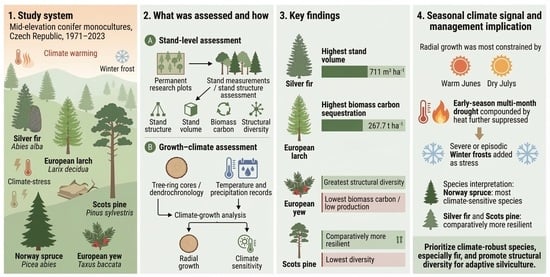
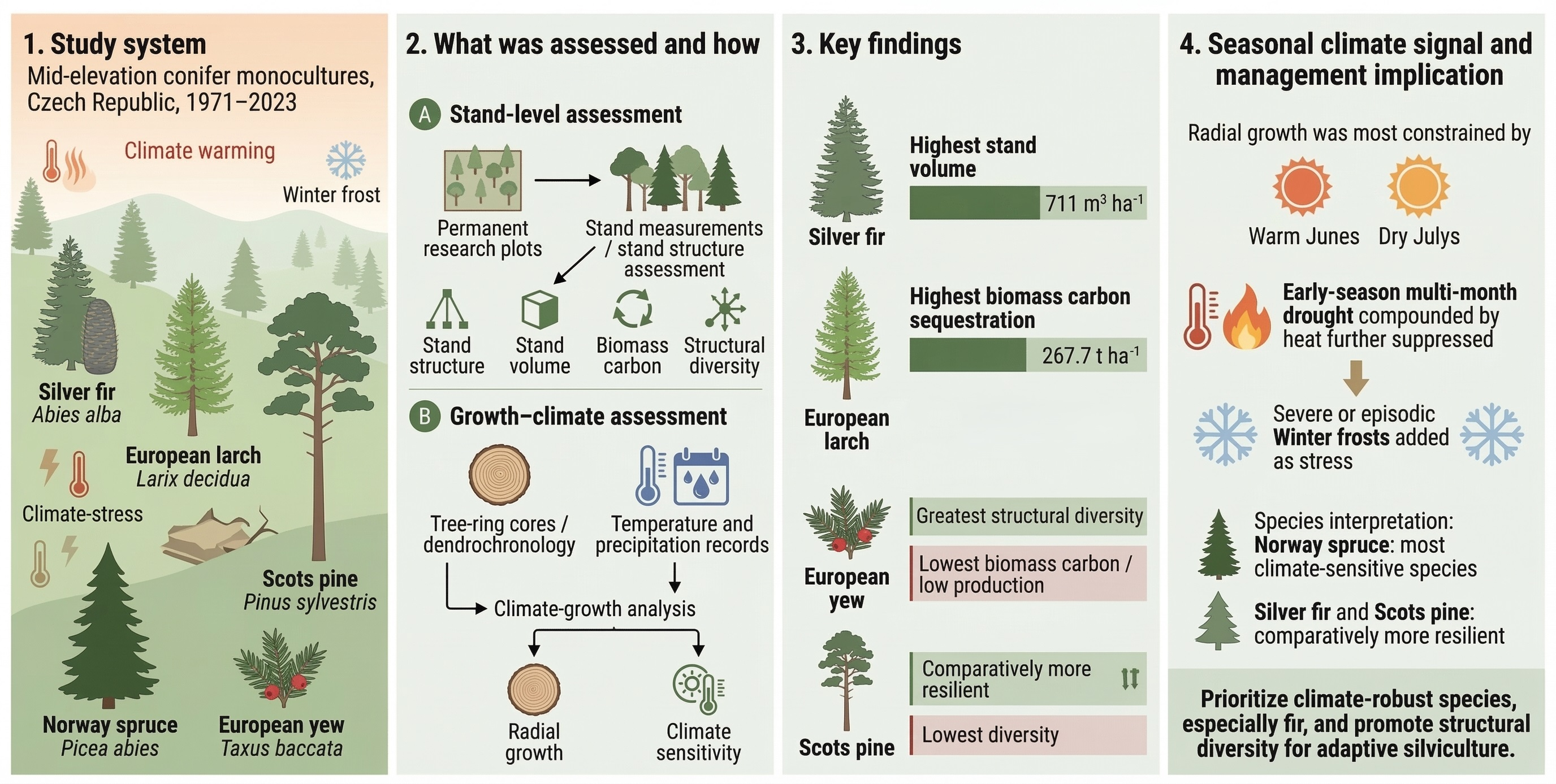
Graphical Abstract

1. Introduction

Global climate change (GCC) is driving profound transformations of forest ecosystems worldwide [1,2], with major consequences for tree species distribution, community composition, and ecosystem functioning [3,4]. Forest ecosystems are particularly sensitive to shifts in air temperature and precipitation [5], and tree species in mid- and high latitudes respond with heightened vulnerability [6]. Climatic warming induces range shifts, including upward and northward migrations and local extinctions, thereby reducing biodiversity, ecosystem stability, and long-term sustainability [7,8]. Forestry must therefore address new challenges that call for adaptive management strategies to ensure resilience [9,10,11]. A sound understanding of GCC impacts, particularly those associated with increasing air temperature and long-term droughts, is essential for developing sustainable silvicultural approaches [12,13].
In recent years, research has increasingly focused on how GCC alters tree growth patterns and changes in species composition [6,14,15,16,17]. In European forests, long-term warming, irregular precipitation, and more frequent extreme events are accompanied by a higher incidence of secondary pest outbreaks, together creating pressures that require a reorganisation of stand structure and species diversity [18,19]. Determining the most suitable tree species composition is a long-term process complicated by considerable uncertainties [20]. It is well established that GCC has strong impacts on tree growth processes, vitality, and interspecific competition [21,22].
Impacts of GCC vary considerably with elevation and are often species- and site-specific: in higher mountains, tree growth may be enhanced where temperature limits productivity, whereas in lowlands or moisture-limited sites, it is typically reduced [23,24]. Documented declines or increases in growth and distribution, especially in coniferous species, include Scots pine (Pinus sylvestris L.) in Germany [25], silver fir (Abies alba Mill.) across southern and central Europe [26,27], and Norway spruce (Picea abies [L.] Karst.) in Austria and the Czech Republic [28,29]. Among these, Norway spruce appears especially sensitive, as evidenced by large-scale disturbances in Central Europe [28,30,31]. Norway spruce has a shallow root system and a dense, conical crown, making it particularly susceptible to long-term drought and windthrow [32]. Silver fir shows more variable responses, retreating in lowlands but expanding in humid mountain environments [33,34], yet projections of its dynamics remain inconsistent [21]. This shade-tolerant species has a deep, tapering root system and a tall, narrow crown, which enhances drought resilience but limits regeneration in open, dry sites [35]. Scots pine, a pioneer species with a deep taproot and sparse crown, seems comparatively less vulnerable due to higher drought tolerance and adaptability to poor soils, and shows potential for northward shifts in distribution [36,37]. European larch (Larix decidua Mill.) is considered a promising species due to its pioneer character, deep roots and tolerance to summer heat [38], although in the lowlands it is increasingly threatened by drought stress [39,40]. By contrast, information on yew (Taxus baccata L.), a slow-growing, shade-tolerant species with dense evergreen foliage and a deep, spreading root system, is still limited [41]. Available evidence, however, points to negative effects of hot and dry summers, with a tendency for the species to retreat from the southern margins of its distribution [42,43].
The successful silviculture of these Central European native conifers under GCC requires a comprehensive understanding of their ecological requirements, stand structure, and growth dynamics. Despite numerous studies on individual species, comparative assessments of multiple native conifers growing under identical environmental conditions remain limited. Such comparisons are essential for identifying species-specific sensitivities and adaptive capacities under GCC. We hypothesise that the studied conifer species (Picea abies, Abies alba, Pinus sylvestris, Larix decidua, Taxus baccata) differ significantly in their growth and sensitivity to climatic drivers due to their contrasting ecological strategies and physiological tolerances. In particular, species traditionally considered climatically sensitive, such as Norway spruce, are expected to exhibit stronger growth limitations under warming and drought conditions than more tolerant species such as Scots pine or European larch. The present study, therefore, aimed to assess (i) production potential including carbon sequestration, (ii) stand diversity and structural attributes, (iii) radial growth dynamics, and (iv) the influence of climatic drivers (air temperature, precipitation, extreme events) on the growth of monocultures of five conifers in mid-elevation forests of the Czech Republic. The inclusion of the rarely studied yew, a legally protected species in the Czech Republic, provides important new insights into its responses to GCC and highlights the relevance of this study for ecological research, conservation practice and forest management.

2. Materials and Methods

2.1. Study Area

The study area is managed by the private owner Colloredo-Mannsfeld and lies at an elevation of 405–545 m above sea level. Slope gradients range from 2 to 13°. For data collection and the establishment of permanent research plots (PRPs), stands located within the coordinate ranges 49.8057–49.8283 N and 13.6916–13.9169 E were selected. The investigated stands consist predominantly of monocultures of the target tree species (silver fir, European yew, Norway spruce, Scots pine, and European larch), with admixtures of European hornbeam (Carpinus betulus L.), silver birch (Betula pendula Roth), Scots elm (Ulmus glabra Huds.), and sessile oak (Quercus petraea [Matt.] Liebl.), collectively accounting for 0%–5% of the stand composition. All investigated forest stands in the study area were established through artificial regeneration, using the minimum number of seedlings prescribed by law, ranging from 4000 for European larch to 9000 for Scots pine. These stands are managed using uniform silvicultural practices, including consistent thinning intensity and other management interventions. According to the Forest Management Plan, the age of the monitored stands ranges between 62 and 73 years.
Climatic conditions correspond to a humid continental climate (Dfb) according to the updated Köppen–Geiger classification [44]. In the early 21st century (2000–2024), the mean annual air temperature is approximately 8.5 °C, peaking in July at 18.4 °C, and the annual precipitation totals 775 mm, with the maximum in June. The average number of days with snow cover is 51 per year, the number of ice days (Tmax < 0 °C) reaches up to 19, and the maximum snow depth observed did not exceed 40 cm. (Czech Hydrometeorological Institute). Typologically, the stands are classified as Acidic Oak-Beech (Querceto-Fagetum acidophilum) and Nutrient-medium Oak-Beech (Querceto-Fagetum oligo-mesotrophicum) forest site types [45]. Soil conditions are represented by modal cambisols, developed predominantly on volcanic bedrock (rhyolite, dacite, and andesite).

2.2. Data Collection

To investigate stand structure and productivity, the Field-Map system (IFER-Monitoring and Mapping Solutions Ltd., Jílové u Prahy, Czech Republic) was employed. A total of 25 permanent research plots (25 × 25 m each) were established, i.e., five plots for each tree species. In August 2024, the spatial positions of individual trees with a diameter at breast height (DBH) ≥ 7 cm were recorded [40]. For each tree, crown projection measurements were taken in at least four cardinal directions. DBH was determined using a Mantax Blue calliper (Haglöf, Långsele, Sweden) with a precision of 1 mm, measured along two perpendicular axes. Total tree height and the height to the base of the live crown were recorded with a Vertex Laser hypsometer (Haglöf, Långsele, Sweden) with an accuracy of 0.1 m.
To analyse radial growth, increment cores were extracted at 1.3 m above ground using a Pressler auger (Haglöf, Långsele, Sweden), oriented along the slope gradient. From each tree species, 30 vigorous dominant or co-dominant trees according to [46] were randomly selected (RNG function, Excel). This selection was made to represent the primary growth response to climatic conditions, while minimising the influence of competition; sub-dominant and suppressed trees were excluded [47]. Cores were evenly distributed across the PRPs (5 per plot) for each species. Increment cores of yew were collected under a permit issued by the Nature Conservation Agency of the Czech Republic in accordance with the Act No. 114/1992 Coll., on Nature and Landscape Protection.
Annual ring widths were measured with 0.01 mm precision using a LINTAB measuring table and an Olympus binocular microscope (Olympus Corporation, Tokyo, Japan), and the data were processed in TSAPWin software (version 4.81, Rinntech, Heidelberg, Germany). Climate influences on growth were assessed using long-term meteorological records from the Zbiroh–Švabín station (476 m a.s.l.) for the period 1971–2023 (range defined by the start of meteorological measurements and the end of tree sampling), which corresponds to the time span used for the dendrochronological analyses. Monthly average air temperature and monthly accumulated precipitation were analysed to examine their relationship with tree-ring development. Historical data on solar radiation were also available for the study area.

2.3. Data Analyses

Tree layer structure, diversity, and production attributes were quantified using the SIBYLA Triquetra 10 software, based on spatially explicit, tree-level measurements [48,49]. All dendrometric parameters recorded in the field (see Section 2.2) were employed as input data, including species identity, spatial coordinates, total height, DBH, crown width, live crown base height, and age. Tree volumes were estimated using species-specific allometric equations [50]. Stand-level parameters, including crown closure [51] and the relative stand density index [52], were derived from measured density indicators. The relative species-specific SDI was calculated as the ratio of the stand density index to its maximum value. The stand density index represents the theoretical number of trees per hectare, if the mean quadratic diameter of the stand component were equal to 25 cm [52]. The maximum SDI value for each tree species was derived from the yield-table model. Above-ground tree biomass (stem, branches and needles) was derived from models provided by [50]. The biomass of tree roots was calculated using a model [53]. The carbon sequestration (CBIO) in coniferous trees was calculated according to [54], based on the carbon fraction in dry matter.
Structural diversity was evaluated through both horizontal and vertical perspectives (Table 1). Horizontal structure was quantified by [55] aggregation index, whereas vertical structure was assessed using the Arten-profile index [56] and the vertical diversity index [57]. Stand structural differentiation was further characterised using diameter and height differentiation indices [58] and crown differentiation metrics [57]. Finally, a complex stand diversity index reflecting overall biodiversity was calculated [57], integrating tree species diversity, vertical stratification, spatial distribution, and crown differentiation. Detailed methodology for the computation of these indices is provided by [59].
Dendrochronological data from coniferous tree species were processed using R software (version 4.3.2, R Core Team, Vienna, Austria) with the “dplR” package [60,61]. Each tree series was detrended using a negative exponential function combined with a fitted spline, following the standard procedures outlined for dplR [62]. Detrending removes the age-related growth trend while preserving high-frequency climatic signals [63,64]. For the detrended data, the Expressed Population Signal (EPS) was calculated. EPS represents the reliability of a chronology as the proportion of the variance shared with a hypothetical infinite tree population. Only data series exceeding the EPS threshold of 0.85 were considered suitable for comparison with climatic records [62]. Furthermore, Rbar (mean interseries correlation) and the GINI index (average interannual growth variability in the series) were calculated. The identification of negative pointer years (NPY) followed the approach outlined by [65,66]. For each cored tree, a pointer year was defined as a year in which the annual ring width fell below 40% of the mean increment of the preceding four years. A negative pointer year was considered significant for a plot if at least 20% of the trees exhibited such a pronounced reduction in radial growth. To investigate the relationships between climatic variables (monthly air temperatures and precipitation totals) and radial growth, analyses were performed using the DendroClim software (version 1.0) [67].
Statistical analyses of diversity and production parameters among individual tree species were conducted using Statistica (version 14.1.0.8, TIBCO, Palo Alto, CA, USA). Data were first tested for normality using the Shapiro–Wilk test and then for homogeneity of variance using the Bartlett test. When both requirements were met, the differences among the examined parameters were tested using analysis of variance (ANOVA). If the normality and variance assumptions were not met, the investigated characteristics were tested using the nonparametric Kruskal–Wallis test. For post hoc pairwise comparisons, Tukey’s Honestly Significant Difference (HSD) test was used following ANOVA, whereas the procedure of multiple comparisons described by [68] was implemented after the Kruskal–Wallis test. Significant differences among groups are indicated by distinct lowercase letters; groups labelled differently are considered statistically distinct. Principal component analysis (PCA) was performed in the CANOCO programme (version 5.15) [69] to evaluate the relations between the stand structure, production parameters, and tree species on 25 research plots. Before analysis, the data were standardised and centralised. The results of PCA were presented as a diagram of species and environmental variables.

3. Results

3.1. Productive Potential

Significant differences among the studied tree species were observed across all measured dendrometric parameters (Table 2), with the smallest variation detected in tree density (p = 0.048). Yew exhibited the lowest mean DBH (21.5 cm) and tree height (12.2 m), whereas fir had the largest diameters (38.2 cm) and pine reached the greatest heights (28.1 m; p < 0.01). No significant difference in height was found among all tree species except for yew (p < 0.05). Fir also showed the highest mean stem volume (1.54 m3) compared to yew (0.21 m3). Total stand volume was maximal in fir (711 m3 ha−1). Pine, larch, and spruce showed 17.0%, 22.9%, and 26.0% lower productivity, respectively, and differed significantly from one another. Yew had the lowest stand volume (70.6%) and formed a separate homogenous group. Similarly, stand basal area reached its maximum in fir (58.8 m2 ha−1). Canopy closure was most pronounced in larch (0.98), and the stand density index (SDI) was highest for yew (90.7). Yew showed the lowest height-to-diameter ratio (HDR = 57.1) compared to pine (89.2) and larch (83.4). From the perspective of GCC, the highest carbon sequestration in biomass was significantly higher in larch (267.7 t ha−1) than in yew stands (87.7 t ha−1).

3.2. Diversity of the Tree Layer

In terms of stand diversity, significant differences among tree species were identified for most parameters, except for the aggregation index, vertical diversity, and overall stand diversity (Table 3). In terms of horizontal structure, a significant (p < 0.05) difference was found only between spruce and yew. The most pronounced difference (p = 0.013) was found in vertical structure, where yew stands reached significantly higher values (Ap = 0.588), reflecting their marked vertical heterogeneity, in contrast to pine, which exhibited a high degree of homogeneity (Ap = 0.268). Similarly, aside from height differentiation, which was highest in spruce, yew consistently achieved the highest diversity indices (six out of seven). Regarding crown differentiation, fir showed a significantly (p < 0.05) lower value compared to yew. Spatial distribution of trees was generally random with a slight tendency towards regularity, except in Scots pine, which displayed a mildly aggregated horizontal pattern. Regarding overall diversity, all stands of the studied species exhibited relatively uniform, monotone structures (B = 3.535–3.961), except for yew, which showed a markedly heterogeneous stand structure (B = 4.764).

3.3. Dynamics of Radial Growth

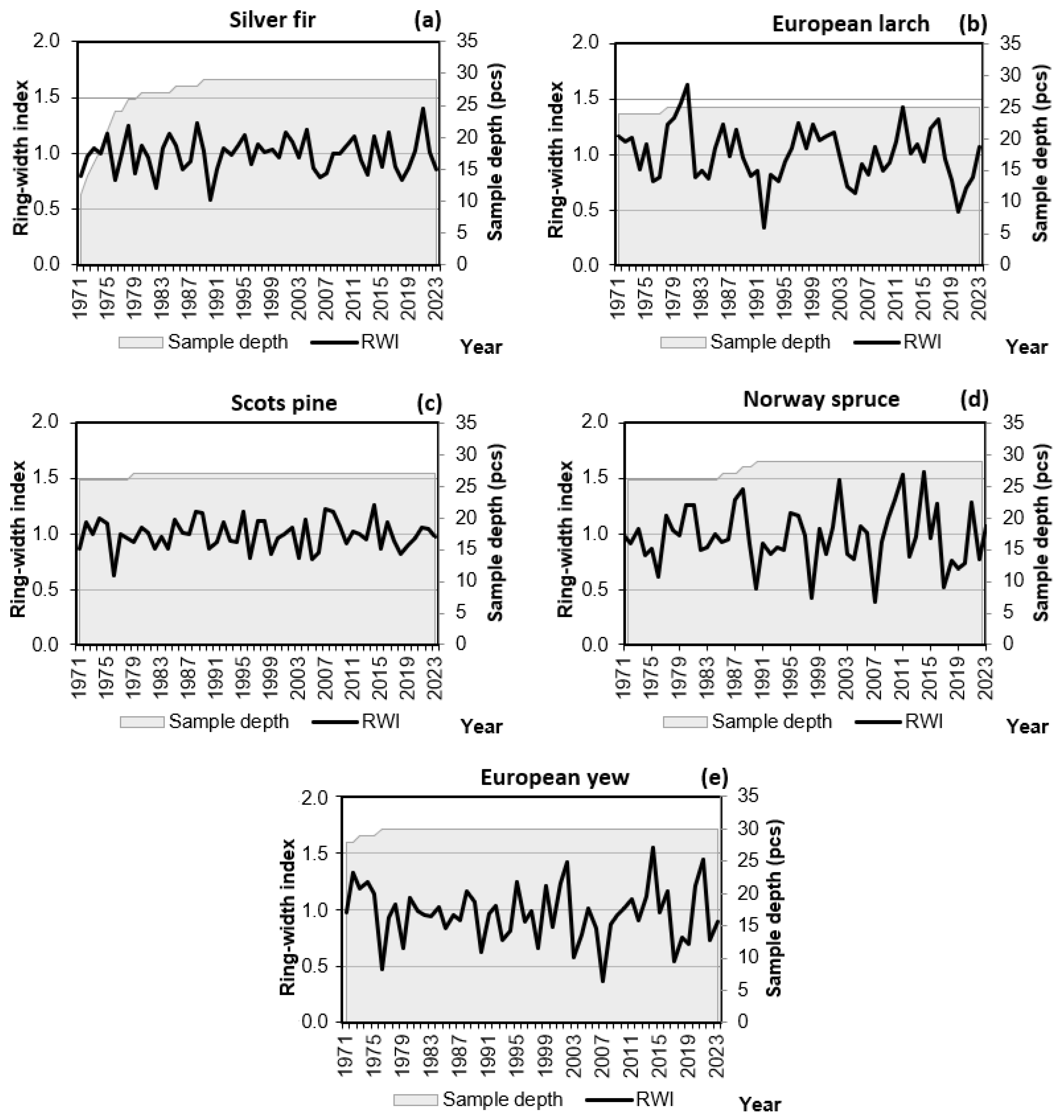
Dendrochronological analyses indicated that all tree species reached EPS threshold (0.927–0.965), confirming the reliability of the chronologies and their suitability for further analyses (Table 4). Fir exhibited the significantly highest mean radial increment over the period 1971–2023 (2.72 mm), followed by spruce (1.96 mm) and pine (1.87 mm), while the lowest growth rates were observed in larch (1.34 mm) and particularly in yew (1.18 mm). The average interannual growth variability in the series (GINI index) was comparably high in fir, larch, and pine (0.134–138), whereas markedly lower values were found in yew (0.081) and subsequently in spruce (0.090). The mean interseries correlation (Rbar) ranged from 0.321 in yew to 0.487 in larch, indicating moderate common growth variability among the individual series. Annual growth variability (standard deviation of ring width index) was greatest in spruce and yew. In contrast, pine and fir showed the lowest variation (Figure 1). With respect to NPY, spruce and yew recorded the highest number (four NPY each), larch showed two, while no NPY were detected in fir and pine. Fir and yew shared two common NPY (2007 and 2017). The year 2007 was characterised by the lowest recorded April precipitation (3 mm compared to the long-term mean of 32 mm) and unusually warm early-season air temperatures. In contrast, 2017 was defined by extremely low solar radiation during the growing season (up to a 50% reduction relative to average) and exceptionally severe winter conditions, with monthly temperature deviations of up to −5.2 °C from the norm.

3.4. Effect of Climate on Growth

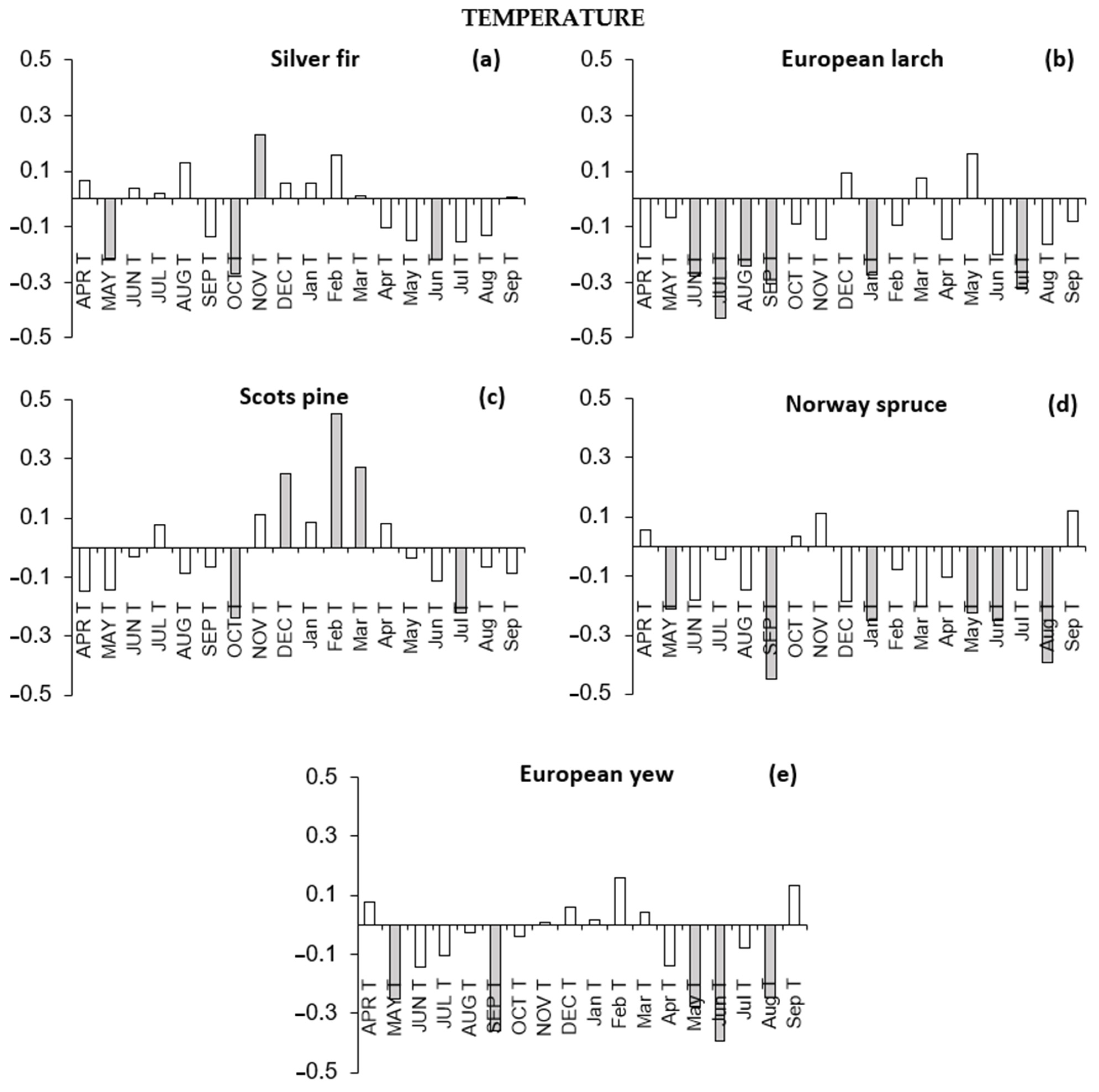
Across all examined tree species, monthly air temperature had a more pronounced influence on radial growth (26 significant months) than precipitation sums (18 significant months). Except for spruce, where air temperature and precipitation contributed equally, air temperature generally had a stronger effect on growth (Figure 2). In most species, air temperature showed a predominantly negative effect on radial increment. In contrast, pine was the only species exhibiting a prevailing positive relationship, most notably in February (r = 0.45). In terms of specific months influencing growth, the strongest negative correlation was observed in September of the previous year (r = −0.45 to −0.30), and in the current year, it was June (r = −0.40 to −0.20). The correlation between radial growth and air temperature was highest in spruce and larch (6 months each) and the lowest in fir (4 months). For larch and fir, growth was more strongly influenced by temperatures in the preceding year, whereas in pine, spruce, and yew, the current-year air temperatures played a more critical role. Growth responses to mean annual temperature were negative, with the strongest correlation observed in spruce (r = −0.48, p < 0.001), while fir showed the weakest relationship (r = −0.18, p > 0.05).
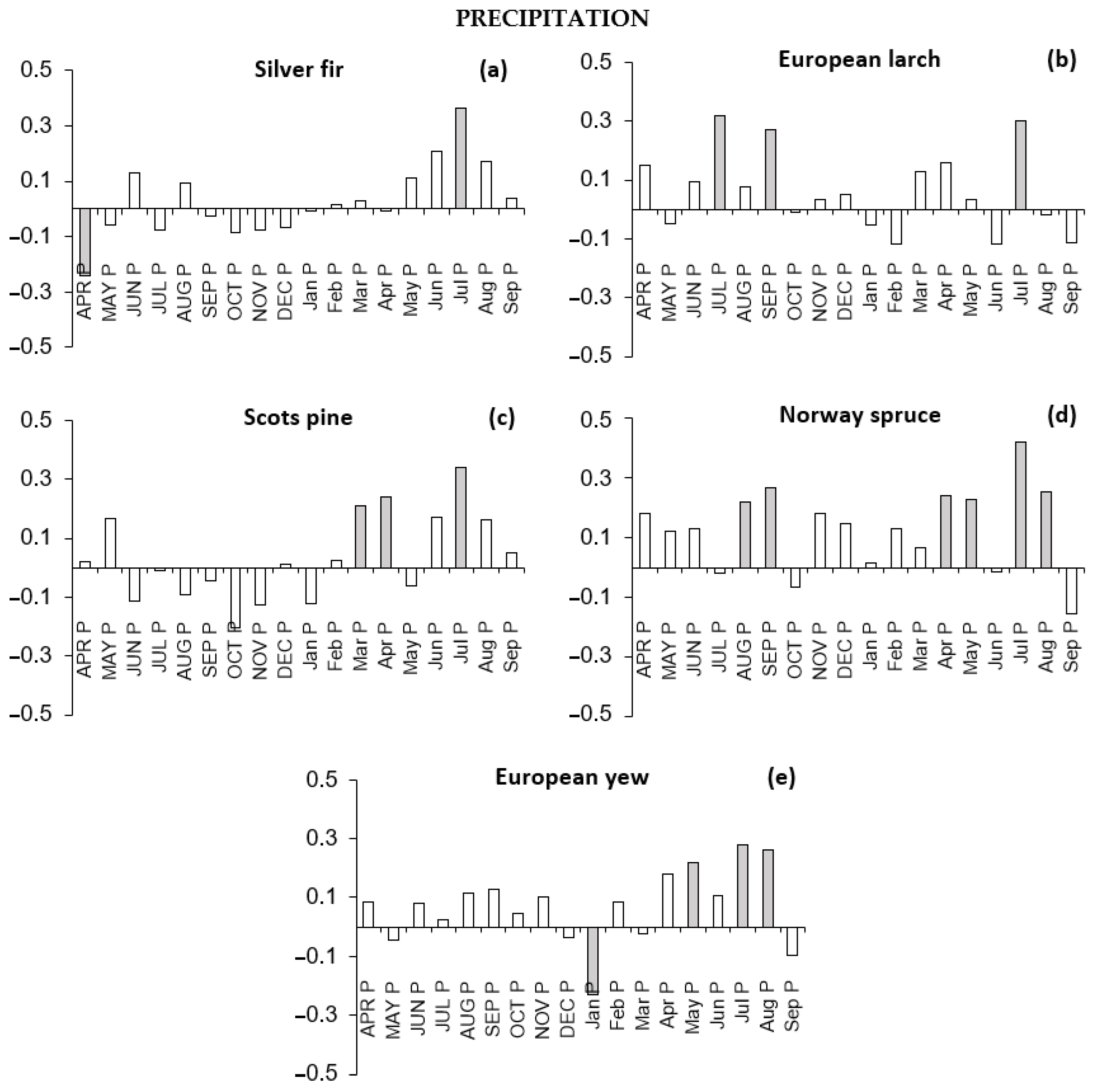
The correlation between radial growth and monthly precipitation sums was highest in spruce (6 significant months), followed by yew (4 months). Larch and pine had moderate correlation (3 months), while fir showed the lowest correlation (only 2 months). Precipitation generally exerted a positive influence on growth in all species, except for fir, where a negative effect was observed in the previous year, but a positive one in the current year (Figure 3). For all coniferous species except larch, precipitation in the current year had a stronger effect on radial growth compared to the previous year. Among individual months, September of the preceding year was the most influential (r = 0.27), while in the current year, July had the strongest impact (r = 0.28–0.42), as seen consistently across all studied species. In contrast to temperature, annual precipitation totals showed generally positive relationships with growth, most pronounced in spruce (r = 0.41, p < 0.01), while larch exhibited only a weak association (r = 0.12, p > 0.05).

3.5. Interaction Among Production, Diversity and Species

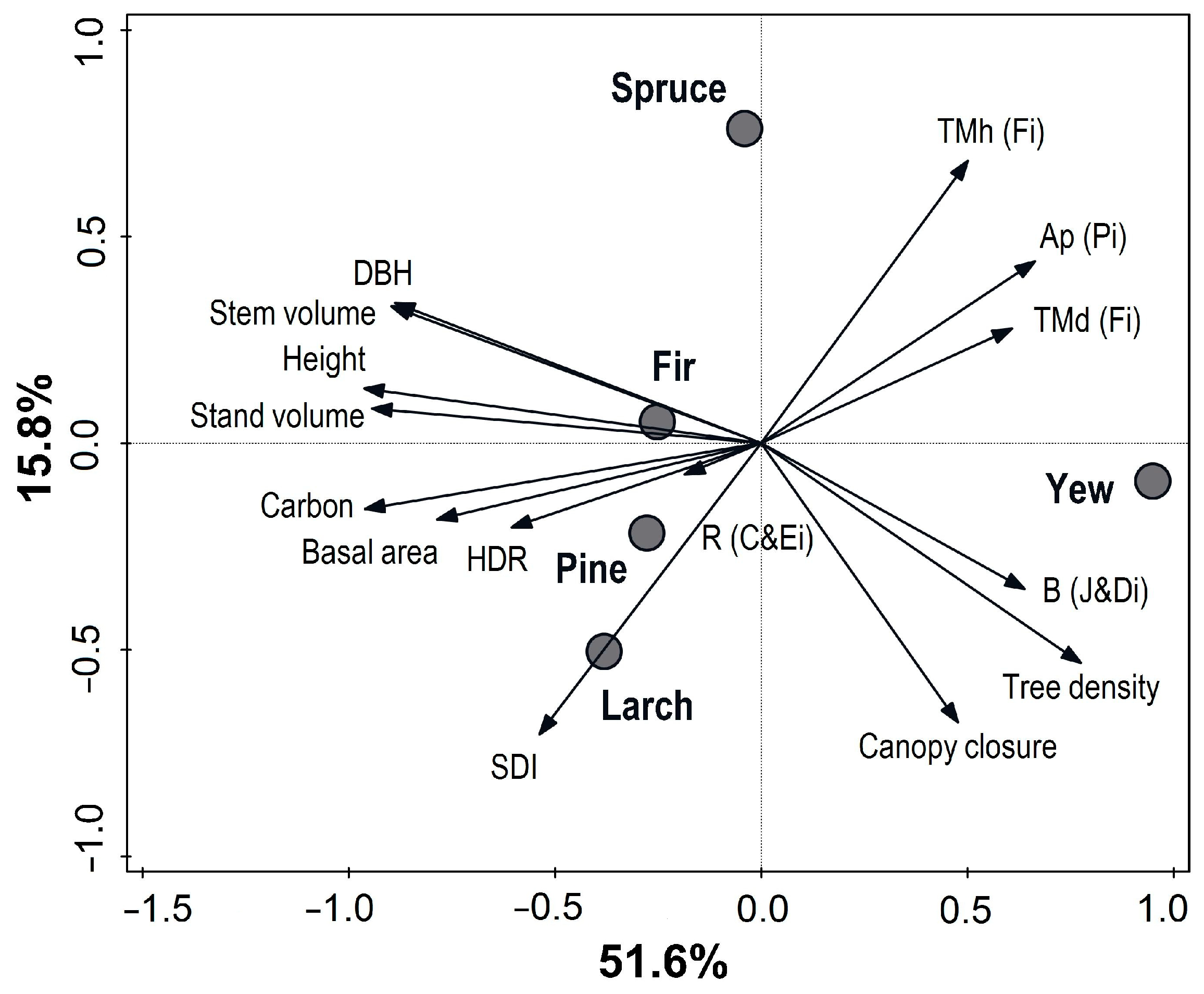
The results of the PCA, illustrating the relationships between production potential, stand structure, diversity, and different tree species, are presented as an ordination diagram in Figure 4. The first axis explained 51.6% of the total variance, the first two axes together accounted for 67.4%, and the four axes combined explained 85.5% of the data variability. The x-axis reflects stand volume, mean height, and carbon sequestration. Production-related characteristics such as stand volume, basal area, and carbon sequestration were positively correlated with each other, but negatively associated with parameters of structural differentiation. Increasing stand density was accompanied by higher overall diversity and canopy closure. The least explanatory variable was the aggregation index. Among the studied species, fir showed the highest variability across PRPs, whereas larch was characterised by relatively homogeneous data. Yew was associated with high stand density and diversity (right part of the diagram), spruce with low stocking and high height differentiation (upper part of the diagram), while the remaining species generally exhibited relatively high production potential.

4. Discussion

4.1. Production Potential of Tree Species

In terms of DBH, mean stem volume, basal area, and stand volume, fir ranked as the most productive species among the five assessed taxa in our study (V = 711 m3 ha−1). In the following section, we focus primarily on stand volume, as it represents the most important indicator of the production potential of forest tree species [70,71]. In the case of fir, similar findings about stand volume have been reported by [35,72,73]. In contrast, ref. [74] documented substantially lower stand volumes of fir stands across different regions of Europe, ranging between 220 and 398 m3 ha−1.
Comparable stand volumes within our study were found for larch (548 m3 ha−1), Scots pine (590 m3 ha−1), and Norway spruce (526 m3 ha−1). Reference [75] reported similar values for first-generation larch stands established on former agricultural land in the Orlické Mountains, Czech Republic (466 m3 ha−1). The production potential of larch is further reflected in its mean annual increment (MAI), which may reach 10 m3 ha−1 or more depending on site conditions [76,77,78]. According to [71], larch achieved MAI of 8.0 m3 ha−1 on former agricultural sites and 6.7 m3 ha−1 on historically permanent forest sites. On nutrient-rich sites, however, larch can attain values as high as 20 m3 ha−1, as documented in Lithuania [76].
The productivity of pine was lower than in our study in most other cases, but highly variable (236–500 m3 ha−1), largely due to its occurrence on poor substrates typical of natural pine sites [79,80]. In pine stands aged 40–46 years, [81] recorded stand volumes of 318–371 m3 ha−1 on reclaimed sites and 370–500 m3 ha−1 on original forest sites, i.e., 22.4% higher. The MAI on reclaimed sites reached 8.0 m3 ha−1, while on original forest land it was 25% higher. Lower values were reported from Estonia, where pine stands on oil shale spoil heaps reached a MAI of only 6.3 m3 ha−1 [82].
In contrast to our findings, significantly lower spruce volumes were reported by [83] in the Krkonoše Mts. (180–407 m3 ha−1), reflecting the harsher site and elevation conditions. Similar results from mountain spruce forests were presented by [24,84,85,86,87,88,89]. Reference [90] also observed lower stand volumes of spruce monocultures in lowland regions of Central Bohemia, where stands have been severely affected by ongoing GCC. A wide range of spruce stand volumes (364–685 m3 ha−1) across different altitudes in the Czech Republic was reported by [30].
The stand volume of yew in our study was 209 m3 ha−1, at a density of 1032 trees ha−1. Reference [87] reported a mixed stand dominated by yew in the “V Horách” Nature Reserve, Czech Republic, where a 75-year-old stand reached 220 m3 ha−1 with a density of 1225 trees ha−1. The MAI there was 2.9 m3 ha−1 [91]. In another reserve in the Křivoklátsko region, a mixed stand with abundant yew reached only 108 m3 ha−1 [92]. In Poland, higher volumes were observed in natural yew communities (165–301 m3 ha−1), although yew itself represented only a minor component of the stand structure [93].
The observed differences in productivity among the studied species support our first hypothesis that conifer species differ significantly in their productivity, growth and sensitivity to climatic drivers due to their contrasting ecological strategies and physiological tolerance [94,95]. Silver fir showed the highest stand volume in our study, which can be attributed to its high growth potential and efficient use of available soil moisture [96,97]. In contrast, European yew exhibited the lowest stand volume, which reflects its inherently slow growth rate and shade-tolerant strategy, typically associated with understory or sub-canopy positions rather than dominant canopy formation [98,99].

4.2. Diversity of the Tree Layer

Tree layer diversity was highest for yew across nearly all parameters except for height differentiation. Subsequently, the focus is placed on the total stand diversity (B) index, which integrates vertical diversity, horizontal structure, and crown differentiation in our case. The B for yew reached 4.76, indicating a relatively uniform stand structure. Other studied species displayed more monotonous structures, with fir (B = 3.86), larch (B = 3.96), pine (B = 3.85), and spruce (B = 3.54). Stand biodiversity is strongly influenced by management practices [92]. Had these stands been managed under close-to-nature approaches, overall stand diversity would likely be higher, particularly in fir and yew, which often develop heterogeneous stand structures [35,92,93,100]. For instance, [89] reported high diversity across all surveyed yew reserves. Fir and yew are key species for maintaining high forest biodiversity due to their shade tolerance, ability to survive in the understory, respond to improved light conditions, ecological plasticity, and coexistence with multiple tree species [35,72,73,101]. Fir stands in other studies also show a wide range of B values. Reference [94] classified fir plots with B = 9.20–10.52 as highly diverse, while [68] reported B = 3.51–3.92 for mid-aged fir stands. The unmanaged fir stand further demonstrated higher tree species richness, greater deadwood presence, and distinct tree and understory layer structures, indicating that fir woodlands abandoned for over 50 years undergo spontaneous structural changes [102].
Stand diversity is influenced not only by management practices but also by historical soil development. In the case of larch, higher overall diversity was observed on forest soils (B = 4.14), whereas former farmland (B = 3.78), despite often having higher nutrient content, exhibited lower total diversity [75]. Pine stands show substantial variability depending on site fertility, B ranging from 2.45 to 8.02 [79,80,81]. Managed and semi-natural pine stands in the Czech Republic also display variable B values [79,103]. In our study, pine stands generally reached the lowest diversity across the analysed indices. Lower diversity is typically observed on reclaimed post-mining soils [81]. Spruce stands in our study show lower B values than fir and yew, but comparable to other mid-elevation or lowland sites, while higher values have been recorded in natural mountain spruce forests [29,83]. Similarly, when comparing our study of managed spruce stands, autochthonous mountain Norway spruce in protected areas exhibited higher vertical diversity as well as a greater tendency toward aggregation [104]. Historical air pollution in the 1980s negatively affected the mountain spruce stand biodiversity [105,106], consistent with findings that soil acidification, or eutrophication, can reduce overall biodiversity [107].
Generally, monocultures show lower biodiversity than mixed stands, reducing adaptive capacity under GCC, since structural and functional diversity enhances ecosystem resilience [108,109,110,111]. Promoting species diversity and structural heterogeneity is recommended as a strategic measure for climate adaptation in forest management [112,113,114,115]. Ecosystem biodiversity encompasses species composition, function, and structure [116], and can be defined taxonomically (species diversity), functionally (functional diversity), or structurally (stand layer differentiation). Numerous studies report positive relationships between tree diversity and forest productivity connected with carbon sequestration, and diversity also increases resilience against pest outbreaks [29,117,118,119].
Overall, yew exhibited the highest total stand diversity and also showed the greatest differentiation in most structural parameters, including vertical structure and crown differentiation, reflecting its shade-tolerant ecology and ability to persist across multiple canopy layers. In contrast, spruce displayed the lowest overall diversity, likely due to its more uniform stand structure typical of managed spruce stands. Pine also showed relatively low structural differentiation, which may be related to its light-demanding growth strategy. This is consistent with findings from the German National Forest Inventory, where spruce and pine forests exhibited the lowest stand diversity across most parameters [120]. These results indicate that species-specific ecological traits, together with management practices, play a key role in shaping the structural diversity of forest stands [121,122].

4.3. Dynamics of Radial Growth and Climate

In our study, pine and fir exhibited the most stable radial growth, whereas spruce and yew showed the greatest variability. Regarding NPY, characterised by pronounced reductions in radial growth, pine and fir showed no NPY, even during extremely stressful periods such as severe droughts in 2003 and 2015–2018. This stability in fir growth is consistent with previous findings showing no significant short-term reductions after extreme droughts; under sufficient soil moisture and moderate climatic conditions, fir can maintain stable growth even in warm environments [123]. Larch experienced two negative years (1992 and 2020). The highest fluctuations in radial growth were recorded for spruce (1990, 1998, 2007, 2017) and yew (1976, 2003, 2007, 2017), each exhibiting four NPY. The absence of NPY in pine and fir is explained by the standard detection procedure applied for all species, which included a 20% threshold and smoothing/detrending of growth series, following commonly used protocols. This approach ensures that observed NPY reflect genuine reductions in growth rather than methodological artefacts.
Across all species examined, monthly air temperatures exerted a stronger influence on radial growth than total precipitation, except for spruce, where both factors had comparable effects in the studied altitudes. The most critical months influencing growth were June for temperature and July for precipitation in our study. These months are important for cambium formation and radial increment, as documented in several studies on conifer growth dynamics in other research [83,124,125].
Among individual tree species, elevated February temperatures were identified as the most influential factor affecting radial growth in pine. Reference [126] reported geographic differences in Scots pine radial growth, with the highest values in the UK (mean annual ring width 2.22 mm), the lowest in the Czech Republic (0.95 mm), and intermediate in Spain (1.33 mm) and Poland (1.25 mm). In our study, Scots pine exhibited a higher mean ring width (1.87 mm) than in the three previously mentioned countries, which can be attributed to a lower stand age and more favourable site conditions. Climatic factors, particularly high air temperatures and low rainfall, increasingly influenced pine growth in Central Europe during 1986–2016 compared to 1951–1985. Critical periods are June and July, when high air temperatures and low precipitation can limit growth. Drought and rising temperatures are major abiotic factors driving pine dieback [127,128,129].
Fir exhibited the significantly highest mean radial growth in our study (2.72 mm). For this tree species, summer precipitation positively affects radial growth, while elevated air temperatures often reduce growth due to increased evapotranspiration. This pattern has been confirmed in the Czech Republic and other European regions [27,130,131]. Fir demonstrates high plasticity, buffering temperature and moisture extremes in mixed stands [132]. In addition, this tree species had the lowest sensitivity to precipitation effects on growth among the five studied conifers.
Larch radial growth is sensitive to late summer temperatures and precipitation during key months [133,134]. Cold and wet Septembers in the previous year can prematurely end radial growth in northern and mountainous provenances [135,136]. In our research, positive temperature effects during May–June and summer precipitation were particularly important, whereas extreme dry (especially in July) or cold conditions reduced radial growth.
In our study, spruce was identified as the most sensitive tree species, with radial growth strongly negatively affected by elevated air temperatures and, in particular, by precipitation deficits during the growing season. Similarly, a study from Germany demonstrated that spruce is strongly limited by water availability during the summer period [137]. This pattern is consistent with previous studies showing that the positive effects of summer temperatures are observed only when water availability is adequate [83,138,139]. Drought also promotes bark beetle (Ips typographus L.) outbreaks, increasing spruce mortality in Central Europe [140]. The highest growth of spruce was observed on soils with better water retention (cambisols) compared to rendzinas, confirming spruce preference for cool, moist conditions [60,63,141].
European yew showed the lowest and most variable radial growth (1.18 mm) in our study. This is likely due to the pronounced competitive interactions experienced by yews, as well as their specific growth ecology [93]. Moreover, male and female trees differ in growth due to higher reproductive costs in females [142,143] as yew is dioecious, whereas spruce, fir, pine, and larch are monoecious, carrying both male and female reproductive structures on the same tree. Yew is shade- and drought-tolerant [144,145], with winter temperature being critical for radial growth in the Caucasus [146]. In Poland, winter and early spring temperatures, combined with summer drought, largely determine yew growth, while populations near the southern range margin are particularly sensitive to dry periods [147,148,149].
With respect to the second hypothesis, which was only partially confirmed. Pine with fir (not as in the case of larch in the hypotheses) showed the most stable radial growth with no negative pointer years, reflecting high resistance to climatic stress. Spruce and yew had the greatest variability and most negative years, indicating strong sensitivity to temperature and precipitation extremes. Similarly, studies from Central Europe indicate that spruce is more sensitive to climate change—particularly to extreme drought events—compared to fir [150,151] and pine [152], reflecting its higher vulnerability to climate stress. Growth was generally more influenced by temperature than precipitation, with June and July being critical months. These patterns reflect species-specific strategies: fir and pine are stable and plastic, while spruce and yew are more sensitive or variable due to their ecological traits. Similarly, other studies comparing multiple conifer species across Europe have reached consistent conclusions, identifying silver fir as the least sensitive species of the comparison [153].

4.4. Limitations and Scope

Our inference is constrained by a limited number of research plots and the absence of repeated long-term inventories, although radial growth series from increment cores provided a multi-decadal perspective (1971–2023), stand-level structural dynamics through time could not be fully captured. In addition, all plots are monocultures sampled within a single mid-elevation region in the Czech Republic, and stands were relatively even-aged (62–73 years). These design choices minimise disruptive factors but may limit generalisability to mixed stands, other elevations and soil conditions, and broader age structures. Climatic responses were assessed with monthly aggregates; therefore, sub-monthly heatwaves, compound hot-dry events, and lagged carry-over effects can be underestimated. Above- and below-ground carbon estimates rely on allometric equations; thus, species-specific parameter uncertainty and wood-density variability introduce additional uncertainty. One factor that may influence the results is the initial planting density at stand establishment; however, this was determined by legal requirements and the ecological demands of each tree species. Although this may introduce some variation in growth outcomes, the data still reliably reflect species-specific growth patterns and structural responses under the conditions at the studied site.
To address these caveats, future work should extend the network to mixed-species stands and multiple regions, span wider age classes, and couple ring-width analyses with mechanistic water-balance metrics, such as Standardised Precipitation Evaporation Index (SPEI), and event-scale extremes. Importantly, the rank ordering observed in our study, specifically fir highest in volume, larch highest in biomass carbon, and spruce the most climate-sensitive, was consistent across plots and robust in sensitivity checks, supporting the management implications despite these limits.

5. Conclusions

At mid elevations in Central Europe, studied coniferous species differ markedly in production and climate sensitivity. Silver fir attained the highest stand volume (711 m3 ha−1), European larch maximised biomass carbon (267.7 t ha−1), and yew combined low production (V 209 m3 ha−1, CBIO 87.7 t ha−1) with the greatest structural diversity, while pine showed the lowest diversity. Radial growth was most constrained by warm Junes and dry Julys. In the mid-elevation sites, growth was influenced significantly more by monthly air temperature than by precipitation. Norway spruce emerged as the most climate-sensitive species, consistent with its documented sensitivity under recent warming, whereas fir and pine were comparatively more resilient. Fir also exhibited the significantly highest mean radial increment (2.72 mm), while yew showed the lowest growth rate (1.18 mm). Structural diversity, particularly pronounced in yew stands, may enhance production and resilience, whereas low-diversity stands, such as pine stands, may be more vulnerable. Managing for structural diversity and prioritising climate-robust species, especially fir, offers a pragmatic pathway to sustain production and stability under GCC.

Author Contributions

M.B.: Conceptualization; Data curation; Investigation; Methodology; Validation; Writing—original draft; Writing—review and editing. S.V.: Conceptualisation; Methodology; Supervision; Writing—original draft; Writing—review and editing. Z.V.: Data curation; Formal analysis; Funding acquisition; Software; Validation; Visualisation; Writing—original draft; Writing—review and editing. J.Č.: Funding acquisition; Project administration; Resources; Writing—original draft; Writing—review and editing. J.C.: Project administration; Resources; Writing—original draft; Writing—review and editing. K.T.: Writing—original draft; Writing—review and editing. V.T.: Investigation; Writing—original draft; Writing—review and editing. J.B.: Investigation; Writing—original draft; Writing—review and editing. A.P.: Investigation; Writing—original draft; Writing—review and editing. V.H.: Investigation; Writing—original draft; Writing—review and editing. All authors have read and agreed to the published version of the manuscript.

Funding

This research was funded by the Czech University of Life Sciences Prague, Faculty of Forestry and Wood Sciences (Excellent Teams 2025) and the National Agency for Agricultural Research (Project No. QL26010390 and Project No. QL26010393).

Data Availability Statement

The data supporting the findings of this study are available from the corresponding author upon reasonable request.

Conflicts of Interest

The authors have no conflicts of interest to declare.

References

  1. Scheffers, B.R.; De Meester, L.; Bridge, T.C.L.; Hoffmann, A.A.; Pandolfi, J.M.; Corlett, R.T.; Butchart, S.H.M.; Pearce-Kelly, P.; Kovacs, K.M.; Dudgeon, D.; et al. The Broad Footprint of Climate Change from Genes to Biomes to People. Science 2016, 354, aaf7671. [Google Scholar] [CrossRef]
  2. Hagerman, S.M.; Pelai, R. Responding to Climate Change in Forest Management: Two Decades of Recommendations. Front. Ecol. Environ. 2018, 16, 579–587. [Google Scholar] [CrossRef]
  3. Freeman, B.G.; Lee-Yaw, J.A.; Sunday, J.M.; Hargreaves, A.L. Expanding, Shifting and Shrinking: The Impact of Global Warming on Species’ Elevational Distributions. Glob. Ecol. Biogeogr. 2018, 27, 1268–1276. [Google Scholar] [CrossRef]
  4. Liang, Y.; Gustafson, E.J.; He, H.S.; Serra-Diaz, J.M.; Duveneck, M.J.; Thompson, J.R. What Is the Role of Disturbance in Catalyzing Spatial Shifts in Forest Composition and Tree Species Biomass under Climate Change? Glob. Change Biol. 2023, 29, 1160–1177. [Google Scholar] [CrossRef] [PubMed]
  5. Marchi, E.; Chung, W.; Visser, R.; Abbas, D.; Nordfjell, T.; Mederski, P.S.; McEwan, A.; Brink, M.; Laschi, A. Sustainable Forest Operations (SFO): A New Paradigm in a Changing World and Climate. Sci. Total Environ. 2018, 634, 1385–1397. [Google Scholar] [CrossRef]
  6. Fu, Y.; Liu, C.; He, H.S.; Wang, S.; Wang, L.; Xie, Z. Assessing the Impact of Climate Warming on Tree Species Composition and Distribution in the Forest Region of Northeast China. Front. Plant Sci. 2024, 15, 1430025. [Google Scholar] [CrossRef]
  7. Gárate-Escamilla, H.; Hampe, A.; Vizcaíno-Palomar, N.; Robson, T.M.; Benito Garzón, M. Range-Wide Variation in Local Adaptation and Phenotypic Plasticity of Fitness-Related Traits in Fagus Sylvatica and Their Implications under Climate Change. Glob. Ecol. Biogeogr. 2019, 28, 1336–1350. [Google Scholar] [CrossRef]
  8. Sáenz-Romero, C.; Lamy, J.-B.; Ducousso, A.; Musch, B.; Ehrenmann, F.; Delzon, S.; Cavers, S.; Chałupka, W.; Dağdaş, S.; Hansen, J.K.; et al. Adaptive and Plastic Responses of Quercus Petraea Populations to Climate across Europe. Glob. Change Biol. 2017, 23, 2831–2847. [Google Scholar] [CrossRef]
  9. Nelson, H.W.; Williamson, T.B.; Macaulay, C.; Mahony, C. Assessing the Potential for Forest Management Practitioner Participation in Climate Change Adaptation. For. Ecol. Manag. 2016, 360, 388–399. [Google Scholar] [CrossRef]
  10. Morán-Ordóñez, A.; Ameztegui, A.; De Cáceres, M.; de-Miguel, S.; Lefèvre, F.; Brotons, L.; Coll, L. Future Trade-Offs and Synergies among Ecosystem Services in Mediterranean Forests under Global Change Scenarios. Ecosyst. Serv. 2020, 45, 101174. [Google Scholar] [CrossRef]
  11. Nunes, L.J.R.; Meireles, C.I.R.; Pinto Gomes, C.J.; Almeida Ribeiro, N.M.C. Forest Management and Climate Change Mitigation: A Review on Carbon Cycle Flow Models for the Sustainability of Resources. Sustainability 2019, 11, 5276. [Google Scholar] [CrossRef]
  12. Szmyt, J.; Dering, M. Adaptive Silviculture and Climate Change—A Forced Marriage of the 21st Century? Sustainability 2024, 16, 2703. [Google Scholar] [CrossRef]
  13. Seidl, R.; Thom, D.; Kautz, M.; Martin-Benito, D.; Peltoniemi, M.; Vacchiano, G.; Wild, J.; Ascoli, D.; Petr, M.; Honkaniemi, J.; et al. Forest Disturbances under Climate Change. Nat. Clim. Change 2017, 7, 395–402. [Google Scholar] [CrossRef]
  14. Fibich, P. The Impact of Climate Change and the Distribution of Tree Species. J. For. Res. 2023, 12, 454. [Google Scholar]
  15. Shirk, A.J.; Cushman, S.A.; Waring, K.M.; Wehenkel, C.A.; Leal-Sáenz, A.; Toney, C.; Lopez-Sanchez, C.A. Southwestern White Pine (Pinus Strobiformis) Species Distribution Models Project a Large Range Shift and Contraction Due to Regional Climatic Changes. For. Ecol. Manag. 2018, 411, 176–186. [Google Scholar] [CrossRef]
  16. Bošeľa, M.; Lukac, M.; Castagneri, D.; Sedmák, R.; Biber, P.; Carrer, M.; Konôpka, B.; Nola, P.; Nagel, T.A.; Popa, I.; et al. Contrasting Effects of Environmental Change on the Radial Growth of Co-Occurring Beech and Fir Trees across Europe. Sci. Total Environ. 2018, 615, 1460–1469. [Google Scholar] [CrossRef]
  17. Vieilledent, G.; Cornu, C.; Cuní Sanchez, A.; Leong Pock-Tsy, J.-M.; Danthu, P. Vulnerability of Baobab Species to Climate Change and Effectiveness of the Protected Area Network in Madagascar: Towards New Conservation Priorities. Biol. Conserv. 2013, 166, 11–22. [Google Scholar] [CrossRef]
  18. Schuldt, B.; Buras, A.; Arend, M.; Vitasse, Y.; Beierkuhnlein, C.; Damm, A.; Gharun, M.; Grams, T.E.E.; Hauck, M.; Hajek, P.; et al. A First Assessment of the Impact of the Extreme 2018 Summer Drought on Central European Forests. Basic Appl. Ecol. 2020, 45, 86–103. [Google Scholar] [CrossRef]
  19. Ray, D.; Bathgate, S.; Moseley, D.; Taylor, P.; Nicoll, B.; Pizzirani, S.; Gardiner, B. Comparing the Provision of Ecosystem Services in Plantation Forests under Alternative Climate Change Adaptation Management Options in Wales. Reg. Environ. Change 2015, 15, 1501–1513. [Google Scholar] [CrossRef]
  20. O’Neill, B.C.; Kriegler, E.; Ebi, K.L.; Kemp-Benedict, E.; Riahi, K.; Rothman, D.S.; van Ruijven, B.J.; van Vuuren, D.P.; Birkmann, J.; Kok, K.; et al. The Roads Ahead: Narratives for Shared Socioeconomic Pathways Describing World Futures in the 21st Century. Glob. Environ. Change 2017, 42, 169–180. [Google Scholar] [CrossRef]
  21. Koch, O.; de Avila, A.L.; Heinen, H.; Albrecht, A.T. Retreat of Major European Tree Species Distribution under Climate Change—Minor Natives to the Rescue? Sustainability 2022, 14, 5213. [Google Scholar] [CrossRef]
  22. Kellomäki, S.; Peltola, H.; Nuutinen, T.; Korhonen, K.T.; Strandman, H. Sensitivity of Managed Boreal Forests in Finland to Climate Change, with Implications for Adaptive Management. Philos. Trans. R. Soc. B Biol. Sci. 2007, 363, 2339–2349. [Google Scholar] [CrossRef]
  23. Marqués, L.; Camarero, J.J.; Gazol, A.; Zavala, M.A. Drought Impacts on Tree Growth of Two Pine Species along an Altitudinal Gradient and Their Use as Early-Warning Signals of Potential Shifts in Tree Species Distributions. For. Ecol. Manag. 2016, 381, 157–167. [Google Scholar] [CrossRef]
  24. Primicia, I.; Camarero, J.J.; Janda, P.; Čada, V.; Morrissey, R.C.; Trotsiuk, V.; Bače, R.; Teodosiu, M.; Svoboda, M. Age, Competition, Disturbance and Elevation Effects on Tree and Stand Growth Response of Primary Picea abies Forest to Climate. For. Ecol. Manag. 2015, 354, 77–86. [Google Scholar] [CrossRef]
  25. Taeger, S.; Fussi, B.; Konnert, M.; Menzel, A. Large-Scale Genetic Structure and Drought-Induced Effects on European Scots Pine (Pinus sylvestris L.) Seedlings. Eur. J. For. Res. 2013, 132, 481–496. [Google Scholar] [CrossRef]
  26. Cailleret, M.; Nourtier, M.; Amm, A.; Durand-Gillmann, M.; Davi, H. Drought-Induced Decline and Mortality of Silver Fir Differ among Three Sites in Southern France. Ann. For. Sci. 2014, 71, 643–657. [Google Scholar] [CrossRef]
  27. Gazol, A.; Camarero, J.J.; Colangelo, M.; de Luis, M.; Martínez del Castillo, E.; Serra-Maluquer, X. Summer Drought and Spring Frost, but Not Their Interaction, Constrain European Beech and Silver Fir Growth in Their Southern Distribution Limits. Agric. For. Meteorol. 2019, 278, 107695. [Google Scholar] [CrossRef]
  28. Vospernik, S.; Nothdurft, A. Can Trees at High Elevations Compensate for Growth Reductions at Low Elevations Due to Climate Warming? Can. J. For. Res. 2018, 48, 650–662. [Google Scholar] [CrossRef]
  29. Vacek, Z.; Prokůpková, A.; Vacek, S.; Bulušek, D.; Šimůnek, V.; Hájek, V.; Králíček, I. Mixed vs. Monospecific Mountain Forests in Response to Climate Change: Structural and Growth Perspectives of Norway Spruce and European Beech. For. Ecol. Manag. 2021, 488, 119019. [Google Scholar] [CrossRef]
  30. Šimůnek, V.; Vacek, Z.; Vacek, S.; Švanda, M.; Hájek, V.; D’Andrea, G. Norway Spruce Forest Management in the Czech Republic Is Linked to the Solar Cycle under Conditions of Climate Change—From Tree Rings to Salvage Harvesting. J. Space Weather Space Clim. 2024, 14, 37. [Google Scholar] [CrossRef]
  31. Buras, A.; Menzel, A. Projecting Tree Species Composition Changes of European Forests for 2061–2090 Under RCP 4.5 and RCP 8.5 Scenarios. Front. Plant Sci. 2019, 9, 1986. [Google Scholar] [CrossRef]
  32. Schlyter, P.; Stjernquist, I.; Bärring, L.; Jönsson, A.M.; Nilsson, C. Assessment of the Impacts of Climate Change and Weather Extremes on Boreal Forests in Northern Europe, Focusing on Norway Spruce. Clim. Res. 2006, 31, 75–84. [Google Scholar] [CrossRef]
  33. Mauri, A.; De Rigo, D.; Caudullo, G. Abies Alba in Europe: Distribution, Habitat, Usage and Threats. In European Atlas of Forest Tree Species; Publication Office of the European Union: Luxembourg, 2016; pp. 48–49. [Google Scholar]
  34. Tinner, W.; Colombaroli, D.; Heiri, O.; Henne, P.D.; Steinacher, M.; Untenecker, J.; Vescovi, E.; Allen, J.R.M.; Carraro, G.; Conedera, M.; et al. The Past Ecology of Abies Alba Provides New Perspectives on Future Responses of Silver Fir Forests to Global Warming. Ecol. Monogr. 2013, 83, 419–439. [Google Scholar] [CrossRef]
  35. Dobrowolska, D.; Bončina, A.; Klumpp, R. Ecology and Silviculture of Silver Fir (Abies alba Mill.): A Review. J. For. Res. 2017, 22, 326–335. [Google Scholar] [CrossRef]
  36. Hanewinkel, M.; Cullmann, D.A.; Schelhaas, M.-J.; Nabuurs, G.-J.; Zimmermann, N.E. Climate Change May Cause Severe Loss in the Economic Value of European Forest Land. Nat. Clim. Change 2013, 3, 203–207. [Google Scholar] [CrossRef]
  37. Durrant, T.H.; De Rigo, D.; Caudullo, G. Pinus sylvestris in Europe: Distribution, Habitat, Usage and Threats. Eur. Atlas For. Tree Species 2016, 14, 845–846. [Google Scholar]
  38. Musil, I.; Hamerník, J. Jehličnaté Dřeviny: Lesnická Dendrologie 1; Academia: Prague, Czech Republic, 2007. [Google Scholar]
  39. Saulnier, M.; Corona, C.; Stoffel, M.; Guibal, F.; Edouard, J.-L. Climate-Growth Relationships in a Larix decidua Mill. Network in the French Alps. Sci. Total Environ. 2019, 664, 554–566. [Google Scholar] [CrossRef]
  40. Rozenberg, P.; Chauvin, T.; Escobar-Sandoval, M.; Huard, F.; Shishov, V.; Charpentier, J.-P.; Sergent, A.-S.; Vargas-Hernandez, J.J.; Martinez-Meier, A.; Pâques, L. Climate Warming Differently Affects Larix decidua Ring Formation at Each End of a French Alps Elevational Gradient. Ann. For. Sci. 2020, 77, 54. [Google Scholar] [CrossRef]
  41. Thomas, P.A.; Polwart, A. Taxus baccata L. J. Ecol. 2003, 91, 489–524. [Google Scholar] [CrossRef]
  42. Kaiser, K.; Kluth, L.; Heinrich, I.; Heinken, T. Stand characteristics and dynamics of sub-spontaneous European yew (Taxus baccata L.) in a Central European urban forest (Potsdam-Telegrafenberg). Eur. J. For. Res. 2026, 145, 50. [Google Scholar] [CrossRef]
  43. Thomas, P.; Garcia-Marti, X. Response of European Yews to Climate Change: A Review. For. Syst. 2015, 24, eR01. [Google Scholar] [CrossRef]
  44. Peel, M.C.; Finlayson, B.L.; McMahon, T.A. Updated World Map of the Köppen-Geiger Climate Classification. Hydrol. Earth Syst. Sci. 2007, 11, 1633–1644. [Google Scholar] [CrossRef]
  45. Viewegh, J.; Kusbach, A.; Mikeska, M. Czech Forest Ecosystem Classification. J. For. Sci. 2003, 49, 74–82. [Google Scholar] [CrossRef]
  46. Kraft, G. Beiträge Zur Lehre von Den Durchforstungen, Schlagstellungen und Lichtungshieben; Klindworth: Lower Saxony, Germany, 1884. [Google Scholar]
  47. Fritts, H.C. Tree Rings and Climate; Academic Press: New York, NY, USA, 1976. [Google Scholar]
  48. Fabrika, M.; Valent, P.; Scheer, Ľ. Thinning Trainer Based on Forest-Growth Model, Virtual Reality and Computer-Aided Virtual Environment. Environ. Model. Softw. 2018, 100, 11–23. [Google Scholar] [CrossRef]
  49. Fabrika, M.; Dursky, J. Algorithms and Software Solution of Thinning Models for SIBYLA Growth Simulator. J. For. Sci. 2005, 51, 431–445. [Google Scholar] [CrossRef]
  50. Petraš, R.; Pajtík, J. Sustava cesko-slovenskych objemovych tabuliek drevin. Lesn. Cas. 1991, 37, 49–56. [Google Scholar]
  51. Crookston, N.L.; Stage, A.R. Percent Canopy Cover and Stand Structure Statistics from the Forest Vegetation Simulator; U.S. Department of Agriculture, Forest Service, Rocky Mountain Research Station: Fort Collins, CO, USA, 1999.
  52. Reineke, L.H. Perfecting a Stand-Density Index for Even-Aged Forest. J. Agric. Res. 1933, 46, 627–638. [Google Scholar]
  53. Drexhage, M.; Colin, F. Estimating Root System Biomass from Breast-height Diameters. For. Int. J. For. Res. 2001, 74, 491–497. [Google Scholar] [CrossRef]
  54. Bublinec, E. Koncentrácia, Akumulácia a Kolobeh Prvkov v Bukovom a Smrekovom Ekosystéme; Veda: Bratislava, Slovakia, 1994. [Google Scholar]
  55. Clark, P.J.; Evans, F.C. Distance to Nearest Neighbor as a Measure of Spatial Relationships in Populations. Ecology 1954, 35, 445–453. [Google Scholar] [CrossRef]
  56. Pretzsch, H. Wissen Nutzbar Machen für Das Management von Waldökosystemen. Allg. Forstz./Der Wald 2006, 61, 1158–1159. [Google Scholar]
  57. Jaehne, S.; Dohrenbusch, A. Ein Verfahren Zur Beurteilung Der Bestandesdiversität. Forstwiss. Cent. Ver. Mit Tharandter Forstl. Jahrb. 1997, 116, 333–345. [Google Scholar] [CrossRef]
  58. Füldner, K. Zur Strukturbeschreibung in Mischbeständen. Forstarchiv 1995, 66, 235–240. [Google Scholar]
  59. Pelyukh, O.; Fabrika, M.; Kucbel, S.; Valent, P.; Zahvoyska, L. Modelling of Secondary Even-Aged Norway Spruce Stands Conversion Using the Tree Growth Simulator SIBYLA: SE “Rakhiv Forestry” Case Study. Bull. Transilv. Univ. Brasov. Ser. II For. Wood Ind. Agric. Food Eng. 2018, 11, 29–46. [Google Scholar]
  60. Bunn, A.G. Statistical and visual crossdating in R using the dplR library. Dendrochronologia 2010, 28, 251–258. [Google Scholar] [CrossRef]
  61. Bunn, A.G. A Dendrochronology Program Library in R (DplR). Dendrochronologia 2008, 26, 115–124. [Google Scholar] [CrossRef]
  62. Bunn, A.; Mikko, K. Chronology Building in Dplr; R Foundation for Statistical Computing: Vienna, Austria, 2018; pp. 1–13. [Google Scholar]
  63. Shumilov, O.I.; Kasatkina, E.A.; Mielikainen, K.; Timonen, M.; Kanatjev, A.G. Palaeovolcanos, Solar Activity and Pine Tree-Rings from the Kola Peninsula (Northwestern Russia) over the Last 560 Years. Int. J. Environ. Res. 2011, 5, 855–864. [Google Scholar] [CrossRef]
  64. ARSTAN Users Manual for Chronology Analysis. 1999, Volume 81. Available online: https://www.scribd.com/document/491154996/Manuel-ARSTAN (accessed on 12 February 2026).
  65. Schweingruber, F.H.; Briffa, K.R. Tree-Ring Density Networks for Climate Reconstruction. In Proceedings of the Climatic Variations and Forcing Mechanisms of the Last 2000 Years; Jones, P.D., Bradley, R.S., Jouzel, J., Eds.; Springer: Berlin/Heidelberg, Germany, 1996; pp. 43–66. [Google Scholar]
  66. Desplanque, C.; Rolland, C.; Schweingruber, F.H. Influence of Species and Abiotic Factors on Extreme Tree Ring Modulation: Picea abies and Abies alba in Tarentaise and Maurienne (French Alps). Trees 1999, 13, 218–227. [Google Scholar] [CrossRef]
  67. Biondi, F.; Waikul, K. DENDROCLIM2002: A C++ Program for Statistical Calibration of Climate Signals in Tree-Ring Chronologies. Comput. Geosci. 2004, 30, 303–311. [Google Scholar] [CrossRef]
  68. Siegel, S.; Castellan, N.J. Nonparametric Statistics for the Behavioral Sciences; McGraw-Hill: New York, NY, USA, 1988; Volume 2. [Google Scholar]
  69. Šmilauer, P.; Lepš, J. Multivariate Analysis of Ecological Data Using CANOCO 5, 2nd ed.; Cambridge University Press: Cambridge, UK, 2014. [Google Scholar]
  70. Assmann, E. The Principles of Forest Yield Study: Studies in the Organic Production, Structure, Increment and Yield of Forest Stands; Pergamon Press: Oxford, UK, 1970. [Google Scholar]
  71. Pretzsch, H. Forest Dynamics, Growth and Yield; Springer: Berlin, Germany, 2009. [Google Scholar]
  72. Vacek, S.; Bulušek, D.; Vacek, Z.; Bílek, L.; Schwarz, O.; Simon, J.; Štícha, V. The Role of Shelterwood Cutting and Protection against Game Browsing for the Regeneration of Silver Fir. Austrian J. For. Sci. 2015, 132, 81–102. [Google Scholar]
  73. Bledý, M.; Vacek, S.; Brabec, P.; Vacek, Z.; Cukor, J.; Černý, J.; Ševčík, R.; Brynychová, K. Silver Fir (Abies alba Mill.): Review of Ecological Insights, Forest Management Strategies, and Climate Change’s Impact on European Forests. Forests 2024, 15, 998. [Google Scholar] [CrossRef]
  74. Šimůnek, V.; Prokůpková, A.; Vacek, Z.; Vacek, S.; Cukor, J.; Remeš, J.; Hájek, V.; D’Andrea, G.; Šálek, M.; Nola, P.; et al. Silver Fir Tree-Ring Fluctuations Decrease from North to South Latitude—Total Solar Irradiance and NAO Are Indicated as the Main Influencing Factors. For. Ecosyst. 2023, 10, 100150. [Google Scholar] [CrossRef]
  75. Zeidler, A.; Borůvka, V.; Černý, J.; Baláš, M. Douglas-Fir Outperforms Most Commercial European Softwoods. Ind. Crops Prod. 2022, 181, 114828. [Google Scholar] [CrossRef]
  76. Godvod, K.; Brazatis, G.; Backaitis, J.; Kulbokas, G. The Development and Growth of Larch Stands in Lithuania. J. For. Sci. 2018, 64, 199–206. [Google Scholar] [CrossRef]
  77. Novak, J.; Slodicak, M.; Dusek, D. Aboveground Biomass of Substitute Tree Species Stand with Respect to Thinning—European Larch (Larix decidua Mill.). J. For. Sci. 2011, 57, 8–15. [Google Scholar] [CrossRef]
  78. Pavlína, M.; Helena, C.; Olga, T. Evaluation of Genetic Diversity and Clonal Identity of European Larch Using Microsatellite Markers. Rep. For. Res. 2020, 65, 288–296. [Google Scholar]
  79. Vacek, S.; Vacek, Z.; Remeš, J.; Bílek, L.; Hůnová, I.; Bulušek, D.; Putalová, T.; Král, J.; Simon, J. Sensitivity of Unmanaged Relict Pine Forest in the Czech Republic to Climate Change and Air Pollution. Trees 2017, 31, 1599–1617. [Google Scholar] [CrossRef]
  80. Vacek, S.; Vacek, Z.; Bílek, L.; Simon, J.; Remeš, J.; Hůnová, I.; Král, J.; Putalová, T.; Mikeska, M. Structure, Regeneration and Growth of Scots Pine (Pinus sylvestris L.) Stands with Respect to Changing Climate and Environmental Pollution. Silva Fenn. 2016, 50, 1564. [Google Scholar] [CrossRef]
  81. Vacek, Z.; Linda, R.; Cukor, J.; Vacek, S.; Šimůnek, V.; Gallo, J.; Vančura, K. Scots Pine (Pinus sylvestris L.), the Suitable Pioneer Species for Afforestation of Reclamation Sites? For. Ecol. Manag. 2021, 485, 118951. [Google Scholar] [CrossRef]
  82. Pensa, M.; Sellin, A.; Luud, A.; Valgma, I. An Analysis of Vegetation Restoration on Opencast Oil Shale Mines in Estonia. Restor. Ecol. 2004, 12, 200–206. [Google Scholar] [CrossRef]
  83. Putalová, T.; Vacek, Z.; Vacek, S.; Štefančík, I.; Bulušek, D.; Král, J. Tree-Ring Widths as an Indicator of Air Pollution Stress and Climate Conditions in Different Norway Spruce Forest Stands in the Krkonoše Mts. Cent. Eur. For. J. 2019, 65, 21–33. [Google Scholar] [CrossRef]
  84. Johansson, T. Total Stem and Merchantable Volume Equations of Norway Spruce (Picea abies (L.) Karst.) Growing on Former Farmland in Sweden. Forests 2014, 5, 2037–2049. [Google Scholar] [CrossRef]
  85. Johansson, T. Biomass Production of Norway Spruce (Picea abies (L.) Karst.) Growing on Abandoned Farmland. Silva Fenn. 1999, 33, 261–280. [Google Scholar] [CrossRef]
  86. Vacek, S.; Vacek, Z.; Bilek, L.; Noskova, I.; Schwarz, O. Structure and Development of Forest Stands on Permanent Research Plots in the Krkonose Mts. J. For. Sci. 2010, 56, 518–530. [Google Scholar] [CrossRef]
  87. Vacek, S.; Vacek, Z.; Schwarz, O. Struktura a Vývoj Lesních Porostů Na Výzkumných Plochách v Národních Parcích Krkonoš; Lesnická práce: Kostelec nad Černými lesy, Czech Republic, 2010. [Google Scholar]
  88. Král, J.; Vacek, S.; Vacek, Z.; Putalová, T.; Bulušek, D.; Štefančík, I. Structure, Development and Health Status of Spruce Forests Affected by Air Pollution in the Western Krkonoše Mts. in 1979–2014. Cent. Eur. For. J. 2015, 61, 175–187. [Google Scholar] [CrossRef]
  89. Schurman, J.S.; Babst, F.; Björklund, J.; Rydval, M.; Bače, R.; Čada, V.; Janda, P.; Mikolas, M.; Saulnier, M.; Trotsiuk, V.; et al. The Climatic Drivers of Primary Picea Forest Growth along the Carpathian Arc Are Changing under Rising Temperatures. Glob. Change Biol. 2019, 25, 3136–3150. [Google Scholar] [CrossRef]
  90. D’Andrea, G.; Šimůnek, V.; Pericolo, O.; Vacek, Z.; Vacek, S.; Corleto, R.; Olejár, L.; Ripullone, F. Growth Response of Norway Spruce (Picea abies [L.] Karst.) in Central Bohemia (Czech Republic) to Climate Change. Forests 2023, 14, 1215. [Google Scholar] [CrossRef]
  91. Zatloukal, V.; Holecyová, J. Metodika Managmentu Populace Tisu Červeného v Přírodní Rezervaci V Horách (Terešovské Tisy) a v Souvisejícím Území Se Zřetelem Na Posílení Jeho Populace v Daném Území a Záchranu Genofondu Tohoto Silně Ohroženého Druhu; IFER, Ústav pro výzkum lesních ekosystémů: Plzeň, Czech Republic, 2009. [Google Scholar]
  92. Vacek, S.; Simon, J.; Remeš, J.; Minx, T.; Mikeska, M.; Malík, V.; Jankovský, L.; Turčáni, M.; Jakuš, R.; Schwarz, O.; et al. Obhospodařování Bohatě Strukturovaných a Přírodě Blízkých Lesů; Lesnická Práce: Kostelec nad Černými lesy, Czech Republic, 2007. [Google Scholar]
  93. Dobrowolska, D.; Niemczyk, M.; Olszowska, G. The Influence of Stand Structure on European Yew Taxus baccata Populations in Its Natural Habitats in Central Poland. Pol. J. Ecol. 2017, 65, 369–384. [Google Scholar] [CrossRef]
  94. Timbal, J.; Bonneau, M.; Landmann, G.; Trouvilliez, J.; Bouhot-Delduc, L. European Non Boreal Conifer Forests. In Ecosystems of the World; Coniferous Forests; Elsevier: Amsterdam, The Netherlands, 2005; Volume 6, pp. 131–162. [Google Scholar]
  95. Song, Y.; Sass-Klaassen, U.; Sterck, F.; Goudzwaard, L.; Akhmetzyanov, L.; Poorter, L. Growth of 19 Conifer Species Is Highly Sensitive to Winter Warming, Spring Frost and Summer Drought. Ann. Bot. 2021, 128, 545–557. [Google Scholar] [CrossRef]
  96. Vitasse, Y.; Bottero, A.; Rebetez, M.; Conedera, M.; Augustin, S.; Brang, P.; Tinner, W. What Is the Potential of Silver Fir to Thrive under Warmer and Drier Climate? Eur. J. For. Res. 2019, 138, 547–560. [Google Scholar] [CrossRef]
  97. Dinca, L.; Marin, M.; Radu, V.; Murariu, G.; Drasovean, R.; Cretu, R.; Georgescu, L.; Timiș-Gânsac, V. Which Are the Best Site and Stand Conditions for Silver Fir (Abies alba Mill.) Located in the Carpathian Mountains? Diversity 2022, 14, 547. [Google Scholar] [CrossRef]
  98. Piovesan, G.; Presutti Saba, E.; Biondi, F.; Alessandrini, A.; Di Filippo, A.; Schirone, B. Population Ecology of Yew (Taxus baccata L.) in the Central Apennines: Spatial Patterns and Their Relevance for Conservation Strategies. Plant Ecol. 2009, 205, 23–46. [Google Scholar] [CrossRef]
  99. Perrin, P.M.; Mitchell, F.J.G. Effects of Shade on Growth, Biomass Allocation and Leaf Morphology in European Yew (Taxus baccata L.). Eur. J. For. Res. 2013, 132, 211–218. [Google Scholar] [CrossRef]
  100. Vencurik, J.; Bosela, M.; Sedmáková, D.; Pittner, J.; Kucbel, S.; Jaloviar, P.; Parobeková, Z.; Saniga, M. Tree Species Diversity Facilitates Conservation Efforts of European Yew. Biodivers. Conserv. 2019, 28, 791–810. [Google Scholar] [CrossRef]
  101. Schütz, J. Silvicultural Tools to Develop Irregular and Diverse Forest Structures. For. Int. J. For. Res. 2002, 75, 329–337. [Google Scholar] [CrossRef]
  102. Sitzia, T.; Trentanovi, G.; Dainese, M.; Gobbo, G.; Lingua, E.; Sommacal, M. Stand structure and plant species diversity in managed and abandoned silver fir mature woodlands. For. Ecol. Manag. 2012, 270, 232–238. [Google Scholar] [CrossRef]
  103. Bilek, L.; Vacek, S.; Vacek, Z.; Remes, J.; Kral, J.; Bulusek, D.; Gallo, J. How Close to Nature Is Close-to-Nature Pine Silviculture? J. For. Sci. 2016, 62, 24–34. [Google Scholar] [CrossRef]
  104. Machar, I.; Simon, J.; Rejsek, K.; Pechanec, V.; Brus, J.; Kilianova, H. Assessment of Forest Management in Protected Areas Based on Multidisciplinary Research. Forests 2016, 7, 285. [Google Scholar] [CrossRef]
  105. Vávrová, E.; Cudlín, O.; Vavříček, D.; Cudlín, P. Ground Vegetation Dynamics in Mountain Spruce (Picea abies (L.) Karsten) Forests Recovering after Air Pollution Stress Impact. Plant Ecol. 2009, 205, 305–321. [Google Scholar] [CrossRef]
  106. Hůnová, I. Ambient Air Quality in the Czech Republic: Past and Present. Atmosphere 2020, 11, 214. [Google Scholar] [CrossRef]
  107. Clark, C.M.; Tilman, D. Loss of Plant Species after Chronic Low-Level Nitrogen Deposition to Prairie Grasslands. Nature 2008, 451, 712–715. [Google Scholar] [CrossRef]
  108. Puettmann, K.J. Silvicultural Challenges and Options in the Context of Global Change: “Simple” Fixes and Opportunities for New Management Approaches. J. For. 2011, 109, 321–331. [Google Scholar] [CrossRef]
  109. Loreau, M.; Hector, A. Partitioning Selection and Complementarity in Biodiversity Experiments. Nature 2001, 412, 72–76. [Google Scholar] [CrossRef] [PubMed]
  110. Pretzsch, H.; Forrester, D.I.; Bauhus, J. Mixed-Species Forests: Ecology and Management; Springer: Berlin/Heidelberg, Germany, 2017; 653p. [Google Scholar]
  111. Neuner, S.; Albrecht, A.; Cullmann, D.; Engels, F.; Griess, V.C.; Hahn, W.A.; Hanewinkel, M.; Härtl, F.; Kölling, C.; Staupendahl, K.; et al. Survival of Norway Spruce Remains Higher in Mixed Stands under a Dryer and Warmer Climate. Glob. Change Biol. 2015, 21, 935–946. [Google Scholar] [CrossRef] [PubMed]
  112. Brang, P.; Spathelf, P.; Larsen, J.B.; Bauhus, J.; Boncčìna, A.; Chauvin, C.; Drössler, L.; García-Güemes, C.; Heiri, C.; Kerr, G.; et al. Suitability of Close-to-Nature Silviculture for Adapting Temperate European Forests to Climate Change. For. Int. J. For. Res. 2014, 87, 492–503. [Google Scholar] [CrossRef]
  113. Nikolova, P.S.; Rohner, B.; Zell, J.; Brang, P. Tree Species Dynamics in Swiss Forests as Affected by Site, Stand and Management: A Retrospective Analysis. For. Ecol. Manag. 2019, 448, 278–293. [Google Scholar] [CrossRef]
  114. Diaci, J.; Kerr, G.; O’hara, K. Twenty-First Century Forestry: Integrating Ecologically Based, Uneven-Aged Silviculture with Increased Demands on Forests. Forestry 2011, 84, 463–465. [Google Scholar] [CrossRef]
  115. Brang, P.; Küchli, C.; Schwitter, R.; Bugmann, H.; Ammann, P. Waldbauliche Strategien Im Klimawandel. In Wald im Klimawandel. Grundlagen für Adaptationsstrategien; Haupt: Bern, Switzerland, 2016; pp. 341–364. [Google Scholar]
  116. Noss, R.F. Indicators for Monitoring Biodiversity: A Hierarchical Approach. Conserv. Biol. 1990, 4, 355–364. [Google Scholar] [CrossRef]
  117. Jactel, H.; Gritti, E.S.; Drössler, L.; Forrester, D.I.; Mason, W.L.; Morin, X.; Pretzsch, H.; Castagneyrol, B. Positive Biodiversity–Productivity Relationships in Forests: Climate Matters. Biol. Lett. 2018, 14, 20170747. [Google Scholar] [CrossRef]
  118. Bauhus, J.; Forrester, D.I.; Gardiner, B.; Jactel, H.; Vallejo, R.; Pretzsch, H. Ecological Stability of Mixed-Species Forests. In Mixed-Species Forests: Ecology and Management; Pretzsch, H., Forrester, D.I., Bauhus, J., Eds.; Springer: Berlin/Heidelberg, Germany, 2017; pp. 337–382. [Google Scholar]
  119. Forrester, D.I.; Bauhus, J. A Review of Processes Behind Diversity—Productivity Relationships in Forests. Curr. For. Rep. 2016, 2, 45–61. [Google Scholar] [CrossRef]
  120. Fischer, C.; Mölder, A. Trend to Increasing Structural Diversity in German Forests: Results from National Forest Inventories 2002 and 2012. Ann. For. Sci. 2017, 74, 80. [Google Scholar] [CrossRef]
  121. Zeller, L.; Pretzsch, H. Effect of Forest Structure on Stand Productivity in Central European Forests Depends on Developmental Stage and Tree Species Diversity. For. Ecol. Manag. 2019, 434, 193–204. [Google Scholar] [CrossRef]
  122. Dieler, J.; Uhl, E.; Biber, P.; Müller, J.; Rötzer, T.; Pretzsch, H. Effect of Forest Stand Management on Species Composition, Structural Diversity, and Productivity in the Temperate Zone of Europe. Eur. J. For. Res. 2017, 136, 739–766. [Google Scholar] [CrossRef]
  123. Walder, D.; Krebs, P.; Bugmann, H.; Manetti, M.C.; Pollastrini, M.; Anzillotti, S.; Conedera, M. Silver Fir (Abies alba Mill.) Is Able to Thrive and Prosper under Meso-Mediterranean Conditions. For. Ecol. Manag. 2021, 498, 119537. [Google Scholar] [CrossRef]
  124. Rybníček, M.; čermák, P.; Žid, T.; Kolář, T. Radial Growth and Health Condition of Norway Spruce (Picea abies (L.) Karst.) Stands in Relation to Climate (Silesian Beskids, Czech Republic). Geochronometria 2010, 36, 9–16. [Google Scholar] [CrossRef]
  125. Mäkinen, T.; Veikkola, T.; Mustjoki, S.; Karpanen, T.; Catimel, B.; Nice, E.C.; Wise, L.; Mercer, A.; Kowalski, H.; Kerjaschki, D.; et al. Isolated Lymphatic Endothelial Cells Transduce Growth, Survival and Migratory Signals via the VEGF-C/D Receptor VEGFR-3. EMBO J. 2001, 20, 4762–4773. [Google Scholar] [CrossRef]
  126. Brichta, J.; Šimůnek, V.; Bílek, L.; Vacek, Z.; Gallo, J.; Drozdowski, S.; Bravo-Fernández, J.A.; Mason, B.; Roig Gomez, S.; Hájek, V.; et al. Effects of Climate Change on Scots Pine (Pinus sylvestris L.) Growth across Europe: Decrease of Tree-Ring Fluctuation and Amplification of Climate Stress. Forests 2024, 15, 91. [Google Scholar] [CrossRef]
  127. Martínez-Vilalta, J.; López, B.C.; Loepfe, L.; Lloret, F. Stand- and Tree-Level Determinants of the Drought Response of Scots Pine Radial Growth. Oecologia 2012, 168, 877–888. [Google Scholar] [CrossRef] [PubMed]
  128. Dauskane, I.; Brūmelis, G.; Elferts, D. Effect of Climate on Extreme Radial Growth of Scots Pine Growing on Bogs in Latvia. Est. J. Ecol. 2011, 60, 236–248. [Google Scholar] [CrossRef]
  129. Vitas, A.; Erlickyte, R. Influence of Droughts to the Radial Growth of Scots Pine (Pinus sylvestris L.). Ekológia 2008, 27, 367–378. [Google Scholar]
  130. Gazol, A.; Camarero, J.J.; Gutiérrez, E.; Popa, I.; Andreu-Hayles, L.; Motta, R.; Nola, P.; Ribas, M.; Sangüesa-Barreda, G.; Urbinati, C.; et al. Distinct Effects of Climate Warming on Populations of Silver Fir (Abies alba) across Europe. J. Biogeogr. 2015, 42, 1150–1162. [Google Scholar] [CrossRef]
  131. Lebourgeois, F.; Rathgeber, C.B.K.; Ulrich, E. Sensitivity of French Temperate Coniferous Forests to Climate Variability and Extreme Events (Abies alba, Picea abies and Pinus sylvestris). J. Veg. Sci. 2010, 21, 364–376. [Google Scholar] [CrossRef]
  132. Novák, J.; Dušek, D. Thinning of silver fir stands—Review. Zprávy Lesn. Výzkumu 2021, 66, 176–187. [Google Scholar]
  133. Szymański, N.; Wilczyński, S.; Kowalczyk, J.; Kowalkowski, W. The Tree-Ring Width and Interval Trend Values as Indicators of Sensitivity to Temperature and Precipitation in Different Provenances of European Larch. Sci. Rep. 2025, 15, 1656. [Google Scholar] [CrossRef]
  134. Szymański, N.; Wilczyński, S. Radial Growth Response of European Larch Provenances to Interannual Climate Variation in Poland. Forests 2021, 12, 334. [Google Scholar] [CrossRef]
  135. Camarero, J.J.; Gazol, A.; Valeriano, C.; Vergarechea, M.; Cattaneo, N. Growth Data of Outlying Plantations Allows Benchmarking the Tolerance to Climate Extremes and Drought Stress in the European Larch. Front. Plant Sci. 2024, 15, 1404347. [Google Scholar] [CrossRef]
  136. Eilmann, B.; Rigling, A. Tree-Growth Analyses to Estimate Tree Species’ Drought Tolerance. Tree Physiol. 2012, 32, 178–187. [Google Scholar] [CrossRef]
  137. Römer, P.; del Castillo, E.M.; Reinig, F.; Torbenson, M.C.A.; Konter, O.; Klippel, L.; Büntgen, U.; Esper, J. Growth Characteristics and Drought Vulnerability of Southwest German Spruce and Pine. Eur. J. For. Res. 2025, 144, 393–409. [Google Scholar] [CrossRef]
  138. Verma, S.; Sharma, A.; Yadava, P.K.; Gupta, P.; Singh, J.; Payra, S. Rapid Flash Flood Calamity in Chamoli, Uttarakhand Region during Feb 2021: An Analysis Based on Satellite Data. Nat. Hazards 2022, 112, 1379–1393. [Google Scholar] [CrossRef]
  139. Schweingruber, F.H. Tree Rings and Environment Dendroecology; Paul Haupt AG Bern: Berne, Switzerland, 1996. [Google Scholar]
  140. Hlásny, T.; Zimová, S.; Merganičová, K.; Štěpánek, P.; Modlinger, R.; Turčáni, M. Devastating Outbreak of Bark Beetles in the Czech Republic: Drivers, Impacts, and Management Implications. For. Ecol. Manag. 2021, 490, 119075. [Google Scholar] [CrossRef]
  141. Zang, C.; Hartl-Meier, C.; Dittmar, C.; Rothe, A.; Menzel, A. Patterns of Drought Tolerance in Major European Temperate Forest Trees: Climatic Drivers and Levels of Variability. Glob. Change Biol. 2014, 20, 3767–3779. [Google Scholar] [CrossRef]
  142. Bañuelos, M.-J.; Obeso, J.-R. How Is Fruit Production Regulated in the Dioecious Fleshy-Fruited Shrub Rhamnus Alpinus? Basic Appl. Ecol. 2005, 6, 249–259. [Google Scholar] [CrossRef]
  143. Obeso, J.R. The Costs of Reproduction in Plants. New Phytol. 2002, 155, 321–348. [Google Scholar] [CrossRef]
  144. Ahmadi, K.; Alavi, S.J.; Hosseini, S.M. Modeling Response Curves of European Yew (Taxus baccata L.) Using HOF Models along the Environmental Gradient in North of Iran. Acta Ecol. Sin. 2022, 42, 383–391. [Google Scholar] [CrossRef]
  145. Brzeziecki, B.; Kienast, F. Classifying the Life-History Strategies of Trees on the Basis of the Grimian Model. For. Ecol. Manag. 1994, 69, 167–187. [Google Scholar] [CrossRef]
  146. Kvaratskhelia, R.; Gavashelishvili, A. Common Yew (Taxus baccata) as a Climate Archive: Reconstructing 200 Years of Temperature Change in Georgia (Caucasus). Dendrochronologia 2025, 89, 126285. [Google Scholar] [CrossRef]
  147. Linares, J.C. Shifting Limiting Factors for Population Dynamics and Conservation Status of the Endangered English Yew (Taxus baccata L., Taxaceae). For. Ecol. Manag. 2013, 291, 119–127. [Google Scholar] [CrossRef]
  148. Cedro, A. Dendrochronology and Dendroclimatology of Yew in Poland. Dendrochronologia 2023, 78, 126068. [Google Scholar] [CrossRef]
  149. Cedro, A.; Cedro, B. Growth-Climate Relationships at Yew and Wild Service Trees on the Eastern Edge of Their Range in Europe. For. Syst. 2015, 24, e044. [Google Scholar] [CrossRef]
  150. van der Maaten-Theunissen, M.; Kahle, H.-P.; van der Maaten, E. Drought Sensitivity of Norway Spruce Is Higher than That of Silver Fir along an Altitudinal Gradient in Southwestern Germany. Ann. For. Sci. 2013, 70, 185–193. [Google Scholar] [CrossRef]
  151. Vitali, V.; Büntgen, U.; Bauhus, J. Silver Fir and Douglas Fir Are More Tolerant to Extreme Droughts than Norway Spruce in South-Western Germany. Glob. Change Biol. 2017, 23, 5108–5119. [Google Scholar] [CrossRef] [PubMed]
  152. Hughes, M.K.; Olchev, A.; Bunn, A.G.; Berner, L.T.; Losleben, M.; Novenko, E. Different Climate Responses of Spruce and Pine Growth in Northern European Russia. Dendrochronologia 2019, 56, 125601. [Google Scholar] [CrossRef]
  153. Bouriaud, O.; Popa, I. Comparative Dendroclimatic Study of Scots Pine, Norway Spruce, and Silver Fir in the Vrancea Range, Eastern Carpathian Mountains. Trees 2009, 23, 95–106. [Google Scholar] [CrossRef]
Figure 1. Standardised mean chronology of (a) silver fir, (b) European larch, (c) Scots pine, (d) Norway spruce and (e) European yew in 1971–2023 after removing the age trend expressed by the tree-ring width index (RWI) and sample depth.
Forests 17 00422 g001
Figure 2. Coefficients of correlation of the regional residual index tree-ring chronology of (a) silver fir, (b) European larch, (c) Scots pine, (d) Norway spruce and (e) European yew with monthly air temperatures from April of the previous year (capital letters) to September of the current year (lower-case letters) in the period 1971–2023; statistically significant (p < 0.05) values are highlighted in grey colour.
Forests 17 00422 g002
Figure 3. Coefficients of correlation of the regional residual index tree-ring chronology of (a) silver fir, (b) European larch, (c) Scots pine, (d) Norway spruce and (e) European yew with monthly precipitation from April of the previous year (capital letters) to September of the current year (lower-case letters) in the period 1971–2023; statistically significant (p < 0.05) values are highlighted in grey colour.
Forests 17 00422 g003
Figure 4. Ordination diagram showing the PCA results of the relationships between production (DBH—diameter at breast height; height; Tree density—number of trees; stand volume; stem volume; basal area; Canopy; SDI—stand density index; HDR—height-to-diameter ratio; carbon sequestration in biomass), diversity (TMd—diameter differentiation; TMh—height differentiation; Ap—vertical structure; R—horizontal structure; B—overall stand diversity), and the five tree species (grey circles) in 2024.
Forests 17 00422 g004
Table 1. Overview of indices describing the stand diversity and their common interpretation.
CriterionQuantifiersLabel ReferenceEvaluation
Horizontal structureAggregation indexR (C&Ei)[55]mean value R = 1; aggregation R < 1; regularity R > 1
Vertical structureArten-profile indexA (Pri)[56]range 0–1; balanced vertical structure A < 0.3; selection forest A > 0.9
Vertical div.S (J&Di)[57]low S < 0.3, medium S = 0.3–0.5, high S = 0.5–0.7, very high diversity S > 0.7
Structure differentiationDiameter dif.TMd (Fi)[58]range 0–1; low TM < 0.3; very high differentiation TM > 0.7
Height dif.TMh (Fi)
Crown dif.K (J&Di)[57]low K < 1.0, medium K = 1.0–1.5, high K = 1.5–2.0, very high differentiation K > 2.0
Complex diversityStand diversityB (J&Di)[57]monotonous structure B < 4; uneven structure B = 6–8; very diverse structure B > 9
Table 2. Basic stand characteristics differentiated by tree species in 2024; significant differences are indicated by different letters, and p-values are underlined.
SpeciesdbhhfvNBAVHDRCCSDICBIO
(cm)(m) (m3)(trees ha−1)(m2 ha−1)(m3 ha−1) (%)
Fir38.2 b26.8 b0.45 bc1.54 b650 ab58.8 c711 b72.5 b0.91 c87.0 bc238.8 bc
Larch 33.8 b28.0 b0.36 a0.91 a606 ab54.0 bc548 b83.4 bc0.98 c83.6 bc267.7 c
Pine 31.5 ab28.1 b0.45 bc1.01 b594 ab45.8 ab590 b89.2 c0.86 bc80.2 ab243.1 bc
Spruce32.9 b27.2 b0.43 b1.01 b531 b44.5 ab526 b82.7 bc0.67 a72.8 a177.7 b
Yew21.5 a12.2 a0.47 c0.21 a1031 a36.3 a209 a57.1 a0.71 ab90.7 c87.7 a
testANOKWKWANOKWKWANOKWANOANOANO
Statistic5.017.224.04.79.816.514.718.011.510.421.3
p-value0.009<0.001<0.0010.0120.048<0.001<0.001<0.001<0.001<0.001<0.001
Notes: dbh—quadratic mean diameter at breast height; h—mean tree height; f—form factor; v—mean stem volume; N—number of trees per hectare; BA—basal area; V—stand volume; HDR—height-to-diameter ratio; CC—canopy closure; SDI—stand density index; CBIO—carbon sequestration in biomass; ANO—Analysis of Variance; KW—Kruskal–Wallis test; Statistic—H or F according to tests.
Table 3. Basic indicators of stand diversity differentiated by tree species in 2024; significant differences are indicated by different letters, and p-values are underlined.
SpeciesR (C&Ei)V (J&Di)Ap (Pi)S (J&Di)TMd (Fi)TMh (Fi)K (J&Di)B (J&Di)
Fir1.101 ns0.714 ab0.451 abc0.630 ns0.272 ab0.197 abc0.496 a3.862 ns
Larch 1.118 ns0.724 ab0.320 ab0.597 ns0.223 ab0.136 ab0.735 ab3.961 ns
Pine 0.992 ns0.764 ab0.268 a0.618 ns0.181 a0.123 a0.578 ab3.849 ns
Spruce1.065 ns0.532 a0.577 bc0.588 ns0.291 ab0.235 c0.818 ab3.535 ns
Yew1.014 ns0.910 b0.588 c0.662 ns0.304 b0.220 bc1.290 b4.764 ns
TestKWKWKWANOANOANOKWKW
Statistic4.111.111.50.93.84.29.75.0
p-value0.4030.0200.0130.5020.0360.0170.0480.343
Notes: R—aggregation index; V—horizontal structure; Ap—vertical Arten-profile index; S—vertical diversity; TMd—diameter differentiation; TMh—height differentiation; K—crown differentiation; B—overall stand diversity; ANO—Analysis of Variance; KW—Kruskal–Wallis test; Statistic—H or F according to tests; ns—not significant.
Table 4. Characteristics of basic tree-ring chronologies of dominant and co-dominant trees on permanent research plots differentiated according to the tree species (in years 1971–2023).
SpeciesMean RWSD RWIAgeCoresRbarEPSGININPY
(mm) (y)(n)
Fir2.720.15870300.3570.9450.135-
Larch 1.340.24368290.4870.9650.1381992, 2020
Pine 1.870.13472250.4590.9530.134-
Spruce1.960.26259290.3620.9430.0901990, 1998, 2007, 2017
Yew1.180.24866270.3210.9270.0811976, 2003, 2007, 2017
Notes: Mean RW—mean tree-ring width; SD RWI—standard deviation of ring width index; Age—age of core samples, Cores—number of used core samples in the series; Rbar—mean interseries correlation, EPS—expressed population signal; GINI—average interannual growth variability in the series; NPY—negative pointer years (years with significantly extreme low radial growth).
Disclaimer/Publisher’s Note: The statements, opinions and data contained in all publications are solely those of the individual author(s) and contributor(s) and not of MDPI and/or the editor(s). MDPI and/or the editor(s) disclaim responsibility for any injury to people or property resulting from any ideas, methods, instructions or products referred to in the content.