Article

Effects of Biochar Addition and Nitrogen Deposition on Forest Soil CO2 Emissions and CH4 Uptake in a Temperate Mixed Conifer–Broadleaf Forest: An Incubation Study


1
School of Life Sciences, Ludong University, Yantai 264025, China
2
Wendeng Management Bureau of Kunyushan National Nature Reserve, Weihai 264421, China
*
Author to whom correspondence should be addressed.
Forests 2026, 17(4), 407; https://doi.org/10.3390/f17040407
Submission received: 3 February 2026 / Revised: 17 March 2026 / Accepted: 23 March 2026 / Published: 25 March 2026
(This article belongs to the Section Forest Soil)

Abstract

In this study, pristine biochar (BC1) and magnesium-modified biochar (BC2) were prepared from corn straw. Different nitrogen deposition intensities (0, 8, 30, and 50 kg N/(ha·yr)) were simulated by adding NH4NO3 solution. A laboratory incubation experiment was conducted to investigate the effects of biochar addition and N deposition on CO2 emissions, CH4 uptake, and microbial community structure in soils from a temperate mixed conifer–broadleaf forest. The results showed that BC1 significantly increased cumulative CO2 emissions (p < 0.05), while no significant difference was observed between BC2 and the control. N deposition had no significant effect on CO2 emissions. Biochar addition significantly promoted cumulative CH4 uptake (p < 0.05), with BC2 exhibiting a stronger promoting effect than BC1. In contrast, N deposition significantly inhibited CH4 uptake (p < 0.05) in a dose-dependent manner. Spearman’s correlation analysis revealed that cumulative CO2 emissions were significantly or highly significantly negatively correlated with the relative abundances of Elusimicrobiota, Actinomycetota, Chloroflexota, Planctomycetota, Acidibacter, Bacillus, Paenibacillus, Acidothermus, and Mycobacterium, and significantly positively correlated with Bacteroidota, Bdellovibrionota, Pseudomonadota, Devosia, and Mesorhizobium. Cumulative CH4 uptake was highly significantly positively correlated with the relative abundance of Bacteroidota and significantly negatively correlated with Chloroflexota, Candidatus_Eremiobacterota, and Mycobacterium. These findings demonstrate that N deposition has no significant impact on soil CO2 emissions but significantly inhibits CH4 uptake, while magnesium-modified corn straw biochar promotes CH4 uptake without substantially increasing CO2 emissions, highlighting its promising application potential.

1. Introduction

The rising atmospheric concentrations of greenhouse gases have intensified the greenhouse effect, leading to ongoing global warming [1], which poses a severe threat to the balance of natural ecosystems and sustainable human development. Besides N2O, CO2 and CH4 are two other major greenhouse gases [2]. The global warming potential of a single CH4 molecule is 15–30 times that of CO2, with methane contributing approximately 16%–25% to the enhanced greenhouse effect [3,4]. In 2020, atmospheric concentrations of CO2 and CH4 reached 413.2 ppm and 1889 ppb, representing 149% and 262% of pre-industrial levels, respectively [1].
Forest soils constitute one of the most significant carbon reservoirs, owing to the extensive coverage of forests [5]. These soils generally serve as a net source of CO2 and a net sink for CH4 [6]. Under aerobic conditions, soil organic matter is oxidized, releasing CO2 into the atmosphere [7,8]. Concurrently, unsaturated forest soils generally absorb atmospheric CH4, which is subsequently oxidized by methanotrophic bacteria to CO2 and H2O [9,10]. Globally, forest soils are estimated to absorb approximately 15.4 Tg CH4 per year, with temperate and tropical forests accounting for about 84% of this uptake [10].
The fluxes of CO2 and CH4 in forest soils can be influenced by nitrogen (N) deposition [9]. Atmospheric nitrogen compounds, primarily in the forms of NO3 and NH4+, are deposited onto the Earth’s surface via dry and wet deposition [10]. Driven by extensive fossil fuel combustion, global nitrogen deposition (N deposition) has risen from 8.66 × 10¹⁰ kg in 1984 to 9.36 × 10¹⁰ kg in 2016 and is projected to potentially exceed 1.95 × 1011 kg by 2050 [11,12]. As a major deposition hotspot, China’s average N deposition reached 21.1 kg N/(ha·yr) in 2010 [11], peaking at 65 kg N/(ha·yr) in its central southern regions [12]. Increased soil N availability due to deposition alters plant growth, microbial community composition and function [13], thereby influencing soil respiration and greenhouse gas fluxes [13]. The effects, however, are highly context-dependent, varying with factors such as soil nutrient status, land-use history, climate, forest type, and stand age.
Biochar, produced from the pyrolysis of biomass under oxygen-limited conditions, is characterized by high porosity, large specific surface area, high carbon content, and strong stability [14]. As a soil amendment, it can improve soil physicochemical properties, influence microbial community structure, promote plant growth, and concurrently influence soil greenhouse gas fluxes such as CO2 and CH4 [15,16]. However, reported effects of biochar on forest soil CO2 emissions are inconsistent, including promotion [17], suppression [18], or neutral outcomes [19]. Similarly, biochar addition has been shown to increase [20], decrease, or have no significant effect on forest soil CH4 uptake [21]. These discrepancies highlight that the influence of biochar on CO2 emissions and CH4 uptake in forest soils is also dependent on factors including vegetation type, soil properties, biochar characteristics, and application rate.
N deposition often suppresses soil CH4 uptake, whereas biochar addition can enhance the CH4 oxidation rate [21] and thereby increase soil net CH4 consumption. Consequently, biochar application is hypothesized to partially offset the increase in global warming potential induced by N deposition [22,23]. However, existing studies investigating the combined effects of N deposition and biochar addition have mainly focused on subtropical forests or bamboo forests [24], with relatively limited research in temperate mixed coniferous and broadleaf forests. Therefore, this study examines the combined effects of N deposition and biochar addition on soil CO2 and CH4 fluxes in a temperate mixed forest [24,25], as well as the associated responses of the soil microbial community structure [26]. This work aims to provide a scientific basis for the management of such forests and strategies to mitigate global climate change [27].

2. Materials and Methods

2.1. Soil

The Kunyushan National Nature Reserve, located in the Shandong Peninsula in eastern China, is characterized by a warm–temperate monsoon climate with a mean annual temperature of 11.9 °C and precipitation of 984.4 mm. This area serves as the native habitat and natural distribution center of Chinese red pine (Pinus densiflora), where mixed coniferous and broadleaf forests dominated by red pine and sawtooth oak (Quercus acutissima) represent one of the primary forest types. In a representative stand of this forest type (center coordinates: 121.835060° E, 37.260448° N), surface soil (0–20 cm depth) was collected from nine sampling points, with large stones, plant debris, and soil fauna manually removed on site. The soil was placed in breathable bags, immediately transported to the laboratory, sieved through a 2 mm mesh, and air-dried [28]. A portion of the soil was used for analyzing physicochemical properties, while the remainder was reserved for subsequent incubation experiments.

2.2. Biochar

The corn straw was washed, dried, and ground before being placed in a tube furnace (Zhuochi SK3-2-10-10, Zhuochi Instrument Corporation, Hangzhou, China). High-purity N2 was introduced at a flow rate of 40 mL/min for 10 min to purge residual air from the furnace. The N2 flow was then adjusted to 20 mL/min, and the furnace was heated to 500 °C at a rate of 6 °C/min and held at this temperature for 3 h. After cooling naturally to room temperature under a continuous N2 flow, the product was collected, ground, and sieved through a 10-mesh sieve [29]. The resulting biochar was stored in a desiccator for further use [30] and labeled as BC1.
A portion of BC1 was immersed in a 1 mol/L MgCl2 solution for 12 h, retrieved, and oven-dried at 110 °C [31]. After cooling to room temperature in a desiccator, the material was loaded into the same tube furnace and subjected to the identical pyrolysis procedure. After cooling, the product was rinsed repeatedly with distilled water and dried to obtain magnesium-modified biochar [31], which was designated as BC2.

2.3. Physicochemical Characterization of Biochar

The pore structure of the two biochars was characterized using an automated surface area and porosity analyzer (Micromeritics ASAP 2460, Micromeritics Instrument Corporation, Norcross, GA, USA). The elemental composition (C, H, N) was determined with an elemental analyzer (Vario MACRO cube, Elementar Analysensysteme GmbH, Langenselbold, Germany).

2.4. Experimental Design and Soil Incubation

Air-dried soil (100 g) was placed in a black high-density polyethylene (HDPE) bottle (capacity: 500 mL; height: 192 mm; body diameter: 67 mm; neck diameter: 32 mm). Three biochar treatments were established: a control (BC0, 3 g quartz sand), BC1 biochar (3 g), and BC2 biochar (3 g). After adding the amendments, the bottles were shaken to homogenize the soil amendment mixture. To simulate nitrogen (N) deposition, an NH4NO3 solution was added at four intensity levels: 0, 8, 30, and 50 kg N·ha−1·a−1, hereafter labeled as N0, N8, N30, and N50, respectively. The NH4NO3 solution (or distilled water for the N0 treatment) and additional distilled water were uniformly and slowly dripped into each bottle to adjust the soil moisture content to 40% (w/w). This constituted a full factorial design with 12 treatments, each replicated three times [32].
The bottles were incubated in the dark at 25 °C for 7 days to allow for microbial recovery and stabilization. During the subsequent incubation period, bottle caps were removed to maintain equilibrium with the ambient atmosphere [33], except during gas sampling.

2.5. Gas Sampling and Measurement

Gas samples were collected on days 8, 15, 22, 29, 36, 43, and 50 of the incubation period [34]. During sampling, the bottle caps were tightly sealed, and 50 mL of headspace gas was extracted from each bottle using a syringe through a pre-installed sampling port on the cap [35,36]. The port was then sealed, and after a 5 h incubation [37], a second 50 mL gas sample was collected from the same port. All gas samples were temporarily stored in gas-sampling bags and then analyzed for CO2 and CH4 concentrations using a gas chromatograph (Agilent 7890A, Agilent Technologies, Santa Clara, CA, USA) [38]. The concentration difference between the two sampling time points was used to calculate the CO2 emission rate and CH4 uptake rate.

2.6. Soil Microbial Community Analysis

Following the final gas sampling, a composite soil sample from each replicate was collected and immediately stored at −80 °C for subsequent microbial analysis [39,40]. All samples were transported on dry ice to Majorbio Co., Ltd. (Shanghai, China), where the microbial community structure was characterized using 16S rRNA gene amplicon sequencing.

2.6.1. DNA Extraction and PCR Amplification

Total microbial genomic DNA was extracted using the E.Z.N.A.® soil DNA Kit (Omega Bio-tek, Norcross, GA, USA) according to manufacturer’s instructions. The quality and concentration of DNA were determined by 1.0% agarose gel electrophoresis and a NanoDrop2000 spectrophotometer (Thermo Scientific, Waltham, MA, USA) and kept at −80 °C before further use. The hypervariable region V3-V4 of the bacterial 16S rRNA gene were amplified with primer pairs 338F (5′-ACTCCTACGGGAGGCAGCAG-3′) and 806R (5′-GGACTACHVGGGTWTCTAAT-3′) by T100 Thermal Cycler PCR thermocycler (BIO-RAD, Hercules, CA, USA) [41]. The PCR reaction mixture including 4 μL 5 × TransStart FastPfu buffer, 2 μL 2.5 mM dNTPs, 0.8 μL each primer (5 μM), 0.4 μL TransStart FastPfu DNA polymerase, 10 ng of template DNA, and ddH2O to a final volume of 20 µL. PCR amplification cycling conditions were as follows: initial denaturation at 95 °C for 3 min, followed by 27 cycles of denaturing at 95 °C for 30 s, annealing at 55 °C for 30 s and extension at 72 °C for 30 s, and single extension at 72 °C for 10 min, and end at 4 °C. The PCR product was extracted from 2% agarose gel and purified using the PCR Clean-Up Kit (YuHua, Shanghai, China) according to manufacturer’s instructions and quantified using Qubit 4.0 (Thermo Fisher Scientific, Waltham, MA, USA).

2.6.2. Illumina Sequencing

Purified amplicons were pooled in equimolar amounts and paired-end sequenced on an Illumina Nextseq2000 platform (Illumina, San Diego, CA, USA) according to the standard protocols by Majorbio Co., Ltd.

2.6.3. Data Processing

Raw FASTQ files were de-multiplexed using an in-house perl script, and then quality-filtered by fastp version 0.19.6 [42] and merged by FLASH version 1.2.7 [43]. Then the optimized sequences were clustered into operational taxonomic units (OTUs) using UPARSE 7.1 [44,45] with 97% sequence similarity level. The most abundant sequence for each OTU was selected as a representative sequence. To minimize the effects of sequencing depth on alpha diversity measure, the number of 16S rRNA gene sequences from each sample was rarefied to 20,000, which still yielded an average Good’s coverage of 99.09%. The taxonomy of each OTU representative sequence was analyzed using RDP Classifier version 2.2 [46] against the 16S rRNA gene database (Silva v138) using a confidence threshold of 0.7.

2.7. Statistical Analysis

The effects of biochar amendment and N deposition treatment on soil CO2 emission rates and CH4 uptake rates across different incubation times were examined using repeated-measures analysis of variance (ANOVA) in SPSS 22.0. Two-way ANOVA was employed to assess the impacts of biochar amendment and N deposition on cumulative CO2 emissions and cumulative CH4 uptake [47]. Where ANOVA results were significant, post hoc multiple comparisons were performed using Duncan’s test. Prior to ANOVA, the original data were tested for normality and homogeneity of variances. Spearman’s correlation analysis was conducted to evaluate the relationships between microbial relative abundance and the cumulative fluxes of CO2 or CH4 [48,49]. Bioinformatic analysis of the soil microbiota was carried out using the Majorbio Cloud platform (https://cloud.majorbio.com).

3. Results

3.1. Properties of the Soil and Biochars

The soil was classified as brown earth, exhibiting a bulk density of 1.136 g/cm3, a water content of 1.55%, and an organic matter content of 68.80 g/kg. The contents of total nitrogen, available potassium, and available phosphorus were 4.82 g/kg, 71.47 mg/kg, and 14.66 mg/kg, respectively (Table 1).
As shown in Table 2, BC2 exhibited a higher nitrogen content, carbon content, and N/C ratio than BC1, whereas its hydrogen content and H/C ratio were slightly lower. Additionally, BC2 showed higher values for BET specific surface area, Langmuir specific surface area, micropore volume, and average pore size compared to BC1.

3.2. Soil CO2 Emission Responses

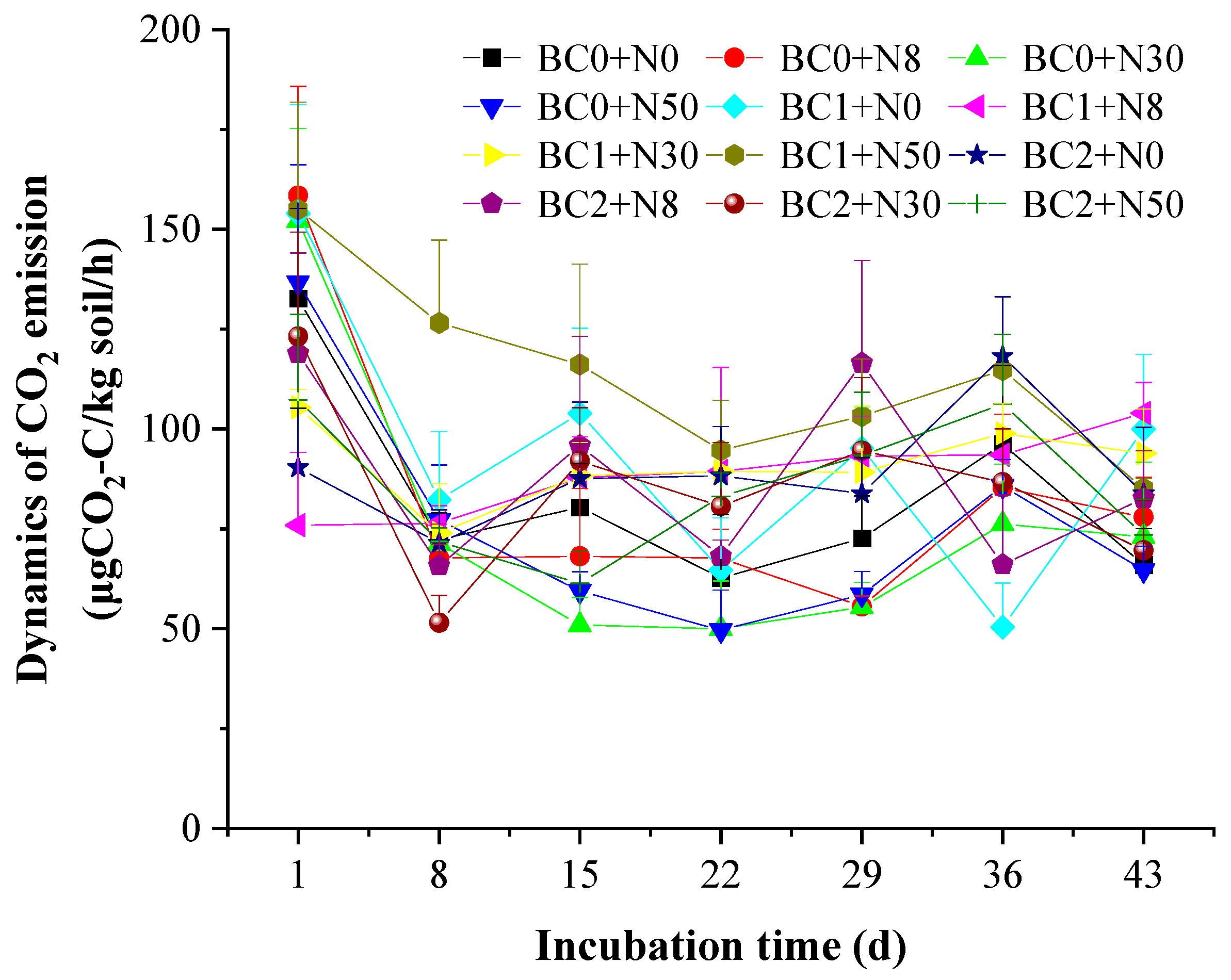
The CO2 emission rates under different treatments are shown in Figure 1. Repeated measures ANOVA (Table 3) revealed that biochar type, incubation time, and their interaction exerted significant effects on CO2 emission rates (p < 0.05), whereas N deposition level, the interaction between biochar type and N deposition, and the interaction between incubation time and N deposition showed no significant effects (p > 0.05).
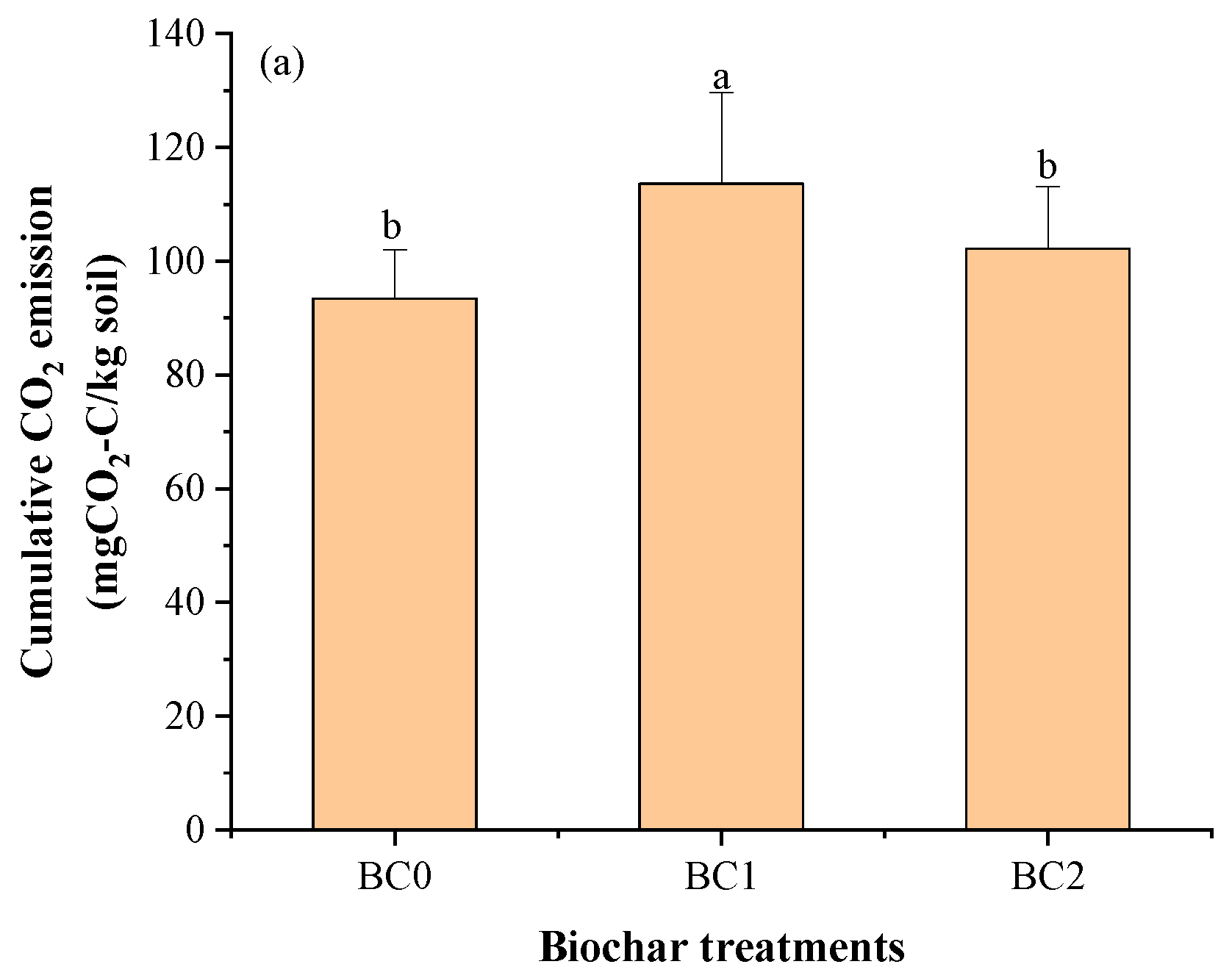
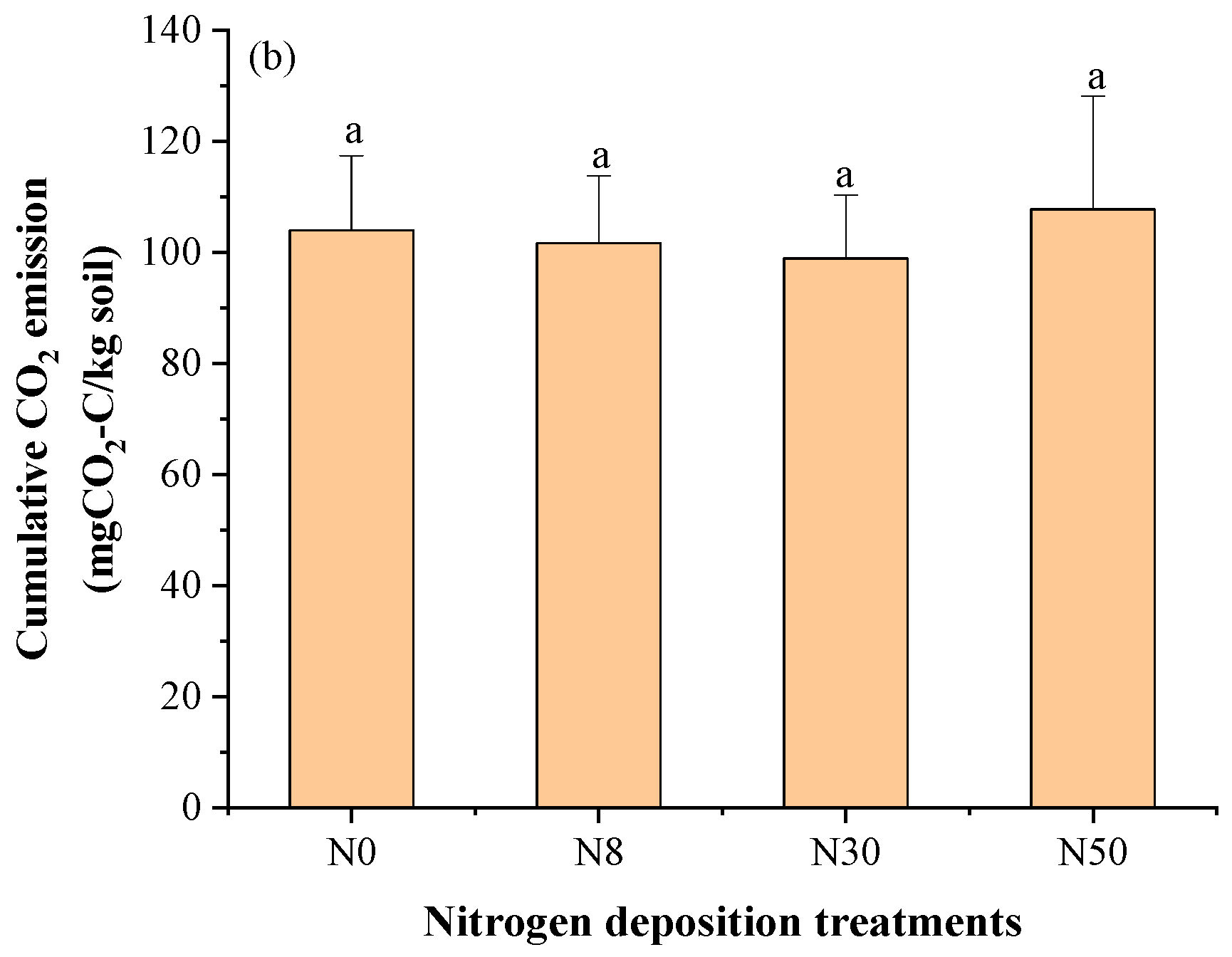
As shown in Figure 2, the cumulative CO2 emission from soil treated with biochar BC1 was significantly higher than that from the control and the BC2 treatment (p < 0.05). The cumulative emission from BC2 treatment was slightly higher than that from the control, but the difference was not statistically significant (p > 0.05). Figure 2 also indicates that N deposition level had no significant effect on cumulative soil CO2 emissions (p > 0.05).

3.3. Soil CH4 Uptake Responses

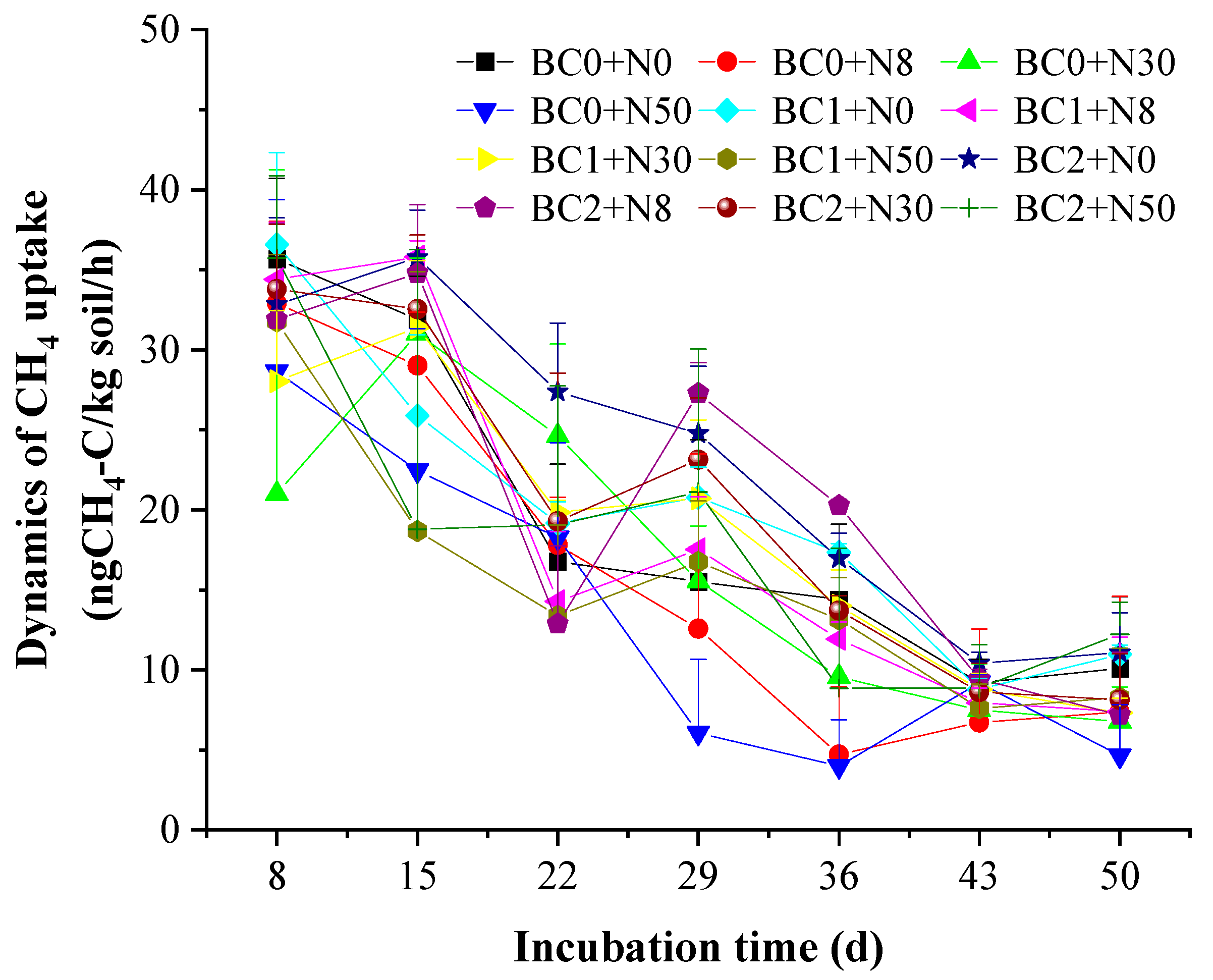
The CH4 uptake rates under different treatments are presented in Figure 3. Repeated measures ANOVA indicated that the assumption of sphericity was not met (p < 0.05), and that incubation time, biochar type, and N deposition level all exerted highly significant effects on CH4 uptake rates (p < 0.01), while the other effects were not significant (p > 0.05) (Table 4).
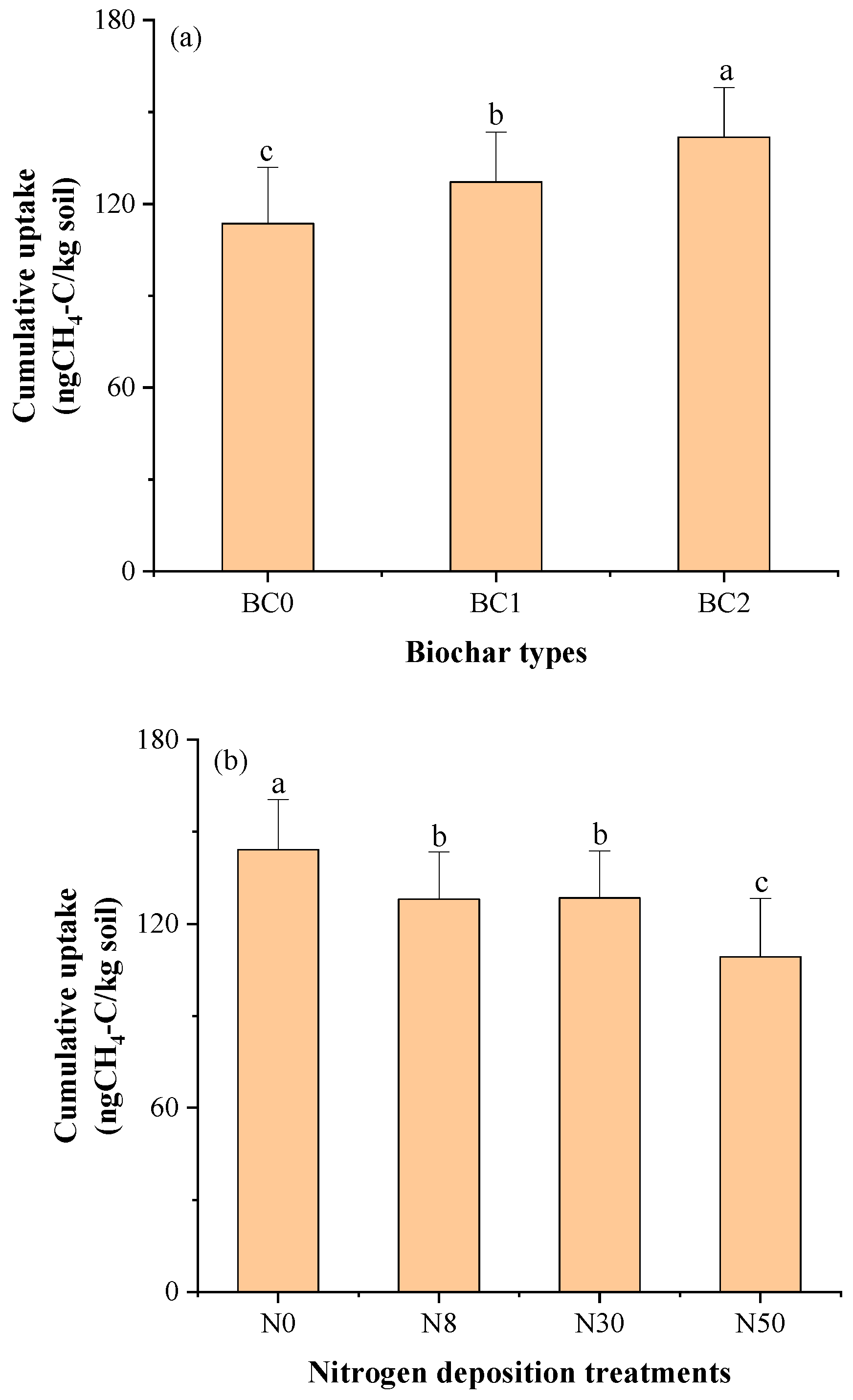
As shown in Figure 4a, the cumulative CH4 uptake differed significantly among biochar types (p < 0.05), with the BC2 group displaying the highest uptake, followed by BC1, and BC0 showing the lowest. N deposition level also significantly influenced CH4 uptake (p < 0.05), with the N0 group showing the highest uptake, the N50 group the lowest, and no significant difference between the N8 and N30 groups (Figure 4b).

3.4. Bacterial Taxa Associated with CO2 and CH4 Fluxes

As shown in Table 5, at the phylum level, the relative abundance of Elusimicrobiota showed a highly significant negative correlation with cumulative CO2 emissions (p < 0.01), while Actinomycetota, Chloroflexota, and Planctomycetota were significantly negatively correlated (p < 0.05). In contrast, the relative abundances of Bacteroidota, Bdellovibrionota, and Pseudomonadota exhibited significant positive correlations (p < 0.05). At the genus level, the relative abundances of Bacillus and Paenibacillus showed a highly significant negative correlation with cumulative CO2 emissions (p < 0.01), whereas Acidibacter, Acidothermus, and Mycobacterium showed significant negative correlations (p < 0.05). Additionally, Devosia and Mesorhizobium displayed highly significant (p < 0.01) and significant (p < 0.05) positive correlations, respectively (Table 5).
Table 6 indicates that, at the phylum level, cumulative CH4 uptake showed a highly significant positive correlation with the relative abundance of Bacteroidota (p < 0.01), but significantly negatively correlated with Chloroflexota and Candidatus_Eremiobacterota (p < 0.05). At the genus level, a significant negative correlation was observed between cumulative CH4 uptake and the relative abundance of Mycobacterium (p < 0.05) (Table 6).
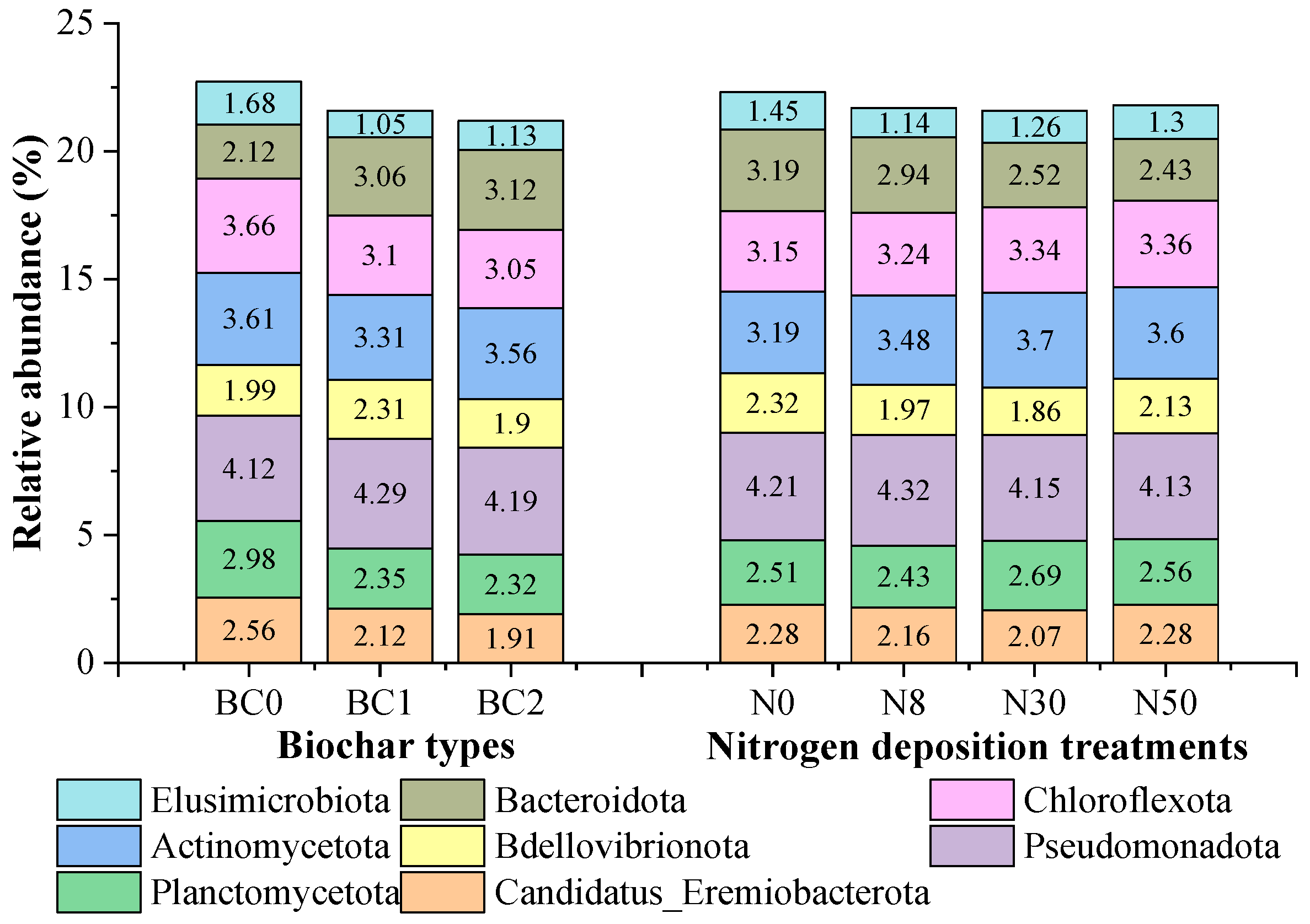
At the phylum level (Figure 5), following biochar addition, the relative abundances of Elusimicrobiota, Chloroflexota, Actinomycetota, Planctomycetota, and Candidatus_Eremiobacterota decreased, while those of Bacteroidota and Pseudomonadota increased. Bdellovibrionota increased in the BC1 group but decreased slightly in the BC2 group. N deposition reduced the relative abundances of Elusimicrobiota, Bacteroidota, and Bdellovibrionota, although only Bacteroidota exhibited a consistent decline. It increased the relative abundances of Chloroflexota, Actinomycetota, and Pseudomonadota, although only Chloroflexota showed a consistent increase. No clear trend was observed for Planctomycetota and Candidatus_Eremiobacterota (Figure 5).
Considering the cumulative CO2 emission patterns across treatments (Figure 2a) and their correlations with bacterial relative abundance at the phylum level (Table 5), in terms of CO2 emissions, Bdellovibrionota, Pseudomonadota, Elusimicrobiota, and Actinomycetota may have played more important roles than other taxa in biochar-treated soils. The negligible effect of N deposition on cumulative CO2 emissions (Figure 2b) may be attributed to offsetting effects resulting from altered bacterial community composition under N deposition treatments.
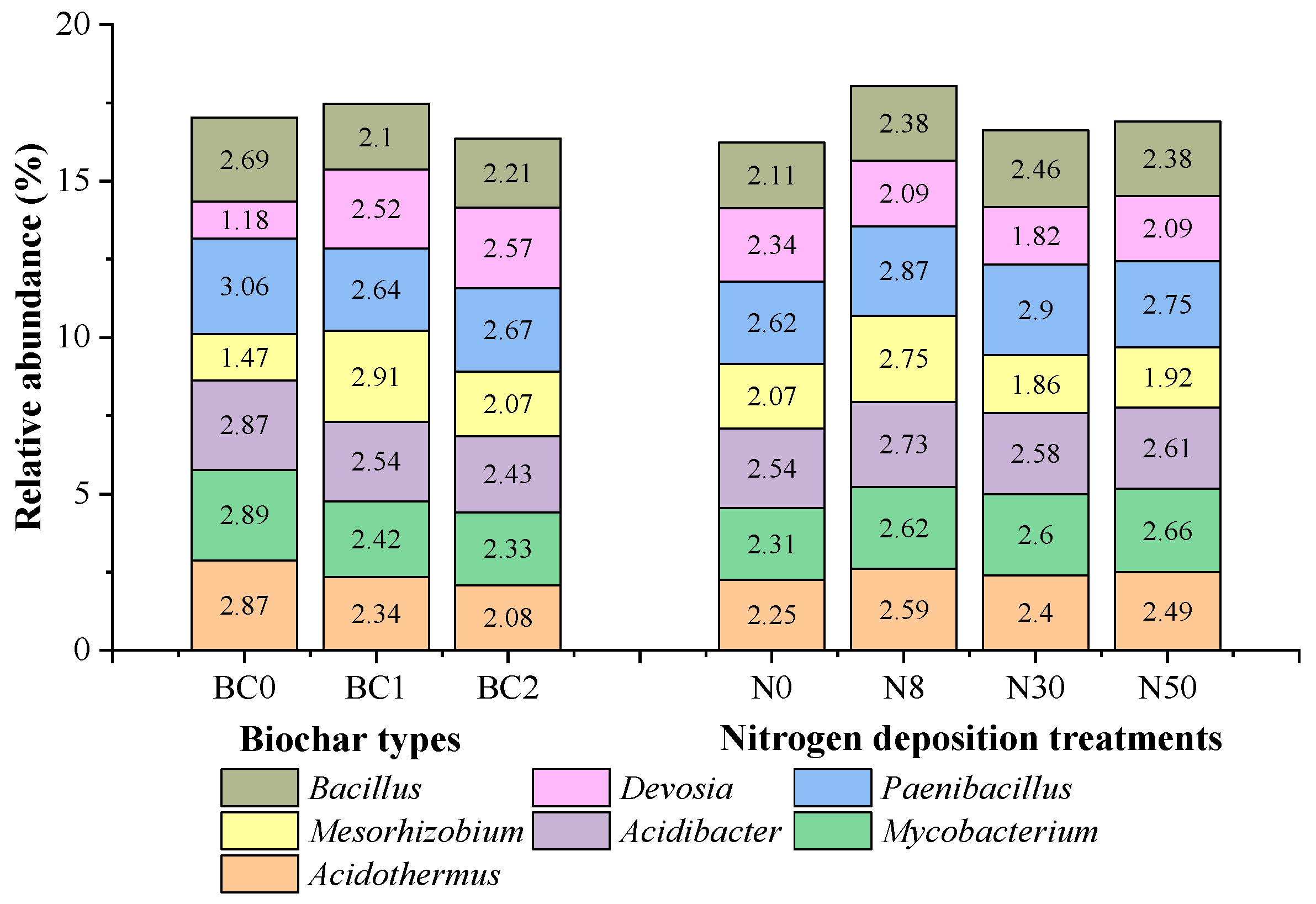
At the genus level (Figure 6), biochar addition decreased the relative abundances of Bacillus, Paenibacillus, Acidibacter, Mycobacterium, and Acidothermus, but increased those of Devosia and Mesorhizobium. N deposition increased the relative abundances of Bacillus, Paenibacillus, Acidibacter, Mycobacterium, and Acidothermus, decreased that of Devosia, and showed no consistent trend for Mesorhizobium (Figure 6).
Considering the cumulative CO2 emission patterns across biochar treatments (Figure 2a) and their correlations with bacterial relative abundance at the genus level (Table 5), Mesorhizobium, Bacillus, and Paenibacillus may have been more important in influencing CO2 emissions in biochar-treated soils. Since N deposition had no significant effect on cumulative CO2 emissions (Figure 2b), the changes in bacterial composition at the genus level under N deposition likely produced offsetting effects.
In both the biochar treatments and the N deposition treatments, the trends in the relative abundances of Bacteroidota, Chloroflexota, and Mycobacterium were similar to the trend in cumulative CH4 uptake (Figure 4, Figure 5 and Figure 6 and Table 5). While these taxa are not known to possess CH4 oxidation capabilities, they may serve as indicator taxa for forest soil CH4 uptake capacity. However, this hypothesis requires further validation with additional data.

4. Discussion

4.1. Mechanisms of Soil CO2 Production and CH4 Uptake in Forests

Forest soil carbon can be categorized into inorganic carbon, which is generally stable in nature, and organic carbon. Soil organic carbon is primarily derived from aboveground plant litter, plant root residues, organic substances generated by plant root metabolic activities, as well as animal excrement and remains [50]. Carbon efflux from forest soils occurs mainly through autotrophic respiration of plant roots, heterotrophic respiration of soil microorganisms and soil fauna, and the chemical oxidation and decomposition of soil organic matter [51]. Among these pathways, root respiration and microbial respiration constitute the most significant carbon output processes in forest soil carbon cycling, with microbial respiration primarily consuming soil organic carbon [52].
In well-drained forest soils, microbial respiration mineralizes organic carbon, resulting in CO2 release from the soil [53]. Concurrently, methanotrophic bacteria in the soil continuously oxidize atmospheric CH4 into CO2, enabling the soil to act as a sink for CH4 [54]. The magnitude of CH4 uptake by soils is typically determined by the oxidation capacity of methanotrophic bacteria [55]. However, under anaerobic conditions, methanogenic archaea decompose soil organic matter to produce CH4, thereby turning the soil into a source of CH4 [54].
The processes of CO2 production and CH4 uptake in forest soils are influenced by vegetation type and plant growth status, as well as by various soil physicochemical properties including pH, moisture content, O2 concentration, organic carbon content, temperature, and nutrient composition. Additionally, microbial community composition and activity play crucial regulatory roles [25,56]. Nitrogen deposition and biochar amendment can alter the intensity of these ecological factors [57], consequently affecting the fluxes of CO2 and CH4.

4.2. Impacts of N Deposition on CO2 and CH4 Fluxes in Forest Soils

Studies have shown that N addition may either stimulate [58] or inhibit [59] CO2 emissions from forest soils, while others report negligible effects. The nature and magnitude of N deposition impacts on greenhouse gas emissions may depend on soil nitrogen status [60]: when forest soils are nitrogen-limited, N deposition tends to have little effect or may stimulate CO2 emissions; however, under nitrogen-saturated conditions, it may suppress CO2 emissions. The present study found that N deposition did not significantly alter soil CO2 emissions, possibly because forest soils in the study area are not nitrogen-saturated.
N deposition can lower soil pH, increase Al3+ concentrations, and generate ions such as NO2, NO3, and NH4+, which may inhibit or competitively suppress methanotrophic activity [61,62], thereby potentially reducing CH4 uptake in forest soils. Our results demonstrate that N deposition significantly decreased CH4 uptake, consistent with earlier studies. However, some studies have reported nonsignificant effects of N deposition on CH4 emissions, potentially due to unsaturated soil nitrogen levels or enhanced CH4 oxidation by ammonia-oxidizing bacteria, which could compensate for reduced methanotroph activity [63].

4.3. Impacts of Biochar on CO2 and CH4 Fluxes in Forest Soils

Although carbon in biochar is generally stable, its addition still introduces extra carbon into the soil, including organic carbon. Furthermore, biochar enhances soil aeration, which facilitates microbial decomposition of organic carbon and CO2 production [64]. Improved soil aeration also promotes CH4 uptake in soils [65]. Consequently, in this study, biochar amendment increased soil CO2 emissions and significantly enhanced CH4 uptake.
During biomass pyrolysis, Mg2+ can promote the cleavage of lignin and cellulose, thereby increasing the specific surface area and improving the pore structure of biochar, resulting in superior physicochemical properties [66]. Similar results were observed in this study (Table 2). Therefore, Mg-modified biochar generally offers greater advantages in improving soil physicochemical properties and microbial community structure. This was reflected in the significantly higher cumulative CH4 uptake in the BC2 group compared to the BC1 group in the present study. During the production of Mg-modified biochar, maize straw underwent two high-temperature pyrolysis steps, which likely further stabilized its carbon content. This may explain why cumulative CO2 emissions in the BC2 group did not differ significantly from those in the BC0 group (Figure 2a).

4.4. Effects of Biochar on Negative Impacts of N Deposition

Biochar is typically alkaline or contains negatively charged functional groups, enabling it to neutralize H+ in soil and thus alleviate pH decline induced by excess nitrogen [66]. Its surface possesses abundant functional groups, high specific surface area, and well-developed pore structure, which facilitate the binding or adsorption of ions such as Al3+, NH4+, NO2, and NO3 in soil [67]. Therefore, biochar application is theoretically expected to mitigate certain adverse effects of excessive N deposition, including the suppression of CH4 uptake, a finding that has been supported by numerous studies [13]. However, in the present study, no significant interaction was observed between biochar addition and N deposition (Table 4), indicating that biochar amendment did not substantially alleviate the N deposition-induced reduction in methane uptake. A possible explanation is that soil CH4 oxidation is influenced by a variety of physicochemical and biological factors [68] and the effects of certain factors in this experiment may have counteracted the mitigating role of biochar.

4.5. Impacts of Biochar Addition and N Deposition on Bacterial Community Structure

Biochar addition and N deposition can alter microbial community structure, leading to shifts in the relative abundance of various taxa. However, the direction and magnitude of these changes may vary with N deposition intensity, soil physicochemical characteristics, vegetation composition, and other factors, showing no consistent pattern [28,29].
Biochar has been reported to increase the abundance of Actinomycetota, Bacteroidota, and Acidobacteriota [24]. In contrast, other studies found that biochar may not significantly affect bacterial community structure or could even inhibit certain groups. The present study also observed differential responses of bacterial taxa to biochar addition.
Increasing N deposition intensity has been shown to elevate the abundance of Acidibacter, Actinomycetota, and Chloroflexota [29], which is partly consistent with our findings. Previous studies reported that N deposition increased the abundance of Pseudomonadota. In this study, however, low-level N deposition (N8 treatment) increased Pseudomonadota abundance, whereas higher deposition rates reduced it. While N deposition was found to increase Bacteroidota abundance in previous work, it decreased in our experiment. Similarly, N deposition has been shown to suppress Paenibacillus growth [25], yet we observed an increase in its relative abundance under N deposition.

4.6. Limitations of Laboratory Simulations and Implications for Field Conditions

Field conditions are inherently diverse and complex. The emission of CO2 and uptake of CH4 in forest soils are influenced not only by a range of physicochemical parameters—including soil texture, temperature, nutrient availability, moisture, and pH—but also by various biological factors such as plant community composition, plant growth dynamics, soil fauna, and other microbial processes [68]. These influencing factors exhibit considerable temporal variability and often involve intricate interactions, all of which can alter the characteristic and effects of biochar. Additionally, the physicochemical properties and ecological impacts of biochar may change over time [69,70]. It is important to note that this study was conducted as a short-term ex situ experiment under relatively stable laboratory conditions, which may result in deviations from the actual effects observed in complex field settings. Consequently, building on these findings, it is essential to conduct long-term in situ experiments to thoroughly evaluate the ecological effects of biochar and establish a robust scientific foundation for its future application.

5. Conclusions

Soil treated with biochar BC1 exhibited significantly greater cumulative CO2 emissions than the control and BC2 (p < 0.05). Emissions under BC2 were slightly higher than in the control, though not significantly (p > 0.05). N deposition did not significantly affect cumulative CO2 emissions (p > 0.05).
N deposition significantly reduced the cumulative CH4 uptake (p < 0.05). In contrast, biochar addition significantly increased cumulative CH4 uptake (p < 0.05), with magnesium-modified biochar exhibiting a more pronounced effect. However, neither biochar amendment significantly alleviated the reduction in methane uptake caused by excessive N deposition.
Relative abundances of Elusimicrobiota, Bacillus, and Paenibacillus were highly significantly negatively correlated with cumulative CO2 emissions (p < 0.01). Significant negative correlations (p < 0.05) were also detected for Actinomycetota, Chloroflexota, Planctomycetota, Acidibacter, Acidothermus, and Mycobacterium. In contrast, Bacteroidota, Bdellovibrionota, Pseudomonadota, Devosia, and Mesorhizobium showed significant positive correlations with cumulative CO2 emissions (p < 0.05). Cumulative CH4 uptake showed a highly significant positive correlation with Bacteroidota (p < 0.01) and significant negative correlations with Chloroflexota, Candidatus_Eremiobacterota, and Mycobacterium (p < 0.05).

Author Contributions

Conceptualization, Y.Z.; methodology, Y.Z.; validation, Y.Z.; formal analysis, Y.Z. and J.Z.; investigation, Y.Z.; resources, Y.Z., J.Z., J.D., T.Y., X.L. and Q.L.; data curation, Y.Z., J.Z., C.S. and Z.S.; writing—original draft preparation, Y.Z.; writing—review and editing, Y.Z. and J.Z.; visualization, Y.Z., J.Z. and J.X.; supervision, Y.Z.; project administration, Y.Z. All authors have read and agreed to the published version of the manuscript.

Funding

This work was financially supported by the Shandong Provincial Natural Science Foundation (ZR2025QC306, ZR2023MC171).

Data Availability Statement

The original contributions presented in this study are included in the article. Further inquiries can be directed to the corresponding author.

Acknowledgments

The authors would like to express their sincere gratitude to Wenhao Dong and Xiaojing Lin for their valuable suggestions and assistance.

Conflicts of Interest

The authors declare no conflicts of interest.

References

  1. Xie, Y.X.; Zhang, S.L.; Feng, W.; Zhao, X.; Guo, T.C. Review of Atmospheric Nitrogen Deposition Research. Chin. J. Eco-Agric. 2010, 18, 897–904. [Google Scholar] [CrossRef]
  2. Muhammad, I.; Lv, J.Z.; Wang, J.; Ahmad, S.; Farooq, S.; Ali, S.; Zhou, X.B. Regulation of Soil Microbial Community Structure and Biomass to Mitigate Soil Greenhouse Gas Emission. Front. Microbiol. 2022, 13, 868862. [Google Scholar] [CrossRef]
  3. Bai, J.; Song, J.; Chen, D.; Zhang, Z.; Yu, Q.; Ren, G.; Han, X.; Wang, X.; Ren, C.; Yang, G.; et al. Biochar Combined with N Fertilization and Straw Return in Wheat-Maize Agroecosystem: Key Practices to Enhance Crop Yields and Minimize Carbon and Nitrogen Footprints. Agric. Ecosyst. Environ. 2023, 347, 108366. [Google Scholar] [CrossRef]
  4. Wang, L.; O’Connor, D.; Rinklebe, J.; Ok, Y.S.; Tsang, D.C.W.; Shen, Z.; Hou, D. Biochar Aging: Mechanisms, Physicochemical Changes, Assessment, and Implications for Field Applications. Environ. Sci. Technol. 2020, 54, 14797–14814. [Google Scholar] [CrossRef]
  5. Wang, N.; Huang, D.; Bai, X.; Lin, Y.; Miao, Q.; Shao, M.; Xu, Q. Mechanism of Digestate-Derived Biochar on Odorous Gas Emissions and Humification in Composting of Digestate from Food Waste. J. Hazard. Mater. 2022, 434, 128878. [Google Scholar] [CrossRef]
  6. Nan, Q.; Speth, D.R.; Qin, Y.; Chi, W.; Milucka, J.; Gu, B.; Wu, W. Biochar Application Using Recycled Annual Self Straw Reduces Long-Term Greenhouse Gas Emissions from Paddy Fields with Economic Benefits. Nat. Food 2025, 6, 456–465. [Google Scholar] [CrossRef]
  7. Zhang, X.Y.; Gao, C.P.; Tang, J.L.; Zhu, Y.; Tian, L.; Han, G.D.; Ren, H.Y. Responses of Soil CH4 and CO2 Flux to Warming and Nitrogen Addition during Freeze-Thaw Cycles in a Desert Steppe of Nei Mongol, China. Chin. J. Plant Ecol. 2024, 48, 1291–1301. [Google Scholar] [CrossRef]
  8. Ge, P.; Li, A.; Wang, Y.L.; Jiang, L.C.; Niu, G.X.; Hasi, M.; Wang, Y.B.; Xue, J.G.; Zhao, W.; Huang, J.H. Nonlinear Response of Greenhouse Gases Emission to Nitrogen Addition in a Meadow Steppe. Chin. J. Plant Ecol. 2023, 47, 1483–1492. [Google Scholar] [CrossRef]
  9. Gill-Olivas, B.; Telling, J.; Tranter, M.; Skidmore, M.; Christner, B.; O’Doherty, S.; Priscu, J. Subglacial Erosion Has the Potential to Sustain Microbial Processes in Subglacial Lake Whillans, Antarctica. Commun. Earth Environ. 2021, 2, 134. [Google Scholar] [CrossRef]
  10. Dong, J.; Wang, R.; Xie, Y.; Gao, F.; Tan, S.T.; Zhao, Z.; Yin, Q.; Hu, E.J. Interpretable Machine Learning Analysis on CO2 Adsorption and Separation Capacity of Biochar under Multi-Scenario Conditions. Green Energy Environ. 2026, 11, 131–147. [Google Scholar] [CrossRef]
  11. Xia, L.; Cao, L.; Yang, Y.; Ti, C.; Liu, Y.; Smith, P.; Van Groenigen, K.J.; Lehmann, J.; Lal, R.; Butterbach-Bahl, K.; et al. Integrated Biochar Solutions Can Achieve Carbon-Neutral Staple Crop Production. Nat. Food 2023, 4, 236–246. [Google Scholar] [CrossRef]
  12. Zhang, J.; Zhou, X.; Zhou, Y.; Zhang, Z. Reliability of CO2 Emissions for Assessing the Carbon Sequestration Effect of Biochar and Its Co-Application with Fertilizer. Environ. Technol. Innov. 2025, 40, 104445. [Google Scholar] [CrossRef]
  13. Zhou, J.; Tang, C.; Vancov, T.; Fu, S.; Fang, Y.; Ge, T.; Dong, Y.; Luo, Y.; Yu, B.; Cai, Y.; et al. Biochar Mitigates the Suppressive Effects of Nitrogen Deposition on Soil Methane Uptake in a Subtropical Forest. Agric. Ecosyst. Environ. 2026, 395, 109951. [Google Scholar] [CrossRef]
  14. Adekiya, A.O.; Agbede, T.M.; Olayanju, A.; Ejue, W.S.; Adekanye, T.A.; Adenusi, T.T.; Ayeni, J.F. Effect of Biochar on Soil Properties, Soil Loss, and Cocoyam Yield on a Tropical Sandy Loam Alfisol. Sci. World J. 2020, 2020, 9391630. [Google Scholar] [CrossRef]
  15. Han, M.X.; Huang, J.R.; Jiang, H.C.; Fang, B.Z.; Xie, Y.G.; Li, W.J. Lunatibacter Salilacus Gen. Nov. Sp. Nov. a Member of the Family Cyclobacteriaceae, Isolated from a Saline and Alkaline Lake Sediment. Int. J. Syst. Evol. Microbiol. 2021, 71, 004621. [Google Scholar] [CrossRef]
  16. Fu, J.; He, Y.; Zhao, H.; Yang, H.; Li, Q.; Chen, R.; Li, Y.Y. Biochar Mediated Microbial Synergy in Partial Nitrification-Anammox Systems: Enhancing Nitrogen Removal Efficiency and Stability. Front. Environ. Sci. Eng. 2025, 19, 95. [Google Scholar] [CrossRef]
  17. Fu, J.; Liao, H.; Wang, Z.; Xiao, Y.; Zhang, Y.; Bai, G.; Zhang, J.; Wang, H.; Lu, H.; Dong, Y.; et al. Effect of Simultaneously Addition of Fe3+ and Reed Straw Biochar on Nitrogen Removal Efficiency and GWP for Anammox. Chem. Eng. J. 2025, 506, 160090. [Google Scholar] [CrossRef]
  18. Hu, T.; Wei, J.; Du, L.; Chen, J.; Zhang, J. The Effect of Biochar on Nitrogen Availability and Bacterial Community in Farmland. Ann. Microbiol. 2023, 73, 4. [Google Scholar] [CrossRef]
  19. Wang, H.; Zhang, R.; Zhao, Y.; Shi, H.; Liu, G. Effect of Biochar on Rhizosphere Soil Microbial Diversity and Metabolism in Tobacco-Growing Soil. Ecologies 2022, 3, 539–556. [Google Scholar] [CrossRef]
  20. Li, Y.; Hu, S.; Chen, J.; Müller, K.; Li, Y.; Fu, W.; Lin, Z.; Wang, H. Effects of Biochar Application in Forest Ecosystems on Soil Properties and Greenhouse Gas Emissions: A Review. J. Soils Sediments 2018, 18, 546–563. [Google Scholar] [CrossRef]
  21. Kolton, M.; Meller Harel, Y.; Pasternak, Z.; Graber, E.R.; Elad, Y.; Cytryn, E. Impact of Biochar Application to Soil on the Root-Associated Bacterial Community Structure of Fully Developed Greenhouse Pepper Plants. Appl. Environ. Microbiol. 2011, 77, 4924–4930. [Google Scholar] [CrossRef]
  22. Ramirez, K.S.; Lauber, C.L.; Knight, R.; Bradford, M.A.; Fierer, N. Consistent Effects of Nitrogen Fertilization on Soil Bacterial Communities in Contrasting Systems. Ecology 2010, 91, 3463–3470. [Google Scholar] [CrossRef]
  23. Wang, J.; Shi, X.; Zheng, C.; Suter, H.; Huang, Z. Different Responses of Soil Bacterial and Fungal Communities to Nitrogen Deposition in a Subtropical Forest. Sci. Total Environ. 2021, 755, 142449. [Google Scholar] [CrossRef]
  24. Wang, N.; Qian, S.Y.; Pan, X.C.; Chen, Y.L.; Bai, S.B.; Xu, F. Effects of Simulated Acid Rain and Nitrogen Deposition on Soil Bacterial Community Structure and Diversity in the Masson Pine Forest. Environ. Sci. 2023, 44, 2315–2324. [Google Scholar] [CrossRef]
  25. Zhou, X.; Zuo, H.; Smaill, S.J. Incorporation of NPP into Forest CH4 Efflux Models. Trends Plant Sci. 2021, 26, 1210–1212. [Google Scholar] [CrossRef]
  26. Chen, W.; Zheng, X.; Wolf, B.; Yao, Z.; Liu, C.; Butterbach-Bahl, K.; Brüggemann, N. Long-Term Grazing Effects on Soil-Atmosphere Exchanges of CO2, CH4 and N2O at Different Grasslands in Inner Mongolia: A Soil Core Study. Ecol. Indic. 2019, 105, 316–328. [Google Scholar] [CrossRef]
  27. Wang, C.; Liu, D.; Bai, E. Decreasing Soil Microbial Diversity Is Associated with Decreasing Microbial Biomass under Nitrogen Addition. Soil Biol. Biochem. 2018, 120, 126–133. [Google Scholar] [CrossRef]
  28. Li, J.Y.; Xi, Y.; Zhao, J.F. Effects of Soil Moisture on Methane Uptake in a Tropical Forest of Southern China. Acta Ecol. Sin. 2022, 42, 4978–4987. [Google Scholar] [CrossRef]
  29. Tian, D.; Niu, S. A Global Analysis of Soil Acidification Caused by Nitrogen Addition. Environ. Res. Lett. 2015, 10, 024019. [Google Scholar] [CrossRef]
  30. Bowman, W.D.; Cleveland, C.C.; Halada, Ĺ.; Hreško, J.; Baron, J.S. Negative Impact of Nitrogen Deposition on Soil Buffering Capacity. Nat. Geosci. 2008, 1, 767–770. [Google Scholar] [CrossRef]
  31. Yang, Y.H.; Kou, L.D.; Fan, Q.F.; Wang, J. Removal of Phosphate and Antibiotics by Magnesium Modified Sludge-Derived Biochar. China Environ. Sci. 2022, 42, 4137–4144. [Google Scholar]
  32. Ma, L.J. Effects of Ammonium and Nitrate Ratio on Soil Carbon and Nitrogen Sequestration and Greenhouse Gas Emissions in Pinus Thunbergii Forest of Taishan. Master’s Thesis, Shandong Agricultural University, Tai’an, China, 2024. [Google Scholar]
  33. Song, X.; Gu, H.; Wang, M.; Zhou, G.; Li, Q. Management Practices Regulate the Response of Moso Bamboo Foliar Stoichiometry to Nitrogen Deposition. Sci. Rep. 2016, 6, 24107. [Google Scholar] [CrossRef]
  34. Dai, Z.; Zhang, X.; Tang, C.; Muhammad, N.; Wu, J.; Brookes, P.C.; Xu, J. Potential Role of Biochars in Decreasing Soil Acidification—A Critical Review. Sci. Total Environ. 2017, 581–582, 601–611. [Google Scholar] [CrossRef]
  35. Wang, Y.; Liu, Y.; Liu, R.; Zhang, A.; Yang, S.; Liu, H.; Zhou, Y.; Yang, Z. Biochar Amendment Reduces Paddy Soil Nitrogen Leaching but Increases Net Global Warming Potential in Ningxia Irrigation, China. Sci. Rep. 2017, 7, 1592. [Google Scholar] [CrossRef]
  36. Kameyama, K.; Miyamoto, T.; Shiono, T.; Shinogi, Y. Influence of Sugarcane Bagasse-Derived Biochar Application on Nitrate Leaching in Calcaric Dark Red Soil. J. Environ. Qual. 2012, 41, 1131–1137. [Google Scholar] [CrossRef]
  37. Gul, S.; Whalen, J.K.; Thomas, B.W.; Sachdeva, V.; Deng, H. Physico-Chemical Properties and Microbial Responses in Biochar-Amended Soils: Mechanisms and Future Directions. Agric. Ecosyst. Environ. 2015, 206, 46–59. [Google Scholar] [CrossRef]
  38. Luo, Y.; Dungait, J.A.J.; Zhao, X.; Brookes, P.C.; Durenkamp, M.; Li, G.; Lin, Q. Pyrolysis Temperature during Biochar Production Alters Its Subsequent Utilization by Microorganisms in an Acid Arable Soil. Land Degrad. Dev. 2018, 29, 2183–2188. [Google Scholar] [CrossRef]
  39. Lü, C.; Tian, H. Spatial and Temporal Patterns of Nitrogen Deposition in China: Synthesis of Observational Data. J. Geophys. Res. Atmos. 2007, 112, 2006JD007990. [Google Scholar] [CrossRef]
  40. Fu, Z.; Niu, S.; Dukes, J.S. What Have We Learned from Global Change Manipulative Experiments in China? A Meta-Analysis. Sci. Rep. 2015, 5, 12344. [Google Scholar] [CrossRef]
  41. Liu, C.; Zhao, C.; Wang, A.; Guo, Y.; Lee, D. Denitrifying Sulfide Removal Process on High-salinity Wastewaters in the Presence of Halomonas sp. Appl. Microbiol. Biot. 2016, 100, 1421–1426. [Google Scholar] [CrossRef]
  42. Chen, S.; Zhou, Y.; Chen, Y.; Gu, J. FASTP: An Ultra-fast All-in-one FASTQ Preprocessor. Bioinformatics 2018, 34, 884–890. [Google Scholar] [CrossRef]
  43. Magoč, T.; Salzberg, S.L. FLASH: Fast Length Adjustment of Short Reads to Improve Genome Assemblies. Bioinformatics 2011, 27, 2957–2963. [Google Scholar] [CrossRef]
  44. Edgar, R. UPARSE: Highly Accurate OTU Sequences from Microbial Amplicon Reads. Nat. Methods 2013, 10, 996–998. [Google Scholar] [CrossRef]
  45. Stackebrandt, E.; Goebel, B.M. Taxonomic Note: A Place for DNA-DNA Reassociation and 16S rRNA Sequence Analysis in the Present Species Definition in Bacteriology. Int. J. Syst. Bacteriol. 1994, 44, 846–849. [Google Scholar] [CrossRef]
  46. Wang, Q. Naive Bayesian Classifier for Rapid Assignment of rRNA Sequences into the New Bacterial Taxonomy. Appl. Environ. Microbiol. 2007, 73, 5261–5267. [Google Scholar] [CrossRef]
  47. Chen, S.; Hao, T.; Goulding, K.; Misselbrook, T.; Liu, X. Impact of 13-Years of Nitrogen Addition on Nitrous Oxide and Methane Fluxes and Ecosystem Respiration in a Temperate Grassland. Environ. Pollut. 2019, 252, 675–681. [Google Scholar] [CrossRef]
  48. Pregitzer, K.S.; Burton, A.J.; Zak, D.R.; Talhelm, A.F. Simulated Chronic Nitrogen Deposition Increases Carbon Storage in Northern Temperate Forests. Glob. Change Biol. 2008, 14, 142–153. [Google Scholar] [CrossRef]
  49. Zhang, L.; Hou, L.; Guo, D.; Li, L.; Xu, X. Interactive Impacts of Nitrogen Input and Water Amendment on Growing Season Fluxes of CO2, CH4, and N2O in a Semiarid Grassland, Northern China. Sci. Total Environ. 2017, 578, 523–534. [Google Scholar] [CrossRef]
  50. Su, L.; Chen, X.; Luo, Z.; Hu, Y.; Chen, Y.; Wu, D.; Zeng, S. Effects of Nitrogen Addition on the Organic Carbon Sequestration and CO2 Emissions in Forest Soils: A Review. Acta Ecol. Sin. 2024, 44, 2717–2733. [Google Scholar] [CrossRef]
  51. Zhu, W.; Zhang, H.; Wang, Y. Research Progress on Effects of Cutting on Forest Soil Respiration. J. Zhejiang A&F Univ. 2021, 38, 1000–1011. [Google Scholar] [CrossRef]
  52. Xu, X.; Schimel, J.P.; Thornton, P.E.; Song, X.; Yuan, F.; Goswami, S. Substrate and Environmental Controls on Microbial Assimilation of Soil Organic Carbon: A Framework for Earth System Models. Ecol. Lett. 2014, 17, 547–555. [Google Scholar] [CrossRef]
  53. Wei, S.; Luo, B.; Wei, S.; Wen, Z.; Sun, L.; Hu, H. Methods of Measuring of Soil Respiration in Forest Ecosystems: A Review. Ecol. Environ. Sci. 2014, 23, 504–514. [Google Scholar] [CrossRef]
  54. He, S.; Liu, J.; Jiang, P.; Zhou, G.; Li, Y. Effects of Global Change on Methane Uptake in Forest Soils and Its Mechanisms: A Review. Chin. J. Appl. Ecol. 2019, 30, 677–684. [Google Scholar] [CrossRef]
  55. Zhang, W.; Mo, J.; Fang, Y.; Lu, X.; Wang, H. Effects of Nitrogen Deposition on the Greenhouse Gas Fluxes from Forest Soils. Acta Ecol. Sin. 2008, 38, 2309–2319. [Google Scholar]
  56. Chen, L.; Zhou, W.; Yi, Y.; Song, Q.; Zhang, Y.; Liang, N.; Lu, Z.; Wen, H.; Mohd, Z.; Sha, L. Characteristics of Soil CH4 Flux in the Subtropical Evergreen Broad-Leaved Forest in Ailao Mountain, Yunnan, Southwest China. Ecol. Environ. Sci. 2022, 31, 949–960. [Google Scholar] [CrossRef]
  57. Ge, X.; Cao, Y.; Zhou, B.; Xiao, W.; Tian, X.; Li, M.H. Combined Application of Biochar and N Increased Temperature Sensitivity of Soil Respiration but Still Decreased the Soil CO2 Emissions in Moso Bamboo Plantations. Sci. Total Environ. 2020, 730, 139003. [Google Scholar] [CrossRef]
  58. Reay, D.S.; Dentener, F.; Smith, P.; Grace, J.; Feely, R.A. Global Nitrogen Deposition and Carbon Sinks. Nat. Geosci. 2008, 1, 430–437. [Google Scholar] [CrossRef]
  59. Skea, J.; Shukla, P.; Al Khourdajie, A.; McCollum, D. Intergovernmental Panel on Climate Change: Transparency and Integrated Assessment Modeling. Wires Clim. Change 2021, 12, e727. [Google Scholar] [CrossRef]
  60. Miller, A.D.; Dietze, M.C.; DeLucia, E.H.; Anderson-Teixeira, K.J. Alteration of Forest Succession and Carbon Cycling under Elevated CO2. Glob. Change Biol. 2016, 22, 351–363. [Google Scholar] [CrossRef]
  61. Song, H.; Peng, C.; Zhu, Q.; Chen, Z.; Blanchet, J.P.; Liu, Q.; Li, T.; Li, P.; Liu, Z. Quantification and Uncertainty of Global Upland Soil Methane Sinks: Processes, Controls, Model Limitations, and Improvements. Earth-Sci. Rev. 2024, 252, 104758. [Google Scholar] [CrossRef]
  62. Chen, W.F.; Zhang, W.M.; Meng, J.; Xu, Z.J. Researches on Biochar Application Technology. Strateg. Study CAE 2011, 13, 83–89. [Google Scholar]
  63. Woolf, D.; Amonette, J.E.; Street-Perrott, F.A.; Lehmann, J.; Joseph, S. Sustainable Biochar to Mitigate Global Climate Change. Nat. Commun. 2010, 1, 56. [Google Scholar] [CrossRef] [PubMed]
  64. Jeffery, S.; Verheijen, F.G.A.; Kammann, C.; Abalos, D. Biochar Effects on Methane Emissions from Soils: A Meta-Analysis. Soil Biol. Biochem. 2016, 101, 251–258. [Google Scholar] [CrossRef]
  65. Hawthorne, I.; Johnson, M.S.; Jassal, R.S.; Black, T.A.; Grant, N.J.; Smukler, S.M. Application of Biochar and Nitrogen Influences Fluxes of CO2, CH4 and N2O in a Forest Soil. J. Environ. Manag. 2017, 192, 203–214. [Google Scholar] [CrossRef]
  66. Li, Q.; Cui, K.; Lv, J.; Zhang, J.; Peng, C.; Li, Y.; Gu, Z.; Song, X. Biochar Amendments Increase Soil Organic Carbon Storage and Decrease Global Warming Potentials of Soil CH4 and N2O under N Addition in a Subtropical Moso Bamboo Plantation. For. Ecosyst. 2022, 9, 100054. [Google Scholar] [CrossRef]
  67. Ackerman, D.; Millet, D.B.; Chen, X. Global Estimates of Inorganic Nitrogen Deposition across Four Decades. Glob. Biogeochem. Cycles 2019, 33, 100–107. [Google Scholar] [CrossRef]
  68. Li, M.; Peng, Y.; Wang, T.; Chang, R. Soil Methane Uptake and Its Response and Mechanism to Global Change in Natural Ecosystems: A Review. Chin. J. Soil Sci. 2025, 56, 884–900. [Google Scholar] [CrossRef]
  69. Qian, M.; Wu, Y.; Han, L.; Chen, R.; Duan, W.; Chen, F. Effects of Biological and Enzymatic Ageing on the Surface Properties of Mg-modified Biochar. Environ. Sci. 2024, 45, 7390–7400. [Google Scholar] [CrossRef]
  70. Zhang, C.; Wang, Z. Effects of Biochar and Its Aging on Ammonia Volatilization and Nitrous Oxide Emission from Farmland. Acta Ecol. Sin. 2024, 44, 1418–1428. [Google Scholar] [CrossRef]
Figure 1. CO2 emission rates from forest soil under different treatments.
Forests 17 00407 g001
Figure 2. Cumulative CO2 emissions under biochar treatments (a) and nitrogen deposition treatments (b). Different lowercase letters indicate significant differences between treatments at the p < 0.05 levels.
Forests 17 00407 g002aForests 17 00407 g002b
Figure 3. CH4 uptake rates under different treatment groups.
Forests 17 00407 g003
Figure 4. Cumulative CH4 uptake under biochar treatments (a) and nitrogen deposition treatments (b). Different lowercase letters indicate significant differences between treatments at the p < 0.05 levels.
Forests 17 00407 g004
Figure 5. Relative abundance of bacterial phyla significantly correlated with cumulative CO2 emissions and CH4 uptake.
Forests 17 00407 g005
Figure 6. Relative abundance of bacterial genera significantly correlated with cumulative CO2 emissions or CH4 uptake.
Forests 17 00407 g006
Table 1. Physicochemical properties of the experimental soil (mean ± SD).
Soil Bulk Density (g/cm3)Soil Moisture Content (%)Organic Matter Content (g/kg)TN Content (g/kg)Available K Content (g/kg)Available P Content (g/kg)
1.136 ± 0.131.55% ± 0.7668.80 ± 3.24.82 ± 0.7871.47 ± 7.7714.66 ± 0.47
Table 2. Physicochemical properties of BC1 and BC2 (mean ± SD).
BiocharN Content (%)C Content (%)H Content (%)H/CN/CBET Surface Area (m2/g)Langmuir Surface Area (m2/g)Micropore Volume (cm3/g)Mean Pore Size (Å)
BC11.3762.602.590.0410.0220.482.040.0016.67
BC21.7968.522.150.0310.02673.42130.140.03325.13
Table 3. Results of repeated-measures ANOVA for the effects of biochar addition and N deposition on soil CO2 emission rates.
SourceEffectdfFp Value
Within-subjects effectsTime627.33<0.01
Time * Biochar type125.253<0.01
Time * N deposition180.9660.501
Between-subjects effectsBiochar type29.789<0.01
N deposition31.0060.407
Biochar type * N deposition62.030.101
Note: The asterisk (*) between two factors represents their interaction.
Table 4. Results of repeated-measures ANOVA for the effects of biochar addition and N deposition on soil CH4 uptake rates.
SourceEffectdfFp Value
Within-subjects effectsTime3.0770.17<0.01
Time * Biochar type6.131.340.25
Time * N deposition9.201.560.14
Between-subjects effectsBiochar type214.78<0.01
N deposition311.38<0.01
Biochar type * N deposition60.210.97
Note: The asterisk (*) between two factors represents their interaction.
Table 5. Spearman’s correlations between the relative abundance of bacterial taxa and cumulative CO2 emissions.
PhylumCorrelation
Coefficient
p ValueGenusCorrelation Coefficientp Value
Elusimicrobiota−0.765 **0.004Bacillus−0.874 **<0.001
Bacteroidota0.692 *0.013Devosia0.832 **0.001
Chloroflexota−0.671 *0.017Paenibacillus−0.720 **0.008
Actinomycetota−0.650 *0.022Mesorhizobium0.664 *0.018
Bdellovibrionota0.643 *0.024Acidibacter−0.594 *0.042
Pseudomonadota0.643 *0.024Mycobacterium−0.594 *0.042
Planctomycetota−0.622 *0.031Acidothermus−0.580 *0.048
Note: * and ** indicate significance at the p < 0.05 and p < 0.01 levels, respectively.
Table 6. Spearman’s correlations between the relative abundance of bacterial taxa and cumulative CH4 uptake.
PhylumCorrelation Coefficientp ValueGenusCorrelation Coefficientp Value
Bacteroidota0.769 **0.003Mycobacterium−0.615 *0.033
Chloroflexota−0.615 *0.033
Candidatus_Eremiobacterota−0.669 *0.017
Note: * and ** indicate significance at the p < 0.05 and p < 0.01 levels, respectively.
Disclaimer/Publisher’s Note: The statements, opinions and data contained in all publications are solely those of the individual author(s) and contributor(s) and not of MDPI and/or the editor(s). MDPI and/or the editor(s) disclaim responsibility for any injury to people or property resulting from any ideas, methods, instructions or products referred to in the content.