Article

Nonmonotonic Elevational Patterns of Soil CO2 Flux Driven by Temperature Dominance and Moisture Thresholds in the Sejila Mountains, Tibetan Plateau


1
College of Water Conservancy and Civil Engineering, Xizang Agricultural and Animal Husbandry University, Linzhi 860000, China
2
Key Laboratory of Forest Ecology in Xizang Plateau Ministry of Education, Xizang Agricultural and Animal Husbandry University, Linzhi 860000, China
3
College of Agricultural Science and Engineering, Hohai University, Nanjing 211100, China
4
Plateau Water Environment and Water Ecology Laboratory, Xizang Agriculture and Animal Husbandry University, Linzhi 860000, China
5
School of Water Conservancy and Civil Engineering, Northeast Agricultural University, Harbin 150030, China
*
Authors to whom correspondence should be addressed.
These authors contributed equally to this work.
Forests 2026, 17(3), 390; https://doi.org/10.3390/f17030390
Submission received: 10 February 2026 / Revised: 10 March 2026 / Accepted: 18 March 2026 / Published: 21 March 2026
(This article belongs to the Section Forest Soil)

Abstract

Understanding spatiotemporal variation in soil CO2 flux (FCO2) along elevational gradients is essential for predicting carbon–climate feedback in alpine ecosystems. However, how temperature- and moisture-related factors jointly regulate daily-scale FCO2 and how their contributions vary with elevation remain unclear, particularly in the Sejila Mountains (Southeastern Tibetan Plateau). We conducted continuous in situ measurements of daily-scale FCO2, air temperature (Ta), relative humidity (RH), soil temperature (ST, 0–10 cm), and volumetric soil water content (SW) across five elevational bands (3000–4200 m) in 2024–2025. Across both years, FCO2 showed a unimodal seasonal cycle and a robust nonmonotonic spatial pattern, with the highest efflux at 3000 and 4200 m and peak rates exceeding 5.0 µmol CO2 m−2 s−1. Cumulative carbon loss at 4200 m (909.90 g C m−2) exceeded that at mid-elevation sites. Linear mixed-effects models identified Ta as the most consistent positive predictor; the ST × SW interaction was not significant, indicating that temperature and moisture effects are largely additive at the daily scale. Piecewise regression revealed nonlinear SW thresholds (θ) in the FCO2 response, with θ varying nonmonotonically with elevation. Multiple linear regression further showed that thermal predictors (Ta, ST) explained substantially more variance than moisture predictors (RH, SW), and the relative importance of thermal drivers increased with elevation. These results challenge the common expectation of a monotonic decline in soil respiration with elevation and suggest that, when SW remains above critical thresholds, warming may amplify soil carbon losses at high elevations on the Tibetan Plateau.

1. Introduction

The Tibetan Plateau (TP), located in the interior of Eurasia, has its highest point exceeding 8000 m, while the northeastern edge and river valley regions descend to below 2200 m [1]. Its average elevation exceeding 4000 m, earning it the ‘Third Pole’ [2,3]. It plays a crucial role in regulating the Asian monsoon, large-scale atmospheric circulation, and downstream water availability [4,5,6], and it is widely regarded as both a hotspot and an amplifier of global climate change [3,7]. In recent decades, the TP has warmed markedly faster than the global mean [8], driving substantial shifts in hydrothermal regimes and, in turn, altering the structure and functioning of regional ecosystems [9,10]. Soil respiration is a major pathway of CO2 flux from terrestrial ecosystems to the atmosphere [11,12]. Its magnitude and spatiotemporal variability strongly influence ecosystem carbon budgets [13,14,15] and are central to quantifying terrestrial carbon-cycle responses and feedback to climate change [15,16,17]. Therefore, elucidating soil-respiration dynamics and their environmental controls in representative TP ecosystems is essential for advancing process understanding in the Third Pole and for better constraining related model simulations.
FCO2 is jointly controlled by multiple factors, including temperature, soil moisture, substrate supply, and biotic community composition [18,19,20]. Beyond these biological and climatic drivers, soil compaction, a physical disturbance resulting from human activities like forestry operations, also critically influences CO2 dynamics. Compaction alters soil structure, reduces pore space, and thus impedes gas diffusion, leading to elevated CO2 concentrations, even from seemingly mild disturbances with long-term implications [21]. Among these, temperature and moisture are the most immediate and sensitive environmental drivers [22,23]. Extensive evidence shows that soil respiration generally increases with temperature, a relationship commonly described using exponential models such as the Arrhenius equation or the Lloyd–Taylor function [16,24]. Recent global syntheses further support this positive temperature dependence. For example, Bond-Lamberty et al. [25] linked multi-decadal increases in soil respiration to concurrent warming based on global records. However, temperature sensitivity is not constant: long-term warming experiments by Luo et al. [26] documented thermal acclimation, with an initially strong stimulation of soil respiration weakening over time, implying that seasonal to interannual temperature variability can alter patterns of soil carbon flux. Consistently, Reichstein et al. [27] used multifactor models to show that spatiotemporal variation in soil respiration is strongly associated with temperature fluctuations. A meta-analysis of 81 field-warming experiments reported significant short-term (typically 1–3 years) increases in FCO2—18.0%, 13.1%, and 5.9% in forests, croplands, and grasslands, respectively—while the effect often declined with longer warming duration, consistent with thermal acclimation [28]. The effect of temperature, however, depends strongly on soil moisture [27,29]. Moisture regulates respiration in a nonlinear manner because soil water simultaneously constrains microbial activity and metabolic pathways and governs the diffusion of substrates and gases. Under dry conditions, water limitation suppresses microbial activity and restricts substrate transport. Under excessively wet conditions, water-filled pore space reduces aeration and promotes a shift from aerobic to less efficient anaerobic metabolism [30,31], yielding an intermediate ‘optimal moisture range’ for respiration [32]. Moreover, soil moisture can modify the apparent temperature sensitivity of respiration via strong temperature–moisture interactions. Field manipulations by Davidson et al. [16] showed that temperature and moisture effects may be additive or interactive. Such hydrothermal coupling is especially complex in alpine ecosystems with highly variable precipitation, where single-factor models based solely on temperature or moisture often fail to reproduce the temporal dynamics of FCO2 [33]. Mountain ecosystems, with strong elevational relief and steep hydrothermal gradients over short horizontal distances, provide a natural laboratory for disentangling coupled temperature and moisture controls on soil respiration. Although elevational-gradient studies have been conducted in montane forests, alpine grasslands, and shrublands, most have targeted limited parts of the growing season or relied on coarse temporal sampling. As a result, daily-scale characterization of FCO2 and their hydrothermal controls remains insufficient [27,34,35], particularly in montane ecosystems within the humid–subhumid transition zone along the southeastern margin of the Tibetan Plateau, where in situ observations are scarce.
Sejila Mountain lies on the southeastern margin of the TP, within the middle–lower reaches of the Yarlung Tsangpo River. Influenced by the warm, moist Indian Ocean monsoon and complex topography, the region exhibits strong elevational differentiation and well-defined vertical zonation [36]. Air temperature and precipitation vary markedly with elevation, and soils and vegetation are organized into altitudinal belts that exert important controls on soil hydrothermal regimes and carbon cycling [35,37]. Previous studies in this area have primarily focused on vegetation productivity, soil physicochemical properties, and hydrothermal processes [35,38,39]. However, diel FCO2 and its hydrothermal drivers along elevational gradients remain poorly constrained, limiting efforts to reduce uncertainty in the contribution of southeastern TP montane ecosystems to regional carbon budgets and their responses to climate change.
Building on this context, we established five representative plots on the western slope of Sejila Mountain at 3000, 3300, 3600, 3900, and 4200 m a.s.l., while maintaining comparable topographic conditions (e.g., aspect and slope). From April 2024 to December 2025, we continuously monitored daily air temperature and relative humidity, as well as 0–10 cm soil temperature and volumetric water content, and simultaneously measured daily-scale FCO2. Specifically, we aimed to (i) characterize seasonal patterns in hydrothermal conditions and daily-scale FCO2 along the elevational gradient; (ii compare FCO2 rates and cumulative emissions among elevations; and (iii) quantify the combined effects of soil temperature and moisture on daily-scale FCO2 and evaluate how these effects vary with elevation. Using these high-temporal-resolution in situ observations, we provide an empirical basis for assessing soil-respiration responses to hydrothermal variability in montane ecosystems of the Tibetan Plateau (‘Third Pole’) and for informing regional carbon-cycle modeling and climate-impact assessments.

2. Materials and Methods

2.1. Study Area

The Sejila Mountains (29°10′–30°15′ N, 93°12′–95°35′ E) lie on the southeastern margin of the Tibetan Plateau (TP), northwest of the Yarlung Tsangpo Grand Bend (Figure 1) [40], forming a major alpine canyon landscape at the tectonic junction of the Nyainqêntanglha and Himalayan ranges. The region exhibits a pronounced ecological transition from humid subtropical conditions at lower elevations to cold, semi-humid alpine conditions at higher elevations.
The regional climate is influenced by both the Indian Ocean and plateau monsoon systems and features cool summers, mild winters, and a distinct wet–dry seasonal cycle. Long-term observations at the Sejila Mountain Central Ecological Station (Table 1) indicate mean annual temperature from 0.5 to 15.8 °C, mean annual evaporation of 308.8 mm, and mean annual precipitation ranges from 677 to 866 mm [36]. This precipitation far exceeds evapotranspiration, indicating that soil moisture in the study area is generally replenished by rainfall. Precipitation is highly seasonal, with most rainfall occurring during the June–September wet season and exhibiting a unimodal annual distribution. Along the elevational gradient, air temperature declines sharply with elevation, while precipitation and snow dynamics vary, producing distinct vertical climatic zones that transition from subtropical or temperate to alpine conditions. This pronounced altitudinal differentiation in hydrothermal regimes provides an ideal setting for examining elevational patterns of FCO2 and their responses to coupled temperature and moisture constraints [41,42]. According to the World Reference Base for Soil Resources (WRB), the soils in the study area are classified as Cambisols (pH 4–6) [43]. From the summit to the foot of the mountain, soils can be subdivided into five types: alpine tundra soils above 4800 m a.s.l.; alpine meadow soils above the treeline; subalpine shrub meadow soils beneath alpine shrubs; montane drift-gray soils beneath the high-altitude Abies fabri forest; and montane dark-brown soils beneath a conifer–broadleaf mixed forest. The parent material is uniform; the soil-forming material is granite weathering regolith [44,45].

2.2. Site Description and Monitoring of Environmental Variables

To capture key ecotones along the elevational gradient (3000–4200 m a.s.l.), we selected five representative sites spanning montane temperate dark conifer forests, fir–spruce mixed forests, and the treeline ecotone (Table 1, Figure 1) [36,46]. Sites were chosen to maintain comparable slope aspect, slope gradient, and topographic position among plots [47], thereby improving inference on hydrothermal and topographic controls on soil processes across elevations. At each 30 m × 30 m plot, a microclimate monitoring system and soil observation points were installed at the plot center. To characterize in situ meteorological conditions, an automatic weather station (RS-WS-4G-C3; Jianda Renke, Jinan, China) was deployed at each site to continuously record air temperature (Ta) and relative humidity (RH). Ta was measured using a high-precision thermistor sensor (−40 to 80 °C; resolution, 0.1 °C) that was calibrated in the laboratory against multiple reference points, with an absolute error of ±0.2 °C. RH was measured using a capacitive sensor (0%−100%; with an accuracy of ±2%).
To quantify near-surface soil hydrothermal conditions, soil volumetric water content (SW) and soil temperature (ST) were continuously monitored using temperature–moisture sensors (RS-WS-N01-TR-1; Jianda Renke, China) installed at a 10 cm depth within the 0−10 cm soil layer at each site. The sensors measure SW over 0%−100% and temperature over −40 to 80 °C, with a resolution of 0.1% and 0.1 °C, respectively. Before field deployment, sensors were calibrated in the laboratory using standardized soil samples collected from each elevation; the post-calibration absolute error in SW was within ±0.8%. Sensors were installed adjacent to the soil-respiration collars to ensure spatial consistency between hydrothermal monitoring and soil FCO2 measurements.
All sensors recorded measurements at 4 h intervals, and data were transmitted in near-real time to a cloud-based platform via a 4G network. Sensors were inspected regularly and cross-checked throughout the monitoring period to ensure the continuity and reliability of the time series.
Additionally, to characterize substrate availability across the elevational gradient, a baseline soil organic carbon (SOC) survey was conducted during plot establishment in September 2023, prior to the commencement of continuous FCO2 monitoring. Given that SOC pools in alpine forests are vast and highly stable, exhibiting negligible overwinter turnover, these baseline data accurately reflect the background soil carbon substrate conditions during the subsequent flux observation period. At each elevational site (HB1–HB5), following the removal of surface litter, soil samples from the 0–20 cm layer were collected using a soil auger (5 cm in diameter). Within each plot, five randomly extracted soil cores were pooled to form a single composite sample. The composite samples were gently broken apart along natural fracture planes and passed through a 6 mm sieve to remove coarse roots, stones, and debris. After removal of coarse materials, the composite samples were thoroughly mixed to ensure homogeneity, then air-dried, gently ground, and sieved to 2 mm for SOC analysis. All samples were transported to the laboratory on the same day. Detailed plot establishment protocols and comprehensive baseline SOC validation are documented in a concurrent publication ([36]; Table 2).

2.3. Site Selection and Experimental Layout Along the Elevational Gradient

FCO2 was measured in situ using a portable soil carbon flux system (PS9000; Lijia United, Beijing, China) equipped with an infrared gas analyzer (IRGA). During each measurement, the instrument continuously recorded CO2 concentrations inside the chamber; the manufacturer reports an accuracy of approximately ±1.5% of the reading, suitable for ecosystem-scale monitoring of FCO2. To ensure representativeness and comparability across elevations, measurement locations within each plot were selected in areas with relatively homogeneous vegetation cover, soil surface conditions, and microtopography. In each plot, three permanent PVC collars (20 cm inner diameter; 15 cm height) were installed as bases for FCO2 measurements. Each collar was inserted 12 cm into the soil, leaving 3 cm above the surface to minimize lateral gas leakage and maintain a stable chamber–collar seal. This insertion depth is particularly important in high-altitude ecosystems where fine roots are predominantly distributed in the upper 0–10 cm soil layer; therefore, it served to physically sever most live roots within the collar, minimizing the contribution of autotrophic (live root) respiration to the measured FCO2. Thus, following a sufficient stabilization period, the FCO2 primarily represents heterotrophic respiration from soil organic matter and recently dead root detritus. Collars were installed on 22 March 2024, and initial FCO2 measurements were conducted on 14 April 2024 to allow disturbances from installation to dissipate.
Field measurements followed a standardized schedule and operating protocol throughout the monitoring period. FCO2 was measured at 7-day intervals, and all five sites were sampled within a fixed time window on each measurement date to minimize confounding effects of diurnal variation and changes in radiation conditions. For each measurement, an automated chamber was sealed to the collar, and the increase in CO2 concentration was recorded over a short closure period (typically 5–10 min). Using the system software, the initial post-closure stabilization period and apparent outliers in the CO2 time series were excluded. FCO2 was calculated from the linear rate of change in chamber CO2 concentration, chamber volume, and the soil surface area enclosed by the collar, and is reported in µmol CO2 m−2 s−1.

2.4. Data Processing and Statistical Analysis

2.4.1. Microclimate and Soil Variables

Air temperature (Ta), relative humidity (RH), soil temperature (ST), and soil volumetric water content (SW) were recorded continuously at 4 h intervals. Data were screened for completeness; records affected by sensor malfunction, transmission failure, or external disturbance were removed. Potential outliers were identified through a combination of statistical screening and field verification. For each variable, observations deviating from the site-specific mean by more than 3 standard deviations were flagged and excluded [48]. Flagged observations were cross-checked against field inspection notes and instrument maintenance logs to avoid discarding valid extreme conditions.
Short gaps due to temporary interruptions were rare and were filled using linear interpolation to preserve time-series continuity. Quality-controlled 4 h records were aggregated to daily resolution to compute daily means of Ta and RH, as well as daily means of ST and SW for the 0–10 cm soil layer. The resulting daily data were used to characterize elevational differences in microclimate and seasonal variability and to serve as candidate predictors in analyses of FCO2.

2.4.2. Processing and Quality Control of Soil CO2 Flux Data

FCO2 measurements underwent multi-level quality control. At the instrument level, the PS9000 system automatically excluded the initial stabilization period immediately after chamber closure and removed clear outliers in the CO2 concentration time series that were inconsistent with stable accumulation during the closure period. During field campaigns, flux readings were monitored in real time using the PS9000 mobile application (v1.0.5). If anomalous values were detected (e.g., negative or zero fluxes, or values that deviated markedly from the previous observation at the same collar), the measurement was repeated immediately to minimize the influence of occasional operational errors.
After instrument-based screening, an additional statistical check was applied to the flux data. For the three collars per plot on a given sampling date, any replicate deviating from the plot mean by more than 3 standard deviations was classified as an outlier and removed [49]. Field notes documenting rainfall, strong winds, or other disturbances were consulted to avoid excluding rare but ecologically meaningful events. Following these procedures, the FCO2 dataset was deemed suitable for comparisons across elevations and for analyses of environmental responses.

2.4.3. Statistical Analysis

Analyses were conducted at time scales aligned with each objective. Seasonal dynamics of FCO2 were assessed from daily-scale flux data paired with daily mean microclimate variables. Elevational patterns were evaluated using plot-level means of FCO2 and environmental variables across the full observation period. Environmental response relationships were examined using paired daily observations FCO2 and environmental variables, with primary emphasis on soil temperature and soil water content in the 0–10 cm layer.
Differences in FCO2 and environmental variables among elevational sites were tested in SPSS (version 31). Assumptions of normality and homogeneity of variance were assessed before conducting parametric tests. When the assumptions were satisfied, one-way ANOVA was used to evaluate site effects; otherwise, nonparametric alternatives (e.g., Kruskal–Wallis tests) were applied. Statistical significance was defined as p < 0.05. Correlation and regression analyses were performed in MATLAB (2022) to quantify relationships between FCO2 and environmental variables. Data visualization was conducted in Origin (2025), including time-series plots, elevational contrasts, and response relationships.

3. Results

3.1. Seasonal Dynamics of Hydrothermal Conditions Along the Elevational Gradient

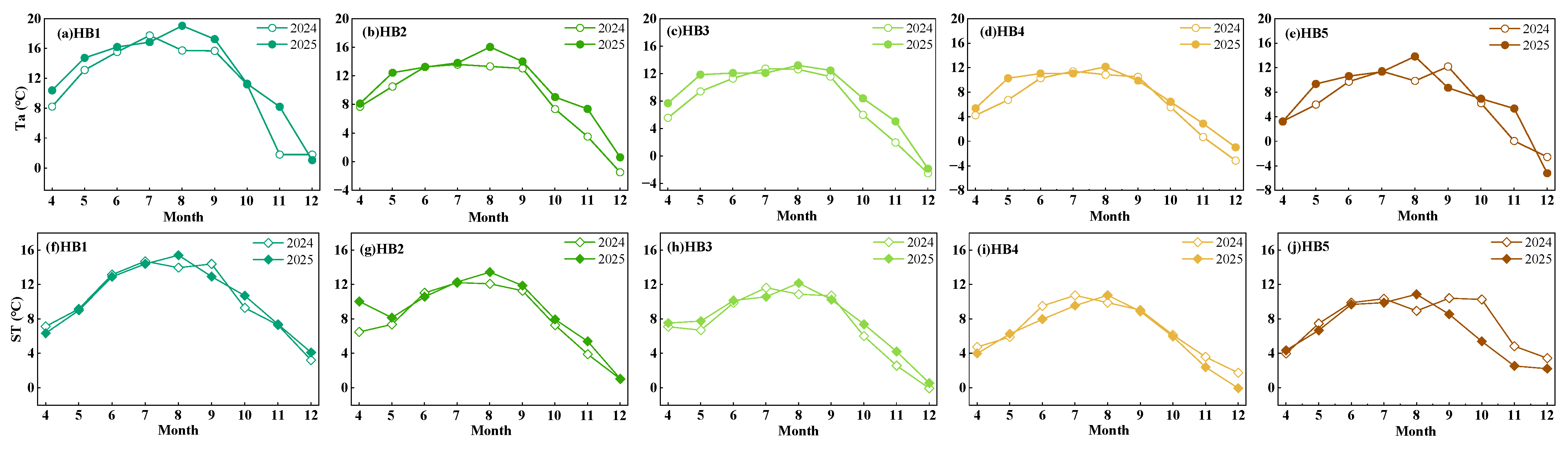
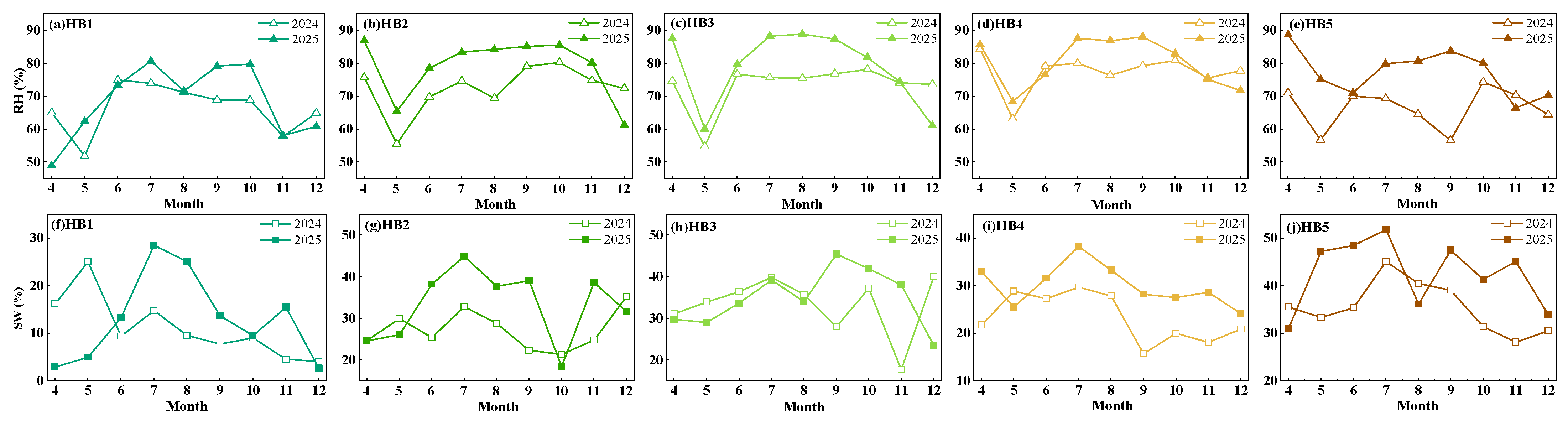
Seasonal variation in Ta, ST, RH, and soil SW across the five sites is shown in Figure 2 and Figure 3. All hydrothermal variables exhibited pronounced seasonality at each elevation, but their absolute levels and the magnitude of seasonal variability varied along the elevational gradient.
Air and soil temperatures followed consistent seasonal trajectories across sites, rising from the early growing season to a mid-season maximum and declining toward the end of the season (Figure 2). Both Ta and ST decreased with increasing elevation, though the overall seasonal pattern was similar among sites. Relative to Ta, ST exhibited a smaller seasonal amplitude.
RH was lowest in the early growing season and increased thereafter, remaining high through the middle to late growing season. Higher-elevation sites generally exhibited higher RH (Figure 3a–e). SW varied more strongly than RH, and its seasonal pattern differed among elevations (Figure 3f–j), indicating spatial heterogeneity in near-surface moisture dynamics along the slope.

3.2. Multiscale Variation in Soil CO2 Flux and Elevational Differences

3.2.1. Dynamics of Soil CO2 Flux

Daily-scale FCO2 during the 2024 and 2025 growing seasons is shown in Figure 4. Across all sites and both years, FCO2 exhibited a pronounced unimodal seasonal trajectory: fluxes rose from the early growing season, peaked mid-season, and declined toward the season’s end.
Daily-scale FCO2 differed significantly among sites along the elevational gradient (Figure 4; Table 2). The low-elevation site HB1 and the high-elevation site HB5 exhibited the highest growing-season mean FCO2 in both years. In 2024, mean FCO2 was 3.22 and 3.52 µmol CO2 m−2 s−1 at HB1 and HB5, respectively; in 2025, both sites averaged 3.13 µmol CO2 m−2 s−1. Maximum Daily-scale FCO2 was also highest at HB1 and HB5, ranging from 5.90 to 6.23 µmol CO2 m−2 s−1 at HB1 and 5.72–5.91 µmol CO2 m−2 s−1 at HB5 (Table 2). In contrast, HB2 and HB4 showed lower FCO2, with growing-season means < 2.0 µmol CO2 m−2 s−1 in both years and maxima generally < 4.0 µmol CO2 m−2 s−1 (Figure 4; Table 2).
Across sites, the coefficient of variation (CV) of Daily-scale FCO2 ranged from 0.37 to 0.58 (Table 2), indicating substantial within-season temporal variability. In 2025, CV was higher at HB1 and HB5, consistent with greater day-to-day fluctuations at these sites.
Seasonal trajectories were broadly similar between 2024 and 2025, although peak magnitude and flux levels during certain periods differed (Figure 4; Table 2). These interannual differences did not alter the overall elevational pattern of FCO2.

3.2.2. Monthly Dynamics of Soil CO2 Flux

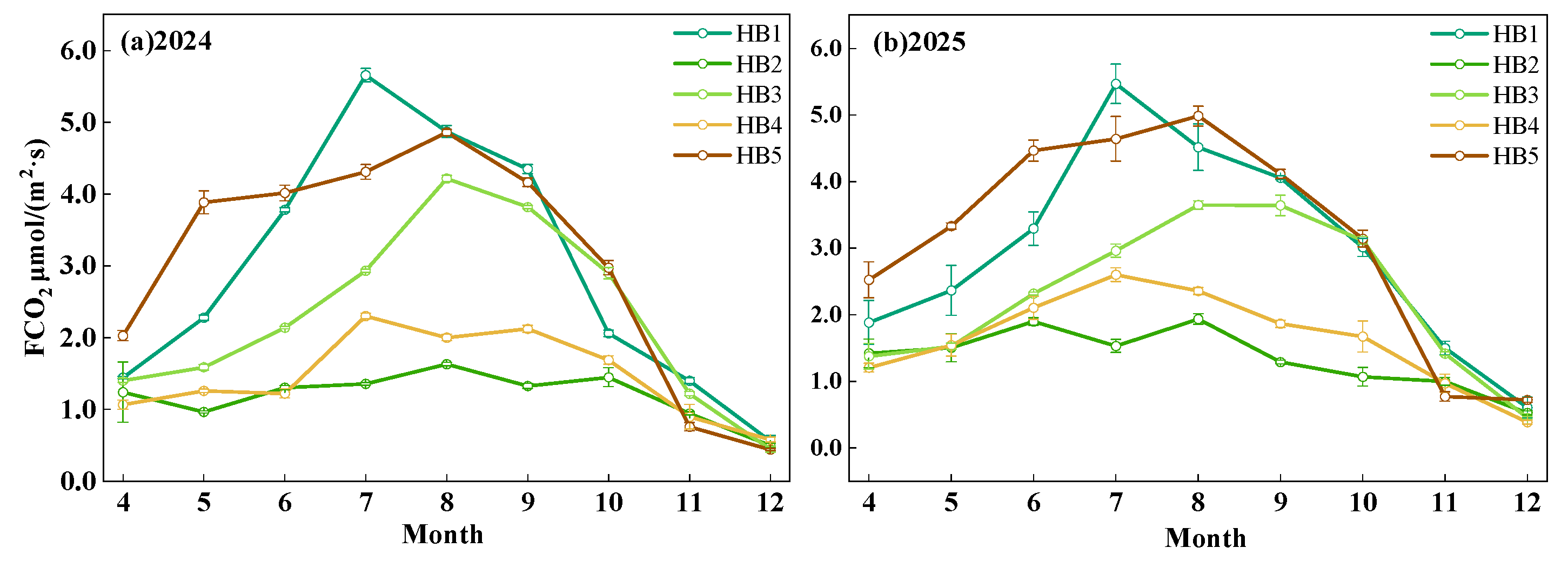
Monthly dynamics of FCO2 at the five sites across 2024 and 2025 are shown in Figure 5. Across HB1–HB5, monthly FCO2 exhibited a consistent unimodal seasonal trajectory in both years: fluxes rose from April to June, peaked in July or August, and then declined from September to December to low levels.
Monthly FCO2 differed significantly among sites along the elevational gradient (Figure 5; Table 2). HB1 and HB5 showed higher monthly fluxes in both years, with monthly peaks approaching or exceeding 5.00 µmol CO2 m−2 s−1. Over the observation period, mean FCO2 at HB1 and HB5 was 3.22 and 3.54 µmol CO2 m−2 s−1 in 2024 and 3.13 and 3.18 µmol CO2 m−2 s−1 in 2025 (Table 2). Maximum daily-scale FCO2 was also highest at HB1 and HB5, ranging from 5.90–6.23 µmol CO2 m−2 s−1 at HB1 and 5.72–5.91 µmol CO2 m−2 s−1 at HB5 (Table 2). In contrast, HB2 and HB4 showed lower FCO2, with mean FCO2 < 1.50 µmol CO2 m−2 s−1 in both years and maxima generally < 4.0 µmol CO2 m−2 s−1 (Figure 5; Table 2). HB3 and HB4 were intermediate, remaining consistently lower than HB1 and HB5.
Across sites, monthly peaks generally occurred in July and August, with small differences in peak timing; however, peak magnitude varied substantially among elevations (Figure 5). Seasonal patterns were broadly similar between 2024 and 2025, and site rankings were maintained. Interannual differences primarily reflected modest changes in peak magnitude and did not alter the overall elevational pattern (Figure 5).

3.2.3. Elevational Differences in Soil CO2 Flux

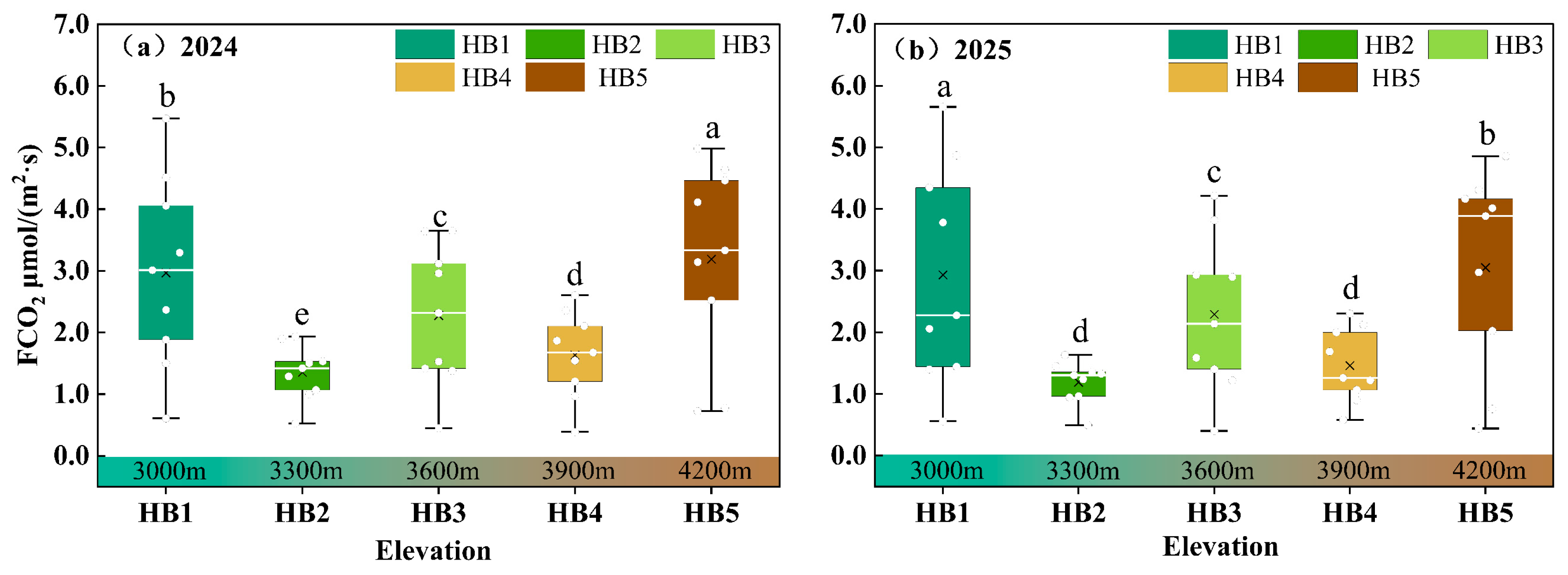
FCO2 differed significantly among the five elevational sites in both 2024 and 2025 (Figure 6). Within each year, a one-way ANOVA indicated a significant site effect (p < 0.05), and Tukey’s post hoc tests identified significant pairwise differences among sites.
In 2024, HB5 (4200 m) and HB1 (3000 m) had higher FCO2 than the other sites (Figure 6). HB5 showed the highest central tendency, with both the median and upper quartile exceeding those of the other sites. In contrast, HB2 (3300 m) consistently exhibited the lowest FCO2 distribution. HB3 (3600 m) and HB4 (3900 m) were intermediate, with FCO2 at HB3 higher than at HB4. Most site comparisons showed significant differences (p < 0.05).
In 2025, the distributional pattern closely matched that in 2024, and the relative ranking among sites was unchanged (Figure 6). HB5 and HB1 again formed the high-flux group, HB2 remained the lowest-flux site, and HB3 and HB4 remained intermediate. Although the median and dispersion of FCO2 differed between years, significant among-site differences persisted, indicating a consistent elevational contrast in soil CO2 flux over the study period.

3.2.4. Elevational Differences in Growing-Season Cumulative Soil CO2 Flux

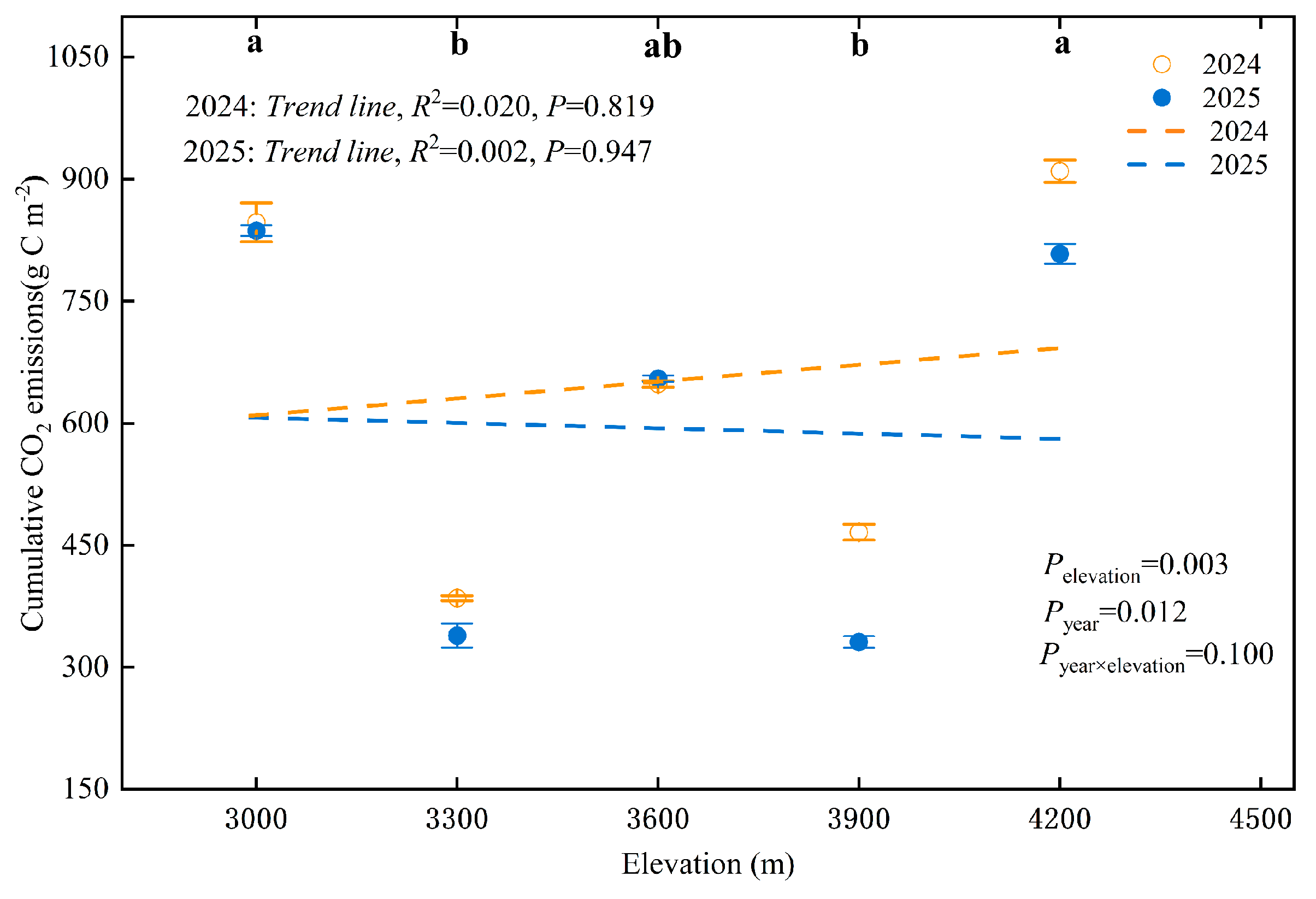
Cumulative emissions of FCO2 from April to December for 2024 and 2025 are presented in Figure 7. These emissions varied among elevational sites in both years, following a consistent nonmonotonic pattern along the elevational gradient (Figure 7).
Across both years, HB1 and HB5 exhibited higher cumulative emissions than the mid-elevation sites. In 2024, cumulative emissions at HB5 reached 909.90 g C m−2, which was significantly higher than those at HB2 (385.32 g C m−2) (Figure 7; Table 2). Similarly, in 2025, HB1 and HB5 again showed higher cumulative emissions, whereas HB2 and HB4 remained relatively low and HB3 was intermediate (Table 2).
A two-way analysis of variance revealed significant main effects of elevation (p = 0.003) and year (p = 0.012), although the elevation × year interaction was not significant (p = 0.100). These results indicate interannual differences in cumulative emissions, yet the site ranking along the elevational gradient remained broadly consistent. Furthermore, within each year, cumulative emissions were not significantly associated with elevation according to linear regression (2024: R2 = 0.020, p = 0.819; 2025: R2 = 0.002, p = 0.947; Figure 7), which supports a nonlinear elevational pattern in cumulative FCO2 emissions.

3.3. Responses of Daily-Scale Soil CO2 Flux to Hydrothermal Factors

3.3.1. Correlation Between Daily-Scale Soil CO2 Flux and Hydrothermal Factors Across Elevations

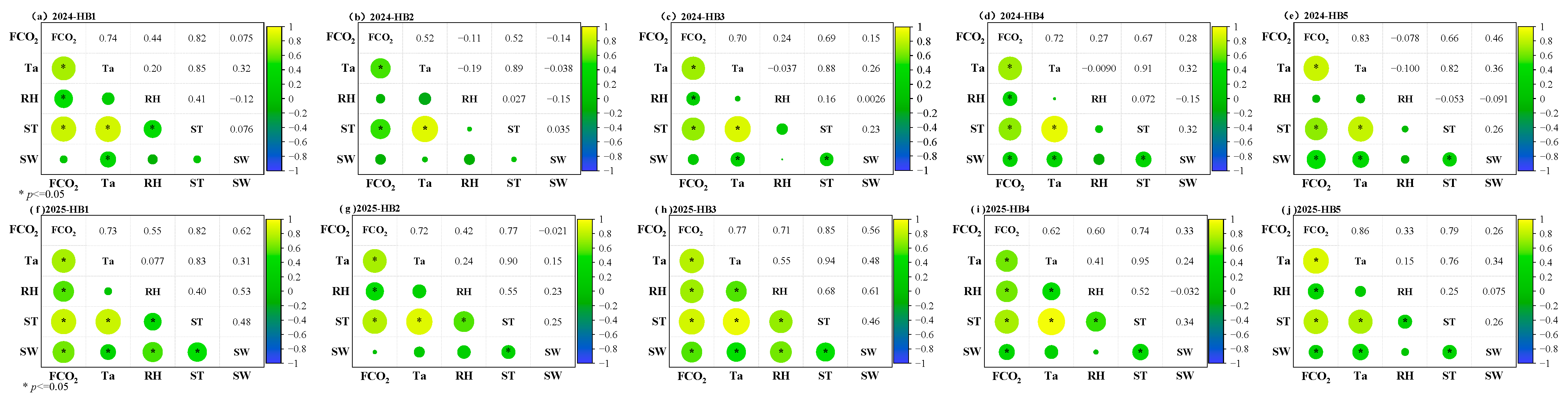
Correlations between daily-scale FCO2 and hydrothermal variables across HB1–HB5 are shown in Figure 8. Across elevations and years, daily-scale FCO2 was consistently and positively correlated with ST, and this relationship was significant at most sites (p < 0.05). The direction of the FCO2–ST relationship was conserved along the gradient, indicating a robust linkage between near-surface soil thermal conditions and daily-scale FCO2.
Daily-scale FCO2 was also positively correlated with Ta in most cases, although the strength of the association varied substantially among sites (Figure 8). In some plots, correlations with Ta were strong and significant, whereas in others they were weaker; however, the direction of the FCO2–Ta relationship remained consistent across years.
Except for HB2, correlations between FCO2 and SW were generally positive, but both magnitude and consistency differed among sites (Figure 8). In some plots, FCO2 was more strongly associated with SW, elsewhere the association was weak, indicating nonuniform moisture sensitivity along the elevational gradient.
In contrast, correlations between RH and FCO2 were weak and variable (Figure 8). Correlation coefficients were generally small and varied in sign among sites, suggesting RH was not a stable descriptor of daily-scale FCO2 across the gradient. Overall, the correlation structure of daily-scale FCO2 varied with elevation: ST showed the most consistent association with FCO2, whereas associations with SW and RH were more site-dependent.

3.3.2. The Interactive Regulation of Soil CO2 Flux by Soil Temperature and Moisture

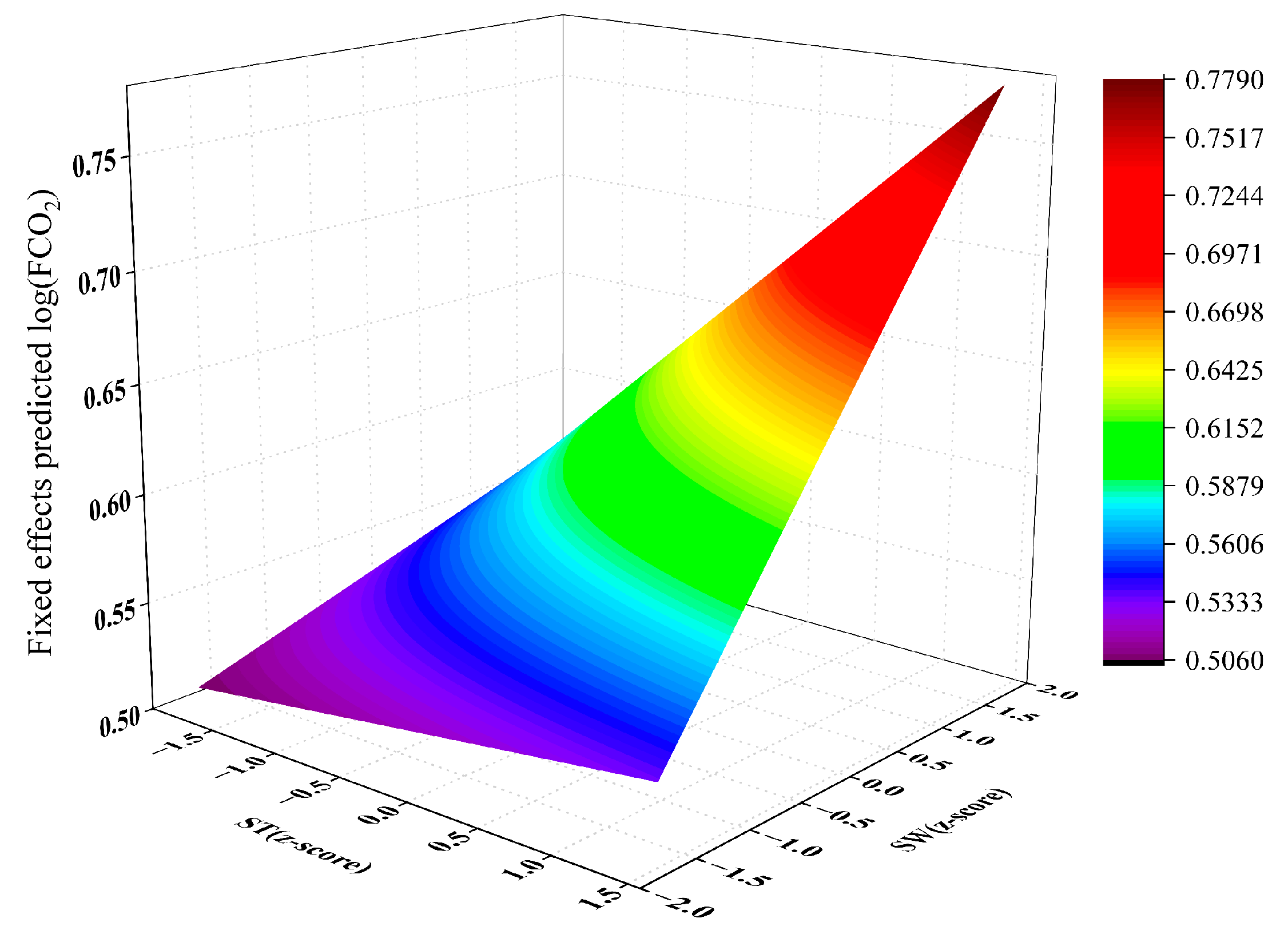
To test whether the effects of ST and SW on daily-scale FCO2 were nonadditive, we evaluated the ST × SW interaction using response-surface analysis and linear mixed-effects models (Figure 9; Table 3) [50]. The response surface indicated that FCO2 generally increased with increasing ST and SW, and that the shape of this response depended on the background level of the other factor, consistent with context-dependent effects.
In the response-surface analysis, FCO2 increased only slightly with ST under low SW, yielding a shallow temperature gradient. As SW increased, the apparent sensitivity of FCO2 to ST strengthened, producing a steeper temperature response. A similar interaction was observed for SW: under low ST, increases in SW were associated with minimal changes in FCO2, whereas under higher ST, FCO2 increased more strongly with SW (Figure 9). Together, these results indicate that the effect of each driver on FCO2 depended on the concurrent level of the other.
However, linear mixed-effects modeling showed that the ST × SW interaction was not statistically significant after controlling for Ta and RH and including random effects of elevation group and year (p = 0.29; Table 3). In contrast, the main effects of Ta and RH were significant (p < 0.001), while the main effects of ST and SW and their interaction were weaker (Table 3). Although Figure 9 shows a continuous response of FCO2 to concurrent variation in ST and SW, the model did not provide statistical evidence for a nonadditive interaction. Thus, at the daily scale, variation in FCO2 was dominated by additive effects, with context dependence expressed as changes in response magnitude rather than a significant interaction term (Figure 9; Table 3).

3.3.3. Nonlinear Response of Soil CO2 Flux to Soil Water Content and Threshold Behavior

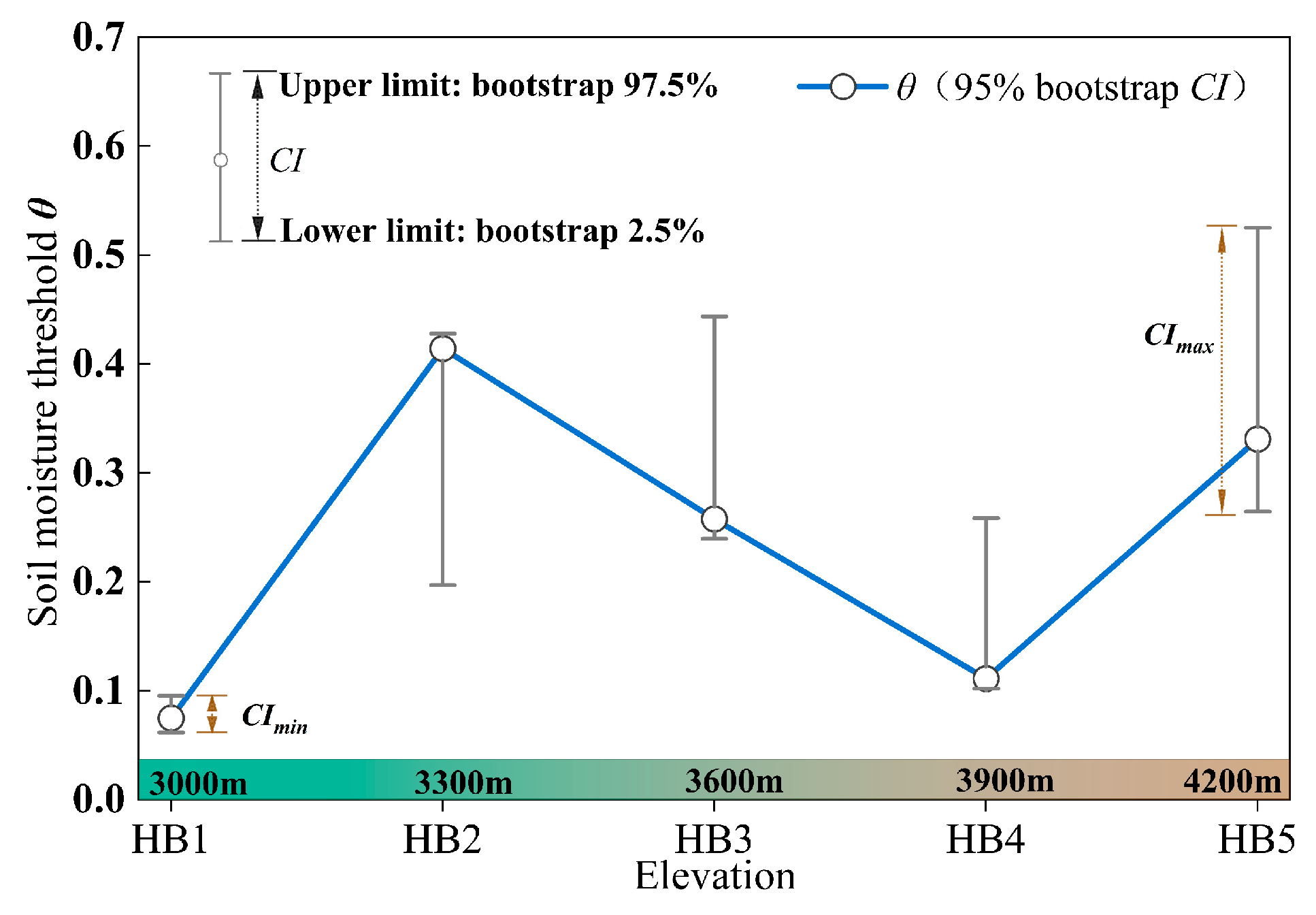
Further analyses indicated that the daily-scale FCO2 response to SW was nonlinear. Piecewise regression identified a site-specific moisture threshold (θ) at each elevation (Figure 10). Across HB1–HB5, the FCO2–SW relationship exhibits a breakpoint that divides a low-sensitivity regime from a higher-sensitivity regime, suggesting that θ is a common moisture-control feature of daily-scale FCO2.
Estimated θ differed among sites and shows a nonmonotonic pattern along the elevational gradient (Figure 10). At the low-elevation site HB1, θ is relatively low; the point estimate and the bootstrap 95% CI indicate that FCO2 sensitivity to SW emerged under comparatively dry conditions. In contrast, θ is generally higher at the mid-and high-elevation sites, with clear inter-site differentiation. The highest thresholds occur at HB2 and HB5 relative to the other sites. Uncertainty in θ also varies with elevation: bootstrap 95% CIs are narrower at low elevations but widen at higher elevations, particularly at HB5, indicating greater uncertainty in threshold estimation under high-elevation conditions.

3.3.4. Direction of Overall Effects of Hydrothermal Factors on Soil CO2 Flux

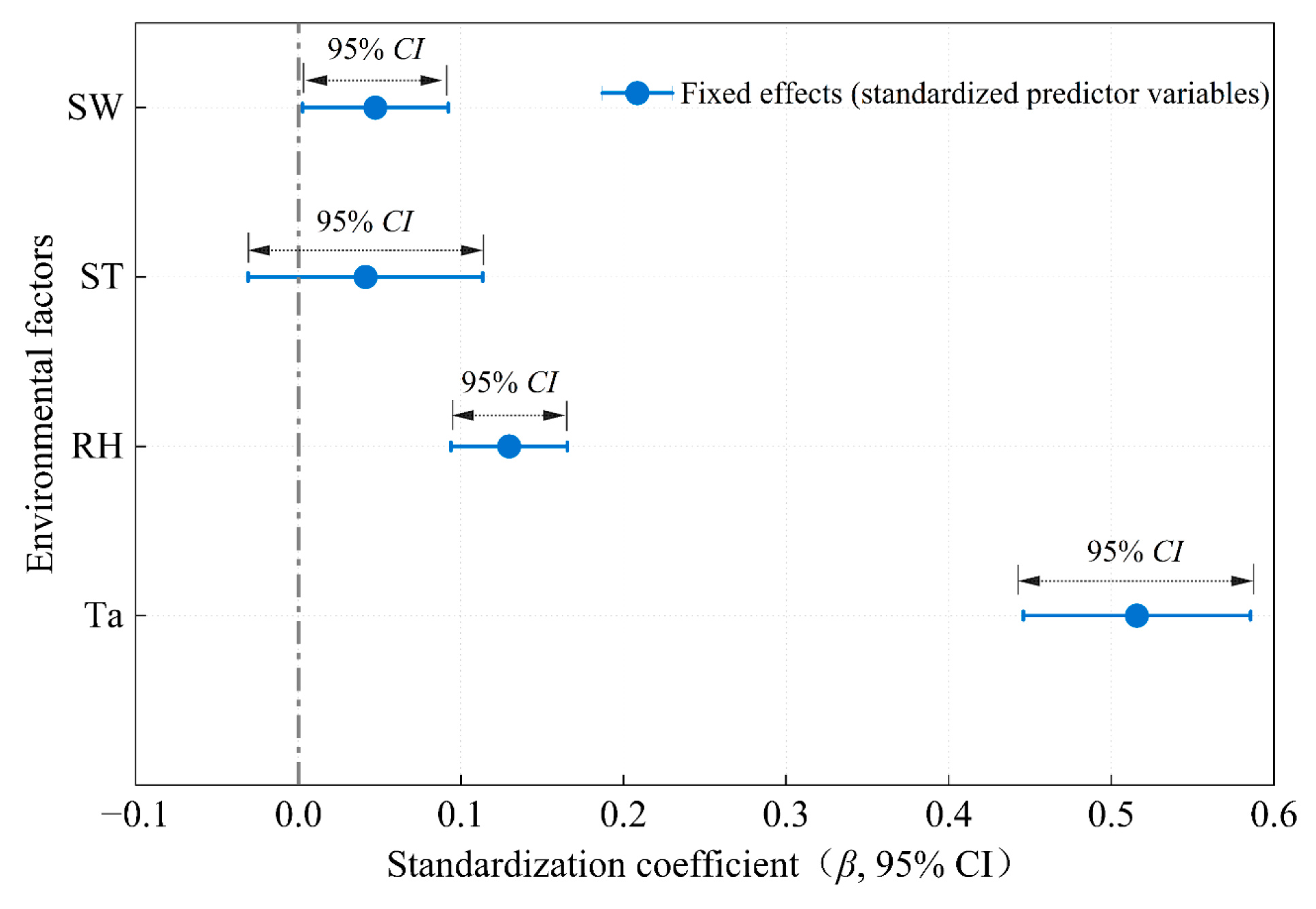
To quantify the direction and relative importance of hydrothermal predictors while accounting for spatial and temporal structure, we fitted linear mixed-effects models with elevation band and year as random intercepts. We compared candidate fixed-effects structures to identify the best-supported model (Figure 11; Table 4). After accounting for random effects, all hydrothermal predictors had positive fixed-effect estimates, although effect sizes and statistical support differed among variables.
Standardized fixed-effect estimates revealed a clear gradient in predictor importance (Figure 11). Ta had the largest standardized coefficient, with a bootstrap 95% CI entirely above zero, indicating the strongest and most robust positive association with FCO2. RH also showed a significant positive effect, although its magnitude was smaller than that of Ta. In contrast, the standardized effects of ST and SW were small, and their CIs were near zero, suggesting weaker fixed effects and greater uncertainty after accounting for Ta, RH, and the random-effects structure.
Model comparison further indicated that explanatory performance differed among predictor combinations (Table 4). The model including Ta, ST, SW, and RH (M3) provided the best fit based on information criteria (ΔAIC = 0), and improvements relative to reduced models were supported by likelihood-ratio tests. Overall, these results suggest that daily-scale FCO2 is associated with multiple hydrothermal drivers, with Ta contributing most strongly and the remaining variables providing additional explanatory power not captured by Ta alone.

3.3.5. Seasonal Heterogeneity in Hydrothermal Controls on Soil CO2 Flux

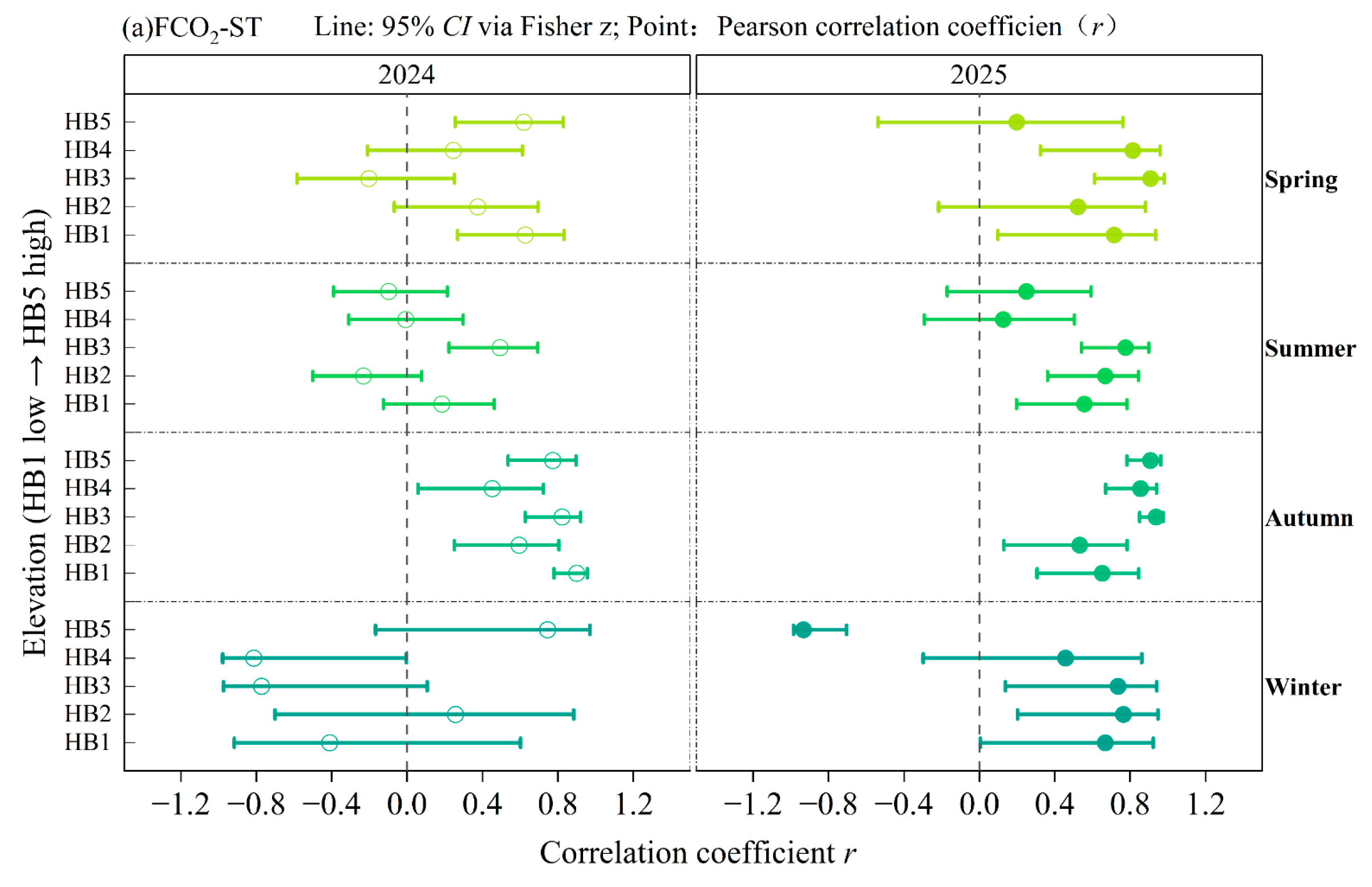
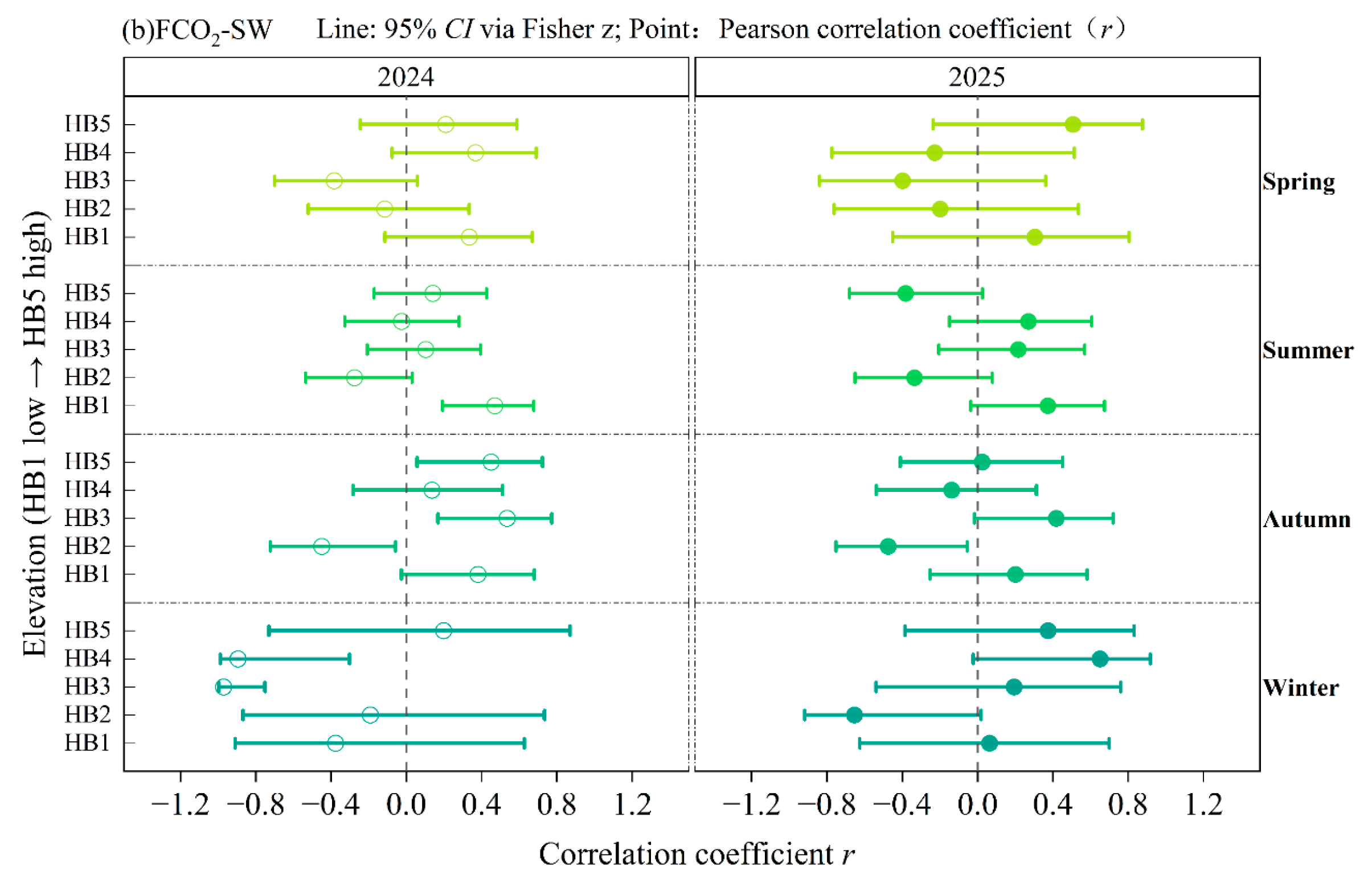
Season-specific correlation analyses revealed pronounced seasonal heterogeneity in associations between daily-scale FCO2 and ST and SW (Figure 12). In spring and summer, correlations between FCO2 and ST were generally stronger, with coefficients ranging from 0.3 to 0.8 across most sites. In 2025, the 95% CI excluded zero for most sites during this period, indicating a consistently positive association between ST and FCO2. In autumn, correlations weakened (approximately 0.1–0.5) and confidence intervals broadened. In winter, correlations are near zero or negative at many sites (−0.6–0.2), with confidence intervals often spanning zero.
In contrast, correlations between daily-scale FCO2 and SW were generally weaker and more variable among sites (Figure 12b). In spring and summer, correlations are predominantly positive at most sites, but smaller (0.1–0.6) and with confidence intervals wider than those for the ST relationship. In autumn, among-site divergence increased, and correlations at some low- and mid-elevation sites approached zero or became weakly negative. In winter, correlations remained weak (−0.5–0.3), with confidence intervals broadly overlapping zero.
At the spatial scale, mid- to high-elevation sites (HB3–HB5) exhibited more consistently positive correlations in spring and summer, particularly for the FCO2–ST relationship, with coefficients remaining above 0.4 across multiple seasons. Interannual comparisons show consistent correlation directions in 2024 and 2025, although correlation strength varies, with generally higher coefficients during the 2025 growing season and fewer confidence intervals overlapping zero.
Overall, the correlation structure between hydrothermal variables and FCO2 varies systematically across seasons. During the growing season, associations are more consistent in direction and magnitude; in winter, they weaken and become less stable, indicating pronounced seasonal heterogeneity. Although this analysis characterizes seasonal shifts in the direction and stability of relationships between FCO2 and hydrothermal factors across elevations, it does not quantify the relative explanatory contributions of individual predictors. Accordingly, the next section applies multivariate regression models to compare the relative importance of hydrothermal predictors for daily-scale variation in FCO2.

3.4. Explanatory Power of Temperature and Moisture for Daily-Scale Soil CO2 Flux

3.4.1. Regression Relationships and Elevational Differences

To quantify the combined influence of hydrothermal variables on daily-scale FCO2, we fitted separate multiple linear regression models for each elevational site (Table 5). Model performance varied across sites: R2 ranged from 0.40 to 0.75, and adjusted R2 ranged from 0.39 to 0.74. Explanatory power was highest for HB1 and HB5 (R2 = 0.74 and 0.71, respectively), followed by HB3 and HB4 (R2 = 0.62 and 0.52), while HB2 showed the lowest explanatory power (R2 = 0.39). Overall, these results indicate that the explanatory power of hydrothermal variables to explain daily-scale variation in FCO2 varies along the elevational gradient.
Standardized regression coefficients indicated site-specific differences in the relative contributions of individual predictors (Table 5). ST was positively associated with FCO2 at all sites, with standardized coefficients ranging from 0.32 to 1.03, making ST the most consistent predictor across elevations. The contribution of Ta increased with elevation, with standardized coefficients rising from 0.19 at HB1 to 1.07 at HB5, indicating a stronger role for Ta at higher elevations. In contrast, the effects of RH and SW were smaller and less consistent across sites: RH coefficients ranged from −0.08 to 0.32 and were near zero at HB5 (0.02), whereas SW coefficients ranged from −0.14 to 0.20, with direction varying among sites.
Overall, regression relationships and the relative importance of hydrothermal predictors exhibit pronounced spatial heterogeneity across elevations. Nevertheless, all site-specific models retained moderate to high explanatory power (R2 ≥ 0.39), highlighting elevational variation in the statistical controls on daily-scale FCO2.

3.4.2. Relative Contributions of Temperature and Moisture and Elevational Variation

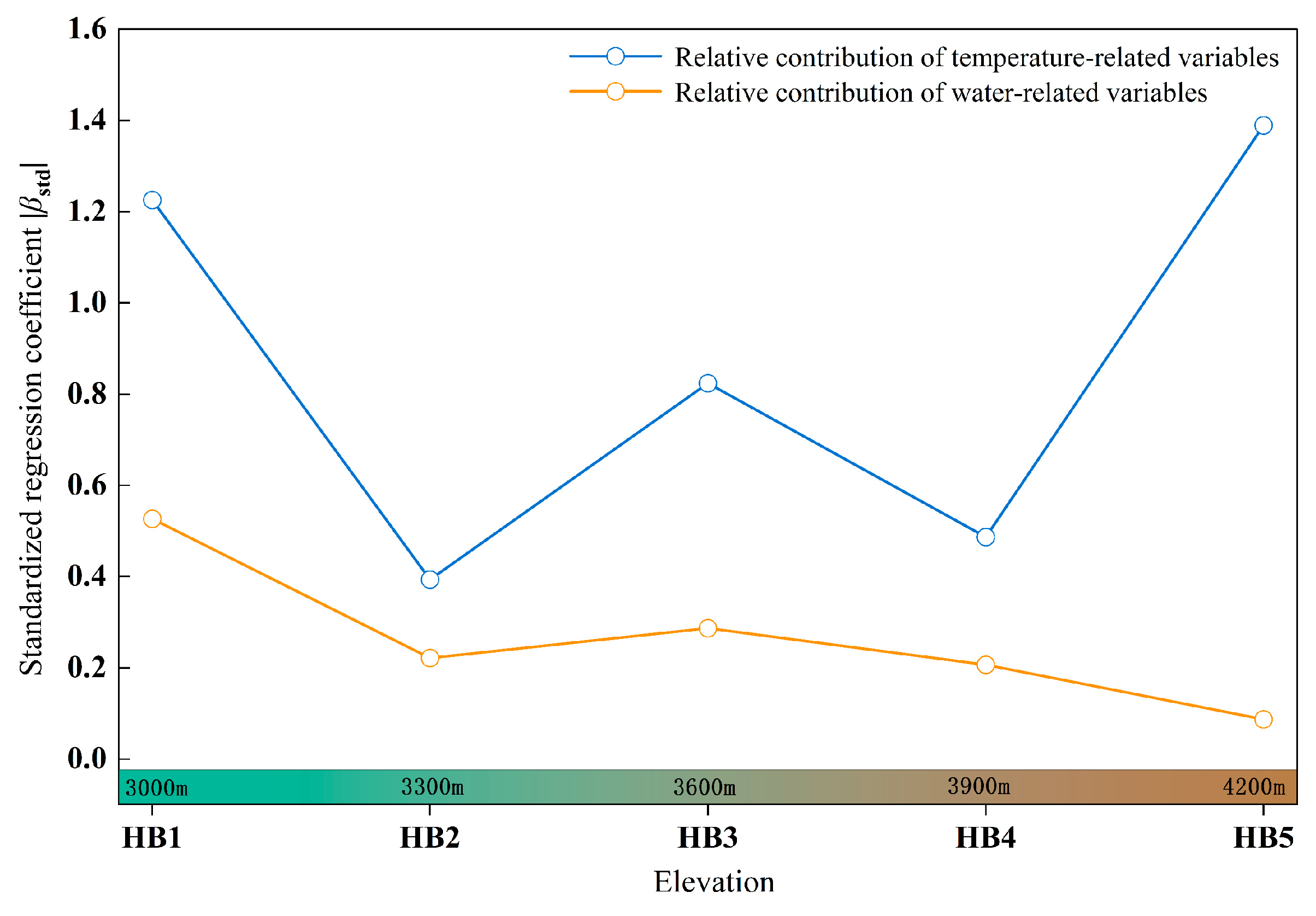
To quantify the combined influence of hydrothermal variables on daily-scale FCO2, we fitted site-specific multiple linear regression models across elevations HB1–HB5, with daily-scale FCO2 as the dependent variable and Ta, RH, ST, and SW as predictors. All predictors were standardized prior to analysis; thus, the reported coefficients are standardized regression coefficients (βstd). Model fit was assessed with R2 and adjusted R2. Across HB1–HB5, temperature-related predictors consistently contributed more to daily-scale FCO2 than moisture-related predictors. The sum of absolute standardized coefficients for temperature ranged from 0.40 to 1.40, whereas the corresponding sum for moisture ranged from 0.10 to 0.50, indicating that temperature accounts for a larger share of daily-scale variation in FCO2 than moisture along the elevational gradient (Figure 13).
The relative contribution of temperature exhibited a nonmonotonic pattern along the elevational gradient: it was high at HB1 (1.23), declined to a minimum at HB2 (0.39), and then increased toward higher elevations, reaching a maximum at HB5 (1.39). In contrast, the relative contribution of moisture remained low and decreased with elevation, from 0.53 at HB1 to 0.09 at HB5. Consequently, the disparity between temperature and moisture contributions widened with elevation; at the highest site (HB5), temperature-related predictors contributed roughly 14-fold more than moisture-related predictors (Figure 13). These results indicate an elevational shift in the dominant environmental controls on daily-scale FCO2.

3.4.3. Comparative Analysis of Model Interpretability and Identification of Critical Control Factors

To compare the explanatory power of temperature- and moisture-related predictors for daily-scale FCO2, we fitted site-specific multiple linear regression models at each elevation (HB1–HB5): (i) a temperature-only model including Ta and ST, (ii) a moisture-only model including RH and SW, and (iii) a full model including all four predictors (Table 6). Model performance varied across predictor sets and elevations. The coefficient of determination, R2, ranged from 0.33 to 0.72 for temperature-only models, 0.03 to 0.31 for moisture-only models, and 0.40 to 0.75 for full models, indicating pronounced spatial variation in explanatory power along the elevational gradient.
Across all sites, temperature-only models explained substantially more variation in daily-scale FCO2 than moisture-only models, indicating stronger statistical control by temperature. By contrast, moisture-only models had limited explanatory power, particularly at mid and high elevations (e.g., R2 = 0.03 at HB2 and R2 = 0.09 at HB5; Table 6). Full models achieved the highest explanatory power at all elevations (R2 = 0.39–0.74), but improvements over temperature-only models were generally modest. This pattern was most evident at HB5, where the full and temperature-only models had nearly identical explanatory power (R2 = 0.72).
Overall, while incorporating both temperature and moisture predictors improved model fit, explanatory power along the elevational gradient was driven primarily by temperature. These results identify temperature as the dominant statistical control on daily-scale FCO2; conversely, the additional contribution of moisture was elevation-dependent and notably limited at higher elevations.

4. Discussion

4.1. Elevational Variation in Soil CO2 Flux Across the Sejila Mountains

Across the five forest sites (HB1–HB5), FCO2 exhibited a consistent unimodal seasonal pattern in both years, increasing from the early growing season, peaking in midsummer, and declining toward the season’s end. This pattern aligns with expectations for cold-region montane ecosystems, where biological activity is concentrated during the warmest and wettest period of the year, when temperature and moisture constraints are relaxed and substrate turnover is fastest [25,50,51,52]. Similar seasonal concentration of forest soil respiration has been reported for subalpine forests across the eastern Tibetan Plateau, where environmental sensitivities differ markedly between active and dormant periods [18,52,53]. In Sejila, however, the elevational pattern was nonmonotonic: efflux was higher at HB1 and HB5 than at mid-elevation sites, and HB2 consistently exhibited the lowest values. Although many elevational-gradient studies report a monotonic decline in soil respiration with elevation, often attributed to temperature limitation [54], the U-shaped pattern observed here indicates that temperature alone cannot explain spatial variation in FCO2 along this monsoon-influenced mountain slope [51,55,56,57]. Instead, our results suggest that the relative importance of thermal limitation and water-related constraints shifts with elevation, producing nonmonotonic responses even over a modest elevational range [58,59,60]. This interpretation is consistent with evidence from Sejila showing that soil respiration varies among forest settings and covaries with both soil temperature and soil moisture, implying joint temperature–moisture control of spatial differences in FCO2 within this mountain system [39,61,62]. However, hydrothermal conditions alone remain insufficient to fully account for the anomalously high FCO2 fluxes observed at the highest-elevation site (HB5). Rather, the emergence of this nonmonotonic (U-shaped) pattern is likely driven by the spatial distribution of substrate availability. Baseline survey results (Table 1) indicate that surface (0–20 cm) soil organic carbon (SOC) content at HB5 reaches 43.82 g·kg−1, which is significantly higher than the levels recorded at the mid-elevation site HB4 (3900 m; 12.28 g·kg−1) and the lower-elevation site HB2 (3300 m; 6.35 g·kg−1). In cold alpine and subalpine environments, prolonged low temperatures severely constrain microbial decomposition, thereby promoting the accumulation of substantial organic matter pools [63]. This vast, carbon-rich substrate pool provides an abundant precursor for soil respiration; once hydrothermal conditions become favorable during the growing season, the alleviation of substrate limitation can trigger intense carbon mineralization. Beyond mere substrate availability, recent regional evidence suggests that this 4200 m treeline ecotone functions as a multidimensional carbon-cycling hotspot driven by non-linear biological and physical feedback. First, microbial communities in the Sejila Mountains exhibit a prominent “U-shaped” rebound in diversity and cold-adapted enzymatic activity above 4100 m [64,65], priming the system for rapid heterotrophic responses to summer thermal pulses. Second, severe environmental and nutrient constraints at the treeline drive woody plants to allocate disproportionate carbon belowground, developing dense fine-root networks that enhance both autotrophic respiration and strong rhizosphere priming effects [66]. Finally, the combination of winter snowpack buffering and the highly porous, low-bulk-density soil structure (γ = 0.76 g·cm−3) characteristic of this site effectively decouples high moisture availability from gas diffusion resistance [67]. Consequently, this unconstrained hydrothermal-aeration configuration, coupled with highly reactive microbial and root engines, collectively dictates the anomalously high FCO2 observed at the upper elevational limit.

4.2. Hydrothermal Controls Across Sites and Seasons: Dominance, Thresholds, and Conditionality

Across HB1–HB5, soil temperature showed the strongest and most consistent association with FCO2, remaining positive and often significant in both years. This finding aligns with evidence that temperature is a primary proximate control of short-term variability in soil respiration, particularly during the growing season when microbial and root activity is strongly temperature-sensitive [25,68,69]. However, several lines of evidence from this study indicate that temperature effects are not spatially uniform and are moderated by water availability.
First, the relative importance of temperature- and water-related predictors shifted along the elevational gradient. In site-specific multiple regression models, temperature variables consistently accounted for most of the explained variance [55], whereas the additional explanatory power of relative humidity and soil water content was smaller and more elevation-dependent [70]. Moreover, the standardized contribution of Ta increased with elevation, suggesting that aboveground thermal conditions became a stronger predictor of day-to-day variability in FCO2 at higher sites [71]. This pattern is consistent with evidence that, in colder environments, modest changes in temperature can produce disproportionate changes in ecosystem respiration [25]; however, the magnitude of this response may still be moderated by moisture conditions [72,73].
Second, the effects of SW were distinctly nonlinear. Piecewise regression identified site-specific soil moisture thresholds (θ) that separate weak responses from stronger increases in FCO2 with increasing SW. These thresholds are ecologically meaningful because they suggest that water availability functions less as a linear covariate and more as a switch-like constraint that enables or amplifies temperature-driven carbon losses once minimum moisture conditions are met [74,75,76]. The nonmonotonic variation in θ across elevations, together with greater uncertainty at the highest site, further suggests that effective moisture control of respiration is not determined by elevation per se but by elevation-linked shifts in local microclimate and soil physical conditions that influence CO2 production and transport [77,78,79].
Third, the interaction between ST and SW highlights an important distinction between descriptive patterns and inferential evidence. Response-surface analyses suggested conditional effects, with greater apparent temperature sensitivity under wetter conditions and greater apparent moisture sensitivity under warmer conditions. However, the mixed-effects model—which accounted for covariation among predictors and included random effects for year and elevation group—did not detect a significant ST × SW interaction. Collectively, these results suggest that day-scale variation is explained primarily by additive effects, although the apparent strength of the temperature response may still depend on background moisture in ways that are not recovered as a robust interaction coefficient after controlling for shared variance among predictors [80,81]. In practice, explicitly representing moisture thresholds and seasonal shifts in sensitivity may be more informative than relying on a single global interaction parameter [82].
Finally, hydrothermal regulation was strongly seasonal. The correlation between temperature and FCO2 was strongest in spring and summer but weakened markedly in autumn, whereas winter correlations were weak and occasionally negative. This seasonal divergence indicates that coupling among near-surface temperature, moisture, and efflux is not stationary over the year. Accordingly, extrapolating growing-season relationships to colder periods using a single parameter set—even within the same site—should be avoided [83]. Season-dependent responses of soil respiration to environmental drivers have also been reported in subalpine forests, underscoring the need to account for seasonal regimes when attributing controls and projecting flux responses [83,84].

4.3. Implications for Carbon–Climate Feedbacks on the Tibetan Plateau Under Warming Scenarios

This study demonstrates that Ta is the most consistent primary driver along the elevational gradient, whereas SW exhibits pronounced nonlinear, threshold responses. Together, these findings provide a useful framework for interpreting how soil carbon stocks on the Tibetan Plateau may respond to future climate change.
A substantial body of meteorological observations and multi-model simulations has established an elevation-dependent warming (EDW) signal over the Tibetan Plateau, in which warming rates at high elevations substantially exceed those at lower elevations [85,86,87]. Consistent with this context, soils at the highest site (4200 m) exhibited persistently high daily-scale FCO2, with temperature-related factors accounting for more than 50% of the standardized contribution. This indicates that high-elevation soil metabolism is not dormant, rather, it may be primed for rapid carbon release. As corroborated by the baseline substrate data in this study (Table 1), historically low temperatures have constrained microbial activity and decomposition [88], leading to the accumulation of abundant soil organic carbon (SOC up to 43.82 g·kg−1) at the highest-elevation site, HB5, within this cold ecotonal environment [89], thereby constituting a substantial potential carbon source. Consequently, climate warming may alleviate this thermal constraint, accelerating the decomposition of this vast substrate pool and triggering carbon losses that exceed those observed at mid-elevation sites [90]. This inference accords with recent large-scale assessments [91,92], suggesting that high-elevation and high-latitude ecosystems are increasingly at risk of shifting from carbon sinks to carbon sources.
Moreover, CMIP6-based projections indicate a marked warming–wetting tendency in southeastern Tibet over coming decades [93], potentially driven by enhanced water vapor transport associated with a strengthened Indian summer monsoon and its interaction with the mid-latitude westerlies [94,95]. Under such conditions, if SW remains above the threshold (θ) identified here, the warming effect may proceed largely unconstrained by moisture, thereby enhancing soil respiration [96]. This supports the view that increasing moisture availability can substantially amplify the temperature sensitivity (Q10) of respiration in cold ecosystems [97].
By contrast, if warming is accompanied by extreme drought such that SW falls below θ, the temperature-driven positive warming–carbon emission feedback may be transiently attenuated by moisture limitation [98]. As shown in Figure 10, when SW is below θ, FCO2 declines sharply as moisture decreases, indicating that moisture rather than temperature becomes the dominant constraint. This threshold behavior acts as a hydrothermal valve that regulates FCO2 by shifting the system between energy limitation and water limitation. Importantly, drought-induced suppression of respiration should not be interpreted as beneficial self-regulation, because severe water deficits often reduce gross primary productivity (GPP) more than ecosystem respiration (Re), thereby decreasing net primary productivity (NPP) [99,100] and increasing the likelihood of a sink-to-source transition driven by reduced carbon inputs rather than by enhanced respiration [101]. Accordingly, under both warm–wet (high respiratory losses) and warm–dry (low productivity) futures, cold-region ecosystems may face a dual risk of carbon-sink weakening.

4.4. Limitations and Future Directions

Although this study employed a high-precision portable carbon-flux system to record high-quality instantaneous soil CO2 flux rates during each campaign, the logistical constraints of in situ measurements across an elevational gradient meant that weekly discrete sampling might not have fully captured short-lived pulse events triggered by rainfall or soil rewetting [102]. Furthermore, owing to the inherent constraints of manual fieldwork and adverse weather conditions, periodic measurements often provide limited coverage during or immediately adjacent to rainfall events. This limitation is common to manual or periodic soil-respiration observations [103,104]. Nevertheless, methodological comparisons indicate that weekly sampling combined with linear interpolation yields robust estimates of seasonal cumulative CO2 fluxes and adequately characterizes growing-season dynamics [105]. The resulting season-integrated totals are comparable to those derived from high-frequency automated measurements [104]. Therefore, while weekly discrete observations may underestimate the peak magnitude or immediate contribution of individual short-term pulses, this uncertainty primarily affects the fine-scale partitioning of event-driven processes. It is highly unlikely to alter our overarching conclusions regarding the nonmonotonic spatial distribution of CO2 emissions and its interannual robustness. Future research should consider deploying continuous automated monitoring systems at key elevations (e.g., low- and high-elevation sites exhibiting high emissions) or implementing intensified sampling protocols following heavy rainfall to more precisely quantify the instantaneous contributions of precipitation pulses to the carbon balance of alpine ecosystems.
Furthermore, although this study clarifies hydrothermal controls on FCO2, future work should incorporate biological processes (e.g., separating autotrophic and heterotrophic respiration) and non-growing-season freeze–thaw dynamics to more fully assess the climate sensitivity of high-elevation ecosystems on the Tibetan Plateau.

5. Conclusions

Drawing on continuous in situ measurements across five elevational bands (3000–4200 m) in the Sejila Mountains of the southeastern Tibetan Plateau, this study evaluated the spatiotemporal variability and hydrothermal environmental controls of daily-scale FCO2. Employing linear mixed-effects models, piecewise regression, and multiple linear regression, we identify four main conclusions:
(1) Nonmonotonic elevational pattern. FCO2 exhibited a robust nonmonotonic (U-shaped) distribution along the elevational gradient, with efflux highest at the gradient extremes (3000 and 4200 m). Peak rates exceeded 5.0 µmol CO2 m−2 s−1, and cumulative emissions at the extremes exceed those at mid-elevations. This pattern challenges the expectation that soil respiration decreases monotonically with elevation on temperature lapse rates and supports a nonlinear elevational distribution of FCO2.
(2) Hydrothermal differentiation with elevation. The hydrothermal environment varied systematically with elevation: air temperature (Ta) and soil temperature (ST) declined roughly linearly, whereas soil water content (SW) and relative humidity displayed nonlinear spatial variation. The combination of a linear thermal gradient and nonlinear moisture variation provides a plausible environmental basis for the observed departure from strictly temperature-driven patterns in FCO2.
(3) Shift in dominant controls. The contribution of environmental drivers changed along the gradient. Ta was the strongest and most consistent positive predictor across sites. The ST × SW interaction was not significant (p = 0.29), indicating additive temperature and moisture effects at the daily scale. With increasing elevation, regulation shifted from joint temperature–moisture control at lower elevations to predominantly thermal limitation at higher elevations; at 4200 m, the relative contribution of thermal factors (Ta, ST) exceeded that of moisture factors (RH, SW) by more than tenfold. Piecewise regression identified site-specific nonlinear moisture thresholds (θ), indicating threshold-dependent moisture regulation of soil respiration.
(4) Implications for warming and upscaling. Given the high maximum FCO2 and the dominant role of Ta at 4200 m, warming could disproportionately enhance soil carbon losses at high elevations, provided that SW remains above critical thresholds. The strong predictive performance of Ta also suggests that gridded meteorological products may be used to estimate soil respiration dynamics in remote, data-scarce alpine regions.

Author Contributions

Conceptualization, Q.M. and J.L.; methodology, Q.M. and J.L.; software, Q.H. and P.C.; validation, Q.M.; formal analysis, Q.M. and Y.C.; investigation, Y.H. (Ying Huang) and Y.H. (Yi Huang); resources, J.L. and P.C.; data curation, J.X.; writing—original draft preparation, Q.M.; writing—review and editing, J.L.; visualization, P.C.; supervision, Q.H.; project administration, J.L.; funding acquisition, J.X. and Q.H. All authors have read and agreed to the published version of the manuscript.

Funding

This research was funded by the Young Investigator Program of the 2024 Xizang Autonomous Region Natural Science Foundation, grant number XZ202401ZR0096, the General Program of the 2024 Xizang Autonomous Region Natural Science Foundation, grant number XZ202401ZR0109, the Youth Fund Project of Xizang Agriculture & Animal Husbandry University, grant number NYQNZR2025-03 and the Open Research Fund from the Research Center of Civil & Hydraulic and Power Engineering of Xizang, grant number XZ202305CHP2008B.

Institutional Review Board Statement

Not applicable.

Data Availability Statement

The data are available from the corresponding author and can be shared upon reasonable request.

Acknowledgments

The authors are also thankful to the anonymous reviewers and editor for their constructive feedback, which significantly improved the manuscript.

Conflicts of Interest

The authors declare no conflicts of interest.

References

  1. Li, G.P.; Yu, Z.B.; Wang, W.G.; Ju, Q.; Chen, X. Analysis of the spatial Distribution of precipitation and topography with GPM data in the Tibetan Plateau. Atmos. Res. 2021, 247, 105259. [Google Scholar] [CrossRef]
  2. Ren, S.T.; Jia, L.; Miles, E.S.; Menenti, M.; Kneib, M.; Shaw, T.E.; Buri, P.; McCarthy, M.J.; Yang, W.; Pellicciotti, F.; et al. Observed and projected declines in glacier albedo across the Third Pole in the 21st century. One Earth 2024, 7, 1587–1599. [Google Scholar] [CrossRef]
  3. Kang, S.C.; Xu, Y.W.; You, Q.L.; Flügel, W.A.; Pepin, N.; Yao, T.D. Review of climate and cryospheric change in the Tibetan Plateau. Environ. Res. Lett. 2010, 5, 015101. [Google Scholar] [CrossRef]
  4. Xu, S.; Lettenmaier, D.P.; McVicar, T.R.; Gentine, P.; Beck, H.E.; Fisher, J.B.; Yu, Z.; Dong, N.; Koppa, A.; McCabe, M.F. Increasing atmospheric evaporative demand across the Tibetan plateau and implications for surface water resources. iScience 2025, 28, 111623. [Google Scholar] [CrossRef]
  5. Tan, Z.; Liu, Y.; Tang, W.; Li, D.; Gao, J.; Luo, M. Impact of the tibetan plateau heat source on heatwaves in China. Clim. Dyn. 2024, 63, 2. [Google Scholar] [CrossRef]
  6. Tian, F.Q.; Nan, Y.; Ni, G.H.; Yang, L.; Tang, Q.H.; Grey, D. Is the Tibetan Plateau really a water tower? Hydrol. Process. 2024, 38, e15103. [Google Scholar] [CrossRef]
  7. Yao, T.; Thompson, L.; Mosbrugger, V.; Zhang, F.; Ma, Y.; Luo, T.; Xu, B.; Yang, X.; Joswiak, D.; Wang, W. Third Pole Environment (TPE). Environ. Dev. 2012, 3, 52–64. [Google Scholar] [CrossRef]
  8. Meng, Y.L.; Duan, K.Q.; Shi, P.H.; Shang, W.; Li, S.S.; Cheng, Y.; Xing, L.; Chen, R.; He, J.P. Sensitive temperature changes on the Tibetan Plateau in response to global warming. Atmos. Res. 2023, 294, 106948. [Google Scholar] [CrossRef]
  9. Men, X.; Fu, Z.T.; Zeng, L.L.; Wang, L.Y.; Du, W.Y.; Gao, S.R.; Zhang, G.S.; Jiang, G.L.; Wu, Q.B. Permafrost collapse alters alpine ecosystem development via microtopographic modification on the Qinghai-Tibet Plateau. Catena 2026, 262, 109692. [Google Scholar] [CrossRef]
  10. Ou Yang, Z.; Zhang, G.; Ying, L. Overview of the impacts of climate change on ecosystem distribution and functions across the Tibetan Plateau. Progress. Inquisitiones De Mutat. Clim. 2024, 20, 699–710. [Google Scholar] [CrossRef]
  11. Morales-Ruiz, D.E.; Villanueva-López, G.; Casanova-Lugo, F.; Venegas-Venegas, J.A.; Pinto-Ruiz, R.; Guevara-Hernández, F.; Reyes-Sosa, M.; Martinez-Zurimendi, P.; Ghimire, R.; Aryal, D.R. Silvopastoral systems reduce soil CO2 emissions, enhance carbon stocks, and regulate the micro-environment in tropical grazing lands. Agric. Ecosyst. Environ. 2025, 393, 109844. [Google Scholar] [CrossRef]
  12. Ngaba, M.J.Y.; Uwiragiye, Y.; Hu, B.; Zhou, J.; Dannenmann, M.; Calanca, P.; Bol, R.; Vries, W.d.; Kuzyakov, Y.; Rennenberg, H. Effects of environmental changes on soil respiration in arid, cold, temperate, and tropical zones. Sci. Total Environ. 2024, 952, 175943. [Google Scholar] [CrossRef] [PubMed]
  13. Khoroshaev, D.; Kurganova, I.; de Gerenyu, V.L.; Sapronov, D.; Kivalov, S.; Aloufi, A.S.; Kuzyakov, Y. Vegetation and Precipitation Patterns Define Annual Dynamics of CO2 Efflux from Soil and Its Components. Land 2024, 13, 2152. [Google Scholar] [CrossRef]
  14. Chang, J.; Huang, N.; Wang, L.; Zhu, L.; Lin, X.; Liu, J.; Niu, Z.; Cai, D. Monthly Soil Respiration in China’s Forests: Spatiotemporal Patterns and Drivers over 21 Years. Glob. Change Biol. 2026, 32, e70698. [Google Scholar] [CrossRef]
  15. Guo, Z.; Zheng, J.; Jia, X.; Bourque, C.P.A.; Zha, T.; Jin, C.; Xu, M.; Li, X. Biogeographic variations in soil respiration and its basal rate across China suggest thermal adaptation, substrate limitation, and soil moisture constraint. Catena 2025, 254, 108992. [Google Scholar] [CrossRef]
  16. Davidson, E.A.; Janssens, I.A. Temperature sensitivity of soil carbon decomposition and feedbacks to climate change. Nature 2006, 440, 165–173. [Google Scholar] [CrossRef]
  17. Bond-Lamberty, B.; Ballantyne, A.; Berryman, E.; Fluet-Chouinard, E.; Jian, J.; Morris, K.A.; Rey, A.; Vargas, R. Twenty Years of Progress, Challenges, and Opportunities in Measuring and Understanding Soil Respiration. J. Geophys. Res. Biogeosci. 2024, 129, e2023JG007637. [Google Scholar] [CrossRef]
  18. Dong, L.X.; Wang, X.F. Inconsistent influence of temperature, precipitation, and CO2 variations on the plateau alpine vegetation carbon flux. npj Clim. Atmos. Sci. 2025, 8, 91. [Google Scholar] [CrossRef]
  19. Xie, J.; Sun, X.; Wen, T.; Bai, Y.; Qian, T.; Hu, S.; Chen, L.; Wang, P.; Miao, Y.; Zhang, R.; et al. Metabolite interactions mediate beneficial alliances between Bacillus and Trichoderma for effective Fusarium wilt control. ISME J. 2025, 20, wraf283. [Google Scholar] [CrossRef]
  20. Wu, J.; Xu, Y.; Liu, Z. A comprehensive review on agricultural greenhouse gas emission reductions in China: Opportunities and challenges. Carbon Footpr. 2024, 3, 17. [Google Scholar] [CrossRef]
  21. Stank, L.; Neruda, J.; Ulrich, R. Changes in the concentration of CO2 in forest soils resulting from the traffic of logging machines. J. For. Sci. 2025, 71, 250–263. [Google Scholar] [CrossRef]
  22. Agbohessou, Y.; Delon, C.; Grippa, M.; Mougin, E.; Ngom, D.; Gaglo, E.K.; Ndiaye, O.; Salgado, P.; Roupsard, O. Modelling CO2 and N2O emissions from soils in silvopastoral systems of the West-African Sahelian band. Biogeosciences 2024, 21, 2811–2837. [Google Scholar] [CrossRef]
  23. Wang, D.; Feng, X. Progress and perspective in parameterizing soil respiration responses to temperature and moisture. Sci. China Earth Sci. 2025, 55, 1817–1836. [Google Scholar] [CrossRef]
  24. Lin, J.; Zhang, W.; Kumar, A.; Hui, D.; Zhang, C.; Shan, S.; Yu, Z.; Zhu, B.; Kuzyakov, Y. Drying-rewetting cycles decrease temperature sensitivity of soil organic matter decomposition. Agric. For. Meteorol. 2025, 364, 110442. [Google Scholar] [CrossRef]
  25. Bond-Lamberty, B.; Thomson, A. Temperature-associated increases in the global soil respiration record. Nature 2010, 464, 579–582. [Google Scholar] [CrossRef]
  26. Luo, Y.; Wan, S.; Hui, D.; Wallace, L.L. Acclimatization of soil respiration to warming in a tall grass prairie. Nature 2001, 413, 622–625. [Google Scholar] [CrossRef]
  27. Reichstein, M.; Rey, A.; Freibauer, A.; Tenhunen, J.; Valentini, R.; Banza, J.; Casals, P.; Cheng, Y.F.; Grünzweig, J.M.; Irvine, J.; et al. Modeling temporal and large-scale spatial variability of soil respiration from soil water availability, temperature and vegetation productivity indices. Glob. Biogeochem. Cycles 2003, 17, 1104. [Google Scholar] [CrossRef]
  28. Qian, T.; Fang, Y.; Zhaohuan, W.; Qingyin, Z. Response of soil CO2 emission in terrestrial ecosystems to the simulated warming and its influencing factors. Acta Ecol. Sin. 2024, 44, 1928–1939. [Google Scholar] [CrossRef]
  29. Junxia, Y.; Ya, F.; Junjian, L.; Hongjian, L.; Guangwei, D. Response of soil respiration and Q10 to temperature and moisture in naturally regenerated and bare lands based on an 11-year observation period. CATENA 2022, 208, 105711. [Google Scholar] [CrossRef]
  30. Ghezzehei, T.; Alvarez, J.; Villa, Y.; Ryals, R. Relating soil structure and hydrophysical characteristics to aerobic and anaerobic soil respiration. In Proceedings of the EGU General Assembly 2020, Online, 4–8 May 2020. [Google Scholar]
  31. Han, Y.; Chen, P.; Zhang, Z.; Yan, X.; Zhang, G.; Zhang, Z.; Li, T.; Nie, T.; Du, S. Continuous biochar amendment to achieve long-term CH4 mitigation in paddy fields under water-saving irrigation: A 5-year experiment. Biochar 2026, 8, 70. [Google Scholar] [CrossRef]
  32. Yang, Z.; Gaofeng, Z.; Li, Y.; Lei, M.; Cong, X.; Huiling, C.; Ting, M.; Yonghong, S.; Yongtai, Z.; Liyang, H.; et al. Optimal soil water content and temperature sensitivity differ among heterotrophic and autotrophic respiration from oasis agroecosystems. Geoderma 2022, 425, 116071. [Google Scholar] [CrossRef]
  33. Wang, Y.; Tong, X.; Zhang, J.; Li, J.; Meng, P.; Wang, W.; Wang, Y.; Yang, M.; Liu, Q. Hydrothermal integration and synergy regulate carbon exchange in forest ecosystems of eastern China. Agric. For. Meteorol. 2026, 377, 110888. [Google Scholar] [CrossRef]
  34. Li, L.F.; Wang, T.H.; Yang, J.J.; Yang, H.Y.; Tang, L.H.; Yang, D.W. Revealing the Long-Term Catchment-Scale Carbon Budget Dynamics on the Permafrost-Dominated Eastern Tibetan Plateau. Glob. Biogeochem. Cycles 2025, 39, e2025GB008743. [Google Scholar] [CrossRef]
  35. Chen, H.; Ju, P.J.; Zhu, Q.; Xu, X.L.; Wu, N.; Gao, Y.H.; Feng, X.J.; Tian, J.Q.; Niu, S.L.; Zhang, Y.J.; et al. Carbon and nitrogen cycling on the Qinghai-Tibetan Plateau. Nat. Rev. Earth Environ. 2022, 3, 701–716. [Google Scholar] [CrossRef]
  36. Guo, H.; He, Q.; Meng, Q.; Min, Z.; Chen, P.; Li, Y.; Chen, J.; Wei, Q.; Zhou, Z.; Xu, J. The Aggregate Structure and Organic Carbon Mineralization in Forest Soils Along an Elevation Gradient in the Sygera Mountains of the Southeastern Tibetan Plateau. Forests 2025, 16, 298. [Google Scholar] [CrossRef]
  37. He, X.; Hou, E.; Veen, G.F.; Ellwood, M.D.F.; Dijkstra, P.; Sui, X.; Zhang, S.; Wen, D.; Chu, C. Soil microbial biomass increases along elevational gradients in the tropics and subtropics but not elsewhere. Glob. Ecol. Biogeogr. 2020, 29, 345–354. [Google Scholar] [CrossRef]
  38. Dai, L.J.; Ge, J.S.; Wang, L.Q.; Zhang, Q.; Liang, T.; Bolan, N.; Lischeid, G.; Rinklebe, J. Influence of soil properties, topography, and land cover on soil organic carbon and total nitrogen concentration: A case study in Qinghai-Tibet plateau based on random forest regression and structural equation modeling. Sci. Total Environ. 2022, 821, 153440. [Google Scholar] [CrossRef]
  39. Duan, M.; Li, A.D.; Wu, Y.H.; Zhao, Z.P.; Peng, C.H.; DeLuca, T.H.; Sun, S.Q. Differences of soil CO2 flux in two contrasting subalpine ecosystems on the eastern edge of the Qinghai-Tibetan Plateau: A four-year study. Atmos. Environ. 2019, 198, 166–174. [Google Scholar] [CrossRef]
  40. Yang, Y.Y.; Chen, Q.Q.; Zhou, Y.; Yu, W.; Shi, Z. Soil bacterial community composition and function play roles in soil carbon balance in alpine timberline ecosystems. J. Soils Sediments 2024, 24, 323–336. [Google Scholar] [CrossRef]
  41. Ma, H.P.; Yang, X.L.; Guo, Q.Q.; Zhang, X.J.; Zhou, C.N. Soil organic carbon pool along different altitudinal level in the Sygera Mountains, Tibetan Plateau. J. Mt. Sci. 2016, 13, 476–483. [Google Scholar] [CrossRef]
  42. Luo, L.; Dan, Z.; Zhu, L.; Zhang, H. Vertical Gradient Changes of Temperature and Precipitation in the Sygera Mountains, Southeastern Qinghai-Xizang Plateau. Plateau Meteorol. 2021, 40, 37–46. [Google Scholar] [CrossRef]
  43. Guo, L.; Ding, H.; Li, J. Characteristics and influencing factors of soil aggregates at different altitudes in Sygera Mountain, southeastern Xizang. Res. Soil Water Conserv. 2025, 32, 81–90. [Google Scholar] [CrossRef]
  44. Xiao, S.; Fu, F.; Li, J.; Chen, W.; Ding, H.; Li, Y. Soil ecological stoichiometry characteristics of six typical forest typesin the Sejila mountain. J. Cent. South Univ. For. Technol. 2023, 43, 120–130+172. [Google Scholar] [CrossRef]
  45. Qiao, F.; Wang, M.; Li, J.; Yang, W.; Yu, W.; Nie, X. Soil Erodibility of Typical Climate Types in Shergyla Mountain. J. South West For. Univ. 2018, 38, 121–126. [Google Scholar] [CrossRef]
  46. Qian, H.; Zhang, J. Phylogenetic Diversity and Dispersion of Angiosperms in Plant Communities Along an Elevational Gradient in the Western United States. J. Biogeogr. 2025, 52, 495–504. [Google Scholar] [CrossRef]
  47. Kiani, M.; Hernandez-Ramirez, G.; Quideau, S.A.M. Spatial variation of soil quality indicators as a function of land use and topography. Can. J. Soil Sci. 2020, 100, 463–478. [Google Scholar] [CrossRef]
  48. Blázquez-García, A.; Conde, A.; Mori, U.; Lozano, J.A. A Review on Outlier/Anomaly Detection in Time Series Data. ACM Comput. Surv. 2022, 54, 1–33. [Google Scholar] [CrossRef]
  49. Jeong, J.; Park, E.; Han, W.S.; Kim, K.; Choung, S.; Chung, I.M. Identifying Outliers of Non-Gaussian Groundwater State Data Based on Ensemble Estimation for Long-Term Trends. J. Hydrol. 2017, 548, 135–144. [Google Scholar] [CrossRef]
  50. Spyropoulou, M.Z.; Hopker, J.G.; Griffin, J.E. Fast Bayesian inference in a class of sparse linear mixed effects models. Stat. Comput. 2025, 35, 122. [Google Scholar] [CrossRef]
  51. Chen, L.F.; Yang, S.P.; He, Z.B.; Zhao, W.Z.; Kong, J.Q.; Feng, X.Y.; Li, X.G. Divergent seasonal patterns and drivers of soil respiration in alpine forests of northwestern China. Agric. For. Meteorol. 2023, 343, 109787. [Google Scholar] [CrossRef]
  52. Hang, Y.; Cory, M.; Zhao, H.X.; Yi, S.; Yang, L.; Tao, Z.; Xiaoye, G.; Caiyu, Y.; Shenghua, C.; Fujiang, H. Seasonal Variation in Soil and Herbage CO2 Efflux for a Sheep-Grazed Alpine Meadow on the North-East Qinghai-Tibetan Plateau and Estimated Net Annual CO2 Exchange. Front. Plant Sci. 2022, 13, 860739. [Google Scholar] [CrossRef]
  53. Zhao, W.; Yang, M.; Yu, G.R.; Chen, Z.; Wang, Q.F. The temporal response of soil respiration to environment differed from that on spatial scale. Agric. For. Meteorol. 2023, 342, 109752. [Google Scholar] [CrossRef]
  54. Liu, H. Characterizing of Soil Organic Carbon Contents and Respiration at Sejila Mountain, in Southeastern Tibet. Ph.D. Thesis, China Agricultural University, Beijing, China, 2017. [Google Scholar]
  55. Junxia, Y.; Min, T.; Ju, L.; Junjian, L.; Hongjian, L. Temperature and moisture sensitivities of soil respiration vary along elevation gradients: An analysis from long-term field observations. Sci. Total Environ. 2024, 912, 169150. [Google Scholar] [CrossRef]
  56. Wang, S.Y.; Zhang, Y.; Meng, X.H.; Shang, L.Y.; Li, Z.G.; Li, S.S. Water availability control the seasonal and inter-annual variability of CO2 fluxes in an alpine meadow on the eastern Tibetan Plateau. Agric. For. Meteorol. 2024, 356, 110187. [Google Scholar] [CrossRef]
  57. Liu, S.; Luo, D.; Xu, G.X.; Wu, J.M.; Feng, Q.H.; Shi, Z.M. Temporal Variability in Soil Greenhouse Gas Fluxes and Influencing Factors of a Primary Forest on the Eastern Qinghai-Tibetan Plateau. Forests 2023, 14, 2255. [Google Scholar] [CrossRef]
  58. Badraghi, A.; Ventura, M.; Polo, A.; Borruso, L.; Giammarchi, F.; Montagnani, L. Soil respiration variation along an altitudinal gradient in the Italian Alps: Disentangling forest structure and temperature effects. PLoS ONE 2021, 16, e0247893. [Google Scholar] [CrossRef] [PubMed]
  59. Tiwari, P.; Bhattacharya, P.; Rawat, G.S.; Talukdar, G. Equilibrium in soil respiration across a climosequence indicates its resilience to climate change in a glaciated valley, western Himalaya. Sci Rep 2021, 11, 23038. [Google Scholar] [CrossRef] [PubMed]
  60. Zeeshan, M.; Zhou, W.; Wu, C.; Lin, Y.; Azeez, P.A.; Song, Q.; Liu, Y.; Zhang, Y.; Lu, Z.; Sha, L. Soil heterotrophic respiration in response to rising temperature and moisture along an altitudinal gradient in a subtropical forest ecosystem, Southwest China. Sci. Total Environ. 2021, 816, 151643. [Google Scholar] [CrossRef]
  61. Cao, L.; Liu, H.; Yang, H.; Lian, Y. Response of soil CO2 concentration at different depths of Abies georgei var. smithii forest to soil temperature and water content on Sejila Mountain, Tibet of southwestern China. J. Beijing For. Univ. 2023, 45, 1–10. [Google Scholar] [CrossRef]
  62. Liu, X.; Zhou, T.; Zhao, X.; Shi, P.J.; Zhang, Y.J.; Xu, Y.X.; Luo, H.; Yu, P.X.; Zhou, P.F.; Zhang, J.Z. Patterns and drivers of soil carbon change (1980s-2010s) in the northeastern Qinghai-Tibet Plateau. Geoderma 2023, 434, 116488. [Google Scholar] [CrossRef]
  63. Hobbie, S.E.; Schimel, J.P.; Trumbore, S.E.; Randerson, J.R. Controls over carbon storage and turnover in high-latitude soils. Glob. Change Biol. 2000, 6, 196–210. [Google Scholar] [CrossRef]
  64. Cao, L.; Liu, H.; Yang, H.; Lian, Y. Soil Microbial Distribution and Fungal Community Composition at Different Altitudes on Sejila Mountain, Southeastern Tibet. J. Soil Water Conserv. 2022, 36, 371–378. [Google Scholar] [CrossRef]
  65. Du, Z.; Wang, Y.; Yang, G.; Liao, J. Distribution Pattern of Soil Enzyme Activity Along Altitude in Sejila Mountain. Sci. Technol. Innov. 2023, 185–188. [Google Scholar]
  66. Cheng, G.; Zhu, S.; Guo, L.; Fu, F.; Liu, Y.; Li, J. Aboveground and belowground nutrient allocation strategies for trees and shrubs at alpinetreeline in Sygera Mountains of the southeastern Qingzang Plateau. Chin. J. Plant Ecol. 2025, 49, 1515–1526. [Google Scholar] [CrossRef]
  67. Gao, W.; Jin, M.; Hou, L. Effect of Different Snow Cover Thickness on the Physicochemical Properties of Typical Forest Soils in the Sejila Mountains. J. Plateau Agric. 2023, 7, 429–436+444. [Google Scholar] [CrossRef]
  68. Wang, X.; Li, Y.; Hao, Y.; Kang, E.; Han, J.; Zhang, X.; Li, M.; Zhang, K.; Yan, L.; Yang, A.; et al. Soil temperature and fungal diversity jointly modulate soil heterotrophic respiration under short-term warming in the Zoige alpine peatland. J. Environ. Manag. 2024, 370, 122778. [Google Scholar] [CrossRef]
  69. Shen, R.C.; Xu, M.; Chi, Y.G.; Yu, S.; Wan, S.Q.; He, N.P. Microbial membranes related to the thermal acclimation of soil heterotrophic respiration in a temperate steppe in northern China. Eur. J. Soil Sci. 2020, 71, 484–494. [Google Scholar] [CrossRef]
  70. Li, J.Y.; Niu, J.Z.; Yu, X.X.; Miao, Y.B.; Wang, D.; Jiao, P.H. Response of soil moisture content to vegetation and climate on a global scale. Acta Ecol. Sin. 2025, 45, 2682–2697. [Google Scholar] [CrossRef]
  71. Gomes, O.S.; Binelo, M.O.; Binelo, M.D.B.; Oliveira, J.P.C.; Galvani, E.; Alves, R.R. An Artificial Neural Network for Short Time Air Temperature Prediction. IEEE Access 2025, 13, 77593–77598. [Google Scholar] [CrossRef]
  72. Ma, Z.L.; Zhao, W.Q.; Liu, M.; Liu, Q. Responses of soil respiration and its components to experimental warming in an alpine scrub ecosystem on the eastern Qinghai-Tibet Plateau. Sci. Total Environ. 2018, 643, 1427–1435. [Google Scholar] [CrossRef]
  73. Chiappero, M.F.; Vaieretti, M.V.; Gallardo, N.; Izquierdo, A.E. Experimental warming increases respiration and affects microbial communities of soil wetlands at different elevations of the Argentinean Puna. Soil Ecol. Lett. 2024, 6, 240242. [Google Scholar] [CrossRef]
  74. Zhan, C.; Orth, R.; Migliavacca, M.; Zaehle, S.; Reichstein, M.; Engel, J.; Rammig, A.; Winkler, A.J. Emergence of the physiological effects of elevated CO2 on land-atmosphere exchange of carbon and water. Glob. Change Biol. 2022, 28, 7313–7326. [Google Scholar] [CrossRef]
  75. Wang, D.; He, N.; Wang, Q.; Lü, Y.; Wang, Q.; Xu, Z.; Zhu, J. Effects of Temperature and Moisture on Soil Organic Matter Decomposition Along Elevation Gradients on the Changbai Mountains, Northeast China. Pedosphere 2016, 26, 399–407. [Google Scholar] [CrossRef]
  76. Li, T.; Tian, D.; He, Y.; Zhang, R.; Wang, J.; Wang, F.; Niu, S. Threshold response of ecosystem water use efficiency to soil water in an alpine meadow. Sci. Total Environ. 2024, 908, 168345. [Google Scholar] [CrossRef]
  77. Jiang, Y.; Zhang, J.; Zheng, X.A.; Zhu, S.S.; Xu, X.T.; Yang, Y. Altitudinal Gradient Characteristics of Plant Diversity and Carbon Storage Distribution of Abies Fabri at Different Altitudes in Mount Gongga. J. Sichuan Agric. Univ. 2025, 43, 884–892. [Google Scholar] [CrossRef]
  78. Wang, F.; Wang, G.; Cui, J.; Guo, L.; Tang, X.; Yang, R.; Du, J.; Askari, M.S. The nonlinear rainfall–quick flow relationships in a humid mountainous area: Roles of soil thickness and forest type. J. Hydrol. 2024, 641, 131854. [Google Scholar] [CrossRef]
  79. Zhu, C.; Li, J.; Sun, J.; Ge, X.; Hu, D.; Zhong, Q.; Cheng, D. Elevation and seasonal variation patterns of soil respiration components and their influencing factors in Pinus taiwanensis forests in Wuyi mountain, China. Catena 2025, 255, 109055. [Google Scholar] [CrossRef]
  80. Abatzoglou, J.T.; Marshall, A.M.; Lute, A.C.; Safeeq, M. Precipitation Dependence of Temperature Trends Across the Contiguous US. Geophys. Res. Lett. 2022, 49, e2021GL095414. [Google Scholar] [CrossRef]
  81. Liu, H.; Rezanezhad, F.; Zhao, Y.; He, H.; Cappellen, P.V.; Lennartz, B. The apparent temperature sensitivity (Q10) of peat soil respiration: A synthesis study. Geoderma 2024, 443, 116844. [Google Scholar] [CrossRef]
  82. Chen, X.; Hu, H.; Wang, Q.; Wang, X.; Ma, B. Exploring the Factors Affecting Terrestrial Soil Respiration in Global Warming Manipulation Experiments Based on Meta-Analysis. Agriculture 2024, 14, 1581. [Google Scholar] [CrossRef]
  83. Yang, S.; Wu, H.; Wang, Z.; Semenov, M.V.; Ye, J.; Yin, L.; Wang, X.; Kravchenko, I.; Semenov, V.; Kuzyakov, Y.; et al. Linkages between the temperature sensitivity of soil respiration and microbial life strategy are dependent on sampling season. Soil Biol. Biochem. 2022, 172, 108758. [Google Scholar] [CrossRef]
  84. Bonfanti, N.; Poulenard, J.; Barre, P.; Baudin, F.; Voisin, D.; Clement, J.C. Seasonality Alters Soil Organic Matter Properties in Alpine and Subalpine Grasslands. Ecosystems 2025, 28, 29. [Google Scholar] [CrossRef]
  85. Pepin, N.C.; Arnone, E.; Gobiet, A.; Haslinger, K.; Kotlarski, S.; Notarnicola, C.; Palazzi, E.; Seibert, P.; Serafin, S.; Schöner, W.; et al. Climate Changes and Their Elevational Patterns in the Mountains of the World. Rev. Geophys. 2022, 60, e2020RG000730. [Google Scholar] [CrossRef]
  86. Sun, Y.; Hu, T.; Zhang, X.B. Anthropogenic influence on altitudinally amplified temperature change in the Tibetan Plateau. Environ. Res. Lett. 2024, 19, 054012. [Google Scholar] [CrossRef]
  87. Niu, X.R.; Tang, J.P.; Chen, D.L.; Wang, S.Y.; Ou, T.H. Elevation-Dependent Warming Over the Tibetan Plateau From an Ensemble of CORDEX-EA Regional Climate Simulations. J. Geophys. Res.-Atmos. 2021, 126, e2020JD033997. [Google Scholar] [CrossRef]
  88. Qin, S.Q.; Zhang, D.Y.; Wei, B.; Yang, Y.H. Dual roles of microbes in mediating soil carbon dynamics in response to warming. Nat. Commun. 2024, 15, 6439. [Google Scholar] [CrossRef]
  89. Liang, Z.X.; Guo, X.; Liu, S.; Su, Y.F.; Zeng, Y.F.; Xie, C.Y.; Gao, Q.; Lei, J.S.; Li, B.C.; Wang, M.; et al. Microbial mediation of soil carbon loss at the potential climax of alpine grassland under warming. Soil Biol. Biochem. 2024, 192, 109395. [Google Scholar] [CrossRef]
  90. Sun, J.; Ye, C.C.; Liu, M.; Wang, Y.; Chen, J.; Wang, S.; Lu, X.Y.; Liu, G.H.; Xu, M.; Li, R.Q.; et al. Response of net reduction rate in vegetation carbon uptake to climate change across a unique gradient zone on the Tibetan Plateau. Environ. Res. 2022, 203, 111894. [Google Scholar] [CrossRef] [PubMed]
  91. Ren, S.; Wang, T.; Guenet, B.; Liu, D.; Cao, Y.F.; Ding, J.Z.; Smith, P.; Piao, S.L. Projected soil carbon loss with warming in constrained Earth system models. Nat. Commun. 2024, 15, 102. [Google Scholar] [CrossRef]
  92. Natali, S.M.; Watts, J.D.; Rogers, B.M.; Potter, S.; Ludwig, S.M.; Selbmann, A.-K.; Sullivan, P.F.; Abbott, B.W.; Arndt, K.A.; Birch, L.; et al. Large loss of CO2 in winter observed across the northern permafrost region. Nat. Clim. Change 2019, 9, 852–857. [Google Scholar] [CrossRef]
  93. Qiu, H.; Zhou, T.; Zou, L.; Jiang, J.; Chen, X.; Hu, S. Future changes in precipitation and water availability over the Tibetan Plateau projected by CMIP6 models constrained by climate sensitivity. Atmos. Ocean. Sci. Lett. 2024, 17, 100537. [Google Scholar] [CrossRef]
  94. Hao, D.; Zhenming, J. Warming and Wetting will continue over the Tibetan Plateau in the Shared Socioeconomic Pathways. PLoS ONE 2023, 18, e0289589. [Google Scholar] [CrossRef]
  95. Anja, K.; Jacob, S.; Julia, P.; Anders, L. Robust increase of Indian monsoon rainfall and its variability under future warming in CMIP6 models. Earth Syst. Dyn. 2021, 12, 367–386. [Google Scholar] [CrossRef]
  96. Li, X.H.; Zha, T.S.; Liu, P.; Jia, X.; Tian, Y.; Zhao, H.X.; Jian, J.S.; Deng, N. Contrasting temperature responses of photosynthesis and respiration amplify reduction in carbon sink under water stress conditions in a temperate semi-arid steppe. Agric. For. Meteorol. 2026, 377, 110961. [Google Scholar] [CrossRef]
  97. Woo, S.; Singh, G.P.; Oh, J.H.; Lee, K.M. Projection of seasonal summer precipitation over Indian sub-continent with a high-resolution AGCM based on the RCP scenarios. Meteorol. Atmos. Phys. 2019, 131, 897–916. [Google Scholar] [CrossRef]
  98. McKay, D.I.A.; Staal, A.; Abrams, J.F.; Winkelmann, R.; Sakschewski, B.; Loriani, S.; Fetzer, I.; Cornell, S.E.; Rockstrom, J.; Lenton, T.M. Exceeding 1.5 °C global warming could trigger multiple climate tipping points. Science 2022, 377, 1171. [Google Scholar] [CrossRef]
  99. Fu, Z.; Ciais, P.; Prentice, I.C.; Gentine, P.; Makowski, D.; Bastos, A.; Luo, X.; Green, J.K.; Stoy, P.C.; Yang, H.; et al. Atmospheric dryness reduces photosynthesis along a large range of soil water deficits. Nat. Commun. 2022, 13, 989. [Google Scholar] [CrossRef] [PubMed]
  100. Zhang, J.; Liu, Y.; Yan, C.; Sun, Y.; Zhang, Y.; Wang, Z.; Chang, S.; Cheng, P.; Hou, F. Carbon balance of yak ranch in alpine meadow. Carbon Footpr. 2025, 4, 36. [Google Scholar] [CrossRef]
  101. Carle, H.; Bauman, D.; Evans, M.N.; Coughlin, I.; Binks, O.; Ford, A.; Bradford, M.; Nicotra, A.; Murphy, H.; Meir, P. Aboveground biomass in Australian tropical forests now a net carbon source. Nature 2025, 646, 611–618. [Google Scholar] [CrossRef]
  102. Du, S.; Chen, P.; Lin, G.; Zhang, Z.; Song, J.; Guan, S.; Han, Y.; Deng, M.; Liu, M.; Qi, Z.; et al. Controlled irrigation and straw-decomposing microbial inoculant mitigate CH4 emissions and increase rice yield in straw return mollisols of paddy fields. Agric. Water Manag. 2026, 327, 110269. [Google Scholar] [CrossRef]
  103. Savage, K.E.; Davidson, E.A. A comparison of manual and automated systems for soil CO2 flux measurements: Trade-offs between spatial and temporal resolution. J. Exp. Bot. 2003, 54, 891–899. [Google Scholar] [CrossRef] [PubMed]
  104. Savage, K.; Davidson, E.A.; Richardson, A.D. A conceptual and practical approach to data quality and analysis procedures for high-frequency soil respiration measurements. Funct. Ecol. 2008, 22, 1000–1007. [Google Scholar] [CrossRef]
  105. Gana, C.; Nouvellon, Y.; Marron, N.; Stape, J.L.; Epron, D. Sampling and interpolation strategies derived from the analysis of continuous soil CO2 flux. J. Plant Nutr. Soil Sci. 2018, 181, 12–20. [Google Scholar] [CrossRef]
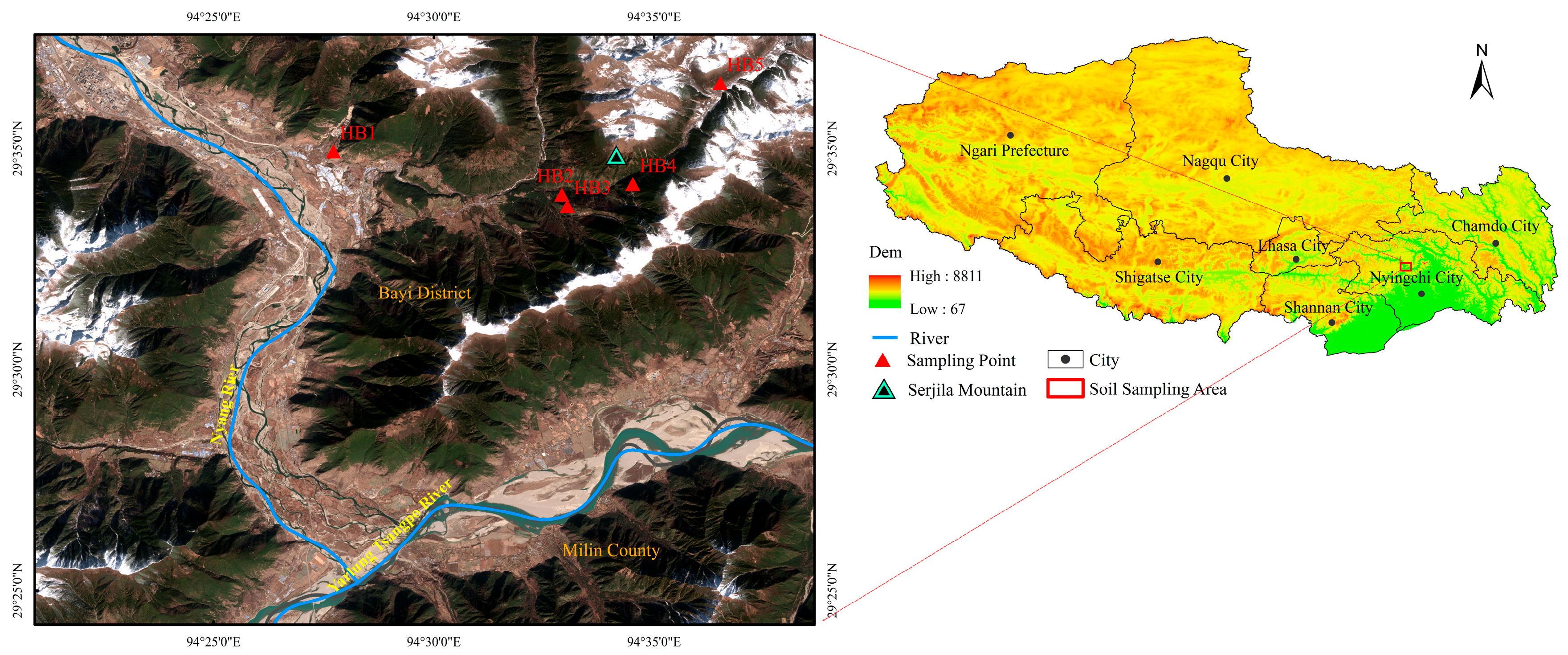
Figure 1. Location of the study area. Observation sites HB1–HB5 were established along Sejila Mountain at varying elevations.
Forests 17 00390 g001
Figure 2. Monthly variation in Ta and ST across the elevational gradient. Monthly values are the means of daily sensor observations for each month.
Forests 17 00390 g002
Figure 3. Monthly variation in RH and SW across the elevational gradient. Monthly values are the means of daily sensor observations for each month.
Forests 17 00390 g003
Figure 4. Variation in FCO2 across plots at different elevations. Note: Panels (ae) show the temporal dynamics of FCO2 at the elevational plots HB1–HB5 for 2024, while panels (fj) show the corresponding dynamics for 2025. Red circles indicate mean values, and the error bars denote ±1 SD (n = 3). Lines are included to aid visualization of temporal trends.
Forests 17 00390 g004aForests 17 00390 g004b
Figure 5. Monthly variation in FCO2 across plots along the elevational gradient. Monthly values are the mean daily flux for each plot within the corresponding month; error bars indicate ± SD (n = 3 replicates).
Forests 17 00390 g005
Figure 6. Differences in FCO2 rates among plots along the elevational gradient in 2024 and 2025. Boxplots summarize FCO2 rates (µmol CO2 m−2 s−1) across five elevational plots (HB1–HB5; 3000, 3300, 3600, 3900, and 4200 m). Each box shows the interquartile range (IQR); the central line indicates the median; whiskers extend to the most extreme data points within 1.5 × IQR of the quartiles, and observations beyond this range are plotted as outliers. Dots indicate monthly mean efflux rates for April through December, and “×” indicates the mean of the FCO2 observation values. Letters above the boxes indicate significant differences among elevations within the same year, as determined by a one-way ANOVA followed by Tukey’s post hoc test (p < 0.05).
Forests 17 00390 g006
Figure 7. Cumulative CO2 from April to December across plots along the elevational gradient in 2024−2025. Dots denote the mean for each elevation in each year (n = 3 replicates per elevation per year); error bars denote ±1 SD. Dashed lines indicate the linear regression fits between cumulative emissions and elevation for 2024 and 2025, with the corresponding R2 and p values shown in the upper-left corner. The lower-right panel reports the two-way ANOVA results for year, elevation, and their interaction (Pelevation, Pyear, and Pyear×elevation). Letters above the plot indicate significant differences among elevations (Tukey’s HSD, α = 0.05); letter groupings are based on post hoc comparisons of the main effect of elevation after pooling data across years (i.e., elevations compared using data aggregated across 2024−2025).
Forests 17 00390 g007
Figure 8. Correlations between daily-scale FCO2 and environmental variables across plots along the elevational gradient. FCO2 denotes the soil CO2 flux rate at each plot (µmol CO2 m−2 s−1). Bubble color indicates the sign and magnitude of the correlation coefficient (r), with green indicating positive and blue indicating negative; bubble size is proportional to |r|. The upper triangle shows Pearson’s r, and the lower triangle displays the corresponding bubble plot. Asterisks denote significant correlations (p < 0.05, two-tailed).
Forests 17 00390 g008
Figure 9. Response surface illustrating the interaction between ST and SW on FCO2. The surface depicts fixed-effects predictions from a linear mixed-effects model of FCO2: log(FCO2)~ST + SW + ST:SW + (1|HB) + (1|Year). ST and SW are standardized (z-score) variables, and elevation group HB and Year are included as random intercepts. The surface height (z-axis) and color encode the predicted log(FCO2), warmer colors indicate higher values and cooler colors indicate lower values. The surface curvature reflects the ST:SW interaction.
Forests 17 00390 g009
Figure 10. Variation of the soil moisture threshold, θ, governing FCO2 along the elevational gradient. θ was estimated by segmented regression as the breakpoint minimizing the residual sum of squares (SSE) in the hinge model: log F C O 2 = a + b 1 · S W + b 2 · m a x ( 0 , S W θ ) , where SW denotes soil water content. Points show the estimated θ for each elevation class (HB1–HB5), with bootstrap 95% CIs represented by error bars. HB1 and HB5 denote the lowest and highest elevations, respectively.
Forests 17 00390 g010
Figure 11. Standardized fixed-effect estimates of environmental drivers of FCO2 derived from the linear mixed-effects model (M3). Points denote standardized regression coefficients (β); horizontal bars indicate 95% CIs; the dashed vertical line marks the null effect (β = 0). Fixed effects include Ta, ST, SW, and RH; random intercepts comprise elevation band and year. All continuous predictors were z-score-standardized prior to analysis.
Forests 17 00390 g011
Figure 12. Forest plot of correlations between daily-scale FCO2 and ST and SW across seasons and elevation bands. The figure summarizes Pearson correlation coefficients (r) between daily-scale FCO2 and ST and between daily-scale FCO2 and SW for plots spanning elevations HB1–HB5 across four seasons in 2024–2025. Each point represents a Pearson’s r, and horizontal bars denote 95% CIs derived from Fisher’s z transformation. Open circles denote 2024 data, and filled circles denote 2025 data; a vertical dashed line marks r = 0. Elevation classes are ordered from low to high (HB1–HB5), with results presented by season. Seasons are defined as spring (March–May), summer (June–August), autumn (September–November), and winter (December–February of the following year). Due to data limitations, spring includes only April–May and winter includes only December; these deviations from the standard seasonal definitions are explicitly noted here and retained in the analysis.
Forests 17 00390 g012aForests 17 00390 g012b
Figure 13. Relative contributions of temperature- and moisture-related variables to daily-scale FCO2 across elevational plots. The figure shows the relative contributions of temperature-related predictors (Ta and ST) and moisture-related predictors (RH and SW) to daily-scale FCO2 along the elevational gradient HB1–HB5. Relative contribution is quantified as the sum of absolute standardized regression coefficients, ∑|βstd|, for the predictors included in each site-specific multiple linear regression model. Models were fitted separately for each elevation site, and all predictors were standardized before analysis.
Forests 17 00390 g013
Table 1. Summary of sampling-site information across the elevational gradient of Sejila Mountain, China.
SitesElevation
(m)
LevelLat. (N)
(°)
Long.(E)
(°)
Ta
(°C)
RH
(%)
γ
(g·cm−3)
θs
(%)
SOC
(g·kg−1)
Dominant Tree SpeciesSoil Type [45] Climate ZonesVegetation Zones
HB13000Low29.58294.46212.557.31.2432.5729.30Alpine oak, Alpine pineCambisolsMontane warm temperate zoneConiferous and broad-leaved mixed forest
HB23300Low29.56694.5489.757.81.1423.016.35Larix griffithiiCambisolsMontane temperate zoneDark-coniferous forest
HB33600Mid29.56194.5508.560.40.9524.7955.22Picea likiangensis var. linzhiensiCambisolsMontane temperate zoneDark-coniferous forest
HB43900Mid29.57094.5758.763.21.4627.6712.28Abies georgei var. smithiiCambisolsSubalpine boreal zoneDark-coniferous forest
HB54200High29.60894.6088.559.50.7630.3543.82uniperus saltuariaCambisolsSubalpine boreal zoneDark-coniferous forest
Note: (1) Ta and RH were calculated as daily averages for each day during the observation period (April–December 2024–2025). (2) Soil bulk density (γ) was measured as the mean dry bulk density of the 0–10 cm soil layer using the core method. (3) Soil saturated water content (θs) was determined as the mean gravimetric water content at saturation from 0–10 cm core samples measured under laboratory conditions. (4) The Latin names for “coniferous and broad-leaved mixed forest” and “dark-coniferous forest” are Silva conifera et foliosa and Silva conifera umbra, respectively.
Table 2. Statistical summary of FCO2 across sample plots along the elevational gradient.
SitesYearStatistical Analysis of Daily-Scale FCO2Statistics on Cumulative Emissions and Seasonal Peak Values
Mean
μmol m−2 s−1
Min
μmol m−2 s−1
Max
μmol m−2 s−1
Q1Q3CVPeak MonthCumulative Emissions
g C m−2
HB120243.22 ± 1.540.315.902.004.350.487846.94 ± 19.58
20253.13 ± 1.510.316.231.664.880.587836.82 ± 5.17
HB220241.47 ± 0.640.473.301.081.980.448385.32 ± 2.43
20251.17 ± 0.440.332.110.891.390.378339.32 ± 12.00
HB320242.39 ± 1.120.374.031.583.600.478648.40 ± 3.19
20252.34 ± 1.250.114.441.423.430.548655.00 ± 3.16
HB420241.78 ± 0.780.233.881.222.320.447466.26 ± 8.00
20251.50 ± 0.680.222.971.061.920.457331.43 ± 5.85
HB520243.52 ± 1.530.235.912.764.700.448909.90 ± 11.13
20253.13 ± 1.680.045.721.984.520.548808.23 ± 9.91
Note: Using the FCO2 data collected at stations spanning multiple elevations from April to December, we calculated summary statistics (mean, SD, median, and range) for FCO2. Descriptive statistics are reported as mean ± SD. Min and Max denote the minimum and maximum values, respectively; Q1 and Q3 denote the first and third quartiles, respectively; and CV denotes the coefficient of variation. Based on weekly observations of CO2 flux rates, daily emission values were estimated using linear interpolation. After unit conversion to obtain daily carbon emissions, the daily values were summed to yield cumulative CO2 emissions for each site over the observation period (April to December; g C·m−2). Cumulative emissions were then averaged across replicate plots and reported as mean ± SD.
Table 3. Linear mixed-effects model results for daily-scale FCO2 as a function of ST, SW, and their interaction.
VariableRegression Coefficient β (Estimate)Standard Error (SE)tDegrees of Freedom (DF)p95% CI
(Lower Limit)
95% CI
(Upper Limit)
Intercept0.6050.20137740.0030.2110.999
Ta0.5220.036147740.0010.4510.593
RH0.1310.0187.27740.0010.0960.167
ST0.0380.0371.07740.306−0.0350.11
SW0.0490.0232.17740.0340.0040.094
ST × SW0.0170.0161.17740.290−0.0150.049
Note: Table 3 reports results from a linear mixed-effects model testing the interaction between ST and SW. Bold values indicate p < 0.001, and italicized values indicate p < 0.05. Daily-scale FCO2 was modeled as the response variable, with Ta, RH, ST, SW, and ST × SW included as fixed effects, and elevational zone and year included as random intercepts. Results are reported as standardized regression coefficients ± SE, with t statistics, degrees of freedom (DF), p values, and 95% confidence intervals (CI). Although the response-surface analysis (Figure 9) suggests that the temperature–efflux relationship varies with moisture conditions, the ST × SW interaction was not statistically significant, indicating limited evidence for a nonadditive interaction at the daily-scale scale.
Table 4. Comparison of linear mixed-effects models (LMMs) and standardized fixed-effect estimates for hydrothermal factors.
ModelFixed EffectsAICΔAICBICTa (β ± SE)ST (β ± SE)SW (β ± SE)RH (β ± SE)LRT
M1Ta + SW + RH1356.956.811389.570.58 ± 0.02 ***0.11 ± 0.03 ***0.20 ± 0.02 ***χ2(8) = 8.81, p = 0.003
M2ST + SW + RH1445.3995.251478.000.56 ± 0.02 ***0.14 ± 0.03 ***0.10 ± 0.02 ***χ2(8) = 97.25, p ≤ 0.001
M3Ta + ST + SW + RH1350.1401387.410.47 ± 0.05 ***0.14 ± 0.05 **0.11 ± 0.03 ***0.17 ± 0.03 ***
Note: AIC (Akaike Information Criterion) and BIC (Bayesian Information Criterion) are model-selection metrics; ΔAIC represents the difference between the AIC of a candidate model and that of the best-fitting model. Table entries report standardized fixed-effects regression coefficients (β) with their SE. **, and *** denote p-values less than 0.01, and 0.001, respectively.
Table 5. Multivariate regression results assessing the effects of hydrothermal factors on daily-scale FCO2 across plots along an elevational gradient.
SitesTa (βstd)RH (βstd)ST (βstd)SW (βstd)R2Adjusted R2
HB10.190.321.030.200.750.74
HB2−0.01−0.080.38−0.140.400.39
HB30.440.260.380.020.630.62
HB40.160.160.330.050.540.52
HB51.070.020.320.070.720.71
Note: Multiple linear regression models were fitted for plots at different elevations, with daily-scale FCO2 as the dependent variable and Ta, RH, ST, and SW as predictors. All predictors were standardized before analysis; therefore, reported coefficients are standardized regression coefficients (βstd). Model fit was evaluated using R2 and adjusted R2. Multicollinearity was assessed using variance inflation factors (VIF); all predictors had VIF < 10, indicating no problematic multicollinearity.
Table 6. Comparison of the explanatory power of temperature-only, moisture-only, and full models for daily-scale FCO2 across sites at different elevations.
SitesTemperature ModelMoisture ModelComprehensive Model
R2Adjusted R2R2Adjusted R2R2Adjusted R2
HB10.700.690.310.300.750.74
HB20.330.320.030.020.400.39
HB30.590.580.240.230.630.62
HB40.490.480.180.170.540.52
HB50.720.710.090.080.720.71
Note: The coefficients of determination (R2) and adjusted coefficients of determination (adjusted R2) from site-specific multiple linear regression models were used to compare each model’s ability to explain variation in daily-scale FCO2 across elevations HB1–HB5. The temperature-only model includes Ta and ST; the moisture-only model includes SW and RH; and the full model includes Ta, ST, SW, and RH. Models were fitted separately for each elevation site (HB1–HB5), and thus the reported R2 values reflect the extent to which each predictor set accounts for variation in daily-scale FCO2.
Disclaimer/Publisher’s Note: The statements, opinions and data contained in all publications are solely those of the individual author(s) and contributor(s) and not of MDPI and/or the editor(s). MDPI and/or the editor(s) disclaim responsibility for any injury to people or property resulting from any ideas, methods, instructions or products referred to in the content.