Valuing Forest Restoration Through Environmental Attitudes: A Hybrid Choice Modelling Approach

Abstract
1. Introduction
2. Theoretical Background
2.1. Latent Class Hybrid Choice Modelling
2.2. Selection of Attitudinal Indicators Through PCA
3. Case Study
Attributes, Levels, and Scenarios
4. Results
4.1. Socioeconomic Background
4.2. Result of Attitudinal Indicator Selection by Latent Group
4.3. Results of HCM and Mixed Logit Estimation
5. Discussion
5.1. Contextualizing Preference Heterogeneity in Forest Restoration
5.2. Interpretation of Latent Classes
5.3. Role of Environmental Attitudes
5.4. Comparing Insights from HCM and MXL
5.5. Policy Implications
6. Conclusions
Author Contributions
Funding
Institutional Review Board Statement
Informed Consent Statement
Data Availability Statement
Conflicts of Interest
Abbreviations
| HCM | Hybrid Choice Models |
| PCA | Principal Component Analysis |
| WTP | Willingness To Pay |
| ASC | Alternative-Specific Constant |
Appendix A

| Alternatives | Improved Situation | Current Situation | ||
|---|---|---|---|---|
| Attributes and Levels | Alternative 1 | Alternative 2 | Alternative 3 (Status Quo) | |
| Forest fire risk |  (Blue) |  (Orange) |  (Red) | |
| Forest pests and disease risk |  (Orange) |  (Blue) |  (Red) | |
| Restriction on forest-related outdoor activities |  (3~5 million restriction) |  (Under 1 million restriction) |  (No restriction) | |
| Biodiversity loss (no. of pine trees damaged) |  (−100 k~−200 k pine trees loss) |  (−200 k~−300 k pine trees loss) |  (−300 k~−400 k pine trees loss) | |
| Forest restoration costs |  (KRW 10,000) |  (KRW 25,000) | KRW Zero | |
| (A1) To what extent do you personally agree with the following statements? | |||
| Items | Mean | Mode | Standard Deviation |
| 1. I am the kind of person who loves spending time in wild, untamed wilderness areas. | 3.55 | 4 | 0.96 |
| 2. Being out in nature is a great stress reducer for me. | 3.95 | 4 | 0.79 |
| 3. I have a sense of well-being in the silence of nature. | 3.99 | 4 | 0.78 |
| 4. I find it more interesting to be in the forest looking at trees and birds than in a shopping mall. | 3.64 | 4 | 0.96 |
| 5. Nature is important because of what it can contribute to the pleasure and welfare of humans. | 4.15 | 4 | 0.81 |
| 6. What concerns me most about deforestation is that there will not be enough lumber for future generations. | 3.72 | 4 | 1.00 |
| 7. We should protect the environment for the well-being of plants and animals rather than for the welfare of humans. | 3.56 | 4 | 1.01 |
| 8. Conservation is important even if it lowers peoples’ standard of living. | 3.71 | 4 | 0.92 |
| (A2) To what extent do you personally agree with the following statements? | |||
| Items | Mean | Mode | Standard Deviation |
| 1. Most environmental problems can be solved by applying more and better technology. | 3.53 | 4 | 0.91 |
| 2. Science and technology will eventually solve our problems with pollution, overpopulation, and diminishing resources. | 3.54 | 4 | 0.95 |
| 3. If things continue their present course, we will soon experience a major ecological catastrophe. | 4.08 | 4 | 0.82 |
| 4. The Earth is like a spaceship with very limited room and resources. | 4.03 | 4 | 0.82 |
| 5. The balance of nature is very delicate and easily upset. | 3.84 | 4 | 0.89 |
| (A3) To what extent do you personally agree with the following statements? | |||
| Items | Mean | Mode | Standard Deviation |
| 1. I make sure that during the winter the heating system in my room is not switched on too high. | 3.98 | 4 | 0.77 |
| 2. In my daily life, I try to find ways to conserve water or power. | 3.95 | 4 | 0.81 |
| 3. Even if public transportation was more efficient than it is, I would prefer to drive my car. | 2.94 | 2 | 1.24 |
| 4. It is alright for humans to use nature as a resource for economic purposes. | 3.08 | 3 | 1.03 |
| 5. The question of the environment is secondary to economic growth. | 3.57 | 4 | 1.07 |
| 6. The benefits of modern consumer products are more important than the pollution that results from their production and use. | 2.97 | 2 | 1.13 |
| 7. I would like to join and actively participate in an environmentalist group. | 3.20 | 3 | 1.02 |
| Component | Initial Eigenvalues * | Rotation Sums of Squared Loadings | ||||
|---|---|---|---|---|---|---|
| Total | Percent of Variance | Cumulative Percent | Total | Percent of Variance | Cumulative Percent | |
| 1 | 5.13 | 25.66 | 25.66 | 2.75 | 13.75 | 13.75 |
| 2 | 2.83 | 14.17 | 39.84 | 2.69 | 13.47 | 27.23 |
| 3 | 1.40 | 7.03 | 46.87 | 2.32 | 11.61 | 38.84 |
| 4 | 1.24 | 6.21 | 53.09 | 2.20 | 11.01 | 49.86 |
| 5 | 1.03 | 5.16 | 58.26 | 1.67 | 8.39 | 58.25 |
| Environmental Attitude Items | Component | |
|---|---|---|
| 1 | 2 | |
| A1_2 | 0.710 | −0.089 |
| A1_3 | 0.665 | −0.161 |
| A1_8 | 0.646 | −0.108 |
| A1_1 | 0.611 | 0.023 |
| A1_7 | 0.583 | 0.101 |
| A2_3 | 0.577 | −0.347 |
| A1_4 | 0.565 | 0.017 |
| A2_5 | 0.556 | −0.157 |
| A1_6 | 0.555 | −0.002 |
| A3_2 | 0.549 | −0.094 |
| A2_4 | 0.547 | −0.372 |
| A1_5 | 0.526 | −0.330 |
| A3_7 | 0.520 | 0.249 |
| A3_1 | 0.441 | −0.195 |
| A3_6 | 0.153 | 0.789 |
| A3_4 | 0.120 | 0.759 |
| A3_3 | 0.183 | 0.624 |
| A2_2 | 0.358 | 0.531 |
| A2_1 | 0.393 | 0.466 |
| A3_5 | 0.299 | 0.438 |
| Class 1 | Class 2 | |||
|---|---|---|---|---|
| Mean | Standard Deviation | Mean | Standard Deviation | |
| Socioeconomic background | ||||
| Gender | 0.55 | 0.49 | 0.57 | 0.49 |
| Age | 40.94 | 12.34 | 39.76 | 10.46 |
| Income | 3.24 | 1.36 | 3.22 | 1.30 |
| Education | 3.96 | 0.60 | 3.97 | 0.51 |
| Environmental attitude and behaviour indicators | ||||
| A1_1 | 3.21 | 0.96 | 4.05 | 0.72 |
| A1_2 | 3.65 | 0.78 | 4.39 | 0.58 |
| A1_3 | 3.71 | 0.77 | 4.40 | 0.60 |
| A1_4 | 3.34 | 0.95 | 4.10 | 0.77 |
| A1_5 | 3.94 | 0.85 | 4.46 | 0.61 |
| A1_6 | 3.33 | 0.98 | 4.29 | 0.73 |
| A1_7 | 3.13 | 0.93 | 4.20 | 0.74 |
| A1_8 | 3.36 | 0.90 | 4.22 | 0.67 |
| A2_1 | 3.23 | 0.87 | 3.97 | 0.77 |
| A2_2 | 3.24 | 0.88 | 4.00 | 0.86 |
| A2_3 | 3.85 | 0.85 | 4.43 | 0.64 |
| A2_4 | 3.82 | 0.86 | 4.33 | 0.65 |
| A2_5 | 3.56 | 0.87 | 4.26 | 0.74 |
| A3_1 | 3.81 | 0.80 | 4.24 | 0.64 |
| A3_2 | 3.67 | 0.80 | 4.36 | 0.62 |
| A3_3 | 2.60 | 1.06 | 3.46 | 1.30 |
| A3_4 | 2.88 | 0.89 | 3.37 | 1.14 |
| A3_5 | 3.28 | 1.00 | 4.01 | 1.01 |
| A3_6 | 2.69 | 0.97 | 3.39 | 1.22 |
| A3_7 | 2.80 | 0.84 | 3.79 | 0.98 |
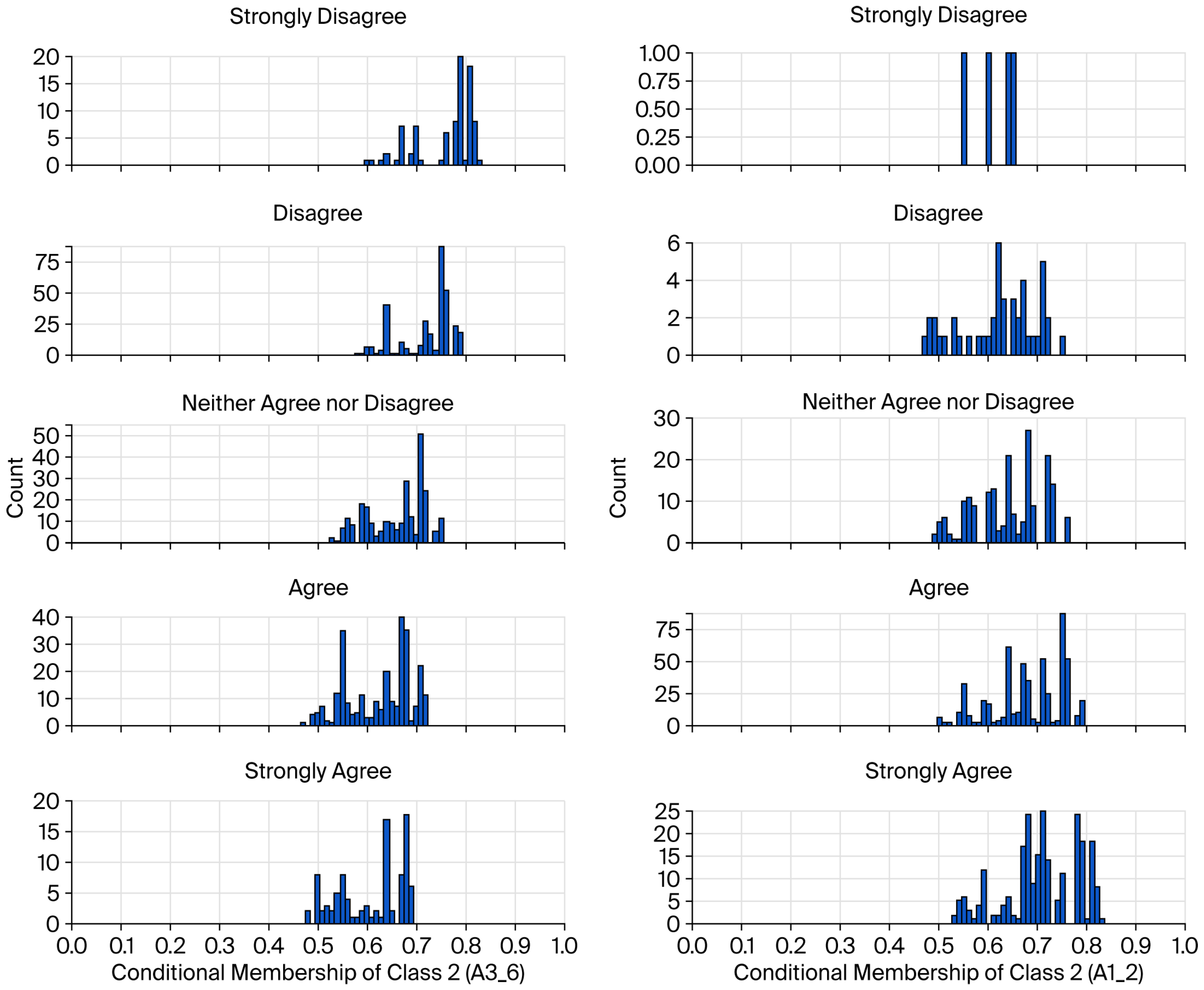
Appendix B. Conditional Probability of Membership in Class 2 by Values of A3_6 and A1_2
| Mean | Median | Standard Deviation | Minimum | Maximum | ||||||
|---|---|---|---|---|---|---|---|---|---|---|
| A3_6 | A1_2 | A3_6 | A1_2 | A3_6 | A1_2 | A3_6 | A1_2 | A3_6 | A1_2 | |
| Strongly | 0.762 | 0.612 | 0.786 | 0.623 | 0.058 | 0.045 | 0.602 | 0.551 | 0.602 | 0.551 |
| Disagree | 0.724 | 0.62 | 0.753 | 0.625 | 0.053 | 0.076 | 0.579 | 0.471 | 0.579 | 0.471 |
| Neither | 0.661 | 0.639 | 0.68 | 0.644 | 0.058 | 0.070 | 0.526 | 0.492 | 0.526 | 0.492 |
| Agree | 0.627 | 0.68 | 0.644 | 0.677 | 0.066 | 0.073 | 0.471 | 0.497 | 0.471 | 0.497 |
| Strongly | 0.61 | 0.706 | 0.643 | 0.707 | 0.067 | 0.076 | 0.482 | 0.527 | 0.482 | 0.527 |

| Classes | Attribute and Levels | Estimate | Rob.t.rat. (0) |
|---|---|---|---|
| Latent Class 1 | b1_fire2 | −0.38 | −2.93 ** |
| b1_fire3 | −0.36 | −2.50 ** | |
| b1_fire4 | −0.62 | −3.71 *** | |
| b1_pest2 | −0.09 | −0.85 | |
| b1_pest3 | −0.13 | −1.21 | |
| b1_pest4 | −0.25 | −2.04 ** | |
| b1_restrn2 | 0.17 | 1.40 | |
| b1_restrn3 | 0.04 | 0.36 | |
| b1_restrn4 | 0.25 | 2.01 ** | |
| b1_biolos2 | 0.00 | −0.03 | |
| b1_biolos3 | −0.07 | −0.59 | |
| b1_biolos4 | −0.04 | −0.32 | |
| b1_cost | −0.27 | −5.92 *** | |
| b1_asc_A | −0.71 | −2.98 ** | |
| b1_asc_B | 0.15 | 0.61 | |
| b2_fire2 | 0.07 | 1.31 | |
| Latent Class 2 | b2_fire3 | 0.05 | 0.82 |
| b2_fire4 | 0.02 | 0.42 | |
| b2_pest2 | −0.01 | −0.20 | |
| b2_pest3 | −0.10 | −1.70 * | |
| b2_pest4 | 0.00 | −0.08 | |
| b2_restrn2 | 0.11 | 2.24 ** | |
| b2_restrn3 | 0.11 | 2.11 ** | |
| b2_restrn4 | 0.02 | 0.40 | |
| b2_biolos2 | 0.09 | 1.74 * | |
| b2_biolos3 | 0.07 | 1.30 | |
| b2_biolos4 | 0.03 | 0.44 | |
| b2_cost | −0.16 | −7.97 *** | |
| b2_asc_A | 2.03 | 8.90 *** | |
| b2_asc_B | 2.37 | 11.69 *** | |
| c2_constant | 0.80 | 4.25 *** | |
| Goodness of fit (Log-likelihood, AIC, BIC) | −9345.82, 18,846.93, 19,071.1 | ||
References
- FAO. The State of the World’s Forests 2022: Forest Pathways for Green Recovery and Building Inclusive, Resilient and Sustainable Economies; FAO: Rome, Italy, 2022. [Google Scholar] [CrossRef]
- Sánchez, J.J.; Marcos-Martinez, R.; Srivastava, L.; Soonsawad, N. Valuing the impacts of forest disturbances on ecosystem services: An examination of recreation and climate regulation services in U.S. national forests. Trees For. People 2021, 5, 100123. [Google Scholar] [CrossRef]
- World Economic Forum. Successful Pilot Shows How Artificial Intelligence Can Fight Wildfires; World Economic Forum Press: Geneva, Switzerland, 2023. [Google Scholar]
- Zenni, R.D.; Essl, F.; Barcia-Berthou, E.; McDermott, S.M. The economic costs of biological invasions around the world. NeoBiota 2021, 67, 1–9. [Google Scholar] [CrossRef]
- Bahamonde-Birke, F.J.; Ortúzar, J.d.D. How to categorize individuals on the basis of underlying attitudes? A discussion on latent variables, latent classes and hybrid choice models. Transp. A Transp. Sci. 2020, 17, 856–877. [Google Scholar] [CrossRef]
- Borriello, A.; Massey, G.; Rose, J.M. Extending the Theory of Planned Behaviour to Investigate the Issue of Microplastics in the Marine Environment. Mar. Pollut. Bull. 2022, 179, 113689. [Google Scholar] [CrossRef] [PubMed]
- McFadden, D. The choice theory approach to market research. Mark. Sci. 1986, 5, 275–297. [Google Scholar] [CrossRef]
- Bae, E.Y.; Lim, M.K.; Lee, B.; Bae, G.; Hong, J. Public Preferences in Healthcare Resource Allocation: A Discrete Choice Experiment in South Korea. Health Policy 2023, 138, 104932. [Google Scholar] [CrossRef] [PubMed]
- Mariel, P.; Artabe, A.; Liebe, U.; Meryeroff, J. An assessment of the current use of hybrid choice models in environmental economics, and considerations for future applications. J. Choice Model. 2024, 53, 100520. [Google Scholar] [CrossRef]
- Marbuah, G.; Gren, I.M.; McKie, B. Economics of harmful invasive species: A review. Divers 2014, 6, 500–523. [Google Scholar] [CrossRef]
- FAO. Global Forest Resources Assessment 2020. 2020. Available online: https://www.fao.org/3/ca9825en/ca9825en.pdf (accessed on 29 August 2023).
- Korea Forest Services (KFS). 2023 Statistical Yearbook of Forestry; Korea Forest Services (KFS): Daejeon, Republic of Korea, 2023. [Google Scholar]
- Ben-Akiva, M.; McFadden, D.; Train, K.; Walker, J.; Bhat, C.; Bierlaire, M.; Bolduc, D.; Boersch-Supan, A.; Brownstone, D.; Bunch, D.S.; et al. Hybrid Choice Models: Progress and Challenges. Mark. Lett. 2002, 13, 163–175. [Google Scholar] [CrossRef]
- Kim, J.H.; Rasouli, S.; Timmermans, H. Hybrid Choice Models: Principles and Recent Progress Incorporating Social Influence and Nonlinear Utility Functions. Procedia Environ. Sci. 2014, 22, 20–34. [Google Scholar] [CrossRef]
- Motoaki, Y.; Daziano, R.A. A hybrid-choice latent-class model for the analysis of the effects of weather on cycling demand. Transp. Res. Part A 2015, 75, 217–230. [Google Scholar] [CrossRef]
- Abou-Zeid, M.; Ben-Akiva, M. Hybrid choice models. In Handbook of Choice Modelling, 2nd ed.; Chapter 18; Edward Elgar Publishing: Cheltenham, UK, 2024; pp. 489–521. [Google Scholar]
- Campbell, D.; Sandorf, E.D. The use of latent variable models in policy: A road fraught with peril? Bio-Based Appl. Econ. 2020, 9, 305–324. [Google Scholar] [CrossRef]
- Mariel, P.; Meyerhoff, J. Hybrid discrete choice models: Gained insights versus increasing effort. Sci. Total Environ. 2016, 568, 433–443. [Google Scholar] [CrossRef] [PubMed]
- Arora, N.; Sourd, R.; Hanson, K.; Woldesenbet, D.; Seifu, A.; Quaife, M. Linking health worker motivation with their stated job preferences: A hybrid choice analysis in Ethiopia. Soc. Sci. Med. 2022, 307, 115151. [Google Scholar] [CrossRef]
- Strazzera, E.; Meleddu, D.; Atzori, R. A hybrid choice modelling approach to estimate the trade-off between perceived environmental risks and economic benefits. Ecol. Econ. 2022, 196, 107400. [Google Scholar] [CrossRef]
- Sun, Y.; Liu, Y.; Zhou, H. Evacuation Decisions in Wildfires: A Hybrid Choice Modeling Approach Incorporating Threat Perception and Risk Attitudes; SSRN: Rochester, NY, USA, 2024. [Google Scholar] [CrossRef]
- Meldrum, J.R. Heterogeneous preferences for managing an invasive forest pathogen: Implications for willingness to pay and policy design. Ecol. Econ. 2015, 120, 13–22. [Google Scholar] [CrossRef]
- Amaris, G.; Hess, S.; Gironás, J.; Ortúzar, J. Using hybrid choice models to capture the impact of attitudes on residential greywater reuse preferences. Resour. Conserv. Recycl. 2021, 164, 105171. [Google Scholar] [CrossRef]
- Jeon, C. Understanding environmental decision-making in forest restoration: The role of latent attitudes, attribute non-attendance, and choice behavior. Front. Behav. Econ. 2025, 4, 1596416. [Google Scholar] [CrossRef]
- Jeon, C.; Campbell, D. Exploring Preference Heterogeneity and Acceptability for Forest Restoration Policies: Latent Class Choice Modeling and Principal Component Analysis. Forests 2025, 16, 1507. [Google Scholar] [CrossRef]
- Roberts, J.; Popli, G.; Harris, R.J. Do Environmental Concerns Affect Commuting Choices? Hybrid Choice Modelling with Household Survey Data. 2014019, Working Papers, The University of Sheffield, Department of Economics. 2014. Available online: https://EconPapers.repec.org/RePEc:shf:wpaper:2014019 (accessed on 11 August 2024).
- McFadden, D. Conditional logit analysis of quantitative choice behaviour. In Frontiers in Econometrics; Zarembka, P., Ed.; Academic Press: New York, NY, USA, 1974; pp. 105–142. [Google Scholar]
- Luce, R.D. A Probabilistic Theory of Utility. Econometrica 1958, 26, 193–224. [Google Scholar] [CrossRef]
- Walker, J.L.; Ben-Akiva, M. Generalized random utility model. Math. Soc. Sci. 2002, 43, 303–343. [Google Scholar] [CrossRef]
- Walker, J.L. Extended Discrete Choice Models: Integrated Framework, Flexible Error Structures, and Latent Variables. Ph.D. Thesis, Massachusetts Institute of Technology, Cambridge, MA, USA, 2001. [Google Scholar]
- McFadden, D. Economic choices. Am. Econ. Rev. 2001, 91, 351–378. [Google Scholar] [CrossRef]
- Vij, A.; Walker, J.L. How, when and why integrated choice and latent variable models are latently useful. Transp. Res. Part B Methodol. 2016, 90, 192–217. [Google Scholar] [CrossRef]
- Bolduc, D.; Álvarez-Daziano, R. On Estimation of Hybrid Choice Models. In Choice Modelling: The State-of-the-Art and the State-of-Practice; Hess, S., Daly, A., Eds.; Emerald Group Publishing Limited: Bingley, UK, 2010; pp. 259–288. [Google Scholar] [CrossRef]
- Mariel, P.; Demel, S.; Longo, A. Modelling welfare estimates in discrete choice experiments for seaweed-based renewable energy. PLoS ONE 2021, 16, e0260352. [Google Scholar] [CrossRef]
- Hensher, D.A.; Rose, J.M.; Greene, W.H. Applied Choice Analysis (A Primer); Cambridge University Press: Cambridge, UK, 2005. [Google Scholar]
- Paulssen, M.; Temme, D.; Vij, A.; Walker, J.L. Values, attitudes and travel behaviour: A hierarchical latent variable mixed logit model of travel mode choice. Transportation 2014, 41, 873–888. [Google Scholar] [CrossRef]
- Faccioli, M.; Czajkowski, M.; Glenk, K.; Martin-Ortega, J. Environmental attitudes and place identity as determinants of preferences for ecosystem services. Ecol. Econ. 2020, 174, 106600. [Google Scholar] [CrossRef]
- Ju, J.Y.; Seok, J.H.; Moon, H.P. An Analysis of Factors Affecting Healthy Food Consumption Intention and Behaviour: Focusing on Ginseng and Red Ginseng Products. J. Rural. Dev. 2022, 45, 41–64. [Google Scholar] [CrossRef]
- Akinwehinmi, O.; Ogundari, K.; Amos, T.T. Consumers’ food control risk perception and preference for food safety certification in emerging food markets. J. Agric. Econ. 2022, 73, 690–708. [Google Scholar] [CrossRef]
- Lahoz, L.T.; Pereira, F.C.; Sfeir, G.; Arkoudi, I.; Monteiro, M.M.; Azevedo, C.L. Attitudes and latent class choice models using machine learning. J. Choice Model. 2023, 49, 100452. [Google Scholar] [CrossRef]
- Hoyos, D. The state of the art of environmental valuation with discrete choice experiments. Ecol. Econ. 2010, 69, 1595–1603. [Google Scholar] [CrossRef]
- Train, K.E. Discrete Choice Methods with Simulation, 2nd ed.; Cambridge University Press: Cambridge, UK, 2009. [Google Scholar]
- Haab, T.C.; McConnell, K.E. Valuing Environmental and Natural Resources: The Econometrics of Non-Market Valuation (New Horizons in Environmental Economics); Edward Elgar: Cheltenham, UK; Northampton, MA, USA, 2002. [Google Scholar]
- Yoo, J.; Kim, M.; Gong, K.; Yoo, B. Economic valuation of forest ecosystem services in the Republic of Korea. J. Rural Econ. 2018, 33, 43–62. [Google Scholar]
- Hess, S. Latent class structures: Taste heterogeneity and beyond. In Handbook of Choice Modelling; Hess, S., Daly, A., Eds.; Edward Elgar Publishing: Cheltenham, UK, 2014; pp. 311–330. [Google Scholar]
- Tadesse, T.; Teklay, G.; Mulatu, D.W.; Rannestad, M.M.; Meresa, T.M.; Woldelibanos, D. Forest benefits and willingness to pay for sustainable forest management. For. Policy Econ. 2022, 138, 102721. [Google Scholar] [CrossRef]
- Daly, A.; Hess, S.; Train, K. Assuring finite moments for willingness to pay in random coefficient models. Transp. Res. Part B 2012, 46, 1785–1793. [Google Scholar] [CrossRef]
- Iannario, M.; Iodice D’Enza, A.; Romano, R. A Hybrid Approach for the Analysis of Complex Categorical Data Structures: Assessment of Latent Distance Learning Perception in Higher Education. Comput. Stat. 2024, 39, 161–179. [Google Scholar] [CrossRef]
- Milfont, T.; Duckitt, J. The environmental attitudes inventory: A valid and reliable measure to assess the structure of environmental attitudes. J. Environ. Psychol. 2010, 30, 80–94. [Google Scholar] [CrossRef]
- Everitt, B.S.; Landau, S.; Leese, M.; Stahl, D. Cluster Analysis, 5th ed.; Wiley: Hoboken, NJ, USA, 2010. [Google Scholar]
- Ajzen, I.; Fishbein, M. The Influence of Attitudes on Behaviour. In The Handbook of Attitudes; Albarracín, D., Johnson, B.T., Zanna, M.P., Eds.; Lawrence Erlbaum Associates Publishers: Mahwah, NJ, USA, 2005; pp. 173–221. [Google Scholar]
- Kraus, S.J. Attitudes and the prediction of behaviour: A meta-analysis of the empirical literature. Personal. Soc. Psychol. Bull. 1995, 21, 58–75. [Google Scholar] [CrossRef]
- Stern, P.C. Toward a coherent theory of environmentally significant behaviour. J. Soc. Issues 2000, 56, 407–424. [Google Scholar]
- Brown, L.R. 2005. Available online: http://www.earth-policy.org/ (accessed on 17 August 2023).
- Korea Forest Service (KFS). 2023 Forest Fire Statistics Yearbook; Korea Forest Services (KFS): Daejeon, Republic of Korea, 2024. [Google Scholar]
- Zhao, J.; Huang, J.; Yan, J.; Fang, G. Economic loss of Pine Wood Nematode Disease in Mainland China from 1998 to 2017. Forests 2020, 11, 1042. [Google Scholar] [CrossRef]
- Niquidet, K.; Tang, J.; Peter, B. Economic analysis of forest insect pests in Canada. Can. Entomol. 2016, 148, S357–S366. [Google Scholar] [CrossRef]
- Olson, L.J. The economics of terrestrial invasive species: A review of the literature. Agric. Resour. Econ. Rev. 2006, 35, 178–194. [Google Scholar] [CrossRef]
- Welling, M.; Zawojska, E.; Sagebiel, J. Information, consequentiality and credibility in stated preference surveys: A choice experiment on climate adaptation. Environ. Resour. Econ. 2022, 82, 257–283. [Google Scholar] [CrossRef]
- Carson, R.T.; Czajkowski, M.; Hanemann, W.M. The discrete choice experiment approach to environmental contingent valuation. In Handbook of Choice Modelling; Hess, S., Daly, A., Eds.; Edward Elgar Publishing: Cheltenham, UK, 2013; pp. 202–235. [Google Scholar]
- Stern, P.C.; Dietz, T.; Abel, T.; Guagnano, G.A.; Kalof, L. A value-belief-norm theory of support for social movements: The case of environmentalism. Hum. Ecol. Rev. 1999, 6, 81–97. [Google Scholar]
- Dunlap, R.E.; Van Liere, K.D.; Mertig, A.G.; Jones, R.E. Measuring endorsement of the new ecological paradigm: A revised NEP scale. Soc. Issues 2000, 56, 425–442. [Google Scholar] [CrossRef]
- Ajzen, I. The theory of planned behaviour. Organ. Behav. Hum. Decis. Process. 1991, 50, 179–211. [Google Scholar] [CrossRef]
- Scarpa, R.; Willis, K.G. Willingness-to-pay for renewable energy: Primary and discretionary choice models. Energy Econ. 2010, 32, 129–136. [Google Scholar] [CrossRef]
- Hess, S.; Palma, D. Apollo: A flexible, powerful and customisable freeware package for choice model estimation and application. J. Choice Model. 2019, 32, 100170. [Google Scholar] [CrossRef]
- Buckell, J.; Hensher, D.A.; Hess, S. Kicking the habit is hard: A hybrid choice model investigation into the role of addiction in smoking behaviour. Health Econ. 2021, 30, 3–19. [Google Scholar] [CrossRef]
- Antonio, B.; Burke, P.F.; Rose, J.M. If one goes up, another must come down: A latent class hybrid choice modelling approach for understanding electricity mix preferences among renewables and non-renewables. Energy Policy 2021, 159, 112611. [Google Scholar] [CrossRef]
- Lovreglio, R.; Kuligowski, E.; Walpole, E.; Link, E.; Gwynne, S. Calibrating the Wildfire Decision Model using hybrid choice modelling. Int. J. Disaster Risk Reduct. 2020, 50, 101770. [Google Scholar] [CrossRef]
- FAO. State of the World’s Forests 2016; FAO: Rome, Italy, 2017. [Google Scholar]
- Islam, K.K.; Sato, N. Deforestation, land conversion and illegal logging in Bangladesh: The case of the Sal (Shorea robusta) forests. iForest 2012, 5, 171–178. [Google Scholar] [CrossRef]

| Levels | Level 1 | Level 2 | Level 3 | Level 4 | |
|---|---|---|---|---|---|
| Attributes | |||||
| Forest fire risk |  (Red, 85 ↑) * |  (Orange, 66~85) |  (Yellow, 51~65) |  (Blue, 51 ↓) | |
| Forest pests and disease risk |  (Red) * |  (Orange) |  (Yellow) |  (Blue) | |
| Restriction on forest-related outdoor activities |  (Zero) * |  (0~−1 million) |  (−1~−2 million) |  (−2~−5 million) | |
| Biodiversity loss (number of pine trees damaged) |  (−300~−400 k trees) * |  (−200~−300 k trees) |  (−100~−200 k trees) |  (0~−100 k trees) | |
| Forest restoration fund | KRW 0 * | KRW 1~KRW 25,000 (USD 0~USD 19.14) | KRW 25,100~KRW 35,000 (USD 19.22~USD 26.80) | KRW 35,100~KRW 50,000 (USD 26.88~USD 38.29) | |
| Variables | Description | Mean | Standard Deviation | Minimum | Maximum |
|---|---|---|---|---|---|
| AGE | Age | 40.47 | 11.64 | 20 | 81 |
| GEN | Gender: Female (1); Male (0) | 0.56 | 0.49 | 0 | 1 |
| EDU | Level of Education | 3.96 (University level) | 0.57 | 1 | 5 |
| INC | Monthly Income | KRW 3,000,000~KRW 3,900,000 (USD 2308~USD 3000) | 1.34 | 1 | 5 |
| Mean | Standard Deviation | |
|---|---|---|
| 1. I cannot afford to pay. | 3.31 | 0.99 |
| 2. I have a better option nearby where I would go to. | 3.51 | 0.80 |
| 3. It is not feasible to stop the spread of forest pests and forest fires. | 2.76 | 1.02 |
| 4. I do not want to put a monetary value on protecting forests. | 2.67 | 1.07 |
| 5. I do not recognize the risks and threats to forest ecosystem services. | 2.94 | 1.03 |
| 6. The payment method is inappropriate. | 3.01 | 1.05 |
| 7. I pay enough tax already. It is the government’s responsibility. | 3.43 | 0.98 |
| 8. The benefits I receive are not worth my rate increases. | 3.28 | 0.97 |
| 9. I am not interested in forests. | 2.45 | 1.05 |
| Component 1 | Component 2 | |
|---|---|---|
| Question items classified ↓ Extraction procedures (Group characteristics) ↓ Final indicators | A3_6, A3_4, A2_2, A2_1, A3_5, A3_3 | A1_2, A1_3, A1_4, A1_1, A2_4, A2_3, A2_5, A1_5, A1_7, A3_7, A1_8, A1_6, A3_1, A3_2 |
| Anthropocentric attitude | Ecocentric attitude | |
| ↓ | ↓ | |
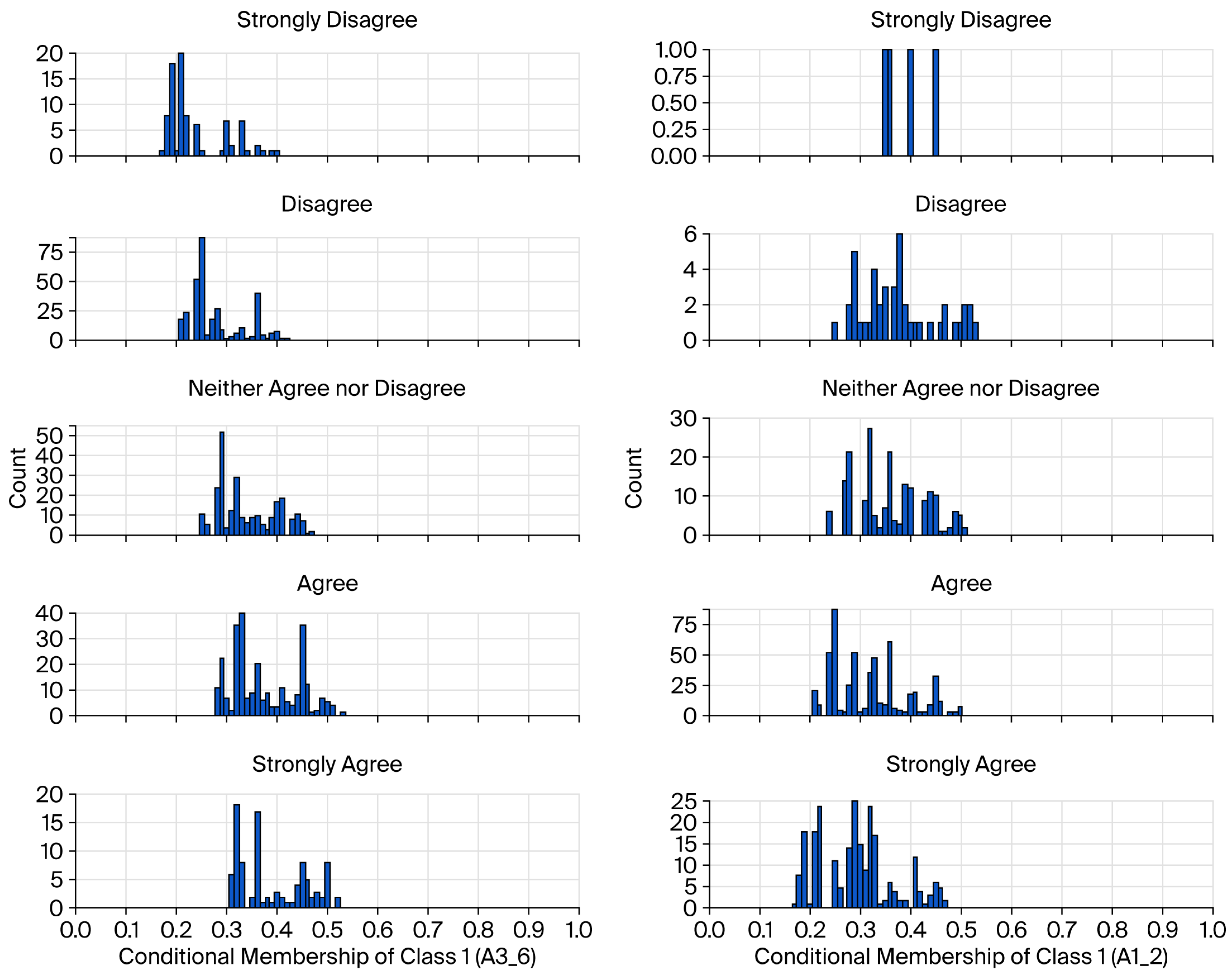
| A3_6 | A1_2 |
| Strongly Disagree | Disagree | Neutral | Agree | Strongly Agree | |
|---|---|---|---|---|---|
| A3_6 (Ratios) | 86 (8.4%) | 319 (31.2%) | 251 (24.6%) | 269 (26.3%) | 96 (9.4%) |
| A1_2 (Ratios) | 4 (0.4%) | 45 (4.4%) | 191 (18.7%) | 541 (53.0%) | 240 (23.5%) |
| Models | HCM | Mixed Logit Model (MXL) | ||||||||
|---|---|---|---|---|---|---|---|---|---|---|
| Class 1 | Class 2 | |||||||||
| Attributes and Variables | Estimate | Rob.t.rat. | Estimate | Rob.t.rat. | Estimate (mu) | Rob.t.rat | S.D. | Rob.t.rat. | ||
| Forest fire risk (FFR) | Fire 2 | −0.36 | −2.82 ** | 0.07 | 1.31 | FFR | 0.28 | 1.86 * | 2.22 | 8.31 ** |
| Fire 3 | −0.33 | −2.47 ** | 0.05 | 0.81 | ||||||
| Fire 4 | −0.57 | −3.39 ** | 0.02 | 0.40 | ||||||
| Forest pest and disease risk (FPDR) | Pest 2 | −0.09 | −0.93 | −0.01 | −0.16 | FPDR | 0.24 | 1.58 * | 1.46 | 4.33 ** |
| Pest 3 | −0.12 | −1.17 | −0.10 | −1.73 * | ||||||
| Pest 4 | −0.24 | −2.07 ** | 0.00 | −0.05 | ||||||
| Forest-related outdoor restriction (FROR) | Restrn 2 | 0.16 | 1.43 | 0.12 | 2.30 ** | FROR | −0.01 | −0.73 | −0.12 | −3.17 ** |
| Restrn 3 | 0.04 | 0.32 | 0.12 | 2.14 ** | ||||||
| Restrn 4 | 0.24 | 2.05 ** | 0.02 | 0.39 | ||||||
| Biodiversity loss (BL) | Biolos 2 | −0.02 | −0.19 | 0.10 | 1.86 * | BL | 0.00 | 0.23 | 0.18 | 4.73 ** |
| Biolos 3 | −0.08 | −0.70 | 0.08 | 1.38 | ||||||
| Biolos 4 | −0.06 | −0.49 | 0.03 | 0.49 | ||||||
| Forest restoration fund (FRF) | Cost | −0.26 | −5.61 ** | −0.16 | −7.97 ** | FRF | −0.03 | −12.25 ** | 0.04 | 17.19 ** |
| Alternative specific constant (ASC) | Asc_A | −0.68 | −3.08 ** | 2.13 | 8.36 ** | ASC | −2.40 | −17.75 ** | 2.81 | 21.01 ** |
| Asc_B | 0.18 | 0.85 | 2.46 | 10.73 ** | ||||||
| Class membership | 1.66 | 1.64 * | - | - | - | - | - | - | ||
| (A3_6) | 1.19 | 1.21 | - | - | - | - | - | - | ||
| (A1_2) | 3.04 | 1.33 | - | - | - | - | - | - | ||
| Measurement component of the HCM model | - | |||||||||
| Estimate | Rob.t.rat. (0) | |||||||||
| Environmental attitude indicators | (A3_6) | −0.92 | −2.51 ** | - | - | - | - | - | ||
| (A3_6) | −2.71 | −9.87 ** | - | - | - | - | - | |||
| (A3_6) | −0.50 | −5.33 ** | - | - | - | - | - | |||
| (A3_6) | 0.69 | 6.57 ** | - | - | - | - | - | |||
| (A3_6) | 2.58 | 9.84 ** | - | - | - | - | - | |||
| (A1_2) | 0.19 | 1.58 *** | - | - | - | - | - | |||
| (A1_2) | −5.55 | −11.08 ** | - | - | - | - | - | |||
| (A1_2) | −3.00 | −20.26 ** | - | - | - | - | - | |||
| (A1_2) | −1.19 | −15.87 ** | - | - | - | - | - | |||
| (A1_2) | 1.19 | 15.81 ** | - | - | - | - | - | |||
| Goodness of fit (Log-likelihood, AIC, BIC) | (−9393.14, 24,250.20, 18,316.68) | (−9116.77, 18,257.54, 37,714.77) | ||||||||
| Attributes | MXL (Mean) | Levels | HCM | |||
|---|---|---|---|---|---|---|
| Class 1 | Class 2 | |||||
| Mean | 95% CI | Mean | 95% CI | |||
| Forest fire risk | 10,287 * (USD 7.9) | Fire2 | −14,129 * | −22,199~−6059 | 4193 | −1631~10,018 |
| Fire3 | −12,867 * | −21,013~−4721 | 2950 | −3431~9331 | ||
| Fire4 | −22,412 * | −32,425~−12,398 | 1498 | −4760~7757 | ||
| Forest pests and disease risk | 8661 * (USD 6.6) | Pest2 | −3562 | −10,933~3809 | −534 | −6471~5402 |
| Pest3 | −4657 | −12,881~3566 | −6249 * | 906~408 | ||
| Pest4 | −9057 * | −17,802~−311 | −295 | −7262~6671 | ||
| Forest-related outdoor restriction | −377 (USD 0.3) | Restrn2 | 6253 | −1431~13,938 | 7191 * | 1056~13,325 |
| Restrn3 | 1459 | −6527~9445 | 7249 * | 857~13,642 | ||
| Restrn4 | 9264 * | 810~17,718 | 1422 | −5081~7927 | ||
| Forest biodiversity loss | 146 (USD 0.1) | Biolos2 | −669 | −8558~7219 | 5927 * | −416~12,271 |
| Biolos3 | −3000 | −11,076~5075 | 4855 | −1672~11,382 | ||
| Biolos4 | −2198 | −10,571~6174 | 1829 | −4818~8476 | ||
| Mean | Median | Standard Deviation | ||||
|---|---|---|---|---|---|---|
| A3_6 | A1_2 | A3_6 | A1_2 | A3_6 | A1_2 | |
| Strongly | 0.238 | 0.388 | 0.214 | 0.377 | 0.058 | 0.045 |
| Disagree | 0.276 | 0.380 | 0.247 | 0.375 | 0.053 | 0.076 |
| Neither | 0.339 | 0.361 | 0.320 | 0.356 | 0.058 | 0.070 |
| Agree | 0.373 | 0.320 | 0.356 | 0.323 | 0.066 | 0.073 |
| Strongly | 0.390 | 0.294 | 0.357 | 0.293 | 0.067 | 0.076 |
| Strongly Disagree | Disagree | Neither | Agree | Strongly Agree | ||
|---|---|---|---|---|---|---|
| Forest fire risk | Fire 2 | −157.95 | −857.31 | −2003.01 | −2633.02 | −2942.86 |
| Fire 3 | −806.02 | −1409.72 | −2398.70 | −2942.53 | −3209.99 | |
| Fire 4 | −4177.74 | −5090.08 | −6584.68 | −7406.55 | −7810.76 | |
| Forest pests and disease risk | Pest 2 | −1253.04 | −1368.51 | −1557.68 | −1661.71 | −1712.87 |
| Pest 3 | −5868.26 | −5807.06 | −5706.81 | −5651.68 | −5624.56 | |
| Pest 4 | −2375.15 | −2709.39 | −3256.93 | −3558.03 | −3706.11 | |
| Forest-related outdoor restriction | Restrn 2 | 6965.14 | 6928.84 | 6869.36 | 6836.66 | 6820.58 |
| Restrn 3 | 5871.86 | 5650.38 | 5287.56 | 5088.04 | 4989.92 | |
| Restrn 4 | 3283.45 | 3582.50 | 4072.41 | 4341.81 | 4474.30 | |
| Forest biodiversity loss | Biolos 2 | 4358.61 | 4106.49 | 3693.45 | 3466.33 | 3354.63 |
| Biolos 3 | 2988.18 | 2688.09 | 2196.48 | 1926.15 | 1793.20 | |
| Biolos 4 | 872.19 | 718.39 | 466.44 | 327.89 | 259.75 |
| Strongly Disagree | Disagree | Neither | Agree | Strongly Agree | ||
|---|---|---|---|---|---|---|
| Forest fire risk | Fire 2 | −2908.86 | −2750.21 | −2406.35 | −1663.80 | −1189.55 |
| Fire 3 | −3180.64 | −3043.69 | −2746.87 | −2105.89 | −1696.51 | |
| Fire 4 | −7766.39 | −7559.43 | −7110.86 | −6142.18 | −5523.50 | |
| Forest pests and disease risk | Pest 2 | −1707.25 | −1681.06 | −1624.28 | −1501.68 | −1423.37 |
| Pest 3 | −5627.54 | −5641.42 | −5671.51 | −5736.49 | −5777.99 | |
| Pest 4 | −3689.85 | −3614.03 | −3449.70 | −3094.82 | −2868.17 | |
| Forest-related outdoor restriction | Restrn 2 | 6822.34 | 6830.58 | 6848.43 | 6886.97 | 6911.59 |
| Restrn 3 | 5000.69 | 5050.93 | 5159.82 | 5394.98 | 5545.17 | |
| Restrn 4 | 4459.76 | 4391.92 | 4244.88 | 3927.36 | 3724.57 | |
| Forest biodiversity loss | Biolos 2 | 3366.89 | 3424.08 | 3548.04 | 3815.74 | 3986.71 |
| Biolos 3 | 1807.79 | 1875.87 | 2023.41 | 2342.03 | 2545.53 | |
| Biolos 4 | 267.23 | 302.12 | 377.74 | 541.03 | 645.33 |
Disclaimer/Publisher’s Note: The statements, opinions and data contained in all publications are solely those of the individual author(s) and contributor(s) and not of MDPI and/or the editor(s). MDPI and/or the editor(s) disclaim responsibility for any injury to people or property resulting from any ideas, methods, instructions or products referred to in the content. |
© 2026 by the authors. Licensee MDPI, Basel, Switzerland. This article is an open access article distributed under the terms and conditions of the Creative Commons Attribution (CC BY) license.
Share and Cite
Jeon, C.; Campbell, D. Valuing Forest Restoration Through Environmental Attitudes: A Hybrid Choice Modelling Approach. Forests 2026, 17, 305. https://doi.org/10.3390/f17030305
Jeon C, Campbell D. Valuing Forest Restoration Through Environmental Attitudes: A Hybrid Choice Modelling Approach. Forests. 2026; 17(3):305. https://doi.org/10.3390/f17030305
Chicago/Turabian StyleJeon, Chulhyun, and Danny Campbell. 2026. "Valuing Forest Restoration Through Environmental Attitudes: A Hybrid Choice Modelling Approach" Forests 17, no. 3: 305. https://doi.org/10.3390/f17030305
APA StyleJeon, C., & Campbell, D. (2026). Valuing Forest Restoration Through Environmental Attitudes: A Hybrid Choice Modelling Approach. Forests, 17(3), 305. https://doi.org/10.3390/f17030305