
Article

Projecting the Potential Shift of Larix principis-rupprechtii in Response to Future Climate Change: A Regional Analysis of the Haihe Basin in Northern China

1
School of Water Resources and Hydropower Engineering, North China Electric Power University, Beijing 102200, China
2
Beijing Linmiao Ecological Environment Technology Co., Ltd., Beijing 100085, China
3
College of Soil and Water Conservation, Beijing Forestry University, Beijing 100083, China
*
Author to whom correspondence should be addressed.
Forests 2026, 17(2), 278; https://doi.org/10.3390/f17020278
Submission received: 7 January 2026 / Revised: 14 February 2026 / Accepted: 16 February 2026 / Published: 19 February 2026
(This article belongs to the Section Forest Meteorology and Climate Change)

Abstract

Projections of species distribution shifts induced by climate change are essential for adaptive management, yet regional-scale projections that explicitly address uncertainty remain underexplored. Future habitat suitability for Larix principis-rupprechtii in the Haihe Basin is projected using ensemble MaxEnt analysis driven by 13 CMIP6 climate simulations under contrasting emission scenarios (SSP1-2.6 and SSP5-8.5). The MaxEnt demonstrates strong performance, with a mean AUC of 0.874. Future scenarios show that climatically favorable habitat for larch expands by over 20% and shifts approximately 42 km southwestward relative to the baseline, while high-suitability areas increase by 109%–181%. However, substantial uncertainty, quantified by the coefficient of variation (CV), persists in the low-suitability areas and intensifies with longer time horizons and higher emission pathways. Crucially, local topographic heterogeneity (elevation, slope, and shallow soil moisture) explains over 84% of the distribution variance, overriding broad-scale climatic drivers. We conclude that adaptive revegetation strategies at the regional basin scale should prioritize topographic controls, while the uncertainty in habitat suitability induced by climate change must not be overlooked.

1. Introduction

Global climate change is increasingly affecting Earth’s ecosystems, with profound consequences on species distribution [1,2]. Compared with pre-industrial levels, the ongoing increase in greenhouse gas emissions has raised global temperatures by about 1.09 °C [3], resulting in intensified climatic variation [4,5], with ecosystems subjected to more serious threats accordingly. Although a number of species are capable of adapting to climate change by moving to higher latitudes [2], species with longer life spans frequently demonstrate constrained adaptive potential, due to their slow growth and reduced vagility [6]. Additionally, local controls such as topography sometimes play more important roles in shaping species distributions than large-scale climatic variables do [7,8]. All of these collectively make species potential distribution more complex in response to climate change [9,10]. Predicting species distributions affected by climate change has received increasing attention from researchers and policymakers in ecosystem management and biodiversity conservation [11].
Species distribution models, such as the Random Forest model [12,13], Biometeorological Model [14], and Maximum Entropy Model (MaxEnt) [15], are commonly employed to forecast shifts in species’ suitable areas driven by climate change. Among these, the MaxEnt model, based on the maximum entropy principle, integrates species occurrence data with environmental variables to estimate probability distributions of species. The model exhibits robust prediction performance even for species with limited ecological plasticity and for scenarios with restricted sample sizes and narrow biogeographic distributions [16,17]. By applying the MaxEnt model, researchers can easily assess potential changes in suitable habitats and prioritize conservation areas for target species under future climate scenarios.
Larix principis-rupprechtii (larch), as one of the dominant tree species in northern China, has shown strong adaptability to cold and drought environments, and poor soil properties. It plays a vital role in soil and water conservation, carbon sequestration and timber production, and is therefore critical to ecosystem protection in the region [18]. When investigating the potential impacts of climate change on the distribution of larch species, Gao et al. suggest that the distribution of Larix gmelinii is expected to shift markedly northward, with local suitable areas expected to shrink or disappear [19]. Cheng et al. emphasize that the suitable distribution area for L. principis-rupprechtii will decrease in the future, with a shift toward higher elevations [20]. Similar results are also reported by An et al. for three larch species on the Qinghai–Tibet Plateau [21]. Global synthesis studies show a general pattern of “northward expansion and southward retreat” for larch distributions under recent warming, especially at the northern margins of Eurasia [22].
Previous studies have successfully predicted potential changes in larch distributions under climate change across different regions, providing an important foundation for understanding their climate responses. However, these predictions were based on outputs from a single global climate model (GCM) scenario, neglecting differences among GCM projections and potentially leading to misinterpretation of species’ potential responses to climate change. Discrepancies among GCM outputs are usually one of the major sources of uncertainty in predicting species’ distribution [23,24]. In Australia, the suitable spatial ranges of endangered species could differ by up to threefold due to different GCM selections [25]. Similarly, the potential distribution estimates of Gentiana have shown entirely different results under different GCMs [26]. These variations have prompted the research community to shift toward ensemble modeling frameworks, which reduce biases from single models and improve prediction accuracy by integrating projections from multiple GCMs [23,27]. For instance, Thuiller et al. used consensus mapping to identify high-confidence areas [24]. Li et al. addressed predictions from 17 GCMs through a majority-voting approach [28]. Dyderski et al. directly averaged outputs from 4 GCMs [29]. These all confirm the advantages of multi-model ensembles in enhancing prediction reliability. However, even within ensemble modeling frameworks, the risks posed by environmental extrapolation have not received sufficient attention. Correlative species distribution models such as MaxEnt inevitably encounter “novel climates” when projecting into the future [30,31]. Once future climate conditions exceed the range of environmental gradients during model calibration, predictions extrapolate in environmental space lacking observational support, leading to amplified uncertainty [32]. Unfortunately, most existing studies based on multiple GCMs, while considering scenario differences, often overlook the distinction between analogous and novel environments. Due to the lack of assessment using environmental similarity diagnostic methods such as the Multivariate Environmental Similarity Surface (MESS), Mobility-Oriented Parity (MOP), and Extrapolation Detection (ExDet) [32,33,34], these studies may fail to effectively distinguish strict extrapolation zones. This limitation thereby underestimates the impacts of extrapolation uncertainty on suitable habitat and conservation area delineation
In addition, previous analyses on species’ suitable habitats were also commonly conducted on macroscales, in which climatic variables such as temperature and precipitation were found important in determining species distribution [35,36]. Nevertheless, species responses to environmental variables are usually scale-dependent [37,38,39]. Local effects of non-climatic factors, such as topography, soil moisture, and vegetation structure, are often more prominent in regional analyses [40,41]. If only large-scale climatic variables are considered in areas with complex terrain, the regulatory role of microclimates shaped by topography on species distribution can be easily masked. Our study area, the Haihe Basin, is an ideal region to test this scale effect. The basin covers 31.82 × 10⁴ km2 and is located in a transitional climatic zone [42]. It is characterized by complex topography, with the upstream consisting of mountainous and hilly areas, whereas the downstream is dominated by plains. Such heterogeneous environmental conditions have resulted in high spatial variability in species distribution, while potentially providing microclimate refugia for montane species such as larch under climate change. Furthermore, as a major component of the Beijing-Tianjin-Hebei region, the Haihe Basin holds an irreplaceable and important position in regional ecological conservation. Therefore, comprehensively considering both climatic and topographic factors in the study area is of critical significance for accurately predicting the future distribution patterns of larch.
Given the combined influences of GCM uncertainty, novel climate extrapolation risks, and regional-scale environmental heterogeneity, this study proposes three hypotheses for larch in the Haihe Basin. H1: Driven by climate warming, the suitable habitat of larch will show a shrinking trend, with the distribution centroid shifting toward mountainous areas. H2: At this regional scale, topographic gradients will exceed large-scale climatic gradients in shaping species distribution. H3: Novel climate zones will emerge under future climate scenarios, and multi-GCM ensemble frameworks will help reduce prediction uncertainty compared to predictions driven by a single GCM. To test these hypotheses, this study includes (i) predicting changes in the distribution patterns of larch and quantifying the uncertainty of multi-GCM predictions; (ii) identifying the dominant variables affecting larch distribution at the basin scale; (iii) characterizing novel climate zones spatially through environmental similarity analysis.

2. Data and Methods

2.1. Study Area

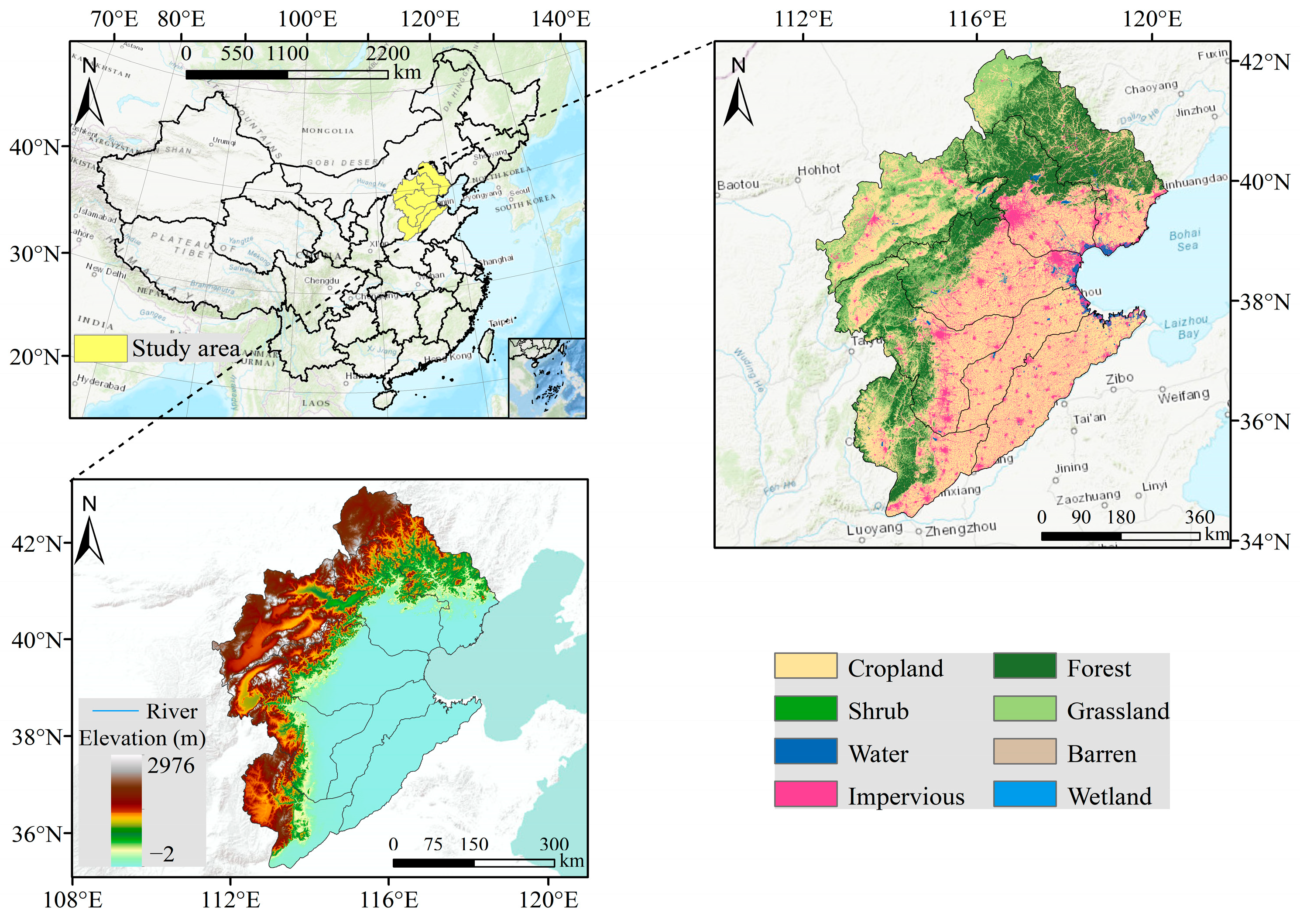
The Haihe Basin, one of China’s seven principal river basins, spans 112–120° E longitude and 34–43° N latitude, encompassing an area of 31.82 × 10⁴ km2 with elevations ranging from −2 to 2976 m (Figure 1). The topography of the region is complex, characterized by the Inner Mongolia Plateau in the north, mountains and hills in the west, and plains in the southeast. The area belongs to the temperate East Asian monsoon climate zone. Due to the impact of climate change, from 1960 to 2010, the mean annual air temperature of the region increased significantly at a rate of approximately 0.34 °C per decade, while the mean annual precipitation declined by 18–19 mm per decade [43,44]. The Haihe Basin supports diverse vegetation types, including coniferous forests, grasslands, shrublands, and agricultural crops. Key tree species in this region include Larix principis-rupprechtii, Pinus tabuliformis, and Platycladus orientalis. The Haihe Basin plays an extremely important role in water resource supply for the Beijing-Tianjin-Hebei region, and is considered a major component of the region’s ecological shelter system. Its ecological security is crucial for regional sustainable development [45].

2.2. Data Acquisition

A vector dataset recording the presence of larch within the study area was acquired from the Plant Photo Bank of China (https://ppbc.iplant.cn/, accessed on 18 October 2025), Chinese Virtual Herbarium (https://www.cvh.ac.cn/, accessed on 18 October 2025), and the National Specimen Information Infrastructure (http://www.nsii.org.cn/, accessed on 18 October 2025). Considering that overly dense or duplicate samples may cause spatial bias in model training, thereby affecting predictive accuracy [46,47], the presence-data samples were filtered using ENMTools (v1.1.5) to minimize potential sampling bias [48]. To match the resolution of the environmental variables, only one record was retained per 1 km × 1 km grid cell when multiple records fell within the same grid, resulting in 139 records for model construction.
Environmental variables such as climate, topography, and soil are primary controls on plant growth and species distribution [49,50]. We obtained the dataset of bioclimatic variables from WorldClim (https://worldclim.org/) at a spatial resolution of 30 arcseconds (approximately 1 km2) [51], which provides 19 bioclimatic variables that are often widely used in species distribution modeling analyses [52]. Elevation data at 90 m resolution were downloaded from the Geospatial Data Cloud (https://www.gscloud.cn/) at 90 m resolution, from which both slope and aspect were derived. Soil data were obtained from the Harmonized World Soil Database v1.2 (https://www.fao.org/) at 1 km resolution. We retrieved soil moisture data covering the period 2000–2020 from the National Tibetan Plateau Data Center (https://www.tpdc.ac.cn/) at a spatial resolution of 9 km. Data from three depth layers (20 cm, 60 cm, and 100 cm) were incorporated into our analysis. All data were resampled to 30 arcseconds resolution (Table A1).

2.3. Model Construction and Evaluation

Correlation and multicollinearity among variables may reduce stability in model construction [53]. Therefore, we first calculated Pearson correlation coefficients (r) for all candidate variables within the study area. Variable pairs exhibiting high correlation (|r| > 0.75) were identified. For each highly correlated pair, we retained the variable that demonstrated greater ecological relevance and higher permutation importance in a preliminary model. Subsequently, we evaluated the relative contribution of the remaining variables using permutation importance and jackknife analysis derived from MaxEnt. Variables with negligible explanatory power (e.g., percent contribution < 1%) were further excluded. Finally, 13 key environmental variables were selected for final model construction (Table 1).
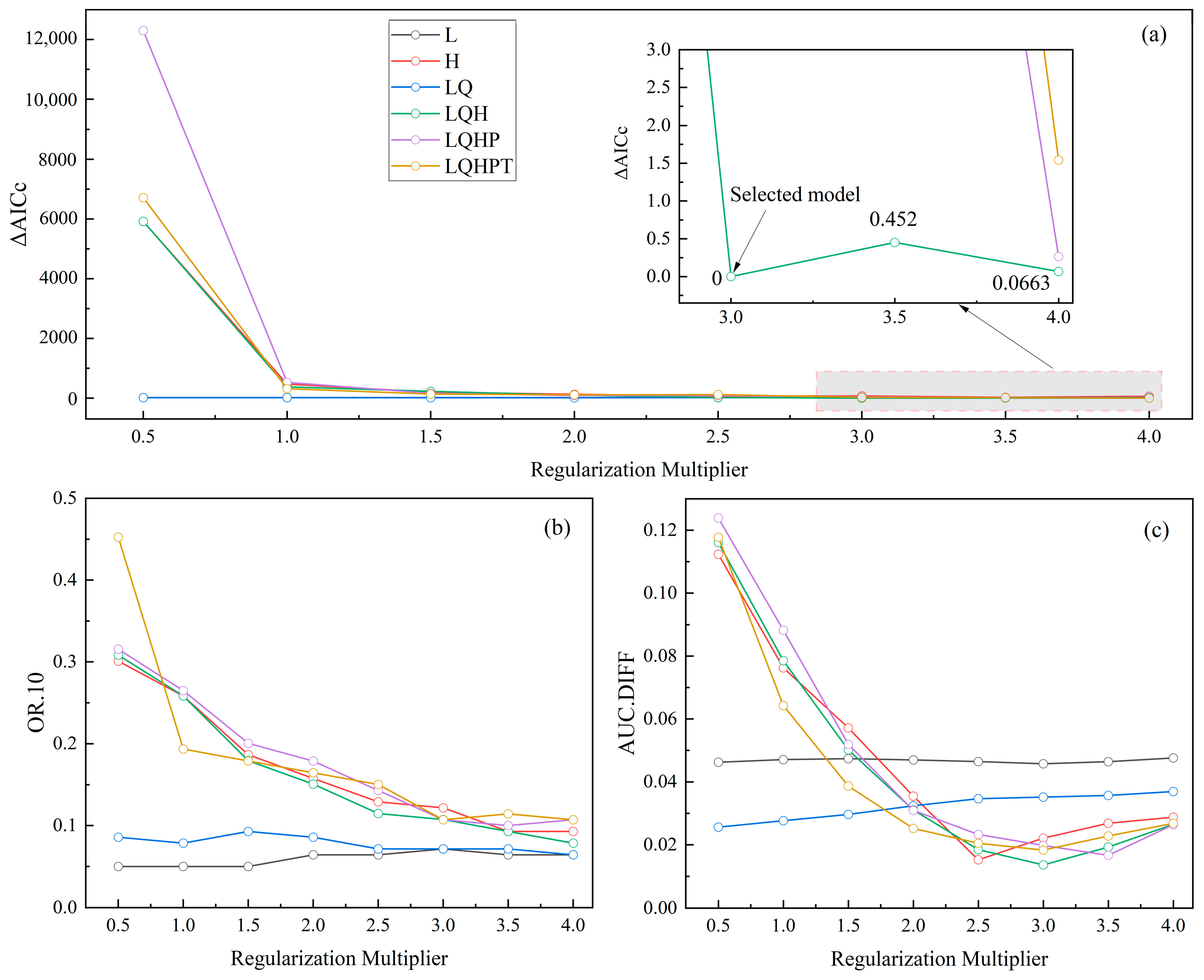
Considering that default model configurations may lead to overfitting or underfitting, thereby failing to truly reflect the model’s predictive capability [54,55], we employed the ENMeval package in R (v4.2.2) via RStudio platform to tune model parameters. We calibrated the regularization multiplier (RM) and feature combination (FC) parameters [56]. FC represents mathematical transformations applied to model covariates, such as linear (L), quadratic (Q), hinge (H), product (P) and threshold (T), to allow complex relationships to be modeled in MaxEnt (v3.4.4) [57]. In contrast, RM is a penalty imposed on the model to prevent over-complexity, by smoothing the response curve through increased regularization penalties on feature coefficients [56]. When tuning the parameters, the presence dataset was randomly divided into four parts, with three quarters for model training and the remaining quarter for model validation. Bootstrap resampling was set to 10 iterations. Following the method of relevant research [58], we tested RM values ranging from 0.5 to 4.0 in 0.5 increments, combined with six FC types (L, H, LQ, LQH, LQHP, LQHPT), which yielded 48 candidate models. To identify the optimal model, multiple selection metrics were used, including the Akaike Information Criterion (AICc), 10% training omission rate (OR.10), and the difference between the training and test AUC (AUC.diff) [59]. Models with the smallest AICc values (ΔAICc = 0) along with low OR.10 and low AUC.diff values were considered optimal [60]. The selected optimal models were then applied to predict species distribution. Following the common practice [61,62,63], model performance was evaluated using the Area Under the Curve (AUC), with higher values indicating stronger discriminatory capability. In our analysis, the evaluation criteria for AUC were as follows: 0.50–0.60 (fail), 0.60–0.70 (poor), 0.70–0.80 (fair), 0.80–0.90 (good), and 0.90–1.00 (excellent).

2.4. Climate Scenarios

Future climate projections were obtained from 13 global climate models (GCMs) from WorldClim v2.1 at a spatial resolution of 30″. Two representative emission pathways were considered, including the Shared Socio-economic Pathways (SSPs) framework of SSP1-2.6 (low emission, sustainable development), and SSP5-8.5 (high emission, fossil-fuel-dependent), corresponding to global warming of approximately 1.8 °C and 4.4 °C, respectively, by 2100, and radiative forcing of approximately 2.6 and 8.5 W m−2, respectively [64]. The data were divided into three periods: near-term (2021–2040, 2030s), mid-term (2041–2060, 2050s), and long-term (2061–2080, 2070s). Non-climatic variables in the future, such as topography and soil, were treated as static [65].
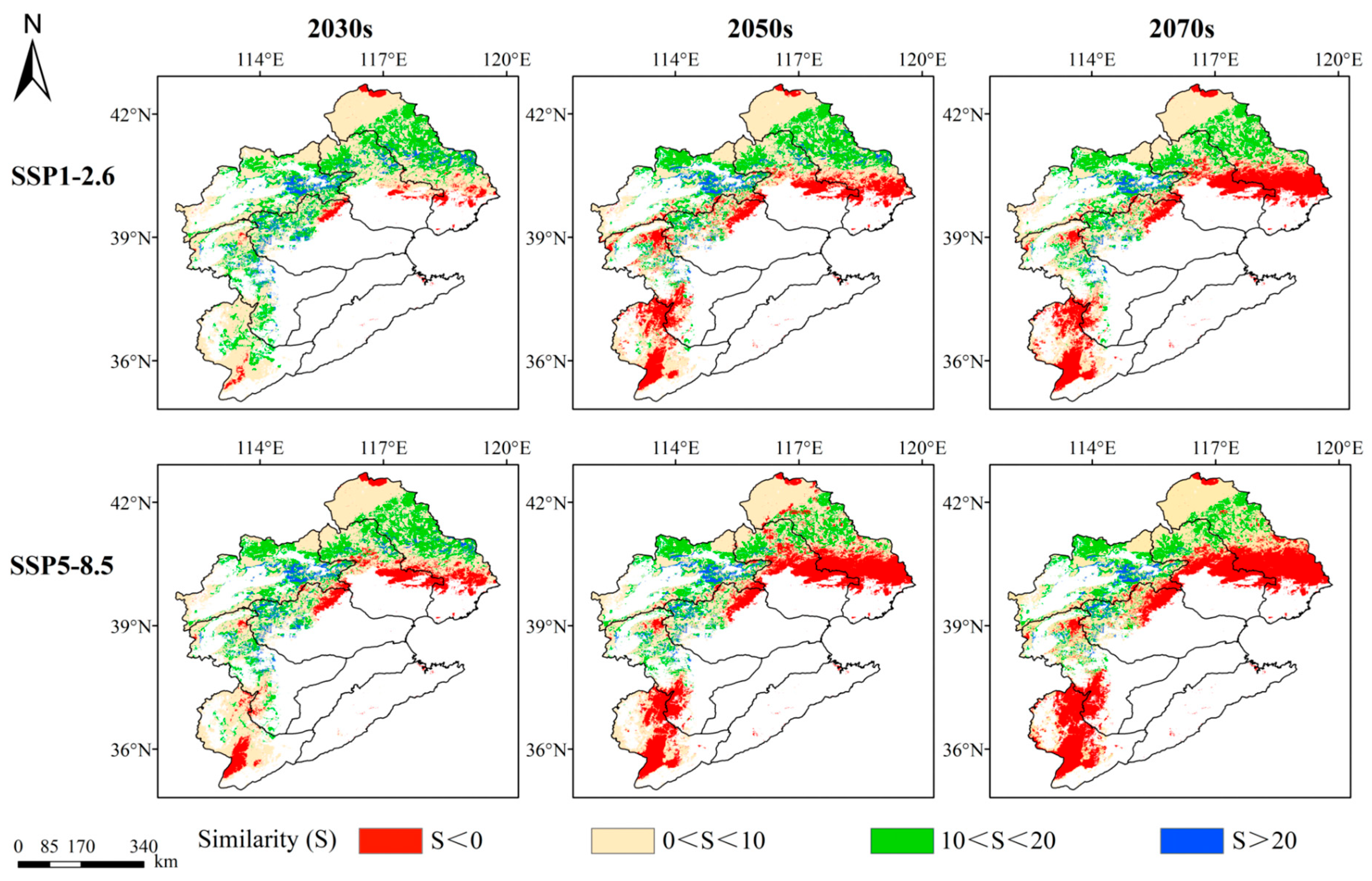
To examine potential extrapolation risks when projecting MaxEnt to future climates, which could compromise prediction reliability [32,66], we assessed environmental similarity using the MESS approach. The MESS analysis yields a similarity index (S) by comparing projected climatic conditions with the environmental space represented by the training data. Positive S values indicate that future conditions remain within the calibration range. In contrast, negative S values indicate novel climates outside the training environmental space, implying higher extrapolation risk.

2.5. Analysis of Species Distribution

2.5.1. The Controls of Potential Environmental Variables

We comprehensively employed Percent Contribution (PC), Permutation Importance (PI), and the jackknife test to evaluate the importance of various potential environmental variables. A higher PC value suggests greater control over the variation in species distribution. PI assesses the dependence of a model on a specific variable by randomly permuting the variable’s values within its range, re-running the model, and calculating the resulting change in model performance. A significant decrease in AUC indicates greater dependence of the model on that variable. Jackknife analysis assessed the independent contribution of each variable to model predictions. A high regularized training gain indicates strong independent predictive power of the variable.

2.5.2. The Changes in the Distribution of the Larch and Its Uncertainties

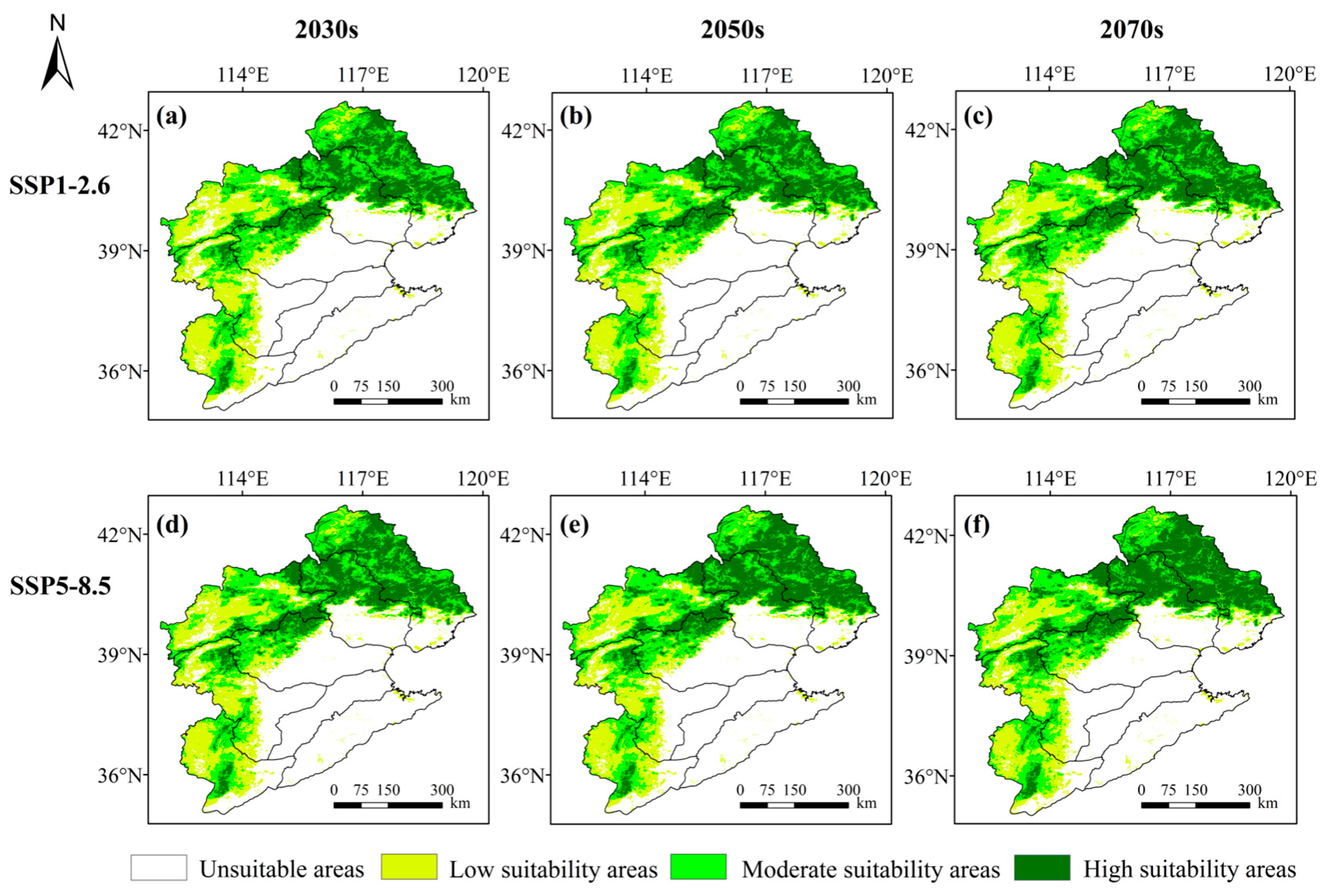
The MaxEnt model provides a habitat suitability (P) distribution with values ranging from 0 to 1. According to the Jenks natural breaks algorithm [67], the probability of species distribution was classified into four levels: unsuitable (P < 0.12), low suitability (0.12 ≤ P < 0.30), moderate suitability (0.30 ≤ P < 0.50), and high suitability (P ≥ 0.50). In our analysis, areas with P less than 0.12 were designated as non-suitable areas, and the rest as suitable areas. The retention zones, expansion zones, and loss zones of the larch distribution in the future were determined by comparing the suitable areas across different time periods. Additionally, the geographic center of suitable areas was determined for each time period, and shifts in distribution centroids across climate scenarios were examined.
As mentioned previously, we integrated climate projections from 13 GCMs into the MaxEnt modeling process to minimize prediction biases associated with reliance on a single climate projection. The final output of the Ensemble_MaxEnt was generated by calculating the arithmetic mean of the predictions from these 13 GCMs. This consensus strategy, which is widely adopted in related studies, essentially assigns equal weight to each GCM [68]. To quantify the uncertainty of the ensemble projections, we employed the coefficient of variation (CV) across individual GCMs as an indicator to characterize the dispersion of species distribution predictions. Based on the quantile distribution of pixel-level CV values, we categorized uncertainty into three levels: low (CV < 15%), moderate (15% ≤ CV < 30%), and high (CV ≥ 30%). These complementary analyses (CV and MESS) together characterize prediction uncertainty for larch under climate change.

3. Results

3.1. Evaluation of Model Performance

Based on model selection criteria, the configuration with RM = 3 and Linear-Quadratic-Hinge (LQH) features performs best, yielding a ΔAICc of 0 (Figure 2a). Relative to the default parameters (RM = 1, FC = LQHP, ΔAICc = 529.79), this configuration achieves a superior balance between model fit and complexity, effectively mitigating overfitting. This enhancement is confirmed by a 59.48% reduction in OR.10 and an 84.55% decrease in AUC.DIFF relative to the default parameters (Figure 2b,c). Therefore, we apply this optimal parameter set to project the potentially suitable habitat for larch. The final model shows a mean AUC of 0.874 ± 0.017, suggesting high predictive accuracy and indicating that it is applicable to estimating species’ potential geographic distribution.

3.2. The Environmental Controls on the Current Potential Distribution of Larch

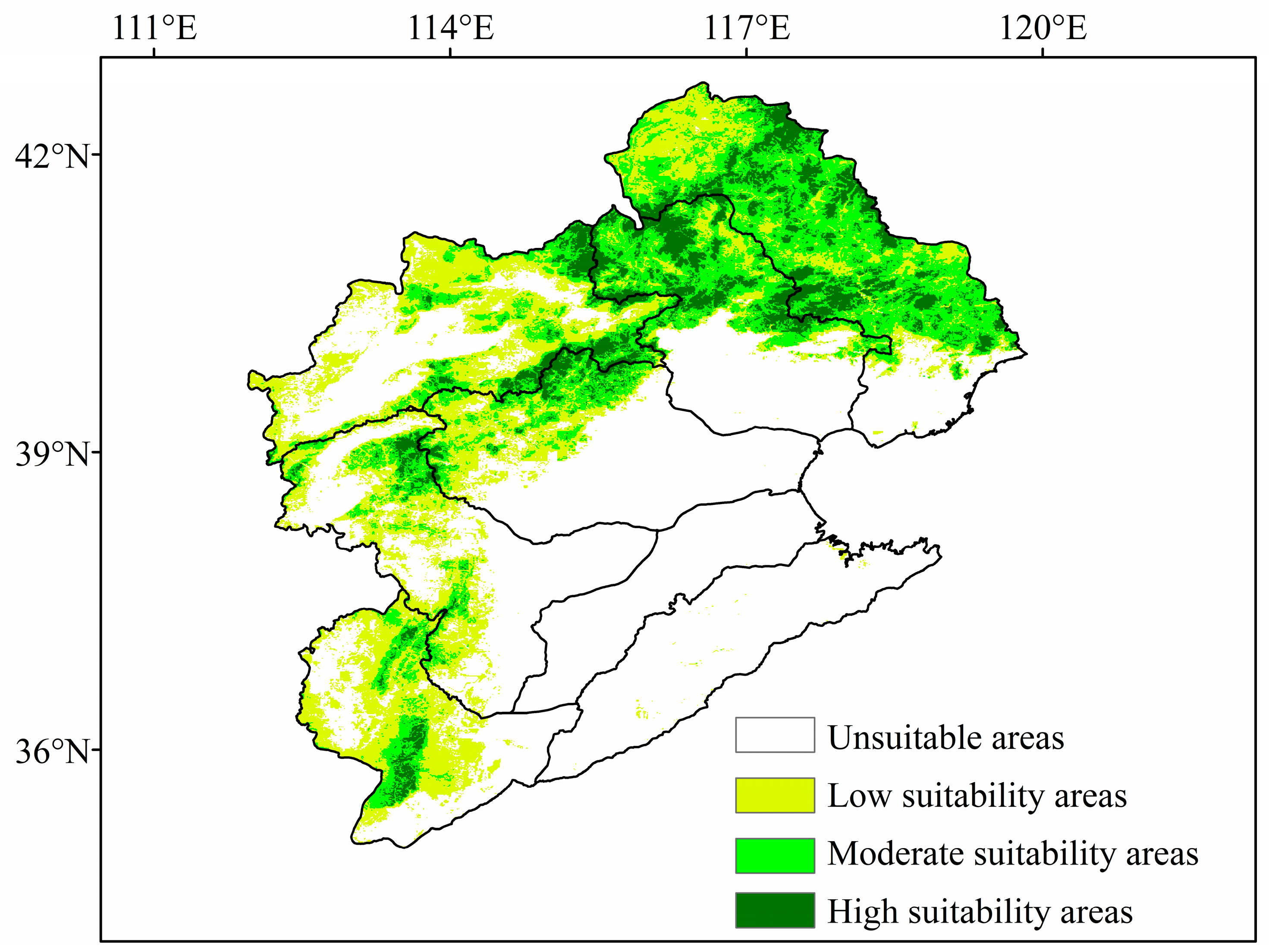
According to the MaxEnt model simulation, approximately 145,400 km2 within the Haihe Basin provides suitable conditions for larch under the current climate. Highly suitable habitat occupies about 26,000 km2 (17.88%), while moderately suitable habitat comprises 51,700 km2 (35.56%). Both are concentrated primarily in the northern and northeastern mountainous regions. The low-suitability area covers about 67,700 km2 (46.56%), predominantly distributed in the western and southwestern mountainous regions (Figure 3). The central and southeastern areas, characterized by plain terrain, are generally identified as unsuitable for larch distribution.
Topographic and climatic gradients explain this spatial divergence. An analysis of the 13 environmental variables (see Table 1) reveals that elevation (elev), soil moisture at 20 cm depth (smc20), and slope are the three most influential factors. Together, they contribute 84.3%, with elev accounts for the largest share (36.0%), followed by smc20 (27.7%). Permutation importance analysis and the jackknife test further confirm the dominance of these variables. For example, the MaxEnt model predictions rely mostly on elev, smc20, and bio2 (i.e., the mean diurnal temperature range), where elev explains 53.4% of the variation and smc20 explains 14%. Similarly, the jackknife shows a substantial decrease in regularized training gain (RTGw) when elev, smc20, and slope are excluded. Overall, elevation, slope, shallow soil moisture, and mean diurnal range emerge as the primary environmental drivers, with topographic and soil factors playing a more significant role than bioclimatic variables.
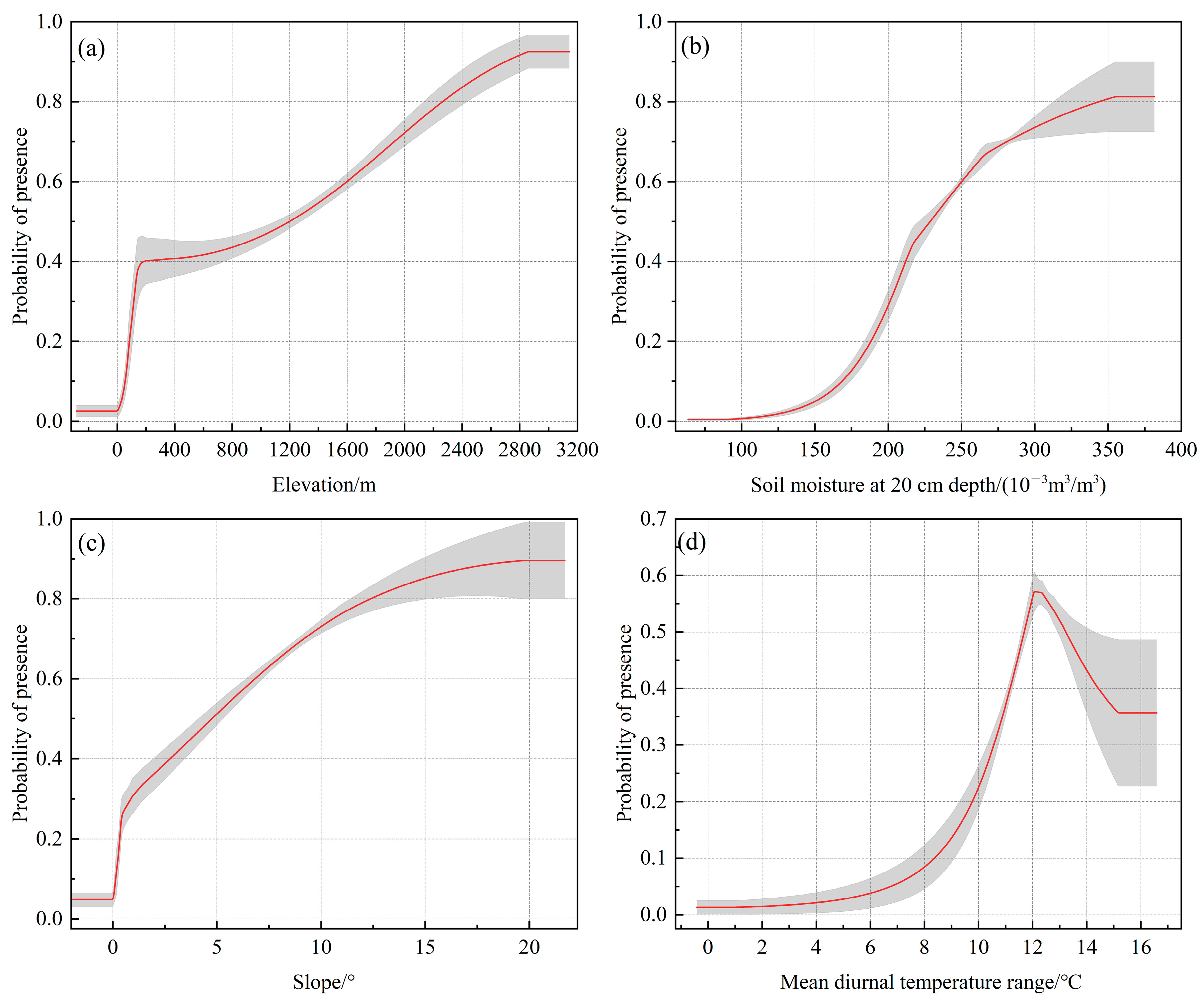
Response curves illustrate how the variables affect the probability of species occurrence (Figure 4), where a probability exceeding 0.5 is considered highly suitable. Areas above 1203 m represent the optimally suitable habitat for the larch, and the probability of presence increases with elevation, stabilizing at approximately 2863 m (Figure 4a). The larch also favors smc20 levels between 0.23 and 0.36 m3/m3 (Figure 4b) and slope steeper than 5° (Figure 4c). Regarding temperature, larch shows optimal growth at bio2 values around 12.1 °C, with suitability declining when bio2 falls below 11.7 °C or exceeds 13.3 °C (Figure 4d).

3.3. Projected Suitable Habitats for Larix principis-rupprechtii in Future Climates

3.3.1. Climate Similarity

MESS analysis is conducted only for the currently suitable areas of larch, as the plain areas are generally unsuitable for the larch, even under future climates. Following the low-emission pathway (SSP1-2.6), the mean similarity score (S) is 7.56 for the 2030s, and the pixels with novel climates (i.e., S < 0) account for only 4.93% of the suitable area. By the 2050s and 2070s, the mean S values decline to 5.42 and 3.90, respectively, with the proportion of novel climate pixels increasing to 21.35% and 25.87%. Climatic deviations are more pronounced under the high-emission scenario (SSP5-8.5). Specifically, mean S values drop to 6.28 (2030s), 3.23 (2050s) and 0.81 (2070s), while the extent of novel-climate areas expands to 13.09%, 29.89% and 36.33% in the corresponding periods. Despite anticipated deviations from baseline conditions, results from the MESS analysis confirm that climatic stability will be maintained in more than 60% of the contemporary suitable habitats (Figure 5). This finding supports the reliability of using future climate projections to predict species distribution.

3.3.2. Response of the Potential Suitable Habitat to Future Climate Change

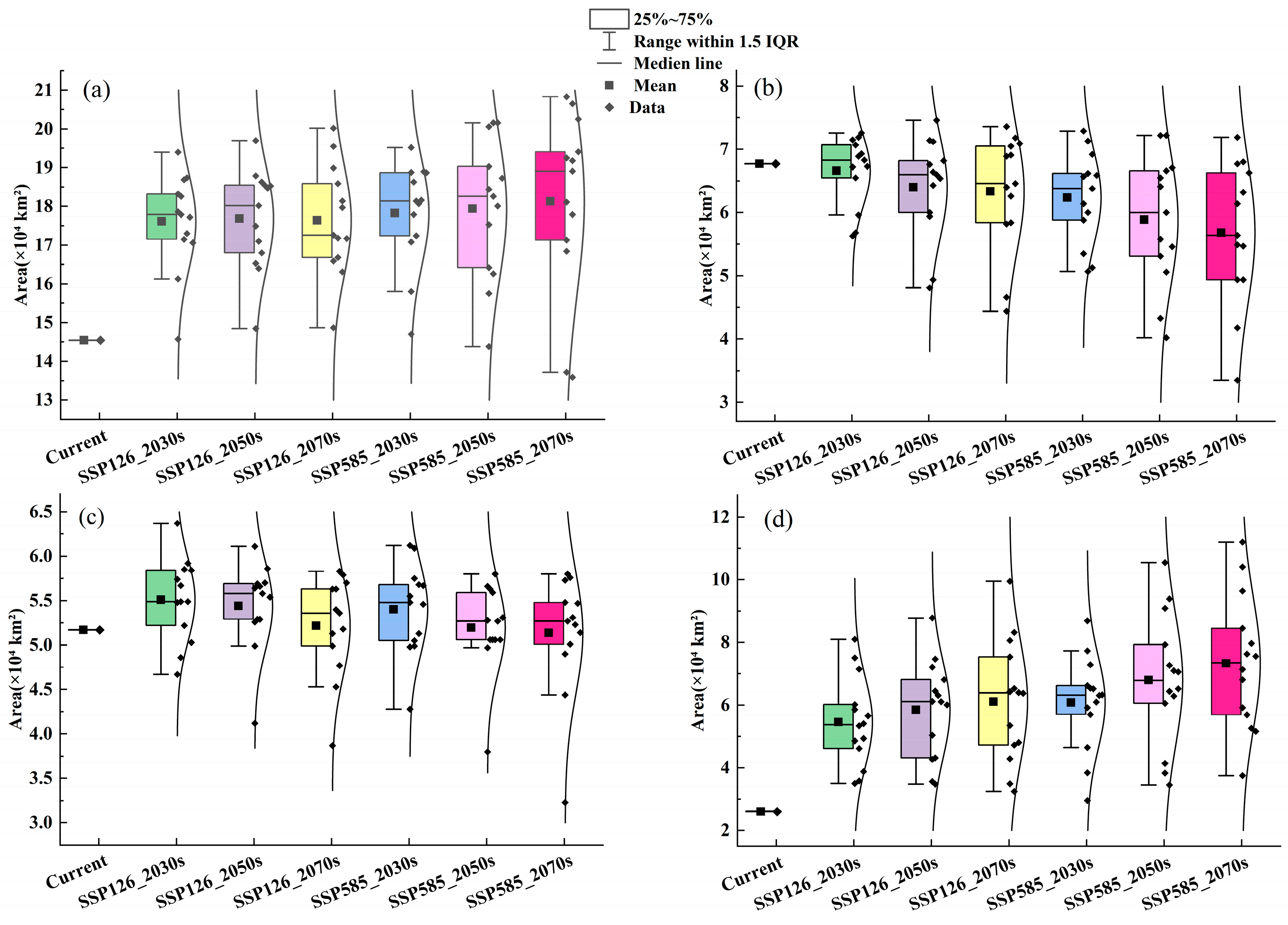
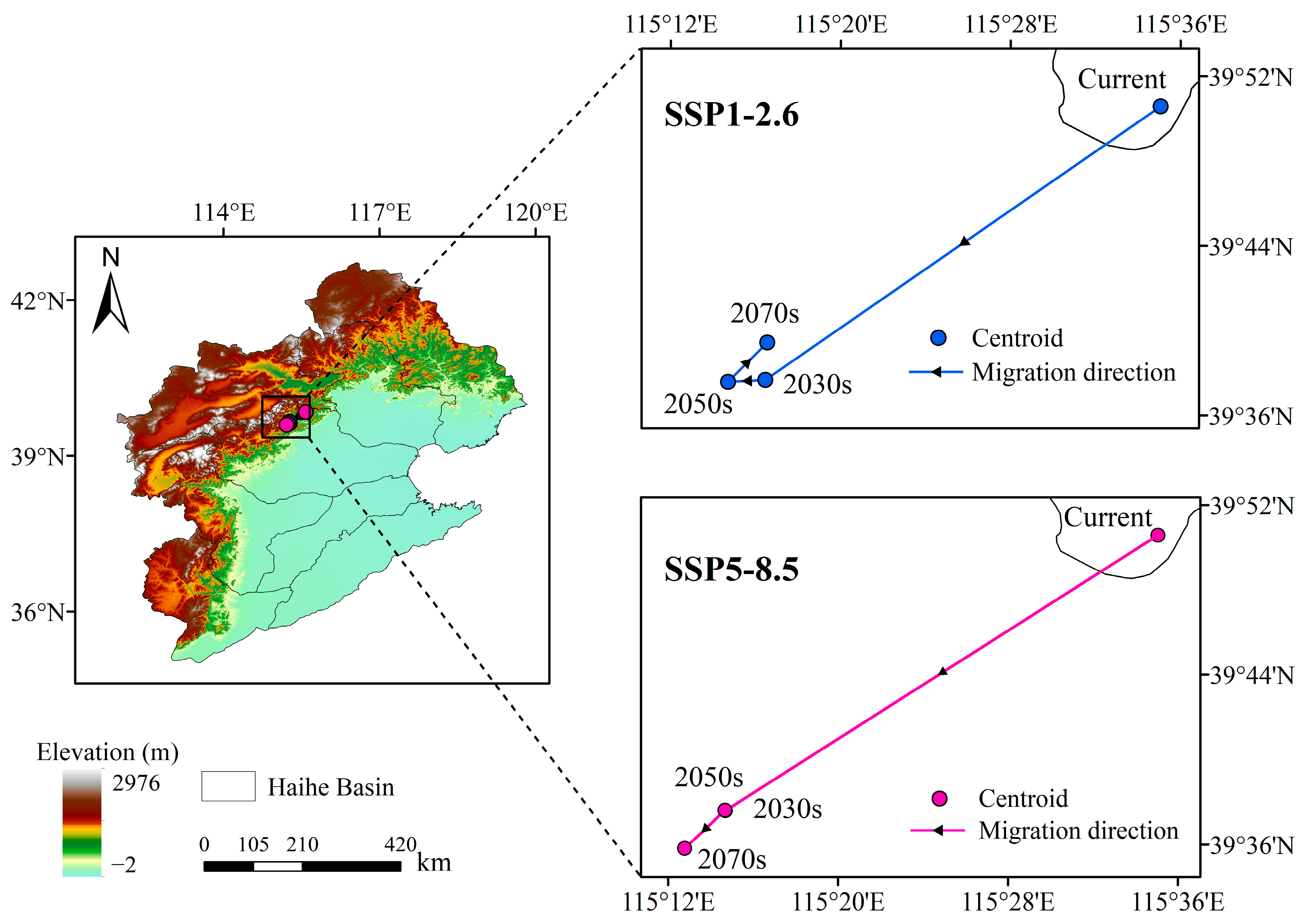
Ensemble_MaxEnt predictions suggest that suitable habitats for larch show expansion under future climate scenarios (Figure 6 and Figure 7). By the 2030s, the total suitable habitat area for larch under SSP1-2.6 and SSP5-8.5 reaches 17.61 ± 1.20 × 10⁴ km2 and 17.83 ± 1.30 × 10⁴ km2, respectively, representing increases of 21.11% and 22.63% relative to the current period. Subsequently, the rate of expansion slows by the 2050s, with the total suitable areas reaching 17.68 ± 1.26 × 10⁴ km2 (SSP1-2.6) and 17.94 ± 1.74 × 10⁴ km2 (SSP5-8.5). By the 2070s, these areas remain almost unchanged at 17.64 ± 1.37 × 10⁴ km2 and 18.13 ± 2.25 × 10⁴ km2, respectively. The potential distribution shifts southwestward under future scenarios (Figure 8). This trend is particularly pronounced in the 2030s, where the distribution centroid migrates more than 35 km toward the southwest under both climate scenarios.
The overall expansion of larch distribution is mainly due to the pronounced increase in highly suitable areas, with growth rates ranging from 109.23% (SSP1-2.6_2030s) to 181.15% (SSP5-8.5_2070s) (Figure 7d). Moderately suitable areas generally remain stable, fluctuating between 5.14 and 5.51 × 10⁴ km2 (Figure 7c), while the low-suitability areas decline by 1.62% to 16.10% across both climate scenarios (Figure 7b). Stratification of suitability areas by altitude reveals distinct spatial differentiation. Specifically, the probability of larch occurrence rises with elevation. Currently, the mean elevations for the low-, moderate-, and high-suitability areas are 937 m, 942 m, and 1190 m. This differentiated spatial distribution also holds under future climate scenarios.

3.4. Uncertainty Analysis

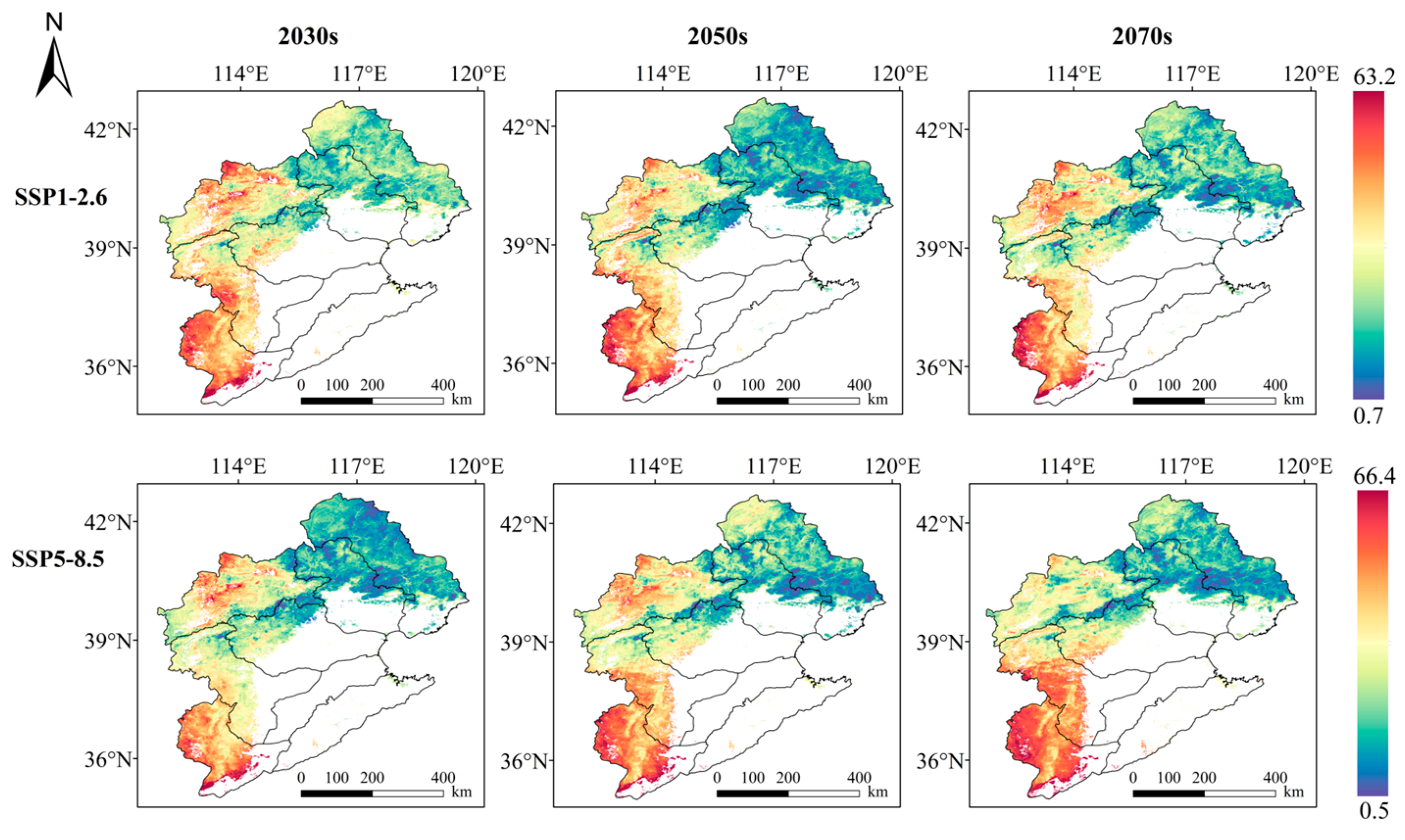
The potential distribution of larch estimated by our Ensemble_MaxEnt exhibits moderate uncertainty overall, with the spatial mean CV values ranging from 18.5% ± 8.3% (SSP1-2.6_2030s) to 25.6% ± 12.9% (SSP5-8.5_2070s) under various climate scenarios. However, this uncertainty displays a distinct spatial pattern (Figure 9). The northern and northeastern areas generally show lower uncertainty, whilst the western areas, such as the western Taihang Mountains and the Yanshan Mountains, display moderate uncertainty, and the southwestern areas show the highest uncertainty.
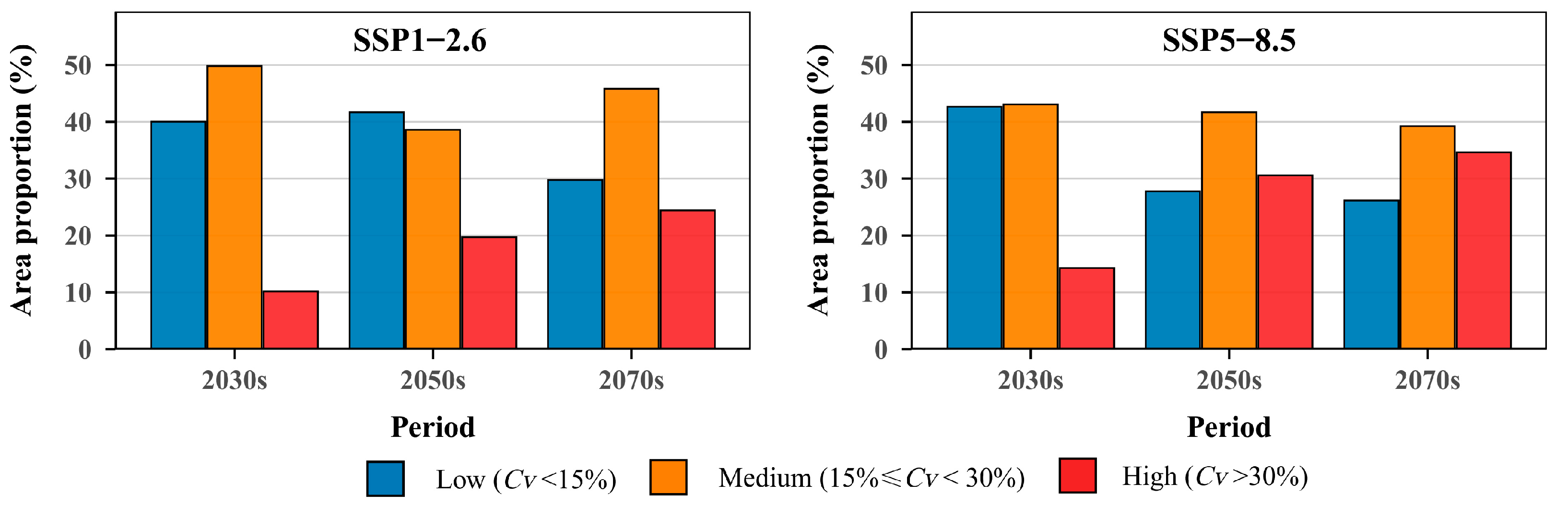
Prediction uncertainty varies over time under both climate scenarios (Figure 10). Low-uncertainty areas decrease over time, while high-uncertainty areas increase. This trend is more evident under the high-emission scenario (SSP5-8.5), where high-uncertainty areas increase by 21%, while low-uncertainty areas decrease by 18% when comparing the 2030s with the 2070s. The temporal increase in uncertainty results mainly from the increased divergence of climate projections among GCMs, which in turn increases uncertainty in Ensemble_MaxEnt distribution predictions.
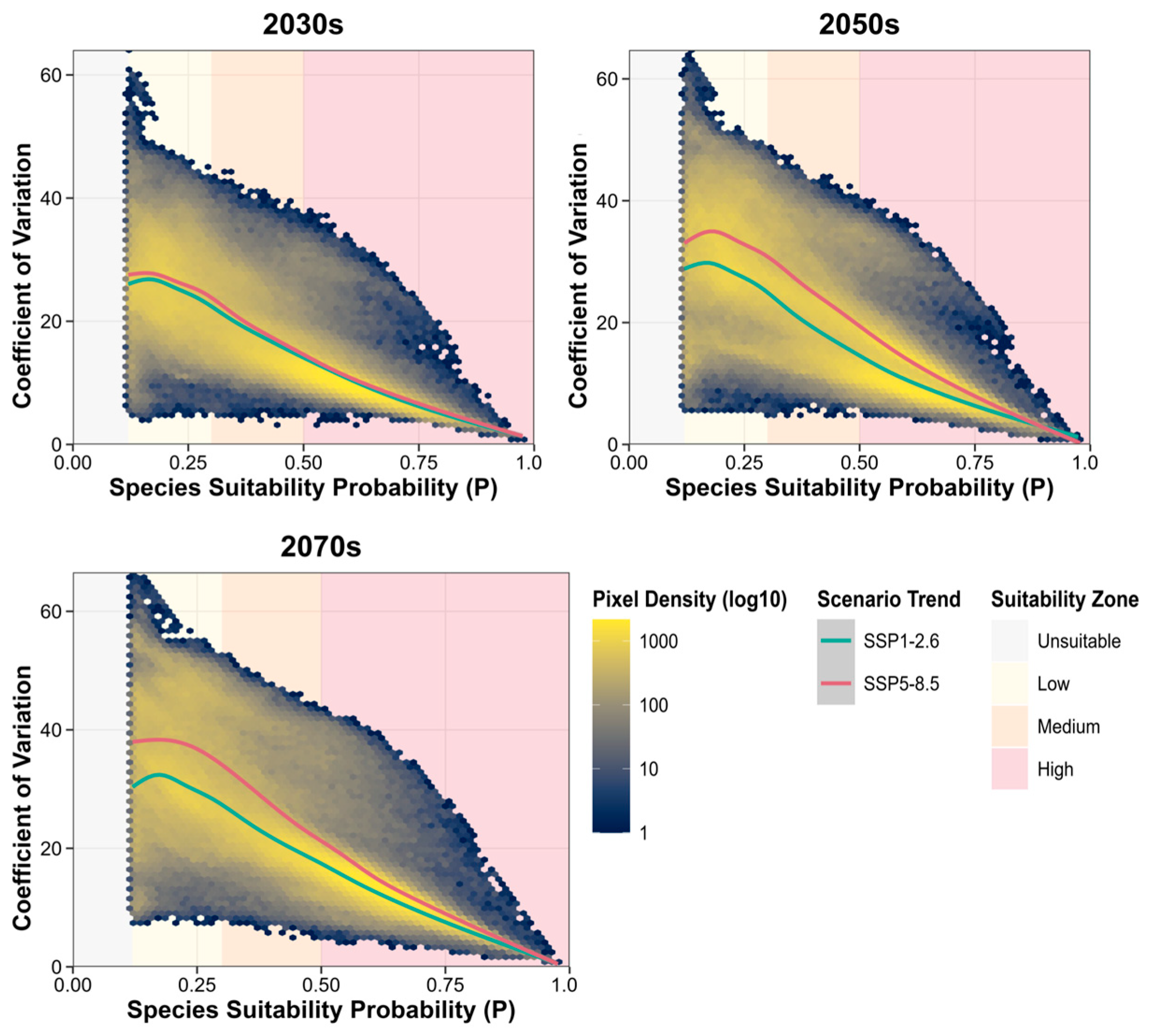
The relationship between model prediction uncertainty (CV) and estimated species suitability probability (P) reveals that the areas classified as low-suitability habitats display the greatest prediction uncertainty, while the remaining areas demonstrate lower uncertainty (Figure 11). Both climate scenarios and projection periods affect prediction uncertainty, as the fitted trend line between CV and P under the high-emission pathway (SSP5-8.5) lies above that under the low-emission pathway (SSP1-2.6) across all periods. The divergence between the trend lines for SSP1-2.6 and SSP5-8.5 increases over time.

4. Discussion

4.1. The Non-Climatic Controls on the Potential Distribution of Larch

The potential suitable habitats of larch are commonly influenced by multiple environmental variables. In our analysis, we find that topographic variables greatly affect the potential distribution of larch, with elevation contributing 36.0% and slope 20.6%, followed by shallow soil moisture (27.7%), while the climatic variable (i.e., the mean diurnal temperature range) contributes only 4.1%. Our results differ from previous studies, in which climatic variables usually play dominant roles in shaping species distributions. For example, in estimates of the global potential distribution of Nitraria L. [69], the cumulative contribution of climatic variables including UV-B radiation and precipitation, exceeds 80%, whereas elevation accounts for only approximately 7.4%. Similarly, rainfall during the warmest quarter accounts for 60% of the climatic influence on the global distribution of Phacellanthus tubiflorus [70]. Findings from Luo et al. also indicate that precipitation in the driest month contributes 43.7% to the variation in Polygonum capitatum distribution, far exceeding the 20.7% contribution of elevation [71]. We attribute these differences to the spatial scale of the investigation, which is widely considered critical for understanding dominant controls of various processes. Huang et al. suggest that ecological variables ranking, model explanatory power, and predictive accuracy depend strongly on the spatial scale [39]. Unlike climatic variables, which usually act as critical determinants of large-scale distribution patterns, local controls with spatial heterogeneity often become more prominent at regional scales.
In our study area, the Haihe Basin, extends from the Taihang Mountains and Mongolian Plateau to the North China Plain, with an elevation ranging from −2 to 2976 m. This complex topography provides diverse local microclimatic environments [9,72], playing a primary role in shaping species distributions through various processes such as solar radiation, water infiltration, and heat distribution [73,74]. The study area is also characterized by spatially and temporally variable precipitation patterns [75,76], which emphasizes the importance of soil water availability for vegetation growth and/or distribution in this region [77,78]. The shallow root system of the larch further increases the dependence of this species on soil moisture [79,80]. Specifically, approximately 64.1% of water uptake originates from shallow soil layers (0–40 cm), making the species highly sensitive to shallow soil moisture.

4.2. Uncertainty in Future Suitable Habitat Predictions

The sources of uncertainty in modeling analysis generally fall into three categories, including model inputs, model parameters, and model structure [81,82,83]. Input uncertainty in species distribution prediction mainly arises from climate projections (different GCMs and emission scenarios), which greatly affect predicted species spatial patterns [23]. Parameter uncertainty relates to decisions about model complexity (e.g., feature combination and regularization multipliers). Incorrect parameterization frequently results in model overfitting or underfitting, thereby affecting the stability of projections. Structural uncertainty mainly reflects differences among algorithms (e.g., MaxEnt, GLM, RF, BRT), as different algorithms characterize species–environment relationships in distinct ways [84].
In our analysis, we calibrate MaxEnt models by applying individual climate projections (i.e., 13 GCMs), and employ an ensemble approach with a simple averaging technique to address uncertainty among different model outputs. Previous studies have shown that ensemble results are generally more stable and accurate than those from individual models [85,86]. The bootstrap technique is also incorporated into our calibration process, which partially compensates for potential biases in model parameters. Additionally, the MESS analysis, which evaluates the resemblance of projected climatic conditions to the reference period, effectively identifies novel climate areas with S < 0, thereby addressing potential extrapolation risks [32,87]. All of these procedures complementarily enable us to understand various sources of uncertainty in species distribution predictions.
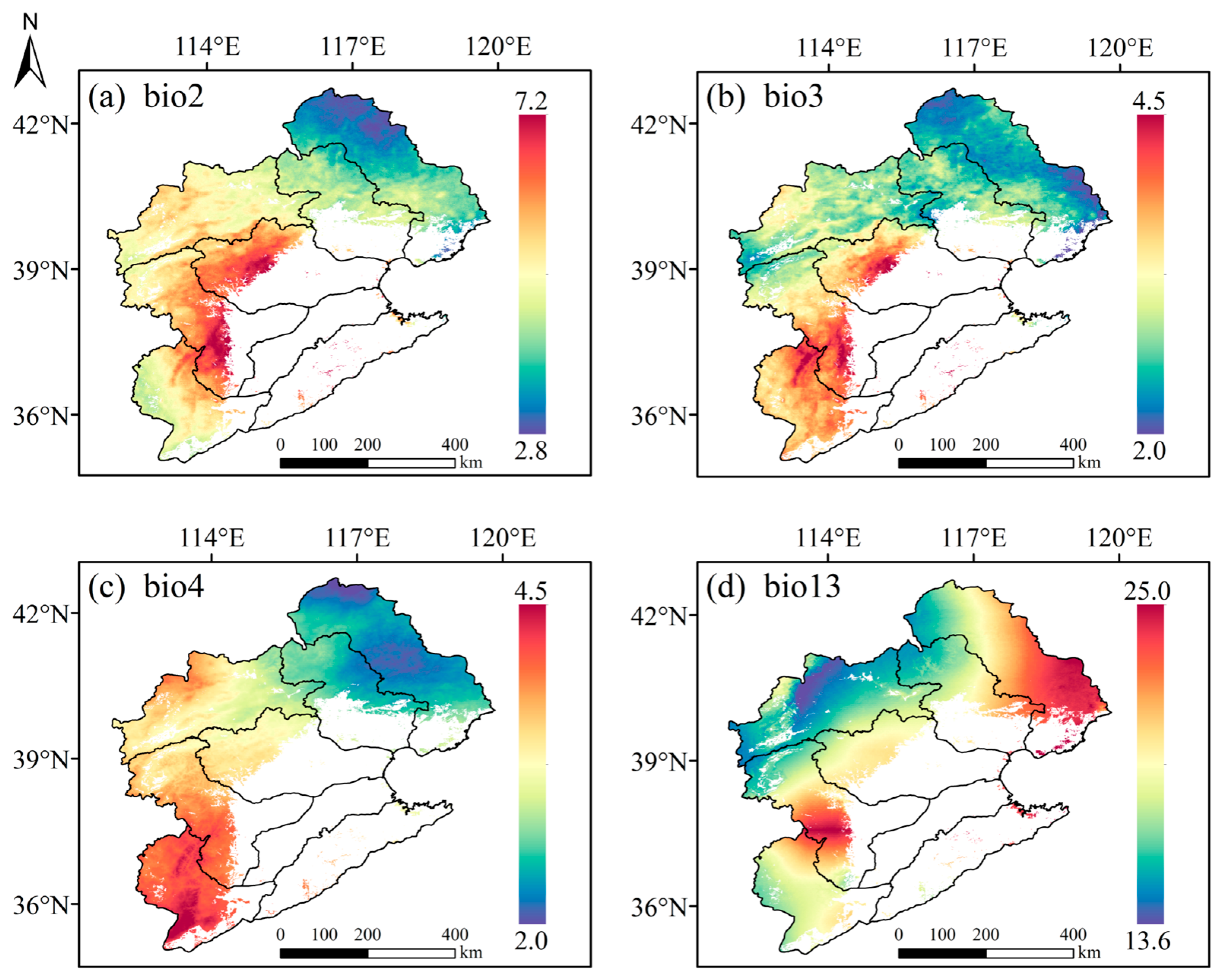
Our results indicate that low-suitability areas commonly exhibit higher uncertainty. We attribute this primarily to the combined effects of nonlinear response amplification and extrapolation risks. Although the Linear-Quadratic-Hinge (LQH) feature combination allows the model to capture strong nonlinear responses [88], hinge features often produce locally steep gradients on the response surface [89]. This characteristic makes model output more sensitive to minor input perturbations, thereby amplifying the dispersion of prediction results [56]. In terms of model input consistency, differences in key climatic variables among GCMs within the study area remain small, with CV values generally staying below 20% (see Figure 12). This suggests that elevated uncertainty in specific areas does not stem from broad-scale input divergence. However, high-uncertainty areas exhibit relatively higher local-scale variability and reduced consistency with training climates. This elevated environmental novelty increases the likelihood of extrapolation and exacerbates associated risks [90,91].

4.3. Basin-Scale Management Implications

This study demonstrates that afforestation planning for Larix principis-rupprechtii in mountainous areas should not rely solely on macro-climatic averages; rather, topographic gradients and soil moisture should be prioritized as primary constraints for zoning. Topography regulates solar radiation, cold air drainage, and hydrothermal redistribution, thereby creating microclimatic buffering that influences species distribution and migration under climate warming [9,92]. Therefore, management applications in the Haihe Basin, a transitional zone between mountains and plains, require a scale-dependent approach. At the macro scale, ecological planning focuses on the overall layout of ecological security patterns and engineering tasks, using suitability maps as strategic guidance. However, at the watershed or regional scale, planning needs to be refined into specific spatial units and engineering rules. Specifically, the upstream mountain-hill zones (e.g., Yanshan and Taihang Mountains), which serve as ecological barriers and water conservation areas [93], should prioritize the cultivation of coniferous species in topographically favorable areas to enhance survival rates and long-term stability. In contrast, the downstream plain areas, dominated by economic development and agriculture, should avoid applying suitability results derived from mountain-adapted species.
To ensure the implementation of these strategies, we recommend establishing a multi-scale assessment framework. At the watershed and zonal scales, remote sensing monitoring and ecological modeling should be used to quantitatively evaluate indicators such as vegetation coverage, net primary productivity (NPP), water conservation, and windbreak and sand fixation functions. This process identifies areas of ecological improvement and degradation risk, providing a basis for adaptive management. At the plot scale, monitoring should focus on soil moisture, sapling growth, and responses to extreme climate events to assess the actual suitability of afforestation measures and optimize silvicultural schemes [94].

4.4. Limitations and Future Work

Although this study improves prediction reliability through ENMeval optimization, multi-GCM ensemble projections, and MESS analysis, several limitations remain. This study utilizes presence-only occurrence records. Although spatial thinning mitigates the clustering of occurrence points, sampling bias remains inevitable due to uneven survey intensity and variations in geographic accessibility. Consequently, this may lead to a biased representation of environmental gradients across the study area, thereby influencing the assessment of variable importance and habitat suitability predictions [46]. Furthermore, MaxEnt does not explicitly account for biological processes such as dispersal limitation, population dynamics, or biotic interactions [95]. Additionally, non-climatic factors are assumed to be static in future projections, which increases uncertainty in suitability estimates [82,96]. Regarding the ensemble strategy, this study relies on an unweighted arithmetic mean of 13 GCMs, which neither accounts for historical simulation performance nor addresses structural similarity among models. Future research should incorporate skill-based weighting schemes and compare the results of unweighted and weighted ensembles to enhance robustness. Finally, while MESS identifies potential extrapolation regions, it does not pinpoint the specific variables driving environmental novelty. Future studies could integrate tools such as MOP or ExDet to diagnose the specific variables and their combinations driving extrapolation risks, thereby better supporting conservation and ecological restoration planning.

5. Conclusions

An ensemble_MaxEnt modeling approach is employed to project Larix principis-rupprechtii (larch) habitat suitability in the Haihe Basin under contrasting emission pathways (SSP1-2.6 and SSP5-8.5) and to evaluate associated prediction uncertainties. Ensemble_MaxEnt projections indicate a substantial increase in high-suitability areas and a decline in low-suitability areas, resulting in an overall expansion of suitable habitat relative to the baseline period (>20%). Spatially, expansion occurs mainly toward the western and southwestern mountains, accompanied by a southwestward shift in the distribution centroid. Uncertainty is highest in low-suitability areas and tends to increase with the prediction horizon and under the high-emission scenario. This trend is likely due to residual parameterization and the and extrapolation errors, as well as greater climatic dissimilarity from baseline conditions. At the basin scale examined here, non-climatic factors emerge as dominant controls on larch distribution, with elevation, slope, and shallow soil moisture contributing approximately 36.0%, 20.6%, and 27.7%, respectively, far exceeding the contribution of the primary bioclimatic variable (bio2, ~4.1%). Overall, while suitable habitat for larch is projected to increase in the Haihe Basin, substantial uncertainty remains in predictions for the low-suitability areas. We conclude that topographic controls should be prioritized when developing adaptive afforestation strategies at the regional basin scale. Meanwhile uncertainty associated with species habitat suitability induced by climate change should not be overlooked. Future research could incorporate skill-based weighting schemes based on historical simulation performance to improve the GCM ensemble.

Author Contributions

Conceptualization, D.C. and S.W.; Data curation, D.C. and W.L.; Formal analysis, D.C.; Funding acquisition, S.W. and Z.Z.; Investigation, D.C. and Y.L.; Methodology, D.C. and S.W.; Project administration, S.W. and Z.Z.; Resources, G.Z. and Z.Z.; Software, D.C. and W.L.; Supervision, S.W. and Z.Z.; Validation, K.W., G.Z. and S.Q.; Visualization, D.C. and Y.L.; Writing—original draft, D.C.; Writing—review and editing, S.W. All authors have read and agreed to the published version of the manuscript.

Funding

This research is funded by the National Key Research and Development Program of China, Grant No. 2022YFF1302501-02.

Data Availability Statement

Publicly available datasets were analyzed in this study. Detailed information regarding these datasets can be found in the Methods section (e.g., WorldClim v2.1). The model outputs generated during the study are available from the corresponding author upon reasonable request.

Acknowledgments

We thank all those who contributed to this research. We are also grateful to the handling editors and anonymous reviewers for their constructive comments and insightful suggestions, which greatly improved the quality of this manuscript.

Conflicts of Interest

Author Guoping Zhu was employed by the company Beijing Linmiao Ecological Environment Technology Co., Ltd. The remaining authors declare that the research was conducted in the absence of any commercial or financial relationships that could be construed as a potential conflict of interest.

Appendix A

Table A1. Summary of environmental predictors used in this study.
TypeCodeDescriptionUnit
Bioclimatic variablesbio1Annual mean temperature°C
bio2Mean diurnal range (mean of monthly (max temp–min temp))°C
bio3Isothermality (bio2/bio7) (×100)%
bio4Temperature seasonality (standard deviation ×100)
bio5Max temperature of warmest month°C
bio6Min temperature of coldest month°C
bio7Temperature annual range (bio5–bio6)°C
bio8Mean temperature of wettest quarter°C
bio9Mean temperature of driest quarter°C
bio10Mean temperature of warmest quarter°C
bio11Mean temperature of coldest quarter°C
bio12Annual precipitationmm
bio13Precipitation of wettest monthmm
bio14Precipitation of driest monthmm
bio15Precipitation seasonality (coefficient of variation)
bio16Precipitation of wettest quartermm
bio17Precipitation of driest quartermm
bio18Precipitation of warmest quartermm
bio19Precipitation of coldest quartermm
TopographicelevElevationm
slopeSlope°
aspectAspect
Soilsmc20soil moisture at 20 cm depthm3/m3
smc60soil moisture at 60 cm depthm3/m3
smc100soil moisture at 100 cm depthm3/m3
t_clayTopsoil clay fraction (0–30 cm)% wt.
t_gravelTopsoil gravel content (0–30 cm)% vol.
t_sandTopsoil sand fraction (0–30 cm)% wt.
t_siltTopsoil silt fraction (0–30 cm)% wt.
s_bsSubsoil base saturation (30–100 cm)%
s_claySubsoil clay fraction (30–100 cm)% wt.
s_gravelSubsoil gravel content (30–100 cm)% vol.

References

  1. Gottfried, M.; Pauli, H.; Futschik, A.; Akhalkatsi, M.; Barančok, P.; Benito Alonso, J.L.; Coldea, G.; Dick, J.; Erschbamer, B.; Fernández Calzado, M.R.; et al. Continent-wide response of mountain vegetation to climate change. Nat. Clim. Change 2012, 2, 111–115. [Google Scholar] [CrossRef]
  2. Rubenstein, M.A.; Weiskopf, S.R.; Bertrand, R.; Carter, S.L.; Comte, L.; Eaton, M.J.; Johnson, C.G.; Lenoir, J.; Lynch, A.J.; Miller, B.W.; et al. Climate change and the global redistribution of biodiversity: Substantial variation in empirical support for expected range shifts. Environ. Evid. 2023, 12, 7. [Google Scholar] [CrossRef]
  3. Bilgili, M.; Tumse, S.; Nar, S. Comprehensive Overview on the Present State and Evolution of Global Warming, Climate Change, Greenhouse Gasses and Renewable Energy. Arab. J. Sci. Eng. 2024, 49, 14503–14531. [Google Scholar] [CrossRef]
  4. Allan, R.P.; Soden, B.J. Atmospheric Warming and the Amplification of Precipitation Extremes. Science 2008, 321, 1481–1484. [Google Scholar] [CrossRef] [PubMed]
  5. Almazroui, M.; Islam, M.N.; Saeed, F.; Saeed, S.; Ismail, M.; Ehsan, M.A.; Diallo, I.; O’Brien, E.; Ashfaq, M.; Martínez-Castro, D.; et al. Projected Changes in Temperature and Precipitation Over the United States, Central America, and the Caribbean in CMIP6 GCMs. Earth Syst. Environ. 2021, 5, 1–24. [Google Scholar] [CrossRef]
  6. Xu, T.; Yu, L. Nature’s wake-up call: Forest adaptation cannot keep pace with climate change. J. For. Res. 2025, 36, 55. [Google Scholar] [CrossRef]
  7. Mod, H.K.; Scherrer, D.; Di Cola, V.; Broennimann, O.; Blandenier, Q.; Breiner, F.T.; Buri, A.; Goudet, J.; Guex, N.; Lara, E.; et al. Greater topoclimatic control of above- versus below-ground communities. Glob. Change Biol. 2020, 26, 6715–6728. [Google Scholar] [CrossRef] [PubMed]
  8. O’Brien, M.J.; Escudero, A. Topography in tropical forests enhances growth and survival differences within and among species via water availability and biotic interactions. Funct. Ecol. 2022, 36, 686–698. [Google Scholar] [CrossRef]
  9. DOBROWSKI, S.Z. A climatic basis for microrefugia: The influence of terrain on climate. Glob. Change Biol. 2011, 17, 1022–1035. [Google Scholar] [CrossRef]
  10. Zellweger, F.; De Frenne, P.; Lenoir, J.; Vangansbeke, P.; Verheyen, K.; Bernhardt-Römermann, M.; Baeten, L.; Hédl, R.; Berki, I.; Brunet, J.; et al. Forest microclimate dynamics drive plant responses to warming. Science 2020, 368, 772–775. [Google Scholar] [CrossRef]
  11. Guisan, A.; Tingley, R.; Baumgartner, J.B.; Naujokaitis-Lewis, I.; Sutcliffe, P.R.; Tulloch, A.I.T.; Regan, T.J.; Brotons, L.; McDonald-Madden, E.; Mantyka-Pringle, C.; et al. Predicting species distributions for conservation decisions. Ecol. Lett. 2013, 16, 1424–1435. [Google Scholar] [CrossRef] [PubMed]
  12. Zhang, L.; Huettmann, F.; Liu, S.; Sun, P.; Yu, Z.; Zhang, X.; Mi, C. Classification and regression with random forests as a standard method for presence-only data SDMs: A future conservation example using China tree species. Ecol. Inform. 2019, 52, 46–56. [Google Scholar] [CrossRef]
  13. Rongcheng, R.; Yi, H.; Jialing, M.; Ying, Y.; Fanning, L.; Xiya, W.; Xinyuan, S.; Caigang, L.; Yingen, D.; Qinghai, H.; et al. The species distribution model based on the random forest algorithm reveals the distribution patterns of Neophocaena asiaeorientalis. Sci. Rep. 2025, 15, 10037. [Google Scholar] [CrossRef] [PubMed]
  14. Xie, C.; Chen, L.; Li, M.; Jim, C.Y.; Liu, D. BIOCLIM Modeling for Predicting Suitable Habitat for Endangered Tree Tapiscia sinensis (Tapisciaceae) in China. Forests 2023, 14, 2275. [Google Scholar] [CrossRef]
  15. Qin, A.; Liu, B.; Guo, Q.; Bussmann, R.W.; Ma, F.; Jian, Z.; Xu, G.; Pei, S. Maxent modeling for predicting impacts of climate change on the potential distribution of Thuja sutchuenensis Franch., an extremely endangered conifer from southwestern China. Glob. Ecol. Conserv. 2017, 10, 139–146. [Google Scholar] [CrossRef]
  16. Elith, J.H.; Graham, C.P.H.; Anderson, R.P.; Dudík, M.; Ferrier, S.; Guisan, A.; Hijmans, R.J.; Huettmann, F.; Leathwick, J.R.; Lehmann, A.; et al. Novel methods improve prediction of species’ distributions from occurrence data. Ecography 2006, 29, 129–151. [Google Scholar] [CrossRef]
  17. Zhang, F.-G.; Zhang, S.; Wu, K.; Zhao, R.; Zhao, G.; Wang, Y. Potential habitat areas and priority protected areas of Tilia amurensis Rupr in China under the context of climate change. Front. Plant Sci. 2024, 15, 1365264. [Google Scholar] [CrossRef]
  18. Guo, H.; Lei, X.; You, L.; Zeng, W.; Lang, P.; Lei, Y. Climate-sensitive diameter distribution models of larch plantations in north and northeast China. For. Ecol. Manag. 2022, 506, 119947. [Google Scholar] [CrossRef]
  19. Gao, M.; Zhao, G.; Zhang, S.; Wang, Z.; Wen, X.; Liu, L.; Zhang, C.; Tie, N.; Sa, R. Priority conservation area of Larix gmelinii under climate change: Application of an ensemble modeling. Front. Plant Sci. 2023, 14, 1177307. [Google Scholar] [CrossRef]
  20. Cheng, R.; Wang, X.; Zhang, J.; Zhao, J.; Ge, Z.; Zhang, Z. Predicting the Potential Suitable Distribution of Larix principis-rupprechtii Mayr under Climate Change Scenarios. Forests 2022, 13, 1428. [Google Scholar] [CrossRef]
  21. An, X.; Huang, T.; Zhang, H.; Yue, J.; Zhao, B. Prediction of Potential Distribution Patterns of Three Larix Species on Qinghai-Tibet Plateau Under Future Climate Scenarios. Forests 2023, 14, 1058. [Google Scholar] [CrossRef]
  22. Mamet, S.D.; Brown, C.D.; Trant, A.J.; Laroque, C.P. Shifting global Larix distributions: Northern expansion and southern retraction as species respond to changing climate. J. Biogeogr. 2019, 46, 30–44. [Google Scholar] [CrossRef]
  23. Goberville, E.; Beaugrand, G.; Hautekèete, N.-C.; Piquot, Y.; Luczak, C. Uncertainties in the projection of species distributions related to general circulation models. Ecol. Evol. 2015, 5, 1100–1116. [Google Scholar] [CrossRef]
  24. Thuiller, W.; Guéguen, M.; Renaud, J.; Karger, D.N.; Zimmermann, N.E. Uncertainty in ensembles of global biodiversity scenarios. Nat. Commun. 2019, 10, 1446. [Google Scholar] [CrossRef]
  25. Porfirio, L.L.; Harris, R.M.B.; Lefroy, E.C.; Hugh, S.; Gould, S.F.; Lee, G.; Bindoff, N.L.; Mackey, B. Improving the Use of Species Distribution Models in Conservation Planning and Management under Climate Change. PLoS ONE 2014, 9, e113749. [Google Scholar] [CrossRef]
  26. Song, Y.; Xu, X.; Zhang, S.; Chi, X. Uncertainty Assessment of Species Distribution Prediction Using Multiple Global Climate Models on the Tibetan Plateau: A Case Study of Gentiana yunnanensis and Gentiana siphonantha. Land 2024, 13, 1376. [Google Scholar] [CrossRef]
  27. Beaumont, L.J.; Hughes, L.; Pitman, A.J. Why is the choice of future climate scenarios for species distribution modelling important? Ecol. Lett. 2008, 11, 1135–1146. [Google Scholar] [CrossRef]
  28. Li, J.; Chang, H.; Liu, T.; Zhang, C. The potential geographical distribution of Haloxylon across Central Asia under climate change in the 21st century. Agric. For. Meteorol. 2019, 275, 243–254. [Google Scholar] [CrossRef]
  29. Dyderski, M.K.; Paź-Dyderska, S.; Jagodziński, A.M.; Puchałka, R. Shifts in native tree species distributions in Europe under climate change. J. Environ. Manag. 2025, 373, 123504. [Google Scholar] [CrossRef]
  30. Williams, J.W.; Jackson, S.T. Novel climates, no-analog communities, and ecological surprises. Front. Ecol. Environ. 2007, 5, 475–482. [Google Scholar] [CrossRef]
  31. Fitzpatrick, M.C.; Hargrove, W.W. The projection of species distribution models and the problem of non-analog climate. Biodivers. Conserv. 2009, 18, 2255–2261. [Google Scholar] [CrossRef]
  32. Elith, J.; Kearney, M.; Phillips, S. The art of modelling range-shifting species. Methods Ecol. Evol. 2010, 1, 330–342. [Google Scholar] [CrossRef]
  33. Owens, H.L.; Campbell, L.P.; Dornak, L.L.; Saupe, E.E.; Barve, N.; Soberón, J.; Ingenloff, K.; Lira-Noriega, A.; Hensz, C.M.; Myers, C.E.; et al. Constraints on interpretation of ecological niche models by limited environmental ranges on calibration areas. Ecol. Model. 2013, 263, 10–18. [Google Scholar] [CrossRef]
  34. Mesgaran, M.B.; Cousens, R.D.; Webber, B.L. Here be dragons: A tool for quantifying novelty due to covariate range and correlation change when projecting species distribution models. Divers. Distrib. 2014, 20, 1147–1159. [Google Scholar] [CrossRef]
  35. Hawkins, B.A.; Field, R.; Cornell, H.V.; Currie, D.J.; Guégan, J.-F.; Kaufman, D.M.; Kerr, J.T.; Mittelbach, G.G.; Oberdorff, T.; O’Brien, E.M.; et al. Energy, water, and broad-scale geographic patterns of species richness. Ecology 2003, 84, 3105–3117. [Google Scholar] [CrossRef]
  36. Gutiérrez-Hernández, O.; García, L.V. Chapter 11—Relationship between precipitation and species distribution. In Precipitation; Rodrigo-Comino, J., Ed.; Elsevier: Amsterdam, The Netherlands, 2021; pp. 239–259. [Google Scholar]
  37. Fournier, A.; Barbet-Massin, M.; Rome, Q.; Courchamp, F. Predicting species distribution combining multi-scale drivers. Glob. Ecol. Conserv. 2017, 12, 215–226. [Google Scholar] [CrossRef]
  38. Huang, E.; Chen, Y.; Fang, M.; Zheng, Y.; Yu, S. Environmental drivers of plant distributions at global and regional scales. Glob. Ecol. Biogeogr. 2021, 30, 697–709. [Google Scholar] [CrossRef]
  39. Huang, E.; Chen, Y.; Yu, S. Climate factors drive plant distributions at higher taxonomic scales and larger spatial scales. Front. Ecol. Evol. 2024, 11, 1233936. [Google Scholar] [CrossRef]
  40. Pearson, R.G.; Dawson, T.P. Predicting the impacts of climate change on the distribution of species: Are bioclimate envelope models useful? Glob. Ecol. Biogeogr. 2003, 12, 361–371. [Google Scholar] [CrossRef]
  41. Walthert, L.; Meier, E.S. Tree species distribution in temperate forests is more influenced by soil than by climate. Ecol. Evol. 2017, 7, 9473–9484. [Google Scholar] [CrossRef] [PubMed]
  42. Cheng, S.; Xie, J.; Ma, N.; Liang, S.; Guo, J.; Fu, N. Variations in Summer Precipitation According to Different Grades and Their Effects on Summer Drought/Flooding in Haihe River Basin. Atmosphere 2022, 13, 1246. [Google Scholar] [CrossRef]
  43. Bao, Z.; Zhang, J.-y.; Liu, J.; Wang, G.; Yan, X.; Wang, X.; Zhang, L. Sensitivity of hydrological variables to climate change in the Haihe River basin, China. Hydrol. Process. 2012, 26, 2294–2306. [Google Scholar] [CrossRef]
  44. Yan, T.; Bai, Z.S.A.J. Spatial and Temporal Changes in Temperature, Precipitation, and Streamflow in the Miyun Reservoir Basin of China. Water 2017, 9, 78. [Google Scholar] [CrossRef]
  45. Rong, Y.; Zheng, L.; Zhao, Y. Balancing ecosystem services supply-flow-demand for watershed ecological security: A case study of the Hai River Basin, China. Front. Ecol. Evol. 2025, 13, 1587167. [Google Scholar] [CrossRef]
  46. Kramer-Schadt, S.; Niedballa, J.; Pilgrim, J.D.; Schröder, B.; Lindenborn, J.; Reinfelder, V.; Stillfried, M.; Heckmann, I.; Scharf, A.K.; Augeri, D.M.; et al. The importance of correcting for sampling bias in MaxEnt species distribution models. Divers. Distrib. 2013, 19, 1366–1379. [Google Scholar] [CrossRef]
  47. Boria, R.A.; Olson, L.E.; Goodman, S.M.; Anderson, R.P. Spatial filtering to reduce sampling bias can improve the performance of ecological niche models. Ecol. Model. 2014, 275, 73–77. [Google Scholar] [CrossRef]
  48. Warren, D.L.; Glor, R.E.; Turelli, M. ENMTools: A toolbox for comparative studies of environmental niche models. Ecography 2010, 33, 607–611. [Google Scholar] [CrossRef]
  49. Tang, W.; Liu, S.; Kang, P.; Peng, X.; Li, Y.; Guo, R.; Jia, J.; Liu, M.; Zhu, L. Quantifying the lagged effects of climate factors on vegetation growth in 32 major cities of China. Ecol. Indic. 2021, 132, 108290. [Google Scholar] [CrossRef]
  50. Yang, Q.; Zhang, H.; Wang, L.; Ling, F.; Wang, Z.; Li, T.; Huang, J. Topography and soil content contribute to plant community composition and structure in subtropical evergreen-deciduous broadleaved mixed forests. Plant Divers. 2021, 43, 264–274. [Google Scholar] [CrossRef]
  51. Fick, S.E.; Hijmans, R.J. WorldClim 2: New 1-km spatial resolution climate surfaces for global land areas. Int. J. Climatol. 2017, 37, 4302–4315. [Google Scholar] [CrossRef]
  52. Merkenschlager, C.; Bangelesa, F.; Paeth, H.; Hertig, E. Blessing and curse of bioclimatic variables: A comparison of different calculation schemes and datasets for species distribution modeling within the extended Mediterranean area. Ecol. Evol. 2023, 13, e10553. [Google Scholar] [CrossRef]
  53. Graham, M.H. Confronting multicollinearity in ecological multiple regression. Ecology 2003, 84, 2809–2815. [Google Scholar] [CrossRef]
  54. Shcheglovitova, M.; Anderson, R.P. Estimating optimal complexity for ecological niche models: A jackknife approach for species with small sample sizes. Ecol. Model. 2013, 269, 9–17. [Google Scholar] [CrossRef]
  55. Radosavljević, A.; Anderson, R.P. Making better Maxent models of species distributions: Complexity, overfitting and evaluation. J. Biogeogr. 2014, 41, 629–643. [Google Scholar] [CrossRef]
  56. Merow, C.; Smith, M.; Silander, J. A practical guide to MaxEnt for modeling species’ distributions: What it does, and why inputs and settings matter. Ecography 2013, 36, 1058–1069. [Google Scholar] [CrossRef]
  57. Morales, N.S.; Fernández, I.C.; Baca-González, V. MaxEnt’s parameter configuration and small samples: Are we paying attention to recommendations? A systematic review. PeerJ 2017, 5, e3093. [Google Scholar] [CrossRef]
  58. Shi, J.; Xia, M.; He, G.; Gonzalez, N.C.T.; Zhou, S.; Lan, K.; Ouyang, L.; Shen, X.; Jiang, X.; Cao, F.; et al. Predicting Quercus gilva distribution dynamics and its response to climate change induced by GHGs emission through MaxEnt modeling. J. Environ. Manag. 2024, 357, 120841. [Google Scholar] [CrossRef]
  59. Shi, X.; Yin, Q.; Sang, Z.; Zhu, Z.; Jia, Z.; Ma, L. Prediction of potentially suitable areas for the introduction of Magnolia wufengensis under climate change. Ecol. Indic. 2021, 127, 107762. [Google Scholar] [CrossRef]
  60. Li, Y.; Zhong, T.; Ning, Y.; Chen, Y.; Yang, T.; Yue, H.; Yang, Y.; Zhao, H.; Wu, H.; Jin, Z.; et al. Global climate change and Macadamia habitat suitability: MaxEnt-based prediction under future scenarios. Front. Plant Sci. 2025, 16, 1658566. [Google Scholar] [CrossRef] [PubMed]
  61. Phillips, S.; Dudík, M. Modeling of species distributions with MAXENT: New extensions and a comprehensive evaluation. Ecography 2008, 31, 161–175. [Google Scholar] [CrossRef]
  62. Wei, B.; Wang, R.; Hou, K.; Wang, X.; Wu, W. Predicting the current and future cultivation regions of Carthamus tinctorius L. using MaxEnt model under climate change in China. Glob. Ecol. Conserv. 2018, 16, e00477. [Google Scholar] [CrossRef]
  63. Ren, J.; Li, S.; Zhang, Y.; Yang, Q.; Liu, J.; Fan, J.; Xiang, Y. MaxEnt-based evaluation of climate change effects on the habitat suitability of Magnolia officinalis in China. Front. Plant Sci. 2025, 16, 1601585. [Google Scholar] [CrossRef]
  64. Riahi, K.; van Vuuren, D.P.; Kriegler, E.; Edmonds, J.; O’Neill, B.C.; Fujimori, S.; Bauer, N.; Calvin, K.; Dellink, R.; Fricko, O.; et al. The Shared Socioeconomic Pathways and their energy, land use, and greenhouse gas emissions implications: An overview. Glob. Environ. Change 2017, 42, 153–168. [Google Scholar] [CrossRef]
  65. Stanton, J.C.; Pearson, R.G.; Horning, N.; Ersts, P.J.; Reşit Akçakaya, H. Combining static and dynamic variables in species distribution models under climate change. Methods Ecol. Evol. 2012, 3, 349–357. [Google Scholar] [CrossRef]
  66. Cobos, M.E.; Owens, H.L.; Soberón, J.; Peterson, A.T.; Franklin, J. Detailed multivariate comparisons of environments with mobility oriented parity. Front. Biogeogr. 2024, 17, e132916. [Google Scholar] [CrossRef]
  67. Bao, X.; Zhou, P.; Zhang, M.; Fang, Y.; Zhang, Q. MaxEnt-Based Habitat Suitability Assessment for Vaccinium mandarinorum: Exploring Industrial Cultivation Opportunities. Forests 2024, 15, 2254. [Google Scholar] [CrossRef]
  68. Sansom, P.G.; Stephenson, D.B.; Ferro, C.A.T.; Zappa, G.; Shaffrey, L. Simple Uncertainty Frameworks for Selecting Weighting Schemes and Interpreting Multimodel Ensemble Climate Change Experiments. J. Clim. 2013, 26, 4017–4037. [Google Scholar] [CrossRef]
  69. Lu, K.; Liu, M.; Feng, Q.; Liu, W.; Zhu, M.; Duan, Y. Predicting the Global Distribution of Nitraria L. Under Climate Change Based on Optimized MaxEnt Modeling. Plants 2025, 14, 67. [Google Scholar] [CrossRef] [PubMed]
  70. Chang, C.; Cai, F.; Shen, L.; Jia, X.; Liu, Z.; Wang, C.; Fu, Y.; Luo, Y. Predicting the potential distribution of Phacellanthus tubiflorus (Orobanchaceae): A modeling approach using MaxEnt and ArcGIS. PeerJ 2025, 13, e19291. [Google Scholar] [CrossRef]
  71. Luo, J.; Ma, Y.; Liu, Y.; Zhu, D.; Guo, X. Predicting Polygonum capitatum distribution in China across climate scenarios using MaxEnt modeling. Sci. Rep. 2024, 14, 20020. [Google Scholar] [CrossRef]
  72. McNichol, B.H.; Wang, R.; Hefner, A.; Helzer, C.; McMahon, S.M.; Russo, S.E. Topography-driven microclimate gradients shape forest structure, diversity, and composition in a temperate refugial forest. Plant-Environ. Interact. 2024, 5, e10153. [Google Scholar] [CrossRef] [PubMed]
  73. Aguilar, C.; Herrero, J.; Polo, M.J. Topographic effects on solar radiation distribution in mountainous watersheds and their influence on reference evapotranspiration estimates at watershed scale. Hydrol. Earth Syst. Sci. 2010, 14, 2479–2494. [Google Scholar] [CrossRef]
  74. Zhang, Y.L.; Li, X.; Cheng, G.D.; Jin, H.J.; Yang, D.W.; Flerchinger, G.N.; Chang, X.L.; Wang, X.; Liang, J. Influences of Topographic Shadows on the Thermal and Hydrological Processes in a Cold Region Mountainous Watershed in Northwest China. J. Adv. Model. Earth Syst. 2018, 10, 1439–1457. [Google Scholar] [CrossRef]
  75. Guo, J.; Ren, G.; Xiong, M.; Huang, H. The Spatiotemporal Pattern of Rainy-Season Precipitation in the Haihe River Basin, North China. Hydrology 2019, 6, 73. [Google Scholar] [CrossRef]
  76. Han, Y.; Liu, B.; Xu, D.; Yuan, C.; Xu, Y.; Sha, J.; Li, S.; Chang, Y.; Sun, B.; Xu, Z. Temporal and Spatial Variation Characteristics of Precipitation in the Haihe River Basin under the Influence of Climate Change. Water 2021, 13, 1664. [Google Scholar] [CrossRef]
  77. Du, R.; Wu, J.; Tian, F.; Yang, J.; Han, X.; Chen, M.; Zhao, B.; Lin, J. Reversal of soil moisture constraint on vegetation growth in North China. Sci. Total Environ. 2023, 865, 161246. [Google Scholar] [CrossRef] [PubMed]
  78. Yang, Z.; Zou, W.; Liu, H.; Sharma, R.P.; Zhang, M.; Hu, Z. The Effect of Soil and Topography Factors on Larix gmelinii var. Principis-rupprechtii Forest Mortality and Capability of Decision Tree Binning Method and Generalized Linear Models in Predicting Tree Mortality. Forests 2024, 15, 2060. [Google Scholar] [CrossRef]
  79. Li, B.; Wu, X.; Dong, X.; Man, H.; Liu, C.; Zou, S.; He, J.; Zang, S. Soil water uptake from different depths of three tree species indicated by hydrogen and oxygen stable isotopes in the permafrost region of Northeast China. Front. Plant Sci. 2024, 15, 1444811. [Google Scholar] [CrossRef]
  80. Sun, T.; Dong, L.; Zhang, L.; Wu, Z.; Wang, Q.; Li, Y.; Zhang, H.; Wang, Z. Early Stage Fine-Root Decomposition and Its Relationship with Root Order and Soil Depth in a Larix gmelinii Plantation. Forests 2016, 7, 234. [Google Scholar] [CrossRef]
  81. Buisson, L.; Thuiller, W.; Casajus, N.; Lek, S.; Grenouillet, G. Uncertainty in ensemble forecasting of species distribution. Glob. Change Biol. 2010, 16, 1145–1157. [Google Scholar] [CrossRef]
  82. Beale, C.M.; Lennon, J.J. Incorporating uncertainty in predictive species distribution modelling. Philos. Trans. R Soc. Lond. B Biol. Sci. 2012, 367, 247–258. [Google Scholar] [CrossRef]
  83. Simmonds, E.G.; Adjei, K.P.; Andersen, C.W.; Hetle Aspheim, J.C.; Battistin, C.; Bulso, N.; Christensen, H.M.; Cretois, B.; Cubero, R.; Davidovich, I.A.; et al. Insights into the quantification and reporting of model-related uncertainty across different disciplines. iScience 2022, 25, 105512. [Google Scholar] [CrossRef]
  84. Hallgren, W.; Santana, F.; Low-Choy, S.; Zhao, Y.; Mackey, B. Species distribution models can be highly sensitive to algorithm configuration. Ecol. Model. 2019, 408, 108719. [Google Scholar] [CrossRef]
  85. Casajus, N.; Périé, C.; Logan, T.; Lambert, M.-C.; de Blois, S.; Berteaux, D. An Objective Approach to Select Climate Scenarios when Projecting Species Distribution Under Climate Change. PLoS ONE 2016, 11, e0152495. [Google Scholar] [CrossRef]
  86. Passos, I.; Figueiredo, A.; Almeida, A.M.; Ribeiro, M.M. Uncertainties in Plant Species Niche Modeling under Climate Change Scenarios. Ecologies 2024, 5, 402–419. [Google Scholar] [CrossRef]
  87. Liu, Z.; Wei, Y.; Cheng, L.; Chen, H.; Weng, H. Optimized Extrapolation Methods Enhance Prediction of Elsholtzia densa Distribution on the Tibetan Plateau. Sustainability 2025, 17, 8206. [Google Scholar] [CrossRef]
  88. Bao, R.; Li, X.; Zheng, J. Feature tuning improves MAXENT predictions of the potential distribution of Pedicularis longiflora Rudolph and its variant. PeerJ 2022, 10, e13337. [Google Scholar] [CrossRef] [PubMed]
  89. Zhu, G.; Qiao, H. Effect of the Maxent model’s complexity on the prediction of species potential distributions. Biodivers. Sci. 2016, 24, 1189–1196. [Google Scholar] [CrossRef]
  90. Guillaumot, C.; Moreau, C.; Danis, B.; Saucède, T. Extrapolation in species distribution modelling. Application to Southern Ocean marine species. Prog. Oceanogr. 2020, 188, 102438. [Google Scholar] [CrossRef]
  91. Velazco, S.; Rose, M.B.; De Marco Júnior, P.; Regan, H.; Franklin, J. How far can I extrapolate my species distribution model? Exploring shape, a novel method. Ecography 2023, 2024, e06992. [Google Scholar] [CrossRef]
  92. Christiansen, D.M.; Strydom, T.; Greiser, C.; McClory, R.; Ehrlén, J.; Hylander, K. Effects of past and present microclimates on northern and southern plant species in a managed forest landscape. J. Veg. Sci. 2023, 34, e13197. [Google Scholar] [CrossRef]
  93. Zhang, P.; Duan, Q.; Dong, J.; Piao, L.; Cui, Z. Ecological Importance Evaluation and Ecological Function Zoning of Yanshan-Taihang Mountain Area of Hebei Province. Sustainability 2024, 16, 10233. [Google Scholar] [CrossRef]
  94. Nagel, L.M.; Janowiak, M.K.; Clark, P.W.; Peterson, C.L.; Vicini, M.R.; Palik, B.J.; D’Amato, A.W.; Battaglia, M.A.; Swanston, C.W. Ten Years of Adaptive Silviculture for Climate Change: An Applied, Coproduced Experimental Framework. BioScience 2025, 76, 157–170. [Google Scholar] [CrossRef] [PubMed]
  95. Elith, J.; Leathwick, J.R. Species Distribution Models: Ecological Explanation and Prediction Across Space and Time. Annu. Rev. Ecol. Evol. Syst. 2009, 40, 677–697. [Google Scholar] [CrossRef]
  96. Dullinger, I.; Gattringer, A.; Wessely, J.; Moser, D.; Plutzar, C.; Willner, W.; Egger, C.; Gaube, V.; Haberl, H.; Mayer, A.; et al. A socio-ecological model for predicting impacts of land-use and climate change on regional plant diversity in the Austrian Alps. Glob. Change Biol. 2020, 26, 2336–2352. [Google Scholar] [CrossRef]
Figure 1. Topography of the Haihe Basin and its geographical location in China.
Forests 17 00278 g001
Figure 2. Variations in MaxEnt model performance metrics associated with different RM and FC. (a) ΔAICc (corrected Akaike information criterion); (b) OR10 (10% omission rate); (c) AUC.DIFF (difference in AUC between training and testing). The selected model is marked in panel (a).
Forests 17 00278 g002
Figure 3. Spatial distribution of habitat suitability for larch under present climate conditions.
Forests 17 00278 g003
Figure 4. Relationships between the predicted probability of the presence of larch and key environmental factors: (a) elevation, (b) soil moisture at 20 cm depth, (c) slope, and (d) mean diurnal temperature range. Data are presented as the mean prediction (red line) with standard deviation intervals (shaded areas).
Forests 17 00278 g004
Figure 5. Spatial distribution of environmental similarity for larch habitats across projected climatic conditions. The climatic data utilized for this assessment represent the ensemble mean derived from 13 Global Climate Models (GCMs).
Forests 17 00278 g005
Figure 6. Projected distribution of suitable larch habitats across future periods under SSP1-2.6 and SSP5-8.5 scenarios: (a) SSP1-2.6, 2030s; (b) SSP1-2.6, 2050s; (c) SSP1-2.6, 2070s; (d) SSP5-8.5, 2030s; (e) SSP5-8.5, 2050s; (f) SSP5-8.5, 2070s. The values are the output of the Ensemble_MaxEnt predictions.
Forests 17 00278 g006
Figure 7. Calculated variations in potentially suitable areas for larch across SSP1-2.6 and SSP5-8.5 warming scenarios. (a) Total suitable area; (b) Low suitability; (c) Moderate suitability; (d) High suitability. The mean is the output of the Ensemble_MaxEnt, i.e., the arithmetic average of the 13 ensemble members’ predictions. IQR is the interquartile range of the ensemble members’ predictions.
Forests 17 00278 g007
Figure 8. Spatial trajectory of the geometric center of suitable larch areas under varying climatic pathways.
Forests 17 00278 g008
Figure 9. Uncertainty of the larch distribution derived from Ensemble_MaxEnt under future climate scenario of SSP1-2.6 and SSP5-8.5 scenarios (2030s–2070s). The values were quantified with the coefficient of variation (CV) of the probability of species occurrence.
Forests 17 00278 g009
Figure 10. The changes in the area proportion of various uncertainty levels for the potentially suitable habitat of larch under SSP1-2.6 and SSP5-8.5.
Forests 17 00278 g010
Figure 11. The relationship between Ensemble_MaxEnt prediction uncertainty in terms of CV and P. The ribbon denotes the density of the grids, and the trend line is fitted with a generalized additive model.
Forests 17 00278 g011
Figure 12. Spatial distribution of the coefficient of variation (CV) across the 13 CMIP6 GCMs for bioclimatic variables. Results are shown only for the 2070s (2061–2080) under SSP5-8.5, as this scenario and time horizon represent the highest-emission pathway and tend to exhibit the largest projection uncertainty. Panels (ad) show CV maps for the bioclimatic variables used in MaxEnt projections: (a) bio2 (mean diurnal range), (b) bio3 (isothermality), (c) bio4 (temperature seasonality), and (d) bio13 (precipitation of wettest month).
Forests 17 00278 g012
Table 1. Environmental variables and their important parameters.
VariableUnitPCPIRTGoRTGw
bio2°C4.110.40.06190.9576
bio3%3.70.80.03260.9869
bio4 1.210.10.06970.9585
bio13mm1.13.70.07290.9702
elevm3653.50.46640.8673
slope°20.62.60.52970.9460
aspect 1.30.80.01340.9782
t_clay% wt.0.91.20.09930.9846
t_silt% wt.0.40.20.16280.9845
s_bs%0.90.90.04090.9764
s_clay% wt.0.20.90.11960.9854
s_gravel% vol.1.90.90.13330.9762
smc20m3/m327.7140.59640.9250
PC: Percent contribution; PI: Permutation importance; RTGo: Regularized training gain using only this variable; RTGw: Regularized training gain without this variable.
Disclaimer/Publisher’s Note: The statements, opinions and data contained in all publications are solely those of the individual author(s) and contributor(s) and not of MDPI and/or the editor(s). MDPI and/or the editor(s) disclaim responsibility for any injury to people or property resulting from any ideas, methods, instructions or products referred to in the content.