A Review of Low-Temperature Plasma for Surface Engineering of Biomass Materials

 and
and 
Abstract
1. Introduction


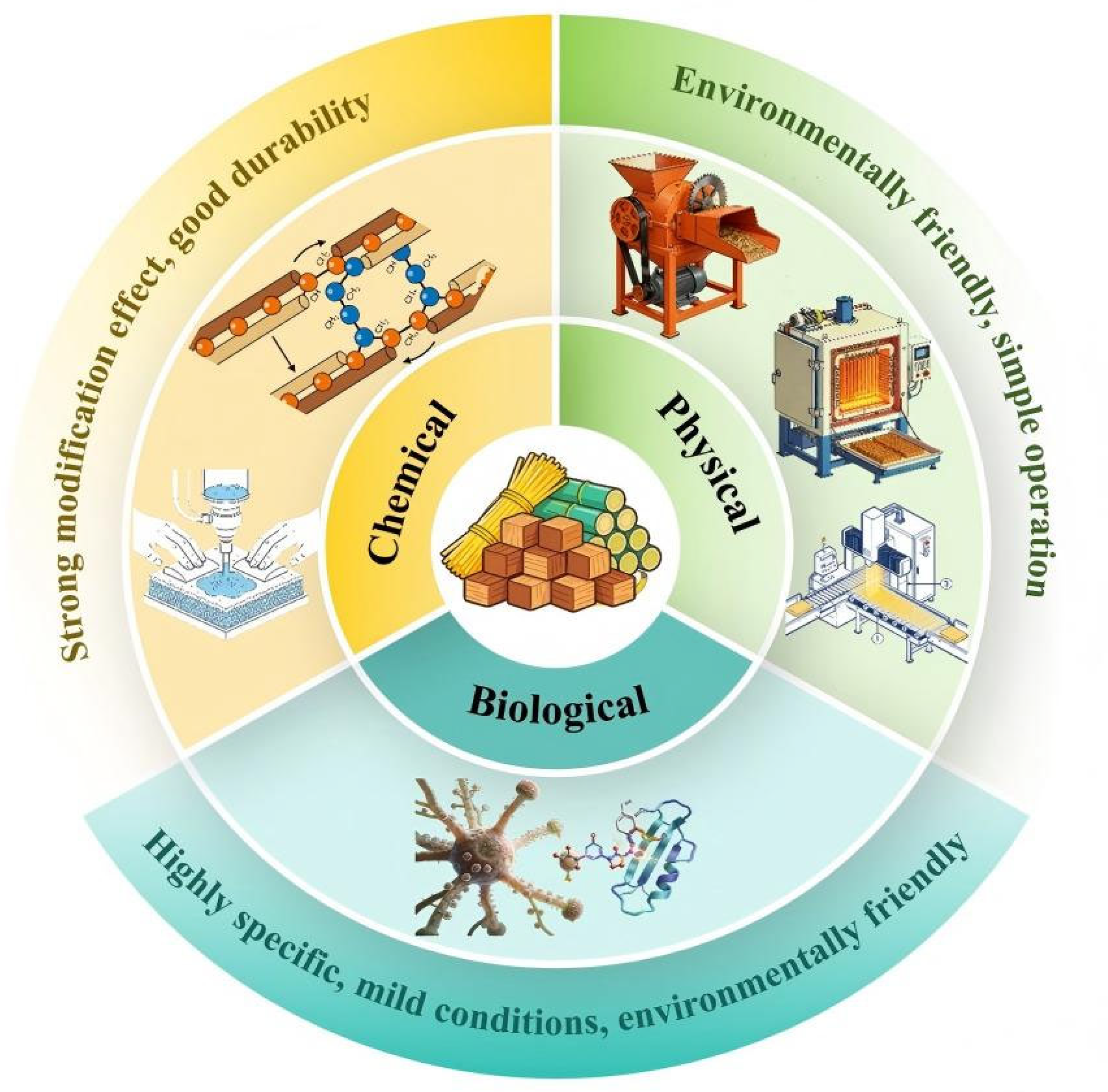
| Modification Type | Representative Technologies | Modification Mechanism | Advantages | Disadvantages | Application Scenarios | Ref. |
|---|---|---|---|---|---|---|
| Physical Methods | Mechanical treatment | Removes surface material through abrasion or blasting to increase surface roughness. | Rapid, low-cost, and pollution-free. | Shallow modification depth; non-uniform results; dust generation. | Surface roughening to improve the mechanical interlocking of coatings or adhesives. | [24] |
| Heat treatment | Applies thermal energy to degrade and reorganize amorphous components (e.g., hemicellulose), reducing hydrophilicity. | Improves dimensional stability and decay resistance; environmentally friendly. | Potential strength loss; energy-intensive; requires precise control. | Reducing surface hydrophilicity and enhancing dimensional stability for outdoor applications. | [25] | |
| Radiation treatment | High-energy radiation cleaves molecular chains and generates free radicals for subsequent reactions. | Uniform modification with deep penetration. | High equipment cost; radiation hazards; potential embrittlement. | Surface cross-linking or degradation to enhance hardness or chemical reactivity. | [26] | |
| Ultrasonic treatment | Utilizes cavitation effects to clean and micro-roughen the surface. | Mild operating conditions with effective cleaning. | Limited to small areas; unsuitable for large components; relatively high energy consumption. | Precision cleaning and micro-roughening to improve uniformity before further processing. | [27] | |
| Laser treatment | Uses a high-energy laser beam to ablate material, enabling precise surface patterning. | High precision with micro-/nano-scale processing capability. | High equipment cost; low throughput; risk of thermal damage/carbonization. | Fabrication of micro-textured surfaces for superhydrophobic, optical, or sensing functions. | [28] | |
| Chemical Methods | Alkali treatment | Dissolves hemicellulose and lignin, thereby increasing porosity and exposing cellulose microfibrils. | Highly effective; significantly improves surface reactivity. | Produces alkaline wastewater; may reduce fiber strength. | Surface cleaning/activation to increase specific surface area and reactive sites. | [29] |
| Acid treatment | Hydrolyzes hemicellulose and alters the surface chemical structure. | Relatively mild reaction conditions. | Reduces polymerization degree; causes equipment corrosion; requires wastewater treatment. | Preparation of water-resistant wood surfaces. | [30] | |
| Esterification/Acetylation | Introduces hydrophobic groups (e.g., acetyl) onto cellulose hydroxyl groups. | Provides durable hydrophobicity; improves dimensional stability. | High cost; use of toxic reagents and catalysts; long reaction times. | Surface functionalization to impart properties such as thermoplasticity or flame retardancy. | [31] | |
| Biological Methods | Enzymatic treatment | Enzymes selectively cleave bonds or introduce functional groups. | Mild conditions; high specificity; environmental friendliness. | High enzyme cost; slow reaction rates; sensitivity to pH and temperature. | Biorefining in pulp/paper and textiles; interfacial modification in biocomposites. | [32,33] |
2. Types of Low-Temperature Plasma
2.1. Working Atmosphere

2.2. Operating Pressure

2.3. Discharge Modes
| Discharge Mode | Typical Excitation Source | Operating Pressure Range | Plasma Characteristics/Generation Mechanism | Main Applications in Biomass Modification | Ref. | |
|---|---|---|---|---|---|---|
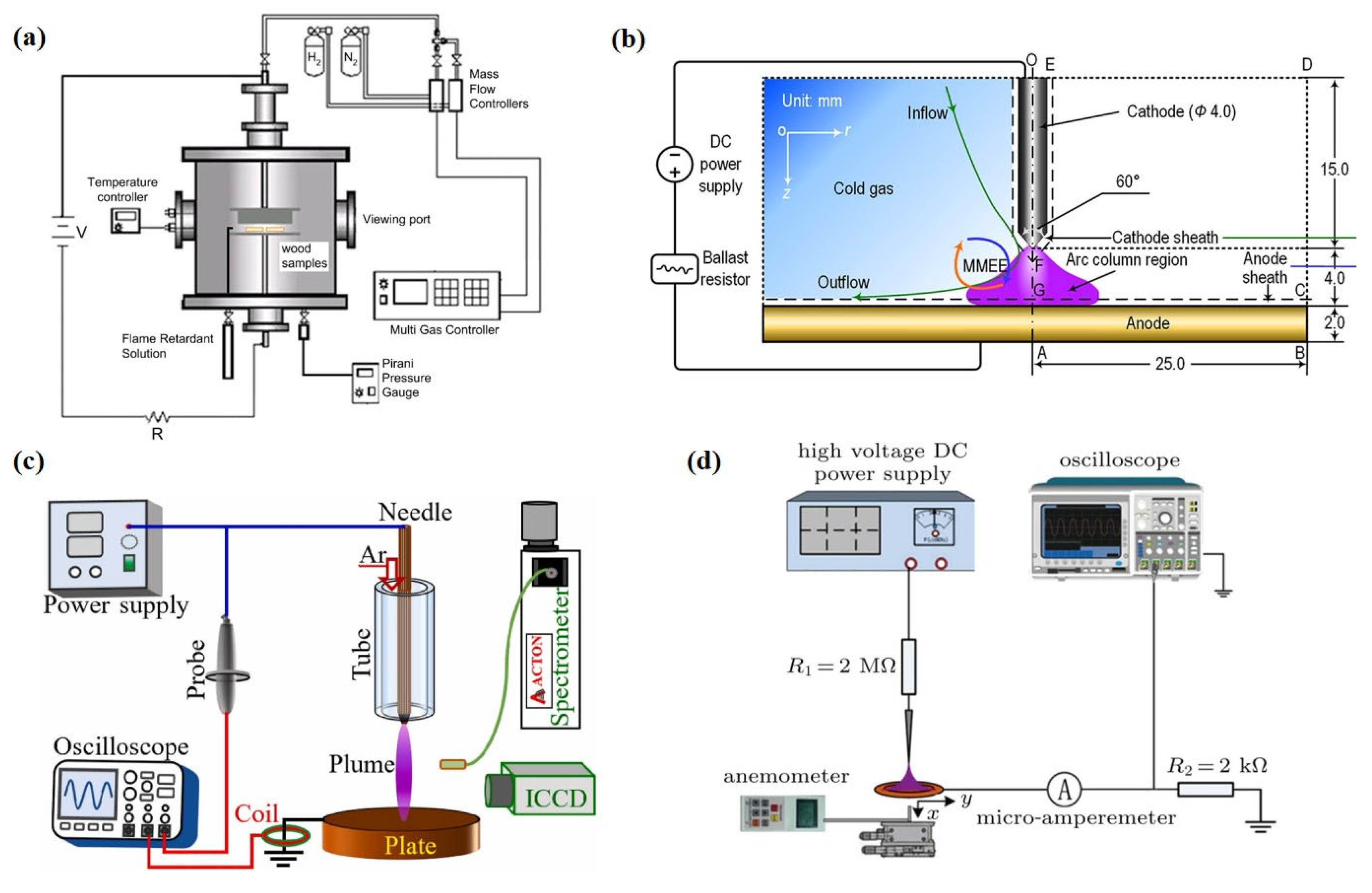
| DC | Glow discharge | DC power supply (1–10 kV) | Low pressure (0.1–10 Pa) | Electrons accelerated by high DC voltage ionize the gas via collisions, forming a stable, uniform glow plasma. | Uniform surface cleaning and activation of wood/fibers to enhance interfacial adhesion. | [68,69] |
| Corona discharge | Pulsed or high-voltage DC | Atmospheric pressure | A strong, localized electric field near a sharp electrode ionizes the surrounding gas, creating a corona rich in reactive species. | Continuous treatment of webs (paper, textiles) to improve printability, dye uptake, or adhesion. | [59,61] | |
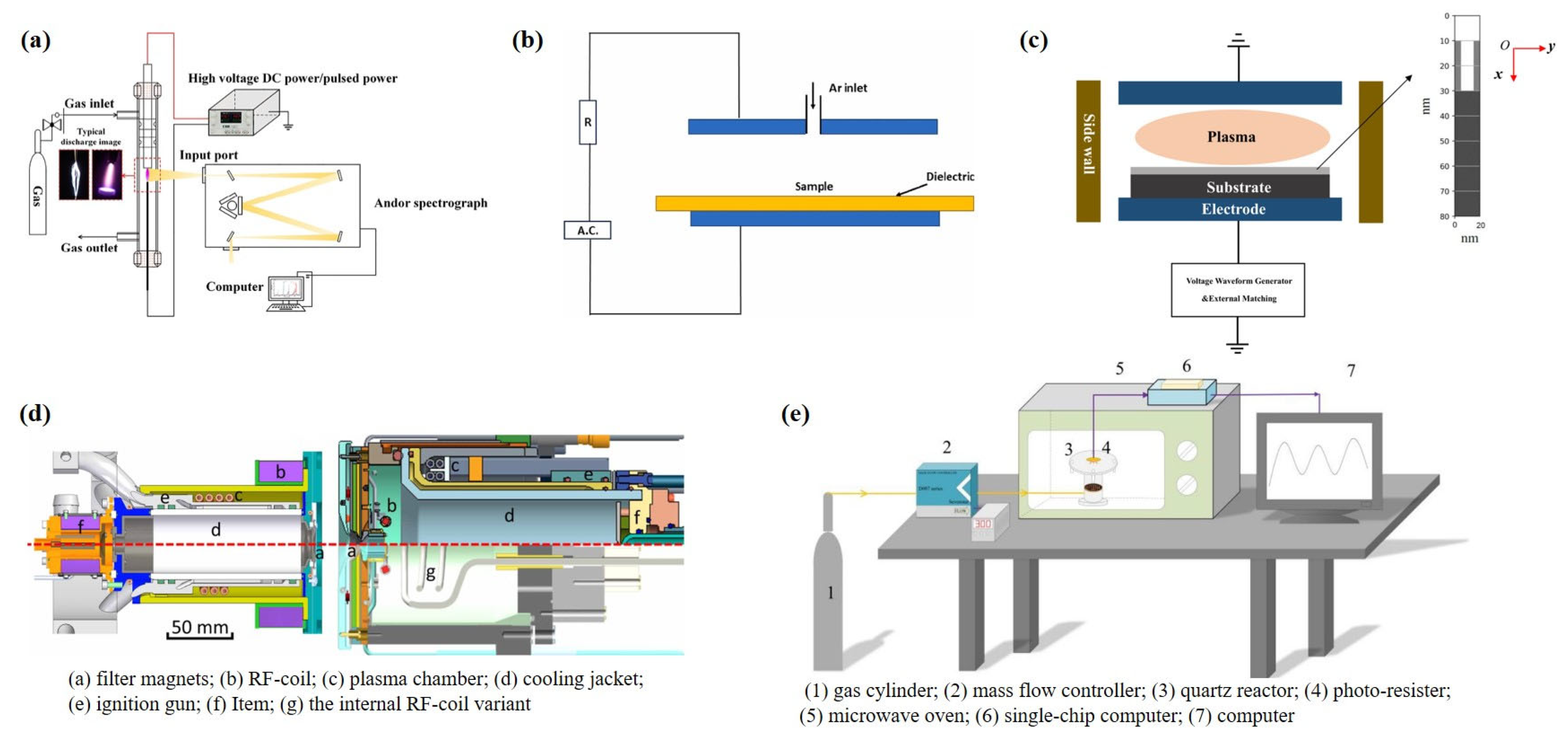
| AC | DBD | AC power supply (50–100 kHz) | Atmospheric pressure | A dielectric barrier limits current, forming numerous micro-discharges and enabling large-area, low-temperature plasma. | Continuous, large-area treatment of wood/textiles for activation, wettability control, or sterilization. | [72] |
| RF discharge (capacitively coupled, CCP) | RF generator (~13.56 MHz) | Low pressure | An RF electric field between parallel electrodes accelerates electrons, generating a uniform, controllable plasma of moderate density. | Precision etching, nanotexturing, and uniform thin-film deposition on biomass surfaces. | [73,79] | |
| RF discharge (inductively coupled, ICP) | RF generator (~13.56 MHz) | Low pressure | An alternating magnetic field induces a circulating electric field, thereby efficiently coupling energy to electrons and producing very high-density plasma. | Deep modification or high-rate deposition for high-performance interphases in biomass composites. | [80] | |
| Microwave discharge | Microwave source (~2.45 GHz) | Wide range (vacuum to atmospheric) | Microwave energy is resonantly absorbed by electrons, creating a high-density, electrodeless (contamination-free), highly reactive plasma. | Efficient functionalization of biomass-derived carbon or biomedical materials; initiation of challenging graft polymerizations. | [75,76] | |
| Hybrid | Microplasma | DC, RF, or Microwave | Atmospheric pressure | Discharge confined within micro-cavities yields high power density and enables stable miniature plasmas. | Localized micro-area modification, portable treatment devices, and interior surface treatment of complex 3D porous scaffolds. | [77] |

3. Multiscale Mechanisms and Property Regulation in Plasma Surface Modification
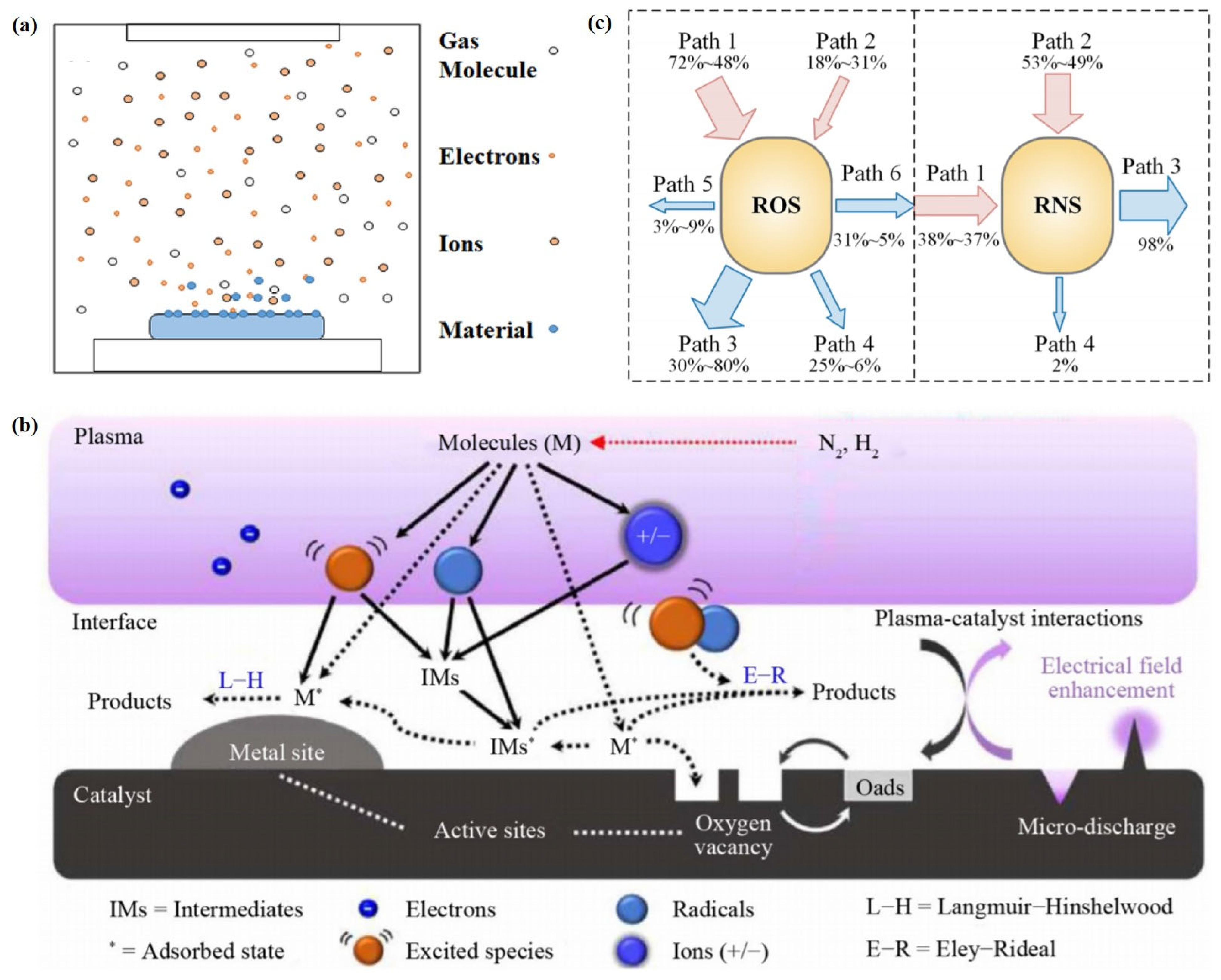
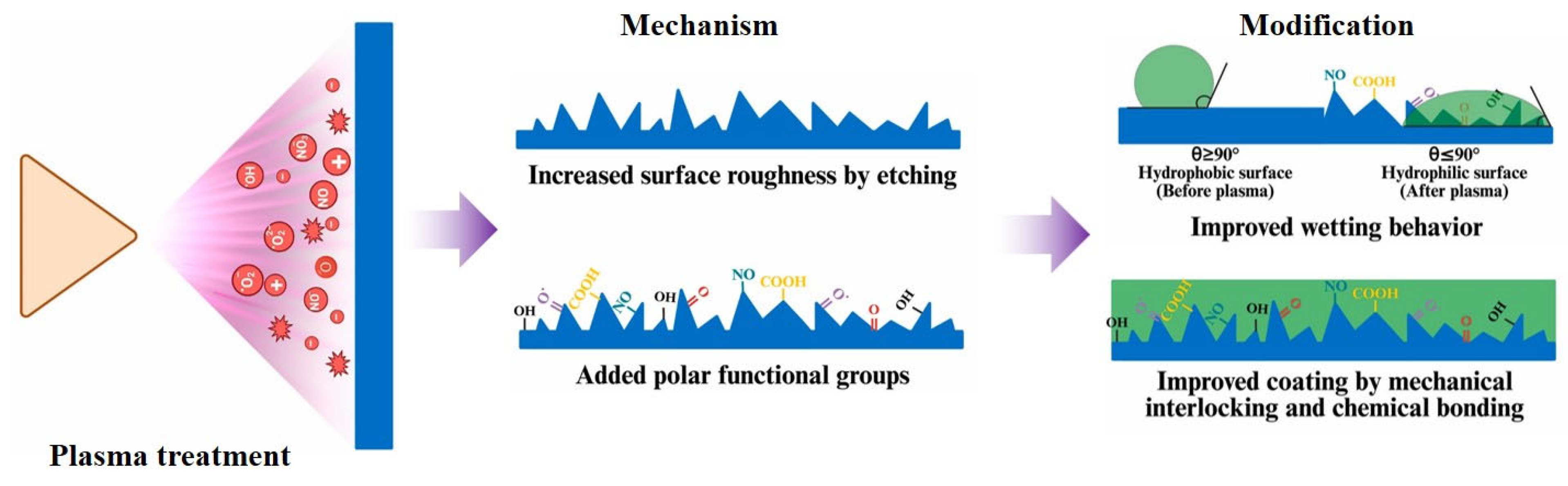
3.1. Mechanisms of Low-Temperature Plasma Surface Treatment

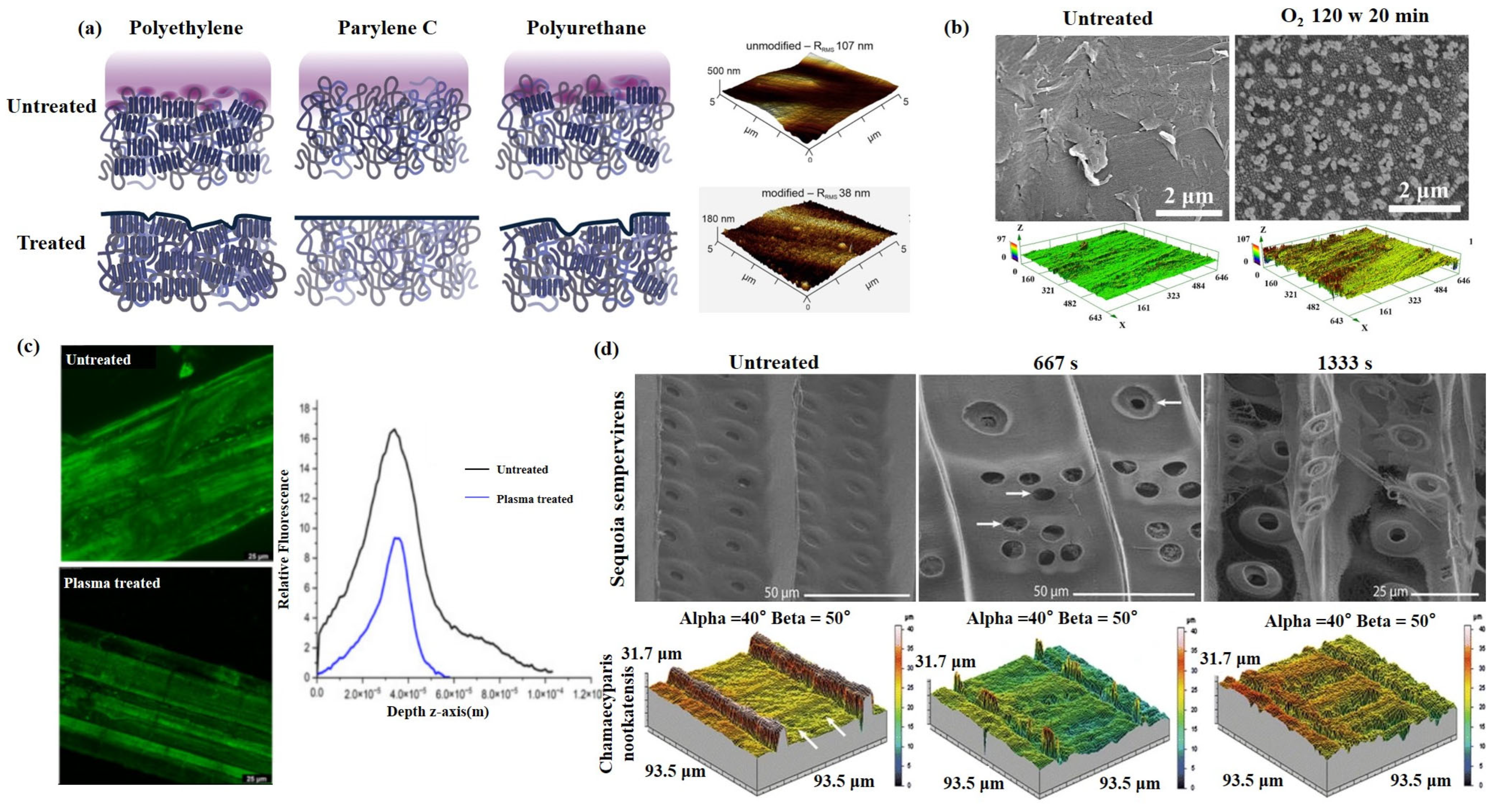
3.1.1. Surface Etching

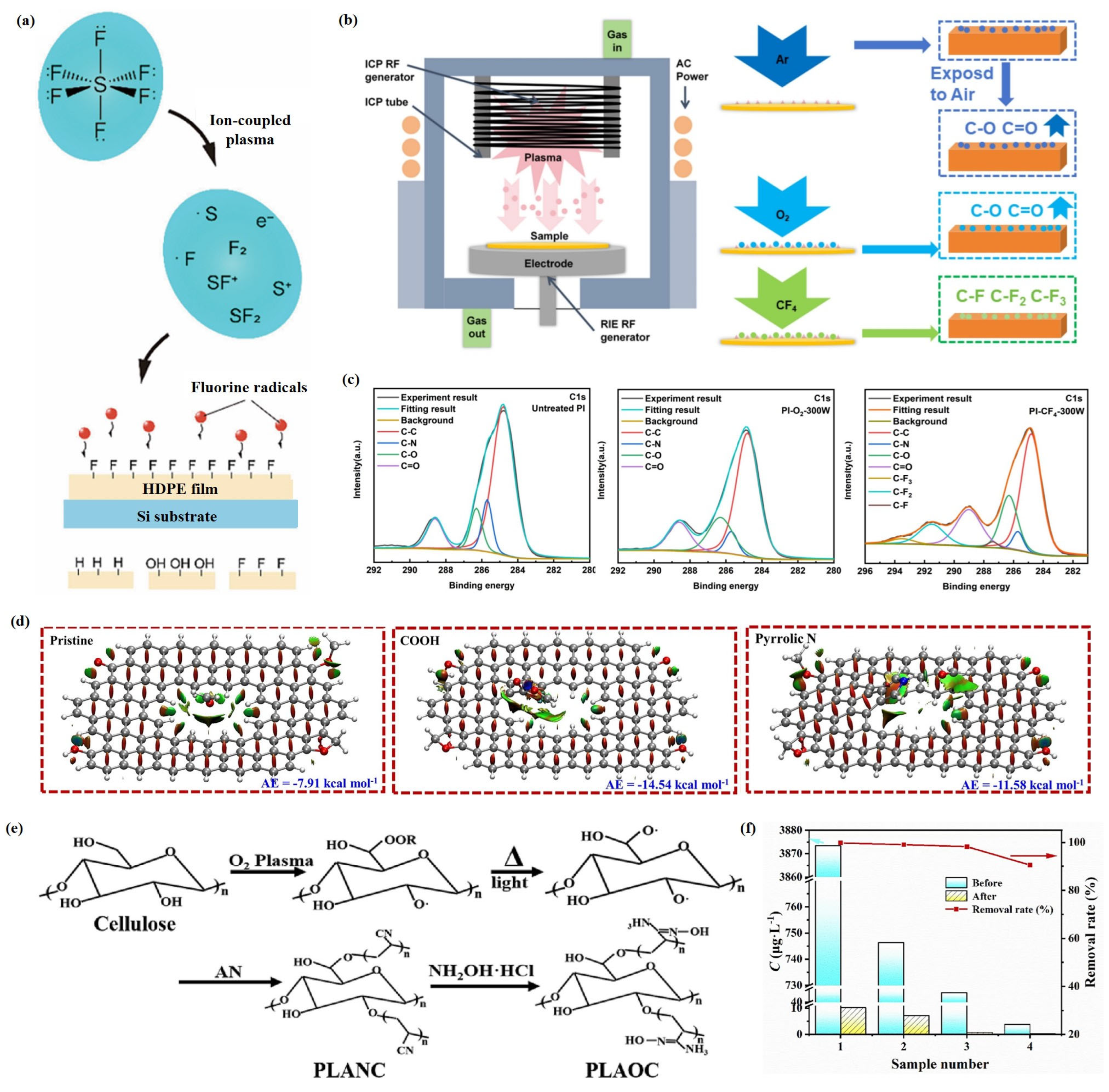
3.1.2. Surface Functionalization

3.2. Aging Effect
| Material Type | Modification Atmosphere | Discharge Mode | Storage Conditions | Aging Time | Changes in Interfacial Properties | Ref. |
|---|---|---|---|---|---|---|
| Zirconia (ZrO2, 3 mol% yttria-stabilized) | N/A | NTP | Air | Significant hydrophobic recovery within 1 week; slight decrease in surface roughness after 4 weeks | Significant improvement in surface hydrophilicity after plasma treatment, followed by rapid hydrophobic recovery during air storage; surface roughness decreased after 4 weeks, with reduced oxygen-/nitrogen-containing functional group content. | [117] |
| Carbonized Bamboo | O2 | DBD | Room temperature, ambient air | Significant decay within 1 d; continuous linear decay over 12 d. | The contact angle reduction rate rapidly decreased from 1.25 to 1.02 and continued to decline over 12 days (linear slope: –0.06). | [36] |
| Bamboo Outer Skin (Green Layer) | N/A | GDP | N/A | 12 h | Contact angle increased over time, recovering approximately 30% of the original value after 24 h, indicating a temporary hydrophilic effect. | [69] |
| Black Spruce Wood | N2 and N2/O2 mixtures | DBD | Natural aging | 14 d | Water contact angle gradually approached that of untreated samples, indicating hydrophobic recovery. | [118] |
| Pine/Beech Wood | Air | RF | Aged for 12 d | 12 d | Minor decrease in surface energy, suggesting plasma-induced cross-linking was not dominant. | [119] |
| Wood-Plastic Composite | Air | DBD | 20 °C, 0% RH; 20 °C, 65% RH; 60 °C, 75% RH | Over one week | Changes in surface wettability, hydrophobic recovery; a model for calculating the half-life of contact angle was established. | [120] |
| Metal Surface (H300LAD Steel) | Air | APP | Air, Water, –20 °C, 30 °C | Several hours to days | Gradual recovery of surface wettability to the untreated state; aging rate influenced by plasma type, storage conditions, and temperature. | [121] |
| Polyketone Film (Poketon™) | Air/Oxygen | APP | Humidity chamber (room temperature, ambient pressure), isothermal heating | N/A | Changes in wettability, surface energy and its polar/dispersive components; adhesion properties (peel strength) varied with storage conditions. | [122] |
| PBO/BMI Composite | Argon | ICP, DBD | Air | 10–30 d | Grafting of polar functional groups on fiber surface, increased surface free energy, and improved interlaminar shear strength (ILSS); however, aging decay occurred over time. | [123] |
| Silk Fibroin Film | N2, H2O(g) | ICP | Ambient temperature and 60 °C high temperature | PE film treated with N2 plasma recovered to 10% of original hydrophobic state within 160 h | Silk film maintained hydrophilicity over a 6-week aging period; hydrophobic recovery rate was influenced by aging temperature. | [124] |
| HDPE/PA12/PA6 | Air | AP-μP | Room temperature | Significant aging occurred within 5 h | Contact angle decreased first and then relaxed/recovered; aging rate depended on polymer hydrophilicity (polyamides faster than polyethylene). | [125] |
| PBO Fiber | Oxygen | DBD | Air | Sharp decline in adhesion within 5 days; continuous decrease in oxygen content over 30 days | Oxygen content decreased from 24.83% to 20.88%, O/C ratio from 0.350 to 0.268; composite adhesion decreased by approximately 18%. | [126] |
| PET Film | Air | DBD | Environments with varying humidity and temperature | Aging rate influenced by storage conditions: low temperature and low humidity could inhibit aging. | Contact angle increased (hydrophobic recovery). | [127] |
| PLA Film | N/A | AC | N/A | Aging effect was evaluated as a function of processing parameters (time, power, frequency). | Wettability (contact angle) changed with storage time; processing parameters could modulate the aging rate. | [128] |
3.3. Influence of Key Process Parameters
3.3.1. Treatment Time
3.3.2. Discharge Power
3.3.3. Treatment Distance
| Discharge Type | Working Atmosphere | Power Density | Treatment Time | Treatment Distance | Characteristics | Ref. |
|---|---|---|---|---|---|---|
| GD | Ar, O2, N2, Air | Relatively low (~W/cm2) | Long (tens of seconds–minutes) | Several cm (sample placed within the plasma zone) | High uniformity; primarily chemical modification; capable of penetrating micropores. Aging effect must be controlled for heat-sensitive biomass to prevent thermal damage. | [149,150] |
| DBD | Air, O2, N2, He/O2 mixture | Medium (up to 102 W/cm2) | Short (seconds–minutes) | Electrode gap 0.1–5 mm | Suitable for in-line processing; faces challenges in uniformity. High flux of reactive species, strong at introducing surface chemistry. | [131,151,152] |
| Jet | Ar, He (often with trace O2) | High (localized) | Very short (milliseconds–tens of seconds) | Several mm to cm (remote treatment) | High directionality, suitable for localized treatment. Enriched in reactive species and excited states, featuring combined physical and chemical effects. | [153,154] |
| RF | Ar, Air | High | Short (seconds–tens of seconds) | Several mm–cm scale | High energy density, high modification efficiency; requires precise control to prevent surface ablation. | [15,155,156] |
3.4. Process Optimization for Engineering Applications
| Material Category | Modification Objective | Material | Process Parameters | Effect Validation | Refs. | |||
|---|---|---|---|---|---|---|---|---|
| Gas | Power | Time | Discharge Mode | |||||
| Wood and Bamboo | 1. Improve wettability and adhesion; 2. Induce controllable color change; 3. Surface cleaning and activation | Bamboo | Water vapor | 150 W | 5 min | GD | Contact angle >110° pre-treatment; became hydrophilic (<20°) post-treatment. | [69] |
| Teak Wood | Air | 3 kW | N/A | CP | Decrease in lightness; overall color difference (ΔE × ab) increased after treatment. | [111] | ||
| Pine Wood | Air | N/A | 1 min | DBD | Degradation of lignin/extractives; increased penetration depth of phenolic resin adhesive; increase in C=O/O–C=O groups and significant improvement in interfacial bonding. | [165] | ||
| Wood | N2 | N/A | N/A | APPJ | Up to 75% removal of DDT contamination from flat wood surfaces. | [166] | ||
| Fagus sylvatica L. | Air | 225 W | 3 s | DBD | Increased surface free energy, wettability, and oxygen-containing functional groups. | [51] | ||
| Starch and Polysaccharides | 1. Improve solubility/dispersibility 2. Induce functional color change | Pea Starch (PS) | Air | 120 W | 21 min | RF | Relative Crystallinity decreased by 6.5%; solubility increased from 6.05 ± 0.38% to 12.37 ± 0.34%. | [167] |
| Waxy Maize Starch (WMS) | Air | 750 W | 7 min | APPJ | RC decreased from 46.7% to 42.0%; Water Binding Capacity increased from 105.19% to 131.27%; Solubility Volume increased from 2.96 g/mL to 3.33 g/mL. | [168] | ||
| Natural Fibers (Hemp, Cotton, etc.) | 1. Optimize composite interface | Coir Fiber | O2 | 350 W | 30 s | CP | Increased roughness; introduction of new oxygen functional groups on fiber surface; enhanced interfacial bonding with resin matrix. | [169] |
| Hemp Fibers | Air | 80 W | 120 s | DBD | Introduction of COOH groups; wettability improved by up to 5 times. | [170] | ||
| Protein-Based Substrates (Protein Films, etc.) | 1. Increase surface hydrophilicity 2. Induce cross-linking | Soy Protein | Air | N/A | 3 min | DBD | Water contact angle decreased from 87.9° to 77.2°; enhanced elongation at break, reduced WVP, improved thermal properties, and cross-linking of soy protein matrix. | [171] |
| Gelatin | Air | N/A | 20 min | DBD | Cross-linking of gelatin nanofibers, improving structural stability and water resistance. | [172] | ||
| Protein Film | Ar | 50 W | 10 min | GD | Increased roughness, introduction of functional groups (e.g., C–O, C=O), and generation of cross-linking. | [173] | ||
4. Applications of Low-Temperature Plasma in Surface Modification of Biomass Materials
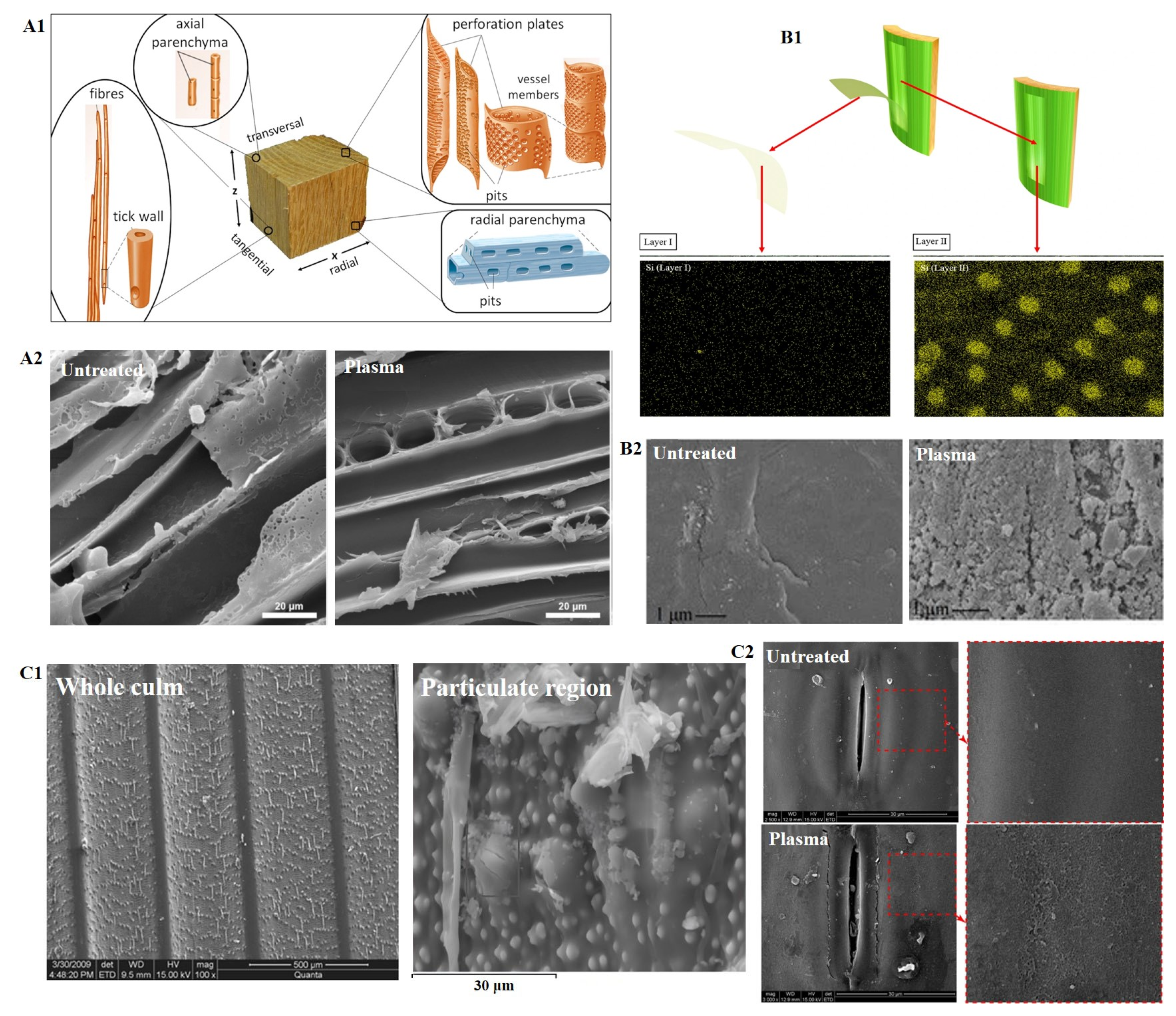
4.1. Surface Structures of Wood, Bamboo, and Straw

| Material Type | Main Structural Characteristics | Initial Surface State and Treatment Objectives | Suitable Plasma Types and Atmospheres | Typical Morphological Changes | Mechanism of Action | Ref. |
|---|---|---|---|---|---|---|
| Wood | Hierarchical pore structure with cell lumens and pits | Some roughness and porosity, but amorphous regions cover cellulose; objective: selectively etch amorphous regions to enlarge pores and expose cellulose microfibrils. | Low-pressure RF/glow discharge (Ar, N2) | Layered exfoliation, cell wall etching, and pore enlargement | High-energy ion bombardment preferentially removes lignin and hemicellulose (amorphous regions) and preserves crystalline cellulose. This increases specific surface area and enhances resin penetration and micro-interlocking. | [44,176] |
| Bamboo | Vascular bundles and parenchyma cells, naturally coated with a siliceous layer and wax | Dense, hydrophobic surface hindering resin penetration; objective: break waxy barrier, open the surface structure, and form nanoscale scratches to enhance penetration and anchoring. | Glow discharge/atmospheric-pressure jet (Ar, O2) | Increased porosity, nanoscale scratches, and disruption of the waxy layer | Physical bombardment disrupts the waxy layer; reactive species increase surface energy and wettability, forming hydrophilic pores that promote resin penetration and interfacial bonding. | [42,69] |
| Straw | Loose fiber bundles coated with silica cells and a hydrophobic cuticle; loose structure; low surface energy | Hydrophobic surface with few reactive sites; objective: create grooves and pits, increase specific surface area, and expose internal cellulose. | Atmospheric-pressure DBD or jet (air, water vapor) | Protrusions, grooves, pits, and surface loosening | Physical etching forms grooves; reactive species chemically oxidize the surface, thereby introducing polar groups, increasing surface energy, and improving compatibility with polymer matrices. | [182,183] |
4.2. Surface Chemical Composition

4.3. Surface Wettability

5. Conclusions and Outlook
Author Contributions
Funding
Data Availability Statement
Conflicts of Interest
Abbreviations
| DC | Direct Current |
| AC | Alternating Current |
| DBD | Dielectric Barrier Discharge |
| RF | Radio Frequency |
| CCP | Capacitively Coupled Plasma |
| ROS | Reactive Oxygen Species |
| RNS | Reactive Nitrogen Species |
| ICP | Inductively Coupled Plasma |
| HDPE | High-Density Polyethylene |
| PI | Polyimide |
| PA12 | Polyamide 12 |
| PA6 | Polyamide 6 |
| PET | Polyethylene Terephthalate |
| PS | Potato Starch |
| SV | Swelling Volume |
| WBC | Water-Binding Capacity |
| RC | Relative Crystallinity |
| DDT | Dichlorodiphenyltrichloroethane |
References
- Zheng, G.Y.; Kang, X.L.; Ye, H.R.; Fan, W.; Sonne, C.; Lam, S.S.; Liew, R.K.; Xia, C.L.; Shi, Y.; Ge, S.B. Recent advances in functional utilisation of environmentally friendly and recyclable high-performance green biocomposites: A review. Chin. Chem. Lett. 2024, 35, 108817. [Google Scholar] [CrossRef]
- Barbhuiya, S.; Das, B.B.; Kapoor, K.; Das, A.; Katare, V. Mechanical performance of bio-based materials in structural applications: A comprehensive review. Structures 2025, 75, 108726. [Google Scholar] [CrossRef]
- D’Orsi, R.; Danielli, C.; Spennato, M.; Guazzelli, E.; Martinelli, E.; Asaro, F.; Gardossi, L.; Operamolla, A. Cellulose Nanocrystals and Rice Husk Surface Functionalization Induced by Infrared Thermal Activation. Chemsuschem 2025, 18, e202500164. [Google Scholar] [CrossRef] [PubMed]
- Xu, R.; Chen, J.W.; Yan, N.A.; Xu, B.Q.; Lou, Z.C.; Xu, L. High-value utilization of agricultural residues based on component characteristics, Potentiality and challenges. J. Bioresour. Bioprod. 2025, 10, 271–294. [Google Scholar] [CrossRef]
- Ghaffar, S.H.; Fan, M. An aggregated understanding of physicochemical properties and surface functionalities of wheat straw node and internode. Ind. Crops Prod. 2017, 95, 207–215. [Google Scholar] [CrossRef]
- Yin, X.S.; Li, G.H.; Yao, Y.; Li, W.Z.; Leng, W.Q.; Wang, X.Z. The effects of moisture content on the bonding interfacial properties of glued bamboo. Colloids Surf. A Physicochem. Eng. Asp. 2023, 679, 132625. [Google Scholar] [CrossRef]
- Chen, L.; Yuan, J.; Wang, X.K.; Huang, B.; Ma, X.X.; Fang, C.H.; Zhang, X.B.; Sun, F.B.; Fei, B.H. Fine gluing of bamboo skin and bamboo pith ring based on sanding. Ind. Crops Prod. 2022, 188, 115555. [Google Scholar] [CrossRef]
- Ghaffar, S.H.; Fan, M.Z.; McVicar, B. Interfacial properties with bonding and failure mechanisms of wheat straw node and internode. Compos. Part A Appl. Sci. Manuf. 2017, 99, 102–112. [Google Scholar] [CrossRef]
- Iglesias, M.C.; Gomez-Maldonado, D.; Davis, V.A.; Peresin, M.S. A review on lignocellulose chemistry, nanostructure, and their impact on interfacial interactions for sustainable products development. J. Mater. Sci. 2023, 58, 685–706. [Google Scholar] [CrossRef]
- Hubbe, M.A.; Rojas, O.J.; Lucia, L.A. Green Modification of Surface Characteristics of Cellulosic Materials at the Molecular or Nano Scale, A Review. Bioresources 2015, 10, 6095–6206. [Google Scholar] [CrossRef]
- Rao, S.; Madhushree, M.; Bhat, K.S. Characteristics of surface modified sugarcane bagasse cellulose, application of esterification and oxidation reactions. Sci. Rep. 2024, 14, 24136. [Google Scholar] [CrossRef]
- Hendriks, A.T.W.M.; Zeeman, G. Pretreatments to enhance the digestibility of lignocellulosic biomass. Bioresour. Technol. 2009, 100, 10–18. [Google Scholar] [CrossRef] [PubMed]
- Langmuir, I. Oscillations in Ionized Gases. Proc. Natl. Acad. Sci. USA 1928, 14, 627–637. [Google Scholar] [CrossRef] [PubMed]
- Bárdos, L.; Baránková, H. Cold atmospheric plasma, Sources, processes, and applications. Thin Solid Film. 2010, 518, 6705–6713. [Google Scholar] [CrossRef]
- Zanini, S.; Canevali, C.; Orlandi, M.; Tolppa, E.L.; Zoia, L.; Riccardi, C.; Morazzoni, F. Radical Formation on Ctmp Fibers by Argon Plasma Treatments and Related Lignin Chemical Changes. Bioresources 2008, 3, 995–1009. [Google Scholar] [CrossRef]
- Sarangapani, C.; Patange, A.; Bourke, P.; Keener, K.; Cullen, P.J. Recent advances in the application of cold plasma technology in foods. Annu. Rev. Food Sci. Technol. 2018, 9, 609–629. [Google Scholar] [CrossRef]
- Witkowska, J.; Borowski, T.; Kulikowski, K.; Wunsch, K.; Morgiel, J.; Sobiecki, J.; Wierzchoń, T. Structure and Properties of Bioactive Titanium Dioxide Surface Layers Produced on NiTi Shape Memory Alloy in Low-Temperature Plasma. Micromachines 2024, 15, 886. [Google Scholar] [CrossRef]
- Karthik, C.; Mavelil-Sam, R.; Thomas, S.; Thomas, V. Cold Plasma Technology Based Eco-Friendly Food Packaging. Biomaterials 2024, 16, 230. [Google Scholar] [CrossRef]
- Karthik, C.; Sarngadharan, S.C.; Thomas, V. Low-Temperature Plasma Techniques in Biomedical Applications and Therapeutics, An Overview. Int. J. Mol. Sci. 2023, 25, 524. [Google Scholar] [CrossRef]
- Weng, H.; Zhang, Y.; Huang, X.; Yuan, H.; Xu, Y.; Li, K.; Tang, Y.; Zhang, Y. Design and Application of High-Density Cold Plasma Devices Based on High Curvature Spiked Tungsten Structured Electrodes. Appl. Sci. 2024, 14, 5901. [Google Scholar] [CrossRef]
- Galaly, A.R.; Dawood, N. Enhancing the Production of Eco-Friendly Silk Fabrics through the Application of Nonthermal Plasma Wettability Techniques. Acs Omega 2024, 9, 20791–20806. [Google Scholar] [CrossRef] [PubMed]
- Wante, H.P.; Yap, S.L.; Khan, A.A.; Chowdhury, Z.Z.; Nee, C.H.; Yap, S.S. Enhanced adsorption of malachite green (MG) dye using RF glow oxygen plasma-modified coconut carbon shell, A sustainable approach for effluent treatment. Diam. Relat. Mater. 2024, 149, 111650. [Google Scholar] [CrossRef]
- Bozaci, E.; Sever, K.; Sarikanat, M.; Seki, Y.; Demir, A.; Ozdogan, E.; Tavman, I. Effects of the atmospheric plasma treatments on surface and mechanical properties of flax fiber and adhesion between fiber–matrix for composite materials. Compos. Part B Eng. 2013, 45, 565–572. [Google Scholar] [CrossRef]
- Hung, J.C.; Yang, P.J.; Lin, X.H.; Jian, S.Y.; Kao, C.H.; Ferng, Y.C.; Huang, Y.S.; Jen, K.K. Surface passivation and brightening of titanium-based AM materials using a robotic electrochemical mechanical polishing system. Int. J. Adv. Manuf. Technol. 2024, 134, 4339–4352. [Google Scholar] [CrossRef]
- Maniet, G.; Schmetz, Q.; Jacquet, N.; Temmerman, M.; Gofflot, S.; Richel, A. Effect of steam explosion treatment on chemical composition and characteristic of organosolvfescue lignin. Ind. Crops Prod. 2017, 99, 79–85. [Google Scholar] [CrossRef]
- Jaganathan, S.K.; Balaji, A.; Vellayappan, M.V.; Subramanian, A.P.; John, A.A.; Asokan, M.K.; Supriyanto, E. Review: Radiation-induced surface modification of polymers for biomaterial application. J. Mater. Sci. 2015, 50, 2007–2018. [Google Scholar] [CrossRef]
- Skorb, E.V.; Möhwald, H. Ultrasonic approach for surface nanostructuring. Ultrason. Sonochemistry 2016, 29, 589–603. [Google Scholar] [CrossRef]
- Mastellone, M.; Bolli, E.; Bellucci, A.; Valentini, V.; Orlando, S.; Lettino, A.; Santagata, A.; Pace, M.L.; Sani, E.; Polini, R.; et al. Enhancing anti-reflection properties of laser nanotextured Indium Phosphide. Surf. Interfaces 2025, 60, 106056. [Google Scholar] [CrossRef]
- Geremew, A.; De Winne, P.; Demissie, T.A.; De Backer, H. Surface modification of bamboo fibers through alkaline treatment, Morphological and physical characterization for composite reinforcement. J. Eng. Fibers Fabr. 2024, 19, 15589250241248764. [Google Scholar] [CrossRef]
- Basri, E.; Tobing, G.; Saefudin Kartika, T.; Adalina, Y.; Rahayu, I.S.; Mubarok, M.; Darmawan, W.; Gérardin, P. Transforming inferior short-rotation teak, unleashing superior durability and stability with lactic acid-based bio-treatments. Eur. J. Wood Wood Prod. 2024, 83, 18. [Google Scholar] [CrossRef]
- Rowell, R.; Bongers, F. Coating Acetylated Wood. Coatings 2015, 5, 792–801. [Google Scholar] [CrossRef]
- Ibrahim, N.A.; Abdel-Aziz, M.S.; Hamed, A.A.; Amin, H.A.; Yassin, M.A.; Eid, B.M. Biosynthesis and potential application of sustainable lignocellulolytic enzymes cocktail for the development of eco-friendly multifunctional cellulosic products. Clean Technol. Environ. Policy 2025, 27, 2821–2836. [Google Scholar] [CrossRef]
- Li, Y.; Pickering, K.L.; Farrell, R.L. Determination of interfacial shear strength of white rot fungi treated hemp fibre reinforced polypropylene. Compos. Sci. Technol. 2009, 69, 1165–1171. [Google Scholar] [CrossRef]
- Qin, L.; Li, O.L. Recent progress of low-temperature plasma technology in biorefining process. Nano Convergence 2023, 10, 38. [Google Scholar] [CrossRef] [PubMed]
- Li, F.; Li, G.; Lougou, B.G.; Zhou, Q.; Jiang, B.; Shuai, Y. Upcycling biowaste into advanced carbon materials via low-temperature plasma hybrid system, applications, mechanisms, strategies and future prospects. Waste Manag. 2024, 189, 364–388. [Google Scholar] [CrossRef] [PubMed]
- Rao, J.; Bao, L.; Wang, B.; Fan, M.; Feo, L. Plasma surface modification and bonding enhancement for bamboo composites. Compos. Part B Eng. 2018, 138, 157–167. [Google Scholar] [CrossRef]
- Yi, S.; Yuan, D.; Sun, L.; Chen, M.; Xu, S.; Wan, S. Nonthermal plasma–assisted fabrication of pomelo peel-based aerogel with rich micropores and high hydrophobicity for the excellent adsorption of gaseous p-xylene. Chem. Eng. J. 2025, 511, 161951. [Google Scholar] [CrossRef]
- Iwai, T.; Albert, A.; Okumura, K.; Miyahara, H.; Okino, A.; Engelhard, C. Fundamental properties of a non-destructive atmospheric-pressure plasma jet in argon or helium and its first application as an ambient desorption/ionization source for high-resolution mass spectrometry. J. Anal. At. Spectrom. 2014, 29, 464–470. [Google Scholar] [CrossRef]
- Lu, X.; Naidis, G.V.; Laroussi, M.; Reuter, S.; Graves, D.B.; Ostrikov, K. Reactive species in non-equilibrium atmospheric-pressure plasmas, Generation, transport, and biological effects. Phys. Rep. 2016, 630, 1–84. [Google Scholar] [CrossRef]
- Seong, J.W.; Kim, K.W.; Beag, Y.W.; Koh, S.K.; Yoon, K.H.; Lee, J.H. Effects of ion bombardment with reactive gas environment on adhesion of Au films to Parylene C film. Thin Solid Film. 2005, 476, 386–390. [Google Scholar] [CrossRef]
- Sundriyal, P.; Pandey, M.; Bhattacharya, S. Plasma-assisted surface alteration of industrial polymers for improved adhesive bonding. Int. J. Adhes. Adhes. 2020, 101, 102626. [Google Scholar] [CrossRef]
- Xu, X.; Wang, Y.; Zhang, X.; Jing, G.; Yu, D.; Wang, S. Effects on surface properties of natural bamboo fibers treated with atmospheric pressure argon plasma. Surf. Interface Anal. 2006, 38, 1211–1217. [Google Scholar] [CrossRef]
- Zeng, Q.; Ni, J.; Mariotti, D.; Lu, L.; Chen, H.; Ni, C. Plasma-treatment of polymeric carbon nitride for efficient NO abatement under visible light. J. Phys. D Appl. Phys. 2022, 55, 354003. [Google Scholar] [CrossRef]
- Van Nguyen, T.H.; Nguyen, T.T.; Ji, X.; Nguyen, V.D.; Guo, M. Enhanced bonding strength of heat-treated wood using a cold atmospheric-pressure nitrogen plasma jet. Eur. J. Wood Wood Prod. 2018, 76, 1697–1705. [Google Scholar] [CrossRef]
- Oberlintner, A.; Vesel, A.; Naumoska, K.; Likozar, B.; Novak, U. Permanent hydrophobic coating of chitosan/cellulose nanocrystals composite film by cold plasma processing. Appl. Surf. Sci. 2022, 597, 153562. [Google Scholar] [CrossRef]
- Atmospheric Pressure Plasma Jet in Ar and O2/Ar Mixtures, Properties and High Performance for Surface Cleaning. Plasma Sci. Technol. 2013, 15, 1203. [CrossRef]
- Lu, X.; Liu, D.; Xian, Y.; Nie, L.; Cao, Y.; He, G. Cold atmospheric-pressure air plasma jet, Physics and opportunities. Phys. Plasmas 2021, 28, 100501. [Google Scholar] [CrossRef]
- Ning, W.; Dai, D.; Zhang, Y.; Han, Y.; Li, L. Effects of trace of nitrogen on the helium atmospheric pressure plasma jet interacting with a dielectric substrate. J. Phys. D Appl. Phys. 2018, 51, 125204. [Google Scholar] [CrossRef]
- Bogaerts, A.; Tu, X.; Whitehead, J.C.; Centi, G.; Lefferts, L.; Guaitella, O.; Azzolina-Jury, F.; Kim, H.H.; Murphy, A.B.; Schneider, W.F.; et al. The 2020 plasma catalysis roadmap. J. Phys. D Appl. Phys. 2020, 53, 443001. [Google Scholar] [CrossRef]
- Liu, Y.F.; Liu, D.X.; Zhang, J.S.; Sun, B.W.; Yang, A.J.; Kong, M.G. 1D fluid model of RF-excited cold atmospheric plasmas in helium with air gas impurities. Phys. Plasmas 2020, 27, 043512. [Google Scholar] [CrossRef]
- Altgen, D.; Avramidis, G.; Viöl, W.; Mai, C. The effect of air plasma treatment at atmospheric pressure on thermally modified wood surfaces. Wood Sci. Technol. 2016, 50, 1227–1241. [Google Scholar] [CrossRef]
- Borisov, D.P.; Kuznetsov, V.M.; Slabodchikov, V.A. Effect of vacuum conditions and plasma concentration on the chemical composition and adhesion of vacuum-plasma coatings. J. Phys. Conf. Ser. 2015, 652, 012020. [Google Scholar] [CrossRef]
- Blanchard, V.; Riedl, B.; Blanchet, P.; Evans, P. Modification of Sugar Maple Wood Board Surface by Plasma Treatments at Low Pressure. Contact Angle Wettability Adhes. 2009, 6, 311. [Google Scholar]
- Pabeliña, K.G.; Lumban, C.O.; Ramos, H.J. Plasma impregnation of wood with fire retardants. Nucl. Instrum. Methods Phys. Res. Sect. B Beam Interact. Mater. At. 2012, 272, 365–369. [Google Scholar] [CrossRef]
- Shimizu, A.; Endo, S. Comprehensive Analysis of the Impact of Various Surface Modification Techniques on Difficult-to-Adhesion Resins. In Proceedings of the 2025 IEEE 75th Electronic Components and Technology Conference (ECTC), Dallas, TX, USA, 27–30 May 2025; pp. 2009–2016. [Google Scholar]
- Shihab, M.; Ibrahim, S.A.; Mahmoud, S.A.; Noser, A.A. The impact of atmospheric air plasma treatment on the polyfunctional end-use polyester fabric using new synthetic pyrazole dye. Dye. Pigment. 2024, 229, 112302. [Google Scholar] [CrossRef]
- Shang, H.; Ning, W.; Shen, S.; Wang, R.; Dai, D.; Jia, S. Atmospheric pressure plasma jet for surface treatment, a review. Rev. Mod. Plasma Phys. 2024, 9, 3. [Google Scholar] [CrossRef]
- Wu, J.; Li, J.; Chen, J.; Wu, K.; Ran, J.; Chen, M.; Jia, P.; Kan, X.; Yang, L.; Li, X. Evolution from a guided-streamer mode to a continuous-discharge mode in an atmospheric pressure argon plasma jet. Vacuum 2024, 230, 113754. [Google Scholar] [CrossRef]
- Klenivskyi, M.; Khun, J.; Thonová, L.; Vaňková, E.; Scholtz, V. Portable and affordable cold air plasma source with optimized bactericidal effect. Sci. Rep. 2024, 14, 15930. [Google Scholar] [CrossRef]
- Rehn, P.; Viöl, W. Dielectric barrier discharge treatments at atmospheric pressure for wood surface modification. Holz Als Roh Werkst. 2003, 61, 145–150. [Google Scholar] [CrossRef]
- Li, Z.; Shao, C.; Xu, Z.; An, Y.; Qiao, S. Experimental Study of Electric Field Characteristics for Barbed Electrodes in Wire-Plate Electrostatic Precipitator. Control Eng. China 2015, 22, 213–221. [Google Scholar]
- Zhang, T.; Zhang, Y.; Ji, Q.; Li, B.; Ouyang, J. Characteristics and underlying physics of ionic wind in dc corona discharge under different polarities. Chin. Phys. B 2019, 28, 075202. [Google Scholar] [CrossRef]
- Zhang, Z.; Fang, C.; Wang, Y.; Luo, L.; Li, H. Analyses of nonequilibrium transport in atmospheric-pressure direct-current argon discharge under different modes. Plasma Sci. Technol. 2024, 26, 115402. [Google Scholar] [CrossRef]
- Hiret, P.; Tognina, P.; Faudot, E.; Steiner, R.; Dmitriev, A.; Marot, L.; Meyer, E. Variations of plasma potential in RF discharges with DC-grounded electrode. Plasma Sources Sci. Technol. 2024, 33, 075019. [Google Scholar] [CrossRef]
- Van Rooij, O.; Wubs, J.; Höft, H.; Sobota, A. DBD-like and electrolytic regimes in pulsed and AC driven discharges in contact with water. J. Phys. D Appl. Phys. 2024, 57, 115201. [Google Scholar] [CrossRef]
- Jiang, S.; Ding, Q.; Rao, J.; Wang, Y. Characteristics of pulse superimposed DC excitation glow discharge. J. Univ. Shanghai Sci. Technol. 2022, 44, 473–476, 489. [Google Scholar]
- Jamali, A.; Evans, P.D. Etching of wood surfaces by glow discharge plasma. Wood Sci. Technol. 2011, 45, 169–182. [Google Scholar] [CrossRef]
- Man, C.; Wang, J.; Gao, K.; Li, Y.; Zhang, Y.; Pei, X. Detection of Transient Decomposition Products of CF3SO2F and C4F7N via OES Under Spark and Glow Discharges. High Volt. 2025, 10, 1582–1592. [Google Scholar] [CrossRef]
- Wang, X.; Cheng, K.J. Effect of Glow-Discharge Plasma Treatment on Contact Angle and Micromorphology of Bamboo Green Surface. Forests 2020, 11, 1293. [Google Scholar] [CrossRef]
- Khorram, S.; Zakerhamidi, M.S.; Karimzadeh, Z. Polarity functions’ characterization and the mechanism of starch modification by DC glow discharge plasma. Carbohydr. Polym. 2015, 127, 72–78. [Google Scholar] [CrossRef]
- Saifutdinov, A.; Timerkaev, B. Modeling and Comparative Analysis of Atmospheric Pressure Anodic Carbon Arc Discharge in Argon and Helium-Producing Carbon Nanostructures. Nanomaterials 2023, 13, 1966. [Google Scholar] [CrossRef]
- Hu, Y.H.; Sun, S.R.; Meng, X.; Huang, H.J.; Wang, H.X. Experimental study on the full cycle evolution of high-intensity atmospheric dc arc discharge from breakdown to extinguishment. Phys. Rev. E 2024, 109, 025205. [Google Scholar] [CrossRef] [PubMed]
- Fridman, A.; Chirokov, A.; Gutsol, A. Non-thermal atmospheric pressure discharges. J. Phys. D Appl. Phys. 2005, 38, R1. [Google Scholar] [CrossRef]
- Liu, Y.; Yin, P.; Xu, B.; Liu, D.; Pi, L.; Fu, Y.; Wang, Y.; Zhao, W.; Tang, J. Numerical simulation of dynamics behavior of pulsed-DC helium plasma jet confined by parallel magnetic field at atmospheric pressure. Phys. Rev. Res. 2024, 6, 033028. [Google Scholar] [CrossRef]
- Reuter, S.; Sousa, J.S.; Stancu, G.D.; Hubertus van Helden, J.-P. Review on VUV to MIR absorption spectroscopy of atmospheric pressure plasma jets. Plasma Sources Sci. Technol. 2015, 24, 054001. [Google Scholar] [CrossRef]
- Ivanov, V.A.; Sakharov, A.S.; Konyzhev, M.E. Strong Local Interaction of Microwave Discharges with Solid Dielectrics in Vacuum. IEEE Trans. Plasma Sci. 2015, 43, 1871–1878. [Google Scholar] [CrossRef]
- Li, L.; Zhang, Y.; Cai, D.; Yu, M.; Cao, K.; Sun, J.; Zhang, L.; Zhang, Q.; Zou, G.; Song, Z. Characteristics and mechanism of microwave-induced discharge of spherical bio-char with graphite addition. Fuel 2023, 331, 125771. [Google Scholar] [CrossRef]
- Li, H.; Wang, Z.; Lu, Y.; Liu, S.; Chen, X.; Wei, G.; Ye, G.; Chen, J. Microplasma electrochemistry (MIPEC) methods for improving the photocatalytic performance of g-C3N4 in degradation of RhB. Appl. Surf. Sci. 2020, 531, 147307. [Google Scholar] [CrossRef]
- Schulze, J.; Luggenholscher, D.; Czarnetzki, U. Instabilities in Capacitively Coupled Radio-Frequency Discharges. IEEE Trans. Plasma Sci. 2008, 36, 1402–1403. [Google Scholar] [CrossRef]
- Dong, W.; Song, L.-Q.; Zhang, Y.-F.; Wang, L.; Song, Y.-H.; Schulze, J. Multiscale Simulation of Capacitively Coupled Ar/CHF3 Discharges Driven by Sawtooth-Tailored Voltage Waveforms. Plasma Process. Polym. 2025, 22, 70026. [Google Scholar] [CrossRef]
- Primc, G.; Mozetic, M. Surface Modification of Polymers by Plasma Treatment for Appropriate Adhesion of Coatings. Materials 2024, 17, 1494. [Google Scholar] [CrossRef]
- Pan, Y.Y.; Cheng, J.H.; Sun, D.W. Cold Plasma-Mediated Treatments for Shelf Life Extension of Fresh Produce, A Review of Recent Research Developments. Compr. Rev. Food Sci. Food Saf. 2019, 18, 1312–1326. [Google Scholar] [CrossRef]
- Zheng, X.L.; Wang, Q.; Li, X.Q.; Zheng, C.K.; Shen, C.J. Efficient and eco-friendly plasma preparation and reaction mechanism of low surface-energetic core-shell CaTiO3. J. Ceram. Process. Res. 2023, 24, 874–883. [Google Scholar]
- Cheng, S.Y.; Yuen, C.W.M.; Kan, C.W.; Cheuk, K.K.L.; Daoud, W.A.; Lam, P.L.; Tsoi, W.Y.I. Influence of atmospheric pressure plasma treatment on various fibrous materials, Performance properties and surface adhesion analysis. Vacuum 2010, 84, 1466–1470. [Google Scholar] [CrossRef]
- Mohammadi, X.; Matinfar, G.; Hossain, A.; Pratap-Singh, A. Cold-plasma surface engineering induces multifunctional enhancements in biodegradable packaging films. Trends Food Sci. Technol. 2026, 167, 105445. [Google Scholar] [CrossRef]
- Sigmund, P. Theory of Sputtering. I. Sputtering yield of amorphous and polycrystalline targets. Phys. Rev. 1969, 184, 383–416. [Google Scholar] [CrossRef]
- Kim, J.H.; Kim, C.K. Mechanism for Plasma Etching of SiO2 using Low Global Warming Potential Materials. J. Chem. Chem. Eng. 2019, 4, 1–4. [Google Scholar]
- Cardinaud, C.; Peignon, M.-C.; Tessier, P.Y. Plasma etching, principles, mechanisms, application to micro- and nano-technologies. Appl. Surf. Sci. 2000, 164, 72–83. [Google Scholar] [CrossRef]
- Racka-Szmidt, K.; Stonio, B.; Żelazko, J.; Filipiak, M.; Sochacki, M. A Review, Inductively Coupled Plasma Reactive Ion Etching of Silicon Carbide. Materials 2022, 15, 123. [Google Scholar] [CrossRef]
- Hsiao, S.N.; Sekine, M.; Britun, N.; Mo, M.K.T.; Imai, Y.; Tsutsumi, T.; Ishikawa, K.; Iijima, Y.; Suda, R.; Yokoi, M.; et al. Pseudo-Wet Plasma Mechanism Enabling High-Throughput Dry Etching of SiO(2) by Cryogenic-Assisted Surface Reactions. Small Methods 2024, 8, e2400090. [Google Scholar] [CrossRef]
- Chytrosz-Wrobel, P.; Golda-Cepa, M.; Stodolak-Zych, E.; Rysz, J.; Kotarba, A. Effect of oxygen plasma-treatment on surface functional groups, wettability, and nanotopography features of medically relevant polymers with various crystallinities. Appl. Surf. Sci. Adv. 2023, 18, 100497. [Google Scholar] [CrossRef]
- Chen, H.Y.; Zavarin, E. Interactions of Cold Radiofrequency Plasma with Solid Wood I. Nitrogen permeability along the grain. J. Wood Chem. Technol. 1990, 10, 387–400. [Google Scholar] [CrossRef]
- Bapat, K.; Kailas, L.; Pask, C.; Kee, T.P.; Russell, S. Study of Hemp Fiber Properties Modified via Long-Duration Low-Pressure Argon and Oxygen Plasma Treatments. ACS Omega 2025, 10, 61435–61451. [Google Scholar] [CrossRef] [PubMed]
- Gupta, B.S.; Reiniati, I.; Laborie, M.-P.G. Surface properties and adhesion of wood fiber reinforced thermoplastic composites. Colloids Surf. A Physicochem. Eng. Asp. 2007, 302, 388–395. [Google Scholar] [CrossRef]
- Xie, L.; Tang, Z.; Jiang, L.; Breedveld, V.; Hess, D.W. Creation of superhydrophobic wood surfaces by plasma etching and thin-film deposition. Surf. Coat. Technol. 2015, 281, 125–132. [Google Scholar] [CrossRef]
- Jamali, A.; Evans, P.D. Chemical and morphological modification of softwood and hardwood surfaces by an oxygen glow discharge plasma. J. Wood Chem. Technol. 2022, 42, 381–394. [Google Scholar] [CrossRef]
- Turkoglu Sasmazel, H.; Alazzawi, M.; Kadim Abid Alsahib, N. Atmospheric Pressure Plasma Surface Treatment of Polymers and Influence on Cell Cultivation. Molecules 2021, 26, 1665. [Google Scholar] [CrossRef]
- Hegemann, D.; Janusová, M.; Navascués, P.; Zajicková, L.; Guex, A.G. Permanent Plasma Surface Functionalization of Internal Surface Areas. Adv. Mater. Interfaces 2025, 12, 2400727. [Google Scholar] [CrossRef]
- Zaplotnik, R.; Mozetič, M. Frontiers in the Interaction of Chemically Reactive Species from Gaseous Plasma with Hydrophobic Polymers. Front. Phys. 2022, 10, 896219. [Google Scholar] [CrossRef]
- Steen, M.L.; Butoi, C.I.; Fisher, E.R. Identification of Gas-Phase Reactive Species and Chemical Mechanisms Occurring at Plasma−Polymer Surface Interfaces. Langmuir 2001, 17, 8156–8166. [Google Scholar] [CrossRef]
- Ren, S.; Wang, Y.; Qiu, Y.; Zhang, B.; Li, Y.; Liu, C.; Pang, L.; Zhou, D.; Li, Y. Dielectric breakdown strength and energy storage improvement of polyimide through environmentally benign reactive ion etching plasma surface modification. Chem. Eng. J. 2026, 527, 171507. [Google Scholar] [CrossRef]
- Zajac, K.; Macyk, J.; Szajna, K.; Krok, F.; Macyk, W.; Kotarba, A. Functionalization of Polypropylene by TiO2 Photocatalytic Nanoparticles, On the Importance of the Surface Oxygen Plasma Treatment. Nanomaterials 2024, 14, 1372. [Google Scholar] [CrossRef] [PubMed]
- Su, G.; Xiong, J.; Li, Q.; Luo, S.; Zhang, Y.; Zhong, T.; Harper, D.P.; Tang, Z.; Xie, L.; Chai, X.; et al. Gaseous formaldehyde adsorption by eco-friendly, porous bamboo carbon microfibers obtained by steam explosion, carbonization, and plasma activation. Chem. Eng. J. 2023, 455, 140686. [Google Scholar] [CrossRef]
- Yu, S.; Sun, C.; Fang, S.; Wang, C.; Alharbi, N.S.; Chen, C. Preparation of cellulose@amidoxime by plasma-induced grafting technology and its potential application for uranium extraction. Appl. Surf. Sci. 2023, 637, 157883. [Google Scholar] [CrossRef]
- Su, Y.; Berbille, A.; Wang, Z.L.; Tang, W. Water-solid contact electrification and catalysis adjusted by surface functional groups. Nano Res. 2024, 17, 3344–3351. [Google Scholar] [CrossRef]
- Weikart, C.M.; Yasuda, H.K. Modification, degradation, and stability of polymeric surfaces treated with reactive plasmas. J. Polym. Sci. Part A 2000, 38, 3028–3042. [Google Scholar] [CrossRef]
- Borcia, C.; Punga, I.L.; Borcia, G. Surface properties and hydrophobic recovery of polymers treated by atmospheric-pressure plasma. Appl. Surf. Sci. 2014, 317, 103–110. [Google Scholar] [CrossRef]
- Wang, J.; Chen, P.; Lu, C.; Chen, H.; Li, H.; Sun, B. Influence of aging behavior of Armos fiber after oxygen plasma treatment on its composite interfacial properties. Surf. Coat. Technol. 2009, 203, 3722–3727. [Google Scholar] [CrossRef]
- Marques, I.R.; Silveira, C.; Leite, M.J.L.; Piacentini, A.M.; Binder, C.; Dotto, M.E.R.; Ambrosi, A.; Di Luccio, M.; Da Costa, C. Simple approach for the plasma treatment of polymeric membranes and investigation of the aging effect. J. Appl. Polym. Sci. 2021, 138, 50558. [Google Scholar] [CrossRef]
- Zhang, C.; Ma, Y.; Kong, F.; Yan, P.; Chang, C.; Shao, T. Atmospheric pressure plasmas and direct fluorination treatment of Al2O3-filled epoxy resin, A comparison of surface charge dissipation. Surf. Coat. Technol. 2019, 362, 1–11. [Google Scholar] [CrossRef]
- Peng, X.R.; Zhao, L.Y.; Zhang, R.; Zhang, Z.K. Effect of Plasma Modification on Surface Discoloration of Decorative Veneer. J. Northwest For. Univ. 2021, 36, 221–226. [Google Scholar]
- Dahle, S.; Pilko, M.; Žigon, J.; Zaplotnik, R.; Petrič, M.; Pavlič, M. An open-source surface barrier discharge plasma pretreatment for reduced cracking of outdoor wood coatings. Cellulose 2021, 28, 8055–8076. [Google Scholar] [CrossRef]
- Nemțanu, M.R.; Braşoveanu, M. Sustainable modification of starch color via dual cold plasma and electron beam irradiation. Radiat. Phys. Chem. 2026, 240, 113477. [Google Scholar] [CrossRef]
- Ramezan, Y.; Kamkari, A.; Lashkari, A.; Moradi, D.; Tabrizi, A.N. A review on mechanisms and impacts of cold plasma treatment as a non-thermal technology on food pigments. Food Sci. Nutr. 2024, 12, 1502–1527. [Google Scholar] [CrossRef] [PubMed]
- Cao, Y.; Tang, M.; Yang, P.; Chen, M.; Wang, S.; Hua, H.; Chen, W.; Zhou, X. Atmospheric Low-Temperature Plasma-Induced Changes in the Structure of the Lignin Macromolecule, An Experimental and Theoretical Investigation. J. Agric. Food Chem. 2020, 68, 451–460. [Google Scholar] [CrossRef]
- Žigon, J.; Petrić, M.M.; Dahle, S. Artificially aged spruce and beech wood surfaces reactivated using FE-DBD atmospheric plasma. Holzforschung 2019, 73, 1069–1081. [Google Scholar] [CrossRef]
- Kang, S.U.; Lee, D.-Y.; Kim, Y.-K.; Kim, S.-J.; Kim, H.-K.; Kim, C.-H. Effect of various storage media on the physicochemical properties of plasma-treated dental zirconia. Sci. Rep. 2024, 14, 25895. [Google Scholar] [CrossRef]
- Hardy, J.M.; Vlad, M.; Vandsburger, L.; Stafford, L.; Riedl, B. Effect of extractives in plasma modification of wood surfaces. Surf. Innov. 2015, 3, 196–205. [Google Scholar] [CrossRef]
- Abbasipour, M.; Salem, M.K.; Sari, A.H.; Abbasipour, M. Wood surface functionalization by means of low-pressure air plasma. Radiat. Eff. Defects Solids 2012, 167, 814–825. [Google Scholar] [CrossRef]
- Hünnekens, B.; Krause, A.; Militz, H.; Viöl, W. Hydrophobic recovery of atmospheric pressure plasma treated surfaces of Wood-Polymer Composites (WPC). Eur. J. Wood Wood Prod. 2017, 75, 761–766. [Google Scholar] [CrossRef]
- Kanbir, Ö.; Ayas, K.; Çavdar, K. Effect of atmospheric pressure plasma treatment on the wettability and aging behavior of metal surfaces. Mater. Test. 2025, 67, 875–883. [Google Scholar] [CrossRef]
- Piskarev, M.S.; Zinovev, A.V.; Kechek’yan, A.S.; Gilman, A.B.; Kuznetsov, A.A. Change in the Contact and Adhesion Properties of Plasma-Modified Polyketone Films Stored under Different Conditions. Polym. Sci. Ser. D 2025, 18, 78–80. [Google Scholar] [CrossRef]
- Liu, D.; Chen, P.; Chen, M.; Yu, Q.; Lu, C. Effects of argon plasma treatment on the interfacial adhesion of PBO fiber/bismaleimide composite and aging behaviors. Appl. Surf. Sci. 2011, 257, 10239–10245. [Google Scholar] [CrossRef]
- Keobounnam, A.N.; Lenert-Mondou, C.; Kubik, A.; Hawker, M.J. Evaluating hydrophobic recovery of N(2) and H(2)O(g) plasma modified silk fibroin films aged at ambient and elevated temperatures. J. Vac. Sci. Technol. A 2023, 41, 050401. [Google Scholar] [CrossRef] [PubMed]
- Che, C.; Dashtbozorg, B.; Qi, S.; North, M.J.; Li, X.; Dong, H.; Jenkins, M.J. The Ageing of μPlasma-Modified Polymers, The Role of Hydrophilicity. Materials 2024, 17, 061402. [Google Scholar] [CrossRef] [PubMed]
- Liu, Z.; Chen, P.; Zhang, X.L.; Yu, Q. Degradation of plasma-treated poly(p-phenylene benzobisoxazole) fiber and its adhesion with bismaleimide resin. Rsc Adv. 2014, 4, 3893–3899. [Google Scholar] [CrossRef]
- De Geyter, N.; Morent, R.; Leys, C. Influence of ambient conditions on the ageing behaviour of plasma-treated PET surfaces. Nucl. Instrum. Methods Phys. Res. Sect. B Beam Interact. Mater. At. 2008, 266, 3086–3090. [Google Scholar] [CrossRef]
- Demina, T.S.; Piskarev, M.S.; Shpichka, A.I.; Gilman, A.B.; Timashev, P.S. Wettability and aging of polylactide films as a function of AC-discharge plasma treatment conditions. J. Phys. Conf. Ser. 2020, 1492, 012001. [Google Scholar] [CrossRef]
- Prégent, J.; Vandsburger, L.; Blanchard, V.; Blanchet, P.; Riedl, B.; Sarkissian, A.; Stafford, L. Modification of hardwood samples in the flowing afterglow of N2–O2 dielectric barrier discharges open to ambient air. Cellulose 2015, 22, 3397–3408. [Google Scholar] [CrossRef]
- Trejbal, J.; Nežerka, V.; Somr, M.; Fládr, J.; Potocký, Š.; Artemenko, A.; Tesárek, P. Deterioration of bonding capacity of plasma-treated polymer fiber reinforcement. Cem. Concr. Compos. 2018, 89, 205–215. [Google Scholar] [CrossRef]
- Zigon, J.; Petric, M.; Dahle, S. Dielectric barrier discharge (DBD) plasma pretreatment of lignocellulosic materials in air at atmospheric pressure for their improved wettability, a literature review. Holzforschung 2018, 72, 979–991. [Google Scholar] [CrossRef]
- Seghini, M.C.; Touchard, F.; Sarasini, F.; Chocinski-Arnault, L.; Tirillò, J.; Bracciale, M.P.; Zvonek, M.; Cech, V. Effects of oxygen and tetravinylsilane plasma treatments on mechanical and interfacial properties of flax yarns in thermoset matrix composites. Cellulose 2020, 27, 511–530. [Google Scholar] [CrossRef]
- Ruangdit, S.; Chittrakarn, T.; Kaew-on, C.; Samran, R.; Nisoa, M.; Sirijarukul, S. Rates of air flow in and out of closed atmospheric-pressure plasma jet system affected surface properties of treated polysulfone membrane. Chem. Eng. Res. Des. 2024, 207, 1–10. [Google Scholar] [CrossRef]
- Nguyen, T.T.; Ji, X.; Van Nguyen, T.H.; Guo, M.J.H. Wettability modification of heat-treated wood (HTW) via cold atmospheric-pressure nitrogen plasma jet (APPJ). Holzforschung 2017, 72, 37–43. [Google Scholar] [CrossRef]
- Abd Hair, A.H.; Salleh, K.M.; Mazlan, N.S.N.; Khairunnisa-Atiqah, M.K.; Purhanudin, N.; Akhiri, A.S.M.; Zakaria, S.; Awang, R. Optimisation of Nitrogen Plasma Exposure Time for Surface Modification of Cotton Fibre. Bioresources 2024, 19, 5699–5716. [Google Scholar] [CrossRef]
- Rehn, P.; Wolkenhauer, A.; Bente, M.; Förster, S.; Viöl, W. Wood surface modification in dielectric barrier discharges at atmospheric pressure. Surf. Coat. Technol. 2003, 174, 515–518. [Google Scholar] [CrossRef]
- Galmiz, O.; Talviste, R.; Panáček, R.; Kováčik, D. Cold atmospheric pressure plasma facilitated nano-structuring of thermally modified wood. Wood Sci. Technol. 2019, 53, 1339–1352. [Google Scholar] [CrossRef]
- Fang, Q.; Cui, H.W.; Du, G.B. Surface wettability, surface free energy, and surface adhesion of microwave plasma-treated Pinus yunnanensis wood. Wood Sci. Technol. 2016, 50, 285–296. [Google Scholar] [CrossRef]
- Tendero, C.; Tixier, C.; Tristant, P.; Desmaison, J.; Leprince, P. Atmospheric pressure plasmas, A review. Spectrochim. Acta Part B At. Spectrosc. 2006, 61, 2–30. [Google Scholar] [CrossRef]
- Chen, M.; Zhang, R.; Tang, L.; Zhou, X.; Li, Y.; Yang, X. Development of an industrial applicable dielectric barrier discharge (DBD) plasma treatment for improving bondability of poplar veneer. Holzforschung 2016, 70, 683–690. [Google Scholar] [CrossRef]
- Wascher, R.; Avramidis, G.; Vetter, U.; Damm, R.; Peters, F.; Militz, H.; Viöl, W. Plasma induced effects within the bulk material of wood veneers. Surf. Coat. Technol. 2014, 259, 62–67. [Google Scholar] [CrossRef]
- Kan, C.W.; Man, W.S. Parametric Study of Effects of Atmospheric Pressure Plasma Treatment on the Wettability of Cotton Fabric. Polymers 2018, 10, 233. [Google Scholar] [CrossRef] [PubMed]
- Ojha, A.; Suvansh, S.; Pandey, S. Numerical optimization of non-equilibrium plasma source for surface processing of materials. Mater. Today Proc. 2023. [Google Scholar] [CrossRef]
- Nascimento, F.D.; Leal, B.S.; Quade, A.; Kostov, K.G. Different Radial Modification Profiles Observed on APPJ-Treated Polypropylene Surfaces according to the Distance between Plasma Outlet and Target. Polymers 2022, 14, 4524. [Google Scholar] [CrossRef] [PubMed]
- Li, M.S.; Zhao, Z.P.; Li, N.; Zhang, Y. Controllable modification of polymer membranes by long-distance and dynamic low-temperature plasma flow, Treatment of PE hollow fiber membranes in a module scale. J. Membr. Sci. 2013, 427, 431–442. [Google Scholar] [CrossRef]
- Kan, C.W.; Man, W.S. Surface Characterisation of Atmospheric Pressure Plasma Treated Cotton Fabric—Effect of Operation Parameters. Polymers 2018, 10, 250. [Google Scholar] [CrossRef]
- Jiang, Y.Y.; Wang, Y.H.; Zhang, J.; Cong, S.Y.; Wang, D.Z. Numerical study on the production and transport of O and OH in a helium-humid air atmospheric pressure plasma jet interacting with a substrate. Phys. Plasmas 2021, 28, 103501. [Google Scholar] [CrossRef]
- Liu, Y.; He, J.; Zhang, B.; Zhu, H.; Yang, Y.; Wu, L.; Zhang, W.; Zhou, Y.; Huang, K. A self-boosting microwave plasma strategy tuned by air pressure for the highly efficient and controllable surface modification of carbon. RSC Adv. 2021, 11, 9955–9963. [Google Scholar] [CrossRef]
- Garamoon, A.A.; El-zeer, D.M. Atmospheric pressure glow discharge plasma in air at frequency 50 Hz. Plasma Sources Sci. Technol. 2009, 18, 045006. [Google Scholar] [CrossRef]
- Prevosto, L.; Kelly, H.; Mancinelli, B.; Chamorro, J.C.; Cejas, E. On the physical processes ruling an atmospheric pressure air glow discharge operating in an intermediate current regime. Phys. Plasmas 2015, 22, 023504. [Google Scholar] [CrossRef]
- Zhao, Z.B.; Yu, Y.L.; Nie, Q.Y.; Zhang, Z.L. Evolutionary distribution and mode transition in medium frequency from 50 kHz to 5 MHz of argon atmospheric pressure dielectric barrier discharge plasma. Front. Phys. 2024, 12, 1442177. [Google Scholar] [CrossRef]
- Huang, Y.Q.; Wang, J.F.; Zhan, X.X.; Mei, C.T.; Li, W.Z.; Deng, Y.H.; Wang, X.Z. Effect of plasma treatment on the surface characteristics and adhesive penetration performance of heat-treated wood. Holzforschung 2022, 76, 941–953. [Google Scholar] [CrossRef]
- Sun, S.Y.; Qiu, Y.P. Influence of moisture on wettability and sizing properties of raw cotton yarns treated with He/O2 atmospheric pressure plasma jet. Surf. Coat. Technol. 2012, 206, 2281–2286. [Google Scholar] [CrossRef]
- Wang, C.X.; Qiu, Y.P. Effect of Atmospheric Pressure Plasma Jet Treatment on Dyeability of Back and Face of Wool Fabric. Available online: http://www.fzxb.org.cn/CN/abstract/abstract5410.shtml (accessed on 6 February 2026).
- Yu, Y.L.; Zhou, Z.B.; Nie, Q.Y.; Chen, S.; Zhang, Z.L. Numerical studies of the voltage amplitude effect on plasma characteristics in atmospheric pressure driven by dual LF-RF frequency discharge. Plasma Sci. Technol. 2025, 27, 035401. [Google Scholar] [CrossRef]
- Dedrick, J.; Boswell, R.W.; Charles, C. Asymmetric surface barrier discharge plasma driven by pulsed 13.56 MHz power in atmospheric pressure air. J. Phys. D Appl. Phys. 2010, 43, 342001. [Google Scholar] [CrossRef]
- Thomas, J.E.; Stapelmann, K. Plasma Control, A Review of Developments and Applications of Plasma Medicine Control Mechanisms. Plasma 2024, 7, 386–426. [Google Scholar] [CrossRef] [PubMed]
- Bai, F.; Deng, Y.; Li, L.; Lv, M.; Razzokov, J.; Xu, Q.; Xu, Z.; Chen, Z.; Chen, G.; Chen, Z. Advancements and challenges in brain cancer therapeutics. Exploration 2024, 4, 20230177. [Google Scholar] [CrossRef]
- Fang, Z.; Cai, L.L. Effects of Power Density on Surface Modification of Polytetrafluorethylene by Using a Homogeneous Dielectric Barrier Discharge at Atmospheric Air. High Volt. Eng. 2011, 37, 1459–1464. [Google Scholar]
- Cui, S.; Meng, S.; Liu, Y.; Chen, S.; Hu, W.; Huang, Q.; Chu, Z.; Zhong, W.; Ma, L.; Li, Z.; et al. Activating Ferroptosis of M1 Macrophages, A Novel Mechanism of Asiaticoside Encapsuled in GelMA for Anti-Inflammation in Diabetic Wounds. Exploration 2025, 5, 20240062. [Google Scholar] [CrossRef]
- Riedl, B.; Angel, C.; Prégent, J.; Blanchet, P.; Stafford, L. Effect of Wood Surface Modification by Atmospheric-Pressure Plasma on Waterborne Coating Adhesion. Bioresources 2014, 9, 4908–4923. [Google Scholar] [CrossRef]
- Zhong, T.; Liu, N.; Wang, J.; Xie, S.; Liu, L.; Wang, M.; Wu, F.; Chen, X.; Xiao, C.; Gongye, X. ASPM Induces Radiotherapy Resistance by Disrupting Microtubule Stability Leading to Chromosome Malsegregation in Non-Small Cell Lung Cancer. Exploration 2025, 5, e20230024. [Google Scholar] [CrossRef]
- Qian, Y.; Yan, Z.; Ye, T.; Shahin, V.; Jiang, J.; Fan, C. Decoding the regulatory role of ATP synthase inhibitory factor 1 (ATPIF1) in Wallerian degeneration and peripheral nerve regeneration. Exploration 2024, 4, 20230098. [Google Scholar] [CrossRef] [PubMed]
- Gao, G.; Li, J.; Ma, Y.; Xie, M.; Luo, J.; Wang, K.; Peng, C.; Yang, H.; Chen, T.; Zhang, G.; et al. Dual-Responsive Multi-Functional Silica Nanoparticles with Repaired Mitochondrial Functions for Efficient Alleviation of Spinal Cord Injury. Exploration 2025, 5, 270012. [Google Scholar] [CrossRef]
- Gerullis, S.; Kretzschmar, B.S.-M.; Pfuch, A.; Beier, O.; Beyer, M.; Grünler, B. Influence of atmospheric pressure plasma jet and diffuse coplanar surface barrier discharge treatments on wood surface properties, A comparative study. Holzforschung 2018, 15, 1800058. [Google Scholar] [CrossRef]
- Roth, C.; Gerullis, S.; Beier, O.; Pfuch, A.; Hartmann, A.; Grünler, B.; Ioppa, E. Atmospheric pressure plasma as a tool for decontamination and functionalization of wooden surfaces. IOP Conf. Ser. Mater. Sci. Eng. 2018, 364, 012077. [Google Scholar] [CrossRef]
- Liu, Z.; Zhang, X.; Li, Z.; Lu, Y.; Xu, Z.; Shen, Q.; Chi, Y. New insights into cold plasma-induced starch modification, A comparative analysis of microstructure and physicochemical properties in A-type and B-type starches. Food Chem. 2025, 478, 143708. [Google Scholar] [CrossRef]
- Zhou, Y.; Yan, Y.; Shi, M.; Liu, Y. Effect of an Atmospheric Pressure Plasma Jet on the Structure and Physicochemical Properties of Waxy and Normal Maize Starch. Polymers 2019, 11, 010008. [Google Scholar] [CrossRef]
- Tu, Y.; Liang, J.; Yu, L.; Wu, Z.; Xi, X.; Zhang, B.; Tian, M.; Li, D.; Xiao, G. Effects of Plasma Treatment on the Surface Characteristics and Bonding Performance of Pinus massoniana wood. Forests 2023, 14, 1346. [Google Scholar] [CrossRef]
- Pejić, B.M.; Kramar, A.D.; Obradović, B.M.; Kuraica, M.M.; Žekić, A.A.; Kostić, M.M. Effect of plasma treatment on chemical composition, structure and sorption properties of lignocellulosic hemp fibers (Cannabis sativa L.). Carbohydr. Polym. 2020, 236, 116000. [Google Scholar] [CrossRef]
- Li, Z.; Deng, S.; Chen, J. Surface Modification via Dielectric Barrier Discharge Atmospheric Cold Plasma (DBD–ACP), Improved Functional Properties of Soy Protein Film. Foods 2022, 11, 091196. [Google Scholar] [CrossRef]
- Liguori, A.; Bigi, A.; Colombo, V.; Focarete, M.L.; Gherardi, M.; Gualandi, C.; Oleari, M.C.; Panzavolta, S. Atmospheric Pressure Non-Equilibrium Plasma as a Green Tool to Crosslink Gelatin Nanofibers. Sci. Rep. 2016, 6, 38542. [Google Scholar] [CrossRef]
- Moosavi, M.H.; Khani, M.R.; Shokri, B.; Hosseini, S.M.; Shojaee-Aliabadi, S.; Mirmoghtadaie, L. Modifications of protein-based films using cold plasma. Int. J. Biol. Macromol. 2020, 142, 769–777. [Google Scholar] [CrossRef] [PubMed]
- Zhou, X.Y.; Chen, M.Z.; Du, G.B. Research progress on surface modification of agriculture and forestry biomass materials by plasma treatment. J. For. Eng. 2017, 2, 1–7. [Google Scholar]
- Stagno, V.; Egizi, F.; Corticelli, F.; Morandi, V.; Valle, F.; Costantini, G.; Longo, S.; Capuani, S. Microstructural features assessment of different waterlogged wood species by NMR diffusion validated with complementary techniques. Magn. Reson. Imaging 2021, 83, 139–151. [Google Scholar] [CrossRef] [PubMed]
- Duan, Z.; Fu, Y.; Du, G.; Zhou, X.; Xie, L.; Li, T. Effects and Modification Mechanisms of Different Plasma Treatments on the Surface Wettability of Different Woods. Forests 2024, 15, 1271. [Google Scholar] [CrossRef]
- Žigon, J.; Saražin, J.; Šernek, M.; Kovač, J.; Dahle, S. The effect of ageing on bonding performance of plasma treated beech wood with urea-formaldehyde adhesive. Cellulose 2021, 28, 2461–2478. [Google Scholar] [CrossRef]
- Farber, R.; Dabush-Busheri, I.; Chaniel, G.; Rozenfeld, S.; Bormashenko, E.; Multanen, V.; Cahan, R. Biofilm grown on wood waste pretreated with cold low-pressure nitrogen plasma, Utilization for toluene remediation. Int. Biodeterior. Biodegrad. 2019, 139, 62–69. [Google Scholar] [CrossRef]
- Li, J.; Xu, H.; Yu, Y.; Chen, H.; Yi, W.; Wang, H. Intelligent analysis technology of bamboo structure. Part I, The variability of vascular bundles and fiber sheath area. Ind. Crops Prod. 2021, 174, 114163. [Google Scholar] [CrossRef]
- He, L.; Chen, L.; Shao, H.; Qi, J.; Jiang, Y.; Xiao, H.; Chen, Y.; Huang, X.; Xie, J. Microstructure and physicochemical properties of the anisotropic moso bamboo (Phyllostachys pubescens) surface. Eur. J. Wood Wood Prod. 2022, 80, 277–288. [Google Scholar] [CrossRef]
- Pan, M.Z.; Zhou, X.Y.; Chen, C. Preparation and morphology properties of nano-silicon dioxide from rice straw. Trans. CSAE 2012, 28, 250–255. [Google Scholar]
- Chen, W.; Xu, Y.; Shi, S.; Cao, Y.; Chen, M.; Zhou, X. Fast modification on wheat straw outer surface by water vapor plasma and its application on composite material. Sci. Rep. 2018, 8, 2279. [Google Scholar] [CrossRef]
- Harianingsih, H.; Indriawan, A.N.D.; Setiadi, R.; Pangestu, I.S.; Erliana, S.R.; Ubay, I.N. The Improvement of Modified Rice Straw Fiber/Polyvinyl Alcohol Thermoplastic Polymer Composite Using Cold Plasma Technology. Indones. J. Chem. 2024, 24, 1145–1155. [Google Scholar] [CrossRef]
- Xiong, J.; Wang, Y.; Wang, H.; Xie, L.; Chai, X.; Zhang, L.; Peng, W.; Wang, S.; Du, G.; Xu, K. Electrospun biomass carbon-based porous nanofibers modified by green-dry cold plasma for gaseous formaldehyde adsorption. Ind. Crops Prod. 2024, 222, 119769. [Google Scholar] [CrossRef]
- Novák, I.; Popelka, A.; Špitalský, Z.; Mičušík, M.; Omastová, M.; Valentin, M.; Sedliačik, J.; Janigová, I.; Kleinová, A.; Šlouf, M. Investigation of beech wood modified by radio-frequency discharge plasma. Vacuum 2015, 119, 88–94. [Google Scholar] [CrossRef]
- De Cademartori, P.H.G.; Stafford, L.; Blanchet, P.; Magalhães, W.L.E.; de Muniz, G.I.B. Enhancing the water repellency of wood surfaces by atmospheric pressure cold plasma deposition of fluorocarbon film. RSC Adv. 2017, 7, 29159–29169. [Google Scholar] [CrossRef]
- Chen, W.; Zhou, X.; Zhang, X.; Bian, J.; Shi, S.; Nguyen, T.; Chen, M.; Wan, J. Fast enhancement on hydrophobicity of poplar wood surface using low-pressure dielectric barrier discharges (DBD) plasma. Appl. Surf. Sci. 2017, 407, 412–417. [Google Scholar] [CrossRef]
- Xiao, Z.; Ai, R.; Wang, Y.; Xu, L.; Li, J. Preparation and Superhydrophobicity of Nano-Al-Coated Wood by Magnetron Sputtering Based on Glow-Discharge Plasma. Forests 2023, 14, 1761. [Google Scholar] [CrossRef]
- Vander Wielen, L.C.; Östenson, M.; Gatenholm, P.; Ragauskas, A.J. Surface modification of cellulosic fibers using dielectric-barrier discharge. Carbohydr. Polym. 2006, 65, 179–184. [Google Scholar] [CrossRef]
- Zhang, W.; Yang, P.; Cao, Y.Z.; Yu, P.J.; Chen, M.Z.; Zhou, X.Y. Evaluation of fiber surface modification via air plasma on the interfacial behavior of glass fiber reinforced laminated veneer lumber composites. Constr. Build. Mater. 2020, 233, 117315. [Google Scholar] [CrossRef]
- Rachtanapun, P.; Sawangrat, C.; Kanthiya, T.; Thipchai, P.; Kaewapai, K.; Suhr, J.; Worajittiphon, P.; Tanadchangsaeng, N.; Wattanachai, P.; Jantanasakulwong, K. Effect of Plasma Treatment on Bamboo Fiber-Reinforced Epoxy Composites. Polymers 2024, 16, 070938. [Google Scholar] [CrossRef]
Disclaimer/Publisher’s Note: The statements, opinions and data contained in all publications are solely those of the individual author(s) and contributor(s) and not of MDPI and/or the editor(s). MDPI and/or the editor(s) disclaim responsibility for any injury to people or property resulting from any ideas, methods, instructions or products referred to in the content. |
© 2026 by the authors. Licensee MDPI, Basel, Switzerland. This article is an open access article distributed under the terms and conditions of the Creative Commons Attribution (CC BY) license.
Share and Cite
Zhang, Y.; Ma, Y.; Wu, J.; Wu, Y.; Li, Y.; Xu, L.; Lou, Z. A Review of Low-Temperature Plasma for Surface Engineering of Biomass Materials. Forests 2026, 17, 251. https://doi.org/10.3390/f17020251
Zhang Y, Ma Y, Wu J, Wu Y, Li Y, Xu L, Lou Z. A Review of Low-Temperature Plasma for Surface Engineering of Biomass Materials. Forests. 2026; 17(2):251. https://doi.org/10.3390/f17020251
Chicago/Turabian StyleZhang, Yanghong, Yan Ma, Jianhua Wu, Youqing Wu, Yanjun Li, Lei Xu, and Zhichao Lou. 2026. "A Review of Low-Temperature Plasma for Surface Engineering of Biomass Materials" Forests 17, no. 2: 251. https://doi.org/10.3390/f17020251
APA StyleZhang, Y., Ma, Y., Wu, J., Wu, Y., Li, Y., Xu, L., & Lou, Z. (2026). A Review of Low-Temperature Plasma for Surface Engineering of Biomass Materials. Forests, 17(2), 251. https://doi.org/10.3390/f17020251