Next Article in Journal
Probability Distribution and Extreme Characteristics of Tree Wind-Induced Responses Under Various Approaching Flow Turbulences
Previous Article in Journal
The Influence of Forest Protection Level on Nest Site Selection by the Great Spotted Woodpecker: Evidence from the Augustów Forest, NE Poland
Previous Article in Special Issue
Evaluating and Calibrating ICESat-2 Canopy Height: Airborne Validation and Machine Learning Enhancement Across Boreal and Tropical Forests
 
 
Due to scheduled maintenance work on our servers, there may be short service disruptions on this website between 11:00 and 12:00 CEST on March 28th.
Article

Comparative Performance of Handheld Personal Laser Scanning Instruments and Operator Experience in Forest Inventory of Even-Aged European Beech Stand


1
Division for Forest Management and Forestry Economics, Croatian Forest Research Institute, Cvjetno naselje 41, HR-10450 Jastrebarsko, Croatia
2
Geo Unit Ltd., Ul. Grgura Budislavića 99, HR-23000 Zadar, Croatia
3
Faculty of Geodesy, University of Zagreb, Kačićeva 26, HR-10000 Zagreb, Croatia
*
Author to whom correspondence should be addressed.
Forests 2026, 17(2), 216; https://doi.org/10.3390/f17020216
Submission received: 7 January 2026 / Revised: 28 January 2026 / Accepted: 1 February 2026 / Published: 5 February 2026
(This article belongs to the Special Issue Applications of LiDAR and Photogrammetry for Forests)

Abstract

Handheld personal laser scanning (PLS) systems are increasingly being tested in forest inventory as an efficient alternative to labor-intensive, time-consuming field-based methods. However, comparative evaluations across different PLS instrument classes and the influence of operator experience on estimation accuracy remain insufficiently explored. This study presents a controlled comparison of three handheld PLS instruments representing different performance and cost classes, namely professional-grade (high-end) and lower-grade (entry-level and open-source) systems, and evaluates the influence of operator experience on the accuracy of diameter at breast height (DBH) and tree height estimation. Data were collected in even-aged European beech stands using consistent acquisition and processing workflows. Tree attributes were independently estimated by operators with high, medium, and low experience and validated against reference measurements obtained from diameter tape and multi-scan terrestrial laser scanning. Accuracy was assessed using mean difference (bias) and root mean square error, and the effects of instrument type and operator experience were analyzed using one-way and two-factor repeated-measures ANOVA. Results show that instrument type is the dominant factor determining estimation accuracy. The high-end system produced the most accurate DBH and tree height estimates across all operator experience levels, whereas the entry-level and open-source systems yielded acceptable DBH accuracy but consistently underestimated tree height, particularly for taller trees. Operator experience had a secondary effect, improving DBH estimates when lower-grade instruments were used, but had little influence on tree height accuracy. Significant interaction effects indicate that operator influence depends on instrument class. These findings demonstrate that PLS can support operational forest inventory when instrument capabilities align with inventory objectives. High-end systems are currently optimal when reliable tree height estimation is required, whereas lower-grade systems may provide cost-effective solutions for inventories focused primarily on DBH.

1. Introduction

Reliable and detailed information on forest resources is fundamental to sustainable forest management, and such information is traditionally obtained through field-based forest inventories. In most countries, forest inventory data are collected through conventional measurements on sample plots [1]. Along with tree species identification, diameter at breast height (DBH) and tree height are the most important and commonly measured tree attributes in forest inventory [1,2].
In operational forest inventory, DBH is usually measured on sample plots for all trees above a defined minimum diameter threshold (e.g., 5, 10 cm) using calipers. While field-based DBH measurements are straightforward, tree height measurements with commonly used ultrasonic hypsometers or rangefinders are more time-consuming and labor-intensive, and consequently, among the costliest data in forest inventory [3]. Therefore, tree height is measured on a much smaller subset of trees compared to DBH. Measured heights are then used to construct height–DBH curves for estimating unmeasured tree heights, and to further statistically derive volume and yield tables, as well as other tree- and stand-level attributes (e.g., biomass, carbon stock, etc.) [4]. In addition, field-based measurements of tree heights generally exhibit considerably lower accuracy than DBH measurements [5,6,7,8]. Tree height estimation accuracy is primarily influenced by the limited treetop visibility, particularly in structurally complex forest stands, as well as by tree species and crown shape, tree height and form (e.g., leaning trees), terrain topography, measurement distance, and operator skill and experience [9,10]. Tompalski et al. [10] revealed that errors in tree height estimation have a greater impact on tree volume estimates than errors in tree species identification.
The potential of remote sensing has long been recognized in forestry science and practice as a means of reducing labor-intensive and time-consuming field-based forest inventory [11]. Over the past several decades, significant advances in remote sensing-based forest inventory studies have been enabled by the development of laser scanning technology, commonly referred to as light detection and ranging (LiDAR) [12]. Consequently, airborne laser scanning (ALS) is now integrated into operational forest inventories in several countries, particularly those conducting periodic national ALS acquisitions [1,13]. A key limitation of ALS, however, is its limited ability to provide reliable individual-tree attribute estimates in stands with more complex structural characteristics, such as dense or multi-layered stands.
Rapid technological progress and sensor miniaturization, particularly pronounced over the past two decades, have enabled the mounting of laser scanning sensors on various platforms near the ground. Compared to ALS, aerial unmanned laser scanning (ULS) systems, and especially terrestrial laser scanning systems, provide much more detailed information on forest and tree structure, enabling the extraction of individual tree attributes [1]. Currently, static terrestrial laser scanning (TLS) provides the highest geometric accuracy among all platforms and sensors [1], but its operational applicability remains limited due to relatively slow data acquisition. For example, when collecting data from a forest inventory plot, multiple scan positions are typically required to reduce occlusion and obtain comprehensive point cloud coverage [14]. TLS is therefore widely used as a reference for validating other sensors or as high-resolution reference data for variables that are difficult, costly, or impractical to measure using traditional field methods [15,16,17]. In particular, TLS is commonly used as reference data for tree height estimation, as it has been shown to provide more accurate height measurements than conventional field methods when a multi-scan approach is applied [17,18].
Modern terrestrial mobile laser scanning systems currently present an efficient alternative to TLS, as they can substantially reduce occlusion effects and acquisition time [12]. The first lightweight handheld mobile laser scanners, commonly referred to as personal laser scanning (PLS) systems, emerged in the early 2010s and have since undergone continuous technological development. Another advantage of handheld PLS, compared to TLS systems, is application of simultaneous localization and mapping (SLAM), enabling the device to determine its position and orientation without relying on global navigation satellite systems (GNSS). This makes them suitable for forest environments, where GNSS signals are often degraded. The first relevant PLS-based forest inventory studies were started approximately a decade ago [19,20] with the introduction of early commercial PLS instruments. Balenović et al. [12] provided a comprehensive review of PLS-based forest inventory studies conducted between 2015 and 2020, highlighting the considerable potential of this technology and certain limitations associated with the technical capabilities of early instruments. Over the past five years, rapid improvements in scanning range, acquisition rate, resolution, and sensor integration have resulted in numerous studies exploring PLS applications in forest inventory [2,21,22,23,24,25,26,27,28,29,30,31,32,33].
Although existing studies clearly demonstrate the strong potential of PLS technology for forest inventory, most have focused on a single instrument and have been conducted under specific stand conditions. Only one study to date has directly compared multiple PLS instruments [26]. Given the increasing availability of PLS systems, including professional-grade, intermediate, and low-cost platforms, which differ markedly in technical specifications, performance, and cost, systematic comparative evaluations are still lacking. In addition, the influence of the operator on measurement outcomes (e.g., tree attribute estimation) remains underexplored in PLS–based forest inventory, despite evidence that differences in user experience can affect measurement accuracy and consistency under operational conditions [34,35]. This issue is particularly relevant in workflows where the operator plays a more active role in estimating individual tree attributes, such as in manual or semi-automated processing procedures, in which operator experience can directly influence the final estimates.
The aim of this study is to provide a controlled, systematic evaluation of handheld PLS instruments across distinct performance and cost classes, i.e., professional-grade (high-end) and lower-grade (entry-level and open-source), while explicitly quantifying the influence of operator experience on the accuracy of DBH and tree height estimation. Using a full factorial design that combines instrument type and operator experience under consistent data acquisition and processing workflows, the study aims to quantify both the independent and combined effects of these factors on estimation accuracy. The expected outcomes include (i) a robust comparison of PLS instrument classes with respect to their suitability for operational forest inventory, (ii) empirical evidence on the extent to which operator expertise affects PLS-derived tree attributes, and (iii) practical guidance for selecting appropriate PLS solutions based on inventory objectives and required accuracy, whilst treating cost considerations qualitatively (instrument cost tiers and operational effort) rather than as a quantified cost–accuracy analysis.
To the best of the authors’ knowledge, no comparable studies have been conducted in forests with similar terrain and structural characteristics, i.e., in mixed European beech (Fagus sylvatica L.) stands in hilly regions. European beech is one of the most ecologically and economically significant tree species in Europe [36], with beech-dominated forests covering approximately 14–15 million hectares [37] and comprising 11.9% of the European growing stock [38].

2. Materials and Methods

2.1. Study Area

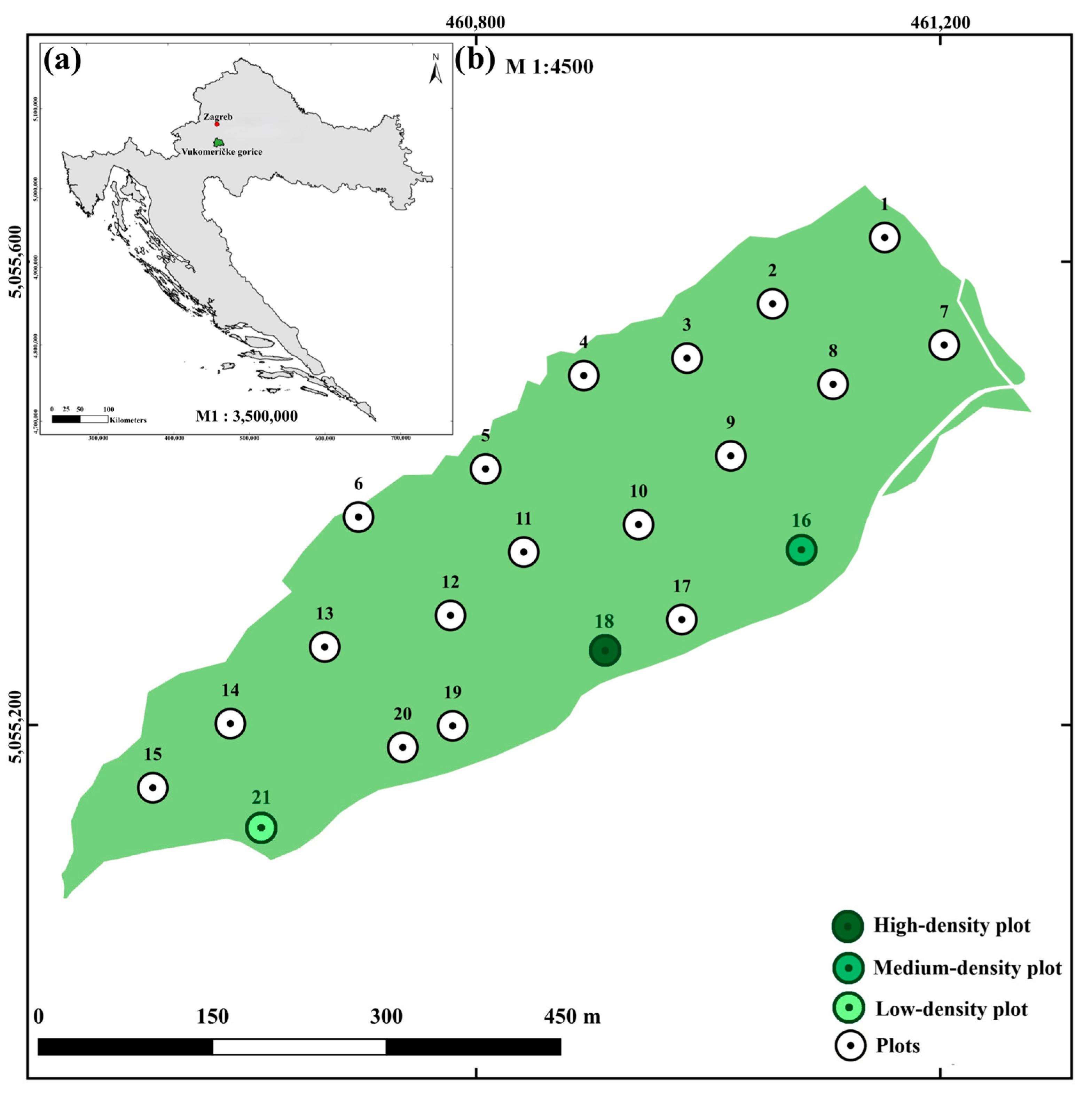
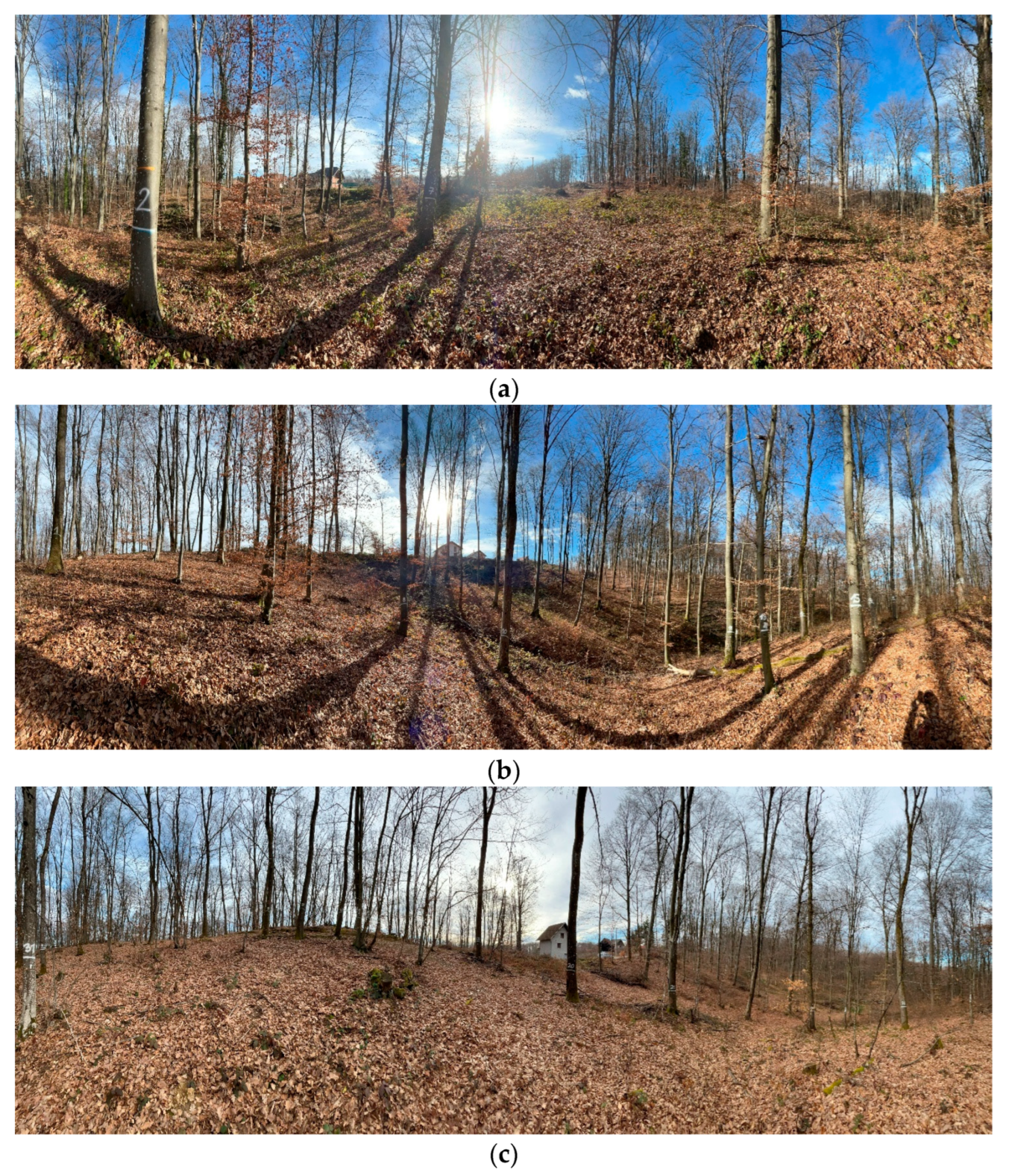
The research was conducted in an 88-year-old European beech forest stand situated within the management unit “Vukomeričke gorice” in Central Croatia, approximately 35 km south of Zagreb (Figure 1a). The forest stand is even-aged and mixed with other tree species (e.g., Quercus petraea (Matt.) Liebl., Carpinus betulus L.), covering an area of 19 hectares (Figure 1b). It is state-owned and actively managed for sustained timber production in 100-year rotations. The understory layer is very sparse and primarily composed of young beech individuals. The terrain is hilly, with slopes varying from 1° to 25° and elevations ranging from 152 to 203 m above sea level. For this study, three circular sample plots with a radius of 12.62 m (500 m2) were selected from a larger dataset of 16 permanent plots distributed (approximately 100 × 100 m) throughout the stand. To capture variation in stand density, all plots were ordered by tree count, and the plots corresponding to the 17th, 50th, and 83rd percentiles were selected. These plots represent low-, medium-, and high-density conditions, respectively (Figure 2).

2.2. Reference Ground-Truth Data

Reference ground-truth, i.e., DBH measured with a diameter tape and tree height estimated from TLS data, was collected during the leaf-off period in February 2025. First, the coordinates of the plot center were recorded using a Global Navigation Satellite System (GNSS) instrument, the Trimble R12i (Trimble Inc., Westminster, CO, USA), in conjunction with the Croatian network of GNSS reference stations (CROPOS) via the high-precision real-time positioning service (VPPS). In addition to the center plot, coordinates of four orientation points were also collected to support the georeferencing of point clouds. Both the plot center and orientation points were marked using square survey markers anchored in the ground with metal spikes.
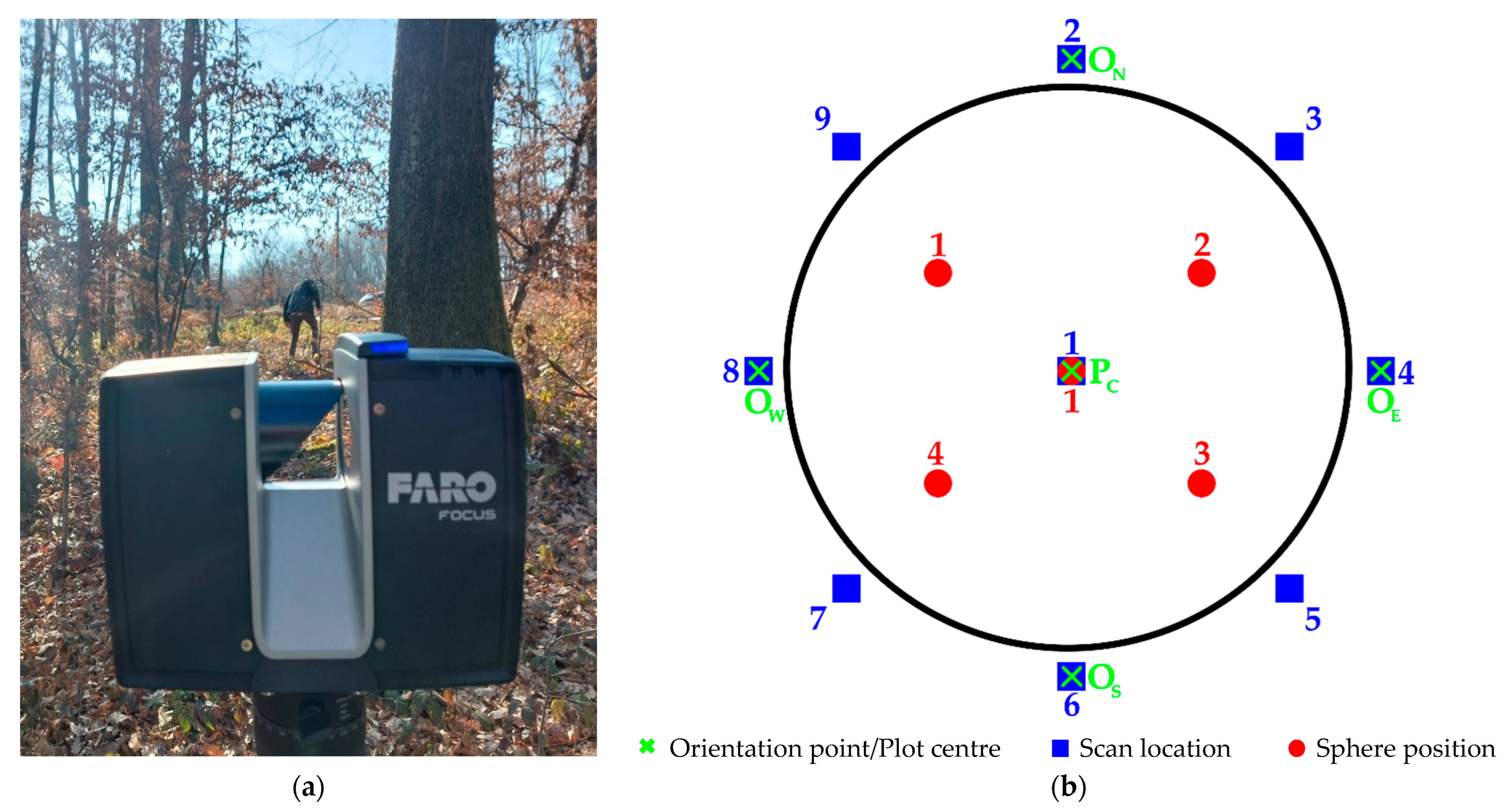
Subsequently, every tree in the plot with DBH ≥ 5 cm was numbered, starting at 1 and proceeding clockwise from north, using white spray paint. Each tree was also marked at a height of 1.30 m to ensure consistent DBH measurement. At the same time, the coordinates of each tree were determined by measuring the distance and azimuth from the plot center with an ultrasonic rangefinder Haglöf DME 201 (Haglöf Sweden AB, Långsele, Sweden) and a compass Suunto KB-14 (Suunto Oy, Vantaa, Finland), respectively. The coordinates were used to match field-measured trees to those in the TLS and PLS point clouds. Afterwards, the DBH of each tree was measured with a diameter tape to 0.1 cm readout. TLS data were collected concurrently in February 2025 using a FARO Focus Premium 150 instrument (FARO Technologies Inc., Lake Mary, FL, USA) (Table 1) with a multi-scan approach. Each of the three plots was scanned from nine strategically positioned locations to ensure optimal coverage and minimize occlusion effects (Figure 3). The first scan location was positioned at the plot center, while the remaining eight were arranged along the leading cardinal and intercardinal directions (N, NE, E, SE, S, SW, W, NW), approximately one meter outside the plot boundary. The scanner parameters were set to 1/4 resolution and 4× quality, where resolution represents the fraction of the maximum number of points the scanner can record, and quality denotes the number of repeated measurements of the same point during scanning. The scanner parameters were set to capture tree morphology from ground to canopy without generating excessive data, while the quality parameter ensured satisfactory precision. This resulted in approximately six minutes per scan location and about one hour per plot, including sphere setup and scan location configuration.
For registration (i.e., aligning individual scans), five reference spheres were used. The spheres were positioned within the plot to ensure that each scan location included at least three spheres within its field of view (Figure 3b). This setup ensured accurate registration and minimized registration errors.
The collected data were preprocessed using FARO Scene v2025.1.1 (FARO Technologies Inc., Lake Mary, FL, USA). The data from each scan location were unpacked into point clouds; the reference spheres were automatically detected and manually verified; and the point clouds were subsequently registered. The mean registration error for the low-, medium-, and high-density plots was 1.5 mm, 1.8 mm, and 1.8 mm, respectively. The registered point clouds were then georeferenced using orientation points. These points were marked manually and point clouds were transformed from the local reference coordinate system to the HTRS96/TM (Croatian Terrestrial Reference System/Transverse Mercator; EPSG:3765) reference coordinate system. Finally, the point clouds were merged into a single point cloud, duplicate points were removed, and the resulting point cloud was exported in .las format. The TLS data processing in LiDAR360 v8.1. software (GreenValley International, Berkeley, CA, USA) was performed in the same manner as the PLS data processing described in Section 2.3.
For this study, TLS-derived tree height served as the reference for validating PLS-derived tree height (Table 2). Previous studies [17,18,39] have shown that TLS-derived tree height provides a reliable reference because TLS data are highly accurate when a multi-scan approach is used. However, TLS is not entirely bias-free. Although a multi-scan acquisition was used to improve canopy coverage and reduce occlusion, residual occlusion, particularly in dense canopies and at treetops, may still affect height retrieval and can lead to underestimation.

2.3. PLS Data Collection

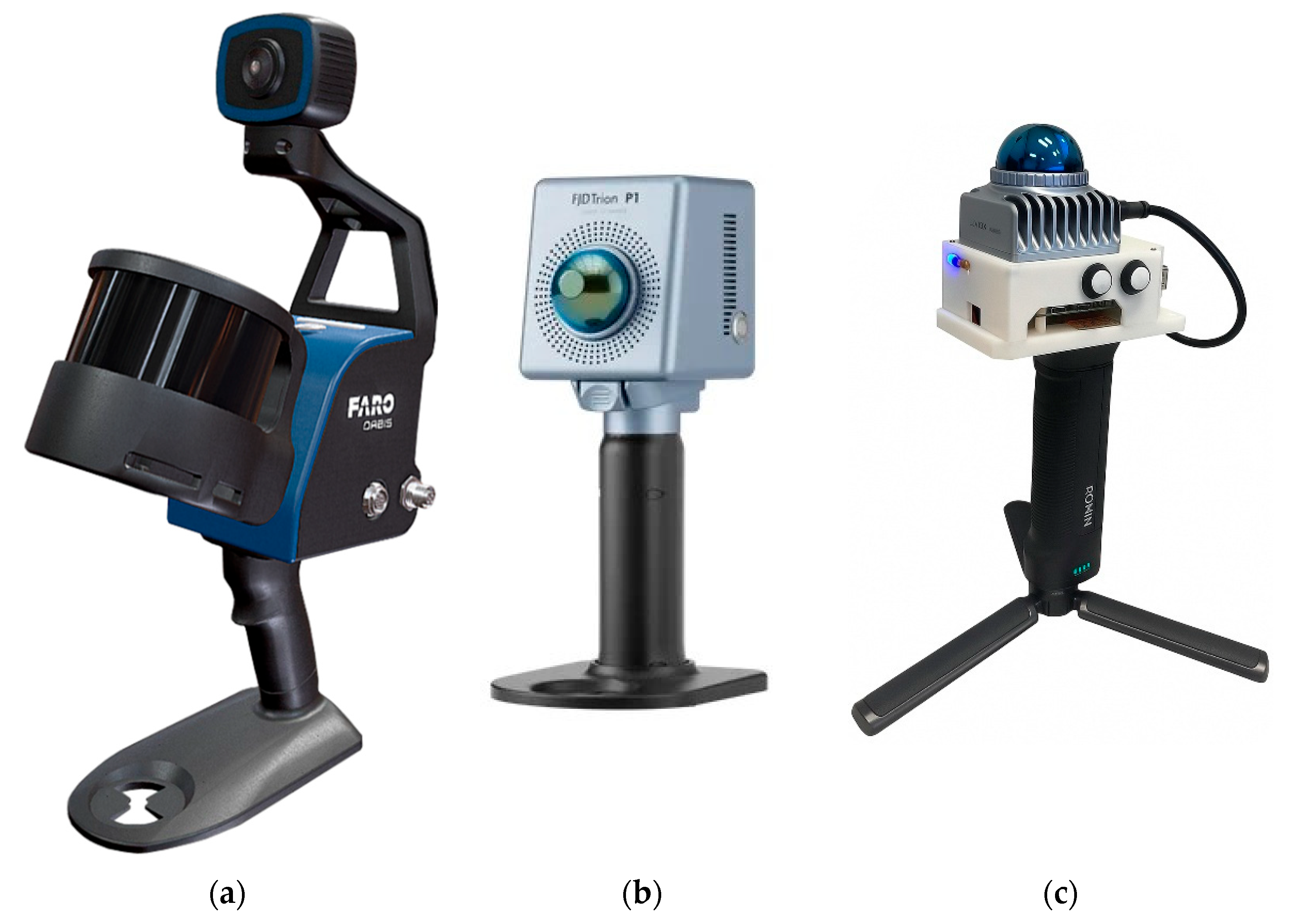
PLS data were collected during the same period as the reference ground-truth data, using three types of PLS instruments: a high-end FARO Orbis (FARO Technologies Inc., Lake Mary, FL, USA), an entry-level FJD Trion P1 (FJDynamics Inc., Singapore), and an open-source Mandeye-DEV (v0.1) (Figure 4). Mandeye-DEV is an open-source hardware and software LiDAR mapping system [40]. Both the open-source and entry-level models are equipped with the same LiDAR sensor, the Livox MID-360 (Livox Inc., Shenzhen, Guangdong, China), which utilizes a single laser with a non-repetitive scanning pattern, whereas the high-end model incorporates the HESAI Pandar XT32 (Hesai Technology Co., Ltd., Shanghai, China), a 32-channel LiDAR (Table 3). Each instrument features a different sensor configuration: the FARO Orbis (Figure 4a) has a rotating sensor located at the front of the device, whereas the FJD Trion P1 (Figure 4b) and Mandeye-DEV (Figure 4c) have fixed sensors positioned at the front and top, respectively. LiDAR sensor orientation on Mandeye-DEV is arbitrary, and the system that is used had a LiDAR sensor mounted on the top. For the FARO Orbis, the instrument position during scanning is less critical than for the FJD Trion P1 and Mandeye-DEV. The FJD Trion P1 must be held at a slight upward tilt, while the Mandeye-DEV should be tilted downward to capture both the ground and the treetops appropriately. Mandeye-DEV system consists of a Raspberry Pi computer (Raspberry Pi Holdings plc, Cambridge, UK), LiDAR sensor, USB storage and power source. It also has the capability to use RTK GNSS data and collect images. The system is compatible with numerous LiDAR sensors and has the capability to use at most two LiDAR sensors at once, which renders it a highly flexible platform for LiDAR SLAM scanning. The implementation used in this study uses a Raspberry Pi 4 computer running Mandeye controller firmware, Livox MID-360 LiDAR sensor, its built-in IMU sensor, and DJI RONIN battery grip as a power source. Regarding the SLAM algorithm, Mandeye-DEV uses an open-source LIO (LiDAR-Inertial Odometry) implementation with pose graph SLAM and ICP (Iterative Closest Point) and NDT (Normal Distributions Transform) scan alignment techniques. In comparison, the entry-level and high-end systems rely on proprietary algorithms developed by their respective companies, which are likewise not publicly disclosed.
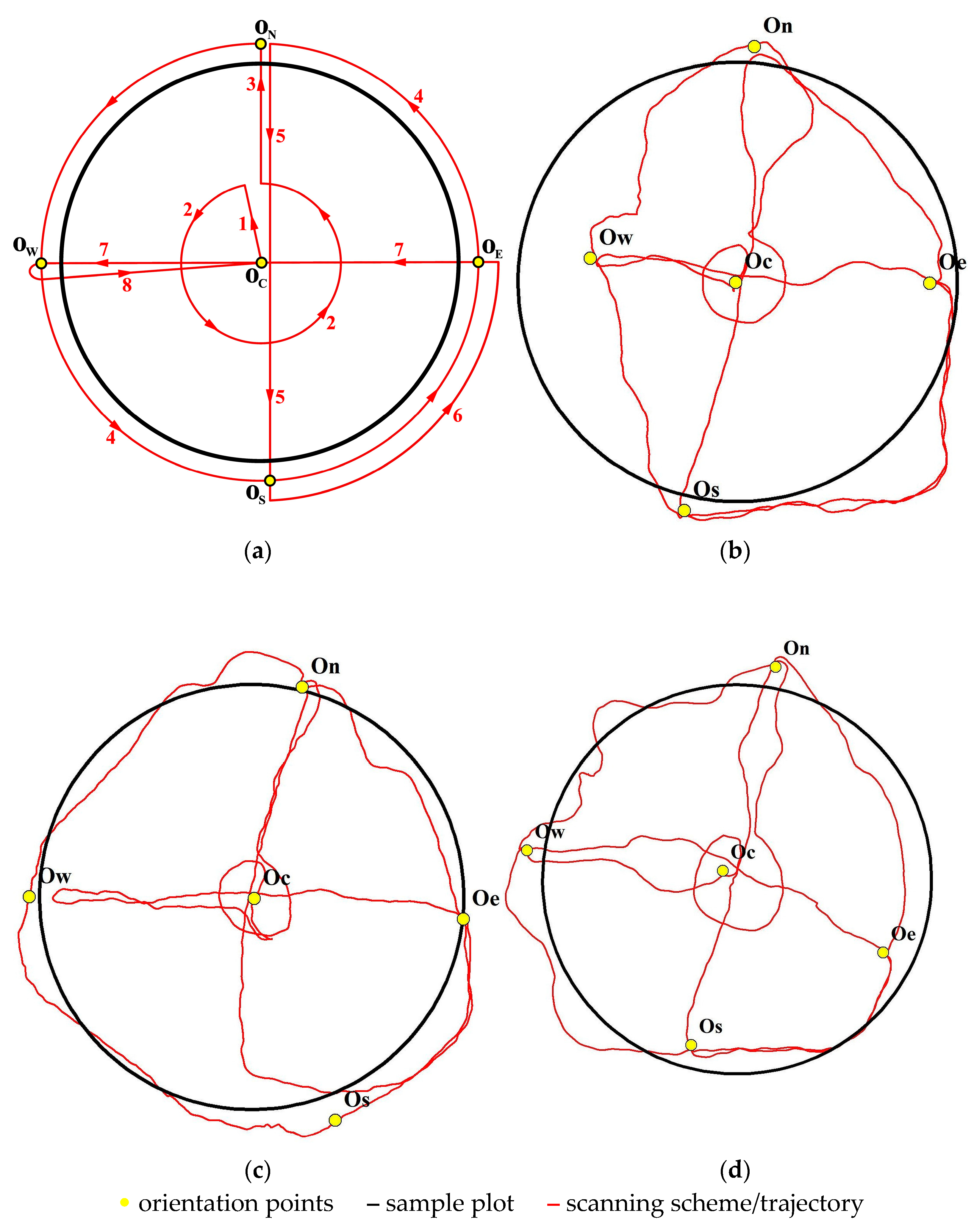
All three PLS instruments were used to scan the three selected plots following a predetermined scanning scheme with a closed-loop trajectory (Figure 5a). The operator aimed to adhere to the scheme as closely as possible; however, in some cases, this was not feasible due to obstacles within the plots (Figure 5b). The scanning scheme was designed to ensure optimal coverage of each plot while maintaining time efficiency [29]. The PLS survey started near the center of the plot where the first orientation point was registered (plot center). From the center, the operator walked a small circle, then continued northward, where he registered the second orientation point (ON). From there, he followed the plot perimeter while simultaneously recording the remaining orientation points (OW, OS, OE). After returning to the north, the operator crossed the plot in two directions: north to south and east to west, finally returning to the plot’s center to complete the loop. Each PLS survey took approximately five to six minutes to complete the scanning process.

2.4. PLS Data Processing

PLS data were pre-processed differently depending on the instrument model. For the open-source Mandeye-DEV scanner, raw data were processed in HDMapping open-source software (v 0.81) [40]. Entry-level FJD Trion P1 and high-end FARO Orbis data were pre-processed in their respective affiliate software, FJD Trion Model (FJDynamics Inc., Singapore) and FARO Connect v2025.1 (FARO Technologies Inc., Lake Mary, FL, USA), respectively. Each dataset was georeferenced to the HTRS96/TM reference coordinate system using the orientation points and exported in *.las format for further processing (Figure 6).
Point clouds in .las format were then imported into LiDAR360 v8.1, where each point cloud was trimmed to a circle using the Clip by Circle tool in the Tools module. The plot center coordinates were entered as the origin of the crop, with a crop radius of 17.62 m (12.62 m + 5 m buffer) from the plot center to retain the crowns of trees along the plot boundary. Outliers were removed using the Remove Outliers tool in the TLS Forest module on the trimmed point cloud to eliminate points below the ground surface or above the treetops, facilitating accurate classification and segmentation. Ground points were classified using the Classify Ground Points tool with the Gentle terrain parameters (max terrain angle = 88°; iteration angle = 8°; iteration distance = 1.4 m), and the point cloud was normalized using these ground points with the Normalize by Ground Points option within the Normalization tool. Normalization converted elevation values from absolute heights (above sea level) to relative heights, with the zero-level representing the stand’s ground.
The normalized point cloud was then processed semi-automatically, with automated processing and manual, visual operator control to ensure the highest accuracy of DBH and tree height estimates. For each instrument, three operators with different levels of experience (low, medium, high) independently performed the estimation tasks. Low experience refers to operators with solid theoretical knowledge but less than one year of processing experience, typically having processed fewer than 50 plots, and therefore requiring frequent supervision. Medium experience refers to operators with excellent theoretical knowledge and 1–3 years of processing experience, typically having processed approximately 50–200 plots; these operators are largely independent, requiring only occasional support. High experience refers to operators with excellent theoretical knowledge and more than five years of processing experience, typically having processed more than 200 plots; these operators are fully independent.
To isolate operator-related effects within the processing workflow, all PLS datasets were collected following an identical field acquisition protocol. Three operators (high-, medium-, and low-experience) independently processed the data using the same software versions and identical parameter settings. No operator-specific parameter adjustment or manual refinement was applied, ensuring that differences in the results could be attributed solely to operator experience rather than to variations in processing configuration. DBH and tree height were derived using predefined and uniform workflows with limited manual interaction restricted to standardized steps. Operators worked independently and were blinded to each other’s results, ensuring that operator effects reflected differences in data interpretation rather than differences in data acquisition or processing strategy.
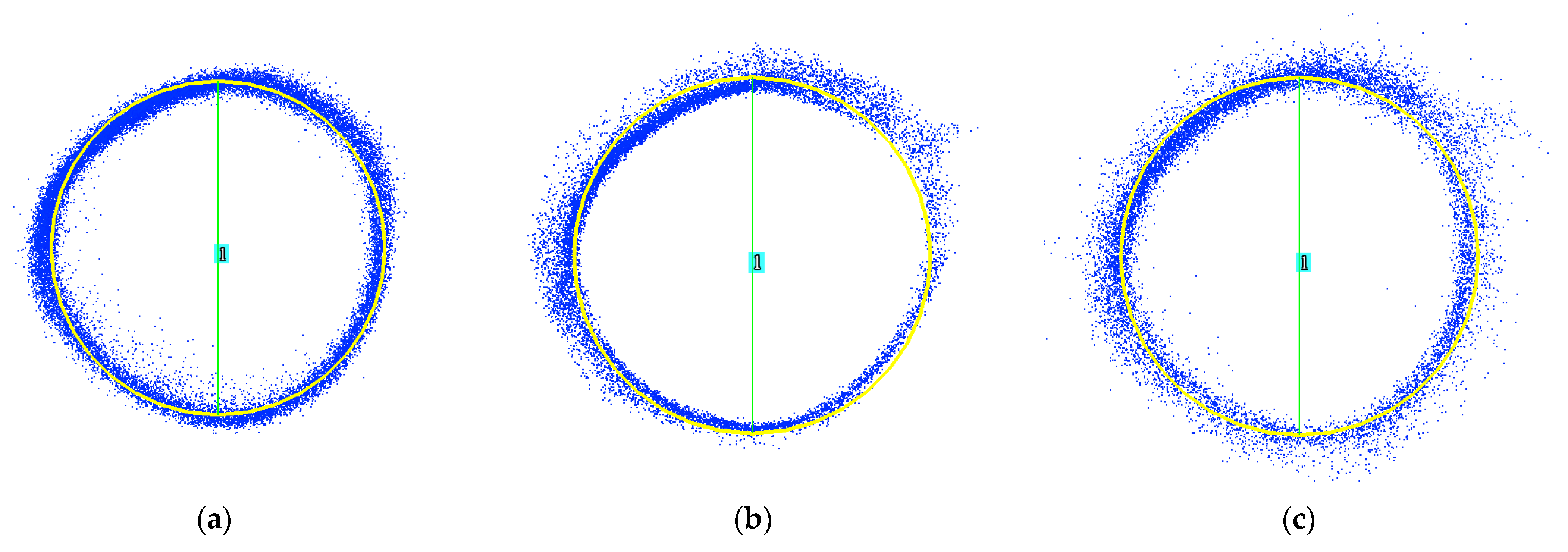
Using the TLS Seed Point Editor tool, the DBH of each tree was first manually marked on a cross-section of the point cloud at a height of 1.30 m. These manual markings were then precisely approximated using the Fit-by-Circle algorithm, which applies the least squares method to derive DBH from the x and y coordinates of the point cloud (Figure 6).
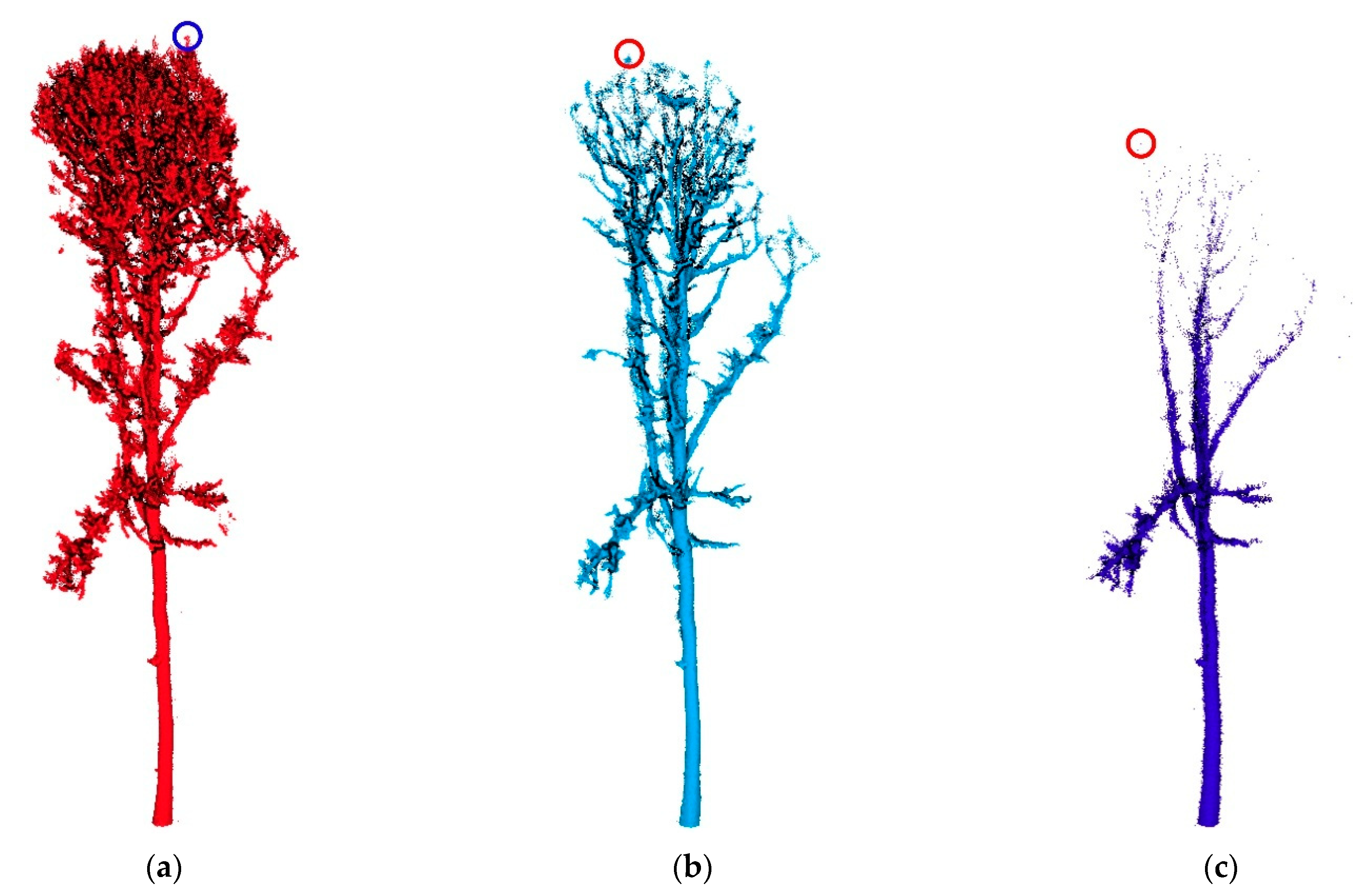
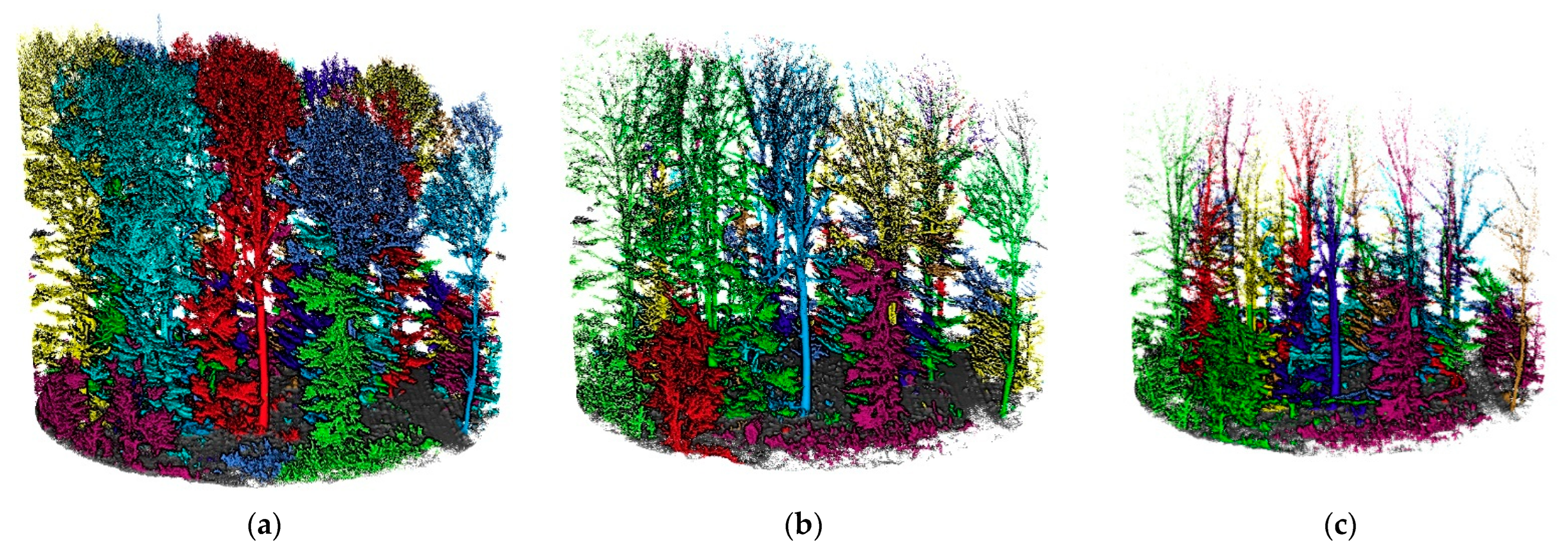
The resulting DBHs were subsequently used as seed points for segmenting individual trees from the entire point cloud using the Point Cloud Segmentation from Seed Points algorithm, ensuring that only trees associated with the predefined seed points were segmented (Figure 7). Because seeds were placed manually (one per visible stem, no duplicates), segmentation recall was 1.0 with no false positives for all instrument and operator combinations.
During segmentation, tree heights were initially estimated automatically for each segmented tree. All automatically estimated tree heights were then visually inspected and, if necessary, manually estimated using the Individual Tree Editor tool, with values derived visually from the highest point above ground within each individual tree point cloud (Figure 8). This setup enabled evaluation of both instrument performance and potential variability due to operator experience.
Besides accuracy, operational workload was recorded for the main workflow stages (Table A1). The high-end system generated denser point clouds, increasing data handling demands and extending computing time during preprocessing and processing. By contrast, although the entry-level and open-source systems rely on the same LiDAR sensor, their workflows differed: the entry-level platform uses an integrated proprietary SLAM and preprocessing software that streamlines preprocessing, whereas the open-source system relies on an open-source pipeline with more manual preprocessing and quality-control steps, resulting in longer operator time.

2.5. Data Evaluation and Analysis

For each PLS instrument (high-end, entry-level, and open-source), DBH and tree heights were estimated independently by three operators with varying levels of experience (low, medium, and high), allowing potential variability associated with operator-dependent estimation to be evaluated. The accuracy of each instrument–operator combination was evaluated by comparing their DBH and tree height estimates with reference ground-truth data, i.e., DBH measured with a diameter tape and tree height estimated from TLS data.
Accuracy was assessed using mean difference (MD, also referred to as bias) (Equation (1)) and root mean square error (RMSE) (Equation (3)), both expressed in their original units and as percentages relative to the reference values for each tree (Equations (2) and (4)). The MD was used to indicate whether the estimates tended to underestimate or overestimate the reference measurements, while the RMSE quantified the overall deviation from the reference measurements. The standard deviation (SD) (Equation (5)) was calculated as the sample standard deviation of the differences (residuals), describing the dispersion of the estimated values around the reference values.
M D = i = 1 n ( y ^ i y i ) n ,
M D % = M D y ¯ · 100 ,
R M S E = i = 1 n ( y ^ i y i ) 2 n ,
R M S E % = R M S E y ¯ · 100 ,
S D = i = 1 n [ ( y ^ i y i ) M D ] 2 n 1
In Equations (1)–(5), n is the number of analyzed trees, y ^ i is the estimated (DBH or tree heights) value for tree i, y i is the reference value for the respective tree, and y ¯ is the mean of the reference values.
To evaluate the influence of instrument type and operator experience on the accuracy of DBH and tree height estimation, two complementary repeated-measures ANOVA (RM-ANOVA) approaches were applied. First, a one-way RM-ANOVA was used to assess the independent effects of each factor separately, i.e., whether instrument type or operator experience alone significantly influenced estimation errors. Second, a two-factor RM-ANOVA was performed to quantify the combined and interactive effects of both factors, allowing to test whether operator influence depended on instrument class and whether instrument performance varied across operator experience levels.
For the one-way RM-ANOVA, Instrument and Operator were analyzed separately to determine the magnitude of each factor’s independent effect on DBH and tree height errors. Effect sizes were expressed as partial eta-squared (ηp2) and interpreted according to standard Cohen-style conventions (negligible < 0.01; small 0.01–0.05; medium 0.06–0.13; large ≥ 0.14) [41,42]. When main effects were statistically significant (p < 0.05), Holm-adjusted pairwise comparisons were performed to identify which instruments or operator experience levels differed. These comparisons were carried out (i) across instruments within each operator level and (ii) across operators within each instrument level.
Because each tree was measured under all instrument–operator combinations, a two-factor RM-ANOVA was conducted on tree-level differences (PLS estimated minus Reference), with Instrument (high-end, entry-level, open-source) and Operator (high-, medium-, low-experience) treated as within-subject factors, and the tree (plot × tree ID) treated as subjects. Effect sizes were again reported as ηp2. Sphericity was addressed by reporting Greenhouse–Geisser (GG) corrected tests for within-subject effects. All statistical analyses were performed using RStudio v2025.09.1+401 [43].
During the writing of this section, the authors used ChatGPT 5.1 to improve the clarity, coherence, and scientific style of the writing. ChatGPT was not used to generate manuscript text or scientific content.

3. Results

For the DBH analysis, all 61 trees within 3 sample plots were used; for the tree height analysis, 50 of 61 trees were analyzed, retaining only those with reliably estimated tree height in the reference data (i.e., clear treetop detection in TLS). The main exclusion reason was an unidentifiable treetop due to crown intertwinement/obscuration (n = 6), followed by severely leaning trees (n = 2), broken treetops (n = 2), and one standing dead tree (snag; n = 1) (Table A2). For clarity, MD reflects systematic bias (over- or underestimation), SD describes the spread of errors around this bias, and RMSE summarises overall accuracy by combining bias and dispersion into a single metric.

3.1. Accuracy Assessment of DBH Estimates Across PLS Instruments and Operators

Accuracy assessment results (Table 4) showed that data collected with the high-end PLS instrument yielded the most accurate DBH estimates, with RMSE values ranging from 5.03% to 5.29%, regardless of operator experience. The entry-level and open-source instruments produced DBH estimates of similar accuracy; however, a slight decrease in accuracy with decreasing operator experience was also observed. Specifically, RMSE ranged from 8.00%–9.12%, 10.39%–10.54%, and 11.02%–11.89% for high-, medium-, and low-experience operators, respectively.
According to MD values, DBH was on average overestimated across all Instrument × Operator combinations. The high-end instrument produced the smallest overestimation (MD = 3.33%–3.40%) and the lowest dispersion of estimated DBH values (SD = 0.89–0.92 cm), independent of operator experience. Compared with high-end instruments, both the entry-level and open-source instruments showed higher but mutually comparable overestimation, as well as slightly higher dispersion of estimated DBH values (SD = 1.16–1.48 cm). For both instruments, overestimation also increased slightly with decreasing operator experience. Specifically, MD ranged from 6.30%–7.65%, 8.45%–8.46%, and 9.22%–10.31% for high-, medium-, and low-experience operators, respectively.
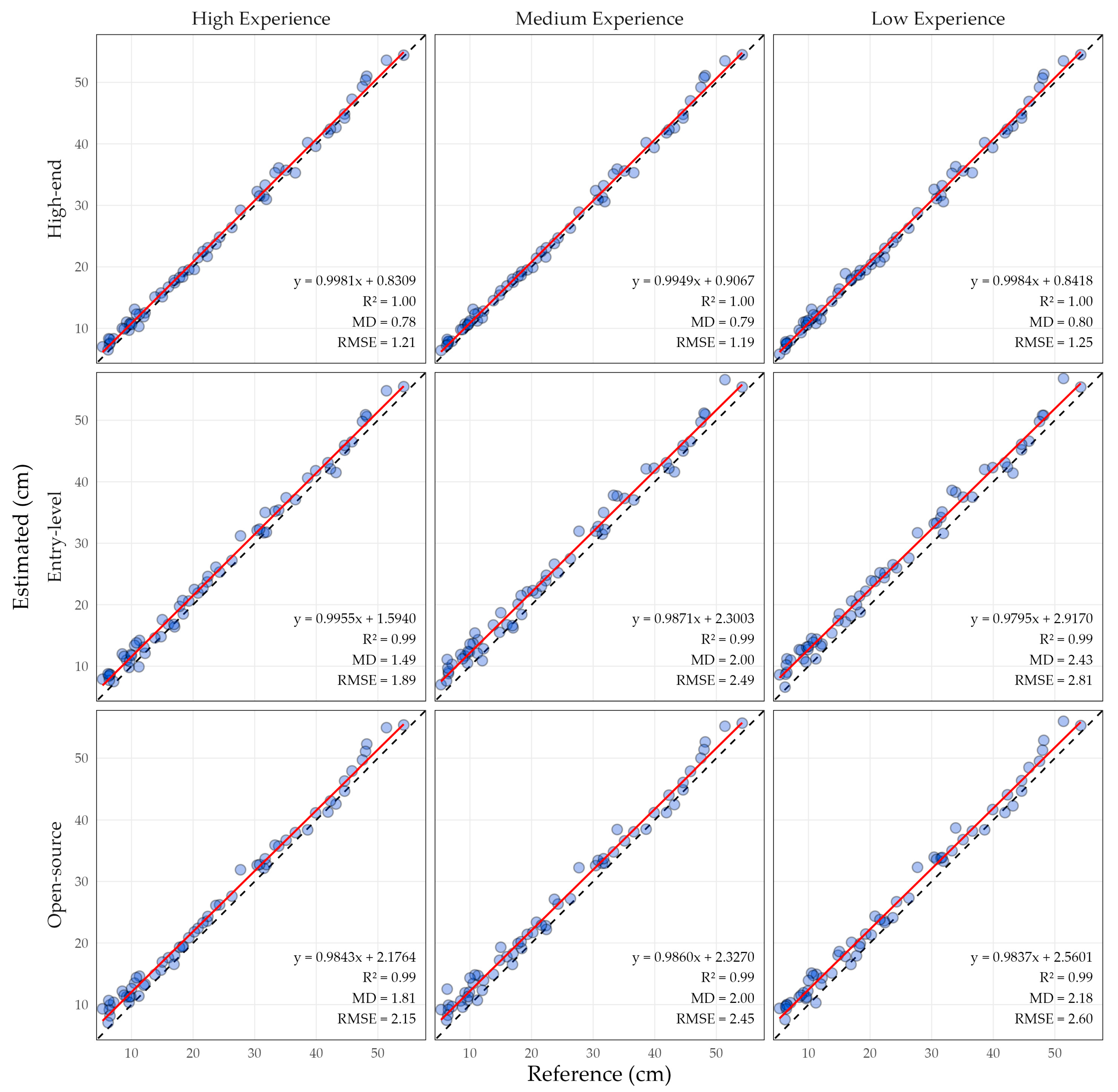
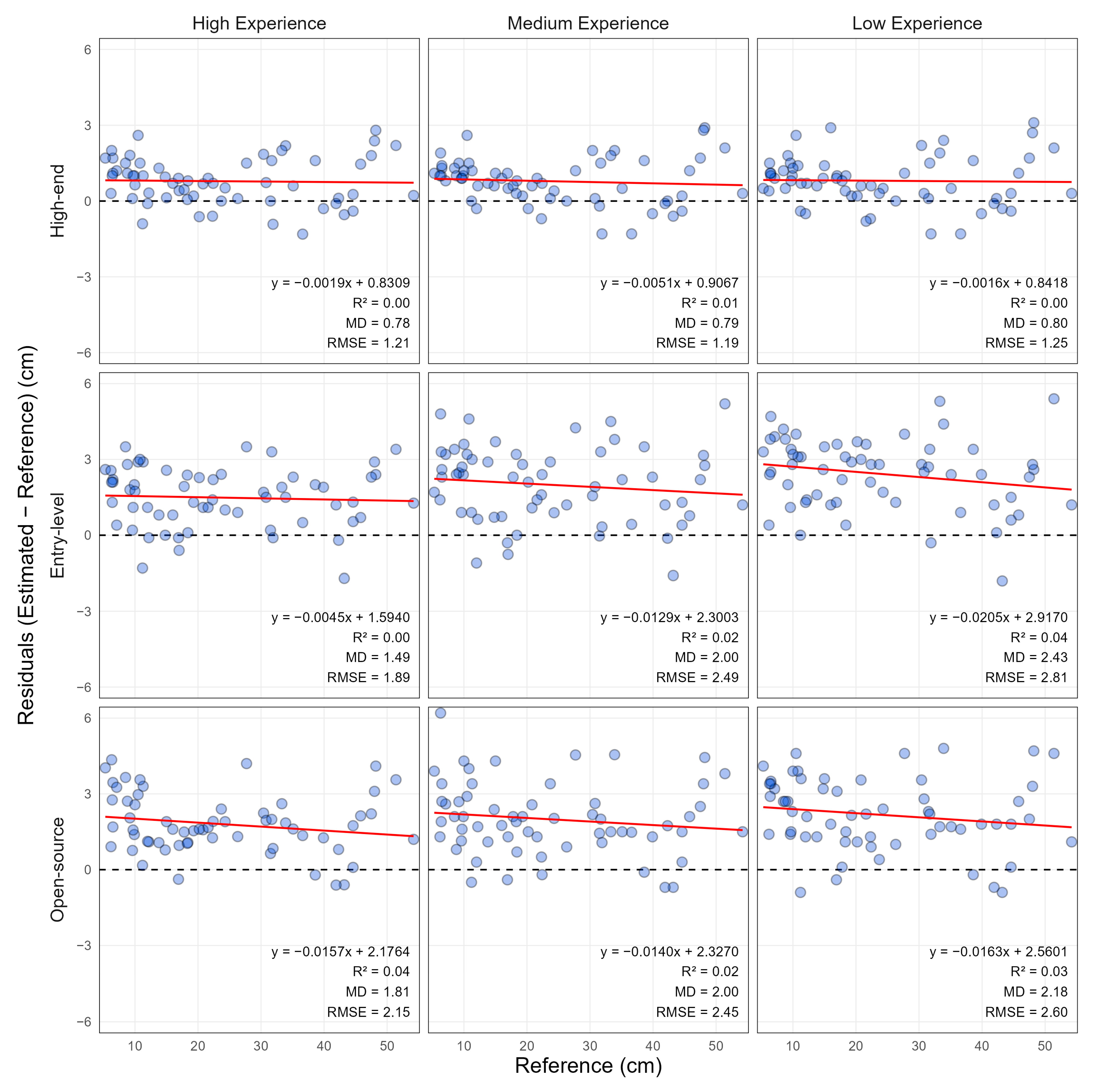
Visual interpretation of the scatterplots (Figure 9), i.e., the comparison of DBH estimates across all Instrument × Operator combinations against the reference measurements, supports the statistics presented in Table 4. The corresponding residual plots are provided in Figure A1. The scatterplots confirm the highest agreement between PLS-derived and reference DBH for the high-end instrument, with the smallest dispersion around the 1:1 line. Relative to the high-end instrument, DBH estimates from the entry-level and open-source instruments show somewhat weaker, though still high, agreement with the reference data, with greater dispersion from the 1:1 line. Deviations from the 1:1 line are nearly constant across the full DBH range (5–55 cm) of the sampled trees.

3.2. Accuracy Assessment of Tree Height Estimates Across PLS Instruments and Operators

Accuracy assessment metrics for tree height estimates (Table 5) showed that the high-end PLS instrument again produced the most accurate results, with RMSE values ranging from 0.89% to 2.68% across all operator experience levels. Accuracy decreased slightly with decreasing operator experience, although this effect was modest compared to the differences observed between instruments. Compared with the high-end instrument, the entry-level and open-source instruments exhibited consistently lower accuracy, with substantially higher RMSE values. For the entry-level instrument, RMSE ranged from 5.35% to 6.68%, while the open-source instrument yielded the largest errors, with RMSE ranging from 10.77% to 11.40%.
MD values further showed that the high-end instrument produced slight overestimates (MD = 0.40%–1.11%), whereas both the entry-level and open-source instruments consistently underestimated tree height. The entry-level instrument underestimated tree height by −3.77% to −4.77%, whereas the open-source instrument showed a greater underestimation, ranging from −7.52% to −8.20%. Dispersion of estimated heights followed the same pattern. SD values were lowest for the high-end instrument (0.17–0.51 m), intermediate for the entry-level instrument (0.80–0.98 m), and highest for the open-source instrument (1.61–1.69 m), indicating a gradual increase in variability as instrument class decreased. Operator experience had a minor but detectable influence on dispersion, particularly for the high-end instrument, where SD increased with declining experience.
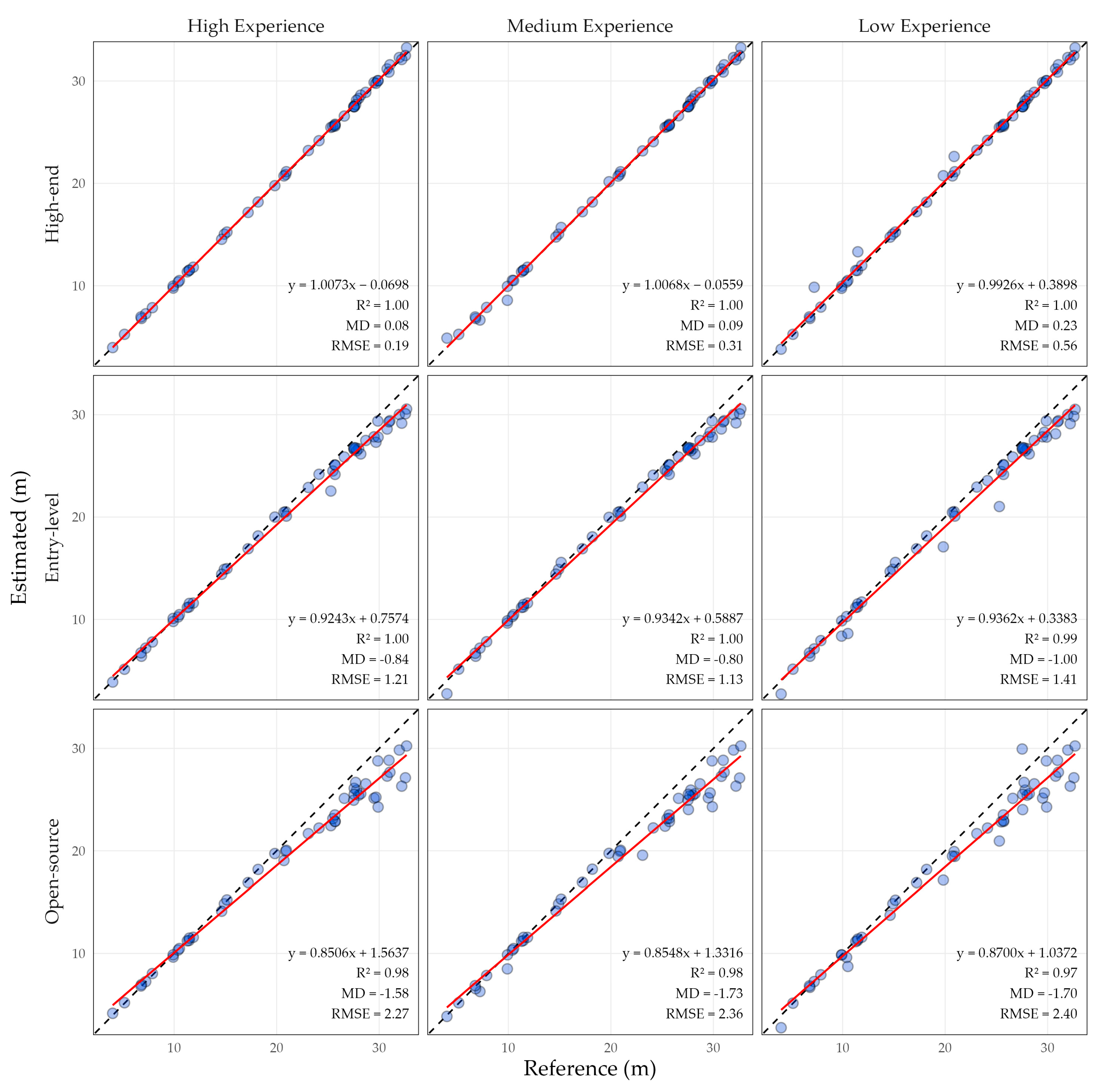
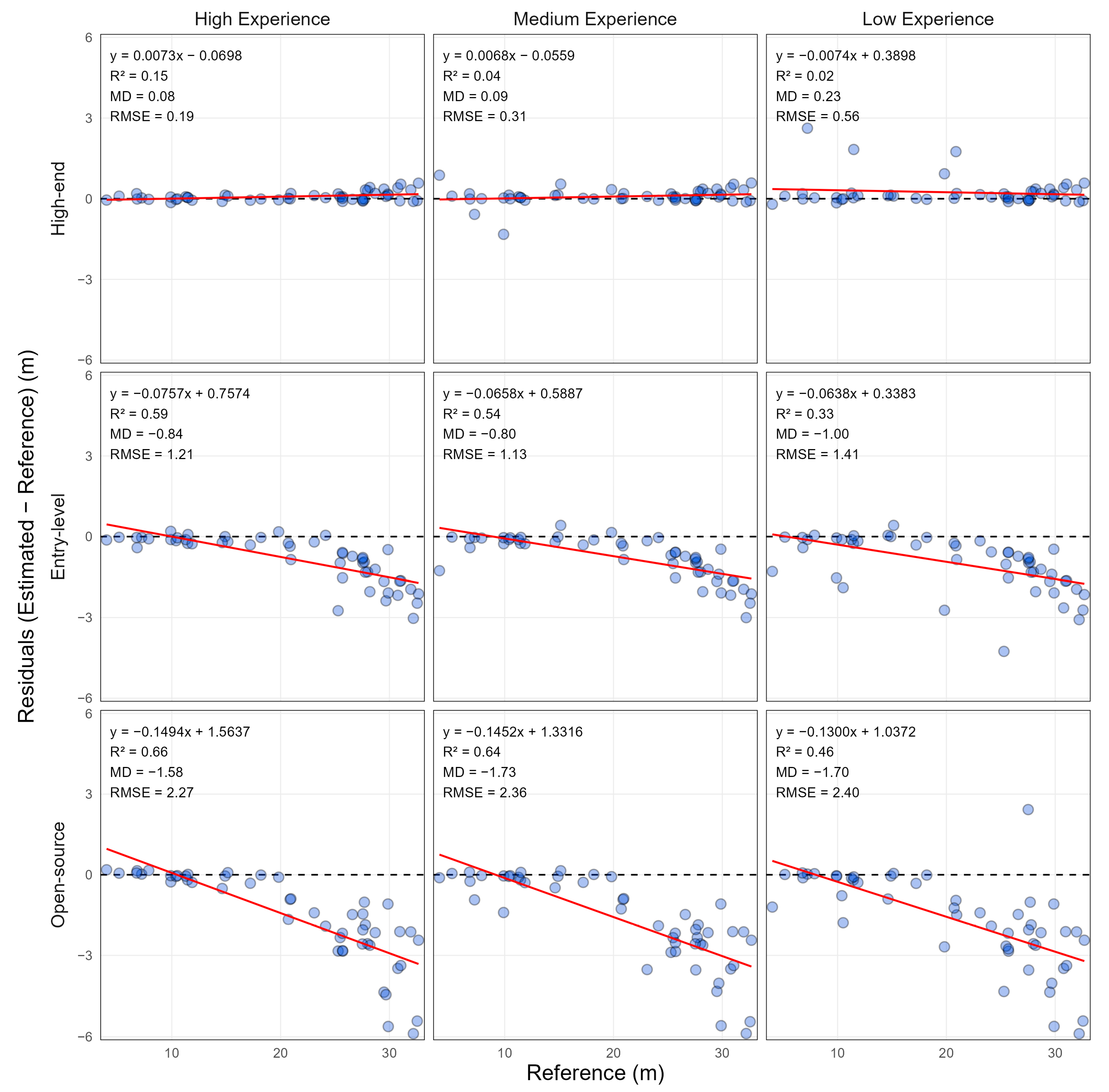
Visual interpretation of the scatterplots (Figure 10) supports the statistical findings presented in Table 5. The corresponding residual plots are provided in Figure A2. Tree height estimates obtained with the high-end instrument showed the closest agreement with reference measurements and the smallest dispersion around the 1:1 line across all levels of operator experience. Conversely, estimates from the entry-level and open-source instruments deviated further from the 1:1 line, with increasingly pronounced underestimation and broader scatter. The scatterplots further show that underestimation of tree height becomes more pronounced and consistently present for trees taller than 25 m when estimated from entry-level instrument data, and even greater for trees taller than 20 m when estimated from open-source instrument data.

3.3. Independent Effects of Instrument Type and Operator Experience on DBH and Tree Height Estimation Accuracy (One-Way RM-ANOVA)

The one-way RM-ANOVA further confirmed that instrument effects were significant and large, affecting the accuracy of both DBH and tree height estimates across all three operator experience levels (Table 6). Specifically, partial eta-squared (ηp2) values ranged from 0.372 to 0.492 for DBH and from 0.474 to 0.517 for tree height, indicating noticeably stronger instrument effects on tree height estimation accuracy than on DBH estimation. Additionally, post hoc Holm-adjusted pairwise comparisons revealed statistically significant differences (p < 0.05) among nearly all pairs of instruments for DBH (Table A3) and all pairs of instruments for tree height (Table A4). For DBH, all pairwise contrasts with the high-end instrument were statistically significant across all operator experience levels. Meanwhile, comparisons between the entry-level and open-source instruments showed no statistically significant differences for medium- and low-experience operators (p = 0.994 and p = 0.120, respectively), while the difference was significant for high-experience operators (p = 0.011). For tree height, however, all pairwise differences among instruments were statistically significant for all operator experience levels.
Unlike the analyses across instruments, the one-way RM-ANOVA revealed a present, but considerably weaker effect of the operator experience on the accuracy of both DBH and tree height estimates (Table 7). For DBH, the operator effect was negligible for the high-end instrument (ηp2 = 0.001), large for the entry-level instrument (ηp2 = 0.295), and medium for the open-source instrument (ηp2 = 0.084). For tree heights, the operator effect was small for the open-source instrument (ηp2 = 0.016) and medium for both the high-end (ηp2 = 0.058) and entry-level instruments (ηp2 = 0.067). Post hoc Holm-adjusted pairwise comparisons revealed statistically significant differences among operator levels only for DBH and only for specific instruments (Table A5). For the entry-level instrument, all three pairwise operator comparisons were statistically significant (p < 0.05), indicating that operator experience substantially influenced DBH accuracy when lower-grade sensor data were processed. For the open-source instrument, only the contrast between high- and low-experience operators was statistically significant (p = 0.007), whereas all other comparisons were not. For the high-end instrument, no significant differences were found among operators, confirming that a high-quality sensor effectively reduces operator-related variability in DBH estimates. For tree height, no statistically significant pair-wise differences among operators were observed for any instrument (Table A6). Although RM-ANOVA detected small to medium operator effects for some instruments, the post hoc tests showed that these effects were not strong enough to produce statistically significant differences in mean deviation (MD) across operator experience levels.

3.4. Combined and Interactive Effects of Instrument Type and Operator Experience on DBH and Tree Height Estimation Accuracy (Two-Factor RM-ANOVA)

The Two-factor RM-ANOVA (Instrument × Operator) further confirmed the magnitudes of the main effects and examined whether and how instrument performance and operator experience interact to influence the accuracy of DBH and tree height estimation (Table 8). For DBH, both main effects (instrument and operator) were statistically significant (p < 0.05), and the Interaction effect was significant as well. Effect sizes showed that the instrument effect remained dominant (ηp2 = 0.498), consistent with the findings from the one-way RM-ANOVA across instruments (Table 6). The operator effect was considerably smaller but still large (ηp2 = 0.246), reflecting the pattern previously observed in the one-way RM-ANOVA across operators (Table 7), where operator influence was evident primarily for lower-grade instruments (entry-level and open-source). Importantly, a significant Instrument × Operator interaction (ηp2 = 0.166) indicates that the influence of operator experience on DBH accuracy depends strongly on instrument type. This interaction consolidates the earlier observation that the high-end instrument effectively suppresses operator-related differences, whereas the entry-level and open-source instruments exhibit higher sensitivity to operator expertise. Thus, the two-factor analysis confirms and integrates the separate one-way results, showing that operator effects are not uniform across instruments but are evident primarily when processing data acquired with lower-performing sensors.
For tree height, the two-factor RM-ANOVA revealed a very strong instrument effect (ηp2 = 0.540), consistent with previous analyses indicating clear differences in tree height estimation accuracy among instruments. At the same time, the operator effect was not statistically significant (p = 0.661) and showed only a negligible effect size (ηp2 = 0.006), reinforcing prior findings that operator influence on tree height estimation is weak or absent. A small but statistically significant interaction effect (ηp2 = 0.062) suggests a modest variation in operator behavior across instruments; however, this effect is substantially smaller than the instrument effect and does not translate into significant pairwise differences, as previously demonstrated by the one-way operator-specific post hoc tests.

4. Discussion

4.1. Methodological Contribution and Context Within Existing PLS Research

This study provides a controlled and systematic evaluation of the performance of three handheld PLS instruments (high-end, entry-level, and open-source) and the influence of operator experience (high, medium, and low) on the accuracy of DBH and tree height estimates in even-aged beech stands. Unlike most previous PLS studies, which focused on a single instrument or operator, this research applies a full factorial design (Instrument × Operator) that enables a clear separation of main and interaction effects. In doing so, it addresses two important gaps in the literature: the lack of comparative assessments across different PLS hardware types and the limited empirical understanding of how operator expertise affects PLS-derived tree attributes. Because all instruments and operators followed the same workflow during data collection and processing, the results provide a useful basis for instrument selection under the tested stand conditions and workflow and inform future efforts towards standardising PLS-based forest inventory methods.
The PLS instruments used in this study differ markedly in their technical specifications (Table 3) and represent distinct performance and cost classes. The high-end FARO Orbis is a professional-grade PLS system and one of the most technically advanced handheld instruments currently available. The entry-level FJD Trion P1 and the open-source Mandeye-DEV fall into the lower-grade category. Although both rely on the same single-beam LiDAR sensor, their operational characteristics differ substantially. The Trion P1 is a commercial, integrated system with proprietary SLAM and processing software that enables a more stable and streamlined workflow, whereas the Mandeye-DEV is a considerably lower-cost open-source platform that requires more intensive manual preprocessing and is more sensitive to operator technique and scan trajectory. Despite using the same sensor, trajectory stability and point-cloud consistency may vary. These differences stem from the SLAM algorithm, its integration with the IMU, and calibration parameters. Such factors can influence DBH and tree height estimation. Since the Trion P1 SLAM implementation is proprietary, it could not be inspected or benchmarked against an open-source SLAM algorithm.

4.2. Interpretation of DBH Estimation Accuracy Across PLS Instruments and Operator Experience

Accuracy assessment results showed that data collected with the high-end PLS instrument produced slightly overestimated (MD = 3.33%–3.40%) but the most accurate DBH estimates (RMSE = 5.03%–5.29%) (Table 4, Figure 9), regardless of operator experience. Data collected with the entry-level and open-source instruments produced similar DBH accuracy; however, compared with the high-end system, both lower-grade instruments exhibited greater overestimation (MD = 6.30%–10.31%) and lower accuracy (RMSE = 8.00%–11.89%). Furthermore, for both lower-grade instruments, accuracy decreased slightly with decreasing operator experience. These trends are consistent with the only existing study that directly compared a lower-grade (Mandeye-DEV) and professional-grade (GeoSLAM ZEB Horizon, LiGrip H120) PLS instruments with reference TLS data [26], which also reported greater overestimation (MD = 4.51%) and lower accuracy (RMSE = 6.11%) for the lower-grade device. By comparison, professional-grade instruments in that study achieved accuracy (RMSE = 4.10%, 6.06%) comparable to the present results, but on average, underestimated DBH (MD = −2.35%, −5.15%). These differences most likely arise from the use of different reference datasets: whereas the present study used diameter tape measurements as ground truth, Balestra et al. [26] used TLS-derived DBH values.
While studies employing lower-grade PLS instruments in forest inventory remain scarce, professional-grade instruments (e.g., ZEB Horizon, FARO Orbis) have attracted greater attention in recent years. The findings of this study are broadly consistent with those of recent work using high-end devices [21,22,23,26,28,29,30,31,32,33]. However, because of substantial differences in forest structure, data acquisition protocols (e.g., plot size and shape, scanning schemes), and data-processing workflows (software and algorithms) across studies, direct comparisons are meaningful only for a subset of studies. Of particular relevance are studies that used the same instrument (FARO Orbis), nearly identical scanning and processing workflows, and the same reference ground-truth data (diameter tape) [29,33], both of which reported a consistent DBH overestimation trend. In these studies, conducted in the lowland pedunculate oak forest, MD values ranged from 0.58% to 1.28%, while RMSE ranged from 1.42% to 2.13%. The somewhat lower accuracy observed in the present study may be attributable to the more complex forest and terrain conditions of the study area.

4.3. Interpretation of Tree Height Estimation Accuracy Across PLS Instruments and Operator Experience

As with DBH, the high-end FARO Orbis produced the most accurate tree height estimates (RMSE = 0.89%–2.68%). Meanwhile, the entry-level (RMSE = 5.35%–6.68%) and, in particular, the open-source (RMSE = 10.77%–11.40%) instruments showed substantially lower accuracy (Table 5 and Figure 10). For all instruments, accuracy decreased slightly with decreasing operator experience. While the high-end instrument produced a slight overestimation (MD = 0.40%–1.11%), the entry-level (MD = −3.77% to −4.77%) and, particularly, the open-source (MD = −7.52% to −8.20%) instruments produced pronounced underestimations. The results obtained with the open-source instrument (Mandeye-DEV) are similar to those reported by Balestra et al. [26], who found an underestimation of −11.38% with an RMSE of 12.97% for the same instrument. The consistent underestimation of tree height observed for lower-grade instruments is likely related to limitations of the Livox MID-360 sensor rather than to operator-related effects. Its single-beam, non-repetitive scanning pattern, limited scanning range, and lower acquisition rate reduce vertical point density, resulting in incomplete treetop coverage. When combined with the narrower field of view, sensitivity to operator tilt, and occasional SLAM drift, these limitations may contribute to the consistent underestimation of tree height in taller trees. Despite relying on the same sensor, the entry-level instrument outperformed the open-source device. Specifically, consistent underestimation of tree height occurred consistently only for trees above approximately 25 m with the entry-level system, whereas the open-source device showed this pattern already above roughly 20 m (Figure 10). This difference may be related to the LiDAR sensor mounting configuration in conjunction with the LiVOX MID-360 sensor FOV. The entry-level system has a LiDAR sensor directed towards the operator’s walking path, whereas the open-source system has the LiDAR sensor pointed upwards. As a result, the open-source configuration may require laser beams to penetrate a larger portion of the canopy before reaching the treetop, increasing the probability of occlusion. Additional differences may also arise from firmware implementation, sensor calibration, and SLAM integration embedded in the commercial platform. Considering that Mandeye-DEV open-source system supports the use of various LiDAR sensors, as well as dual configuration of sensors [46], the results presented in this study reflect only this specific implementation of the system.
While the results of this study highlight a practical limitation of lower-grade PLS devices for accurate tree height estimation in high forests with dense canopies, the high-end (FARO Orbis) instrument demonstrated consistently high accuracy across the entire tree height range. Its superior performance can be attributed to the multi-channel rotating LiDAR architecture, a wider vertical field of view, a substantially larger scanning range, a higher acquisition rate, and more robust SLAM integration, all of which enhance canopy penetration and provide more complete treetop coverage. Combined with an appropriate data collection protocol, these advantages indicate the suitability of high-end PLS systems for reliable tree-level measurements in the studied even-aged beech stands; therefore, further validation in structurally more diverse forests is still required.
The findings of this study align with previous research reporting high performance and accuracy of high-end PLS systems for tree height estimation across different forest environments. For example, Jurjević et al. [20] reported MD of 1.82% and RMSE of 4.45% when comparing tree PLS-derived tree height estimates with conventional field measurements in mid-aged pedunculate oak stands. Similarly, Hyyppä et al. [22] reported MD values between 3.0% and 6.0% and RMSE values between 4.9% and 8.7% in boreal mixed forests when evaluated against ULS data. An even closer correspondence to the present results is observed in studies that used TLS as the reference dataset. Vandendaele et al. [24] reported an RMSE of 1.78% in Canadian mixed broadleaf stands, while Seletković et al. [33] estimated tree heights in an old pedunculate oak forest with MD of 0.69% and RMSE of 0.95%. A consistent pattern across the present study and previous research [20,22,24,33] is the slight overestimation tendency of PLS-derived tree heights, regardless of the type of reference data (field measurements, TLS, or ULS) or forest stand conditions. This trend suggests that high-end PLS instruments may provide some of the most accurate tree height estimates currently achievable. Indeed, classical field-based height measurements obtained with ultrasonic hypsometers can present errors of 1–5 m or more [6,8,19,20]. Vandendaele et al. [24] also noted that PLS may outperform TLS for tree height estimation because static TLS systems are more susceptible to occlusion. In addition, several studies [47,48,49,50] have shown that ULS frequently underestimates tree height due to crown occlusion, reduced point density at canopy apices, and filtering of isolated points during processing. Nevertheless, to conclusively determine whether PLS provides the most accurate tree height estimates, additional studies are required, particularly those comparing high-end PLS systems with ground-truth measurements, such as direct measurements of felled tree lengths during thinning or regeneration cutting operations.

4.4. Effects of Instrument Type and Operator Experience on DBH and Tree Height Accuracy (ANOVA-Based Interpretation)

One-way RM-ANOVA was used to assess the isolated effects of instrument type and operator experience on DBH and tree height estimation accuracy, whereas the two-factor RM-ANOVA was employed to quantify their combined and interactive effects.
The one-way ANOVA results showed that instrument type had a strong and statistically significant effect on the accuracy of both DBH and tree height estimates (Table 6, Table A3 and Table A4). Operator experience also influenced DBH accuracy, particularly for lower-grade instruments, whereas its effect on tree height was weaker and less consistent (Table 7, Table A5 and Table A6). These results indicate that operator experience influences DBH estimation more strongly than tree height estimation, and primarily when processing point clouds collected with lower-grade PLS instruments.
The two-factor RM-ANOVA confirmed these findings and provided additional insight into the interaction between instrument and operator (Table 8). Instrument type emerged as the primary determinant of estimation accuracy for both DBH and tree height, accounting for most of the observed variance. Operator effects were secondary and statistically relevant primarily for DBH estimation with lower-grade instruments. Importantly, the interaction effect for DBH was significant and substantial, demonstrating that operator influence is instrument-dependent rather than uniform across devices. From a methodological standpoint, the significant Instrument × Operator interaction for DBH is likely to reflect instrument-specific sensitivity to scan trajectory and SLAM stability. For lower-grade systems, even small differences in operator behavior, such as path geometry, overlap/loop closures, and distance to stems, can amplify drift and point-cloud inconsistency. This subsequently degrades the 1.3 m stem cross-sections used for circle fitting and increases operator-to-operator variability. Unlike the lower-grade systems, the high-end FARO Orbis produces denser, more stable point clouds, thereby reducing operator effects. Meanwhile, Trion P1′s proprietary SLAM prevents direct inspection of the underlying algorithmic causes. This interpretation is consistent with the observed patterns but cannot be fully verified for proprietary processing pipelines.
This interaction reflects a pattern already evident in the descriptive accuracy results (Table 4 and Table 5). For DBH, the difference in performance between entry-level and open-source instruments was small for most operators and became noticeable only for those with the highest experience (Table 4). In other words, operator skill improves DBH accuracy only when sensor limitations are not the dominant source of error. While for tree height all pairwise differences between instruments were statistically significant across all operator experience levels (Table 5, Table 6 and Table A4), indicating that tree height estimation is primarily determined by sensor characteristics rather than by operator expertise. For tree height, the interaction effect was minimal (Table 8 and Table A6), consistent with the observation that sensor-related limitations dominate the error structure in lower-grade instruments. Even highly experienced operators could not overcome the inherent constraints of the sensor in lower-grade PLS instruments, resulting in a consistent underestimation of taller trees (Table 5 and Figure 10).

5. Conclusions

This study provides a comprehensive evaluation of the performance of three handheld PLS instruments (high-end, entry-level, and open-source) and the influence of operator experience (high, medium, and low) on the accuracy of DBH and tree height estimates in even-aged European beech stands. Based on consistent acquisition and processing workflows, a full factorial experimental design, and statistical analysis, three main conclusions were drawn.
First, instrument type is the dominant factor determining estimation accuracy. The high-end system consistently produced the most accurate DBH and height estimates, whereas the two lower-grade systems, despite providing acceptable DBH accuracy, consistently underestimated tree height due to inherent sensor and SLAM-related limitations. These differences were substantial across all levels of operator experience, indicating that instrument selection represents the most critical decision when deploying PLS for tree height estimation in operational forest inventory.
Second, operator experience has a secondary but measurable effect. More experienced operators achieved improved DBH accuracy when processing lower-grade point clouds, but operator influence was negligible when using the high-end system. For tree height, operator effects were weak and inconsistent, indicating that tree height estimation accuracy is governed primarily by system performance. Third, interaction effects between instrument type and operator experience show that device performance characteristics limit operator influence. High-end systems suppress operator-induced variation, whereas lower-grade systems amplify it. This indicates that training and experience improve results only within the limits imposed by system performance and cannot compensate for fundamental hardware limitations, particularly in tree height estimation.
Taken together, the findings indicate that handheld PLS can support operational forest inventory when instrument capabilities are aligned with the accuracy requirements of the target variables. High-end systems remain essential for applications requiring reliable tree height information, whereas lower-grade systems currently offer a lower-cost option for inventories focused primarily on DBH.
From an operational perspective, these findings provide practical guidance for instrument selection and contribute towards standardizing PLS-based forest inventory workflows through consistent acquisition/processing protocols and explicit separation of instrument and operator effects. Because the study was conducted in an even-aged beech stand with moderate stem density, further validation in structurally diverse forest conditions is needed to assess the generality of the results. As the market for PLS instruments continues to expand, future research should include broader comparisons across clearly defined instrument classes to quantify trade-offs among cost, achievable accuracy, and inventory objectives.

Author Contributions

Conceptualization, A.K., D.M. and I.B.; formal analysis, A.K. and I.B.; investigation, A.K., A.S., L.J., K.I. and I.B.; data curation, A.K., A.S., L.J. and K.I.; writing—original draft preparation, A.K. and I.B.; writing—review and editing, A.S., L.J., D.M. and K.I. All authors have read and agreed to the published version of the manuscript.

Funding

This research was funded by the Croatian Science Foundation, project number IP-2022-10-9246; “Close-Range Remote Sensing for Precision Forest Inventory (CLOSER-FORINVENT)”.

Data Availability Statement

The datasets generated and analyzed during the current study are available from the corresponding author on reasonable request.

Acknowledgments

We would like to express our sincere gratitude to GEOCENTAR d.o.o. for enabling the FJD Trion P1 data collection and pre-processing. During the preparation of this manuscript/study, the authors used ChatGPT 5.1 to improve the clarity, coherence, and scientific style of the writing. ChatGPT was not used to generate manuscript text or scientific content. The authors have reviewed and edited the output and take full responsibility for the content of this publication.

Conflicts of Interest

Author Luka Jurjević was employed by the company Geo Unit Ltd. The remaining authors declare that the research was conducted in the absence of any commercial or financial relationships that could be construed as a potential conflict of interest.

Appendix A

Table A1. Operational workload time requirements by instrument grade.
InstrumentPre-ProcessingProcessingDBH EstimationTree Height EstimationTotal
High-end20105–1015–2050–60
Entry-level1055–1020–2540–50
Open-source1555–1025–3050–60
Note. All values are reported as minutes per plot under the applied workflow. Processing refers to hands-off computing time required by the software. Times are reported as operational workload indicators and are not intended as a formal economic cost–benefit analysis.

Appendix B

Table A2. Trees excluded from the height analysis.
PlotTree IDHeight Class (m)SpecieCanopy PositionReason
16715–20European beechSuppressedCrown not identifiable (intertwined/no clear treetop)
161320–25European beechIntermediateCrown not identifiable (intertwined/no clear treetop)
16175–10European beechSuppressedStanding dead tree (snag)
1865–10Common hornbeamSuppressedStem form (severely leaning tree)
181020–25Sessile oakCo-dominantCrown not identifiable (intertwined/no clear treetop
181120–25European beechCo-dominantCrown not identifiable (intertwined/no clear treetop
181315–20European beechCo-dominantCrown not identifiable (intertwined/no clear treetop
18145–10European beechSuppressedCrown not identifiable (intertwined/no clear treetop
18165–10European beechIntermediateStem form (severely leaning tree)
21815–20European beechIntermediateTop damaged (broken treetop)
2195–10European beechSuppressedTop damaged (broken treetop)

Appendix C

Figure A1. Residuals (Estimated − Reference) of DBH produced by high-, medium-, and low-experience operators from data collected with three PLS instruments (high-end, entry-level, and open-source), plotted against reference DBH measured with a diameter tape at 1.3 m (n = 61 trees). The solid red line represents the linear regression of residuals on the reference values, while the dashed line represents the zero-residual line (perfect agreement).
Forests 17 00216 g0a1
Figure A2. Residuals (Estimated − Reference) of tree height produced by high-, medium-, and low-experience operators from data collected with three PLS instruments (high-end, entry-level, and open-source), plotted against reference tree height derived from TLS (n = 50 trees; only trees with reliable TLS treetop detection were retained). The solid red line represents the linear regression of residuals on the reference values, while the dashed line represents the zero-residual line (perfect agreement).
Forests 17 00216 g0a2

Appendix D

Table A3. Post hoc comparisons among instruments for DBH across operator experience levels.
OperatorComparisonMD (cm)df (GG)tp (Holm)
High ExperienceHigh-end—Entry-level−0.7060−5.31<0.001
High-end—Open-source−1.0260−8.60<0.001
Entry-level—Open-source−0.3260−2.640.011
Medium ExperienceHigh-end—Entry-level−1.2160−7.86<0.001
High-end—Open-source−1.2160−7.88<0.001
Entry-level—Open-source<0.01600.010.994
Low ExperienceHigh-end—Entry-level−1.6360−9.78<0.001
High-end—Open-source−1.3760−8.67<0.001
Entry-level—Open-source0.26601.580.120
Table A4. Post hoc comparisons among instruments for tree height across operator experience levels.
OperatorComparisonMD (m)df (GG)tp (Holm)
High ExperienceHigh-end—Entry-level0.92496.79<0.001
High-end—Open-source1.67496.95<0.001
Entry-level—Open-source0.75495.41<0.001
Medium ExperienceHigh-end—Entry-level0.89496.71<0.001
High-end—Open-source1.82497.75<0.001
Entry-level—Open-source0.93496.02<0.001
Low ExperienceHigh-end—Entry-level1.24498.11<0.001
High-end—Open-source1.93497.91<0.001
Entry-level—Open-source0.70494.25<0.001
Table A5. Post hoc comparisons among operators for DBH with different instruments.
InstrumentComparisonMD (cm)df (GG)tp (Holm)
High-endHigh—Medium<0.0160−0.011.000
High—Low−0.0260−0.261.000
Medium—Low−0.0260−0.341.000
Entry-levelHigh—Medium−0.5160−4.16<0.001
High—Low−0.9460−6.76<0.001
Medium—Low−0.4460−3.180.002
Open-sourceHigh—Medium−0.1960−1.730.176
High—Low−0.3760−3.180.007
Medium—Low−0.1860−1.650.176
Table A6. Post hoc comparisons among operators for tree height with different instruments.
InstrumentComparisonMD (m)df (GG)tp (Holm)
High-endHigh—Medium0.0049−0.090.931
High—Low−0.1549−2.040.140
Medium—Low−0.1549−1.670.202
Entry-levelHigh—Medium−0.0449−0.740.463
High—Low0.17491.910.137
Medium—Low0.21492.050.137
Open-sourceHigh—Medium0.14491.970.163
High—Low0.12490.880.771
Medium—Low−0.0349−0.190.853

References

  1. Liang, X.; Kukko, A.; Balenović, I.; Saarinen, N.; Junttila, S.; Kankare, V.; Holopainen, M.; Mokroš, M.; Surový, P.; Kaartinen, H.; et al. Close-range remote sensing of forests: The state of the art, challenges, and opportunities for systems and data acquisitions. IEEE Geosci. Remote Sens. Mag. 2022, 10, 32–71. [Google Scholar] [CrossRef]
  2. Jurjević, L.; Liang, X.; Gašparović, M.; Balenović, I. Is field-measured tree height as reliable as believed—Part II, a comparison study of tree height estimates from conventional field measurement and low-cost close-range remote sensing in a deciduous forest. ISPRS J. Photogramm. Remote Sens. 2020, 169, 227–241. [Google Scholar] [CrossRef]
  3. Durrieu, S.; Vega, C.; Bouvier, M.; Gosselin, F.; Renaud, J.-P.; Saint-André, L. Optical Remote Sensing of Tree and Stand Heights. In Remote Sensing Handbook; Taylor & Francis: New York, NY, USA, 2015. [Google Scholar]
  4. Kershaw, J.A.; Ducey, M.J.; Beers, T.W.; Husch, B. Forest Mensuration; Wiley: Chichester, UK, 2016. [Google Scholar]
  5. Luoma, V.; Saarinen, N.; Wulder, M.A.; White, J.C.; Vastaranta, M.; Holopainen, M.; Hyyppä, J. Assessing precision in conventional field measurements of individual tree attributes. Forests 2017, 8, 38. [Google Scholar] [CrossRef]
  6. Ganz, S.; Käber, Y.; Adler, P. Measuring tree height with remote sensing—A comparison of photogrammetric and LiDAR data with different field measurements. Forests 2019, 10, 694. [Google Scholar] [CrossRef]
  7. Stereńczak, K.; Mielcarek, M.; Wertz, B.; Bronisz, K.; Zajączkowski, G.; Jagodziński, A.M.; Ochał, W.; Skorupski, M. Factors influencing the accuracy of ground-based tree-height measurements for major European tree species. J. Environ. Manag. 2019, 231, 1284–1292. [Google Scholar] [CrossRef] [PubMed]
  8. Wang, Y.; Lehtomäki, M.; Liang, X.; Pyörälä, J.; Kukko, A.; Jaakkola, A.; Liu, J.; Feng, Z.; Chen, R.; Hyyppä, J. Is field-measured tree height as reliable as believed—A comparison study of tree height estimates from field measurement, airborne laser scanning and terrestrial laser scanning in a boreal forest. ISPRS J. Photogramm. Remote Sens. 2019, 147, 132–145. [Google Scholar] [CrossRef]
  9. Bragg, D.C. Accurately measuring the height of (real) forest trees. J. For. 2014, 112, 51–54. [Google Scholar] [CrossRef]
  10. Tompalski, P.; Coops, N.C.; White, J.C.; Wulder, M.A. Simulating the impacts of error in species and height upon tree volume derived from airborne laser scanning data. For. Ecol. Manag. 2014, 327, 167–177. [Google Scholar] [CrossRef]
  11. White, J.C.; Coops, N.C.; Wulder, M.A.; Vastaranta, M.; Hilker, T.; Tompalski, P. Remote sensing technologies for enhancing forest inventories: A review. Can. J. Remote Sens. 2016, 42, 619–641. [Google Scholar] [CrossRef]
  12. Balenović, I.; Liang, X.; Jurjević, L.; Hyyppä, J.; Seletković, A.; Kukko, A. Hand-held personal laser scanning—Current status and perspectives for forest inventory application. Croat. J. For. Eng. 2021, 42, 165–183. [Google Scholar] [CrossRef]
  13. Rahlf, J.; Breidenbach, J.; Solberg, S.; Næsset, E.; Astrup, R. Comparison of four types of 3D data for timber volume estimation. Remote Sens. Environ. 2014, 155, 325–333. [Google Scholar] [CrossRef]
  14. Liang, X.; Hyyppä, J.; Kaartinen, H.; Lehtomäki, M.; Pyörälä, J.; Pfeifer, N.; Holopainen, M.; Brolly, G.; Francesco, P.; Hackenberg, J.; et al. International benchmarking of terrestrial laser scanning approaches for forest inventories. ISPRS J. Photogramm. Remote Sens. 2018, 144, 137–179. [Google Scholar] [CrossRef]
  15. Liang, X.; Kankare, V.; Hyyppä, J.; Wang, Y.; Kukko, A.; Haggrén, H.; Yu, X.; Kaartinen, H.; Jaakkola, A.; Guan, F.; et al. Terrestrial laser scanning in forest inventories. ISPRS J. Photogramm. Remote Sens. 2016, 115, 63–77. [Google Scholar] [CrossRef]
  16. Wilkes, P.; Lau, A.; Disney, M.; Calders, K.; Burt, A.; Gonzalez de Tanago, J.; Bartholomeus, H.; Brede, B.; Herold, M. Data acquisition considerations for terrestrial laser scanning of forest plots. Remote Sens. Environ. 2017, 196, 140–153. [Google Scholar] [CrossRef]
  17. Disney, M.; Burt, A.; Calders, K.; Schaaf, C.; Stovall, A. Innovations in ground and airborne technologies as reference and for training and validation: Terrestrial laser scanning (TLS). Surv. Geophys. 2019, 40, 937–958. [Google Scholar] [CrossRef]
  18. Calders, K.; Newnham, G.; Burt, A.; Murphy, S.; Raumonen, P.; Herold, M.; Culvenor, D.; Avitabile, V.; Disney, M.; Armston, J.; et al. Nondestructive estimates of above-ground biomass using terrestrial laser scanning. Methods Ecol. Evol. 2015, 6, 198–208. [Google Scholar] [CrossRef]
  19. Ryding, J.; Williams, E.; Smith, M.; Eichhorn, M. Assessing handheld mobile laser scanners for forest surveys. Remote Sens. 2015, 7, 1095–1111. [Google Scholar] [CrossRef]
  20. Bauwens, S.; Bartholomeus, H.; Calders, K.; Lejeune, P. Forest inventory with terrestrial LiDAR: A comparison of static and hand-held mobile laser scanning. Forests 2016, 7, 127. [Google Scholar] [CrossRef]
  21. Gollob, C.; Ritter, T.; Nothdurft, A. Forest inventory with long range and high-speed personal laser scanning (PLS) and simultaneous localization and mapping (SLAM) technology. Remote Sens. 2020, 12, 1509. [Google Scholar] [CrossRef]
  22. Hyyppä, E.; Yu, X.; Kaartinen, H.; Hakala, T.; Kukko, A.; Vastaranta, M.; Hyyppä, J. Comparison of backpack, handheld, under-canopy UAV, and above-canopy UAV laser scanning for field reference data collection in boreal forests. Remote Sens. 2020, 12, 3327. [Google Scholar] [CrossRef]
  23. Mokroš, M.; Mikita, T.; Singh, A.; Tomaštík, J.; Chudá, J.; Wężyk, P.; Kuželka, K.; Surový, P.; Klimánek, M.; Zięba-Kulawik, K.; et al. Novel low-cost mobile mapping systems for forest inventories as terrestrial laser scanning alter-natives. Int. J. Appl. Earth Obs. Geoinf. 2021, 104, 102512. [Google Scholar] [CrossRef]
  24. Vandendaele, B.; Martin-Ducup, O.; Fournier, R.A.; Pelletier, G.; Lejeune, P. Mobile laser scanning for estimating tree structural attributes in a temperate hardwood forest. Remote Sens. 2022, 14, 4522. [Google Scholar] [CrossRef]
  25. Tupinambá-Simões, F.; Pascual, A.; Guerra-Hernández, J.; Ordóñez, C.; de Conto, T.; Bravo, F. Assessing the performance of a handheld laser scanning system for individual tree mapping—A mixed forests showcase in Spain. Remote Sens. 2023, 15, 1169. [Google Scholar] [CrossRef]
  26. Balestra, M.; Cabo, C.; Murtiyoso, A.; Vitali, A.; Alvarez-Taboada, F.; Cantero-Amiano, A.; Bolaños, R.; Laino, D.; Pierdicca, R. Advancing forest inventory: A comparative study of low-cost MLS lidar device with professional laser scanners. Int. Arch. Photogramm. Remote Sens. Spat. Inf. Sci. 2024, XLVIII-2/W8-2024, 9–15. [Google Scholar] [CrossRef]
  27. Giannetti, F.; Passarino, L.; Aleandri, G.; Borghi, C.; Vangi, E.; Anzilotti, S.; Raddi, S.; Chirici, G.; Travaglini, D.; Maltoni, A.; et al. Efficiency of mobile laser scanning for digital marteloscopes for conifer forests in the Mediterranean region. Forests 2024, 15, 2202. [Google Scholar] [CrossRef]
  28. Guan, T.; Shen, Y.; Wang, Y.; Zhang, P.; Wang, R.; Yan, F. Advancing forest plot surveys: A comparative study of visual vs. LiDAR SLAM technologies. Forests 2024, 15, 2083. [Google Scholar] [CrossRef]
  29. Kokeza, A.; Jurjević, L.; Domazetović, F.; Marić, I.; Šiljeg, A.; Medak, D.; Indir, K.; Kuric, D.; Balenović, I. Testing the performance of hand-held personal laser scanning systems for precision forest inventory. Int. Conf. Environ. Remote Sens. GIS 2024, 2024, 117–120. [Google Scholar] [CrossRef]
  30. Sofia, S.; Giannetti, F.; Buscarini, S.; Chirici, G.; Serena, C.; Maetzke, F.; Miozzo, M.; Travaglini, D.; La Mela Veca, D.S. View of comparing efficiency, timing and costs of different walking paths in HMLS LIDAR survey. Ann. For. Res. 2024, 67, 87–107. [Google Scholar] [CrossRef]
  31. Hrdina, M.; Molina-Valero, J.A.; Kuželka, K.; Tatsumi, S.; Yamaguchi, K.; Melichová, Z.; Mokroš, M.; Surový, P. Obtaining the highest quality from a low-cost mobile scanner: A comparison of several pipelines with a new scanning device. Remote Sens. 2025, 17, 2564. [Google Scholar] [CrossRef]
  32. Kükenbrink, D.; Marty, M.; Rehush, N.; Abegg, M.; Ginzler, C. Evaluating the potential of handheld mobile laser scanning for an operational inclusion in a national forest inventory—A Swiss case study. Remote Sens. Environ. 2025, 321, 114685. [Google Scholar] [CrossRef]
  33. Seletković, A.; Seitz, A.; Kokeza, A.; Matošević, M.; Balenović, I. Accuracy of tree attribute estimates by personal laser scanning in an old pedunculate oak forest. Šumarski List 2025, 149, 515. [Google Scholar] [CrossRef]
  34. Strahler, A.H.; Jupp, D.L.B.; Woodcock, C.E.; Schaaf, C.B.; Yao, T.; Zhao, F.; Boykin-Morris, W. Retrieval of forest structural parameters using a ground-based lidar instrument (Echidna®). Can. J. Remote Sens. 2008, 34, S426–S440. [Google Scholar] [CrossRef]
  35. Astrup, R.; Ducey, M.J.; Granhus, A.; Ritter, T.; von Lüpke, N. Approaches for estimating stand-level volume using terrestrial laser scanning in a single-scan mode. Can. J. For. Res. 2014, 44, 666–676. [Google Scholar] [CrossRef]
  36. Houston Durrant, T.; de Rigo, D.; Caudullo, G. Fagus sylvatica and other beeches in Europe: Distribution, habitat, usage and threats. In European Atlas of Forest Tree Species; San-Miguel-Ayanz, J., de Rigo, D., Caudullo, G., Houston Durrant, T., Mauri, A., Eds.; Publication Office of the European Union: Luxembourg, 2016. [Google Scholar]
  37. Brunet, J.; Fritz, Ö.; Richnau, G. Biodiversity in European beech forests—A review with recommendations for sustainable forest management. Ecol. Bull. 2010, 53, 77–94. [Google Scholar]
  38. Forest Europe. State of Europe’s Forests 2020; Forest Europe: Jönköping, Sweden, 2020. [Google Scholar]
  39. Panagiotidis, D.; Abdollahnejad, A. Reliable estimates of merchantable timber volume from terrestrial laser scanning. Remote Sens. 2021, 13, 3610. [Google Scholar] [CrossRef]
  40. Bedkowski, J. Open-source, open hardware hand-held mobile mapping system for large scale surveys. SoftwareX 2024, 25, 101618. [Google Scholar] [CrossRef]
  41. Mauchly, J.W. Significance test for sphericity of a normal n-variate distribution. Ann. Math. Stat. 1940, 11, 204–209. [Google Scholar] [CrossRef]
  42. Greenhouse, S.W.; Geisser, S. On methods in the analysis of profile data. Psychometrika 1959, 24, 95–112. [Google Scholar] [CrossRef]
  43. Posit Team. RStudio: Integrated Development Environment for R; Posit Software: Boston, MA, USA, 2025. [Google Scholar]
  44. Cohen, J. Statistical Power Analysis for the Behavioral Sciences, 2nd ed.; Lawrence Erlbaum Associates: Mahwah, NJ, USA, 1988. [Google Scholar]
  45. Richardson, J.T.E. Eta squared and partial eta squared as measures of effect size in educational research. Educ. Res. Rev. 2011, 6, 135–147. [Google Scholar] [CrossRef]
  46. Bedkowski, J.; Fitri, T.Y. Novel (re-configurable, wearable, light weight, ergonomic) low cost 3D mobile mapping system not only for extreme mapping applications. Int. Arch. Photogramm. Remote Sens. Spat. Inf. Sci. 2024, XLVIII-2/W8-2024, 25–30. [Google Scholar] [CrossRef]
  47. Li, Z.; Chen, S.; Liang, X. Performance of UAV-based LiDAR in estimating forest structural attributes compared with TLS. ISPRS J. Photogramm. Remote Sens. 2023, 196, 45–59. [Google Scholar] [CrossRef]
  48. Guan, H.; Li, W.; Wang, Q.; Xu, Y. Evaluating UAV LiDAR for tree height and crown detection in temperate forests. Remote Sens. Environ. 2024, 302, 113–129. [Google Scholar]
  49. Mîzgaciu, D.; Ganne, A.; Legros, S.; Mermoz, S.; Bouvet, A.; Le Toan, T. A comparative analysis of UAV LiDAR and mobile laser scanning for tree height and canopy structure estimation. Forests 2025, 16, 1481. [Google Scholar] [CrossRef]
  50. Tupinambá-Simões, F.; Saatchi, S.; Dubayah, R.; Clark, M.L.; Calders, K.; Silva, C.A. Combining hand-held and drone-based LiDAR for forest carbon monitoring. Eur. J. For. Res. 2025, 144, 345–362. [Google Scholar] [CrossRef]
Figure 1. Study area: (a) Location of the management unit “Vukomeričke gorice” in Croatia; (b) Forest stand with selected sample plots.
Forests 17 00216 g001
Figure 2. Panoramic photos of the plots: (a) low-density; (b) medium-density; (c) high-density.
Forests 17 00216 g002
Figure 3. TLS data collection on a (a) low-density plot using the FARO Focus Premium 150 and (b) scheme of pre-planned locations of orientation points, TLS scan locations, and sphere positions.
Forests 17 00216 g003
Figure 4. The three different PLS instruments: (a) High-end FARO Orbis; (b) Entry-level FJD Trion P1; (c) Open-source Mandeye-DEV.
Forests 17 00216 g004
Figure 5. (a) PLS planned scanning scheme and conducted trajectories with a high-end PLS instrument (FARO Orbis) on: (b) low-density plot; (c) medium-density plot; (d) high-density plot.
Forests 17 00216 g005
Figure 6. Estimating DBH from point cloud in LiDAR360 for the three PLS instruments: (a) high-end FARO Orbis, (b) entry-level FJD Trion P1, and (c) open-source Mandeye-DEV.
Forests 17 00216 g006
Figure 7. Segmented point cloud of high-density plot for the three PLS instruments: (a) high-end FARO Orbis, (b) entry-level FJD Trion P1, and (c) open-source Mandeye-DEV.
Forests 17 00216 g007
Figure 8. Estimating tree height from point cloud in LiDAR360 for the three PLS instruments: (a) high-end FARO Orbis, (b) entry-level FJD Trion P1, and (c) open-source Mandeye-DEV.
Forests 17 00216 g008
Figure 9. Comparison of DBH estimates produced by high-, medium-, and low-experience operators from data collected with three PLS instruments (high-end, entry-level, and open-source) against reference measurements obtained with a diameter tape at 1.3 m (n = 61 trees). The solid red line represents the linear regressions between the DBH estimates and reference values, while the dashed line represents the 1:1 line.
Forests 17 00216 g009
Figure 10. Comparison of tree height estimates produced by high-, medium-, and low-experience operators from data collected with three PLS instruments (high-end, entry-level, open-source) against reference measurements obtained with a TLS (n = 50 trees; only trees with reliable TLS treetop detection were retained). The solid red line represents the linear regression between the tree height estimates and reference values, while the dashed line represents the 1:1 line.
Forests 17 00216 g010
Table 1. Technical specifications of the FARO Focus Premium 150.
FeatureFARO Focus Premium 150
Maximum range150 m
Relative accuracy 2 mm @ 10 m, 3.5 mm @ 25 m
Ranging error±1 mm
Angular accuracy19 arcsec
Acquisition rateUp to 2 MPts
Field of view360° (H) × 300° (V)
Laser wavelength1153.5 nm, Class 1
Beam divergence0.3 mrad
Camera13 MPx
Table 2. Descriptive statistics of the sample plots based on reference ground-truth data.
Sample PlotNN/haDBH (cm)Tree Height (m)
Mean + Standard DeviationRangeMean + Standard DeviationRange
Low density1020025.46 ± 15.556.2–54.224.35 ± 7.946.8–32.6
Medium density 1938029.72 ± 12.069.2–48.227.14 ± 5.4314.9–32.7
High density3264019.40 ± 13.335.2–51.716.30 ± 8.024.0–27.7
Table 3. Technical specifications of the three PLS instruments.
FeaturePLS Instrument
High-End
FARO Orbis
Entry-Level
FJD Trion P1
Open-Source
Mandeye-DEV
Maximum range (m)1207070
Relative accuracy (cm)0.522
Acquisition rate (points/second)640,000200,000200,000
Number of channels3211
Field of view (H × V)360° × 290°360° × 59°360° × 52°
SensorHesai Pandar XT32Livox MID-360Livox MID-360
LiDAR channels321 (≈40)1 (≈40)
Laser wavelength (nm)/class905, Class 1905, Class 1905, Class 1
Beam divergence0.70 × 1.71 mrad25.2° × 8° (FWHM)25.2° × 8° (FWHM)
Camera360° (8 MP)180° (≈17 MP @ 30 fps)No Camera
Note. Livox reports divergence as FWHM (Full Width at Half Maximum), not directly comparable to typical multi-channel mechanical LiDAR beam divergence reporting.
Table 4. Accuracy metrics for DBH estimates obtained from three different PLS instruments (high-end, entry-level, and open-source) and processed by operators with high, medium, and low experience levels. n = 61 trees; reference DBH was measured using a diameter tape at 1.3 m.
OperatorInstrumentSD
(cm)
MD
(cm)
MD
(%)
RMSE
(cm)
RMSE
(%)
High ExperienceHigh-end0.920.783.331.215.11
Entry-level1.161.496.301.898.00
Open-source1.171.817.652.159.12
Medium ExperienceHigh-end0.890.793.331.195.03
Entry-level1.482.008.462.4910.54
Open-source1.432.008.452.4510.39
Low ExperienceHigh-end0.960.803.401.255.29
Entry-level1.402.4310.312.8111.89
Open-source1.422.189.222.6011.02
Table 5. Accuracy metrics for tree height estimates obtained from three different PLS instruments (high-end, entry-level, and open-source) and processed by operators with high, medium, and low experience levels. n = 50 trees; reference tree height was obtained from TLS point cloud.
OperatorInstrumentSD
(m)
MD
(m)
MD
(%)
RMSE
(m)
RMSE
(%)
High ExperienceHigh-end0.170.080.400.190.89
Entry-level0.87−0.84−3.971.215.72
Open-source1.62−1.58−7.522.2710.77
Medium ExperienceHigh-end0.300.090.420.311.49
Entry-level0.80−0.80−3.781.135.35
Open-source1.61−1.73−8.202.3611.21
Low ExperienceHigh-end0.510.231.110.562.68
Entry-level0.98−1.00−4.771.416.68
Open-source1.69−1.70−8.082.4011.40
Table 6. One-way RM-ANOVA across instruments for all operators.
AttributeInstrumentdf (GG)pηp2 1
DBHHigh Experience1.96, 117.50<0.0010.372
Medium Experience1.99, 119.63<0.0010.401
Low Experience1.99, 119.60<0.0010.492
Tree heightHigh Experience1.20, 58.74<0.0010.474
Medium Experience1.31, 64.42<0.0010.512
Low Experience1.43, 69.88<0.0010.517
Note. 1 ηp2 interpreted using Cohen’s conventional benchmarks (small ≈ 0.01; medium ≈ 0.06; large ≈ 0.14) as heuristic guidance; note that ηp2 is not identical to η2 and may be larger in repeated-measures designs [44,45].
Table 7. One-way RM-ANOVA across operators for all instruments.
AttributeInstrumentdf (GG)pηp2 1
DBHHigh-end1.48, 88.52<0.0010.001
Entry-level1.95, 117.01<0.0010.295
Open-source1.99, 119.18<0.0010.084
Tree heightHigh-end1.29, 63.17<0.0010.058
Entry-level1.43, 70.07<0.0010.067
Open-source1.43, 69.95<0.0010.016
Note. 1 ηp2 interpreted using Cohen’s conventional benchmarks (small ≈ 0.01; medium ≈ 0.06; large ≈ 0.14) as heuristic guidance; note that ηp2 is not identical to η2 and may be larger in repeated-measures designs [44,45].
Table 8. Two-factor RM-ANOVA (Instrument × Operator) for DBH and tree height.
AttributeEffectdf (GG)pηp2 1
DBHInstrument2.00, 119.99<0.0010.498
Operator1.94, 116.27<0.0010.246
Instrument × Operator3.55, 213.09<0.0010.166 (large)
Tree heightInstrument1.21, 59.46<0.0010.540
Operator1.38, 67.520.6610.006
Instrument × Operator2.59, 127.110.0310.062
Note. 1 ηp2 interpreted using Cohen’s conventional benchmarks (small ≈ 0.01; medium ≈ 0.06; large ≈ 0.14) as heuristic guidance; note that ηp2 is not identical to η2 and may be larger in repeated-measures designs [44,45].
Disclaimer/Publisher’s Note: The statements, opinions and data contained in all publications are solely those of the individual author(s) and contributor(s) and not of MDPI and/or the editor(s). MDPI and/or the editor(s) disclaim responsibility for any injury to people or property resulting from any ideas, methods, instructions or products referred to in the content.