Review

Knowledge Gaps and Research Trends of Mezilaurus itauba: A Systematic Scoping Review

by
Anselmo Junior Correa Araújo
1,
Denise Castro Lustosa
2 and
Thiago Almeida Vieira
1,2,*
1
Doctoral Program in Society, Nature and Development, Federal University of Western Pará, Rua Vera Paz, s/n, Salé, Santarém 68040-255, PA, Brazil
2
Master’s Program in Forest Science, Technology and Innovation, Federal University of Western Pará, Rua Vera Paz, s/n, Salé, Santarém 68040-255, PA, Brazil
*
Author to whom correspondence should be addressed.
Forests 2026, 17(2), 176; https://doi.org/10.3390/f17020176
Submission received: 26 December 2025 / Revised: 21 January 2026 / Accepted: 22 January 2026 / Published: 28 January 2026
(This article belongs to the Section Forest Ecology and Management)

Abstract

Itaúba (Mezilaurus itauba (Meisn.) Taub. ex Mez) is an Amazonian forest tree whose high-quality timber has driven sustained commercial exploitation, leading to its classification as threatened with extinction. This systematic scoping review synthesizes the current scientific knowledge on M. itauba. A systematic search of the Web of Science, Scopus, and SciELO databases retrieved studies published in English, Portuguese, and Spanish. Sixty-eight articles were analyzed using quantitative and qualitative approaches. Publications were concentrated between 2012 and 2025, largely derived from research conducted in Brazil and disseminated mainly through national journals. Overall, the literature is dominated by studies on wood technological properties, whereas research on the ecology and silviculture of M. itauba remains limited and often methodologically insufficient to support effective conservation actions. Based on the synthesis of identified knowledge gaps, we highlight as research priorities (i) the generation of empirical data on field performance across developmental stages, from nursery based seedling production to establishment and growth under open field and managed forest conditions; (ii) advancement of knowledge on genetic attributes, including structure and adaptive potential, to support conservation strategies and the selection of planting material; and (iii) integration of ecological interactions, ecophysiological responses, and regeneration processes into applied management frameworks capable of informing evidence based public policies. Addressing these priorities is essential to support conservation planning and the sustainable management of M. itauba.

1. Introduction

The Amazon plays a central role in global climate regulation, the hydrological cycle, and the maintenance of essential ecological processes [1,2,3]. It harbors one of the highest levels of faunal and floral diversity worldwide, much of which remains insufficiently studied [4,5]. Research on Amazonian biodiversity has largely emphasized broad ecological patterns, often with limited resolution at the species level [6].
Mezilaurus itauba (Meisn.) Taub. ex Mez is a forest species widely distributed across the Brazilian Amazon; however, it exhibits naturally discontinuous occurrence [7,8] and low population density, with records of approximately 1.5 trees ha−1 for DBH ≥ 30 cm [9]. It occurs mainly in terra firme forests but is also found in floodplain (várzea), igapó, and open vegetation formations, across diverse edaphic conditions [10]. Low local abundance characterizes the species as naturally rare at the landscape scale, and it is currently classified as threatened with extinction [11,12]. Despite this, M. itauba has historically ranked among the most heavily exploited Amazonian timber species, with high commercialized volumes, standing out among the most exploited and threatened species in Brazil [13], and exhibiting documented population declines [14]. This pattern is driven by the high value of its wood due to its natural durability and technological quality [15,16,17,18].
Native Amazonian forest species face persistent anthropogenic pressures, primarily driven by land use and land cover change, agricultural frontier expansion, timber extraction, and other economic interests [19,20,21,22]. These drivers have intensified habitat fragmentation [23], reduced natural populations [24], and degraded forest ecosystems [25], thereby threatening numerous tree species of ecological and economic importance [26].
In this context, species-focused studies are essential to disentangle how biological, ecological, and economic traits interact with ongoing threat processes [27,28,29]. Unlike multispecies timber reviews, this study is designed as a systematic scoping review focused exclusively on M. itauba, a high-value and increasingly threatened Amazonian tree species. This species-centered approach systematically maps the available literature, identifies major research themes, and highlights critical knowledge gaps. By concentrating on a single ecologically and economically relevant taxon, this review enables a clearer assessment of research fragmentation across technological, ecological, silvicultural, and conservation domains. Consequently, this targeted synthesis provides a clearer diagnosis of current research limitations and supports the formulation of species-specific priorities.
Accordingly, the research question of this study was structured using the PCC framework (Population, Concept, Context) [30], in which the population corresponds to M. itauba, the concept encompasses the range of investigated aspects, and the context refers to the scientific domain. The guiding question was therefore: to what extent, and in what ways, has scientific knowledge addressed a species that integrates ecological, economic, and conservation interests?
In this review, we identify and discuss (i) temporal patterns in the distribution of publications; (ii) geographic locations and institutions conducting the research; (iii) the main thematic axes and identified knowledge gaps; and (iv) the principal scientific contributions of these studies on M. itauba.

2. Study Design and Methods

This systematic review was conducted in accordance with the PRISMA-ScR (Preferred Reporting Items for Systematic reviews and Meta-Analyses extension for Scoping Reviews) guidelines [31]. Three databases were used as sources of information: Web of Science, Scopus, and SciELO. Web of Science and Scopus are among the most comprehensive and widely used databases for accessing peer-reviewed scientific publications [32]. Because the forest species investigated in this study is native to the Amazon, a region where its timber is in high demand [14], SciELO was included in the search strategy because it indexes a substantial proportion of Latin American journals and is particularly effective in capturing geographically and linguistically localized studies published in Portuguese and Spanish [33]. This inclusion increased the retrieval of regionally disseminated studies that may be underrepresented in global databases. Nevertheless, we acknowledge that some studies may have been published in local or institutional journals that are not indexed in any of the consulted databases. Institutional access to all databases was obtained through the CAPES Journal Portal (Coordenação de Aperfeiçoamento de Pessoal de Nível Superior; https://www.periodicos.capes.gov.br/ [accessed on 03 November 2025]).

2.1. Search Strategy

The search strategy was designed to retrieve all studies related to M. itauba. Three forms of reference to the species were used: the currently accepted scientific name, as registered in the Virtual Herbarium Reflora [34] of the Rio de Janeiro Botanical Garden; the abbreviated scientific name; and the vernacular name. In Web of Science, the search was conducted in the Web of Science Core Collection using the Topic field (TS), which includes title, abstract, author keywords, and Keywords Plus, applying the following query: TS = (“Mezilaurus itauba” OR “M. itauba” OR itauba*). In Scopus, the query was applied to the Title, Abstract, and Keywords fields using the syntax: TITLE-ABS-KEY (“Mezilaurus itauba” OR “M. itauba” OR itauba*). In SciELO, the search was performed in the Title, Abstract, and Keywords fields using the following structure: (ti:(“Mezilaurus itauba”) OR ab:(“Mezilaurus itauba”) OR kw:(“Mezilaurus itauba”) OR ti:(“M. itauba”) OR ab:(“M. itauba”) OR kw:(“M. itauba”) OR ti:(itauba*) OR ab:(itauba*) OR kw:(itauba*)). The truncation operator (*) was used to retrieve lexical variants of the species’ vernacular name. The search key was tested using the vernacular name with and without the acute accent (“itaúba” and “itauba”), with no differences observed in retrieval. For standardization, the unaccented form (“itauba”) was adopted, considering that the databases normalize accented and non-accented characters.

2.2. Eligibility Criteria and Screening Process

All scientific articles published up to 26 December 2025, in English, Portuguese, or Spanish, were considered eligible. A total of 78 records were retrieved from Web of Science, 82 from Scopus, and 40 from SciELO. Between Web of Science and Scopus, 51 duplicates were automatically removed using the bibliometrix package [35] in the R environment [36]. An additional 11 duplicates were subsequently removed manually. In SciELO, 33 duplicates were manually excluded, resulting in a total of 44 manual exclusions and 105 records retained for screening.
After duplicate removal, the remaining 105 articles were screened based on titles, abstracts, and keywords. The primary inclusion criterion was the explicit consideration of itaúba as an object of study, regardless of study type. Studies that mentioned the species only as secondary information derived from the literature were excluded. Most exclusions at this stage resulted from homonymy between the vernacular name of the species and geographic locations, including the municipality of Itaúba (Mato Grosso), the Itaúba Extractive Reserve (Vale do Anari, Rondônia), and the municipality of Itaubal (Amapá), which shares the same lexical root. In these cases, records referred exclusively to locations rather than to the species. At this stage, 36 records were excluded.
Following screening, 69 articles were subjected to full-text assessment, during which the inclusion and exclusion criteria were reapplied. Considering that the objective of this systematic scoping review was to map knowledge gaps and thematic trends in the scientific production on M. itauba, no appraisal of the individual methodological quality of the included studies was performed. The critical assessment focused on the characterization of scope, thematic distribution, and scientific contributions, in accordance with the purpose of this type of review. Only one article was excluded at this final stage because the species was mentioned only in interview results and was not treated as an object of analysis in the discussion. Consequently, 68 articles were included in the review. Details of the article screening process are presented in Supplementary Figure S1.

2.3. Data Extraction and Analysis

To characterize the quantitative profile of the studies included in the review, the following information was extracted and tabulated: (i) authorship; (ii) country; (iii) titles; (iv) abstracts; (v) keywords; (vi) Keywords Plus, when available in Web of Science; (vii) year of publication; and (viii) journal of publication. The country attributed to each publication corresponds to the country where the research was conducted, regardless of the nationality or institutional affiliation of the authors. This criterion was adopted to ensure that the geographic distribution of scientific production reflects the spatial context in which the studies were performed.
When the scientific name of the species appeared among author keywords or Keywords Plus, it was manually standardized in the input file used for the analytical software to include only the genus and specific epithet (Mezilaurus itauba) in order to ensure terminological consistency across records and avoid redundancy caused by botanical author citations. The vernacular name was retained. The terms “Tropical Wood” and “Tropical Woods” were considered synonymous and were also manually standardized to the single form “Tropical Wood”.
No conceptual differences were observed between the thematic domains represented by Keywords Plus and those defined by author keywords; however, Keywords Plus exhibited greater lexical variability within the same conceptual niches. Using Biblioshiny, the graphical interface of the bibliometrix package [35], the three-field plot was constructed to relate the ten most frequent occurrences of authorship/country (considered jointly), journals, and author-assigned keywords to exclusively represent the authors’ thematic decisions, without any interference from database-generated algorithms.
The keyword cooccurrence analysis was performed in VOSviewer (version 1.6.20) using both author keywords and Keywords Plus, as their combined use increases the probability of cooccurrences and provides enhanced thematic representativeness in this figure. The analysis was conducted using the full counting method, with a minimum occurrence threshold of three for each keyword, and network normalization was applied using the association strength method.
Multiple correspondence analysis was performed in Biblioshiny on bigrams extracted from article abstracts. Stopwords (e.g., articles, prepositions, and conjunctions) and non-informative technical terms common to scientific writing in forest sciences were removed using a customized domain-specific list manually curated to prevent distortion of term associations. Textual data were lemmatized to normalize morphological variants and ensure semantic consistency across terms. Only bigrams occurring in at least five documents were retained, and the analysis was restricted to the 50 most frequent terms to characterize the core conceptual structure of the literature. Thematic structuring was performed using three clusters. Graphic editing and image quality enhancement were performed using Inkscape software (version 1.2.1) [37].
For qualitative analysis, the publications were organized into a spreadsheet containing the extracted information. A critical synthesis was subsequently developed, and a thematic classification was assigned to each study to support their grouping into topics in the Results and Discussion sections. This systematic approach enabled the identification of trends and gaps in the scientific literature on M. itauba.

3. Results and Discussion

3.1. Bibliometric Trends and Research Gaps

The 68 scientific articles included in this systematic review span a period of 39 years (1986–2025). The highest number of publications was recorded in 2012, with eight articles. A second peak occurred between 2021 and 2025, with six publications in each year. From 2012 onward, annual scientific output on M. itauba became more consistent, resulting in a progressive accumulation of studies in the literature. The 2012–2025 period alone accounted for 56 studies, corresponding to 82.3% of the total. In contrast, no publications were identified between 1990 and 1997. Prior to this interval, only three studies were found, addressing the chemical composition of the bark, leaves, and branches of M. itauba [38,39] and the manufacture of bentwood furniture [40].
Scientific production in Latin America is shaped by multiple interacting factors and cannot be attributed to a single driver such as socioeconomic conditions [41,42]. Structural inequalities and systemic disadvantages influence research capacity and impact, including biodiversity-related studies [43,44], which may contextualize the publication gap observed during the 1990s despite the Amazon being a global biodiversity hotspot [45]. In Brazil, political and economic conditions during that decade prioritized sectors considered economically strategic [46] within a broader context of neoliberal reforms and fiscal austerity [47], a period that coincided with a reduced emphasis on natural resource-related scientific debate and institutional capacity [48,49]. In contrast, subsequent investments in education and research infrastructure have been associated with strengthened scientific and technological activity [50]. The higher volume of publications observed from 2012 onward in the bibliometric dataset may be associated with research focused on innovation and technology [6], as reflected by the predominance of studies on wood technology conducted mainly by public institutions.
Another factor contributing to increased interest in the species is the recognized quality of M. itauba wood, characterized by high natural durability [15], mechanical strength [15,16,17], and resistance to termite attack [18], properties that often surpass those of other Amazonian timbers. These attributes confer a wide range of potential applications to the species.
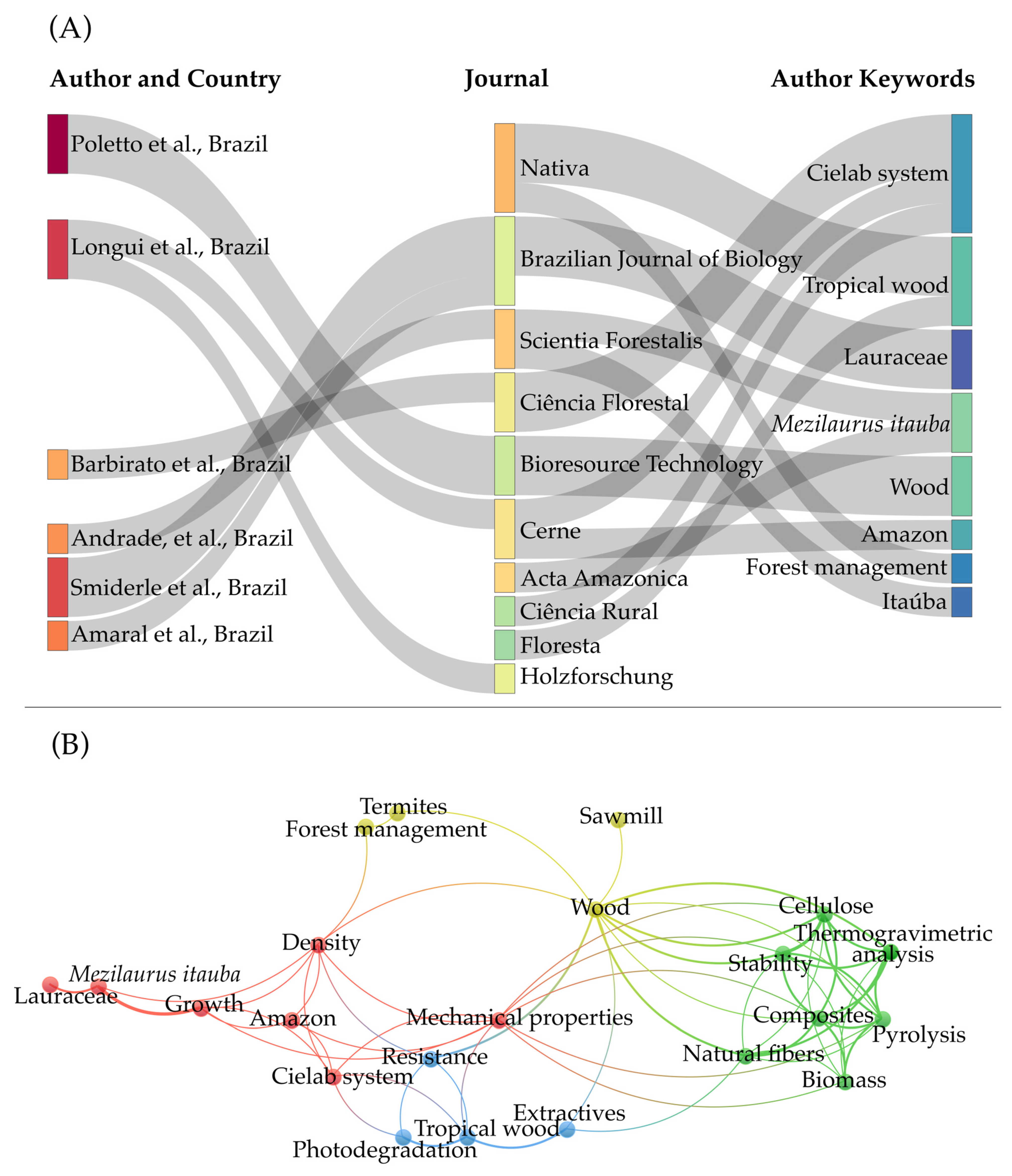
Overall, the studies were published across 38 scientific journals. Among the ten journals with the highest number of publications (Figure 1A), 80% are Brazilian and collectively account for 35 articles (51.5%). The remaining 33 studies were distributed among 28 journals.
Among the ten authors with the highest number of publications, six are Brazilian and publish in these journals (Figure 1A). Of the ten most frequent keywords, eight are associated with these outlets. Most descriptors (Tropical wood, Lauraceae, Mezilaurus itauba, Amazon, Itaúba) relate to general characteristics of the species; two (Cielab system and Wood) are linked to wood technology, and only one (Forest management) pertains to forest management.
Keyword co-occurrence analysis (Figure 1B) highlights the dominant thematic trends within the literature. Although some keywords related to other topics are present, wood technology clearly predominates across all identified clusters. This likely reflects the close connection between this subfield and civil and materials engineering [51], as M. itauba wood is frequently evaluated across diverse applications, enhancing its perceived versatility.
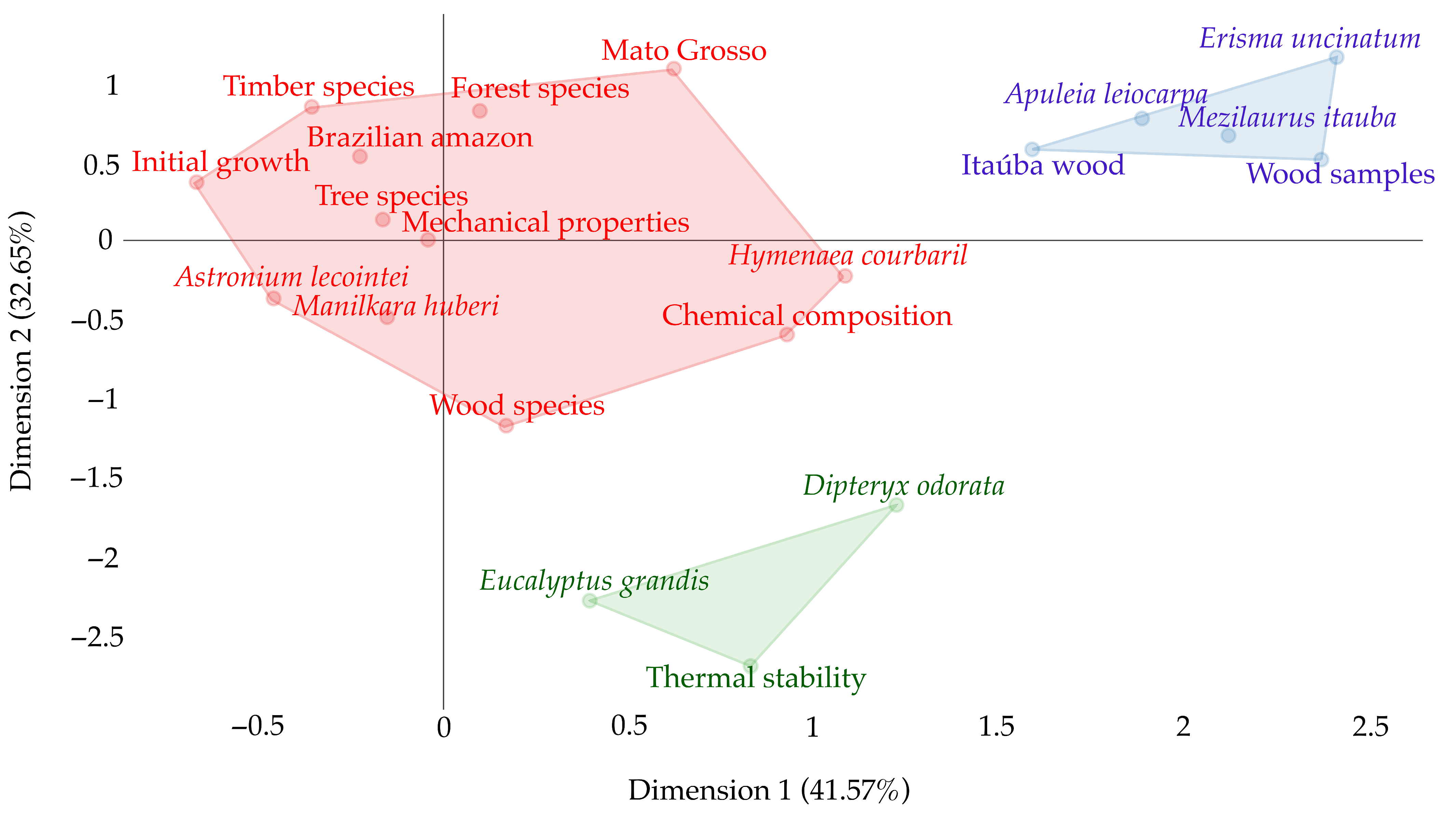
Thematic analysis of article abstracts revealed three bigram clusters consistent with the keyword patterns, enabling the identification of forest species associated with M. itauba in the analyzed studies (Figure 2).
The blue and green clusters associate Apuleia leiocarpa, Dipteryx odorata, Erisma uncinatum, and Eucalyptus grandis with M. itauba in wood technology-focused studies, and include commonly used technical bigrams (e.g., wood samples, Itaúba wood, thermal stability). The red cluster predominantly comprises generalist bigrams related to technological wood properties (chemical composition, mechanical properties) and silviculture (initial growth), and indicates associations between M. itauba and Astronium lecointei, Hymenaea courbaril, and Manilkara huberi. The bigram Mato Grosso refers to a state in central-western Brazil where several studies were conducted.
These findings suggest that M. itauba wood properties have often been evaluated alongside those of other species, possibly to identify timbers of comparable quality. Such an approach may contribute to reducing commercial pressure on M. itauba, particularly given its threatened conservation status, if coupled with ecological and silvicultural research on the species.
Overall, the bibliometric analysis revealed substantial gaps in silviculture and forest management research, limiting the development of long-term conservation strategies for the species and Amazonian forests. Effective actions require the integration of multiple knowledge domains within a multidisciplinary framework [52].

3.2. Thematic Synthesis of the Literature

In the qualitative assessment, the 68 articles were classified according to their primary contribution into the following categories: wood technology (45 articles), forest management and ecology (13 articles), silviculture (five articles), phytochemistry (four articles), and policy and legislation (one article). Consistent with the quantitative analysis, most publications focused on wood technology. Details are provided in Supplementary Table S1.
In sawmills across three municipalities in Pará (Brazil), M. itauba ranked among the most profitable species in 2005 [53]. Between 2007 and 2014, its timber represented the highest commercialized volume in the state of Mato Grosso [54]. From 2012 to 2016, 38 timber species classified as threatened with extinction were transported and traded in Brazil, including M. itauba, which ranked second in commercialized volume. A group of 2214 species collectively accounted for approximately 10% of all native timber circulating nationwide [13].

3.2.1. Ecology, Population Structure, and Forest Management

Botanical records combined with modeling indicate that M. itauba occurs across all states of the Brazilian Amazon, as well as in Espírito Santo and Minas Gerais (Atlantic Forest biome) and Mato Grosso do Sul (Pantanal biome). The species has been recorded in ombrophilous forests, floodplain (várzea) and igapó forests, and open vegetation types such as campina and arboreal campinarana. It occurs on clayey and sandy soils and on yellow Oxisols; however, the model failed to adequately reflect its status as a vulnerable species [10], which is officially recognized in Brazil [11,12].
Extractivist residents of a Sustainable Development Reserve in Amazonas State have reported long-term population declines of itaúba, underscoring the need for precautionary forest management strategies [14]. Environmental plasticity may reduce disturbance impacts and enhance population connectivity [55], increasing the species’ persistence under conservation strategies such as enrichment planting. In this context, conserving primary forest fragments may represent a priority measure to protect seed trees and ensure long-term population viability [56].
In Pará State, 11 Lauraceae species were identified in the Carajás National Forest, seven of which, including M. itauba, occurred in canga formations associated with ferruginous outcrops [57]. In another sustainable-use conservation unit in Pará, M. itauba tended to co-occur with Astronium lecointei, Bagassa guianensis, Couratari guianensis, Manilkara huberi, and Vochysia maxima, possibly due to zoochorous dispersal patterns [58]. In a state park in Tocantins, typical Cerrado species are being replaced by Amazonian species, including M. itauba, which has shown increasing importance values, possibly linked to its location in a biome transition zone facilitating gene flow [59].
From a genetic perspective, the presence of DNA polymorphisms in M. itauba, as observed in other Lauraceae, indicates genetic diversity in forest fragments in southern Amazonia [60]. In one southern Amazon forest, individuals exhibited a random spatial distribution and potential intraspecific genetic variability [7]. Similarly, in a conservation unit in Pará, the spatial pattern remained largely random, likely due to water and nutrient limitations affecting younger individuals and restricting their progression to larger diameter classes [8].
Population structure analyses confirm the ecological relevance of the species. Based on density, frequency, and dominance, M. itauba exhibited one of the highest importance values in both managed and unmanaged areas in Pará State [61]. Although some estimation approaches were unsuccessful [62], the Demaerschalk model [63], adapted by Moura [64], proved to be the most accurate for estimating diameter along the stem of this species [65].

3.2.2. Wood Properties and Technological Performance

Even after carbonization at 450 °C, M. itauba wood retains key anatomical features, including solitary and diffuse pores, the presence of oil–resin, and tyloses [66]. Diffuse-porous wood is common among Lauraceae species [67]. Colorimetric characterization using the Cielab system indicated an olive-brown coloration [68]. Although not all Lauraceae species accumulate silica, M. itauba exhibits a moderate content (0.37%) in the form of globular bodies, concentrated mainly in ray parenchyma cells [69], as well as a high extractive content [70,71,72,73].
These traits result from secondary metabolism, through which three new neolignans, a class of metabolites common to Lauraceae and of considerable biological interest, have been identified [38]. As observed in related species, the essential oil is rich in sesquiterpenes (≈90%), dominated by β-caryophyllene [74]. Leaves and branches are rich in polyphenols that degrade rapidly when submerged [39]. Seeds exhibit higher calcium and nitrogen concentrations than those of the three other evaluated timber species [75].
The species may exhibit pronounced pith eccentricity, although the stem tends to be cylindrical [76]. Sapwood accounts for approximately 18% of the stem, a proportion similar to that of Dipteryx odorata and Apuleia leiocarpa [77]. Predictive methods indicate a diameter at breast height of approximately 120 cm, with an 80% probability of internal cavities [78].
Log yield in sawn timber averages approximately 50% [79]. Drying tends to be slow and difficult due to its medium-to-high basic density (0.69–0.89 g cm−3) [70,80,81], and industrial drying schedules typically recommend initial and final temperatures of 44.4 °C and 67.7 °C, respectively [82].
Mechanical resistance is closely linked to density. With a basic density near 0.80 g cm−3, wood hardness is high [83]. At a bulk density of 0.99 g cm−3, M. itauba exhibited a dynamic modulus of elasticity higher than Trattinnickia burserifolia, Qualea paraensis, Ocotea velutina, and Erisma uncinatum, but lower than Dipteryx odorata and Hymenaea courbaril. Acoustic wave propagation velocity exceeded that of Hymenolobium petraeum, Ocotea velutina, Dipteryx odorata, Hymenaea courbaril, and Diplotropis purpurea [84].
With a bulk density around 0.80 g cm−3, itaúba showed high shear strength compared with Pinus spp. and Erisma uncinatum [16]. Despite its medium-to-high density, the wood exhibits excellent bending capacity and curve stability, justifying its traditional use in Amazonian boat construction [40].
Outstanding Natural Durability and Biodeterioration Resistance
Mezilaurus itauba wood contains high levels of extractives (10%–15%) [70,71,72,73], which confer protection against biological agents and enhance natural durability. Extracts obtained with chloroform and methanol (4:1, v/v) inhibited Gram-positive and Gram-negative bacteria, including Klebsiella pneumoniae, Micrococcus luteus, Escherichia coli, Staphylococcus aureus, and Proteus mirabilis, whereas Pseudomonas aeruginosa, Streptococcus mutans, and Enterobacter aerogenes (currently Klebsiella aerogenes) showed resistance [85].
Lauraceae species have also exhibited rare alkaloids and inhibitory activity against wood-decaying fungi such as Rhodonia placenta and Trametes versicolor [86], as well as moderate efficacy against the termite Cryptotermes brevis [87]. Although yields are lower, supercritical fluid extraction is recommended to obtain purer extracts [88].
Among 46 evaluated native species, M. itauba demonstrated resistance to biodegradation even after eight years of soil exposure [89]. With bulk densities between 0.80 and 0.99 g cm−3, it exhibited one of the highest durability indices after 660 days of exposure in open-field and forest environments, comparable to Nectandra cissiflora (0.67 g cm−3) [90], and similar durability to Aspidosperma populifolium (0.72 g cm−3) after 415 days [18]. These results indicate that density alone does not determine natural durability.
At basic densities between 0.69 and 0.72 g cm−3, itaúba showed among the lowest mass losses under attack by different wood-decaying fungi, a pattern also observed in Sextonia rubra [70]. Likewise, it preserved mass and mechanical properties after 40 days of termite exposure [81].
When subjected to 2000 h of photodegradation and 400 h of leaching, M. itauba wood showed lower resistance than Tabebuia impetiginosa, Couratari sp., and Manilkara huberi; however, the application of a semitransparent impregnating varnish (“stain”) reduced degradation rates by approximately 50% [91,92]. High extractive content also contributed significantly to color changes under simulated weathering [93]. Among the five Amazonian woods, M. itauba and Apuleia leiocarpa exhibited lower surface erosion, preserved chemical properties, and maintained mechanical resistance after 360 days of weathering (without soil contact), although itaúba showed significant color variation [15,94].
Applications and Limitations
Mezilaurus itauba wood is highly versatile, meeting requirements for both exterior and interior applications in construction and furniture manufacturing. Machining tests indicated excellent surface finish quality [17]. Its physical, chemical, and mechanical properties support structural applications and suggest potential as an alternative to polymers such as polypropylene and polyethylene [17,95].
Although performance in particleboard production was limited [96], promising results were obtained when combined with peanut shells [97]. Incorporation of its fibers may also improve the weathering resistance of thermoplastic composites [98]. During thermal pressing, residues macerated with NaOH exhibited lower mechanical resistance and premature thermal degradation [99].
High extractive content may result in smoother surfaces that favor finishing [17], but it compromises adhesion, limiting applications in composites [71] and bonded products. In dowel manufacturing, M. itauba outperformed Eucalyptus spp., although joint performance was suboptimal [100]. Adhesion tends to be more effective between elements of the same species, and friction welding has emerged as an alternative for joining M. itauba to Pinus spp., provided specific parameters are applied [101,102].
In industrial processes involving high temperatures, wood use is constrained by thermal stability. Thermal decomposition of M. itauba can be catalyzed by its own chemical constituents and occurs mainly through diffusion [73,103]. Higher extractive content and lower lignin levels reduce thermal stability, with degradation initiating at approximately 180 °C, earlier than in other Amazonian species [72,104].
Finally, the wood shows limited potential for bow-making in musical instruments when compared with Caesalpinia echinata, a benchmark species for this purpose [105,106].

3.2.3. Silviculture and Nursery-Based Propagation

Studies addressing silvicultural aspects of M. itauba remain scarce. None of the articles included in this review investigated tree development under field conditions, either in monoculture or polyculture systems, highlighting a critical knowledge gap in management and conservation practices. Available research is largely restricted to the nursery stage, focusing on seedling production and the use of biological [107,108,109] or synthetic agents [110] to promote growth.
Seedling development was enhanced by the application of beneficial microorganisms (Trichoderma harzianum, Azospirillum brasilense, or the combination of Bradyrhizobium japonicum + Azospirillum brasilense) together with organomineral fertilizer derived from composted cupuaçu residues (leaves, branches, fruit peels, and seeds) [107,108,109]. The use of the commercial product Stimulate® (containing kinetin, gibberellic acid [GA3], and indolebutyric acid [IBA]) at a concentration of 0.35 mL L−1 resulted in significant increases across all evaluated morphological parameters in seedlings [110].
For nursery production in polyethylene bags, containers measuring 33 cm in height and 23 cm in width are recommended, as reported in the literature [111].

3.2.4. Analytical Synthesis and Future Research Directions

Based on the synthesis of the available literature, three research priorities emerge as critical for advancing both scientific understanding and the sustainable management of M. itauba. These priorities are directly derived from the main knowledge gaps identified in this scoping review and are organized according to their potential to generate immediate and medium-term impacts.
First, the most critical gap concerns the lack of empirical data on the field performance of M. itauba across developmental stages, from nursery-based seedling production to establishment and growth under open field and managed forest conditions. Field silvicultural performance under different cultivation models (monoculture, mixed stands, and agroforestry) varies markedly among native Amazonian tree species and progenies, affecting survival and growth, thereby underscoring the need for empirical data to guide sustainable management and restoration programs [112,113]. Moreover, understanding population dynamics across environmental contexts is critical for the persistence and sustainable management of ecologically rare Amazonian tree species [114,115,116]. This type of research presents high feasibility, as it can be developed using established experimental designs and infrastructure already available in forest nurseries.
A second priority involves advancing knowledge on the genetic attributes of M. itauba, supporting the selection of planting material with improved nursery performance and field establishment. Although genetic variability in Amazonian forest tree species is known to favor adaptive potential and management effectiveness [117,118], robust analyses of population structure, gene flow, and adaptive variation for M. itauba remain scarce. Such information is essential to guide genetic conservation strategies and breeding programs and can be generated using established molecular tools and existing research infrastructure.
The third priority focuses on generating integrated knowledge capable of supporting evidence-based public policies for the protection and sustainable management of M. itauba. To this end, it builds on the previous priorities by adopting a multidisciplinary approach that integrates ecological interactions, ecophysiological responses, and regeneration processes into applied management frameworks. While biotic interactions and species-specific responses to climatic stress play a central role in tree mortality and forest stability [119,120], these processes remain weakly connected to management-oriented research on the species. Integrative management models combining selective harvesting, natural regeneration, and restoration at the landscape scale are therefore needed to reconcile timber production with biodiversity conservation and to support adaptive management in forest systems with multiple uses [121,122].

4. Conclusions

The scientific literature on M. itauba remains strongly concentrated on wood technology, providing a robust basis for understanding its physical, chemical, and mechanical properties. In contrast, ecological, silvicultural, and genetic dimensions are comparatively underrepresented, revealing a persistent imbalance in research focus.
This scoping review demonstrates that, despite the species’ wide geographic distribution and high commercial value, current knowledge is insufficient to support integrated management strategies capable of reconciling timber exploitation with long-term population persistence. The lack of empirical data on field performance, limited understanding of genetic structure, and weak integration of ecological processes into management frameworks remain key constraints.
By systematically synthesizing the literature and explicitly identifying priority knowledge gaps, this study provides a structured framework to guide future research efforts. Addressing these priorities is essential to support evidence-based conservation policies and sustainable management strategies for M. itauba, and contributes more broadly to discussions on the management of threatened high-value timber species in Amazonian forests.

Supplementary Materials

The following supporting information can be downloaded at: https://www.mdpi.com/article/10.3390/f17020176/s1, Figure S1: PRISMA-ScR flow diagram of the study selection process for scientific articles related to M. itauba; Table S1: Characteristics of included studies and list of excluded articles.

Author Contributions

Conceptualization, A.J.C.A., T.A.V. and D.C.L.; Formal Analysis, A.J.C.A.; Visualization, A.J.C.A., T.A.V. and D.C.L.; Writing—Original Draft Preparation, A.J.C.A.; Writing—Review and Editing, A.J.C.A., T.A.V. and D.C.L. All authors have read and agreed to the published version of the manuscript.

Funding

Coordination for the Improvement of Higher Education Personnel (Coordenação de Aperfeiçoamento de Pessoal de Nível Superior—Capes)—Financing Code 001.

Data Availability Statement

The data from this study have been used in the analysis presented in this article. Further inquiries can be directed to the corresponding author.

Acknowledgments

The authors are grateful to Breno Santos dos Reis and Daniela Pauletto for their valuable support during the development of this study. We also thank the Program in Society, Nature, and Development (PPGSND) at the Federal University of Western Pará (Ufopa).

Conflicts of Interest

The authors declare no conflicts of interest.

References

  1. Domínguez-Tuda, M.; Gutiérrez-Jurado, H.A. Global Analysis of Forest Tipping Points Leading to Changing Water Cycle Dynamics. J. Hydrol. X 2024, 25, 100187. [Google Scholar] [CrossRef]
  2. McKay, D.I.A.; Staal, A.; Abrams, J.F.; Winkelmann, R.; Sakschewski, B.; Loriani, S.; Fetzer, I.; Cornell, S.E.; Rockström, J.; Lenton, T.M. Exceeding 1.5 °C Global Warming Could Trigger Multiple Climate Tipping Points. Science 2022, 377, eabn7950. [Google Scholar] [CrossRef]
  3. Steur, G.; Ter Steege, H.; Verburg, R.W.; Sabatier, D.; Molino, J.-F.; Bánki, O.S.; Castellanos, H.; Stropp, J.; Fonty, É.; Ruysschaert, S.; et al. Relationships between Species Richness and Ecosystem Services in Amazonian Forests Strongly Influenced by Biogeographical Strata and Forest Types. Sci. Rep. 2022, 12, 5960. [Google Scholar] [CrossRef]
  4. Carvalho, R.L.; Resende, A.F.; Barlow, J.; França, F.M.; Moura, M.R.; Maciel, R.; Alves-Martins, F.; Shutt, J.; Nunes, C.A.; Elias, F.; et al. Pervasive Gaps in Amazonian Ecological Research. Curr. Biol. 2023, 33, 3495–3504.e4. [Google Scholar] [CrossRef]
  5. Klautau, A.G.C.M.; Cordeiro, A.P.B.; Chagas, R.A.; Santos, W.C.R.; Marceniuk, A.P.; Nóbrega, P.S.V.; Martinelli-Lemos, J.M.; Cintra, I.H.A.; Castro, N.S.S.; Bastos, C.E.M.C.; et al. Biodiversity Hotspots and Threatened Species under Human Influence in the Amazon Continental Shelf. Sci. Rep. 2025, 15, 26681. [Google Scholar] [CrossRef] [PubMed]
  6. Fernandes, C.C.; Lazaro, L.L.B.; Yazbek Bitar, N.M.; Franco, M.A.; Artaxo, P. Scientific Research for Amazonia: A Review on Key Trends and Gaps. Conservation 2025, 5, 35. [Google Scholar] [CrossRef]
  7. Ebert, A.; Costa, R.B.; Brondani, G. Spatial Distribution Pattern of Mezilaurus itauba (Meins.) Taub. ex Mez. in a Seasonal Forest Area of the Southern Amazon, Brazil. iForest Biogeosci. For. 2016, 9, 497–502. [Google Scholar] [CrossRef]
  8. Vieira, D.D.S.; Gomes, K.M.A.; Santos, L.E.D.; Oliveira, M.L.R.D.; Gama, J.R.V.; Mendonça, E.L.M.; Lafetá, B.O.; Moura, C.C.D.; Figueiredo, A.E.S. Estrutura Diamétrica e Espacial de Espécies Madeireiras de Importância Econômica na Amazônia. Sci. For. 2021, 49, e3438. [Google Scholar] [CrossRef]
  9. Braz, E.M.; Canetti, A.; Mattos, P.P.; Basso, R.O.; Figueiredo Filho, A. Alternative Criteria to Achieve Sustainable Management of Mezilaurus itauba in the Brazilian Amazon. Pesqui. Florest. Bras. 2018, 38, e201801648. [Google Scholar] [CrossRef]
  10. Franciscon, C.H.; Miranda, I.S. Distribuição e Raridade das Espécies de Mezilaurus (Lauraceae) No Brasil. Rodriguésia 2018, 69, 489–501. [Google Scholar] [CrossRef]
  11. Brasil Portaria MMA N° 148, de 7 de Junho de 2022—Altera Os Anexos da Portaria N° 443, de 17 de Dezembro de 2014, da Portaria N° 444, de 17 de Dezembro de 2014, e da Portaria N° 445, de 17 de Dezembro de 2014, Referentes à Atualização da Lista Nacional de Espécies Ameaçadas de Extinção; Diário Oficial da União Brasil: Brasília, Brazil, 2022; p. 74.
  12. Martinelli, G.; Moraes, M.A. Livro Vermelho da Flora do Brasil; Andrea Jakobsson Estudio Editorial Ltda: Rio de Janeiro, Brazil, 2013. [Google Scholar]
  13. Brandes, A.F.D.N.; Novello, B.Q.; Domingues, G.D.A.F.; Barros, C.F.; Tamaio, N. Endangered Species Account for 10% of Brazil’s Documented Timber Trade. J. Nat. Conserv. 2020, 55, 125821. [Google Scholar] [CrossRef]
  14. Demarchi, L.O.; Scudeller, V.V.; Moura, L.C.; Lopes, A.; Piedade, M.T.F. Logging Impact on Amazonian White-Sand Forests: Perspectives from a Sustainable Development Reserve. Acta Amaz. 2019, 49, 316–323. [Google Scholar] [CrossRef]
  15. Batista, L.; Stangerlin, D.M.; Melo, R.R.D.; Souza, A.P.D.; Silva, E.D.S.; Pariz, E. Resistência Mecânica e Composição Química de Madeiras Amazônicas Deterioradas Em Ensaios de Campo. Madera y Bosques 2021, 27, e2712079. [Google Scholar] [CrossRef]
  16. Massayuki, M.; Matoski, A.; Magajewski, C.; Machado, J. Resistencia a Corte Paralela a La Tensión de La Fibra de La Madera, Por Medio de la Prueba de Punzonamiento Propuesta. Rev. Ing. Constr. 2014, 29, 46–60. [Google Scholar] [CrossRef][Green Version]
  17. Rodrigues, J.V.; Barbosa, F.M.; Dreyer, J.B.B.; Schorr, L.P.B.; Cuchi, T.; Schlickmann, M.B. Technological Characterization of Mezilaurus itauba Wood: Application and Machining Tests. Floresta 2020, 51, 037–043. [Google Scholar] [CrossRef]
  18. Souza, J.H.G.D.; Santos, R.Q.D.; Castelo, P.A.R.; Corassa, J.D.N. Natural Durability of Five Amazonian Species in Two Different Decay Environments. Ciênc. Rural 2025, 55, e20240356. [Google Scholar] [CrossRef]
  19. Rocha, L.G.D.; Marimon Junior, B.H.; Barradas, A.D.C.; Carvalho, M.A.C.D.; Soares, C.R.A.; Marimon, B.S.; Ribeiro, G.H.P.D.M.; Oliveira, E.A.D.; Elias, F.; Emidio Júnior, C.; et al. Fire-Induced Floristic and Structural Degradation Across a Vegetation Gradient in the Southern Amazon. Forests 2025, 16, 1218. [Google Scholar] [CrossRef]
  20. Quaresma, A.; Zuquim, G.; Demarchi, L.O.; Ribas, C.C.; Wittmann, F.; Assunção, A.M.; Carneiro, C.C.; Ferreira, P.P.; Juruna, J.J.P.; Juruna, R.T.V.D.S.; et al. Belo Monte Dam Impacts: Protagonism of Local People in Research and Monitoring Reveals Ecosystem Service Decay in Amazonian Flooded Vegetation. Perspect. Ecol. Conserv. 2025, 23, 39–50. [Google Scholar] [CrossRef]
  21. Gomes, V.S.; Dourado, V.V.C.; Toledo, J.J.; Lima, A.P.; Fadini, R.F. Community Structure, Biomass, and Tree Species Composition across Soil and Fire Gradients in a Threatened Amazonian Savanna. Plant Ecol. 2025, 226, 1251–1262. [Google Scholar] [CrossRef]
  22. Lapola, D.M.; Pinho, P.; Barlow, J.; Aragão, L.E.O.C.; Berenguer, E.; Carmenta, R.; Liddy, H.M.; Seixas, H.; Silva, C.V.J.; Silva-Junior, C.H.L.; et al. The Drivers and Impacts of Amazon Forest Degradation. Science 2023, 379, eabp8622. [Google Scholar] [CrossRef]
  23. Ma, J.; Li, J.; Wu, W.; Liu, J. Global Forest Fragmentation Change from 2000 to 2020. Nat. Commun. 2023, 14, 3752. [Google Scholar] [CrossRef]
  24. Pinheiro, B.T.; Almeida, S.M.; Santos, M.P.D. The Impact of Rare and Common Species on the Functional Diversity of Forest Birds in a Palm-Dominated Landscape in the Eastern Amazon. Acta Oecologica 2025, 126, 104060. [Google Scholar] [CrossRef]
  25. Leal Filho, W.; Dinis, M.A.P.; Canova, M.A.; Cataldi, M.; Costa, G.A.S.; Enrich-Prast, A.; Symeonakis, E.; Brearley, F.Q. Managing Ecosystem Services in the Brazilian Amazon: The Influence of Deforestation and Forest Degradation in the World’s Largest Rain Forest. Geosci. Lett. 2025, 12, 24. [Google Scholar] [CrossRef]
  26. Brandão, D.O.; Barata, L.E.S.; Nobre, C.A. The Effects of Environmental Changes on Plant Species and Forest Dependent Communities in the Amazon Region. Forests 2022, 13, 466. [Google Scholar] [CrossRef]
  27. Wang, H.; Caetano-Andrade, V.; Boivin, N.; Clement, C.R.; Ayala, W.E.; Melinski, R.D.; Costa, F.S.; Weigel, D.; Roberts, P. Long-Term Human Influence on the Demography and Genetic Diversity of the Hyperdominant Bertholletia excelsa in the Amazon Basin. Curr. Biol. 2025, 35, 629–639.e4. [Google Scholar] [CrossRef]
  28. Leal, B.S.S.; Tavares, V.D.C.; Watanabe, M.T.C.; Cardoso, A.L.D.R.; Tyski, L.; Alves-Pereira, A.; Dalapicolla, J.; Oliveira, G.; Carvalho, C.D.S. Genetic-Based Conservation Status Indicators Applied to Endemics with Restricted Distributions: A Case for Eastern Amazonian Cangas Plants. Ann. Bot. 2025, mcaf030. [Google Scholar] [CrossRef] [PubMed]
  29. Sontag, V.E.; Dadio, B.; Ambrosano, G.B.; Miguel, S.R.; Rodriguez, D.R.O.; Fontana, C.; Assis-Pereira, G.; Vidal, E. Maintaining Genetic Diversity in the Amazon: Species-Specific Strategies Are More Effective for Managed Forests than Generalist Criteria in Brazilian Legislation. For. Ecol. Manag. 2025, 584, 122568. [Google Scholar] [CrossRef]
  30. Peters, M.D.J.; Godfrey, C.M.; Khalil, H.; McInerney, P.; Parker, D.; Soares, C.B. Guidance for Conducting Systematic Scoping Reviews. Int. J. Evid. Based Healthc. 2015, 13, 141–146. [Google Scholar] [CrossRef] [PubMed]
  31. Tricco, A.C.; Lillie, E.; Zarin, W.; O’Brien, K.K.; Colquhoun, H.; Levac, D.; Moher, D.; Peters, M.D.J.; Horsley, T.; Weeks, L.; et al. PRISMA Extension for Scoping Reviews (PRISMA-ScR): Checklist and Explanation. Ann. Intern. Med. 2018, 169, 467–473. [Google Scholar] [CrossRef]
  32. Pranckutė, R. Web of Science (WoS) and Scopus: The Titans of Bibliographic Information in Today’s Academic World. Publications 2021, 9, 12. [Google Scholar] [CrossRef]
  33. Beigel, F.; Packer, A.L.; Gallardo, O.; Salatino, M. OLIVA: The Scientific Output in Journals Edited in Latin America. Disciplinary Diversity, Institutional Collaboration, and Multilingualism in SciELO and Redalyc (1995–2018). Dados 2024, 67, e20210174. [Google Scholar] [CrossRef]
  34. Flora e Funga Do Brasil. Available online: https://reflora.jbrj.gov.br/reflora (accessed on 1 December 2025).
  35. Aria, M.; Cuccurullo, C. Bibliometrix: An R-Tool for Comprehensive Science Mapping Analysis. J. Informetr. 2017, 11, 959–975. [Google Scholar] [CrossRef]
  36. R Core Team. R: A Language and Environment for Statistical Computing; R Foundation for Statistical Computing: Vienna, Austria, 2024. [Google Scholar]
  37. Inkscape Project Inkscape 2022. Available online: https://inkscape.org (accessed on 5 December 2025).
  38. Yanez R., X.; Diaz, A.M.P.; De Diaz, P.P. Neolignans from Mezilaurus itauba. Phytochemistry 1986, 25, 1953–1956. [Google Scholar] [CrossRef]
  39. Ribeiro, M.N.D.S.; Varejão, M.D.J.C.; Zoghbi, M.D.G.B.; Ribeiro, J.S.B. Degradação de Polifenóis Em Cinco Espécies Vegetais m Ambientes Aquáticos. Acta Amaz. 1988, 18, 189–197. [Google Scholar] [CrossRef][Green Version]
  40. Pinto, P.S.; Pennington, D.R.L.; Nascimento, C.C.D.; Cunha Neto, Z.B.D.; Suano, J.M.F. Protótipo de um Móvel de Madeira Maciça Curvada. Acta Amaz. 1989, 19, 515–524. [Google Scholar] [CrossRef]
  41. Urrutia Sánchez, G.; Prado, L.; Bietenholz, W. Theoretical High Energy Physcis in Latin America from 1990 to 2012: A Statistical Study. Scientometrics 2018, 116, 125–146. [Google Scholar] [CrossRef]
  42. Brum, A.G. Papel da Ciência, Tecnologia e Inovação (CT&I) Na Política de Defesa Do Brasil: Uma Análise dos Documentos Estratégicos Brasileiros. Rev. Tempo Mundo 2025, 37, 81–107. [Google Scholar] [CrossRef]
  43. Valdez, J.; Damasceno, G.; Oh, R.R.Y.; Quintero Uribe, L.C.; Barajas Barbosa, M.P.; Amado, T.F.; Schmidt, C.; Fernandez, M.; Sharma, S. Strategies for Advancing Inclusive Biodiversity Research through Equitable Practices and Collective Responsibility. Conserv. Biol. 2024, 38, e14325. [Google Scholar] [CrossRef] [PubMed]
  44. Reverchon, F.; Canto-Canché, B.; Rocha, J.; Sepúlveda, E. The Cost of Doing Science in Latin America: Experiences from Mexico. Trends Microbiol. 2025, 33, 705–708. [Google Scholar] [CrossRef]
  45. Tiruneh, G.A.; Righi, C.A.; Polizel, J.L.; Pereira, C.R. Amazonian River Islands: Biodiversity Hotspots, Carbon Reservoirs, and Ecological Corridors in Need of Integrated Conservation. Discov. For. 2025, 1, 44. [Google Scholar] [CrossRef]
  46. Andrade, T.H.N.; Silva, L.R.; Gitahy, L. New Policies for Science and Technology and the Impacts on Public Research Institutes: A Case Study in Brazil. Braz. Polit. Sci. Rev. 2013, 7, 37–61. [Google Scholar] [CrossRef][Green Version]
  47. Saad-Filho, A. Neoliberalism, Democracy, and Development Policy in Brazil. Dev. Soc. 2010, 39, 1–28. [Google Scholar] [CrossRef]
  48. Andrade, D. Neoliberal Extractivism: Brazil in the Twenty-First Century. J. Peasant Stud. 2022, 49, 793–816. [Google Scholar] [CrossRef]
  49. Mancebo, D.; Silva Júnior, J.D.R.; Spears, E. The Crisis of Science in Brazil: Austerity, “Culture War” and Innovationism. Rev. Bras. Política Adm. Educ. 2022, 38, e122690. [Google Scholar] [CrossRef]
  50. Burchardt, H.-J.; Dietz, K. (Neo-)Extractivism—A New Challenge for Development Theory from Latin America. Third World Q. 2014, 35, 468–486. [Google Scholar] [CrossRef]
  51. Olofin, I. Nano-Cement Engineered Wood-Boards (NCEW)—A Review on Wood-Cement Composite, Materials, New Technologies and Future Perspectives. J. Build. Eng. 2025, 99, 111571. [Google Scholar] [CrossRef]
  52. Moutinho, P.; Azevedo-Ramos, C. Untitled Public Forestlands Threaten Amazon Conservation. Nat. Commun. 2023, 14, 1152. [Google Scholar] [CrossRef]
  53. Fiedler, N.C.; Costa, A.F.; Soares, T.S.; Leite, A.M.P. Caracterização do Segmento de Madeira Serrada em Três Municípios do Estado do Pará. Rev. Bras. Ciênc. Agrár. Braz. J. Agric. Sci. 2012, 7, 111–116. [Google Scholar] [CrossRef]
  54. Zaque, L.A.D.M.; Melo, R.R.D.; Stangerlin, D.M.; Serenine Junior, L. Diagnóstico da Comercialização de Madeira Serrada no Estado de Mato Grosso. Nativa 2019, 7, 607–612. [Google Scholar] [CrossRef]
  55. Brum, M.; Vadeboncoeur, M.A.; Ivanov, V.; Asbjornsen, H.; Saleska, S.; Alves, L.F.; Penha, D.; Dias, J.D.; Aragão, L.E.O.C.; Barros, F.; et al. Hydrological Niche Segregation Defines Forest Structure and Drought Tolerance Strategies in a Seasonal Amazon Forest. J. Ecol. 2019, 107, 318–333. [Google Scholar] [CrossRef]
  56. Amaral, D.; Vieira, I.; Salomão, R.; Almeida, S.; Jardim, M. The Status of Conservation of Urban Forests in Eastern Amazonia. Braz. J. Biol. 2012, 72, 257–265. [Google Scholar] [CrossRef]
  57. Moraes, P.L.R.D. Flora das Cangas da Serra dos Carajás, Pará, Brasil: Lauraceae. Rodriguésia 2018, 69, 81–117. [Google Scholar] [CrossRef]
  58. Rodrigues, B.L.; Bruzinga, J.S.C.; Ribeiro, R.B.D.S.; Gama, J.R.V.; Machado, E.L.M.; Oliveira, M.L.R.D. Pattern and Spatial Associations of Commercial Trees in the Amazon. Ciênc. Rural 2021, 51, e20200367. [Google Scholar] [CrossRef]
  59. Oliveira, K.N.; Miguel, E.P.; Martins, M.S.; Rezende, A.V.; Santos, J.A.; Nappo, M.E.; Matricardi, E.A.T. Species Substitution and Changes in the Structure, Volume, and Biomass of Forest in a Savanna. Plants 2024, 13, 2826. [Google Scholar] [CrossRef]
  60. Ebert, A.; Tardin, A.B.B.; Skowronski, L.; Constantino, M.; Barros, J.H.S.; Costa, R.B. Genetic Diversity of a Natural Population of Mezilaurus itauba (Meisn.) Taub. ex Mez. in the Southern Amazon, Brazil. Semina Ciênc. Agrár. 2017, 38, 1625–1630. [Google Scholar] [CrossRef]
  61. Ribeiro, R.B.D.S.; Gama, J.R.V.; Martins, S.V.; Moraes, A.; Santos, C.A.A.D.; Carvalho, A.N.D. Estrutura Florestal em Projeto de Assentamento, Comunidade São Mateus, Município de Placas, Pará, Brasil. Rev. Ceres 2013, 60, 610–620. [Google Scholar] [CrossRef]
  62. Lima, G.D.A.; Ribeiro, R.B.D.S.; Gomes, K.M.A.; Ximenes, L.C.; Cruz, G.D.S. Ajuste Volumétrico Por Grupo e Para 24 Espécies Comerciais em uma Área de Manejo Florestal Comunitário. Rev. Agronegócio Meio Ambiente 2022, 15, 497–505. [Google Scholar] [CrossRef]
  63. Demaerschalk, J.P. Converting Volume Equations to Compatible Taper Equations. For. Sci. 1972, 18, 241–245. [Google Scholar] [CrossRef]
  64. Moura, J.B. Estudo da Forma do Fuste e Comparação de Métodos de Estimativa Volumétrica de Espécies Florestais da Amazônia Brasileira. Master’s Thesis, Universidade Federal do Paraná, Curitiba, Brazil, 1994. [Google Scholar]
  65. Lanssanova, L.R.; Ubialli, J.A.; Arce, J.E.; Pelissari, A.L.; Favalessa, C.M.C.; Drescher, R. Evaluation of Taper Functions for Diameter Estimated of Commercial Forest Species in Amazon Matogrossense Biome. Floresta 2013, 43, 215–224. [Google Scholar] [CrossRef]
  66. Muñiz, G.I.B.D.; Nisgoski, S.; Shardosin, F.Z.; França, R.F. Anatomia do Carvão de Espécies Florestais. Cerne 2012, 18, 471–477. [Google Scholar] [CrossRef][Green Version]
  67. Santos, J.X.; Vieira, H.; Naide, T.; Souza, D.; Stygar, M.; Muñiz, G.; Soffiatti, P.; Nisgoski, S. Anatomical Traits of ‘Louros’ Wood from the Brazilian Amazon for Wood Identification. J. Trop. For. Sci. 2022, 34, 415–425. [Google Scholar] [CrossRef]
  68. Sousa, W.C.S.E.; Barbosa, L.D.J.; Soares, A.A.V.; Goulart, S.L.; Protásio, T.D.P. Wood Colorimetry for the Characterization of Amazonian Tree Species: A Subsidy for a More Efficient Classification. Cerne 2019, 25, 451–462. [Google Scholar] [CrossRef]
  69. Santana, M.A.E.; Rodrigues, L.C.; Rauber Coradin, V.T.; Arakaki Okino, E.Y.; Souza, M.R. Silica Content of 36 Brazilian Tropical Wood Species. Holzforschung 2013, 67, 19–24. [Google Scholar] [CrossRef]
  70. Carneiro, J.S.; Emmert, L.; Sternadt, G.H.; Mendes, J.C.; Almeida, G.F. Decay Susceptibility of Amazon Wood Species from Brazil against White Rot and Brown Rot Decay Fungi 10th EWLP, Stockholm, Sweden, August 25–28, 2008. Holzforschung 2009, 63, 767–772. [Google Scholar] [CrossRef]
  71. Poletto, M. Thermal Degradation and Morphological Aspects of Four Wood Species Used in Lumber Industry. Rev. Árvore 2016, 40, 941–948. [Google Scholar] [CrossRef]
  72. Poletto, M.; Zattera, A.J.; Santana, R.M.C. Structural Differences between Wood Species: Evidence from Chemical Composition, FTIR Spectroscopy, and Thermogravimetric Analysis. J. Appl. Polym. Sci. 2012, 126, E337–E344. [Google Scholar] [CrossRef]
  73. Ornaghi Junior, H.L.; Ornaghi, F.G.; Neves, R.M.; Oliveira, D.M.; Poletto, M. Thermal Decomposition of Wood Fibers: Thermal Simulation Using the F-Test Statistical Tool. Cellul. Chem. Technol. 2021, 55, 231–241. [Google Scholar] [CrossRef]
  74. Alcântara, J.M.; Yamaguchi, K.K.L.; Veiga-Junior, V.F. Composição de Óleos Essenciais de Dicypellium manausense, Mezilaurus duckei, Mezilaurus itauba e Pleurothyrium vasquezii, Quatro Espécies Amazônicas da Família Lauraceae. Bol. Latinoam. Caribe Plantas Med. Aromáticas 2013, 12, 469–475. [Google Scholar]
  75. Souza, L.C.D.; Sa, M.E.; Moraes, S.M.; Carvalho, M.A.C.; Silva, M.P.; Abrantes, F.L. Composição Química e Nutrientes em Sementes das Espécies Florestais Pente de Macaco, Flor de Paca, Itaúba, Jatobá e Murici Manso. Biosci. J. 2012, 28, 478–483. [Google Scholar]
  76. Luz, E.S.; Soares, Á.A.V.; Goulart, S.L.; Carvalho, A.G.; Monteiro, T.C.; Protásio, T.P. Challenges of the Lumber Production in the Amazon Region: Relation between Sustainability of Sawmills, Process Yield and Logs Quality. Environ. Dev. Sustain. 2021, 23, 4924–4948. [Google Scholar] [CrossRef]
  77. Miranda, D.L.C.; Loch, V.M.; Silva, F.; Lisboa, G.S.; Canalez, G.G.; Condé, T.M.; Castelo, P.A.R. Porcentagem de Cerne, Alburno e Casca de Cinco Espécies Madeireiras da Amazônia. Nativa 2017, 5, 619–627. [Google Scholar] [CrossRef]
  78. Santos, M.F.D.; Figueiredo Filho, A.; Pelissari, A.L.; Nascimento, R.G.M.; Costa, D.L.D. Predictive Models of the Occurrence of Hollows in Commercial Trees in the Brazilian Amazon: A Comparison with the Hollow Test. Cerne 2025, 31, e-103447. [Google Scholar] [CrossRef]
  79. Garcia, F.M.; Manfio, D.R.; Sansígolo, C.A.; Magalhães, P.A.D. Rendimento No Desdobro de Toras de Itaúba (Mezilaurus itauba) e Tauarí (Couratari guianensis) Segundo a Classificação da Qualidade da Tora. Floresta Ambiente 2012, 19, 468–474. [Google Scholar] [CrossRef]
  80. Silveira, L.H.C.; Rezende, A.V.; Vale, A.T.D. Teor de Umidade e Densidade Básica da Madeira de Nove Espécies Comerciais Amazônicas. Acta Amaz. 2013, 43, 179–184. [Google Scholar] [CrossRef]
  81. Gallio, E.; Machado, S.F.; Silva, F.J.T.D.; Cruz, N.D.; Gatto, D.A. Caracterização de Propriedades Tecnológicas de Quatro Folhosas Deterioradas por Térmitas do Gênero Nasutitermes. Nativa 2018, 6, 763–766. [Google Scholar] [CrossRef]
  82. Andrade, A.; Jankowsky, I.P.; Ducatti, M.A. Grupamento de Madeiras para Secagem Convencional (Grouping Wood Species to Kiln Drying). Sci. For. 2001, 59, 89–99. [Google Scholar]
  83. Silva, F.; Higuchi, N.; Nascimento, C.C.; Matos, J.L.M.; Paula, E.V.C.M.; Santos, J. Nondestructive Evaluation of Hardness in Tropical Wood. J. Trop. For. Sci. 2014, 26, 69–74. [Google Scholar]
  84. Stangerlin, D.M.; Cavalcante, C.F.P.; Costa, C.A.; Pariz, E.; Melo, R.R.; Dall’Oglio, O.T. Mechanical Properties of Amazonian Woods Estimated by Ultrasound Waves Propagation Methods. Nativa 2018, 5, 628–633. [Google Scholar] [CrossRef]
  85. Granato, D.; Nunes, D.S.; Mattos, P.P.D.; Rios, E.D.M.; Glinski, A.; Rodrigues, L.C.; Zanusso Júnior, G. Chemical and Biological Evaluation of Rejects from the Wood Industry. Braz. Arch. Biol. Technol. 2005, 48, 237–241. [Google Scholar] [CrossRef][Green Version]
  86. Wanschura, R.; Baumgartner, M.; Linder, C.U.; Windeisen, E.; Benz, J.P.; Richter, K. Direct Bioautography for the Screening of Selected Tropical Wood Extracts against Basidiomycetes. Holzforschung 2020, 74, 733–743. [Google Scholar] [CrossRef]
  87. Cabrera, R.R.; Lelis, A.T.; Berti Filho, E. Ação de Extratos das Madeiras de Ipê (Tabebuia Sp., Bignoniaceae) e de Itaúba (Mezilaurus sp., Lauraceae) sobre o Cupim-de-Madeira-Seca Cryptotermes brevis (Isoptera, Kalotermitidae). Arq. Inst. Biológico 2001, 68, 103–106. [Google Scholar] [CrossRef]
  88. Acosta, E.D.; Bolzan, A.; Livia, M.A. Supercritical Extraction of Residues Mezilaurus itauba and Application of Mathematical Models. J. Supercrit. Fluids 2014, 95, 92–99. [Google Scholar] [CrossRef]
  89. Jesus, M.A.; Moraes, J.W.; Abreu, R.L.S.; Cardias, M. Durabilidade Natural de 46 Espécies de Madeira Amazônicas em Contato com o Solo em Ambiente Florestal. Sci. For. 1998, 53, 81–92. [Google Scholar]
  90. Corassa, J.D.N.; Tiesen, C.M.A.; Dall’Oglio, O.T.; Melo, R.R.D. Durabilidade Natural de Dez Madeiras Amazônicas Sob Condições de Campo. Nativa 2019, 7, 758–762. [Google Scholar] [CrossRef]
  91. Silva, J.O.E.; Pastore, T.C.M.; Pastore Junior, F. Resistência ao Intemperismo Artificial de Cinco Madeiras Tropicais e de Dois Produtos de Acabamento. Ciênc. Florest. 2007, 17, 17–23. [Google Scholar] [CrossRef]
  92. Pastore, T.C.M.; Oliveira, C.C.K.D.; Rubim, J.C.; Santos, K.D.O. Efeito do Intemperismo Artificial Em Quatro Madeiras Tropicais Monitorado por Espectroscopia de Infravermelho (DRIFT). Quím. Nova 2008, 31, 2071–2075. [Google Scholar] [CrossRef]
  93. Barreto, C.C.K.; Pastore, T.C.M. Resistência Ao Intemperismo Artificial de Quatro Madeiras Tropicais: O Efeito dos Extrativos. Ciênc. Florest. 2009, 19, 23–30. [Google Scholar] [CrossRef]
  94. Silva, E.D.S.; Bonfatti Junior, E.A.; A Silva, G.A.D.O.; Curvo, K.R.; Stangerlin, D.M.; Melo, R.R.D.; Souza, A.P.D. Deterioração da Superfície de Cinco Madeiras Amazônicas Expostas ao Intemperismo Natural. Madera Bosques 2022, 28, e2822405. [Google Scholar] [CrossRef]
  95. Ornaghi Junior, H.L.; Poletto, M.; Andrade, M.P.; Monticeli, F.M.; Hillig, E.; Blanchet, P.; Sadaoui, A.; Zattera, A.J. Itauba Wood Fiber (Mezilaurus lindaviana) and Itauba Wooden Board: A Survey on the Physical, Chemical, Thermal, and Mechanical Properties. ACS Omega 2025, 10, 44038–44047. [Google Scholar] [CrossRef]
  96. Longo, B.L.; Cunha, A.B.D.; Rios, P.D.; Terezo, R.F.; Almeida, C.C.F.D. Caracterização Tecnológica de Painéis Particulados Produzidos com Resíduos de Cinco Espécies Tropicais. Sci. For. 2015, 43, 907–917. [Google Scholar] [CrossRef]
  97. Barbirato, G.; Fiorelli, J.; Barrero, N.M.G.; Pallone, E.M.D.J.A.; Lahr, F.A.R.; Cristoforo, A.L.; Savastano Junior, H. Painel Aglomerado Híbrido de Casca de Amendoim Reforçado com Partículas de Madeira Itaúba. Ciênc. Florest. 2014, 24, 685–697. [Google Scholar] [CrossRef]
  98. Silva, C.B.D.; Martins, A.B.; Catto, A.L.; Santana, R.M.C. Effect of Natural Ageing on the Properties of Recycled Polypropylene/Ethylene Vinyl Acetate/Wood Flour Composites. Matéria 2017, 22, e11835. [Google Scholar] [CrossRef]
  99. Santos, G.M.; Araújo, A.B.S.; Giacon, V.M.; Faez, R. Does the Moisture Content of Mercerized Wood Influence the Modulus of Rupture of Thermopressed Polyurethane-Based Composites? Ind. Crops Prod. 2023, 206, 117585. [Google Scholar] [CrossRef]
  100. Viana, A.C.C.; Sampaio, R.B.; Moraes, P.D.; Weingaertner, W.L. Optimisation of Rotary-Friction-Welding Parameters for Brazilian Eucalyptus. Wood Mater. Sci. Eng. 2025, 1–10. [Google Scholar] [CrossRef]
  101. Viana, A.C.C.; Campos, C.E.M.; Moraes, P.D.; Weingaertner, W.L. Bond-Line Strength, Chemical Properties and Cellulose Crystallinity of Welded Pine and Itauba Wood. Wood Mater. Sci. Eng. 2024, 19, 56–68. [Google Scholar] [CrossRef]
  102. Viana, A.C.C.; Ebersbach, F.G.; Moraes, P.D.; Weingaertner, W.L. Influence of Pre-Drilling Hole and Feed Rate on Welded Surface Strength of Pine-Itauba Joints. Case Stud. Constr. Mater. 2022, 17, e01473. [Google Scholar] [CrossRef]
  103. Poletto, M.; Zattera, A.J.; Santana, R.M.C. Thermal Decomposition of Wood: Kinetics and Degradation Mechanisms. Bioresour. Technol. 2012, 126, 7–12. [Google Scholar] [CrossRef] [PubMed]
  104. Poletto, M.; Zattera, A.J.; Forte, M.M.C.; Santana, R.M.C. Thermal Decomposition of Wood: Influence of Wood Components and Cellulose Crystallite Size. Bioresour. Technol. 2012, 109, 148–153. [Google Scholar] [CrossRef]
  105. Longui, E.L.; Lombardi, D.R.; Alves, E.S. Potential Brazilian Wood Species for Bows of String Instruments. Holzforschung 2010, 64, 511–520. [Google Scholar] [CrossRef]
  106. Longui, E.L.; Lima, I.L.D.; Lombardi, D.R.; Garcia, J.N.; Alves, E.S. Woods with Physical, Mechanical and Acoustic Properties Similar to Those of Caesalpinia echinata Have High Potential as Alternative Woods for Bow Makers. Cerne 2014, 20, 369–376. [Google Scholar] [CrossRef]
  107. Souza, A.D.G.; Maia, S.D.S.; Smiderle, O.J. Impacto do Fertilizante Orgânico em Mudas de Mezilaurus itauba Coinoculadas Com Azospirillum brasilense e Bradyrhizobium japonicum. Sci. For. 2025, 53, e4065. [Google Scholar] [CrossRef]
  108. Smiderle, O.J.; Souza, A.G.; Lima-Primo, H.E.; Fagundes, P.R.O. Efficiency of Organomineral Fertilizer and Doses of Azospirillum brasilense on the Morphophysiological Quality of Mezilaurus itauba Seedlings. Braz. J. Biol. 2024, 84, 279851. [Google Scholar] [CrossRef]
  109. Smiderle, O.J.; Milhomem, C.A.; Dias, T.J.; Alves, E.U.; Souza, A.G. Quality of Mezilaurus itauba Seedlings Inoculated with Trichoderma harzianum under Doses of Organomineral Fertilizer from Cupuaçu Residues. Braz. J. Biol. 2024, 84, e284144. [Google Scholar] [CrossRef]
  110. Milhomem, C.A.; Dionisio, L.F.S.; Souza, A.D.G.; Smiderle, O.J. Biorreguladores Stimulate® e Acadian® como Estimulantes de Crescimento de Mudas de Mezilaurus itauba (Meisn.) Taub. ex Mez. Semina Ciênc. Agrár. 2025, 46, 861–874. [Google Scholar] [CrossRef]
  111. Ferreira, M.D.S.; Santos, J.Z.L.; Tucci, C.A.F.; Costa, L.V. Crescimento Inicial de Itaúba e Macacaúba em Recipientes de Diferentes Tamanhos. Ciênc. Florest. 2017, 27, 499–508. [Google Scholar] [CrossRef]
  112. Guimarães, Z.T.M.; Lopes, K.F.L.; Barbosa, M.D.S.; Santos, V.A.H.F.D.; Silva, T.V.M.; Oliveira, R.G.D.; Lima Júnior, M.D.J.V.; Martins, N.O.D.A.; Ferreira, M.J. Desempenho Silvicultural de Progênies de Parkia multijuga Benth. No Amazonas Três Anos Após o Plantio. Ciênc. Florest. 2022, 32, 43–70. [Google Scholar] [CrossRef]
  113. Machado, M.R.; Camara, R.; Sampaio, P.D.T.B.; Ferraz, J.B.S.; Pereira, M.G. Silvicultural Performance of Five Forest Species in the Central Brazilian Amazon. Acta Amaz. 2018, 48, 10–17. [Google Scholar] [CrossRef]
  114. Oliveira, A.N.; Amaral, I.L. Florística e Fitossociologia de Uma Floresta de Vertente Na Amazônia Central, Amazonas, Brasil. Acta Amaz. 2004, 34, 21–34. [Google Scholar] [CrossRef]
  115. Luize, B.G.; Tuomisto, H.; Ekelschot, R.; Dexter, K.G.; Amaral, I.L.D.; Coelho, L.D.S.; Matos, F.D.D.A.; Lima Filho, D.D.A.; Salomão, R.P.; Wittmann, F.; et al. The Biogeography of the Amazonian Tree Flora. Commun. Biol. 2024, 7, 1240. [Google Scholar] [CrossRef] [PubMed]
  116. Ter Steege, H.; Pitman, N.C.A.; Amaral, I.L.; Coelho, L.S.; Matos, F.D.A.; Lima Filho, D.A.; Salomão, R.P.; Wittmann, F.; Castilho, C.V.; Guevara, J.E.; et al. Mapping Density, Diversity and Species-Richness of the Amazon Tree Flora. Commun. Biol. 2023, 6, 1130. [Google Scholar] [CrossRef]
  117. Oliveira, A.M.; Ramos, S.L.F.; Ferreira, M.J.; Lopes, R.; Meneses, C.H.S.G.; Valente, M.S.F.; Silva, R.F.; Batista, J.D.S.; Muniz, A.W.; Lopes, M.T.G. Mating System Analysis and Genetic Diversity of Parkia multijuga Benth. One Native Tree Species of the Amazon. Forests 2024, 15, 172. [Google Scholar] [CrossRef]
  118. Serrote, C.M.L.; Reiniger, L.R.S.; Stefanel, C.M.; Silva, K.B.D.; Golle, D.P. Microsatellites Are Important for Forest Genetic Resources Conservation in Brazilian Biomes. Acta Bot. Bras. 2023, 37, e20220176. [Google Scholar] [CrossRef]
  119. Silva, W.R.; Pequeno, P.A.C.L.; Farias, H.L.S.; Melo, V.F.; Villacorta, C.D.A.; Carvalho, L.C.S.; Perdiz, R.O.; Citó, A.C.; Barbosa, R.I. Environmental Filters and Biotic Interactions Drive Species Richness and Composition in Ecotone Forests of the Northern Brazilian Amazonia. Bol. Mus. Para. Emílio Goeldi-Ciênc. Nat. 2021, 16, 229–244. [Google Scholar] [CrossRef]
  120. Flores, B.M.; Montoya, E.; Sakschewski, B.; Nascimento, N.; Staal, A.; Betts, R.A.; Levis, C.; Lapola, D.M.; Esquível-Muelbert, A.; Jakovac, C.; et al. Critical Transitions in the Amazon Forest System. Nature 2024, 626, 555–564. [Google Scholar] [CrossRef]
  121. Gomes, J.K.D.S.; Cunha, T.A.D.; Wadt, L.H.D.O.; Figueiredo, E.O. Evaluation of the Impact of Wood Forest Management Operations on Amazon Nut Trees in Forest Concession Areas in the Amazon. Rev. Árvore 2024, 48, e4827. [Google Scholar] [CrossRef]
  122. Silva, C.M.; Elias, F.; Nascimento, R.O.; Ferreira, J. The Potential for Forest Landscape Restoration in the Amazon: State of the Art of Restoration Strategies. Restor. Ecol. 2023, 31, e13955. [Google Scholar] [CrossRef]
Figure 1. Main journals publishing studies on M. itauba in this systematic review, as well as associated authors and keywords (A); keyword co-occurrence patterns for terms cited at least three times, with different colors indicating thematic clusters (B).
Forests 17 00176 g001
Figure 2. The main bigrams extracted from the abstracts of scientific articles on M. itauba included in the systematic review.
Forests 17 00176 g002
Disclaimer/Publisher’s Note: The statements, opinions and data contained in all publications are solely those of the individual author(s) and contributor(s) and not of MDPI and/or the editor(s). MDPI and/or the editor(s) disclaim responsibility for any injury to people or property resulting from any ideas, methods, instructions or products referred to in the content.