Article

Annual and Intra-Annual Variation in Lignin Content and Composition in Juvenile Pinus pinaster Ait. Wood


1
Centro de Estudos Florestais, Laboratório Associado TERRA, Instituto Superior de Agronomia, Universidade de Lisboa, Tapada da Ajuda, 1349-017 Lisboa, Portugal
2
SERQ, Innovation and Competence Forest Centre, 6100-711 Sertã, Portugal
*
Author to whom correspondence should be addressed.
Forests 2026, 17(2), 164; https://doi.org/10.3390/f17020164
Submission received: 23 December 2025 / Revised: 20 January 2026 / Accepted: 23 January 2026 / Published: 27 January 2026
(This article belongs to the Section Wood Science and Forest Products)

Abstract

This study investigated chemical variations in softwood juvenile wood, focusing on intra-ring variation between earlywood (EW) and latewood (LW) components along the radii. While no radial trends in lignin content and hydroxyphenyl/guaiacyl (H/G) ratio were found, the variation between EW and LW within a single growth ring was highly significant. Analytical pyrolysis demonstrated that earlywood contained, on average, 2.4% more lignin than latewood. Surprisingly, EW exhibited a lower H/G ratio (0.036) compared to LW (0.041), challenging the typical correlation between high lignin content and high H/G ratios. Principal component analysis (PCA) of the pyrolysis products confirmed distinct structural differences in lignin between EW and LW, reflecting their disparate functional roles—transport and mechanical support, respectively. Overall, analytical pyrolysis was highly effective for assessing the significant intra-ring variation in both lignin content and structural composition.

1. Introduction

The juvenile wood phase is a critical factor influencing the quality of wood, particularly in pines. This phase is generally characterized by a rapid, directional change in key wood properties, such as a sharp increase in wood density and fiber length, typically occurring within the first 10 annual rings from the pith. These properties tend to stabilize as the tree transitions into mature wood [1,2,3]. However, the trend for chemical composition is not so obvious, even though a reduction in lignin content with age is expected due to the relative increase in latewood (LW) proportion with age. Gymnosperm wood is structurally simple, being predominantly composed of axial tracheids—a single cell type responsible for both water conduction and mechanical support [4,5]. To fulfill these dual functions optimally, the tracheids within a single growth ring exhibit a transition: from wide, thin-walled earlywood (EW) tracheids formed in the spring, to narrow, thick-walled latewood (LW) tracheids developed later in the season [4]. The EW/LW transition is mainly driven by an increasing water deficit, primarily due to reduced precipitation and increased evaporative demand (higher temperature and vapor pressure deficit) as the growing season progresses. This structural variation results in distinct differences in cell wall composition: The middle lamella, which is rich in lignin [6,7,8,9], accounts for a greater proportion of the total cell wall volume in EW compared to LW. The S2 secondary cell wall layer of EW tracheids has also been reported to have a higher lignin content than LW [4,10].
Consequently, EW is widely reported to have a higher total lignin content than LW [4,11,12,13,14,15,16,17]. However, this trend is not universal, as some studies have reported no difference [18] or even a reverse trend in the juvenile wood of certain species [9]. Furthermore, while a reduction in overall lignin content with tree age is sometimes expected due to the relative increase in the LW proportion, the radial trend for bulk wood chemical composition is less obvious than that for anatomical properties.
While numerous studies address total lignin content, only a few have investigated differences in lignin composition—specifically the ratio of guaiacyl (G) and p-hydroxyphenyl (H) units—between EW and LW in gymnosperms. Existing limited evidence suggests that structural variations do exist. For example: (i) Raman spectroscopy in Scots pine indicated an increase in G-units in LW compared to EW [19,20]; (ii) Differences in the thermal softening properties of Douglas Fir lignin between EW and LW were attributed to compositional differences [21]; (iii) LW in Scots pine exhibited lower recalcitrance to enzymatic digestion than EW, which was linked to a higher proportion of coniferaldehydes in LW [22]. It is theorized that EW lignin may contain more phenolic hydroxyl content than LW, stemming from the compositional differences between the tracheid’s secondary wall and its cell corner middle lamella [23,24]. However, a study on Corsican pine found no difference in pyrolysis product composition between EW and LW [18], highlighting the need for more targeted research.
Analytical pyrolysis is a powerful and efficient technique for assessing subtle variations in lignin composition, such as the H/G ratio, even in demanding matrices [25]. Key advantages include its simplicity, speed, and minimal sample requirement (less than 80 μg), offering a compelling alternative to conventional wet chemical analysis [26]. This technique, often paired with PCA, has successfully discriminated between species, provenances, and tissues [25,27,28,29].
This study aims to address the current knowledge gap by employing analytical pyrolysis to investigate the lignin composition (expressed as the H/G ratio) and pyrolysis product pattern (via PCA) at the annual ring level (EW/LW) in juvenile Pinus pinaster wood. Additionally, this research will assess the radial variation in Py-lignin content and H/G ratio within the juvenile wood for both EW and LW tissues.

2. Materials and Methods

2.1. Sampling and Sample Preparation

A wood disk (2.5 mm thick) was obtained at breast height diameter (130 cm) from a 12–13-year-old maritime pine (Pinus pinaster Aiton) tree [27].
Following a visual assessment, a linear transect was established across the wood disk to bypass as many defects as possible, especially avoiding CW. Samples were taken from the disk along the radii (pith to bark) at the EW/LW levels for each annual growth ring from R2 to R10. In rings R1 (near the pith) and R11, only the EW was sampled; the LW of ring R1 was too narrow and the tree was felled in spring, before the LW could develop in ring R11. EW/LW sampling at each ring was based on sub-millimeter drilling (using 0.5–1 mm drills). Taking special care during drilling is essential to prevent burning the sample; however, this enhances sample preparation and throughput by eliminating the need for subsequent milling, thereby reducing material loss—a particularly critical consideration when working with narrow rings.
Using a Soxhlet apparatus, samples held in Ankom filter bags (ANKOM Technology, New York, NY, USA) were sequentially extracted: first with 125 mL of water for 16 h, and then with acetone for 12 h. Soxhlet extraction was performed to remove non-structural components typical of Pinus pinaster, such as resins, waxes, fatty acids, and phenolics, which could interfere with the analysis of the cell wall polymers. This step was solely used to obtain extractive-free wood in order to ensure the accuracy of subsequent characterizations. The extractive content was not quantified. Following extraction, the samples were stored until analysis [27,28,29].

2.2. Analytical Pyrolysis

Analytical pyrolysis (Py-GC/FID) was performed in a heated interface (270 °C) (CDS Pyroprobe 1000—Oxford, PA, USA) equipped with a coil filament probe and connected to a gas chromatograph (Agilent 5890—Santa Clara, CA, USA) with a flame ionization detector (FID). Pyrolysis was performed at 650 °C for 10 s with 75–77 µg of extractive-free samples. The capillary column was a J&W Scientific DB1701 (60 m × 0.25 mm, 0.25 µm film) from Agilent—Santa Clara, CA, USA. GC conditions: injector and detector at 270 °C, temperature program 45 °C, 4 min isothermal, then heating rate 4 °C minute−1 up to 270 °C. Peak areas were quantified using the Chemstation program (version D.03.00.611, Agilent Technologies, Palo Alto, CA, USA). The identified peaks were used for quantification, and the lignin products derived from p-hydroxyphenyl (H) and guaiacyl (G) were used to calculate the H/G ratio. This ratio was obtained by dividing the sum of the H lignin peak areas by the sum of the G lignin peak areas. Py-lignin was calculated by dividing the sum of the areas of the lignin product peaks by the sum of the areas of all the peaks used (lignin and polysaccharides). Pyrolysis products were identified by Py-GC/MS, with selected samples connected to an Agilent 6890 (Santa Clara, CA, USA) coupled with an Agilent 5973 Mass Selective Detector and a CDS Pyroprobe 1000. Products were identified by comparing their mass spectra and retention times to those in National Institute of Standards and Technology (NIST) libraries and literature [30,31,32]. Each sample was analyzed twice by analytical pyrolysis. Analysis of the same ring (EW, LW) was performed sequentially, whereas replicate analysis was performed 4 weeks apart. Precision of the method was assessed by the average standard deviation and by the pooled standard deviation of all replicates.

2.3. Data Analysis

A paired t-test to evaluate the differences in lignin content and H/G ratios between earlywood (EW) and latewood (LW) was performed using the Microsoft Excel Analysis ToolPak. The correlations between lignin content and the H/G ratio for both earlywood (EW) and latewood (LW) were calculated using Microsoft Excel.
Principal Component Analysis (PCA) of the pyrolysis products was conducted using The UnscramblerTM Vsn. 10.4 (CAMO). Before analysis, the relative area of each characteristic peak in the pyrogram was calculated as a percentage: (peak area/sum of all used peak areas) ×100%. The raw data was pre-processed using two methods: mean-centering only or mean-centering followed by standardization. This difference had a notable impact on the scores plot: when mean-centering alone was used, the largest peaks disproportionately influenced the sample positions in the score plot. Conversely, the standardized data set ensured that all peaks contributed equally to the scores plot, independent of their absolute intensity.

3. Results and Discussion

3.1. Analytical Pyrolysis Precision

The average standard deviation for all analyses based on replicated data was 0.002, while the pooled standard deviation was 0.003 for the H/G ratio and 0.5 and 0.8, respectively, for Py-lignin. Both H/G and Py-lignin values are within the reported values for maritime pine as well as for other softwoods [27,28,29,33].

3.2. Variability of Lignin Content and H/G Ratio Within and Between Rings

Table 1 shows the lignin content (Py-lignin) and H/G ratio determined by analytical pyrolysis, at the EW level for rings R1 to R11 and at the LW level for rings R2 to R10. EW has a higher lignin content and a lower H/G ratio (26.9%, 0.036) than LW (24.5%, 0.041) on average. A higher H/G ratio in LW in comparison with EW was also found for Scots pine [19,20]. The R1 (near the pith) and R11 had similarly high lignin contents of 29.7% and 29.3%, respectively; however, they differ markedly in the H/G ratio: 0.042 and 0.072, respectively, for R1 and R11. The high lignin content and high H/G ratio of R11 are characteristic signs of compression wood, also confirmed by visual inspection. This identification was corroborated by a visual assessment of the specimen’s color, which was intermediate in intensity between the EW and LW.
A moderate correlation was observed between the H/G ratio and lignin content for EW (R = 0.70) and LW (R = 0.58). The differences in the lignin content and H/G ratio between EW and LW are in opposition to the positive correlation between lignin content and H/G ratio within EW or LW. No correlation between the H/G ratio and lignin content for Radiata pine normal wood was found; however, samples with compression wood did exhibit a moderate correlation (R = 0.64) [34].
The radial variation in the lignin content for EW ranged from 26% to 28% and from 24 to 25% for LW. Not only is the variation small, but more importantly, there is no radial pattern of variation with age for either EW and LW; this is especially relevant since juvenile wood rings usually show a clear increase in other wood characteristics, such as density and fiber length, or a decreasing microfiber angle with age [1,3]. In fact, these trends are used to estimate the transition zone age between juvenile and mature wood [35]. However, there is a systematic and highly significant (p < 0.001) difference of about 2.5% in lignin content between EW and LW for each annual ring (Table 1). This difference in lignin content between EW and LW is expected and is attributed to the larger proportion of lignin-rich middle lamella in earlywood [7,8,9]. Additionally, a higher lignin content may occur in the S2 layer of earlywood (EW) cells, as the secondary cell wall represents the major structural component of plant cells and contains approximately 75–85% of the total lignin. Lignin is initially deposited in the primary wall and middle lamella regions and is subsequently incorporated into the secondary cell walls [36,37].
The H/G ratio for both EW and LW did not show a trend with age; nevertheless, the values ranged from 0.033 to 0.044 for EW and from 0.037 to 0.054 for LW. Moreover, with the exception of ring 7, LW has a systematically higher H/G ratio than EW, on average 0.005 higher (p < 0.05).
The EW of ring 7 has a higher H/G ratio than the corresponding LW and a high lignin content, possibly pointing to a case of mild compression wood [38].
The higher H/G ratio found in LW compared to EW is an unexpected result since, in principle, the secondary wall is predominantly G-type lignin, and the cell corners and middle lamella are enriched in H units [10].
The reported differences in lignin content between EW and LW seem dependent on the species: for Radiata pine, 1.3% [15]; for Norway spruce, 2% [16].

3.3. Variability of Lignin Pyrolysis Products Within and Between Rings

3.3.1. Lignin Pyrolysis Products

The identification and relative amounts of the lignin-derived pyrolysis products, based on all identified peaks and on lignin products alone, are shown in Table 2. They consist of only three hydroxyphenyl-type products (H) and twenty-two guaiacyl-type products that represent more than 93% of the lignin composition. The most abundant peaks are coniferylaldehyde (G22), 4-vinyl guaiacol (G4), 4-methyl guaiacol (G3), trans-isoeugenol (G8), and vanillin (G9), which together account for about 50 percent of the lignin pyrolysis products (Table 2). A PCA was calculated using all samples and the means-centered lignin variables G and H, focusing on the differences in lignin composition between samples. By centering the lignin variables, the most abundant peaks were given a greater weight, thereby maximizing their influence on the score plot’s separation between all samples.

3.3.2. Mean-Centered PCA

A PCA model was constructed using H and G lignin-derived products to assess ring variability. Mean-centering was applied to prioritize the influence of high-abundance peaks on the scores plot distribution, ensuring that major structural differences were captured in the principal components.
The principal score plot revealed a clear separation between earlywood (EW) and latewood (LW) samples along PC 1 (53%), effectively distinguishing the EW and LW groups. The samples R11 (EW_CW) and R1 (EW) represent the extremes of this separation. Notably, the EW samples exhibit higher dispersion, largely influenced by the positions of R1 and R11.
The loadings plot (Figure 1B) identifies the most significant variables contributing to the EW/LW separation along PC 1. These compounds, which are most abundant in EW, include 4-vinyl guaiacol (G4), coniferylaldehyde (G22), coniferyl alcohol (trans) (G21), and 4-methyl guaiacol (G3).
A secondary separation occurs along PC 2 (26%), where R1 (EW) and R2 (LW) are differentiated from their respective groups. This separation is primarily attributed to a high relative percentage of trans-isoeugenol (G8) in these two samples.
Ring 11 was visually identified as compression wood (CW), and its chemical profile strongly supports this classification. This sample exhibited the second highest overall lignin content and the highest H/G ratio (0.072) among all analyzed rings. Furthermore, Ring 11 showed a high content of characteristic peaks associated with CW. These peaks included higher amounts of H-lignin signals, specifically phenol (H1) and p-cresol (H2), and G-lignin signals, including trans-coniferyl alcohol (G21) and coniferylaldehyde (G22). The presence of these compounds confirms the chemical signature of CW, consistent with previous findings [25].
Ring 1 displayed the highest overall lignin content (29.7%) among the samples. However, despite this high content, its H/G ratio (0.042) was lower than might be expected for that lignin level. In the PCA, Ring 1 clustered close to R11 along PC 1, but it was distinctly separated along PC 2. This separation along PC 2 is primarily attributed to a higher percentage of trans-isoeugenol (G8) and 4-methyl guaiacol (G3), coupled with lower levels of the H-lignin components phenol (H1) and p-cresol (H2). G8 (trans-isoeugenol) is one of the secondary pyrolysis products derived from lignin side-chain cleavage, most probably from the primary pyrolysis product of lignin, such as coniferyl alcohol [39]. Higher percentages of G8 are associated with pine normal wood rather than compression wood, whereas higher percentages of G3 are associated with compression wood [25]. A higher percentage of G8 is often interpreted as an indicator of a higher proportion of β-O-4 linkages (arylglycerol-β-aryl ether) that possess a free hydroxyl (OH) group at the α-position of the propane side-chain [40]. G3 (4-methyl guaiacol) is a pyrolysis product primarily derived from the cleavage of condensed lignin structures. An increased amount of G3 is typically associated with a higher percentage of β-5 linkages (phenylcoumaran structures) within the lignin polymer [41].
Ring 2 (LW) also separated from the remaining LW samples along PC 2. This sample exhibited the highest H/G ratio (0.054) among the LW samples, which is corroborated by a higher level of p-hydroxyphenyl lignin markers, such as phenol (H1) and p-cresol (H2), compared to the other LW rings. Furthermore, R2 LW showed a concentration of 4-methyl guaiacol (G3) similar to that found in R11 (the compression wood ring). However, what primarily distinguishes R2 LW is its higher percentage of trans-isoeugenol (G8), second only to R1, combined with lower amounts of the coniferyl alcohols (cis G20 and trans G21).
Previous studies show the predictive potential of p-hydroxyphenyl (H) lignin unit content for assessing compression wood (CW) severity. The yields of uncondensed H increased linearly with increasing CW severity, reaching a maximum yield of 0.74 mmol/g lignin in severe CW [42].
The utility of combining analytical techniques with chemometrics, such as PCA, for wood tissue differentiation is well-established and supports this analytical approach [25,33]. Analytical pyrolysis (Py-GC-FID) combined with PCA is effective for identifying wood species, origin, and various tissues, including normal wood and reaction wood [25].
However, the degree to which these methods distinguish subtle variations, such as between earlywood (EW) and latewood (LW), appears to be dependent on the analytical method and species. Hori and Sugiyama (2003) [43] utilized combined Fourier-Transform Infrared (FT-IR) microscopy and PCA to demonstrate that the polysaccharide composition of EW and LW in 15 softwoods grouped by cell wall composition rather than wood species. This indicated that the chemical differences between cell types within a species can be greater than the differences between species [43].
In contrast, Romagnoli et al. (2018) [18], using Py-GC-MS on Pinus nigra, found different results, being unable to detect significant differences between EW and LW when considering both lignin- and carbohydrate-derived pyrolysis products.
This variation suggests that while analytical pyrolysis is robust for identifying distinct tissues like CW, its sensitivity to differentiate between normal EW and LW may vary, highlighting the need for careful interpretation of PC space clustering.

3.3.3. Normalized PCA

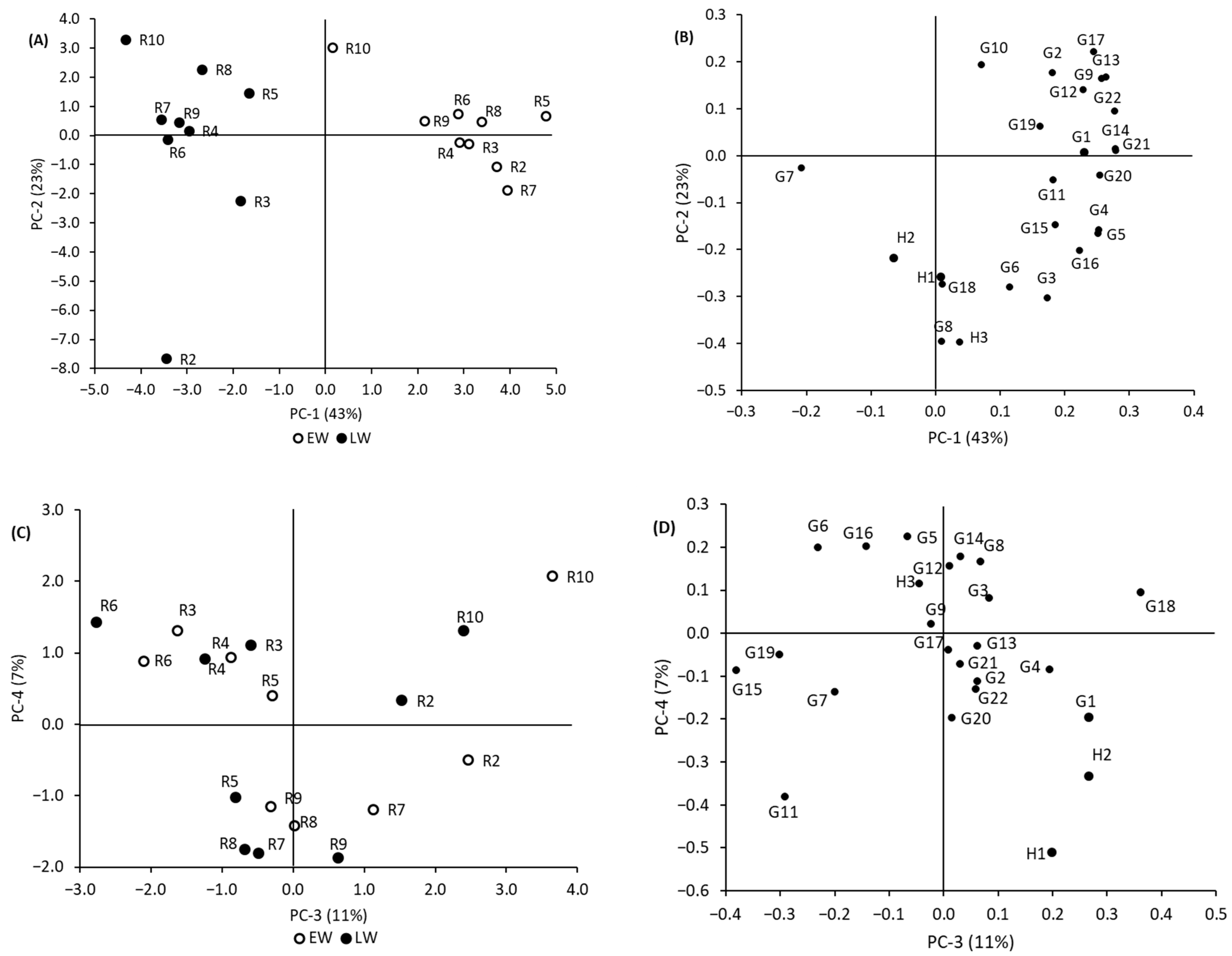
To focus only on the structural differences between EW and LW, a PCA was calculated using lignin-derived pyrolysis products H and G, mean-centered and standardized (unit variation scaling) so that each variable, regardless of absolute abundance, contribute equally to the sample distribution. The first principal plane reveals a distinct separation between EW and LW samples along PC1 (43%) (Figure 2A). However, no age-dependent trends were observed within either tissue type along this primary axis.
Significant differences were observed in the phenolic profiles of EW and LW. Notably, cis-isoeugenol (G7) was more abundant in LW, whereas guaiacyl acetone (G14), both isomers of coniferyl alcohol (cis-G20 and trans-G21), and coniferylaldehyde (G22) predominated in EW. This distribution is particularly noteworthy as G7, though a minor peak, exhibits an inverse abundance pattern compared to its primary lignin degradation precursors, G21 and G22. These findings align with previous studies on reaction and opposite wood, where G7, G21, and G22 were associated with compression wood; however, while these compounds clustered together along PC1, they were clearly differentiated on opposite sides of PC2.
Interestingly, LW samples exhibit a subtle age-related progression along PC 2 (23%), with rings R2, R3, R5, R8, and R10, aligning sequentially, while the remaining peaks cluster near the origin of PC 2. Ring 2 (LW) (Figure 2A, bottom left) is separated due to a higher content of trans-isoeugenol (G8), similar to the EW of Ring 1, and a higher content of H2. R10 is separated due to a high content of a methoxy-substituted hydroxyl-indene (G10), also a secondary pyrolysis product, likely derived from rearrangement of guaiacol-type precursors.
The prevalent isomer of isoeugenol (trans) G8, representing more than 10% of the lignin products (Table 2), lies at the origin of PC1. This indicates that G8 does not contribute to the EW/LW separation; its influence is mainly in differentiating R2 (LW) from the other LW samples along PC2. Furthermore, since H/G ratios between EW and LW remain relatively constant, H-type phenols do not contribute significantly to tissue discrimination, leaving G-type peaks as the primary drivers of separation.
The lack of a distinct age pattern, particularly within EW, may be attributed to the heterogeneity of monolignol incorporation during vascular differentiation and distinct cell wall regions [10,44,45]. Lignin deposition and composition are also significantly influenced by environmental factors [26].
Another potential climatic influence, other than the one related to the EW/LW transition, is discernible along PC3 (11%), where samples R6 and R4 (both EW and LW) cluster on one side, while R10 and R2 (EW, LW) cluster on the opposite side. Additionally, in PC4 (7%), samples R7, R8, and R9 (both EW and LW) cluster together, contrasting with the opposing cluster of R10, R6, and R3 (Figure 2C). It seems that there is something particular about these years, superimposed on the normal transition EW/LW. The separation along PC3 is due to propioguaiacone (G15), a secondary product of uncondensed β-0–4 lignol structures, and dihydroconiferyl alcohol (G19), a dehydrated product of coniferyl alcohol, on one hand, and a primary/intermediate pyrolysis product derived from the guaiacylglycerol-β-guaiacyl ether linkages G–CO–CO–CH3 (G18). The separation along PC4 is due to the main primary pyrolysis of the H-lignin signal, phenol (H1), on one hand, and, among others, G-lignin signals like eugenol (G5), guaiacyl acetone (G14), and trans-isoeugenol (G8), all secondary products of uncondensed β-0-4 lignol structures.
Collectively, these findings suggest that the detailed analysis of lignin structural variations presents a promising new avenue for dendrochronological research, potentially revealing environmental signals not captured by traditional ring-width analysis.

4. Conclusions

We acknowledge that using a single tree limits our ability to generalize these findings across the entire Pinus pinaster species. Our objective was to provide a high-resolution, “proof-of-concept” look at intra-ring chemical variability, which is often masked in multi-tree studies that use pooled samples.
This study demonstrates that analytical pyrolysis (Py-GC-FID), coupled with multivariate analysis, provides high-resolution insights into the structural heterogeneity of wood lignin within and between years. PCA successfully differentiated EW, LW, and CW based on their specific chemical fingerprints.
Noteworthy is the finding that earlywood contains more lignin but has a lower H/G ratio compared to latewood, challenging conventional expectations and adding a novel layer to our understanding of wood chemistry.
The first and second rings showed unique profiles; specifically, the EW of Ring 1 and LW of Ring 2 were differentiated by higher percentages of trans-isoeugenol (G8).
While primary PCA axes define tissue types, higher components (PC3 and PC4) revealed climatic and environmental signatures across different years. The accumulation of secondary products, such as methoxy-substituted hydroxyindene (G10) in the farthest pith ring (10), suggests that lignin “fingerprinting” can capture physiological responses occurring during vascular differentiation.
In summary, while the resolution of subtle EW/LW variations may be species-dependent, the combination of Py-GC-FID and PCA is a powerful tool for identifying distinct wood tissues and environmental influences, offering a promising new avenue for molecular dendrochronology.

Author Contributions

Conceptualization, A.A., J.G. and J.R.; methodology, A.A.; formal analysis, A.A. and J.R.; investigation, A.A. and J.R.; writing—original draft, A.A., J.R. and J.G.; writing—review and editing, A.A., J.R. and J.G.; visualization, J.G. and J.R.; supervision, J.R. and J.G. All authors have read and agreed to the published version of the manuscript.

Funding

The Article Processing Charges (APC) for this work were funded by the ADISA—Wood Analysis project (no. 91489).

Data Availability Statement

Data will be made available on request.

Acknowledgments

This work was supported by FCT–Fundação para a Ciência e a Tecnologia, I.P., through the projects UID/00239/2025 (DOI:10.54499/UID/00239/2025) and UID/PRR/00239/2025 (DOI:10.54499/UID/PRR/00239/2025) of the Forest Research Centre. Ana Alves was supported by FCT Contract-program No. 2025.CP00039.TENURE (2023.13610.TENURE.001).

Conflicts of Interest

The authors declare no conflicts of interest.

References

  1. Bruce, J.; Zobel, J.R.S. Juvenile Wood in Forest Trees; Springer Series in Wood Science; Springer: Berlin/Heidelberg, Germany, 1998. [Google Scholar]
  2. Cown, D.; Dowling, L. Juvenile wood and its implications. N. Z. J. For. 2015, 59, 10–17. [Google Scholar]
  3. Zobel, B.J.; van Buijtenen, J.P. Wood Variation: Its Causes and Control; Springer: Berlin/Heidelberg, Germany, 2012. [Google Scholar]
  4. Fredriksson, M.; Pedersen, N.B.; Thygesen, L.G. The cell wall composition of Norway spruce earlywood and latewood revisited. Int. Wood Prod. J. 2018, 9, 80–85. [Google Scholar] [CrossRef]
  5. Evert, R.F. Xylem: Secondary Xylem and Variations in Wood Structure, in Esau’s Plant Anatomy; John Wiley & Sons, Inc.: Hoboken, NJ, USA, 2006; pp. 291–322. [Google Scholar]
  6. Donaldson, L.A. Within, and between-tree variation in lignin concentration in the tracheid cell wall of Pinus radiata. N. Z. J. For. Sci. 1985, 15, 361–369. [Google Scholar]
  7. Fergus, B.J.; Goring, D.A.I. The Distribution of Lignin in Birch Wood as Determined by Ultraviolet Microscopy. Holzforschung 1970, 24, 118–124. [Google Scholar] [CrossRef]
  8. Fromm, J.; Rockel, B.; Lautner, S.; Windeisen, E.; Wanner, G. Lignin distribution in wood cell walls determined by TEM and backscattered SEM techniques. J. Struct. Biol. 2003, 143, 77–84. [Google Scholar] [CrossRef]
  9. Fukazawa, K.; Imagawa, H. Quantitative-analysis of lignin using an UV microscopic image analyzer—Variation within one growth increment. Wood Sci. Technol. 1981, 15, 45–55. [Google Scholar] [CrossRef]
  10. Baucher, M.; Monties, B.; Montagu, M.V.; Boerjan, W. Biosynthesis and genetic engineering of lignin. Crit. Rev. Plant Sci. 1998, 17, 125–197. [Google Scholar] [CrossRef]
  11. Fengel, D.; Wegener, G. Wood: Chemistry, Ultrastructure, Reactions; De Gruyter: Beijing, China, 1989. [Google Scholar]
  12. Timell, T. Physiology of Compression Wood Formation, in Compression Wood in Gymnosperms; Springer: Berlin/Heidelberg, Germany, 1986; pp. 1207–1218. [Google Scholar]
  13. Chen, C.L. Lignins: Occurrence in woody tissues, isolation, reactions, and structure. In Wood Structure and Composition; Lewin, M., Goldstein, I.S., Eds.; Marcel Dekker, Inc.: New York, NY, USA, 1991; pp. 183–261. [Google Scholar]
  14. Ritter, G.J.; Fleck, L.C. Chemistry of Wood: Springwood and Summerwood; U.S. Department of Agriculture, Forest Service, Forest Products Laboratory: Madison, WI, USA, 1930.
  15. Kibblewhite, R.P.; Suckling, I.D.; Evans, R.; Grace, J.C.; Riddell, M.J. Lignin and carbohydrate variation with earlywood, latewood, and compression wood content of bent and straight ramets of a radiata pine clone. Holzforschung 2010, 64, 101–109. [Google Scholar] [CrossRef]
  16. Bertaud, F.; Holmbom, B. Chemical composition of earlywood and latewood in Norway spruce heartwood, sapwood and transition zone wood. Wood Sci. Technol. 2004, 38, 245–256. [Google Scholar] [CrossRef]
  17. Terzopoulou, P.; Kamperidou, V. Chemical characterization of Wood and Bark biomass of the invasive species of Tree-of-heaven (Ailanthus altissima (Mill.) Swingle), focusing on its chemical composition horizontal variability assessment. Wood Mater. Sci. Eng. 2022, 17, 469–477. [Google Scholar] [CrossRef]
  18. Romagnoli, M.; Vinciguerra, V.; Silvestri, A. Heat treatment effect on lignin and carbohydrates in Corsican pine earlywood and latewood studied by PY-GC-MS technique. J. Wood Chem. Technol. 2018, 38, 57–70. [Google Scholar] [CrossRef]
  19. Antonova, G.F.; Varaksina, T.N.; Zheleznichenko, T.V.; Stasova, V.V. Lignin deposition during earlywood and latewood formation in Scots pine stems. Wood Sci. Technol. 2014, 48, 919–936. [Google Scholar] [CrossRef]
  20. Antonova, G.F.; Varaksina, T.N.; Zheleznichenko, T.V.; Bazhenov, A.V. Changes in lignin structure during earlywood and latewood formation in Scots pine stems. Wood Sci. Technol. 2019, 53, 927–952. [Google Scholar] [CrossRef]
  21. Horiyama, H.; Kojiro, K.; Okahisa, Y.; Imai, T.; Itoh, T.; Furuta, Y. Combined analysis of microstructures within an annual ring of Douglas fir (Pseudotsuga menziesii) by dynamic mechanical analysis and small angle X-ray scattering. J. Wood Sci. 2022, 68, 52. [Google Scholar] [CrossRef]
  22. Liszka, A.; Wightman, R.; Latowski, D.; Bourdon, M.; Krogh, K.B.R.M.; Pietrzykowski, M.; Lyczakowski, J.J. Structural differences of cell walls in earlywood and latewood of Pinus sylvestris and their contribution to biomass recalcitrance. Front. Plant Sci. 2023, 14, 1283093. [Google Scholar] [CrossRef]
  23. Boutelje, J.; Eriksson, I. Analysis of Lignin in Fragments from Thermomechanical Spruce Pulp by Ultraviolet Microscopy. Holzforschung 1984, 38, 249–252. [Google Scholar] [CrossRef]
  24. Yang, J.M.; Goring, D.A.I. The Phenolic Hydroxyl Content of Lignin in Spruce Wood. Can. J. Chem. 1980, 58, 2411–2414. [Google Scholar] [CrossRef]
  25. Alves, A.; Gierlinger, N.; Schwanninger, M.; Rodrigues, J. Analytical pyrolysis as a direct method to determine the lignin content in wood Part 3. Evaluation of species-specific and tissue-specific differences in softwood lignin composition using principal component analysis. J. Anal. Appl. Pyrolysis 2009, 85, 30–37. [Google Scholar] [CrossRef]
  26. Meier, D.; Faix, O. Pyrolysis-Gas Chromatography-Mass Spectrometry, in Methods in Lignin Chemistry; Lin, S.Y., Dence, C.W., Eds.; Springer: Berlin/Heidelberg, Germany, 1992; pp. 177–199. [Google Scholar]
  27. Alves, A.; Schwanninger, M.; Pereira, H.; Rodrigues, J. Analytical pyrolysis as a direct method to determine the lignin content in wood—Part 1: Comparison of pyrolysis lignin with Klason lignin. J. Anal. Appl. Pyrolysis 2006, 76, 209–213. [Google Scholar] [CrossRef]
  28. Alves, A.; Simões, R.; Lousada, J.L.; Lima-Brito, J.; Rodrigues, J. Predicting the lignin H/G ratio of Pinus sylvestris L. wood samples by PLS-R models based on near-infrared spectroscopy. Holzforschung 2020, 74, 655–662. [Google Scholar] [CrossRef]
  29. Alves, A.; Graca, J.; Rodrigues, J. Analytical Pyrolysis as a Tool to Assess Residual Lignin Content and Structure in Maritime Pine High-Yield Pulp. Forests 2022, 13, 2169. [Google Scholar] [CrossRef]
  30. Faix, O.; Meier, D.; Fortmann, I. Thermal-Degradation Products of Wood—A Collection of Electron-Impact (Ei) Mass-Spectra of Monomeric Lignin Derived Products. Holz Als Roh-Und Werkst. 1990, 48, 351–354. [Google Scholar] [CrossRef]
  31. Faix, O.; Meier, D.; Fortmann, I. Thermal-Degradation Products of Wood—Gas-Chromatographic Separation and Mass-Spectrometric Characterization of Monomeric Lignin Derived Products. Holz Als Roh-Und Werkst. 1990, 48, 281–285. [Google Scholar] [CrossRef]
  32. Ralph, J.; Hatfield, R.D. Pyrolysis-GC-MS Characterization of forage materials. J. Agric. Food Chem. 1991, 39, 1426–1437. [Google Scholar] [CrossRef]
  33. Alves, A.; Rodrigues, J. Variation of Eucalyptus globulus lignin content and composition within and between countries. J. Wood Chem. Technol. 2025, 45, 142–152. [Google Scholar] [CrossRef]
  34. Nanayakkara, B.; Riddell, M.; Harrington, J. Screening of juvenile Pinus radiata wood by means of Py-GC/MS for compression wood focussing on the ratios of p-hydroxyphenyl to guaiacyl units (H/G ratios). Holzforschung 2016, 70, 313–321. [Google Scholar] [CrossRef]
  35. Zamudio, F.; Baettyg, R.; Vergara, A.; Guerra, F.; Rozenberg, P. Genetic trends in wood density and radial growth with cambial age in a radiata pine progeny test. Ann. For. Sci. 2002, 59, 541–549. [Google Scholar] [CrossRef]
  36. Akpan, E.I.; Adeosun, S.O. Sustainable Lignin for Carbon Fibers: Principles, Techniques, and Applications; Springer International Publishing: Berlin/Heidelberg, Germany, 2019. [Google Scholar]
  37. Donaldson, L.A. Lignification and lignin topochemistry—An ultrastructural view. Phytochemistry 2001, 57, 859–873. [Google Scholar] [CrossRef] [PubMed]
  38. Donaldson, L.A.; Singh, A.P.; Yoshinaga, A.; Takabe, K. Lignin distribution in mild compression wood of Pinus radiata. Can. J. Bot. -Rev. Can. Bot. 1999, 77, 41–50. [Google Scholar] [CrossRef]
  39. Kawamoto, H. Lignin pyrolysis reactions. J. Wood Sci. 2017, 63, 117–132. [Google Scholar] [CrossRef]
  40. Choi, J.W.; Faix, O.; Meier, D. Characterization of residual lignins from chemical pulps of spruce (Picea abies L.) and beech (Fagus sylvatica L.) by analytical pyrolysis-gas chromatography/mass spectrometry. Holzforschung 2001, 55, 185–192. [Google Scholar]
  41. Kuroda, K.; Nakagawa-izumi, A. Analytical pyrolysis of lignin: Products stemming from beta-5 substructures. Org. Geochem. 2006, 37, 665–673. [Google Scholar] [CrossRef]
  42. Nanayakkara, B.; Manley-Harris, M.; Suckling, I.D.; Donaldson, L.A. Quantitative chemical indicators to assess the gradation of compression wood. Holzforschung 2009, 63, 431–439. [Google Scholar] [CrossRef]
  43. Hori, R.; Sugiyama, J. A combined FT-IR microscopy and principal component analysis on softwood cell walls. Carbohydr. Polym. 2003, 52, 449–453. [Google Scholar] [CrossRef]
  44. Dixon, R.A.; Chen, F.; Guo, D.; Parvathi, K. The biosynthesis of monolignols: A “metabolic grid”, or independent pathways to guaiacyl and syringyl units? Phytochemistry 2001, 57, 1069–1084. [Google Scholar] [CrossRef] [PubMed]
  45. Terashima, N.; Fukushima, K. Heterogeneity in formation of lignin.11. An autoradiographic study of the heterogeneous formation and structure of pine lignin. Wood Sci. Technol. 1988, 22, 259–270. [Google Scholar] [CrossRef]
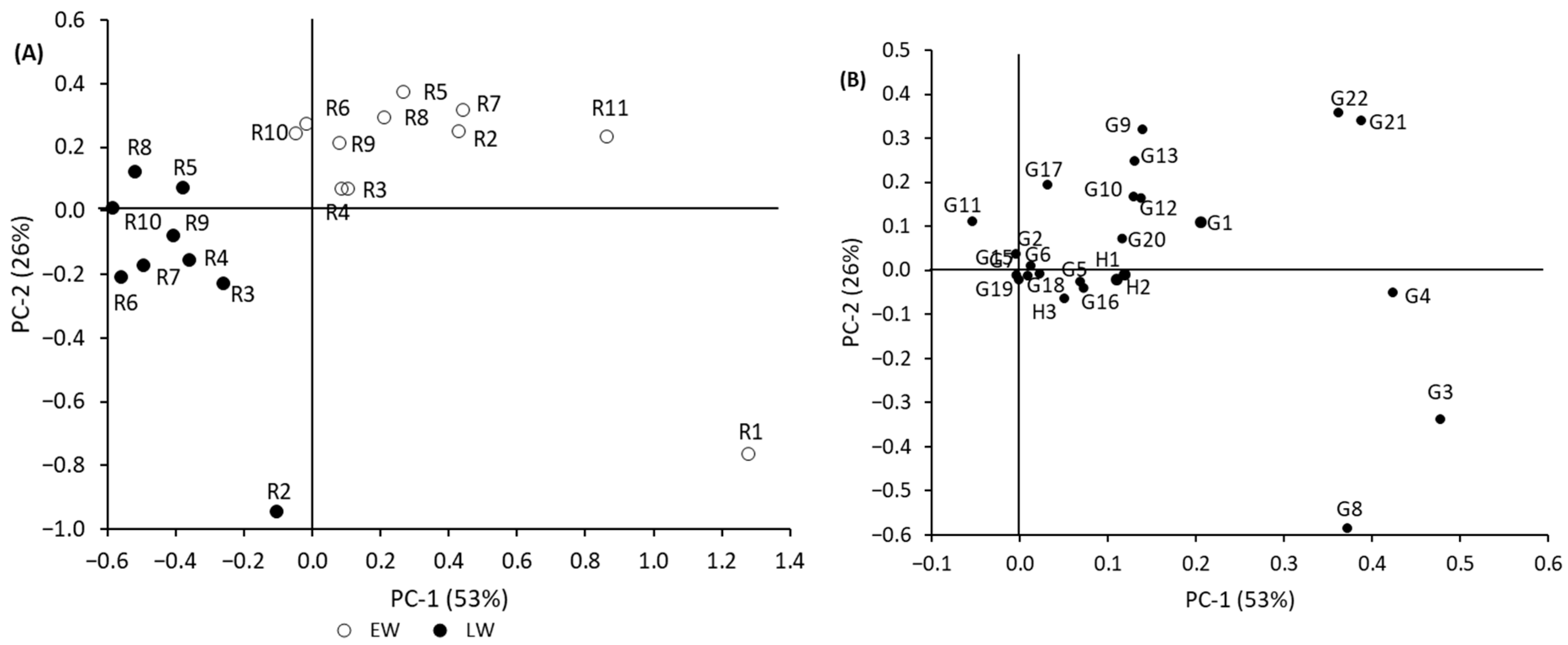
Figure 1. Principal component analysis (PCA) of tissue separation and lignin variables. (A) Principal component plot showing PC 1 (53%) versus PC 2 (26%), illustrating the separation among different tissues. (B) Loading plot showing the contribution of G- and H-lignin variables to the observed separation in the score plot.
Forests 17 00164 g001
Figure 2. (A) Principal component plot showing PC 1 (43% variance explained) versus PC 2 (23% variance explained) and a separation between EW and LW. (B) Shows the corresponding loading plot of the G- and H-lignin variables responsible for the separation. (C) Principal component plot showing PC 3 (11% variance explained) versus PC 4 (7% variance explained) and a separation between EW and LW. (D) Corresponding loading plot of the G- and H-lignin variables responsible for the separation.
Forests 17 00164 g002
Table 1. Radial variation in the Py-lignin (%) and H/G ratio (dimensionless) of Pinus pinaster wood samples.
Py-Lignin (%)H/G
Ring nr.EW–LWEW–LW
R129.7–n.d.0.042–n.d.
R227.7–25.10.038–0.054
R326.7–24.90.034–0.040
R426.6–24.60.035–0.037
R527.4–24.70.033–0.038
R626.4–24.00.033–0.037
R728.0–24.30.044–0.042
R827.1–24.40.038–0.040
R926.6–24.60.039–0.045
R1026.0–23.90.033–0.039
R1129.3–n.d.0.072–n.d.
Av.26.9–24.50.036–0.041
Std0.6–0.40.004–0.006
p-valuep < 0.001p < 0.05
Table 2. Identification of the lignin-derived pyrolysis products used for the principal component analyses (PCA) to reveal tissue differences in lignin composition using only G- and H-lignin variables; * percentage (%, average of rings 2 to 10) is based on all identified products; ** percentage (%) is based only on lignin products.
CodeCompoundEW * (%)LW *
(%)
EW **
(%)
LW **
(%)
H1Phenol0.50.51.71.9
H2p-Cresol0.30.31.01.2
H3m-Cresol0.20.20.80.9
G1Guaiacol1.81.76.76.8
G23-Methyl guaiacol0.10.10.30.3
G34-Methyl guaiacol2.82.710.510.9
G44-Vinyl guaiacol2.92.710.710.8
G5Eugenol1.00.93.63.7
G64-Propyl guaiacol0.20.20.60.6
G7Isoeugenol (cis)0.20.20.70.8
G8Isoeugenol (trans)2.62.69.510.5
G9Vanillin2.42.18.88.6
G10Indene, 6-hydroxy-7-methoxy-, 1H-1.31.14.84.7
G11Indene, 6-hydroxy-7-methoxy-, 2H-0.80.72.82.8
G12Homovanillin1.41.35.15.1
G13Acetoguaiacone1.10.94.13.7
G14Guaiacyl acetone0.20.20.80.8
G15Propioguaiacone0.20.20.70.7
G16Isomer of coniferyl alcohol0.70.62.42.5
G17G-CO-CH=CH20.60.52.32.1
G18G-CO-CO-CH30.10.10.30.4
G19Dihydroconiferyl alcohol0.90.93.43.5
G20Coniferyl alcohol (cis)0.60.52.32.1
G21Coniferyl alcohol (trans)1.20.94.53.5
G22Coniferylaldehyde3.12.711.411.0
Total (%)26.924.5100100
Disclaimer/Publisher’s Note: The statements, opinions and data contained in all publications are solely those of the individual author(s) and contributor(s) and not of MDPI and/or the editor(s). MDPI and/or the editor(s) disclaim responsibility for any injury to people or property resulting from any ideas, methods, instructions or products referred to in the content.