Fungal Diversity Associated with the Sharp-Dentated Bark Beetle Ips acuminatus (Coleoptera: Curculionidae) in Latvia

 ,
,  ,
,  , ,
, ,
Abstract
1. Introduction
2. Materials and Methods
2.1. Study Sites
2.2. Collecting Ips acuminatus Beetles
2.3. Isolation and Identification of Fungi Associated with Ips acuminatus
2.4. Data Analysis
3. Results
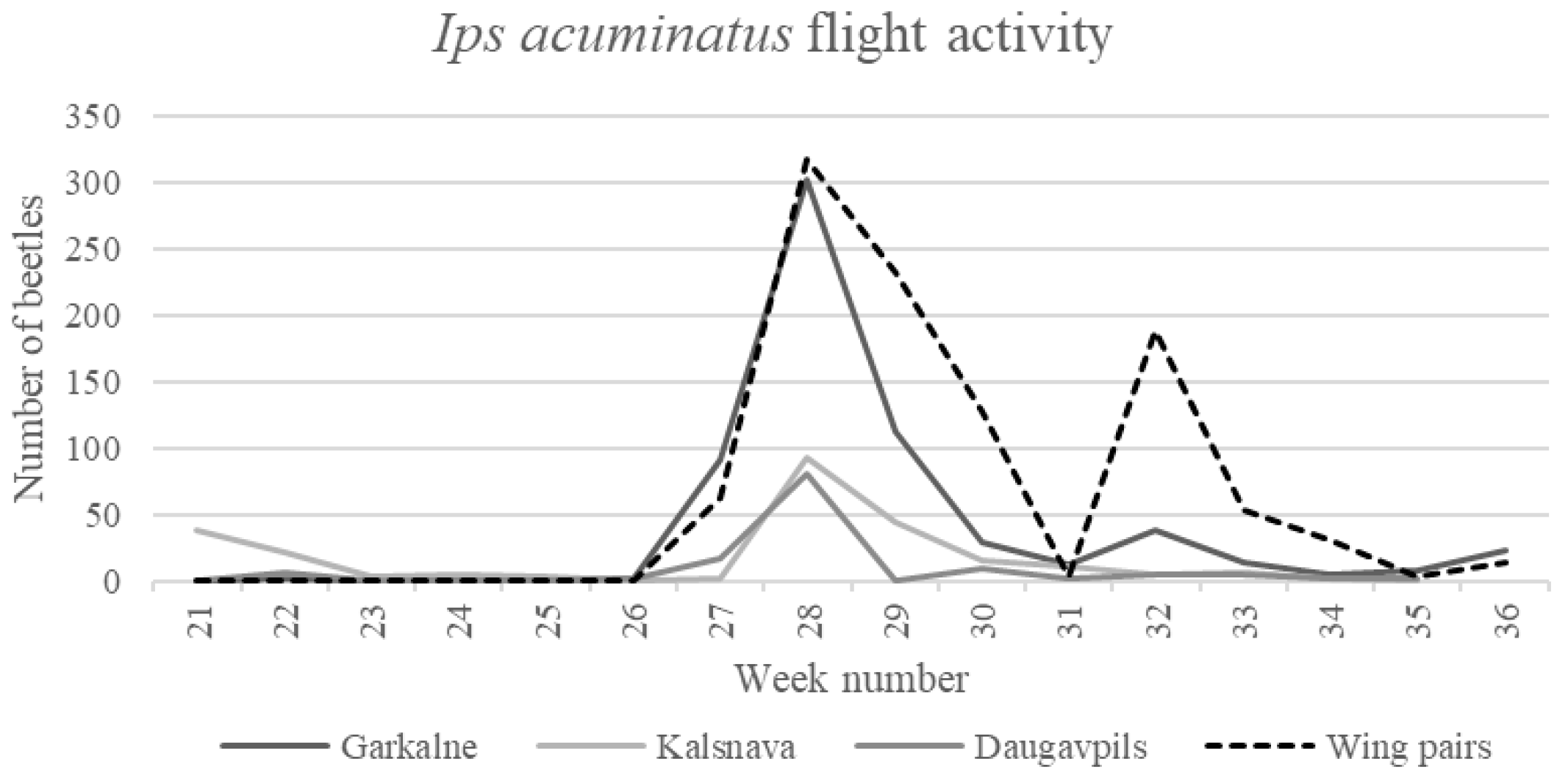
3.1. Seasonal Flight Activity of Bark Beetle Ips acuminatus
3.2. Fungi Associated with Ips acuminatus
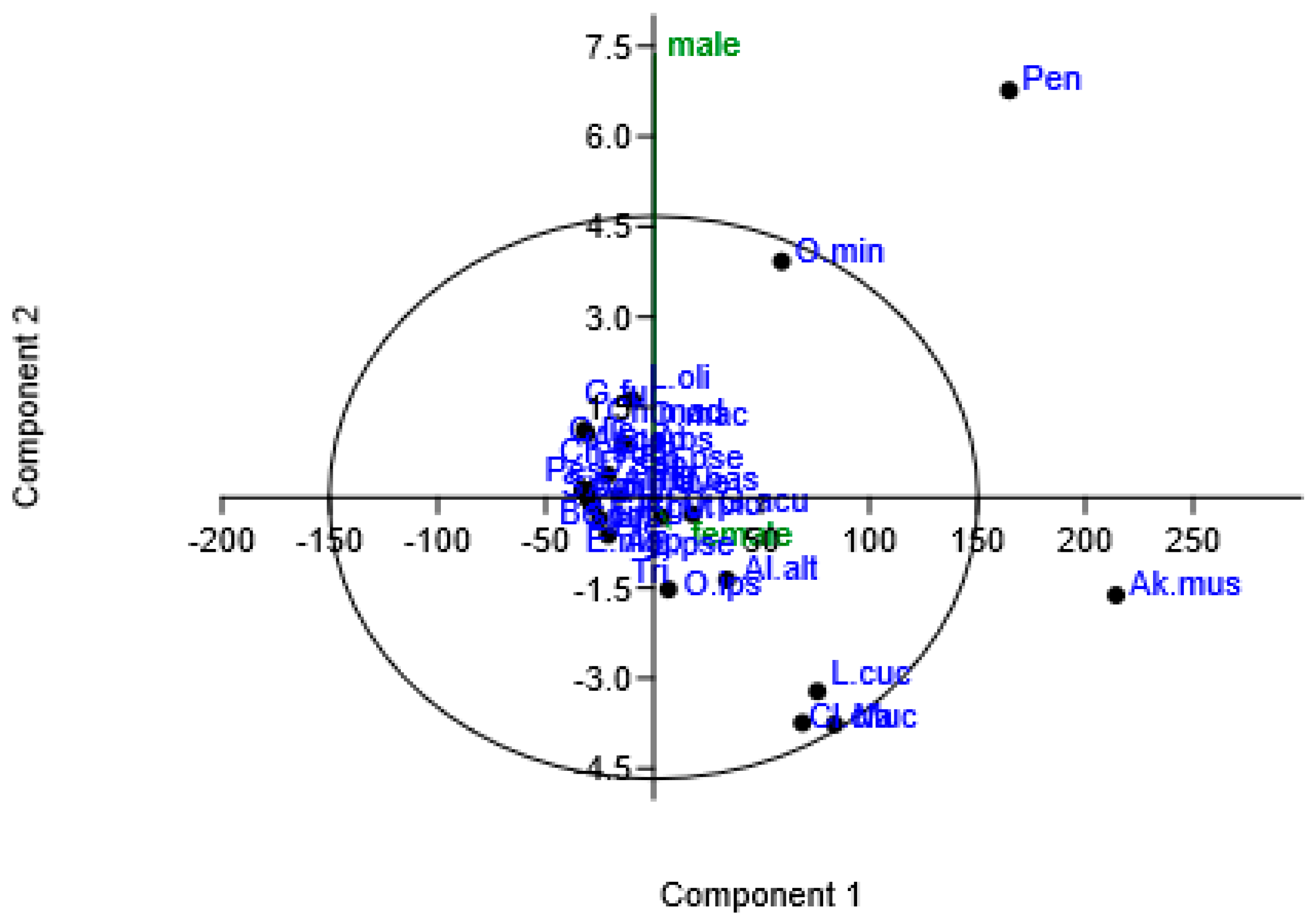
3.3. Seasonal Differences in Fungal Communities Isolated from Ips acuminatus
4. Discussion
5. Conclusions
Author Contributions
Funding
Data Availability Statement
Acknowledgments
Conflicts of Interest
References
- Siitonen, J. Ips acuminatus kills pines in southern Finland. Silva Fenn. 2014, 48, 1145. [Google Scholar] [CrossRef]
- Gregoire, J.-C.; Bonte, J.; Bourke, A.; Cocos, D.; Fielding, N.; Gohli, J.; Inward, D.; Klapwijk, M.; Nikolav, C.; Økland, B.; et al. Territorial expansion of the European Ips species in the 20th century—A review. Entomol. Gen. 2024, 44, 1359–1375. [Google Scholar] [CrossRef]
- Otanke, E.; Smits, A.; Legzdina, L. Spatial competition between Ips acuminatus and other main pine tree colonizing pests. In Proceedings of the Research on Rural Development 2025, Jelgava, Latvia, 14–16 May 2025; Volume 40, pp. 106–111. [Google Scholar] [CrossRef]
- Papek, E.; Ritzer, E.; Biedermann, P.H.W.; Cognato, A.I.; Baier, P.; Hoch, G.; Kirisits, T.; Schebeck, M. The pine bark beetle Ips acuminatus: An ecological perspective on life-history traits promoting outbreaks. J. Pest Sci. 2024, 97, 1093–1122. [Google Scholar] [CrossRef]
- Bakke, A. Ecological studies on bark beetles (Coleoptera: Scolytidae) associated with Scots pine (Pinus sylvestris L.) in Norway with particular reference to the influence of temperature. Medd. Nor. Skogforsk. 1968, 21, 441–602. [Google Scholar]
- Bakke, A. Field and laboratory studies on sex ratio in Ips acuminatus (Coleoptera: Scolytidae) in Norway. Can. Entomol. 1968, 100, 640–648. [Google Scholar] [CrossRef]
- Hlavkova, D.; Koudelkova, J.; Davidkova, M.; Dolezal, P. Ips acuminatus (Gyllenhal) in the Czech Republic: Flight dynamics and adult population structure. Physiol. Entomol. 2025, 1–11. [Google Scholar] [CrossRef]
- Latvian Forest Sector 2025. Latvian Forest Sector in Facts & Figures. Available online: https://www.mezaskaitli.lv/en (accessed on 26 November 2025).
- Past and Future Climate Change in Latvia; Latvian Centre for Environment, Geology and Meteorology: Riga, Latvia, 2024. Available online: https://klimats.meteo.lv/data/climate_change_data_viewer/report_downloads/LVGMC-klimata-parmainas-2024.pdf (accessed on 20 November 2025). (In Latvian).
- Alvarez, G.; Fernandez, M.; Diez, J.J. Ophiostomatoid fungi associated with declined Pinus pinaster stands in Spain. For. Sys. 2015, 24, e-006. [Google Scholar] [CrossRef]
- Wang, Z.; Liu, C.; Tie, Y.; Song, X.; Wang, H.; Lu, Q. Ophiostomatalean Fungi (Ascomycota, Ophiostomatales) associated with three beetles from Pinus sylvestris var. mongolica in Heilongjiang, China. J. Fungi 2024, 11, 27. [Google Scholar] [CrossRef]
- Davydenko, K.; Vasaitis, R.; Menkis, A. Fungi associated with Ips acuminatus (Coleoptera: Curculionidae) in Ukraine with a special emphasis on pathogenicity of ophiostomatoid species. Eur. J. Entomol. 2017, 114, 77–85. [Google Scholar] [CrossRef]
- Davydenko, K.; Baturkin, D.O. Pine engraver beetle Ips acuminatus as a potential vector of Sphaeropsis sapinea. For. For. Melior. 2020, 136, 149–156. [Google Scholar] [CrossRef]
- Poimala, A.; Uimari, A.; Terhonen, E. Alien invasive pathogens and pests in the changing environment: Focus on North Europe. Balt. For. 2024, 30, 104–115. [Google Scholar] [CrossRef]
- Ounap, H. Insect Predators and Parasitoids of Bark Beetles in Estonia. Ph.D. Thesis, Institute of Plant Protection, Faculty of Agronomy, Estonia Agricultural University, Tartu, Estonia, 2001; 111p. [Google Scholar]
- Colombari, F.; Schroeder, M.L.; Battisti, A.; Faccoli, M. Spatio-temporal dynamics of an Ips acuminatus outbreak and implications for management. Agric. For. Entomol. 2013, 15, 34–42. [Google Scholar] [CrossRef]
- Knížek, M.; Liška, J.; Véle, A. Efficacy of synthetic lures for pine bark beetle monitoring. J. For. Sci. 2022, 68, 19–25. [Google Scholar] [CrossRef]
- Jankowiak, R.; Bilanski, P.; Trabka, O.; Hulboj, R.; Taerum, S.J. Ophiostomatatoid fungi (Ascomycota) associated with Ips acuminatus (Coleoptera) in eastern Poland. Dendrobiology 2023, 90, 95–110. [Google Scholar] [CrossRef]
- Barta, M.; Artimova, R.; Medo, J.; Horakova, M.K.; Strmiskova, M.; Pastircakova, K. Host-specific fungal assemblages, dominated by Ophiostomatoid taxa, in Scots pine bark beetles from Slovakia revealed by metabarcoding. Forests 2025, 16, 1690. [Google Scholar] [CrossRef]
- Sukovata, L.; Jaworski, T.; Plewa, R. Effectiveness of different lures for attracting Ips acuminatus (Coleoptera: Curculionidae: Scolytinae). Agric. Forest Entomol. 2021, 23, 154–162. [Google Scholar] [CrossRef]
- Watanabe, T. Pictorial Atlas of Soil and Seed Fungi: Morphologies of Cultured Fungi and Key to Species, 2nd ed.; CRC Press: Boca Raton, FL, USA, 2002; 486p, ISBN 0-8493-1118-7. [Google Scholar]
- Doyle, J.J.; Doyle, J.L. Isolation of Plant DNA from Fresh Tissue. Focus 1990, 12, 13–15. [Google Scholar]
- White, T.J.; Bruns, T.; Lee, S.J.W.T.; Taylor, J. Amplification and direct sequencing of fungal ribosomal RNA genes for phylogenetics. In PCR Protocols: A Guide to Methods and Applications; Academic Press: Cambridge, MA, USA, 1990; Volume 18, pp. 315–322. [Google Scholar] [CrossRef]
- Gardes, M.; Bruns, T.D. ITS primers with enhanced specificity for basidiomycetes—Application to the identification of mycorrhizae and rusts. Mol. Ecol. 1993, 2, 113–118. [Google Scholar] [CrossRef]
- Sanger, F.; Nicklen, S.; Coulson, A.R. DNA sequencing with chain-terminating inhibitors. Proc. Natl. Acad. Sci. USA 1977, 74, 5463–5467. [Google Scholar] [CrossRef]
- Hammer, O.; Harper, D.A.T.; Ryan, P.D. PAST: Paleontological Statistics Software Package for Education and Data Analysis. 2001. Available online: http://palaeo-electronica.org/2001_1/past/issue1_01.htm (accessed on 5 November 2025).
- R Core Team. R: A Language and Environment for Statistical Computing; R Foundation for Statistical Computing: Vienna, Austria, 2025; Available online: http://www.r-project.org/ (accessed on 20 June 2025).
- Zare, R.; Gams, W. Lecanicillium muscarium. In IMI Descriptions of Fungi and Bacteria; CABI: Wallingford, UK, 2003; p. 157. [Google Scholar] [CrossRef]
- ISO 8601-1:2019; Date and Time—Representations for Information Interchange—Part 1: Basic Rules. International Organization for Standardization: Geneva, Switzerland, 2019.
- Alvarez-Baz, G.; Fernandes-Bravo, M.; Pajares, J.; Quesada-Moraga, E. Potential of native Beauveria pseudobassiana strain for biological control of Pine Wood Nematode vector Monochamus galloprovincialis. J. Invertebr. Pathol. 2015, 132, 48–56. [Google Scholar] [CrossRef]
- Di Sora, N.; Turko, S.; Brugneti, F.; Isoli, F.; Mazzaglia, A.; Contarini, M.; Speranzo, S.; Rossini, L. “The last of them”: Entomopathogenic effect of Akanthomyces muscarius on the scale insect pest Toumeyella parvicornis under laboratory conditions, a potential biological control candidate. Physiol. Plant. 2025, 177, e70533. [Google Scholar] [CrossRef] [PubMed]
- Biryol, S.; Sayin, N.A.; Akturk, R.; Bilgin, L.; Isik, S.; Soydinc, A.; Topkara, E.F.; Yanar, O.; Ayvaz, S.; Turna, H.; et al. Target and non-target impact of oil-based Beauveria bassiana formulation in controlling forest insect pests. J. Pest Sci. 2025, 98, 2129–2144. [Google Scholar] [CrossRef]
- Draganova, S.; Takov, D.; Doychev, D. Bioassays with isolates of Beauveria bassiana (Bals.) Vuill. and Paecilomyces farinosus (Holm.) Brown & Smith against Ips sexdentatus Boerner and Ips acuminatus Gyll. (Coleoptera: Scolytidae). Plant Sci. 2006, 44, 24–28, ISSN: 2534-9848. [Google Scholar]
- Solheim, H.; Langstrom, B. Blue-stain fungi associated with Tomicus piniperda in Sweden and preliminary observations on their pathogenicity. Ann. Sci. For. 1991, 48, 149–156. [Google Scholar] [CrossRef]
- Linnakoski, R.; de Beer, Z.W.; Ahtianen, J.; Sidorov, E.; Niemela, P.; Pappinen, A.; Wingfield, M.J. Ophiostoma spp. associated with pine- and spruce-infesting bark beetles in Finland and Russia. Persoonia 2010, 25, 72–93. [Google Scholar] [CrossRef]
- Yin, M.; Wingfield, M.J.; Zhou, X.; Linnakoski, R.; de Beer, Z.W. Taxonomy and phylogeny of the Leptographium olivaceum complex (Ophiostomatales, Ascomycota), including descriptions of six new species from China and Europe. MycoKeys 2019, 60, 93–123. [Google Scholar] [CrossRef]
- Jankowiak, R. Ophiostomatoid fungi associated with the spruce bark beetle (Ips typographus) New for Poland: Occurrence and morphology. Phytopathol. Pol. 2004, 33, 5–21. [Google Scholar]
- Ramanenka, M.O.; Ugwu, J.A.; Ivashchanka, L.O. Mycobiota of bark beetles of the genus Ips DeGeer, 1775(Coleoptera, Curculionidae: Scolytinae: Ipini) and its economic impact. Entomol. Rev. 2021, 101, 1113–1125. [Google Scholar] [CrossRef]
- Chang, R.; Duong, T.A.; Taerum, S.J.; Wingfield, M.J.; Zhou, X.; Yin, M.; de Beer, Z.W. Ophiostomatoid fungi associated with the spruce bark beetle Ips typographus, including 11 new species from China. Persoonia 2018, 42, 50–74. [Google Scholar] [CrossRef]
- Davydenko, K.; Vasaitis, R.; Elfstrand, M.; Baturkin, D.; Meshkova, V.; Menkis, A. Fungal communities vectored by Ips sexdentatus in declining Pinus sylvestris in Ukraine: Focus on occurrence and pathogenicity of Ophiostomatoid species. Insects 2021, 12, 1119. [Google Scholar] [CrossRef]




| Study Area | Trap Site | Longitude | Latitude |
|---|---|---|---|
| Daugavpils | 1 | 55.91216 | 26.46869 |
| 2 | 55.91471 | 26.46188 | |
| 3 | 55.91954 | 26.46586 | |
| 4 | 55.92918 | 26.47763 | |
| 5 | 55.93680 | 26.46891 | |
| Garkalne | 1 | 57.03536 | 24.42798 |
| 2 | 57.04562 | 24.49557 | |
| 3 | 57.06071 | 24.42741 | |
| 4 | 57.04844 | 24.40907 | |
| 5 | 57.00322 | 24.32353 | |
| Kalsnava | 1 | 56.67875 | 25.84702 |
| 2 | 56.67153 | 25.84529 | |
| 3 | 56.67252 | 25.86201 | |
| 4 | 56.67790 | 25.89302 |
| Fungal Taxa | Locality (% of Beetles Colonized/% Among Isolates) | Total (% of All Beetles/% Among All Isolates) | ||
|---|---|---|---|---|
| Daugavpils | Garkalne | Kalsnava | ||
| Absidia spp. | - | 2.6/1.0 | 1.9/1.4 | 2.2/1.0 |
| Akanthomyces muscarius | 15.0/9.0 | 58.5/23.4 | 17.9/13.7 | 44.4/21.0 |
| Alternaria alternata | 7.5/4.5 | 14.2/5.7 | 8.0/6.2 | 11.9/5.6 |
| Alternaria infectoria | 2.5/1.5 | 0.3/0.1 | - | 0.3/0.2 |
| Armillaria cepistipes | - | - | 0.6/0.5 | 0.2/0.1 |
| Aspergillus spp. | 2.5/1.5 | 0.3/0.1 | 1.9/1.4 | 0.8/0.4 |
| Aureobasidium pullulans | - | 0.8/0.3 | 0.6/0.5 | 0.7/0.3 |
| Beauveria bassiana | 12.5/7.5 | 2.3/0.9 | 2.5/1.9 | 3.1/1.4 |
| Beauveria pseudobassiana | - | 1.5/0.6 | 1.2/0.9 | 1.4/0.6 |
| Blastobotrys sp. LV59 | - | 0.3/0.1 | - | 0.2/0.1 |
| Botrytis cinerea | - | 0.3/0.1 | 0.6/0.5 | 0.3/0.2 |
| Chaetomium madrasense | 2.5/1.5 | 0.3/0.1 | 0.6/0.5 | 0.5/0.2 |
| Chaetomium subaffine | - | - | 0.6/0.5 | 0.2/0.1 |
| Cladosporium cladosporioides | 15.0/9.0 | 22.2/8.9 | 8.0/6.2 | 18.8/8.4 |
| Diplodia sapinea | - | 0.3/0.1 | - | 0.2/0.1 |
| Epicoccum nigrum | - | 0.8/0.3 | - | 0.5/0.2 |
| Fusarium avenaceum | - | 0.5/0.2 | 1.2/0.9 | 0.7/0.3 |
| Graphilbum acuminatum | 10.0/6.0 | 10.1/4.0 | 6.8/5.2 | 9.2/4.3 |
| Graphilbum furuicola | - | 0.3/0.1 | 0.6/0.5 | 0.3/0.2 |
| Leptographium cucullatum | 12.5/7.5 | 24.5/9.8 | 8.0/6.2 | 19.2/9.1 |
| Leptographium olivaceum | - | 6.4/2.6 | 0.6/0.5 | 4.4/2.1 |
| Mucor spp. | 42.5/25.4 | 19.3/7.7 | 17.9/13.7 | 20.5/9.7 |
| Ophiostoma ips | 10.0/6.0 | 9.3/3.7 | 0.6/0.5 | 6.9/2.3 |
| Ophiostoma macrosporum | 2.5/1.5 | 3.4/1.3 | 3.1/2.4 | 3.6/1.7 |
| Ophiostoma minus | 12.5/7.5 | 22.9/9.2 | 4.9/3.8 | 17.3/8.2 |
| Ophiostoma piceae | - | 9.5/3.8 | 1.2/0.9 | 6.6/3.1 |
| Penicillium spp. | 20.0/11.9 | 34.8/13.9 | 37.0/28.4 | 34.4/16.3 |
| Pestalotiopsis sp. LV47 | - | 0.3/0.1 | - | 0.2/0.1 |
| Petriella guttulata | - | 0.5/0.2 | - | 0.3/0.2 |
| Pleosporales sp. LV24 | - | 0.5/0.2 | - | 0.3/0.2 |
| Pyrenophora tetrarrhenae | - | 0.3/0.1 | - | 0.2/0.1 |
| Sporothrix pseudoabietina | - | 0.8/0.3 | - | 0.5/0.2 |
| Sporothrix sp. LV27 | - | - | 0.6/0.5 | 0.2/0.1 |
| Sydowia polyspora | - | 0.3/0.1 | - | 0.2/0.1 |
| Trichoderma spp. | - | 1.5/0.6 | 3.7/2.8 | 2.0/1.0 |
| Cylindromonium lichenicola | - | 0.3/0.1 | - | 0.2/0.1 |
| Other information | ||||
| Bacteria | 90.0 | 90.5 | 80.2 | 87.6 |
| Number of Ips acuminatus beetles analysed | 40 | 388 | 162 | 590 |
| Number of traps | 5 | 5 | 4 | 14 |
| Number of fungal isolates | 67 | 969 | 211 | 1247 |
| Variable | Ophiostoma minus | Leptographium cucullatum |
|---|---|---|
| Sex of Ips acuminatus | 4.5 * | 1.0 |
| Sampling month | 17.6 ** | 19.6 *** |
| Random effects | variance | |
| Trap × Sampling area | 0.559 | 0.467 |
| Sampling area | 0.000 | 0.000 |
| Model performance, marginal R2 | 0.908 | 0.182 |
| Model performance, conditional R2 | 0.9211 | 0.284 |
Disclaimer/Publisher’s Note: The statements, opinions and data contained in all publications are solely those of the individual author(s) and contributor(s) and not of MDPI and/or the editor(s). MDPI and/or the editor(s) disclaim responsibility for any injury to people or property resulting from any ideas, methods, instructions or products referred to in the content. |
© 2025 by the authors. Licensee MDPI, Basel, Switzerland. This article is an open access article distributed under the terms and conditions of the Creative Commons Attribution (CC BY) license.
Share and Cite
Burnevica, N.; Gricjus, E.; Legzdina, L.; Strike, Z.; Krivmane, B.; Rancane, S.; Lekavičs, J.; Smits, A.; Klavina, D. Fungal Diversity Associated with the Sharp-Dentated Bark Beetle Ips acuminatus (Coleoptera: Curculionidae) in Latvia. Forests 2026, 17, 9. https://doi.org/10.3390/f17010009
Burnevica N, Gricjus E, Legzdina L, Strike Z, Krivmane B, Rancane S, Lekavičs J, Smits A, Klavina D. Fungal Diversity Associated with the Sharp-Dentated Bark Beetle Ips acuminatus (Coleoptera: Curculionidae) in Latvia. Forests. 2026; 17(1):9. https://doi.org/10.3390/f17010009
Chicago/Turabian StyleBurnevica, Natalija, Elza Gricjus, Liva Legzdina, Zane Strike, Baiba Krivmane, Selita Rancane, Janis Lekavičs, Agnis Smits, and Darta Klavina. 2026. "Fungal Diversity Associated with the Sharp-Dentated Bark Beetle Ips acuminatus (Coleoptera: Curculionidae) in Latvia" Forests 17, no. 1: 9. https://doi.org/10.3390/f17010009
APA StyleBurnevica, N., Gricjus, E., Legzdina, L., Strike, Z., Krivmane, B., Rancane, S., Lekavičs, J., Smits, A., & Klavina, D. (2026). Fungal Diversity Associated with the Sharp-Dentated Bark Beetle Ips acuminatus (Coleoptera: Curculionidae) in Latvia. Forests, 17(1), 9. https://doi.org/10.3390/f17010009