


Abstract
The molecular weight distribution (MWD) of cellulose and its degree of polymerization (DP) have a significant influence on the strength properties of wood. The most widely used method for analyzing MWD and DP is size exclusion chromatography (SEC). In this study, we monitored changes in the MWD and DP of cellulose in spruce wood after thermal treatment at temperatures of up to 280 °C. We employed the two most prevalent SEC methods: after direct dissolution of cellulose in a solution of dimethylacetamide and lithium chloride, and after its derivatization to tricarbanilates (CTCs). Both methods yield comparable results that correlate well with each other, although CTCs yield approximately 15% higher absolute values of DP. Our results show that a drop in DP begins at 100 °C, particularly above 220 °C, where significant cellulose degradation occurs. Both methods are appropriate for analyzing cellulose in thermally degraded wood. CTCs have the advantage of greater sensitivity and are suitable for small sample quantities. Direct dissolution can also provide information on the aromatic compounds formed during the thermal treatment of wood when used in conjunction with a refractive index (RI) detector and an ultraviolet (UV) detector. There is a strong linear relationship between DP and the modulus of rupture (MOR), as well as between the modulus of elasticity (MOE) and DP.
1. Introduction
Cellulose, the most abundant organic polymer on Earth, is a naturally occurring organic macromolecule that is a straight syndiotactic homopolymer with the general molecular formula (C6H10O5)n. Cellulose is made up of long chains of β-d-glucose molecules connected via β(1→4) glycosidic bonds, with hydroxyl groups at the C2, C3, and C6 positions. These -OH groups exhibit different reactivities, which significantly impact the chemical processing of cellulose. As a significant renewable resource, biomass offers the advantages of low carbon emissions and being environmentally friendly [1,2,3]. The properties of cellulose and its processing methods depend on several factors. Among the most important are the crystalline and amorphous fractions, the average degree of polymerization (DP), and the molecular weight distribution (MWD). Viscometry is a quick and simple method for determining the DP of cellulose and its derivatives in various solvents, e.g., cuoxam using cuprammonium hydroxide, cuen (CED) using cupriethylenediamine hydroxide, cadoxen using triethylenediamine cadmium hydroxide, and EWNN (FeTNa) using iron-tartaric acid-sodium complex solutions. However, this method has a significant disadvantage in that it only provides the value of the viscosity average molecular weight (Mv). Furthermore, it does not provide information on the distribution of molecular weights in polymers. Size exclusion chromatography (SEC) enables the distribution of molecular weights and several molecular weight averages to be determined (number-average molecular weight (Mn), weight-average molecular weight (Mw), and z-average molecular weight (Mz)). SEC also provides information on degradation fractions, helping to clarify the mechanism underlying cellulose changes during various processing steps [4]. Accurately determining the MWD of cellulose samples is challenging, and there is still no universal method for this; various methods were compared in [5,6].
Since cellulose is insoluble in most common solvents due to its dense, partially crystalline structure and numerous intra- and intermolecular hydrogen bonds. A suitable dissolution system or derivatization method that does not degrade the original sample must be found [7]. As wood remains the most important source of cellulose today, the solubility of lignin and hemicelluloses must be considered. The dissolution process can be more complicated when examining cellulose samples that have been subjected to various processes, such as thermal modification or aging. The most commonly used systems today include the direct dissolution of cellulose in dimethylacetamide (DMAc) and lithium chloride (LiCl), as well as the derivatization of cellulose to tricarbanilates (CTCs) [8,9]. Other compounds, e.g., 1,3-dimethyl-2-imidazolidinone (DMI) [10], 1-ethyl-3-methylimidazolium acetate (EmimOAc) [6], and various ionic liquids [11], are also used to dissolve cellulose before subsequent SEC analysis.
The application of LiCl/DMAc to dissolve cellulose was first performed and patented by McCormick [12] and Turbak [13]. The original methods have been gradually adapted to the different characteristics of cellulose in many applications [14,15]. Cellulose is dissolved in an 8–9 wt% LiCl/DMAc solution, and 0.5–1.0 wt% LiCl/DMAc is used as the mobile phase (see Section 2 for details). Molecular weight determination can be performed via column calibration with pullulans or by using a multi-angle laser light scattering (MALLS) detector [14]. By simultaneously using both refractive index (RI) and ultraviolet (UV) detectors, changes in aromatic compounds can be monitored in addition to the MWD of cellulose [16].
Analysis of the molecular weight distribution of cellulose after its derivatization to CTCs using phenyl isocyanate has been known for 50 years [17]. Two different procedures—precipitation in a methanol–water mixture or evaporation of pyridine from the reaction mixture—can be applied, and the final analysis is performed using size exclusion chromatography (SEC). During precipitation, not all low-molecular-weight cellulose fractions precipitate, and the resulting DP values are higher than those obtained when the sample is evaporated [18,19].
For analysis, a refractive index (RI) detector, a UV detector set to 235 nm, or a MALLS detector can be used. When using an RI or UV detector, the system needs to be calibrated using polystyrene standards and universal calibration with different Mark–Houwink constants. These methods yield similar results [6,20,21,22].
The macromolecular characteristics of cellulose significantly impact the mechanical properties of wood and the stability of wooden structures. Monitoring these characteristics is therefore crucial in the field of wooden building construction and fire protection.
Both SEC methods are widely used for analyzing cellulose, particularly in the paper and pulp industries. According to the available information, however, these methods have not yet been compared in the context of SEC analysis of cellulose isolated from thermally treated wood, a process that results in significant changes. This study aimed to determine whether the two most commonly used methods for determining DP provide reliable and comparable results for cellulose in thermally degraded spruce wood.
2. Materials and Methods
2.1. Material
Specimens of Norway spruce (Picea abies L. Karst.) with dimensions of 150 × 10 × 10 mm (longitudinal × tangential × radial) were thermally treated in an oven (Memmert UNB 200, Fisher Scientific, Loughborough, UK) at temperatures of 100 °C, 150 °C, 200 °C, 220 °C, 240 °C, 260 °C, and 280 °C for 1 h. The specimens were then cooled in a desiccator to 20 ± 2 °C, after which, they were labeled as follows: 20 (reference), 100, 150, 200, 220, 240, 260, and 280.
2.2. Methods
2.2.1. Derivatization of Cellulose into Cellulose Tricarbanilates
Cellulose tricarbanilates (CTCs) were prepared via a modified method [18,23,24]. Briefly, cellulose samples were dried over silica gel to constant weight. Anhydrous pyridine (1.0 mL), cellulose (5 mg), and phenyl isocyanate (0.1 mL) were sealed in a 10 mL dropping flask. The flask was immersed in an oil bath at 80 °C for 48 h. At the end of the reaction, methanol (0.1 mL) was added to the mixture to eliminate excess phenyl isocyanate. Subsequently, 2.5 mL of tetrahydrofuran (THF) was added to the pyridine reaction mixture and filtered through a glass filter (Membrane Solutions, Auburn, WA, USA) with a pore size of 0.7 µm before SEC analysis.
2.2.2. Dissolution of Cellulose in Dimethylacetamide (DMAc) and Lithium Chloride (LiCl)
Cellulose samples were dissolved in DMAc/LiCl according to a modified method [25,26]. A cellulose sample (10 mg) was suspended in 100 mL of demineralized water and briefly disintegrated three times for 10 s in a kitchen mixer. Excess water was removed by suction filtration using a fritted glass funnel (S4) with a porosity of 5–15 µm. One milliliter of DMAc was added to the sample and left for ten minutes. The DMAc was then removed using a vacuum. This procedure was repeated five times. The sample was then transferred to a 10 mL pear-shaped flask, and 1.25 mL of 8% LiCl in DMAc was added. The sample was allowed to dissolve with occasional stirring. Dissolution times vary depending on the material. A study by Henniges et al. provides additional information on the dissolution times of different pulp samples [15,25]. In general, sulfite pulps dissolve very quickly, whereas annual plant fibers require longer dissolution times. In our case, the samples dissolved within 24 h. Before SEC analysis, the samples were diluted with DMAc to a volume of 10 mL to achieve a concentration of 1% LiCl in DMAc.
2.2.3. Size Exclusion Chromatography (SEC)
The SEC analysis of CTCs was performed under the conditions reported in our previous work [19].
The SEC analysis of cellulose dissolved in DMAc/LiCl was carried out on an Agilent 1200 HPLC (Agilent Technologies, Santa Clara, CA, USA) using a refractive index (RI) detector and a diode array detector (DAD) working at 280 nm, and separation was performed at 35 °C with 1% LiCl in DMAc at a flow rate of 1 mL min−1 on two PLgel 10 μm (7.5 × 300 mm) MIXED B columns, which were preceded by a PLgel 10 μm (7.5 × 50 mm) GUARD column (Agilent Technologies, Santa Clara, CA, USA). Data acquisition was carried out with Chemstation software, version B.04.03 (Agilent Technologies, Santa Clara, CA, USA), and calculations were performed with the Clarity GPC module (DataApex, Prague, Czech Republic). The system was calibrated with pullulan standards with an average molecular weight (MW) in the range of 180–708,000 Da (Polymer Laboratories, Shropshire, UK).
For SEC analysis, each sample was prepared in duplicate, and each solution (CTCs or cellulose in DMAc/LiCl) was analyzed twice; therefore, the results represent the average of four measurements.
2.2.4. Measurements of Mechanical Properties
Specimens were conditioned at an air temperature of 20 ± 2 °C and a relative humidity of 65 ± 5% to a constant weight with a moisture content of 12% before mechanical testing. Bending strength (modulus of rupture—MOR) and modulus of elasticity (MOE) were evaluated according to the ASTM 143-22 standard [27]. The tangential direction of a sample was parallel to the loading force. The loading was performed using a Testometric M250-3CT loading machine (Rochdale, UK). Each set contained 10 specimens.
3. Results and Discussion
Size exclusion chromatography (SEC) is a rapid and reliable method of measuring the macromolecular characteristics of polymers. For some polymers where solubility is an issue, different methods can produce different results. Such polymers include cellulose, which must be dissolved directly in special solvents or derivatized into compounds that are soluble in the solvents suitable for SEC analysis.
In our experiments, we employed two dissolution approaches: derivatization to cellulose tricarbanilates (CTCs), followed by SEC analysis in tetrahydrofuran using narrow polystyrene standards for calibration, and direct dissolution in dimethylacetamide (DMAc) with LiCl and calibration with pullulans. These two methods are currently the most commonly used for analyzing the molecular weight distribution (MWD) of cellulose. Other cellulose derivatives, such as nitrates, which were previously used to determine the degree of polymerization (DP), are now rarely used. However, an SEC method for cellulose nitrates on museum objects in various aging conditions has recently been published [28]. Ionic solvents are also used, but not yet widely.
MWD analysis is influenced by several factors, e.g., sample type, dissolution/derivatization method, mobile phase, chromatographic columns, calibration method, and SEC instrumentation. When using a MALLS detector, calibration of the system is not necessary; however, when using other detectors, it is necessary to select the appropriate type of standards and calibration method. In our study, we used the same samples, columns, and SEC instrumentation. We also monitored the influence of dissolution, derivatization, and calibration on the resulting molecular weights.
3.1. SEC of Cellulose Tricarbanilates
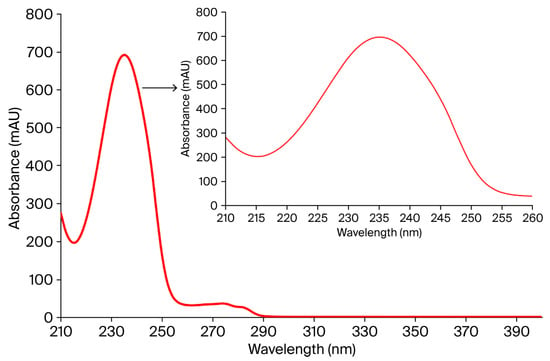
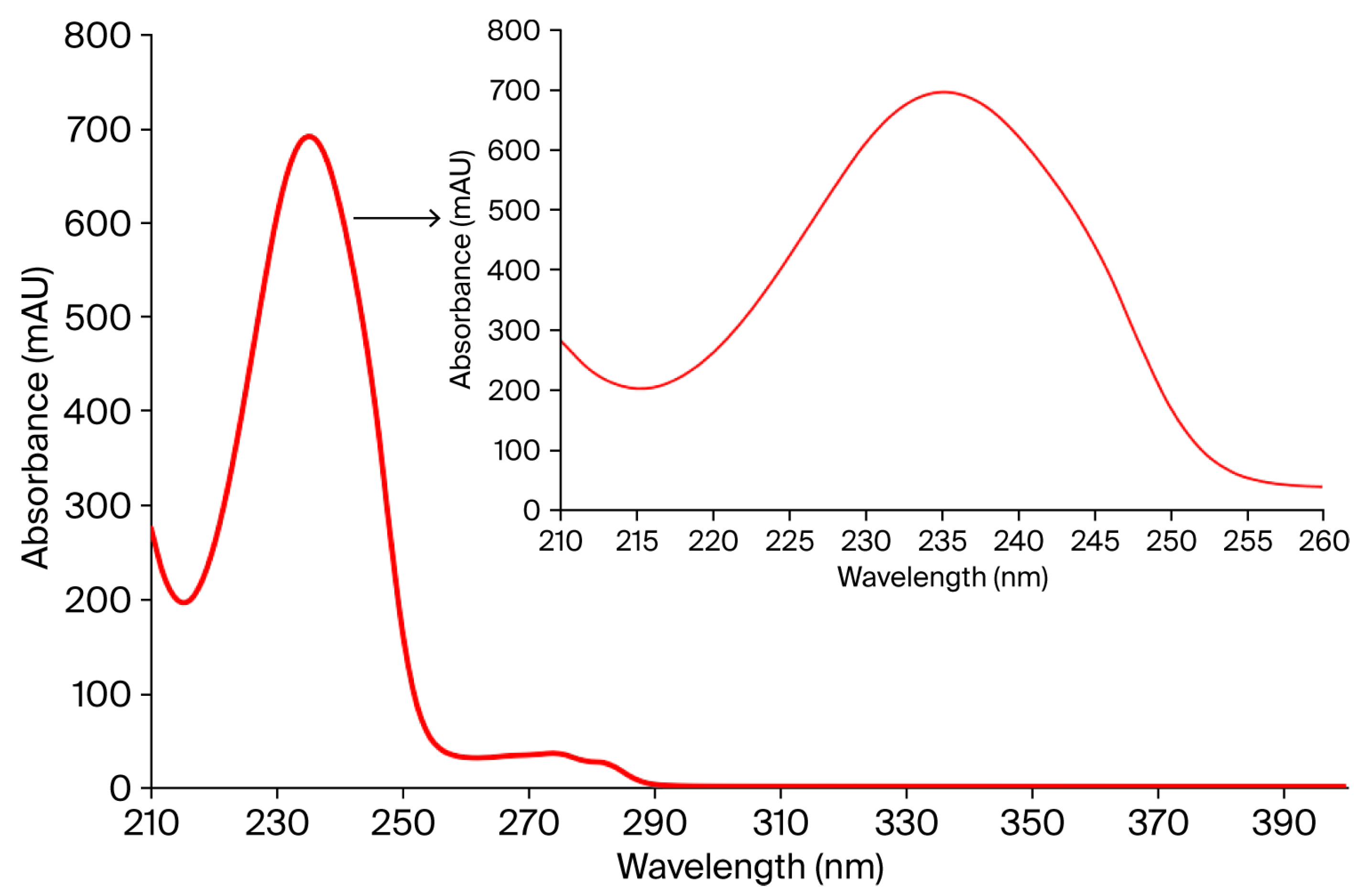
CTCs are well soluble in tetrahydrofuran, even after prior precipitation or directly after derivatization without precipitation. The advantages of using CTCs include absorbance in the UV region of the spectrum, with a maximum at 235 nm (Figure 1). Using a UV detector allows for much more sensitive analysis than using an RI detector. However, the derivatization step is complicated by the presence of large quantities of lignin. Small amounts do not interfere [26], nor does the presence of hemicelluloses up to 20% [29].
Figure 1.
UV spectrum of spruce CTCs (λmax = 235 nm).
Thermal degradation of wood significantly affects all components of wood (extractives, cellulose, lignin, hemicelluloses), which has an impact on the chemical composition of wood as well as its physical and chemical properties. Increased temperature causes degradation of hemicelluloses and cellulose in the surface layer, resulting in a darker color [30]. This color change can be used as a measure of wood quality control [31,32]. This correlation has been confirmed many times for common temperate wood species, but not for wood species with a high extractive content, such as black locust [33]. The mechanical properties of wood are significantly influenced by the degree of cellulose polymerization [34,35], making it crucial to accurately determine this value.
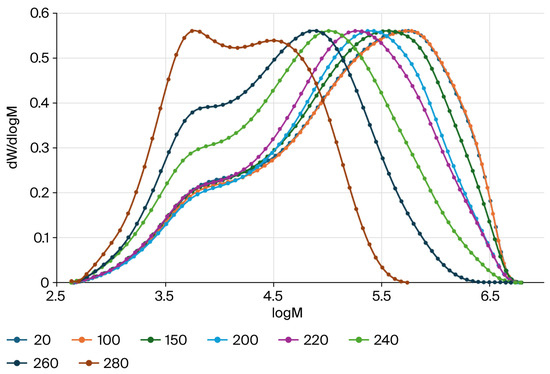
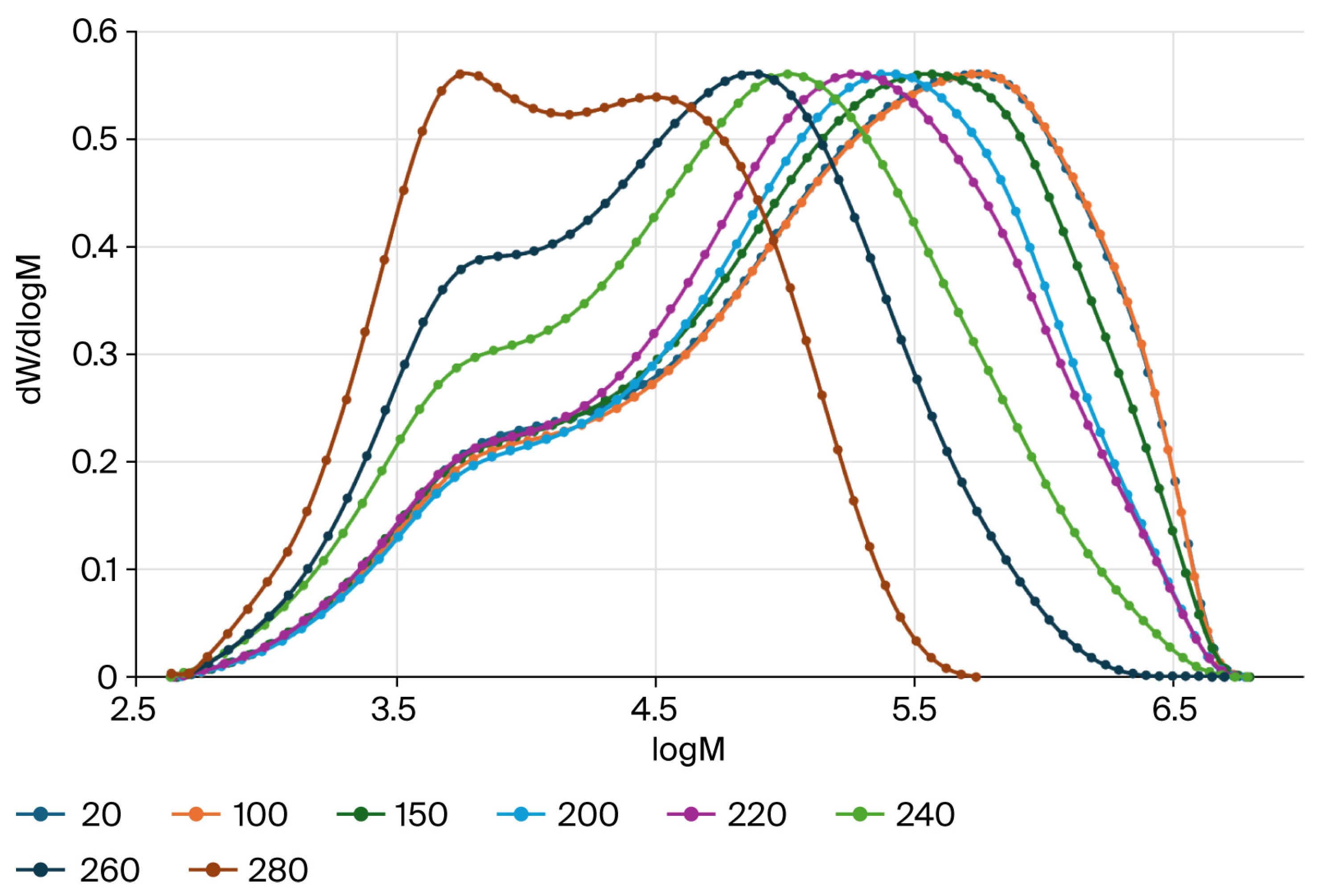
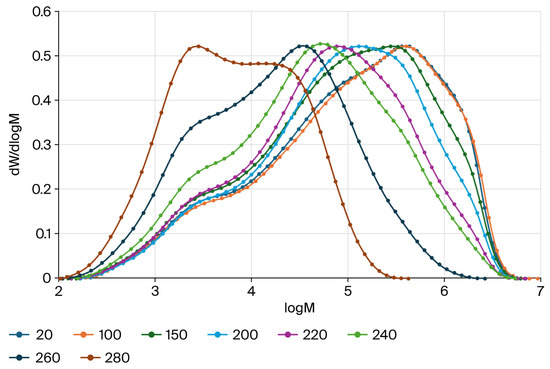
Thermal treatment causes a decrease in the degree of cellulose polymerization (Figure 2, Table 1). A temperature of 100 °C results in a slight increase in DP, likely due to the preferential degradation of shorter cellulose chains and also hemicelluloses, as observed in the MWD graphs (Figure 2). In the temperature range from 100 to 220 °C, a linear decrease in DP of 35% can be observed. At higher temperatures, the sharp decrease in DP is also linear, and at 280 °C, it only reaches approximately 8% of the original value (Table 1). A decrease in the DP of cellulose during the thermal treatment of pine wood and its effect on mechanical properties were also observed in another study [36].
Figure 2.
Molecular weight distribution of spruce CTCs.
Table 1.
Molecular weight parameters of spruce cellulose analyzed via SEC of CTCs (SD—standard deviation; n = 4).
3.2. SEC of Non-Derivatized Cellulose in DMAc/LiCl
The cellulose samples were completely dissolved in a solution of 8% LiCl in DMAc. After dilution to 1% LiCl in DMAc, they were successfully analyzed using the SEC method (Figure 3). The MWD curves are very similar to those obtained from the SEC analysis of CTC derivatives in THF (Figure 2). The molecular weight parameters obtained by both methods are also very similar (Table 1 and Table 2), although the absolute values are 15% lower on average. When evaluating the molecular weight parameters of CTC derivatives, we employed a universal calibration method, which yields higher values than pullulan calibration for non-derivatized cellulose. This is consistent with the findings of another study [26], which reported that universal calibration produced 20% higher values, on average, compared to the average values obtained using all methods. These differences in absolute DP values may be due to the different calibration standards used (pullulans vs. polystyrenes).
Figure 3.
Molecular weight distribution of spruce cellulose directly dissolved in DMAc/LiCl.
Table 2.
Molecular weight parameters of spruce cellulose analyzed via SEC directly dissolved in DMAc/LiCl (SD—standard deviation; n = 4).
3.3. Comparison of SEC Results for Derivatized and Non-Derivatized Cellulose Specimens
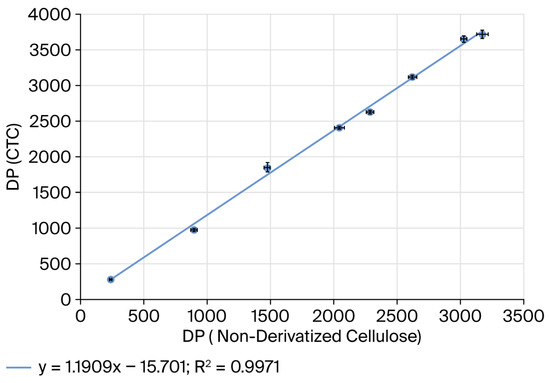
Both methods show a significant correlation between DP values (Figure 4). Similar correlations have also been reported when comparing SEC using universal calibration, SEC with a MALLS detector, and the asymmetric flow field–flow fractionation (A4F) method [24]. It should be noted that the A4F method yields DP values that are approximately 10% higher than those obtained by SEC analysis as it does not involve two phenomena that occur in SEC columns. The first is shear degradation, which is especially significant in the case of high-molecular-weight polymers. The second is that side chains in high-molecular-weight branched polymers can become entangled in the pores of the column filling (so-called anchoring), causing their retention times to correspond to a smaller hydrodynamic volume than their actual value. The A4F method can be used to analyze such polymers because it eliminates both the anchoring and shear degradation that occur during SEC [37].
Figure 4.
Correlation between DP obtained via SEC of CTCs and non-derivatized cellulose.
Although cellulose is a linear polysaccharide in its pure form, the substitution of hydroxyl groups and branching of the originally linear chain can occur when it is isolated from various types of biomass or due to various modifications of either the original raw material or the isolated cellulose. Branching of cellulose mainly occurs in pulps with a high molecular weight. New functional groups can also form within cellulose monomer units as a result of the action of oxygen in an aging atmosphere and the emission of volatile organic compounds from degrading cellulose. These new functional groups can enhance or elicit branching [38,39].
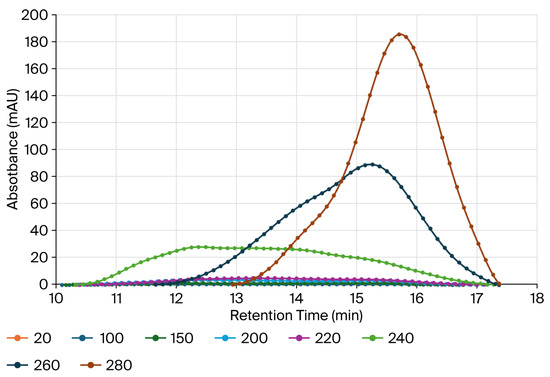
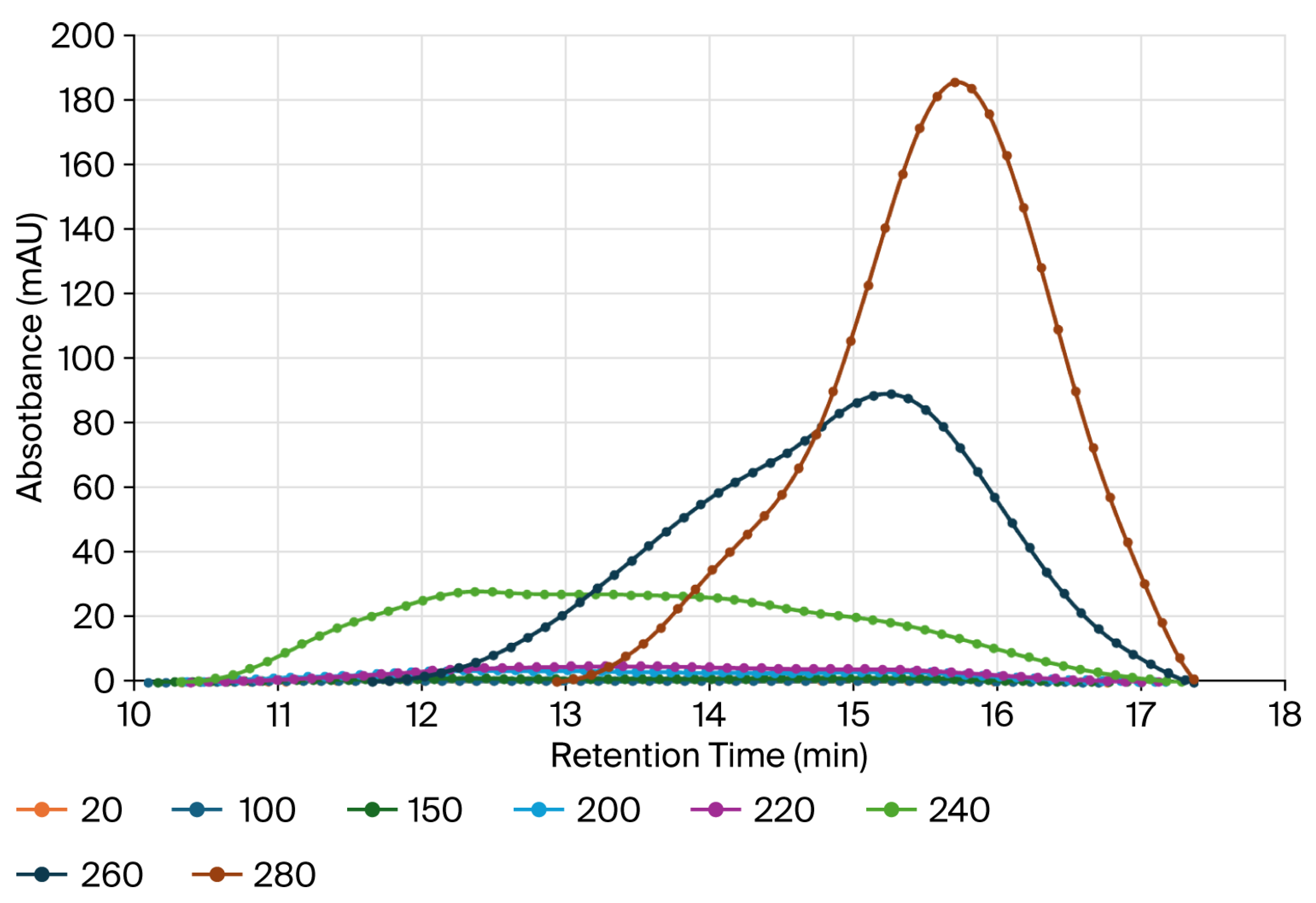
By using RI and UV detectors simultaneously, it is possible to detect the emerging aromatic compounds that are formed under the influence of elevated temperatures. In this work, they started to form at temperatures above 220 °C (Figure 5), which is consistent with the sharp decrease in the DP of cellulose (Table 1 and Table 2). The content of aromatics increases at higher temperatures, and concomitantly, their molecular weights decrease (Figure 5). Yildiz et al. [40] reported that the heating carbohydrates leads, to some extent, to the formation of unsaturated nonvolatile material (i.e., UV-detectable “lignin-like material”). The presence of aromatic compounds was also observed in infrared (FTIR) spectra. The simultaneous use of RI and UV detectors in the SEC of non-derivatized samples can also be used to monitor changes during pulp bleaching [16], residual lignin in wood cellulose samples, and pulps [41].
Figure 5.
SEC chromatograms of non-derivatized cellulose using UV detector (λ = 280 nm).
It is worth noting that the samples were not completely dissolved in individual solvents (THF or DMAc/LiCl), and larger amounts of insoluble residues were present at higher thermal treatment temperatures (Table 3). For simplicity, the terms ‘CTC’ and ‘cellulose’ are used throughout the text, but it should be noted that these refer to the ‘THF-soluble’ or ‘LiCl/DMAc-soluble’ fractions. During the thermal treatment of wood, mass loss mainly occurs due to the decomposition of organic components, such as hemicelluloses, cellulose, and lignin (Table 3). This leads to a color change, a reduction in density, and an improvement in dimensional stability. However, it can also result in a deterioration in mechanical properties. The cellulose content remains constant, but increases at temperatures above 200 °C due to gradual carbonization and the formation of aromatic substances (see Figure 5). Cellulose modified in this way does not undergo sufficient oxidative reactions, and its content in thermally modified wood appears to increase when measured by gravimetric methods, even though the glucose content decreases during cellulose hydrolysis and chromatographic determination.
Table 3.
Mass loss, cellulose yield, and insoluble residues in DMAc/LiCl, and THF (SD = standard deviation).
3.4. The Impact of the Degree of Cellulose Polymerization on the Mechanical Properties of Wood
The mechanical properties of wood are crucial in many applications. The most important parameters are bending strength (modulus of rupture, or MOR) and the modulus of elasticity (MOE). These are influenced by various factors, the most significant of which are wood density and the properties of cellulose, particularly its degree of polymerization (DP) and crystallinity [42,43]. MOR and MOE values depend on many properties of the xylem and the presence of defects and anomalies in the wood. Unsurprisingly, the measured values for spruce wood show a wide variation, ranging from 6800 MPa to 12,872 MPa for MOE and from 58.9 MPa to 89.9 MPa for MOR [44,45]. Our results for thermally untreated wood are within the specified range (Table 4).
Table 4.
Modulus of rupture (MOR) and modulus of elasticity (MOE) of spruce wood after thermal treatment (SD—standard deviation; CoV—coefficient of variation; n = 10).
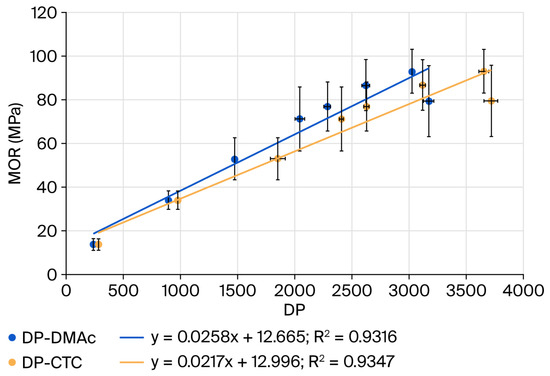
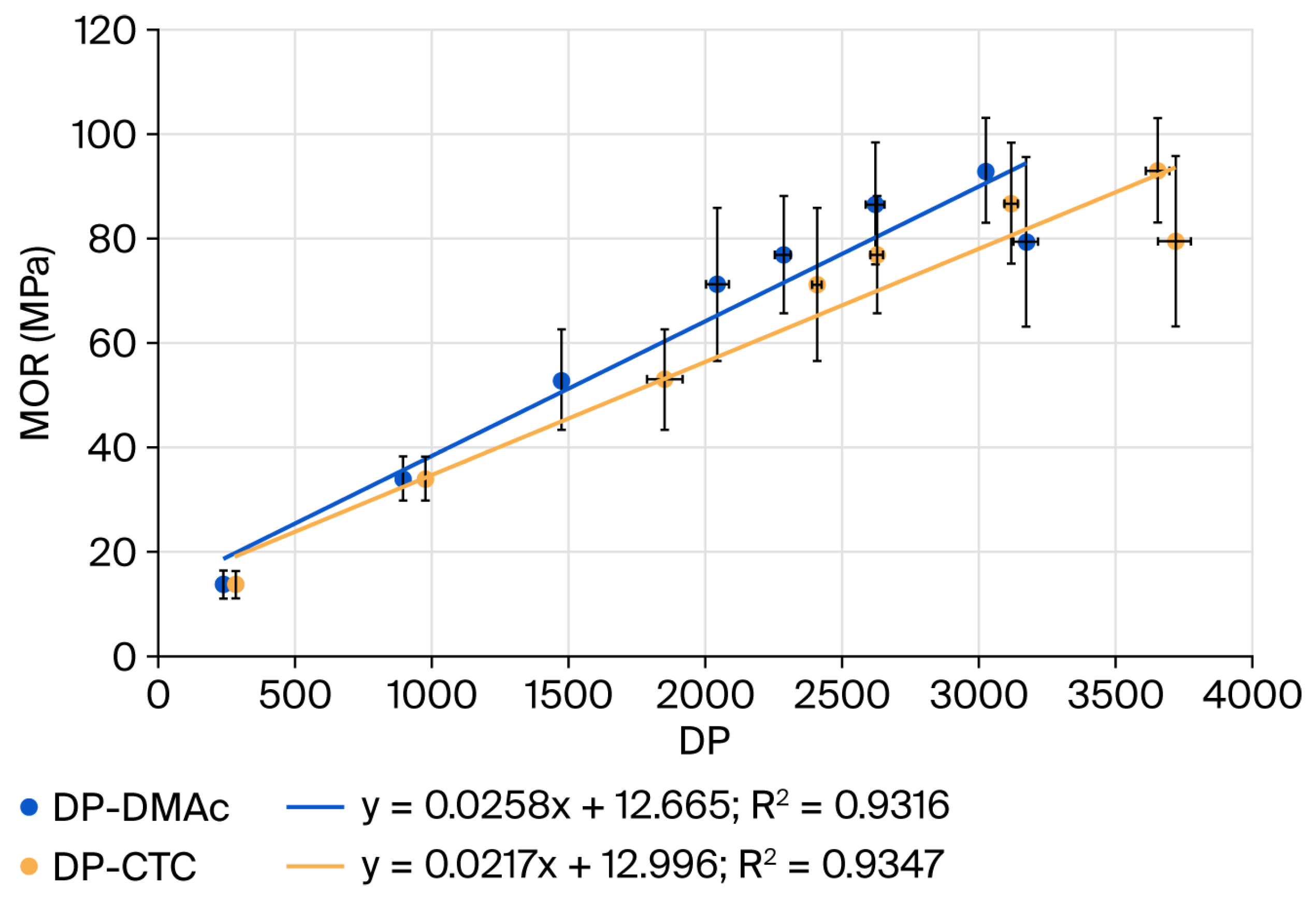
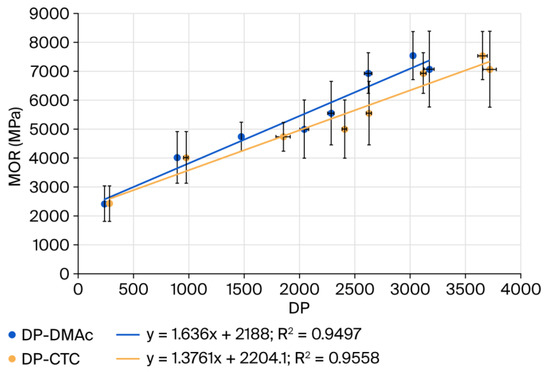
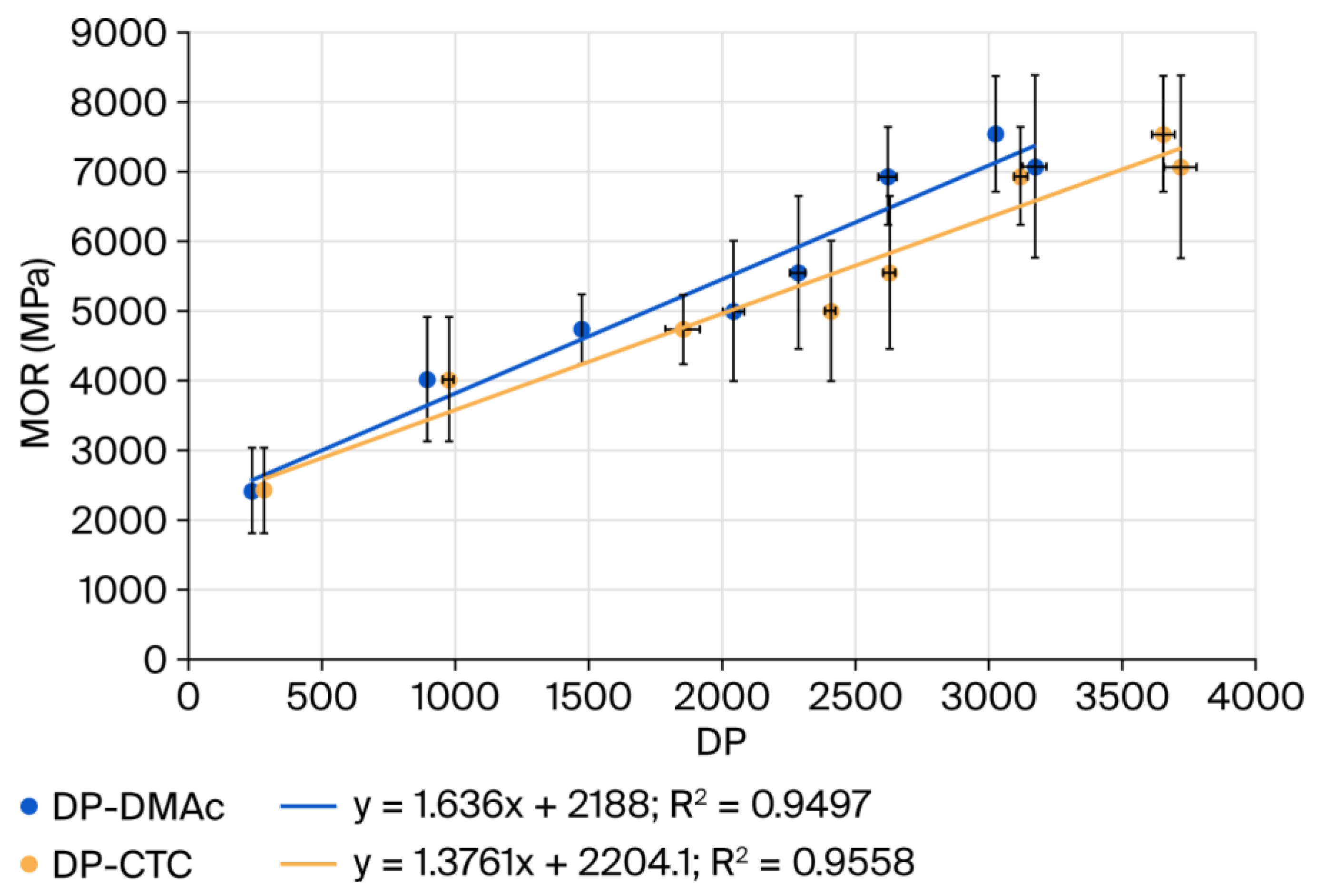
The thermal treatment of wood decreases both MOR and MOE [46,47], which can be attributed, among other factors, to a decrease in DP. A very strong correlation was found between MOR and DP (see Figure 6), as well as between MOE and DP (see Figure 7). Similar dependencies were also found for spruce [35] and pine wood [36].
Figure 6.
Dependence of modulus of rupture (MOR) on degree of polymerization (DP) of cellulose.
Figure 7.
Dependence of modulus of elasticity (MOE) on degree of polymerization (DP) of cellulose.
4. Conclusions
This study compares the two most common methods for determining the degree of polymerization (DP) and the molecular weight distribution (MWD) of cellulose. The first method involved size exclusion chromatography (SEC) of cellulose after derivatization to tricarbanilates (CTCs). The second method involved SEC of non-derivatized cellulose after dissolution in a lithium chloride/dimethylacetamide (DMAc/LiCl) solution. The aim was to establish the suitability of these methods for analyzing cellulose in thermally modified spruce wood. Both methods enable the complete dissolution of cellulose in both the original wood and the thermally degraded wood, yielding comparable results. However, CTCs are more sensitive and are therefore more suitable for smaller sample quantities. The second method provides information on aromatic compounds formed during the thermal treatment process, in addition to the monitored cellulose parameters. Based on our experiments, we recommend using non-derivatized cellulose dissolved in a DMAc/LiCl solution for SEC analysis of cellulose in untreated and thermally degraded wood.
Author Contributions
Conceptualization, D.K. and F.K.; methodology, F.K.; data curation, F.K., and D.K.; writing—original draft preparation, F.K.; writing—review and editing, F.K. and D.K.; supervision, D.K.; funding acquisition, D.K. All authors have read and agreed to the published version of the manuscript.
Funding
This work was supported by the Slovak Research and Development Agency under Contract No. APVV-22-0030.
Data Availability Statement
Data are contained within the article.
Conflicts of Interest
The authors declare no conflicts of interest.
References
- Madhushree, M.; Vairavel, P.; Mahesha, G.; Bhat, K.S. A Comprehensive Review of Cellulose and Cellulose-Based Materials: Extraction, Modification, and Sustainable Applications. J. Nat. Fibers 2024, 21, 2418357. [Google Scholar] [CrossRef] [Scilit]
- Srivastava, R.K.; Shetti, N.P.; Reddy, K.R.; Nadagouda, M.N.; Badawi, M.; Bonilla-Petriciolet, A.; Aminabhavi, T.M. Valorization of Biowastes for Clean Energy Production, Environmental Depollution and Soil Fertility. J. Environ. Manag. 2023, 332, 117410. [Google Scholar] [CrossRef] [Scilit] [PubMed]
- Marinho, E. Cellulose: A Comprehensive Review of Its Properties and Applications. Sustain. Chem. Environ. 2025, 11, 100283. [Google Scholar] [CrossRef] [Scilit]
- Dupont, A.-L.; Mortha, G. Comparative Evaluation of Size-Exclusion Chromatography and Viscometry for the Characterisation of Cellulose. J. Chromatogr. A. 2004, 1026, 129–141. [Google Scholar] [CrossRef] [Scilit] [PubMed]
- Pitkänen, L.; Sixta, H. Size-Exclusion Chromatography of Cellulose: Observations on the Low-Molar-Mass Fraction. Cellulose 2020, 27, 9217–9225. [Google Scholar] [CrossRef] [Scilit]
- Hashizume, T.; Saito, K.; Watanabe, T. Facile Characterization of Molecular Weight Distribution of Cellulose by Gel Permeation Chromatography Using a Dimethyl Sulfoxide Solution Containing 1% EmimOAc. Cellulose 2025, 32, 1499–1511. [Google Scholar] [CrossRef] [Scilit]
- Oberlerchner, J.T.; Rosenau, T.; Potthast, A. Overview of Methods for the Direct Molar Mass Determination of Cellulose. Molecules 2015, 20, 10313–10341. [Google Scholar] [CrossRef] [Scilit]
- Hou, G.; Chitbanyong, K.; Takeuchi, M.; Shibata, I.; Isogai, A. Determination of Molar-Mass Parameters of TEMPO-Oxidized Pulps by SEC/MALLS/RI. Cellulose 2025, 32, 6449–6461. [Google Scholar] [CrossRef] [Scilit]
- Lee, L.Q.; Chan, H.L.; Zhou, H.; Zhao, H.; Ao, Q.; Huang, H.; Chong, C.C.; Zhou, Y.; Li, H. Green Catalyst-Based Cardboard Waste Conversion into Biogas. Green Chem. 2025, 27, 3964–3979. [Google Scholar] [CrossRef] [Scilit]
- Yanagisawa, M.; Shibata, I.; Isogai, A. SEC-MALLS Analysis of Softwood Kraft Pulp Using LiCl/1,3-Dimethyl-2-Imidazolidinone as an Eluent. Cellulose 2005, 12, 151–158. [Google Scholar] [CrossRef] [Scilit]
- Zhou, Y.; Zhang, X.; Zhang, J.; Cheng, Y.; Wu, J.; Yu, J.; Zhang, J. Molecular Weight Characterization of Cellulose Using Ionic Liquids. Polym. Test. 2021, 93, 106985. [Google Scholar] [CrossRef] [Scilit]
- McCormick, C.L. Novel Cellulose Solutions. U.S. Patent 4,278,790, 14 July 1981. [Google Scholar]
- Turbak, A.F.; El-Kafrawy, A.; Snyder, F.W.; Auerbach, A.B. Solvent System for Cellulose. U.S. Patent 4,302,252, 24 November 1981. [Google Scholar]
- Dupont, A.-L. Cellulose in Lithium Chloride/N,N-Dimethylacetamide, Optimisation of a Dissolution Method Using Paper Substrates and Stability of the Solutions. Polymer 2003, 44, 4117–4126. [Google Scholar] [CrossRef] [Scilit]
- Henniges, U.; Vejdovszky, P.; Siller, M.; Jeong, M.-J.; Rosenau, T.; Potthast, A. Finally Dissolved! Activation Procedures to Dissolve Cellulose in DMAc/LiCl Prior to Size Exclusion Chromatography Analysis—A Review. Curr. Chromatogr. 2014, 1, 52–68. [Google Scholar] [CrossRef] [Scilit]
- Westermark, U.; Gustafsson, K. Molecular Size Distribution of Wood Polymers in Birch Kraft Pulps. Holzforschung 1994, 48, 146–150. [Google Scholar] [CrossRef] [Scilit]
- Daňhelka, J.; Kössler, I.; Boháčková, V. Determination of Molecular Weight Distribution of Cellulose by Conversion into Tricarbanilate and Fractionation. J. Polym. Sci. Polym. Chem. Ed. 1976, 14, 287–298. [Google Scholar] [CrossRef] [Scilit]
- Wood, B.F.; Conner, A.H.; Hill, C.G., Jr. The Effect of Precipitation on the Molecular Weight Distribution of Cellulose Tricarbanilate. J. Appl. Polym. Sci. 1986, 32, 3703–3712. [Google Scholar] [CrossRef] [Scilit]
- Jurczyková, T.; Kačík, F.; Čabalová, I.; Hájková, K. Evaluation of Selected Cellulose Macromolecular Properties after Its Chemical Treatment Using Size Exclusion Chromatography. Polymers 2023, 15, 573. [Google Scholar] [CrossRef] [Scilit]
- Valtasaari, L.; Saarela, K. Determination of Chain Length Distribution of Cellulose by Gel Permeation Chromatography Using the Tricarbanilate Derivative. Paperi Puu 1975, 57, 5–10. [Google Scholar]
- Kačík, F.; Kačíková, D.; Jablonský, M.; Katuščák, S. Cellulose Degradation in Newsprint Paper Ageing. Polym. Degrad. Stabil. 2009, 94, 1509–1514. [Google Scholar] [CrossRef] [Scilit]
- Łojewski, T.; Zieba, K.; Lojewska, J. Size Exclusion Chromatography and Viscometry in Paper Degradation Studies. New Mark-Houwink Coefficients for Cellulose in Cupri-Ethylenediamine. J. Chromatogr. A 2010, 1217, 6462–6468. [Google Scholar] [CrossRef] [Scilit]
- Hubbell, C.A.; Ragauskas, A.J. Effect of Acid-Chlorite Delignification on Cellulose Degree of Polymerization. Bioresour. Technol. 2010, 101, 7410–7415. [Google Scholar] [CrossRef] [Scilit] [PubMed]
- Kačík, F.; Podzimek, Š.; Vizárová, K.; Kačíková, D.; Čabalová, I. Characterization of Cellulose Degradation during Accelerated Ageing by SEC-MALS, SEC-DAD, and A4F-MALS Methods. Cellulose 2016, 23, 357–366. [Google Scholar] [CrossRef] [Scilit]
- Henniges, U.; Kostic, M.; Borgards, A.; Thomas, R.; Potthast, A. Dissolution Behavior of Different Celluloses. Biomacromolecules 2011, 12, 871–879. [Google Scholar] [CrossRef] [Scilit] [PubMed]
- Potthast, A.; Radosta, S.; Saake, B.; Lebioda, S.; Heinze, T.; Henniges, U.; Isogai, A.; Koschella, A.; Kosma, P.; Rosenau, T.; et al. Comparison Testing of Methods for Gel Permeation Chromatography of Cellulose: Coming Closer to a Standard Protocol. Cellulose 2015, 22, 1591–1613. [Google Scholar] [CrossRef] [Scilit]
- ASTM D143-22; Standard Test Methods for Small Clear Specimens of Timber. ASTM: West Conshohocken, PA, USA, 2022.
- Kavda, S.; Micheluz, A.; Elsässer, C.; Pamplona, M. Development of a Gel Permeation Chromatography Method for Analysing Cellulose Nitrate in Museums. J. Sep. Sci. 2021, 44, 1795–1804. [Google Scholar] [CrossRef]
- Elashmawy, A.E.; Daňhelka, J.; Kössler, I. Determination of Molecular Weight Distribution of Cellulosic Pulps by Conversion into Tricarbanilate, Elution Fractionation and GPC. Sven. Papperstidn. 1974, 77, 603–608. [Google Scholar]
- Tang, J.; Zhan, T.; Li, Z.; Jiang, J.; Lyu, J. Optimization of Dimensional Stability and Mechanical Performance of Thermally Modified Wood Using Cyclic-Gradient Thermal Treatment. Constr. Build. Mater. 2025, 458, 139596. [Google Scholar] [CrossRef] [Scilit]
- Torniainen, P.; Popescu, C.-M.; Jones, D.; Scharf, A.; Sandberg, D. Correlation of Studies between Colour, Structure and Mechanical Properties of Commercially Produced ThermoWood® Treated Norway Spruce and Scots Pine. Forests 2021, 12, 1165. [Google Scholar] [CrossRef] [Scilit]
- Torniainen, P.; Jones, D.; Sandberg, D. Colour as a Quality Indicator for Industrially Manufactured ThermoWood®. Wood Mater. Sci. Eng. 2021, 16, 287–289. [Google Scholar] [CrossRef] [Scilit]
- Kačík, F.; Kubovský, I.; Bouček, J.; Hrčka, R.; Gaff, M.; Kačíková, D. Colour and Chemical Changes of Black Locust Wood during Heat Treatment. Forests 2023, 14, 73. [Google Scholar] [CrossRef] [Scilit]
- Winandy, J.E.; Rowell, R.M. 11 Chemistry of Wood Strength. In Handbook of Wood Chemistry and Wood Composites; CRC Press LLC: Boca Raton, FL, USA, 2005; pp. 303–347. ISBN 0-8493-1588-3. [Google Scholar]
- Kačíková, D.; Kačík, F.; Čabalová, I.; Ďurkovič, J. Effects of Thermal Treatment on Chemical, Mechanical and Colour Traits in Norway Spruce Wood. Bioresour. Technol. 2013, 144, 669–674. [Google Scholar] [CrossRef] [Scilit] [PubMed]
- Zawadski, J.; Gawron, J.; Antczak, A.; Kłosińska, T.; Radomski, A. The Influence of Heat Treatment on the Physico-Chemical Properties of Pinewood (Pinus Sylvestris L.). Drewno 2016, 58, 49–57. [Google Scholar] [CrossRef] [Scilit]
- Podzimek, S. Light Scattering, Size Exclusion Chromatography and Asymmetric Flow Field Flow Fractionation; John Wiley & Sons, Ltd.: Hoboken, NJ, USA, 2011; ISBN 978-0-470-87797-5. [Google Scholar]
- Pawcenis, D.; Thomas, J.L.; Łojewski, T.; Milczarek, J.M.; Łojewska, J. Towards Determination of Absolute Molar Mass of Cellulose Polymer by Size Exclusion Chromatography with Mulitple Angle Laser Light Scattering Detection. J. Chromatogr. A 2015, 1409, 53–59. [Google Scholar] [CrossRef] [Scilit] [PubMed]
- Ono, Y.; Funahashi, R.; Saito, T.; Isogai, A. Investigation of Stability of Branched Structures in Softwood Cellulose Using SEC/MALLS/RI/UV and Sugar Composition Analyses. Cellulose 2018, 25, 2667–2679. [Google Scholar] [CrossRef] [Scilit]
- Yildiz, S.; Gezer, E.D.; Yildiz, U.C. Mechanical and Chemical Behavior of Spruce Wood Modified by Heat. Build. Environ. 2006, 41, 1762–1766. [Google Scholar] [CrossRef] [Scilit]
- Ono, Y.; Isogai, A. Analysis of Celluloses, Plant Holocelluloses, and Wood Pulps by Size-Exclusion Chromatography/Multi-Angle Laser-Light Scattering. Carbohydr. Polym. 2021, 251, 117045. [Google Scholar] [CrossRef] [Scilit]
- Cabral, J.P.; Kafle, B.; Subhani, M.; Reiner, J.; Ashraf, M. Densification of Timber: A Review on the Process, Material Properties, and Application. J. Wood Sci. 2022, 68, 20. [Google Scholar] [CrossRef] [Scilit]
- Arriaga, F.; Wang, X.; Íñiguez-González, G.; Llana, D.F.; Esteban, M.; Niemz, P. Mechanical Properties of Wood: A Review. Forests 2023, 14, 1202. [Google Scholar] [CrossRef] [Scilit]
- Jelonek, T.; Klimek, K.; Kopaczyk, J.; Wieruszewski, M.; Arasimowicz-Jelonek, M.; Tomczak, A.; Grzywiński, W. Influence of the Tree Decay Duration on Mechanical Stability of Norway Spruce Wood (Picea abies (L.) Karst.). Forests 2020, 11, 980. [Google Scholar] [CrossRef] [Scilit]
- Zeidler, A.; Borůvka, V.; Brabec, P.; Tomczak, K.; Bedřich, J.; Vacek, Z.; Cukor, J.; Vacek, S. The Possibility of Using Non-Native Spruces for Norway Spruce Wood Replacement—A Case Study from the Czech Republic. Forests 2024, 15, 255. [Google Scholar] [CrossRef] [Scilit]
- Kučerová, V.; Lagaňa, R.; Výbohová, E.; Hýrošová, T. The Effect of Chemical Changes during Heat Treatment on the Color and Mechanical Properties of Fir Wood. BioResources 2016, 11, 9079–9094. [Google Scholar] [CrossRef] [Scilit]
- Jančíková, V.; Jablonský, M. Thermal Modification of Wood—A Review. Sustain. Chem. 2025, 6, 19. [Google Scholar] [CrossRef] [Scilit]

Disclaimer/Publisher’s Note: The statements, opinions and data contained in all publications are solely those of the individual author(s) and contributor(s) and not of MDPI and/or the editor(s). MDPI and/or the editor(s) disclaim responsibility for any injury to people or property resulting from any ideas, methods, instructions or products referred to in the content. |
© 2025 by the authors. Licensee MDPI, Basel, Switzerland. This article is an open access article distributed under the terms and conditions of the Creative Commons Attribution (CC BY) license.