Article

Effects of Fissure Network Morphology on Soil Organic Carbon Pools in Karst Rocky Habitats

1
Guiyang Institute of Humanities and Technology, College of Architecture and Civil Engineering, Guiyang 550025, China
2
College of Forestry, Guizhou University, Guiyang 550025, China
3
Sichuan Academy of Forestry Sciences, Chengdu 610081, China
4
Division of Landscape Architecture, Department of Architecture, The University of Hong Kong, Hong Kong, China
5
College of Architecture and Urban Planning, Guizhou University, Guiyang 550025, China
6
School of Architecture and Art, Central South University, Changsha 410083, China
*
Authors to whom correspondence should be addressed.
Forests 2026, 17(1), 59; https://doi.org/10.3390/f17010059
Submission received: 2 December 2025 / Revised: 26 December 2025 / Accepted: 29 December 2025 / Published: 31 December 2025
(This article belongs to the Section Forest Soil)

Abstract

Karst regions cover about 12% of Earth’s land surface and exhibit high uncertainty in soil organic carbon (SOC) pools due to strong spatial heterogeneity. This study quantifies the association between rock fissure network morphology and SOC pools across three karst rocky habitat types in the Maolan National Nature Reserve (Guizhou, China): Type I (predominantly sub-horizontal and weakly connected fissures), Type II (oblique and moderately connected fissures), and Type III (predominantly subvertical and highly connected fissures). Fissure network morphology was characterized using quantitative network morphology metrics, and SOC pools (content, density, and stock) were measured from field samples (with long-term sequestration estimated). Type I habitats showed the highest SOC content, density, stock, and sequestration estimates, whereas Type III habitats consistently showed the lowest values. Across habitats, SOC density and stock were negatively associated with metrics reflecting steeper fissure orientation, greater spatial heterogeneity, and higher network connectivity, while SOC content was positively associated with fissure network complexity. These findings highlight fissure network morphology as an important structural dimension for explaining SOC variability in karst rocky habitats and suggest incorporating fissure information into SOC assessment and habitat-specific soil and vegetation management in karst landscapes.

1. Introduction

The acceleration of global warming is one of the most pressing environmental challenges. If current emission trajectories persist, the remaining carbon budget compatible with limiting warming to 1.5 °C could be exhausted by around 2030 [1]. A key pathway to mitigate climate change is to identify strategies that increase the carbon-sequestration potential of terrestrial ecosystems and thereby reduce atmospheric CO2 at the source. Among terrestrial carbon sinks, the soil organic carbon pool is the largest reservoir, estimated at about 1500–2400 Gt C—about three times the current atmospheric carbon stock. Rapid land-use change and soil degradation constrain this soil carbon-sink potential and disrupt ecosystem carbon cycling. This issue is particularly critical in karst regions—often regarded as ecologically fragile landscapes—where shallow soils, fragmented terrain and extensive exposed bedrock create highly heterogeneous rocky habitats that strongly influence SOC stocks and stability. Karst landscapes also cover approximately 12% of Earth’s land area, and their SOC pools exhibit substantial uncertainty in both spatial distribution and stock estimates [2,3]. Improving the understanding of SOC controls in karst systems is therefore essential for robust carbon-sink assessment and for guiding ecological restoration.
Most studies explaining SOC variability emphasize climatic [4,5], vegetation [6,7], land-use [8,9], and soil physicochemical drivers across scales [10], and similar factors have also been examined in karst settings [11,12,13,14,15]. However, unlike non-karst landscapes, a large fraction of soil and moisture in rocky karst terrains is stored and redistributed through rock fissures and dissolution-generated voids [16,17]. Fissure networks can also evolve through carbonate dissolution over long timescales, and their development may be influenced by lithology and hydroclimatic water supply, as reported for diverse karst regions worldwide [18,19]. In our study area, bedrock is predominantly limestone; thus, we focus on how present-day fissure-network structure—under broadly comparable lithology—relates to SOC patterns. Such landscape development reflects long-term karstification since the late Quaternary/Holocene; nevertheless, here we focus on present-day structural attributes and their statistical associations with SOC patterns. These fissures form a three-dimensional structure where roots, soil particles, and microorganisms co-occur, creating an integrated root–soil–rock system. Conceptually, fissure network morphology can regulate (i) hydrological pathways (e.g., infiltration, preferential/bypass flow, and water retention), which then shape (ii) soil microenvironments (e.g., moisture, aeration, and bulk density), thereby influencing (iii) SOC inputs, turnover, and stabilization at the soil–rock interface (fissure network morphology–hydrology–microenvironment–SOC). While karst aquatic processes have been widely discussed in the context of atmospheric carbon sinks [20,21], the extent to which the structural properties of fissure networks regulate SOC patterns remains less well quantified. Accordingly, fissure structure is often underrepresented in SOC studies, yet it may substantially modify hydrological connectivity and microhabitat conditions that govern SOC accumulation and decomposition. For instance, differences in fissure complexity and heterogeneity can alter water availability and oxygen status, influence root proliferation and litter-derived inputs, and potentially affect microbial activity and mineral-associated organic carbon formation. Moreover, carbonate-rich soils may shift humification pathways and organo-mineral interactions (e.g., via carbonate buffering, Ca-mediated bridging, and aggregate stabilization) compared with acidic soils, potentially altering SOC persistence in karst settings [22]. Despite these plausible pathways, quantitative integration between fissure morphology and SOC patterns remains limited, leaving a key gap in explaining SOC heterogeneity in rocky karst environments.
Recent advances in quantitative characterization of fissure morphology provide an opportunity to address this gap from a geomorphological–ecological perspective [23]. Fractal dimension can describe fissure network complexity and scale-dependent structural organization, whereas lacunarity captures scale-dependent heterogeneity; both metrics have been linked to hydrological behavior and pore/void architecture in geomorphological and soil-structural studies [23]. In addition, space syntax indices (e.g., integration and connectivity) can quantify network connectedness and potential transport pathways. Together, these complementary metrics offer a quantitative basis for evaluating how fissure morphology relates to hydrological and ecological conditions at the soil–rock interface. However, systematic evaluations linking these indices to SOC pools across habitat types remain scarce, and studies that jointly integrate fissure-morphology metrics with SOC measurements in rocky karst habitats are still limited.
Building on our previous work in the Maolan karst forest region [23,24], we investigated relationships between fissure network morphology and SOC pools across different rocky habitats in the Maolan National Nature Reserve, Guizhou, China. Specifically, we combined field sampling with quantitative fissure-morphology indices (fractal dimension, lacunarity, and space syntax metrics) to (i) quantify how SOC pools vary among habitat types characterized by distinct fissure network morphologies; (ii) identify key network morphological indices associated with SOC accumulation and stabilization; and (iii) infer plausible physical–hydrological pathways linking fissure morphology to SOC patterns and propose a conceptual framework of fissure–SOC interactions. Although we did not directly measure microbial, root, or mineral-stabilization mechanisms, our results provide quantitative evidence for the structural regulation of SOC pools by fissure network morphology within a karst hydrological–geomorphological context. These findings offer a basis for subsequent mechanistic testing and model development, and may improve SOC stock assessment and inform ecological restoration and rocky desertification control in karst regions.

2. Materials and Methods

2.1. Basic Overview of the Research Object

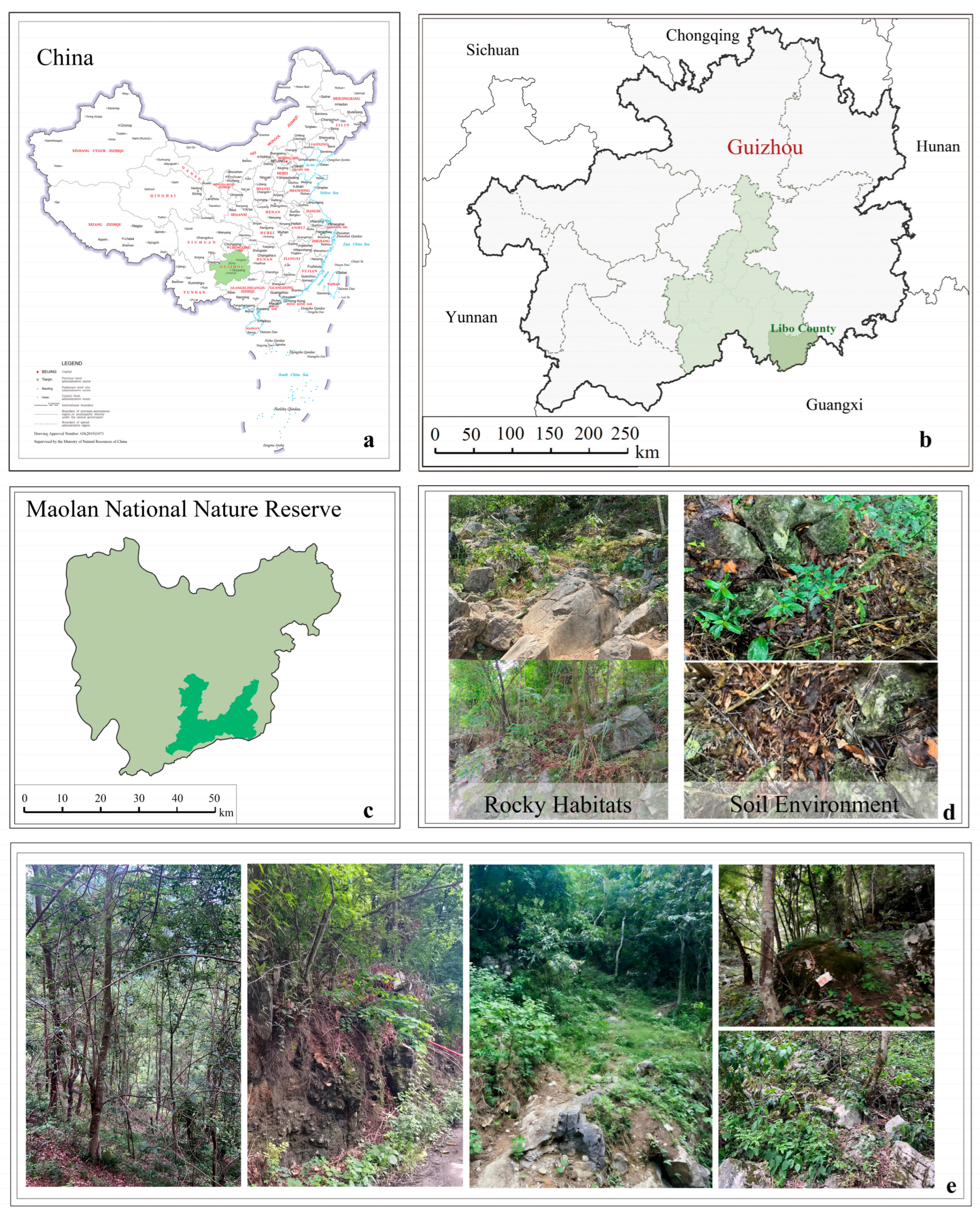
The Maolan National Nature Reserve, located in Libo County, Qiannan Buyei and Miao Autonomous Prefecture, Guizhou Province (25°09′–25°20′ N, 107°52′–108°05′ E), lies in a humid subtropical monsoon climate. The region has a mean annual temperature of 15.3 °C, a mean annual precipitation of 1752.5 mm, a mean relative humidity of about 83%, and an annual sunshine percentage of 29%. These favorable hydrothermal conditions have fostered a complex and diverse forest ecosystem, with forest cover reaching 88.61%. Vegetation includes evergreen broadleaf and mixed conifer–broadleaf communities, and biodiversity is exceptional. The reserve contains one of the largest, most intact karst forest ecosystems at this latitude and retains one of the most complete karst ecosystems globally. UNESCO recognized the site as “an outstanding example of Earth’s evolutionary processes” and inscribed it on the World Natural Heritage List in 2007.
The study area is dominated by peak-cluster depressions and exposed karst landforms, with rock outcrops covering around 80% of the surface. Intense karstification has produced typical micro-landforms such as solution grooves and dissolution fissures, yielding a complex network of rock fissures and microtopography. Under warm–humid hydrothermal conditions, long-term carbonate dissolution and structural discontinuities promote the development of fissures and connected void spaces that serve as key pathways for water storage and transport in rocky habitats. The investigated plots are underlain by relatively pure limestone. Soil cover on bedrock surfaces is shallow (generally <20 cm) and patchily distributed, which constrains soil formation and contributes to a fragile ecological setting. Soils are highly heterogeneous and show a banded, mosaic-like distribution; zonal soil types mainly include yellow soils and calcareous soils (Chinese Soil Classification), ranging locally from yellow soils to brown calcareous soils. Soil pH ranges from 6.15 to 8.00, and organic matter content varies widely (75.5–380.0 g·kg−1), exhibiting pronounced spatial heterogeneity. This distinctive geological background and soil properties provide a robust basis for studying soil organic carbon pools in karst rocky habitats (Figure 1).

2.2. Research Ideas

This study addresses the core scientific question of how fissure network morphology affects soil organic carbon pools. Building on previous research, the study formulates testable hypotheses, develops a targeted research plan, and applies key techniques to advance the work. The research approach is outlined below.

2.2.1. Connection with Previous Research and Focus on Scientific Issues

The project team has completed surveys of 46 vertical rock profiles across Guizhou Province. Based on the morphological characteristics of the rock fissure network, the habitats were classified into three types. The effects of the rock fissure network morphology on soil nutrients and enzyme activity were examined, and the dominant factors influencing these properties were clarified [23,24]. In the present study, we selected representative sites of these three habitat types within the Maolan Nature Reserve and used independent plots as the experimental replicates for SOC-related analyses (Section 2.2.2). Although prior work has evaluated short-term responses of soil properties to fissure network morphology, its long-term effects on the soil organic carbon pool—particularly on carbon accumulation and baseline-dependent long-term sequestration estimates—remain insufficiently characterized. Therefore, we propose the following testable hypotheses.
H1. 
Distinct fissure network morphologies lead to significant differences in SOC pool attributes (SOC content, SOC density, and SOC stock) among rocky habitat types.
H2. 
Fissure-network complexity and connectedness (e.g., fractal dimension and connectivity) are significantly associated with SOC pool attributes and/or sequestration estimates.
H3. 
Fissure networks influence long-term SOC sequestration by regulating soil microenvironmental conditions (e.g., moisture retention, nutrient availability, and pore structure).
H4. 
Spatial heterogeneity of fissure distributions (e.g., lacunarity) is significantly associated with long-term SOC sequestration estimates.

2.2.2. Research Design and Key Techniques

  • Habitat Environment Control and Plot Setup
To ensure consistent environmental conditions, this study investigated and validated the three rocky habitat types previously classified in Guizhou Province and selected three representative habitats characterized by distinct fissure network morphology within the Maolan Nature Reserve. The environmental backgrounds of these three rocky habitats were largely comparable (indicators of rock fissure network morphology are presented in Table 1; site environmental conditions are provided in Table 2). For each rocky habitat type, three plant-community plots (30 m × 30 m) were established (n = 3 plots per type) to examine the influence of rock fissure network morphology on the SOC pools. Within each plot, multiple subsamples were composited to obtain plot-level soil samples; therefore, statistical replication was defined at the plot level (n = 3 per habitat type), rather than at the subsample level.
2.
Selection and Explanation of Indicators
Key indicators of rock fissure network morphology include: average trace length (ATL), representing the mean length of fissure traces; dip angle (Dag), describing fissure inclination; areal density (Ads), quantifying the areal intensity of fissures (higher values denote denser distributions); fractal dimension (Fra), reflecting network complexity; lacunarity (Lac), quantifying distributional heterogeneity/uniformity (higher values indicate more randomness and larger gaps); integration (Int), capturing the mean number of angular changes (“turns”) along the shortest path connecting two fissures (higher values indicate more tortuous paths); and connectivity (Con), indicating the degree of connectedness among fissures. Grounded in principles of petrology and geology, the estimation of these parameters integrated space-syntax, fractal-dimension, and lacunarity analyses. This innovative measurement framework not only elucidates the spatial structure and complexity of rock fissure networks but also provides a novel perspective for understanding the physical characteristics of karst strata and their potential ecological functions [23].
The soil organic carbon pool was characterized by soil organic carbon content, soil organic carbon stock, soil organic carbon density, and soil organic carbon sequestration rate. To estimate sequestration rates more accurately, we incorporated the historical context of the Maolan karst region: when the karst forest was first documented in 1975 [25], parts of the area remained degraded, with exposed rock and sparse vegetation cover. These conditions closely resembled the herbaceous stage of karst ecosystems (e.g., vegetation composition, degree of soil development) described in the literature [26]. Accordingly, carbon-density data for the herbaceous stage (10.71 t·hm−2) were used as the baseline [27,28] to evaluate long-term trends in soil carbon sequestration capacity across the three fissure network types. Because this baseline was derived from published data rather than measured at our plots, the resulting sequestration rates should be interpreted as approximate, baseline-dependent long-term estimates and are used primarily for relative comparisons among habitat types; the associated uncertainty is discussed in Section 4.
3.
Technical Approach and Research Framework
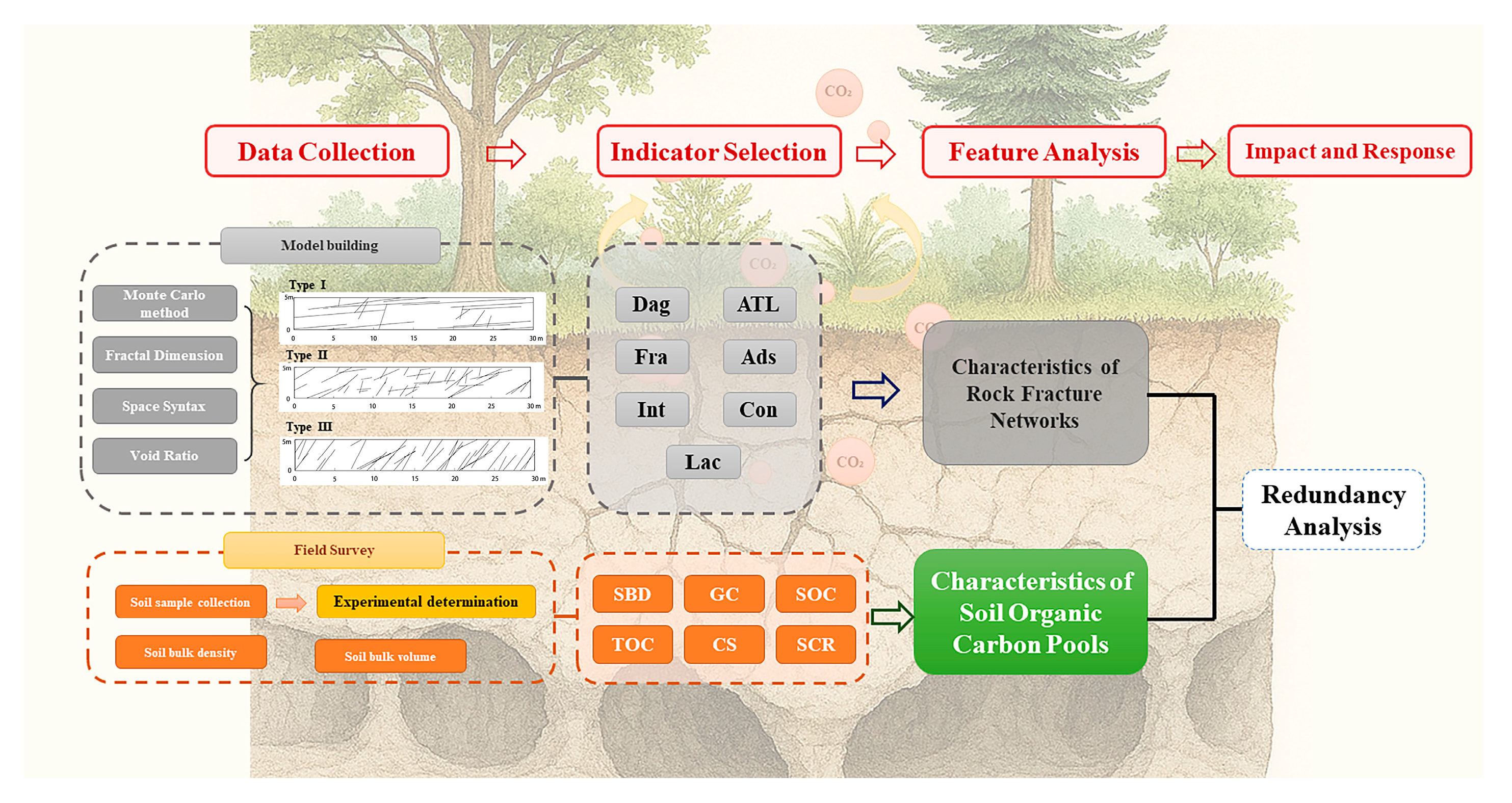
This study addressed the core scientific issue by utilizing methods such as fractal dimension and space syntax to quantify the morphological characteristics of the rock fissure network. Carbon stocks and carbon sequestration rates were determined from analyses of soil samples. Redundancy analysis (RDA) was used to identify key factors controlling the soil organic carbon pool and to evaluate hypotheses H1–H4. The overall research framework and methodology are shown in Figure 2.

2.3. Characterization and Measurement of Three Types of Rock Fissure Network Rocky Habitats in Karst

The term “fissure network” is used broadly in this study to encompass all intra-rock spatial structures, including pores, fissures, bedding/stratification, joints, and karstic voids. The three types of karst rocky habitats defined by rock fissure networks and their characteristics are described in reference [23]. Based on the fissure network indicators in Table 1, the characteristics of each type are summarized as follows:
Type I. Rock fissure networks extend predominantly horizontally; mean trace length is moderate (ATL), areal density is medium (Ads), fissure counts are relatively high, and spatial patterns are complex. Lacunarity is moderate (Lac), the network is relatively dispersed, and connectivity is low (Con).
Type II. Rock fissure networks extend obliquely; mean trace length is short and areal density is low. Fissure counts are small with simple spatial patterns. Lacunarity is low (more regular distribution), and the network is relatively simple with limited connectivity.
Type III. Rock fissure networks extend predominantly vertically; mean trace length is long and areal density is high. Fissure counts are moderate with more complex spatial patterns. Lacunarity is high (more random distribution), yielding dense, complex networks with high connectivity.
This classification was used for subsequent analyses of soil organic carbon pools.

2.4. Community Survey

Based on prior research, three representative types of rock fissure network morphologies with distinct characteristics were selected for soil sampling and plant community surveys. Following the minimum plot size of 900 m2 defined by Zhu Shouqian et al. for the Maolan Karst Forest [29], three 30 m × 30 m plots were randomly established with comparable site conditions within each rocky habitat type (n = 3 per type). Plant-community surveys were conducted within each plot, and basic site variables (elevation, slope, dominant species) were recorded. Further details are provided in Table 2.

2.5. Soil Sample Collection and Indicator Calculation

2.5.1. Soil Volume Determination, Sample Collection, and Treatment

This study uses the soil volume measurement method to determine key indicators of the soil organic carbon pool. Based on the rocky habitat types previously defined and the nine plots established during the community survey (i.e., three 30 m × 30 m plots per fissure network morphology type), the soil area within each plot was subdivided into 3 m × 3 m sampling subplots. Thus, each 900 m2 plot contains approximately 30 sampling subplots. Based on site conditions, 4 to 8 measurement points were randomly placed within each subplot. These points were used to perform three-dimensional measurements of soil depth and the corresponding area, followed by volume calculations, which provided the soil volume statistics [28]. These within-plot measurements were used to quantify soil volume and to guide representative subsampling, but they were not treated as independent replicates for SOC analyses.
Soil samples were collected using the “S”-shaped five-point composite sampling method [30], with a sampling depth of 0–15 cm. The soil samples from five points within each plot were mixed and homogenized, resulting in 9 composite soil samples. After collection, soil samples were placed in sterile bags and stored in foam containers with ice packs for refrigeration. The samples were transported to the laboratory, air-dried, and prepared for analysis of soil carbon pool indicators.

2.5.2. Determination and Calculation of Soil Carbon Pool Indicators

Soil bulk density was determined using the ring knife method [31]. Gravel content was quantified by sieving through a 2 mm soil sieve for separation and measurement [31]. Gravels (>2 mm) were dominated by limestone fragments in all plots. Organic carbon content was measured using the potassium dichromate method with heat treatment [28]. Calculation methods for other indicators are provided below [28].
Soil organic carbon density:
S O C = C D E ( 1 G ) × 10 6
In this equation, S O C represents the soil organic carbon density (kg·m−2) for the corresponding soil layer, C is the soil organic carbon content (g·kg−1), D is the bulk density (g·cm−3) for the corresponding soil layer, G is the gravel content (>2 mm) for the corresponding soil layer (%), and E is the thickness of the soil layer (m).
Organic carbon stock (900 m2):
C S = C V D ( 1 G ) × 10 9
where C S represents the organic carbon stock (t) for the corresponding soil layer, and V is the soil volume (m3), measured and calculated for that layer.
The carbon sequestration rate is calculated as the difference between the current soil carbon density and the baseline carbon density from 1976 (based on the herbaceous-stage carbon density of 10.71 t·hm−2 when the karst forest in the region was first discovered in 1975, using 1976 as the starting point for calculation), divided by the restoration period (1976–2024, a total of 48 years). Because this 1976 baseline is adopted from published herbaceous-stage data rather than measured at our plots, the resulting sequestration rates should be interpreted as approximate, baseline-dependent long-term estimates and are used primarily for relative comparisons among habitat types.

2.6. Data Processing

All soil organic carbon (SOC) variables were first subjected to normality tests to ensure compliance with the assumptions of parametric analyses. Differences in SOC variables among habitat types were assessed using one-way analysis of variance (ANOVA). When significant differences were detected, multiple comparisons were performed using the Least Significant Difference (LSD) method, and the robustness of group differences was additionally verified using Tukey’s HSD test, with both approaches yielding consistent significance patterns. All statistical tests were conducted at α = 0.05 using Excel 2016 and SPSS 26.0.
Pearson correlation analysis was performed to examine pairwise relationships between fissure network morphology indices (Ads, ATL, Fra, Lac, Dag, Int, and Con) and SOC variables (content, density, stock and sequestration rate). The resulting correlation matrix was visualized using a correlation heatmap to identify key fissure metrics associated with different SOC pools.
Redundancy analysis (RDA) was performed in Canoco 5 using a constrained ordination framework to quantify multivariate relationships between fissure-network morphology and SOC variables. Explanatory variables were screened using interactive forward selection (pseudo-F and permutation-based p values). Multicollinearity among explanatory variables was checked using variance inflation factors (VIFs) prior to interpretation. Variation partitioning analysis (VPA) was then conducted using the varpart function in the vegan package in R to quantify the independent and shared contributions of fissure-network morphology and environmental/soil variables to SOC variability.
Generalized additive models (GAMs) were applied to evaluate potential non-linear relationships between fissure-network morphology and habitat-scale carbon storage. GAMs were fitted for SOC density and SOC stock because these plot-scale indicators integrate SOC concentration with soil mass/volume and showed comparatively stable associations with fissure-network morphology in exploratory analyses. Models were fitted in R (mgcv) using a Gaussian distribution with an identity link and REML estimation. Habitat type was included as a parametric factor (Type), and smooth terms were fitted with a limited basis dimension (k = 4). To reduce multicollinearity and multiple-testing burden, models were fitted with one fissure metric per GAM (e.g., Type + s(Lac), Type + s(Con)), and model performance was evaluated using standard residual and smoothness diagnostics.

3. Results

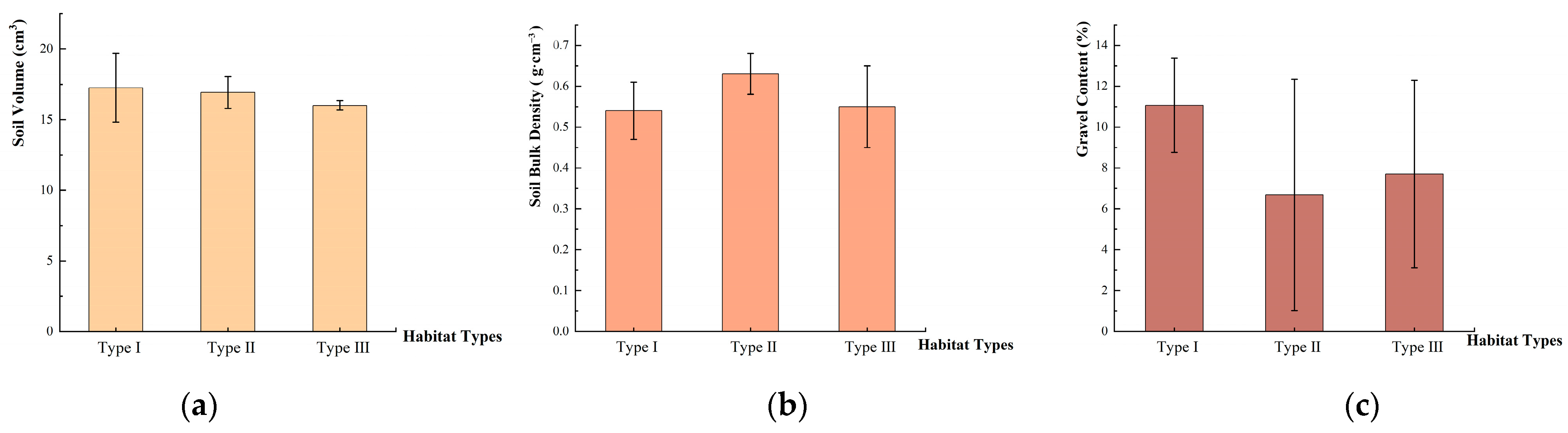
3.1. Soil Volume, Bulk Density, and Gravel Content in Different Rocky Habitats

Figure 3 shows that soil volume, bulk density, and gravel content differ among the three rocky habitat types. Type I has the largest soil volume, the lowest bulk density, and the highest gravel content; Type II shows an intermediate soil volume with the highest bulk density and a moderate gravel content; and Type III has the smallest soil volume, an intermediate bulk density, and the lowest gravel content. Together, these soil physical properties (soil volume, bulk density, and gravel content) show among-habitat variability.

3.2. Analysis of Soil Organic Carbon Content (TOC) in Different Rocky Habitats

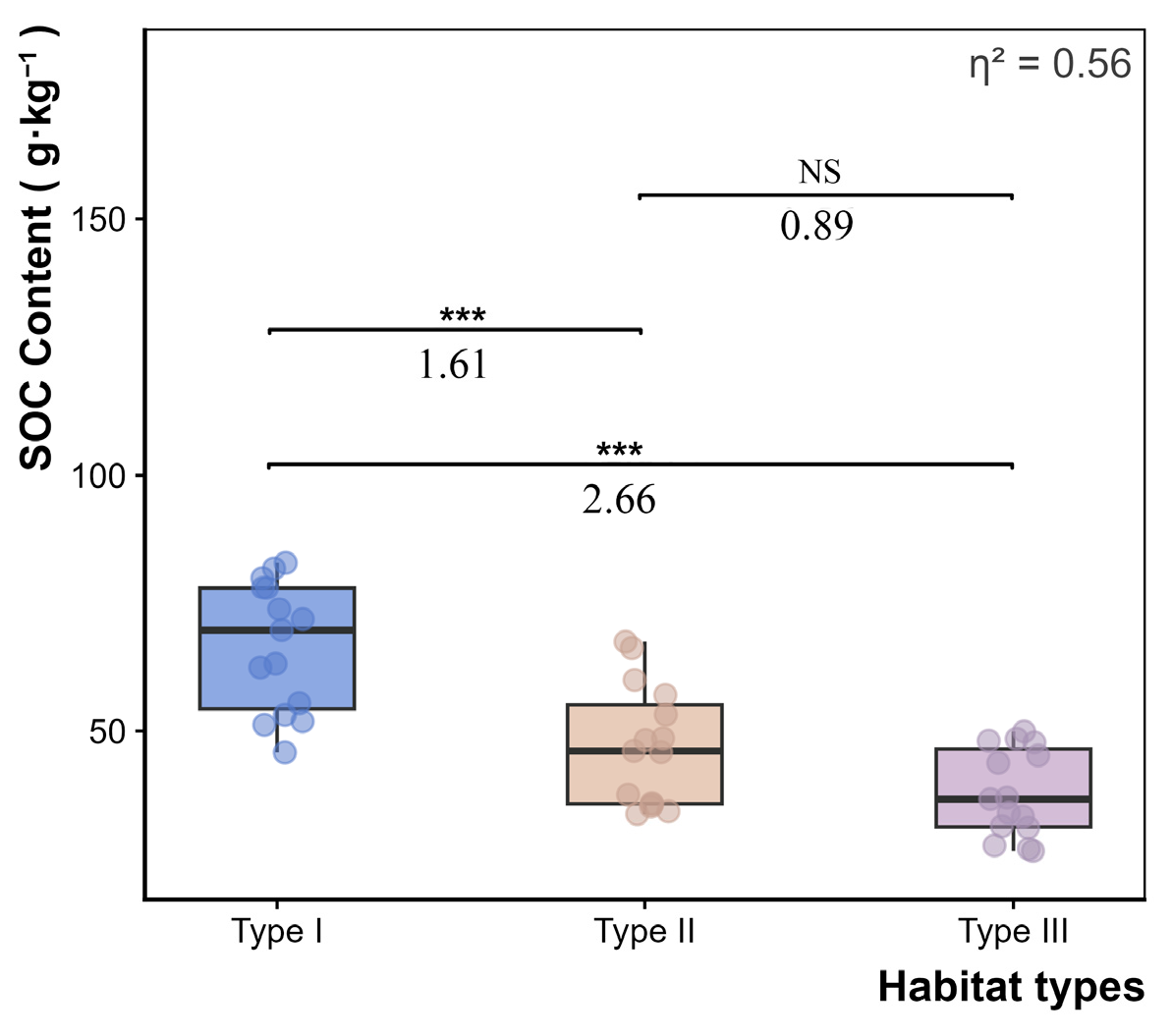
Figure 4 shows significant differences in soil organic carbon content (TOC) among the three rocky habitat types (one-way ANOVA, p < 0.001; η2 = 0.56). Type I exhibits the highest TOC (66.62 ± 12.68 g·kg−1), followed by Type II (47.03 ± 11.66 g·kg−1), while Type III shows the lowest values (37.91 ± 8.53 g·kg−1). Pairwise multiple comparisons (LSD, verified by Tukey’s HSD) indicate that TOC in Type I is significantly higher than in both Type II and Type III (p < 0.001), whereas the difference between Type II and Type III is not significant (NS). These TOC patterns are consistent with the fissure-network morphology-based habitat classification, suggesting a potential link between TOC differences and fissure network morphology.

3.3. Analysis of Soil Organic Carbon Stock in Different Rocky Habitats

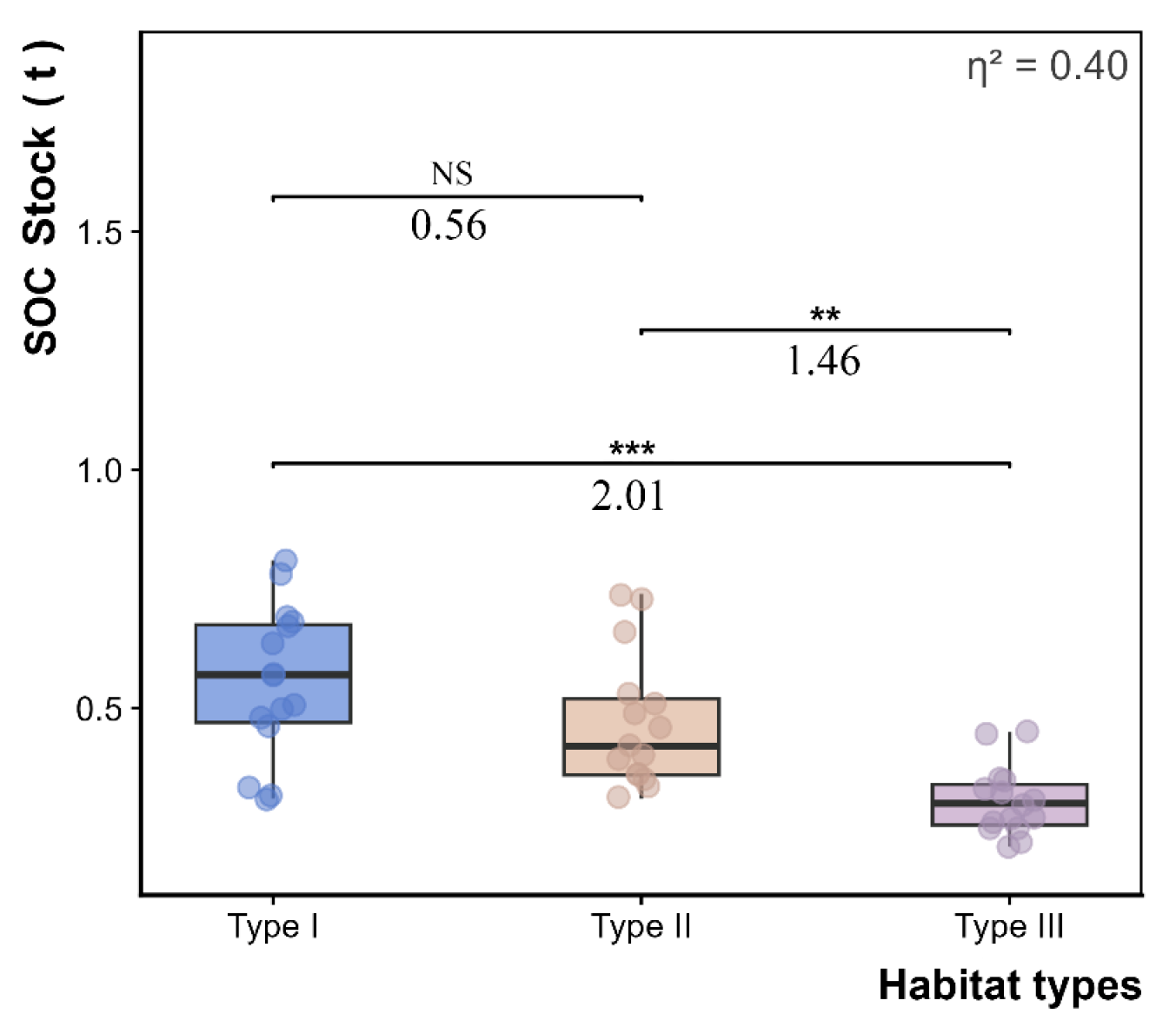
Figure 5 shows clear differences in soil organic carbon stock among the three rocky habitat types. Type I habitats have the highest SOC stock (0.55 ± 0.16 t), followed by Type II (0.47 ± 0.14 t), whereas Type III exhibits the lowest values (0.31 ± 0.07 t). Pairwise multiple comparisons (LSD, verified by Tukey’s HSD) indicate that SOC stock in Type III is significantly lower than in both Type I and Type II (p < 0.01–0.001), whereas the difference between Type I and Type II is not significant (NS). Type I shows a more dispersed fissure network and a larger soil volume, and it also exhibits higher SOC stock. Type II exhibits intermediate SOC stock. Type III shows predominantly vertical fissures with stronger connectivity and exhibits the lowest SOC stock.

3.4. Analysis of Soil Organic Carbon Density in Different Rocky Habitats

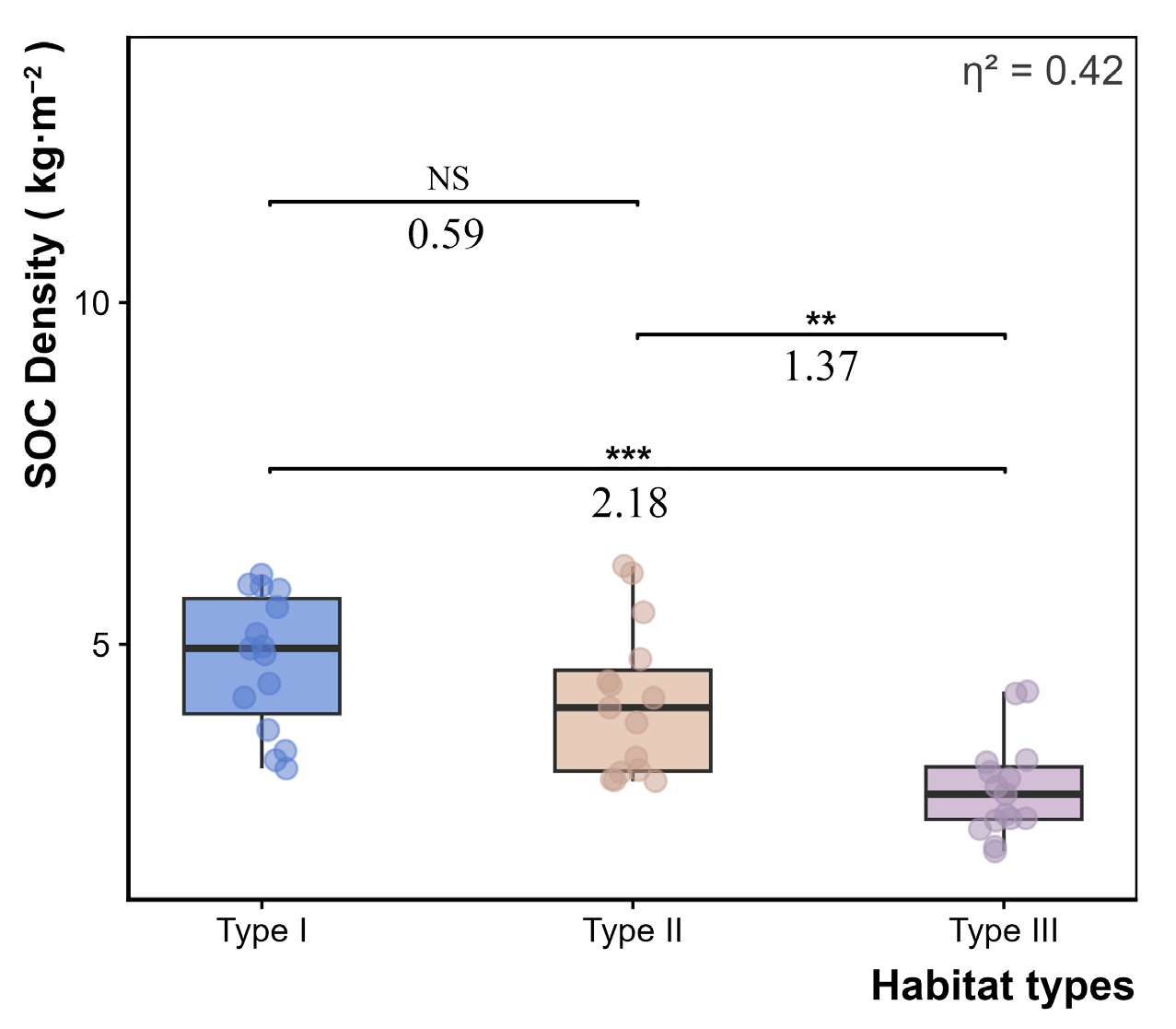
Figure 6 shows that soil organic carbon density differs among the three rocky habitat types: Type I has the highest value (4.75 ± 0.99 kg·m−2), followed by Type II (4.14 ± 1.09 kg·m−2), and Type III has the lowest (2.92 ± 0.72 kg·m−2). Pairwise multiple comparisons (LSD, verified by Tukey’s HSD) indicate that SOC density in Type III is significantly lower than in both Type I and Type II (p < 0.01–0.001), whereas the difference between Type I and Type II is not significant (NS). This pattern suggests that rock fissure-network morphology and structure strongly influence SOC density, making it a key factor underlying the spatial variability of SOC in karst regions.

3.5. Analysis of Soil Organic Carbon Sequestration Rate in Different Rocky Habitats

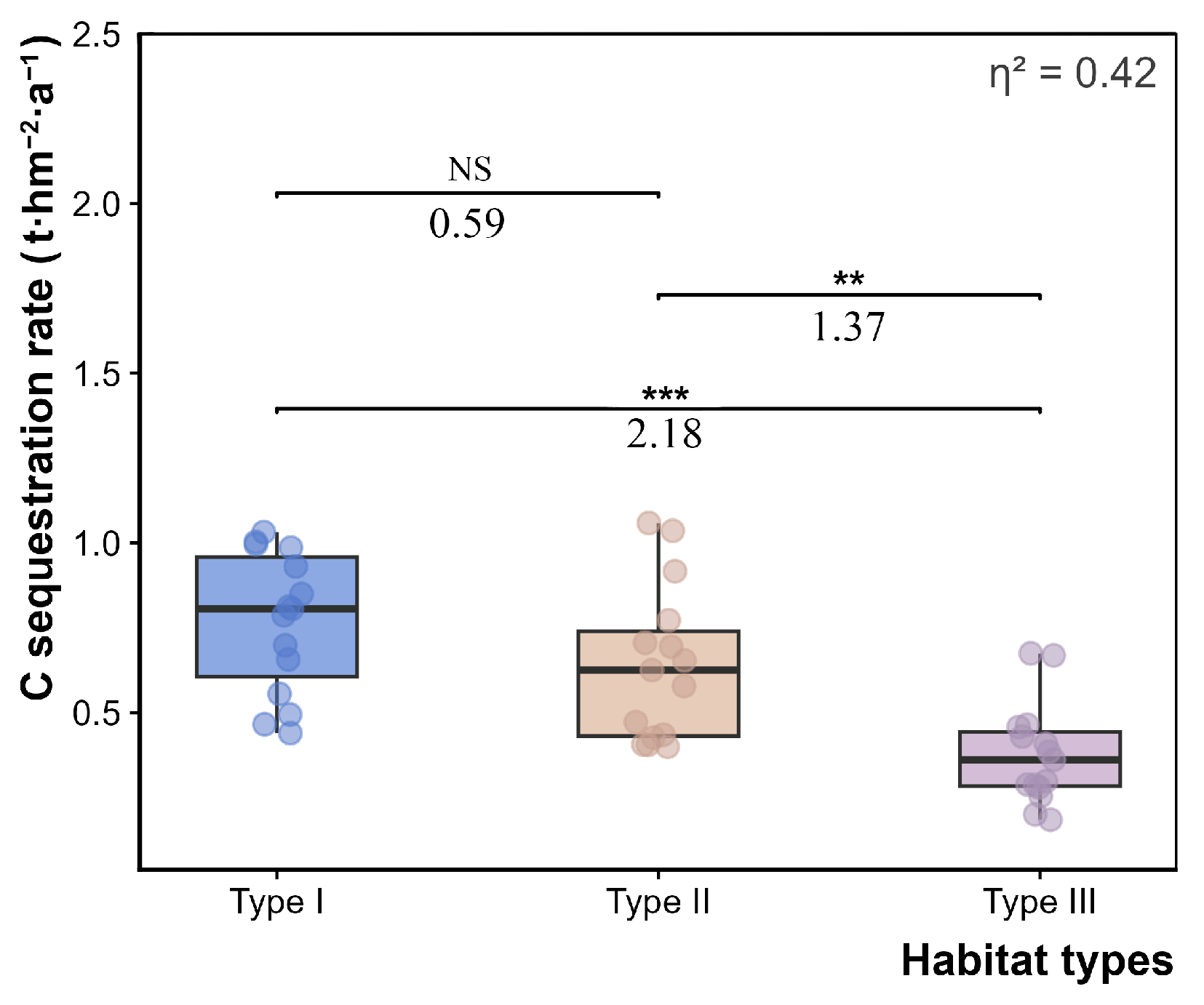
Figure 7 shows that soil organic carbon sequestration rate differs among the three rocky habitat types. Type I has the highest sequestration rate (0.77 ± 0.21 t·hm−2·a−1), followed by Type II (0.64 ± 0.23 t·hm−2·a−1), and Type III has the lowest (0.38 ± 0.15 t·hm−2·a−1). Pairwise multiple comparisons (LSD, verified by Tukey’s HSD) indicate that the difference between Type I and Type II is not significant (NS), whereas both Type I and Type II have significantly higher sequestration rates than Type III (p < 0.01–0.001). This indicates that all three habitats exhibit a certain soil carbon-sink potential, but the magnitude of sequestration remains relatively low, reflecting the generally limited soil carbon sequestration capacity in the karst forest region.

3.6. Relationships Between Fissure Morphology and SOC Pools

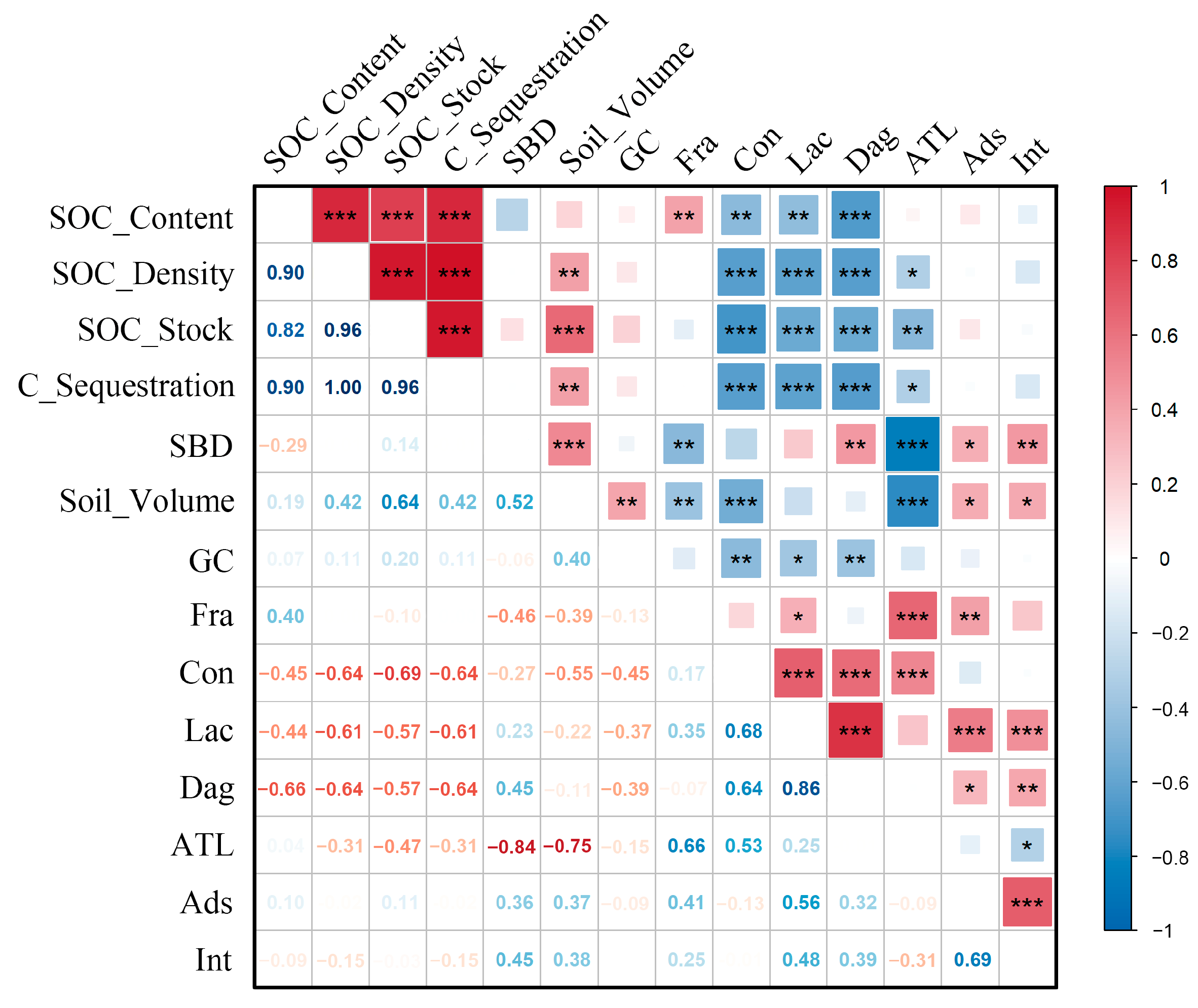
Pearson correlation analysis was used to examine relationships between fissure-network morphology indices and SOC-pool variables across all plots from the three rocky habitat types (Figure 8). Fissure dip angle (Dag) shows consistently negative correlations with TOC, SOC density, SOC stock, and SOC sequestration rate; connectivity (Con) and lacunarity (Lac) are also strongly and negatively correlated with these SOC variables, particularly SOC density and SOC stock. Fractal dimension (Fra) shows a mixed pattern, being positively correlated with TOC but negatively correlated with SOC stock and SOC sequestration rate. Average trace length (ATL) shows moderate negative correlations, especially with SOC stock and sequestration rate. In contrast, areal density (Ads) and integration (Int) exhibit relatively weak or inconsistent correlations with SOC variables. Overall, Dag, Con, and Lac (and, to a lesser extent, Fra) show the strongest associations with SOC-pool variation among plots from the three rocky habitat types.
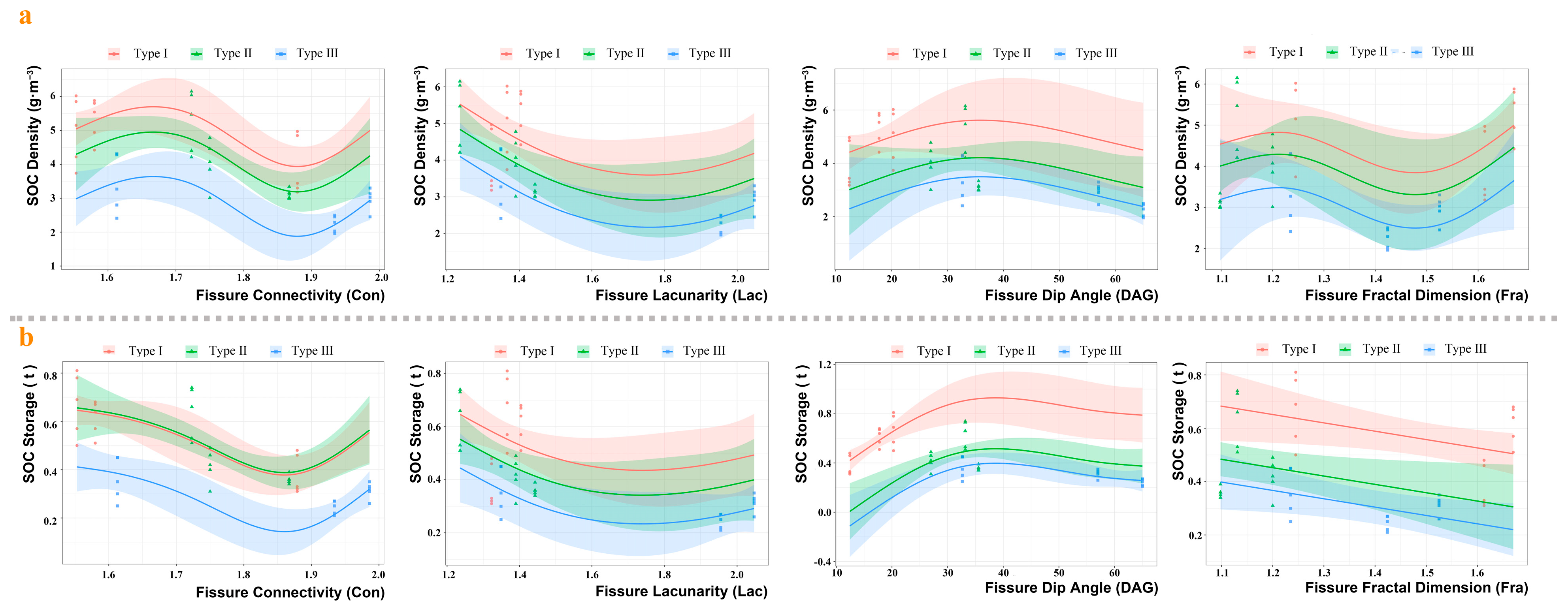
Generalized additive models (GAMs) were fitted to evaluate potential non-linear relationships between selected fissure indices and SOC density and SOC stock (Figure 9). GAM results indicated significant smooth terms for connectivity (Con) and lacunarity (Lac) in the SOC-density models, and for dip angle (Dag) and fractal dimension (Fra) in the SOC-stock models. The fitted effects were non-linear, with curves exhibiting curved, hump-shaped, or saturating patterns rather than strictly linear trends. Figure 9 presents the fitted curves with 95% confidence bands for each habitat type. In combination with the Pearson correlations (Figure 8), Dag, Fra, Lac, and Con were the fissure indices most strongly related to variation in SOC density and SOC stock in the GAMs.

3.7. Analysis of the Impact of Rock Fissure Network Structure on Soil Organic Carbon Pools

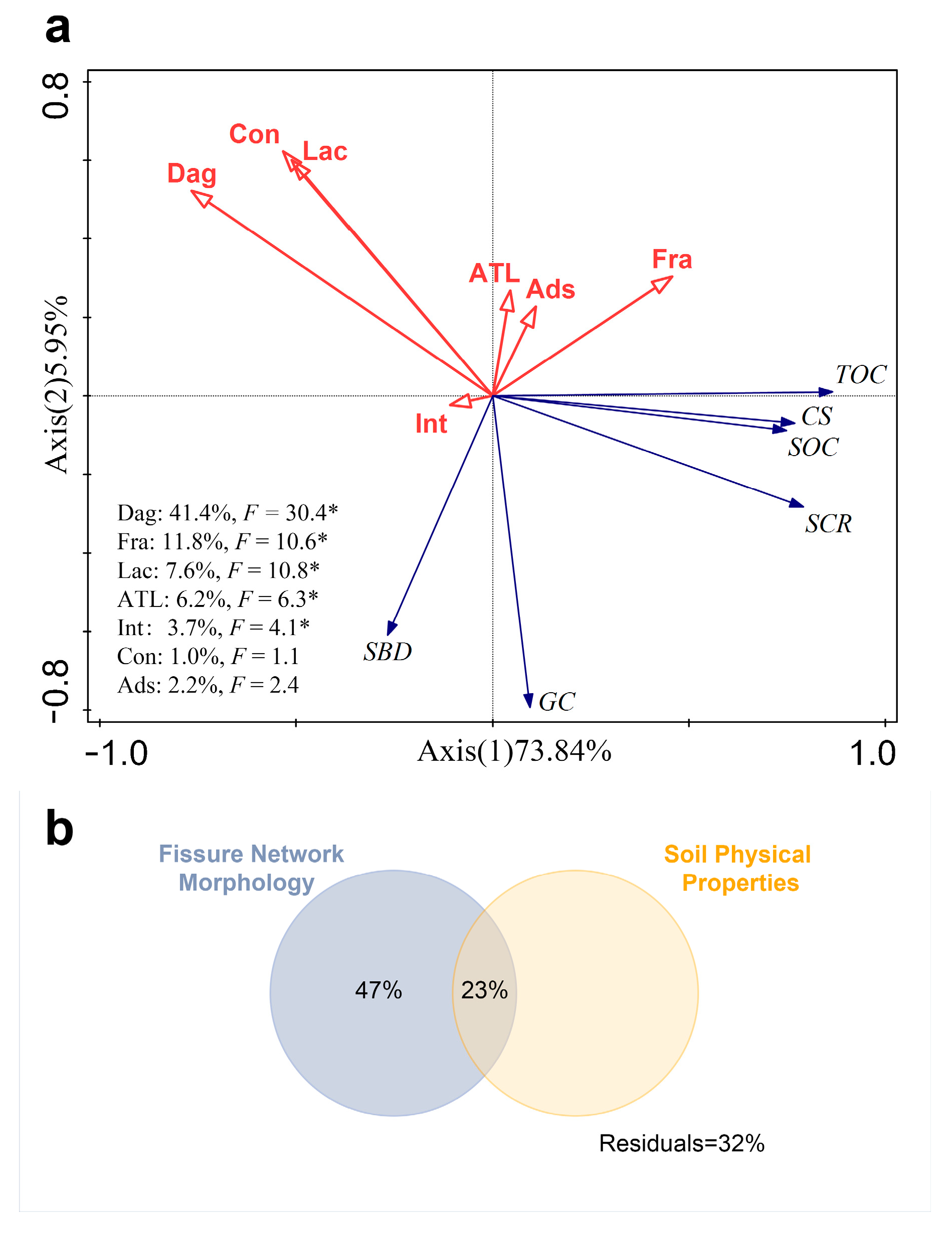
Figure 10 shows that RDA Axis 1 and Axis 2 explain 73.84% and 5.95% of the variation in SOC variables, respectively. Based on the Canoco ordination output, fissure dip angle (Dag) has the highest relative importance among the fissure indices, followed by fractal dimension (Fra), lacunarity (Lac), and average trace length (ATL). Along Axis 1, Dag and Lac point in the opposite direction to TOC, SOC, CS and SCR, indicating negative associations with these SOC variables, whereas Fra and ATL align with the SOC vectors, indicating positive associations. Variation partitioning further quantified the relative contributions of fissure network morphology and soil physical properties to SOC density (Figure 10b). Fissure network morphology alone explained 47% of the variance in SOC density, whereas soil physical properties contributed almost no independent variation (~0%). A substantial fraction (23%) was shared by fissure morphology and soil physical properties, indicating that part of the SOC pattern is associated with their combined effects and cannot be clearly separated. These results indicate that fissure-network morphology explained a large fraction of the observed SOC variability, while additional unmeasured factors likely contributed to the remaining variance.

4. Discussion

4.1. Impact Characteristics of Rock Fissure Network Morphology on Soil Organic Carbon Pools in Karst Rocky Habitats

In all three types of karst rocky habitats, the overall SOC stock level is relatively low, which is closely linked to the unique geographical conditions of the karst region. The complex terrain and fragmented landscape lead to significant spatial variability in soil organic carbon [12], while differences in fissure network morphology further intensify this heterogeneity. Our results show that rock fissure network morphology is strongly associated with SOC pools in karst rocky habitats. Fissure network structure can influence water and soil redistribution pathways and thereby shape conditions relevant to SOC accumulation and retention (e.g., soil volume, moisture residence time, and root–soil–rock contact). In particular, differences in fissure directionality and connectivity can shape whether soil and organic matter are retained near the surface or redistributed downward through preferential flow paths.
In terms of habitat-scale structure, the three habitat types represent contrasting “retention vs. redistribution” settings. Type I fissure network structure is associated with surface retention of water, soil, and organic matter, enhancing water retention and litter accumulation, while providing space for root expansion and promoting rhizosphere carbon input, resulting in the highest TOC, SOC density and SOC stock levels. This is consistent with Type I having predominantly horizontal fissures that are numerous and weakly connected, forming relatively enclosed spatial units that can favor lateral soil accumulation and storage. Although Type I showed higher gravel content, the predominance of sub-horizontal and weakly connected fissures still favor near-surface residence and lateral trapping of soil and organic matter, which is consistent with its higher SOC pools. Type II fissure network structures are relatively regular, exhibiting intermediate carbon stock capacity. Its oblique fissures and moderate connectivity coincide with combined vertical and lateral deposition, supporting an intermediate soil volume and carbon storage. Type III fissures extend vertically, with strong connectivity. Although this fissure network coincides with downward migration of water and soil, it also co-occurs with lower surface SOC pools, resulting in the lowest organic carbon stock. In Type III, vertically developed and highly connected fissures can promote preferential drainage and downward transport, limiting stable soil volume and constraining the formation of a persistent retention environment for organic matter.
These habitat-scale patterns are further supported by the RDA and variation-partitioning results, which indicates that the directionality and complexity of the rock fissure network are key factors influencing the heterogeneity, low carbon stock, and instability of soil organic carbon pools in karst regions, thereby providing new theoretical support for understanding the formation mechanisms of soil organic carbon in karst areas. Specifically, the ordination patterns suggest that steeper, more vertically oriented and spatially heterogeneous fissure networks (e.g., higher Dag and Lac) tend to align with lower SOC-related variables, whereas greater structural complexity and moderate trace-length configurations (e.g., higher Fra and ATL) align with higher SOC pools, consistent with enhanced soil–rock interface development and potential sorption surfaces.
Previous studies have shown that the stable accumulation of soil organic carbon in karst regions is influenced by multiple environmental factors, including climate [32], vegetation type [33], soil texture, and initial carbon content [34,35], consistent with findings in non-karst regions [36,37]. However, our results suggest that, in contrast to non-karst regions, soil in karst areas, characterized by high rock exposure, shallow soil layers, and widespread, complex fissures, is more vulnerable to external disturbances, such as erosion and oxidation. The directionality and complexity of the fissure network influence organic carbon migration and accumulation by altering water and soil movement, thereby exhibiting varying carbon sequestration potential. Thus, the formation of soil organic carbon pools in karst regions results from the combined effects of climate, vegetation, soil texture, initial carbon content, and rock fissure network morphology, with the directionality and complexity of the rock fissure network playing a critical role. Moreover, the relatively low sequestration rates observed across habitats are consistent with two concurrent constraints: (i) a portion of organic matter produced during soil formation is rapidly taken up by aboveground vegetation to sustain biomass production, limiting net SOC accumulation; and (ii) shallow soils and pervasive fissures restrict carbon stock capacity and shorten carbon residence time, especially in highly connected vertical-fissure settings where organic matter can be exported with water and soil.
Karst fissure networks develop over long time scales through carbonate dissolution and structural discontinuities, and their geometry may continue to evolve under Holocene-to-modern hydroclimatic conditions [38]. Although all investigated plots are developed on limestone, regional studies have reported heterogeneity in carbonate lithology in nearby karst terrains (e.g., differences in carbonate purity or locally dolomitized limestone), which may modify dissolution kinetics and thus influence the long-term evolution of karst voids and fracture connectivity [38]. We note this regional context as background, without inferring dolomitization within our plots. In humid subtropical settings such as Maolan, high precipitation and frequent wetting–drying cycles can further strengthen preferential infiltration and subsurface transport, thereby reinforcing “redistribution-dominated” conditions in highly connected, steep fissure networks [39]. These geomorphological and hydroclimatic contexts provide a background for interpreting why fissure directionality and connectivity are consistently aligned with SOC pool variability in our habitat-scale analyses.
In carbonate-rich soils, SOC stabilization can differ from acidic soil environments because near-neutral to alkaline pH and abundant Ca2+ can promote organo-mineral associations, aggregation, and physico-chemical protection of organic matter [40,41]. Thus, fissure-controlled microenvironments that favor longer water residence time, finer particle retention, and repeated organo-mineral contact at soil–rock interfaces may enhance SOC persistence, whereas vertically connected fissures that facilitate rapid drainage and material export may reduce opportunities for stabilization. Integrating carbonate-specific humification and stabilization mechanisms helps explain why habitat-scale SOC density and SOC stock exhibit consistent associations with fissure-network structure in our results. International studies from karst regions also report that karst microtopography and fracture-related retention can promote SOC accumulation and potentially more stable organic matter pools in carbonate settings [14,42].
This influence primarily stems from complex karst processes within the rocks: on one hand, differences in the chemical and physical properties of the rocks themselves [43,44], along with water dissolution capacity and mobility [45], shape the diversity of pore-fissure-layer-joint geometries and spatial orientations within the rock mass; on the other hand, dynamic changes in climate, vegetation succession, and human activities [28,32] continue to drive the temporal evolution of these fissure structures through water, soil, and biological processes. Additionally, the difficulty of observing underground spaces and extreme weather events that disrupt conventional patterns contributes to the high uncertainty in the spatial structure of the fissure network. Therefore, the impact of fissure network morphology on the soil organic carbon pool reflects four characteristics: diversity, dynamics, complexity, and uncertainty.

4.2. Implications of Rock Fissure Network Morphology on Soil Organic Carbon Pool

Building on the above patterns and the multivariate analyses, our results have several implications for the management and modeling of SOC pools in karst rocky habitats. The RDA and variance partitioning indicate that fissure network morphology acts as an independent structural control on SOC pools, rather than serving as a simple proxy for soil or environmental conditions. In addition, the generalized additive models reveal pronounced non-linear responses of SOC density and SOC stock to key fissure attributes such as lacunarity, connectivity, directionality and fractal dimension. Compared with SOC concentration variables, the stronger non-linear behavior of SOC density and stock indicates a tighter association with habitat-scale carbon storage capacity, rather than by altering carbon concentration alone. Importantly, the pronounced habitat-scale differences in SOC density imply that assuming a constant SOC-density value in regional carbon-stock assessments may be inappropriate for karst landscapes and could introduce substantial bias; habitat-specific SOC density should therefore be used where possible.
These findings highlight that SOC management strategies in karst regions should be explicitly tailored to fissure-network characteristics and habitat types. Type I habitats, which possess relatively complex but well-balanced fissure networks and the strongest carbon-sink function, should be prioritized for protection and closure to minimize human disturbance. Restricting activities such as quarrying, grazing and soil excavation can help maintain the integrity of the fissure–soil system and preserve existing SOC stocks. In Type II habitats, where fissure networks and SOC stock are intermediate, management should focus on maintaining current structure while enhancing vegetation recovery (e.g., planting native shrubs and herbs to increase litter inputs and canopy cover) [46] to improve water and soil conservation. In Type III habitats, characterized by highly connected, vertically oriented fissures and the lowest SOC stock, restoration should aim to slow water and soil loss and optimize fissure functioning. Targeted moderate interventions such as stone piling, shallow tillage, fissure infilling with fine soil and organic matter, and the establishment of high-coverage herbaceous vegetation [47] can improve soil moisture retention, rooting conditions and, ultimately, SOC accumulation.
Collectively, these structural and environmental constraints, together with the slow weathering process in karst regions, lead to generally small soil volumes and high gravel content, thereby limiting the carbon stock capacity. The small soil volume is insufficient to provide adequate nutrients for plants, further restricting soil carbon stocks, resulting in poor carbon sequestration capacity and low sequestration rates. Therefore, carbon management and ecological restoration strategies in karst regions should account for the characteristics of different rocky habitats, particularly the morphology of the rock fissure network. Precise management measures should be developed, such as implementing water and soil conservation, deep plowing in areas with thin soils, and increasing fertilizer application in areas with slow organic matter accumulation. In particular, the characteristics of the rock fissure network structure and environmental factors should be considered together to accurately predict the soil organic carbon stock potential, providing scientific support for carbon management in karst regions. Finally, the unexplained fraction in the variance partitioning analysis indicates that additional factors (e.g., vegetation inputs, microtopography, and biological processes) may also contribute to SOC heterogeneity and should be addressed in future work.

4.3. Limitations and Future Directions

First, the identified fissure–SOC relationships are statistical associations at the habitat scale and should not be interpreted as direct causation. Second, our inference is scale-dependent: plot-level patterns may not translate linearly to hillslope or landscape carbon accounting in karst terrains with strong microtopographic variability. Third, the long-term sequestration rate relies on a literature-derived baseline for the herbaceous stage; although this provides a useful reference, it introduces uncertainty that should be considered when comparing absolute rates across studies. Fourth, we did not provide soil profile photographs and detailed horizon descriptions because soil cover on bedrock is shallow and discontinuous in the investigated habitats; future work combining targeted pit descriptions with high-resolution imaging would strengthen pedological interpretation. Finally, we did not directly measure below-ground biological and physico-chemical processes (e.g., microbial activity, root turnover, mineral-associated SOC fractions), and testing these pathways remains an important next step.
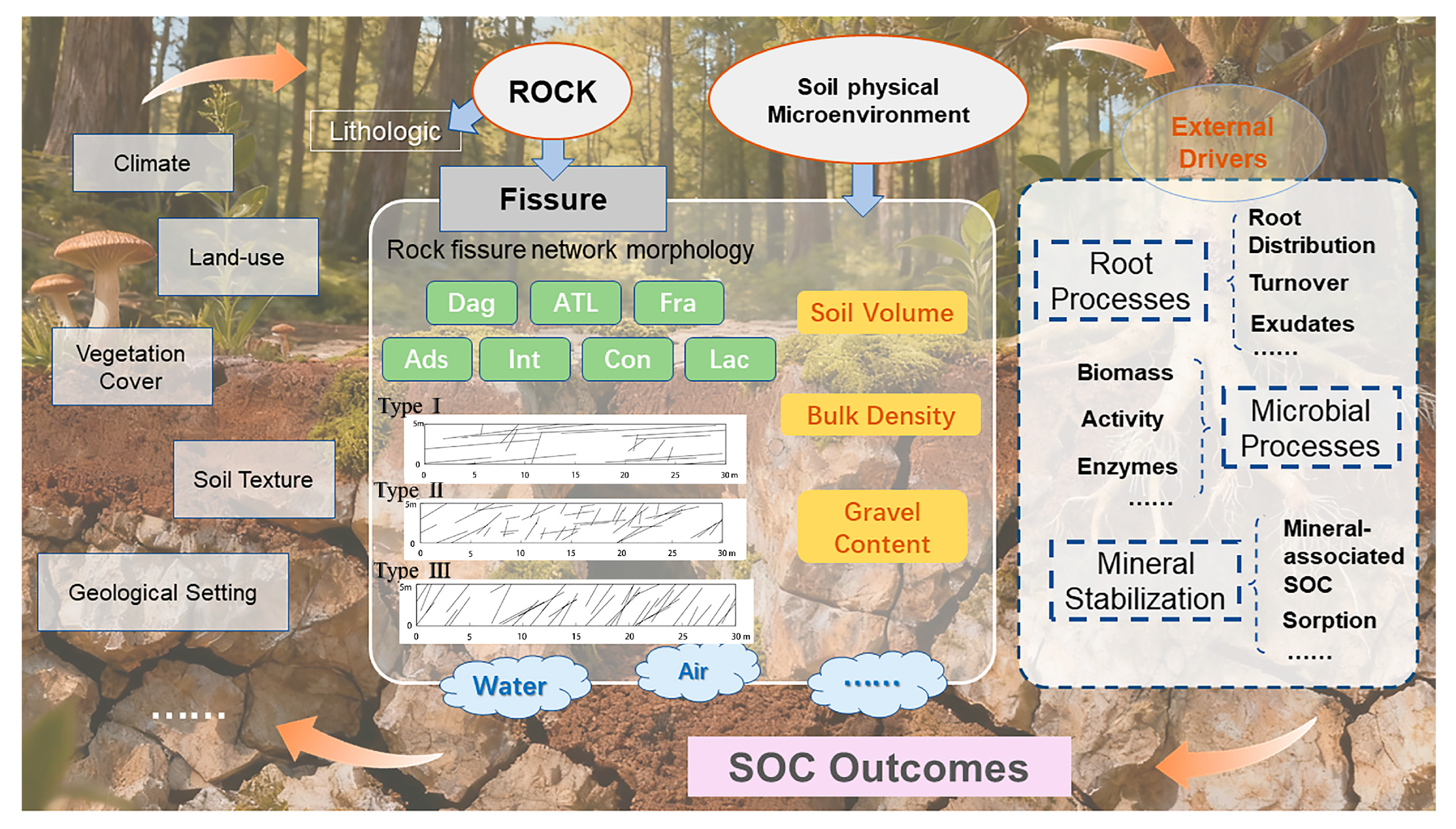
Beyond site-level management, our findings also point to a broader conceptual and modelling framework for karst carbon cycling. The conceptual framework we propose (Figure 11) illustrates how fissure-network morphology may exert multi-level influences on SOC dynamics through hydrological regulation, modification of soil physical microenvironments and associated biological and physicochemical processes. The present study primarily resolves the structural–hydrological pathway within this framework by quantifying the links between fissure geometry and SOC pools. The biological (root- and microbe-mediated) and mineral-stabilization pathways remain to be tested. Nevertheless, the independent structural dimension revealed by the variance partitioning can be incorporated into process-based carbon models by parameterizing fissure-derived effects on infiltration, drainage, soil volume, water-holding capacity and micro-environmental variability. Fissure indices or composite fissure-structure axes could be used as state variables or modifiers that regulate SOC input, decomposition and stabilization rates in regional or mechanistic models for karst landscapes.
Despite these advances, our study focuses on the structural perspective of how fissure-network morphology is associated with SOC pools at the habitat scale. We did not simultaneously quantify below-ground biological and physicochemical processes such as microbial biomass and activity, root distribution and turnover, or mineral-associated organic carbon, which are known to mediate SOC stabilization [48,49,50]. Therefore, the mechanistic pathways proposed here should be viewed as working hypotheses that integrate geomorphological constraints with established biogeochemical processes and our previous findings on relationships between fissure morphology and soil enzyme activities [23,24]. Future work should explicitly combine detailed fissure-network characterization with in situ measurements of microbial communities and enzyme activities, root dynamics and mineral-stabilization indices, in order to verify and refine the conceptual framework of fissure–SOC interactions in karst rocky habitats. At larger scales, integrating UAV and LiDAR data with deep-learning approaches to achieve rapid monitoring of fissure-network structures and dynamic SOC assessment will provide efficient tools for evaluating carbon-sink responses to different management measures in karst regions and other fragile ecosystems [51,52,53].

5. Conclusions

In summary, this study shows that rock fissure network morphology is a key structural correlate of SOC pools in karst rocky habitats and helps explain SOC differences among contrasting habitats. Differences in soil volume, bulk density, and gravel content across habitats co-vary with fissure network morphology, reflecting strong spatial heterogeneity of soil physical properties in karst regions. Type I habitats are associated with higher SOC content, density, stock, and estimated sequestration rate, whereas Type III habitats with steep, highly connected fissures are associated with lower SOC stock and lower sequestration potential. Multivariate analyses further indicate that fissure-network variables explain a non-negligible and partly independent proportion of SOC variability, supporting the view that fissure networks act as structural controls on SOC pools rather than simple proxies for soil or environmental conditions.
Across habitats, dip angle (Dag), lacunarity (Lac), and connectivity (Con) are negatively associated with SOC density and SOC stock, whereas fractal dimension (Fra) shows positive associations; average trace length (ATL) shows weaker and context-dependent relationships. Overall, these results support a structural–hydrological framework for interpreting SOC heterogeneity in rocky karst landscapes and suggest that fissure-aware, habitat-specific strategies may improve carbon accounting and restoration planning. Because our inference is based on plot-scale statistical associations and a literature-derived baseline, the reported sequestration rates and inferred mechanisms should be interpreted as approximate and hypothesis-generating rather than strictly causal. Future research should couple fissure characterization with microbial and root processes and incorporate advanced monitoring and modelling to enable more precise management of karst soil carbon sinks.

Author Contributions

All authors contributed to the study conception and design. Y.C. (First Author): Writing—review and editing, Writing—original draft, Visualization, Software, Methodology, Investigation, Data curation, Conceptualization. M.W.: Writing—review and editing, supervision, Conceptualization; Resources Methodology, Investigation. H.X. (Correspondence Author): Writing—review and editing, Visualization, Validation, Supervision, Software, Resources, Methodology, Investigation, Data curation, Conceptualization. Z.H. (Correspondence Author): Writing—review and editing, Validation, Supervision, Software, Resources, Methodology, Funding acquisition, Formal analysis, Data curation, Conceptualization. Z.L.: Investigation, Supervision, Software, Methodology, Data curation, Conceptualization. X.H.: Investigation, Validation, Visualization, Writing—review and editing. J.Y.: Visualization, Supervision, Software, Resources, Investigation. All authors have read and agreed to the published version of the manuscript.

Funding

The research work was carried out with funding received from the National Natural Science Foundation of China (Grant: 31560187 and 51978187).

Data Availability Statement

The original contributions presented in this study are included in the article. Further inquiries can be directed to the corresponding authors.

Acknowledgments

The authors acknowledge the National Natural Science Foundation of China (Grant: 31560187 and 51978187).

Conflicts of Interest

The authors declare that they have no known competing financial interests or personal relationships that could have appeared to influence the work reported in this paper.

References

  1. IPCC. Sixth Assessment Report—IPCC[EB/OL]. Available online: https://www.ipcc.ch/assessment-report/ar6/ (accessed on 5 July 2025).
  2. Li, Y.; Xiong, K.; Liu, Z.; Li, K.; Luo, D. Distribution and influencing factors of soil organic carbon in a typical karst catchment undergoing natural restoration. Catena 2022, 212, 106078. [Google Scholar] [CrossRef]
  3. Zhang, Z.; Zhou, Y.; Wang, S.; Huang, X. Estimation of soil organic carbon storage and its fractions in a small karst watershed. Acta Geochim. 2018, 37, 113–124. [Google Scholar] [CrossRef]
  4. Álvaro-Fuentes, J.; Easter, M.; Paustian, K. Climate change effects on organic carbon storage in agricultural soils of northeastern Spain. Agric. Ecosyst. Environ. 2012, 155, 87–94. [Google Scholar] [CrossRef]
  5. Wiesmeier, M.; Urbanski, L.; Hobley, E.; Lang, B.; von Lützow, M.; Marin-Spiotta, E.; van Wesemael, B.; Rabot, E.; Ließ, M.; Garcia-Franco, N.; et al. Soil organic carbon storage as a key function of soils-A review of drivers and indicators at various scales. Geoderma 2019, 333, 149–162. [Google Scholar] [CrossRef]
  6. Zhang, Z.; Gao, X.; Zhang, S.; Gao, H.; Huang, J.; Sun, S.; Song, X.; Fry, E.; Tian, H.; Xia, X. Urban development enhances soil organic carbon storage through increasing urban vegetation. J. Environ. Manag. 2022, 312, 114922. [Google Scholar] [CrossRef] [PubMed]
  7. Zhao, W.; Zhang, R.; Huang, C.; Wang, B.; Cao, H.; Koopal, L.K.; Tan, W. Effect of different vegetation cover on the vertical distribution of soil organic and inorganic carbon in the Zhifanggou Watershed on the loess plateau. Catena 2016, 139, 191–198. [Google Scholar] [CrossRef]
  8. Liao, H.; Long, J.; Li, J. Soil organic carbon associated in size-fractions as affected by different land uses in karst region of Guizhou, Southwest China. Environ. Earth Sci. 2015, 74, 6877–6886. [Google Scholar] [CrossRef]
  9. Zhang, Z.; Huang, X.; Zhou, Y.; Zhang, J.; Zhang, X. Discrepancies in karst soil organic carbon in southwest china for different land use patterns: A case study of Guizhou Province. Int. J. Environ. Res. Public Health 2019, 16, 4199. [Google Scholar] [CrossRef]
  10. Kan, Z.; Liu, W.; Liu, W.; Lal, R.; Dang, Y.P.; Zhao, X.; Zhang, H. Mechanisms of soil organic carbon stability and its response to no-till: A global synthesis and perspective. Glob. Change Biol. 2022, 28, 693–710. [Google Scholar] [CrossRef]
  11. He, G.; Zhang, Z.; Zhang, J.; Huang, X. Soil organic carbon dynamics and driving factors in typical cultivated land on the Karst Plateau. Int. J. Environ. Res. Public Health 2020, 17, 5697. [Google Scholar] [CrossRef]
  12. Huang, K.; Ma, Z.; Wang, X.; Shan, J.; Zhang, Z.; Xia, P.; Jiang, X.; Wu, X.; Huang, X. Control of soil organic carbon under karst landforms: A case study of Guizhou Province, in southwest China. Ecol. Indic. 2022, 145, 109624. [Google Scholar] [CrossRef]
  13. Liu, X.; Wu, Q.; Wang, H.; Zhao, Y.; Liu, Z.; Yuan, Q. Effects of different land-use types on the activity and community of autotrophic microbes in karst soil. Geoderma 2023, 438, 116635. [Google Scholar] [CrossRef]
  14. Valjavec, M.B.; Čarni, A.; Žlindra, D.; Zorn, M.; Marinšek, A. Soil organic carbon stock capacity in karst dolines under different land uses. Catena 2022, 218, 106548. [Google Scholar] [CrossRef]
  15. Zhang, Z.; Huang, X.; Zhou, Y. Spatial heterogeneity of soil organic carbon in a karst region under different land use patterns. Ecosphere 2020, 11, e03077. [Google Scholar] [CrossRef]
  16. Willimas, P.W. The role of the epikarst in karst and cave hydrogeology: A review. Int. J. Speleol. 2008, 37, 1–10. [Google Scholar] [CrossRef]
  17. Aquilina, L.; Ladouche, B.; Dörfliger, N. Water storage and transfer in the epikarst of karstic systems during high flow periods. J. Hydrol. 2006, 327, 472–485. [Google Scholar] [CrossRef]
  18. Kanfar, R.; Mukerji, T. Stochastic geomodeling of karst morphology by dynamic graph dissolution. Math. Geosci. 2024, 56, 1207–1231. [Google Scholar] [CrossRef]
  19. Champollion, C.; Deville, S.; Chéry, J.; Doerflinger, E.; Le Moigne, N.; Bayer, R.; Vernant, P.; Mazzilli, N. Estimating epikarst water storage by time-lapse surface-to-depth gravity measurements. Hydrol. Earth Syst. Sci. 2018, 22, 3825–3839. [Google Scholar] [CrossRef]
  20. Cao, X.; Wu, Q.; Wang, W.; Wu, P. Carbon dioxide partial pressure and its diffusion flux in karst surface aquatic ecosystems: A review. Acta Geochim. 2023, 42, 943–960. [Google Scholar] [CrossRef]
  21. Wang, S.; Jin, Z.; Li, X.; Zhu, H.; Fang, F.; Luo, T.; Li, J. Characterization of microbial carbon metabolism in karst soils from citrus orchards and analysis of its environmental drivers. Microorganisms 2025, 13, 267. [Google Scholar] [CrossRef] [PubMed]
  22. Gaspar, L.; Mabit, L.; Lizaga, I.; Navas, A. Lateral mobilization of soil carbon induced by runoff along karstic slopes. J. Environ. Manag. 2020, 260, 110091. [Google Scholar] [CrossRef] [PubMed]
  23. Wang, M.-Q.; Guan, Q.-W.; Huang, Z.-S.; Zhao, J.-H.; Liu, Z.-J.; Zhang, H.; Bao, X.-W.; Wang, L.; Ye, Y.-Q. Morphological characteristics of rock fissure networks and the main factors affecting their soil nutrients and enzyme activities in Guizhou Province, China. J. Mt. Sci. 2022, 19, 2587–2600. [Google Scholar] [CrossRef]
  24. Lin, Z.; Huang, Z.; Wang, M.; Xiang, H.; Chen, Y.; Lu, S. Soil Nutrient Profiles in Three Types of Rocky Fissure Network Habitats of Typical Karst Formations in China: A Maolan World Heritage Perspective. Forests 2024, 15, 2101. [Google Scholar] [CrossRef]
  25. Guizhou Maolan National Nature Reserve [EB/OL]. Available online: https://www.gzmaolan.cn/index.jsp (accessed on 19 August 2025).
  26. Huang, Z.; Yu, L.; Fu, Y.; Yang, R. Carbon Sequestration Characteristics of Ecosystems during Natural Vegetation Restoration in Degraded Karst Forests of Maolan. Chin. J. Plant Ecol. 2015, 39, 554–564. [Google Scholar] [CrossRef]
  27. An, M. Community Structure and Health Assessment of Vegetation Restoration in the Maolan Karst Region. Doctoral Dissertation, Guizhou University, Guizhou, China, 2008. [Google Scholar]
  28. Huang, Z.; Fu, Y.; Yu, L. Evolution of Soil Organic Carbon Pool Characteristics during Natural Vegetation Restoration in Karst Forests. Acta Pedol. Sin. 2013, 50, 306–314. (In Chinese) [Google Scholar]
  29. Zhu, S. Ecological Studies of Karst Forests III; Guizhou Science and Technology Publishing House: Guiyang, China, 2003. [Google Scholar]
  30. Bao, S. Soil Agrochemical Analysis; China Agricultural Publishing House: Beijing, China, 2000. [Google Scholar]
  31. Institute of Soil Science, Chinese Academy of Sciences. Soil Physical and Chemical Analysis; Shanghai Scientific & Technical Publishers: Shanghai, China, 1978. [Google Scholar]
  32. Bai, X.; Huang, Y.; Ren, W.; Coyne, M.; Jacinthe, P.-A.; Tao, B.; Hui, D.; Yang, J.; Matocha, C. Responses of soil carbon sequestration to climate-smart agriculture practices: A meta-analysis. Glob. Change Biol. 2019, 25, 2591–2606. [Google Scholar] [CrossRef]
  33. Li, H.; Wu, Y.; Liu, S.; Xiao, J.; Zhao, W.; Chen, J.; Alexandrov, G.; Cao, Y. Decipher soil organic carbon dynamics and driving forces across China using machine learning. Glob. Change Biol. 2022, 28, 3394–3410. [Google Scholar] [CrossRef]
  34. Ibnmrhar, M.; Bouabdli, A.; Baghdad, B.; Moussadek, R. Unlocking the potential of conservation agriculture for soil carbon sequestration influenced by soil texture and climate: A worldwide systematic review. J. Arid. Agric. 2023, 9, 108–131. [Google Scholar] [CrossRef]
  35. Campbell, C.A.; VandenBygaart, A.J.; Zentner, R.P.; McConkey, B.G.; Smith, W.; Lemke, R.; Grant, B.; Jefferson, P.G. Quantifying carbon sequestration in a minimum tillage crop rotation study in semiarid southwestern Saskatchewan. Can. J. Soil Sci. 2007, 87, 235–250. [Google Scholar] [CrossRef]
  36. Tian, Q.; He, H.; Cheng, W.; Bai, Z.; Wang, Y.; Zhang, X. Factors controlling soil organic carbon stability along a temperate forest altitudinal gradient. Sci. Rep. 2016, 6, 18783. [Google Scholar] [CrossRef]
  37. Zhang, Y.; Guo, X.; Chen, L.; Kuzyakov, Y.; Wang, R.; Zhang, H.; Han, X.; Jiang, Y.; Sun, O.J. Global pattern of organic carbon pools in forest soils. Glob. Change Biol. 2024, 30, e17386. [Google Scholar] [CrossRef]
  38. Zhdanov, S.V.; Kurilenko, V.V. Quantitative groundwater estimation of Izhora Plateau, Russian Federation using thermodynamic and kinetic methods for carbonate rock interaction in identified karst terrain. Carbonates Evaporites 2017, 32, 403–414. [Google Scholar] [CrossRef]
  39. Vakhrushev, B.A.; Amelichev, G.N.; Tokarev, S.V.; Samokhin, G.V. The main problems of karst hydrogeology in the Crimean Peninsula. Water Resour. 2022, 49, 595–604. [Google Scholar] [CrossRef]
  40. Rowley, M.C.; Pena, J.; Marcus, M.A.; Porras, R.; Pegoraro, E.; Zosso, C.; Ofiti, N.O.E.; Wiesenberg, G.L.B.; Schmidt, M.W.I.; Torn, M.S.; et al. Calcium is associated with specific soil organic carbon decomposition products. Soil 2025, 11, 381–388. [Google Scholar] [CrossRef]
  41. Hu, P.; Zhang, W.; Nottingham, A.T.; Xiao, D.; Kuzyakov, Y.; Xu, L.; Chen, H.; Xiao, J.; Duan, P.; Tang, T.; et al. Lithological controls on soil aggregates and minerals regulate microbial carbon use efficiency and necromass stability. Environ. Sci. Technol. 2024, 58, 21186–21199. [Google Scholar] [CrossRef]
  42. Bogunovic, I.; Pereira, P.; Coric, R.; Husnjak, S.; Brevik, E.C. Spatial distribution of soil organic carbon and total nitrogen stocks in a karst polje located in Bosnia and Herzegovina. Environ. Earth Sci. 2018, 77, 612. [Google Scholar] [CrossRef]
  43. Li, Y.; Xiang, H.; Huang, Z.; Zhang, Y.; Zou, J.; Fu, Y.; Qian, C. Carbon sequestration characteristics of two plantation forest ecosystems with different lithologies of karst. PLoS ONE 2022, 17, e0276537. [Google Scholar] [CrossRef] [PubMed]
  44. Fu, Y.; Peng, Q.; Li, A.; Huang, Z. Soil Quality of Subterranean Habitats in Karst Limestone Formations. J. For. Environ. 2017, 37, 353–359. [Google Scholar] [CrossRef]
  45. Li, R.; Pan, L. Current Research Status on the Relationship Between Rock Exposure and Soil and Water Loss, and Issues in the Study of Rocky Desertification Factors. J. Soil Water Conserv. 2021, 35, 10–15. [Google Scholar] [CrossRef]
  46. Liu, S.; Zhang, W.; Wang, K.; Pan, F.; Yang, S.; Shu, S. Factors controlling accumulation of soil organic carbon along vegetation succession in a typical karst region in Southwest China. Sci. Total Environ. 2015, 521, 52–58. [Google Scholar] [CrossRef]
  47. Zhou, H.; Dai, Q.; Yan, Y.; He, J.; Yang, Y.; Zhang, Y.; Hu, Z.; Meng, W.; Wang, C. Litter input promoted dissolved organic carbon migration in karst soil. Appl. Soil Ecol. 2024, 202, 105606. [Google Scholar] [CrossRef]
  48. Sokol, N.W.; Bradford, M.A. Microbial formation of stable soil carbon is more efficient from belowground than aboveground input. Nat. Geosci. 2019, 12, 46–53. [Google Scholar] [CrossRef]
  49. Liang, G.; Stark, J.; Waring, B.G. Mineral reactivity determines root effects on soil organic carbon. Nat. Commun. 2023, 14, 4962. [Google Scholar] [CrossRef] [PubMed]
  50. Sokol, N.W.; Sanderman, J.; Bradford, M.A. Pathways of mineral-associated soil organic matter formation: Integrating the role of plant carbon source, chemistry, and point of entry. Glob. Change Biol. 2019, 25, 12–24. [Google Scholar] [CrossRef] [PubMed]
  51. Zhang, C.; Xiao, Q.; Wu, Z.; Martin, K. Ecosystem-driven karst carbon cycle and carbon sink effects. J. Groundw. Sci. Eng. 2022, 10, 99–112. [Google Scholar] [CrossRef]
  52. Mihevc, A.; Mihevc, R. Morphological characteristics and distribution of dolines in Slovenia, a study of a lidar-based doline map of Slovenia. Acta Carsologica 2021, 50, 11–36. [Google Scholar] [CrossRef]
  53. Kim, J.; Hong, I. Evaluation of the usability of UAV LiDAR for analysis of karst (doline) terrain morphology. Sensors 2024, 24, 7062. [Google Scholar] [CrossRef]
Figure 1. Overview of the Study Area: (a) location of Guizhou Province in China (sourced from: http://bzdt.ch.mnr.gov.cn); (b) location of Libo County within Guizhou Province; (c) boundary of the Maolan National Nature Reserve; (d) representative photographs of karst rocky habitats and soil environments (from the authors’ photography); (e) representative photographs of the forest stands at the sampling sites, illustrating stand morphology and the sampling context (from the authors’ photography).
Forests 17 00059 g001
Figure 2. Research framework and analytical workflow.
Forests 17 00059 g002
Figure 3. Soil physical properties in three types of rock fissure-network rocky habitats: (a) soil volume, (b) soil bulk density, and (c) gravel content.
Forests 17 00059 g003
Figure 4. Soil Total Organic Carbon Content in Three Types of Rock Fissure Network Rocky Habitats. Note: Boxplots show the median and interquartile range; circles represent individual data points. Numbers above brackets indicate mean differences between habitat types. Significance levels: *** p < 0.001, NS = not significant.
Forests 17 00059 g004
Figure 5. Soil Organic Carbon Stock in Three Types of Rock Fissure Network Rocky Habitats (per 900 m2 plot). Note: Boxplots show the median and interquartile range; circles represent individual data points. Numbers above brackets indicate mean differences between habitat types. Significance levels: *** p < 0.001, ** p < 0.01, NS = not significant.
Forests 17 00059 g005
Figure 6. Soil Organic Carbon Density in Three Types of Rock Fissure Network Rocky Habitats. Note: Boxplots show the median and interquartile range; circles represent individual data points. Numbers above brackets indicate mean differences between habitat types. Significance levels: *** p < 0.001, ** p < 0.01, NS = not significant.
Forests 17 00059 g006
Figure 7. Soil Organic Carbon Sequestration Rate in Different Rocky Habitats. Note: Boxplots show the median and interquartile range; circles represent individual data points. Numbers above brackets indicate mean differences between habitat types. Significance levels: *** p < 0.001, ** p < 0.01, NS = not significant.
Forests 17 00059 g007
Figure 8. Pearson correlation matrix between SOC variables, soil physical properties and fissure network morphology indices. Note: Cells show Pearson’s correlation coefficients (r). Color intensity indicates the strength and direction of correlations (positive vs. negative). Significance levels: *** p < 0.001, ** p < 0.01, * p < 0.05.
Forests 17 00059 g008
Figure 9. Generalized additive model (GAM) relationships between SOC density (a) and SOC stock (b) and four key fissure network morphology indices (Con, Lac, Dag and Fra) in the three rocky habitat types. Solid lines represent fitted smooths and shaded areas represent 95% confidence intervals.
Forests 17 00059 g009
Figure 10. Relationships between fissure network morphology and SOC pools based on (a) redundancy analysis (RDA) and (b) variation partitioning analysis (VPA). Note: SBD = Soil Bulk Density; GC = Gravel Content; TOC = Total Organic Carbon; CS = Soil Organic Carbon Stock; SOC = Soil Organic Carbon Density; SCR = Soil Organic Carbon Sequestration Rate. * indicates p < 0.05.
Forests 17 00059 g010
Figure 11. Conceptual framework of rock fissure network morphology regulating soil organic carbon (SOC) dynamics in karst rocky habitats.
Forests 17 00059 g011
Table 1. Values of Rock Fissure Network Indicators in Three Types of Rocky Habitats in the Maolan Reserve.
AdsATLFraLacDagIntCon
Type I0.2573.7641.5091.36416.8200.6731.671
Type II0.1732.3471.1551.34333.7900.6051.734
Type III0.2633.8191.3951.78451.5500.6781.844
Note: Ads = areal density; ATL = average trace length; Fra = fractal dimension; Lac = lacunarity; Dag = dip angle; Int = integration; Con = connectivity.
Table 2. General Characteristics of Sample Plots in Three Types of Rock Fissure Network Rocky Habitats.
Rocky Habitat TypePlot No.Elevation (m)LithologySlope (°)AspectCanopy DensityTree LayerShrub LayerHerb Layer
Dominant SpeciesMean Height (m)Mean DBH (cm)Dominant SpeciesMean Height (m)Dominant SpeciesCoverage (%)
I1634Limestone26WS0.41Bauhinia purpurea; Boniodendron minus; Clerodendrum mandarinorum5.0216.05Mallotus philippensis; Tirpitzia sinensis1.32Nephrolepis cordifolia; Liparis campylostalix72
2684Limestone300.447.1723.791.1667
3616Limestone200.386.8427.511.1174
II4597Limestone25WS0.63Bauhinia purpurea; Staphylea forrestii; Rauvolfia verticillata6.3221.96Lindera communis; Staphylea forrestii;1.25Selaginella uncinate; Microstegium vimineum68
5610Limestone390.527.7736.281.0654
6656Limestone320.625.2626.301.2169
III7607Limestone26WS0.32Photinia bodinieri; Eurycorymbus cavaleriei; Pinus massoniana5.8527.07Lindera communis; Rhus chinensis;
zanthoxylum simulans;
1.43Elatostema oblongifolium; Scleria levis Retz; Pilea peploides70
8673Limestone360.478.5236.181.4164
9600Limestone400.305.1432.891.4268
Disclaimer/Publisher’s Note: The statements, opinions and data contained in all publications are solely those of the individual author(s) and contributor(s) and not of MDPI and/or the editor(s). MDPI and/or the editor(s) disclaim responsibility for any injury to people or property resulting from any ideas, methods, instructions or products referred to in the content.