Article

Mining Remnants Hindering Forest Management Detected Using Digital Elevation Model from the National Airborne Laser Scanning Database (Kłobuck Forest District and Its Environs, Southern Poland)


1
Department of Forest Engineering, Faculty of Forestry and Wood Technology, Poznań University of Life Sciences, Wojska Polskiego 71C, 60-625 Poznań, Poland
2
Kłobuck Forest District, Regional Directorate of State Forests in Katowice, Zakrzewska 85, 42-100 Kłobuck, Poland
*
Author to whom correspondence should be addressed.
Forests 2026, 17(1), 37; https://doi.org/10.3390/f17010037
Submission received: 17 November 2025 / Revised: 16 December 2025 / Accepted: 22 December 2025 / Published: 26 December 2025

Abstract

Forested areas in Poland comprise numerous post-mining sites that hinder effective forest management. Such mining remnants may pose a threat to humans, animals, and operating forest machines. This study aimed to determine the feasibility of inventorying such man-made landforms as mining waste heaps, excavations, remnants of shallow shafts, adits, etc., using the Digital Elevation Model (DEM) based on Airborne Laser Scanning (ALS) data provided by the national agency (the Head Office of Geodesy and Cartography—HOGC) as open data. The DEM, when combined with other cartographic materials using GIS, accurately reflects the anthropogenic transformation evident in the topography. This paper presents the results of inventorying remnants of iron ore mining in the present-day forested area located between Krzepice, Kłobuck, and Częstochowa in southern Poland. The identification and inventory of post-mining landforms, mainly mounds resulting from shallow shaft mining operations, were supplemented by their digitization, automatically providing information on parameters such as perimeter (ranged in most cases from 24.3 to 159 m), surface area (46.9 to 1656 m2), length and width (7.8 to 59.2 m). The heights of the investigated structures were also read from the DEM, ranging from 0.3 to 4.1 m. Much larger structures were also identified, but they occurred accidentally (up to 23.5 m in height). In this manner, approximately 823 morphological forms were characterized, resulting in a database. Test fieldwork was then conducted to verify the DEM readings. It was proposed to calculate deformation indexes (Id [%]) for forested areas and apply them when estimating the forest management hindrance index used by the State Forests. The studied forest compartments managed by State Forests were characterized by an Id value from 0.1 to 55.5%. This type of measure provides a helpful tool in planning forestry operations in areas with diverse topography, including those transformed by mining activities. The actual environmental impact is highlighted. Forest management practices in the study area must take into consideration, in particular, topography, as well as geology and hydrology. Studies have shown that the DEM based on the ALS data is sufficiently accurate to detect even minor post-mining deformations (which may be important, in particular, in inaccessible areas). The recorded parameters can be considered when planning management, protection interventions, or reclamation activities.

1. Introduction

In many regions worldwide, forested areas contain deposits of minerals, including precious metal ores, fossil fuels (such as hard coal, lignite, hydrocarbons), and rock raw materials. Some of these resources are extracted legally, whereas others are illegally overexploited and excavated in a manner extremely destructive to the natural environment. These mineral resources are extracted in open pits, boreholes, shafts, and adits, or by in situ leaching, which frequently alters the surrounding landscape and causes land deformations, disturbs hydrological conditions, and, as a consequence, has an impact on the biotic environment. In forested areas, some land deformations are evidence of historical mining activity. In Poland, historical land deformations are typically associated with the extraction of metal ores, coal, and stone [1,2,3,4,5,6,7]. The relatively newest problem in Polish forests is the occurrence of significant land deformations caused by the illegal extraction of amber through in situ leaching of geological formations, as reported by the forest services.
Currently, legal extraction operations are typically conducted based on contracts with the landowner or the administrator, such as the State Forest Directorates in Poland. In the case of legal mining, upon completion of mining operations, the site is subjected to reclamation measures aimed at restoring its previous condition, and the site is returned to its owner [8]. It is frequently challenging to detect illegal mining operations and resource overexploitation, and the reclamation of remnants from such mining operations is also problematic. Such practices are often held in remote, secluded, and inaccessible areas. Deformed land surface, collapse sinks, illegal spoil tips, etc., are frequently covered by ruderal vegetation, different from the vegetation previously found there and of lower natural value. These sites are hazardous for people entering the area and hinder their management, posing a risk to both manual and machine operations. Collapse sinks, adit entrances, and shafts are also dangerous for wildlife.
When mining operations are conducted in forested and reforested areas, it is challenging to assess the effects of such activity using traditional surveying methods. Therefore, the authors of this study propose to apply the dynamically developing digital elevation model technique. The Digital Elevation Model (DEM), as an ordered, digital set of discrete (point-based), spatial characteristics of land surface, primarily elevation data [9] has become an invaluable analytical tool in many fields and disciplines. Initially, digital elevation models could be generated by digitizing elevation data from topographic maps. The standard method used to generate topographic maps is aerial mapping, which unfortunately fails to present topography in sufficient detail. Particularly in forested areas, aerial photographs often fail to provide a reliable representation of the land surface features due to dense vegetation cover [9,10,11]. At the turn of the 20th and 21st centuries, new technologies for remote sensing of the Earth’s surface introduced new functionalities for land surface identification and mapping, while simultaneously enhancing the precision of the generated images. Digital models of the terrain began to be built based on data collected from satellite and airborne altitudes, utilizing both passive and active remote sensing techniques across various bands of the electromagnetic spectrum. Over the last few decades, significant progress has been made in data acquisition methods and systems for digital processing, storage, and visualization of data, as well as the utilization of DEMs. This progress has resulted in the development of numerous types of models and their classification based on various criteria. One of the most commonly used, and presently the most accurate technique, is Airborne Laser Scanning (ALS), providing a DEM of excellent resolution (accuracy), enabling the analysis of terrain elevation also in a land covered by vegetation. As a result, the obtained topographic information is much more detailed compared to that in maps produced by traditional airborne mapping [11] and is applicable in analyses of forested areas.
Guth et al. (2021) [12] distinguished 10 types of digital land surface models, depending on the type of objects included in the model. Among these, the most basic are Digital Elevation Models (DEM) and Digital Surface Models (DSM), as commonly found in the literature on the subject. Here, the DEM presents the boundary between the lithosphere and the atmosphere, excluding the biosphere and the anthroposphere, and it is a bare Earth model of the uncovered ground. The hydrosphere, cryosphere, and void spaces (e.g., buildings, water, and trees) which are not included in the model, are mapped and precisely located using respective masks. In turn, DSM (digital surface model) is a type of a model recording the boundary between the atmosphere and the lithosphere, the hydrosphere, the cryosphere, the biosphere or the antroposphere, thus the DSM is a surface model presenting tops of all objects in the area, including buildings, other infrastructure, tree crowns and bare land surface [12,13,14]. This distinction between DEM and DSM holds tremendous potential for their application in forestry [15]. In forested areas, DEM represents the ground surface, while DSM represents the height of the tallest forest vegetation (the tree crown canopy). By eliminating DTM from DSM we obtain a normalized digital surface model (nDSM), which contains information on tree height. Thus, it is used, e.g., to identify forest boundaries, estimate tree height, as well as assess trunk/stem volume and aboveground biomass. In forestry applications, the terms Digital Canopy Model (DCM) and normalized Canopy Model (nCM) are used as equivalents of DSM and nDSM, respectively [16,17,18,19,20,21]. In advanced digital data processing, Digital Surface Models also serve as the basis for generating some derivative indicators that evaluate various aspects of the forest environment, including topography and forest structure [22].
The DEM, which presents the land surface, is of great importance for studies on the forest environment, e.g., facilitating a comprehensive determination of both slope and aspect, which influence the insolation and soil moisture content—environmental factors of fundamental importance for the forest. The DEM supports identification and quantification of changes in topography occurring under the influence of various natural and anthropogenic factors, e.g., mass movements on mountain slopes or escarpments, changes in river beds, deposition, or effects of erosion [23,24,25]. Topography plays a vital role in hydrology, regulating discharge and flow of surface and underground waters; thus, DEM is essential for the identification of the course of the river systems, determination of boundaries and analysis of forest catchments (stream and watershed delineation and modeling) [26,27], identification and management of the flood risk [28,29], estimation of surface runoff and the resulting erosion intensity [30]. Finally, DEM facilitates the inventorying and monitoring of the effects of mining activity and the reclamation of post-mining sites [31,32,33], as well as the mapping, planning, and development of road networks and other forest infrastructure [34,35,36].
All aspects of the diversification and variability of topography, as well as the related dynamics of other natural, ecological, and habitational elements, influence silviculture, forest management, and planning in forested areas, for which DEM has proven to be an indispensable tool.
In this study, the applicability of the digital elevation model (DEM) in detecting and identifying the effects of historical mining activity on sites of natural value was tested, based on deformation of selected forested areas in fragments of uplands in southern Poland: the Kraków-Częstochowa and Wieluń Uplands. The case study presented below focuses on the remnants of iron ore extraction in three forest districts, primarily the Kłobuck Forest District, along with the Herby and Złoty Potok Forest Districts. In the presented project, the digital terrain model was generated using ALS data, as the primary tool in inventorying man-made geomorphological forms in post-mining sites currently being forested and administered, in some cases, by the State Forests National Forest Holding. The historical context related to iron ore extraction, spanning several centuries, was included in the analysis, as it has a direct impact on current forest management. In the study area, abandoned shafts and spoil tips that have been formed in their immediate vicinity imply modifications to typical silvicultural operations. They disturb water relations, while unfilled pits and openings pose a threat to humans and wildlife, and as such need to be secured. The project presented in the paper aimed to conduct a basic inventory and preliminary identification of problematic areas, and characterize them; the primary goal was to use the DEM based on ALS data as a tool to address the challenges of terrain management in significant sections of forested land, as the post-mining landforms in the study area forests cause difficulties. The digital elevation model enabled a systematic survey of post-mining topographic objects, including their location and determination of their basic geometric parameters, thereby providing a database for these objects. Determination of these parameters by surveying methods on the ground is often impossible because the area is overgrown with shrubs and trees, it is marshy and uneven. The results of digital material analyses were referred to the actual situation in situ, and the outcomes of this comparison are presented in this study.

2. Materials and Methods

2.1. Study Area

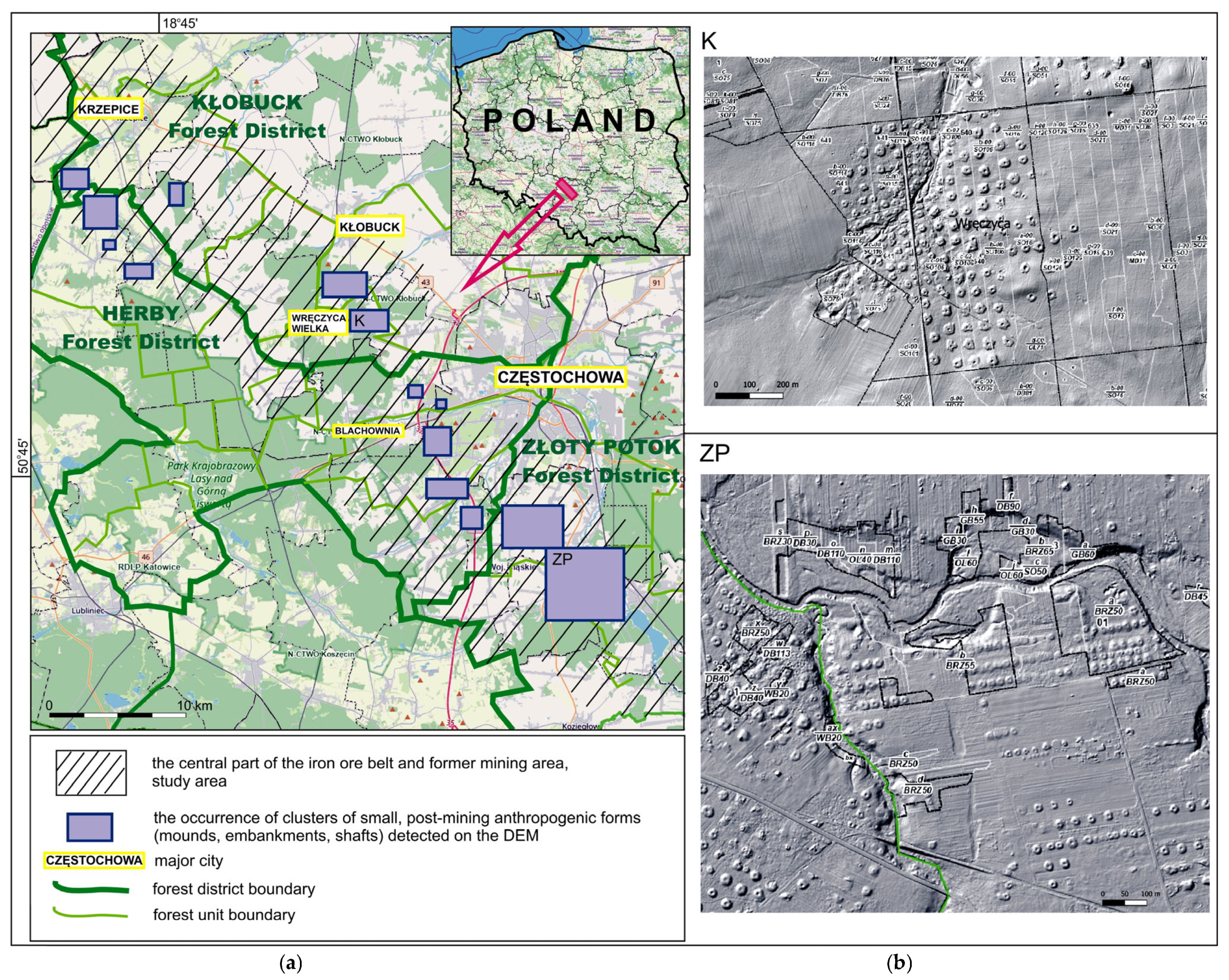
The area around Częstochowa, along with the stretch of land extending in the NW-SE direction from Wieluń up to Zawiercie (southern Poland) (Figure 1a), until recently was the region known for the extraction of shallow deposits of iron ores formed as siderite or sphaerosiderite (FeCO3) in Middle Jurassic mud, thus this formation is commonly referred to as ore-bearing mud. They are found in the form of slightly inclined, tectonized layers, typically overlain by a Quaternary overburden of varying thickness. Within the geology of the mineral deposit, three ore layers are distinguished, located within a depth interval ranging from the ground surface (in places) to several dozen meters, up to a max. 100 m [37].
Historical sources report mining and iron smelting in the area as early as the 14th century, which promoted industrial development, increased local population density, and accelerated overall progress. It also led to considerable changes in the natural environment and landscape, affecting the relief, subsurface geological strata, and hydrogeological conditions, which in turn influenced the further development of the biotic environment. The method of ore extraction determined the type and size of resulting land deformations and other environmental changes. Ore extraction systems have evolved with advances in technology and the increasing depth of deposit mining. Open-pit mining was the simplest extraction method used in areas with the shallowest ore deposits, reaching a depth of as much as 6 m. Layers deposited at a depth below 5–6 m were mined using shafts. Remnants of such mining activity include low, oval, frequently flattened spoil tips, most commonly (as reported in the literature data) 0.5–2.5 m in height, heaped up around ore extraction sites [38] (Figure 2).
Figure 1. (a) A map of former iron ore extraction sites in the area of Częstochowa and Kłobuck (Southern Poland) with marked zones comprising remnants of mining shafts and spoil tips identified in a DEM generated using ALS data provided by the Head Office of Geodesy and Cartography (HOGC); (b) Shaded relief of the portions of the Złoty Potok Forest District ((ZP)—the Poraj and Siedlec Forest Units), and the Kłobuck Forest Distirct ((K)—the Wręczyca Wielka Forest Units), with spoil heaps found in a series, at former shallow mining shafts; the boundaries of forest compartments are marked with black lines, and the numbers of compartments are indicated [39]; compilation of the DEM and a forest map—an example of a potential application in the form of layers in the forest management IT system. The DEM based on ALS (LiDAR) data, originally presented online on the HOGC portal [40].
Forests 17 00037 g001
When extracting the mined material from the shaft, the gangue accumulated around the excavation site. Thus, in the present-day relief, we may observe heaps around the presently filled shafts, marked by a depression at the center of the heap. In areas where extraction was run using multiple prospecting shafts, such spoil tips are found in series; in such a case, sequences of heaps, frequently in the form of parallel rows, are found in the area (Figure 1b and Figure 2). In sites where exploitation shafts were located very close to one another, heaps of clay material were connected, forming elongated structures (embankments) several dozen meters in length (max. 180 m) and 2–5 m in height. Currently, these landforms are often overgrown with trees, shrubs, or sod [38], as a result of decades of natural plant succession. Several methods were adopted in ore extraction using shafts. Thus, shafts of 1 × 1.5 m, 2 × 2 m up to 3 × 3 m were dug at varying distances from one another. In the simplest variant, it was every 2 m, while in more complex ones, at distances of 30–40 m, tunneling also underground horizontal galleries, following the horizontal arrangement of ore layers. Shafts were lined with planks and insulated with excavated clay material. Underground galleries were frequently connected the neighboring shafts, which improved ventilation in the underground mine.
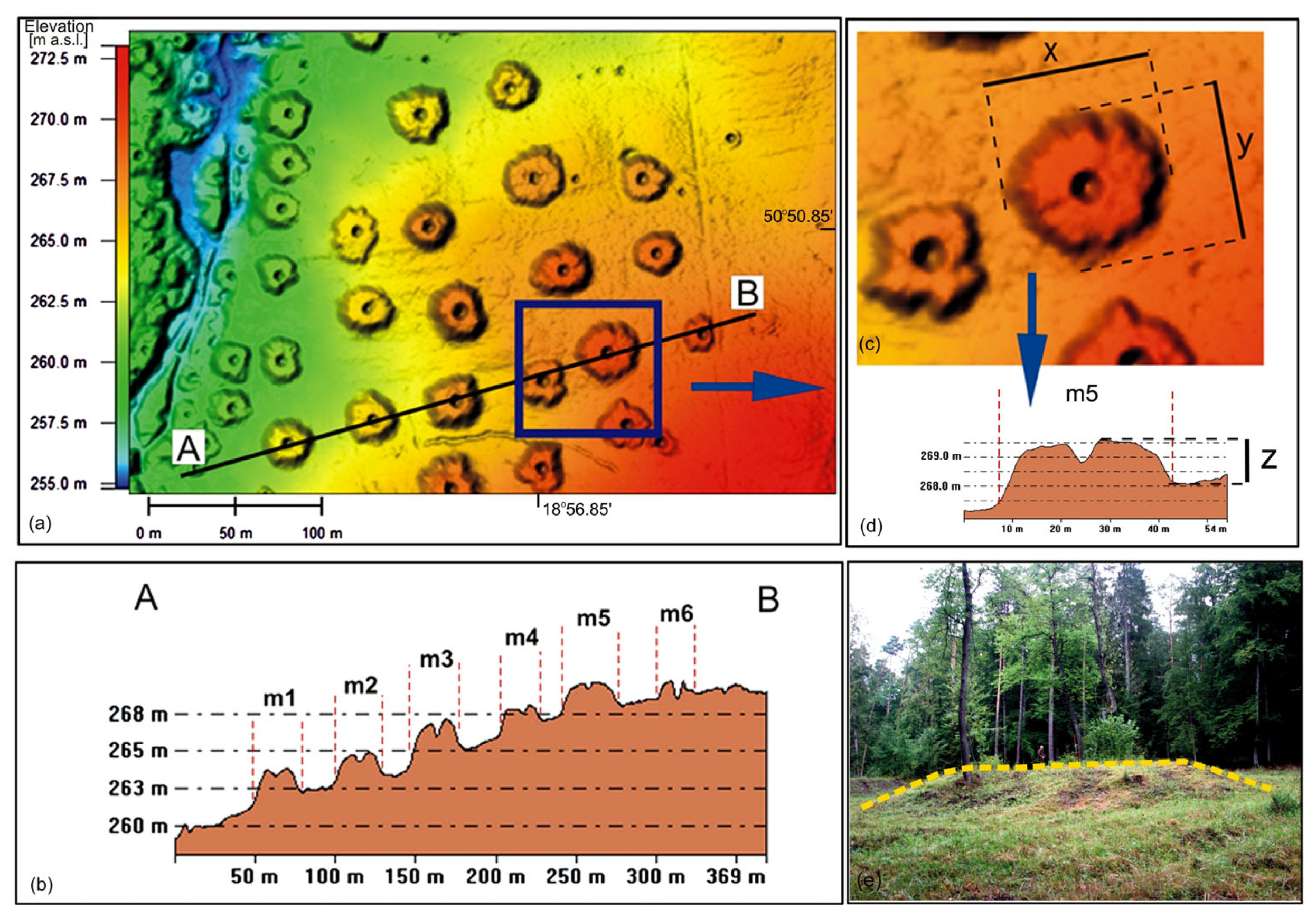
Figure 2. (a) The DEM showing a group of post-mining mounds in a forested area; (b) a section along a marked line, generated automatically; (c,d) the method adopted to measure geometric parameters of individual landforms; (e) a single mound revealed in the area after trees had been felled, the Wręczyca Wielka Forest Unit (N50°50.78; E18°56.65).
Forests 17 00037 g002
The open-pit and shaft systems, which reached depths of several meters, were used in mines in the region from the 14th century to the early 20th century. Then, due to the progress of electrification, the ore began to be mined using deep shafts equipped with drainage pumps and ventilation systems. Ore was extracted in deep mines, up to approx. 100 m deep, using professional machinery [41]. In locations with deep mines, massive dumps were formed. They were the largest and youngest anthropogenic landforms in the Częstochowa region, formed between 1950 and 1982. These dumping sites reach 15–60 m in height aboveground and 130–500 m in length [38,42], making them the most conspicuous and characteristic landforms in the area.
Deep mining activity in the 20th century has had a considerable impact on the prevalent hydrogeological conditions, leading to the formation of a regional cone of depression covering approx. 1500 km2, in places lowering the water table by as much as 80–100 m. After ore extraction ceased and drainage stopped, the cone of depression began to fill slowly and now is close to the natural state [43]. In the land belt, where iron ore was found and mined in the past (Figure 1a), the current groundwater table of the shallowest aquifer varies in depth, ranging from less than 1 m to over 50 m, and is variable within small sections of the terrain [44,45,46]. In areas where anthropogenic landforms are studied, such as in the Wręczyca Wielka zone, the groundwater table is shallow, in places less than 1 m to a maximum of 5 m below the surface. In the Kłobuck area, it also occurs locally at this shallow level, although the depth of the water table is more variable there, and in some places, it is slightly deeper. In the regions immediately south, southwest, and west of Częstochowa, the groundwater table occurs in vast areas at depths ranging from less than 1 to 2 m. The shallow groundwater level explains the need to drain underground excavations over the course of decades of mining. A factor shaping moisture conditions at the ground surface and in the soil horizons, which directly influence the development of forest stands, is the layer of clay occurring on the ground surface or shallowly beneath the sand layer, which is practically present throughout the entire area of the former mining. Clays, being poorly permeable rocks, retain rainwater and meltwater in the near-surface zones of the terrain, thereby contributing significantly to environmental moisture.
Currently, the area of the former mining activity is partially forested. In the forested areas, post-mining landforms and other remnants of mining activity, apart from the largest in size, are hardly discernible, as they are covered by diverse vegetation, which simultaneously affects the development of habitats and forest site types, and consequently the adopted forest management. The study area within this project comprises such areas administered by the Kłobuck Forest District (in the northern part of the former mining region), the Herby Forest District (in its western and south-western part), and the Złoty Potok Forest District (in the south and southern east) (Figure 1), as well as forested areas of other ownership types.

2.2. DEM as an Inventory Tool

The study utilized cartographic materials, including the DEM, from the State Geodesy and Cartography Collection (SGCC), administered by the national agency Head Office of Geodesy and Cartography (HOGC), which is available as an open-access resource. The DEM data are shared in a 1 m × 1 m grid and are regularly updated based on Airborne Laser Scanning (ALS). In this DEM type, there are 1,000,000 points per 1 km2. The Act assigns the Surveyor General of Poland, under geodetic and cartographic law, as responsible for the maintenance of the DEM database of Poland. The Office possesses such data for the entire area of Poland. In this project, the study area covered approximately 293 km2, comprising 293 million points that provided information on elevation, which was used to construct a digital elevation model of sufficient accuracy to reflect, with adequate detail, most of the still-present post-mining landforms. The area was subjected to a relief (DEM) analysis, combined with other materials, such as archival 1:10,000 topographic maps and orthophotomaps from the SGCC, a forest map provided by the Forest Data Bank (administered by the State Forests National Forest Holding [39]). Among other things, those maps and data were used, e.g., to identify the forested areas administered by the State Forests and those administered by other entities (privately owned). The DEM for the entire Poland is presented on the HOGC Geoportal [40], facilitating a preliminary survey of the material of interest (examples in Figure 1b). Following a preliminary review, the data for selected areas were collected from the Geoportal in the ASCI format. These were ALS elevation data acquired in 2019. Next, for further processing, along with other cartographic layers, they were applied to the GIS systems, facilitating data processing and analysis. Moreover, when determining the specific locations of particular objects, the authors utilized both their knowledge acquired during everyday fieldwork in forestry and information from other foresters working in the study area.
Using both the DEM and GIS tools (QGIS, Surfer, online tools available through the HOGC Geoportal), geometric parameters of anthropogenic landforms were measured (length, width, perimeter, covered area, height). Several hundred objects were subjected to such analyses.
To assess the accuracy of the adopted method for inventorying post-mining landforms, the control field measurements were performed on several selected mounds. Measurements applying survey methods were taken on-site in the Kłobuck Forest District, specifically in the area of Wręczyca Wielka (Figure 1 and Figure 2), where a portion of the area had been exposed due to the recent tree extraction operations. This test area is shown in the photograph (Figure 3a). In neighboring areas, where several decades-old stands remain, precise measurements would not have been possible at all. Next, the results of morphometric measurements for individual forms (primarily small mounds formed around former shafts) obtained using DEM and GIS tools were compared with the results of in situ field measurements of these parameters. Thus, it provided information on the level of reliability of measurements taken using the DEM. Due to terrain difficulties (dense stands over a large terrain, significant elevation differences over short distances, uneven terrain left over from skidding operations, often poorly visible and covered with thick grass vegetation, and numerous marshes in hidden depressions), field measurements were conducted at only eight sites. Due to the small number of sites that were successfully surveyed, this project can be considered a test or pilot study, allowing for a preliminary comparison and estimation of convergence/difference in the results obtained from the terrain and the DEM. Despite the limited dataset, an attempt was made to apply the statistic measures: Pearson Correlation Coefficient (r), Standard Deviation (SD) and Root Mean Squared Error (RMSE) values.
The investigation also covered features of particular post-mining objects found separately, primarily several shafts still left unsecured, known from practical work in the terrain. Their depth and dimensions of the openings were determined on site, as well as verified in the DEM, to determine whether such single elements could be identified.
The range of the locations of transformed areas on forestry maps was accurately determined in areas administered by the State Forests National Forest Holding, indicating respective forest compartments along with calculations of deformation indexes for the most severely altered areas. The ratio of the surface area of the deformed area to the total area of a given forest compartment was calculated, thus providing a measure applicable when estimating forest management problems in a given compartment. Among the morphometric parameters measured on the DEM, the surface areas occupied by post-mining mounds were also used in further analyses. After totaling these values in individual forest compartments and referring the result to the surface area of the entire compartment, a parameter was produced, i.e., the terrain deformation index (Id). This test was conducted for the forest compartments administered by the State Forests, since it may be helpful in the management system adopted in that company.
Id = ∑a/A × 100 [%]
  • Id—terrain deformation index,
  • a—surface area occupied by a mound-shaped spoil tip,
  • A—surface area of the forest compartment.

3. Results

As a result of the inventory based on DEM, the territorial range of terrain deformations related to former siderite ore mining was identified. The location was specified for objects found either in series (former mining fields) or as single occurrences, such as remnants of shafts, spoil tips formed by the deposition of gangue left after ore extraction, and former extraction pits. A total of 14 zones were identified with post-mining landforms found in series and individually (mounds, embankments) (Figure 1a). Using a set of digital layers, comprising the DEM, the orthophotomap, and forest maps analyzed in the GIS environment, it was demonstrated which parts of these areas are currently forested and administered by the State Forests National Forest Holding, and which are owned by other entities (Table 1). These areas were subjected to further morphometric analysis, as well as in situ analyses. Within the forests, the highest number of terrain deformations, in the form of groups of mounds, is situated in the northern part of the ore-bearing region in the Kłobuck Forest District (Figure 1 and Figure 2), particularly in the Wręczyca, Pierzchno, Rybno, and Zwierzyniec Forest Units. To a lesser extent, groups of topographic post-mining objects and single remnants are found in the Herby Forest District (the Kuleje, Aleksandria, and Hutki Forest Units) and the Złoty Potok Forest District (the Kręciwilk, Siedlec, and Poraj Forest Units) (Figure 1). In those forest districts, forested areas comprising post-mining deformations are typically owned by entities other than the State Forests National Forest Holding.
The DEM showed a sufficient degree of detail for developing morphometric characteristics of the investigated terrain forms and constructing a database. Mounds formed around former shafts were digitized, which facilitated the automatic acquisition of information on parameters such as the circumference of a given form, surface area, length, and width. The height of such structures was also read from the DEM. In this mode, a total of 823 objects identified using the DEM have been characterized, with the joint results of this analysis presented in Table 1. The surface area occupied by individual post-mining mounds related to shallow shafts in forested areas ranged from 46.9 up to 1656 m2. These forms were primarily oval or irregular in shape, reaching lengths of 7.8 to 59.2 m and heights of 0.3 to 4.1 m, respectively. Mounds found singly did not vary in size from the average given here. Most shafts were refilled; for this reason, the post-mining forms are typically mounds with a slight depression in their center, located at the former shaft entrance. These features are clearly visible in both the analyzed DEM and on-site (Figure 2). In some areas, such mounds are partly leveled, reduced in size, e.g., where some construction projects were executed. It may be assumed that a part of the deformed area was already leveled and prepared for further use.
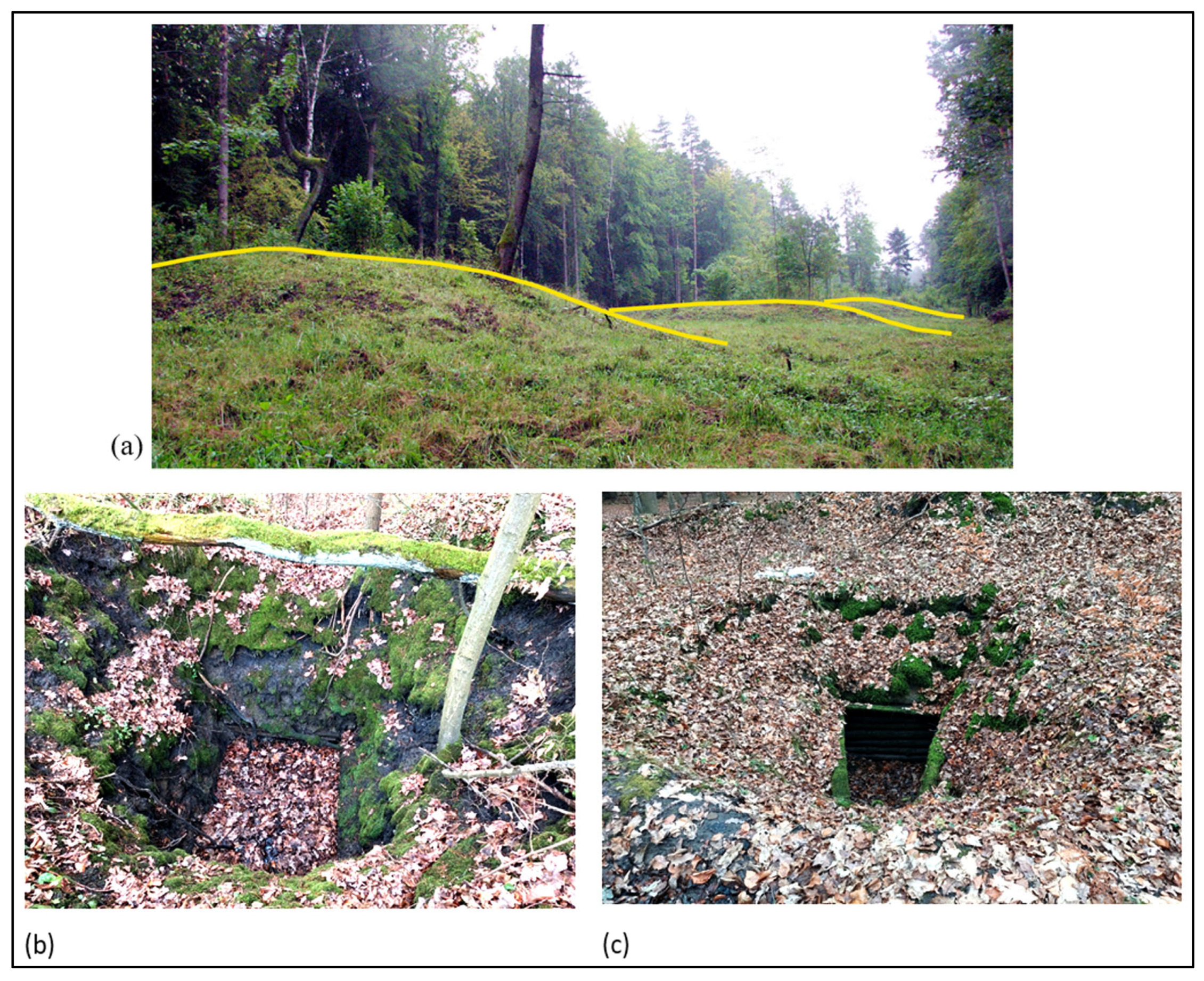
Some exploitation shafts remained unfilled, and the depth of three of these structures was measured (Table 1). In other cases, some of the shafts or adits were not surrounded by an embankment of deposited material, and the location (i.e., coordinates) was the only parameter extracted from the DEM, as they were hardly discernible on the image (Figure 3).
In the analysis of post-mining landforms, apart from mounds, considerably elongated objects arranged in belts (embankments) were also distinguished. A total of 7 such objects were found in the described forested areas. They ranged from 49.5 to 109 m in length, and typically measured around a dozen meters in width.
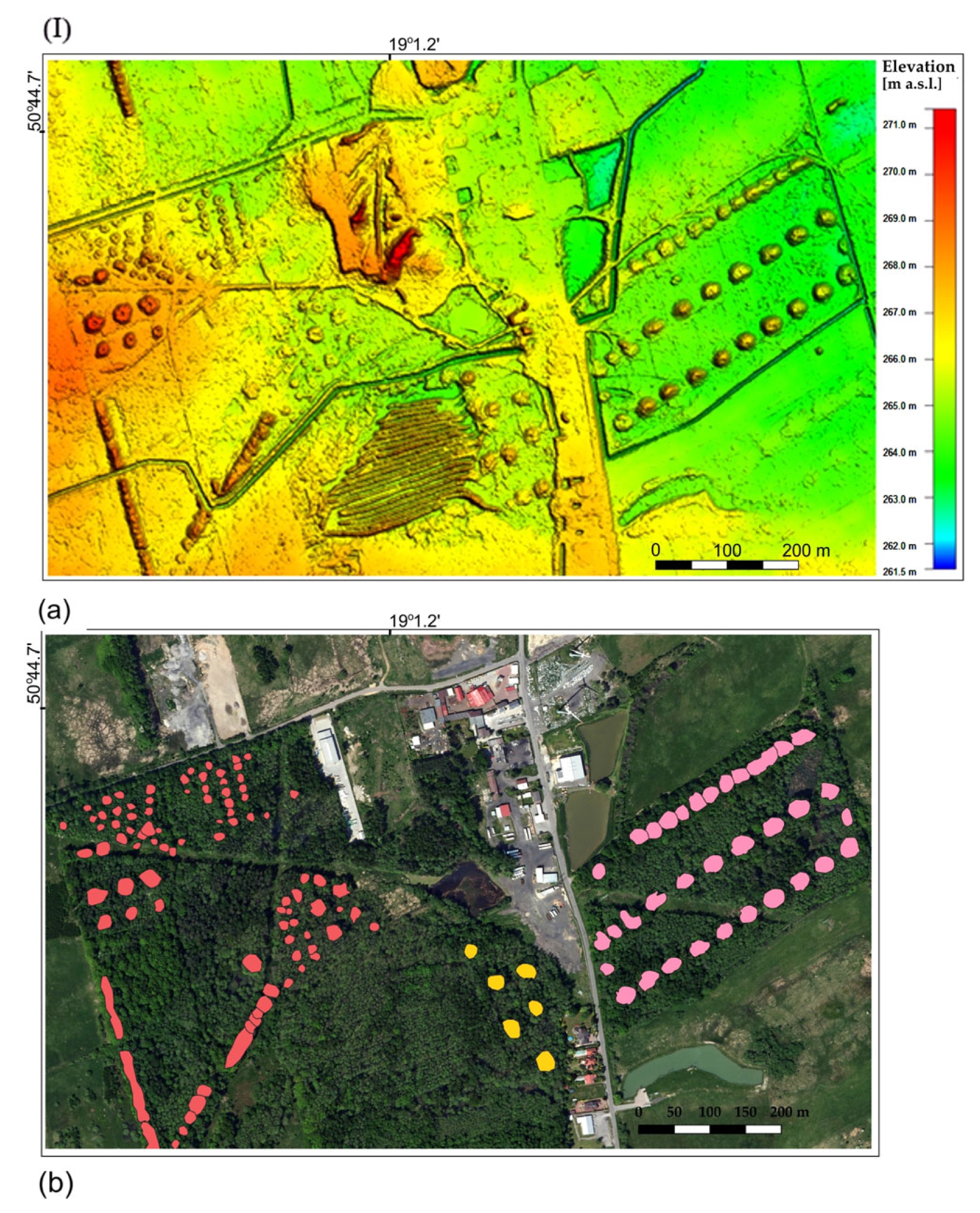
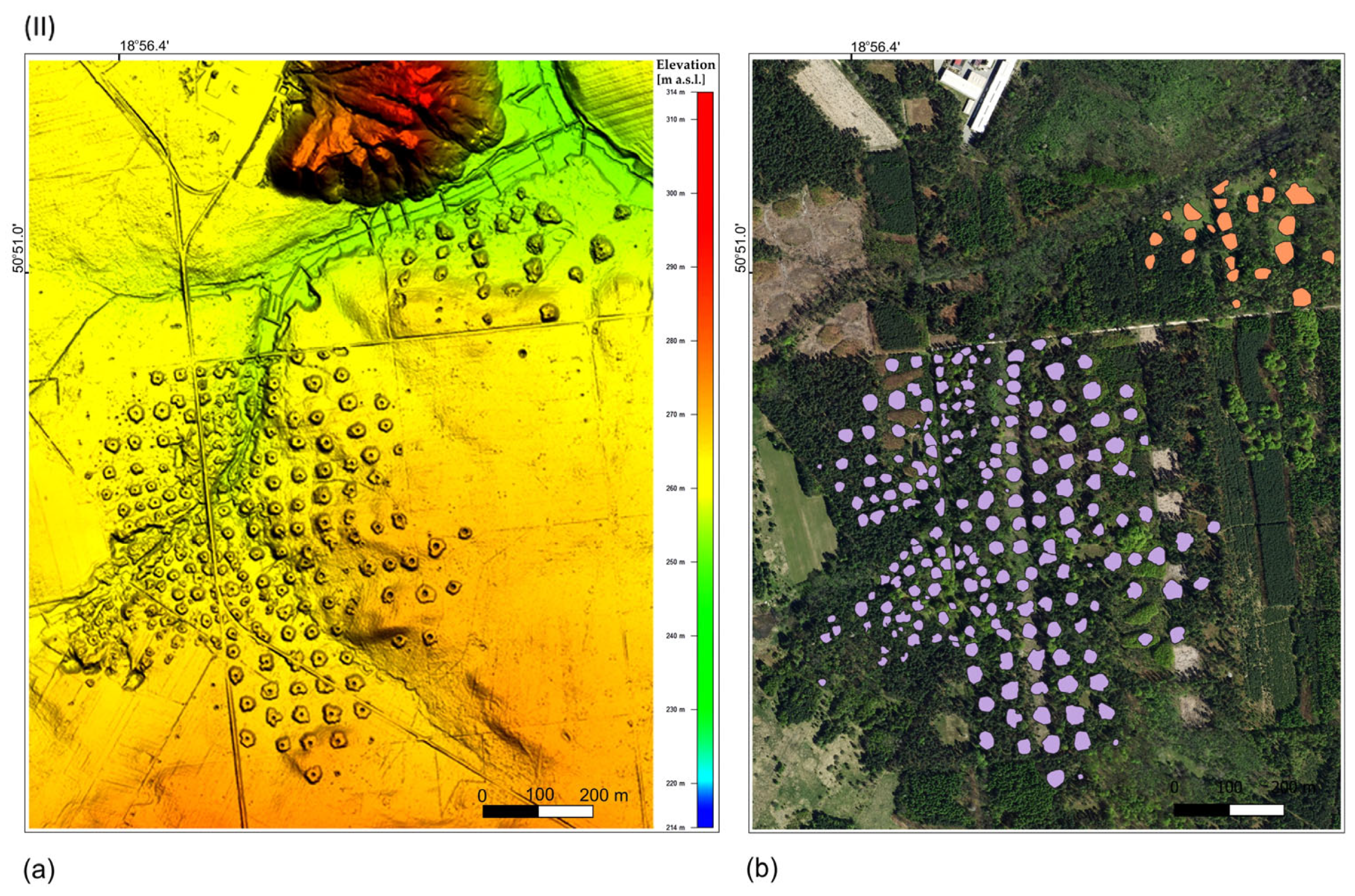
In terms of spatial arrangement, the linear series of mounds were found in locations characterized by groups of such landforms (Figure 4); the distances between structures and the distances between their rows can be read from the DEM. Such a distribution was related to the organization and logistics of ore exploitation, most probably in the relatively recent past (the 20th century).
The results of the in situ measurements recorded in the post-mining field near Wręczyca Wielka and Zwierzyniec, together with the parameters read from the DEM for comparison, are presented in Table 2. The value differences for individual parameters are shown as the calculated error, ranging from 0.14% to 22.8%. For the perimeter of the investigated structures, this range was smaller (from 0.14% to 7.99%), with absolute error values varying from 0.14 m to 8.46 m. A similar measuring error may be assumed for the surface area occupied by individual landforms. It should be acknowledged that differences obtained in a comparison of field measurements and cartometric results are acceptable. Considering the problems and labor intensity of in situ measurements, the adoption of a method based on DEM enables a considerable streamlining of the process for identifying post-mining deformations, while generating only a slight error. It is crucial when the landforms are spot-like, scattered over a large area, and in a remote, hardly accessible area.
Calculations of the deformation index for selected individual forest compartments with shaft-mounds provided maximum values of 14.8% and 21.7%. The value of 55.4% corresponds to the compartment that contained one dump of a larger size. The indices show that these man-made landforms occupy a significant percentage of the area (Table 3). In regions where these objects occur in groups and exhibit considerable spatial accumulation, the deformed area is not limited to the mound itself (a positive morphological form), but also includes portions of land extending between the mounds, often formed as depressions (negative morphological forms). The entire area is problematic for forest management activity, but the proposed index offers valuable insights into field conditions and facilitates easy comparisons between compartments to support planning forestry operations.

4. Discussion

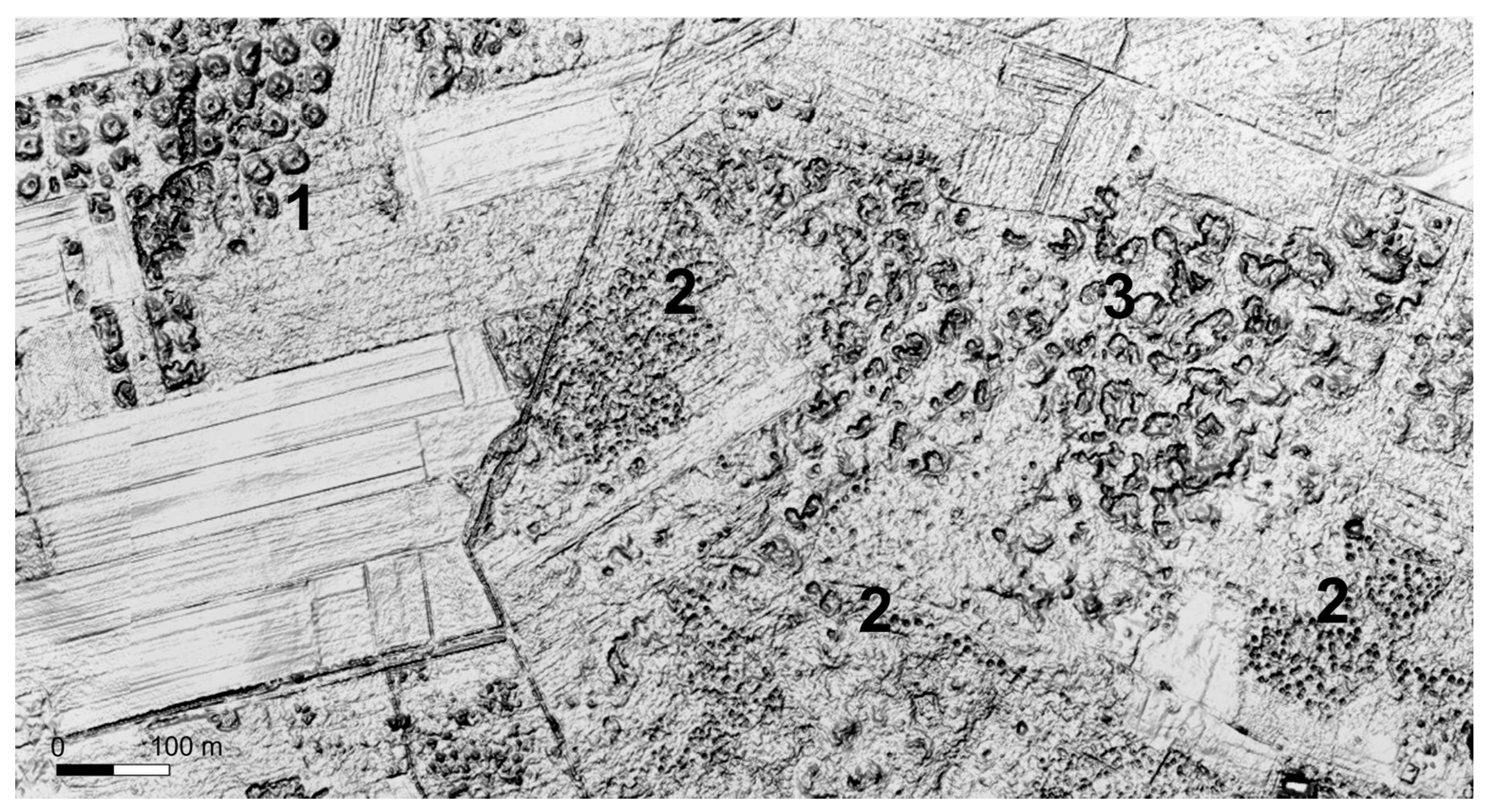
Forest restoration following exploitation activity is a global problem, frequently discussed in the context of areas degraded by industrial operations and subsequently being reclaimed through reforestation. In European countries, including Poland, mining companies currently extracting natural resources are legally obligated to restore the areas they have exploited to their original condition and function [8,47,48]. However, in the past, even relatively recently, no such legal requirements were binding, resulting in many anthropogenically altered regions, which have not been reclaimed. This refers to a considerable part of the study area. The authors’ long-term experience, gained while working in the forests around Kłobuck and neighboring areas, has enabled them to identify problems in proper forest management operations. Changes in topography, apart from the landforms related to the shaft operations, also include extensive areas altered as a consequence of shallow open-cast mining. In the present-day DEM, these regions are characterized by an uneven surface, dotted with small, irregular forms differing in elevation, frequently found together with groups of round depressions—remnants of exploratory excavations, but with no heaps of waste material (see Figure 5). Within this study, no detailed measurements were conducted in these areas; however, it needs to be highlighted that this type of terrain deformation may also affect forest management operations due to the surface soil layer removal or deformation and exposure of the underlying ground layers, typically clay, having a considerable impact on hydrological relations.
The most significant accumulation of shafts and mounds—remnants of mining activity within a single location is found in the Wręczyca Forest Unit. These objects considerably hinder everyday forest management practices, particularly since the currently binding standard worktime and labor consumption guidelines do not take into consideration the increased need for worktime due to terrain structure, while the conditions are comparable to those found in mountainous areas. The area is undulating, as indicated by the DEM analysis. The mounds are frequently joined at the base or are close to each other, forming a regular series of elevations and depressions. Such a relief significantly hinders timber harvesting and extraction. The difficulties are related to maintaining one’s balance while performing felling operations on mound slopes and selecting a location where felled trees are to land. The fall of tree trunks onto slopes is hazardous, as they may slide rapidly or break. Moving skidders and other heavy skidding machinery over such terrain is also tricky. Their excessive tilting may result in rollover. The relief prevents mechanical soil cultivation. The high moisture content of the surface promotes heavy weed infestation. For this reason, cultivation of future plantations is highly labor-intensive, which is further exacerbated by problems with transport due to the presence of spoil tips and depressions between them.
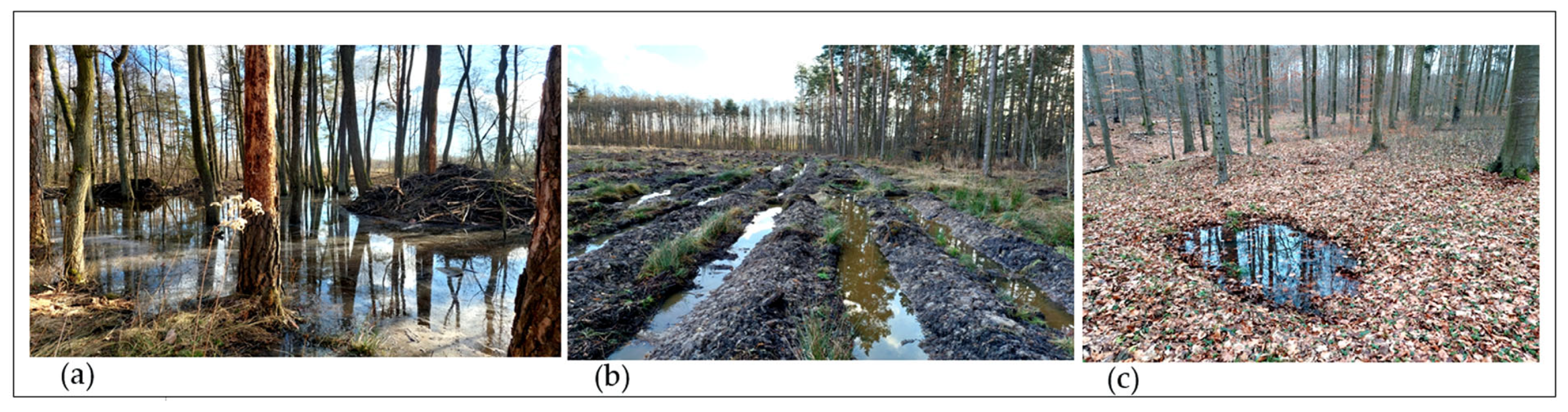
The area of the investigated forest units is water-logged in many parts, with beavers living at the watercourses (example in Figure 3a). Due to water-logging some areas are practically inaccessible. Beavers fell a large number of trees, while others frequently die due to excess stagnant water (Figure 6). Depressions left in a result of open-pit mining or shaft extraction of iron ore for a considerable part of the year are filled with water as a result of shallow or even surface deposition of clay material. They constitute obstacles that need to be navigated around and avoided during forest operations. Water-soaked soil frequently makes tree stands more susceptible to the damaging effects of winds. Numerous water-logged sites are sometimes used as wallows by wildlife.
Additional obstacles in the study area, although relatively rare, include adits or mining shafts (e.g., in the Pierzchno and Zwierzyniec Forest Units) (Table 1, Figure 3b,c), which are currently only partially leveled with soil and filled with water. As such, they may pose a threat to humans and wildlife.
To a considerable degree, the diverse relief resulting from mining activity and water stagnating in hollows and depressions is beneficial for the environment. The water retention capacity is improved compared to other forested areas in the region. The last decades brought the decrease in precipitation, and scientists issue warnings due to multiannual drought periods, while stands in many regions of Poland, as well as in many other regions of Europe, have been weakened, leading to their die-back [49,50,51,52]. In view of such climate fluctuations in Poland, the post-mining region of Kłobuck and its adjacent areas appear to be in a better hydrological situation.
The use of DEM is definitely conducive to the analysis and prediction of the above difficulties and characteristics of the forest environment. It is advisable to utilize the open-access DEM resources offered by state institutions, as they provide the acceptable resolution and precision necessary for land imaging for some of the forestry purposes. With no need for extra expenditure or costly special projects covering targeted flights for specific areas, a stock of precise information may be collected. It is particularly justified since ALS (Light Detection and Ranging—LIDAR) technology is currently considered the most accurate source of topographic data worldwide [34,53,54,55,56]. The possibility and justification for the broadest possible use of this tool have been recognized and promoted for several years on a continental scale in various regions of the world, emphasizing the ethical, scientific, and practical benefits of open access elevation data, e.g., in archeology, cultural heritage protection, or natural resource management [57,58].
The DEM, as a tool for precise topography analysis, should be applied when determining the forest management hindrance index for forest units administered by the State Forests. This index describes the degree of problems in management and silviculture operations within these organizational units, thereby indicating the resultant level of involvement and professional efforts on the part of forest unit employees [59]. It constitutes a significant element in the management system adopted in State Forests in Poland, while balancing the work burden for employees of organizational units characterized by varying conditions.
Through the application of DEM and modeling techniques, combined with quantitative analysis, field operations can be optimized in the planning process for forested areas. As a result, this ensures cost savings and reduces logistics problems associated with data collection in challenging, inaccessible areas, where precise measurements may be practically impossible [60].
In relation to anthropogenic changes in the relief, the effects of mineral mining are sometimes monitored in real-time and supervised by respective agencies using DEMs constructed based on regularly provided ALS data [61]. This monitoring system can also be used to track illegal overexploitation operations, facilitating not only their detection but also the quantitative estimation of the resulting environmental damage. In cases of illegal mineral extraction or extraction that does not comply with contractual terms and conditions, it is necessary in court proceedings to determine losses using the most advanced methods to mitigate the resulting economic and environmental impacts.
One of the key issues addressed in this study is the safety and performance of forest tending operations in the area. Excavations, which may potentially pose a health hazard to humans and a threat to wildlife, need to be promptly marked and secured; unfortunately, this has not been performed to date. The health hazard associated with the presence of unsecured shafts left after iron ore extraction may potentially lead to criminal liability.
Individuals and services conducting work in the area, as well as other visitors, such as tourists, should be informed of the existing unusual obstacles and threats resulting from the former mining activity. In view of the above arguments, DEM topography imaging is also a valuable tool in identifying potentially hazardous sites, which, upon verification on-site, need to be adequately secured to prevent accidents affecting humans and wildlife.
It can also be stated that the investigated area should be treated as a landscape of cultural and historical significance, as well as an example of regional distinctiveness and local identity. The remnants of mining activity may be used as tourist attractions. The image of the terrain (provided by the DEM) can be used when planning tourist trails, including identifying the most interesting locations to present to visitors, as well as those that require protection from excessive tourist traffic.
In this study, the results of comparative field measurements indicate that the accuracy of the landforms representation on the applied DEM is satisfactory. Although the value of the relative error appears to be highly diverse and, in some cases, high, it is related to small values of the parameter being tested. It applies especially to the height of objects (only a few meters). Studies by many experts confirm that the accuracy of object representation in DEM depends, among other things, on the density of data points and the grid density/image resolution. Therefore, the smaller the object, the less accurately it is represented; and errors can significantly increase in the case of low, small topographic features [55,62,63]. Modern science and technology enable higher precision in terrain analysis, which may be required, for example, in determining negative environmental impacts and protecting the environment, especially in mining areas, or addressing some discrepancies related to mining operations. Advanced digital data processing technologies, such as application of geomorphometric algorithms, Object-Based Image Analysis (OBIA) or GEOBIA (Geographic Object-Based Image Analysis) with contextual segmentation [64,65,66], data mining [67], machine learning and deep learning models [65,68]—contribute to increasing the level of precision in acquiring morphometric data from DEMs and, more broadly, from remote sensing data. These techniques, developed at the intersection of geomorphology, geomatics, and remote sensing, enable the automatic or semi-automatic extraction and classification of landforms in a manner that closely approximates human perception, but without the subjectivity that typically characterizes human interpretation results. Such techniques, currently being developed and applied, appear to be a key feature of future analysis in geomorphology, particularly used to detect negative environmental impacts and protect the environment, including mining areas, or address discrepancies related to mining operations. Among the ecological and deposit issues, in which ALS data, high-resolution DEMs generated from points are used with the advanced techniques mentioned, one can distinguish volumetric estimation of soil masses on post-mining waste dumps [31,69], quantifying the effects of applied reclamation treatments [70], monitoring of active deformation processes in the temporal aspect: the effects of erosion, land subsidence, slope slips (landslides) within large-scale waste dumps after mining and ore processing, estimating the stability of waste dump surfaces [71,72,73], quantifying changes in the volume of waste dumps, or simply monitoring the progress of mining operations in operating open-pit mines [74]. In all of these applications, precise volume calculation is crucial, which depends on the accuracy of mapping and measuring the size of morphological structures in three dimensions.

5. Conclusions

The applied Digital Elevation Model showed a sufficient level of detail for developing morphometric characteristics of the investigated post-mining landforms. The completed database gathers the details of the landforms, facilitating the determination of further works required to secure, level, and reclaim those sites, or plan forest management operations more effectively. The quantitative data set in the database, easily integrated into the IT system of the forest services, can serve as a valuable resource for calculating the costs of planned forest protection and management operations, supporting management decisions for specific investments while ensuring their safe execution. In some cases, information on the deformed sites may enable the exclusion of these locations from standard economic operations.
The information obtained from the DEM (number, location, spread, and arrangement in the field, geometric parameters of post-mining landforms) supplements knowledge on the area, significantly reducing the need for labor-intensive and costly identification of specific problems observed in these sites. A total of 823 post-mining landforms were identified using the DEM in the study area, the vast majority of which were mounds formed around former mining shafts, in most places occurring in groups, often arranged in rows. The surface area occupied by individual post-mining mounds ranged from 46.9 to 1656 m2, reaching lengths of 7.8 to 59.2 m and heights of 0.3 to 4.1 m, respectively. These forms were primarily oval or irregular in shape. Occurring in groups, they are the cause of exceptionally varied terrain relief, forming a series of hills and depressions that diversify the forest environment but hinder economic development.
Based on a compilation of DEM, orthophotomaps, and forest maps in a GIS environment, it was found that in the study area around Częstochowa, Kłobuck, and Krzepice, the State Forests’ systemic management covers 16 forest compartments amongs 24 identified; they are characterized by the terrain deformation index ranging from 0.1 to 55.4% which means, that post-mining, man-made landforms occupy such a percentage of the compartment area.
The tested methodology may be a valuable tool for inventorying other, similar post-mining areas in Poland, which are numerous, including forest territories. It can significantly support work on detecting illegal activities that lead to the distortion of the soil in forested areas, as well as preventive monitoring and inventorying the effects of legal mining activities, e.g., compliance of the boundaries of plots designated for mining with the actual state, the depth of excavations, the volume of mined minerals, the height of heaps, or the correctness of excavation slopes.
The tested DEM based on ALS data, obtained from the open-access HOGC resources, is already partially processed by the data provider, making it easy to use. Among the satisfactory accuracy, another advantage of the data source is the systematic updating of the ALS resource, declared by the HOGC.

Author Contributions

Conceptualization, E.E.K., A.C. and K.G.; methodology, E.E.K.; software, E.E.K.; validation, A.C.; formal analysis, A.C.; investigation, E.E.K. and K.G.; resources, E.E.K. and K.G.; writing—original draft preparation, E.E.K., K.G. and A.C.; writing—review and editing, E.E.K. and A.C.; visualization, E.E.K.; supervision, A.C.; project administration, E.E.K. and A.C.; funding acquisition, A.C. All authors have read and agreed to the published version of the manuscript.

Funding

The publication was funded by the Polish Minister of Science and Higher Education as part of the Strategy of the Poznan University of Life Sciences for 2024–2026 in the field of improving scientific research and development work in priority research areas.

Data Availability Statement

The raw data supporting the conclusions of this article will be made available by the authors on request.

Conflicts of Interest

The authors declare no conflicts of interest.

Abbreviations

The following abbreviations are used in this manuscript:
DEMDigital Elevation Model
ALSAirborne Laser Scanning
LIDARLight Detection and Ranging
HOGCHead Office of Geodesy and Cartography
SGCCState Geodesy and Cartography Collection

References

  1. Pietrzyk-Sokulska, E. Tereny po odkrywkowej eksploatacji zwięzłych kopalin skalnych na Wyżynie Krakowsko-Częstochowskiej—możliwości adaptacji. Probl. Ekol. Kraj. 2009, 24, 37–48. [Google Scholar]
  2. Madziarz, M.; Sztuk, H. Prace badawczo-inwentaryzacyjne stanowisk dawnego górnictwa kruszców jako element zabezpieczenia, ochrony i wykorzystania dziedzictwa górniczego Dolnego Śląska. Min. Sci. 2012, 135, 163–178. [Google Scholar] [CrossRef]
  3. Madziarz, M. Historical ore mining sites in Lower Silesia (Poland) as geo-tourism attraction. Acta Geoturistica 2013, 4, 15–26. [Google Scholar]
  4. Małka, A. Śladami bursztynowego górnictwa w województwie pomorskim. Acta Univ. Lodz. Folia Geogr. Socio-Oeconomica 2015, 22, 65–86. [Google Scholar] [CrossRef]
  5. Wrona, P.; Różański, Z.; Pach, G.; Niewiadomski, A.P.; Veiga, J.P. Historical Outline of Iron Mining and Production in the Area of Present-Day Poland. Minerals 2021, 11, 1136. [Google Scholar] [CrossRef]
  6. Dulias, R. The Impact of Mining on the Landscape. A Study of the Upper Silesian Coal Basin in Poland; Springer: Cham, Switzerland, 2016. [Google Scholar]
  7. Kurowska, E.E.; Czerniak, A.; Bańkowski, J. The Rationale for Restoration of Abandoned Quarries in Forests of the Ślęża Massif (Poland) in the Context of Sustainable Tourism and Forest Environment Protection. Forests 2023, 14, 1386. [Google Scholar] [CrossRef]
  8. Zajączkowski, M.; Czerniak, A.; Adamski, P. Wydobywanie Kopalin ze złóż Położonych na Gruntach w Zarządzie PGL LP—Zasady i tryb Ubiegania się o Koncesję Przez Jednostki PGL LP; Państwowe Gospodarstwo Leśne Lasy Państwowe: Warszawa, Poland, 2017. [Google Scholar]
  9. Doyle, F.J. Digital Terrain Models: An Overview. Photogramm. Eng. Remote Sens. 1978, 44, 1481–1487. [Google Scholar]
  10. Hutchinson, M.F.; Gallant, J.C. Digital elevation models and representation of terrain shape. In Terrain Analysis: Principles and Applications; Wilson, J.P., Gallant, J.C., Eds.; John Wiley & Sons Inc.: Hoboken, NJ, USA, 2000; pp. 29–50. [Google Scholar]
  11. Sasaki, H.; Mukoyama, S.; Nagata, N.; Namikawa, K. Digital Terrain Analysis Using Airborne Laser Scanner (LIDAR) Data for Natural Hazard Assessment. Int. Arch. Photogramm. 2008, 37, 1225–1228. [Google Scholar]
  12. Guth, P.L.; Van Niekerk, A.; Grohmann, C.H.; Muller, J.-P.; Hawker, L.; Florinsky, I.V.; Gesch, D.; Reuter, H.I.; Herrera-Cruz, V.; Riazanoff, S.; et al. Digital Elevation Models: Terminology and definitions. Remote Sens. 2021, 13, 3581. [Google Scholar] [CrossRef]
  13. Ko, C.; Remmel, T.K. Airborne LiDAR Applications in Forest Landscapes. In Mapping Forest Landscape Patterns; Remmel, T.K., Perera, A.H., Eds.; Springer Science + Business Media LLC: New York, NY, USA, 2017; pp. 147–185. [Google Scholar] [CrossRef]
  14. Alganci, U.; Besol, B.; Sertel, E. Accuracy Assessment of Different Digital Surface Models. ISPRS Int. J. Geo. Inf. 2018, 7, 114. [Google Scholar] [CrossRef]
  15. Kelly, M.; Di Tommaso, S. Mapping forests with Lidar provides flexible, accurate data with many uses. Calif. Agric. 2015, 69, 14–20. [Google Scholar] [CrossRef]
  16. Holmgren, J. Prediction of tree height, basal area and stem volume in forest stands using airborne laser scanning. Scand. J. For. Res. 2004, 19, 543–553. [Google Scholar] [CrossRef]
  17. Chirrek, M.; Wencel, A.; Strzeliñski, P.; Stereñczak, K.; Zasada, M.; Zawiła-Niedźwiecki, T. Airborne Laser Scanning as a Source of Data for GIS in Forest Districs. Rocz. Geomatyki 2007, 5, 19–28. [Google Scholar]
  18. Maier, B.; Tiede, D.; Dorren, L. Characterising Mountain Forest Structure Using Landscape metrics on LiDAR−Based Canopy Surface Models. In Object−Based Image Analysis; Blaschke, T., Lang, S., Hay, G.J., Eds.; Series: Lecture Notes in Geoinformation and Cartography; Springer: Berlin/Heidelberg, Germany, 2008; pp. 625–643. [Google Scholar]
  19. Hollaus, M.; Mandlburger, G.; Pfeifer, N.; Mücke, W. Land Cover Dependent Derivation of Digital Surface Models from Airborne Laser Scanning Data. IAPRS 2010, 38, 1–3. [Google Scholar]
  20. Järnstedt, J.; Pekkarinen, A.; Tuominen, S.; Ginzler, C.; Holopainen, M.; Viitala, R. Forest variable estimation using a high-resolution digital surface model. ISPRS J. Photogramm. Remote Sens. 2012, 74, 78–84. [Google Scholar] [CrossRef]
  21. Balenović, I.; Alberti, G.; Marjanović, H. Airborne Laser Scanning—The Status and Perspectives for the Application in the South-East European Forestry. South East Eur. For. 2013, 4, 59–79. [Google Scholar] [CrossRef]
  22. Ross, C.W.; Loudermilk, E.L.; O’Brien, J.J.; Flanagan, S.A.; McDaniel, J.; Aubrey, D.P.; Lowe, T.; Hiers, J.K.; Skowronski, N.S. Lidar-derived estimates of forest structure in response to fire frequency. Fire Ecol. 2024, 20, 44. [Google Scholar] [CrossRef]
  23. Anders, N.S.; Seijmonsbergen, A.C.; Bouten, W. Geomorphological change detection using object-based feature extraction from multi-temporal LiDAR data. IEEE Geosci. Remote Sens. Lett. 2013, 10, 1587–1591. [Google Scholar] [CrossRef]
  24. Pawłuszek, K.; Marczak, S.; Borkowski, A.; Tarolli, P. Multi-Aspect Analysis of Object-Oriented Landslide Detection Based on an Extended Set of LiDAR-Derived Terrain Features. ISPRS Int. J. Geo. Inf. 2019, 8, 321. [Google Scholar] [CrossRef]
  25. Eagleston, H.; Marion, J.L. Application of airborne LiDAR and GIS in modeling trail erosion along the Appalachian Trail in New Hampshire, USA. Landsc. Urban Plan. 2020, 198, 103765. [Google Scholar] [CrossRef]
  26. Pryde, J.K.; Osorio, J.; Wolfe, M.L.; Heatwole, C.; Benham, B.; Cardenas, A. Comparison of watershed boundaries derived from SRTM and ASTER digital elevation datasets and from a digitized topographic map. In Proceedings of the ASABE Annual International Meeting, Minneapolis, MN, USA, 17–20 June 2007. [Google Scholar]
  27. Moges, D.M.; Virro, H.; Kmoch, A.; Cibin, R.; Rohith, A.N.; Martínez-Salvador, A.; Conesa-García, C.; Uuemaa, E. How does the choice of DEMs affect catchment hydrological modeling? Sci. Total Environ. 2023, 892, 164627. [Google Scholar] [CrossRef]
  28. Annis, A.; Nardi, F.; Petroselli, A.; Apollonio, C.; Arcangeletti, E.; Tauro, F.; Belli, C.; Bianconi, R.; Grimaldi, S. UAV-DEMs for Small-Scale Flood Hazard Mapping. Water 2020, 12, 1717. [Google Scholar] [CrossRef]
  29. Parizi, E.; Khojeh, S.; Hosseini, S.M.; Moghadam, Y.J. Application of Unmanned Aerial Vehicle DEM in flood modeling and comparison with global DEMs: Case study of Atrak River Basin, Iran. J. Environ. Manag. 2022, 317, 115492. [Google Scholar] [CrossRef] [PubMed]
  30. Singh, V.; Karan, S.K.; Singh, C.; Samadder, S.R. Assessment of the capability of SWAT model to predict surface runoff in open cast coal mining areas. Environ. Sci. Pollut. Res. Int. 2023, 30, 40073–40083. [Google Scholar] [CrossRef] [PubMed]
  31. Kowalski, A.; Maciejak, K.; Wojewoda, J.; Kozłowski, A.; Raczyński, P. Antropogeniczne zmiany rzeźby na terenach górniczych Starego Zagłębia Miedziowego (synklinorium północnosudeckie) w świetle analiz geomorfometrycznych NMT LiDAR i danych archiwalnych. Biul. Państwowego Inst. Geol. 2017, 469, 177–200. [Google Scholar] [CrossRef]
  32. Bindzarova Gergelova, M.; Labant, S.; Mizak, J.; Sustek, P.; Leicher, L. Inventory of Locations of Old Mining Works Using LiDAR Data: A Case Study in Slovakia. Sustainability 2021, 13, 6981. [Google Scholar] [CrossRef]
  33. Szostak, M.; Pajak, M. LiDAR Point Clouds Usage for Mapping the Vegetation Cover of the “Fryderyk” Mine Repository. Remote Sens. 2023, 15, 201. [Google Scholar] [CrossRef]
  34. White, R.A.; Dietterick, B.C.; Mastin, T.; Strohman, R. Forest Roads Mapped Using LiDAR in Steep Forested Terrain. Remote Sens. 2010, 2, 1120–1141. [Google Scholar] [CrossRef]
  35. Sterenczak, K.; Moskalik, T. Use of LIDAR-based digital terrain model and single tree segmentation data for optimal forest skid trail network. Iforest Biogeosciences For. 2014, 8, 661–667. [Google Scholar] [CrossRef]
  36. Waga, K.; Tompalski, P.; Coops, N.C.; White, J.C.; Wulder, M.A.; Malinen, J.; Tokola, T. Forest Road Status Assessment Using Airborne Laser Scanning. For. Sci. 2020, 66, 501–508. [Google Scholar] [CrossRef]
  37. Bednarek, J.; Haisig, J.; Lewandowski, J.; Wilanowski, S. Objaśnienia do Szczegółowej Mapy Geologicznej Polski, Arkusz Kłobuck; Państwowy Instytut Geologiczny: Warszawa, Poland, 1992. [Google Scholar]
  38. Fajer, M.; Waga, J.M. Hałdy górnictwa rud żelaza w regionie częstochowskim. In Kształtowanie Środowiska Geograficznego i Ochrona Przyrody na Obszarach Uprzemysłowionych i Zurbanizowanych; Choiński, A., Dulias, D., Havrlant, J., Herczek, A., Jankowski, A.T., Łopuch, P.S., Strzelec, M., Świeca, A., Wach, J., Wika, S., Eds.; Uniwersytet Śląski: Katowice, Poland, 2012; Volume 44, pp. 22–34. [Google Scholar]
  39. Available online: https://www.bdl.lasy.gov.pl/portal/mapy (accessed on 17 November 2025).
  40. Available online: https://mapy.geoportal.gov.pl (accessed on 17 November 2025).
  41. Adamski, A. Górnictwo Rud Żelaza w Regionie Częstochowskim; SiiTG: Częstochowa, Poland, 1994. [Google Scholar]
  42. Praska, S. Zwałowiska porudne i ich otoczenie w procesie zmian krajobrazowych. In Kształtowanie Środowiska Geograficznego i Ochrona Przyrody na Obszarach Uprzemysłowionych i Zurbanizowanych; Uniwersytet Śląski: Katowice, Poland, 2001; Volume 31, pp. 40–47. [Google Scholar]
  43. Pacholewski, A. Hydrogeologia złóż i problemy wodne zlikwidowanego górnictwa rud żelaza w rejonie częstochowskim. In Wody Podziemne Rejonu Częstochowsko-Zawierciańskiego Ich Występowanie, Zagrożenia, Degradacja i Ochrona; Pacholewski, A., Ed.; Informator PSH; PIG-PIB: Warszawa, Poland, 2016. [Google Scholar]
  44. Gajowiec, B. (Ed.) Mapa Hydrogeologiczna Polski (PPPWWH) w Skali 1:50 000 ark. Kłobuck (808); PIG-PIB & MŚ: Warszawa, Poland, 2006. [Google Scholar]
  45. Wagner, J.; Zembal, M.; Rolka, M.; Kaczorowski, Z. (Eds.) Mapa Hydrogeologiczna Polski (PPPWWH) w Skali 1:50,000 ark. Częstochowa (845); PIG-PIB & MŚ: Warszawa, Poland, 2006. [Google Scholar]
  46. Kaczorowski, Z.; Cudak, J.; Razowska-Jaworek, L. (Eds.) Mapa Hydrogeologiczna Polski (PPPWWH) w skali 1:50,000 ark. Boronów (844); PIG-PIB & MŚ: Warszawa, Poland, 2006. [Google Scholar]
  47. Paulo, A. Economical and Natural Conditions Applicable to the Development Oo Post-Mining Areas. Pol. Geol. Inst. Spec. Pap. 2005, 17, 49–69. [Google Scholar]
  48. Macdonald, S.E.; Landhäusser, S.M.; Skousen, J.; Franklin, J.; Frouz, J.; Hall, S.; Jacobs, D.F.; Quideau, S. Forest restoration following surface mining disturbance: Challenges and solutions. New For. 2015, 46, 703–732. [Google Scholar] [CrossRef]
  49. Hlásny, T.; Mátyás, C.; Seidl, R.; Kulla, L.; Merganičová, K.; Trombik, J.; Dobor, L.; Barcza, Z.; Konôpka, B. Climate change increases the drought risk in Central European forests: What are the options for adaptation? For. J. 2014, 60, 5–18. [Google Scholar] [CrossRef]
  50. Skrzecz, I.; Perlińska, A. Current problems and tasks of forest protection in Poland. Folia For. Pol. Ser. A For. 2018, 60, 161–172. [Google Scholar] [CrossRef]
  51. Czerniak, A.; Grajewski, S.; Krysztofiak-Kaniewska, A.; Kurowska, E.E.; Okoński, B.; Górna, M.; Borkowski, R. Engineering Methods of Forest Environment Protection against Meteorological Drought in Poland. Forests 2020, 11, 614. [Google Scholar] [CrossRef]
  52. Pietrzykowski, M.; Woś, B. The Impact of Climate Change on Forest Tree Species Dieback and Changes in Their Distribution. In Climate Change and the Microbiome: Sustenance of the Ecosphere, Soil Biology; Choudhary, D.K., Arti, M., Ajit, V., Eds.; Springer International Publishing: Cham, Switzerland, 2021; Volume 63. [Google Scholar] [CrossRef]
  53. Reutebuch, S.E.; McGaughey, R.J.; Andersen, H.-E.; Carson, W.W. Accuracy of a high-resolution lidar terrain model under a conifer forest canopy. Can. J. Remote Sens. 2003, 29, 527–535. [Google Scholar] [CrossRef]
  54. Krogstad, F.; Schiess, P. The Allure and Pitfalls of Using LiDAR Topography in Harvest and Road Planning. In Proceedings of the 12th International Mountain Logging Conference, Vancouver, BC, USA, 13–16 June 2004. [Google Scholar]
  55. Liu, X. Airborne LiDAR for DEM generation: Some critical issues. Prog. Phys. Geogr. Earth Environ. 2008, 32, 31–49. [Google Scholar] [CrossRef]
  56. Chase, A.F.; Chase, D.Z.; Fisher, C.T.; Leisz, S.J.; Weishampel, J.F. Geospatial revolution and remote sensing LiDAR in Mesoamerican archaeology. Proc. Natl. Acad. Sci. USA 2012, 109, 12837–13132. [Google Scholar] [CrossRef]
  57. Kakoulaki, G.; Martinez, A.; Florio, P. Non-Commercial Light Detection and Ranging (LiDAR) Data in Europe, Publications Office of the European Union. 2021. Available online: https://data.europa.eu/doi/10.2760/212427 (accessed on 17 November 2025).
  58. Stoker, J.; Harding, D.; Parrish, J. The need for a national LIDAR data set. Photogramm. Eng. Remote Sens. 2008, 74, 1066–1068. [Google Scholar]
  59. Kocel, J.; Kwiecień, R. Methodological foundations of determining the indicator of the degree of management difficulty in the State Forests forest ranges. Sylwan 2012, 156, 118–127. [Google Scholar]
  60. Collerton, H.; Hock, B.; Hawke, R.; Payn, T. Digital terrain modelling for site productivity assessment and stand management in plantation forestry. N. Z. J. For. 2008, 53, 33–41. [Google Scholar]
  61. Yiğit, A.Y.; Şenol, H.İ. Surface Change and Stability Analysis in Open-Pit Mines Using UAV Photogrammetric Data and Geospatial Analysis. Drones 2025, 9, 472. [Google Scholar] [CrossRef]
  62. Aguilar, F.J.; Mills, J.P. Accuracy assessment of lidar-derived digital elevation models. Photogramm. Rec. 2008, 23, 148–169. [Google Scholar] [CrossRef]
  63. Bater, C.W.; Coops, N.C. Evaluating error associated with lidar-derived DEM interpolation. Comput. Geosci. 2009, 35, 289–300. [Google Scholar] [CrossRef]
  64. Drăguţ, L.; Blaschke, T. Automated classification of landform elements using object-based image analysis. Geomorphology 2006, 81, 330–344. [Google Scholar] [CrossRef]
  65. Li, X.; Cheng, X.; Chen, W.; Chen, G.; Liu, S. Identification of Forested Landslides Using LiDar Data, Object-based Image Analysis, and Machine Learning Algorithms. Remote Sens. 2015, 7, 9705–9726. [Google Scholar] [CrossRef]
  66. Huang, H.; Lan, Y.; Yang, A.; Zhang, Y.; Wen, S.; Deng, J. Deep learning versus Object-based Image Analysis (OBIA) in weed mapping of UAV imagery. Int. J. Remote Sens. 2020, 41, 3446–3479. [Google Scholar] [CrossRef]
  67. Simionato, J.; Bertani, G.; Sayuri Osako, L. Identification of artisanal mining sites in the Amazon Rainforest using Geographic Object-Based Image Analysis (GEOBIA) and Data Mining techniques. Remote Sens. Appl. Soc. Environ. 2021, 24, 100633. [Google Scholar] [CrossRef]
  68. Yang, J.; Xu, J.; Lv, Y.; Zhou, C.; Zhu, Y.; Cheng, W. Deep learning-based automated terrain classification using high-resolution DEM data. Int. J. Appl. Earth Obs. Geoinf. 2023, 118, 103249. [Google Scholar] [CrossRef]
  69. Witt, E.C. Use of lidar point cloud data to support estimation of residual trace metals stored in mine chat piles in the Old Lead Belt of southeastern, Missouri. AIMS Environ. Sci. 2016, 3, 509–524. [Google Scholar] [CrossRef]
  70. Moudrý, V.; Gdulová, K.; Fogl, M.; Klápště, P.; Urban, R.; Komárek, J.; Moudrá, L.; Štroner, M.; Barták, V.; Solský, M. Comparison of leaf-off and leaf-on combined UAV imagery and airborne LiDAR for assessment of a post-mining site terrain and vegetation structure: Prospects for monitoring hazards and restoration success. Appl. Geogr. 2019, 104, 32–41. [Google Scholar] [CrossRef]
  71. Martín-Velázquez, S.; Rodríguez-Santalla, I.; Ropero-Szymañska, N.; Gomez-Ortiz, D.; Martín-Crespo, T.; de Ignacio-San José, C. Geomorphological Mapping and Erosion of Abandoned Tailings in the Hiendelaencina Mining District (Spain) from Aerial Imagery and LiDAR Data. Remote Sens. 2022, 14, 4617. [Google Scholar] [CrossRef]
  72. Hu, L.; Tomás, R.; Tang, X.; López Vinielles, J.; Herrera, G.; Li, T.; Liu, Z. Updating Active Deformation Inventory Maps in Mining Areas by Integrating InSAR and LiDAR Datasets. Remote Sens. 2023, 15, 996. [Google Scholar] [CrossRef]
  73. An, S.; Yuan, L.; Xu, Y.; Wang, X.; Zhou, D. Ground subsidence monitoring in based on UAV-LiDAR technology: A case study of a mine in the Ordos, China. Geomech. Geophys. Geo Energ. Geo Resour. 2024, 10, 57. [Google Scholar] [CrossRef]
  74. Park, H.J.; Turner, R.; Yun, B.Y.; Lee, J.O. Change detection analysis using airborne LiDAR: Open-cut mine environment. In Proceedings of the 16th International Congress for Mine Surveying, Brisbane, AU, Australia, 12–16 September 2016. [Google Scholar]
Figure 3. Post-mining objects found in the field: (a) a row of mounds exposed after tree felling, against the background of a dense forest, where the remaining majority of the group of these forms occurs (Wręczyca Forest Unit); (b) a singly occurring object visible in DEM—opening of a former shaft, with visible wooden lining, the Zwierzyniec Forest Unit, compartment 519c; (c), singly occuring adit entrance, hardly discernible in the DEM, characterized in this study based on field analyses only (an adit in compartment 535a with well-preserved wooden lining).
Forests 17 00037 g003
Figure 4. Portions of the Herby Forest District (the Aleksandria Forest Unit) (I) and the Kłobuck Forest District (the Wręczyca Forest Unit) (II) with numerous mounds and embankments being remnants of siderite extraction using shafts technique; (a) DEM—an image generated from ALS data acquired from the HOGC as an open-access point cloud, subsequently processed in the GIS software; (b) digitized post-mining forms against the background of an orthophotomap accessed from the same source; due to the forest cover, the terrain deformations are not visible in the orthophotomap; when combined with the DEM, a detailed analysis of the terrain is possible, constituting a handy planning tool for forest management.
Forests 17 00037 g004aForests 17 00037 g004b
Figure 5. Remnants of iron ore mining in a fragment of the Kłobuck Forest District (the Zwierzyniec Forest Unit) shaded relief: 1—mounds remained after shaft-mining, 2—depressions left after shallow pits digging, 3—shallow, small-scale open-pit extractions; these are the terrain deformations promoting surface water retention. DEM based on ALS from [40].
Forests 17 00037 g005
Figure 6. Situations observed in the area showing increased water retention in the study area related to natural and anthropogenic factors such as remnants of mining activity; (a) a watercourse with beaver dams on the Czarna Oksza (the Pierzchno Forest Unit), additionally increasing water-logging in the area; (b) area prepared for forest regeneration with water stagnating in seed beds on clay substrate of the Jurassic formation of ore-bearing clays; (c) one of many depressions left after open-pit extraction of iron ore in compartment 535a, the Zwierzyniec Forest Unit.
Forests 17 00037 g006
Table 1. A joint table of morphometric parameters for landforms related to siderite ore mining in areas presently covered with forests. Location of forest districts and forest units consistent with the map in Figure 1a, records of forest compartments consistent with the forest map constructed and updated by the State Forests National Forest Holding, accessible from [39].
Location (Forest District)Location (Forest Unit)Forest CompartmentNumber of MoundsElongated Forms (Embankments); Larger Spoil TipsPerimeter [m]Surface Area [m2]Length/Width
(x,y Dimensions) [m]
Height [m]
Kłobuck Forest DistrictPierzchno59513 25.4–9046.9–5017.77–27.90.3–1.8
593, 594, 596, 583, 566, 6356 single occurrences –
shafts depth: 2.9–17 m
24.3–37.843.7–1068.4–13.40.4–1.1
Wręczyca624, 625, 639, 640, 641, 645,
comptm. owned by other entities
233 27.1–15952.6–15419.47–59.20.7–3.9
1 large dump; the terrain owned by other entities827.739,793.0255.323.3
Zwierzynieccomptm. owned by other entities82 46.1–97.4143–71815.9–32.90.7–1.9
Herby Forest DistrictAleksandria227, 228128 26–13548.1–9519.1–51.20.3–2.7
4 embankments155–2401081–158760.8–1091.0–2.7
Hutkicomptm. owned by other entities6 62.7–86.9164–50818–28.81.1–1.7
Kulejecomptm. owned by other entities173 42–105126–77514.5–34.60.5–2
1 embankment41137421831.8
2 middle-size dumps207–3192970–577160.9–1157–11
Złoty Potok Forest DistrictKręciwilk537, comptm. owned by other entities10 40–102.3110.6–62213.8–34.30.4–1.4
1 large dump61224,77921023.5
2 remnants of a larger dump81.7–316304–392935.6–1172.9–4.2
Siedlec600,
comptm. owned by other entities
46 31.4–11364.4–88712.3–37.50.6–2.4
Porajcomptm. owned by other entities112 33.8–15681–165611.5–52.50.3–1.7
3 embankments133–212757–145949.5–860.6–0.9
Table 2. Results of the comparative test, referring to the values of morphometric parameters for selected mounds related to mining shafts obtained by two methods: on-site surveying and cartometric using the DEM based on ALS data.
No.LocationPerimeter Measured at the Base of the Landform in the Field Perimeter Measured at the Base of the Landform from the DEMDifference [m]
{Absolute Error}
Relative ErrorLength Measured in the Field Length Measured from the DEMDifference
{Absolute Error}
Relative ErrorWidth Measured in the FieldWidth Measured from the DEMDifference
{Absolute Error}
Relative ErrorMean Height Measured in the FieldMean Height Measured from the DEMDifference
{Absolute Error}
Relative Error
[m][m][m][%][m][m][m][%][m][m][m][%][m][m][m][%]
1Wręczyca
Forest Unit,
compartment 640
105.8697.48.46 (+)7.99 (+)33.7532.31.45 (+)4.3 (+)30.1829.90.28 (+)0.938 (+)2.171.950.22 (+)9.93 (+)
296.4689.966.50 (+)6.74 (+)31.8030.751.05 (+)3.30 (+)26.325.11.2 (+)4.56 (+)1.721.50.22 (+)12.54 (+)
391.692.81.20 (−)1.31 (−)28.1031.803.7 (−)13.17 (−)24.1526.82.65 (−)10.97 (−)1.691.650.04 (+)2.37 (+)
4104.761022.76 (+)2.63 (+)33.3033.00.3 (+)0.90 (+)29.831.82 (−)6.71 (−)1.712.10.39 (−)22.80 (−)
5100.861010.14 (−)0.14 (−)31.5534.22.65 (−)8.4 (−)25.2527.62.35 (−)9.32 (−)2.432.550.12 (−)4.94 (−)
686.588.82.30 (−)2.66 (−)25.2529.84.55 (−)18.02 (−)1924.35.3 (−)27.9 (−)1.251.50.25 (−)20.0 (−)
782.483.61.20 (−)1.46 (−)22.5026.03.5 (−)15.56 (−)22.424.21.8 (−)8.04 (−)1.111.10.005 (+)0.45 (+)
8 Zwierzyniec
Forest Unit,
Compartment
519 c
40.539.31.20 (+)2.96 (+)12120.00109.320.68 (+)6.8 (+)1.71.80.1 (−)5.882 (−)
r */SD **/RMSE ***0.9833/3.97/4.05 0.9460/2.52/2.67 0.9498/2.31/2.49 0.8798/0.22/0.20
* r—correlation coefficient; ** SD—standard deviation; *** RMSE—Root Mean Squared Error.
Table 3. Calculation of the deformation index for selected forest compartments (managed by State Forests), determining the degree of coverage with anthropogenic landforms (remnants of siderite extraction).
Location
(Forest
District)
Location (Forest Unit)Forest CompartmentSurface Area of Compartment (m2)Total Surface Area Occupied by Mounds and Other Spoil Heaps, Obtained Through Digitization from DEM in GIS Software [m2]Deformation Index [%]
Kłobuck
Forest District
Pierzchno595220,19630781.4
Wręczyca640289,096.162,779.921.7
641135,947.520,132.914.8
639288,634.538491.3
645
625
626
316,720.2
192,893.2
111,672.8
959.7
15,670
127
0.3
8.1
0.1
Herby
Forest
District
Aleksandria227
228
182,100.4
322,404.5
17,264
23,160
9.5
7.2
Złoty Potok
Forest
District
Kręciwilk53752,646.329,14355.4
Disclaimer/Publisher’s Note: The statements, opinions and data contained in all publications are solely those of the individual author(s) and contributor(s) and not of MDPI and/or the editor(s). MDPI and/or the editor(s) disclaim responsibility for any injury to people or property resulting from any ideas, methods, instructions or products referred to in the content.