Soil and Climate Controls on the Economic Value of Forest Carbon in Northeast China
Abstract
1. Introduction
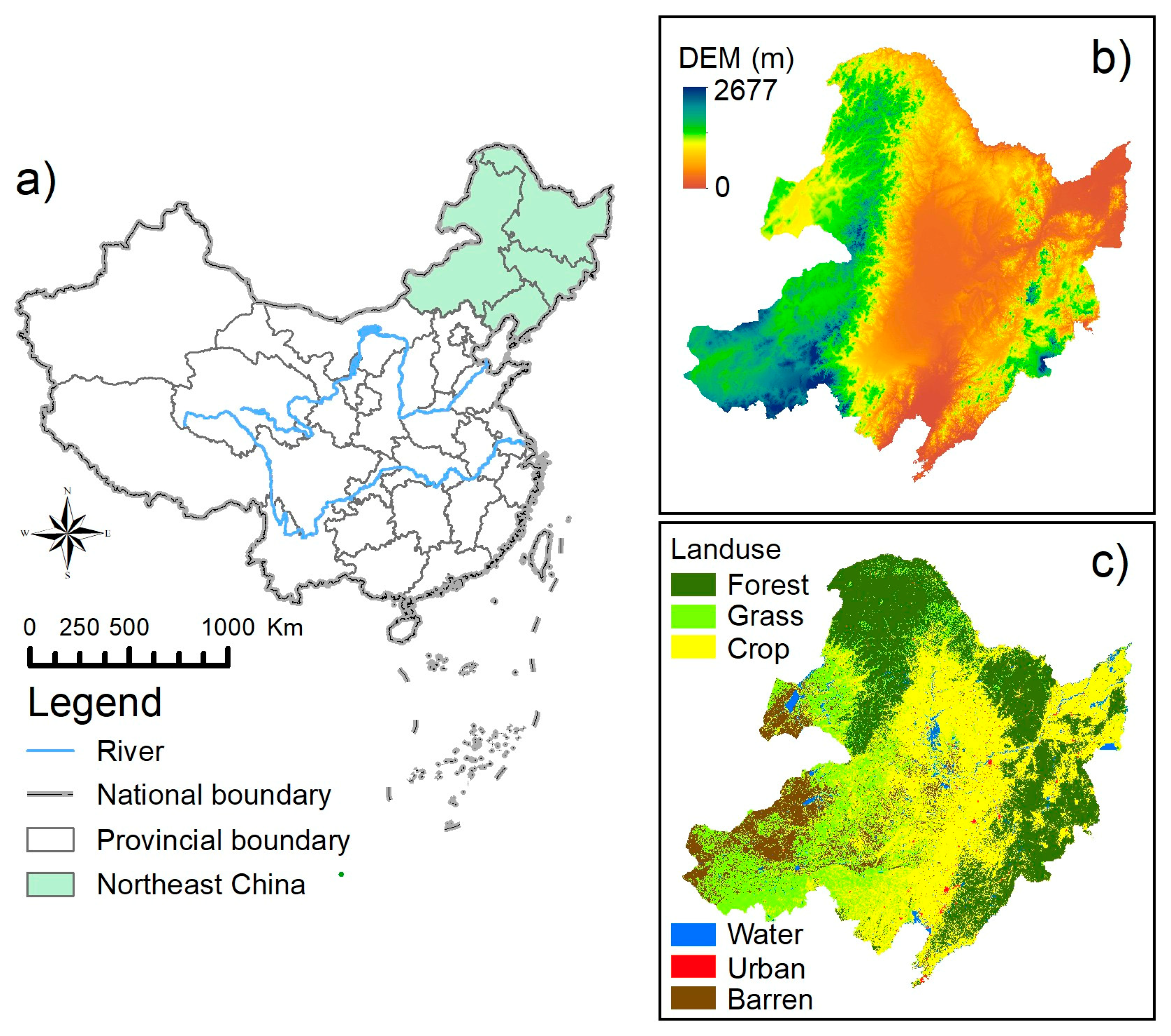
2. Study Site
2.1. Data Sources
2.2. Forest Carbon Dynamic
2.2.1. Conversion from ΔNPP to Carbon-Stock Difference (ΔC)
2.2.2. Pixel Level Carbon Economic Value (Conversion from ΔC to )
2.2.3. Identifying Drivers of Carbon Economic Value
3. Results
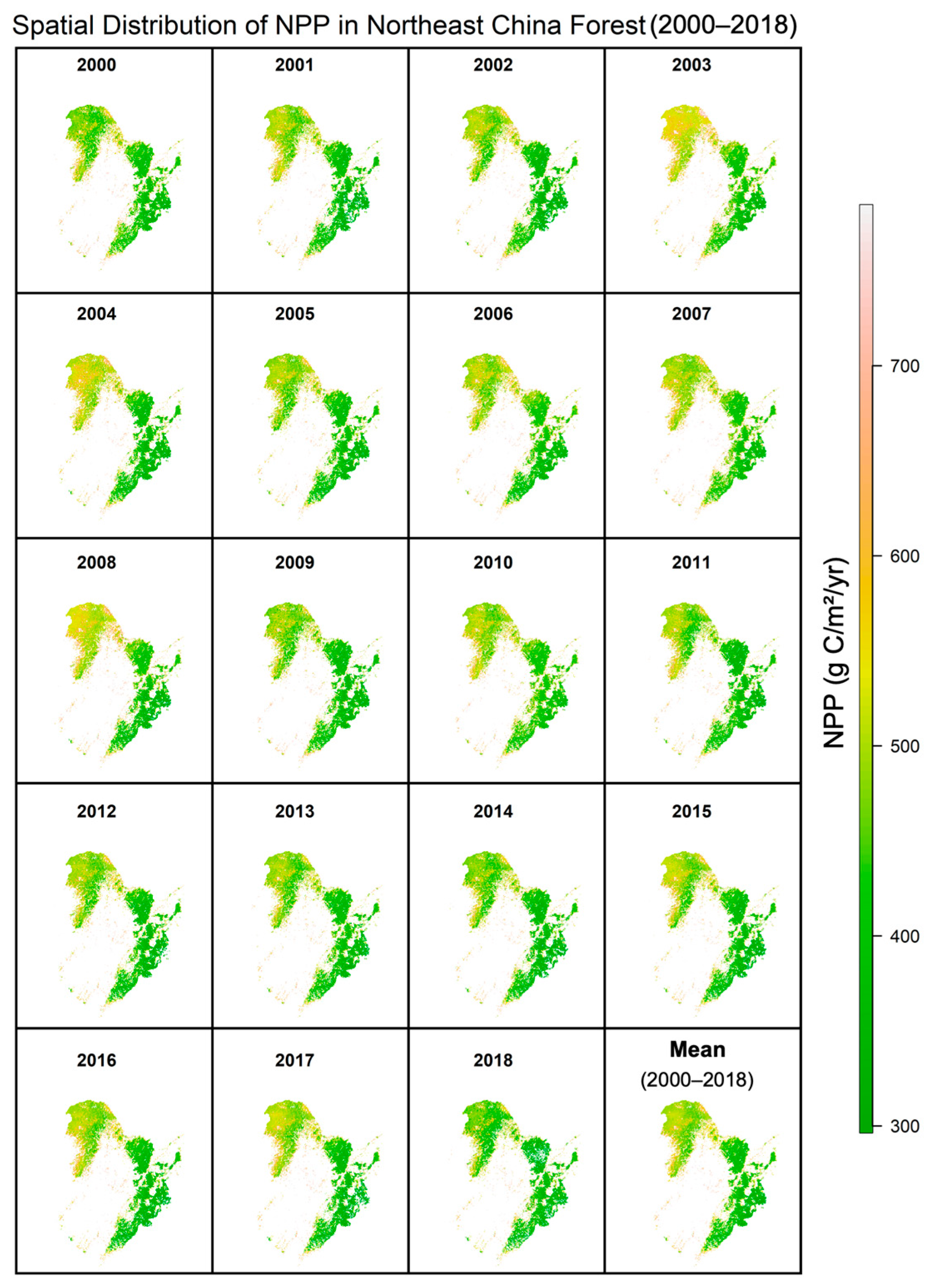
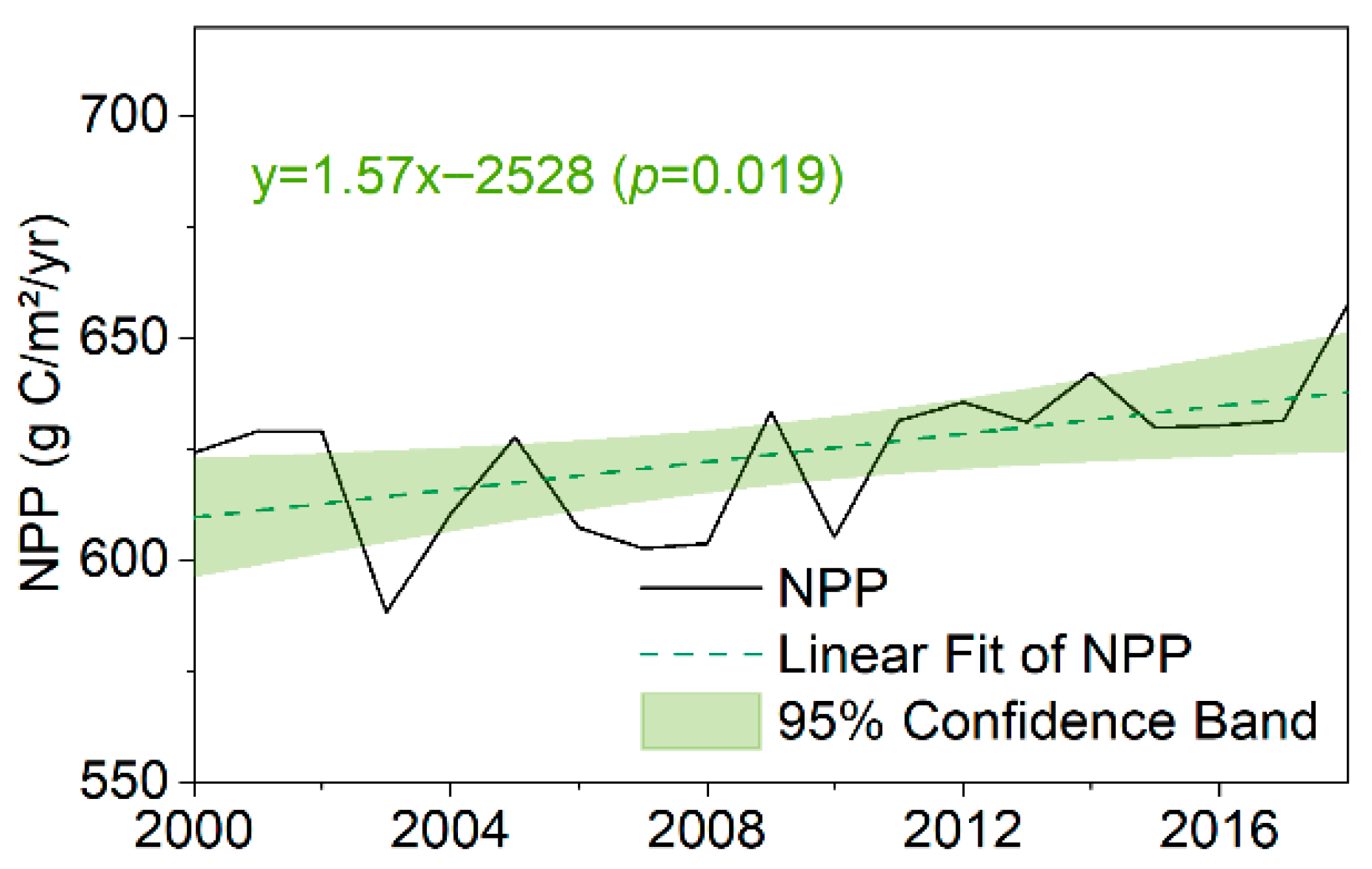
3.1. Spatiotemporal Patterns of NPP in Northeast China
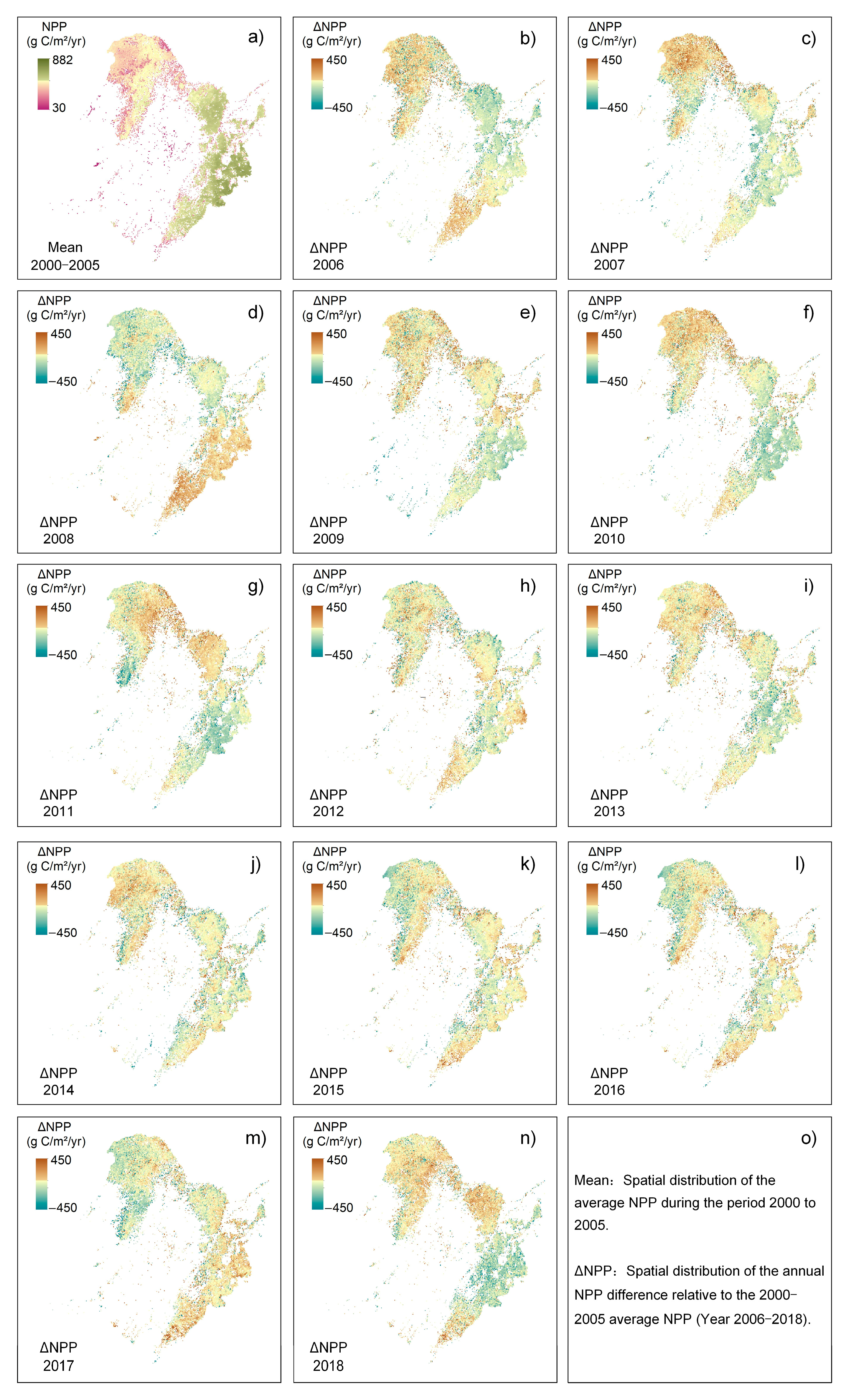
3.2. Spatial Dynamics of Forest ΔNPP in Northeast China (2000–2018)
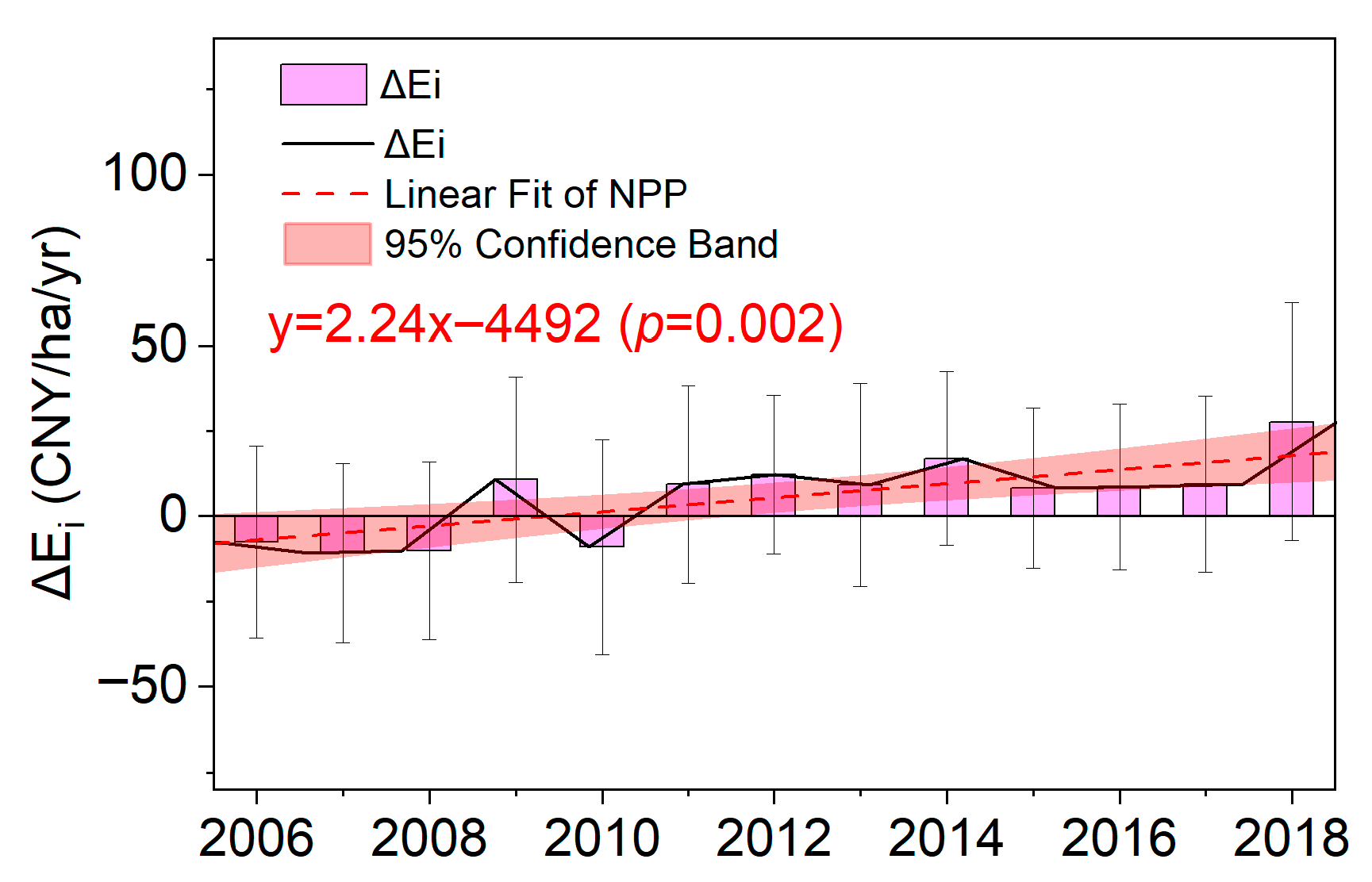
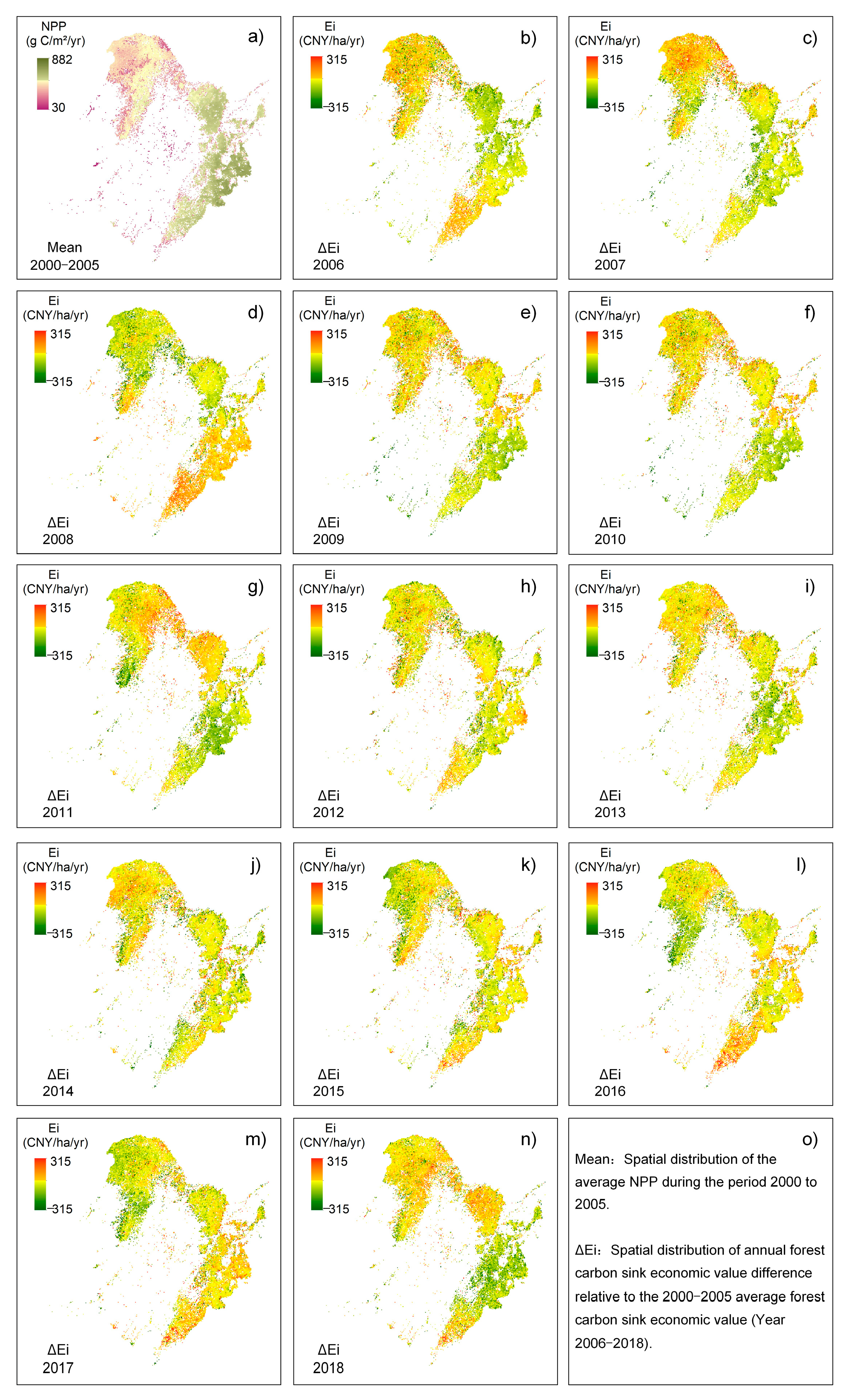
3.3. Spatial Dynamics of Forest Carbon Economic Value (ΔEi) in Northeast China (2000–2018)
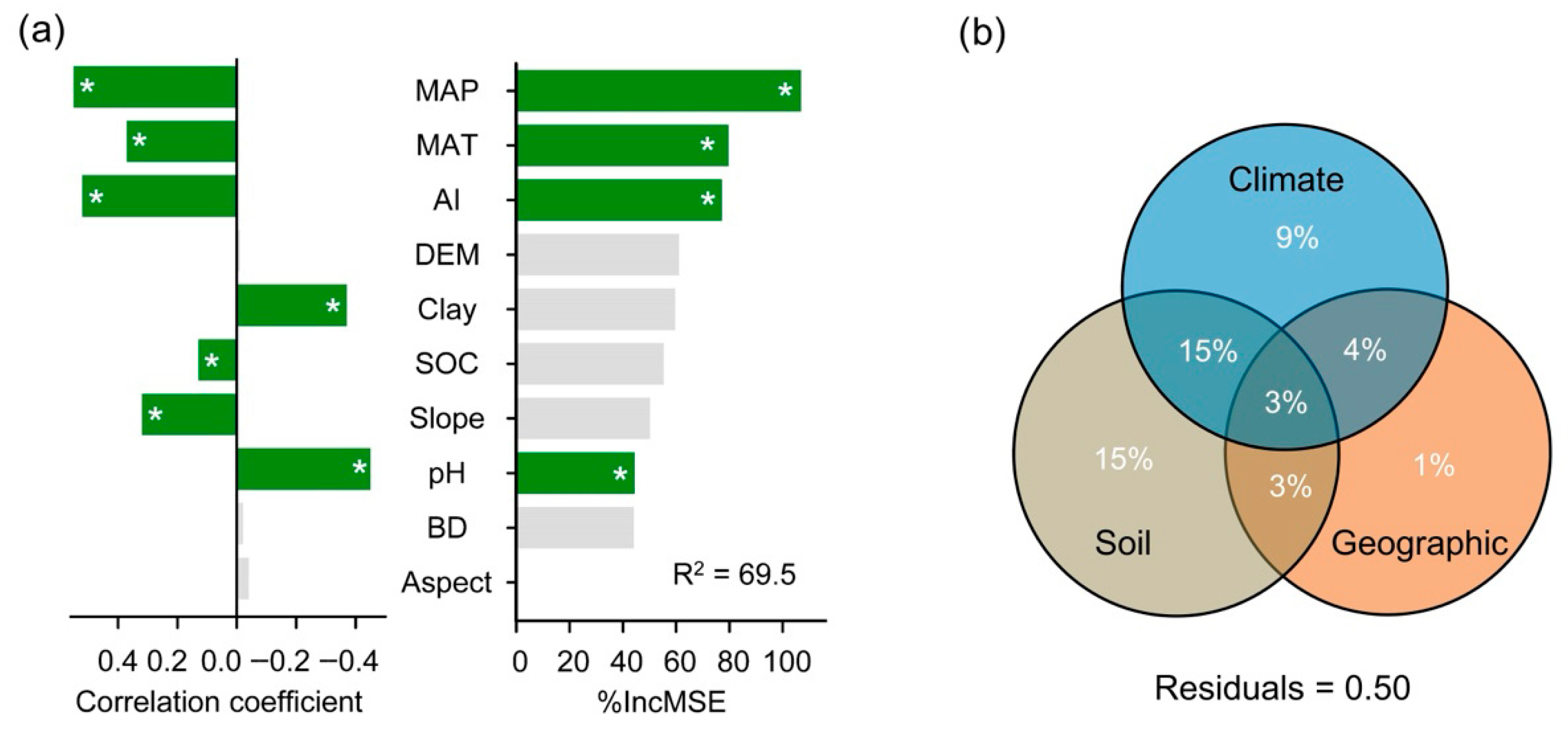
3.4. Environmental Drivers of the Spatial Dynamics of Forest Carbon Economic Value
4. Discussion
4.1. Spatiotemporal Linkage Between NPP and Carbon Economic Value: Coupling of Ecological Processes and Market Valuation
4.2. Drivers of Carbon Economic Value in the Study Region: Coordination Between Natural Resilience and Human Regulation
4.3. Limitations and Future Research Directions
5. Conclusions
Author Contributions
Funding
Data Availability Statement
Conflicts of Interest
Abbreviations
| GLASS | Global Land Surface Satellite |
| NPP | Net Primary Productivity |
| ESA CCI-LC | European Space Agency Climate Change Initiative Land Cover |
| ΔNPP | Change in Net Primary Productivity Relative to Baseline |
| ΔC | Change in Carbon Stock Relative to Baseline |
| ΔEi | Relative Carbon Economic Value |
| CEA | China Emissions Allowances (Carbon Price Parameter) |
| MAP | Mean Annual Precipitation |
| MAT | Mean Annual Temperature |
| AI | Aridity Index |
| DEM | Digital Elevation Model |
| SOC | Soil Organic Carbon |
References
- Xu, X.; Li, J.; Li, X.; Fang, C.; Li, B.; Nie, M. Thermal adaptation of respiration in terrestrial ecosystems alleviates carbon loss. Nat. Clim. Change 2025, 15, 873–879. [Google Scholar] [CrossRef]
- Bar-On, Y.M.; Li, X.; O’Sullivan, M.; Wigneron, J.-P.; Sitch, S.; Ciais, P.; Frankenberg, C.; Fischer, W.W. Recent gains in global terrestrial carbon stocks are mostly stored in nonliving pools. Science 2025, 387, 1291–1295. [Google Scholar] [CrossRef]
- Dass, P.; Houlton, B.Z.; Wang, Y.; Wårlind, D.; Morford, S. Bedrock weathering controls on terrestrial carbon-nitrogen-climate interactions. Glob. Biogeochem. Cycles 2021, 35, e2020GB006933. [Google Scholar] [CrossRef]
- Piao, S.; Wang, X.; Wang, K.; Li, X.; Bastos, A.; Canadell, J.G.; Ciais, P.; Friedlingstein, P.; Sitch, S. Interannual variation of terrestrial carbon cycle: Issues and perspectives. Glob. Change Biol. 2020, 26, 300–318. [Google Scholar] [CrossRef] [PubMed]
- Guan, X.; Yang, X.; Yu, Y.; Zhao, Y.; Wang, G. Improved optical phenology estimation contributes to more accurate simulation of forest carbon sink dynamics in Northeast China. Ecol. Indic. 2025, 178, 114122. [Google Scholar] [CrossRef]
- Zhu, J.; Zhang, Q.; Wang, A.; Yu, L.; Yu, D.; Zhang, Q.; Yan, Q.; Zheng, X.; Wang, B.; Zhou, Z. Suggestions for improving the qualities and functions of forest ecosystems in northeast China. Terr. Ecosyst. Conserv. 2022, 2, 41–48. [Google Scholar]
- Pan, Y.; Birdsey, R.A.; Phillips, O.L.; Houghton, R.A.; Fang, J.; Kauppi, P.E.; Keith, H.; Kurz, W.A.; Ito, A.; Lewis, S.L. The enduring world forest carbon sink. Nature 2024, 631, 563–569. [Google Scholar] [CrossRef]
- Liu, Y.; Jiao, L.; Zhang, J.; Li, X.; Zheng, H.; Sawasdchai, B.; Chen, Y.; Zhang, Y.; Gnanamoorthy, P.; Song, Q. Increase in carbon sink in a protected tropical seasonal rainforest in southwestern China over 20 years. Agric. For. Meteorol. 2025, 375, 110851. [Google Scholar] [CrossRef]
- Lian, X.; Piao, S.; Li, L.Z.; Li, Y.; Huntingford, C.; Ciais, P.; Cescatti, A.; Janssens, I.A.; Peñuelas, J.; Buermann, W. Summer soil drying exacerbated by earlier spring greening of northern vegetation. Sci. Adv. 2020, 6, eaax0255. [Google Scholar] [CrossRef]
- Piao, S.; Friedlingstein, P.; Ciais, P.; Viovy, N.; Demarty, J. Growing season extension and its impact on terrestrial carbon cycle in the Northern Hemisphere over the past 2 decades. Glob. Biogeochem. Cycles 2007, 21, GB3018. [Google Scholar] [CrossRef]
- Gao, Y.; Jia, J.; Lu, Y.; Yang, T.; Lyu, S.; Shi, K.; Zhou, F.; Yu, G. Determining dominating control mechanisms of inland water carbon cycling processes and associated gross primary productivity on regional and global scales. Earth-Sci. Rev. 2021, 213, 103497. [Google Scholar] [CrossRef]
- Wei, Y.; Zhou, W.; Yu, D.; Zhou, L.; Fang, X.; Zhao, W.; Bao, Y.; Meng, Y.; Dai, L. Carbon storage of forest vegetation under the Natural Forest Protection Program in Northeast China. Acta Ecol. Sin. 2014, 34, 5696–5705. [Google Scholar] [CrossRef]
- Liu, L.; Chen, C.; Zhao, Y.; Zhao, E. China׳ s carbon-emissions trading: Overview, challenges and future. Renew. Sustain. Energy Rev. 2015, 49, 254–266. [Google Scholar] [CrossRef]
- Torres, A.B.; Marchant, R.; Lovett, J.C.; Smart, J.C.; Tipper, R. Analysis of the carbon sequestration costs of afforestation and reforestation agroforestry practices and the use of cost curves to evaluate their potential for implementation of climate change mitigation. Ecol. Econ. 2010, 69, 469–477. [Google Scholar] [CrossRef]
- Nel, L.; Boeni, A.F.; Prohászka, V.J.; Szilágyi, A.; Tormáné Kovács, E.; Pásztor, L.; Centeri, C. InVEST soil carbon stock modelling of agricultural landscapes as an ecosystem service indicator. Sustainability 2022, 14, 9808. [Google Scholar] [CrossRef]
- Pache, R.-G.; Abrudan, I.V.; Niță, M.-D. Economic Valuation of Carbon Storage and Sequestration in Retezat National Park, Romania. Forests 2021, 12, 43. [Google Scholar] [CrossRef]
- Schmidt, M.W.I.; Torn, M.S.; Abiven, S.; Dittmar, T.; Guggenberger, G.; Janssens, I.A.; Kleber, M.; Kögel-Knabner, I.; Lehmann, J.; Manning, D.A.C.; et al. Persistence of soil organic matter as an ecosystem property. Nature 2011, 478, 49–56. [Google Scholar] [CrossRef] [PubMed]
- Yang, X.; Jin, X.; Yang, Y.; Xue, Q.; Liu, R.; Zhou, Y. Spatial and Temporal Explicit Analysis of Forestland of Northeast China in 1950–2020. Sci. Geogr. Sin. 2022, 42, 1996–2005. [Google Scholar]
- Pu, L. Impact of cropland use changes based on non-agriculturalization, non-grainization and abandonment on grain potential production in Northeast China. Sci. Rep. 2025, 15, 23596. [Google Scholar] [CrossRef]
- Liang, S.; Cheng, J.; Jia, K.; Jiang, B.; Liu, Q.; Xiao, Z.; Yao, Y.; Yuan, W.; Zhang, X.; Zhao, X. The global land surface satellite (GLASS) product suite. Bull. Am. Meteorol. Soc. 2021, 102, E323–E337. [Google Scholar] [CrossRef]
- Mousivand, A.; Arsanjani, J.J. Insights on the historical and emerging global land cover changes: The case of ESA-CCI-LC datasets. Appl. Geogr. 2019, 106, 82–92. [Google Scholar] [CrossRef]
- Li, W.; Ciais, P.; MacBean, N.; Peng, S.; Defourny, P.; Bontemps, S. Major forest changes and land cover transitions based on plant functional types derived from the ESA CCI Land Cover product. Int. J. Appl. Earth Obs. Geoinf. 2016, 47, 30–39. [Google Scholar] [CrossRef]
- Churkina, G.; Running, S.W.; Schloss, A.L.; ThE. Participants OF. ThE. Potsdam NpP. Model Intercomparison. Comparing global models of terrestrial net primary productivity (NPP): The importance of water availability. Glob. Change Biol. 1999, 5, 46–55. [Google Scholar] [CrossRef]
- Mathias, J.M.; Trugman, A.T. Climate change impacts plant carbon balance, increasing mean future carbon use efficiency but decreasing total forest extent at dry range edges. Ecol. Lett. 2022, 25, 498–508. [Google Scholar] [CrossRef]
- Noormets, A.; Bracho, R.; Ward, E.; Seiler, J.; Strahm, B.; Lin, W.; McElligott, K.; Domec, J.C.; Gonzalez-Benecke, C.; Jokela, E.J. Heterotrophic respiration and the divergence of productivity and carbon sequestration. Geophys. Res. Lett. 2021, 48, e2020GL092366. [Google Scholar] [CrossRef]
- Parton, W.J. The CENTURY model. In Proceedings of the Evaluation of Soil Organic Matter Models, Berlin/Heidelberg, Germany, 18 January 1996; Powlson, D.S., Smith, P., Smith, J.U., Eds.; Springer: Berlin/Heidelberg, Germany, 1996; pp. 283–291. [Google Scholar]
- Li, Z.; Ma, T.; Cai, Y.; Fei, T.; Zhai, C.; Qi, W.; Dong, S.; Gao, J.; Wang, X.; Wang, S. Stable or unstable? Landscape diversity and ecosystem stability across scales in the forest–grassland ecotone in northern China. Landsc. Ecol. 2023, 38, 3889–3902. [Google Scholar] [CrossRef]
- Fu, Z.; Ciais, P.; Prentice, I.C.; Gentine, P.; Makowski, D.; Bastos, A.; Luo, X.; Green, J.K.; Stoy, P.C.; Yang, H. Atmospheric dryness reduces photosynthesis along a large range of soil water deficits. Nat. Commun. 2022, 13, 989. [Google Scholar] [CrossRef]
- Moore, C.E.; Meacham-Hensold, K.; Lemonnier, P.; Slattery, R.A.; Benjamin, C.; Bernacchi, C.J.; Lawson, T.; Cavanagh, A.P. The effect of increasing temperature on crop photosynthesis: From enzymes to ecosystems. J. Exp. Bot. 2021, 72, 2822–2844. [Google Scholar] [CrossRef]
- Reich, P.B.; Sendall, K.M.; Stefanski, A.; Rich, R.L.; Hobbie, S.E.; Montgomery, R.A. Effects of climate warming on photosynthesis in boreal tree species depend on soil moisture. Nature 2018, 562, 263–267. [Google Scholar] [CrossRef] [PubMed]
- Yuan, D.; Cherubini, P.; Zhu, L.; Li, M.-H.; Huang, Y.; Wang, X.; von Arx, G. Coping with warming and drying climate: Xylem adjustment in four temperate diffuse-porous tree species in northeastern China. Agric. For. Meteorol. 2025, 372, 110657. [Google Scholar] [CrossRef]
- Liu, M.; Yin, Y.; Zhang, P.; Ma, X.; Mao, Y.; Dai, S. Water-energy characteristics of the warming and drying trends in the eastern China. J. Hydrol. 2025, 661, 133515. [Google Scholar] [CrossRef]
- Huang, M.; Piao, S.; Ciais, P.; Peñuelas, J.; Wang, X.; Keenan, T.F.; Peng, S.; Berry, J.A.; Wang, K.; Mao, J. Air temperature optima of vegetation productivity across global biomes. Nat. Ecol. Evol. 2019, 3, 772–779. [Google Scholar] [CrossRef] [PubMed]
- Gao, W.; Liang, M.; Xiang, W.; Fu, L.; Guo, H.; He, X.; Sharma, R.P.; Chen, Z.; Li, Y.; Zhou, M. Development stage-dependent effects of biodiversity on aboveground biomass of temperate forests. Ecography 2025, 2025, e07414. [Google Scholar] [CrossRef]
- Feng, Z.-H.; Zou, L.-L.; Wei, Y.-M. Carbon price volatility: Evidence from EU ETS. Appl. Energy 2011, 88, 590–598. [Google Scholar] [CrossRef]
- Bertrand, M.; Duflo, E.; Mullainathan, S. How much should we trust differences-in-differences estimates? Q. J. Econ. 2004, 119, 249–275. [Google Scholar] [CrossRef]
- Ma, T.; Zhou, Y.; Zhou, C.; Haynie, S.; Pei, T.; Xu, T. Night-time light derived estimation of spatio-temporal characteristics of urbanization dynamics using DMSP/OLS satellite data. Remote Sens. Environ. 2015, 158, 453–464. [Google Scholar] [CrossRef]
- Jay, S.; Potter, C.; Crabtree, R.; Genovese, V.; Weiss, D.J.; Kraft, M. Evaluation of modelled net primary production using MODIS and landsat satellite data fusion. Carbon Balance Manag. 2016, 11, 8. [Google Scholar] [CrossRef] [PubMed]
- Sandalow, D. China’s Response to Climate Change: A Study in Contrasts and a Policy at a Crossroads. 2020. Available online: https://asiasociety.org/sites/default/files/2020-10/Download%20the%20Paper%20%28English%29.pdf (accessed on 20 March 2025).




Disclaimer/Publisher’s Note: The statements, opinions and data contained in all publications are solely those of the individual author(s) and contributor(s) and not of MDPI and/or the editor(s). MDPI and/or the editor(s) disclaim responsibility for any injury to people or property resulting from any ideas, methods, instructions or products referred to in the content. |
© 2025 by the authors. Licensee MDPI, Basel, Switzerland. This article is an open access article distributed under the terms and conditions of the Creative Commons Attribution (CC BY) license.
Share and Cite
Song, J.; Lin, S.; Bao, H.; He, Y. Soil and Climate Controls on the Economic Value of Forest Carbon in Northeast China. Forests 2026, 17, 35. https://doi.org/10.3390/f17010035
Song J, Lin S, Bao H, He Y. Soil and Climate Controls on the Economic Value of Forest Carbon in Northeast China. Forests. 2026; 17(1):35. https://doi.org/10.3390/f17010035
Chicago/Turabian StyleSong, Jingwei, Song Lin, Haisen Bao, and Youjun He. 2026. "Soil and Climate Controls on the Economic Value of Forest Carbon in Northeast China" Forests 17, no. 1: 35. https://doi.org/10.3390/f17010035
APA StyleSong, J., Lin, S., Bao, H., & He, Y. (2026). Soil and Climate Controls on the Economic Value of Forest Carbon in Northeast China. Forests, 17(1), 35. https://doi.org/10.3390/f17010035