Effects of Companion Tree Species on Soil Fertility, Enzyme Activities, and Organic Carbon Components in Eucalyptus Mixed Plantations in Southern China


Abstract
1. Introduction
- 1.
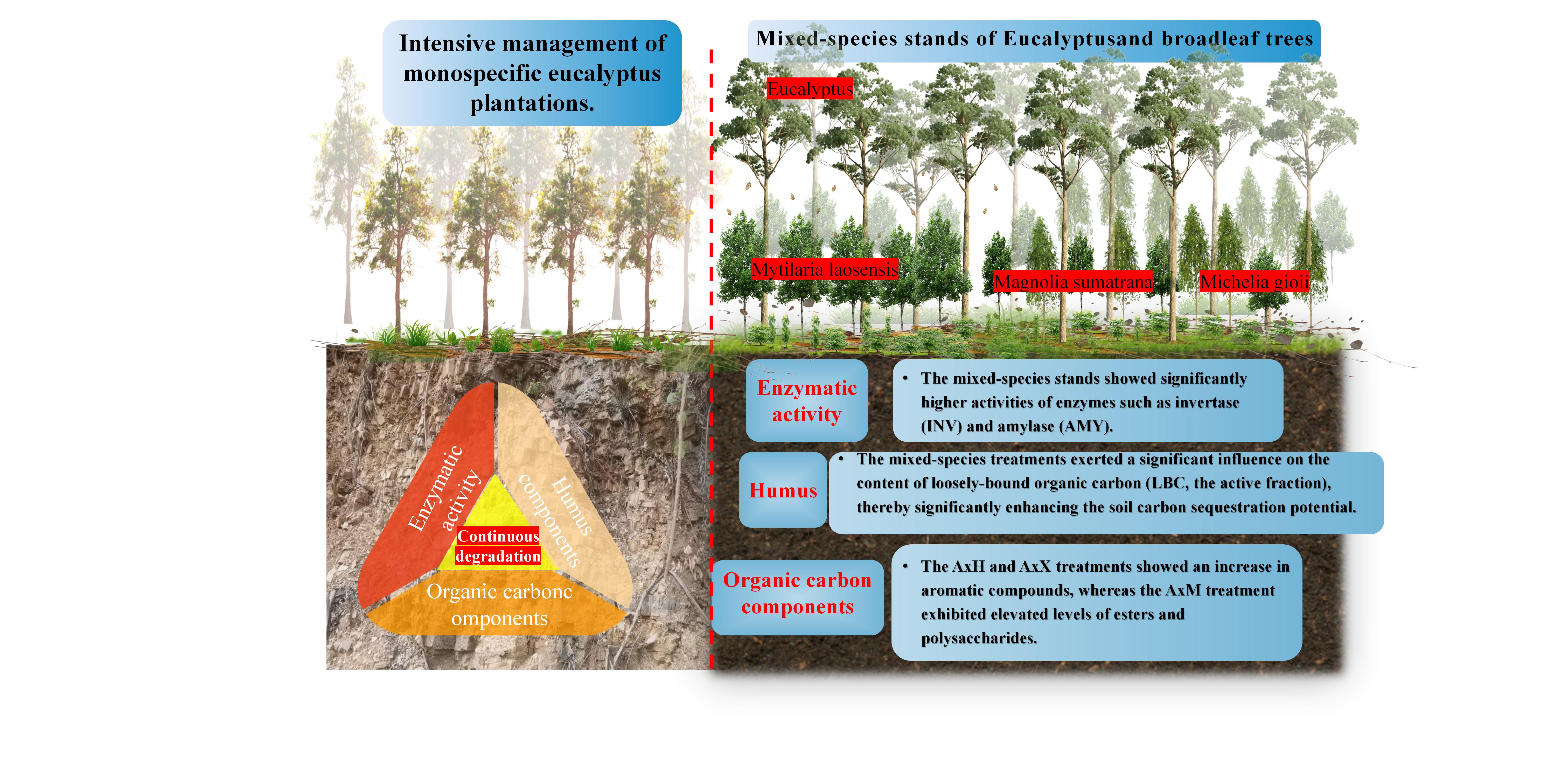
- To quantify the effects of different mixed forest ecosystems on key soil properties, including fertility indices (e.g., OM, TN, TP, AP), enzyme activities (e.g., INV, AMY, URE, ACP), and humus components (LOC, IOC, ROC);
- 2.
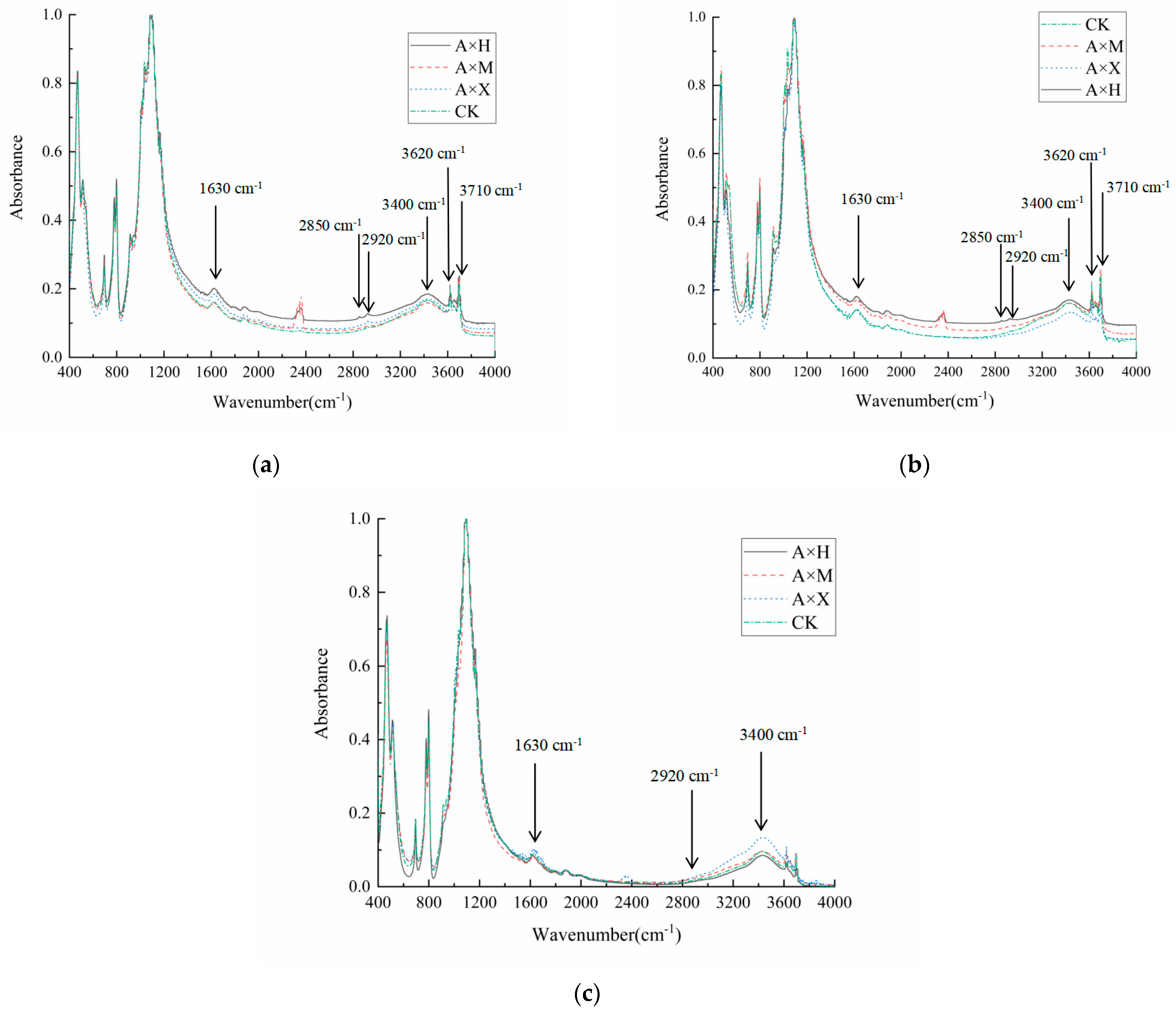
- To characterize the molecular-level organic chemical characteristics of rhizosphere soils from different mixed forest ecosystems using Fourier-Transform Infrared Spectroscopy (FTIR) and analyze the specific alterations induced by companion tree species;
- 3.
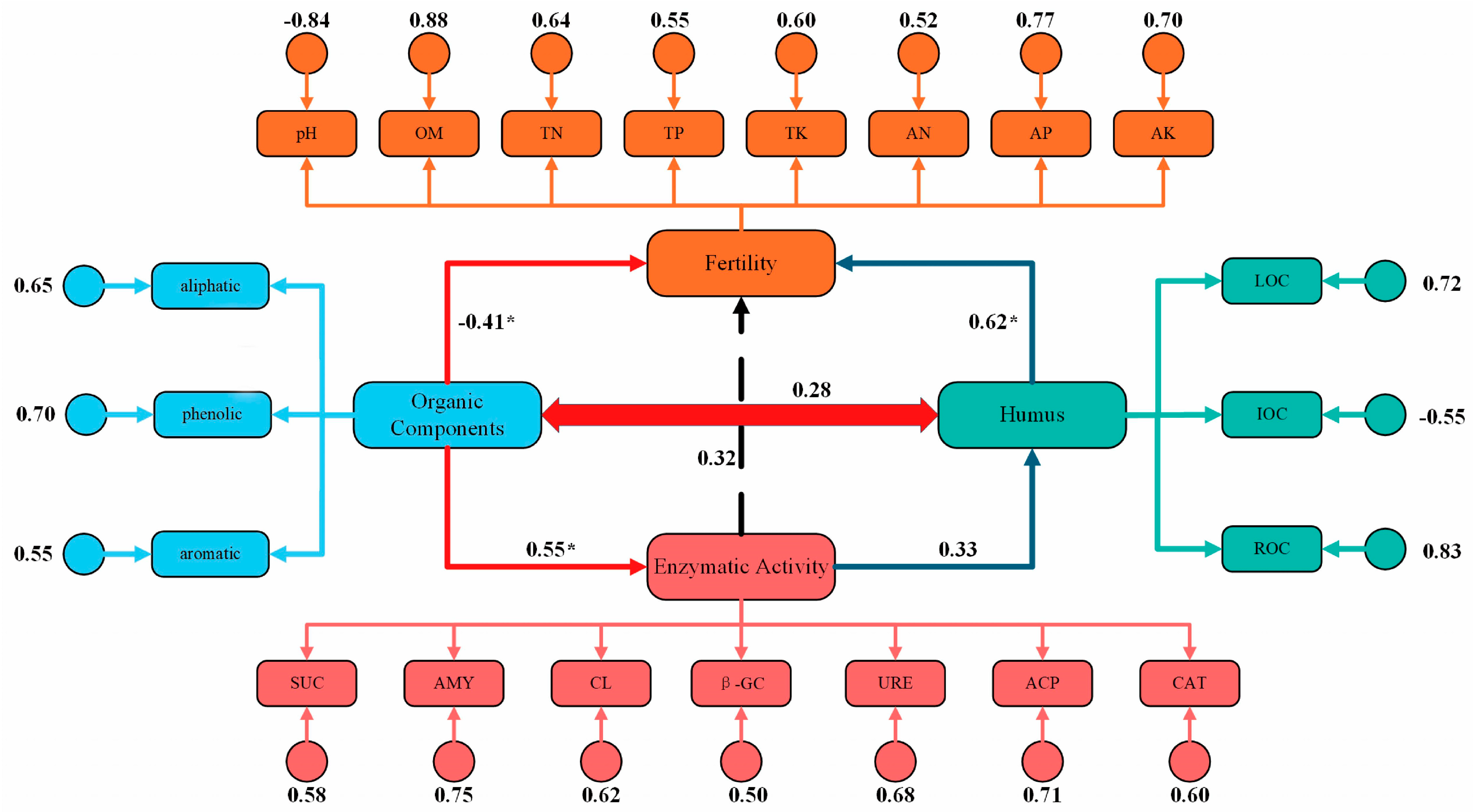
- To explore the causal relationships between organic functional groups (based on FTIR), enzyme activities, humus components, and soil fertility by constructing and evaluating a Structural Equation Model (SEM), thereby identifying the key pathways through which companion tree species influence soil functionality.
2. Materials and Methods
2.1. Study Area
2.2. Experimental Design
2.3. Analysis of Soil Chemical Properties
2.4. Fourier-Transform Infrared Spectroscopy Analysis
2.5. Structural Equation Modeling
2.6. Data Analysis and Processing
3. Results
3.1. Primary Chemical Properties of Soil
3.2. Soil Microelements
3.3. Soil Enzyme Activity
3.4. Soil Humus Components
3.5. Soil Infrared Spectral Characteristics of Different Mixed Forest Types
3.6. Peak Area Integration
3.7. Structural Equation Modeling
4. Discussion
4.1. Differential Effects of Companion Tree Species on Soil Fertility Indicators
4.2. Functional Differentiation of Companion Tree Species in Soil Enzyme Activities and Effects on Humic Components
4.3. Driving Factors and Action Pathways of Companion Tree Species in Soil Fertility Formation
- Chelating reactions with soil inorganic nitrogen sources (e.g., ammonium nitrogen, nitrate nitrogen) to form organic nitrogen compounds that are difficult for plants to directly absorb, temporarily reducing available soil nutrients [48];
- The potential biotoxicity of phenolic compounds may inhibit certain microbial activities at specific concentrations, thereby slowing nutrient mineralization rates.
5. Conclusions
- Compared with pure Eucalyptus stands (CK), both A × M and A × H treatments significantly enhanced topsoil fertility and stable carbon pool formation. The A × H treatment exhibited the highest levels of key nutrients (OM, TN, TP) in the 0–20 cm soil profile. Concurrently, the A × M treatment demonstrated a significant capacity to promote ROC accumulation, indicating greater potential for long-term carbon sequestration and stable soil structure formation. FTIR analysis further confirmed that mixed forests altered the chemical composition of soil organic matter, increasing the content of aromatic compounds associated with more complex and decomposition-resistant organic substances.
- The improvement in mixed-forest soil fertility is not a direct process but mediated through a complex “organic input–microbial enzyme response–humus formation” pathway. This study utilized SEM analysis to quantify key mechanisms: alterations in organic components (predominantly phenolic compounds) directly and significantly stimulated microbial enzyme activity (0.55). Although the direct pathway from enzyme activity to humus was not significant, humus accumulation exerted a significant positive effect on overall soil fertility (0.62). The direct negative effect of organic components on fertility (−0.41*) suggests that the initial biochemical properties of litter (e.g., high phenolic content) may temporarily sequester nutrients or exhibit mild allelopathic effects, creating a short-term trade-off between litter input and immediate nutrient availability.
Author Contributions
Funding
Data Availability Statement
Acknowledgments
Conflicts of Interest
Abbreviations
| pH | pH value |
| OM | Organic matter |
| TN | Total nitrogen |
| TP | Total phosphorus |
| TK | Total potassium |
| AK | Available potassium |
| AP | Available phosphorus |
| Ca | Calcium |
| Mg | Magnesium |
| Cu | Copper |
| Zn | Zinc |
| B | Boron |
| Fe | Iron |
| Mn | Manganese |
| INV | Invertase |
| AMY | Amylase |
| CEL | Cellulase |
| -ß-GLU | ß-D-Glucosidase |
| URE | Urease |
| ACP | Acid phosphatase |
| PPO | Polyphenol oxidase |
References
- Qin, Z.; Nie, Y.; Ming, A.; Yang, K.; Min, H.; Wei, H.; Shen, W. Tree species mixing promotes surface soil organic carbon accumulation in mid-age and stability in old-growth forests. Plant Soil 2024, 512, 711–730. [Google Scholar] [CrossRef]
- Shu, C.; Shen, Y.; Liu, G.; Zhang, Q.; Xu, J.; Guo, Z. Impacts of Eucalyptus plantation on soil and water losses in a typical small watershed in mountainous area of southern China. Chin. J. Appl. Ecol. 2023, 34, 1015–1023. [Google Scholar]
- Wang, J.; Deng, Y.; Li, D.; Liu, Z.; Wen, L.; Huang, Z.; Jiang, D.; Lu, Y. Soil aggregate stability and its response to overland flow in successive Eucalyptus plantations in subtropical China. Sci. Total Environ. 2022, 807, 151000. [Google Scholar] [CrossRef]
- Liu, S.J.; He, J.Y.; Huang, C.; Li, Y.S.; Luo, X.Y.; Deng, Y.B.; Xu, Y.S.; Lin, J.; Wang, H.L. Effects of Continuous Eucalyptus Plantation on Understory Vegetation Diversity and Soil Fertility. Eucalyptus Sci. Technol. 2024, 41, 24–30. [Google Scholar]
- Zhu, L.; Wang, X.; Chen, F.; Li, C.; Wu, L. Effects of the successive planting of Eucalyptus urophylla on the soil bacterial and fungal community structure, diversity, microbial biomass, and enzyme activity. Land Degrad. Dev. 2019, 30, 636–646. [Google Scholar] [CrossRef]
- You, H.; Tao, X.; Mingquan, Z.; Deng, Y.; Yang, G.; Ban, Y.; Lei, T.; Yu, X.; Huang, Y. Influence of soil properties and near-surface roots on soil infiltration process in short-rotation eucalyptus plantations in southern subtropical China. Catena 2024, 234, 107606. [Google Scholar] [CrossRef]
- Hua, Y.R.; Yu, L.K.; Jing, L.J.; Yan, H.; Zhong, L.; Lin, H.; Dong, L. Erysiphe elevata causing powdery mildew on Eucalyptus urophylla × E. camaldulensis in China. Plant Dis. 2023, 107, 3305. [Google Scholar] [CrossRef]
- Tan, X.P.; Tang, X.; Guo, H.B.; He, J.H.; Wang, W.R.; Wang, S.H.; Nie, Y.X.; Zhang, W.; Ye, Q.; Shen, W.J. Current Status and Sustainable Management Strategies of Plantations in South China. J. Terr. Ecosyst. Conserv. 2022, 2, 102–108. [Google Scholar]
- Santos, F.M.; Chaer, G.M.; Diniz, A.R.; Balieiro, F.C. Nutrient cycling over five years of mixed-species plantations of Eucalyptus and Acacia on a sandy tropical soil. For. Ecol. Manag. 2017, 384, 110–121. [Google Scholar] [CrossRef]
- Lucas-Borja, M.E. Tools for Soil Management and Restoration: Strategies, Practices and Future Challenges; Nova Science Publishers, Inc.: Hauppauge, NY, USA, 2019; pp. 8–28. [Google Scholar]
- Gabriel, J.L.; Quemada, M. Replacing bare fallow with cover crops in a maize cropping system: Yield, N uptake and fertiliser fate. Eur. J. Agron. 2010, 34, 133–143. [Google Scholar] [CrossRef]
- Wang, J.Y.; Deng, Y.S.; Lin, L.W.; Huang, J.; Jiang, D.H.; Huang, Z.G. Hydrological Effects of Litter in Five Typical Plantations in the Southern Subtropics. J. Soil Water Conserv. 2020, 34, 169–175. [Google Scholar]
- Li, J.; Huang, H.; You, Y.; Xiang, M.; Li, C.; Ming, A.; Ma, H.; Huang, X. N 2-Fixing Tree Species Help to Alleviate C- and P-Limitation in Both Rhizosphere and Non-Rhizosphere Soils in the Eucalyptus Plantations of Subtropical China. Forests 2023, 14, 2070. [Google Scholar] [CrossRef]
- Bouillet, J.-P.; Laclau, J.-P.; de Moraes Gonçalves, J.L.; Voigtlaender, M.; Gava, J.; Leite, F.; Hakamada, R.; Mareschal, L.; Mabiala, A.; Tardy, F.; et al. Eucalyptus and Acacia tree growth over entire rotation in single- and mixed-species plantations across five sites in Brazil and Congo. For. Ecol. Manag. 2013, 301, 89–101. [Google Scholar] [CrossRef]
- Qin, F.; Yang, F.; Ming, A.; Jia, H.; Zhuo, B.; Xiong, J.; Lu, J. Mixture enhances microbial network complexity of soil carbon, nitrogen and phosphorus cycling in Eucalyptus plantations. For. Ecol. Manag. 2024, 553, 121632. [Google Scholar] [CrossRef]
- Wu, F.; Wei, Q.; Yang, M.; Deng, R.; Liu, S. Analysis of chemical components in two tree species of magnoliaceae, Magnolia sumatrana var. glauca (Blume) Figlar & Noot and Magnolia hypolampra (Dandy) Figlar. Nat. Prod. Res. 2021, 37, 328–332. [Google Scholar] [CrossRef]
- Tang, J.; Zhao, J.; Qin, Z.; Chen, L.; Song, X.; Ke, Q.; Wu, L.; Shi, Y. Structural equation model was used to evaluate the effects of soil chemical environment, fertility and enzyme activity on eucalyptus biomass. R. Soc. Open Sci. 2023, 10, 221570. [Google Scholar] [CrossRef]
- Yao, X.; Li, Y.; Liao, L.; Sun, G.; Wang, H.; Ye, S. Enhancement of nutrient absorption and interspecific nitrogen transfer in a Eucalyptus urophylla × Eucalyptus grandis and Dalbergia odorifera mixed plantation. For. Ecol. Manag. 2019, 449, 117465. [Google Scholar] [CrossRef]
- Pereira, A.P.A.; Durrer, A.; Gumiere, T.; Gonçalves, J.L.M.; Robin, A.; Bouillet, J.; Wang, J.; Verma, J.; Singh, B.K.; Cardoso, E. Mixed Eucalyptus plantations induce changes in microbial communities and increase biological functions in the soil and litter layers. For. Ecol. Manag. 2019, 433, 332–342. [Google Scholar] [CrossRef]
- Orly, M.; Stefaan, D.N.; Heleen, D.; Li, H.; Steven, S. Do interactions between application rate and native soil organic matter content determine the degradation of exogenous organic carbon? Soil Biol. Biochem. 2022, 164, 108473. [Google Scholar] [CrossRef]
- Sun, R.F.; Han, G.X. Effects of simulated warming on content, fractions and chemical structure of soil organic carbon: Progress and prospects. Chin. J. Appl. Ecol. 2024, 35, 2432–2444. [Google Scholar] [CrossRef]
- Shrestha, B.M.; Certini, G.; Forte, C.; Singh, B.R. Soil Organic Matter Quality under Different Land Uses in a Mountain Watershed of Nepal. Soil Sci. Soc. Am. J. 2008, 72, 1563–1569. [Google Scholar] [CrossRef]
- Xing, Z.; Du, C.; Tian, K.; Ma, F.; Shen, Y.; Zhou, J. Application of FTIR-PAS and Raman spectroscopies for the determination of organic matter in farmland soils. Talanta 2016, 158, 262–269. [Google Scholar] [CrossRef] [PubMed]
- He, S.; Zheng, Z.; Zhu, R. Long-term tea plantation effects on composition and stabilization of soil organic matter in Southwest China. Catena 2021, 199, 105132. [Google Scholar] [CrossRef]
- Lorenz, K.; Lal, R.; Jiménez, J.J. Soil organic carbon stabilization in dry tropical forests of Costa Rica. Geoderma 2009, 152, 95–103. [Google Scholar] [CrossRef]
- Gao, B.; Zhou, H.D.; Jin, J.; Sun, K. Characterization of Different Forms of Organic Matter in Soils and Sediments. Spectrosc. Spectr. Anal. 2013, 33, 1194–1197. [Google Scholar]
- Wang, Q.C.; Ji, H.K.; Li, S.M.; Li, C.S.; Hou, Z.W.; Deng, W.G.; Wu, Z.P.; Wang, D.F. Molecular Characteristics and Interface Transformation Mechanism of Dissolved Black Carbon in Soil-Stream Continuum of Dongzhagang Watershed, Hainan. Ecol. Environ. Sci. 2023, 32, 139–149. [Google Scholar]
- Chen, L.M.; Wu, Y.Y.; Li, C.S.; Wu, Z.P.; Huang, C.; Ji, H.K.; Hou, Z.W.; Fu, C.L.; Zhao, Y.D.; Wu, W.D. Response of Molecular Characteristics of Soil Dissolved Organic Matter to Decomposition of Organic Fertilizers from Different Sources. Acta Pedol. Sin. 2023, 60, 1101–1112. [Google Scholar]
- Zhang, X.; Dou, S.; Ndzelu, B.S.; Zhang, Y.; Xin, L. Accumulation of straw-derived carbon and changes in soil humic acid structural characteristics during corn straw decomposition. Can. J. Soil Sci. 2021, 101, 452–465. [Google Scholar] [CrossRef]
- Enrica, P.; Daniela, B.; Francesco, I.; Alessio, L.; Flavia, D.N. Soil organic matter stability and microbial community in relation to different plant cover: A focus on forests characterizing Mediterranean area. Appl. Soil Ecol. 2021, 162, 103897. [Google Scholar] [CrossRef]
- Eisenhauer, N.; Bowker, M.A.; Grace, J.B.; Powell, J.R. From patterns to causal understanding: Structural equation modeling (SEM) in soil ecology. Pedobiologia 2015, 58, 65–72. [Google Scholar] [CrossRef]
- Tan, Y.; Wang, Z. Research on influencing factors of soybean yield in China’s northeast black soil region based on PLS-SEM. Front. Sustain. Food Syst. 2024, 8, 12. [Google Scholar] [CrossRef]
- Wen, D.; Jiang, N.; Liu, C.; Lv, Z. Study of the Influence of Temperature Rise on the Microstructure of Frozen Soil Based on SEM and MIP. J. Mater. Civ. Eng. 2023, 35, 8. [Google Scholar] [CrossRef]
- Hu, W.; Chen, J.; Liu, M.; Tian, X.; Chen, X.; Lin, W.; Pan, L. Mixing with Schima Superba Enhanced Soil Fertility and Simplified Soil Microbial Community of Eucalyptus Urophylla Forests. J. Soil Sci. Plant Nutr. 2024, 24, 5972–5987. [Google Scholar] [CrossRef]
- Xu, Y.; Ren, S.; Liang, Y.; Du, A.; Li, C.; Wang, Z.; Wu, L. Soil nutrient supply and tree species drive changes in soil microbial communities during the transformation of a multi-generation Eucalyptus plantation. Appl. Soil Ecol. 2021, 166, 103991. [Google Scholar] [CrossRef]
- Wang, H.-J.; Qin, L.-N.; Li, M.-Z.; Wang, X.-Y. Further Study on Chemical Constituents from the Seeds of Michelia hedyosperma. Chem. Nat. Compd. 2022, 58, 75–77. [Google Scholar] [CrossRef]
- Zhao, Y.; Han, Z.; Zhang, G.; Chen, D.; Zang, L.; Liu, Q.; He, Y. Variability of soil enzyme activities and nutrients with forest gap renewal interacting with soil depths in degraded karst forests. Ecol. Indic. 2024, 166, 112332. [Google Scholar] [CrossRef]
- Bier, R.L.; Daniels, M.; Oviedo-Vargas, D.; Peipoch, M.; Price, J.R.; Omondi, E.; Kan, J. Agricultural soil microbiomes differentiate in soil profiles with fertility source, tillage, and cover crops. Agric. Ecosyst. Environ. 2024, 368, 109002. [Google Scholar] [CrossRef]
- Pang, Z.H.; Chen, Z.F.; Chen, X.L.; Huang, K.T.; Zhou, J. Research Progress on Mytilaria laosensis in China. Guangxi For. Sci. 2022, 51, 573–582. [Google Scholar]
- Hou, J.; Yu, C.; Ye, M.; Guo, Z.; Xin, Y.; Meng, F.; Li, M. Short-term hydrothermal fermentation amendments enhance labile organic carbon in deep soil: Synergistic effects of organic carbon, enzymes, and microbes. Environ. Technol. Innov. 2025, 40, 104348. [Google Scholar] [CrossRef]
- He, Z.; Shang, X.; Jin, X. Effect of Calcium Addition on Extracellular Enzymes and Soil Organic Carbon in Maize Rhizosphere Soils. Agronomy 2025, 15, 1680. [Google Scholar] [CrossRef]
- Xu, Q.; Fu, Y.; Zhang, J.; Xu, C.; Yang, C.; Yuan, Q.; Xiao, C. Soil microorganism colonization influenced the growth and secondary metabolite accumulation of Bletilla striata (Thunb.) Rchb. F. BMC Microbiol. 2025, 25, 276. [Google Scholar] [CrossRef] [PubMed]
- Lu, X.; Guo, Y.; Yao, X.; Ye, S.; Wang, S. Mixed with Broadleaf Tree Species Changes Soil Microbial Stoichiometric Characteristics in Chinese Fir Plantations: Insights at the Aggregate Scale. J. Soil Sci. Plant Nutr. 2025, 25, 3676–3689. [Google Scholar] [CrossRef]
- Solomon, W.; Mutum, L.; Janda, T.; Molnar, Z. Microalgae-bacteria interaction: A catalyst to improve maize (Zea mays L.) growth and soil fertility. Cereal Res. Commun. 2024, 53, 1037–1049. [Google Scholar] [CrossRef]
- Askarov, A.A.; Stovba, E.V.; Askarova, A.A. Ecological and economic evaluation of using arable land in the Republic of Bashkortostan. IOP Conf. Ser. Earth Environ. Sci. 2019, 274, 012095. [Google Scholar] [CrossRef]
- Wang, H.G.; Zhang, J.; Yang, W.S.; Feng, M.S. Study on Allelopathic Substances in Roots and Rhizosphere Soil of Eucalyptus grandis. J. Sichuan Norm. Univ. (Nat. Sci. Ed.) 2006, 29, 368–371. [Google Scholar]
- Zhang, P.J.; Xu, J.M.; Lu, W.H.; Pan, S.M.; Chen, M.X.; Li, K.S.; Shang, X.H. Analysis of Plant Diversity and Soil Physicochemical Properties in Eucalyptus urophylla × E. tereticornis Plantations with Different Stand Ages in Leizhou Peninsula. J. Cent. South Univ. For. Technol. 2021, 96–105. [Google Scholar]
- Ding, Z.; Gong, L.; Zhu, H.; Tang, J.; Li, X.; Zhang, H. Changes in Soil Microbial Communities under Mixed Organic and Inorganic Nitrogen Addition in Temperate Forests. Forests 2022, 14, 21. [Google Scholar] [CrossRef]



| Forest Type | Depth | N | pH | OM/(g·kg−1) | TN/(g·kg−1) | TP/(g·kg−1) | TK/(g·kg−1) | AN/(mg·kg−1) | AP/(mg·kg−1) | AK/(mg·kg−1) |
|---|---|---|---|---|---|---|---|---|---|---|
| A × H | 0–20 cm | 3 | 3.67 ± 0.08 aA | 46.61 ± 13.42 bA | 3.51 ± 0.71 aA | 1.16 ± 1.05 aA | 8.62 ± 3.83 bA | 228.1 ± 56.49 aA | 9.5 ± 4.36 bA | 65.23 ± 15.77 aA |
| 20–40 cm | 3 | 4.15 ± 0.07 aA | 17.95 ± 4.33 bB | 1.45 ± 0.14 aB | 0.67 ± 0.36 aA | 4.48 ± 1.27 bAB | 114.76 ± 20.81 aB | 3.86 ± 0.94 bB | 30.1 ± 4.22 aA | |
| 40–60 cm | 3 | 4.22 ± 0.17 aA | 19.56 ± 3.47 bB | 1.11 ± 0.94 aB | 1.06 ± 0.19 aA | 6.97 ± 1.17 bB | 72.8 ± 18.52 aC | 3.6 ± 1.35 bB | 23.98 ± 9.98 aA | |
| A × M | 0–20 cm | 3 | 3.82 ± 0.12 aA | 39.93 ± 9.64 abA | 2.88 ± 0.53 aA | 1.03 ± 0.36 aA | 12.58 ± 0.59 aA | 166.2 ± 34.02 aA | 6.93 ± 0.72 abA | 49.76 ± 10.05 abA |
| 20–40 cm | 3 | 3.83 ± 0.16 aA | 20.71 ± 6.57 abB | 2.05 ± 0.27 aB | 0.49 ± 0.19 aA | 10.84 ± 2.01 aAB | 140.01 ± 6.22 aB | 3.66 ± 2.41 abB | 50.56 ± 8.09 abA | |
| 40–60 cm | 3 | 4.04 ± 0.11 aA | 25.21 ± 8.41 abB | 1.27 ± 0.39 aB | 1.03 ± 0.11 aA | 3.72 ± 2.68 aB | 82.8 ± 28.54 aC | 5.97 ± 1.39 abB | 29.26 ± 5.28 abA | |
| A × X | 0–20 cm | 3 | 3.84 ± 0.03 aA | 40.06 ± 17.56 aA | 2.79 ± 0.66 aA | 0.84 ± 0.41 aA | 4.48 ± 1.02 aA | 225.7 ± 74.65 aA | 14.56 ± 12.26 aA | 57.4 ± 19.24 bA |
| 20–40 cm | 3 | 3.95 ± 0.13 aA | 24.85 ± 5.21 aB | 1.82 ± 0.25 aB | 0.79 ± 0.48 aA | 4.79 ± 0.46 aAB | 114.8 ± 18.87 aB | 6.23 ± 2.32 aB | 38.66 ± 4.81 bA | |
| 40–60 cm | 3 | 3.94 ± 0.15 aA | 35.97 ± 3.15 aB | 1.62 ± 0.63 aB | 0.61 ± 0.39 aA | 5.5 ± 1.05 aB | 110.6 ± 44.82 aC | 6.6 ± 1.96 aB | 36.19 ± 2.97 bA | |
| CK | 0–20 cm | 3 | 3.83 ± 0.03 aA | 28.23 ± 4.18 abA | 2.52 ± 0.1 aA | 0.32 ± 0.02 bA | 10.75 ± 2.12 aA | 172 ± 16.92 aA | 3.1 ± 1.55 bA | 61.8 ± 5.41 abA |
| 20–40 cm | 3 | 3.99 ± 0.09 aA | 22.26 ± 3.56 abB | 1.71 ± 0.45 aB | 0.71 ± 0.11 bA | 4.50 ± 0.25 aAB | 148.4 ± 35.38 aB | 5.56 ± 1.34 bB | 33.86 ± 6.95 abA | |
| 40–60 cm | 3 | 4.00 ± 0.02 aA | 24.03 ± 2.17 abB | 1.14 ± 0.63 aB | 0.57 ± 0.33 bA | 4.47 ± 0.84 aB | 84.77 ± 18.96 aC | 4.8 ± 0.92 bB | 23.98 ± 10.03 abA | |
| Two-way ANOVA | Forest type | F = 1.748 | F = 4.001 | F = 1.081 | F = 8.314 | F = 16.407 | F = 2.127 | F = 5.07 | F = 4.068 | |
| p = 0.184 | p < 0.05 | p = 0.376 | p < 0.05 | p < 0.05 | p = 0.123 | p < 0.05 | p < 0.05 | |||
| Depth | F = 0.199 | F = 33.071 | F = 14.482 | F = 0.128 | F = 3.721 | F = 22.248 | F = 9.527 | F = 1.556 | ||
| p = 0.821 | p < 0.05 | p < 0.05 | p = 0.881 | p < 0.05 | p < 0.05 | p < 0.05 | p = 0.232 | |||
| Interaction | F = 0.998 | F = 9.99 | F = 1.174 | F = 0.366 | F = 10.523 | F = 1.421 | F = 0.602 | F = 0.12 | ||
| p = 0.449 | p < 0.05 | p = 0.353 | p = 0.893 | p < 0.05 | p = 0.247 | p = 0.726 | p = 0.993 |
| Forest Type | Depth | N | Ca (mg·kg−1) | Mg (mg·kg−1) | Cu (mg·kg−1) | Zn (mg·kg−1) | B (mg·kg−1) | Fe (mg·kg−1) | Mn (mg·kg−1) |
|---|---|---|---|---|---|---|---|---|---|
| A × H | 0–20 cm | 3 | 101.86 ± 31.71 aA | 9.72 ± 4.98 aA | 1.15 ± 0.04 aA | 0.93 ± 0.34 aA | 0.30 ± 0.06 aA | 62.57 ± 28.68 aA | 9.69 ± 3.01 aA |
| 20–40 cm | 3 | 82.72 ± 11.54 aA | 6.9 ± 0.59 aA | 1.19 ± 0.47 aA | 0.96 ± 0.17 aA | 0.28 ± 0.02 aA | 47.49 ± 2.11 aA | 0.86 ± 0.53 aB | |
| 40–60 cm | 3 | 70.87 ± 4.62 aA | 5.44 ± 0.55 aA | 0.92 ± 0.04 aA | 0.80 ± 0.13 aA | 0.19 ± 0.02 aB | 45.32 ± 2.92 aA | 1.00 ± 0.12 aB | |
| A × M | 0–20 cm | 3 | 99.14 ± 13.83 aA | 4.87 ± 2.17 aA | 1.06 ± 0.11 aA | 0.74 ± 0.11 aA | 0.283 ± 0.06 aA | 55.97 ± 16.73 aA | 5.94 ± 2.76 aA |
| 20–40 cm | 3 | 91.33 ± 4.96 aA | 8.42 ± 0.36 aA | 0.68 ± 0.24 aA | 0.78 ± 0.16 aA | 0.26 ± 0.05 aA | 44.23 ± 1.99 aA | 0.83 ± 0.45 aB | |
| 40–60 cm | 3 | 83.41 ± 0.74 aA | 7.48 ± 0.86 aA | 0.73 ± 0.21 aA | 0.65 ± 0.17 aA | 0.21 ± 0.07 aB | 45.11 ± 2.77 aA | 1.03 ± 0.7 aB | |
| A × X | 0–20 cm | 3 | 89.35 ± 3.32 aA | 6.82 ± 1.81 aA | 1.38 ± 0.42 aA | 0.87 ± 0.11 aA | 0.31 ± 0.01 aA | 68.12 ± 29.45 aA | 8.31 ± 1.27 aA |
| 20–40 cm | 3 | 88.88 ± 1.97 aA | 7.98 ± 0.24 aA | 0.75 ± 0.16 aA | 0.89 ± 0.18 aA | 0.33 ± 0.05 aA | 41.98 ± 1.83 aA | 0.62 ± 0.32 aB | |
| 40–60 cm | 3 | 91.35 ± 8.74 aA | 7.24 ± 0.92 aA | 0.75 ± 0.14 aA | 0.67 ± 0.17 aA | 0.25 ± 0.03 aB | 42.73 ± 2.16 aA | 0.48 ± 0.18 aB | |
| CK | 0–20 cm | 3 | 89.65 ± 21.79 aA | 5.43 ± 1.18 aA | 0.79 ± 0.26 aA | 0.75 ± 0.06 aA | 0.36 ± 0.02 aA | 35.86 ± 4.92 aA | 2.59 ± 4.07 aA |
| 20–40 cm | 3 | 94.85 ± 2.36 aA | 9.18 ± 1.65 aA | 1.24 ± 0.47 aA | 1.17 ± 0.45 aA | 0.33 ± 0.02 aA | 44.29 ± 4.36 aA | 1.24 ± 0.48 aB | |
| 40–60 cm | 3 | 90.89 ± 3.83 aA | 7.84 ± 1.49 aA | 1.22 ± 0.43 aA | 0.84 ± 0.14 aA | 0.25 ± 0.03 aB | 42.62 ± 7.49 aA | 0.83 ± 0.28 aB | |
| Two-way ANOVA | Forest type | F = 1.31 | F = 1.569 | F = 1.812 | F = 0.716 | F = 2.388 | F = 1.025 | F = 2.497 | |
| p = 0.294 | p = 0.223 | p = 0.172 | p = 0.552 | p = 0.094 | p = 0.399 | p = 0.084 | |||
| Depth | F = 0.287 | F = 1.29 | F = 0.867 | F = 1.998 | F = 9.977 | F = 1.991 | F = 28.648 | ||
| p = 0.753 | p = 0.294 | p = 0.433 | p = 0.157 | p < 0.05 | p = 0.159 | p < 0.05 | |||
| Interaction | F = 0.731 | F = 1.157 | F = 1.423 | F = 0.668 | F = 0.635 | F = 0.661 | F = 8.278 | ||
| p = 0.629 | p = 0.361 | p = 0.247 | p = 0.676 | p = 0.701 | p = 0.682 | p < 0.05 |
| Forest Type | Depth | N | INV mg/(g · 24 h) | AMY mg/(g · 24 H) | CEL mg/(g · 72 h) | β-GLU mg/(g · 24 h) | URE mg/(g · 24 h) | ACP mg/(g · 24 h) | PPO mg/(g · 2 h) |
|---|---|---|---|---|---|---|---|---|---|
| A × H | 0–20 cm | 3 | 2.16 ± 0.87 bA | 45.86 ± 10.22 abA | 0.28 ± 0.04 aA | 0.85 ± 0.17 aA | 0.27 ± 0.15 aA | 1.51 ± 0.07 abA | 0.18 ± 0.03 bA |
| 20–40 cm | 3 | 1.90 ± 1.03 bA | 51.35 ± 17.22 abAB | 0.15 ± 0.01 aB | 0.64 ± 0.09 aB | 0.18 ± 0.06 aA | 1.57 ± 0.05 abAB | 0.14 ± 0.01 bB | |
| 40–60 cm | 3 | 2.02 ± 1.34 bA | 28.75 ± 0.62 abB | 0.22 ± 1.03 aAB | 0.71 ± 0.04 aB | 0.19 ± 0.35 aA | 1.10 ± 0.08 abB | 0.13 ± 0.04 bB | |
| A × M | 0–20 cm | 3 | 5.13 ± 2.01 aA | 43.97 ± 9.72 abA | 0.28 ± 0.09 aA | 1.28 ± 0.40 aA | 0.13 ± 0.03 aA | 2.30 ± 0.67 aA | 0.07 ± 0.02 cA |
| 20–40 cm | 3 | 10.11 ± 3.75 aA | 44.10 ± 19.01 abAB | 0.21 ± 0.02 aB | 0.82 ± 0.21 aB | 0.12 ± 0.15 aA | 1.98 ± 0.49 aAB | 0.04 ± 0.01 cB | |
| 40–60 cm | 3 | 11.44 ± 5.04 aA | 44.98 ± 13.14 abB | 0.26 ± 0.04 aAB | 0.67 ± 0.05 aB | 0.09 ± 0.02 aA | 1.56 ± 0.14 aB | 0.06 ± 0.02 cB | |
| A × X | 0–20 cm | 3 | 4.49 ± 0.69 abA | 67.98 ± 6.99 aA | 0.29 ± 0.07 aA | 1.37 ± 0.37 aA | 0.18 ± 0.10 aA | 2.16 ± 0.31 abA | 0.03 ± 0.01 cA |
| 20–40 cm | 3 | 5.60 ± 3.11 abA | 53.99 ± 7.45 aAB | 0.21 ± 0.03 aB | 0.91 ± 0.21 aB | 0.14 ± 0.03 aA | 1.50 ± 0.19 abAB | 0.04 ± 0.02 cB | |
| 40–60 cm | 3 | 8.35 ± 5.26 abA | 41.69 ± 5.41 aB | 0.20 ± 0.01 aAB | 0.64 ± 0.25 aB | 0.11 ± 0.03 aA | 1.50 ± 0.14 abB | 0.05 ± 0.03 cB | |
| CK | 0–20 cm | 3 | 1.80 ± 1.27 bA | 43.67 ± 15.7 bA | 0.27 ± 0.07 aA | 1.02 ± 0.17 aA | 0.21 ± 0.04 aA | 1.37 ± 0.27 bA | 0.28 ± 0.05 aA |
| 20–40 cm | 3 | 3.05 ± 1.41 bA | 35.99 ± 3.77 bAB | 0.20 ± 0.07 aB | 0.68 ± 0.01 aB | 0.16 ± 0.02 aA | 1.29 ± 0.20 bAB | 0.20 ± 0.02 aB | |
| 40–60 cm | 3 | 5.67 ± 4.78 bA | 28.09 ± 1.72 bB | 0.19 ± 0.07 aAB | 0.61 ± 0.09 aB | 0.14 ± 0.03 aA | 1.27 ± 0.41 bB | 0.17 ± 0.02 aB | |
| Two-way ANOVA | Forest type | F = 5.925 | F = 3.497 | F = 0.416 | F = 1.517 | F = 2.203 | F = 5.441 | F = 72.483 | |
| p < 0.05 | p < 0.05 | p = 0.743 | p = 0.236 | p = 0.114 | p < 0.05 | p < 0.05 | |||
| Depth | F = 2.612 | F = 4.335 | F = 5.673 | F = 9.341 | F = 2.285 | F = 4.784 | F = 6.941 | ||
| p = 0.094 | p < 0.05 | p < 0.05 | p < 0.05 | p = 0.123 | p < 0.05 | p < 0.05 | |||
| Interaction | F = 0.495 | F = 0.961 | F = 0.324 | F = 0.627 | F = 0.137 | F = 0.855 | F = 3.324 | ||
| p = 0.806 | p = 0.472 | p = 0.918 | p = 0.707 | p = 0.99 | p = 0.541 | p < 0.05 |
| Forest Type | Depth | LOC (g/kg) | IOC (g/kg) | ROC (g/kg) |
|---|---|---|---|---|
| A × H | 0–20 cm | 6.16 ± 1.34 bA | 0.61 ± 0.31 cA | 25.19 ± 3.38 bA |
| 20–40 cm | 4.13 ± 0.46 bB | 0.69 ± 0.42 aA | 15.40 ± 3.83 bB | |
| 40–60 cm | 3.48 ± 0.75 bB | 0.83 ± 0.32 aA | 9.77 ± 0.99 bC | |
| A × M | 0–20 cm | 7.46 ± 1.35 aA | 0.82 ± 0.08 bA | 35.29 ± 2.61 aA |
| 20–40 cm | 5.36 ± 1.22 bB | 0.61 ± 0.16 aA | 24.16 ± 4.54 aB | |
| 40–60 cm | 3.83 ± 0.68 bB | 0.67 ± 0.05 aA | 15.83 ± 4.10 aC | |
| A × X | 0–20 cm | 6.62 ± 2.51 bA | 0.75 ± 0.28 bA | 29.47 ± 10.11 bA |
| 20–40 cm | 4.97 ± 0.71 bB | 0.58 ± 0.32 aA | 25.49 ± 3.85 aB | |
| 40–60 cm | 4.71 ± 0.25 aB | 0.91 ± 0.31 aA | 14.97 ± 4.21 bC | |
| CK | 0–20 cm | 7.12 ± 1.05 aA | 0.56 ± 0.11 cA | 28.29 ± 2.21 bA |
| 20–40 cm | 6.28 ± 0.71 aB | 0.52 ± 0.08 aA | 17.25 ± 2.25 bB | |
| 40–60 cm | 5.43 ± 0.42 aB | 0.63 ± 0.14 bA | 10.74 ± 4.67 aC | |
| Two-way ANOVA | Forest type | F = 5.925 | F = 3.497 | F = 0.416 |
| p < 0.05 | p < 0.05 | p = 0.743 | ||
| Depth | F = 2.612 | F = 4.335 | F = 5.673 | |
| p = 0.094 | p < 0.05 | p < 0.05 | ||
| Interaction | F = 0.495 | F = 0.961 | F = 0.324 | |
| p = 0.806 | p = 0.472 | p = 0.918 |
| Depth | Wave Number λ (cm−1) | N | Functional Group Assignment | Forest Type | |||
|---|---|---|---|---|---|---|---|
| CK | A × H | A × M | A × X | ||||
| 0–20 cm | 1630 | 3 | Aromatic | 2.26 ± 0.82 b | 3.62 ± 0.64 a | 2.52 ± 0.76 b | 3.74 ± 0.63 a |
| 2850~2920 | 3 | Aliphatic | 1.76 ± 0.04 b | 2.53 ± 0.11 a | 1.76 ± 0.15 b | 1.69 ± 0.06 b | |
| 3400~3710 | 3 | Phenolic | 4.71 ± 0.41 b | 5.98 ± 0.07 a | 5.91 ± 0.09 a | 5.88 ± 0.84 a | |
| 20–40 cm | 1630 | 3 | Aromatic | 2.04 ± 0.31 b | 3.42 ± 0.44 a | 3.38 ± 0.36 a | 2.05 ± 0.21 b |
| 2850~2920 | 3 | Aliphatic | 1.42 ± 0.02 b | 2.13 ± 0.07 a | 1.54 ± 0.14 b | 1.53 ± 0.03 b | |
| 3400~3710 | 3 | Phenolic | 5.71 ± 0.11 a | 5.98 ± 0.07 a | 5.77 ± 0.06 a | 4.58 ± 0.33 b | |
| 40–60 cm | 1630 | 3 | Aromatic | 1.45 ± 0.08 c | 1.76 ± 0.15 b | 1.39 ± 0.02 c | 1.90 ± 0.33 a |
| 2920 | 3 | Aliphatic | 0.16 ± 0.05 a | 0.17 ± 0.05 a | 0.21 ± 0.08 a | 0.24 ± 0.04 a | |
| 3400~3710 | 3 | Phenolic | 3.32 ± 0.85 a | 3.46 ± 0.58 a | 3.52 ± 0.74 a | 3.78 ± 0.30 a | |
Disclaimer/Publisher’s Note: The statements, opinions and data contained in all publications are solely those of the individual author(s) and contributor(s) and not of MDPI and/or the editor(s). MDPI and/or the editor(s) disclaim responsibility for any injury to people or property resulting from any ideas, methods, instructions or products referred to in the content. |
© 2025 by the authors. Licensee MDPI, Basel, Switzerland. This article is an open access article distributed under the terms and conditions of the Creative Commons Attribution (CC BY) license.
Share and Cite
Zhao, J.; Ke, Q.; Shi, Y.; Song, X.; Qin, Z.; Tang, J. Effects of Companion Tree Species on Soil Fertility, Enzyme Activities, and Organic Carbon Components in Eucalyptus Mixed Plantations in Southern China. Forests 2026, 17, 22. https://doi.org/10.3390/f17010022
Zhao J, Ke Q, Shi Y, Song X, Qin Z, Tang J. Effects of Companion Tree Species on Soil Fertility, Enzyme Activities, and Organic Carbon Components in Eucalyptus Mixed Plantations in Southern China. Forests. 2026; 17(1):22. https://doi.org/10.3390/f17010022
Chicago/Turabian StyleZhao, Junyu, Qin Ke, Yuanyuan Shi, Xianchong Song, Zuoyu Qin, and Jian Tang. 2026. "Effects of Companion Tree Species on Soil Fertility, Enzyme Activities, and Organic Carbon Components in Eucalyptus Mixed Plantations in Southern China" Forests 17, no. 1: 22. https://doi.org/10.3390/f17010022
APA StyleZhao, J., Ke, Q., Shi, Y., Song, X., Qin, Z., & Tang, J. (2026). Effects of Companion Tree Species on Soil Fertility, Enzyme Activities, and Organic Carbon Components in Eucalyptus Mixed Plantations in Southern China. Forests, 17(1), 22. https://doi.org/10.3390/f17010022