Article

Transient Root Plasticity and Persistent Functional Divergence in Pine and Oak Forests in Response to Thinning


1
Co-Innovation Center for Sustainable Forestry in Southern China, College of Life Science, Nanjing Forestry University, Nanjing 210037, China
2
College of Ecology and Environment, Nanjing Forestry University, Nanjing 210037, China
3
Institute of Botany Jiangsu Province and Chinese Academy of Sciences, Nanjing 210014, China
*
Authors to whom correspondence should be addressed.
Forests 2026, 17(1), 23; https://doi.org/10.3390/f17010023
Submission received: 23 November 2025 / Revised: 15 December 2025 / Accepted: 23 December 2025 / Published: 24 December 2025
(This article belongs to the Section Forest Ecology and Management)

Abstract

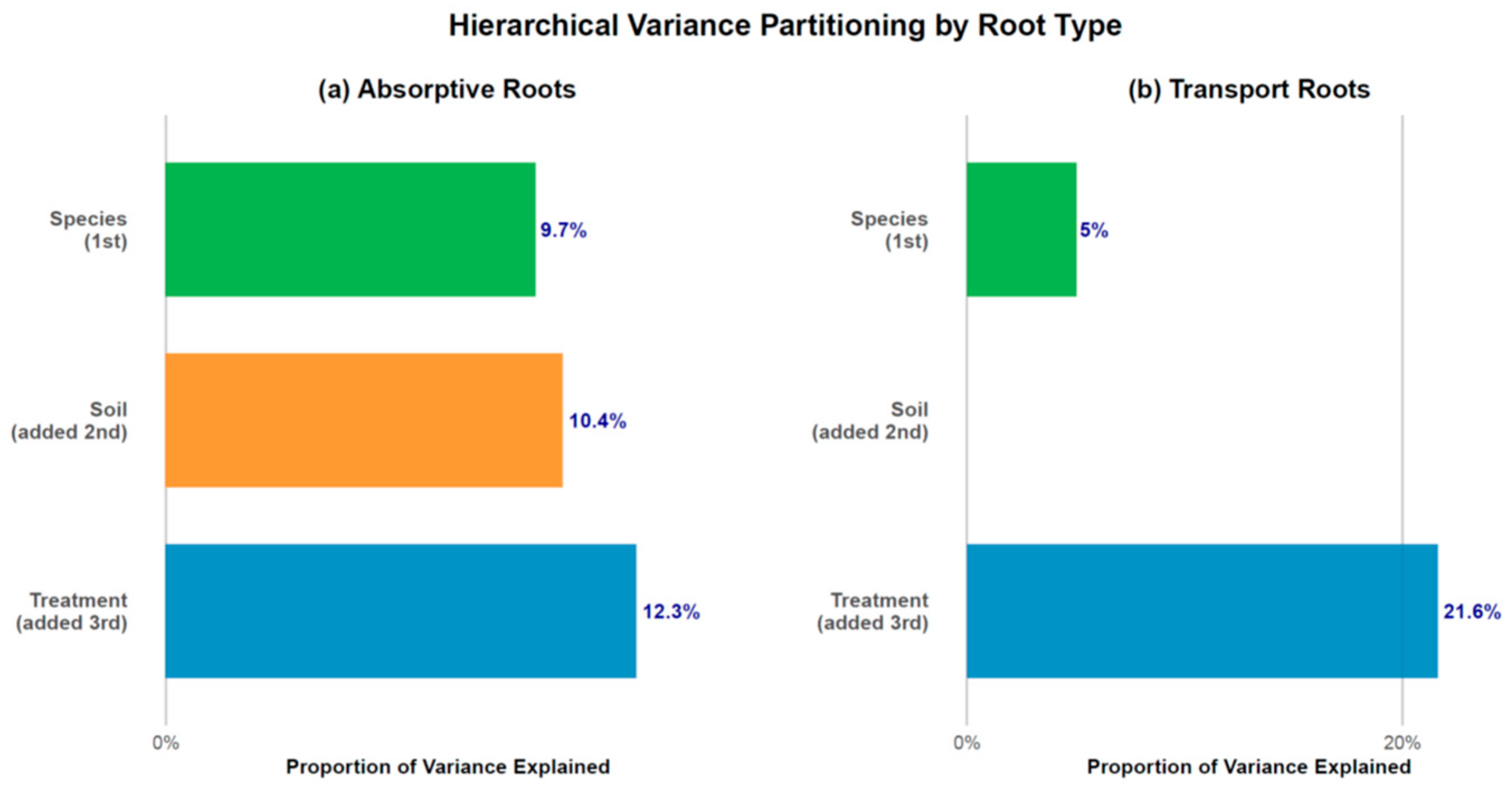
The mechanisms through which forest thinning influences the fine root foraging strategies of coexisting tree species in mixed forests remain unclear, limiting our ability to manage mixed forests for long-term productivity. We employed a space-for-time substitution approach in a Qinling pine-oak forest, in which fine roots of Pinus tabuliformis (Pt) and Quercus aliena var. acuteserrata (Qa) were sampled from unthinned plots and plots thinned 6 years (transient phase) and 14 years (persistent phase) prior, respectively. We analyzed the morphological and chemical traits of both absorptive and transport fine roots (0–20 cm depth) to decipher their distinct adaptation strategies. The results showed that Pt enhanced morphological plasticity in both absorptive and transport roots at T2010 (e.g., specific root length: +44% and 37%, p < 0.05). In contrast, Qa showed minimal changes in absorptive root morphology and chemistry (p > 0.05). Redundancy analysis indicated that thinning intensified functional divergence in root strategies between the two tree species and between the two root functional types (i.e., absorptive vs. transport fine roots). Hierarchical variance partitioning analysis indicated that root functional type was the primary driver (51.9%), with tree species identity (Pt vs. Qa) and thinning practices being secondary. Critically, soil properties significantly shaped absorptive root traits (explaining 10.4% of the variance) but did not affect transport root traits, whereas thinning was a dominant factor for transport roots (21.6%). This insight enables the tailoring of silvicultural interventions to tree species-specific foraging strategies, optimizing belowground resource acquisition in mixed forests.

1. Introduction

The sustainable management of mixed forests is crucial for ensuring long-term productivity and ecosystem resilience [1]. Silvicultural practices such as thinning are widely applied to achieve these goals by altering aboveground competition and resource availability [2,3,4,5]. While the aboveground benefits of thinning are well established [2,4,6], its belowground effects, particularly on the fine-root foraging strategies that drive resource acquisition, remain critically uncertain. Because fine roots are the primary organs for water and nutrient uptake, understanding their trait plasticity in response to thinning is essential for designing science-based management practices that increase species coexistence and belowground efficiency in mixed forests.
Previous studies have confirmed that root trait responses to thinning are highly species and context specific. For instance, studies in monoculture plantations report contrasting results: thinning increased root tissue density (RTD) but decreased specific root length (SRL) in Chinese fir (Cunninghamia lanceolata) plantations [7], whereas it increased specific root area (SRA) in Pinus massoniana [8]. Key chemical traits such as nitrogen concentration sometimes remain unresponsive [9], deviating from the functional trade-offs predicted by the root economic spectrum (RES), which is a conceptual framework positing trade-offs between resource acquisition and conservation [10]. These inconsistencies highlight a critical gap in predicting thinning effects in mixed forests. The unique value of mixed forests lies in the interplay of species with diverse strategies, yet our current, conflicting knowledge from simple systems fails to predict how thinning will regulate belowground interactions in these complex stands.
The magnitude and velocity of root trait adjustments to environmental changes vary significantly among plant species and functional groups, reflecting different adaptive strategies and inherent constraints Ostonen et al. [11]. In nutrient-rich areas, species employing an acquisitive foraging strategy typically exhibit rapid increases in SRL and root branching intensity [12]. This high-velocity response maximizes soil exploration but incurs substantial carbon (C) costs through (1) accelerated construction of new root tissues, (2) heightened maintenance respiration from expanded root surface areas, and (3) frequent turnover of short-lived roots [11,13,14]. Conversely, species utilizing a conservative resource economic strategy prioritize mycorrhizae-mediated SRA enhancement and enzymatic plasticity. This approach yields slower trait shifts but achieves greater nutrient acquisition efficiency per unit of C invested [15]. Fine roots thus exhibit tree species-specific foraging behaviors and can alter their chemical composition, particularly their nitrogen (N) content, in response to thinning-induced soil nutrient shifts.
While previous studies have advanced our understanding of the response of fine roots to forest thinning, several critical knowledge gaps remain. First, the tree species-specific dynamics of fine root morphological and chemical traits—particularly in secondary mixed stands—remain underexplored. The divergent root foraging strategies of conifers (prioritizing rapid nutrient uptake) and broadleaf trees (emphasizing resource conservation) suggest that thinning-induced alterations in resource availability may elicit contrasting adaptive responses. Second, the temporal trajectory of root trait adjustments due to thinning practices has been poorly characterized, as most research relies on static, single-season measurements. Third, how forest thinning modulates tree species-specific root-foraging strategies to amplify or buffer these indirect effects through soil media in mixed forests remains unclear. Addressing these interconnected gaps is vital for optimizing thinning practices to increase forest resilience, belowground resource use efficiency, and long-term ecosystem functioning.
In Qinling pine–oak mixed forests, we investigated how thinning drives transient plasticity (short-term trait adjustments within 6 years) versus persistent functional divergence (long-term, tree species-specific strategies) in the absorptive and transport fine roots of Pinus tabuliformis (Pt) and Quercus aliena var. acuteserrata (Qa). By quantifying key morphological and chemical traits across a 14-year chronosequence (0, 6, and 14 years after thinning), we traced the temporal dynamics of these temporal adaptation pathways. We hypothesized that (1) root trait adjustments would be most pronounced at an intermediate recovery stage (6 years) before stabilizing and that (2) thinning would induce stronger morphological plasticity in Pt than in Qa. By quantifying the direct and soil-mediated indirect effects of thinning, this study provides a mechanistic understanding of belowground responses to forest management. Our findings inform silvicultural strategies that leverage tree species-specific root-foraging behaviors to increase the sustainability and productivity of mixed forests.

2. Materials and Methods

2.1. Study Area and Experimental Setting

The study was conducted at Xinkuang Forest Farm, Ningdong Forestry Bureau, in Shaanxi Province, China (33°23′ N, 108°33′ E), which is located at the northern margin of the subtropical forest zone. The elevation in the area ranges from 1095 to 2591 m a.s.l. (Figure 1). The region experiences a northern subtropical semihumid monsoon climate with distinct seasons, featuring a mean annual temperature of 8.5 °C and an average annual precipitation of 908 mm. The soils are classified as mountain yellow–brown soils, with a clay texture and a depth of 30–60 cm. Stands are secondary mixed forests dominated by Pt and Qa that regenerated naturally after logging in the 1970s. The associated species include Toxicodendron vernicifluum, Ligustrum quihoui, and Acer davidii, with the understory dominated by Euonymus alatus, Litsea pungens, Rubus spp., Carex canteolata, Agrimonia pilosa, and Rubia cordifolia.
We established 9 plots (20 × 30 m) across a thinning chronosequence, including unthinned controls (CK, n = 3) and stands thinned 6 and 14 years prior (T2018, n = 3; and T2010, n = 3), to ensure the detection of transient (T2018) and persistent (T2010) root responses. Plot selection from the forest farm management units ensured similarity in key site conditions (e.g., soil type) and prethinning stand structure (secondary forests), as per management records. Thinning intensity was standardized at ~15% basal area removal via low thinning. A field survey in May 2022 provided contemporary stand data (Table 1).

2.2. Sampling and Laboratory Testing

In November 2024, three Pt and three Qa trees of comparable size (mean diameter at breast height of 21.3 ± 3.2 cm) were randomly selected in each plot. Thus, a total of 54 trees (27 trees for each species) were sampled. For each tree, we extracted two soil cores (0–20 cm depth) at a distance of 50 cm from the trunk on opposite sides using a root auger (Ø 10 cm). To ensure that the collected roots originated from the target trees, soil cores were selected far from the understory vegetation, including shrubs, seedlings, and large herbaceous plants (at least 1 m away). The surface litter was removed prior to sampling. Immediately after extraction, each soil core was carefully broken apart by hand (Figure S1). The fine roots were initially sorted in the field on the basis of well-established morphological criteria: (1) compared with the herbaceous roots, the roots of Pt were identified by their typically darker color and woody texture, and (2) the roots of Qa were distinguished by their lighter brown color and thicker and more rigid structure.
The root samples were immediately sealed in sterile Ziplock bags, labeled, transported to the laboratory as soon as possible, and stored at 4 °C before processing. The root samples were subsequently rinsed with deionized water in the laboratory. The fine roots were carefully separated on the basis of color, shape, and other morphological criteria above. Following cleaning and prescreening, the fine roots of each tree were further separated into two functional types [16,17]: absorptive fine roots (root orders 1–3) and transported fine roots (root orders 4–5).
Root images were obtained using a root scanner (10,000XL 1.0, Expression, Washington, DC, USA) at 400 dpi, and the morphological parameters (root diameter, root length, and total volume of absorptive and transport roots) were analyzed using WinRHIZO (2005b) software (Regent Instruments Inc., Quebec, QC, Canada). After being scanned, the roots were dried at 65 °C for 24 h (WF-11E, Wiggens, Straubenhard, Germany) until a constant weight was achieved.
After morphological analysis, the oven-dried root samples were ground into powder using a grinder (TL-2020, Dinghaoyuan, Beijing, China) and passed through a 100-mesh sieve. For each plot, the absorptive or transport roots of the same tree species were combined into a single sample because of the small amount of each sample. Approximately 20 mg of each combined sample was used to measure the root C and N contents via an elemental analyzer (2400 II, PerkinElmer, Waltham, MA, USA), and the C/N ratio was also calculated.
Soil samples were collected in October 2023. In each plot, five 0–20 cm soil cores (S-shaped sampling method) were collected and mixed into composite samples. Roots and rocks were excluded, and the samples were air dried and sieved (2 mm mesh). Soil organic carbon (SOC) was determined by the dichromate oxidation (external heating) method Walkley and Black [18]. Microbial biomass carbon (MBC) was measured using the chloroform fumigation-extraction method [19]. Total C (TC) and total N (TN) were analyzed simultaneously by dry combustion using an elemental analyzer. Soil pH was measured potentiometrically in a 1:5 (w/v) soil-to-water suspension. Mineral nitrogen was extracted with 1 M KCl (1:5 soil-to-solution ratio). Ammonium (NH4+-N) and nitrate (NO3-N) concentrations in the extracts were determined by the indophenol blue colorimetric method and by ultraviolet (UV) spectrophotometry, respectively [20]. Available phosphorus (AP) was extracted with 0.5 M NaHCO3 at a 1:20 soil-to-solution ratio and measured calorimetrically by the molybdenum blue method using a UV spectrophotometer (UV-8000, Metash, Shanghai, China) [21].

2.3. Conceptual Framework and Statistical Assessment of Root Responses

Root plasticity was operationally defined as a statistically significant difference (p < 0.05) in a given root trait between the thinned and control plots for the same species. This definition allows us to objectively identify whether a transient (within 6 years after thinning) or long-term plastic response occurred. The absence of a significant difference was interpreted as a lack of detectable plasticity for that trait under the given conditions. Prior to analysis, outliers exceeding the 3×IQR (interquartile range) threshold were removed using boxplots. Data normality was tested using the Shapiro–Wilk test, and homogeneity of variance was assessed with Levene’s test. If necessary, the original data were transformed to ensure that they passed the tests. If data transformation still failed to meet the assumptions, nonparametric tests were used. To investigate the effects of thinning recovery time and species on the morphological and chemical parameters of the fine roots, we performed two-way analysis of variance (ANOVA), followed by Tukey’s HSD tests for post hoc comparisons when the data met the assumptions of normality and homogeneity of variance. If the data violated these assumptions, the nonparametric Scheier–Ray–Hare test was used. Differences were considered significant at p < 0.05.
Functional divergence specifically refers to the increasing dissimilarity in root trait syndromes (i.e., multivariate trait space) between root functional types (absorptive vs. transport roots) and between species (Pt and Qa) in response to thinning. We employed redundancy analysis (RDA) to quantify the individual and joint contributions of species identity (Pt vs. Qa), soil properties, and thinning treatment to the variation in root traits. To mitigate potential multicollinearity among explanatory variables, we first assessed pairwise correlations using Pearson’s correlation coefficient, considering |r| > 0.7 as indicating strong collinearity (Figure S2). Four root traits, RTD, SRL, and root C and N concentrations, were used as response variables. Soil properties, namely, pH, inorganic N (IN), AP, and SOC, were selected as explanatory variables on the basis of ecological relevance and preliminary analysis. Owing to the fully balanced experimental design, we also used hierarchical variance partitioning analysis (VPA) to assess the relative importance of different factors, ordering them on the basis of ecological precedence: root functional type (the primary organizer of trait variation), species identity (evolutionary adaptations), soil properties (environmental conditions), and management treatments (anthropogenic influences). RDAs and HVPAs were conducted using the ‘vegan’ package [22]. All the statistical analyses were conducted using R 3.5.1.

3. Results

3.1. Biomass and Morphological Trait Responses to Thinning

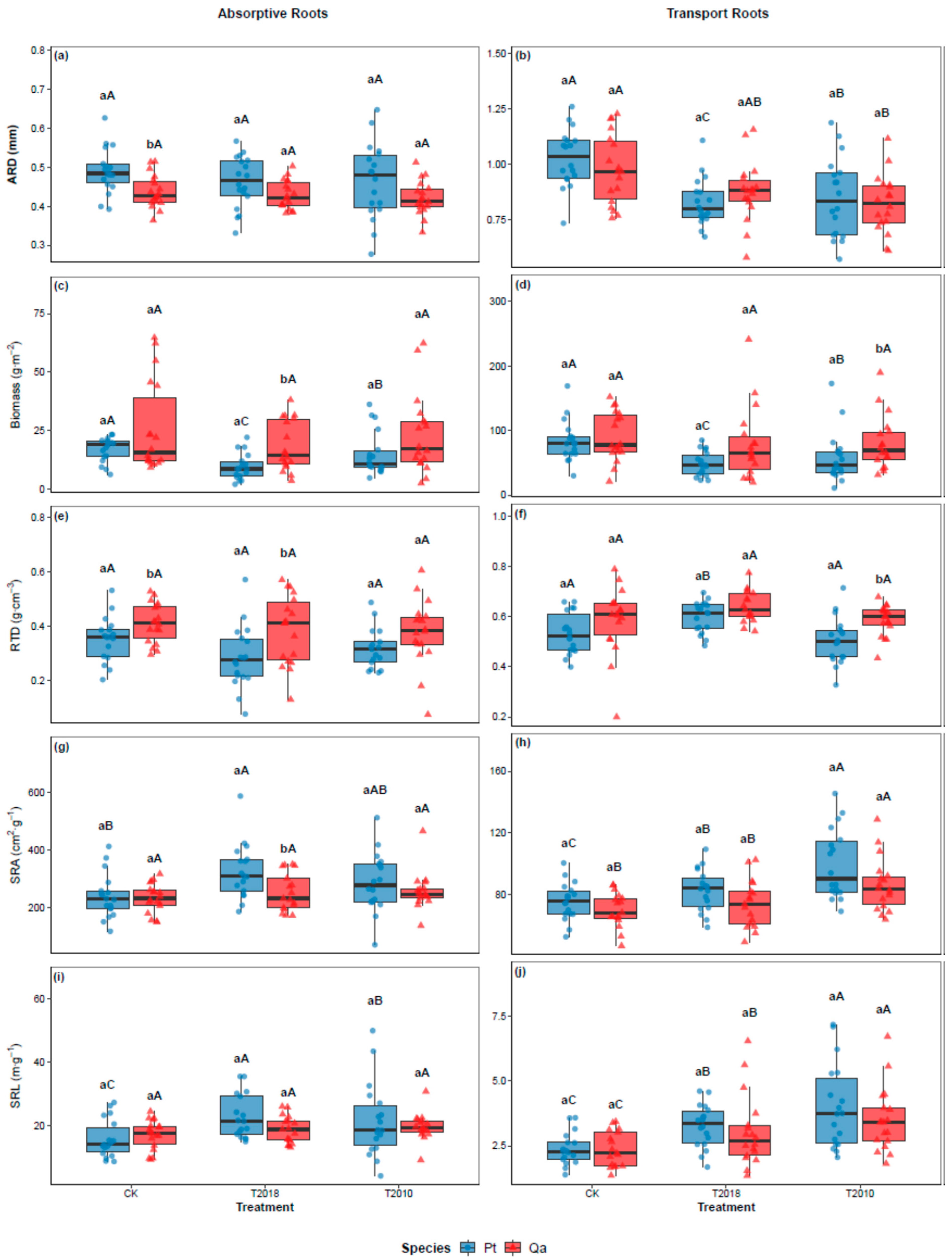
The most consistent responses to thinning and species identity were observed for the biomass and morphological traits (RTD and SRA) of both root types (Table 2). With respect to absorptive roots, neither species exhibited significant changes in average root diameter (ARD) or RTD across the thinning chronosequence (Figure 1a,e). Qa also maintained stable biomass levels, whereas the initial value of Pt was significant at T2018, followed by a partial recovery that remained below the CK level (Figure 1b). Similarly, Qa showed no thinning-induced variations in SRL and SRA (Figure 1g,i), whereas Pt significantly increased SRL (T2018: 22.9 ± 6.9 m g−1 vs. CK: 15.9 ± 5.9 m g−1, p < 0.05) and SRA (T2018: 326.9 ± 96.6 cm2 g−1 vs. CK: 239.4 ± 76.1 cm2 g−1, p < 0.01) during the initial 6-year post-thinning period, followed by a gradual return to control levels after 14 years of recovery (21.6 ± 11.7 cm g−1 and 287.1 ± 101.5 cm2 g−1 for SRL and SRA, respectively).
With respect to the transport root traits, the ARD and SRL tended to change with the thinning recovery chronosequence but showed no tree species-specific response. Both traits generally increased from the CK stage to T2018 and further to T2010 (Table 2, Figure 1d,j). The SRL and SRA significantly and consistently increased throughout the thinning chronosequence, except for the SRA of Qa (Figure 1f,g). The RTD responses, however, differed between the two species (Figure 1h). Pt displayed an initial significant increase of 12.3% (CK: 0.53 ± 0.08 g cm−3 vs. T2018: 0.60 ± 0.06 g cm−3; p < 0.05 at T2018) before it returned to the prethinning level (T2010: 0.50 ± 0.09 g cm−3). In contrast, Qa did not significantly change (0.59–0.64 g cm−3) across all stages. The interactions between species and thinning chronosequence treatments were not significant for any of the measured traits.

3.2. Response of Chemical Traits to Thinning

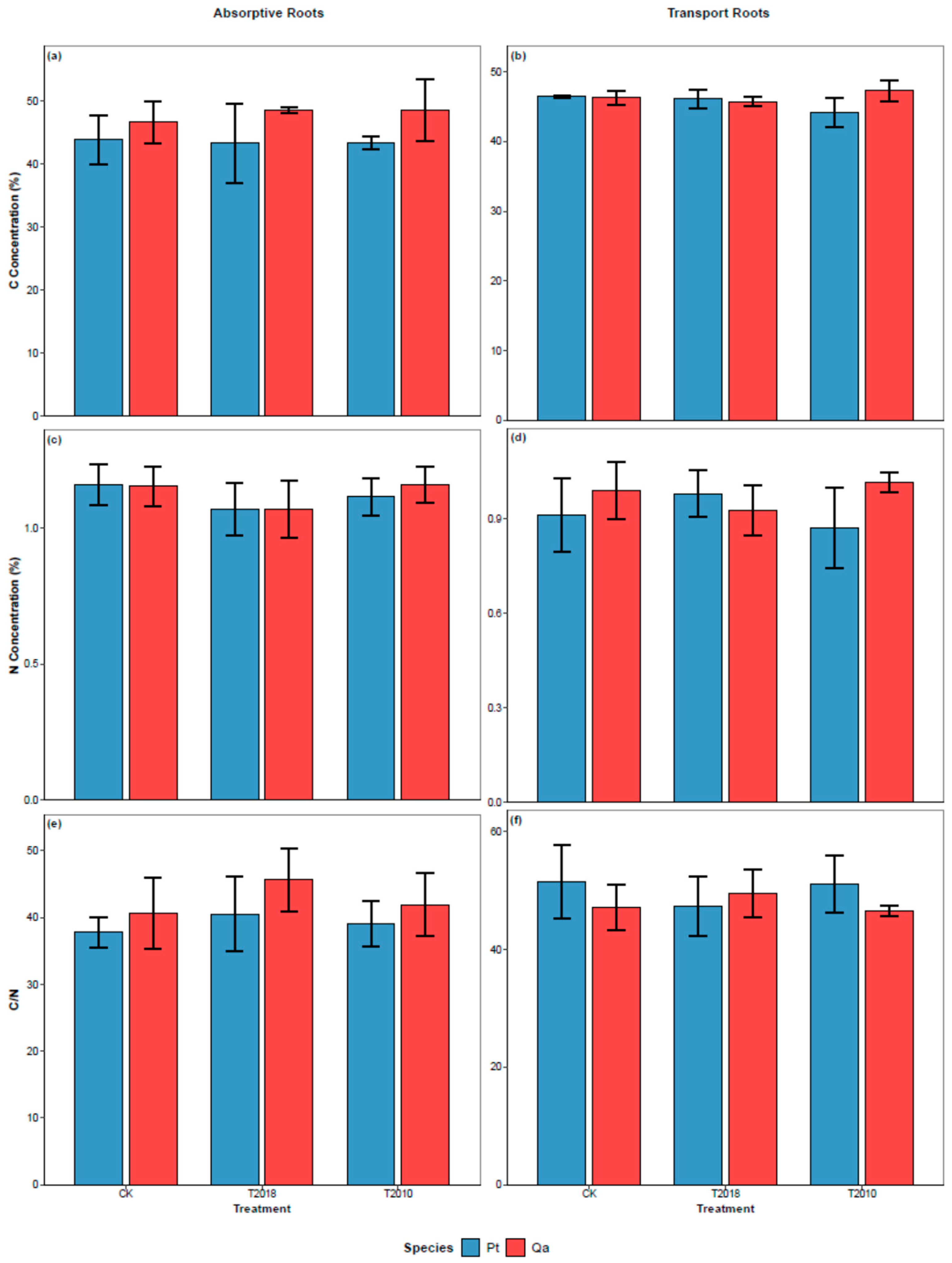
After analyzing the morphological responses, we examined root chemical traits to explore potential shifts in nutrient allocation and further elucidate how thinning influences root foraging strategies over time. In contrast to the morphological traits, root chemistry (C, N, and the C/N ratio) generally showed no significant responses to thinning, species identity, or their interactions (Table 2). A single exception was observed for absorptive root C concentration, whose effect was significant (Table 2, Pt: 43.53 ± 3.55% vs. Qa: 47.90 ± 2.91%, p = 0.035). However, post hoc pairwise comparisons did not reveal significant differences between Pt and Qa (Figure 2).

3.3. Joint Effects of Environmental Drivers and Species Identity on Root Traits

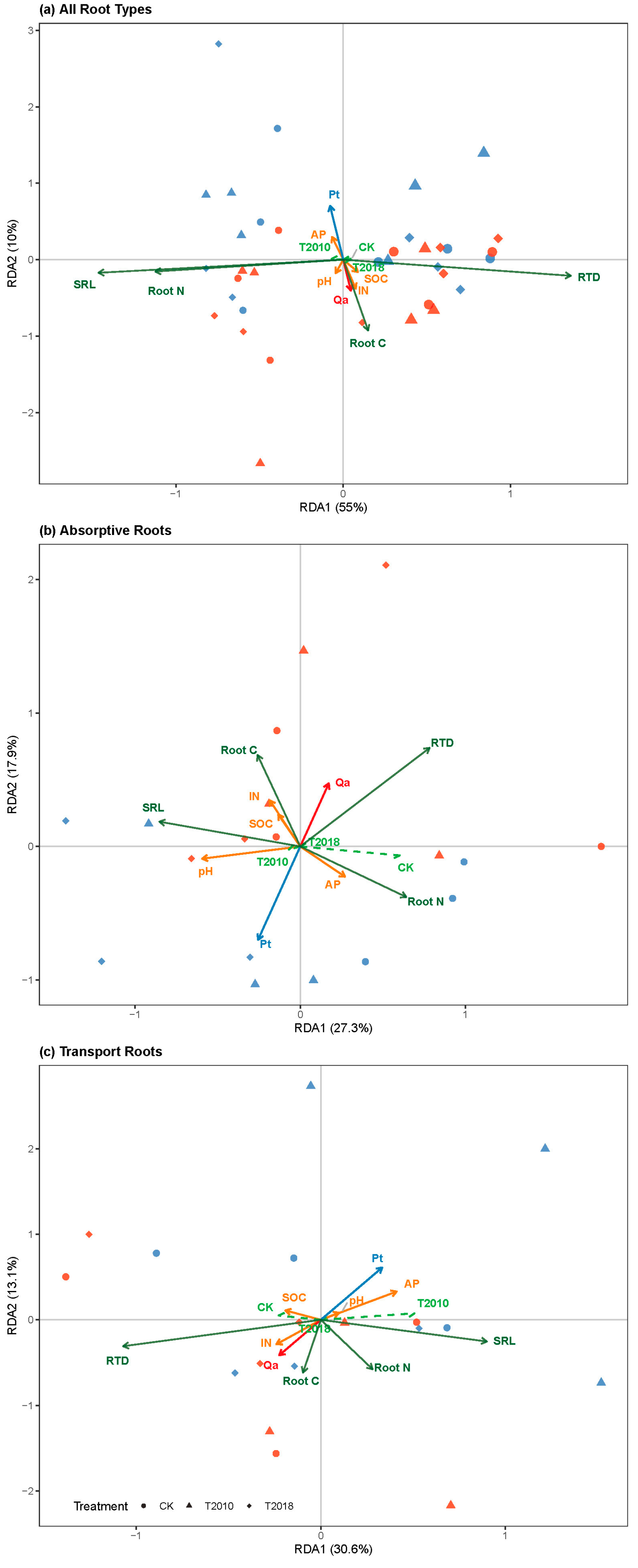
The results of the RDA revealed clear functional differentiation in terms of root strategies between tree species and across root types (Figure 3). Across all the root types (Figure 3a), the first two RDA axes explained 55.0% and 10.0% of the variance, respectively. The analysis demonstrated a strong species contrast along RDA1, with Pt and Qa occupying opposite ends of the spectrum. Pt aligned with absorptive root traits, SRL, and root N, indicating an exploitative resource acquisition strategy. In contrast, Qa is associated with transport root traits, RTD, and root C, reflecting a conservative structural investment strategy. Soil properties, including pH, IN, AP, and SOC, showed distinct directional effects, with SOC being particularly associated with the Qa-conservation strategy axis. Among the thinning treatments, T2010 had the most pronounced effect, positioned between the two species strategies, while T2018 had the least influence. Absorptive roots (Figure 3b, RDA1: 27.3%; RDA2: 13.1%) maintained species contrast but with reduced explanatory power, suggesting that other factors influence absorptive root trait variation. Transport roots (Figure 3c, RDA1: 30.6%; RDA2: 17.9%) showed the strongest species differentiation, highlighting that transport root strategies are more distinctly species-specific. The consistent opposition between Pt and Qa across all analyses reveals fundamental differences in root economic spectrum positioning, with Pt specializing in rapid resource acquisition and Qa in structural conservation, modulated by soil conditions and management practices.
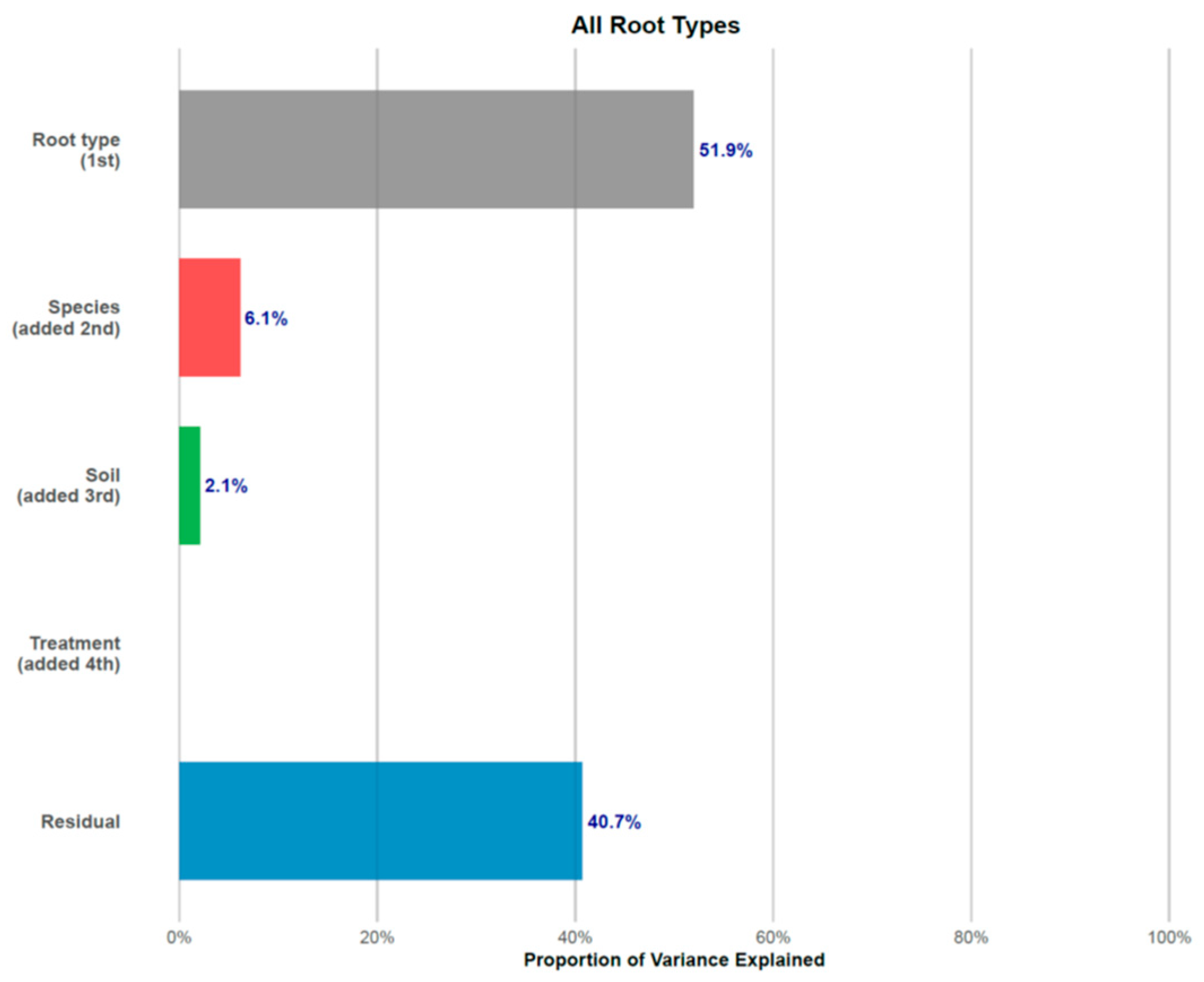
Root type (51.9%), species (6.1%), soil properties (2.1%), and management collectively explained 60.1% of the trait variation (Figure 4). The determinants of absorptive root traits were multifactorial (Figure 5), with comparable contributions from species (9.7%), soil (10.4%), and treatment (12.3%). In contrast, root transport traits were driven primarily by the thinning recovery stage (21.6%), with soil factors exhibiting no significant independent explanatory power. This pattern was visually confirmed by the RDA ordination. For absorptive roots, traits were strongly associated with soil and treatment gradients, whereas for transport roots, the soil factor vectors were short, indicating a weak relationship. They explained more than 60% of the variation, which was attributed to microenvironmental heterogeneity, measurement error, and strong phenotypic plasticity in response to short-term nutrient fluctuations.

4. Discussion

4.1. Temporal Responses of Fine Root Trait Plasticity to Thinning

The functional traits of fine roots are critical indicators of how trees alter their resource acquisition strategies in response to forest management practices such as thinning. This section focuses on how the temporal dynamics of absorptive and transport root traits differ between Pt and Qa following thinning and how these patterns align with or diverge from existing findings. Our results revealed that the absorptive root traits of Pt presented a unimodal pattern of thinning response in terms of SRL and SRA, whereas those of Qa presented negligible trait dynamics (Figure 1). In contrast, transport roots displayed prolonged structural changes, with SRL increasing persistently and SRA increasing only after >14 years, correlating with secondary xylem/suberin accumulation and a phased investment in hydraulic architecture [23]. These findings partly support our first hypothesis that traits could peak at intermediate recovery stages and then gradually return to the unthinned level. This type of pattern aligns with the “resource pulse response” theory [24]. However, as competition increases for more than 14 years, these traits may revert to those under baseline conditions.
Notably, existing studies have shown variable responses to thinning intensity and species identity, which contextualizes our findings. For example, with increasing thinning intensity, the root N concentration, SRA, and SRL of the absorptive roots of trees in Chinese fir plantations significantly decreased [7], but no significant differences in fine roots, regardless of root type, were detected [25]. Noguchi et al. [26] reported that the difference in SRL, without distinguishing root types, was not significant between thinned and control plots for 10-year-old young hinoki cypress (Chamaecyparis. obtusa) stands after three years of thinning (65% removal in the basal area). In a study of thinning leading to species mixing at a conifer plantation (Cryptomeria japonica), both the SRL and SRA of C. japonica were lower in the weak and intensive thinning plots than in the control plots, whereas those for hardwood species (Cornus controversa) did not differ among the studied thinning intensities. These inconsistencies highlight that root trait responses depend on tree species-specific strategies (e.g., the rapid plasticity of Pt vs. the stability of Qa or conifer vs. hardwood differences) and the differentiation of root functional types. Our study addresses these gaps by focusing on temporal dynamics across root orders and species.
Absorptive roots are considered more important for tree growth than are transport roots [17]. The temporal response of the fine root system in our study clearly differed between absorptive and transport roots following thinning. Our finding that absorptive roots presented greater morphological plasticity than did transport roots, aligns with global patterns of root order specialization [27]. Notably, most absorptive root traits reverted to control levels at T2010, implying that their plasticity is a transient tactic rather than a permanent adaptation. These results demonstrate coordinated yet asynchronous belowground reorganization due to environmental changes, indicating that tree species-specific adjustments in resource foraging occur during the early thinning phase. These findings are connected to the subsequent sections, which explore the mechanistic drivers (e.g., soil nutrients and mycorrhizae) and management implications of such trait dynamics.

4.2. A Hierarchical Model of Tree Species-Specific Foraging Strategy Responses to Thinning

A global meta-analysis revealed that forest thinning is a significant driver of belowground dynamics, primarily leading to a marked reduction in fine root biomass, while many other morphological and chemical traits remain largely unresponsive [9]. This pattern highlights a critical knowledge gap: the apparent stability of pooled “fine roots” masks potential divergent responses between functional root types. In addition to other root-order-specific studies [8], our study begins to dissect this black box, revealing that the postthinning strategy of a tree is not a uniform reduction but a complex reorganization of its root-foraging strategies.
Our results provide clear evidence of fundamental functional divergence within the fine root system (Figure 3 and Figure 5), a differentiation that is rooted in the distinct developmental and physiological programs of the plant vascular system [28]. This difference was demonstrated by the differential drivers of root traits: absorptive roots responded to both soil and management, whereas transport roots responded primarily to management. This physiological and morphological divergence means that absorptive and transport roots represent distinct microbial niches [29], as evidenced by pronounced differences in their fungal and bacterial communities, root metabolomes, and the potential functions of their rhizoplane microbiomes [30]. The response of root traits to thinning observed in this study is partially consistent with previous findings that thinning induces opposite morphological shifts in absorptive and transport roots [8]. Furthermore, the shift in absorptive root traits toward a thicker and more resource-conservative morphology is accompanied by a potential increase in root exudation [25], suggesting a strategic pivot from morphological foraging to chemical priming of the rhizosphere for nutrient acquisition.
The ecological consequences of this functional divergence are profound. This provides a mechanistic explanation for the central pattern in which absorptive root traits are superior predictors of tree growth, as their plasticity directly governs resource acquisition [17]. Furthermore, the tree species-specific enhancement of key ecosystem processes, such as the microbial carbon pump, can be mechanistically linked to the exudation and microbial recruitment strategies of absorptive roots [31]. These findings collectively argue against treating fine roots as a homogeneous pool and underscore that their functional divergence is a cornerstone of belowground ecology.
The response to thinning is further refined by tree species-specific strategies. We found that Pt adopted a strategy that relies on the significant morphological plasticity of both absorptive and transport roots to broadly explore the soil environment, whereas Qa employed a strategy with minimal morphological change in absorptive roots but invested more in transport roots. This phenomenon supports our second hypothesis, which aligns with broader patterns in which pioneer species display greater trait plasticity in response to resource fluctuations, whereas slow-growing species prioritize efficiency over structural change [32]. Previous studies of fine root morphology and chemical traits associated with forest thinning in pure P. massoniana and C. lanceolata plantations revealed that forest thinning is expected to change the foraging strategy of species to a more resource-conserving approach [7,8]. The pattern of Qa is consistent with the expectation that species with stable root morphology rely more on fungal networks to access resources, as supported by research on oak species and their mycorrhizal relationships [33]. These studies likely reflect intraspecific competition dynamics, whereas our results highlight interspecific differences in mixed forests.

4.3. Root Trait Plasticity Trade-Off Governed by Multiple Drivers

Our heretical analysis demonstrated that the plasticity of root traits is governed not by a single factor but by the combined effects of species identity, the soil environment, and management practices (Figure 5). The significant role of species identity in driving root trait variation, as identified in our hierarchical models, aligns with the global spectrum of plant form and function, which posits that root traits are fundamentally shaped by recent ancestral and evolutionarily strategies [27,34]. Our observations that soil properties primarily influenced absorptive rather than transport roots are consistent. Trees respond to varying soil conditions primarily by altering fine-root biomass and mycorrhizal collaboration while maintaining relatively stable fine-root morphology [35]. However, interpreting the effects of soil on root traits requires caution, as its role can be reversed or modulated by other environmental factors, such as climate [36].
Ecologically, thinning initiates changes in soil resources and competition for light, but its legacy is predominantly mediated through these subsequent shifts in the soil environment and interspecific dynamics rather than acting as a direct biological trigger. Studies have consistently shown that thinning affects soil microenvironments and nutrient cycling, often increasing topsoil C, N, and P availability through mechanisms such as stimulated enzyme activity [37,38,39]. The legacy of thinning is thus fundamentally mediated through these shifts in soil properties. Moreover, these changes set the stage for complex belowground feedback. For instance, the strategic increase in root exudation observed in thinned stands can increase microbial activity [8,25,39], creating a dynamic interplay between plant roots and the soil matrix. Furthermore, the increased fine root necromass and turnover following thinning can significantly increase soil carbon accretion, demonstrating a direct pathway from management to long-term carbon storage [40]. These soil-mediated processes form the critical initial bridge between silvicultural interventions and root system function.
Our results clearly demonstrate that soil changes exert a convergent selective force primarily on the absorptive root module, which exhibits high plasticity in its morphological and chemical traits. In contrast, the transport root module remains largely decoupled from these soil chemical fluctuations, reflecting its role in long-term architectural stability. This fundamental functional divergence is strongly supported by studies showing that fine roots of different diameters exhibit fundamentally different response mechanisms to thinning intensity [41]. The plastic adjustments of absorptive root traits—which can include shifts toward a thicker diameter and increased exudation [25]—are not merely physiological endpoints. They represent a key mechanistic link to the broader ecosystem, as these very traits are paramount in structuring root-associated fungal communities [42], thereby translating management impacts into shifts in microbiome assembly and function. Ultimately, the plant species-specific interplay between soil drivers and root functional traits determines whether the soil–microbe–plant feedback loop stabilizes or destabilizes species interactions [43].

4.4. Limitations, Future Work, and Implications for Management

While this study provides novel insights into root trait plasticity and foraging strategies in response to thinning in mixed forests, we acknowledge several limitations that could be addressed in future research. First, the ‘space-for-time’ substitution approach used in this study has inherent limitations. The preexisting differences in soil properties (e.g., SOC, TN, and pH) and slope gradients among the three plots might have confounded the thinning effects to some extent. Although we selected plots with similar forest stands and soil types prior to thinning, these inherent differences could influence root dynamics and resource availability. Second, root sampling, such as the use of soil cores, end-of-season timing, and sampling depth, may have introduced biases in morphological measurements and obscured active growth-phase dynamics. Third, gaps in mechanistic measurements, including the absence of concurrent soil nutrient data, aboveground variables such as light availability and leaf traits, and uninvestigated mycorrhizal fungal associations, restrict our understanding of underlying drivers [14,44,45]. Fourth, our statistical framework, while robust for quantifying the relative contributions of different factor groups through variance partitioning, was not suited for testing a priori causal pathways. Although structural equation modeling (SEM) can explore such complex causal networks, our experimental design and sample size were not optimized to meet the specific requirements for a well-identified SEM. Future studies with dedicated designs for causal inference would benefit from employing SEM to build upon the foundational driver relationships identified here. Finally, the use of a spatially distributed chronosequence presents a common challenge in such studies. Although the selected plots shared similar prethinning site conditions (e.g., soil type) based on forest management records, we cannot entirely rule out the possibility that unmeasured preexisting differences contributed to the observed patterns. However, the strong, tree species-specific nature of the root responses and the clear role of soil mediation we detected provide confidence that the reported patterns are primarily driven by thinning interventions and their aftermath.
To address these limitations, future work should integrate more precise root sampling and aboveground variables, wide sampling depth gradients, timely monitoring of soil biogeochemistry, and associated microbiota, use causal modeling frameworks such as SEM from the outset, and, ideally, establish long-term, replicated thinning experiments to minimize spatial confounding and to provide a more complete picture of belowground processes in response to thinning.
Our findings offer practical guidelines for mixed forest management for Qinling from a belowground perspective, emphasizing the importance of aligning interventions with tree species-specific root strategies. Thinning enhances complementary resource use by triggering phased root trait adaptations. Pt benefits from early postthinning interventions (1–6 years) to leverage rapid absorptive root plasticity, whereas Qa requires longer monitoring (≥10 years) owing to slow responses, with a 10-year interval thinning balancing short-term resource capture and long-term stability. In addition to the Qinling pine–oak system, this trait-based framework could be broadly applicable. It could guide thinning in temperate mixed forests by matching intervention timing to analogous foraging characteristics, optimize root-mediated resource use through soil-mediated effects, and aid in the restoration of degraded ecosystems by prioritizing species on the basis of their root strategies. Ultimately, this framework offers a transferable tool to enhance global forest sustainability.

5. Conclusions

Our study demonstrated that the belowground response of trees to thinning is not a monolithic process but rather a hierarchically structured reorganization driven by the interplay of root functional type, species identity, and the soil environment in a Qinling mixed forest. We showed that root functional type acts as the dominant filter, partitioning trait variations into two divergent strategies. Absorptive roots exhibit environmentally driven plasticity and functional convergence toward soil nutrients, and transport roots remain under strong genetic constraints and maintain tree species-specific structural investments. This functional hierarchy creates a dual-response mechanism to thinning. Pt operates through an exploitative foraging strategy, leveraging rapid morphological plasticity in its absorptive roots to exploit postthinning resource pulses, whereas Qa employs a conservative strategy, relying on physiological efficiency and mycorrhizal partnerships with minimal structural adjustment. This interspecific divergence at the whole-root level promotes resource partitioning and coexistence.
From a management perspective, this trait-based hierarchy provides a predictive framework. Silvicultural interventions can be timed to align with tree species-specific response patterns: early-phase interventions (1–6 years) capitalize on fast-response plasticity foragers such as Pt, whereas longer monitoring cycles (≥10 years) are needed to assess the responses of foragers such as Qa in Qinling mixed forests. Our findings also refine the root economic spectrum by showing it is not a single continuum but a compartmentalized framework, where separate acquisitive–conservative trade-offs operate within each functional root module. To advance this framework, future work should explore three frontiers: (1) linking root trait shifts to whole-plant C budgets to quantify the total C costs of rapid vs. conservative strategies; (2) investigating how microbial communities mediate these trait responses; and (3) scaling these decadal patterns to landscape-level dynamics, including interactions with other disturbances such as drought or fire.

Supplementary Materials

The following supporting information can be downloaded at: https://www.mdpi.com/article/10.3390/f17010023/s1, Figure S1: Photos of soil coring, root sampling, storage, and pre-selection. Figure S2: Pearson correlation heatmap showing relationships among soil physicochemical properties, nutrient availability, and root morphological and chemical traits.

Author Contributions

Conceptualization, S.Y., J.Z. and W.W.; methodology, X.M. and X.X.; software, S.Y.; validation, S.Y. and W.W.; formal analysis, X.M. and X.X.; investigation, S.W. and Q.W.; resources, W.W.; data curation, X.X.; writing—original draft preparation, X.M.; writing—review and editing, S.Y., J.X. and W.W.; visualization, X.M. and X.X.; supervision, J.Z.; project administration, W.W.; funding acquisition, J.X. and W.W. All authors have read and agreed to the published version of the manuscript.

Funding

This work was supported by the National Key Research and Development Program of China, grant number 2021YFD2200404, the National Natural Science Foundation of China, grant number 32071763, and the Priority Academic Program Development of Jiangsu Higher Education Institution (PAPD).

Data Availability Statement

The data will be made available upon request.

Acknowledgments

We thank Xiangfu Wang, Qilin Sheng and Xiaowei Wang for providing forest management history and helping with the field work.

Conflicts of Interest

The authors declare that they have no conflicts of interest.

Abbreviations

The following abbreviations are used in this manuscript:
PtPinus tabuliformis
QaQuercus aliena var. acuteserrata
ARDAverage Root Diameter
RTDRoot Tissue Density
SRASpecific Root Area
SRLSpecific Root Length
SOCSoil Organic Carbon
MBCMicrobial Biomass Carbon
INInorganic Nitrogen
APAvailable Phosphorous

References

  1. del Río, M.; Löf, M.; Bravo-Oviedo, A.; Jactel, H. Understanding the complexity of mixed forest functioning and management: Advances and perspectives. For. Ecol. Manag. 2021, 489, 119138. [Google Scholar] [CrossRef]
  2. Zhang, H.; Liu, S.; Yu, J.; Li, J.; Shangguan, Z.; Deng, L. Thinning increases forest ecosystem carbon stocks. For. Ecol. Manag. 2024, 555, 121702. [Google Scholar] [CrossRef]
  3. Gong, C.; Tan, Q.; Liu, G.; Xu, M. Forest thinning increases soil carbon stocks in China. For. Ecol. Manag. 2021, 482, 118812. [Google Scholar] [CrossRef]
  4. del Campo, A.D.; Otsuki, K.; Serengil, Y.; Blanco, J.A.; Yousefpour, R. A global synthesis on the effects of thinning on hydrological processes: Implications for forest management. For. Ecol. Manag. 2022, 519, 120324. [Google Scholar] [CrossRef]
  5. Davis, K.T.; Peeler, J.; Fargione, J.; Haugo, R.D.; Metlen, K.L.; Robles, M.D.; Woolley, T. Tamm review: A meta-analysis of thinning, prescribed fire, and wildfire effects on subsequent wildfire severity in conifer dominated forests of the Western US. For. Ecol. Manag. 2024, 561, 121885. [Google Scholar] [CrossRef]
  6. Egnell, G.; Ulvcrona, K.A. Stand productivity following whole-tree harvesting in early thinning of Scots pine stands in Sweden. For. Ecol. Manag. 2015, 340, 40–45. [Google Scholar] [CrossRef]
  7. Wang, Z.; Liu, M.; Chen, F.; Li, H. Variation in fine root traits with thinning intensity in a Chinese fir plantation insights from branching order and functional groups. Sci. Rep. 2021, 11, 22710. [Google Scholar] [CrossRef] [PubMed]
  8. Zhao, J.; Sun, X.; Wang, D.; Wang, M.; Li, J.; Wang, J.; Guan, Q. Responses of fine root morphological and chemical traits among branch orders to forest thinning in Pinus massoniana plantations. Forests 2024, 15, 495. [Google Scholar] [CrossRef]
  9. Qin, J.; Lu, J.; Peng, Y.; Guo, X.; Yang, L.; Martin, A.R. Thinning-induced decrease in fine root biomass, but not other fine root traits in global forests. J. Environ. Manag. 2024, 370, 122938. [Google Scholar] [CrossRef]
  10. Reich, P.B. The world-wide ‘fast–slow’ plant economics spectrum: A traits manifesto. J. Ecol. 2014, 102, 275–301. [Google Scholar] [CrossRef]
  11. Ostonen, I.; Truu, M.; Helmisaari, H.-S.; Lukac, M.; Borken, W.; Vanguelova, E.; Godbold, D.L.; Lõhmus, K.; Zang, U.; Tedersoo, L.; et al. Adaptive root foraging strategies along a boreal–temperate forest gradient. New Phytol. 2017, 215, 977–991. [Google Scholar] [CrossRef] [PubMed]
  12. Stiblíková, P.; Klimes, A.; Cahill, J.F.; Koubek, T.; Weiser, M. Interspecific differences in root foraging precision cannot be directly inferred from species’ mycorrhizal status or fine root economics. Oikos 2023, 2022, e08995. [Google Scholar] [CrossRef]
  13. Morikawa, Y.; Hayashi, S.; Negishi, Y.; Masuda, C.; Watanabe, M.; Watanabe, K.; Masaka, K.; Matsuo, A.; Suzuki, M.; Tada, C.; et al. Relationship between the vertical distribution of fine roots and residual soil nitrogen along a gradient of hardwood mixture in a conifer plantation. New Phytol. 2022, 235, 993–1004. [Google Scholar] [CrossRef]
  14. Eissenstat, D.M.; Kucharski, J.M.; Zadworny, M.; Adams, T.S.; Koide, R.T. Linking root traits to nutrient foraging in arbuscular mycorrhizal trees in a temperate forest. New Phytol. 2015, 208, 114–124. [Google Scholar] [CrossRef]
  15. Weemstra, M.; Mommer, L.; Visser, E.J.W.; van Ruijven, J.; Kuyper, T.W.; Mohren, G.M.J.; Sterck, F.J. Towards a multidimensional root trait framework: A tree root review. New Phytol. 2016, 211, 1159–1169. [Google Scholar] [CrossRef] [PubMed]
  16. McCormack, M.L.; Dickie, I.A.; Eissenstat, D.M.; Fahey, T.J.; Fernandez, C.W.; Guo, D.; Helmisaari, H.-S.; Hobbie, E.A.; Iversen, C.M.; Jackson, R.B.; et al. Redefining fine roots improves understanding of below-ground contributions to terrestrial biosphere processes. New Phytol. 2015, 207, 505–518. [Google Scholar] [CrossRef]
  17. Sanaei, A.; van der Plas, F.; Chen, H.; Davids, S.; Eckhardt, S.; Hennecke, J.; Kahl, A.; Möller, Y.; Richter, R.; Schütze, J.; et al. Tree growth is better explained by absorptive fine root traits than by transport fine root traits. Commun. Biol. 2025, 8, 313. [Google Scholar] [CrossRef]
  18. Walkley, A.; Black, I.A. An examination of the degtjareff method for determining soil organic matter, and a proposed modification of the chromic acid titration method. Soil Sci. 1934, 37, 29–38. [Google Scholar] [CrossRef]
  19. Vance, E.D.; Brookes, P.C.; Jenkinson, D.S. An extraction method for measuring soil microbial biomass C. Soil Biol. Biochem. 1987, 19, 703–707. [Google Scholar] [CrossRef]
  20. Mulvaney, R.L. Nitrogen—Inorganic forms. In Methods of Soil Analysis: Part 3 Chemical Methods; Wiley: Hoboken, NJ, USA, 1996; pp. 1123–1184. [Google Scholar]
  21. Cooper, D.L.M.; Lewis, S.L.; Sullivan, M.J.P.; Prado, P.I.; ter Steege, H.; Barbier, N.; Slik, F.; Sonké, B.; Ewango, C.E.N.; Adu-Bredu, S.; et al. Consistent patterns of common species across tropical tree communities. Nature 2024, 625, 728–734. [Google Scholar] [CrossRef]
  22. Oksanen, J.; Simpson, G.; Blanchet, F.; Kindt, R.; Legendre, P.; Minchin, P.; O’Hara, R.; Solymos, P.; Stevens, M.; Szoecs, E.; et al. Vegan: Community Ecology Package, version 2.7-2. 2025. Available online: https://cran.r-project.org/web/packages/vegan/index.html (accessed on 22 December 2025). [CrossRef]
  23. Boursiac, Y.; Pradal, C.; Bauget, F.; Lucas, M.; Delivorias, S.; Godin, C.; Maurel, C. Phenotyping and modeling of root hydraulic architecture reveal critical determinants of axial water transport. Plant Physiol. 2022, 190, 1289–1306. [Google Scholar] [CrossRef]
  24. Yang, L.H.; Bastow, J.L.; Spence, K.O.; Wright, A.N. What can we learn from resource pules. Ecology 2008, 89, 621–634. [Google Scholar] [CrossRef] [PubMed]
  25. Zhao, J.; Ye, Y.; Sun, X.; Shi, L.; Chen, X.; Guan, Q. Root exudation patterns of Chinese fir after thinning relating to root characteristics and soil conditions. For. Ecol. Manag. 2023, 541, 121068. [Google Scholar] [CrossRef]
  26. Noguchi, K.; Han, Q.; Araki, M.G.; Kawasaki, T.; Kaneko, S.; Takahashi, M.; Chiba, Y. Fine-root dynamics in a young hinoki cypress (Chamaecyparis obtusa) stand for 3 years following thinning. J. For. Res. 2011, 16, 284–291. [Google Scholar] [CrossRef]
  27. Ma, Z.; Guo, D.; Xu, X.; Lu, M.; Bardgett, R.D.; Eissenstat, D.M.; McCormack, M.L.; Hedin, L.O. Evolutionary history resolves global organization of root functional traits. Nature 2018, 555, 94–97. [Google Scholar] [CrossRef] [PubMed]
  28. Lucas, W.J.; Groover, A.; Lichtenberger, R.; Furuta, K.; Yadav, S.-R.; Helariutta, Y.; He, X.-Q.; Fukuda, H.; Kang, J.; Brady, S.M.; et al. The plant vascular system: Evolution, development and functions. J. Integr. Plant Biol. 2013, 55, 294–388. [Google Scholar] [CrossRef]
  29. Guo, D.; Li, H.; Mitchell, R.J.; Han, W.; Hendricks, J.J.; Fahey, T.J.; Hendrick, R.L. Fine root heterogeneity by branch order: Exploring the discrepancy in root turnover estimates between minirhizotron and carbon isotopic methods. New Phytol. 2008, 177, 443–456. [Google Scholar] [CrossRef]
  30. King, W.L.; Yates, C.F.; Cao, L.; O’Rourke-Ibach, S.; Fleishman, S.M.; Richards, S.C.; Centinari, M.; Hafner, B.D.; Goebel, M.; Bauerle, T.; et al. Functionally discrete fine roots differ in microbial assembly, microbial functional potential, and produced metabolites. Plant Cell Environ. 2023, 46, 3919–3932. [Google Scholar] [CrossRef]
  31. Wang, Q.; Zhang, Z.; Zhu, X.; Liu, Z.; Li, N.; Xiao, J.; Liu, Q.; Yin, H. Absorptive roots drive a larger microbial carbon pump efficacy than transport roots in alpine coniferous forests. J. Ecol. 2022, 110, 1646–1655. [Google Scholar] [CrossRef]
  32. Medeiros, J.S.; Tomeo, N.J.; Hewins, C.R.; Rosenthal, D.M. Fast-growing Acer rubrum differs from slow-growing Quercus alba in leaf, xylem and hydraulic trait coordination responses to simulated acid rain. Tree Physiol. 2016, 36, 1032–1044. [Google Scholar] [CrossRef]
  33. Tarkka, M.T.; Grams, T.E.E.; Angay, O.; Kurth, F.; Maboreke, H.R.; Mailänder, S.; Bönn, M.; Feldhahn, L.; Fleischmann, F.; Ruess, L.; et al. Ectomycorrhizal fungus supports endogenous rhythmic growth and corresponding resource allocation in oak during various below- and aboveground biotic interactions. Sci. Rep. 2021, 11, 23680. [Google Scholar] [CrossRef] [PubMed]
  34. Carmona, C.P.; Bueno, C.G.; Toussaint, A.; Traeger, S.; Diaz, S.; Moora, M.; Munson, A.D.; Paertel, M.; Zobel, M.; Tamme, R. Fine-root traits in the global spectrum of plant form and function. Nature 2021, 597, 683–687. [Google Scholar] [CrossRef] [PubMed]
  35. Weemstra, M.; Sterck, F.J.; Visser, E.J.W.; Kuyper, T.W.; Goudzwaard, L.; Mommer, L. Fine-root trait plasticity of beech (Fagus sylvatica) and spruce (Picea abies) forests on two contrasting soils. Plant Soil 2017, 415, 175–188. [Google Scholar] [CrossRef]
  36. Simpson, A.H.; Richardson, S.J.; Laughlin, D.C. Soil–climate interactions explain variation in foliar, stem, root and reproductive traits across temperate forests. Glob. Ecol. Biogeogr. 2016, 25, 964–978. [Google Scholar] [CrossRef]
  37. Zhou, Z.; Wang, C.; Jin, Y.; Sun, Z. Impacts of thinning on soil carbon and nutrients and related extracellular enzymes in a larch plantation. For. Ecol. Manag. 2019, 450, 117523. [Google Scholar] [CrossRef]
  38. Xiao, X.; Ali, I.; Du, X.; Xu, Y.; Ye, S.; Yang, M. Thinning promotes soil phosphorus bioavailability in short-rotation and high-density Eucalyptus grandis × E. urophylla coppice plantation in Guangxi, southern China. Forests 2023, 14, 2067. [Google Scholar] [CrossRef]
  39. Li, Y.; Ajloon, F.H.; Wang, X.; Malghani, S.; Yu, S.; Ma, X.; Li, Y.; Wang, W. Temporal effects of thinning on soil organic carbon and carbon cycling-related enzyme activities in oak-pine mixed forests. For. Ecol. Manag. 2023, 545, 121293. [Google Scholar] [CrossRef]
  40. Asaye, Z.; Zewdie, S. Fine root dynamics and soil carbon accretion under thinned and un-thinned Cupressus lusitanica stands in, Southern Ethiopia. Plant Soil 2013, 366, 261–271. [Google Scholar] [CrossRef]
  41. Pang, Y.; Tian, J.; Yang, H.; Zhang, K.; Wang, D. Responses of fine roots at different soil depths to different thinning intensities in a secondary forest in the Qinling mountains, China. Biology 2022, 11, 351. [Google Scholar] [CrossRef] [PubMed]
  42. Hogan, J.A.; Jusino, M.A.; Smith, M.E.; Corrales, A.; Song, X.; Hu, Y.-H.; Yang, J.; Cao, M.; Valverde-Barrantes, O.J.; Baraloto, C. Root-associated fungal communities are influenced more by soils than by plant-host root traits in a Chinese tropical forest. New Phytol. 2023, 238, 1849–1864. [Google Scholar] [CrossRef]
  43. Yan, X.; Levine, J.M.; Kandlikar, G.S. A quantitative synthesis of soil microbial effects on plant species coexistence. Proc. Natl. Acad. Sci. USA 2022, 119, e2122088119. [Google Scholar] [CrossRef] [PubMed]
  44. Chen, W.; Koide, R.T.; Adams, T.S.; DeForest, J.L.; Cheng, L.; Eissenstat, D.M. Root morphology and mycorrhizal symbioses together shape nutrient foraging strategies of temperate trees. Proc. Natl. Acad. Sci. USA 2016, 113, 8741–8746. [Google Scholar] [CrossRef] [PubMed]
  45. Jiang, Q.; Jia, L.; Chen, W.; Zheng, Z.; Lin, C.; Zhu, L.; Wang, X.; Yao, X.; Tissue, D.; Robinson, D.; et al. Complementary foraging of roots and mycorrhizal fungi among nutrient patch types in four subtropical monospecific broadleaved tree plantations. New Phytol. 2025, 247, 1401–1414. [Google Scholar] [CrossRef] [PubMed]
Figure 1. Interspecific variation in the morphological traits of absorptive (a,c,e,g,i) and transport (b,d,f,h,j) fine roots of Pinus tabuliformis (blue) and Quercus aliena var. acuteserrata (red) along a postthinning gradient. The average root diameter (ARD, (a,b)), biomass (c,d), root tissue density (RTD, (e,f)), specific root area (SRA, (g,h)), and specific root length (SRL, (i,j)) are shown. Boxplots show the 5th, 25th, median, 75th, and 95th percentiles. Lowercase letters denote significant interspecific differences, and uppercase letters indicate significant temporal differences within a species (p < 0.05).
Forests 17 00023 g001
Figure 2. Fine root chemical traits of Pinus tabuliformis (blue) and Quercus aliena var. acuteserrata (red) across a thinning chronosequence. Absorptive (a,c,e) and transport (b,d,f) root traits include the C, N, and C/N ratios. The error bars indicate the standard error (n = 3).
Forests 17 00023 g002
Figure 3. Divergent root trait–environment associations across root functional types: (a) all root types, (b) absorptive roots, and (c) transport roots. Explanatory variables include soil properties (orange arrows: pH, IN: inorganic nitrogen, AP: available phosphorus, SOC: soil organic carbon) and categorical factors (species: blue, Pinus tabuliformis, Pt; red, Quercus aliena var. acuteserrata, Qa; thinning: green arrows). The response variables (dark green arrows) are root traits (RTD: root tissue density, SRL: specific root length, root C: carbon, root N: nitrogen). Symbols represent thinning treatments (CK, circles; T2018, squares; T2010, triangles), species (blue, Pt; red, Qa), and root type (size: large, transport; small, absorptive).
Forests 17 00023 g003
Figure 4. Relative contribution of the drivers to root trait variance. Proportion of variance explained by each factor in a hierarchical partitioning model (root type → species → soil → treatment).
Forests 17 00023 g004
Figure 5. Contrasting drivers of absorptive (a) vs. transport (b) root traits by species, soil, and treatment.
Forests 17 00023 g005
Table 1. Stand and soil (0–20 cm) characteristics (mean ± SD, n = 3) of mixed pine–oak stands with different thinning recovery times in May 2022.
CharacteristicsCK aT2018 aT2010 a
Elevation (m)1585 ± 1071450 ± 221758 ± 35
Slope (°)18 ± 525 ± 59 ± 2
Mean stand density (stems ha−1)1420 ± 881208 ± 3551254 ± 207
Mean DBH b (cm)14.6 ± 0.4713.8 ± 1.1913.8 ± 0.84
Canopy density0.70.50.6
Dominant speciesPinus armandi; Pinus tabuliformis; Quercus aliena var. acuteserrataPinus tabuliformis; Quercus aliena var. acuteserrataPinus tabuliformis; Quercus aliena var. acuteserrata
pH (H2O)5.0 ± 0.15.8 ± 0.15.7 ± 0.1
Bulk density (g cm−3)1.1 ± 0.11.3 ± 0.21.2 ± 0.1
Soil water content (%)35.9 ± 3.625.6 ± 3.037.2 ± 1.5
SOC (g kg−1)9.4 ± 6.67.6 ± 0.87.7 ± 3.5
Total N (g kg−1)3.4 ± 0.52.3 ± 0.32.7 ± 0.1
NO3-N (mg kg−1)3.2 ± 1.73.7 ± 0.73.6 ± 0.1
NH4+-N (mg kg−1)14.2 ± 2.014.0 ± 1.114.2 ± 3.4
Total P (g kg−1)0.5 ± 0.30.5 ± 0.10.6 ± 0.1
Available P (mg kg−1)3.0 ± 0.14.6 ± 0.95.6 ± 2.0
Soil C/N ratio10.1 ± 1.811.5 ± 1.712.3 ± 1.4
a.CK: unthinned plots; T2018 and T2010: stands thinned in 2018 and 2010, respectively. b.DBH: diameter at breast height.
Table 2. Results of two-way parametric (ANOVA) and nonparametric (Scheirer-Ray-Hare) tests for the effects of species (Pinus vs. Quercus) and treatments (CK, T2010, and T2018) on root traits. ARD: average root diameter; RTD: root tissue density; SRA: specific root area; SRL: specific root length; C: carbon; N: nitrogen.
Root TypeRoot TraitSpeciesTreatmentSpecies × Treatment
Absorptive BiomassH (1) = 8.500, p < 0.01H (2) = 7.851, p < 0.05H (2) = 2.367, p = 0.306
rootARDH (1) = 13.232, p < 0.001H (2) = 2.944, p = 0.229H (2) = 0.140, p = 0.932
RTDF (1, 100) = 13.595, p < 0.001F (2, 100) = 1.975, p = 0.144F (2, 100) = 0.490, p = 0.614
SRAH (1) = 3.623, p < 0.01H (2) = 8.037, p < 0.05H (2) = 3.419, p = 0.181
SRLH (1) = 0.006, p = 0.939H (2) = 8.396, p < 0.05H (2) = 3.225, p = 0.199
Root CF (1, 12) = 5.665, p = 0.035F (2, 12) = 0.070, p = 0.933F (2, 12) = 0.19, p = 0.829
Root NH (1) = 0.031, p = 0.860H (2) = 2.406, p = 0.300H (2) = 0.217, p = 0.897
C:N ratioF (1, 12) = 2.910, p = 0.174F (2, 12) = 1.168, p = 0.344F (2, 12) = 0.123, p = 0.855
Transport BiomassF (1, 102) = 7.077, p < 0.01F (2, 102) = 5.219, p < 0.01F (2, 102) = 0.855, p = 0.428
rootARDF (1, 102) = 0.123, p = 0.727F (2, 102) = 15.042, p < 0.001F (2, 102) = 1.162, p = 0.317
RTDF (1, 101) = 8.333, p < 0.001F (2, 101) = 6.327, p < 0.01F (2, 100) = 0.813, p = 0.446
SRAF (1, 100) = 9.034 p < 0.01F (2, 100) = 14.531, p < 0.001F (2, 100) = 0.264, p = 0.768
SRLF (1, 100) = 1.816, p = 0.181F (2, 100) = 14.314, p < 0.001F (2, 100) = 0.293, p = 0.746
Root CF (1, 12) = 2.062 p = 0.177F (2, 12) = 0.43, p = 0.660F (2, 12) = 13.559, p = 0.061
Root NF (1, 12) = 1.718, p = 0.214F (2, 12) = 0.023, p = 0.977F (2, 12) = 1.761, p = 0.214
C:N ratioF (1, 12) = 1.172, p = 0.300F (2, 12) = 0.063, p = 0.940F (2, 12) = 1.096, p = 0.366
Statistical explanation: “F” = F statistic for the parametric test (ANOVA), “H” = test statistic for the nonparametric test (Scheirer-Ray-Hare), “p” = significance p value. Among these root traits, biomass, RTD, SRA, and SRL for transport roots were log transformed before ANOVA.
Disclaimer/Publisher’s Note: The statements, opinions and data contained in all publications are solely those of the individual author(s) and contributor(s) and not of MDPI and/or the editor(s). MDPI and/or the editor(s) disclaim responsibility for any injury to people or property resulting from any ideas, methods, instructions or products referred to in the content.