

Article

Maintaining Fertilization Supports Productivity in Second Rotation Eucalypt Plantations

by
Nivaldo S. Martins
1,
Bruno O. Lafetá
2,*,
Marcio L. R. Oliveira
3 and
Reynaldo C. Santana
3
1
Aperam BioEnergy, Itamarandiba 39670-000, Brazil
2
Department of Forest Engineering, Federal Institute of Education, Science and Technology of Minas Gerais, São João Evangelista 39705-000, Brazil
3
Department of Forest Engineering, Federal University of the Jequitinhonha and Mucuri Valleys, Diamantina 39100-000, Brazil
*
Author to whom correspondence should be addressed.
Forests 2026, 17(1), 13; https://doi.org/10.3390/f17010013
Submission received: 27 November 2025 / Revised: 13 December 2025 / Accepted: 16 December 2025 / Published: 22 December 2025
(This article belongs to the Special Issue Research Advances in Management and Design of Forest Operations)

Abstract

Eucalypt plantations form the basis of Brazilian forestry; however, successive rotations under coppice systems often experience productivity declines. This study presents an original long-term investigation over a 13-year cultivation cycle (2005–2018) with Eucalyptus grandis W. Hill ex Maiden × E. urophylla S. T. Blake, assessing whether the full maintenance of nine phosphate fertilization packages could sustain productivity from the first to the second rotation in a commercial plantation in Itamarandiba, Minas Gerais. Continuous forest inventories and rotation-specific growth modeling were used. Productivity in the second rotation declined by 33%–46% in packages TP1 to TP6, which included various phosphorus sources, highlighting the recurring challenges of coppice systems. Conversely, the highest and most consistent yields (~305 m3 ha−1 rotation−1) were obtained with package TP9, which consisted of 280 kg ha−1 of triple superphosphate (TSP) applied at the beginning of each rotation and 600 kg ha−1 of ammonium sulfate (SA) in split topdressing applications. These findings demonstrate that the full maintenance of fertilization, specifically with highly soluble phosphorus sources combined with balanced nitrogen and sulfur supplementation, is an effective strategy to secure productivity and ensure the economic viability of coppice systems. This offers a new paradigm for managing successive rotations, where nutritional synergy, rather than single-nutrient fertilization, is key to enhancing the resilience of clonal eucalypt plantations.

1. Introduction

The Brazilian forest sector is rapidly expanding in the global market, with more than 8 million hectares planted with eucalypts [1]. Its national relevance derives from rapid growth, high biomass accumulation, and broad adaptability to diverse edaphic and climatic conditions. Such characteristics have made eucalypts a strategic resource for the pulp, paper, bioenergy, and sawn timber industries, while contributing to carbon sequestration and environmental restoration initiatives. These plantations typically occur on soils with low natural fertility, where limited phosphorus (P) availability is a major constraint to productivity [2,3,4,5]. Under such conditions, balanced phosphate fertilization using soluble or moderately soluble P sources is recommended [3,6].
Achieving high productivity in forest plantations relies on efficient management of growth-regulating resources, particularly nutrients [7,8,9]. Phosphate fertilization is commonly applied during stand establishment to support a single rotation and alleviate nutrient depletion caused by stem removal at harvest [10]. The benefits of P fertilization in first-rotation eucalypt plantations are well documented [3,6,11,12,13,14]. When managing successive rotations, nonetheless, the challenge extends beyond selecting an appropriate P source; the fertilisation rate plays a central role because it influences both plant physiological performance and soil chemical dynamics. Adequate P inputs promote rapid root establishment, canopy development, and sustained biomass accumulation [3], whereas insufficient or excessive applications may lead to nutritional imbalances, economic inefficiencies, or increased soil P fixation [6].
Nutrient dynamics in successive rotations are also not fully understood. The prevailing assumption is that nutrient cycling from harvest residues, together with nutrients retained in roots and stumps, would partially meet the demand of following rotations [15,16,17,18]. As a result, even when supplemental fertilization is applied, second-rotation stands rarely receive the same dose or nutrient balance used during stand establishment. Therefore, systematic evaluation of full fertilization maintenance across rotations remains an experimental gap. Our study directly addresses this gap by providing an original, long-term assessment of whether full maintenance of initial fertilization packages can sustain productivity throughout a complete cultivation cycle in a clonal eucalypt plantation.
Forest managers require reliable guidance for input allocation in each rotation [8]. The appropriate source and amount of fertilizer enhance rapid root system establishment and promote crown development and stem biomass accumulation [3]. Commonly used P sources range widely in reactivity, from rock phosphates to superphosphates. Accelerated growth resulting from adequate P supply can shorten rotation lengths and, in some cases, enable successive cultivation on the same site [14].
Nutrient uptake by eucalypts depends on the spatial extent of the root system and its capacity to explore larger soil volumes [6,11]. Clones may reach depths greater than 10 m [19], partially compensating for low nutrient availability in surface layers; benefit enhanced in coppice systems due to pre-existing roots [20]. However, fertilization in successive rotations should not merely replicate the previous scheme; it must also replenish nutrients exported at harvest based on nutrient budget principles. Such replenishment sustains productivity and ensures sufficient wood supply for industrial processing and economic returns throughout the cultivation cycle.
Eucalypt plantations in Brazil are predominantly managed under seedling systems, in which the cycle ends after harvest and the stand is fully replanted. Although coppicing system, which relies on stump sprouting for new rotations, offers decisive operational advantages such as lower costs and no need for replanting [12,21,22], its adoption is often limited by recurring productivity declines in subsequent rotations. This contrast between systems generates uncertainty about fertilization recommendations specific to each rotation.
Scientific investigations that directly test fertilization strategies across successive rotations are essential to develop sustainable management protocols and counteract recurring yield declines in coppice systems. To address this gap, we conducted a novel 13-year field assessment to evaluate whether maintaining the initial fertilization regime across successive rotations sustains productivity in Eucalyptus grandis W. Hill ex Maiden × E. urophylla S. T. Blake stands over two complete rotations. The work tested two central hypotheses: (1) that full maintenance of the fertilization regime across rotations sustains second-rotation productivity at levels comparable to the first; and (2) that P-source solubility influences growth dynamics but does not alter final stand productivity at maturity.

2. Materials and Methods

2.1. Study Site

This study was conducted in an area belonging to Aperam BioEnergy, in the municipality of Itamarandiba, Minas Gerais, Brazil, at coordinates 17°39′58.09″ S and 42°50′30.23″ W (WGS84 Datum). Regional climate is classified as Cwa (Köppen), characterized by rainy summers and dry winters. According to 30-year (1991–2020) climate normals from the National Institute of Meteorology (https://portal.inmet.gov.br/; accessed on 12 July 2024), the mean annual temperature is 20.5 °C, ranging from 17.6 °C (July) to 22.4 °C (February), and mean annual precipitation is 921 mm, with monthly values varying from 11 mm (June–August) to 195 mm (December).
The 50.5-ha experimental stand is located on a very clayey Red–Yellow Latosol, on flat terrain at 889 m elevation. The latossolic B horizon (Bw) exhibits a predominantly granular structure (>80%), is plastic and sticky when wet and firm when moist, and has a particle density of 2.47 g cm−3 and a bulk density of 0.95 g cm−3. Chemical characterization of the 0–40 cm soil layer is presented in Table 1. Phosphorus (P), potassium (K), calcium (Ca), and magnesium (Mg) contents were determined using the ion-exchange resin method; sulfur (S) as SO42− was quantified by turbidimetry after extraction with Ca(H2PO4)2; and organic matter (OM) was assessed by colorimetry. Soil pH was measured in CaCl2. Among micronutrients, boron (B) was extracted with hot water, whereas copper (Cu), iron (Fe), manganese (Mn) e zinc (Zn) were extracted using diethylenetriaminepentaacetic acid (DTPA).
The available phosphorus content (3.7–4.1 mg dm−3; Table 1) was classified as low according to Brazilian technical standards (e.g., Cantarutti et al. [23] and the Agronomic Institute of Campinas, https://www.iac.sp.gov.br; accessed on 12 July 2024), indicating a strong limitation to early stand development and reinforcing the relevance of assessing phosphate-fertilization strategies. The remaining attributes corroborate a low-fertility environment, with intermediate organic matter, S-SO4 and B levels; low Ca, Mg, Cu, Mn and Zn; very low K; and high Fe. Altogether, these indicators characterize a chemically impoverished soil, particularly deficient in phosphorus and basic cations. This context justifies the fertilizer rates adopted and underscores the study’s focus on the efficiency of phosphate fertilization under conditions of low nutrient availability.

2.2. Experimental Design

The experiment was established in June 2005 with clone AEC 1528® of E. grandis × E. urophylla. This clone was selected as it is a benchmark genotype for scientific studies in the region, developed by Aperam BioEnergy for the Jequitinhonha Valley in Minas Gerais. It is widely adopted in Brazil for combining the fast growth of E. grandis with the resilience of E. urophylla, showing good drought tolerance and phenotypic plasticity.
Planting followed a minimum-tillage system with subsoiling (40 cm depth) and a 3.0 × 2.8 m spacing (8.4 m2). A randomized block design with four replicates was used to evaluate the effect of nine technological packages emphasizing phosphate fertilization (Table 2). These packages were formulated using commercially available fertilizers that are widely employed in regional silviculture practices. The doses were initially determined following technical guidelines established for low-fertility soils [23,24] and were subsequently adjusted based on the extensive operational experience of the partner company (active since 1974), through systematic field observations of growth responses and nutrient-use efficiency. Each experimental unit consisted of six planting rows, with 90 trees measured in the two central rows (double border).
Cultivation cycle included two rotations, following the operational schedule of the forest company. The first rotation lasted 84 months, with clearcutting performed in July 2012, and wood removed two months later. Coppice system comprised a primary sprout selection six months after harvest, consisting of selecting one sprout per stump (or two sprouts in the subsequent plant in the event of failure), based on physiological vigor, size, and attachment quality. A secondary sprout thinning was applied at 12 months, eliminating competing sprouts that developed after the primary intervention. The second rotation was harvested in July 2018, lasting 72 months.
All fertilizations applied in the first rotation were repeated in the second (Table 2), differing only in their application method. In the first rotation, fertilizers were applied in planting furrow and NPK in a lateral pit; in the second rotation, both were applied as a continuous band under the crown projection, at 20 cm depth and after sprout thinning. Agrosilicon was broadcast over the entire area in each rotation without incorporation. Topdressing fertilizations were also applied uniformly as a continuous band under the crown projection throughout the cycle.

2.3. Data Collection

A continuous forest inventory was conducted annually beginning at 12 months of age in each rotation. Circumference at 1.30 m height (CBH, cm) was measured using a metric tape, and total tree height (H, m) was determined with a Haglöf hypsometer. Diameter at breast height (DBH) corresponding to CBH was calculated by dividing circumference by π (3.1415927). Individual stem volume with bark (Vi, m3) was estimated using rotation-specific allometric equations provided by the company.
First rotation:
L n V i = 11.090325 + 1.766661   L n D B H + 1.471862   L n H ;   R 2 = 98.62 %
Second rotation:
L n V i = 10.488624 + 1.794069   L n D B H + 1.292210   L n H ;   R 2 = 99.23 %

2.4. Statistical Analysis

Volume with bark was quantified for each experimental unit and inventory age (V, m3 ha−1). Functional relationship between volume and age (A, months) was established using nonlinear regression, fitted with the Gauss–Newton iterative algorithm for the three-parameter logistic model. The logistic model was selected due to its biological foundation, interpretable parameters, and proven efficacy in modeling sigmoidal growth in even-aged stands.
V = α 1 + β   e γ A + ε
where  α β , and  γ  are the logistic model parameters; e is Euler’s constant; and  ε  is the random error.
Technical cutting age (TCA, months) was estimated for each technological package as the age at which the mean annual increment (MAI) is maximized, defined as point on the production curve where the line from the origin has the greatest slope. TCA was obtained analytically by differentiation:
T C A = L n 2 3 β γ
Goodness-of-fit was evaluated using the mean absolute error (MAE), root mean squared error (RMSE), and Pearson correlation coefficient between observed and estimated values ( r Y Y ^ ). Lower MAE and RMSE values indicate higher predictive quality. Nonlinear model identity test [25] was applied to assess whether production curves differed significantly between rotations and technological packages. Graphical inspection was performed using production curves for each rotation and package, along with their respective confidence bands.
All analyses were conducted in R statistical computing environment (version 4.5.2) [26], adopting a significance level of 1%.

3. Results

3.1. Model Fitting and Volume Estimation

Production modeling based on the logistic model allowed establishing functional relationships for estimating over-bark volume across all technological packages emphasizing phosphate fertilization and both rotations (Table 3). On average, the MAE and RMSE accounted for only 4.1% and 4.8% of the volume estimated at TCA in the first rotation, and 5.6% and 7.2% in the second rotation, respectively, denoting high volumetric estimation accuracy across rotations. Equations generated for the first and second rotations exhibited minimal deviations, with low MAE and RMSE values. Correlation coefficients were high and statistically significant ( r Y Y ^  ≥ 0.98, p ≤ 0.01). Asymptotic volume estimates, represented by the parameter “α,” were higher in the first rotation compared to the second.
TCA analysis revealed that cultivation cycle duration and volumetric productivity were influenced by the technological package (Table 4). Cycle duration estimates (months; m3 ha−1) were 146 (526) for TP1, 125 (510.72) for TP2, 132 (522) for TP3, 148 (591) for TP4, 144 (558) for TP5, 121 (501) for TP6, 138 (584) for TP7, 144 (535) for TP8, and 145 (610) for TP9. The descending order of mean end-of-cycle wood production estimates was: TP9 > TP4 > TP7 > TP5 > TP8 > TP1 > TP3 > TP2 > TP6. Among these, packages TP7 to TP9 stood out for higher productivity consistency (relative similarity above 85%) and lower TCA variation (relative similarity above 80%) between rotations. This similarity indicates that the fertilization strategy in these packages effectively replenished nutrients exported during the first rotation, supporting consistent stand growth in the following rotation. Cross-referencing these results with the fertilization design (Table 2) reveals a clear association: the packages achieving the highest second-rotation consistency (TP7 and TP9) were precisely those that received highly soluble phosphate sources (triple superphosphate) combined with nitrogen and sulfur supplementation (ammonium sulfate).

3.2. Statistical and Graphical Comparison of Production Patterns

Nonlinear model identity tests indicated that the different fertilization regimes had a significant effect (p ≤ 0.01) on over-bark volume production patterns throughout the eucalypt cultivation cycle (Table 5). In the first rotation, two distinct groups with similar growth patterns were formed: the first comprised TP3, TP7, and TP9, which used highly soluble P sources, and the second involved TP1, TP4, and TP5, which used less soluble P sources.
Production curves displayed a sigmoidal growth pattern in both rotations, with clear differences among technological packages (Figure 1). Visual analysis of the confidence bands ( 1 α  = 0.99) revealed that volume estimates in the first rotation tended to exceed those of the second in most packages (TP1 to TP6), particularly after 72 months, with the largest difference at 84 months. This divergence resulted from accelerated growth after 36 months relative to the previous rotation, followed by a decline around 60 months and subsequent stabilization at a lower volume plateau than the first rotation (Figure 1). Consequently, the TCA of these packages was anticipated, from 81.15 ± 7.31 months in the first rotation to 54.77 ± 5.50 months in the second (Table 4). Finally, the growth pattern of this group, which was distinct in the first rotation, became homogeneous in the subsequent rotation, forming a single similarity group (Table 5; p > 0.01).
The most productive technological packages (Table 4) that also maintained similar growth patterns between rotations (p > 0.01) were TP7 and TP9 (Table 5; Figure 1). Maintaining these technological packages across successive rotations demonstrated productivity consistency throughout the cultivation cycle. Regarding the average TCA estimate, TP7 showed an advancement of approximately 9 months in the second rotation, indicating an accelerated production cycle, while TP9 maintained nearly stable values across rotations, evidencing regularity and predictability in silvicultural performance.
Comparison of the nutrient formulation between TP7 and TP9 (Table 2) showed that halving the agrosilicon dose did not limit clone productivity (Table 5; Figure 1). TP9 achieved similar yields with only half the TP7 dose, representing savings of up to 226 t of Ca and 42 t of Mg per 1000 ha rotation−1. Thus, 1 t ha−1 of agrosilicon was considered the most suitable for both rotations, demonstrating the feasibility of maintaining a consistent nutritional balance throughout the entire crop cycle.

3.3. Contextual Analysis Based on Site Conditions

Divergent rotational performance patterns occurred within a specific environmental context. Soil monitoring data (Table 1) showed minimal variation in key chemical attributes between rotation cycles, with pH increasing slightly from 4.1 to 4.3, organic matter from 39.5 to 40.4 g dm−3, and resin-extractable phosphorus from 3.7 to 4.1 mg dm−3. This stability suggests that drastic soil fertility degradation was not the primary driver of the generalized second-rotation decline observed in TP1–TP6.
Climatic stress, especially severe water deficits, likely contributed to differences in the nutritional performance of some technological packages. The first rotation experienced a severe drought in its second year (2007: 581.7 mm), while the second rotation faced cumulative stress, with critical water deficits recorded both in the establishment phase (2014: 590.0 mm) and mid-rotation growth period (2017: 650.7 mm), compared with the regional average of 921 mm. This more frequent and intense water stress in the second rotation coincided with a marked decline in productivity relative to the first rotation, most evident in packages relying on less soluble phosphate sources (TP1, TP3–TP6).
Packages TP7–TP9, applying the synergistic TSP + SA fertilization strategy at planting and topdressing, exhibited greater resilience under these water deficits, maintaining both productivity and cycle stability. Conversely, TP1–TP6 showed marked reductions in volume and shorter cycles under the same conditions. These results indicate that climatic variability acted as a conditioning factor, accentuating inherent differences in the effectiveness of the fertilization packages rather than being the primary cause of observed performance differences.

4. Discussion

Over-bark volume production of the eucalypt clone was modeled for two successive rotations within the same cultivation cycle, evaluated under nine technological packages with emphasis on phosphate fertilization. The logistic model exhibited satisfactory predictive performance, establishing 18 single-input (age) functional relationships for volume estimation (Table 3), which demonstrates flexibility in describing growth dynamics under different nutrient regimes.
Detailed biometric information is necessary for adequate forest management. However, the asymptote should not be considered in isolation, as it only represents the estimated maximum growth potential without reflecting increment dynamics throughout the cultivation cycle. Accuracy of management decisions depends on a thorough analysis of the sigmoidal growth pattern, plant response to interventions, and the technical cutting age. This integrated approach supports the definition of silvicultural and regulatory prescriptions aimed at maintaining high productivity and plantation sustainability.
All phosphate fertilization packages promoted gains in volumetric productivity, regardless of P source solubility, with clone 1528 exceeding the production of commercial stands adjacent to the experiment (averages of 228 and 180 m3 ha−1 at 84 months in the first and second rotations, respectively; unpublished data). Nevertheless, this did not prevent productivity decline in the second rotation for most packages (TP1 to TP6), a phenomenon widely documented in the literature [16,22,27]. The volume difference relative to the first rotation ranged from 33.01 to 46.47% (TP1 to TP6; Table 4) at corresponding TCAs, confirming the challenge posed by resource depletion in successive rotations. This decline aligns with findings by Silva et al. [28], who reported that fifteen eucalypt clones, cultivated at spacings of 4.9 to 9.5 m2 per plant in different regions of Minas Gerais, showed an average productivity decline of approximately 33.6% between the first and second rotations at seven years of age. In another study in the state, Lafetá et al. [22] observed volumetric declines of 61.7% and 58.7% for a spacing of 3.0 × 2.8 m in three eucalypt clones at 72 and 84 months, in a total evaluated area of 20,317 ha.
The high productivity achieved across all technological packages directly reflected the nutritional balance provided by fertilization. The strong P-fixation capacity in highly weathered tropical soils requires the combined application of soluble and slow-release sources, a well-established practice in Brazilian eucalypt cultivation [6]. This approach contributed to maintaining nutrient availability throughout the cultivation cycle, partially sustaining growth and enabling higher productive increments. It is emphasized that replenishing nutrients exported through harvest is indispensable for forest production sustainability [17], supporting consistent yields from stand establishment through multiple cultivation cycles. This pronounced response to phosphorus, however, is context-dependent, varying with site conditions and genetic material. This principle is illustrated by the contrasting results of Brinkhoff et al. [29], who found no growth response to P fertilization in mid-rotation E. nitens plantations where nitrogen was identified as the limiting nutrient.
Average soil P concentration between rotations was 3.9 mg dm−3 (Table 1), considered insufficient for establishing eucalypt plantations [23]. The referenced study recommends applying at least 10.5 g plant−1 of soluble P at planting; for soils with less than 15 mg dm−3 P (resin extractable), an additional 62.8 kg ha−1 of slightly soluble P in a continuous band is indicated. To meet these requirements, all packages supplied 130 g plant−1 of P via NPK (Table 2), exceeding the minimum recommendation. Packages TP2, TP3, TP7, and TP9 received an additional 54.5 kg ha−1 of soluble P on average, whereas the remaining packages were supplemented with 62.7 kg ha−1 of low-solubility P sources.
The range of mean annual increment corresponding to TCA (46–52 m3 ha−1 yr−1 in the first rotation and 40–50 m3 ha−1 yr−1 in the second) indicated that clone productivity is sensitive to silvicultural strategies (Table 4; Figure 1). This demonstrates the need to adjust nutrient doses and sources according to specific site conditions and the genetic potential of the plants. Such productive variability among packages underscores that careful selection of management practices is critical for achieving high increments and successful forest systems.
In the first rotation, P-source solubility organized the technological packages into two distinct growth patterns (Table 5): one associated with highly soluble sources (TP3, TP7, TP9) and the other with less soluble sources (TP1, TP4, TP5). Despite these initial differences influenced TCA (Table 4), production converged to similar volumes at 84 months in this rotation, with overlapping confidence intervals (Figure 1; p > 0.01). This convergence may reflect intrinsic physiological growth limitations of the genotype or a saturation of the fertilization response, consistent with Mitscherlich’s Law of diminishing returns, where additional inputs do not necessarily result in proportional volume increments [6].
Package TP6 exhibited higher productivity than TP1 in the first rotation, matching it in the second (Figure 1), although both used Araxá natural phosphate (Table 1). This initial gain in TP6 may be attributed to ammonium sulfate supplementation, highlighting the importance of N and S supply to enhance low-solubility P efficiency. One plausible hypothesis is that the availability of P and S promoted a synergistic interaction, improving nutrient uptake and conversion into biomass [6,11,30]. This corroborates Novais et al. [6], who noted that low S concentrations suffice to maintain adequate N and P balance for plant growth. Consequently, the use of different P sources, even low-solubility ones, provides technical alternatives for achieving productivity without compromising fertilizer efficiency.
Evidence from packages TP7 and TP9 confirmed that coppice system can sustain high initial productivity and reach production levels equivalent to seedling system (Table 5 and Figure 1). This performance relies on maintaining appropriate fertilization balance, favorable climatic conditions, and rational management of other silvicultural and harvesting practices [22]. It is relevant to mention that both packages employed triple superphosphate with ammonium sulfate topdressing, generally marketed in granular form, which reduces compaction or caking risks and facilitates storage, transport, and application [31].
Alternating P sources between rotations is a promising strategy to enhance operational flexibility aligned with practical silvicultural conditions. In cases of financial constraints or limited fertilizer availability, less soluble natural sources or more accessible soluble sources may be used. Some P sources lack S, potentially limiting productivity and sustainability; in such cases, supplemental S from other sources or practices should be technically reviewed to maintain nutrient balance throughout the cycle.
The obtained results provide support for the development of future research to define the optimal quantity and ideal source of nutrients for the establishment and management of multiple forest rotations. The selection and recommendation of nutritional sources requires considerable caution to achieve higher productivity at a reduced cost, considering technical, economic, and practical field applicability aspects.

5. Conclusions

Based on 13 years of experimental data, this study demonstrates that the productive potential of second-rotation eucalypt stands can match that of the first rotation, but only under specific, fully maintained fertilization regimes. For most technological packages (TP1 to TP6), which included various phosphorus sources, productivity in the second rotation declined by 33%–46%, highlighting the recurring challenges of coppice systems.
The most effective strategy to sustain high and consistent productivity across successive rotations was the full maintenance of fertilization using package TP9. This package is defined by a balanced nutritional regimen centered on the application of 280 kg ha−1 of triple superphosphate (TSP) at the beginning of each rotation and topdressing applications of ammonium sulfate (SA) totaling 600 kg ha−1 (split into 200 and 400 kg ha−1). Package TP7 produced equivalent results but required a higher dose of soil correctives, pointing to a clear opportunity for input optimization by reducing this dose.
Proper selection of fertilizer sources and doses, together with maintenance of nutritional balance, is decisive for sustaining productivity and provides foresters with technical alternatives to optimize yield and economic efficiency. Soluble and partially soluble phosphorus sources are suitable for successive rotations, although less soluble sources delayed the achievement of first-rotation volumes until 84 months.
Finally, these results support future research to define the optimal quantity and ideal source of nutrients for the establishment and management of multiple forest rotations. The selection and recommendation of nutritional sources requires considerable caution to achieve higher productivity at a reduced cost, considering technical, economic, and practical field applicability aspects.

Author Contributions

N.S.M.: conceptualization, data curation, methodology, and Writing—original draft visualization; B.O.L.: methodology, formal analysis, Investigation, and Writing—original draft; M.L.R.O.: formal analysis, supervision, and visualization; R.C.S.: conceptualization, Project administration, and writing—review and editing. All authors have read and agreed to the published version of the manuscript.

Funding

This study was supported by the Coordination for the Improvement of Higher Education Personnel—CAPES (Finance Code 001).

Data Availability Statement

The data that has been used is confidential.

Acknowledgments

This work was possible due to the support of the Federal University of the Jequitinhonha and Mucuri Valleys, Federal Institute of Minas Gerais, and Aperam BioEnergy.

Conflicts of Interest

Author Nivaldo S. Martins was employed by the company Aperam BioEnergy. The remaining authors declare that the research was conducted in the absence of any commercial or financial relationships that could be construed as a potential conflict of interest.

Abbreviations

The following abbreviations are used in this manuscript:
AGAgrosilicon
ANPAraxá Natural Phosphate
BwLatossolic B Horizon
CaCalcium
CBHCircumference at Breast Height
DBHDiameter at Breast Height
DTPADiethylenetriaminepentaacetic Acid
HTotal Height
KPotassium
KClPotassium Chloride
MAEMean Absolute Error
MAIMean Annual Increment
MgMagnesium
NNitrogen
NPKNPK Fertilizer
NRPNatural Reactive Phosphate
PPhosphorus
RMSERoot Mean Square Error
RPResidual Phosphate
  r Y Y ^ Pearson correlation coefficient
SSulfur
SAAmmonium Sulfate
SSPSingle Superphosphate
TCATechnical Cutting Age
TSPTriple Superphosphate
VVolume with Bark per hectare
ViIndividual Volume with Bark

References

  1. Indústria Brasileira de Árvores (IBÁ). Relatório Anual 2025: Ano Base 2024; IBÁ: São Paulo, Brazil, 2025. [Google Scholar]
  2. Gonçalves, J.L.M.; Stape, J.L.; Laclau, J.P.; Gava, J.L. Silvicultural effects on the productivity and wood quality of eucalypt plantations. For. Ecol. Manag. 2004, 193, 45–61. [Google Scholar] [CrossRef]
  3. Crous, K.Y.; Ósvaldsson, A.; Ellsworth, D.S. Is phosphorus limiting in a mature Eucalyptus woodland? Phosphorus fertilization stimulates stem growth. Plant Soil 2015, 391, 293–295. [Google Scholar] [CrossRef]
  4. Garay, M.; Amiotti, N.; Zalba, P. Response of phosphorus pools in Mollisols to afforestation with Pinus radiata D. Don in the Argentinean Pampa. For. Ecol. Manag. 2018, 422, 33–40. [Google Scholar] [CrossRef]
  5. Viana, T.O.; Gama-Rodrigues, A.C.; Gama-Rodrigues, E.F.; Aleixo, S.; Moreira, R.V.S.; Sales, M.V.S.; Marques, J.R.B. Phosphorus transformations in Alfisols and Ultisols under different land uses in the Atlantic Forest region of Brazil. Geoderma Reg. 2018, 14, e00184. [Google Scholar] [CrossRef]
  6. Novais, R.F.; Smyth, T.J.; Nunes, F.N. Phosphorus. In Fertilidade do Solo; Novais, R.F., Alvarez, V.H., Barros, N.F., Fontes, R.L.F., Cantarutti, R.B., Neves, J.C.L., Eds.; SBCS: Viçosa, Brazil, 2007; pp. 471–550. [Google Scholar]
  7. Melo, E.A.S.C.; Moraes, G.J.L.; Tertulino, J.H.; Hakamada, R.E.; Bazani, J.H.; Wenzel, A.V.A.; Arthur, J.C., Jr.; Borges, J.S.; Malheiros, R.; Lemos, C.C.Z.L.; et al. Responses of clonal eucalypt plantations to N, P and K fertilizer application in different edaphoclimatic conditions. Forests 2016, 7, 2. [Google Scholar] [CrossRef]
  8. Albaugh, T.; Rubilar, R.A.; Maier, C.A.; Acuña, E.A.; Cook, R.L. Biomass and nutrient mass of Acacia dealbata and Eucalyptus globulus bioenergy plantations. Biomass Bioenergy 2017, 97, 162–171. [Google Scholar] [CrossRef]
  9. Carrero, O.; Stape, J.L.; Allen, L.; Arrevillaga, M.C.; Ladeira, M. Productivity gains from weed control and fertilization of short-rotation Eucalyptus plantations in the Venezuelan Western Llanos. For. Ecol. Manag. 2018, 430, 566–575. [Google Scholar] [CrossRef]
  10. Bender, M.A.; Santos, D.R.; Tiecher, T.; Minella, J.P.G.; Barros, C.A.P.; Ramon, R. Phosphorus dynamics during storm events in a subtropical rural catchment in southern Brazil. Agric. Ecosyst. Environ. 2018, 261, 93–102. [Google Scholar] [CrossRef]
  11. Graciano, C.; Goya, J.F.; Frangi, J.L.; Guiamet, J.J. Fertilization with phosphorus increases soil nitrogen absorption in young plants of Eucalyptus grandis. Forest Ecol. Manag. 2006, 36, 202–210. [Google Scholar] [CrossRef]
  12. Stape, J.L.; Binkley, D.; Ryan, M.G.; Fonseca, S.; Loos, R.A.; Takahashi, E.N.; Silva, C.R.; Silva, S.R.; Hakamada, E.; Ferreira, J.M.A.; et al. The Brazil Eucalyptus potential productivity project: Influence of water, nutrients and stand uniformity on wood production. For. Ecol. Manag. 2010, 259, 1684–1694. [Google Scholar] [CrossRef]
  13. Costa, M.G.; Gama-Rodrigues, A.C.; Gonçalves, J.L.M.; Gama-Rodrigues, E.F.; Sales, M.V.S.; Aleixo, S. Labile and non-labile fractions of phosphorus and its transformations in soil under Eucalyptus plantations, Brazil. Forests 2016, 7, 15. [Google Scholar] [CrossRef]
  14. Bassaco, M.V.M.; Motta, A.C.V.; Pauletti, V.; Prior, S.A.; Nisgoski, S.; Ferreira, C.F. Nitrogen, phosphorus, and potassium requirements for Eucalyptus urograndis plantations in Southern Brazil. New For. 2018, 49, 681–697. [Google Scholar] [CrossRef]
  15. Mendham, D.S.; O’Connell, A.M.; Grove, T.S.; Rance, S.J. Residue management effects on soil carbon and nutrient contents and growth of second rotation eucalypts. For. Ecol. Manag. 2003, 181, 357–372. [Google Scholar] [CrossRef]
  16. Walmsley, J.D.; Jones, D.L.; Reynolds, B.; Price, M.H.; Healey, J.R. Whole tree harvesting can reduce second rotation forest productivity. For. Ecol. Manag. 2009, 257, 1104–1111. [Google Scholar] [CrossRef]
  17. Laclau, J.P.; Ranger, J.; Gonçalves, J.L.M.; Maquere, V.; Krusche, A.V.; M’Bou, A.T.; Nouvellon, Y.; Saint-André, L.; Bouillet, J.P.; Piccolo, M.; et al. Biogeochemical cycles of nutrients in tropical Eucalyptus plantations: Main features shown by intensive monitoring in Congo and Brazil. For. Ecol. Manag. 2010, 259, 1771–1785. [Google Scholar] [CrossRef]
  18. Oliveira, G.G.; Queiroz, T.B.; Kupper, A.P.; Masullo, L.; Hakamada, R.; Guerrini, I.A. Optimizing forest residue management after harvesting: Nutrient export scenarios in Eucalyptus plantations across high forest and coppice systems. Forestry 2025, cpaf044. [Google Scholar] [CrossRef]
  19. Pinheiro, R.C.; Deus, J.C., Jr.; Nouvellon, Y.; Campoe, O.C.; Stape, J.L.; Aló, L.L.; Guerrini, I.A.; Jourdan, C.; Laclau, J. A fast exploration of very deep soil layers by Eucalyptus seedlings and clones in Brazil. For. Ecol. Manag. 2016, 366, 143–152. [Google Scholar] [CrossRef]
  20. Lima, A.S.; Gonçalves, J.L.M.; Gonçalves, A.N. Effect of nutrients omission in the Eucalyptus shoots. Nucleus 2017, 14, 147–160. [Google Scholar] [CrossRef]
  21. Gonçalves, J.L.M.; Alvares, C.A.; Behling, M.; Alves, J.M.; Pizzi, G.T.; Angeli, A. Productivity of eucalypt plantations managed under high forest and coppice systems, depending on edaphoclimatic factors. Sci. For. 2014, 42, 411–419. [Google Scholar]
  22. Lafetá, B.O.; Santana, R.C.; Oliveira, M.L.R.; Leite, H.G.; Soares, L.C.S.; Vieira, D.S. Eucalypt production in different rotations, sites and spatial arrangements. For. Ecol. Manag. 2024, 571, 122222. [Google Scholar] [CrossRef]
  23. Cantarutti, R.B.; Barros, N.F.; Prieto, H.E.; Novais, R.F. Avaliação da fertilidade do solo e recomendação de fertilizantes. In Fertilidade do Solo; Novais, R.F., Alvarez, V.H., Barros, N.F., Fontes, R.L.F., Cantarutti, R.B., Neves, J.C.L., Eds.; SBCS: Viçosa, Brazil, 2007; pp. 471–550. [Google Scholar]
  24. Barros, N.F.d.; Novais, R.F.; Teixeira, J.L.; Fernandes Filho, E.I. NUTRICALC 2.0—Sistema para cálculo del balance nutricional y recomendación de fertilizantes para el cultivo de eucalipto. Bosque 1995, 16, 129–131. [Google Scholar] [CrossRef]
  25. Bates, D.M.; Watts, D.G. Nonlinear Regression Analysis and Its Applications; John Wiley & Sons: New York, NY, USA, 1988. [Google Scholar] [CrossRef]
  26. R Core Team. R: A Language and Environment for Statistical Computing; R Foundation for Statistical Computing: Vienna, Austria, 2024. [Google Scholar]
  27. Miranda, I.; Gominho, J.; Pereira, H. Heartwood, sapwood and bark variation in coppiced Eucalyptus globulus trees in 2nd rotation and comparison with the single-stem 1st rotation. Silva Fenn. 2015, 49, 1141. [Google Scholar] [CrossRef]
  28. Silva, L.G.; Santana, R.C.; Oliveira, M.L.R.; Gomes, F.S. Evaluation of different silvicultural management techniques and water seasonality on eucalyptus yield. Sci. Agric. 2022, 79, e20200064. [Google Scholar] [CrossRef]
  29. Brinkhoff, R.E.; Mendham, D.; Hunt, M.A.; Britton, T.G.; Hovenden, M.J. The response of mid-rotation Eucalyptus nitens to nitrogen fertiliser is non-linear and not influenced by phosphorus application. For. Ecol. Manag. 2024, 561, 121897. [Google Scholar] [CrossRef]
  30. Taiz, L.; Møller, I.M.; Murphy, A.; Zeiger, E. Plant Physiology and Development, 7th ed.; Oxford University Press: New York, NY, USA, 2022. [Google Scholar]
  31. Rodrigues, R.F.; Leite, S.R.; Santos, D.A.; Barrozo, M.A.S. Drum granulation of single super phosphate fertilizer: Effect of process variables and optimization. Powder Technol. 2017, 321, 251–258. [Google Scholar] [CrossRef]
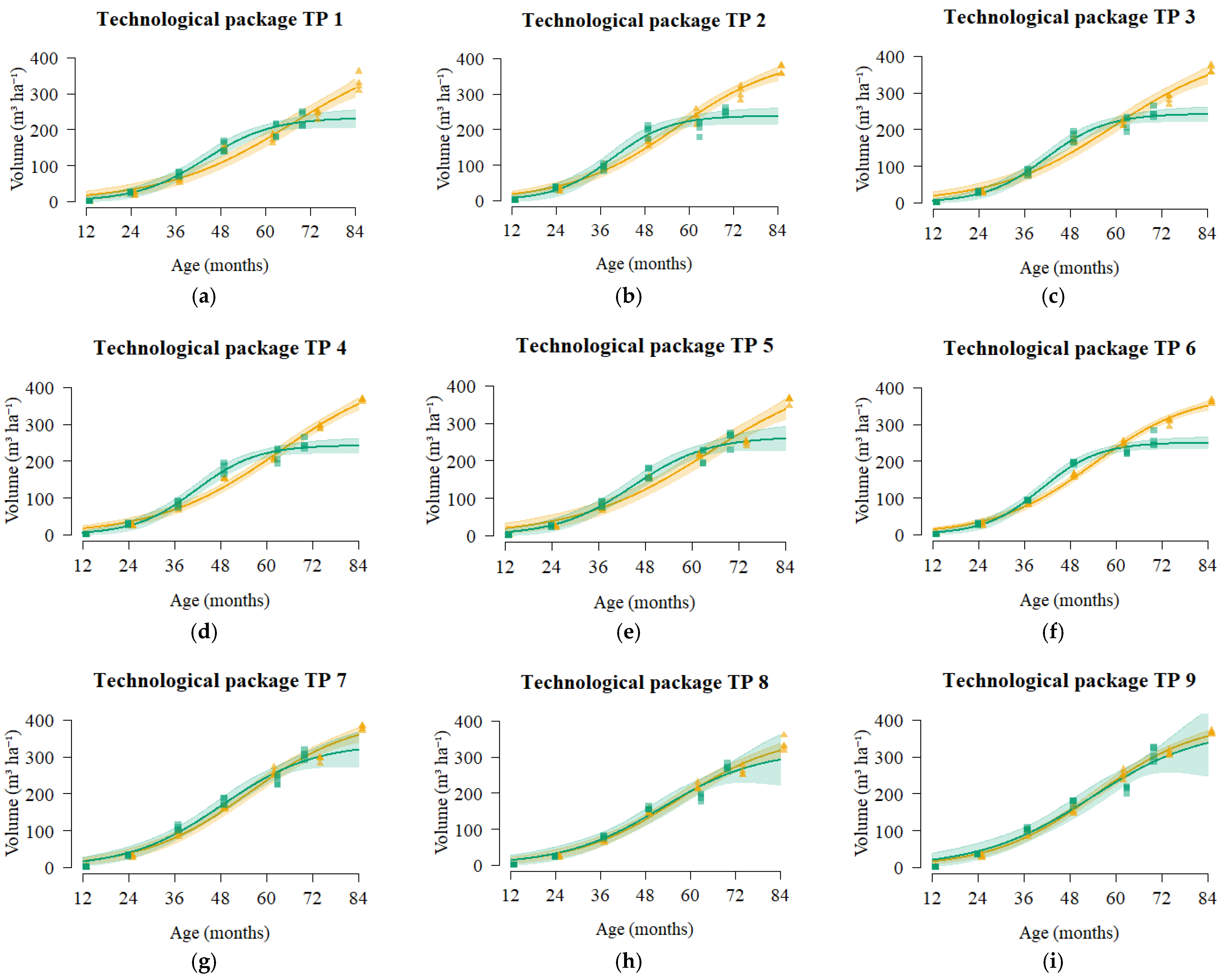
Figure 1. Graphical representations of volume production curves with bark (m3 ha−1) in the first (orange) and second (green) rotations under different technological packages, with emphasis on phosphate fertilization. Shaded areas represent confidence interval ( 1 α  = 0.99).
Forests 17 00013 g001
Table 1. Chemical analysis of the soil in the experimental site across different rotations within the same cultivation cycle.
RotationsSoil Chemical Attributes
pHOM (g dm−3)P(resin) (mg dm−3)K (mg dm−3)Ca (cmolc dm3)Mg (cmolc dm3)
1st4.139.53.715.60.220.08
2nd4.340.44.115.60.240.08
S-SO4 (mg dm−3)B (mg dm−3)Cu (mg dm−3)Fe (mg dm−3)Mn (mg dm−3)Zn (mg dm−3)
1st7.20.60.2109.00.90.4
2nd7.60.60.2117.01.20.6
The durations of the first and second rotations were 84 and 72 months, respectively. OM = organic matter; P = phosphorus; K = potassium; Ca = calcium; Mg = magnesium; S-SO4 = sulfur as sulfate; B = boron; Cu = copper; Fe = iron; Mn = manganese; and Zn = zinc. Soil texture consisted of 12.14% sand, 3.38% silt, and 84.48% clay.
Table 2. Technological packages with emphasis on phosphate fertilization applied in both rotations of the eucalypt cultivation cycle, with basal fertilization corresponding to planting fertilization in the first rotation and to post-sprout fertilization in the second rotation.
PackagesBasal FertilizationTopdressing Fertilization
(kg ha−1)(g plant−1)(Mg ha−1)(kg ha−1)(kg ha−1)
TP1500 ANP130 NPK2 AG210 KCl210 KCl
TP2600 SSP130 NPK2 AG210 KCl210 KCl
TP3280 TSP130 NPK2 AG210 KCl210 KCl
TP4860 RP130 NPK2 AG210 KCl210 KCl
TP5400 NRP130 NPK2 AG210 KCl210 KCl
TP6500 ANP130 NPK2 AG210 KCl + 200 SA210 KCl + 400 SA
TP7280 TSP130 NPK2 AG210 KCl + 200 SA210 KCl + 400 SA
TP8500 ANP130 NPK1 AG210 KCl210 KCl
TP9280 TSP130 NPK1 AG210 KCl + 200 SA210 KCl + 400 SA
Operations schedule: First rotation (84 months)—planting and basal fertilization (June 2005), topdressing (January 2006 and December 2006), and clear-cutting (July 2012). Second rotation (72 months)—initiated after clearcutting with primary sprout thinning (January 2013), followed by basal fertilization (April 2013), secondary sprout thinning (July 2013), topdressing (October 2013 and October 2014), and final clearcutting (July 2018). ANP = Araxá natural phosphate (24% P2O5 + 28% Ca). SSP = Single superphosphate (18% P2O5 + 16% Ca + ~10%–12% S). TSP = Triple superphosphate (41% P2O5 + 13% Ca). RP = Residual phosphate (RLT2; 21% P2O5 + 27% Ca). NRP = Natural reactive phosphate (30% P2O5 + 28% Ca). NPK = 04:26:16 + 0.5% Cu + 1.0% Zn. AG = Agrosilicon (19% Ca + 4.2% Mg). KCl = Potassium chloride (56% K + 0.5% B). SA = Ammonium sulfate (20% N + 22% S).
Table 3. Coefficients and goodness-of-fit statistics of the logistic model for estimating over-bark volume (m3 ha−1) in eucalypt stands managed under different technological packages, with emphasis on phosphate fertilization.
Package   α   β   γ MAERMSE   r Y Y ^
------------------------- 1st Rotation -------------------------
TP1434.328649.49040.058016.0419.920.98 **
TP2408.964650.54190.069412.8115.370.99 **
TP3418.680246.60260.064615.2618.010.99 **
TP4448.783154.66270.063411.7213.390.99 **
TP5443.511243.55500.058718.6321.340.99 **
TP6384.718467.79440.07808.219.801.00 **
TP7404.218755.53870.072613.5116.110.99 **
TP8360.259561.46840.072912.5315.750.99 **
TP9395.171159.02840.074710.5511.821.00 **
------------------------- 2nd Rotation -------------------------
TP1232.5159126.52570.110910.6713.650.99 **
TP2238.1158158.96450.129312.6316.310.98 **
TP3242.7047187.56990.12619.1512.780.99 **
TP4300.656357.58540.083813.7717.530.98 **
TP5263.3778103.77450.103812.0015.850.99 **
TP6250.5299228.55740.13427.3710.850.99 **
TP7335.972355.01270.083113.8916.590.99 **
TP8317.565956.59370.077215.8919.050.98 **
TP9377.878840.61670.069319.0822.710.98 **
** Significant at the 1% level according to the t-test.  α β  and  γ  are parameters of the logistic model. MAE = mean absolute error. RMSE = root mean square error.  r Y Y ^  = correlation coefficient.
Table 4. Technical cutting age (TCA), over-bark volume, and percentage difference of the second rotation relative to the first in eucalypt managed under different technological packages, with emphasis on phosphate fertilization.
Packages1st Rotation2nd Rotation
TCA (Months)Volume (Months)TCA (Months)Volume (m3 ha−1)
TP189.98342.5555.52 (61.70%)183.37 (53.53%)
TP275.50322.5449.39 (65.42%)187.82 (58.23%)
TP379.85330.1851.95 (65.06%)191.41 (57.97%)
TP483.88353.9364.08 (76.39%)237.10 (66.99%)
TP586.73349.7957.41 (66.19%)207.72 (59.38%)
TP670.94303.4150.29 (70.89%)197.59 (65.12%)
TP773.47318.7964.07 (87.21%)264.96 (83.11%)
TP874.56284.1269.34 (93.00%)250.47 (88.15%)
TP972.22311.6572.46 (100.33%)298.05 (95.63%)
Values in parentheses represent the percentage similarity of the second rotation relative to the first. TCA = Technical Cutting Age.
Table 5. Summary of the nonlinear model identity test for volume production equation of eucalypt managed under different technological packages, with emphasis on phosphate fertilization.
Groupsp-ValueGroupsp-ValueGroupsp-Value
1st Rotation2nd RotationCombined rotations
TP1 a TP9≤0.01TP1 a TP9≤0.01TP7 a TP9≤0.01
TP1-TP6-TP8≤0.01TP1-TP6-TP8≤0.01TP7-TP8≤0.01
TP3-TP7-TP90.71TP3-TP7-TP9≤0.01TP7-TP90.40
TP7 a TP9≤0.01TP7 a TP9≤0.01TP8-TP9≤0.01
TP1 a TP6≤0.01TP1 a TP60.02--
TP1-TP4-TP50.03----
p-value = probability value.
Disclaimer/Publisher’s Note: The statements, opinions and data contained in all publications are solely those of the individual author(s) and contributor(s) and not of MDPI and/or the editor(s). MDPI and/or the editor(s) disclaim responsibility for any injury to people or property resulting from any ideas, methods, instructions or products referred to in the content.



