Article

Climate Change and Ecological Restoration Synergies Shape Ecosystem Services on the Southeastern Tibetan Plateau


1
State Grid Economic and Technological Research Institute Co., Ltd., Beijing 102200, China
2
School of Land Science and Technology, China University of Geosciences, Beijing 100083, China
*
Author to whom correspondence should be addressed.
Forests 2026, 17(1), 102; https://doi.org/10.3390/f17010102
Submission received: 15 November 2025 / Revised: 25 December 2025 / Accepted: 7 January 2026 / Published: 12 January 2026

Abstract

Global environmental changes significantly alter ecosystem services (ESs), particularly in fragile regions like the Tibetan Plateau. While methodological advances have improved spatial assessment capabilities, understanding of how multiple drivers interact to shape ecosystem service heterogeneity remains limited to regional scales, especially across complex alpine landscapes. This study aims to clarify whether multi-factor interactions produce nonlinear enhancements in ES explanatory power and how these driver–response relationships vary across heterogeneous terrains. We quantified spatiotemporal patterns of four key ecosystem services—water yield (WY), soil conservation (SC), carbon sequestration (CS), and habitat quality (HQ)—across the southeastern Tibetan Plateau from 2000 to 2020 using multi-source remote sensing data and spatial econometric modeling. Our analysis reveals that SC increased by 0.43 t·hm−2·yr−1, CS rose by 1.67 g·m−2·yr−1, and HQ improved by 0.09 over this period, while WY decreased by 3.70 mm·yr−1. ES variations are predominantly shaped by potent synergies, where interactive explanatory power consistently surpasses individual drivers. Hydrothermal coupling (precipitation ∩ potential evapotranspiration) reached 0.52 for WY and SC, while climate–vegetation synergy (precipitation ∩ normalized difference vegetation index) achieved 0.76 for CS. Such climate–restoration synergies now fundamentally shape the region’s ESs. Geographically weighted regression (GWR) further revealed distinct spatial dependencies, with southeastern regions experiencing strong negative effects of land use type and elevation on WY, while northwestern areas showed a positive elevation associated with WY but negative effects on SC and HQ. These findings highlight the critical importance of accounting for spatial non-stationarity in driver–ecosystem service relationships when designing conservation strategies for vulnerable alpine ecosystems.

1. Introduction

Global climate change, characterized by shifting temperature regimes and altered hydrological cycles, increasingly destabilizes the delivery of essential ecosystem services (ES)—the foundational benefits that human societies derive from nature [1]. These perturbations, compounded by unsustainable resource exploitation, have triggered a worldwide decline in the capacity of ecosystems to provide critical regulating and supporting functions [2,3]. This degradation is particularly acute on the southeastern Tibetan Plateau (STP), where the convergence of rapid climatic warming and intensive anthropogenic pressures, such as overgrazing, has precipitated significant alpine grassland degradation [4,5]. In response, ecological restoration has emerged as a central pillar for stabilizing these fragile landscapes and reclaiming lost ecological functions [6,7]. However, as the efficacy of restoration interventions is often constrained by the extreme spatial heterogeneity of the STP, a rigorous quantification of ES spatiotemporal dynamics and their response to climate–land use interactions is essential for informing targeted management and ensuring regional sustainability [8].
The precise quantification and mapping of ESs are crucial for their integration into environmental governance. The conceptual landscape of ES research was significantly shaped by the foundational frameworks of Costanza et al. and the Millennium Ecosystem Assessment (MEA), which provided the theoretical basis for identifying and categorizing global ecosystem functions [9]. While these pioneering works often emphasized monetary valuation as a tool for policymaking, contemporary research has increasingly diversified to include the biophysical quantification of ES supply and its spatial dynamics. For instance, Ouyang et al. refined these frameworks by developing a tailored scale for China’s specific national context, facilitating the assessment of ES patterns across various regions [10,11,12]. Building on this transition from purely economic valuation toward spatially explicit assessment, this study focuses on the biophysical supply and spatial heterogeneity of ESs. However, applying these assessment frameworks to complex landscapes like the Tibetan Plateau remains challenging, particularly in quantifying non-stationary driver-response relationships. Advances in spatial analysis, such as geographic detector methods and spatial statistical models, have transformed ES assessments by decoding spatiotemporal patterns and their drivers [13,14,15,16]. While effective across multiple scales [17,18,19,20], these analytical frameworks often fail to capture localized driver effects in high-altitude regions characterized by extreme spatial heterogeneity.
The question then remains: To what extent have widespread vegetation changes across the Tibetan Plateau altered its critical ecosystem services, and what mechanisms govern these responses? To address this question, we analyzed two decades of ecosystem service dynamics across this globally significant yet ecologically fragile region. We selected the STP for this investigation because of its dual identity as China’s primary ecological security barrier and Asia’s vital water tower [21]. This unique status confronts growing pressures from intensified anthropogenic activities that increasingly threaten its natural capital [22]. The methodological progression in remote sensing and ecological modeling has fundamentally transformed our capacity to monitor these vital ESs. Current research efforts concentrate on three primary domains: the systematic classification of ecosystem services using integrated geospatial technologies [23]; comprehensive assessment of climate change associated with, with particular focus on carbon sequestration processes within grassland and wetland ecosystems [24]; and comprehensive water security studies addressing the hydrological consequences of accelerated glacier retreat [25]. This consolidated research framework provides the essential foundation for evaluating how large-scale ecological recovery influences ES provision across this sensitive region. Parallel research thrusts include building habitat protection networks and ecological corridors [26], with a growing emphasis on the nexus between ecosystem services and human well-being. Together, these efforts underscore the critical importance of ES research for guiding regional conservation and development.
The STP, a core component of “Asia’s water tower,” exhibits extreme sensitivity to global environmental shifts while providing indispensable services such as water yield and carbon sequestration [27]. Despite the ecological prominence of the STP, the extent to which multifaceted environmental and human pressures interact to modulate ES patterns, and whether these driver–response relationships exhibit significant non-stationarity across complex terrains, has yet to be fully elucidated. Current understanding is hindered by a lack of quantitative evidence regarding the interactive magnitude of drivers and their spatial non-stationarity across extreme elevational gradients [28]. To address this, this study aims to clarify the mechanisms of ES variation by integrating multi-source remote sensing data with a dual-modeling framework: (1) quantify spatiotemporal patterns of key ecosystem services from 2000 to 2020 using remote sensing, and (2) utilizing geographic detectors to quantify the nonlinear enhancements produced by driver interactions, and (3) reveal how these driving mechanisms vary spatially across the STP’s complex elevational gradients. This research provides a robust empirical basis for formulating differentiated conservation strategies tailored to the heterogeneous terrains of the STP.

2. Materials and Methods

2.1. Study Area

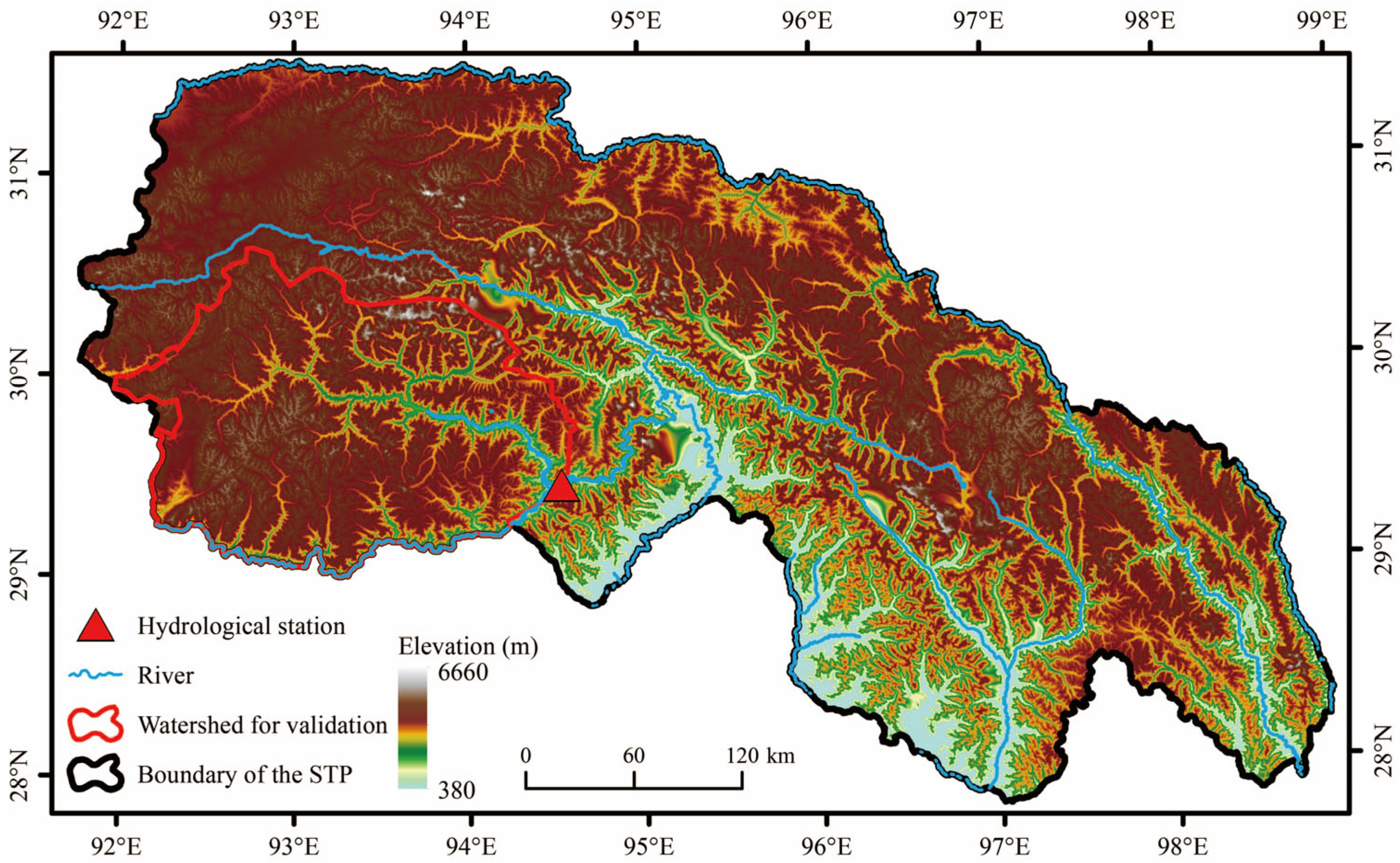
The STP (91°45′52″–98°52′52″ E, 27°48′42″–31°34′7″ N) forms a unique ecotone where the Nyenchen Tanglha Mountains, Himalayan eastern fringe, and Hengduan Mountains converge (Figure 1). This 149,100 km2 transition zone exhibits three defining characteristics: extreme topographical gradients (371–7261 m elevation) create China’s densest maritime glacier distribution; monsoon-driven hydrologic systems generate southeast–northwest decreasing precipitation patterns; and vertical vegetation stratification encompasses alpine meadows, subtropical forests, and tropical rainforests. Such geodiversity sustains exceptional biodiversity, making STP a priority area for ecological security monitoring using satellite-based approaches.

2.2. Data Sources

The datasets used in this study mainly included precipitation data, soil data, land use data, DEM data, and NDVI data. Details of the datasets used are shown in Table 1. After a series of preprocessing, such as splicing, alignment, cropping, projection transformation, and resampling, the above data were converted into a 30 m resolution raster and projected using the WGS_1984_UTM_Zone_46N coordinate system.

2.3. Methods

2.3.1. Ecosystem Service Assessment Methods

(1)
Water Yield
Water yield capacity is vital for regional ecological security [29]. Evaluating the water yield function in this region can help enhance its ESs [30]. Therefore, this study applies the Water Yield module of the InVEST model (version 3.13.0; Natural Capital Project, Stanford University, Stanford, CA, USA) to calculate the annual surface water yield, using it as an indicator to measure the water yield capacity. The calculations are primarily based on the Budyko water–energy coupling balance equation [31]. The formula is as follows:
Y x   = ( 1 A E T x / P x ) × P x
where Yx represents the annual water yield (mm) of grid cell x in the study area; Px denotes the annual precipitation of grid cell x; and AETx indicates the annual actual evapotranspiration of grid cell x.
(2)
Soil Conservation
In this study, the soil conservation service is assessed using the SDR module within the InVEST model. Through ArcGIS software (version 10.8; Esri, Redlands, CA, USA), we quantify soil erosion within a given cell [32,33,34]. Soil erosion can be expressed as follows:
S C = R K L S U S L E
R K L S = R × K × L × S
U S L E = R × K × L × S × P × C
where RKLS represents the potential soil erosion amount (t·hm−2·yr−1), and USLE denotes the actual soil erosion amount (t·hm−2·yr−1).
Data sources and calculation methods for each USLE factor are as follows:
R (Rainfall erosivity factor, MJ·mm·hm−2·h−1·yr−1): Calculated using the daily precipitation data (1 km) from the National Earth System Science Data Center (http://gre.geodata.cn).
K (Soil erodibility factor, t·hm2·h·hm−2·MJ−1·mm−1): Derived from the Harmonized World Soil Database (HWSD).
LS (Slope length and steepness factor, dimensionless): Computed from the 30 m resolution GDEMV3 DEM data (https://www.gscloud.cn/).
C (Vegetation cover factor, dimensionless): Estimated based on the NDVI data (MOD13A3, 1 km resolution) from NASA Earthdata (https://www.earthdata.nasa.gov/).
P (Conservation practice factor, dimensionless): Assigned according to land use types from the CNLUCC dataset (1 km), with values referenced from the FAO guidelines and regional studies on the Tibetan Plateau.
(3)
Carbon Sequestration
The net primary productivity (NPP) index was adopted to assess carbon assimilation. NPP represents the net accumulation of organic matter by plants per unit area over time. Computationally, it is derived from the product of absorbed photosynthetically active radiation (APAR) and light use efficiency (ε), following the core logic of the CASA model [35].
N P P ( x , t ) = A P A R ( x , t ) × ε ( x , t )
where x denotes the spatial location; t denotes time; APAR(x,t) denotes the photosynthetically active radiation absorbed by the spatial location x in month t; and ε(x,t) is the photoconversion rate of the image element x in month t.
(4)
Habitat Quality
Habitat quality, a key indicator of biodiversity and ecosystem service potential [36,37,38], was quantified using the InVEST model to evaluate species conservation capacity in the study area. The assessment integrates landscape structure and threat factors through the standardized equation:
Q x j = H j 1 D x j z / D x j z + k z
where Qxj represents the habitat quality value of raster cell x within land use type j. z and k are proportion factors. Dxj represents the total threat level value for each raster cell within the land use/cover type.

2.3.2. Principal Component Analysis

This study selects seven potential driving factors from the fields of climate, vegetation, topography, socio-economics, and land use types. Detailed information on all the driving factors is listed in Table 2.
Principal component analysis (PCA) [39,40,41] was applied to transform correlated multi-dimensional indicators into orthogonal principal components through eigenvalue decomposition, achieving dimensionality reduction while preserving maximal variance in the dataset. This approach effectively addresses multicollinearity among driving factors and generates statistically independent composite variables for subsequent analysis.
P C i = l i 1 X 1 + l i 2 X 2 + ... + l i n X n
where PCi is the i-th PC, Xn is the j-th predictor variable, and lin is the coefficient of Xj (i, n = 1, 2,…, n).

2.3.3. Geo-Detector Model

The Geo-detector model [42] quantitatively assesses spatial stratified heterogeneity by measuring the consistency between dependent and independent variables’ distributions through determinant power (q). Based on the geographical superposition principle, it assumes that if factor X influences variable Y, their spatial patterns will exhibit similar stratification, with qx calculated as follows:
q x = 1 1 N σ 2 i = 1 m σ 1 2
where m represents the number of classifications of influencing factors within the study area. N and Ni denote the total number of observation units in the entire study area and in the i layer, respectively. σ and σi represent the variances of the explained variable in the entire study area and in the i layer, respectively. The q value ranges from 0 to 1; a higher q value indicates a greater contribution of the influencing factor Xi to the dependent variable Y.

2.3.4. Geographically Weighted Regression (GWR)

Unlike traditional regression with global relationships [43], GWR generates location-specific equations to capture spatial non-stationarity [44,45]. By incorporating geographic coordinates into the regression framework, GWR models the spatially varying relationships between predictors and outcomes through the local formulation:
Y i = β o ( u i , v i ) + k = 1 k β k ( u i , v i ) x i k + ε i
where Yi is the observed variable; Xik is the k-th independent variable; (ui, vi) stands for the space-time coordinate of the i-th element; ui and vi represent the latitude and longitude of the observation i; βo (ui, vi) means the slope value; βk (ui, vi) is the coefficient of Xik; and εi is the residual of the i-th point.

2.3.5. Model Accuracy Verification

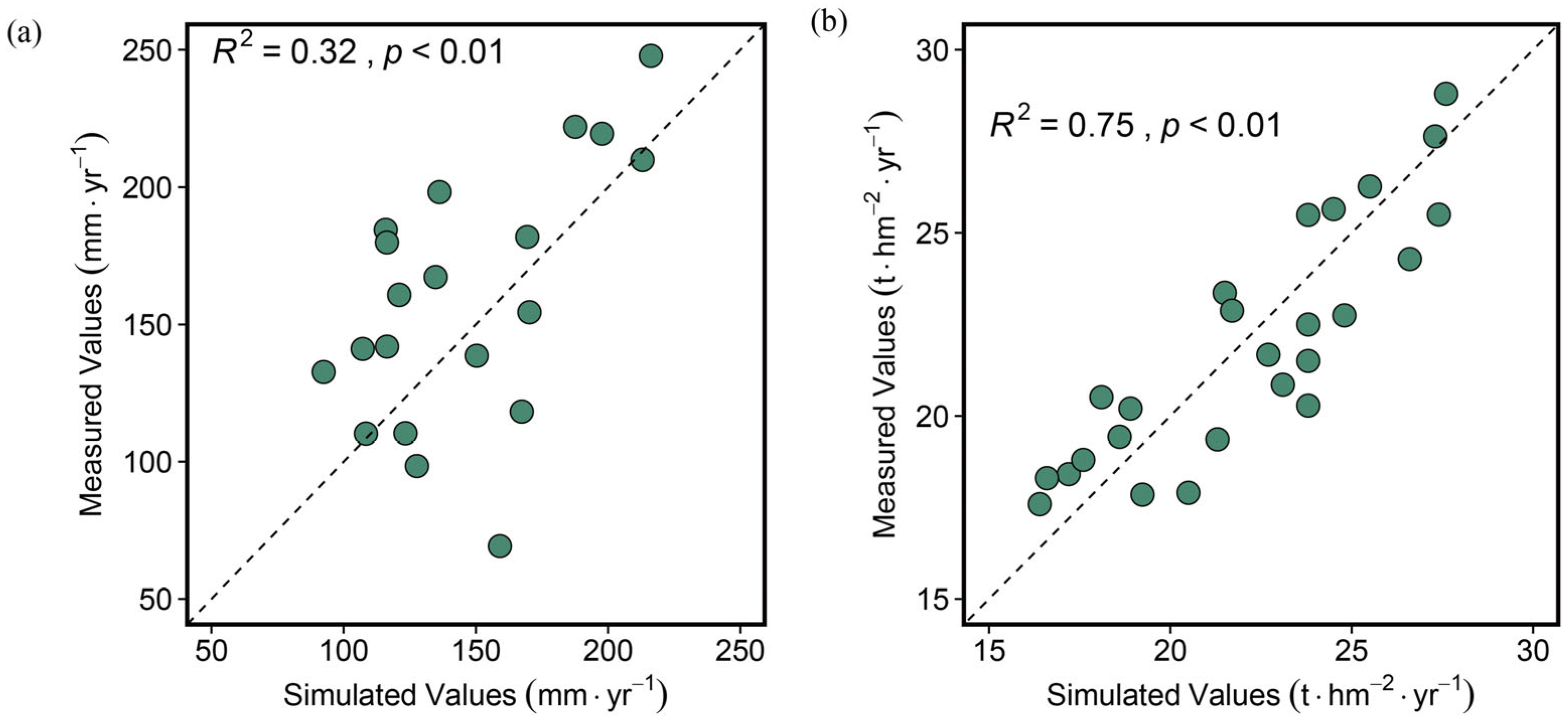
The reliability of InVEST-modeled ESs in STP was validated using observed data from key hydrological stations. For water yield, the simulated results were compared against multi-year observations from the Nuxia hydrological station (Figure 2a). For soil conservation, the simulated erosion intensity was calibrated using sediment transport data from the Yarlung Tsangpo River basin (Figure 2b).
The results of the water yield simulation versus observed values showed an R2 of 0.32 (p < 0.01). It is consistent with hydrological modeling benchmarks in the high-altitude cryosphere of the Tibetan Plateau. The discrepancy primarily stems from the inherent complexity of alpine hydrology, where the InVEST model does not explicitly account for seasonal snowmelt and glacial meltwater contributions. Additionally, the sparse distribution of meteorological stations in complex mountain terrains introduces inevitable interpolation uncertainties. For soil conservation, the R2 reached 0.75 (p < 0.01), indicating robust performance. Despite the challenges in point-to-point temporal fitting for water yield, the model successfully captures the broad spatial gradients and macro-scale patterns across the study area. These results suggest that the simulation is adequate for analyzing the relative spatial evolution and driving mechanisms of ESs in this region.

3. Results

3.1. Spatial Heterogeneity and Spatiotemporal Variation of ESs

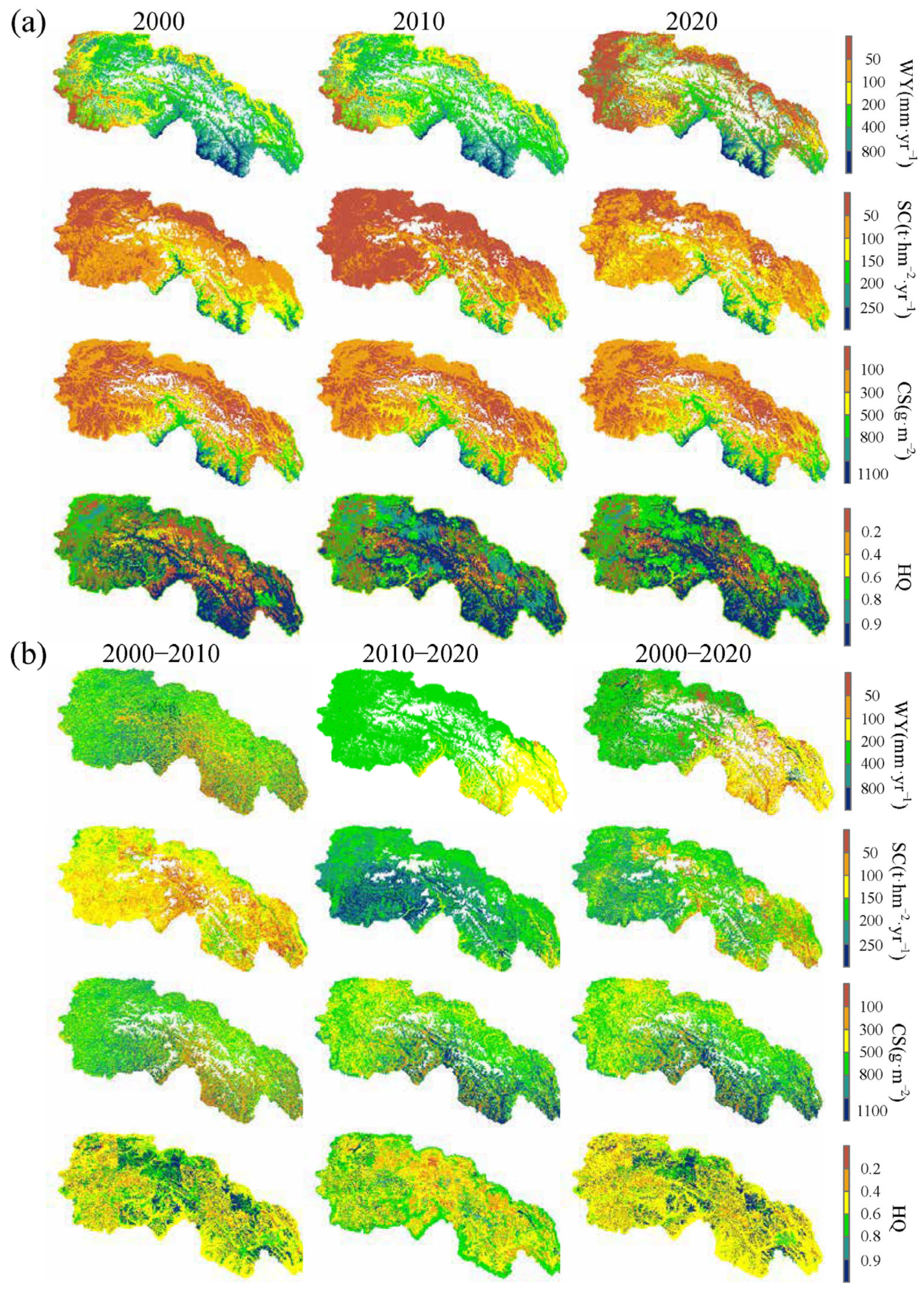
The study area generally exhibits a southeast–northwest gradient in ESs (Figure 3), with high-value clusters for WY, SC, and CS consistently concentrated in southeastern forested regions and central river valleys. However, HQ displays a more nuanced spatial pattern; while also high in the forested southeast, significant high-value areas extend into the northern and western sectors. These northern and western HQ hotspots coincide with expansive alpine grasslands and high-altitude wetlands, which, despite their lower water and carbon provisioning capacities, maintain high habitat integrity due to minimal anthropogenic interference. Consequently, while WY, SC, and CS are predominantly driven by a precipitation–biomass gradient, HQ distribution reflects the preservation of intact natural land covers across both the forested southeast and the alpine northwest. Over the two-decade period, the regional mean WY decreased from 357.90 mm·yr−1 in 2000 to 283.88 mm·yr−1 in 2020, a decline driven primarily by reductions in the southeast. In contrast, SC increased from 79.24 t·hm−2·yr−1 to 87.79 t·hm−2·yr−1, with the most significant gains concentrated in the southwest. CS showed a rise from 225.66 g·m−2 to 259.11 g·m−2, characterized by a general increase across southern areas. HQ improved from 0.57 to 0.66, maintaining high values in western, northern, and southwestern grassland and forest patches; however, the central region exhibited a complex mosaic of localized declines and improvements.
Distinct decadal trends, derived by differencing sequential decadal averages, further elucidated these patterns (Figure 3b). WY experienced a decline of 4.01 mm·yr−1 during 2000–2010 compared to 3.39 mm·yr−1 in 2010–2020, with the southeast showing decreases against western gains. SC showed a decline of 2.45 t·hm−2·yr−1 during the initial decade, predominantly in the central and southeastern regions, followed by a recovery with an increase of 3.31 t·hm−2·yr−1 in the subsequent decade, driven by the northwestern region’s revitalization. CS remained stable from 2000 to 2010, with southeastern losses offsetting western gains, but increased by 1.99 g·m−2·yr−1 during 2000–2010, particularly in the southeast. HQ increased by 0.05 units from 2000 to 2010, with improvements concentrated largely in central regions. From 2010 onward, the overall trend stabilized, as values in the central region began to decline while western areas continued to improve.

3.2. The Dominating Factors of ESs

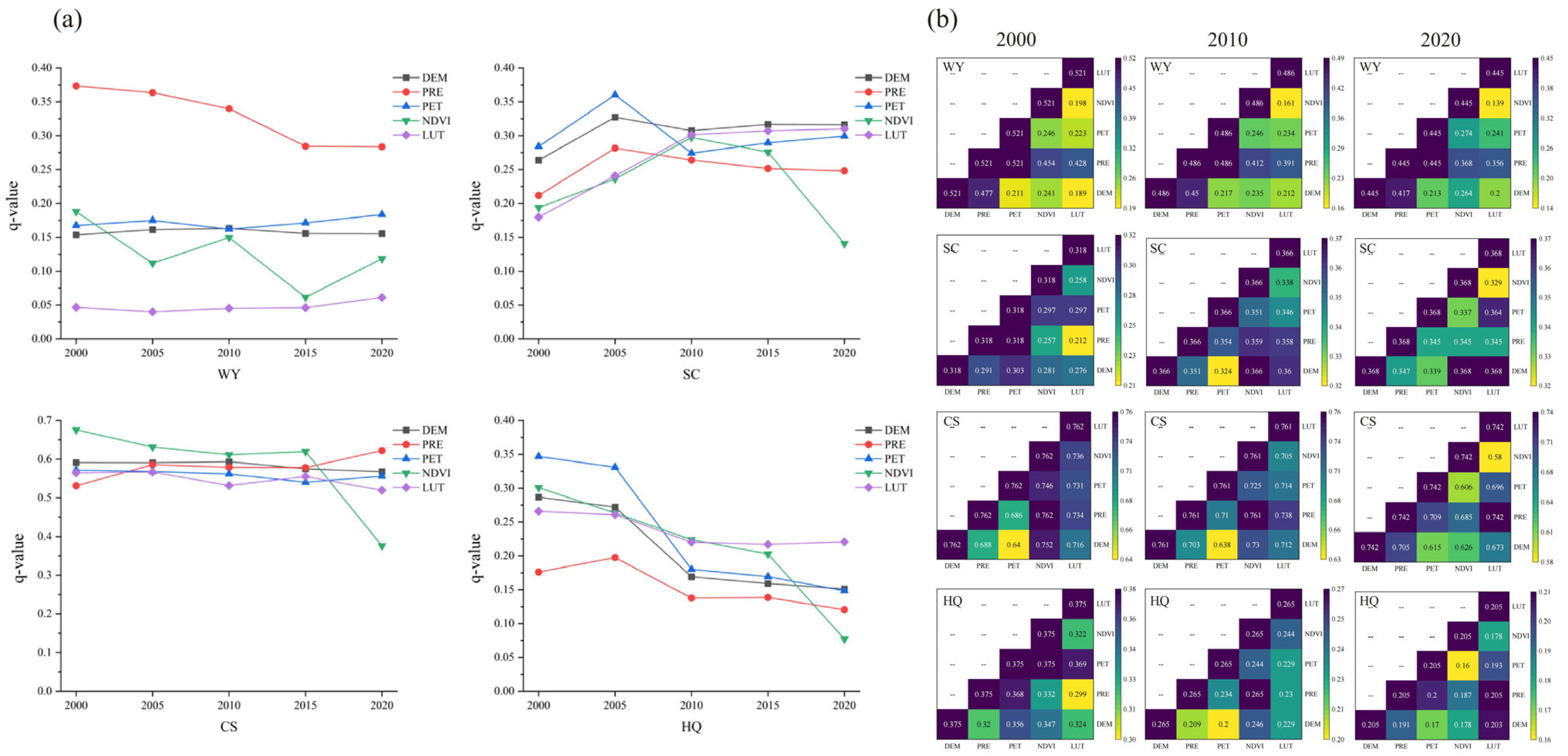
Principal component analysis (PCA) distilled seven potential drivers into five dominant factors: DEM, PET, LUT, NDVI, and PRE. We excluded GDP, POP, SLOPE, and TMP because they contributed little to the overall variance. Our geographical detector analysis showed that all five factors were statistically significant drivers (p < 0.01), and their influence changed in distinct ways from 2000 to 2020 (Figure 4a). For WY, PRE had the strongest influence throughout the study period, with q-values starting at 0.33 in 2000 and remaining at 0.32–0.34. PET showed a consistent but weaker effect, with q-values between 0.16 and 0.18. For SC, DEM demonstrated increasing dominance with q-values rising from 0.31 in 2000 to 0.33 in 2020, whereas PET remained consistently influential around q-values of 0.30. CS exhibited equally strong associations with DEM, PRE, and NDVI, with all three maintaining q-values between 0.56 and 0.58 throughout the study period. In contrast, HQ was primarily governed by NDVI, though its explanatory power declined from a q-value of 0.24 in 2000 to 0.22 by 2020.
Interaction analysis revealed that two-factor combinations generally provided greater explanatory power for ecosystem services than single factors (Figure 4b). For WY, the PRE∩PET interaction reached a peak of 0.521 in 2000, underscoring the dominance of hydrothermal coupling. The interactive influence of PRE∩NDVI at 0.454 notably surpassed the 0.19 explanatory power of NDVI alone, emphasizing vegetation’s role in precipitation partitioning. Regarding SC, the PRE∩PET interaction strengthened from 0.318 in 2000 to 0.366 in 2020, at which point the DEM∩LUT interaction climbed to 0.368, signaling that anthropogenic land-use practices have become as decisive as climatic forces in modulating erosion. The most intense nonlinear enhancements were observed in CS, where the PRE∩NDVI interaction held a q-value of 0.762 through 2010; however, by 2020, the PRE∩LUT interaction took precedence with a q-value of 0.742, outperforming the 0.685 observed for PRE∩NDVI. A similar trajectory was evident for HQ, as dominant interactions evolved from PET∩NDVI at 0.375 in 2000 to PRE∩NDVI at 0.265 in 2010, and finally to the PRE∩LUT interaction at 0.205 in 2020, collectively highlighting the expanding role of human interventions in shaping regional ecosystem functionality.

3.3. The Driving Factors for Spatial ESs Heterogeneity

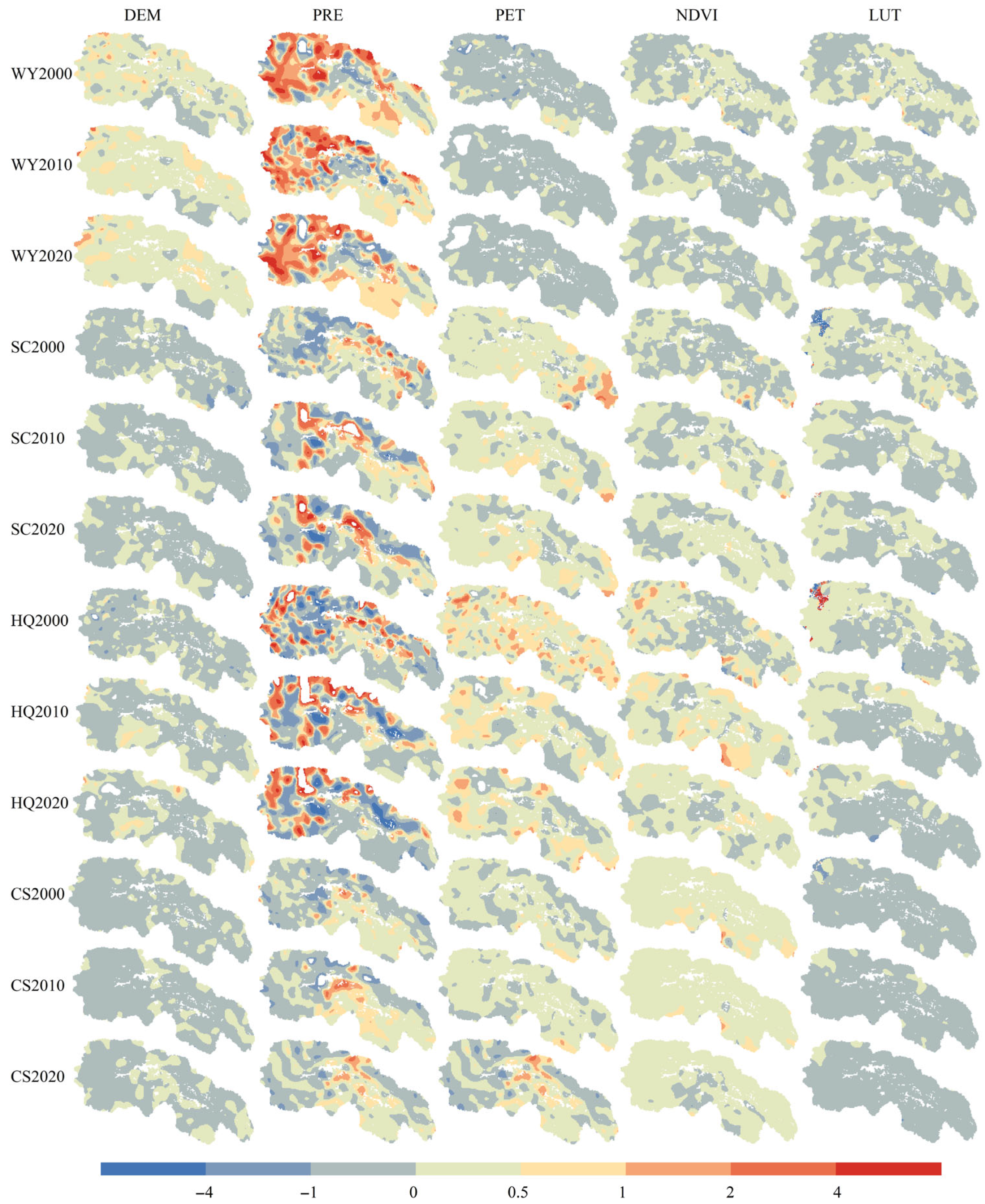
Complex spatiotemporal heterogeneity in the drivers of ecosystem services across the STP region emerges from our GWR analysis (Figure 5). For WY, PRE remained the primary positive driver, with its median coefficient increasing from 0.527 to 0.698, while PET maintained a stable negative effect near −0.305. DEM exerted a predominantly negative influence that transitioned from fragmented patches in 2000 to concentrated clusters by 2020, signaling a strengthening spatial dependency. Coefficients mostly hovered around −0.1, though extreme negative intensity reached −1.3 in the southeast by 2010 and −6.0 in the northwest by 2020. In the southeastern STP, this negative DEM-WY relationship is driven by the region’s extreme vertical relief, where higher altitudes often face reduced moisture interception and increased evapotranspiration compared to the humid, moisture-trapping valley corridors, leading to a decline in water yield capacity as elevation rises. Regarding SC, GWR results clarify that PET predominantly exerts a negative influence across the southeastern, northwestern, and northern STP, with coefficients ranging from −1.98 to −1.08 in 2000, −1.63 to −0.86 in 2010, and −1.60 to −0.6 in 2020. While slight positive coefficients (0–0.23) were observed in central STP, their absolute values are significantly lower than the negative impacts recorded in other regions, confirming that higher evaporative demand generally suppresses soil conservation capacity. PRE demonstrated pronounced temporal variability, with its median coefficient shifting from −0.014 in 2000 to 0.072 in 2010, before reverting to −0.018 in 2020, reflecting a sensitive, context-dependent role. Meanwhile, DEM consistently exerted negative pressure on SC, with median values intensifying slightly from −0.106 in 2000 to −0.115 by 2020.
For CS, the NDVI persisted as the most stable positive driver, even as its median value decreased from 0.202 to 0.071. Concurrently, the positive effect of PET intensified significantly, its median rising from 0.052 to 0.172. DEM’s negative influence weakened markedly, its median improving from −0.099 to −0.048, indicating a relaxation of topographical constraints. HQ was governed by the consolidation of negative spatial drivers. GWR results confirm that PET exerted a persistent negative influence, transitioning from dispersed patches in 2000 to contiguous clusters by 2020, with median negative intensity strengthening from −0.1 to −0.3. In the northwestern core, coefficients reached −1.5, suggesting that high evaporative stress restricts habitat suitability by reducing moisture availability and vegetation vigor. Crucially, the influence of LUT shifted from 0.001 in 2000 to a significant negative value of −0.118 by 2020, underscoring that anthropogenic land-use transitions are increasingly degrading habitat integrity. Combined with the stable negative pressure from DEM (−0.181 to −0.124), these trends indicate that the STP’s regional habitat is under escalating pressure from both climatic variability and intensified human activities.

4. Discussion

4.1. Forest–Grassland Conversions Amplify ES Fluctuations in STP

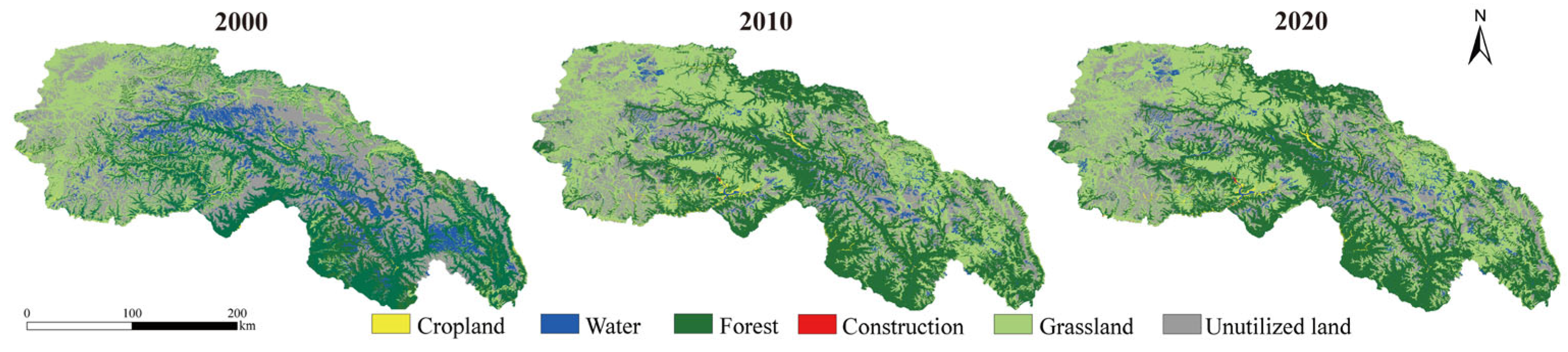
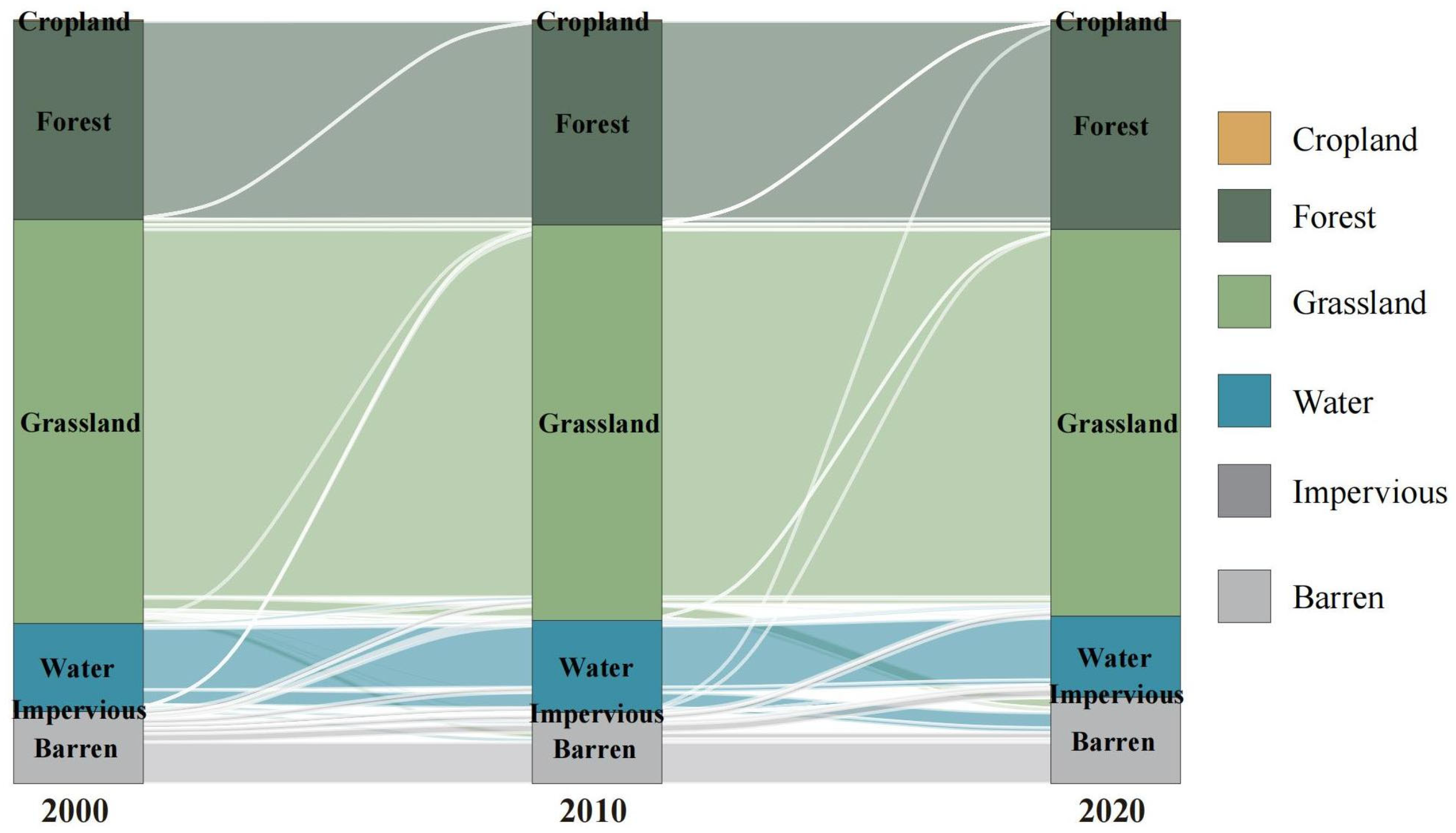
The evolution of ecosystem services across the STP between 2000 and 2020 is closely associated with systematic land use transitions, particularly the conversion between forest and grassland (Figure 6 and Figure 7). Our statistical analysis provides evidence of a consistent afforestation trend: forest area increased from 25.97% in 2000 to 26.68% in 2010, reaching 27.24% by 2020. This expansion primarily drew from the grassland pool, which concurrently contracted from 52.89% to 50.64%. As illustrated in the Sankey diagram (Figure 7), these transitions represent a strategic shift in land cover, where the replacement of grassland or cropland with forest in the southeast correlates with a reduction in WY in exchange for enhanced SC, CS, and HQ. These dynamics align with Liu et al., who documented an 18.92% increase in water yield following similar vegetation transitions [46]. After 2010, the region exhibited “landscape stabilization,” which we define here as a decelerating rate of land use conversion and the subsequent consolidation of vegetation patches. This stabilization, particularly through grassland expansion, facilitated the recovery of soil conservation and carbon sequestration. This recovery trajectory supports Lian et al.’s identification of nonlinear ES responses to sustained land use change, with the observed 10-year stabilization lag matching temporal thresholds reported from Qinghai Lake [47].
These LUCC-ES dynamics, however, cannot be fully understood without considering how they are modulated by climate and human interventions [48]. Although post-2010 landscape stabilization supported ES recovery, regional studies emphasize precipitation’s powerful role. Lan et al., for example, identified precipitation as the dominant control on WY with a correlation coefficient of 0.954, suggesting climate variability can override LUCC effects in arid subregions [49]. Similarly, Liu et al. found that meteorological and topographic factors outweighed land use in governing water yield and soil conservation, respectively [50]. Human interventions further reshape these relationships [51,52]. Chen et al. demonstrated that improved grazing management increased soil water content by 43%–55% and forage biomass by 57%, showing how anthropogenic strategies can alter LUCC-ES lag effects [53]. Zhang et al. further highlighted how plant functional groups—particularly legumes promoting diversity—mediate vegetation responses to land use change [54]. In other words, ecosystem service dynamics stem not from land use alone, but from its interaction with climate and local human actions. Effective governance must therefore account for these spatiotemporal lags, particularly in high-altitude landscapes where such interactions are most pronounced.

4.2. The Necessity of Studying ES Drivers at Different Spatial Scales

The complex drivers of ecosystem services in the STP operate differently across spatial scales—a pattern that becomes clear only through multi-scale analysis. At the regional level, PCA identified climate factors as dominant controls, with precipitation and potential evapotranspiration shaping broad ecosystem service patterns. This finding aligns with several large-scale studies: it supports Liu et al.’s work in the Qinghai–Tibet Plateau, where climate and land use intensity emerged as primary drivers at broader scales [55], and corroborates Zhou et al.’s emphasis on macro-scale climatic controls [56]. However, these regional relationships masked critical local variations. Our geographically weighted regression revealed that precipitation coefficients ranged from −0.014 in western grasslands to 0.072 in central forests, while land use type showed a strongly negative association with habitat quality in southeastern regions, with median coefficients declining to −0.118 by 2020. This spatial non-stationarity echoes the scale-dependent effects observed in other mountain systems and aligns with the metacoupling framework proposed by Liu et al., which emphasizes the importance of cross-scale interactions [57].
These cross-scale dynamics have direct implications for ecosystem governance. The disconnect between regional patterns and local processes means that management strategies based solely on broad-scale driver assessments may fail at local levels [58]. This challenge is evident in our finding that cropland-grassland conversions produced contrasting effects across scales—a phenomenon that supports Delphin et al.’s argument about the critical role of meso-scale phenomena [59]. The management significance of these scale effects is further underscored by Sun et al., who demonstrated that payments for ecosystem services require careful consideration of scale linkages and local contexts to be effective [60]. In other words, our results provide empirical evidence that effective ecosystem governance must account for how drivers operate differently across spatial scales—particularly in complex landscapes like the STP, where both regional patterns and local heterogeneity shape ecosystem outcomes.

4.3. Informing Policy for Sustaining ES Provision in STP

Interactive effects among climate, vegetation, and land use produce combined associations far stronger than their individual influences [61]. Our findings make it clear that these synergies fundamentally challenge conventional single-driver approaches to ecosystem management. While Sheng et al. established that climate factors contributed over 45% to ecological restoration in the Three-River-Source region, our study reveals that specific factor combinations generate substantially stronger effects [62]. The PRE∩NDVI interaction explained 0.762 of carbon sequestration variation in 2000, while PRE∩LUT reached 0.742 for carbon sequestration and 0.205 for habitat quality by 2020. Similarly, our analysis extends Wu et al.’s documentation of the dual nature of human activities by quantifying how specific factor combinations drive ecosystem service outcomes [63]. These findings strongly support integrated policies that leverage synergistic effects rather than focusing on singular drivers like grazing pressure or precipitation changes. Addressing these synergies is crucial as the QTP faces an escalating mismatch between ES supply and demand, particularly in densely populated valleys where demand outstrips the natural NW-to-SE supply gradient [64]. These areas are increasingly vulnerable to ecological risks driven by urbanization and intensive grazing, the latter of which has depleted significant vegetation and soil organic carbon across the plateau’s grasslands [65]. Since vegetation condition acts as a vital intermediary, policy interventions must look beyond direct pressures to manage the complex, indirect pathways through which human activities and landscape fragmentation destabilize ecosystem health [66].
The spatially explicit nature of these relationships necessitates management strategies that account for both geographical and temporal dimensions of ecosystem change [67,68,69]. Southeastern regions require stringent land use regulations given land use types’ strongly negative effects, with median coefficients declining to −0.118 by 2020, while western grasslands need adaptive measures to address their high sensitivity to precipitation variations. This spatial patterning aligns with observations across the Tibetan Plateau by Li et al., who reported NDVI increases in 65.68% of the plateau [70]. Temporally, our analysis reveals that driver–ecosystem service relationships have stabilized over time, suggesting policies must transition from initial intervention to long-term maintenance. This approach addresses the divergent patterns between NDVI trends and biomass stability noted by Xiong et al., who observed aboveground biomass stability in over 60% of alpine grasslands despite vegetation changes [71]. In other words, effective policy must simultaneously address the spatial variability of driver associations and their temporal evolution—implementing targeted strategies that sustain ecosystem services across the STP’s diverse and changing landscapes.

5. Conclusions

This study develops a spatially explicit framework to unravel the complex dynamics of four key ecosystem services across the STP. We identified distinct southeast–northwest gradients: WY decreased from 357.90 to 283.88 mm·yr−1 between 2000 and 2020, whereas SC increased from 79.24 to 87.79 t·hm−2·yr−1, CS rose from 225.66 to 259.11 g·m−2·yr−1, and HQ improved from 0.57 to 0.66 overall, despite localized degradation in central areas. Decadal trends further clarify these pathways: WY declined at 4.01 mm·yr−1 during 2000–2010, moderating to 3.39 mm·yr−1 thereafter. SC shifted from decreasing by 2.45 t·hm−2·yr−1 to increasing at 3.31 t·hm−2·yr−1 after 2010, while CS grew steadily at 1.99 g·m−2·yr−1 in the same period.
Ecosystem service dynamics in this region are driven by the nonlinear synergy between climate change and ecological restoration rather than individual factors. For instance, hydrothermal coupling through the PRE∩PET interaction peaked at a q-value of 0.521 for WY, while the PRE∩NDVI synergy reached a high q-value of 0.762 for CS, demonstrating how vegetation greening amplifies climatic effects. Over two decades, a pivotal shift occurred as restoration-led interactions became dominant. By 2020, the synergy between land use and climate reached a q-value of 0.742 for CS and 0.205 for HQ, while the DEM∩LUT interaction rose to 0.368 for SC. These results prove that ecological restoration works alongside climatic gradients to boost carbon sequestration and soil stability, confirming that the observed changes are the integrated outcome of these combined synergies.
These findings are important for several reasons. First, the progressive attenuation of spatial heterogeneity points to landscape-scale homogenization—an emerging process with implications for regional stability. Second, our framework clarifies how drivers differentially influence ecosystem services across subregions, thereby supporting targeted management. In other words, we provide a transferable approach for zonal environmental governance in fragile ecosystems worldwide, where integrating broad patterns with local heterogeneity is essential to achieving sustainability.

Author Contributions

Conceptualization, X.C., J.Z. and D.P.; methodology, X.C., D.P., X.S. and Q.H.; software, Q.H.; formal analysis, D.P., X.S., Y.Z. and X.Z.; investigation, Q.Z., X.S., S.Z., Y.Z. and X.Z.; resources, Y.W., C.L. and S.Z.; data curation, Q.Z., D.P. and X.Z.; writing—original draft preparation, X.C., Q.H., D.P., Q.Z. and C.L.; writing—review and editing, J.Z., X.C., Q.H. and D.P.; visualization, X.C., Q.H., D.P., Y.W. and S.Z.; supervision, J.Z.; project administration, Q.Z., Q.H., D.P., X.C. and J.Z.; funding acquisition, Q.Z., Q.H., D.P., X.C. and J.Z. All authors have read and agreed to the published version of the manuscript.

Funding

This research was funded by the State Grid Corporation Headquarters’ Science and Technology Project: Research on design and construction technology of UHV engineering in high altitude area with fragmented and steep terrain (5200-202356401A-2-4-KJ).

Data Availability Statement

The data presented in this study are available online, as mentioned in Section 2.2.

Acknowledgments

We would like to express our respect and gratitude to the anonymous reviewers and editors for their professional comments and suggestions.

Conflicts of Interest

Authors Xiaofeng Chen, Qian Hong, Yanbing Wang, Chao Liu, Xiaohu Sun, Shu Zhu, Yixuan Zong, Xiao Zhang were employed by the company State Grid Economic and Technological Research Institute Co., Ltd. The remaining authors declare that the research was conducted in the absence of any commercial or financial relationships that could be construed as a potential conflict of interest.

References

  1. Dee, L.E.; Miller, S.J.; Helmstedt, K.J. Quantifying disturbance effects on ecosystem services in a changing climate. Nat. Ecol. Evol. 2025, 9, 436–447. [Google Scholar] [CrossRef]
  2. Wu, J. Landscape sustainability science: Ecosystem services and human well-being in changing landscapes. Landsc. Ecol. 2013, 28, 999–1023. [Google Scholar] [CrossRef]
  3. Song, Q.F.; Niu, X.; Wang, B. Review on forest ecosystem services assessment based on big data. Chin. J. Ecol. 2015, 34, 2914. [Google Scholar]
  4. Wu, X.; Liu, S.; Zhao, S.; Hou, X.; Xu, J.; Dong, S.; Liu, G. Quantification and driving force analysis of ecosystem services supply, demand and balance in China. Sci. Total Environ. 2019, 652, 1375–1386. [Google Scholar] [CrossRef] [PubMed]
  5. Geijzendorffer, I.R.; Martín-López, B.; Roche, P.K. Improving the identification of mismatches in ecosystem services assessments. Ecol. Indic. 2015, 52, 320–331. [Google Scholar] [CrossRef]
  6. Rong, Y.; Luo, Y.; Zheng, L. Novel framework for identifying priority areas in ecological restoration: Integrating ecosystem service flows. Ecol. Front. 2025, 45, 1258–1269. [Google Scholar] [CrossRef]
  7. Huang, B.; Lu, F.; Wang, X. The impact of ecological restoration on ecosystem services change modulated by drought and rising CO2. Glob. Change Biol. 2023, 29, 5304–5320. [Google Scholar] [CrossRef]
  8. Dong, W.; Wu, X.; Zhang, J.J.; Zhang, Y.L.; Dang, H.; Lü, Y.H.; Wang, C.; Guo, J.Y. Spatiotemporal heterogeneity and driving factors of ecosystem service relationships and bundles in a typical agropastoral ecotone. Ecol. Indic. 2023, 156, 11107. [Google Scholar] [CrossRef]
  9. Costanza, R.; d’Arge, R.; de Groot, R.; Farber, S.; Grasso, M.; Hannon, B.; Limburg, K.; Naeem, S.; O’Neill, R.V.; Paruelo, J.; et al. The value of the world’s ecosystem services and natural capital. Nature 1997, 387, 253–260. [Google Scholar] [CrossRef]
  10. OuYang, Z.Y.; Wang, R.S.; Zhao, J.Z. Ecosystem services and their economic valuation. Chin. J. Appl. Ecol. 1999, 10, 635–640. [Google Scholar]
  11. OuYang, Z.Y.; Wang, X.K.; Miao, H. A primary study on Chinese terrestrial ecosystem services and their ecological economic values. Acta Ecol. Sin. 1999, 19, 19–25. [Google Scholar]
  12. Xie, G.D.; Lu, C.X.; Leng, Y.F.; Zheng, D.; Li, S.C. Ecological assets valuation of the Tibetan Plateau. J. Nat. Resour. 2003, 18, 189–196. [Google Scholar]
  13. Wang, Y.Z.; Yu, H.R.; Lu, L. Spatiotemporal pattern and functional zoning of ecosystem services in the Yangtze River Delta region based on spatially constrained K-means. Acta Ecol. Sin. 2024, 44, 7087–7104. [Google Scholar]
  14. Zhou, D.L.; Yang, M.X.; Su, J.Y.; Bai, Y. Research progress in evaluating the value of watershed ecosystem services. J. Desert Res. 2024, 44, 149–164. [Google Scholar]
  15. Tran, D.X.; Pearson, D.; Palmer, A.; Lowry, J.; Gray, D.; Dominati, E.J. Quantifying spatial non-stationarity in the relationship between landscape structure and the provision of ecosystem services: An example in the New Zealand hill country. Sci. Total Environ. 2022, 808, 152126. [Google Scholar] [CrossRef] [PubMed]
  16. Degefu, M.A.; Argaw, M.; Feyisa, G.L.; Degefa, S. Dynamics of urban landscape nexus spatial dependence of ecosystem services in rapid agglomerate cities of Ethiopia. Sci. Total Environ. 2021, 798, 149192. [Google Scholar] [CrossRef] [PubMed]
  17. Ma, Z.Y.; Li, P.; Xiao, L. Identification of Key Areas for Ecological Restoration and Division of Restoration Zones in Qinghai Province. J. Soil Conserv. 2024, 38, 252–265. [Google Scholar]
  18. Xiao, J.Y.; Dai, J.J.; Fang, X.R. Multiple Scenario Simulation of Ecosystem Service Value in Xuzhou City Based on PLUS Model. China Land Sci. 2024, 38, 125–134. [Google Scholar]
  19. Lu, S.; Zhang, H.P.; Pei, X.S.; Wang, Y. Drivers of ecosystem service trade-off and synergy in long-term sequence. a case study of the extremely important ecosystem service function area in Wuhu City. Acta Ecol. Sin. 2024, 44, 1780–1790. [Google Scholar]
  20. Ding, Y.L.; Liu, L.M.; Liu, B.; Li, Y. Spatiotemporal evolution of ecosystem service value in Inner Mongolia Kubuqi Qixing Lake National Desert Park at a grid scale. J. Arid Land Resour. Environ. 2024, 38, 106–114. [Google Scholar]
  21. Bai, P.Z.; Xiao, D.C.; Bao, L.L.; Yao, Y.H. Biodiversity and conservation in the Tibetan Plateau. J. Geogr. Sci. 2002, 12, 135–143. [Google Scholar] [CrossRef]
  22. Tremblay, J.C.; Ainslie, P.N. Global and country-level estimates of human population at high altitude. PNAS 2021, 118, e2102463118. [Google Scholar] [CrossRef]
  23. Tang, Q.; Zhang, G.; Yao, T.; Wieland, M.; Liu, L.; Kaushik, S. Automatic extraction of glacial lakes from Landsat imagery using deep learning across the Third Pole region. Remote Sens. Environ. 2024, 315, 114413. [Google Scholar] [CrossRef]
  24. Li, Y.; Hasbagan, G.; Hu, G.Z.; Wan, Y.F.; Li, Y.E.; Baima, Y.Z.; Gao, Q.Z. Effects of warming on carbon exchange in an alpine steppe in the Tibetan plateau. Acta Ecol. Sin. 2019, 39, 2004–2012. [Google Scholar] [CrossRef]
  25. Immerzeel, W.W.; Van Beek, L.P.H.; Bierkens, M.F.P. Climate change will affect the Asian water towers. Science 2010, 328, 1382–1385. [Google Scholar] [CrossRef]
  26. Ma, X.L.; Guo, S.S.; Xu, Y.; Wei, Z.Q.; Gao, Z.T.; Yu, L.; Hou, J.L. Research on ecological security pattern construction in vulnerable ecological region. Acta Ecol. Sin. 2023, 43, 9500–9513. [Google Scholar]
  27. Wang, Q.X.; Cao, W.; Huang, L. Evolutionary characteristics and zoning of ecosystem functional stability on the Qinghai-Tibet Plateau. Acta Geogr. Sin. 2023, 78, 1104–1118. [Google Scholar]
  28. Liu, H.C.; Sun, Z.R.; Wu, J.Y.; Yu, H.; Yang, X.M.; Zhou, D.J. Evaluation of natural landscape aesthetic value and its spatial differentiation in Tibet from the perspective of ecosystem services. Prog. Geogr. 2023, 42, 1961–1972. [Google Scholar] [CrossRef]
  29. He, Q.Q.; Wang, J.W.; Bi, X.; Song, X.W. Temporal and spatial dynamics of water conservation in Shanxi Province (2005–2020): Patterns and influence analysis. Res. Environ. Sci. 2024, 37, 862–873. [Google Scholar]
  30. Qiao, Y.J.; Zhang, H.; Han, X.Y.; Liu, Q.F.; Liu, K.; Hu, M.T.; Pei, W.M. Exploring drivers of water conservation function variation in Heilongjiang Province from a geospatial perspective. Acta Ecol. Sin. 2023, 43, 27112721. [Google Scholar] [CrossRef]
  31. Budyko, M.I. The heat balance of the earth’s surface. Sov. Geogr. 1961, 2, 3–13. [Google Scholar] [CrossRef]
  32. Guo, Z.; Yan, Z.; Paerhati, M. Assessment of soil erosion and its driving factors in the Huaihe region using the InVEST-SDR model. Geocarto Int. 2023, 38, 2213208. [Google Scholar] [CrossRef]
  33. Hilou, M.; Hosseini, S.; Sharafati, A. Assessing sediment connectivity with the InVEST model and a structural approach: A case study. Catena 2025, 260, 14. [Google Scholar] [CrossRef]
  34. Mohammadyari, F.; Abdollahi, K.; Tavakoli, M. Modeling soil retention, erosion potential, and sedimentation risk using the invest sdr model. J. Env. Eng. Landsc. Manag. 2025, 33, 389–399. [Google Scholar] [CrossRef]
  35. Chen, W.; Sun, W.; Wu, Z. Microtopography-Guided precision restoration of sandy lands through UAV: A case study in Hunshandake Sandy Land, China. Catena 2024, 247, 108489. [Google Scholar] [CrossRef]
  36. Hao, M.Y.; Ren, Z.Y.; Sun, Y.J. The dynamic analysis of trade-off and synergy of ecosystem services in the Guanzhong Basin. Geogr. Res. 2017, 36, 592–602. [Google Scholar]
  37. Liu, Z.F.; Tang, L.N.; Qiu, Q.Y.; Xiao, L.S.; Xu, T.; Yang, L. Temporal and spatial changes in habitat quality based on land-use change in Fujian Province. Acta Ecol. Sin. 2017, 37, 4538–4548. [Google Scholar]
  38. Liu, C.F.; Wang, C.; Liu, L.C. Spatio-temporal variation on habitat quality and its mechanism within the transitional area of the Three Natural Zones: A case study in Yuzhong county. Geogr. Res. 2018, 37, 419–432. [Google Scholar]
  39. Liu, Y.; Zhou, Y.; Du, Y.T. Study on the Spatio-Temporal Patterns of Habitat Quality and lts Terrain Gradient Effects of the Middle of the Yangtze River Economic Belt Based on InVEST Model. Resour. Environ. Yangtze Basin 2019, 28, 2429–2440. [Google Scholar]
  40. Abdul-Wahab, S.A.; Bakheit, C.S.; Al-Alawi, S.M. Principal component and multiple regression analysis in modelling of ground-level ozone and factors affecting its concentrations. Environ. Model. Softw. 2005, 20, 1263–1271. [Google Scholar] [CrossRef]
  41. Demšar, U.; Harris, P.; Brunsdon, C.; Fotheringham, A.S.; McLoone, S. Principal component analysis on spatial data: An overview. Ann. Assoc. Am. Geogr. 2013, 103, 106–128. [Google Scholar] [CrossRef]
  42. Wang, J.F.; Xu, C.D. Geodetector: Principle and prospective. Geogr. Res. 2017, 72, 116–134. [Google Scholar]
  43. Fotheringham, A.S. Geographically Weighted Regression: The Analysis of Spatially Varying Relationships; Wiley: Hoboken, NJ, USA, 2002. [Google Scholar]
  44. Brunsdon, C.; Fotheringham, A.S.; Charlton, M.E. Geographically weighted regression: A method for exploring spatial nonstationarity. Geogr. Anal. 1996, 28, 281–298. [Google Scholar] [CrossRef]
  45. Bruna, F.; Yu, D. Geographically weighted panel regression. In Proceedings of the XI Galician Congress Statistics and Operations Research, Santiago de Compostela, Spain, 4–6 November 2013; pp. 1–23. [Google Scholar]
  46. Dai, E.F.; Lu, R.R. Spatial distribution pattern and influencing factors of water yield services in Qinghai-Tibet Plateau from 2000 to 2020. J. Northwest Norm. Univ. (Nat. Sci.) 2024, 60, 1–11. [Google Scholar]
  47. Lian, X.H.; Qi, Y.; Wang, H.W.; Zhang, J.L.; Yang, R. Assessing Changes of Water Yield in Qinghai Lake Watershed of China. Water 2020, 12, 11. [Google Scholar] [CrossRef]
  48. Zhu, D.Z.; Chu, L.; Ma, S.; Wang, L.J.; Zhang, J.C. Tradeoff and Synergistic Relationship Among Ecosystem Services. Res. Soil Water Conserv. 2021, 28, 308–315. [Google Scholar]
  49. Lan, X.Y.; Ye, C.C.; Wang, Y.; Zeng, T.; Sun, J. Spatiotemporal Variation Characteristics and Its Driving Forces of Water Conservation Function on the Tibetan Plateau from 1995 to 2014. Acta Agrestia Sin. 2021, 29, 80–92. [Google Scholar]
  50. Liu, J.; Zhou, Y.; Wang, L.; Zuo, Q.; Li, Q.; He, N. Spatiotemporal Analysis and Multi-Scenario Prediction of Ecosystem Services Based on Land Use/Cover Change in a Mountain-Watershed Region China. Remote Sens. 2023, 15, 2759. [Google Scholar] [CrossRef]
  51. Li, Z.; Dong, L.; Xu, L.; Wang, L.; Yuan, Z. Evaluation of vegetation-wetland-soil ecological water retention capacity in the source region of the yangtze and yellow rivers (sryy). Watershed Ecol. Environ. 2025, 7, 260–273. [Google Scholar] [CrossRef]
  52. Li, H.R.; Ma, S.; Yin, Y.K.; Wang, L.J.; Jiang, J. Spatio-temporal Changes of Ecosystem Service Multi-functional Areas and Their Influencing Factors: A Case Study of the Qinghai-Tibet Plateau Ecological Shelter. J. Ecol. Rural. Environ. 2024, 40, 1038–1046. [Google Scholar]
  53. Chen, Y.; Xu, C.; Ma, K.; Hou, Q.; Yu, X. Responses of community traits and soil characteristics of Achnatherum inebrians-type degraded grassland to grazing systems in alpine meadows on the Qinghai-Tibet Plateau. Front. Plant Sci. 2023, 14, 1270304. [Google Scholar] [CrossRef] [PubMed]
  54. Zhang, A.; Li, X.; Zeng, F.; Jiang, Y.; Wang, R. Variation characteristics of different plant functional groups in alpine desert steppe of the Altun Mountains, northern Qinghai-Tibet Plateau. Front. Plant Sci. 2022, 13, 961692. [Google Scholar] [CrossRef] [PubMed]
  55. Liu, Y.J.; Yang, Q. Research Progress and Prospect of Degraded Grassland Restoration in Qinghai-Tibet Plateau. Chin. J. Grassl. 2023, 45, 131–143. [Google Scholar]
  56. Zhou, B.R.; Yuan, J.S.; Qiao, B.; Ma, H.L.; Shi, F.F.; Cao, X.Y.; Yan, Y.Q.; Sun, W.J. Research Progress on Climate and Cryosphere Changes in the Qinghai-Tibetan Plateau. Res. Environ. Sci. 2024, 37, 1885–1896. [Google Scholar]
  57. Liu, Q.W.; Gu, J.K.; Li, Q.L.; Li, W.C.; Xiang, S.J.; Tang, G.Y. Characteristics of Vegetation and Soil of Degraded Grasslands and Their Relationships in Xizang. Environ. Sci. 2024, 45, 5341–5350. [Google Scholar]
  58. Hao, J.Y.; Zhi, L.; Li, X.; Dong, S.K.; Li, W. Temporal and spatial variations and the relationships of land use pattern and ecosystem services in Qinghai-Tibet Plateau, China. Ying Yong Sheng Tai Xue Bao 2023, 34, 3053–3063. [Google Scholar]
  59. Delphin, S.; Escobedo, F.J.; Abd-Elrahman, A.; Cropper, W. Urbanization as a land use change driver of forest ecosystem services. Land Use Policy 2016, 54, 188–199. [Google Scholar] [CrossRef]
  60. Sun, G.; Caldwell, P.; Noormets, A.; McNulty, S.G.; Cohen, E.; Myers, J.M.; Domec, J.-C.; Treasure, E.; Mu, Q.Z.; Xiao, J.F. Upscaling key ecosystem functions across the conterminous United States by a water-centric ecosystem model. J. Geophys. Res. Biogeosci. 2011, 116, 1–16. [Google Scholar] [CrossRef]
  61. Feng, J.; Li, S.; Huang, C. Effects of climate change, land use/cover change, and interactions on ecosystem services in Jiulianshan National Nature Reserve of Jiangxi Province, China. J. For. Res. 2025, 36, 66. [Google Scholar] [CrossRef]
  62. Sheng, W.; Zhen, L.; Xiao, Y.; Hu, Y. Ecological and socioeconomic effects of ecological restoration in China’s Three Rivers Source Region. Sci. Total Environ. 2019, 650, 2307–2313. [Google Scholar] [CrossRef]
  63. Wu, C.; Lu, R.; Zhang, P.; Dai, E. Multilevel ecological compensation policy design based on ecosystem service flow: A case study of carbon sequestration services in the Qinghai-Tibet Plateau. Sci. Total Environ. 2024, 921, 171093. [Google Scholar] [CrossRef] [PubMed]
  64. Li, Y.; Zhao, Z.; Fu, B. Ecological restorations enhance ecosystem stability by improving ecological resilience in a typical basin of the Yangtze River, China. Geogr. Sustain. 2025, 6, 100357. [Google Scholar] [CrossRef]
  65. Dou, X.; Li, W.; He, Y. Assessing the future effectiveness of ecological protection and restoration by compiling ecological patterns & services indicators and multi-scenario simulation. Environ. Sustain. Indic. 2025, 28, 100939. [Google Scholar] [CrossRef]
  66. Willig, J.; Häublein, S.; Sorge, S. Information access, governance support and operational flexibility are needed to drive adaptation of European forests to global change. For. Policy Econ. 2025, 181, 103654. [Google Scholar] [CrossRef]
  67. Ma, Y.M.; Ma, W.Q.; Zhong, L.; Hu, Z.Y.; Li, M.S.; Zhu, Z.K.; Han, C.B.; Wang, B.B.; Liu, X. Monitoring and Modeling the Tibetan Plateau’s climate system and its impact on East Asia. Sci. Rep. 2017, 7, 44574. [Google Scholar] [CrossRef]
  68. Gao, P.C.; Gao, Y.F.; Ou, Y.; McJeon, H.; Zhang, X.D.; Ye, S.J.; Wang, Y.H.; Song, C.Q. Fulfilling global climate pledges can lead to major increase in forest land on Tibetan Plateau. iScience 2023, 26, 106364. [Google Scholar] [CrossRef]
  69. Guo, B.; Wei, C.X.; Yu, Y.; Liu, Y.F.; Li, J.L.; Meng, C.; Cai, Y.M. The dominant influencing factors of desertification changes in the source region of Yellow River: Climate change or human activity? Sci. Total Environ. 2022, 813, 152512. [Google Scholar] [CrossRef]
  70. Li, D.; Tian, P.P.; Luo, H.Y.; Hu, T.S.; Dong, B.; Cui, Y.L.; Khan, S.; Luo, Y.F. Impacts of land use and land cover changes on regional climate in the Lhasa River basin, Tibetan Plateau. Sci. Total Environ. 2020, 742, 140570. [Google Scholar] [CrossRef]
  71. Xiong, Y.; Mo, S.H.; Wu, H.P.; Qu, X.Y.; Liu, Y.Y.; Zhou, L. Influence of human activities and climate change on wetland landscape pattern-A review. Sci. Total Environ. 2023, 879, 163112. [Google Scholar] [CrossRef]
Figure 1. Geographical location of the STP.
Forests 17 00102 g001
Figure 2. (a) Water Yield module of InVEST model verification; (b) SDR module of InVEST model verification.
Forests 17 00102 g002
Figure 3. (a) Spatial distribution of four ESs from 2000 to 2020. (b) Spatiotemporal variations in the four ESs from 2000 to 2020.
Forests 17 00102 g003
Figure 4. (a) q-value of driving factors for ESs in the STP. (b) The interaction between two driving factors on the spatial heterogeneity of ESs.
Forests 17 00102 g004
Figure 5. Spatial patterns of regression coefficients in estimating in 2000, 2010, and 2020.
Forests 17 00102 g005
Figure 6. Land use status in southeastern Tibet from 2000 to 2020.
Forests 17 00102 g006
Figure 7. Transfer situation in southeastern Tibet from 2000 to 2020.
Forests 17 00102 g007
Table 1. The main dataset used in this study.
DatasetData TypeTimeSpatial ResolutionSource DatasetData Source
Annual mean PrecipitationRaster2000–20201 kmAnnual precipitation data at 1 km resolution in China (1982–2022)National Earth System Science Data Center (http://gre.geodata.cn (accessed on 15 March 2024))
Annual mean temperatureRaster2000–20201 kmAnnual temperature data at 1 km resolution in China (1982–2022)National Earth System Science Data Center (http://gre.geodata.cn (accessed on 12 May 2024))
Potential evapotranspirationRaster2000–20201 km1 km monthly potential evapotranspiration dataset for China (1901–2023)National Tibetan Plateau Data Center (https://data.tpdc.ac.cn (accessed on 20 April 2024))
Soil DataRaster-1 kmHarmonized World Soil Database version 1.1 (HWSD)(https://www.fao.org/soils-portal/soil-survey/soil-maps-and-databases/harmonized-world-soil-database-v12/en/ (accessed on 22 April 2024))
Land use typeRaster2000–20201 kmChina Multiperiod Land Use Land Cover Remote Sensing Monitoring Dataset (CNLUCC)Resource and Environmental Science Data Center, Chinese Academy of Sciences. (https://www.resdc.cn/ (accessed on 12 May 2024))
DEMRaster202030 mGDEMV3Geospatial Data Cloud. (https://www.gscloud.cn/ (accessed on 14 May 2024))
NDVIRaster2000–20201 kmMODIS Vegetation Index Products (MOD13A3); Global
GIMMS NDVI3g v1 dataset (1981–2015)
Earthdata (https://search.earthdata.nasa.gov/search (accessed on 14 May 2024))
NPPRaster2000–20201 kmMODIS Vegetation Index Products (MOD13A3); GlobalEarthdata (https://lpdaac.usgs.gov/products/mod17a3hgfv061/ (accessed on 18 May 2024))
Table 2. Driving factors of ecosystem service change in the study area.
Drivers Driver FactorsUnitDriver Factors Code
ClimateAnnual mean PrecipitationmmPRE
Annual mean temperature°CTMP
Potential evapotranspirationm·s−3PET
VegetationNormalized Difference Vegetation Index/NDVI
TopographyDigital Elevation ModelmDEM
SlopedegreeSLOPE
SocioeconomicGross domestic product densityPeople/km2GDP
Population density104 yuan·km−2PD
Land use typeLand use type/LUT
Disclaimer/Publisher’s Note: The statements, opinions and data contained in all publications are solely those of the individual author(s) and contributor(s) and not of MDPI and/or the editor(s). MDPI and/or the editor(s) disclaim responsibility for any injury to people or property resulting from any ideas, methods, instructions or products referred to in the content.