Article

From Ecological Functions to Green Space Management: Driving Factors and Planning Implications of Urban Ecosystem Service Bundles


College of Architecture and Planning, Fujian University of Technology, Fuzhou 350118, China
*
Author to whom correspondence should be addressed.
Forests 2025, 16(12), 1856; https://doi.org/10.3390/f16121856 (registering DOI)
Submission received: 10 November 2025 / Revised: 7 December 2025 / Accepted: 10 December 2025 / Published: 14 December 2025
(This article belongs to the Special Issue Ecological Functions of Urban Green Spaces)

Abstract

Amidst rapid urbanization, balancing ecological protection with development demands has become a critical challenge for sustainable planning. This article collected data on the natural geography and socio-economic aspects of Fuzhou City and quantified five key ecosystem services—crop production, water yield, carbon sequestration, soil conservation, and habitat quality—using the InVEST model. By using SOFM to identify different ESBs and combining sensitivity analysis to form different ecological functional zones, and using geographic detectors to detect their driving factors, this aims to provide a framework for urban green space management. The results indicate that ecosystem services have a significant northwest southeast spatial gradient and can be divided into five types of ESBs. Among them, the core ecological clusters account for 59.36% of the study area and are mainly distributed in the forest-covered northwest region. Based on different service bundles and sensitivity levels, it is divided into five ecological functional zones. Geographic detector analysis shows that the interaction effect between natural factors (such as altitude and precipitation) and socio-economic factors (such as GDP density and land use) significantly enhances the explanatory power of ESB distribution. This study provides a transferable model for ecological management in global coastal cities facing similar terrain complexity and urbanization pressures. The framework demonstrates how understanding ecosystem service packages and their driving factors can effectively guide urban ecological planning decisions and provide valuable insights into coordinating ecological protection and urban development through targeted green space management methods.

1. Introduction

The rapid urbanization process affects the regional ecological pattern, especially in developed southeastern coastal areas with complex natural background and sharp human-land contradictions. High-intensity human activities have led to the increasingly serious problems of ecological space fragmentation and degradation of ecosystem service functions. How to accurately identify the ecological background characteristics of the region and coordinate the spatial conflict between ecological protection and economic development has become a core issue that needs to be resolved urgently in land space planning and ecological civilization construction [1]. As a key technology to coordinate ecological security and resource utilization, its effectiveness requires an accurate grasp of the complex relationship between regional ecosystem services and its spatial heterogeneity [2].
Ecosystem services are all benefits that humans obtain from natural ecosystems, and they play a crucial role in ensuring human production and life and regional sustainable development [3]. In recent decades, people have been committed to the conceptualization, classification, quantification, and evaluation of ecosystem services. The existing research on various types of ecosystem services mainly focuses on the identification of ecosystem service bundles [4], trade-offs and collaboration of ecosystem services [5,6], and the supply and demand of ecosystem services [7]. Among them, the ecosystem service bundles are a series of ecosystem service combinations that recur at the same time in a specific region. It can identify several ecosystem services that affect the ecological environment of the research area, such as revealing nonlinear relationships between services through trade-offs and collaborative analysis [8] or achieving partition accuracy with spatial bundles models [9], etc., providing a new way for quantitative research area-led ecosystem services. Raudsepp-Hearne et al. [10] found that ecosystem services usually manifest as co-occurrence characteristics in space and proposed a theoretical framework for service bundles in combination with trade-offs and collaborative analysis. This framework greatly improves the one-sidedness of trade-offs and collaborative analysis. Scholars globally have employed the ESB approach to analyze ecosystem services from pattern to process. For instance, studies in metropolitan regions like Barcelona have used ESB mapping to inform green infrastructure planning [11], while research across European cities has highlighted how socioeconomic factors shape service bundles [12]. In addition, more and more scholars have explored the distribution of ecosystem service bundles of different scales such as regions [13], river basins [14], provinces [15], and different land use such as forests [16] and grasslands [17], based on the service bundles framework. There are also scholars who have conducted in-depth discussions on the process of ecosystem service bundles, explore the interaction process between regional service bundles and human welfare [18], social and economic activities [19], etc. In addition, ecosystem service bundles are also used to guide practical activities, combine them with agricultural utilization to achieve agricultural planting management with the best ecological and economic benefits [20], and combine them with planning to guide urban functional area management [21], land resource allocation [22]. The rapid expansion of previous research has promoted the practical application of ecosystem service bundles to support spatial decision-making in different policy contexts. However, most of the current studies focus on the identification of regional overall service bundles pattern, and insufficient mining of the spatial differentiation mechanism and its driving factors of service bundles under heterogeneous terrain conditions.
Ecological functional areas are an important guarantee area for national ecological security and a key support for building a national ecological security barrier. Its main task is to protect the ecological environment and provide ecological products, which plays an important role in maintaining regional ecological security and promoting regional sustainable development [23]. Ecological functional areas are key concepts and spatial bridges between the scientific assessment of ecosystem services and their combinations, and the practical needs of spatial planning and territorial management. Because traditional administrative or land-use units often fail to align with the boundaries of ecological processes. Ecological functional zones are defined based on biophysical and socio-ecological standards, such as service synergy and sensitivity, providing a more ecologically consistent foundation for management [24]. It can provide spatial allocation information and optimization paths for these strategy development units, providing an ecological process reference for domain management strategies. Identifying regional ecosystem sensitivity and service functions and then formulating differentiated management and control strategies is of great significance to improving the efficiency of natural resource management and resource allocation optimization [25]. The existing research on ecological functional areas mainly uses the spatial superposition method for ecological functional zoning identification [26]; In their study in the Yanshan Taihang Mountains region of Hebei Province, Zhang et al. comprehensively evaluated the importance and ecological sensitivity of ecosystem services, and successfully divided the dominant ecological functional areas using self-organizing mapping neural networks [27]; Liao Q et al. [28] studied the ecosystem service functions and driving factors of seven ecosystem service functions on the scale of townships and river basins in southern Gannan from 2000 to 2020, providing support for comprehensive analysis of the spatio-temporal evolution mechanisms and interactions of ecosystem service functions at different scales. However, studies on driver factor analysis of each ecological functional area are relatively lacking [29]. Demarcate ecological functional areas for multiple ecosystems and analyzing drivers in each region can not only deepen our understanding of the driving mechanism but also be used to design ecosystem management strategies.
At present, research on service bundles is more common in the use of service bundles methods to grasp the overall pattern of the research area, and rarely considers the spatial heterogeneity of ecosystem service bundles in areas with complex natural conditions. Especially in some developed cities along the southeast coast with complex terrain, ecological landscape management is difficult, and economic development and ecological environment protection are clearly conflicting. New ways and new perspectives for ecosystem service bundles are urgently needed to balance the relationship between economic development and ecological protection. In ecological functional zoning, single service functions or simple spatial superposition methods are mostly used, and there is a lack of a partition framework that systematically combines “ecosystem service bundles” with “ecological sensitivity”, resulting in poor targeted and adaptable management and control measures. In addition, although studies have emphasized the interaction between nature and socio-economic factors [30], in-depth analysis of the dominant driving mechanisms of different functional areas is still lacking.
Therefore, the key scientific question addressed in this study is, how can we delineate ecologically functional zones in a spatially explicit and managerially relevant way for complex, rapidly urbanizing cities, by moving beyond descriptive ecosystem service patterns to understand the bundled relationships of services and their underlying socio-ecological drivers? We propose and test the following core hypotheses: (1) The supply of multiple ecosystem services in a complex urbanizing landscape exhibits clear spatial clustering, forming distinct, mappable ESBs, rather than being distributed randomly; (2) The spatial differentiation of these ESBs is not driven by natural or socioeconomic factors in isolation, but primarily by the nonlinear interactions between these two sets of drivers. (3) A functional zoning scheme derived from the integration of ESB patterns and ecological sensitivity will yield more ecologically meaningful and managerially relevant spatial units than zoning based on single services or sensitivity alone. To address these issues and transform ecological complexity into actionable guidance for spatial planning, the overall goal of this study is to develop and demonstrate a comprehensive “assessment zoning driving” framework for urban green space management. To generate findings that are directly relevant to municipal spatial planning, this study is conducted at the regional (city) scale of Fuzhou. Hence, to test these hypotheses and translate ecological understanding into planning support, this study takes Fuzhou City, aiming to (1) Quantitatively evaluate the spatial pattern of five key ecosystem services: food supply, water supply, carbon sequestration, soil conservation, and habitat quality. We focus on the biophysical supply capacity of these services, which provides the essential ecological baseline for spatial area; (2) Use a self-organized feature map (SOFM) to identify the type of ecosystem service bundles in the research area and analyze their spatial differentiation characteristics; (3) Build a two-dimensional correlation judgment matrix between ecosystem service bundles and comprehensive ecological sensitivity, and form an ecological functional partitioning scheme that integrates “dominant service functions” and “ecological sensitivity”; (4) Use geographic detectors to reveal the main driver factors and their interaction mechanisms of each functional area. This research is designed for application, and its core results, ecological function zoning map, and regional specific driving factor analysis, have been transformed into spatial control, which can provide reference for the practice of ecological red line delineation and land use optimization in Fuzhou [31].

2. Materials and Methods

2.1. Study Area

Fuzhou City is the capital of Fujian Province, located at the eastern end of central Fujian Province, between latitude 25°15′–26°39′ N and longitude 118°08′–120°31′ E. It borders the Taiwan Strait to the east, Sanming City and Nanping City to the west, Putian City to the south, and Ningde City to the north (Figure 1). The total area is 11,968 square kilometers. Fuzhou has a subtropical marine monsoon climate, which is warm and humid. The river system in Fuzhou is developed. The coastal mudflats are wide and there are many harbors. Fuzhou has an internationally important wetland (Minjiang Estuary Wetland). The terrain belongs to a typical estuarine basin with many mountains and hills, and urban development is greatly constrained by natural conditions. Fuzhou, as the capital of Fujian Province, is an economic, cultural, and transportation center. As of the end of 2023, the urbanization rate of Fuzhou City has risen to 73.91%, with a permanent population of 8.469 million people [32]. In recent years, the construction land planning in Fuzhou has been continuously expanding, urbanization and economic development have been rapid, and the ecological pattern of land use has undergone significant changes, facing various ecological threats such as soil erosion and floods. Therefore, selecting Fuzhou to carry out urban ecosystem service assessment, ecological function zoning, and to propose corresponding strategies has important practical significance. Fuzhou, as a rapidly urbanizing coastal city, is characterized by complex low mountain and river mouth terrain, which has important global related cases. The strong land use conflicts and heterogeneous ecological gradients it exhibits are common features of many coastal metropolises around the world. This makes it a model for developing analytical frameworks that can be applied to similar regions facing the universal challenge of balancing development and ecological sustainability.
The advantage of choosing a city scale lies in its consistency with the jurisdictional boundaries of spatial planning and environmental management, ensuring that our research results on ecosystem service areas and functional areas can directly provide information for municipal decision-making. In addition, this scale enables us to capture the complete social ecological gradient—from dense urban cores to remote forest mountains—and analyze the comprehensive interactions between systems that may be dispersed at smaller scales. However, we acknowledge that regional scale analysis may eliminate fine-grained local variations in ecosystem services. To alleviate this inherent scale limitation, our method uses a 1 km × 1 km grid as the basic analysis unit, utilizes the spatial pattern sensitive clustering technique SOFM, and applies a statistical tool geographic detector aimed at revealing heterogeneity driving relationships. This approach enables us to strike a balance between the generalization requirements related to strategy and the scientific rigor in capturing potential spatial complexity.

2.2. Data Sources

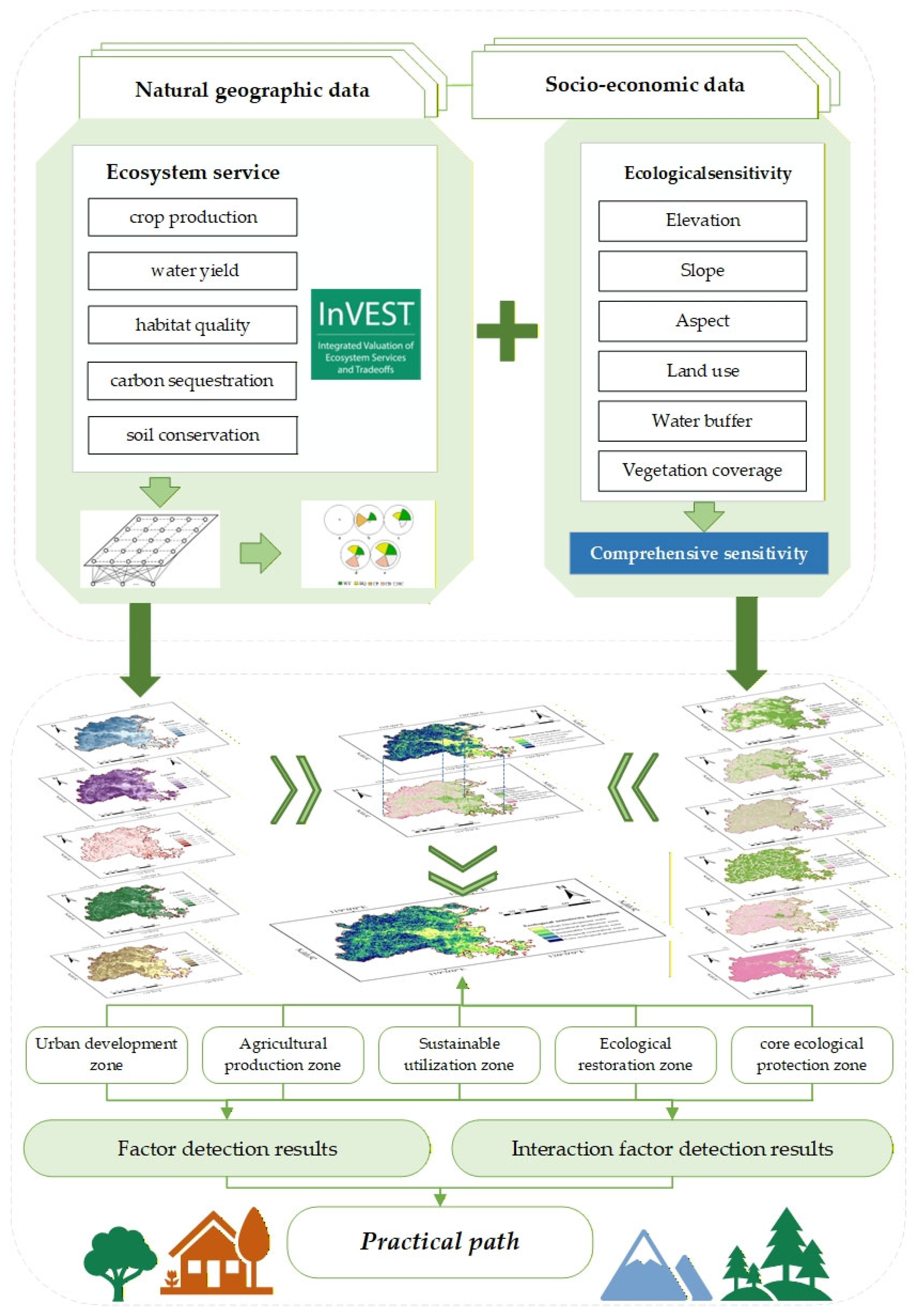
The data required for the study were collected and pre-processed, including the geographical space, vegetation, hydrology, soil, meteorological data, land use survey data, socio-economic data, etc., in the central urban area of Fuzhou, as detailed in Table 1. The research framework mainly includes two parts in Figure 2. Step 1: data preparation, quantification, and hierarchical classification: processing key biophysical and socio-economic datasets to simulate five core ecosystem services, identifying spatial bundles of services through clustering methods, and conducting comprehensive ecological sensitivity evaluation; Step 2: Comprehensive and zoning and mechanism diagnosis and inspiration: Based on the comprehensive service bundle and sensitivity, delineate ecological functional zones, analyze the driving factors of each zone, and provide information for tailored management strategies. This logical flow ensures transparent progress from data to decision support.

2.3. Quantitation of Ess

This study draws on research methods and combines the regional characteristics of Fuzhou to select five key ecosystem service functions for evaluation. The selection of these services is based on policy relevance and key regional issues, which are consistent with national and local sustainable development goals such as food security, carbon neutrality, and water resource protection; Key regional issues, such as the prominent ecological challenges in Fuzhou, include soil erosion on sloping land, habitat fragmentation caused by urbanization, and carbon sequestration pressure in rapidly developing cities. The specific methods are as follows:

2.3.1. Crop Production (CP)

Grain production services are calculated by collecting grain output, statistics and normalized vegetation index (NDVI) of cultivated land grids [33], and the formula is as follows:
C P x = N D V I x N D V I s u m × C P s u m
where CPx is the grain output of cell x (t/hm2), NDVIx refers to the normalized vegetation index in grid x; and NDVIsum is the sum in the study area; CPsum is the total grain yield (t).

2.3.2. Water Yield (WY)

Calculation is performed based on the InVEST model (Version 3.14.0; The Natural Capital Project, Stanford, CA, USA). Water source supply module [34]. The InVEST model parameters were sourced from peer-reviewed literature and localized studies. While direct field validation at this scale was not feasible, output patterns were cross-checked for spatial consistency with land cover and topography, supporting their use for revealing relative spatial gradients rather than absolute values. And the formula of WY is as follows:
Y i j = 1 A E i j P x P x
where Px is the average annual precipitation (mm) for grid x; and AEij refers to the average annual evapotranspiration (mm) of its grid.

2.3.3. Habitat Quality (HQ)

The formula of using the InVEST habitat quality [34] model is as follows:
Q i j = H j 1 D i j z D i j z + K z
where Qij is the value of grid I for land use typej. Dij is the degree of habitat degradation. Hj is the suitability of the habitat for land use typej. k is the half-saturation constant. Z is the model parameter. K and z were both set as the model default values, i.e., 0.5 and 2.5, respectively.

2.3.4. Carbon Sequestration (CS)

The InVEST carbon module [34] is used to calculate the carbon reserves of the ecosystem, and the formula is as follows:
C x = C above + C below + C soil + C dead
where Cx is the total carbon storage (t/hm2) of cell x, and each component represents the above-ground biomass, underground biomass, soil organic carbon, and dead organic matter carbon storage, respectively. The parameters are referenced to IPCC guidelines and localization research results.

2.3.5. Soil Conservation (SC)

The calculation of the SDR module [34] using the InVEST model is based on the general equation of soil erosion. The potential soil erosion is reduced by the actual soil erosion. The specific formula is as follows:
S C = R K L S U S L E = R × K × L S R × K × L S × C × P
where SC is the soil retention amount (t/hm2), RKLS is the potential soil erosion amount (t/hm2), USLE is the soil erosion amount (t/hm2), R is the precipitation erosion factor, K is the soil erosion factor; LS is the slope length slope factor; C is the water and soil retention factor; P is the vegetation coverage factor.

2.3.6. Uncertainty Consideration

Recognizing the inherent uncertainty in model-based estimation, we conducted basic uncertainty analysis on key model parameters. For the carbon storage module, we changed the main carbon pool coefficient by ±20% based on the range reported in local literature. For the soil conservation module, we tested the sensitivity of the results to the c factor (vegetation cover management factor). Analysis confirms that although the absolute values have changed, the relative spatial pattern and ranking of high/low service areas remain stable, which is the main basis for our subsequent determination and zoning. A comprehensive probabilistic uncertainty analysis of all parameters and input data is beyond the scope of this study, but it is recommended to focus on absolute service quantification in future work.

2.4. Ecosystem Service Bundles Identification

In order to identify the typical spatial combination mode of multiple ecosystem services, namely ecosystem service bundles (ESBs), this study uses SOFM for bundle analysis. SOFM is more suitable for identifying targets in spatial beams because it preserves the topological relationships in the input data, which means that geographically adjacent and ecologically similar regions are naturally grouped together, forming spatially coherent and interpretable clusters [35]. This method is also robust when dealing with multivariate variables. This unsupervised clustering algorithm is suitable for visualization and pattern recognition of high-dimensional data and has been widely used in the research of ecosystem service bundles [36]. The evaluation results of the five ecosystem services (CP, WY, HQ, CS, SC) were uniformly resampled to a 1 km × 1 km grid, and each grid was used as a sample unit. The various service values in each grid form the input feature vector. All input data are standardized before analysis to eliminate the impact of dimensions and scales. The SOFM input layer is composed of 5 neurons (corresponding to 5 ecosystem services), and the competition output layer is a two-dimensional structure. The output layer size was initially set to a topology of 5 × 5 (25 neurons) to allow for appropriate pattern differentiation. In order to objectively determine the optimal number of clusters k and reduce subjectivity [37], the silhouette coefficients (SC) of a series of potential cluster numbers (k = 3 to k = 8) obtained from the SOFM weight vector were calculated. SC measures clustering and separation, with values ranging from −1 to 1. The higher the value, the better the clustering. The combination of these criteria shows a clear optimum at k = 5, resulting in a high SC = 0.61. Therefore, the ecosystem service functions of Fuzhou city are robustly divided into five different types of service packages, and they were marked as (a), (b), (c), (d), (e), respectively. The mean of each ecosystem service in each service bundle is calculated and statistically compared to characterize the typical characteristics of each service bundle. Finally, the spatial distribution of the service bundle is visualized to provide a key basis for subsequent ecological functional partitioning.

2.5. Ecological Function Partitioning

2.5.1. Ecological Sensitivity Evaluation Factors and Grading Standards

Based on existing research and the current ecological environment of Fuzhou City, six indicators of land use type, vegetation coverage, elevation, slope, slope direction and water system buffer zone were comprehensively selected to build a sensitivity evaluation system. Among them, land use types reflect the intensity of human activity interference, vegetation coverage represents ecosystem stability, topographic factors (elevation, slope, slope direction) represent habitat vulnerability, and water system buffers show water resource sensitivity. The coefficient of variation method is used to determine the index weight [38], and this method objectively empowers the index by quantifying the degree of spatial differentiation of each index.
The single factor sensitivity was divided into 5 levels (Table 2), and the total ecological sensitivity of the study area was calculated based on weights. The grading standards and value ranges of each sensitive factor were based on past academic practices and the natural segment method. For continuous variables such as elevation, slope, and vegetation coverage, the natural breakpoint method in ArcGIS (Version 10.8; Environmental Systems Research Institute, Redlands, CA, USA) is used to classify the data based on their inherent statistical distribution, ensuring that the intervals reflect the actual data sequence of Fuzhou City [39]. The grading standards for slope orientation, land use type, and water buffer zones are based on established academic practices and are widely used in urban ecological sensitivity assessments [40].

2.5.2. Ecological Function Partitioning Standards

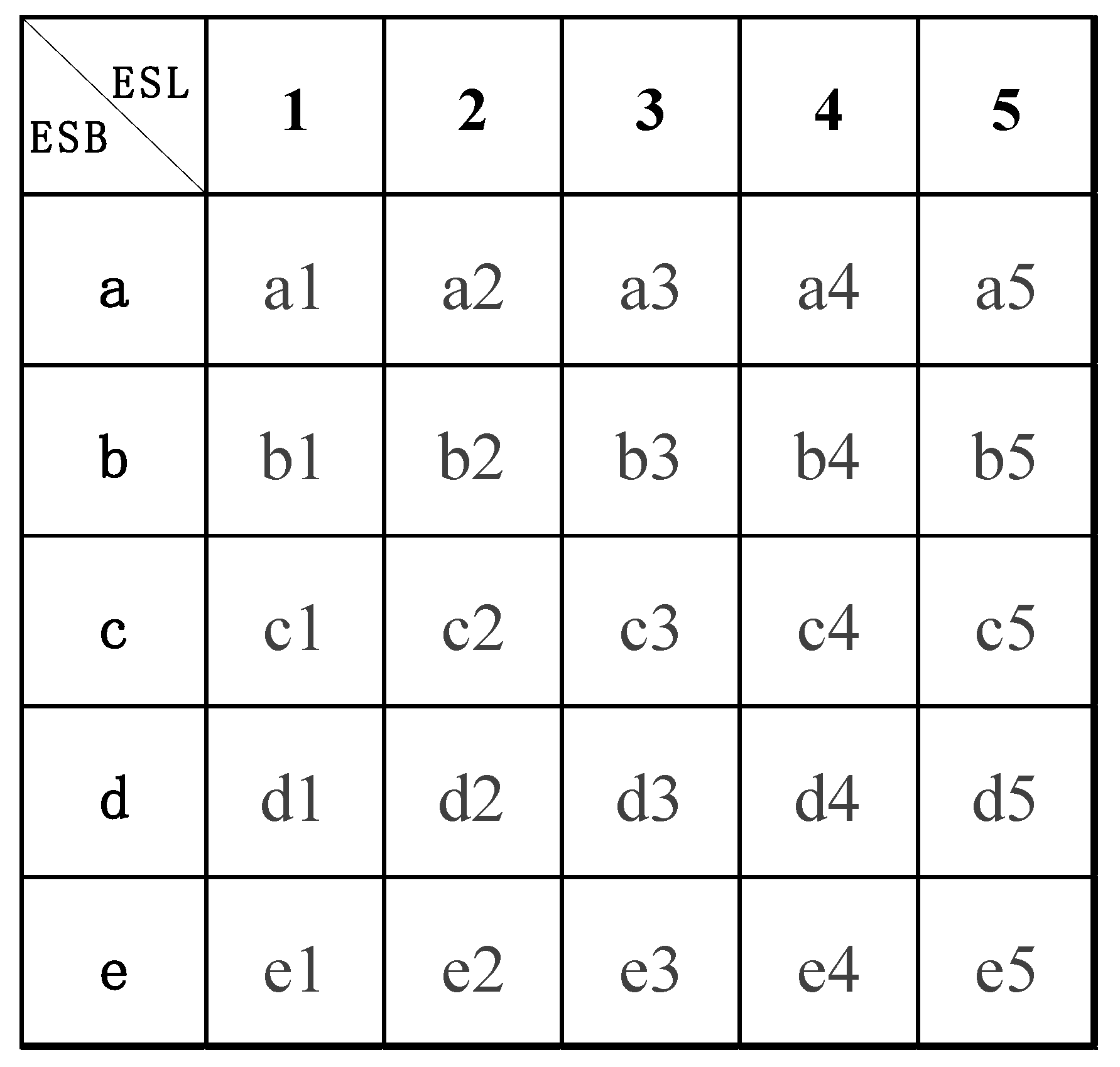
Ecological functional partitioning is achieved by performing spatial overlay analysis in ArcGIS [41], combining the identified ecosystem service bundles (ESBs) with integrated ecological sensitivity levels (ESL) [26,42]. This study abandons simple superposition and adopts a two-dimensional correlation judgment matrix (Figure 3), which jointly considers ecosystem service supply capacity (characterized by ESB type) and ecosystem vulnerability (characterized by ESL rank). The core logic of partitioning follows the principle of “priority of leading service functions and ecological sensitivity constraints”. The ESB type identifies the main ecological function or potential of a spatial unit (e.g., carbon sink-dominated, food production-dominated). The ESL rating determines the appropriate intensity of human activity or protection urgency of the unit (e.g., extremely sensitive requires strict protection, and low sensitivity can be used sustainably). Level 5 ESL (levels 1–5, from insensitive to extremely sensitive) and five ESB types (a–e) form the two axes of the judgment matrix. Each cell in the matrix represents a unique combination of “service-sensitivity” states and is classified into one of the five ecological functional partitions according to preset rules. Classification rules are formulated based on ecological protection priority and sustainable development needs:
  • Core Ecological Protection Zone: Assigned to areas providing the most critical regulating services Bundles (d), (e), (c) exhibiting high habitat quality, carbon sequestration, and water yield) coupled with high to extreme ecological sensitivity (ESL ≥ 4). These areas are paramount for maintaining regional ecological security and require the strictest protection against development activities.
  • Ecological Restoration Zone: Assigned to areas with important ecosystem services but showing signs of degradation risk or moderate sensitivity (typically ESL ≥ 3). This includes ESB types that are valuable but potentially fragile, necessitating restorative measures to enhance ecosystem stability and resilience.
  • Sustainable Utilization Zone: Assigned to areas with relatively stable and moderate service bundles and lower sensitivity (ESL ≤ 2). These areas can support certain human activities but must be managed sustainably to prevent degradation, focusing on maintaining the existing service supply.
  • Agricultural Production Zone: Dominated by the grain production bundle (b) and characterized by low sensitivity (ESL ≤ 2), this zone is prioritized for agricultural activities. Management should focus on optimizing production while minimizing ecological impacts through eco-agricultural practices.
  • Urban Development Zone: Characterized by the low service potential bundle (a) and low sensitivity (ESL ≤ 2), this zone is deemed most suitable for accommodating urban expansion and socioeconomic activities. Ecological management here focuses on enhancing livability through greening and mitigating negative environmental impacts.
The specific corresponding codes between the ESB-ESL matrix combinations and the final functional zones are detailed in Table 3. Allocation is based on service packages and sensitivity levels. The example of ‘c1’ is classified as urban development because its insensitive ecological sensitivity (ESL = 1) is the main limiting factor, indicating that the region can accommodate development despite the presence of water related services. This method ensures that the zoning scheme is not only spatially explicit but also ecologically meaningful, providing a transparent and defensible basis for differentiated spatial management and control.

2.6. Driver Identification

Based on the social and economic development status and geographical and environmental characteristics of Fuzhou City, and referring to existing research results, this study selected 8 indicators for driving factor analysis. The geodetector model (Geodetector) [33] is used to identify the dominant driver factors and their interaction effects of different ecological functional areas. The selected indicators include natural factors (precipitation, temperature, NDVI, elevation) and socioeconomic factors (GDP density, population density, urbanization rate, land use type). First, the natural breakpoint method is used to perform 5-level discretization treatment for continuous variables, and the land use type is directly involved in the analysis as type variables. By calculating the q value of each factor (explanatory force index, value range is 0–1), the interpretation ability of a single factor to ecological functional partition is evaluated; Although a high q-value indicates strong spatial consistency between a factor and functional area, which suggests that the factor may be a key spatial determinant, it alone cannot prove a direct causal relationship. Therefore, the inferred ‘driving mechanism’ should be understood as a hypothesis about influential social ecological processes from its powerful spatial footprint. The type of interaction between factors is determined by using an interaction detector. The dominant driving factors are further clarified through the ranking of factor contribution rates, thereby revealing the comprehensive driving mechanism of the composite formation of natural-social and economic multidimensional factors.

3. Results

3.1. Spatial Distribution of Ecosystem Services

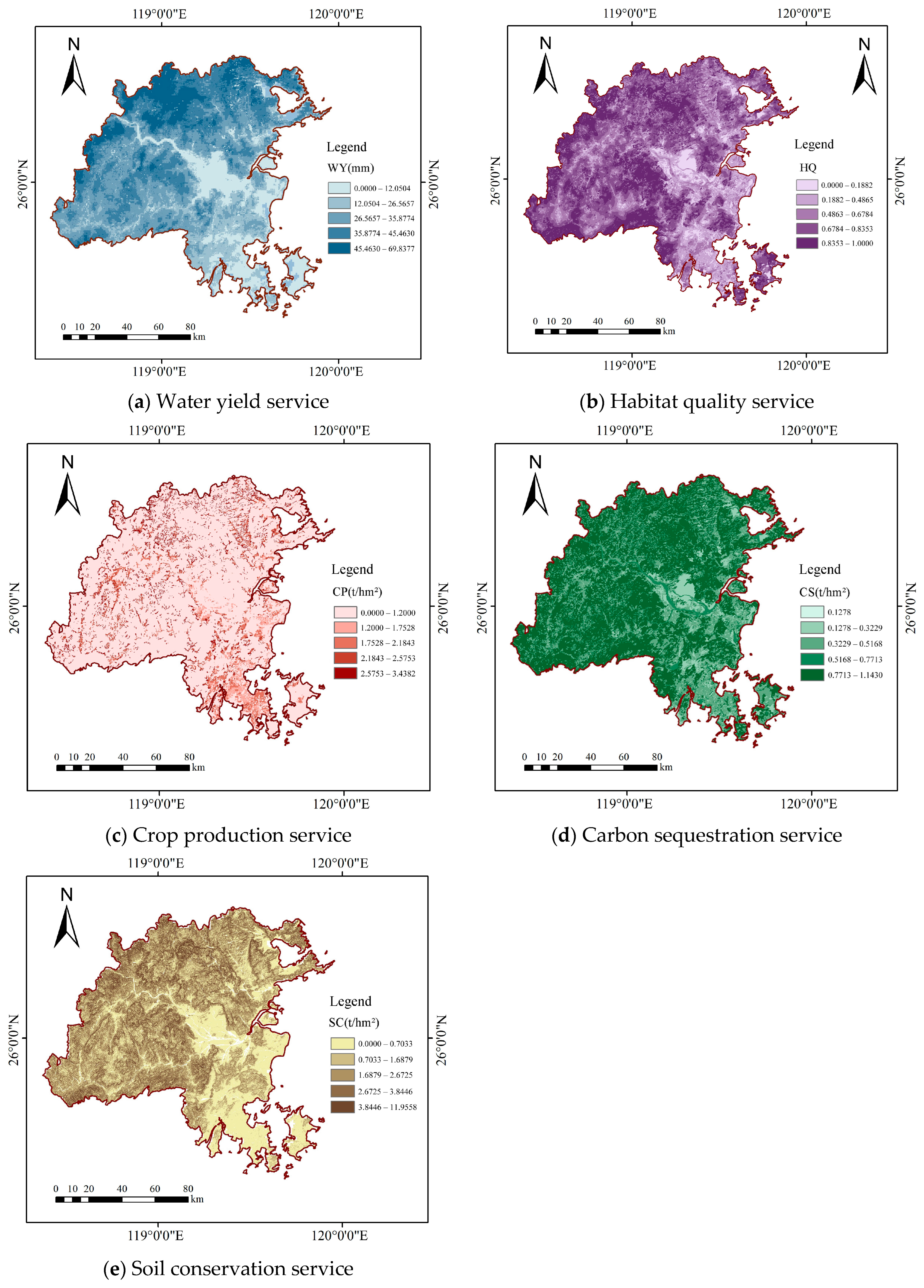
Based on the natural breakpoint method, the five key ecosystem services in Fuzhou city exhibit significant spatial differentiation patterns (Figure 4). Specifically, water supply services (WY, a) exhibit a typical spatial gradient of being high in the northwest (up to 69.84 mm) and low in the southeast. The habitat quality (HQ, b) also reached its highest level (1.0) in the dense forest area of the northwest, demonstrating the region’s function as a core barrier for biodiversity conservation. The high-value areas of grain production services (CP, c) (up to 3.44 t/hm2) are concentrated in the plain and coastal areas along the river, benefiting from flat terrain and irrigation conditions. Carbon sequestration services (CS, d) are highly consistent with the forest coverage area, which accounts for 64.3% of the total area of the city, with a high value of 1.14 t/hm2, while urban built-up areas and surrounding areas form significantly low value areas. The spatial distribution of soil and water conservation functions (SC, e) is closely related to terrain undulations, and its service capacity performs best in gentle slope hilly areas (up to 11.96 t/hm2), while it sharply decreases in steep slopes and urban hardened areas.

3.2. Spatial Distribution of Ecosystem Service Bundles

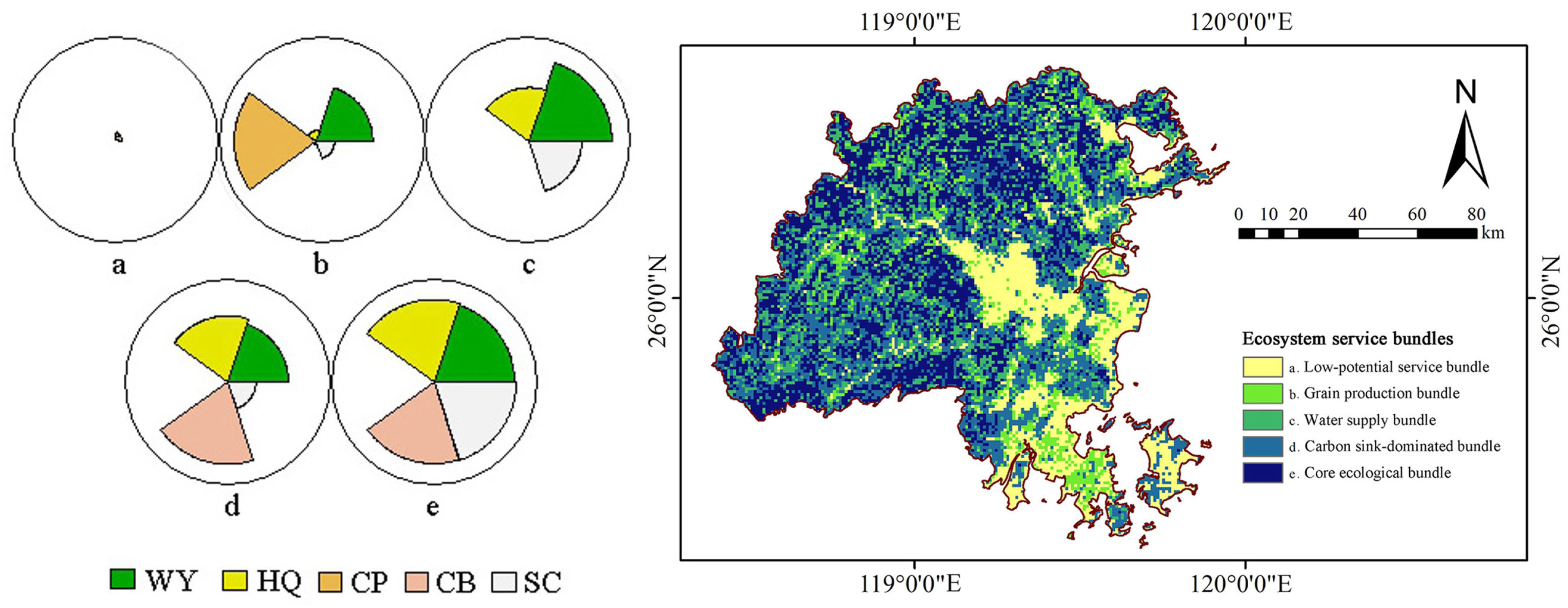
This study conducted bundle analysis of Fuzhou ecosystem services based on SOFM, and it identified five types of service bundle types with significant differences (Figure 5). The analysis results show that core ecological bundles dominate spatial distribution, with an area accounting for 30.09%, and this type shows high values in many key ecosystem service indicators. The carbon sink-dominated bundle accounts for 29.27%, dominated by carbon sink services, medium water supply services, habitat quality services, and low-soil maintenance services. Water supply clusters account for 13.96%, with water supply services dominating, and moderate habitat quality services and soil conservation services. Although the grain production bundle only accounts for 9.39% of the area, it is the only type in the research area that has significant agricultural product supply function and has important ecological economic value. Low-potential service bundles account for 17.28%, mainly distributed in urbanized areas and surrounding areas.

3.3. Ecological Sensitivity Distribution

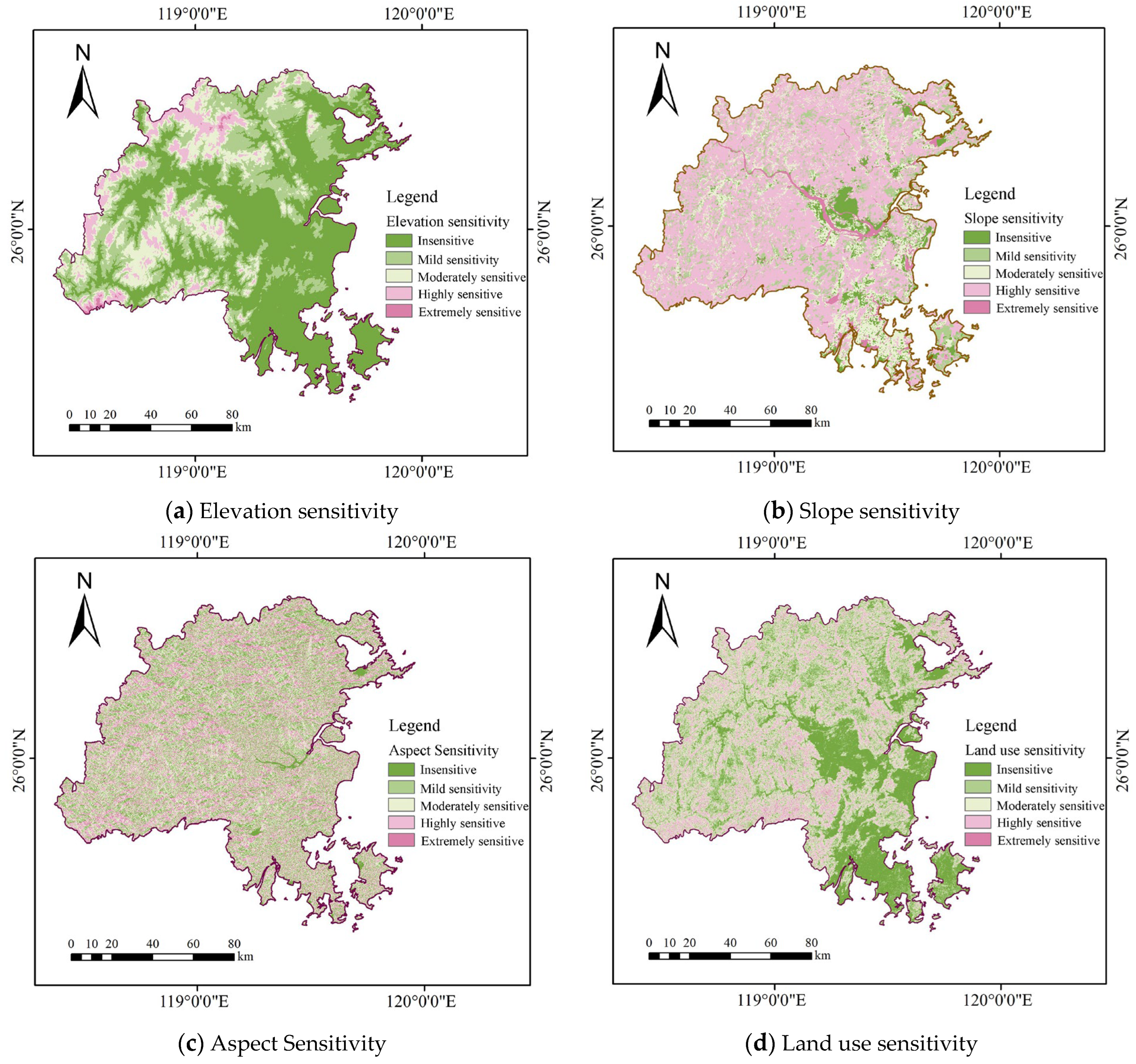
In terms of elevation ecological sensitivity, severely sensitive areas account for 0.33% of the total area and are distributed in the northwest. Because the mountains of Jiufeng and Daiyun are obliquely cut north and south, the terrain is the highest; the slope sensitivity is mainly moderately sensitive, and the moderately sensitive areas account for 28.86% of the total area, concentrated in the central and western regions near the mountains; the slope sensitivity is mainly high and medium sensitive, high-sensitive areas account for 24.86% of the total area, and the moderately sensitive areas account for 25.29% of the total area, and the overall distribution is relatively uniform; among the ecological sensitivity of the water area, extreme, high-altitude, moderate, and mildly sensitive areas account for 66.83% of the total area, and the overall distribution is tree-like; land use sensitivity is mainly high-sensitivity, accounting for 59.91% of the total area; vegetation coverage ecological sensitivity height and extreme sensitive areas account for 75.30%.
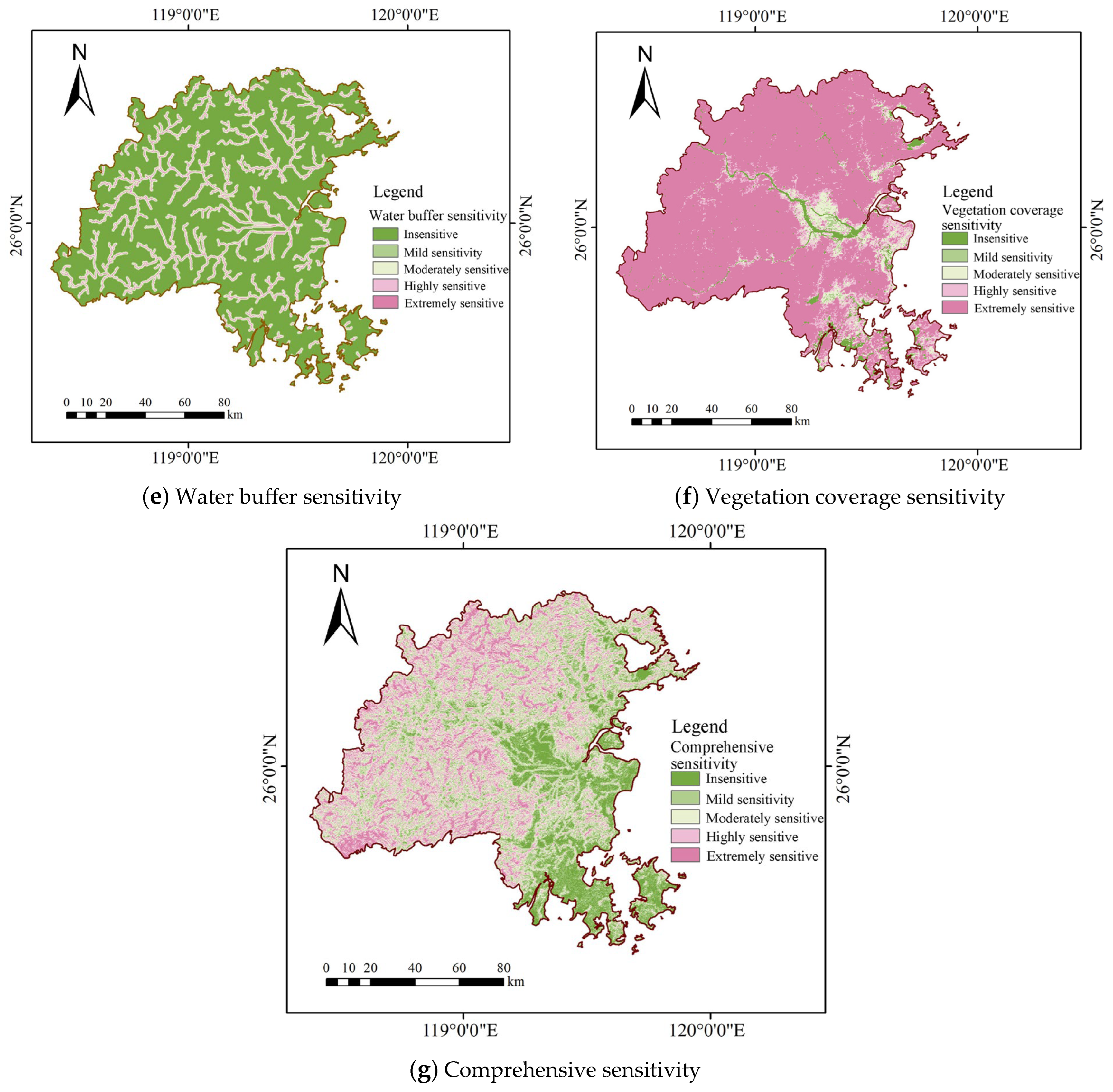
Fuzhou City has significant spatial differences in comprehensive ecological sensitivity, showing an overall pattern of “high in the northwest and low in the southeast” (Figure 6). The highly sensitive and extremely sensitive areas account for a total of 33.42%, mainly concentrated in high-altitude areas such as the Jiufeng Mountains and Daiyun Mountains in the northwest, as well as important water system buffer zones such as the Minjiang River Estuary Wetlands. These regions feature complex terrain and high vegetation coverage, and their ecosystems are highly vulnerable due, in part, to the imperative for water resource protection. The moderately sensitive areas account for 28.59%, mainly distributed in the mountainous and hilly transition zones in the central and western regions, mainly woodlands and shrubs, with moderate vegetation coverage and relatively weak human activities interference. The lightly sensitive and insensitive areas account for 38.1% of the total, concentrated in the southeast coastal plains, river valley basins, and urban built-up areas. The terrain is gentle, land use is mainly built for construction land and arable land, vegetation coverage is low, and ecological sensitivity is dominated by interference from human activities.

3.4. Ecological Functional Partitioning

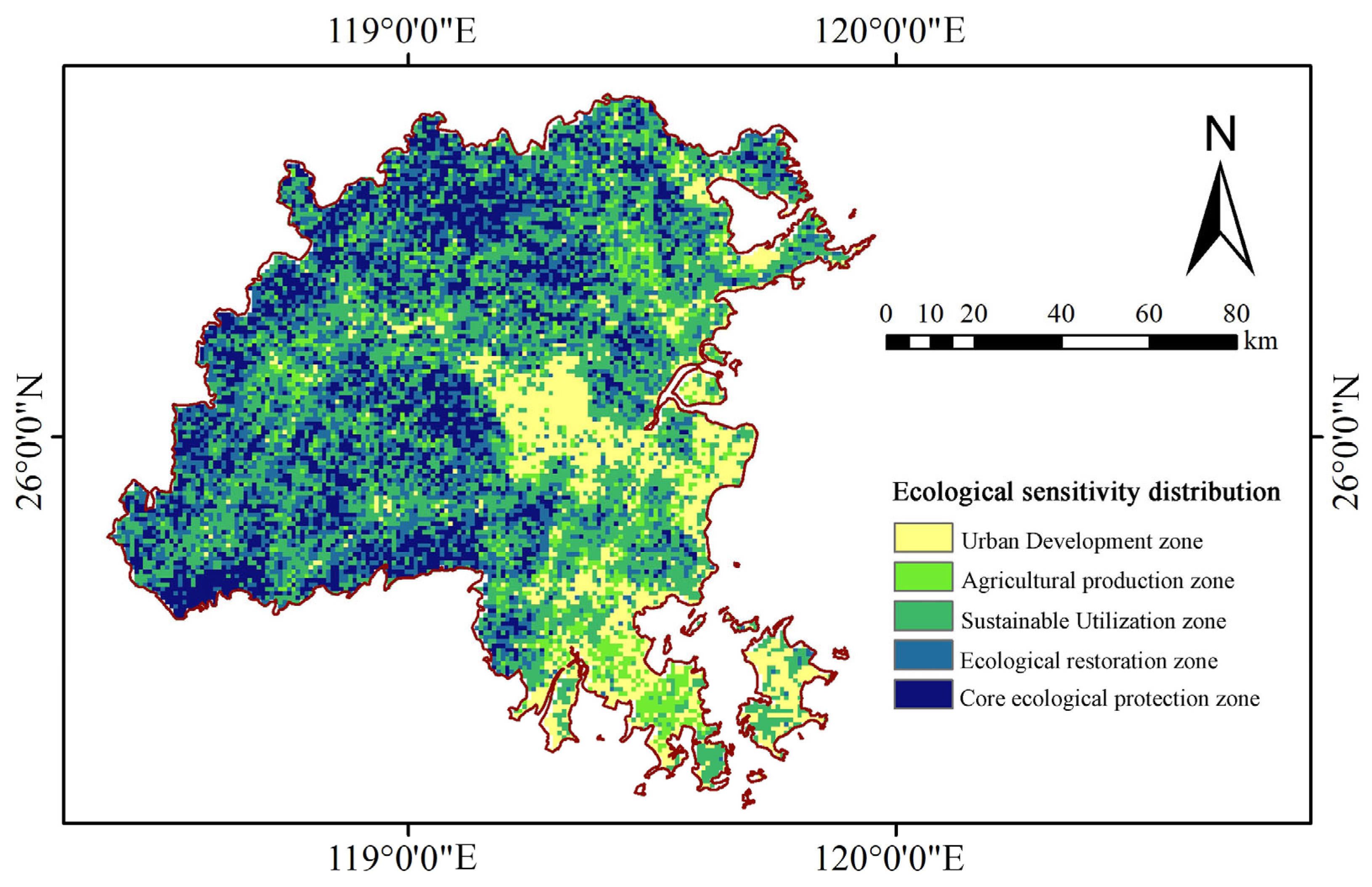
Based on the two-dimensional correlation judgment matrix partitioning standard of ecosystem service bundles and comprehensive ecological sensitivity, the research area is divided into five ecological functional areas (Figure 7). Among them, the core ecological protection zone accounts for 21.17%, mainly distributed in the northwest mountainous areas, the Minjiang River estuary wetlands, and large reservoirs. The habitat quality, carbon sequestration, soil and water supply services in the region are outstanding, with high ecological sensitivity. Ecological restoration areas account for 22.20%, concentrated in mountainous hills in the central and western regions. The regional carbon sink services are strong, but soil and water conservation and water supply services have certain degradation risks. Sustainable utilization areas account for 15.32%, and are distributed in the river source areas of the northwest and southern mountains. The area has significant advantages in water supply services, but habitat quality and carbon sink services are weak. Agricultural production areas account for 7.49%, which is a concentrated area for grain production bundles. It is located in lightly sensitive areas such as coastal lowlands and valley basins. It is the core area for agricultural product supply. Urban development zones account for 33.82%, covering low-service potential bundles and insensitive areas. They are mainly urban built-up areas and surrounding expansion zones. The overall ecosystem services in this area are weak, but social and economic activities are intensive.

3.5. Identification of Ecological Functional Partition Driver Factors in Fuzhou City

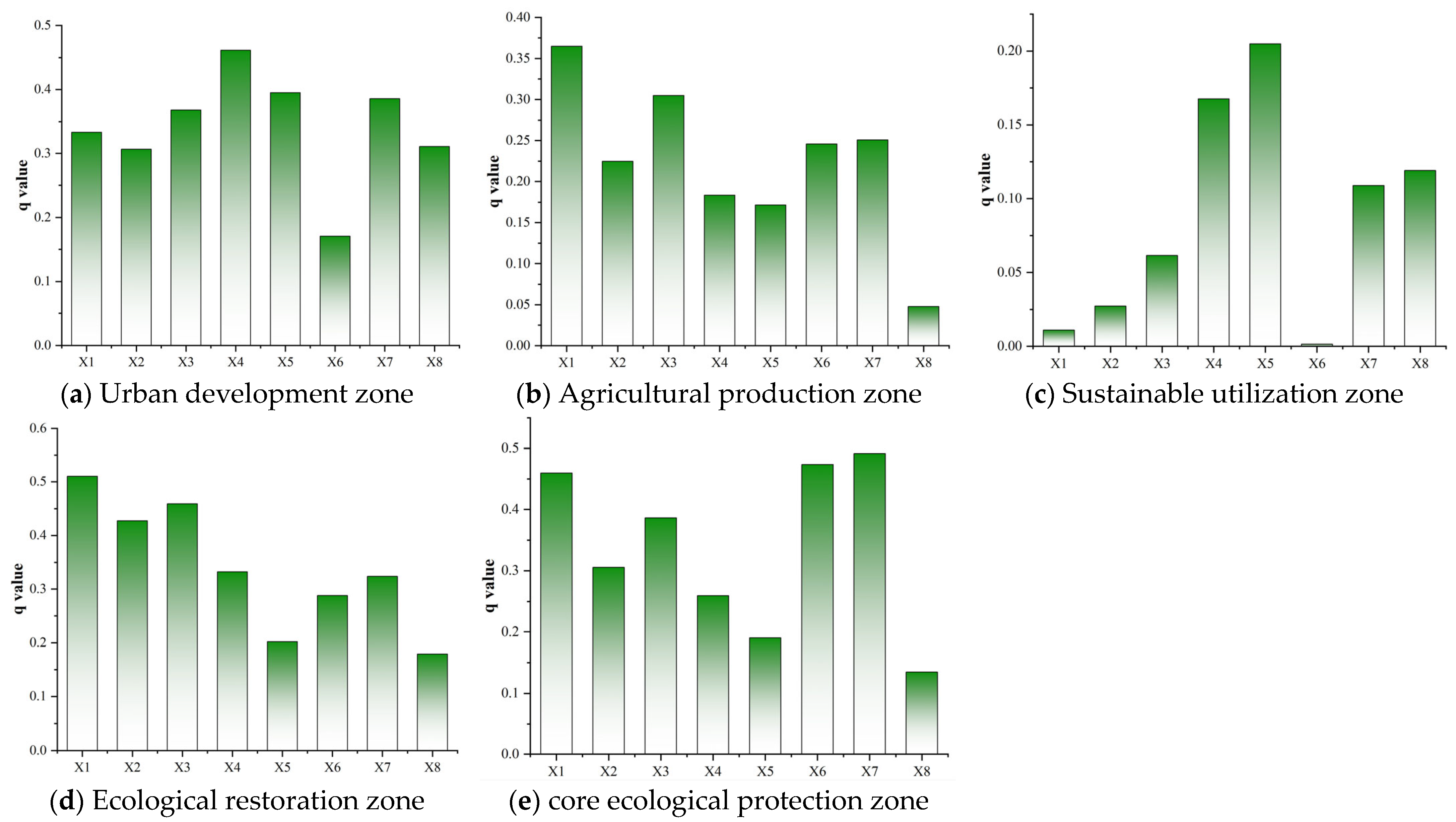
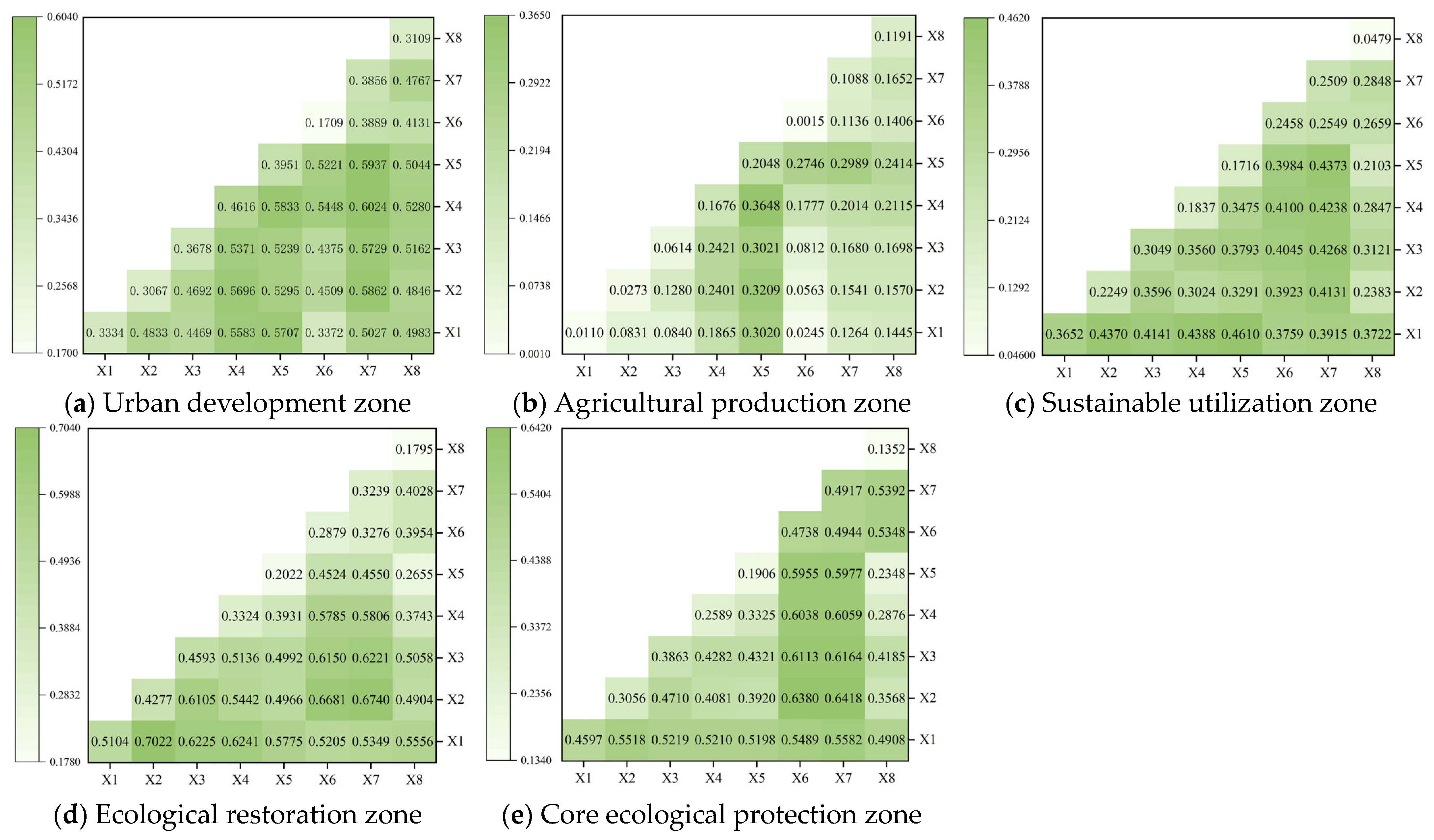
The analysis results based on the geodetector model show that (Figure 8 and Figure 9) the explanatory power of NDVI (0.4616), land use type (0.3951), and GDP (0.3856) in the distribution of urban development areas, the explanatory power of NDVI and GDP (0.6024), NDVI and land use type (0.5937) in the detection of interaction factor is strong; in the distribution of agricultural production areas, the explanatory power of annual precipitation (0.3652) and elevation (0.3049) is strong, and the explanatory power of interaction factor detection of middle-aged precipitation and land use type (0.4610), annual rainfall and NDVI (0.4388), land use type and GDP (0.4373) is strong. In the distribution of sustainable use areas, the explanatory power of land use type (0.2458) has the strongest explanatory power of other factors. In the detection of interactive factors, the explanatory power of land use type and NDVI (0.3648), land use type, and annual average temperature (0.3209) has strong explanatory power. In the distribution of ecological restoration areas, the explanatory power of annual precipitation (0.5103), annual average temperature (0.4277), elevation (0.4592), and NDVI (0.3324) has the strong explanatory power of natural factors that are significantly higher than that of economic and social factors.
In the detection of interactive factors, the average precipitation and annual average of inter-year detection of interaction factors. The combined explanatory power of temperature (0.7022) is the strongest, the combined explanatory power of annual average temperature and GDP (0.6740), annual average temperature and urbanization rate (0.6681), and annual average temperature and elevation (0.6241) is strong; in the distribution of core ecological protection areas, the single factor explanatory power of GDP (0.4916), urbanization rate (0.4738), and annual precipitation (0.4593) is strong, and the detection of interactive factor average temperature and GDP (0.6481), annual average temperature and urbanization rate (0.6380) shows strong explanatory power. The combined explanatory power of the five partitions is significantly higher than the single factor explanatory power.

4. Discussion

4.1. From Ecosystem Services to Ecological Functional Zoning

In the assessment of ecosystem services, water supply and habitat quality services have formed a significantly high-value area in the northwest mountainous region, mainly attributed to the high forest coverage, the interception effect of complex terrain on water vapor, and the low intensity of human interference in this area. This discovery is consistent with the research findings conducted in many mountainous forest areas, which suggest that a complete forest ecosystem is the core of water resource conservation and biodiversity maintenance [43]. The ecological barrier constructed by the Minjiang River system and the widespread forests has further strengthened the ecological regulation function of this region. In contrast, the southeastern coastal plain and urban built-up areas exhibit characteristics dominated by food supply, but with generally low regulation services (such as carbon sequestration and soil and water conservation). The flat terrain and developed irrigation system support the agricultural production function of the region, but the high degree of urbanization and agricultural activities also lead to significant ecological costs, which is consistent with the research findings of Barral, Maria Paula in Argentina Chaco [44]. Carbon sequestration services have formed significant low value areas around construction land and farmland, similar to Fan Li’s research findings in Henan Province [45], which intuitively reflects the consumption of natural carbon pools by human land use. Similarly, similar to Wang F’s conclusion in Central Urban Area Chongqing Municipality [46], the soil and water conservation function faces severe challenges in steep slopes and urban hardened areas. The spatial differentiation of ecosystem service supply is the fundamental framework for forming subsequent ecological functional zoning.
The ecological function zoning plan for Fuzhou city was constructed based on the ecosystem service bundles and ecological sensitivity, and the results are consistent with the natural geographical characteristics and socio-economic development status of Fuzhou city [47]. The clustering of service clusters in the northwest reflects the dominant role of forest ecosystems in providing multiple regulatory services [48]; the concentration of low service potential bundles in built-up areas reveals the systematic weakening of ecological functions caused by high-intensity urbanization. This provides empirical evidence for understanding the functional structure of urban ecological space. However, a single service bundle is not sufficient to support precise ecological management decisions [49]. By incorporating Ecological Sensitivity Scale (ESL) into the analysis framework and combining it with ES spatial differentiation, the dual attributes of ecological function and vulnerability in different regions were revealed, providing a more scientific and refined decision-making basis for green space system planning and ecological function zoning. The ecological functional zoning scheme constructed from this is essentially an induction and enhancement of the above-mentioned functional pattern [50]. The delineation of core ecological protection areas and ecological restoration areas clarifies the key ecological spaces that require priority protection and restoration [51]. The identification of urban development areas and agricultural production areas provides spatial guidance for coordinating the relationship between development and protection. This zoning framework transforms abstract ecosystem service assessments into concrete spatial management units, directly supporting the transition from ecological function cognition to green space management practices, and providing a scientific basis for implementing differentiated spatial planning [52].

4.2. Unveiling the Driving Mechanisms: Nonlinear Interactions Between Natural and Socioeconomic Factors

It is worth noting that the explanatory power of the core ecological protection zone mainly comes from GDP (0.4916) and urbanization rate (0.4738). Such results are inconsistent with the results of Xue, Z et al. [53] in the Four Lakes Basin. Due to the different research objects, the research results reveal the actual pressure faced by ecological protection in Fuzhou: the optimal ecosystem often remains in high-altitude and steep slope areas (such as Jiufeng Mountain and Daiyun Mountain) where human development is difficult, and these areas face potential development threats precisely because of their ecological value, such as ecological tourism, infrastructure construction, etc. This discovery is similar to Huang’s research [42], emphasizing that in economically developed areas, the core of ecological protection lies in restricting the invasion of key areas by human activities. Therefore, the strictest ecological red line control must be adhered to in this area. For ecological restoration areas (22.20%), their driving factors are mainly natural factors such as annual precipitation (0.5103) and elevation (0.4592). The research results of this area are consistent with those of Zhang et al. [54], indicating that the ecological problems in this area mainly stem from the fragility of the natural environment, such as steep slope reclamation can easily cause soil erosion. We can learn from the successful experience of Liu et al. [55] in the Pearl River Delta Metropolitan Region and implement targeted ecological projects such as Silviculture and Sustainable Forest Management to improve the stability of the ecosystem.
The factor interaction analysis results of the geodetector show that the interaction q value of all factor pairs is greater than the independent q value of any factor, which shows that the formation of ecological functional partition in Fuzhou is a joint result of natural and socioeconomic factors. In urban development areas, the high explanatory power of NDVI and GDP (0.6024) and NDVI and land use (0.5937) suggests that the urban expansion process (GDP growth) is directly reflected in encroachment on green space (NDVI decline) and the transformation of land use types. In the ecological restoration area, the extremely high explanatory power of annual precipitation and annual average temperature (0.7022) highlights the hydrothermal combination conditions as the basic environmental driving force, and jointly determines the vegetation type and ecosystem process of the region (mid-western hills), thus dominating its service functions characterized by carbon sinks and soil and water conservation and potential degradation risks. In core ecological protection areas, the strong interaction between average annual temperature and GDP (0.6481) suggests that with the dual pressures of future climate change (increased temperatures) and economic development (growth of GDP), these key ecological regions may face greater threats, suggesting that climate change scenario simulations must be included in long-term planning. The results reveal that the formulation of ecological management policies must take into account the synergies of multiple drivers. For example, improving the ecological function of urban development areas cannot be achieved by adding green spaces alone (improving NDVI), but they must also be combined with land use control (controlling land use types) and economic transformation policies (optimizing GDP structure).

4.3. Practical Path of Urban Green Space Management Based on Zoning Framework

The core practical value of the ecological functional zoning framework constructed in this study lies in transforming the causal understanding of driving factors into management strategies with clear spatial orientation. This framework goes beyond traditional ecosystem service assessments, not only revealing ‘where’ needs to be protected, but more importantly, elucidating ‘why’ it needs to be protected and ‘how’ to manage it in a targeted manner.
In order to translate diagnosis into action, we have transformed the zoning plan and its potential driving factors into specific guidelines for the development, protection, and improvement of urban space in Fuzhou. These guidelines are constructed based on five functional areas:
Core ecological protection areas (21.17%): The development guidelines prohibit any form of urban expansion, infrastructure construction, or land use change that leads to the degradation of core forest and wetland ecosystems [56]. Improvement actions can strengthen the monitoring and enforcement of ecological protection red lines [57]. The improvement action is to strengthen the monitoring and enforcement of ecological protection red lines, promote the protection and restoration of natural forests, and enhance habitat connectivity.
Ecological restoration area (22.20%): The development policy is to restrict large-scale development; priority should be given to returning farmland to forests and controlling soil erosion. Improvement actions can implement targeted afforestation and sustainable forest management projects [58]. The improvement action is to implement targeted afforestation and sustainable forest management projects, establish plant buffer zones along streams to improve water quality and soil stability.
Sustainable use areas (15.32%): The development guidelines focus on managing low impact uses, with a focus on water source protection and non-intensive recreational activities such as ecotourism. The improvement action is to protect water source forests, develop a payment plan for watershed protection ecosystem services, and maintain forest cover to maintain water production services [59].
Agricultural production areas (7.49%): The development guide is to optimize ecological agriculture, maintain farmland productivity, and integrate ecological functions. The improvement action is to promote agriculture and forestry, establish ecological ditches and hedges, reduce non-point source pollution [60], and protect good farmland from being occupied by non-agricultural land [61].
Urban development zone (33.82%): The development guide is to expand the city directly into this area in the future, under the premise of ecological compensation. Improvement actions can implement green infrastructure, such as parks, green corridors, and sponge city facilities, to offset ecological deficits [62,63]. The improvement action is to build green infrastructure, such as parks, green corridors, and sponge city facilities, to offset ecological deficits, strictly enforce urban development boundaries, and prevent encroachment on high-value ecological areas [64].
By adhering to these principles, Fuzhou can systematically optimize its territorial space, ensure that development activities are guided to the most suitable locations, and at the same time ensure an ecological foundation for sustainable growth.

4.4. Limitations and Future Prospects

Despite its contribution, this study still has some limitations, which provide avenues for future research. Although the InVEST model is robust, it relies on generalized parameters that may not be fully localized, such as carbon storage coefficients referenced from IPCC default values, and it lacks direct field validation of InVEST outputs, which is common in regional assessments. Therefore, the results should be interpreted as spatially explicit estimates of relative models. Although basic uncertainty checks have been conducted, research lacks a complete probabilistic uncertainty analysis of InVEST model estimates. This means that the accuracy of absolute values cannot be quantified, and future research should strictly quantify the uncertainty of parameters and input data sources. In addition, our analysis focuses on the supply side of ecosystem services. Integrating spatially clear data on social demand and consumption patterns remains the key next step in assessing supply-demand mismatch and environmental justice. The research results and zoning framework of Fuzhou, a coastal city with complex terrain, may need to be calibrated for direct application to areas with vastly different geographical environments, such as inland plains or arid regions. Future research should adopt higher resolution and time series data, integrate procession-based models to supplement InVEST, and explicitly incorporate social demand indicators. This will improve the accuracy of urban ecosystem service evaluation and the comprehensiveness of social ecology.

5. Conclusions

This study takes the rapidly urbanizing coastal city of Fuzhou as an example to construct and implement an ecological spatial assessment and management framework. The results indicate that the key ecosystem services in Fuzhou city exhibit a significant spatial differentiation pattern of “northwest high southeast low”. SOFM clustering identified five service clusters, among which the core ecological cluster dominated by high regulation services and the carbon sink dominant cluster accounted for 59.36% of the total area, forming the core foundation of regional ecological security. The study reveals that the formation of ecological functional patterns is not driven by a single natural or socio-economic factor, but mainly stems from the nonlinear interaction between the two. Geographic detector analysis shows that the interactive explanatory power is much higher than any single factor, highlighting the necessity of ecological management to pay attention to the synergistic effects of multiple driving factors. Based on the ecological functional zoning of service clusters, abstract service evaluation is transformed into five spatial units with clear management orientation.
Based on the spatial differentiation characteristics and driving mechanisms of ecosystem service clusters, Fuzhou City is divided into five ecological functional zones with clear functional positioning, and corresponding differentiated control strategies are proposed. The contribution of this work is twofold: in terms of scientific contribution, it provides a transferable methodological framework that systematically combines spatial patterns of ecosystem service bundling with statistical explanations of their driving factors, providing a replicable approach for diagnosing social ecological management of complex urban green spaces. The spatial clear ecological function zoning schemes and differentiated management strategies derived from social practice contributions provide direct scientific tools for urban planners. It helps to determine the priority order of protection, restoration, and sustainable development areas, thereby supporting practical decisions on spatial planning and green space management in Fuzhou.

Author Contributions

All authors contributed to the study’s conception and design. J.W.: Conceptualization, Supervision, Methodology, Writing—original draft, Writing—review & editing. M.W.: Methodology, Data curation, Software, Writing—review & editing. N.L.: Methodology, Formal analysis. D.R.: Methodology, Formal analysis, Funding acquisition. X.Y.: Conceptualization, Supervision, Methodology. Z.Z.: Conceptualization, Supervision, Methodology, Funding acquisition. All authors have read and agreed to the published version of the manuscript.

Funding

This research was funded by Zhipeng Zhu, National Natural Science Foundation of China, grant number, 32301648 and Daihui Rao, Fuzhou Social Science Planning Project, grant number 2019FZC43.

Data Availability Statement

The data that support the findings of this study are not openly available due to reasons of sensitivity and are available from the corresponding author upon reasonable request.

Conflicts of Interest

The authors have no conflicts of interest to declare that are relevant to the content of this article.

References

  1. Wu, J. Urban Ecology and Sustainability: The State-of-the-Science and Future Directions. Landsc. Urban Plan. 2014, 125, 209–221. [Google Scholar] [CrossRef]
  2. Costanza, R. Valuing Natural Capital and Ecosystem Services toward the Goals of Efficiency, Fairness, and Sustainability. Ecosyst. Serv. 2020, 43, 101096. [Google Scholar] [CrossRef]
  3. Costanza, R.; d’Arge, R.; de Groot, R. The Value of the World’s Ecosystem Services and Natural Capital. Nature 1997, 387, 253–260. [Google Scholar] [CrossRef]
  4. Zhou, S.Y.; Li, W.; Lu, Z.Y.F. An Ecosystem-Based Analysis of Urban Sustainability by Integrating Ecosystem Service Bundles and Socio-Economic-Environmental Conditions in China. Ecol. Indic. 2020, 117, 106691. [Google Scholar] [CrossRef]
  5. Chang, B.; Chen, B.; Chen, W.; Xu, S.; He, X.; Yao, J. Analysis of Trade-Off and Synergy of Ecosystem Services and Driving Forces in Urban Agglomerations in Northern China. Ecol. Indic. 2024, 165, 112210. [Google Scholar] [CrossRef]
  6. Su, B.; Liu, M. An Ecosystem Service Trade-Off Management Framework Based on Key Ecosystem Services. Ecol. Indic. 2023, 154, 110894. [Google Scholar] [CrossRef]
  7. Ma, Y.; Chen, H.; Yang, M.; Zhang, J.; Wang, J.; Huang, J. Assessment of Supply–Demand Relationships Considering the Interregional Flow of Ecosystem Services. Environ. Sci. Pollut. Res. 2024, 31, 27710–27729. [Google Scholar] [CrossRef]
  8. Zhong, L.; Wang, J.; Zhang, X.; Ying, L. Effects of Agricultural Land Consolidation on Ecosystem Services: Trade-Offs and Synergies. J. Clean. Prod. 2020, 264, 121412. [Google Scholar] [CrossRef]
  9. Liu, Y.; Li, T.; Zhao, W.; Wang, S.; Fu, B. Landscape Functional Zoning at a County Level Based on Ecosystem Services Bundle: Methods Comparison and Management Indication. J. Environ. Manag. 2019, 249, 109315. [Google Scholar] [CrossRef]
  10. Raudsepp-Hearne, C.; Peterson, G.D.; Bennett, E.M. Ecosystem Service Bundles for Analyzing Tradeoffs in Diverse Landscapes. Proc. Natl. Acad. Sci. USA 2010, 107, 5242–5247. [Google Scholar] [CrossRef]
  11. Haase, D.; Larondelle, N.; Andersson, E.; Artmann, M.; Borgström, S.; Breuste, J.; Gomez-Baggethun, E. A Quantitative Review of Urban Ecosystem Service Assessments: Concepts, Models, and Implementation. Ambio 2014, 43, 413–433. [Google Scholar] [CrossRef]
  12. Baró, F.; Palomo, I.; Zulian, G.; Vizcaino, P.; Haase, D.; Gómez-Baggethun, E. Mapping Ecosystem Service Capacity, Flow and Demand for Landscape and Urban Planning: A Case Study in the Barcelona Metropolitan Region. Land. Use Policy 2016, 57, 405–417. [Google Scholar] [CrossRef]
  13. Li, C.; Zhao, J. Understanding the Spatiotemporal Dynamics and Social-Ecological Drivers of Ecosystem Service Supply-Demand Bundles in the Yangtze River Delta Region, China. Environ. Dev. Sustain. 2025; early access, advance online publication. [Google Scholar] [CrossRef]
  14. Tian, H.; Wang, H.; Lyu, X.; Li, X.; Yang, Y.; Zhang, Y.; Liu, J.; Lu, Y.; Zhao, X.; Qu, T.; et al. Construction and Optimization of Ecological Security Patterns in Dryland Watersheds Considering Ecosystem Services Flows. Ecol. Indic. 2024, 159, 111664. [Google Scholar] [CrossRef]
  15. Wang, Y.; Xu, Z.; Yu, S.; Xia, P.; Zhang, Z.; Liu, X. Exploring Watershed Ecological Risk Bundles Based on Ecosystem Services: A Case Study of Shanxi Province, China. Environ. Res. 2024, 245, 118040. [Google Scholar] [CrossRef]
  16. Xu, L.; He, Y.; Zhang, L.; Bao, G.; Xu, H. Spatial Variation in Ecosystem Service Relationships in Alpine Ecosystems: A Case Study of the Daxing’anling Forest Area, Inner Mongolia. Ecol. Indic. 2024, 166, 112351. [Google Scholar] [CrossRef]
  17. Bi, J.; Hao, R.; Li, J.; Qiao, J. Identifying Ecosystem States with Patterns of Ecosystem Service Bundles. Ecol. Indic. 2021, 131, 108195. [Google Scholar] [CrossRef]
  18. Wang, B.J.; Tang, H.P.; Xu, Y. Integrating Ecosystem Services and Human Well-Being into Management Practices: Insights from a Mountain-Basin Area, China. Ecosyst. Serv. 2017, 27 Pt A, 58–69. [Google Scholar] [CrossRef]
  19. Cusens, J.; Barraclough, A.D.; Maren, I.E. Integration Matters: Combining Socio-Cultural and Biophysical Methods for Mapping Ecosystem Service Bundles. Ambio 2023, 52, 1004–1021. [Google Scholar] [CrossRef] [PubMed]
  20. Cao, Y.; Cao, Y.; Li, G.; Tian, Y.; Fang, X.; Li, Y. Linking Ecosystem Services Trade-Offs, Bundles and Hotspot Identification with Cropland Management in the Coastal Hangzhou Bay Area of China. Land. Use Policy 2020, 97, 104689. [Google Scholar] [CrossRef]
  21. Huck, M.; Drzejewski, W.O.; Borowik, T.; Drzejewska, B.; Nowak, S.; Ajek, R.W. Analyses of Least Cost Paths for Determining Effects of Habitat Types on Landscape Permeability: Wolves in Poland. Acta Theriol. 2011, 56, 91–101. [Google Scholar] [CrossRef]
  22. Norton, L.; Greene, S.; Scholefield, P.; Dunbar, M. The Importance of Scale in the Development of Ecosystem Service Indicators? Ecol. Indic. 2016, 61, 130–140. [Google Scholar] [CrossRef]
  23. Xia, H.; Yuan, S.; Prishchepov, A.V. Spatial-Temporal Heterogeneity of Ecosystem Service Interactions and Their Social-Ecological Drivers: Implications for Spatial Planning and Management. Resour. Conserv. Recycl. 2023, 189, 106767. [Google Scholar] [CrossRef]
  24. Xu, W.H.; Xiao, Y.; Zhang, J.J.; Yang, W.U.; Zhang, L.U.; Hull, V.; Wang, Z. Strengthening Protected Areas for Biodiversity and Ecosystem Services in China. Proc. Natl. Acad. Sci. USA 2017, 114, 1601–1606. [Google Scholar] [CrossRef]
  25. Xu, H.; Zhang, Z.Q.; Yu, X.C.; Li, T.Y.; Chen, Z. The Construction of an Ecological Security Pattern Based on the Comprehensive Evaluation of the Importance of Ecosystem Service and Ecological Sensitivity: A Case of Yangxin County, Hubei Province. Front. Environ. Sci. 2023, 11, 1154166. [Google Scholar] [CrossRef]
  26. Zhang, Q.; Wu, Y.; Zhao, Z. Identification of Harbin Ecological Function Degradation Areas Based on Ecological Importance Assessment and Ecological Sensitivity. Sustainability 2024, 16, 6763. [Google Scholar] [CrossRef]
  27. Zhang, P.; Duan, Q.; Dong, J.; Piao, L.; Cui, Z. Ecological Importance Evaluation and Ecological Function Zoning of Yanshan-Taihang Mountain Area of Hebei Province. Sustainability 2024, 16, 10233. [Google Scholar] [CrossRef]
  28. Liao, Q.; Li, T.; Wang, Q. Exploring the Ecosystem Services Bundles and Influencing Drivers at Different Scales in Southern Jiangxi, China. Ecol. Indic. 2023, 148, 110089. [Google Scholar] [CrossRef]
  29. An, Z.Y.; Sun, C.Z.; Hao, S. Spatial Heterogeneity and Driving Forces of Ecosystem Services: An Individual-Pair-Bundle Perspective. J. Geogr. Sci. 2025, 35, 2039–2068. [Google Scholar] [CrossRef]
  30. Chen, S.L.; Liu, X.T.; Yang, L.; Zhu, Z.H. Variations in Ecosystem Service Value and Its Driving Factors in the Nanjing Metropolitan Area of China. Forests 2023, 14, 113. [Google Scholar] [CrossRef]
  31. Colavitti, A.M.; Floris, A.; Serra, S. Urban Standards and Ecosystem Services: The Evolution of the Services Planning in Italy from Theory to Practice. Sustainability 2020, 12, 2434. [Google Scholar] [CrossRef]
  32. Fuzhou Municipal Bureau of Statistics. Fuzhou 2023 Statistical Bulletin on National Economic and Social Development. Fuzhou Municipal People’s Government Portal. Available online: https://tjj.fuzhou.gov.cn/zwgk/tjzl/ndbg/202404/t20240412_4807960.htm (accessed on 12 April 2024).
  33. Tao, J.; Lu, Y.; Ge, D.; Dong, P.; Gong, X.; Ma, X. The Spatial Pattern of Agricultural Ecosystem Services from the Production-Living-Ecology Perspective: A Case Study of the Huaihai Economic Zone, China. Land. Use Policy 2022, 122, 106355. [Google Scholar] [CrossRef]
  34. Sharp, R.; Tallis, H.T.; Ricketts, T.; Guerry, A.D.; Wood, S.A.; Chaplin-Kramer, R.; Nelson, E.; Ennaanay, D.; Wolny, S.; Olwero, N. InVEST User’s Guide; Natural Capital Project: Stanford, CA, USA, 2014. [Google Scholar]
  35. Li, Q.; Li, D.; Wang, J.; Wang, S.; Wang, R.; Fu, G.; Yuan, Y.; Zheng, Z. Spatial Heterogeneity of Ecosystem Service Bundles and the Driving Factors in the Beijing-Tianjin-Hebei Region. J. Clean. Prod. 2024, 479, 144006. [Google Scholar] [CrossRef]
  36. García-Nieto, A.P.; García-Llorente, M.; Iniesta-Arandia, I.; Martín-López, B. Mapping Forest Ecosystem Services: From Providing Units to Beneficiaries. Ecosyst. Serv. 2013, 4, 126–138. [Google Scholar] [CrossRef]
  37. Motegi, R.; Seki, Y. SMLSOM: The Shrinking Maximum Likelihood Self-Organizing Map. Comput. Stat. Data Anal. 2023, 182, 107714. [Google Scholar] [CrossRef]
  38. Zhang, Z.F.; Wang, C.M.; Lv, B.H. Comparative Analysis of Ecological Sensitivity Assessment Using the Coefficient of Variation Method and Machine Learning. Environ. Monit. Assess. 2024, 196, 1000. [Google Scholar] [CrossRef] [PubMed]
  39. Feng, H.D.; Zhang, X.G.; Nan, Y.; Zhang, D.; Sun, Y. Ecological Sensitivity Assessment and Spatial Pattern Analysis of Land Resources in Tumen River Basin, China. Appl. Sci. 2023, 13, 4197. [Google Scholar] [CrossRef]
  40. Yilmaz, F.C.; Zengin, M.; Tekin Cure, C. Determination of Ecologically Sensitive Areas in Denizli Province Using Geographic Information Systems (GIS) and Analytical Hierarchy Process (AHP). Environ. Monit. Assess. 2020, 192, 589. [Google Scholar] [CrossRef]
  41. Wang, Z.; Guo, J.; Ling, H.; Han, F.; Kong, Z.; Wang, W. Function Zoning Based on Spatial and Temporal Changes in Quantity and Quality of Ecosystem Services under Enhanced Management of Water Resources in Arid Basins. Ecol. Indic. 2022, 137, 108725. [Google Scholar] [CrossRef]
  42. Huang, F.X.; Zuo, L.Y.; Gao, J.B. Exploring the Driving Factors of Trade-Offs and Synergies Among Ecological Functional Zones Based on Ecosystem Service Bundles. Ecol. Indic. 2023, 146, 109827. [Google Scholar] [CrossRef]
  43. Yu, C.; Zhang, Z.; Jeppesen, E.; Gao, Y.; Liu, Y.; Liu, Y.; Lu, Q.; Wang, C.; Sun, X. Assessment of the Effectiveness of China’s Protected Areas in Enhancing Ecosystem Services. Ecosyst. Serv. 2024, 65, 101588. [Google Scholar] [CrossRef]
  44. Barral, M.P.; Villarino, S.; Levers, C.; Baumann, M.; Kuemmerle, T.; Mastrangelo, M. Widespread and Major Losses in Multiple Ecosystem Services as a Result of Agricultural Expansion in the Argentine Chaco. J. Appl. Ecol. 2020, 57, 2485–2498. [Google Scholar] [CrossRef]
  45. Fan, L.; Wang, X.; Chen, Z.; Chen, R.; Liu, X.; He, Y.; Wang, S. Analysis of Spatial and Temporal Evolution of Ecosystem Services and Driving Factors in the Yellow River Basin of Henan Province, China. Forests 2024, 15, 1547. [Google Scholar] [CrossRef]
  46. Wang, F.; Yuan, X.; Zhou, L.; Liu, S.; Zhang, M.; Zhang, D. Detecting the Complex Relationships and Driving Mechanisms of Key Ecosystem Services in the Central Urban Area Chongqing Municipality, China. Remote Sens. 2021, 13, 4248. [Google Scholar] [CrossRef]
  47. Hu, X.; Hong, W.; Qiu, R.; Hong, T.; Chen, C.; Wu, C. Geographic Variations of Ecosystem Service Intensity in Fuzhou City, China. Sci. Total Environ. 2015, 512, 215–226. [Google Scholar] [CrossRef]
  48. Miao, C.; Wang, J.; Wang, D. Research Progress on Urban Forest Ecosystem Services and Multifunctionality. Int. J. Environ. Sci. Technol. 2025, 22, 11557–11566. [Google Scholar] [CrossRef]
  49. Gao, J.; Wang, K.; Xie, M.; Zhao, Y.; Wang, X.; Liu, C.; Zhang, Y. Exploring Natural-Social Impacts on the Complex Interactions of Ecosystem Services in Ecosystem Service Bundles. Ecosyst. Health Sustain. 2024, 10, 0236. [Google Scholar] [CrossRef]
  50. Zhao, H.; Jiang, X.; Gu, B.; Wang, K. Evaluation and Functional Zoning of the Ecological Environment in Urban Space—A Case Study of Taizhou, China. Sustainability 2022, 14, 6619. [Google Scholar] [CrossRef]
  51. Shao, S.; Yang, Y. Identification of Ecological Improvement Zones in Different Ecological Functional Zones in Northwest Hubei, China. Ecol. Indic. 2023, 155, 111032. [Google Scholar] [CrossRef]
  52. Hu, Q.; Zhang, Y.; Wang, J.; Huo, R.; Feng, Z. The Evaluation of Territorial Spatial Planning from the Perspective of Sustainable Development Goals. Sustainability 2024, 16, 2965. [Google Scholar] [CrossRef]
  53. Xue, Z.; Meng, X.; Liu, B. Spatiotemporal Evolution and Driving Factors of Ecosystem Services in the Upper Fenhe Watershed, China. Ecol. Indic. 2024, 160, 111803. [Google Scholar] [CrossRef]
  54. Zhang, Y.; Zhang, K.; Wei, S.; Wang, K.; Li, H. Spatiotemporal Evolution and Driving Factors of Ecosystem Services Based on InVEST-OPGD Model: A Case Study in Kunming. Environ. Res. Commun. 2025, 7, 065029. [Google Scholar] [CrossRef]
  55. Liu, W.; Zhan, J.Y.; Zhao, F.; Yan, H.M.; Zhang, F.; Wei, X.Q. Impacts of Urbanization-Induced Land-Use Changes on Ecosystem Services: A Case Study of the Pearl River Delta Metropolitan Region, China. Ecol. Indic. 2019, 98, 228–238. [Google Scholar] [CrossRef]
  56. Hu, T.; Peng, J.; Liu, Y.; Wu, J.; Li, W.; Zhou, B. Evidence of Green Space Sparing to Ecosystem Service Improvement in Urban Regions: A Case Study of China’s Ecological Red Line Policy. J. Clean. Prod. 2020, 251, 119678. [Google Scholar] [CrossRef]
  57. Watson, J.E.M.; Dudley, N.; Segan, D.B.; Hockings, M. The Performance and Potential of Protected Areas. Nature 2014, 515, 67–73. [Google Scholar] [CrossRef]
  58. Benayas, J.M.R.; Newton, A.C.; Diaz, A.; Bullock, J.M. Enhancement of Biodiversity and Ecosystem Services by Ecological Restoration: A Meta-Analysis. Science 2009, 325, 1121–1124. [Google Scholar] [CrossRef]
  59. Brauman, K.A.; Daily, G.C.; Duarte, T.K.; Mooney, H.A. The Nature and Value of Ecosystem Services: An Overview Highlighting Hydrologic Services. Annu. Rev. Environ. Resour. 2007, 32, 67–98. [Google Scholar] [CrossRef]
  60. Garibaldi, L.A.; Oddi, F.J.; Miguez, F.E.; Bartomeus, I.; Orr, M.C.; Jobbágy, E.G.; Kremen, C. Working Landscapes Need at Least 20% Native Habitat. Conserv. Lett. 2021, 14, e12773. [Google Scholar] [CrossRef]
  61. Xu, M. Can the Ecological Protection Red Line Policy Promote Food Security?—Based on the Empirical Analysis of Land Protection in China. Front. Environ. Sci. 2025, 13, 1654217. [Google Scholar] [CrossRef]
  62. Herath, P.; Bai, X. Benefits and Co-Benefits of Urban Green Infrastructure for Sustainable Cities: Six Current and Emerging Themes. Sustain. Sci. 2024, 19, 1039–1063. [Google Scholar] [CrossRef]
  63. Meerow, S.; Newell, J.P. Spatial Planning for Multifunctional Green Infrastructure: Growing Resilience in Detroit. Landsc. Urban Plan. 2017, 159, 62–75. [Google Scholar] [CrossRef]
  64. He, J.; Chen, J.; Xiao, J.; Zhao, T.; Cao, P. Defining Important Areas for Ecosystem Conservation in Qinghai Province under the Policy of Ecological Red Line. Sustainability 2023, 15, 5524. [Google Scholar] [CrossRef]
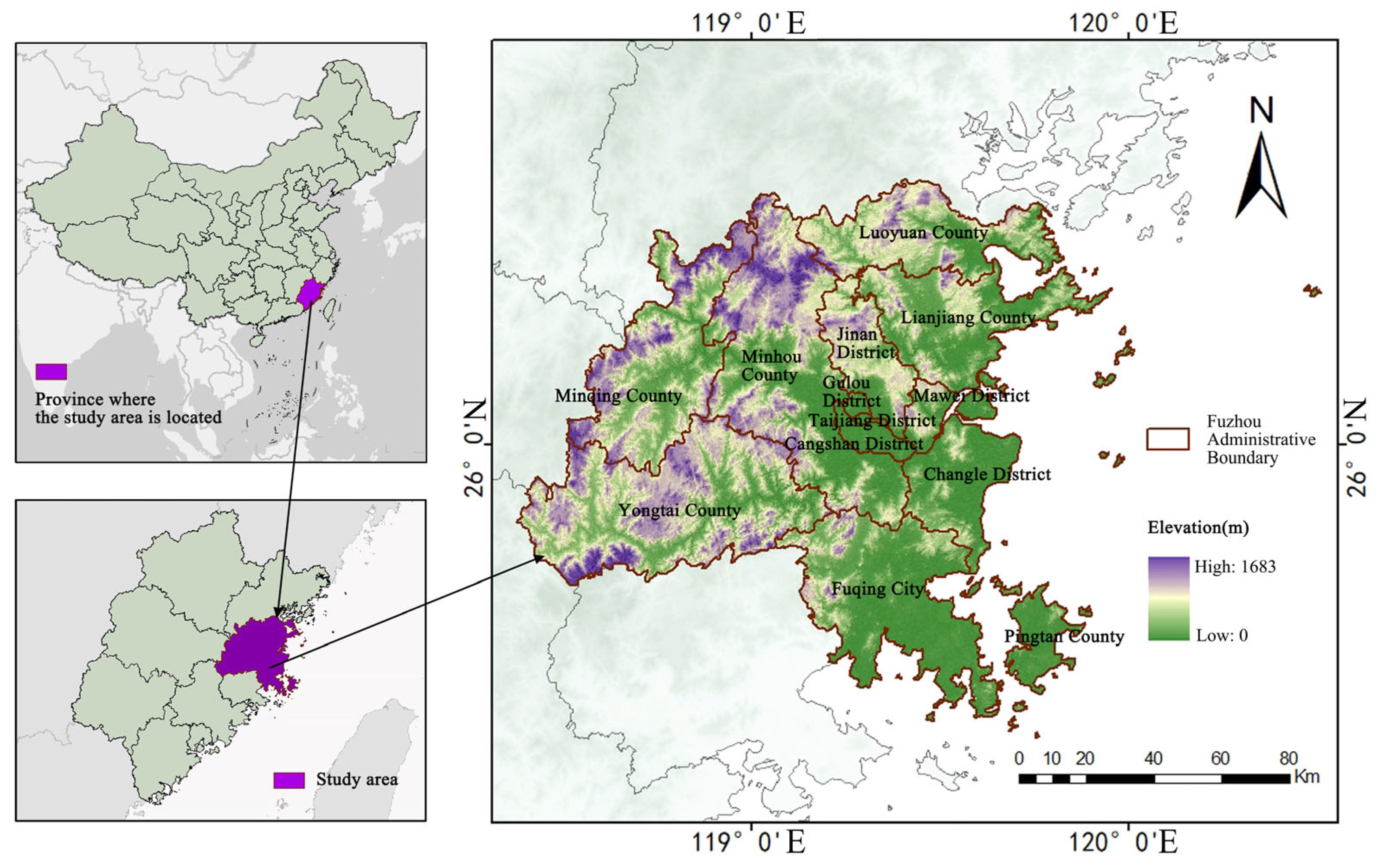
Figure 1. Location of the study area.
Forests 16 01856 g001
Figure 2. Methodological framework of this study.
Forests 16 01856 g002
Figure 3. Two-dimensional correlation judgment matrix between ESB and ESL.
Forests 16 01856 g003
Figure 4. Spatial distribution of ecosystem services.
Forests 16 01856 g004
Figure 5. Spatial distribution of ecosystem service bundles.
Forests 16 01856 g005
Figure 6. Ecological sensitivity distribution.
Forests 16 01856 g006aForests 16 01856 g006b
Figure 7. Ecological functional partitioning.
Forests 16 01856 g007
Figure 8. Factor detection results. (X1) year precipitation; (X2) year average temperature; (X3) elevation; (X4) NDVI; (X5) land use; (X6). urbanization rate; (X7) GDP; (X8) population density.
Forests 16 01856 g008
Figure 9. Interaction factor detection results. (X1) year precipitation; (X2). year average temperature; (X3) elevation; (X4) NDVI; (X5) land use; (X6). urbanization rate; (X7) GDP; (X8) population density.
Forests 16 01856 g009
Table 1. Description of data source.
Data TypeDataDescriptionSource
Natural geographic dataDEM data30 m resolution DEM data(http://www.gscloud.cn) (accessed on 15 March 2024)
soil dataThese data were used to determine the soil parameters for the INVEST model, including soil depth and soil texture data(https://data.tpdc.ac.cn) (accessed on 5 July 2024)
precipitation and evaporation dataExtract raw data and calculate annual mean with a resolution of 1000 m for 2020(https://data.tpdc.ac.cn) (accessed on 14 July 2024)
Plant Available Water CapacityUsed for INVEST model calculation with a resolution of 1000 m(http://globalchange.bnu.edu.cn/research/cdtb.jsp) (accessed on 16 July 2024)
Socio-economic dataLand use dataLand use type data for 2020 with a spatial resolution of 30 m(http://www.resdc.cn) (accessed on 17 July 2024)
GDPGDP data for 2020(www.fuzhou.gov.cn) (accessed on 18 July 2024)
UrbanizationUrbanization rate data in 2020(www.fuzhou.gov.cn)
Population densityPopulation density data for 2020(http://www.resdc.cn) (accessed on 20 July 2024)
Table 2. Ecological sensitivity evaluation factors and grading standards.
GradingElevationSlopeSlopeWater BufferLand Use TypeVegetation CoverGrading Assignment
Insensitive<300<8South<50Construction land<0.21
Mild sensitivity300~<6008~<15Southeast, Southwest50~200Shrubs, grasslands0.2–0.42
Moderately sensitive600~<90015~<25The east, the west200~<500arable land0.4–0.63
Highly sensitive900~<120025~<45Northeast, Northwest500~<800woodland0.6–0.84
Extremely sensitive≥1200≥45North>800Waters, wetlands>0.85
Table 3. Ecological sensitivity evaluation factors and grading standards.
Ecological Function ZoneDivision BasisCorresponding Encoding
Core ecological protection zoneESL ≥ 4 + e/d/c bundlee5, e4, d5, c5
Ecological restoration zoneESL ≥ 3 + Service function degradation areae3, d4, c4, b5, b4, a5, a4, c4
Sustainable Utilization zoneESL ≤ 3 + Service function stability areae2, e1, d3, d2, d1, c2, c3
Agricultural production zoneESL ≤ 2 + b bundle dominantb1, b2, b3
Urban Development zoneESL ≤ 2 + a bundle dominanta2, a1, c1
Disclaimer/Publisher’s Note: The statements, opinions and data contained in all publications are solely those of the individual author(s) and contributor(s) and not of MDPI and/or the editor(s). MDPI and/or the editor(s) disclaim responsibility for any injury to people or property resulting from any ideas, methods, instructions or products referred to in the content.