
You are currently viewing a new version of our website. To view the old version click .
Forests
  • Article
  • Open Access

10 December 2025

Overexpression of Flavonoid Biosynthesis Gene, ZeF3H, from Zelkova schneideriana Enhanced Plant Tolerance to Chilling Stress
,
,
,
and
State Key Laboratory of Tree Genetics and Breeding, College of Biological Sciences and Technology, Beijing Forestry University, Beijing 100083, China
*
Author to whom correspondence should be addressed.
These authors contributed equally to this work.
Forests2025, 16(12), 1838;https://doi.org/10.3390/f16121838 
(registering DOI)
This article belongs to the Special Issue Tree Epigenetic Diversity and Its Role in Tree Adaptation

Abstract

The flavonoid 3′-hydroxylase gene (F3H), in relation to flavonoid biosynthesis, is widely involved in stress tolerance. To understand its contribution to chilling stress, we cloned a ZeF3H gene—1092 bp long and encoding 363 amino acids—from the chilling-tolerant line of Zelkova schneideriana. Under a cold treatment, ZeF3H’s expression level in the Zelkova genotypes was found to be significantly related to its morphological performance, with a correlation coefficient of −0.8735. The ZeF3H gene was introduced into tobacco plants. When subjected to 4 °C for 10 h, the ZeF3H-transgenic tobacco plants performed better and had relatively low electrical leakage and malondialdehyde contents—0.76-fold and 0.70-fold lower than the wild-type plant—and had a high proline content and soluble sugar content—1.40- and 1.20-fold higher than that of the WT plants, respectively. In conclusion, ZeF3H can significantly improve plants’ tolerance to chilling stress and can be a candidate gene for molecular breeding programs.

1. Introduction

Flavonoids, including anthocyanins, flavones, and flavonols, are water-soluble secondary metabolites present in all organs and tissues of plants [1]. They confer vibrant colors to plants and also have the ability to enhance plants’ tolerance to various abiotic and biotic stresses, including UV radiation [1], pathogens [2], heat [3], cold [4], and drought [5,6]. Currently, the flavonoid biosynthesis pathway is well established. Some genes in relation to flavonoid biosynthesis are well studied and exhibit strong associations with stress tolerance. For example, the plant hormone jasmonic acid can induce the expression of PAP1, PAP2, MYB113, and MYB114, thereby activating the transcription of anthocyanin biosynthetic genes—DFR, ANS, and TT7—and enhancing a plant’s cold tolerance [7]. In Arabidopsis thaliana, flavonoids enhance drought tolerance by scavenging the ROS and regulating the stomatal movement by modulating ABA and H2O2 signaling [8]. In Pinus massoniana, PmCHS and PmANR respond to high temperatures and drought by upregulating the accumulation of epigallocatechin and myricetin through the flavonoid biosynthesis pathway, thereby regulating stress adaptations [9]. In Glycine max, GmbZIP131 activates the expression of GmICHG, promotes the accumulation of flavonoid lupiwighteone to scavenge the ROS, and enhances plants’ salt tolerance [10]. In freeze-tolerant Brassica rapa, BrDFR9, a key gene encoding dihydroflavonol 4-reductase in the flavonoid biosynthetic pathway, was found to be upregulated under low temperatures [11]. F3H, encoding flavanone 3-hydroxylase, is another important gene in the plant flavonoid metabolism pathway, which catalyzes the biosynthesis of the anthocyanin precursor—dihydroflavonols. This leads to the great diversification of the flavonoid biosynthesis pathway that has been recognized as playing a critical role in a plant’s adaption to diverse environmental conditions [12,13,14,15,16]. In Fragaria × Ananassa, F3H’s downregulation drastically reduced the anthocyanin content and moderately reduced the flavanol content [17]. In mulberries, it reduced the anthocyanin content and slightly increased the flavonoid content [18]. Several studies revealed that F3H genes were significantly involved in plant stress tolerance. For example, LcF3H’s overexpression in tobacco increased the content of flavan-3-ols (catechin, epicatechin, and epigallocatechin) and enhanced tobacco’s drought tolerance [19]. The heterologous expression of Dendrobium DoF3H in E. coli enhanced its tolerance to salt and cold stress [20]. Moreover, in tea plants, F3H’s overexpression promoted flavonoid accumulation and enhanced its drought and salt stress tolerance [21]. These findings collectively indicate that flavonoid-related genes contribute to multiple stress tolerance mechanisms across diverse plant species.
Chilling stress impacts plants’ growth, development, and geographical distribution by causing physiological injuries and oxidative damage [22,23]. Zelkova schneideriana, an important landscaping species, can be planted in −20 °C conditions [24]. In our previous transcriptome analysis, ZeF3H, a flavonoid biosynthesis-related gene in Zelkova, was expression induced at low temperatures in the cold-tolerant Zelkova line [25]. In this study, we aimed to characterize ZeF3H and evaluate its contribution to plants’ tolerance to chilling stress using a transformation assay. Our findings enhance our understanding of the mechanism of Zelkova plants against chilling stress, promote genetic improvement, and confer a wide application of the species.

2. Materials and Methods

2.1. Plant Material and Treatment

Twelve seedlings (lines) of Zelkova schneideriana were propagated by cutting, respectively. At least five clones per line were individually planted in pots (30 cm × 30 cm) filled with vermiculite and grew in an incubator (25 °C, 16 h light/8 h dark, a relative humidity of 65%, and a photosynthetically active radiation of 500 μmol m−2 s−1). They were irrigated with water every 4 d (100 mL per pot) and irrigated with Hoagland solution once a week (100 mL per pot). After six months of growth, the plants were transferred to a low-temperature incubator (4 °C) for 14 d (25 °C as the control). Based on the percentage and extent of affected leaves, the Zelkova lines were classified as 5 grades (1, the tolerant type with no significant changes before and after chilling treatment; 5, the sensitive type with the most wilted and seriously dried leaves; and 2–4, the intermediate type with certain leaves wilted). Each line was recorded as the mean value of 5 biological repeats.

2.2. Gene Expression Parttern of ZeF3H in Zelkova schneideriana

The specific primers were designed at 5′ side of the gene based on the transcriptome data with a fragment length of 254 bp (ZeF3H-F1, 5′-CAATGGAAGGTTCAGGAA-3′; ZeF3H-R1, 5′-CCTTCTCCAAGTCTTGCAAC-3′). The total RNAs were extracted from the leaf samples of the cold-tolerant Z. schneideriana line treated at 4 °C and 25 °C using RNAprep Pure Polysaccharide Polyphenol Plant Total RNA Extraction Kit (Vazyme Biotech Co., Ltd., Hongfeng Plot, Nanjing, China) and were reverse transcribed to cDNA using FastKing cDNA First-Strand Synthesis Kit (Tiangen Biotech Co., Ltd., Changping District, Beijing, China). The gene expression pattern was detected by PCR: 95 °C for 3 min, followed by 34 cycles at 95 °C for 30 s, 55 °C for 30 s, 72 °C for 1 min, and a final extension at 72 °C for 5 min. The expression levels of ZeF3H were qualified with Ze18S as reference gene (Zs18S-F, 5′-CACATCCAAGGAAGGCAG-3′; Ze18S-R, 5′-CCAAAGTCCAACTACGAGC-3′) by AlphaImager HP (ProteinSimple) (Bio-Techne Corporation, Minneapolis, MN, USA). Three replicates for expression test were used.

2.3. Gene Cloning and Sequence Analysis of ZeF3H Gene

The specific primers were designed at both sides of the gene based on the transcriptome data (ZeF3H-F2, 5′-agaggacacgctcgagctcaATGGCTCCTTCAACTCTTAC-3′; ZeF3H-R2, 5′-tatctcattaaagcaggactTTAAGCAAGAATCTCCTCAATTG-3′). The lowercase letters are adapter sequences used for vector ligation. The whole CDS fragments were amplified from the cold-tolerant Z. schneideriana line, recovered, and sequenced. The homologous gene sequences of ZeF3H from 10 plant species were obtained from NCBI database (https://www.ncbi.nlm.nih.gov/). The amino acid alignment was conducted using DNAMAN software v 7.0. Based on the protein sequence, the phylogenetic tree was constructed using MEGA 7.0 software following MUSCLE alignment with the neighbor-joining method and Poisson model, setting the bootstrap value to 1000 and using default settings for all other parameters. The properties of ZeF3H protein were analyzed using ExPASy Prot Param tool 2005 (https://web.expasy.org/protparam, accessed on 30 October 2024). The conserved domain of ZeF3H was analyzed by using the Conserved Domain Search Service (http://www.ncbi.nlm.nih.gov/Structure/cdd/wrpsb.cgi, accessed on 30 October 2024).

2.4. The Construction of the Expression Vector and Gene Transformation

The whole gene fragments were amplified using KOD plus DNA polymerase and the specific primer pairs of ZeF3H-F2/ZeF3H-R2 and were recovered and assembled into PEZR(K)-LC expression vector with the ClonExpress II One Step Cloning Kit (C112) (Vazyme Biotech Co., Ltd., Hongfeng Plot, Nanjing, China). The recombinant plasmid was introduced into Agrobacterium tumefaciens strain GV3101 by electroporation method (Eppendorf Eporator, Hamburg, Germany). The positive clone with the recombinant plasmid was determined by PCR test.
The Agrobacterium tumefaciens strain with the recombinant plasmid was cultured in 100 mL of YEB liquid medium at 28 °C for 7–10 h until OD600 value reached up to 0.6–0.8. The fresh tobacco leaf (Nicotiana tabacum L.) was cut into pieces and immersed into the bacterial solution for 10 min. It was further transferred to the screening medium without antibiotics (MS + 2 mg/L 6-BA + 0.1 mg/L NAA + 3% sucrose + 0.55% agar) in the dark for 3 d then cultured on the screening medium with antibiotics (100 mg/L Kanamycin and 200 mg/L Timentin) in light for 30 d. The regenerated buds were transferred to the rooting medium (MS + 3% sucrose + 0.55% agar + 50 mg/L Kanamycin + 200 mg/L Timentin) for growth. The leaves were sampled from the regenerated buds for DNA extraction. PCR assays were performed using the specific primers ZeF3HF/ZeF3HR. The tobacco plants with the ZeF3H fragment were further tested for ZeF3H expression. Ubiquitin (UBQ) was used as the reference gene to qualify the candidate level (UBQF, 5′-AGAAGGAGTCAGCAAACGATG-3′; UBQR, 5′-CATTAGGTTCTGAACAGCAGG-3′).

2.5. Physiological Index Measurement

The ZeF3H overexpression tobacco plants were transplanted into the pots as above. The F1 seeds were harvested and planted, and we conducted DNA tests. The F2 seeds were further harvested from each positive F1 line, planted, and DNA tested again. All F2 plants from a single F1 plant with the transformed gene were recognized as homozygous. Their F3 seeds were harvested and used for subsequent assays.
The seedlings of the ZeF3H overexpression tobacco lines and wide type (WT) were individually planted in the pots (10 cm × 10 cm) filled with vermiculite in an incubator (light intensity of 2000 lux, day/night ratio of 16 h/8 h), watered every 3 d, and irrigated with Hogland nutrient solution once a week. After three weeks of growth, three identical plants for each line were used for chilling treatment in the incubator (4 °C, 16 h light/8 h dark) (25 °C as the control). The leaves were harvested at 10 h of the treatment for physiological index test and Evans blue staining experiment. Three plants for each line were used for the biological repeats. SPSS software (Version 15.0) for one-way analysis of variance (ANOVA) was used for significance analysis by employing LSD algorithm.
Relative electrical leakage (REL) [26]: A total of 0.1 g of fresh leaves were cut into pieces (0.5 cm × 0.5 cm), soaked in 30 mL of deionized water, and shaken overnight. The electrical conductivity was measured as R1 using a conductivity meter (DDS-11C). The samples were further autoclaved at 121 °C for 20 min and shaken overnight again. The electrical conductivity was measured as R2. REL (%) was calculated by R1/R2.
Malondialdehyde (MDA) content [26]: A total of 0.1 g of fresh leaves were ground into homogenate in 1 mL of 10%TCA. After centrifugation, the supernatant was mixed with 1 mL of 0.6% TBA then boiled in a water bath for 15 min then centrifuged. The absorbance value of the supernatant was measured at 450 nm, 532 nm, and 600 nm, respectively. The MDA content (μmol/g FW) was calculated using the formula [6.45 × (OD532 − OD600) − 0.56 × OD450] × total extraction volume/sample fresh weight.
Soluble sugar content [27]: A total of 0.5 g of fresh leaves were ground to powder in deionized water and boiled for 20 min. The filtrate was mixed with anthrone reagent and boiled for 10 min. The absorbance value was measured at 620 nm. The soluble sugar content (μg/g FW) was calculated using the formula (m1 × V1 × dilution factor)/(V2 × m2 × 106) (m1, soluble sugar content from the standard curve; V1, extraction volume; V2, volume of the test sample solution; m2, sample fresh weight).
Proline content [28]: A total of 0.1 g of fresh leaves were ground and homogenized in 3% sulfosalicylic acid. The filtrate was boiled for 10 min and mixed with equal volumes of glacial acetic acid and 2.5% acidic ninhydrin. The mixture was incubated at 100 °C for 30 min and mixed with a double volume of toluene. The optical density of the upper aqueous phase was measured at 520 nm. The proline concentration was determined from a standard curve created using purified L-proline. The proline content (μg/g FW) was calculated using the formula (m1 × V1)/(m2 × V2) (m1, proline content based on the standard curve; V1, volume of the total extraction; m2, sample fresh weight; V2, volume of the test sample solution).

2.6. Evans Blue Staining Experiment

The tobacco leaves were incubated with 0.25% (w/v) Evans blue solution at room temperature for 15 min, washed twice with distilled water, and kept in distilled water overnight [29]. The stained leaves were boiled in a mixed solution (glycerol/ice acetic acid/ethanol = 1:1:3) to remove chlorophyll and photographed.

3. Results

3.1. Expression Pattern of ZeF3H in Z. schneideriana

Under regular growth conditions, the Z. schneideriana lines performed well without any difference in morphology. When subjected to chilling stress, the lines exhibited injuries differently. Based on their morphological performance, lines 6 and 8 demonstrated the best cold tolerance and were classified as grade 1. They were followed by lines 9, 11, 12, 7, 10, 1, 2, 3, and 4, which were assigned grades of 2, 2, 2, 3, 3, 3, 4, 4, and 4, respectively. Line 5 had the worst performance and was assigned a grade of 5.
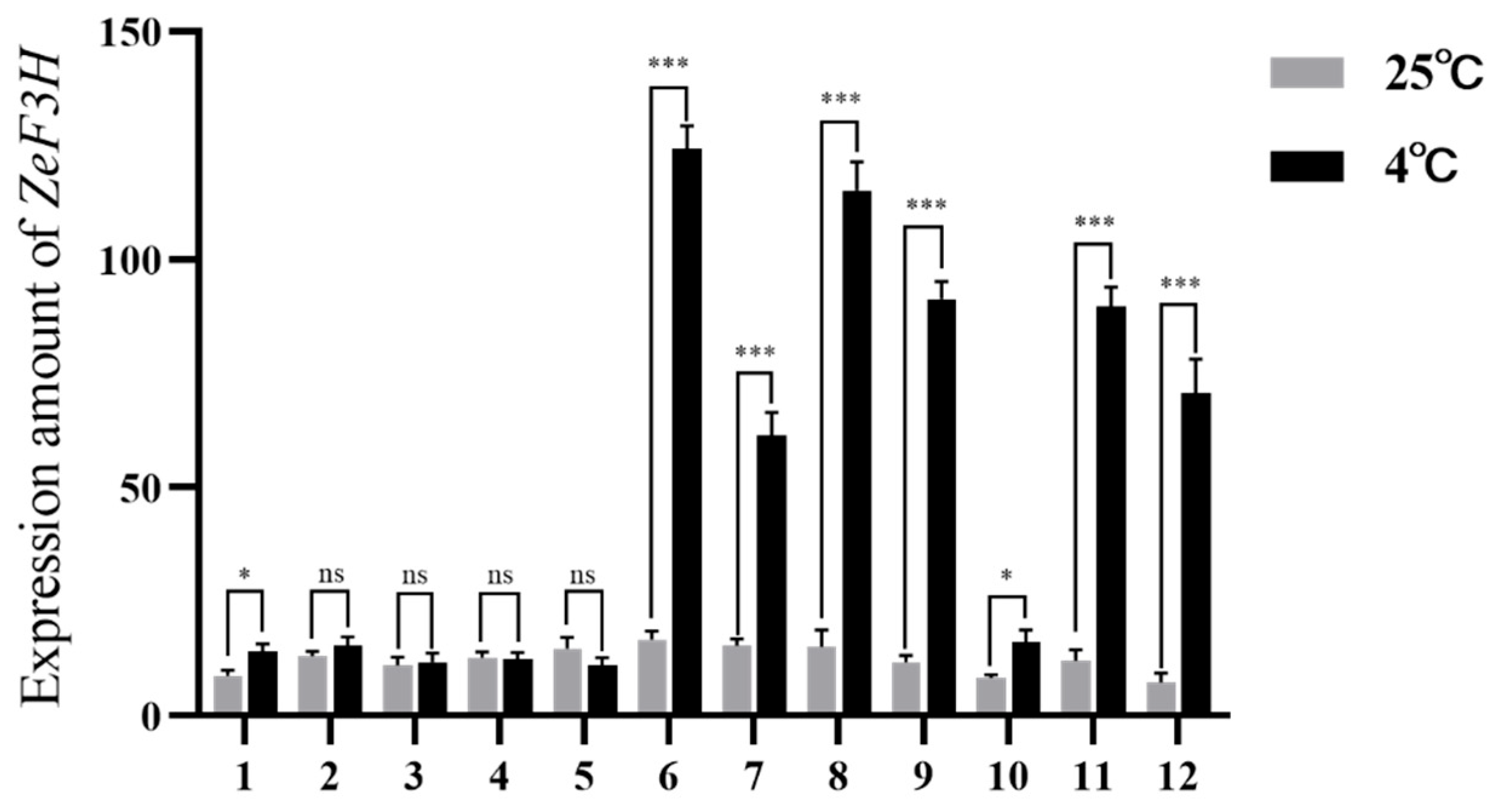
ZeF3H’s gene expression assay revealed no significant differences among the Zelkova lines under regular growth conditions. After the cold treatment, ZeF3H’s expression level in the lines varied greatly (Figure 1): The cold-tolerant lines 6 and 8 expressed it 3.3- and 3.6-fold higher, respectively, than the control (25 °C). In contrast, the chilling-sensitive lines, such as 2, 3, 4, and 5, had unchanged expression levels (Table S1). The correlation coefficient between the ZeF3H expression level and the plants’ cold tolerance performance was up to −0.8735, indicating ZeF3H expression’s significant association with plants’ cold tolerance.
Figure 1. Expression of ZeF3H in Zelkova schneideriana lines with chilling stress (4 °C) and control (25 °C) for 14 d. 18s rRNA was used as the reference gene. The values represent the mean of three replicates ± SD. * and *** indicate significant difference at p values of 0.05 and 0.001 using Duncan’s test following one-way ANOVA.

3.2. Characteristics of ZeF3H

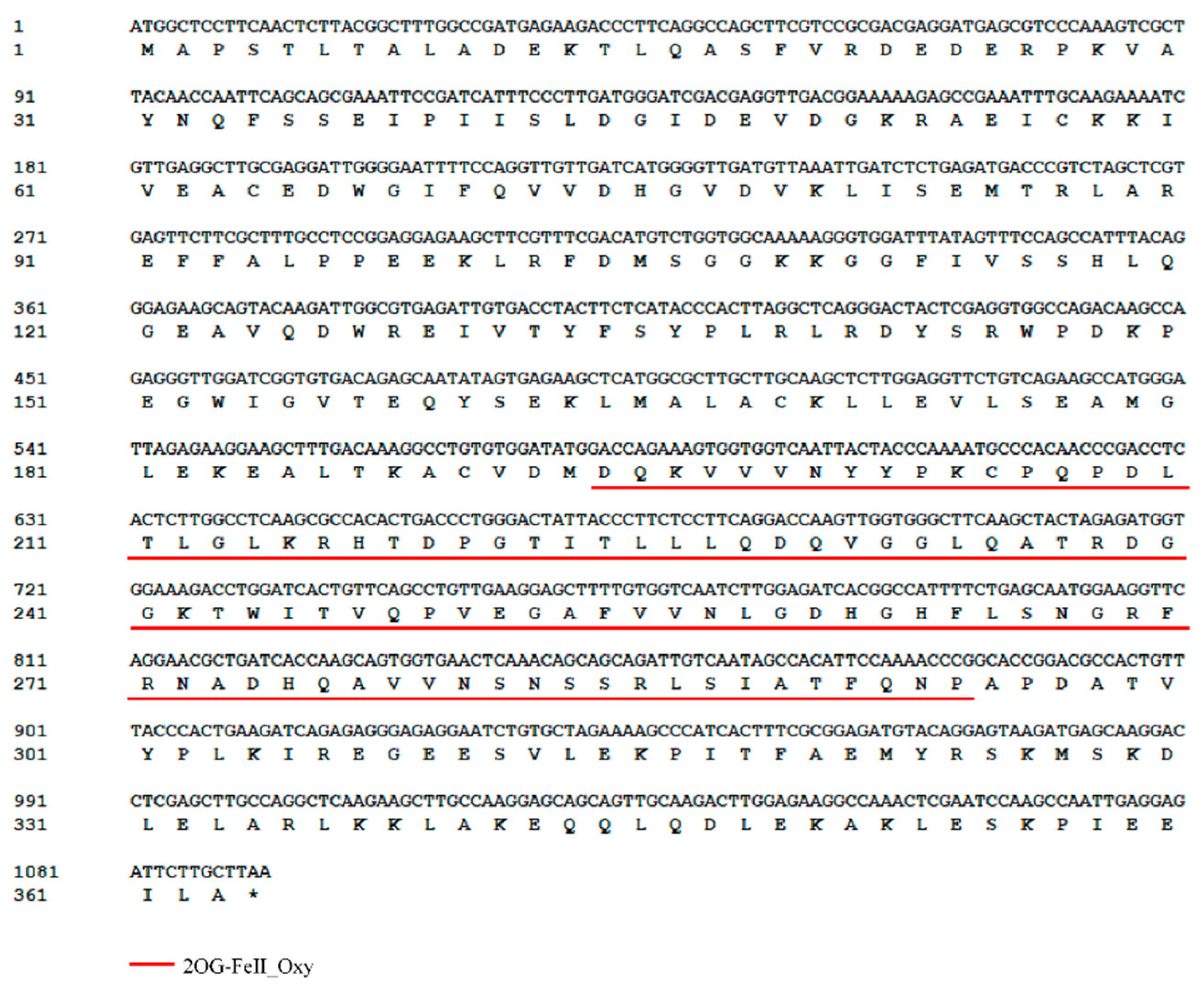
A full-length fragment of ZeF3H was obtained from the chilling-tolerant Zelkova plant using the primers ZeF3HF/ZeF3HR. The sequencing data revealed its length as 1092 bp, encoding 363 amino acids (Figure 2). ZeF3H is rich in several amino acids, such as Leu (L) and Glu (E), accounting for 10.5% and 9.1%, respectively. Moreover, ZeF3H had a molecular weight (MW) of 41.82 kDa, an isoelectric point (pI) of 4.95, a grand average of hydropathicity (GRAVY) value of −0.366, and an instability index of 43.62, revealing that it is a slightly acidic, hydrophilic, and unstable protein. The conserved domain of the ZsF3H protein was predicted, which showed its possession of a 2-oxoglutarate (2OG)-dependent dioxygenase domain (2OG-Fell_Oxy), indicating a potential role in the oxygen mechanism.
Figure 2. Nucleotide and amino acids of the ZeF3H gene. The red line represents a conserved domain of 2-oxoglutarate (2OG)-dependent dioxygenase (2OG-Fell_Oxy). * represents stop codon.
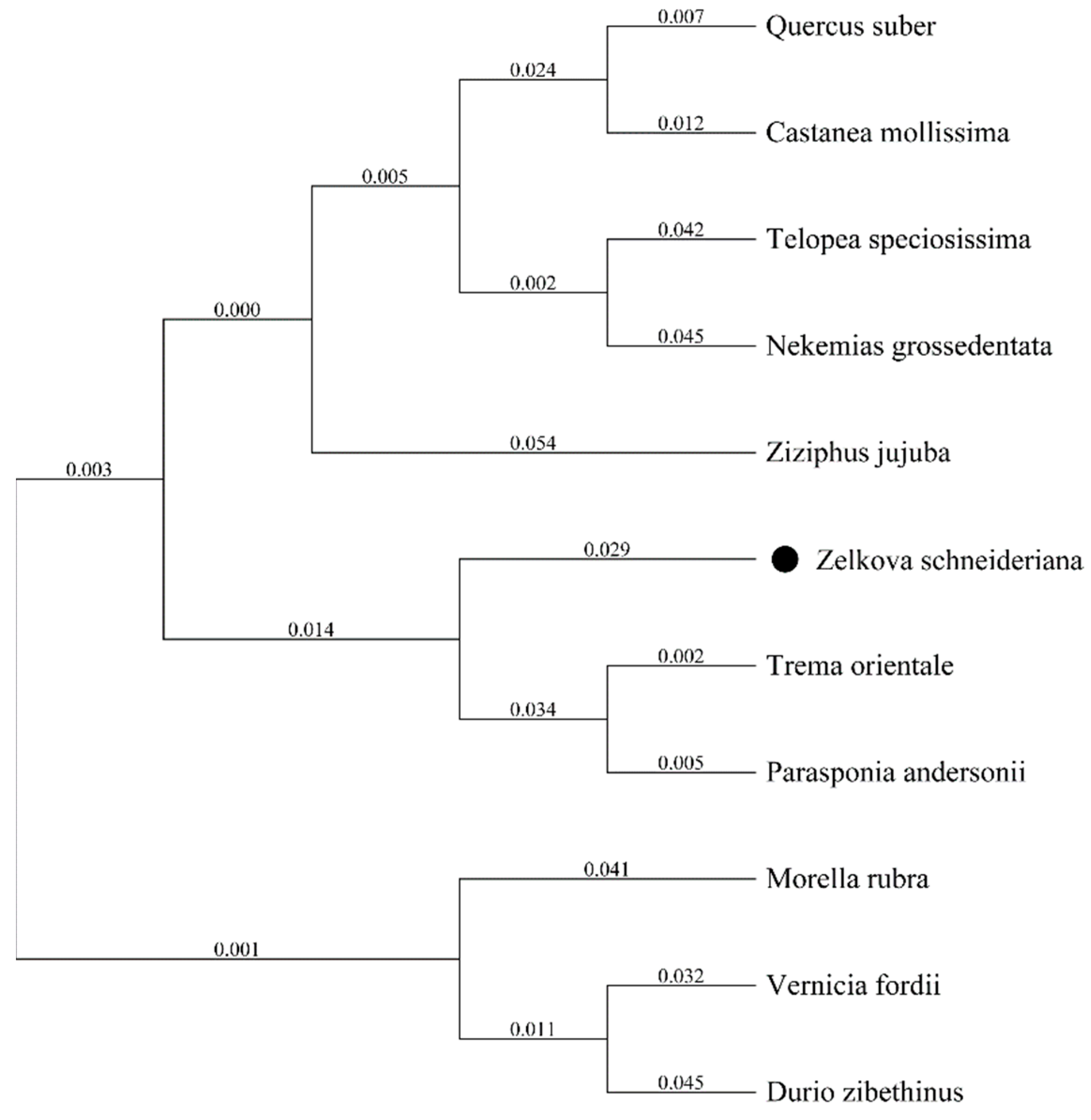
A phylogenetic tree was constructed using 11 F3H homologous species. They were grouped into two categories: the first included the species from the Juglandaceae, Sapindaceae, Vitaceae, Rhamnaceae, and Ulmaceae families, while the second included the species from the Myricaceae, Euphorbiaceae, and Malvaceae families (Figure 3). ZeF3H (Ulmus genus), which belongs to a branch of the first category, was sub-grouped with Parasponia andersonii (Trema genus) and Trema orientale (Trema genus) from the same Ulmaceae family.
Figure 3. Phylogenetic tree of F3H proteins from 11 species. Quercus suber (NW_019814279); Castanea mollissima (KAF3948124); Telopea speciosissima (XM_043856759); Nekemias grossedentata (AFN70721); Ziziphus jujuba var. spinosa (XM_016034153); Zelkova schneideriana (BankIt2988723 ZelkovaPX093070); Trema orientale (PON99462); Parasponia andersonii (PON42671); Morella rubra (KAB1219056); Vernicia fordii (ARV78456); and Durio zibethinus (XM_022885372). Numbers on phylogenetic branches indicate branch lengths, which indicate the genetic distance between the two taxa they connect, with smaller values indicating closer evolutionary relationships. ● represents the plant species used in this report.
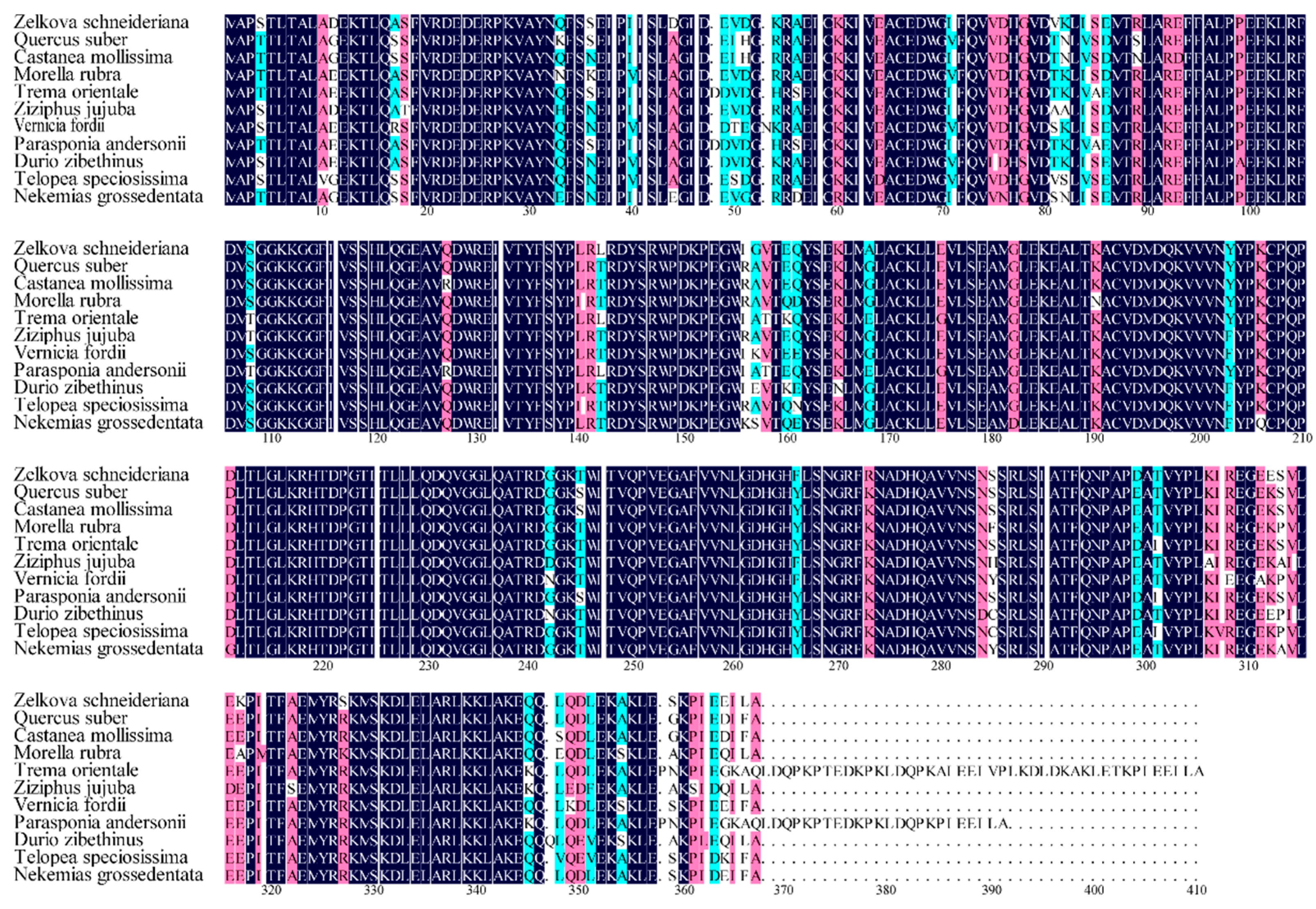
A further sequence alignment revealed that ZeF3H was conserved among species, with an amino acid identity of over 75% (Figure 4). ZeF3H and the homologous from Parasponia andersonii had the highest identity value of 82.68%, followed by 82.20% with the homologous from Trema orientale. Two distinct amino acids were determined in the F3H proteins from the three Ulmaceae species and were distinguished from the other family species, such as 142L (T in the other species) and 168A/E (G in the other species). They can be used as markers for species identification and classification. And these substitutions may influence enzyme stability or substrate specificity, suggesting a potential adaptive significance in Ulmaceae species. Thus, F3H exhibited evolutionary attributes.
Figure 4. Sequence alignment among ZeF3H and the homologous proteins. Zelkova schneideriana (BankIt2988723 ZelkovaPX093070); Quercus suber (NW_019814279); Castanea mollissima (KAF3948124); Morella rubra (KAB1219056); Trema orientale (PON99462); Ziziphus jujuba var. spinosa (XM_016034153); Vernicia fordii (ARV78456); Parasponia andersonii (PON42671); Durio zibethinus (XM_022885372). Telopea speciosissima (XM_043856759); and Nekemias grossedentata (AFN70721). The number under the sequence represents the locations of the relative amino acids. The colors display different identity of the amino acids among the homologous proteins.

3.3. ZeF3H Enhanced Plant’s Tolerance to Chilling Stress

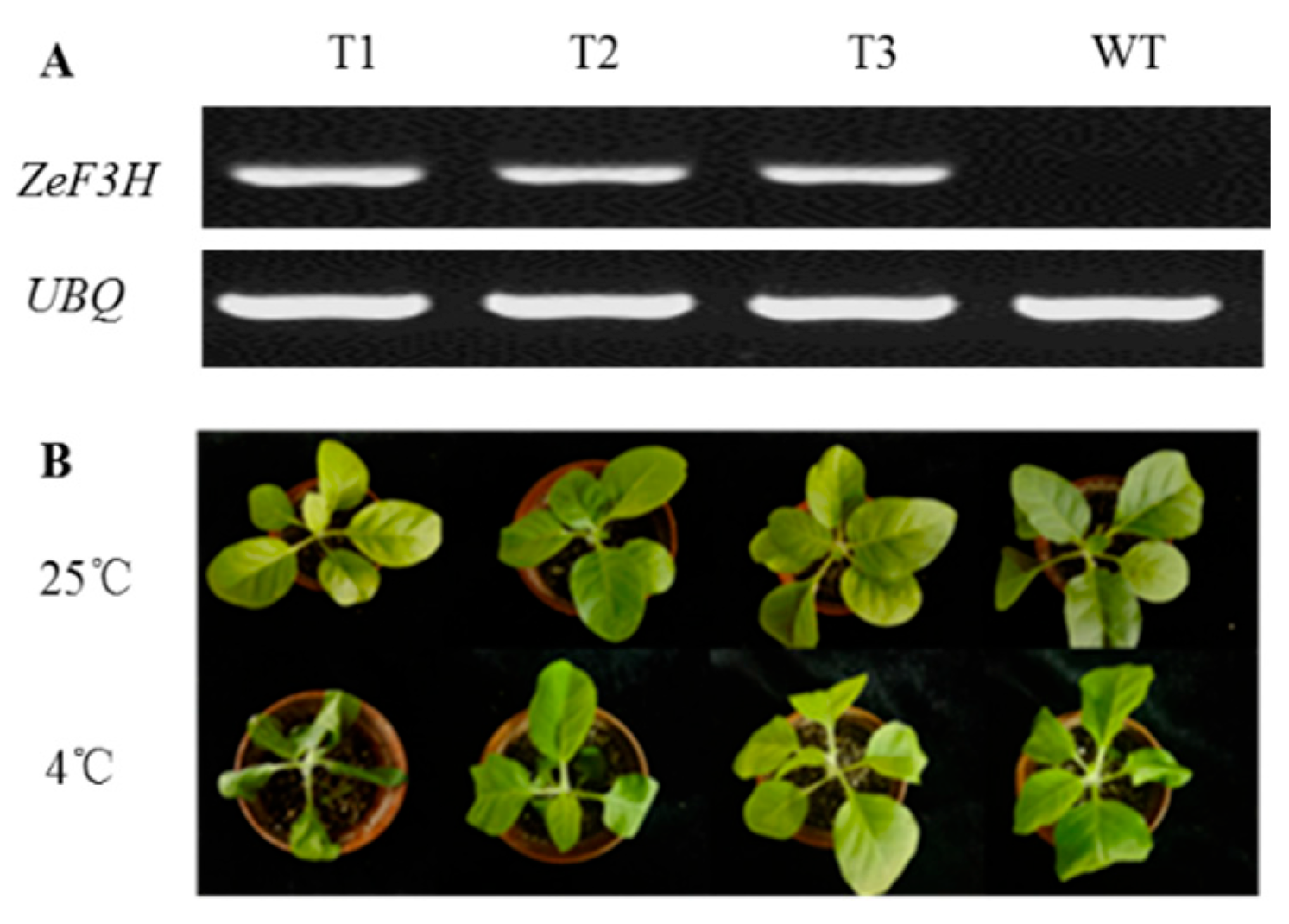
The ZeF3H fragment was ligated with the PEZR(K)-LC vector driven by the 35S promoter and introduced in tobacco plants. The DNA tests revealed that five regenerated lines were positive for ZeF3H, and a further RNA assay revealed that three lines—T1, T2, and T3—had a high expression of ZeF3H (Figure 5A) and were used for the chilling tolerance evaluation in the next steps.
Figure 5. Morphological performance of the tobacco plants under 4 °C treatment and control (25 °C) for 10 h. (A) Expression tests of ZeF3H and (B) morphological performance. WT, wild type; T1–T3, ZeF3H-transgenic lines.
One-month-old seedlings of the ZeF3H overexpressed tobacco lines and wild type (WT) were subjected to a 4 °C treatment for 10 h. Unsurprisingly, the transgenic tobacco lines and WT suffered, with their leaves wilting and drooping. The transgenic lines performed better than the WT (Figure 5B). Relatively, all the tobacco plants grew well at 25 °C, and no significant difference was found between the transgenic lines and the WT.
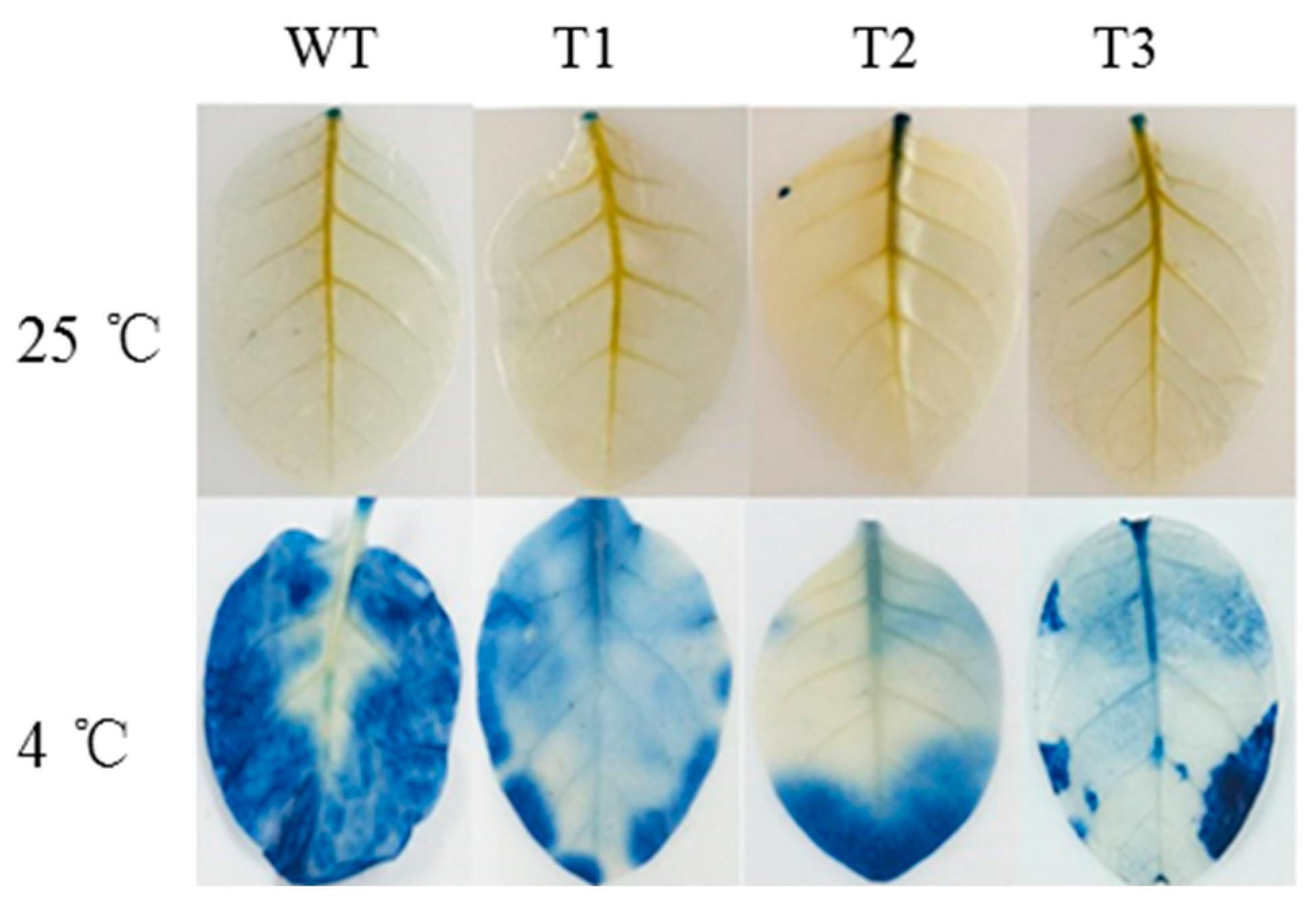
Evans blue staining assays revealed that the tobacco lines displayed a clear background at 25 °C, with the transgenic and WT plants demonstrating no differences. However, when subjected to the 4 °C stress, the WT leaves were significantly stained, while the transgenic leaves were stained only at the edges. Evidently, ZeF3H offered protection against chilling stress (Figure 6).
Figure 6. Evans blue staining of the tobacco leaves under 4 °C treatment and control (25 °C) for 10 h. WT, wild type; T1–T3, ZeF3H-transgenic lines.
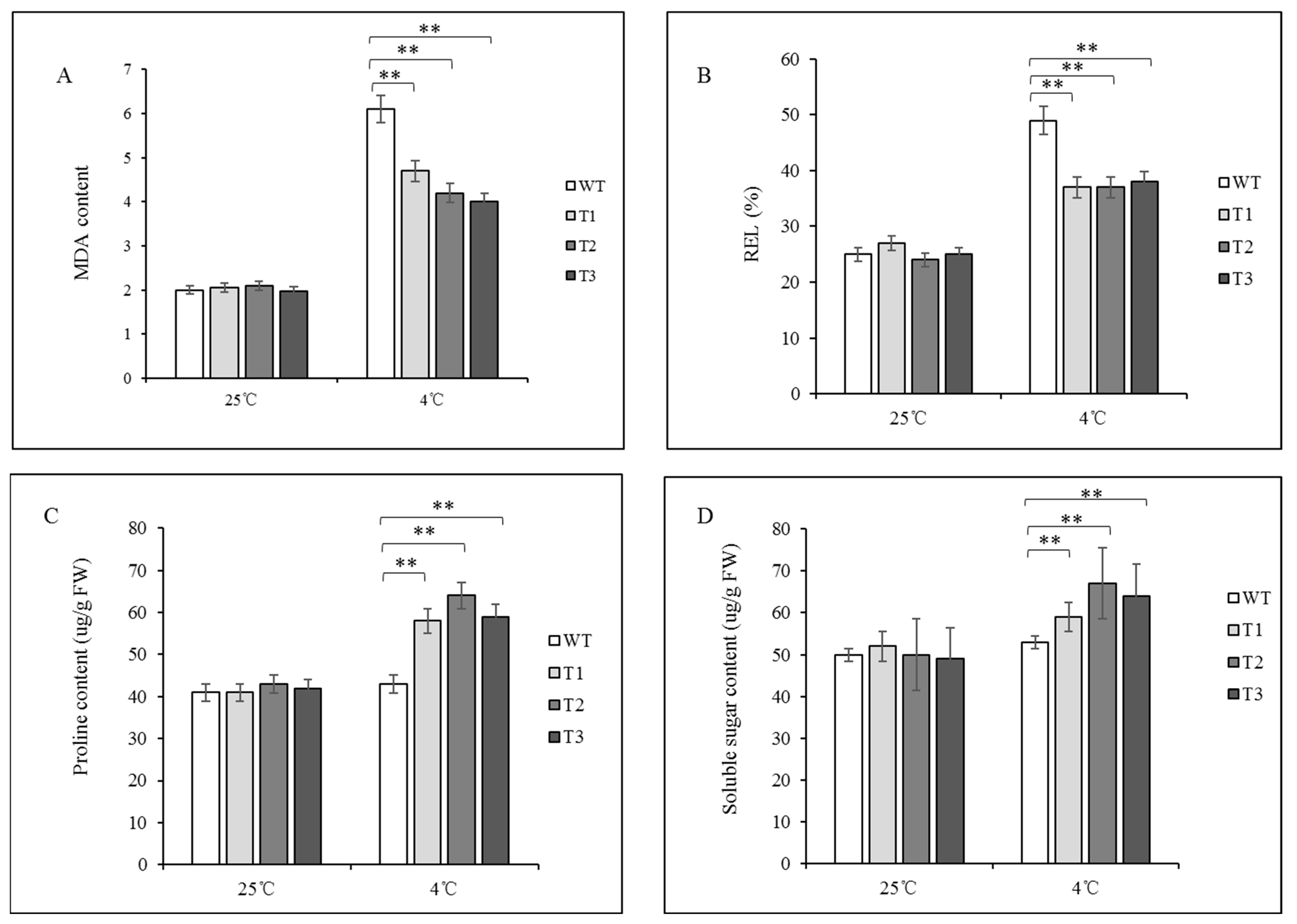
The physiological index measurements exhibited similar results. Under regular growth conditions, the transgenic plants and WT had a similar performance in all four indexes. However, under the chilling stress, all the plants had increased values, but the transgenic lines performed differently than the WT (Figure 7). The REL value increased by 35.49% to 50.41% in the transgenic plants [(after treatment − before treatment)/before treatment)] and 92.98% in the WT plants. The MDA content increased by 99.35% to 122.73% in the transgenic plants and 210.02% in the WT plants. The proline content increased by 40.48% to 48.84% in the transgenic plants and 4.88% in the WT plants. The soluble sugar content increased by 13.46% to 34.00% in the transgenic plants and 6.00% in the WT plants. ZeF3H could thus lower the cell membrane oxidation and damage caused by chilling stress and enhance the plants’ tolerance.
Figure 7. Physiological index of the ZeF3H-transgenic tobacco lines (T1, T2, T3) and WT plants under 25 °C and 4 °C treatments for 10 h. (A), MDA content; (B), REL; (C), proline content; (D), soluble sugar content. Bars represent mean ± SD (3 replicates). Significant differences were determined by one-way ANOVA followed by LSD test (** p < 0.01).

4. Discussion

Numerous F3H genes, according to the existing research, are crucial for plant responses to abiotic stress. For example, the maize gene ZmF3H6 was transferred into Arabidopsis, and its overexpression led to an increased tolerance to salt stress, with the REL value in the transgenic plants decreasing by about 24% and their survival rate increasing by about 50% compared to the WT plants [30]. In Lycium chinense, a novel F3H gene was isolated and introduced in tobacco plants [14]. The MDA content and the H2O2 content in the transgenic plants were significantly reduced by 1.61- and 1.70-fold compared to the WT plants, suggesting that LcF3H contributes to the enhancement of drought tolerance. Further, F3H was found to exhibit a strong tolerance to chilling stress, such as the tomato F3H gene introduced in tobacco plants. When subjected to a 4 °C treatment for 7 d, the seed germination rate of the WT was 51%, whereas those of the transgenic plants were 73%, 85%, and 78%, respectively, indicating that F3H improved the plant’s tolerance to chilling stress [31]. In this study, the ZeF3H transcript level was higher in cold-tolerant Zelkova serrata lines than in cold-sensitive lines. ZeF3H’s heterologous expression in tobacco significantly increased chilling tolerance, with the MDA content and REL value of the transgenic plants being 0.70- and 0.76-fold lower than that of the WT plants (transgenic line/WT) under low-temperature stress, while the proline content and soluble sugar content of the transgenic plants were 1.40- and 1.20-fold higher than that of the WT plants, respectively. Obviously, ZeF3H exhibited a high tolerance level against abiotic stress as the homologous genes from various species. It could be an efficient gene resource in chilling tolerance breeding. Further exploring the effect of the ZeF3H gene on other abiotic stresses would be crucial for understanding the contribution of the F3H gene to plants’ adaption to various environmental conditions.
Tolerance to chilling stress is a complex process. Some tolerant genes were involved and functioned in different ways. For example, the main latex protein is a unique type of protein in plants. The overexpression of NtMLP423 in tobacco enhanced the plant’s performance under chilling stress, with its chlorophyll content being 1.38-fold more than that of the WT plants [32]. Expansins are a type of cell wall proteins that disrupt the noncovalent bonds between cell wall polysaccharides and regulate cell wall relaxation. The PttEXPA8-transgenic tobacco leaves were found to have a lower MDA content—1.16-fold lower than the WT plants—when subjected to low-temperature stress [33]. Dehydrin is a type of antifreeze protein that can directly react with ice crystals. A dehydrin gene, PicW, was transferred to creeping bentgrass plants, whose REL value and MDA content were 39.52% and 337.24% lower, respectively, than that of the WT plants [33]. Beta-amylase hydrolyzes starch into soluble sugars that participate in energy metabolism. Several related genes were confirmed in relation to chilling tolerance [34,35,36,37]. Of them, the overexpression of AaBAM3.1 in Arabidopsis increased the survival rate of plants when subjected to a −2 °C treatment—20% higher than that of the WT plants—and the REL value and MDA content were 0.6- and 0.75-fold higher than the WT plants [38]. F3H is a key enzyme in the biosynthesis of dihydroflavonols, catalyzing the conversion of naringenin to dihydrokaempferol. It contains a conserved 2-oxoglutarate (2OG)-dependent dioxygenase domain (2OG-Fell_Oxy), which relates to oxygen metabolism [39,40,41]. An increase in the flavonoid content significantly enhanced its ability to absorb hydroxyl radicals and prevent the accumulation of reactive oxygen species (ROS) at low temperatures, improving the plant’s resistance to freezing [42]. In this report, we cloned a ZeF3H gene from the Zelkova species and found that the ZeF3H-transgenic plants performed morphologically and physiologically better under the 4 °C treatment than the WT plants. Accordingly, each of the mechanisms partially contributed to the plants’ tolerance to chilling stress. Pyramid breeding of the genes might be attempted in a complementary or reinforcing manner to improve the plants’ tolerance to stress in future studies.

5. Conclusions

The ZeF3H gene from Zelkova plants was involved in the biosynthesis pathway of flavonoids and revealed a specific sequence. ZeF3H overexpression reduced oxidative damage (MDA and REL) and enhanced osmoprotectant accumulation (proline and soluble sugars), confirming its role in chilling tolerance and its potential as a candidate gene for molecular breeding. Future studies should explore ZeF3H’s regulatory network and its interaction with other stress-responsive genes to develop pyramiding strategies for enhanced chilling tolerance.

Supplementary Materials

The following supporting information can be downloaded at https://www.mdpi.com/article/10.3390/f16121838/s1: Table S1: Expression data of the ZeF3H gene and chilling tolerance level of 12 Zelkova lines.

Author Contributions

All authors contributed to this study’s conception and design. L.G. and J.H. performed material preparation and research; X.L. (Xiao Liu) and X.L. (Xiaoxiong Lu) participated in the physiological index tests; and L.G. and J.X. wrote the paper. All authors have read and agreed to the published version of the manuscript.

Funding

This research was funded by the National Natural Science Foundation of China (#31870648).

Data Availability Statement

The sequences of the ZeFH gene were deposited in the NCBI database (accession number: BankIt2988723 ZelkovaPX093070).

Acknowledgments

We thank Xu Xiao from Ludong University for editing the English text of a draft of this manuscript.

Conflicts of Interest

The authors declare no conflicts of interest.

References

  1. Guo, J.; Han, W.; Wang, M. Ultraviolet and environmental stresses involved in the induction and regulation of anthocyanin biosynthesis: A review. Afr. J. Biotechnol. 2008, 7, 4966–4972. [Google Scholar] [CrossRef]
  2. Winkel-Shirley, B. Biosynthesis of flavonoids and effects of stress. Curr. Opin. Plant Biol. 2002, 5, 218–223. [Google Scholar] [CrossRef]
  3. Petrussa, E.; Braidot, E.; Zancani, M.; Peresson, C.; Bertolini, A.; Patui, S.; Vianello, A. Plant flavonoids-biosynthesis, transport and involvement in stress responses. Int. J. Mol. Sci. 2013, 14, 14950–14973. [Google Scholar] [CrossRef] [PubMed]
  4. Zhang, Q.; Zhai, J.; Shao, L.; Lin, W.; Peng, C. Corrigendum: Accumulation of anthocyanins: An adaptation strategy of Mikania micrantha to low temperature in winter. Front. Plant Sci. 2019, 10, 1049, Erratum in Front. Plant Sci. 2020, 10, 1796. [Google Scholar] [CrossRef]
  5. Li, B.; Fan, R.; Sun, G.; Sun, T.; Fan, Y.; Bai, S.; Guo, S.; Huang, S.; Liu, J.; Zhang, H.; et al. Flavonoids improve drought tolerance of maize seedlings by regulating the homeostasis of reactive oxygen species. Plant Soil 2021, 461, 389–405. [Google Scholar] [CrossRef]
  6. Zeng, Y.; Guo, C.; Wang, M.; Jin, J.; Yu, K.; Zhang, J.; Cao, F. Comprehensive evaluation of drought tolerance of six Chinese chestnut varieties (clones) based on flavonoids and other physiological indexes. Sci. Rep. 2024, 14, 14511. [Google Scholar] [CrossRef]
  7. Wang, L.; Wang, B.; Yu, H.; Guo, H.; Lin, T.; Kou, L.; Wang, A.; Shao, N.; Ma, H.; Xiong, G. Transcriptional regulation of strigolactone signalling in Arabidopsis. Nature 2020, 583, 277–281. [Google Scholar] [CrossRef] [PubMed]
  8. Li, B.; Fan, R.; Fan, Y.; Liu, R.; Zhang, H.; Chen, T.; Liu, J.; Li, H.; Zhao, X.; Song, C. The flavonoid biosynthesis regulator PFG3 confers drought stress tolerance in plants by promoting flavonoid accumulation. Environ. Exp. Bot. 2022, 196, 104792. [Google Scholar] [CrossRef]
  9. Li, L.; Duan, H.; Li, Y.; Tie, L.; Ding, G. The PmCHS and PmANR of Pinus massoniana regulate flavonoid metabolism in response to high temperatures and drought. Ind. Crops Prod. 2025, 225, 120495. [Google Scholar] [CrossRef]
  10. Ni, X.; Wang, Y.; Dai, L.; Jiang, K.; Zeng, S.; Huang, Y.; Zhou, Y.; Duan, L.; Bian, C.; Liu, Q. The transcription factor GmbZIP131 enhances soybean salt tolerance by regulating flavonoid biosynthesis. Plant Physiol. 2025, 197, 092. [Google Scholar] [CrossRef]
  11. Ahmed, N.U.; Park, J.I.; Jung, H.J.; Yang, T.J.; Hur, Y.; Nou, I.S. Characterization of dihydroflavonol 4-reductase (DFR) genes and their association with cold and freezing stress in Brassica rapa. Gene 2014, 550, 46–55. [Google Scholar] [CrossRef] [PubMed]
  12. Jia, Y.; Li, B.; Zhang, Y.; Zhang, X.; Li, C. Evolutionary dynamic analyses on monocot flavonoid 3′-hydroxylase gene family reveal evidence of plant-environment interaction. BMC Plant Biol. 2019, 19, 347. [Google Scholar] [CrossRef]
  13. Kim, B.G.; Kim, J.H.; Kim, J.; Lee, C.; Ahn, J.H. Accumulation of flavonols in response to ultraviolet-B irradiation in soybean is related to induction of flavanone 3-beta-hydroxylase and flavonol synthase. Mol. Cells 2008, 25, 247–252. [Google Scholar] [CrossRef]
  14. Liu, Y.; Qian, J.; Li, J.; Xing, M.; Grierson, D.; Sun, C.; Xu, C.; Li, X.; Chen, K. Hydroxylation decoration patterns of flavonoids in horticultural crops: Chemistry, bioactivity and biosynthesis. Hortic. Res. 2022, 9, 068. [Google Scholar] [CrossRef]
  15. Nishihara, M.; Yamada, E.; Saito, M.; Fujita, K.; Takahashi, H.; Nakatsuka, K. Molecular characterization of mutations in white-flowered torenia plants. BMC Plant Biol. 2014, 14, 86. [Google Scholar] [CrossRef]
  16. Singh, K.; Rani, A.; Kumar, S.; Sood, P.; Mahajan, M.; Yadav, S.K.; Singh, B.; Ahuja, P.S. An early gene of the flavonoid pathway, flavanone 3-hydroxylase, exhibits a positive relationship with the concentration of catechins in tea (Camellia sinensis). Tree Physiol. 2008, 28, 1349–1356. [Google Scholar] [CrossRef]
  17. Jiang, F.; Wang, J.; Jia, H.; WS Jia, W.; Wang, H.; Xiao, M. RNAi-mediated silencing of the flavanone 3-hydroxylase gene and its effect on flavonoid biosynthesis in strawberry fruit. J. Plant Growth Regul. 2012, 32, 182–190. [Google Scholar] [CrossRef]
  18. Dai, M.; Kang, X.; Wang, Y.; Huang, S.; Guo, Y.; Wang, R.; Chao, N.; Liu, L. Functional characterization of flavanone 3-hydroxylase (F3H) and its role in anthocyanin and flavonoid biosynthesis in mulberry. Molecules 2022, 27, 3341. [Google Scholar] [CrossRef]
  19. Song, X.; Diao, J.; Ji, J.; Wang, G.; Guan, C.; Jin, G.; Wang, Y. Molecular cloning and identification of a flavanone 3-hydroxylase gene from Lycium chinense, and its overexpression enhances drought stress in tobacco. Plant Physiol. Biochem. 2016, 98, 89–100. [Google Scholar] [CrossRef] [PubMed]
  20. Si, C.; Dong, W.; da Silva, J.A.T.; He, C.; Yu, Z.; Zhang, M.; Huang, L.; Zhao, C.; Zeng, D.; Li, C.; et al. Functional analysis of flavanone 3-hydroxylase (F3H) from Dendrobium officinale, which confers abiotic stress tolerance. Hortic. Plant J. 2023, 9, 356–364. [Google Scholar] [CrossRef]
  21. Shen, G.; Cao, H.; Zeng, Q.; Guo, X.; Shao, H.; Wang, H.; Luo, L.; Yue, C.; Zeng, L. Integrated physiological, transcriptomic, and metabolomic analysis reveals mechanism underlying the Serendipita indica-enhanced drought tolerance in tea plants. Plants 2025, 14, 989. [Google Scholar] [CrossRef]
  22. Li, X.; Gong, B.; Xu, K. Interaction of nitric oxide and polyamines involves antioxidants and physiological strategies against chilling-induced oxidative damage in Zingiber officinale Roscoe. Sci. Hortic. 2014, 170, 237–248. [Google Scholar] [CrossRef]
  23. Yu, D.; Lee, H. Evaluation of freezing injury in temperate fruit trees. Hortic. Environ. Biotechnol. 2020, 61, 787–794. [Google Scholar] [CrossRef]
  24. Cheng, H.; Huang, K.; Liang, R. Research progress on efficient cultivation, development and utilization of the precious fast growing tree Zelkova schneideriana. For. Sci. Technol. 2024, 1, 27–31. [Google Scholar] [CrossRef]
  25. Sun, Y.; Gong, L.; Liu, X.; Su, J.; Lu, X.; Xu, J. Genome-wide profiling of the genes related to leaf discoloration in Zelkova schneideriana. Forests 2024, 15, 1146. [Google Scholar] [CrossRef]
  26. Liu, H.; Li, H.; Zhang, H.; Li, J.; Xie, B.; Xu, J. The expansin gene PttEXPA8 from poplar (Populus tomentosa) confers heat resistance in transgenic tobacco. Plant Cell Tissue Organ Cult. 2016, 126, 353–359. [Google Scholar] [CrossRef]
  27. Wang, B.; Chen, J.; Chen, L.; Wang, X.; Wang, R. Combined drought and heat stress in Camellia oleifera cultivars: Leaf characteristics, soluble sugar and protein contents, and Rubisco gene expression. Trees 2015, 29, 1483–1492. [Google Scholar] [CrossRef]
  28. Bates, L.S.; Waldeen, R.P.; Teare, I.D. Rapid determination of free proline for water-stress studies. Plant Soil 1963, 39, 205–207. [Google Scholar] [CrossRef]
  29. Zhang, H.; Liu, H.; Yang, R.; Xu, X.; Liu, X.; Xu, J. Over-expression of PttEXPA8 gene showed various resistances to diverse stresses. Int. J. Biol. Macromol. 2019, 130, 50–57. [Google Scholar] [CrossRef] [PubMed]
  30. Xiao, T.; Zhang, S.; Gu, Y.; Hu, H.; Sun, L.; Lu, C.; Warburton, M.L.; Li, H.; Zhu, J. Systematic analysis of the F3H family in maize reveals a role for ZmF3H6 in salt stress tolerance. New Crops 2026, 3, 100082. [Google Scholar] [CrossRef]
  31. Meng, C.; Zhang, S.; Deng, Y.; Wang, G.; Kong, F. Overexpression of a tomato flavanone 3-hydroxylase-like protein gene improves chilling tolerance in tobacco. Plant Physiol. Biochem. 2015, 96, 388–400. [Google Scholar] [CrossRef] [PubMed]
  32. Liu, H. Functional Study of Tobacco NtMLP423 Gene in Drought and Cold Stress. Master’s Thesis, Shandong Agricultural University, Tai’an, China, 2021. [Google Scholar]
  33. Zhang, H.; Shi, Y.; Liu, X.; Wang, R.; Li, J.; Xu, J. Transgenic creeping bentgrass plants expressing a Picea wilsonii dehydrin gene (PicW) demonstrate improved freezing tolerance. Mol. Biol. Rep. 2018, 45, 1627–1635. [Google Scholar] [CrossRef] [PubMed]
  34. Fulton, D.C.; Stettler, M.; Mettler, T.; Vaughan, C.K.; Li, J.; Francisco, P.; Gil, D.; Reinhold, H.; Eicke, S.; Messerli, G. Beta-amylase4, a noncatalytic protein required for starch breakdown, acts upstream of three active β-amylases in Arabidopsis chloroplasts. Plant Cell 2008, 20, 1040–1058. [Google Scholar] [CrossRef] [PubMed]
  35. Hao, X.; Yue, C.; Tang, H.; Qian, W.; Wang, Y.; Wang, L.; Wang, X.; Yang, Y. Cloning of β-amylase gene (CsBAM3) and its expression model response to cold stress in tea plant. Acta Agron. Sin. 2017, 43, 1417–1425. [Google Scholar] [CrossRef]
  36. Thalmann, M.; Santelia, D. Starch as a determinant of plant fitness under abiotic stress. New Phytol. 2017, 214, 943–951. [Google Scholar] [CrossRef]
  37. Zhao, L.; Gong, X.; Gao, J.; Dong, H.; Zhang, S.; Tao, S.; Huang, X. Transcriptomic and evolutionary analyses of white pear (Pyrus bretschneideri) β-amylase genes reveals their importance for cold and drought stress responses. Gene 2019, 689, 102–113. [Google Scholar] [CrossRef]
  38. Sun, S.; Hu, C.; Qi, X.; Chen, J.; Zhong, Y.; Muhammad, A.; Lin, M.; Fang, J. The AaCBF4-AaBAM3.1 module enhances freezing tolerance of kiwifruit (Actinidia arguta). Hortic. Res. 2021, 8, 97. [Google Scholar] [CrossRef]
  39. Zhao, S.; Wu, L.; Xu, Y.; Nie, Y. Fe(II) and 2-oxoglutarate-dependent dioxygenases for natural product synthesis: Molecular insights into reaction diversity. Nat. Prod. Rep. 2025, 42, 67–92. [Google Scholar] [CrossRef]
  40. Panat, N.A.; Maurya, D.K.; Ghaskadbi, S.S.; Sandur, S.K. Troxerutin, a plant flavonoid, protects cells against oxidative stress-induced cell death through radical scavenging mechanism. Food Chem. 2016, 194, 32–45. [Google Scholar] [CrossRef]
  41. Rao, Y.; Peng, T.; Xue, S. Mechanisms of plant saline-alkaline tolerance. J. Plant Physiol. 2023, 281, 153916. [Google Scholar] [CrossRef]
  42. Watanabe, M.; Ayugase, J. Effect of low temperature on flavonoids, oxygen radical absorbance capacity values and major components of winter sweet spinach (Spinacia oleracea L.). J. Sci. Food Agric. 2015, 95, 2095–2104. [Google Scholar] [CrossRef] [PubMed]
Disclaimer/Publisher’s Note: The statements, opinions and data contained in all publications are solely those of the individual author(s) and contributor(s) and not of MDPI and/or the editor(s). MDPI and/or the editor(s) disclaim responsibility for any injury to people or property resulting from any ideas, methods, instructions or products referred to in the content.

Article Metrics

Citations

Article Access Statistics

Article metric data becomes available approximately 24 hours after publication online.