Modelling Growth and Yield Response to Thinning in Quercus robur L. Stands in NW Spain



Abstract
1. Introduction
2. Materials and Methods
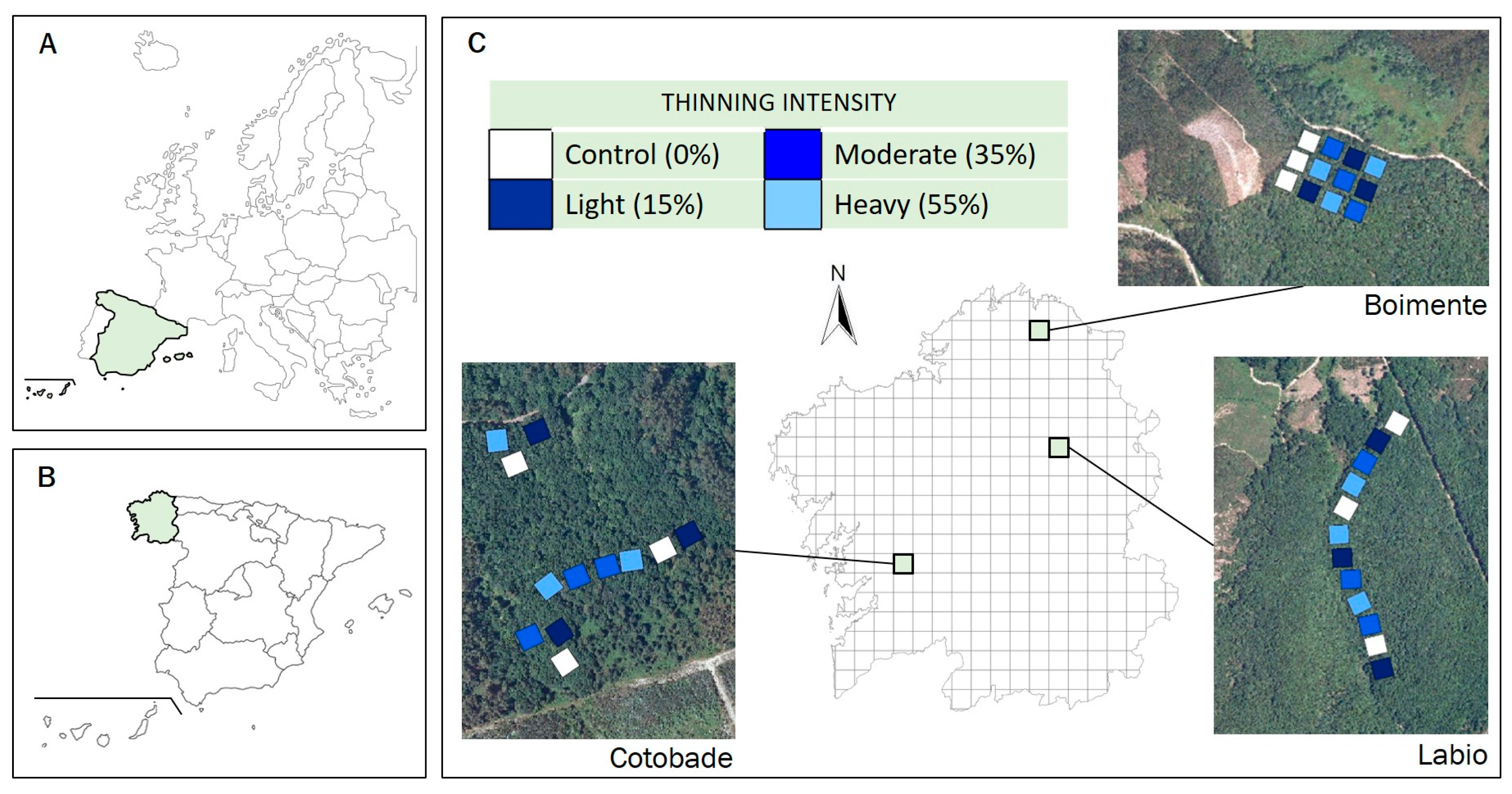
2.1. Data
2.2. Analysis Approach
2.3. Dependent Variables
2.4. Statistical Analysis
3. Results
3.1. The State-Space Approach
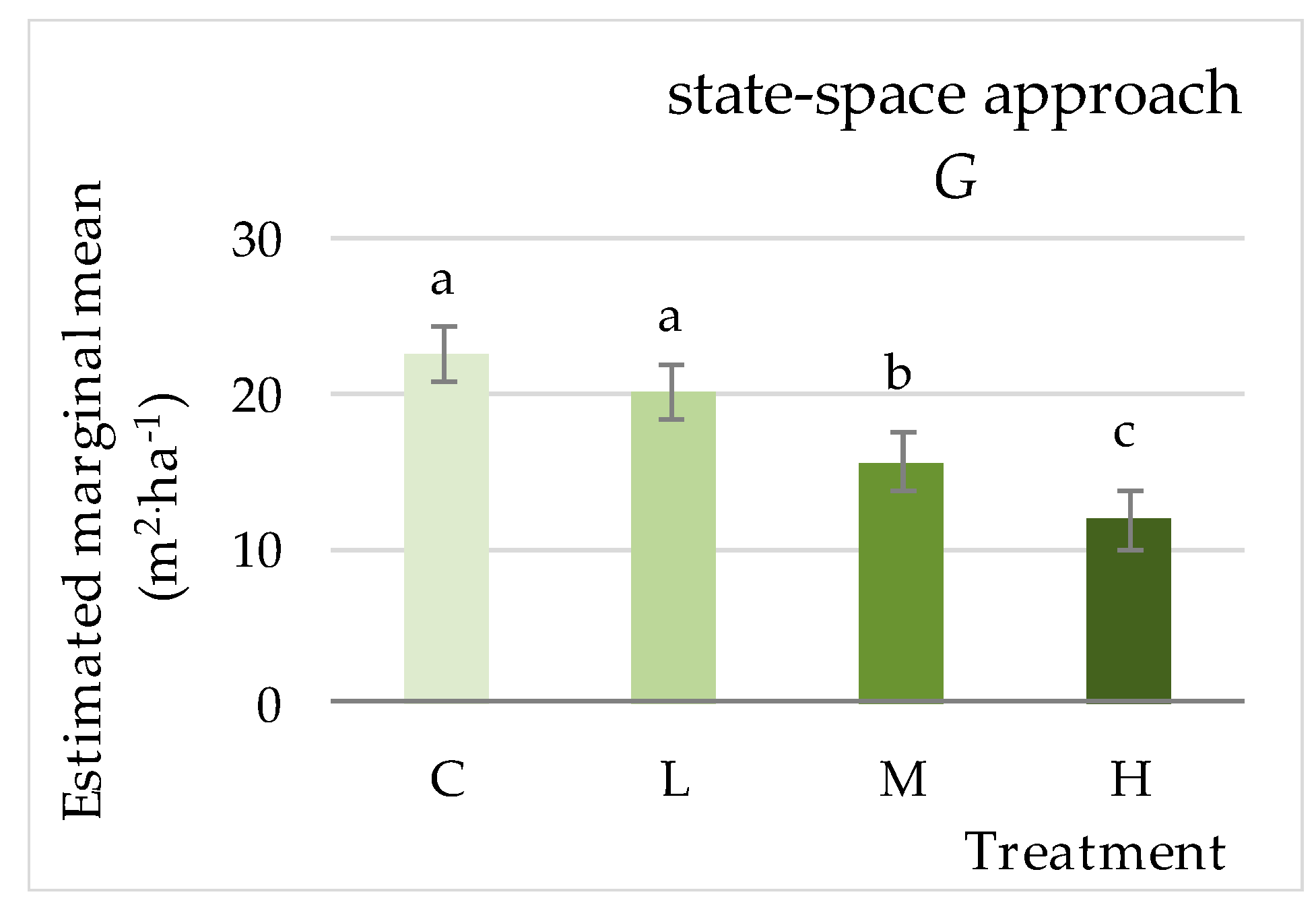
3.1.1. G Variable
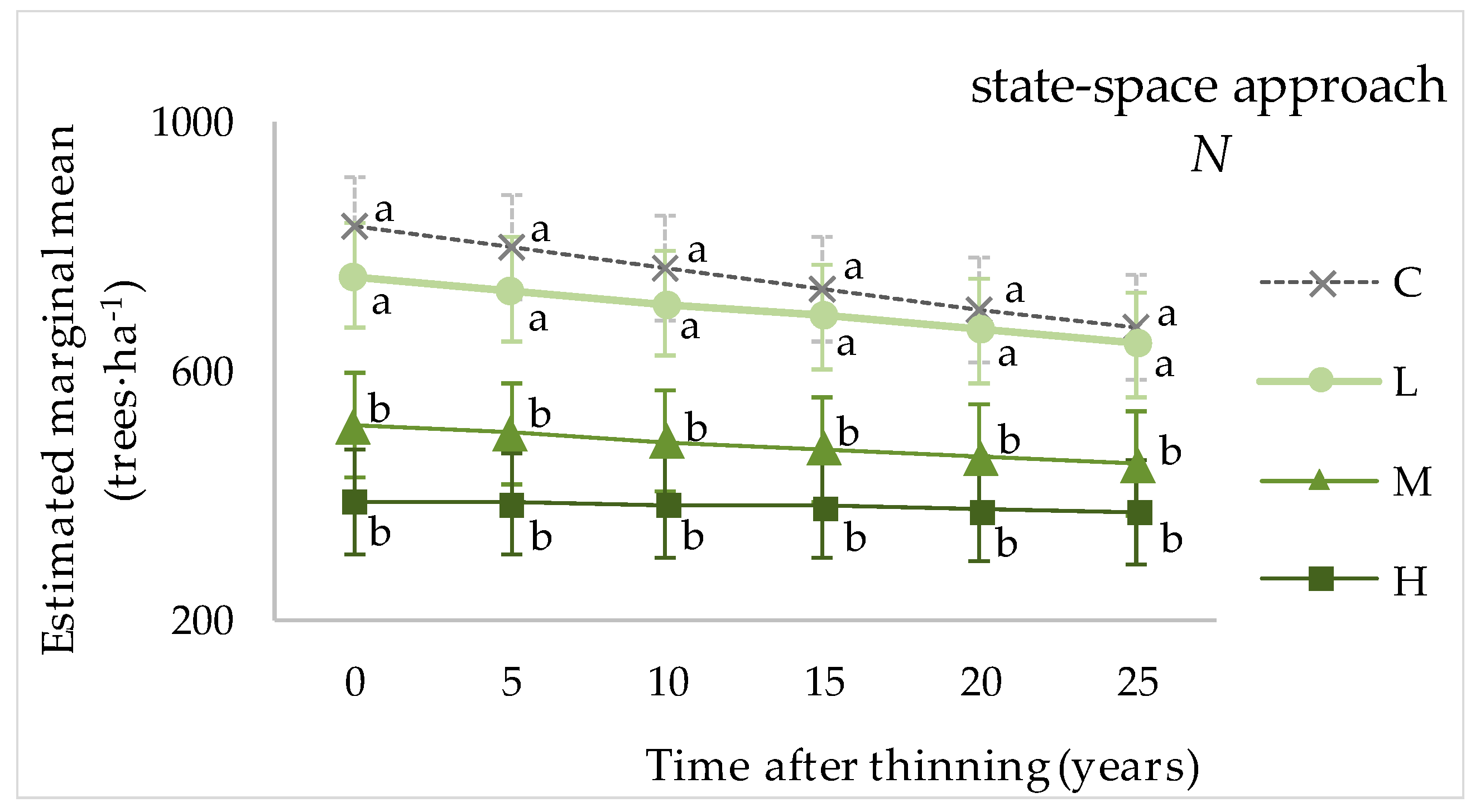
3.1.2. N Variable
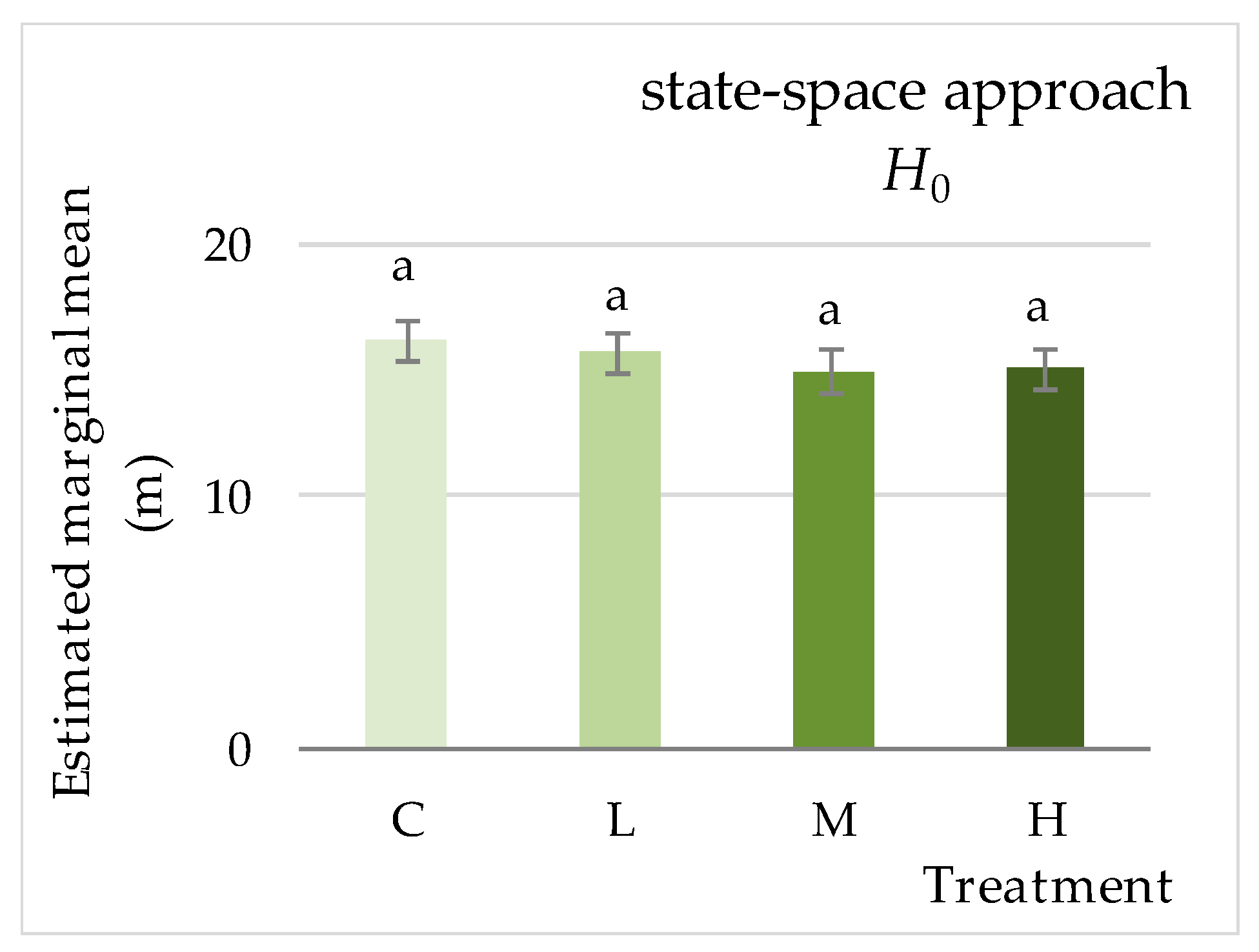
3.1.3. H0 Variable
3.2. Thinning-Effect Approach
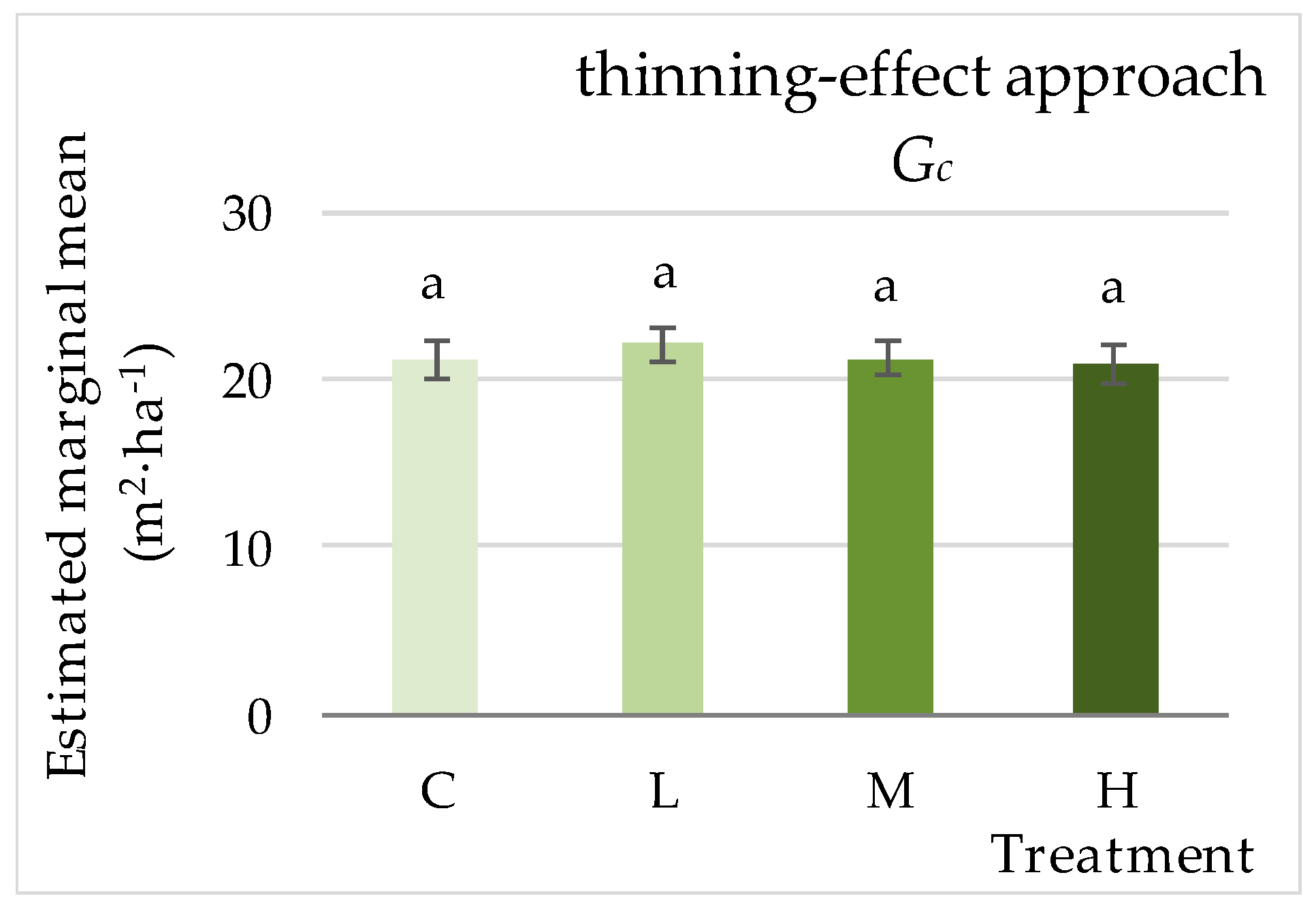
3.2.1. Gc Variable
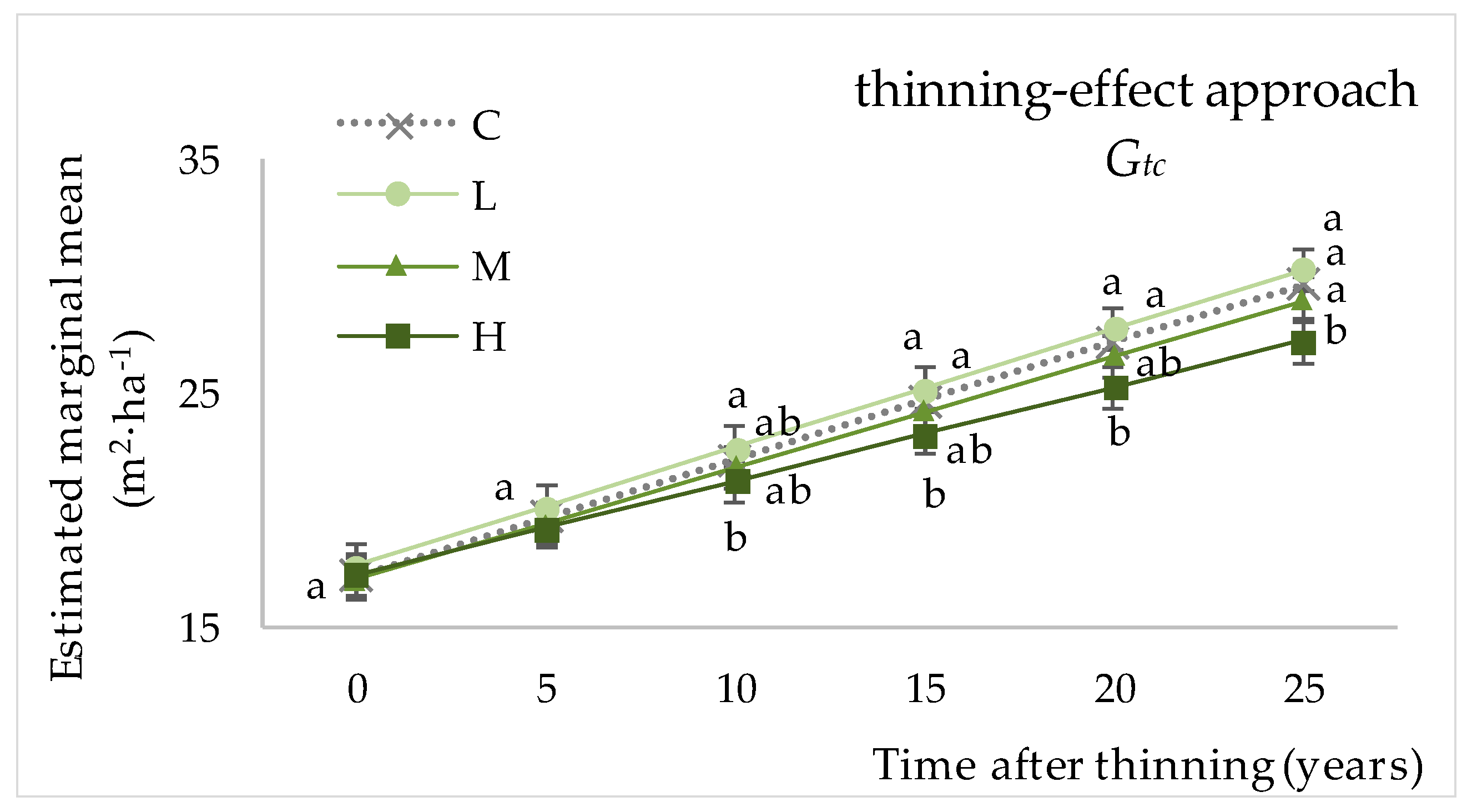
3.2.2. Gtc Variable
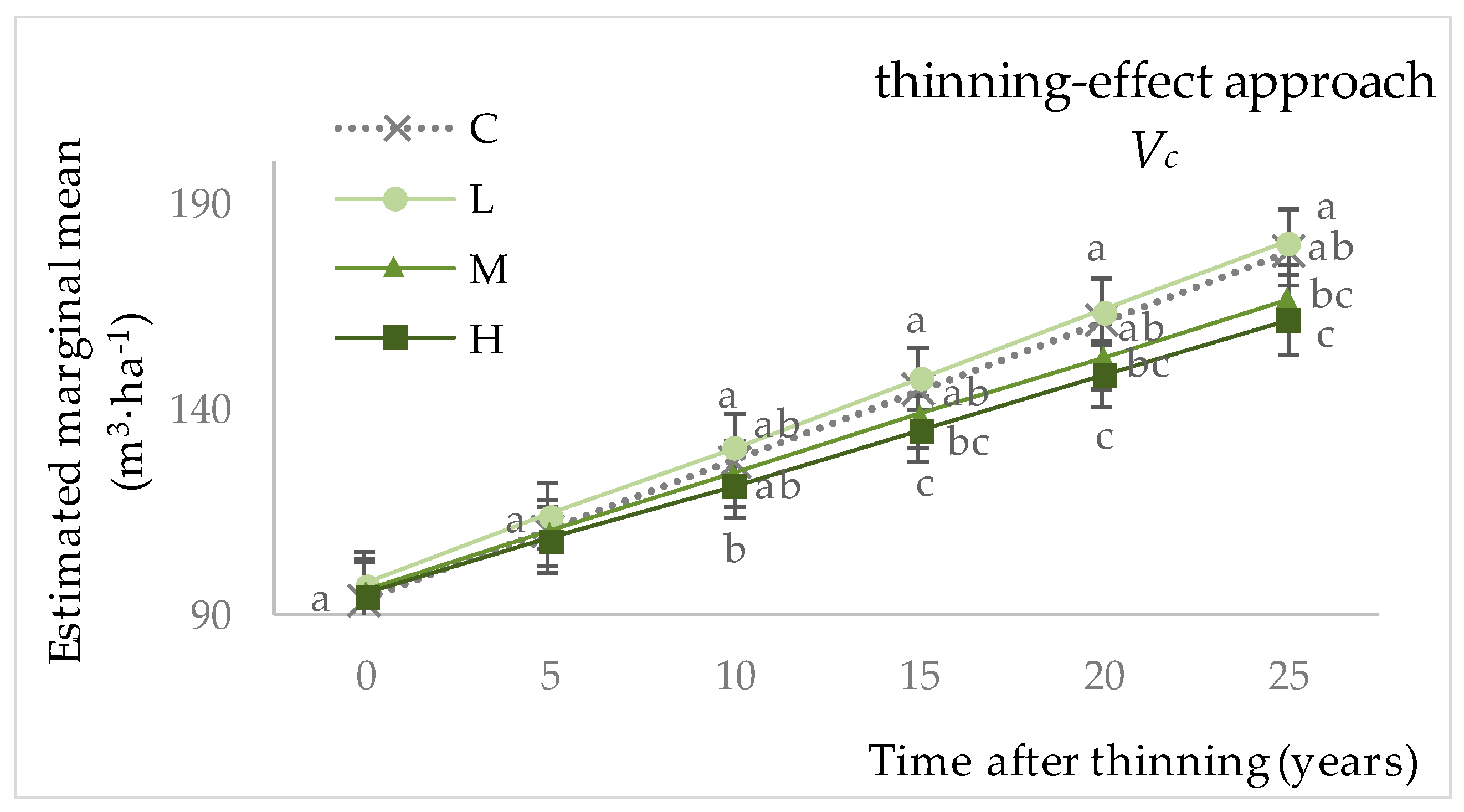
3.2.3. Vc Variable
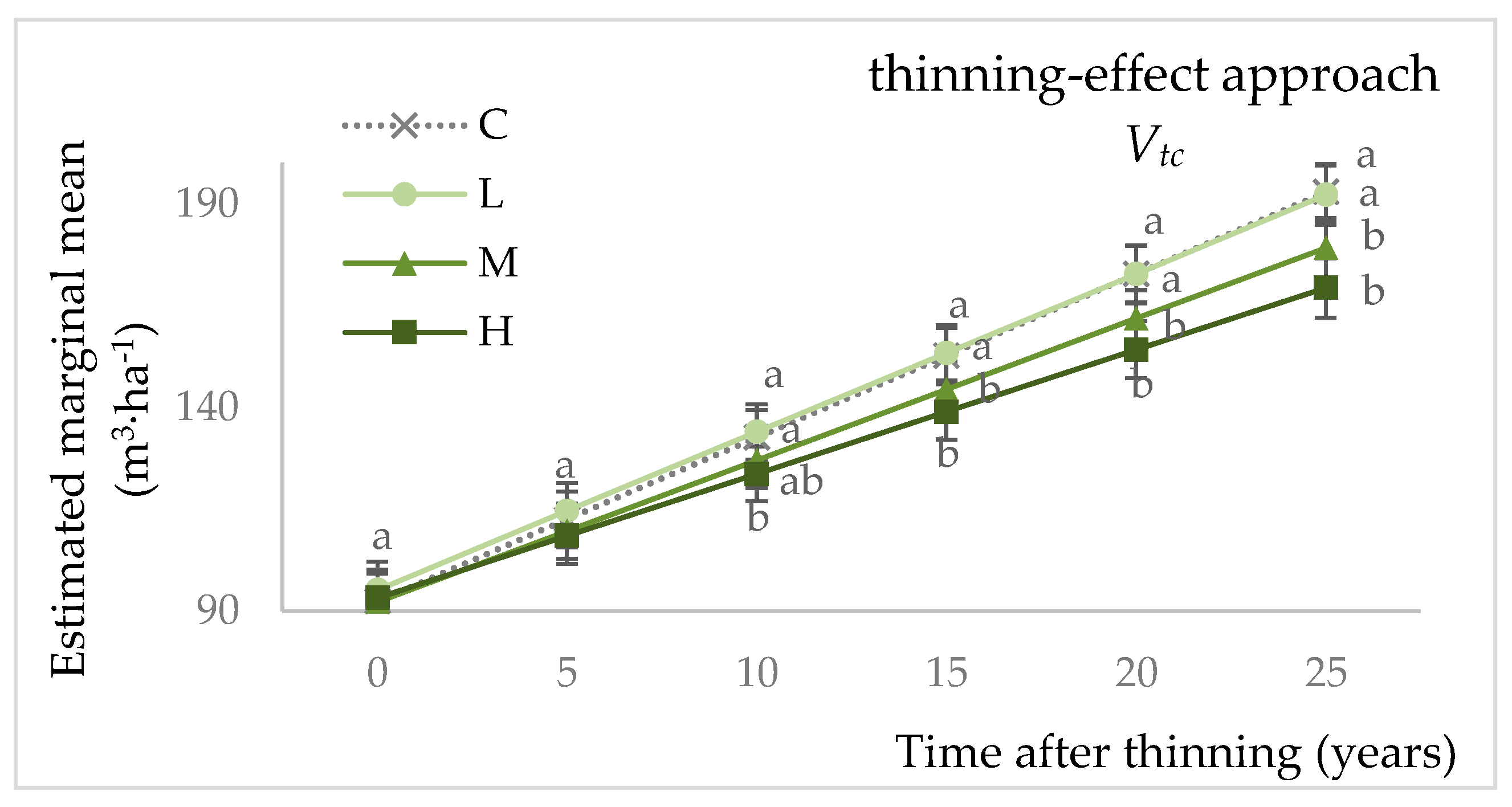
3.2.4. Vtc Variable
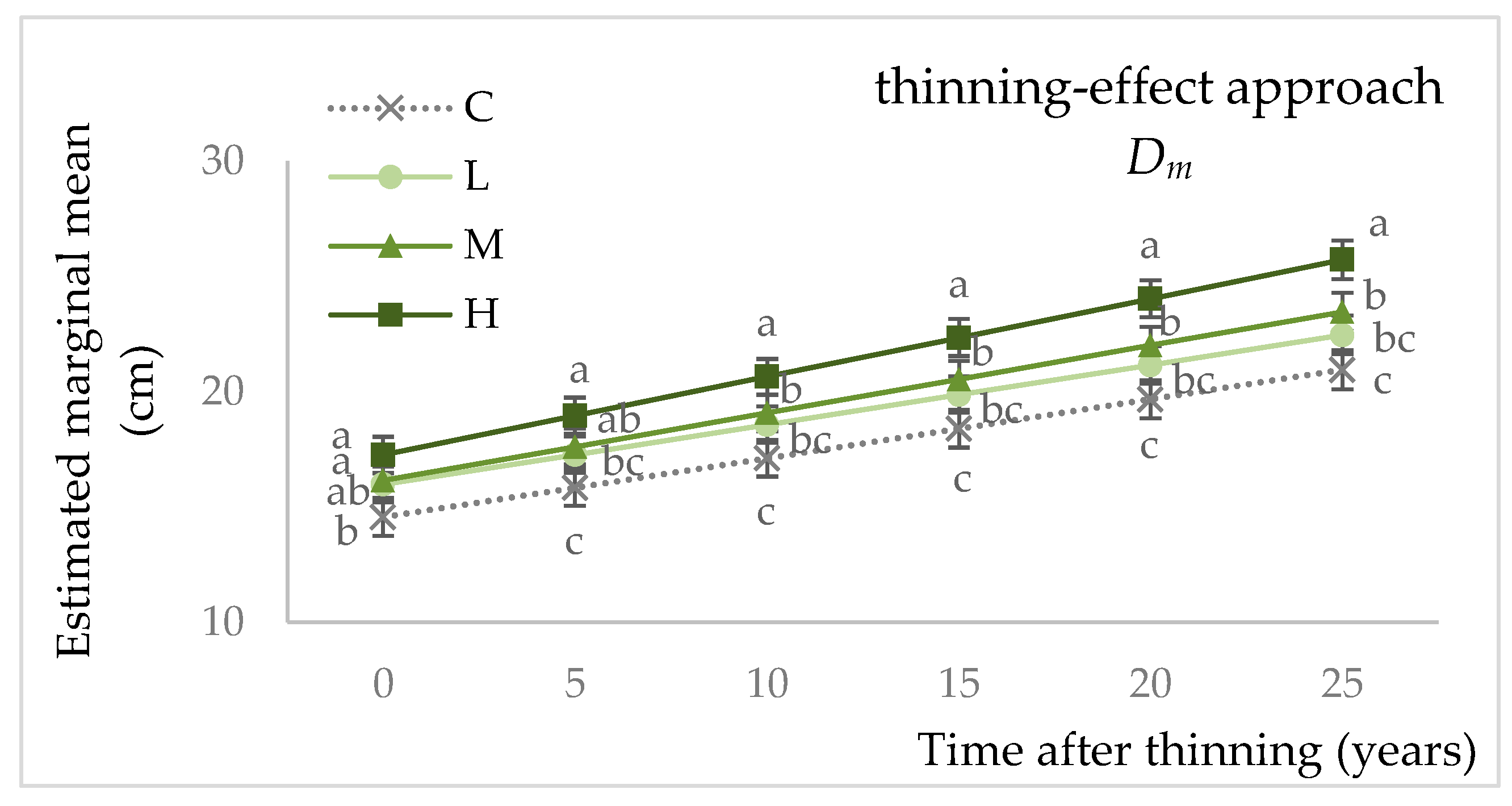
3.2.5. Dm Variable
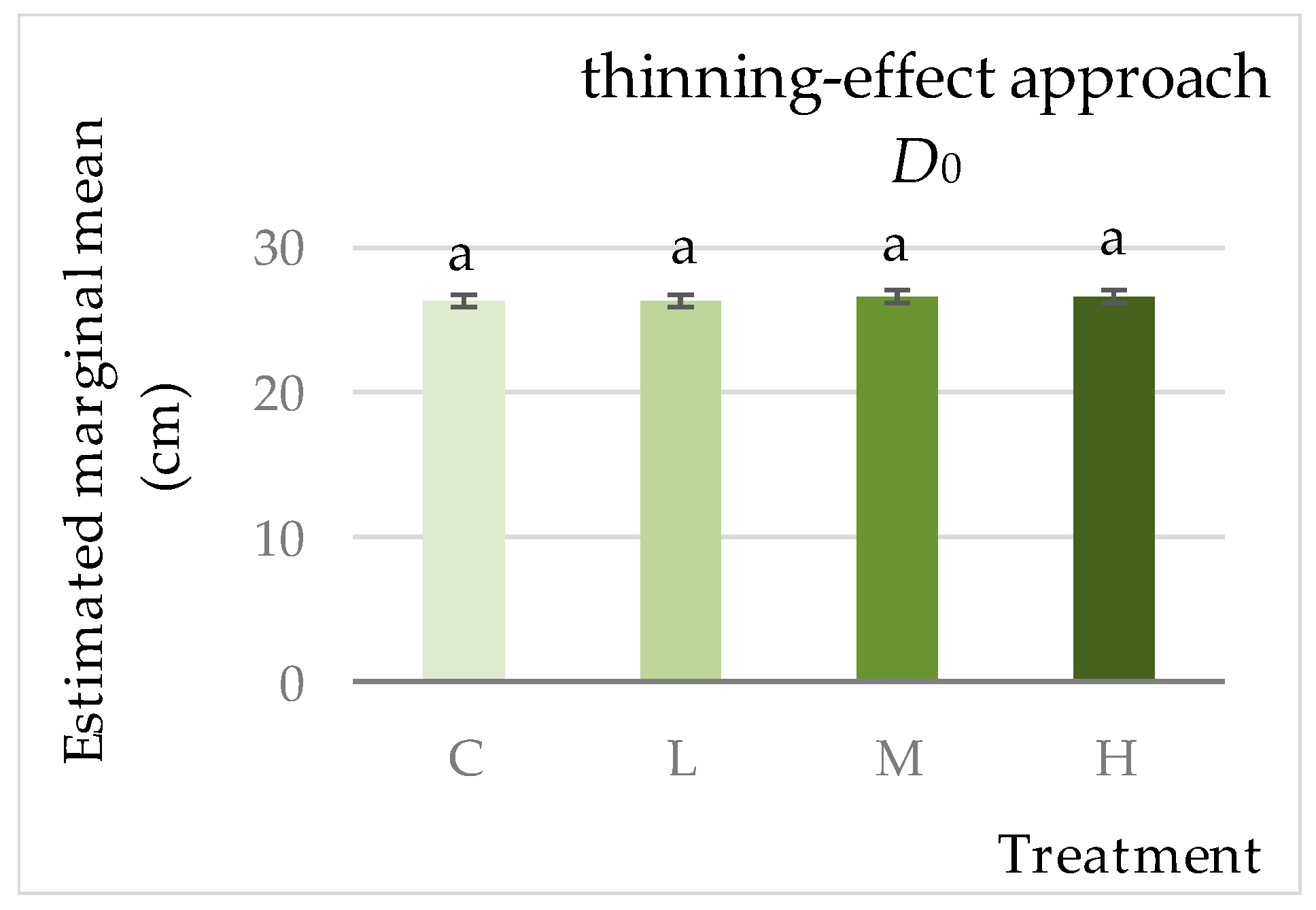
3.2.6. D0 Variable
4. Discussion
5. Conclusions
Supplementary Materials
Author Contributions
Funding
Data Availability Statement
Acknowledgments
Conflicts of Interest
Abbreviations
| C | Control (no thinning, 0% stand basal area removed) |
| L | Light thinning (15% stand basal area removed) |
| M | Moderate thinning (35% stand basal area removed) |
| H | Heavy thinning (55% stand basal area removed) |
| G | Stand basal area (m2 ha−1) |
| N | Trees per hectare |
| H0 | Dominant height (m) |
| V | Stand volume (m3 ha−1) |
| Gc | Cumulative basal area (current G plus G removed in the thinning, m2 ha−1) |
| Gtc | Cumulative total basal area (Gc plus G lost in dead trees, m2 ha−1) |
| Vc | Cumulative volume (current V plus V removed in the thinning, m3 ha−1) |
| Vtc | Cumulative total volume (Vc plus V lost in dead trees, m3 ha−1) |
| Dm | Mean diameter (cm) |
| D0 | Dominant diameter (cm) |
References
- Díaz-Fernández, P.M.; Jiménez Sancho, P.; Martín Albertos, S.; de Tuero y Reyna, M.; Gil Sánchez, L. Regiones de procedencia de Quercus robur L., Quercus petraea (Matt.) Liebl. y Quercus humillis (Miller); Publicaciones del ICONA, MAPA: Madrid, Spain, 1995. [Google Scholar]
- Ducousso, A.; Bordacs, S. EUFORGEN Technical Guidelines for Genetic Conservation and Use for Pedunculate and Sessile Oaks (Quercus robur and Q. petraea); International Plant Genetic Resources Institute: Rome, Italy, 2004. [Google Scholar]
- Reque, J.A. Selvicultura de Quercus petraea L. y Quercus robur L. In Compendio de Selvicultura Aplicada en España; Serrada, R., Montero, G., Reque, J.A., Eds.; INIA, Ministerio de Eduación y Ciencia: Madrid, Spain, 2008; pp. 745–772. [Google Scholar]
- Eaton, E.; Caudullo, G.; Oliveira, S.; de Rigo, D. Quercus robur and Quercus petraea in Europe: Distribution, habitat, usage and threats. In European Atlas of Forest Tree Species; San-Miguel-Ayanz, J., de Rigo, D., Caudullo, G., Houston Durrant, T., Mauri, A., Eds.; Publications Office of the European Union: Luxembourg, 2016; pp. 160–163. [Google Scholar]
- MARM. Cuarto Inventario Forestal Nacional—Galicia; Dirección General de Medio Natural y Política Forestal, Ministerio de Medio Ambiente y Medio Rural y Marino: Madrid, Spain, 2011. [Google Scholar]
- Gómez-García, E.; Crecente-Campo, F.; Barrio-Anta, M.; Diéguez-Aranda, U. A disaggregated dynamic model for predicting volume, biomass and carbon stocks in even-aged pedunculate oak stands in Galicia (NW Spain). Eur. J. Forest Res. 2015, 134, 569–583. [Google Scholar] [CrossRef]
- Zeide, B. Evolution of silvicultural thinning: From rejection to transcendence. In Proceedings of the 13th Biennial Southern Silvicultural Research Conference, Memphis, TN, USA, 28 February–4 March 2005; Connor, K.F., Ed.; Gen. Tech. Rep. SRS–92. U.S. Department of Agriculture, Forest Service, Southern Research Station: Asheville, NC, USA, 2006. [Google Scholar]
- Daniel, T.W.; Helms, J.A.; Baker, F.S. Principles of Silviculture, 2nd ed.; McGraw-Hill Book Co.: New York, NY, USA, 1979. [Google Scholar]
- Burkhart, H.E.; Tomé, M. Modeling Forest Trees and Stands; Springer: New York, NY, USA, 2012. [Google Scholar]
- Smith, D.M. The Practice of Silviculture, 8th ed.; John Wiley & Sons: New York, NY, USA, 1986. [Google Scholar]
- Johnson, P.S.; Shifley, S.R.; Rogers, R. The Ecology and Silviculture of Oaks, 2nd ed.; CAB International: Wallingford, UK, 2009. [Google Scholar]
- Pretzsch, H. Density and growth of forest stands revisited. Effect of the temporal scale of observation, site quality, and thinning. For. Ecol. Manage. 2020, 460, 117879. [Google Scholar] [CrossRef]
- Zeide, B. Thinning and growth: A full turnaround. J. Forest. 2001, 99, 20–25. [Google Scholar] [CrossRef]
- Lhotka, J.M. Examining growth relationships in Quercus stands: An application of individual-tree models developed from long-term thinning experiments. For. Ecol. Manage. 2017, 385, 65–77. [Google Scholar] [CrossRef]
- Silva-Pando, F.J.; Rigueiro, A. Guía das Árbores e Bosques de Galicia; Galaxia: Vigo, Spain, 1992. [Google Scholar]
- Pérez Alberti, A. Climatoloxía. In Xeografía de Galicia. Tomo I: O Medio; Pérez Alberti, A., Ed.; Sálvora: Santiago de Compostela, Spain, 1982; pp. 71–96. [Google Scholar]
- del Río, M.; Bravo-Oviedo, A.; Pretzsch, H.; Löf, M.; Ruiz-Peinado, R. A review of thinning effects on Scots pine stands: From growth and yield to new challenges under global change. For. Syst. 2017, 26, eR03S. [Google Scholar] [CrossRef]
- Diéguez-Aranda, U.; Rojo Alboreca, A.; Castedo-Dorado, F.; Álvarez-González, J.G.; Barrio-Anta, M.; Crecente-Campo, F.; González-González, J.M.; Pérez-Cruzado, C.; Rodríguez Soalleiro, R.; López-Sánchez, C.A.; et al. Herramientas Selvícolas Para la Gestión Forestal Sostenible en Galicia; Xunta de Galicia: Santiago de Compostela, Spain, 2009. [Google Scholar]
- Burkhart, H.E.; Strub, M.R. A model for simulation of planted loblolly pine stands. In Growth Models for Tree and Stand Simulation; Royal College of Forestry: Stockholm, Sweden, 1974; pp. 128–135. [Google Scholar]
- Gómez-García, E.; Diéguez-Aranda, U.; Castedo-Dorado, F.; Crecente-Campo, F. A comparison of model forms for the development of height-diameter relationships in even-aged stands. For. Sci. 2014, 60, 560–568. [Google Scholar] [CrossRef]
- García, O. The state-space approach in growth modelling. Can. J. For. Res. 1994, 24, 1894–1903. [Google Scholar] [CrossRef]
- Mäkinen, H.; Isomäki, A. Thinning intensity and growth of Scots pine stands in Finland. For. Ecol. Manag. 2004, 201, 311–325. [Google Scholar] [CrossRef]
- Kasraei, B.; Schmidt, M.G.; Zhang, J.; Bulmer, C.E.; Filatow, D.S.; Arbor, A.; Pennell, T.; Heung, B. A framework for optimizing environmental covariates to support model interpretability in digital soil mapping. Geoderma 2024, 445, 116873. [Google Scholar] [CrossRef]
- Wang, B.; Park, C.; Small, D.S.; Li, F. Model-robust and efficient covariate adjustment for cluster-randomized experiments. J. Am. Stat. Assoc. 2024, 119, 1–12. [Google Scholar] [CrossRef]
- Weiskittel, A.R.; Hann, D.W.; Kershaw, J.A., Jr.; Vanclay, J.K. Forest Growth and Yield Modeling; Wiley-Blackwell: Oxford, UK, 2011. [Google Scholar]
- Cañellas, I.; del Río, M.; Roig, S.; Montero, G. Growth response to thinning in Quercus pyrenaica Willd. coppice stands in Spanish central mountain. Ann. For. Sci. 2004, 61, 243–250. [Google Scholar] [CrossRef]
- del Río, M.; Calama, R.; Cañellas, I.; Roig, S.; Montero, G. Thinning intensity and growth response in SW-European Scots pine stands. Ann. For. Sci. 2008, 65, 308. [Google Scholar] [CrossRef]
- Barrio-Anta, M. Crecimiento y Producción de Masas Naturales de Quercus robur L. en Galicia. Ph.D. Thesis, Escuela Politécnica Superior, Universidad de Santiago de Compostela, Lugo, Spain, 2003. [Google Scholar]
- Henderson, C.R. Estimation of variance and covariance components. Biometrics 1953, 9, 226–252. [Google Scholar] [CrossRef]
- Lindstrom, M.J.; Bates, D.M. Nonlinear mixed-effects models for repeated measures data. Biometrics 1990, 46, 673–687. [Google Scholar] [CrossRef] [PubMed]
- Bates, D.; Mächler, M.; Bolker, B.; Walker, S. Fitting Linear Mixed-Effects Models Using lme4. J. Stat. Softw. 2015, 67, 1–48. [Google Scholar] [CrossRef]
- R Core Team. R: A Language and Environment for Statistical Computing, (Version 4.5.1), [Computer software]; R Foundation for Statistical Computing: Vienna, Austria, 2025. Available online: https://www.R-project.org/ (accessed on 4 September 2025).
- Zuur, A.F.; Ieno, E.N.; Walker, N.; Saveliev, A.A.; Smith, G.M. Mixed Effects Models and Extensions in Ecology with R. Statistics for Biology and Health; Springer: New York, NY, USA, 2009; p. 122. [Google Scholar]
- Laird, N.M.; Ware, J.H. Random-effects models for longitudinal data. Biometrics 1982, 38, 963–974. [Google Scholar] [CrossRef] [PubMed]
- Kuznetsova, A.; Brockhoff, P.B.; Christensen, R.H.B. lmerTest package: Tests in linear mixed effects models. J. Stat. Softw. 2017, 82, 1–26. [Google Scholar] [CrossRef]
- Lenth, R.V. Emmeans: Estimated Marginal Means, Aka Least-Squares Means. R Package Version 1.11.2-8. Available online: https://CRAN.R-project.org/package=emmeans (accessed on 28 October 2025).
- Tukey, J.W. Exploratory Data Analysis; Addison-Wesley: Reading, MA, USA, 1977. [Google Scholar]
- Chroust, L. Thinning experiment in a Scots pine forest stand after 40-year investigations. J. For. Sci. 2001, 47, 356–365. [Google Scholar]
- Dawkins, H.C. Crown diameters: Their relation to bole diameter in tropical forest trees. Commonw. For. Rev. 1963, 42, 318–333. [Google Scholar]
- Kerr, G. The effect of heavy or ‘free growth’ thinning on oak (Quercus petraea and Q. robur). Forestry 1996, 69, 303–317. [Google Scholar] [CrossRef]
- Hemery, G.E.; Savill, P.S.; Pryor, S.N. Applications of the crown diameter–stem diameter relationship for different species of broadleaved trees. For. Ecol. Manag. 2005, 215, 285–294. [Google Scholar] [CrossRef]
- Dale, M.E. Growth and Yield Predictions for Upland Oak Stands: 10 Years After Initial Thinning; Rep. Pap. NE-241, USDA For. Ser.; Northeastern Forest Experiment Station: Upper Darby, PA, USA, 1972. [Google Scholar]
- Dale, M.E.; Sonderman, D.L. Effect of Thinning on Growth and Potential Quality of Young White Oak Crop Trees; Rep. Pap. NE-539, USDA For. Ser.; Northeastern Forest Experiment Station: Broomall, PA, USA, 1984. [Google Scholar]
- Halbritter, A. An economic analysis of thinning intensity and thinning type of a two-tiered even-aged forest stand. For. Policy Econ. 2020, 111, 102054. [Google Scholar] [CrossRef]



| Trial | Year | Age | N | G | Dm | Dg | Hm | H0 | SI |
|---|---|---|---|---|---|---|---|---|---|
| Boimente | 1998 | 60 | 797 (168) | 16.90 (2.07) | 15.97 (1.84) | 16.64 (1.95) | 13.27 (1.76) | 13.81 (1.89) | 13.81 |
| Cotobade | 1999 | 32 | 1013 (422) | 21.23 (4.69) | 15.78 (3.47) | 17.12 (3.56) | 11.63 (1.38) | 14.84 (1.86) | 23.09 |
| Labio | 1998 | 38 | 1044 (136) | 15.58 (1.59) | 13.57 (1.05) | 13.85 (1.08) | 12.29 (1.06) | 12.54 (1.03) | 17.77 |
| Term | Estimate | Std. Error | df | t Value | p Value |
|---|---|---|---|---|---|
| (Intercept) | 18.71 | 1.871 | 2.57 | 10.00 | 0.0040 |
| Treatment L | −2.428 | 1.034 | 23.28 | −2.35 | 0.0277 |
| Treatment M | −6.924 | 1.034 | 23.28 | −6.70 | <0.0001 |
| Treatment H | −10.62 | 1.034 | 23.28 | −10.27 | <0.0001 |
| Time | 0.3683 | 0.013 | 199.4 | 28.96 | <0.0001 |
| Term | Estimate | Std. Error | df | t Value | p Value |
|---|---|---|---|---|---|
| (Intercept) | 827.6 | 83.29 | 3.49 | 9.936 | 0.0011 |
| Treatment L | −76.56 | 67.10 | 25.04 | −1.141 | 0.2646 |
| Treatment M | −317.2 | 67.10 | 25.04 | −4.727 | <0.0001 |
| Treatment H | −439.0 | 67.10 | 25.04 | −6.543 | <0.0001 |
| Time | −6.489 | 0.785 | 197.86 | −8.270 | <0.0001 |
| Treatment L × Time | 2.076 | 1.071 | 197.94 | 1.939 | 0.0540 |
| Treatment M × Time | 3.978 | 1.071 | 197.94 | 3.715 | 0.0003 |
| Treatment H × Time | 5.874 | 1.071 | 197.94 | 5.485 | <0.0001 |
| Term | Estimate | Std. Error | df | t Value | p Value |
|---|---|---|---|---|---|
| (Intercept) | 14.46 | 0.826 | 3.26 | 17.50 | 0.0002 |
| Treatment L | −0.482 | 0.613 | 24.06 | −0.79 | 0.4394 |
| Treatment M | −1.234 | 0.613 | 24.09 | −2.01 | 0.0555 |
| Treatment H | −1.097 | 0.613 | 24.09 | −1.79 | 0.0861 |
| Time | 0.149 | 0.010 | 179.9 | 15.25 | <0.0001 |
| Term | Estimate | Std. Error | df | t Value | p Value |
|---|---|---|---|---|---|
| (Intercept) | 17.47 | 1.066 | 2.32 | 16.38 | 0.0019 |
| Treatment L | 0.8912 | 0.414 | 25.22 | 2.15 | 0.0411 |
| Treatment M | 0.0848 | 0.419 | 25.88 | 0.20 | 0.8412 |
| Treatment H | −0.2411 | 0.421 | 25.72 | −0.57 | 0.5715 |
| Time | 0.3678 | 0.013 | 203.4 | 29.08 | <0.0001 |
| G pre-treat. cent. | 0.8580 | 0.055 | 28.02 | 15.74 | <0.0001 |
| Term | Estimate | Std. Error | df | t Value | p Value |
|---|---|---|---|---|---|
| (Intercept) | 17.243 | 0.896 | 2.759 | 19.25 | 0.0005 |
| Treatment L | 0.4521 | 0.509 | 84.44 | 0.888 | 0.3771 |
| Treatment M | −0.1424 | 0.513 | 84.07 | −0.277 | 0.7822 |
| Treatment H | 0.0601 | 0.517 | 84.78 | 0.116 | 0.9077 |
| Time | 0.4989 | 0.026 | 217.25 | 19.42 | <0.0001 |
| G pre-treat. cent. | 0.9422 | 0.056 | 37.61 | 16.97 | <0.0001 |
| Treatment L × Time | 0.0062 | 0.035 | 218.47 | 0.178 | 0.8588 |
| Treatment M × Time | −0.0224 | 0.035 | 218.53 | −0.642 | 0.5215 |
| Treatment H × Time | −0.0989 | 0.035 | 218.43 | −2.83 | 0.0051 |
| Term | Estimate | Std. Error | df | t Value | p Value |
|---|---|---|---|---|---|
| (Intercept) | 93.76 | 8.056 | 2.519 | 11.64 | 0.0030 |
| Treatment L | 4.047 | 3.839 | 94.49 | 1.05 | 0.2945 |
| Treatment M | 2.106 | 3.855 | 93.93 | 0.55 | 0.5862 |
| Treatment H | 1.357 | 3.906 | 95.07 | 0.347 | 0.7290 |
| Time | 3.390 | 0.198 | 218.46 | 17.12 | <0.0001 |
| V pre-treat. cent. | 0.9309 | 0.060 | 33.51 | 15.62 | <0.0001 |
| Treatment L × Time | −0.0705 | 0.269 | 219.69 | −0.26 | 0.7934 |
| Treatment M × Time | −0.5339 | 0.269 | 219.68 | −1.99 | 0.0480 |
| Treatment H × Time | −0.7204 | 0.269 | 219.70 | −2.68 | 0.0080 |
| Term | Estimate | Std. Error | df | t Value | p Value |
|---|---|---|---|---|---|
| (Intercept) | 93.07 | 7.076 | 2.666 | 13.15 | 0.0017 |
| Treatment L | 2.759 | 3.794 | 93.44 | 0.73 | 0.4690 |
| Treatment M | −0.2352 | 3.813 | 92.64 | −0.06 | 0.9510 |
| Treatment H | 0.7910 | 3.871 | 93.46 | 0.20 | 0.8386 |
| Time | 4.014 | 0.195 | 218.07 | 20.62 | <0.0001 |
| V pre-treat. cent. | 0.9938 | 0.064 | 39.22 | 15.59 | <0.0001 |
| Treatment L × Time | −0.1355 | 0.264 | 219.21 | −0.51 | 0.6088 |
| Treatment M × Time | −0.5357 | 0.264 | 219.21 | −2.03 | 0.0437 |
| Treatment H × Time | −0.9706 | 0.264 | 219.22 | −3.67 | 0.0003 |
| Term | Estimate | Std. Error | df | t Value | p Value |
|---|---|---|---|---|---|
| (Intercept) | 14.57 | 0.810 | 3.185 | 17.99 | 0.0002 |
| Treatment L | 1.409 | 0.571 | 38.41 | 2.47 | 0.0182 |
| Treatment M | 1.587 | 0.557 | 38.85 | 2.85 | 0.0070 |
| Treatment H | 2.691 | 0.578 | 38.05 | 4.66 | <0.0001 |
| Time | 0.2547 | 0.0196 | 241.0 | 13.00 | <0.0001 |
| Dm pre-treat. cent. | 1.235 | 0.0855 | 30.12 | 14.44 | <0.0001 |
| Treatment L × Time | 0.00403 | 0.0263 | 240.9 | 0.15 | 0.8786 |
| Treatment M × Time | 0.03723 | 0.0264 | 240.9 | 1.41 | 0.1590 |
| Treatment H × Time | 0.08351 | 0.0263 | 240.9 | 3.17 | 0.0017 |
| Term | Estimate | Std. Error | df | t Value | p Value |
|---|---|---|---|---|---|
| (Intercept) | 22.71 | 0.469 | 2.70 | 48.44 | <0.0001 |
| Treatment L | 0.3596 | 0.237 | 22.72 | 1.52 | 0.1428 |
| Treatment M | 0.4950 | 0.245 | 24.18 | 2.02 | 0.0549 |
| Treatment H | 0.1701 | 0.257 | 24.50 | 0.66 | 0.5140 |
| Time | 0.3808 | 0.00735 | 234.6 | 51.82 | <0.0001 |
| D0 pre-treat. cent. | 0.9962 | 0.0344 | 34.13 | 28.93 | <0.0001 |
Disclaimer/Publisher’s Note: The statements, opinions and data contained in all publications are solely those of the individual author(s) and contributor(s) and not of MDPI and/or the editor(s). MDPI and/or the editor(s) disclaim responsibility for any injury to people or property resulting from any ideas, methods, instructions or products referred to in the content. |
© 2025 by the authors. Licensee MDPI, Basel, Switzerland. This article is an open access article distributed under the terms and conditions of the Creative Commons Attribution (CC BY) license (https://creativecommons.org/licenses/by/4.0/).
Share and Cite
Gómez-García, E.; Rozados Lorenzo, M.J.; Silva-Pando, F.J. Modelling Growth and Yield Response to Thinning in Quercus robur L. Stands in NW Spain. Forests 2025, 16, 1831. https://doi.org/10.3390/f16121831
Gómez-García E, Rozados Lorenzo MJ, Silva-Pando FJ. Modelling Growth and Yield Response to Thinning in Quercus robur L. Stands in NW Spain. Forests. 2025; 16(12):1831. https://doi.org/10.3390/f16121831
Chicago/Turabian StyleGómez-García, Esteban, María José Rozados Lorenzo, and Francisco Javier Silva-Pando. 2025. "Modelling Growth and Yield Response to Thinning in Quercus robur L. Stands in NW Spain" Forests 16, no. 12: 1831. https://doi.org/10.3390/f16121831
APA StyleGómez-García, E., Rozados Lorenzo, M. J., & Silva-Pando, F. J. (2025). Modelling Growth and Yield Response to Thinning in Quercus robur L. Stands in NW Spain. Forests, 16(12), 1831. https://doi.org/10.3390/f16121831