Article

Discolouration of Artificially Irradiated Fir (Abies alba L.) Wood Extractives

by
Viera Kučerová
1,* and
Richard Hrčka
2,*
1
Department of Chemistry and Chemical Technologies, Faculty of Wood Sciences and Technology, Technical University in Zvolen, T.G. Masaryka 24, 96001 Zvolen, Slovakia
2
Department of Wood Sciences, Faculty of Wood Sciences and Technology, Technical University in Zvolen, T.G. Masaryka 24, 96001 Zvolen, Slovakia
*
Authors to whom correspondence should be addressed.
Forests 2025, 16(12), 1791; https://doi.org/10.3390/f16121791
Submission received: 3 November 2025 / Revised: 24 November 2025 / Accepted: 27 November 2025 / Published: 28 November 2025
(This article belongs to the Special Issue Phenomenon of Wood Colour—2nd Edition)

Abstract

This study investigates the influence of thermal treatment and subsequent artificial irradiation on the colour stability of fir (Abies alba L.) wood extractives. Wood samples were heat-treated at temperatures ranging from 100 °C to 280 °C for varying durations, and their extractives were isolated using Soxhlet extraction with an ethanol–toluene solvent mixture. The extract solutions were subjected to accelerated ageing under xenon light irradiation for up to 400 h, and colour changes were systematically monitored using a spectrophotometer in transmission mode. The amount and colour of extractives varied with treatment temperature. The extractive yields decreased up to 150 °C, increased between 150 °C and 240 °C, and declined again above 250 °C. The initial colours of the extract solutions ranged from yellow to brown, depending on the treatment conditions. During irradiation, colour differences (ΔEab) progressively decreased, and after 400 h, the solutions became nearly colourless, with lightness values approaching 100. The decline in b* values indicated a loss of yellow hue, while a* values shifted from red or green towards neutrality. These results confirm that fir wood extractives are highly sensitive to both heat and UV exposure, leading to significant discolouration and reduced colour saturation. These findings enhance our understanding of the mechanisms underlying fir wood colour changes and contribute to the broader knowledge of wood ageing processes.

1. Introduction

Colour is only a supplementary feature of wood across various species due to its high variability before and after processing. Measurement provides a systematic approach to characterizing wood colour [1,2]. Wood consists of various chemical compounds that exhibit characteristic colours after isolation [3]. Changes in wood colour are associated with changes in the colour of its chemical compounds [4]. The resulting wood colour is assumed to be a mixture of the colours of individual chemical compounds [5]. Interactions exist between chemical compounds within the wood [6,7]. Moreover, the chemical structure of wood is not the only structural level influencing its colour [8,9,10,11]. Wood, as a system [12], stabilizes all its properties in equilibrium with the surrounding environment. Elevated temperature [13,14], incident radiation on the wood surface [15], the presence of oxygen [16], and other transparent substances in contact with the wood surface are factors contributing to changes in wood colour [17].
Wood remains compact after immersion in solvents such as water, toluene–ethanol mixture, and other substances typically used in wood extraction. During extraction, wood releases part of its mass into the solvent. The wood may then begin to crack, but it still retains some mechanical strength. Originally colourless solvents become coloured after extraction, while the wood itself becomes less saturated in colour. Certain compounds of the wood substance, generally referred to as wood extractives, are present in the solution. The quality of wood extractives depends on the solvent used, following the general chemical principle “like dissolves like”. The quality and quantity of extractives depend on the process of thermal treatment and factors such as the mass of wood before extraction, the season of felling, the position within the stem, and others [18,19].
Wood colour is unique to each specimen, with zero probability of exact recurrence, and follows a statistical distribution [1]. Extractives migrate within the wood volume due to their solubility in solution [20]. This process results in maps of varying colours on the wood surface. The heterogeneity of extractive colour can be overcome by extracting into solution, where the extractives can be analysed separately from the wood residue. Wood species is another factor affecting extract composition and colour [21,22]. Fir wood exhibits a paler hue compared to spruce. The odour of fir resembles a sour smell. Haptic properties are linked to extractives and volatile compounds. Thermal treatment modifies both the odour and colour of fir wood. The pale hue of fir is further enhanced by surface discolouration following UV radiation exposure [23,24,25,26]. The effects of thermal treatment and UV radiation on fir wood colour require quantitative investigation, and further studies are suggested to clarify the influence of extractive content on the colour of thermally modified wood [27]. It is assumed that fir wood extractives are responsible for the wood’s characteristic hue and saturation.
In fir wood, the extractives consist primarily of phenolic compounds, lignans, flavonoids, terpenoids, and resin acids, which contribute to the natural colour, biological durability, and sensory properties of the wood [28,29,30,31,32]. The dominant extractives identified in fir include lignans such as pinoresinol, lariciresinol, secoisolariciresinol, and matairesinol, as well as phenolic acids and flavonoids including taxifolin and quercetin, which participate in chromophore formation and colour modification [28,29]. In addition, lipophilic compounds such as diterpenoid resin acids and essential oil constituents including α-cedrol, terpinen-4-ol, and α-phellandrene have been reported in fir wood and bark [31,33].
During thermal treatment, extractives undergo significant chemical transformations. Heat exposure leads to depolymerisation and cleavage reactions in lignin and polysaccharides, resulting in the formation of compounds such as furfural, hydroxymethylfurfural, and thermally generated phenolic derivatives, which may contribute to colour darkening and modified chromatic coordinates of heat-treated wood [34,35,36].
Extractives of silver fir wood are among the most UV-sensitive chemical components of the cell wall. Under UV radiation, low-molecular-weight phenolic compounds and resin acids degrade via photochemical oxidation, which leads to their loss and volatilisation. This degradation contributes to the formation of chromophoric structures, resulting in surface discolouration and darkening [37]. Meanwhile, degradation products may react with lignin and hemicellulose fragments to form more stable oxidised structures, accelerating chemical changes in the wood [38]. The photodegradation of extractives is thus a key factor influencing the optical stability, surface ageing, and long-term durability of fir wood when exposed outdoors [39].
The colour of extractives in liquid form can be investigated using a spectrophotometer in transmission mode. The aim of this contribution is to report the colour of fir wood extracts before, during, and after artificial irradiation. We hypothesized that extracts would differ based on the exposure time of fir wood to various elevated temperatures prior to extraction and irradiation, contrary to the null hypothesis of equal characteristics of extracts before, during, and after irradiation.

2. Materials and Methods

European silver fir (Abies alba L.) wood was sourced from the Zvolen region in the Slovak Republic. The tree was 59 years old, with a diameter at breast height of 262 mm. A radial board was cut from the butt end of the trunk and used to prepare samples measuring 10 mm × 10 mm × 150 mm (radial × tangential × longitudinal). The samples were conditioned in a climate chamber at 20 ± 2 °C and 65 ± 5% relative humidity until they reached a moisture content of approximately 12%. A total of seven groups, each consisting of ten samples, were heat-treated under defined conditions, while one group of ten samples remained untreated (20 °C).

2.1. Heat Treatment

The heat treatment of the experimental samples was conducted in a preheated Binder ED 53 laboratory oven (Binder, Tuttlingen, Germany) at temperatures of 100 °C, 150 °C, 200 °C, 220 °C, 240 °C, 260 °C, and 280 °C for 60 min under atmospheric pressure in the presence of air. The oven required 5 min to reheat to the target temperature after the samples were inserted. The samples were put on a stainless steel rack. After treatment, each group of samples was removed from the oven and cooled in a desiccator.

2.2. Determination of Extractives

The wood samples were mechanically disintegrated into sawdust. Fractions between 0.5 mm and 1.0 mm were extracted using a Soxhlet apparatus with a mixture of ethanol and toluene, following ASTM D1107-96 (2013) [40]. All measurements were performed four times, and the results are expressed as percentages of oven-dry weight.

2.3. Preparation of Extracts’ Solutions

Subsequently, the extractives were dissolved in a mixture of ethanol and toluene. The concentration of extractives was 0.19 g·L−1. Volumes of 50 mL of the extractive solutions were poured into Erlenmeyer flasks and sealed with stoppers. These assemblies were prepared for irradiation.

2.4. Dry Mode of Accelerated Ageing

The accelerated extract ageing was simulated in a xenotest chamber Q-SUN Xe-3-HS (Q-Lab Europe Ltd., Bolton, UK). The experimental material was arranged equidistantly across the xenotest chamber. To ensure equal radiation intensity and heat for all the specimens, the specimens were regularly shifted according to the recommended schedule [41]. The ageing conditions in the xenotest chamber followed the standard ASTM G 155-05 (2005) [42]. The radiation intensity was 0.35 W·m−2 at a wavelength of 340 nm, following the standard. This value corresponds to the mean annual value for the temperate zone. The temperature, controlled on a black panel, corresponded to the maximum temperature on the panel surface. In both modes, one accelerated ageing cycle consisted of two steps, covering a total of 120 min (Table 1). For each mode, the total duration of the ageing process was 400 h, which was equivalent to 200 cycles. The ageing process was stopped six times: after 25 h, 50 h, 100 h, 200 h, 300 h, and 400 h. Then, colour measurements were performed.

2.5. Measurement of Colour

The colour was measured using a benchtop spectrophotometer CM-5 (Konica Minolta, Osaka, Japan) with a wavelength resolution of 10 nm. A measurement spot diameter of 20 mm was selected in transmission mode. The colour of the prepared extractive solutions was measured in quartz glass cuvettes. The spectrophotometer was calibrated prior to each measurement according to the procedure recommended by the manufacturer. The cuvette used was filled with pure solvent during calibration. The white standard was built into the spectrophotometer. The entire calibration process was guided by a computer using Color Data Software CM-S100w 2.81.0001 SpectraMagicTM NX (Konica Minolta, Osaka, Japan). The transmittance spectrum was measured under illuminant D65, with the specular component excluded. The 2° standard observer was set before the computation of colour coordinates. The spectrophotometer provided the three parameters of the CIE Lab colour space and two parameters of the chromaticity diagram, among others. The colour change was calculated according to the total colour difference formula, as follows:
E a b = ( L 2 * L 1 * ) 2 + ( a 2 * a 1 * ) 2 + ( b 2 * b 1 * ) 2 ,
where index 1 denotes the reference sample (without thermal treatment and calibrated cuvette filled with toluene–ethanol mixture), and index 2 denotes the tested sample (with or without thermal treatment and during ageing). In total, 462 measurements were performed.

3. Results and Discussion

The percentage of toluene–ethanol extractives in the oven-dry mass of whole wood is shown in Table 2.
The level of the treatment temperature factor influenced the percentage of extractives differently. The differences in extractive percentages showed a similar pattern between 1 h and 5 h treatment durations. The differences decreased between 20 °C, 100, and 150 °C, increased between 150 and 240 °C, and finally decreased again between 240 and 280 °C. The maximum average extractive percentage was 3.11% at a treatment temperature of 240 °C during 1 h of treatment. The minimum average extractive percentage was less than 1.10% at a treatment temperature of 280 °C during 3 h of treatment. The trend in extractive percentage measurements revealed various processes occurring in wood at different treatment temperatures.
The original extractives of untreated fir wood (20 °C) became more volatile after thermal treatment at 100 °C and 150 °C, which caused a decrease in extractive percentage. Many of the original low-molecular-weight extractives migrated inside the wood or evaporated, such as waxes and resin acids [43]. Simultaneously, some original extractives became more strongly attached to the wood due to condensation or cross-linking reactions, which made them harder to extract [44]. In the mid-temperature range (150–250 °C), new extractives were formed because lignin and hemicelluloses started to break down into smaller molecules [45]. Finally, at the highest studied temperatures (250–280 °C), many of the newly formed extractives evaporated or continued to degrade, which decreased their total amount [43,45]. Thus, the decrease in extractive yield beyond 250 °C was caused by both the formation of new extractives and their further degradation, rather than a continuous increase.
Other components of the wood, which were treated as extractives or as losses of wood substance, were produced during thermal treatment between 150 and 240 °C. Finally, thermally treated wood substances were converted into lower amounts of extractives between 240 and 280 °C.
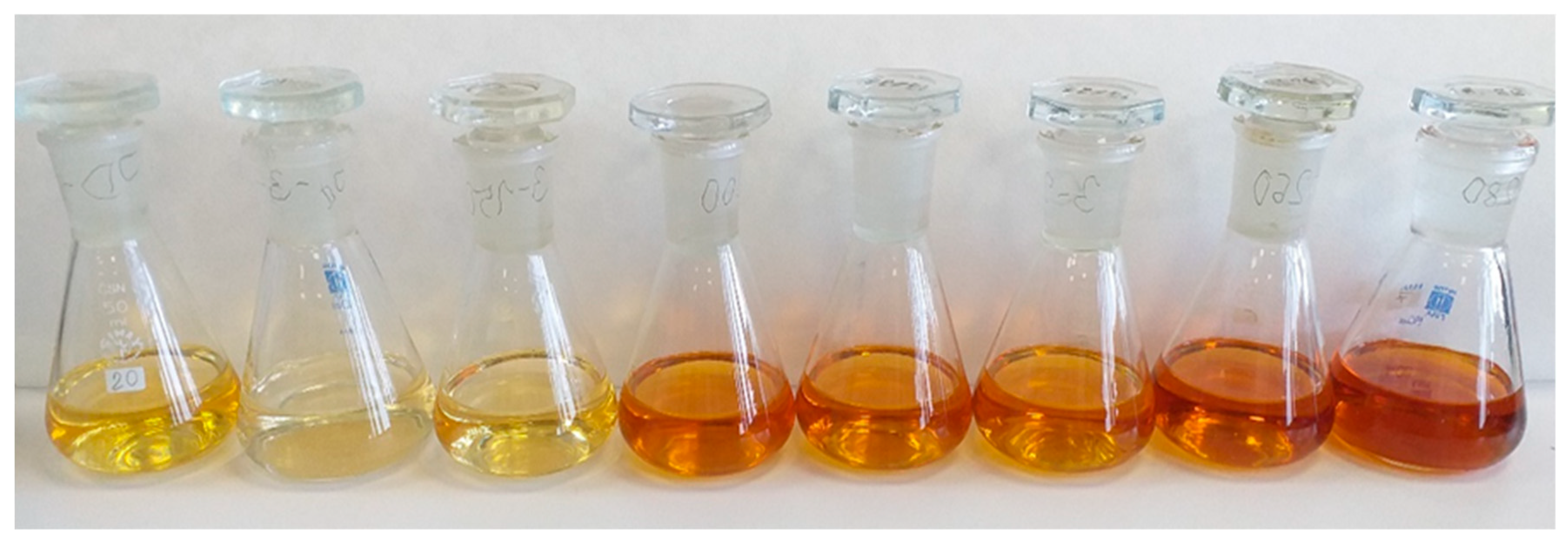
The visual appearance of the extractives is shown in Figure 1 before irradiation. The colour of the extractive solutions ranged from light yellow to brown at 22 °C under D65 illumination.
In Figure 1, the set of Erlenmeyer flasks is arranged according to the temperatures used in thermal treatment (from left to right: 20 °C, 100 °C, 150 °C, 200 °C, 220 °C, 240 °C, 260 °C, and 280 °C). The extract in the first flask is more vivid because the extractives came from wood without thermal treatment. This result indicates variations in the amount or nature of wood extractives. Thermal treatment was responsible for decreasing the amount of extractives up to a temperature of 150 °C (see Figure 1). These extractives are assumed to have been highly volatile. Other types of extractives remained in the wood and reacted with degradation products of the main wood components at temperatures above 150 °C.
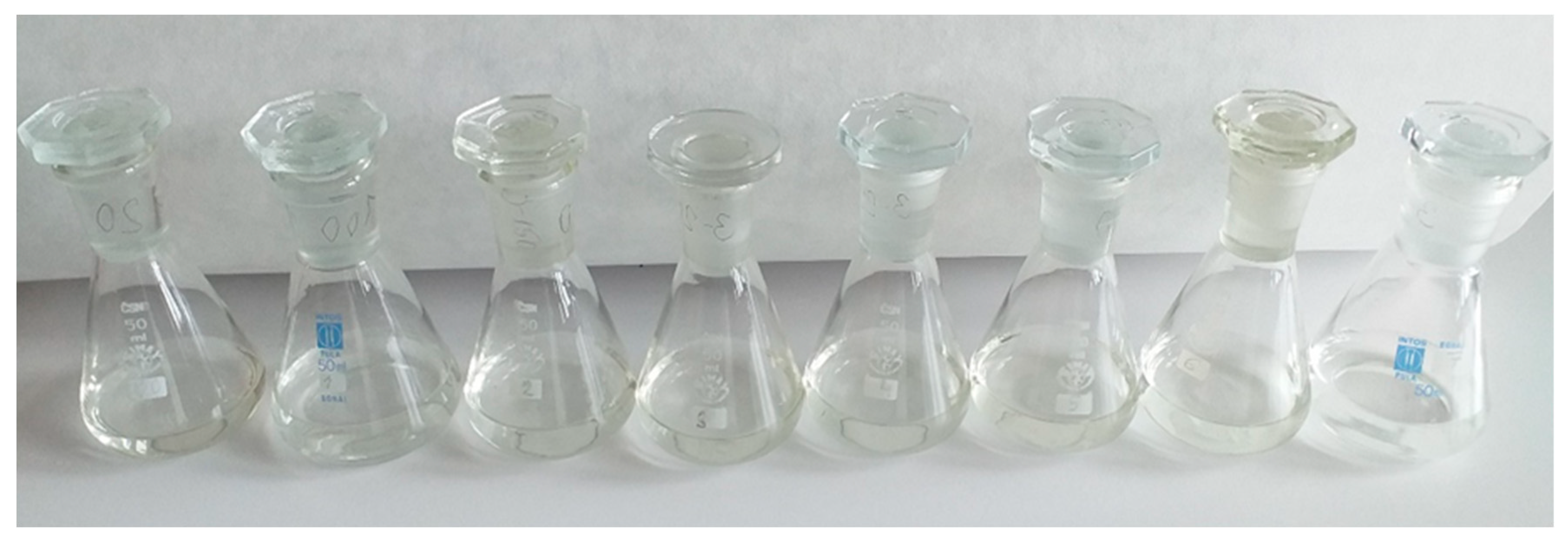
The visual appearance of the extractives after 400 h of artificial irradiation is shown in Figure 2. The extractive solutions had become almost colourless.
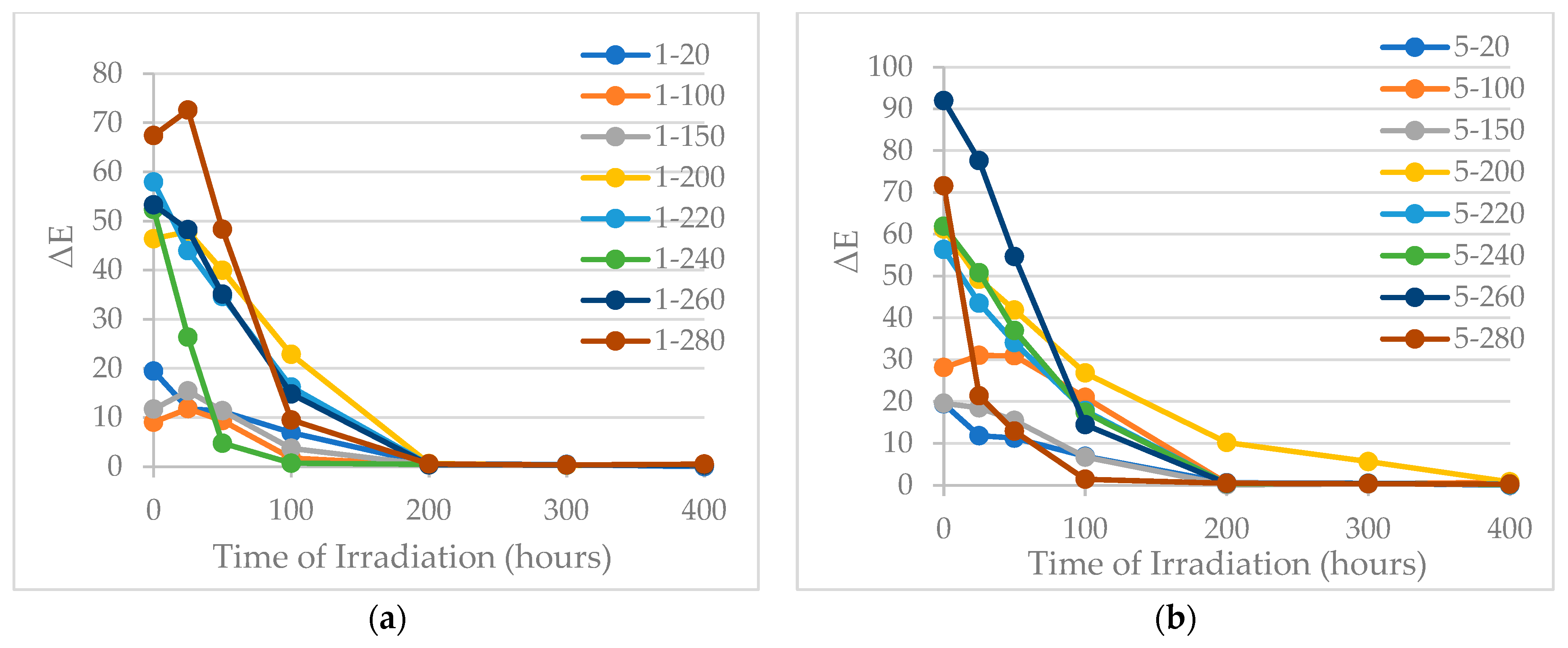
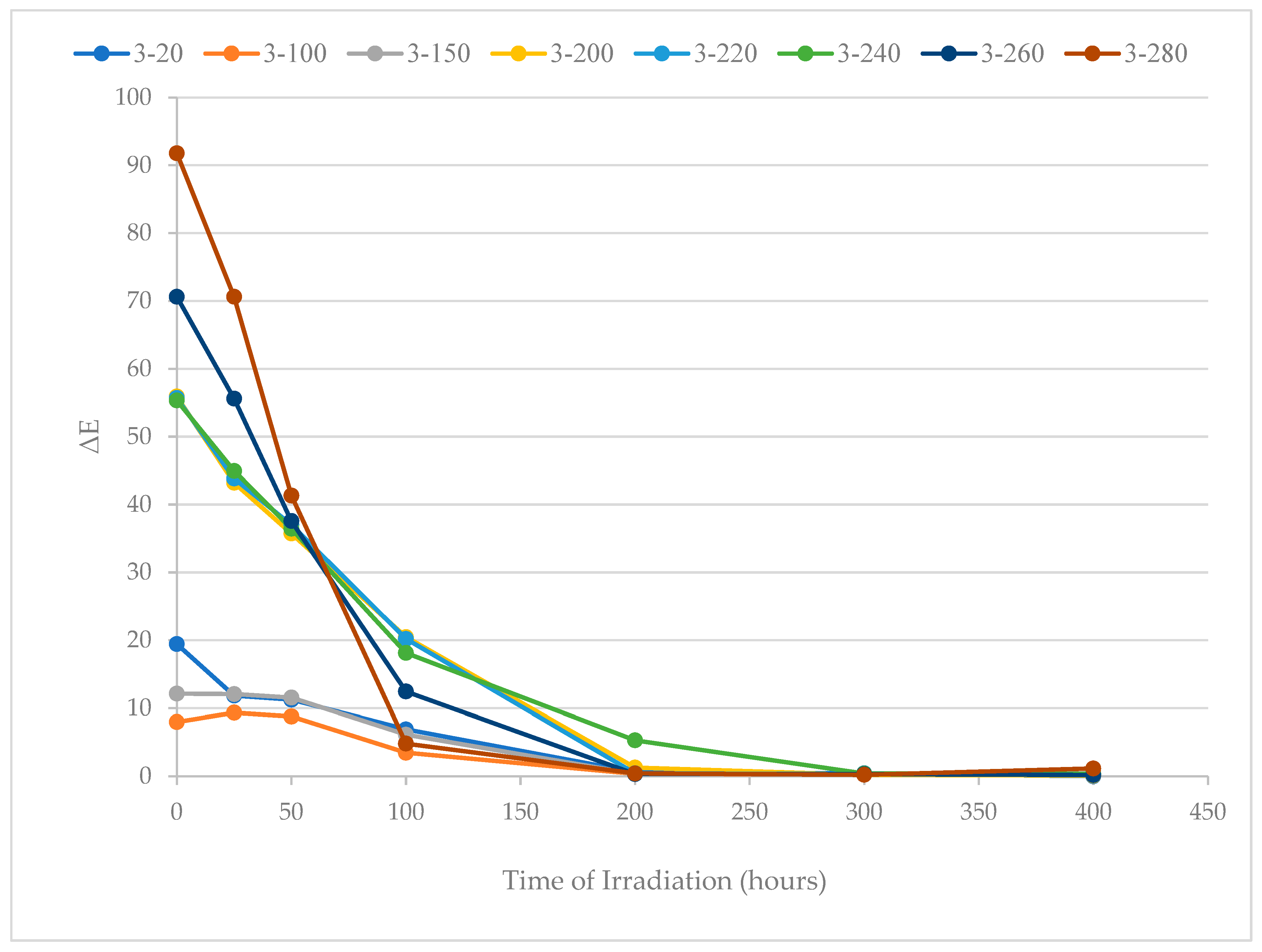
In Figure 2, the set of Erlenmeyer flasks is arranged according to the temperatures used in thermal treatment, as before. The CM-5 spectrophotometer (Konica Minolta, Japan) provided colour values in the form of an ordered triplet, characterising wood colour in the CIE L*a*b* colour space. The initial colours of the extracts prior to artificial ageing depended on the treatment temperature and the duration of the thermal treatment. This observation indicates a positive correlation between the initial colour change ΔEab and the treatment temperature or duration, with some exceptions. The change in extractive colour did not consistently decrease with treatment durations from 1 to 5 h. Exceptions were observed between 1 and 3 h at 100 °C, and between 3 and 5 h at 280 °C. The almost constant value of ΔEab ≈ 58 was independent of treatment duration at a treatment temperature of 220 °C (see Figure 3 and Figure 4).
As the ageing time progressed, the colour change (ΔEab) decreased with irradiation time. Exceptions occurred between the beginning of irradiation and 25 h, but not at all treatment durations or temperatures (see Figure 3). The colour change (ΔEab) after ageing periods showed a more chaotic pattern following 1 h and 5 h thermal treatments. In contrast, the colour change (ΔEab) after ageing showed some regularity following 3 h thermal treatment. The faster change in extractive colour is related to higher treatment temperatures, with the only exception occurring between 100 and 300 h of irradiation at a treatment temperature of 240 °C. The ageing curves for treatment temperatures above 200 °C overlapped between 50 and 100 h of irradiation. The colour of the extractives was almost completely diminished after 300 h of ageing, regardless of the treatment temperature or duration of heat treatment. Later, until 400 h of irradiation was reached, a small but distinct change in the colour of irradiated extractives still occurred.
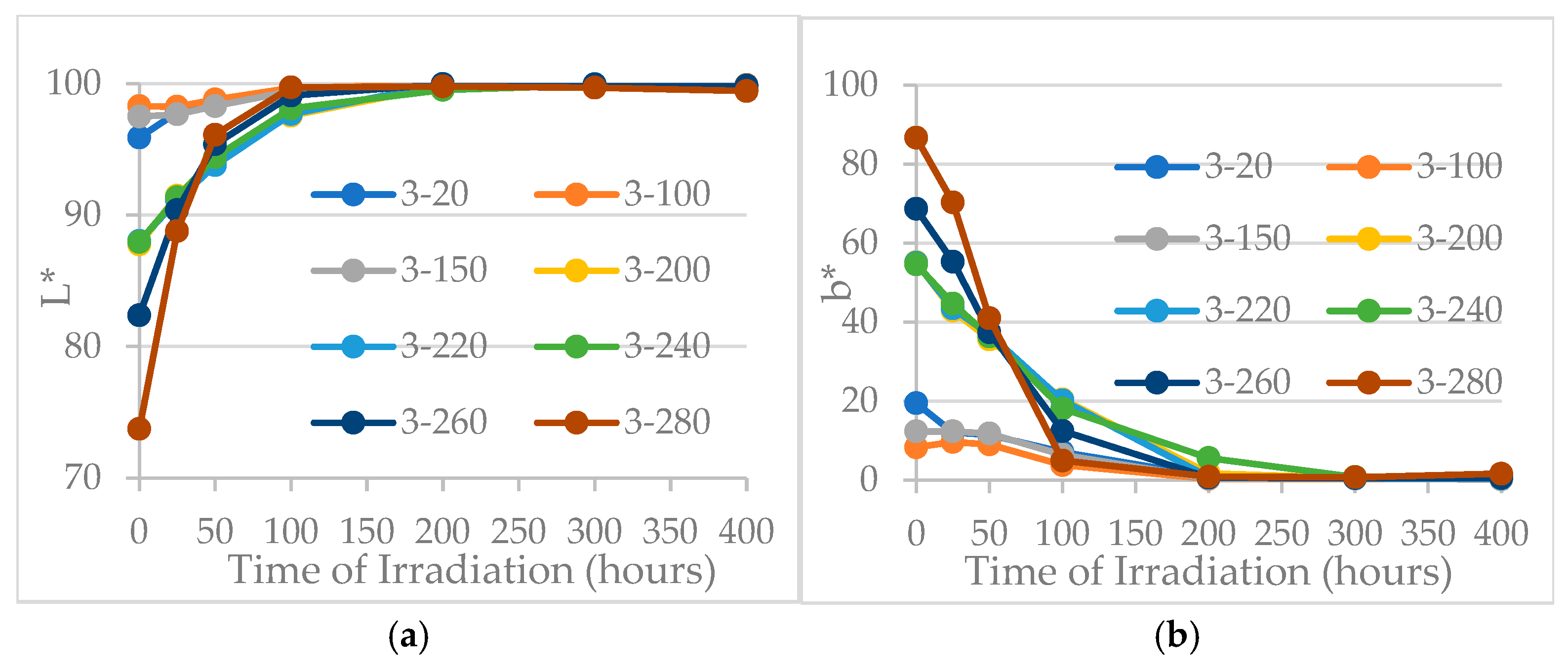
The colour change is an informative indicator of the process, but it is composed of changes in individual colour coordinates. Therefore, the progression of lightness (L*) and colour coordinates a* and b* was investigated during the irradiation period. The overall colour change reflected the behaviour of the b* coordinate. The initial appearance of the extractive solutions shifted from yellow to brown, depending on the increasing duration of thermal treatment and treatment temperature. While lightness decreased, the b* coordinate increased with increasing treatment duration and temperature (Figure 5).
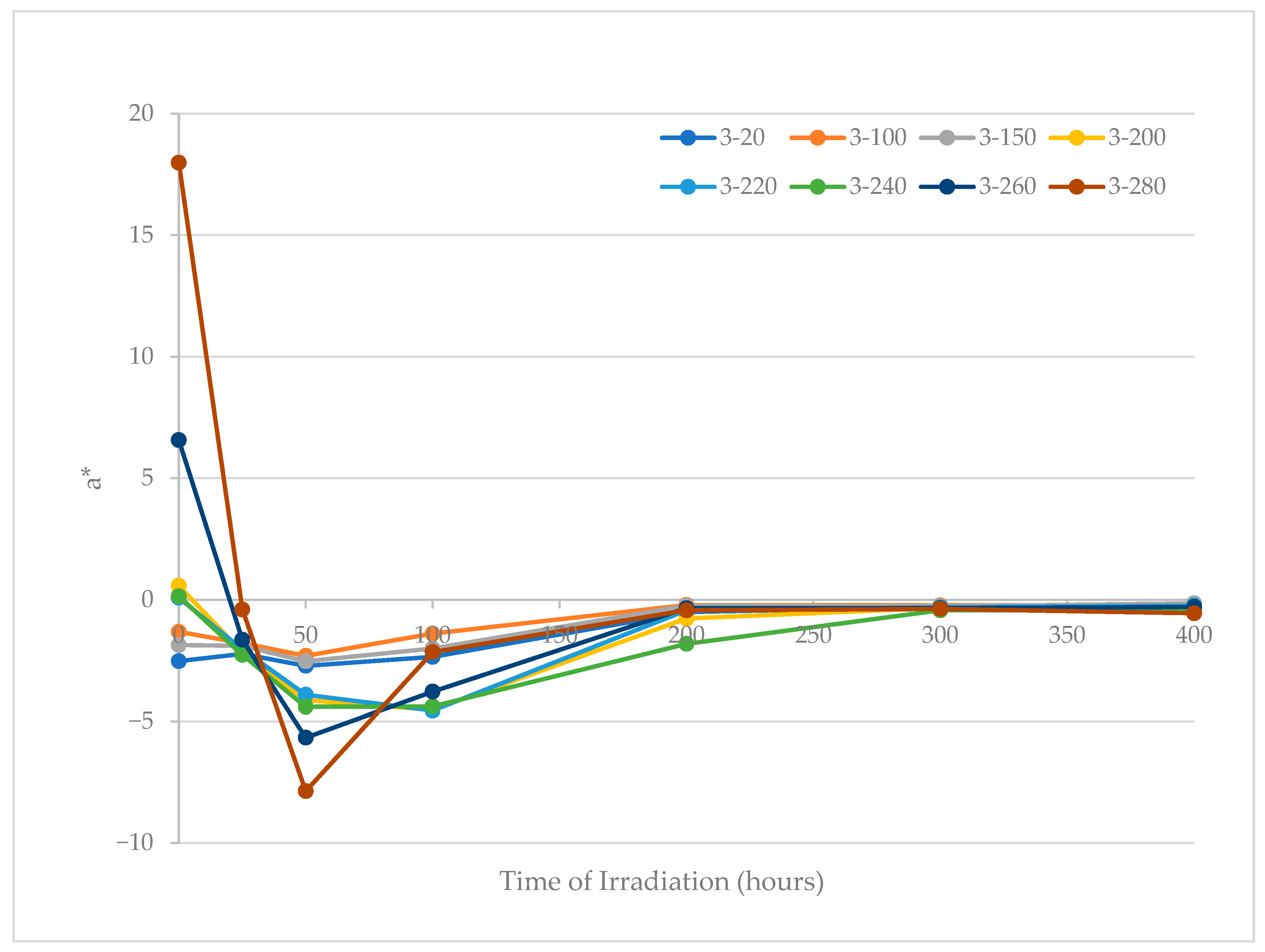
The negative a* coordinate indicated the green colour of extractives at treatment temperatures from 20 °C to 150 °C. Only positive a* values were measured, and a red colour was detected at the beginning of the ageing process in extractive solutions treated at temperatures from 200 °C to 280 °C (Figure 6).
The ageing process enhanced the green colour and the negative value of the a* coordinate before 100 h of irradiation. The a* coordinate of the extract colour almost overlapped at 25 h of irradiation for a 3 h treatment duration across different treatment temperatures. The greenest colour was recorded at 50 h of irradiation and a treatment temperature of 280 °C. However, the saturation decreased, which was a consequence of the b* coordinate decreasing during the ageing process. The colour of the extractives became paler, and the solutions were almost clear at the end of the irradiation process after 400 h. The final colour of the extracts was not identical to the colour of the pure solvent; it was darker, greener, and more yellow than the pure solvent (Table 3).
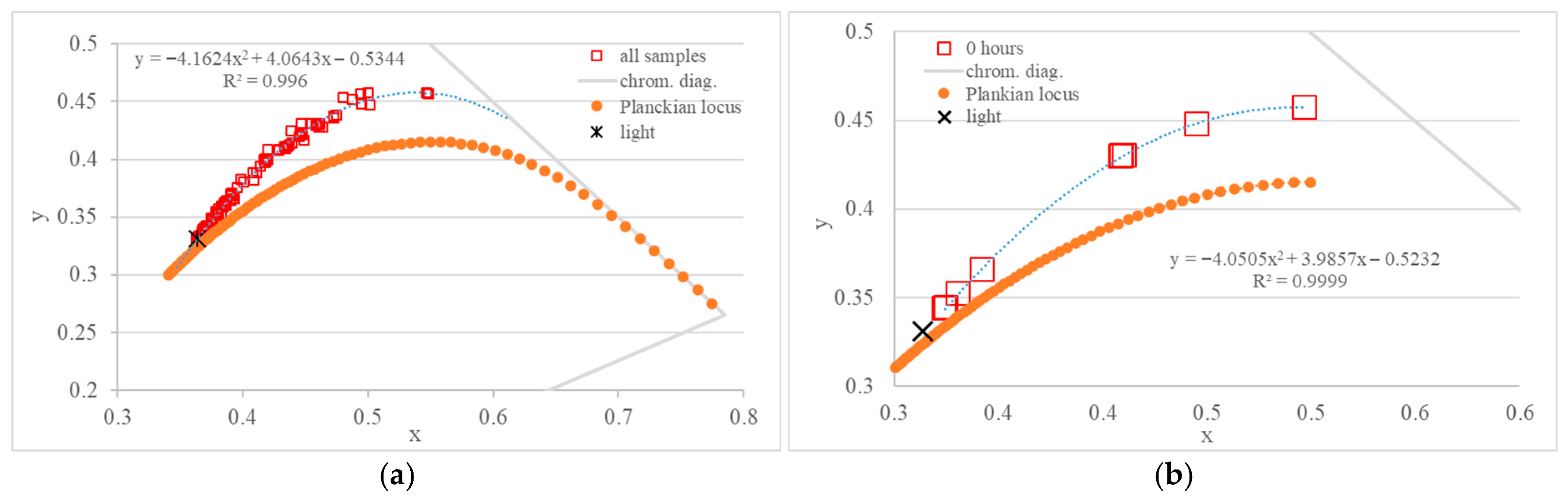
The saturation and hue are depicted in the chromaticity diagram. The extract colour coordinates followed the Planckian locus in the CIE xyY colour space (Figure 7a). The measured xy coordinates consistently appeared above the Planckian locus, regardless of the treatment duration, temperature, or irradiation time. The incident light passed through the extended regression parabola (Figure 7b).
It is assumed that there is a correlation between the mass of extractives and their position above the Planckian locus in the chromaticity diagram. Such a method could be useful for identifying extractives based on their colour.

4. Conclusions

The solutions of fir wood extractives, after various thermal treatment durations at different temperatures, were artificially irradiated in a xenotest under dry conditions. The initial mass and colour of the extracts differed before thermal treatment compared to the colour of the extracts at various stopping times after treatment. Thermal treatment was responsible for reducing the amount of extractives, up to a temperature of 150 °C for treatment times of 3 and 5 h (0.07% and 0.54%) and at 200 °C for a treatment time of 1 h (0.17%). The content of extractives increased at treatment temperatures of 220 °C to 260 °C in comparison to the untreated sample (maximum 1.25%). Decreasing contents were observed at a treatment temperature of 280 °C for 3 and 5 h treatment times (−0.75% and −0.05%). The dependence of colour coordinates on treatment temperature and time defined three intervals of treatment temperature: 20–150 °C, 200–240 °C, and 260–280 °C. The most intensive changes in extract colour, depending on treatment temperature, occurred in the interval 260–280 °C, while the smallest changes were observed for 20–150 °C. The colour difference decreased during the irradiation process, resulting in nearly colourless extracts after 400 h of irradiation of initially untreated samples. The lightness (L*) of the extractives increased towards a value of 100 during irradiation. The decrease in b* indicated the loss of yellow colour, while the initial a* values shifted towards green and later diminished during irradiation. It is assumed that the colour of fir wood will become less saturated and the original colour will appear paler after irradiation.

Author Contributions

Conceptualization, V.K. and R.H.; methodology, V.K. and R.H.; investigation, V.K. and R.H.; resources, V.K. and R.H.; data curation, V.K. and R.H.; writing—original draft preparation, V.K. and R.H.; writing—review and editing, V.K. and R.H. All authors have read and agreed to the published version of the manuscript.

Funding

This study was supported by the Scientific Grant Agency, Project KEGA 042SPU-4/2024, Project VEGA 1/0656/23, Project VEGA 1/0599/25, and the Slovak Research and Development Agency Contract no. APVV-22-0034 and no. APVV-21-0051.

Data Availability Statement

The data are embedded in this article.

Acknowledgments

This study was supported by the Scientific Grant Agency, Project KEGA 042SPU-4/2024, Project VEGA 1/0656/23, Project VEGA 1/0599/25, and the Slovak Research and Development Agency Contract no. APVV-22-0034 and no. APVV-21-0051.

Conflicts of Interest

The authors declare no conflicts of interest.

References

  1. Katuščák, S.; Kučera, L.J. CIE orthogonal and cylindrical color parameters and the color sequences of the temperate wood species. Drev. Výsk. 2000, 45, 9–22. [Google Scholar]
  2. Janin, G.; Gonçalez, J.C.; Ananías, R.A.; Charrier, B.; Silva, G.F.; Dilem, A. Aesthetics appreciation of wood colour and patterns by colorimetry. Part 1. Colorimetry theory for the CIELab system. Maderas. Cienc. Tecnol. 2001, 3, 3–13. [Google Scholar] [CrossRef]
  3. Kučerová, V.; Hrčka, R.; Hýrošová, T. Relation of chemical composition and colour of spruce wood. Polymers 2022, 14, 5333. [Google Scholar] [CrossRef] [PubMed]
  4. Barlović, N.; Čavlović, A.O.; Pervan, S.; Klarić, M.; Prekrat, S.; Španić, N. Chemical changes and environmental issues of heat treatment of wood. Drv. Ind. 2022, 73, 245–251. [Google Scholar] [CrossRef]
  5. Kučerová, V.; Hrčka, R.; Hýrošová, T. Chemical composition as the indicator of thermally treated pine (Pinus sylvestris L.) wood colour. Forests 2024, 15, 1186. [Google Scholar] [CrossRef]
  6. Fengel, D.; Wegener, G. Wood—Chemistry, Ultrastructure, Reactions; Walter de Gruyter: Berlin, Germany; New York, NJ, USA, 1989; 482p. [Google Scholar]
  7. Košíková, B.; Zákutná, L.; Joniak, D. Investigation of the lignin-saccharide complex by electron microscopy. Holzforschung 1978, 32, 15–18. [Google Scholar] [CrossRef]
  8. Jirous-Rajkovic, V.; Turkulin, H.; Miller, E.R. Depth profile of UV-induced wood surface degradation. Surf. Coat. Int. Part B Coat. Trans. 2004, 87, 235–308. [Google Scholar] [CrossRef]
  9. Matsuo, M.; Yokoyama, M.; Umemura, K.; Sugiyama, J.; Kawai, S.; Gril, J.; Kubodera, S.; Mitsutani, T.; Ozaki, H.; Sakamoto, M.; et al. Aging of wood–analysis of color changing during natural aging and heat treatment. Holzforschung 2011, 65, 361–368. [Google Scholar] [CrossRef]
  10. Moya, R.; Soto Fallas, R.; Jiménez Bonilla, P.; Tenorio, C. Relationship between wood color parameters measured by the CIELab system and extractive and phenol content in Acacia mangium and Vochysia guatemalensis from fast-growth plantations. Molecules 2012, 17, 3639–3652. [Google Scholar] [CrossRef]
  11. Feng, Q.; Yan, L.; Huang, G.; Ren, S.; Appelt, J.; Radtke, S.; Koch, G.; Cao, J.; Zhao, R. Variation in anatomical characteristics and chemical compositions during the sapwood to heartwood transformation of cultivated teak and their relationships to color formation. Wood Sci. Technol. 2025, 59, 38. [Google Scholar] [CrossRef]
  12. Babiak, M. Wood-Water System; VŠLD Zvolen: Zvolen, Slovakia, 1991; 63p. [Google Scholar]
  13. Mai, C.; Zhang, K. Wood Chemistry. In Springer Handbook of Wood Science and Technology; Niemz, P., Teischinger, A., Sandberg, D., Eds.; Springer: Cham, Switzerland, 2023; pp. 179–279. [Google Scholar]
  14. Kučerová, V.; Lagaňa, R.; Hýrošová, T. Changes in chemical and optical properties of silver fir (Abies alba L.) wood due to thermal treatment. J. Wood Sci. 2019, 65, 21. [Google Scholar] [CrossRef]
  15. El Bakali, I.; Yagi, S.; Hamzah, M.; George, B.; Merlin, A.; Deglise, X. Influence of thermal treatment and impregnation on the durability of wood colour. J. For. Prod. Ind. 2014, 3, 42–49. [Google Scholar]
  16. Dirckx, O.; Triboulot-Trouy, M.C.; Merlin, A.; Deglise, X. Modifications de la couleur du bois d’Abies grandis exposé à la lumière solaire. Ann. For. Sci. 1992, 49, 425–447. [Google Scholar] [CrossRef]
  17. Kúdela, J.; Hrčka, R.; Svocák, J.; Molčanová, S. Transparent coating systems applied on spruce wood and their colour stability on exposure to an accelerated ageing process. Forests 2024, 15, 1865. [Google Scholar] [CrossRef]
  18. N’Guessan, J.L.; Niamké, B.F.; Yao, N.J.C.; Amusant, N. Wood extractives: Main families, functional properties, fields of application and interest of wood waste. For. Prod. J. 2023, 73, 194–208. [Google Scholar] [CrossRef]
  19. Čabalová, I.; Bélik, M.; Kučerová, V.; Jurczyková, T. Chemical and morphological composition of Norway spruce wood (Picea abies L.) in dependence of its storage. Polymers 2021, 13, 1619. [Google Scholar] [CrossRef] [PubMed]
  20. Banadics, E.A.; Tolvaj, L.; Varga, D. Steaming of poplar, black locust and beech timbers simultaneously to investigate colour modification effect of extractive transport. Drewno 2022, 65, 1–11. [Google Scholar] [CrossRef]
  21. Gao, C.; Cui, X.; Matsumura, J. Multidimensional exploration of wood extractives: A review of compositional analysis, decay resistance, light stability, and staining applications. Forests 2024, 15, 1782. [Google Scholar] [CrossRef]
  22. Tomak, E.D.; Ermeydan, M.A.; Can, A.; Aydın, M.A. A comparative study on photodegradation of twenty-three wood species after UV irradiation. Radiat. Phys. Chem. 2024, 223, 111986. [Google Scholar] [CrossRef]
  23. Oltean, L.; Teischinger, A.; Hansmann, C. Wood surface discolouration due to simulated indoor sunlight exposure. Eur. J. Wood Prod. 2008, 66, 51–56. [Google Scholar] [CrossRef]
  24. Roșu, D.; Teaca, C.-A.; Bodirlau, R.; Roșu, L. FTIR and color change of the modified wood as a result of artificial light irradiation. J. Photochem. Photobiol. B Biol. 2010, 99, 144–149. [Google Scholar] [CrossRef]
  25. Timar, M.C.; Varodi, A.M.; Gurau, L. Comparative study of photodegradation of six wood species after short-time UV exposure. Wood Sci. Technol. 2016, 50, 135–163. [Google Scholar] [CrossRef]
  26. Godovčin, P.; Martinka, J.; Rantuch, P.; Hladová, M.; Kopúnek, J.; Otajovičová, M.; Bednáriková, M.Z. Impact of temperature and ultraviolet radiation on changes of colour of fir and spruce wood. Wood Res. 2022, 67, 894–907. [Google Scholar] [CrossRef]
  27. Gomes, F.S.; Reis, M.S.; Rupf, A.C.O.; Silvares, P.H.S.; Ferreira, J.S.S.; Dias, L.C.; Madi, J.P.S.; Cademartori, P.H.G.; Neto, H.F.; Paes, J.B.; et al. Chemical composition and color of short-rotation teak wood thermally modified in closed and open systems. Appl. Sci. 2023, 13, 13050. [Google Scholar] [CrossRef]
  28. Vek, V.; Keržič, E.; Poljanšek, I.; Eklund, P.; Humar, M.; Oven, P. Wood Extractives of Silver Fir (Abies alba) and Their Antioxidant and Antifungal Properties. Molecules 2021, 26, 6412. [Google Scholar] [CrossRef] [PubMed]
  29. Tavčar Benković, E.; Grohar, T.; Žigon, D.; Švajger, U.; Janeš, D.; Kreft, S.; Štrukelj, B. Chemical Composition of the Silver Fir (Abies alba) Bark Extract Abigenol® and Its Antioxidant Activity. Ind. Crops Prod. 2014, 52, 23–28. [Google Scholar] [CrossRef]
  30. Ancuceanu, R.; Hovanet, M.V.; Miron, A.; Anghel, A.I.; Dinu, M. Phytochemistry, Biological, and Pharmacological Properties of Abies alba Mill. Plants 2023, 12, 2860. [Google Scholar] [CrossRef] [PubMed]
  31. Salem, M.Z.M.; Zeidler, A.; Böhm, M.; Mohamed, M.E.A.; Ali, H.M. Wood and Bark Oil Extractives of Abies alba: A GC Analysis of Essential Compounds. BioResources 2015, 10, 7725–7737. [Google Scholar] [CrossRef]
  32. Hrovatič, P.; Poljanšek, I.; Osolnik, U.; Oven, P.; Vek, V. Changes in the content of extractives in silver fir (Abies alba Mill.) bark due to different storage conditions. Eur. J. Wood Prod. 2025, 83, 186. [Google Scholar] [CrossRef]
  33. Stojanov, S.; Ravnikar, M.; Berlec, A.; Kreft, S. Interaction between silver fir (Abies alba) wood water extract and lactobacilli. Pharmazie 2021, 76, 614–617. [Google Scholar]
  34. Tjeerdsma, B.; Militz, H. Chemical Changes in Softwoods Due to Heat Treatment. Holz Als Roh- Werkst. 2005, 63, 102–111. [Google Scholar] [CrossRef]
  35. González-Peña, M.M.; Hale, M.D.; Owen, N.L. Fast Assessment of Chemical Changes in Heated Softwoods Using Raman Spectroscopy. J. Wood Chem. Technol. 2004, 24, 155–167. [Google Scholar]
  36. Esteves, B.; Pereira, H. Wood Modification by Heat Treatment: A Review. BioResources 2009, 4, 370–404. [Google Scholar] [CrossRef]
  37. Mitsui, K. Light source dependence of the photodegradation of wood. J. Wood Sci. 2005, 51, 468–473. [Google Scholar] [CrossRef]
  38. Gandelová, L.; Persze, L.; Tolvaj, L. Photodegradation of wood: Role of chromophoric groups in lignin and polysaccharides. Acta Fac. Xylologiae Zvolen 2020, 62, 5–18. [Google Scholar]
  39. Sommerauer, L.; Petutschnigg, A.; Schnabel, T. Investigation of impregnation approach of zinc oxide nano-dispersions for potential UV stabilization in Abies alba and Fagus sylvatica. Compounds 2023, 3, 561–572. [Google Scholar] [CrossRef]
  40. ASTM D1107-96; Standard Test Method for Ethanol-Toluene Solubility of Wood. ASTM International: West Conshohocken, PA, USA, 1996.
  41. Kúdela, J.; Sikora, A.; Gondáš, L. Wood surface finishing with transparent lacquers intended for indoor use, and the colour resistance of these surfaces during accelerated aging. Polymers 2023, 15, 747. [Google Scholar] [CrossRef]
  42. ASTM G155-05; Practice for Operating Xenon Arc Light Apparatus for Exposure of Non-Metallic Materials. ASTM International: West Conshohocken, PA, USA, 2005.
  43. Hill, C.A.S. Wood Modification: Chemical, Thermal and Other Processes; Wiley: Hoboken, NJ, USA, 2020. [Google Scholar]
  44. Lyu, J.; Wang, J.; Chen, M. Effects of Heat Treatment on the Chemical Composition and Microstructure of Cupressus funebris Endl. Wood. Forests 2024, 15, 1370. [Google Scholar] [CrossRef]
  45. Butnaru, E.; Brebu, M. The Thermochemical Conversion of Forestry Residues from Silver Fir (Abies alba Mill.) by Torrefaction and Pyrolysis. Energies 2022, 15, 3483. [Google Scholar] [CrossRef]
Figure 1. Extractives in Erlenmeyer flasks before irradiation.
Forests 16 01791 g001
Figure 2. Extractives in Erlenmeyer flasks after the irradiation duration of 400 h.
Forests 16 01791 g002
Figure 3. The change of the extract colour in CIE L*a*b* colour space for 1 h (a) and 5 h (b) stop times and different treatment temperatures during artificial irradiation.
Forests 16 01791 g003
Figure 4. The change of the extract colour in CIE L*a*b* colour space for 3 h stop time and different treatment temperatures during artificial irradiation.
Forests 16 01791 g004
Figure 5. The lightness L* (a) and coordinate b* (b) of the extract colour in CIE L*a*b* colour space for 3 h stop time and different treatment temperatures during artificial irradiation.
Forests 16 01791 g005
Figure 6. The coordinate a* of the extract colour in CIE L*a*b* colour space for 3 h stop time and different treatment temperatures during artificial irradiation.
Forests 16 01791 g006
Figure 7. The colour of extracts in the chromaticity diagram for different stop times, different treatment temperatures, and times of artificial irradiation (a); the colour of extracts in the chromaticity diagram after 3 h stop time and different treatment temperatures at initial time of irradiation (b).
Forests 16 01791 g007
Table 1. The ageing parameters set according to the Standard ASTM G 155-05 (2005) “dry mode” [42].
StepModeRadiation Intensity
(W/m2)
Black Panel Temperature
(°C)
Air Temperature (°C)Relative Air Humidity
(%)
Time (min.)
1Radiation0.35634830102
2Radiation-free--38-18
Table 2. Percentage of extractives dependent on treatment temperature and duration of the thermal process in fir wood.
Time (h)135
Temperature (°C)Extractives (%)Extractives (%)Extractives (%)
201.86 ± 0.031.86 ± 0.031.86 ± 0.03
1001.35 ± 0.041.71 ± 0.021.53 ± 0.07
1501.47 ± 0.021.79 ± 0.071.32 ± 0.07
2001.69 ± 0.022.12 ± 0.091.93 ± 0.08
2202.39 ± 0.012.43 ± 0.052.24 ± 0.07
2403.11 ± 0.022.92 ± 0.062.51 ± 0.05
2602.96 ± 0.032.46 ± 0.092.80 ± 0.08
2802.91 ± 0.011.10 ± 0.071.81 ± 0.07
Table 3. The colour change of extracts after 400 h of irradiation relative to calibrated cuvette filled with untreated toluene–ethanol mixture.
Treatm. Time/HourTreatm. Temp./°C20100150200220240260280
Colour Coordinate
1L*99.6599.9399.8099.8799.8999.9699.8899.76
a*−0.23−0.26−0.32−0.35−0.34−0.35−0.33−0.40
b*0.530.570.790.810.790.730.731.00
3L*99.6599.8899.8399.7399.8499.7499.8199.42
a*−0.23−0.20−0.15−0.29−0.25−0.42−0.30−0.56
b*0.530.210.180.520.400.860.531.60
5L*99.6599.2999.5099.7899.8699.8099.8599.52
a*−0.23−0.18−0.22−0.59−0.25−0.27−0.28−0.31
b*0.530.460.521.210.380.470.430.75
Disclaimer/Publisher’s Note: The statements, opinions and data contained in all publications are solely those of the individual author(s) and contributor(s) and not of MDPI and/or the editor(s). MDPI and/or the editor(s) disclaim responsibility for any injury to people or property resulting from any ideas, methods, instructions or products referred to in the content.