
Article

Spatial and Temporal Dynamics of Forest Carbon Sequestration and Spatial Heterogeneity of Influencing Factors: Evidence from the Beiluo River Basin in the Loess Plateau, China


1
College of Economics and Management, Northwest A&F University, Yangling, Xianyang 712100, China
2
Center for Resource Economics and Environment Management, Northwest A&F University, Yangling, Xianyang 712100, China
3
School of Economics, Sichuan University of Science & Engineering, Zigong 643000, China
*
Author to whom correspondence should be addressed.
Forests 2025, 16(11), 1719; https://doi.org/10.3390/f16111719
Submission received: 6 September 2025 / Revised: 31 October 2025 / Accepted: 9 November 2025 / Published: 12 November 2025
(This article belongs to the Section Forest Meteorology and Climate Change)

Abstract

To accurately analyze the dynamic response and driving mechanism of forest carbon sequestration in the core area of the Loess Plateau’s Returning Farmland to Forestry Project, this study takes the Beiluo River Basin as the research area. Using spatial autocorrelation, gravity model, a geodetector, and spatiotemporal geographically weighted regression models, it analyzes the spatiotemporal evolution of forest carbon sequestration and the spatial heterogeneity of its influencing factors based on 2000–2023 data. The results show the following: (1) Forest carbon sequestration in the basin increased by 13.55% from 2000 to 2023; its spatial pattern shifted from “middle reaches concentration” to “stable middle reaches core plus significant upper reaches growth”, with the gravity center moving “southeast then northwest”. (2) Forest carbon sequestration had significant positive spatial correlation, with hotspots in soil–rock mountain forest areas and cold spots in ecologically fragile or high-human-activity areas. (3) Natural ecological factors dominated forest carbon sequestration evolution, socioeconomic factors enhanced synergy, and evapotranspiration and NDVI had significant impacts. (4) Factor impacts had spatiotemporal heterogeneity, such as the decaying positive effect of precipitation and the “positive-negative-equilibrium” change in forestry value-added. This study provides scientific guidance for basin and Loess Plateau ecological restoration and “double carbon” goal achievement.

1. Introduction

Forest carbon sequestration refers to the ecological process and capacity of forests to absorb and store carbon dioxide through photosynthesis, serving as a core indicator for assessing forests’ role in regulating climate and maintaining carbon balance [1]. On a global scale, forest ecosystems have been identified as the largest terrestrial carbon sink, accounting for over half of terrestrial ecosystem carbon storage, and are a “natural carbon sink” for mitigating climate change [2]. Under the backdrop of global climate governance and the “dual carbon” goals, understanding forest carbon sequestration dynamics and driving mechanisms has become a core basis for formulating ecological policies. China has enhanced carbon sink functions through afforestation and forest management measures, with policies such as the “National Plan for Addressing Climate Change” highlighting the importance of forestry [3,4]. Research by Academician Fang Jingyun and others shows that since the late 1970s, China’s forest vegetation carbon stock has significantly increased, with artificial forests contributing over 80% to the national forest carbon sink [5]. It is projected that by 2050, China’s forest net carbon sink will account for 7% of industrial sector greenhouse gas emissions during the same period [5]. China’s forest carbon storage is unevenly distributed across regions [6]. Since the late 1990s, regions such as the northwest have implemented afforestation projects, resulting in a significant increase in forest carbon storage in these areas [7,8]. However, the process of changes in forest ecosystems’ carbon sequestration services is highly complex, influenced by multiple intertwined factors [9]. Currently, systematic research on ecologically fragile regions such as the Loess Plateau remains insufficient, particularly regarding the long-term spatiotemporal dynamics and driving mechanisms, which require further in-depth study.
Current research on the carbon sequestration services of forest ecosystems can be organized around three core directions. The first is the spatiotemporal dynamics analysis of forest carbon sequestration services. At the global scale, there is a regional differentiation characterized by a decline in the carbon sequestration capacity of tropical forests and an increase in the potential of temperate forests [10]. At the regional scale in China, research has primarily focused on the Northeast and Southwest forest regions [11,12,13]. Some studies have elucidated the differences in the sensitivity of forest carbon sinks to climate change through cross-regional comparisons [14], while others have outlined the spatial pattern and growth potential of total forest carbon sequestration in China based on field survey data [15]. However, existing research has insufficiently addressed the core areas of the afforestation program in the Loess Plateau, lacks long-term tracking at the small watershed scale, and thus fails to reflect the carbon sequestration characteristics of the entire project lifecycle. Second, the exploration of factors influencing forest carbon sequestration services. Among natural factors, topography influences carbon sequestration through water and heat conditions and vegetation distribution; precipitation and evapotranspiration interact complexly; and temperature influences the carbon cycle through vegetation growth and microbial activity [16,17,18,19]. Among human factors, the impacts of urbanization, forestry activities, and ecological engineering projects such as afforestation have been widely discussed [20,21,22,23]. However, existing studies often analyze individual factors in isolation, with insufficient analysis of the synergistic mechanisms between “natural-human” factors, particularly lacking quantitative research on their interactions. Third, research methods on the spatial heterogeneity of forest carbon sequestration services. Traditional statistical models, such as ordinary least squares, assume that variables act with spatial homogeneity, making it difficult to accurately capture the spatial differentiation characteristics of forest carbon sequestration services. Although some studies have introduced geographically weighted regression models to analyze the spatial heterogeneity of carbon sequestration services [24,25], such methods have limitations in long-term dynamic tracking and multi-scale coupling analysis, and they do not adequately address changes in influencing factors at different stages of ecological engineering projects, making it difficult to support targeted ecological management. Existing research still has certain limitations: first, there is a mismatch between temporal and spatial scales, with macro-level studies failing to reflect fine-scale changes in small watersheds, and short-term monitoring unable to capture the long-term effects of ecological engineering; second, analyses of influencing factors lack consideration of spatial heterogeneity, often treating influencing factors as homogeneous, and failing to quantitatively analyze the spatial interaction mechanisms of multi-dimensional factors; finally, there is insufficient integration of research methods, with low integration between remote sensing data and econometric models, limiting the depth of mechanism analysis.
As a core demonstration area for returning farmland to forest in the Loess Plateau, the Beiluo River Basin has unique research value [26,27]. First, it spans the loess hills and high loess gullies, with complex topography and stepwise distribution of forest types, providing a natural sample for the study of spatial differentiation of carbon sequestration. Second, the forested area has increased significantly since 2000, and the ecosystem structure has changed dramatically, making it an ideal area to explore the dynamics of carbon sequestration under human intervention. Third, as an important tributary of the middle reaches of the Yellow River, its carbon sequestration function directly impacts the ecological security and carbon cycle of the basin, making the research findings practically significant. Addressing the limitations of existing studies, this research spans the period from 2000 to 2023, utilizing 30-m resolution grid data, and combines spatial autocorrelation and center-of-gravity migration methods to systematically analyze the spatiotemporal evolution characteristics of the carbon sequestration service functions of the forest ecosystem in the Beiluo River Basin; Using the Geographic Detector System to identify the influence of multi-dimensional factors such as topographic factors, natural ecological factors, and socio-economic factors on the carbon sequestration service function of forest ecosystems, this study introduces a spatio-temporal geographically weighted regression model to analyze the heterogeneity of influencing factors in both temporal and spatial dimensions. The marginal contribution of this study first lies in achieving long-term, high-resolution dynamic monitoring from 2000 to 2023 based on 30-m grid data, thereby enhancing research precision. Second, it systematically integrates topographical, natural ecological, and socio-economic factors to deepen understanding of the mechanisms by which multiple types of factors synergistically drive carbon sequestration functions. Finally, it uses the spatio-temporal geographic weighted regression model to capture the spatio-temporal heterogeneity of influencing factors, providing scientific support for the formulation of differentiated and targeted policies to enhance carbon sequestration.

2. Materials and Methods

2.1. Study Area

The Beiluo River Basin (34°39′55″–37°18′22″ N, 107°33′33″–110°10′30″ E) spans the provinces of Shaanxi and Gansu, located in the critical ecological transition zone between the Loess Plateau and the Weihe Plain (Figure 1). As the longest tributary of the Wei River and a secondary tributary of the Yellow River, it originates from the southern slopes of the Baiyu Mountains in Shaanxi Province, flows through the typical loess plateau gully region, and ultimately empties into the Wei River at Dali County. The total basin area is approximately 26,900 km2, extending in a narrow, elongated strip. This region is a key implementation area for the national afforestation program and soil and water conservation measures. Over the past few decades, it has undergone significant land use changes, particularly in terms of forest vegetation restoration and reconstruction. This intense human intervention has profoundly impacted the structure and function of forest ecosystems, making it an ideal research sample for investigating the spatiotemporal dynamics of forest carbon sequestration services and their driving mechanisms [26,27].

2.2. Data Sources and Processing

The time series for this study spans from 2000 to 2023. To focus on long-term trends and ensure the quality of multi-source data processing, the analysis is based on data from six representative years: 2000, 2005, 2010, 2015, 2020, and 2023. These years are evenly distributed and cover key milestones within the study period, effectively supporting the analysis of long-term evolution patterns in forest carbon sequestration services.

2.2.1. Land Use Data

The land use data for the Beiluo River basin from 2000 to 2023 are sourced from the CLCD dataset at Wuhan University (https://irsip.whu.edu.cn/recent_achi/recent_show.php?16 (accessed on 30 June 2025)), which has overall accuracy superior to that of the MCD12Q1, ESACCI_LC, FROM_GLC, and Globe Land 30 products, with a spatial resolution of 30 m [28]. Following reclassification according to research requirements, six major categories of land use data were obtained for the Beiluo River Basin: arable land, forest land, grassland, water bodies, constructed land, and unutilized land. This study utilizes the forest land data from this dataset.

2.2.2. Driving Force Data

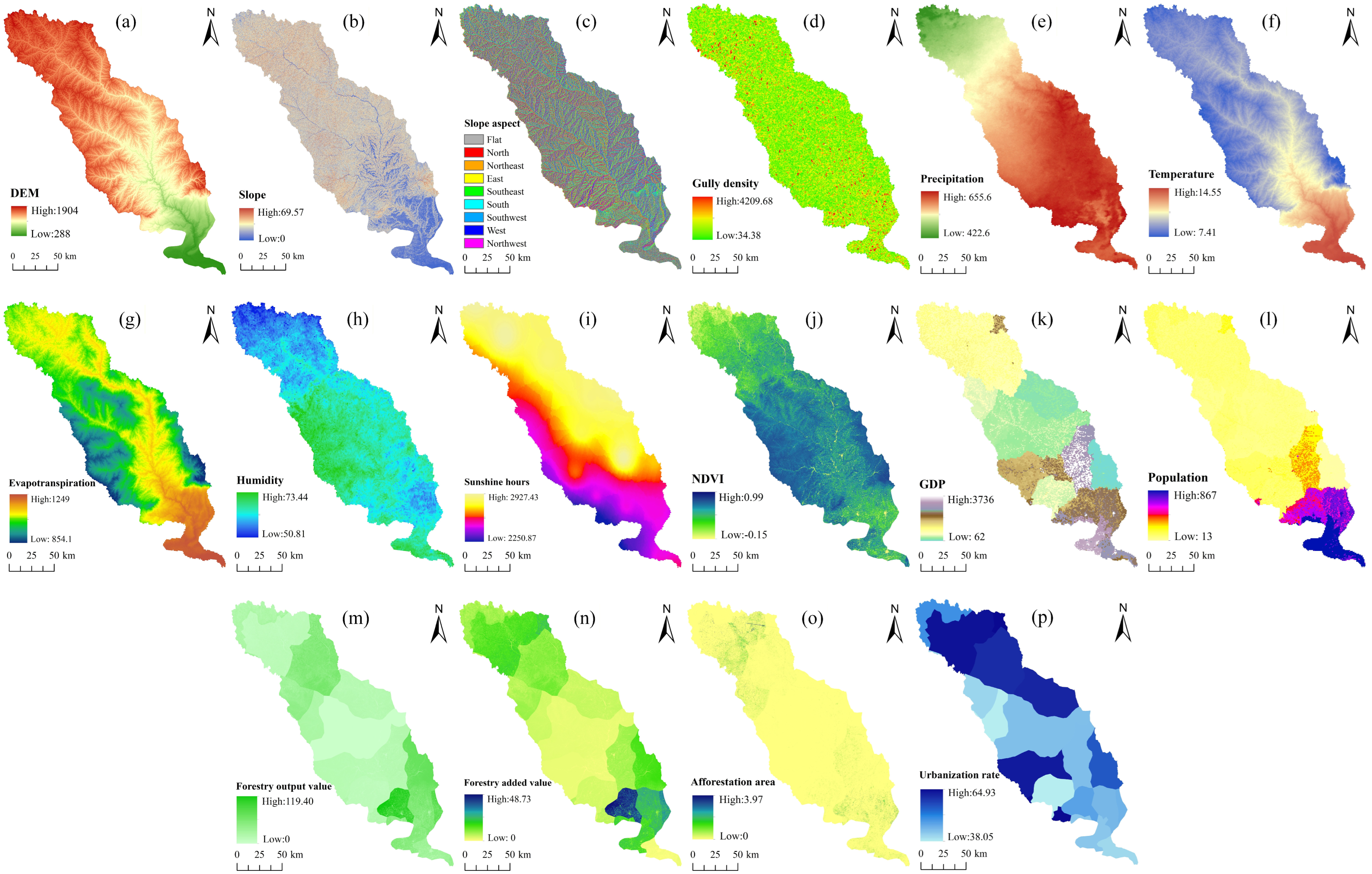
Based on the actual conditions of the Beiluo River basin, the carbon sequestration service function of forest ecosystems was selected as the dependent variable. Sixteen driving factors with direct or indirect impacts on the structure and function of forest ecosystems were identified from topographic, natural ecological, and socioeconomic factors, as shown in Table 1. Among topographic factors, DEM, slope, and slope aspect directly influence vegetation types and productivity; gully density indirectly affects forest ecosystem stability [29]. Among natural ecological factors, precipitation and temperature are fundamental climatic elements determining vegetation photosynthesis and respiration rates; evapotranspiration comprehensively reflects vegetation transpiration and soil evaporation, directly influencing vegetation physiological activities; humidity and sunshine duration further characterize habitat moisture and energy conditions; NDVI serves as an effective proxy variable for forest photosynthetic capacity and primary productivity [30,31,32]. Among socioeconomic factors, GDP and population density serve as macro-level drivers of land use change. Forestry output value, forestry value-added, and afforestation area directly measure the scale and investment of forestry operations, reflecting ecological engineering policies. Urbanization rates characterize the expansion of human settlements and construction land, typically exerting a crowding effect on natural vegetation space [33,34,35].
The annual average precipitation and annual average temperature in the natural ecological factors were obtained using the Anusplin interpolation method based on data from the National Climate Center [36,37]. Socioeconomic factors, including GDP and population density, were sourced from the Resource and Environmental Science and Data Center. Using a multi-factor weighting allocation method, data based on administrative regions were distributed to grid cells, thereby achieving spatialization of the data. Data such as forestry output value, forestry added value, afforestation area, and urbanization rate were converted from county-level statistical data to grid data using spatial data conversion methods. All base data underwent unified projection conversion and spatial resampling on the ArcGIS 10.8 platform, standardizing the spatial resolution of all raster data to 30 m × 30 m before visualization (Figure 2).

2.3. Research Methods

2.3.1. InVEST Model

The full name of the InVEST model is the Integrated Valuation and Trade-off Assessment of Ecosystem Services model. Multiple modules are used to assess ecosystem services. This paper uses the carbon stock calculation module of the InVEST model (3.14.2) to perform a quantitative assessment of carbon stocks in the Beiluo River basin [38,39,40]. The total carbon stock of the Beiluo River basin was determined using the following formula:
C i = C a b o v e + C b e l o w + C s o i l + C d e a d
C t o t a l = i = 1 m A i C i
In the formula: C i is the carbon density of land use types; C a b o v e is the above-ground carbon density; Cbelow is the below-ground carbon density; C s o i l is the soil carbon density; C d e a d is the carbon density of dead organic matter; C t o t a l is the sum of carbon stocks for all land types; A i is the area of different land use types; m is the number of land types.
Formula (1) defines the framework for carbon stock composition. The selection of carbon density values for this framework followed a key scientific principle, which was to prioritize data from a larger, ecologically homologous region to ensure comparability. Given that the Beiluo River Basin is a secondary tributary of the Yellow River Basin and shares highly similar climatic and vegetative conditions, the initial baseline carbon density values in this study were rationally referenced from well-established studies conducted in the Yellow River Basin [41]. It should be noted that directly applying the Yellow River basin’s baseline carbon density values may not fully reflect the spatiotemporal heterogeneity within the Beiluo River basin. Therefore, based on the carbon density correction formulas proposed by Alam et al., the Yellow River basin’s carbon density values were adjusted using precipitation and temperature factors [42]. The correction factor K B calculated from Equations (4)–(8) is the correction factor for biomass carbon density. This factor will be applied to the corrections of both C a b o v e and C b e l o w . The correction factor K S calculated from Equations (3) and (9) is applied to the correction of C s o i l . The final corrected carbon density values are presented in Table 2, with the correction formula as follows:
C S P = 3.3968 × M A P + 3996.1
C B P = 6.798 × e ( 0.0054 × M A P )
C B T = 28 × M A T + 398
In the formula: C S P is the soil organic carbon density (t/hm2) obtained based on the annual average precipitation; C B P and C B T are the biomass carbon densities (t/hm2) obtained based on the annual average precipitation and annual average temperature, respectively; M A P is the annual average precipitation, with 397.37 mm for the Yellow River Basin and 415.23 mm for the North Luo River Basin; M A T is the annual average temperature, with 6.57 °C for the Yellow River basin and 9.95 °C for the Beiluo River basin. Substituting these values into the above formula, the ratio of the calculated results is the carbon density correction factor. Finally, the carbon density of the Yellow River basin is multiplied by the correction factor to obtain the carbon density of the Beiluo River basin. The correction factor calculation formula is as follows:
K B P = C B P a C B P b
K B T = C B T a C B T b
K B = K B P × K B T
K S = C S P a C S P b
In the equation: K B P and K B T are the correction coefficients for the biomass carbon density precipitation factor and temperature factor, respectively; K B and K S are the correction coefficients for biomass carbon density and soil organic carbon density, respectively; C B P a and C B P b are the biomass carbon density data for the Beiluo River Basin and the Yellow River Basin obtained using annual average precipitation; C B T a and C B T b are the biomass carbon density data for the Beiluo River Basin and the Yellow River Basin calculated using annual average temperature; C S P a and C S P b are the soil organic carbon density data for the Beiluo River Basin and the Yellow River Basin calculated using annual average precipitation. The results of all calculations are summarized in Table 2.

2.3.2. Spatial Autocorrelation Model

Spatial autocorrelation is an important method for measuring the spatial correlation of geographical elements, mainly including global spatial autocorrelation and local spatial autocorrelation [43,44]. This paper uses the global Moran’s I index to characterize the global correlation characteristics of the carbon sequestration service function of the forest ecosystem in the North Luo River Basin, and further analyzes the local correlation characteristics of the carbon sequestration service function of the regional forest ecosystem through the local LISA index.
(1)
Global spatial autocorrelation. This describes the spatial characteristics of a certain attribute across the entire study area. The calculation formula is as follows:
M o r a n s   I = n i = 1 n j = 1 m w i j ( x i x ¯ ) ( x j x ¯ ) i = 1 n j = 1 m w i j i = 1 n ( x i x ¯ ) 2 Z = I E ( I ) V A R ( I )
In the formula: n is the number of grids; m is the number of neighboring grids of grid i; w i j is an element in the spatial weight matrix W. When grid i is adjacent to grid j, w i j = 1; otherwise, w i j = 0; x i   w i j and x j are the values of the carbon sequestration service function of the forest ecosystem in grid cells i and j, respectively; x is the mean value of the carbon sequestration service function of the forest ecosystem; the standardized Z-value is used to test the significance level of the global Moran’s I; E ( I ) and V A R ( I ) represent the expected value and variance of Moran’s I, respectively.
(2)
Local spatial autocorrelation. The degree of correlation between each grid of measurement attributes and adjacent grids is calculated using the following formula:
M o r a n s   I i = x i x ¯ S 2 j = 1 m w i j ( x j x ¯ ) S 2 = 1 n 1 j = 1 , j i m ( x i x ¯ ) 2
In the formula: x i , x ¯ , x j , m , w i j , n and have the same meanings as above; S 2 denotes variance.

2.3.3. Center of Gravity Model

The center of gravity model is used to describe the direction and distance of movement of the center of gravity of elements within a region. It can intuitively and accurately reveal the distribution and evolution patterns of these elements in two-dimensional space [45,46]. This paper uses this model to analyze the spatial changes in the carbon sequestration service function of the forest ecosystem in the Beiluo River basin. The calculation formula is as follows:
X i = i = 1 n P i X ¯ i i = 1 n P i , Y i = i = 1 n P i Y ¯ i i = 1 n P i
θ i j = n π / 2 + arctan y i y j x i x j
D i j = C ( y i y j ) 2 + ( x i x j ) 2
In the equation: X i and Y i represent the center of gravity of the carbon sequestration service function of the forest ecosystem in the Beiluo River basin; n represents the number of grids; X ¯ i , Y ¯ i represent the geographic coordinates of the i -th grid in the Beiluo River basin, P i denotes the carbon sequestration service function value of the forest ecosystem in that grid cell; θ i j denotes the angle of center of gravity movement, ( x i , y j ) and ( x j , y j ) denote the center of gravity coordinates in the i -th and j -th years, respectively; when θ = 0°, the center of gravity moves toward the east; D i j denotes the distance of center of gravity movement; C denotes the conversion rate when geographic coordinates are calculated as projected coordinates.

2.3.4. Geographic Detector Model

The geographic detector is a statistical method proposed by Wang Jin-feng et al. to detect spatial heterogeneity and reveal its underlying driving forces [47]. It includes factor detection, ecological detection, interaction detection, and risk detection, and has been widely applied in many fields. This paper mainly uses factor detection and interaction detection from the geographic detector.
Factor detection is used to analyze the degree to which driving factors explain the spatial heterogeneity of the dependent variable, expressed as:
q = 1 h = 1 L N h σ h 2 N σ 2 = 1 S S W S S T , S S W = h = 1 L N h σ h 2 , S S T = N σ 2
In the formula: q represents the degree to which the driving factor X explains the spatial differentiation of the dependent variable Y, with a value range of [0, 1]; L is the stratification of the independent variable X or the dependent variable Y; N h and N represent the number of units in layer h and the entire area, respectively; σ h 2 and σ 2 represent the variance of the independent variable in layer h and the entire area, respectively; S S W and S S T represent the sum of the variances within the layer and the total variance in the entire area, respectively.
Interaction detection aims to assess the interaction effects between different factors X, i.e., to determine whether the explanatory power of factors X 1 and X 2 on the dependent variable Y is enhanced, weakened, or whether the factors independently influence Y. The specific procedure involves first calculating the q -values of factors X 1 and X 2 on Y separately, denoted as q X 1 and q X 2 , then calculating the q -value when the two interact, denoted as q ( X 1 X 2 ) . Subsequently, compare q X 1 , q X 2 , and q ( X 1 X 2 ) to determine the type of interaction, which includes nonlinear weakening, single-factor nonlinear weakening, double-factor enhancement, independence, and nonlinear enhancement.

2.3.5. Spatio-Temporal Geographic Weighted Regression Model

The spatiotemporal geographic weighting regression model, as an extension of the spatial geographic weighting regression model, simultaneously considers temporal and spatial non-stationarity, enabling a synchronous explanation of the spatiotemporal variation mechanisms of geographic phenomena [48,49]. The GTWR model in this study was implemented using the GTWR plugin developed by Huang et al. within the ArcGIS 10.8.1 platform [50]. Drawing upon established methods from existing literature, key parameter settings were configured as follows: the Gaussian kernel function was selected as the kernel type; bandwidth was set using automatic optimization, employing the golden section search algorithm with the objective of minimizing the model’s Akaike Information Criterion (AICc) [48,49]. To evaluate model performance and select the optimal model, this study compared the GTWR model with the OLS model based on adjusted R2 and AICc criteria. The comparison reveals that the adjusted R2 of the GTWR model reaches 0.72, representing a 0.14 improvement over the OLS model’s 0.58, indicating superior fitting accuracy. More importantly, the GTWR model’s AICc value is 1584.91, significantly lower than the OLS model’s 2971.75, with a difference of 1386.84. According to model selection theory, a lower AICc value indicates better trade-off between model fit and complexity. This substantial difference far exceeds the strong evidence threshold of 10, providing decisive statistical support for the superiority of the GTWR model. This paper employs spatiotemporal geographic weighting to conduct a regression analysis of the factors influencing the carbon sequestration service function of forest ecosystems in the Beiluo River Basin at different time points. The specific calculation formula is as follows:
y i = b 0 ( u i , v i , t i ) + k = 1 P b k ( u i , v i , t i ) x i k + ε i
In the equation: yi is the observed value; ( u i , v i , t i ) is the spatiotemporal coordinate of the i -th observation point, where u i denotes longitude, v i denotes latitude, and t i denotes the time point; b 0 ( u i , v i , t i ) is the constant term of the regression; b k ( u i , v i , t i ) is the regression coefficient of the k -th variable at the i -th observation point; P is the total number of variables; x i k is the value of the k -th independent variable x k at the i -th observation point; ε i is the random error of the i -th observation point.

3. Results

3.1. Multidimensional Evolutionary Characteristics of the Spatio-Temporal Pattern of Forest Carbon Sequestration in the Beiluo River Basin

3.1.1. Temporal Characteristics of Forest Carbon Sequestration from 2000 to 2023

As shown in Table 3, forest carbon sequestration in the Beiluo River Basin exhibited a significant upward trend between 2000 and 2023, with carbon sequestration increasing from 13,193.18 million tons in 2000 to 14,980.83 million tons in 2023, representing a 13.55% increase, with overall steady growth. This growth is attributed to the implementation of ecological conservation policies, the continued implementation of the grain-for-green program, and the optimization of forestry management, which have laid a solid foundation for carbon sequestration. Regionally, the upstream areas, such as Wuyi County, have shown particularly prominent growth. Wuyi County saw an increase of 3691.37%, due to the significant efforts in ecological restoration in the early stages, the early implementation of the grain-for-green demonstration project, and the rapid recovery of vegetation, leading to an explosive increase in carbon sink capacity; Jingbian County benefited from desertification control efforts, with vegetation transitioning from sparse to lush, resulting in a 535.19% increase in carbon sequestration capacity. This drove the total carbon sequestration capacity of the upstream region from 25.021 million tons to 31.453 million tons, representing a 25.71% increase. Midstream counties like Luochuan County saw steady growth, with Luochuan County increasing by 33.92%. Fuxian County and Ganquan County relied on natural forest conservation, with vegetation naturally evolving to increase carbon sequestration, resulting in a combined increase of 9.94% in the midstream region. In the downstream region, due to regional development disparities, Baishui County and Yintai District increased carbon sinks through urban greening and ecological corridor construction, while Chengcheng County and Heyang County saw a decline in carbon sequestration due to agricultural development encroaching on ecological space. However, the downstream region as a whole still saw a 60.29% increase, thanks to the efforts of local ecological projects. From a landform perspective, the hilly and gully areas saw a 204.56% increase, as the terrain is suitable for vegetation restoration, making afforestation easier to implement and improving vegetation’s ability to retain precipitation, leading to efficient carbon accumulation. The high plateau and gully areas saw an increase of 763.25 million tons, driven by large-scale afforestation and grassland planting to promote carbon sequestration. The terrace and plain areas saw steady growth in carbon sequestration. Although the increase in the rocky mountain forest area was relatively low, its baseline was large, reaching 106.74 million tons in 2000, and it has long served as the main carbon sink, contributing steadily.

3.1.2. Spatial Pattern Evolution Characteristics of Forest Ecosystem Carbon Sequestration Services from 2000 to 2023

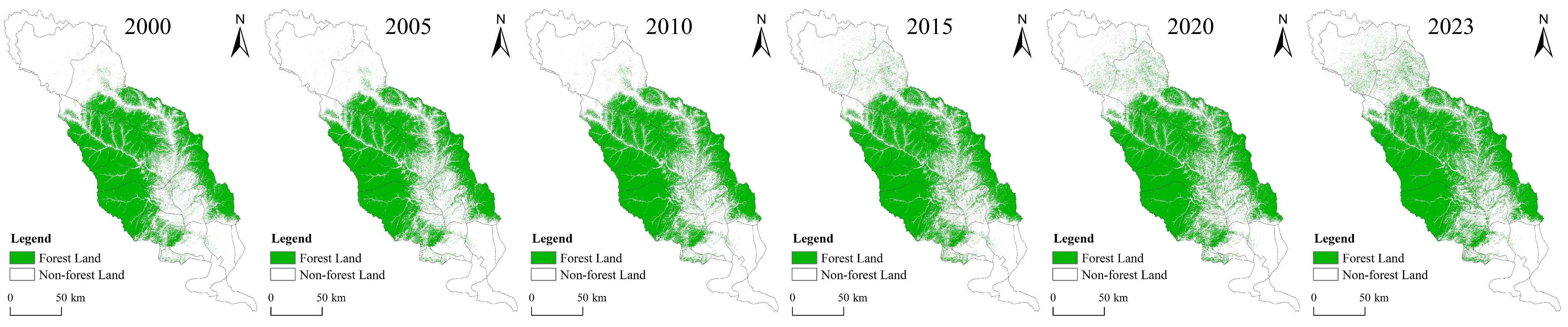
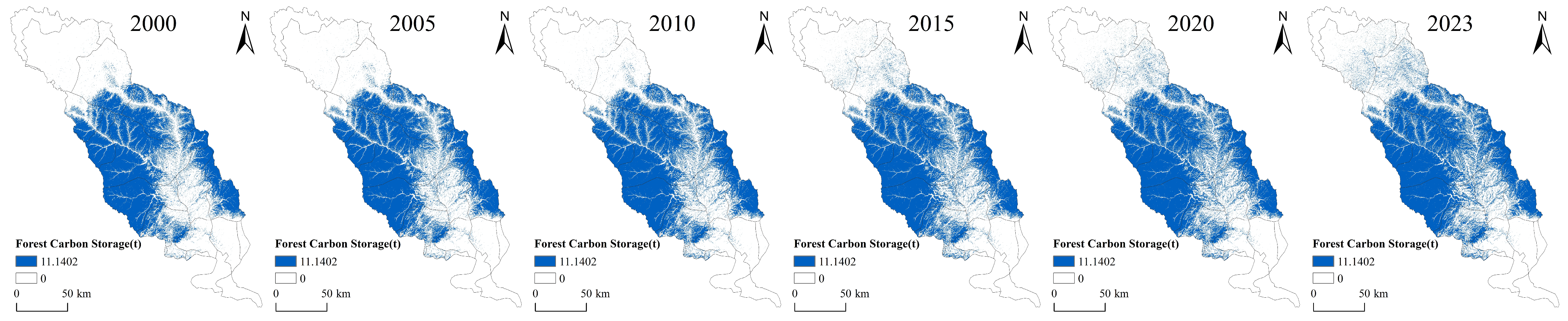
As shown in Figure 3 and Figure 4, from 2000 to 2023, the spatial patterns of forest land and forest carbon sequestration services in the Beiluo River Basin evolved in tandem, exhibiting the characteristic of “strengthening the ecological foundation and enhancing carbon sequestration capacity”. From a spatial perspective, the middle reaches, with their river valleys and gentle mountain terrain offering favorable water and heat conditions and soil conservation advantages, have long served as the core area for forest land, acting as the foundational carrier for the basin’s forest carbon sink. The carbon sequestration service function of forests has also been concentrated in this region due to the stable development of forests in the middle reaches. From a temporal perspective, forest land across the entire basin has shown a sustained expansion trend, with particularly notable increases in the upper reaches. From 2000 to 2023, forest land patches in the upper reaches extended deeply into the northern and northwestern regions, simultaneously driving the expansion of forest carbon sequestration services, with carbon sequestration blank zones in the upper reaches gradually shrinking. This change is closely linked to the Grain-for-Green Program. After the program’s implementation, the upstream region converted vulnerable non-forest land into forest land through slope farmland afforestation and barren mountain afforestation, thereby restoring the fragile ecological space in the upstream region while enhancing carbon sink capacity through forest growth. From the perspective of spatial pattern evolution, over time, the distribution of forest land and forest carbon sequestration services shifted from “concentrated in the middle reaches with scattered areas in the upper and lower reaches” to “stable core in the middle reaches, significant increases in the upper reaches, and gradual expansion across the entire basin”, reflecting the synergistic effectiveness of ecological engineering and natural restoration. Forest nurturing and management in the middle reaches maintain stable carbon sequestration levels, while newly added forest land in the upper reaches gradually forms scaled carbon sequestration services, continuously strengthening the carbon sequestration foundation of the watershed ecosystem.
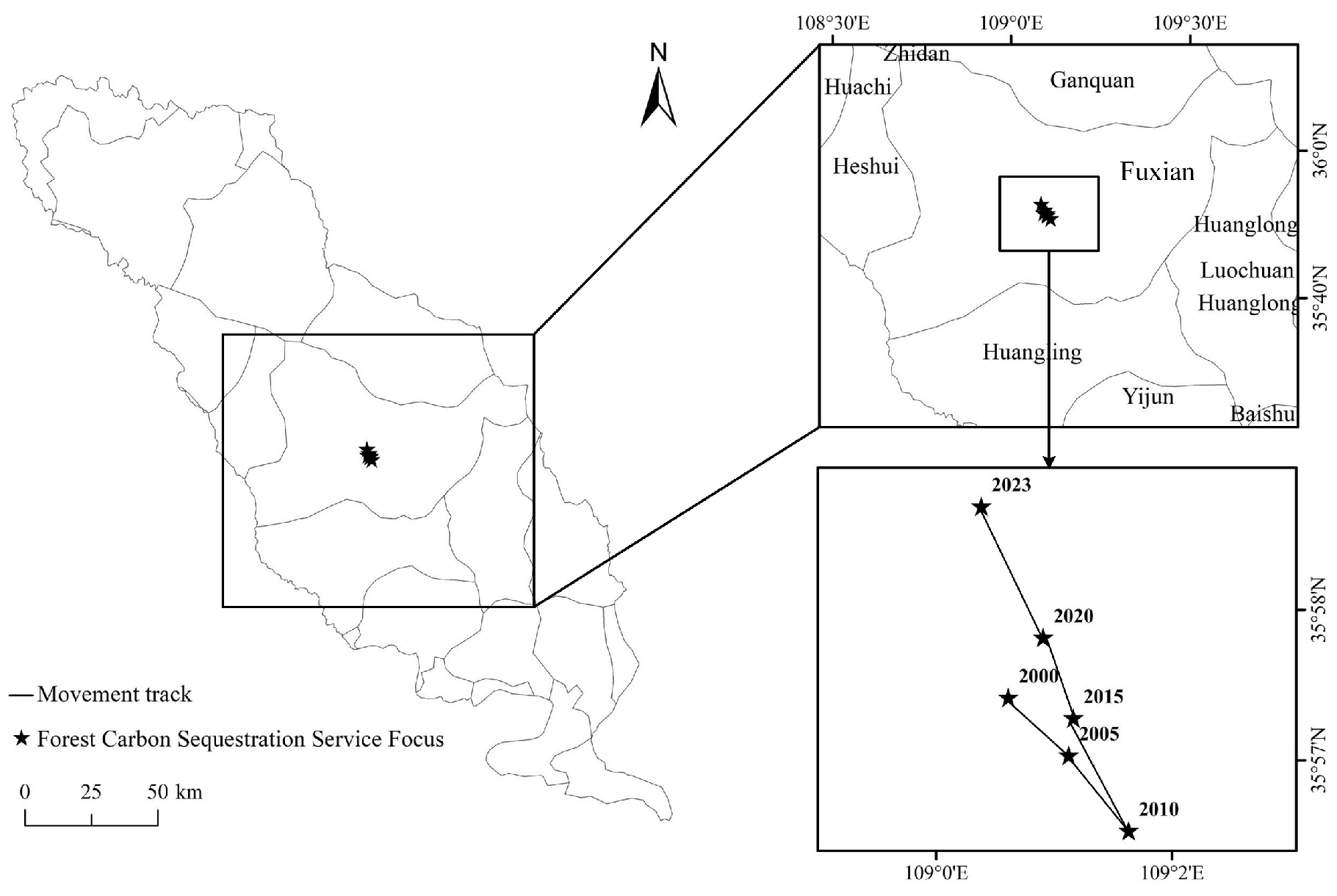
Based on the total carbon sequestration service function of the forest ecosystem in the Beiluo River basin from 2000 to 2023, the spatial statistics tool module of ArcGIS 10.8 software was used to calculate a series of parameters, including the center of gravity coordinates, movement distance, and movement direction (Table 4), and to plot the center of gravity movement trajectory diagram (Figure 5). From 2000 to 2023, the overall center of gravity of the forest carbon sequestration service function in the Beiluo River basin exhibited a general migration trend of “shifting southeastward and returning northwestward”, clearly illustrating the phased spatial distribution changes in the forest carbon sequestration service function within the basin. From 2000 to 2005, the center of gravity migrated a distance of 1073.963 m, moving overall toward the southeast. During this period, significant differences in the baseline natural conditions within the basin, combined with the uneven implementation of the initial afforestation program, jointly shaped the spatial differentiation of forest carbon sequestration capacity. In some southeastern regions, where the terrain is relatively flat and precipitation conditions are more favorable, the initial effects of the afforestation measures began to show, with high survival rates of newly planted trees, resulting in a more pronounced increase in carbon sequestration capacity compared to the northwestern regions, becoming the core driving force behind the shift of the center of gravity toward the southeast. From 2005 to 2010, the center of gravity shifted by 1227.114 m, continuing to move in a southeasterly direction. As the afforestation program deepened, forest communities in the southeastern part of the basin entered a stable development phase. Water conditions and nutrient cycling in the southeastern region were synergistically optimized, providing a more favorable environment for forest growth. Carbon sequestration contributions continued to grow, strongly driving the center of gravity to shift further southeastward. From 2010 to 2015, the center of gravity shifted 1590.207 m, showing a trend of moving back toward the northwest. During this period, the intensity of the northwest region’s afforestation program was further increased, with improved survival rates of species like Pinus tabulaeformis and Caragana microphylla in high-altitude areas, increased vegetation coverage, and gradually emerging carbon sequestration contributions. From 2015 to 2020, the center of gravity shifted by 1091.284 m, continuing to move toward the northwest. During this period, the ecological restoration projects in the northwestern part of the basin showed significant results, with artificial forests growing well and grasslands transitioning toward forest communities, leading to enhanced carbon sequestration capacity. However, in the southeastern part of the basin, some areas were affected by the edge effects of urbanization, resulting in compressed forest growth space and slowed carbon sequestration growth. From 2020 to 2023, the center of gravity shifted by 1840.905 m, continuing its northwestward movement. During this period, on the one hand, forests in the high-altitude areas of the northwest, after years of ecological adaptation and artificial nurturing, saw a continuous increase in their carbon sequestration capacity, becoming the core carbon sink area of the region. On the other hand, the southeastern region was disrupted by human activities such as the construction of tourist facilities, which impacted the stability of the forest ecosystem, leading to a bottleneck in carbon sequestration growth. The gap in carbon sequestration capacity between the north and south further widened, driving the center of gravity to continue moving toward the northwest, reflecting the complex response process of forest ecosystems.

3.1.3. Spatial Correlation of Forest Carbon Sequestration from 2000 to 2023

To further analyze the spatial evolution characteristics of forest carbon sequestration within the study area, a global spatial autocorrelation analysis was conducted on forest carbon sequestration from 2000 to 2023, yielding values for Moran’s I. The results show (Table 5) that the global Moran’s I index values were all greater than 0 during the study period and passed the 99.9% confidence level test (p < 0.001), indicating that the carbon sequestration service functions of forest ecosystems in the study area exhibit significant positive spatial correlation. From the trend perspective, the global Moran’s I index values exhibit a pattern of “fluctuating increase-peak adjustment-resilience recovery”, reaching a peak of 0.802 in 2015, reflecting the continuous strengthening of the spatial aggregation effect of carbon sequestration services. Under the synergistic effects of natural recovery and engineering interventions, high-carbon-sequestration areas gradually formed contiguous zones. From 2015 to 2020, the index declined to 0.747, primarily due to widening disparities in carbon sequestration capacity across regions. For instance, newly afforested areas in upstream regions exhibited weak initial carbon sinks, temporarily weakening spatial connectivity; From 2020 to 2023, the index rose to 0.783, indicating that ecosystem resilience has emerged, with the potential of newly afforested areas for carbon sequestration being released and the efficiency of existing forests for carbon sequestration improving, leading to a resurgence in the growth trend of spatial aggregation characteristics. Overall, although the spatial aggregation of forest carbon sequestration services in the study area has experienced fluctuations, it has maintained a stable correlation in the long term.
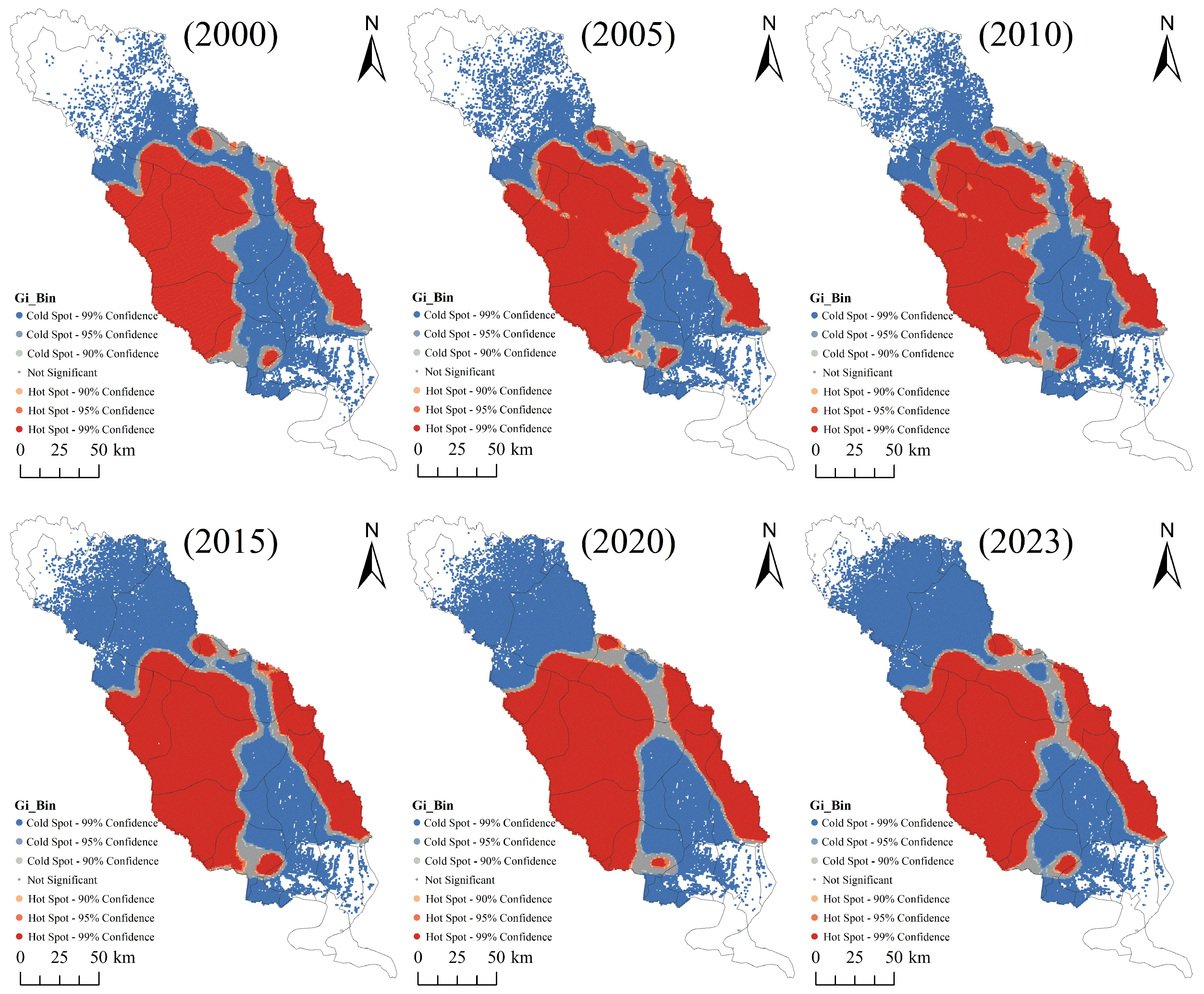
Using ArcGIS, a hotspot map of forest ecosystem carbon sequestration services for the period 2000–2023 was generated to characterize spatial relationships (Figure 6). The study area exhibits significant localized clustering of forest carbon sequestration services. From a spatial differentiation perspective, hotspot regions have long been concentrated in the rocky mountain forest area, which features complex terrain, high potential for natural vegetation recovery, and priority implementation of afforestation projects, making it the core zone for high-value carbon sequestration clustering; Cold spot areas are concentrated in hilly gully regions, high plateau gully regions, and terrace plain regions. Hilly gully regions suffer from severe soil erosion and fragile ecological foundations, high plateau gully regions have fragmented terrain that limits vegetation growth, and terrace plain regions are strongly impacted by human activities such as agricultural development and urban construction, resulting in low forest coverage and weak carbon sequestration capacity, leading to the aggregation of cold spots. From a temporal evolution perspective, the hotspot and coldspot patterns from 2000 to 2023 exhibit a trend of “hotspot expansion-coldspot contraction-boundary optimization”. From 2000 to 2010, the hotspot area in the rocky mountain forest region expanded slowly, benefiting from the initial implementation of the Grain-for-Green Program; From 2010 to 2020, the cold spot areas in the hilly and gully regions saw their carbon sequestration gaps gradually filled due to the deepening of ecological restoration projects, resulting in a reduction in the cold spot range; from 2020 to 2023, the internal aggregation of hot spots further intensified, and the boundary between cold spot and hot spot regions became more distinct. Overall, the evolution of forest carbon sequestration service hotspots in the Beiluo River basin is based on topographical zoning, with ecological projects and natural recovery synergistically driving the evolution of the pattern. The Tushishan Forest Area has maintained its hotspot status through the synergistic advantages of natural and artificial factors; cold spot areas have gradually improved with the advancement of ecological restoration, providing direct spatial evidence for the enhancement of forest ecosystem carbon sequestration services in the basin.

3.2. Spatial Heterogeneity of Driving Factors for the Spatiotemporal Evolution of Forest Carbon Sequestration in the Beiluo River Basin

The spatiotemporal evolution of forest carbon sequestration in the study area is influenced by multiple factors. In this study, forest carbon sequestration was used as the dependent variable, and explanatory variables were selected from three aspects—topographic factors, natural ecological factors, and socioeconomic factors—to establish an indicator system (Table 1). Topographic factors include DEM (X1), slope (X2), aspect (X3), and gully density (X4); natural ecological factors include annual average precipitation (X5), annual average temperature (X6), annual average evapotranspiration (X7), humidity (X8), sunshine duration (X9), and NDVI (X10); and socioeconomic factors include GDP (X11), population density (X12), forestry output (X13), forestry value added (X14), afforestation area (X15), and urbanization rate (X16). The factor detection model of the Geographic Detector was used to identify the primary driving factors influencing the spatial pattern evolution of forest ecosystem carbon sequestration services in the study area. Additionally, the GTWR model was introduced to conduct local spatial regression analysis, exploring the differences in the influence of these factors across varying spatial scales.

3.2.1. Identification of Dominant Factors

The explanatory variables were imported into the Geodetector model to obtain the q values representing the influence of each explanatory variable on the spatiotemporal evolution of the carbon sequestration service function of the forest ecosystem in the Beiluo River Basin. The results (Table 6) show that all 16 independent variables passed the significance test at the 0.05 level, indicating that the spatiotemporal evolution of the carbon sequestration service function of the forest ecosystem in the study area is the result of the combined effects of topographical factors, natural ecological factors, and socioeconomic factors. From 2000 to 2023, the magnitude of the influencing factors on the spatial pattern of the carbon sequestration service function of the forest ecosystem was as follows: X7 > X10 > X8 > X5 > X9 > X6 > X1 > X11 > X14 > X13 > X16 > X12 > X15 > X2 > X3 > X4, indicating that natural ecological factors play a dominant role in the spatiotemporal evolution of the carbon sequestration service function of the forest ecosystem, Socioeconomic factors play an important role in the spatiotemporal evolution of forest carbon sequestration within the study area, while topographic factors have a relatively weaker influence.
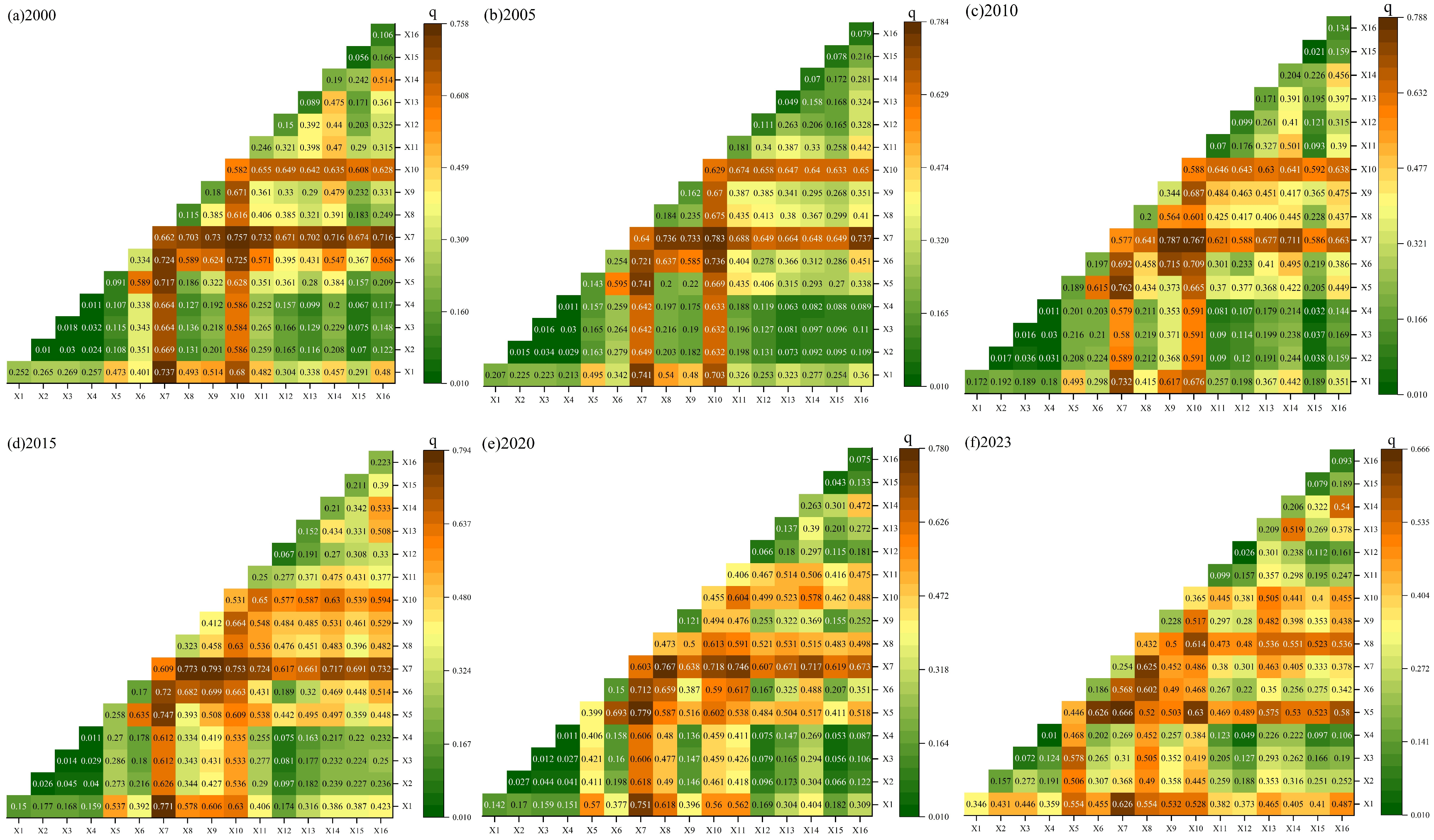
Based on the results of the Geodetector (Excel version) interaction analysis (Figure 7), the interactions influencing forest carbon sequestration services in the Beiluo River Basin from 2000 to 2023 were primarily characterized by two-factor enhancement and nonlinear enhancement. Heatmaps of interaction q-values for each period clearly reveal that interactions among natural factors are the primary drivers of spatial heterogeneity. Among these, interaction combinations centered on evapotranspiration, NDVI, and precipitation consistently exhibit high q-values. For instance, the interaction between evapotranspiration and NDVI was the strongest among all combinations in both 2000 and 2005, with q-values reaching 0.757 and 0.783, respectively. By 2010 and 2015, the interaction between evapotranspiration and sunshine duration significantly strengthened, with q-values rising to 0.787 and 0.793, respectively, becoming the dominant interaction type during this phase. In the later study period, the interaction between precipitation and evapotranspiration markedly intensified, achieving q-values of 0.779 and 0.666 in 2020 and 2023, respectively, emerging as one of the leading interaction types. Simultaneously, interactions between socioeconomic and natural factors warrant attention. For instance, the q-value for GDP interacting with evapotranspiration reached 0.732 in 2000, while the q-value for forestry output interacting with precipitation reached 0.575 in 2023. From a temporal perspective, the dominant interaction patterns underwent a dynamic evolution: initially dominated by the interaction between evapotranspiration and NDVI, followed by the strengthening of the interaction between evapotranspiration and sunshine duration around 2010, and finally marked by the prominence of the interaction between precipitation and evapotranspiration in later periods.

3.2.2. Spatio-Temporal Heterogeneity of Influencing Factors

To further conduct local spatial regression analysis using the GTWR model (10.8.1), we implemented rigorous variable screening in two steps prior to modeling to ensure the robustness and interpretability of GTWR results. First, we utilized the q-statistic from the geodetector to evaluate the independent explanatory power of 16 initial influencing factors on the spatial pattern of forest carbon sequestration services. Subsequently, we set a q-value threshold (q < 0.1) to eliminate factors with weaker explanatory power [51]. This process retained 11 factors with strong influence from the initial set. Second, to eliminate the interference of multicollinearity among variables on subsequent GTWR model coefficient estimates, we introduced an independent preprocessing step before constructing the GTWR model: conducting multicollinearity diagnostics using stepwise linear regression [52]. The diagnostic criterion for severe multicollinearity was set as VIF ≥ 10. Analysis revealed that the VIF value for the annual mean temperature (X6) factor exceeded 10, leading to its exclusion from the final model. Following these two screening stages, ten influencing factors were retained for GTWR analysis: DEM (X1), precipitation (X2), annual average evapotranspiration (X3), humidity (X4), sunshine duration (X5), NDVI (X6), GDP (X7), forestry output value (X8), forestry value-added (X9), and urbanization rate (X10). This process ensures that the variables entering the model significantly influence the dependent variable while remaining relatively independent from each other, thereby providing a reliable foundation for subsequent analysis of the spatio-temporal non-stationarity of regression coefficients.
(a)
Time-series evolution analysis of regression coefficients for influencing factors
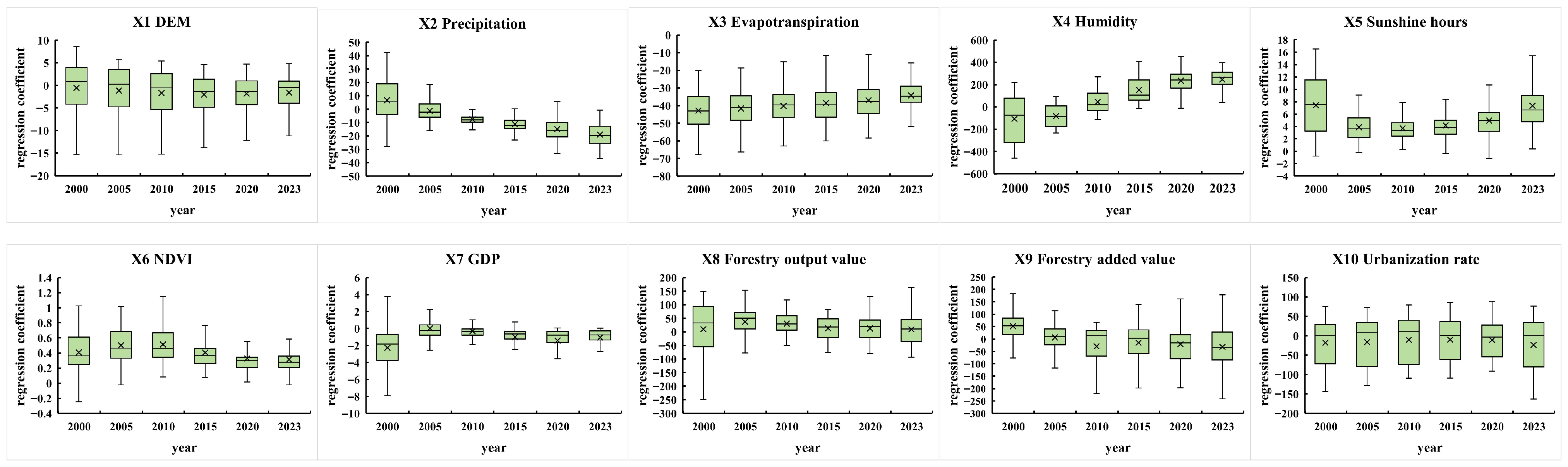
Figure 8 illustrates the temporal evolution patterns of regression coefficients for each influencing factor obtained from the GTWR model between 2000 and 2023. Box plots provide information on the median, mean, data distribution range, and distribution pattern. This paper uses box plots to describe the mean distribution of GTWR regression coefficients for each factor in order to analyze the time non-stationarity of the impact of each factor on the carbon sequestration service function of the forest ecosystem in the Beiluo River Basin (Figure 8).
The DEM influence coefficient exhibits a pattern of “overall stability, narrowing local fluctuations, and gradually stabilizing effects”. From 2000 to 2023, the coefficient fluctuated within the range of −15 to 10, with the median value remaining stable near 0, indicating a long-term balanced influence. From 2000 to 2010, the box plot had a wide span and long whiskers, reflecting significant spatial heterogeneity due to differences in regional ecological baseline conditions; From 2010 to 2020, the box width narrowed and the whisker length shortened, indicating that the dispersion of DEM influence decreased as the ecosystem evolved; from 2020 to 2023, the box and whisker plot further compressed, reflecting that the association pattern between DEM and carbon sequestration services has become increasingly stable.
The impact coefficient of precipitation exhibits a pattern of “diminishing positive effects, declining concentration trends, and gradually stabilizing effects”. From 2000 to 2023, the coefficient has continuously shifted from a high positive value range to a negative value range. From 2000 to 2010, the box plot had a wide span, long whiskers, and a high proportion of positive values, indicating that positive promotion was the main factor but spatial heterogeneity was strong; From 2010 to 2020, the median fell into the negative range, the box line narrowed, and the whisker length shortened, reflecting the prominence of negative constraints and synchronized spatial responses; from 2020 to 2023, the box line stabilized between −30 and 0, indicating that the relationship has entered a balanced phase.
The influence coefficient of evapotranspiration exhibits a pattern of “negative dominance intensification, narrowing dispersion, and gradually stabilizing effects”. From 2000 to 2023, the coefficient remained negative, with the box and whisker plot gradually compressing. From 2000 to 2010, the negative inhibitory effect was strong, and spatial heterogeneity was significant; from 2010 to 2020, the median stabilized around −40, with the box plot narrowing, indicating that the intensity of the negative influence remained stable and spatial response differences weakened; from 2020 to 2023, the box plot further compressed, indicating that the negative association pattern is becoming more stable.
The humidity influence coefficient follows a pattern of “turning from negative to positive, strengthening positively, and stabilizing”. From 2000 to 2005, the coefficients were mostly negative, indicating an initial inhibitory effect; after 2010, the coefficients remained positive and the box shifted upward, suggesting that as the ecosystem evolved, humidity promoted carbon sequestration by improving the water-heat environment, and the positive effect strengthened; from 2015 to 2023, the box lines narrowed and the dispersion decreased, indicating that the correlation gradually stabilized.
The influence coefficient of sunshine hours follows the pattern of “first decreasing then increasing, dispersion first narrowing then expanding, and effects gradually diverging”. From 2000 to 2015, the coefficient showed an overall downward trend, with the box narrowing, indicating a weakening of positive effects and a reduction in spatial heterogeneity. From 2015 to 2023, the coefficient began to rise again, with the box widening once more, reflecting an increase in positive effects and a widening of spatial differences, with vegetation in different regions showing diverging efficiencies in utilizing sunlight.
The influence coefficient of NDVI follows the pattern of “positive driving dominance, fluctuating and declining intensity of effects, and gradually synergistic spatial response”. From 2000 to 2023, the coefficient remained positive, continuously promoting positive effects. From 2000 to 2010, the box-and-whisker plot showed a wide range and long whiskers, indicating strong driving effects and significant spatial heterogeneity. From 2010 to 2020, the box gradually narrowed, and the median slightly decreased, suggesting weakened driving intensity and synchronized spatial responses. From 2020 to 2023, the box-and-whisker plot further compressed, indicating a weakening of marginal driving effects.
The coefficient of GDP’s impact follows a pattern of transitioning from negative constraints to weak positive effects, with reduced dispersion and increasingly stable effects. In 2000, the coefficients were predominantly negative, reflecting the negative interference of early economic activities; from 2005 to 2015, the median value converged toward zero, and the range narrowed, indicating a shift in GDP impact from “strong negative constraints” to “weak bidirectional fluctuations”. The interplay between ecological conservation and economic development led to a more balanced effect; From 2020 to 2023, the coefficient remained stable near zero, with reduced dispersion, indicating that as the concept of green development is promoted, the negative impact of economic activities on carbon sequestration has weakened, and an eco-friendly development model is gradually being established, with the relationship between GDP and carbon sequestration services entering a relatively synergistic phase.
The impact coefficients of forestry output exhibit a pattern characterized by “positive driving dominance, fluctuating intensity convergence, and gradually synergistic spatial response”. From 2000 to 2023, the coefficients were overall positive, reflecting the sustained positive promotional effect of forestry output growth on carbon sequestration. In 2000, the median was in a relatively low positive range, indicating that forestry economic activities initially drove carbon sequestration, but due to differences in management models, spatial heterogeneity was significant; From 2005 to 2015, the box gradually narrowed, and the median steadily increased, indicating that the intensity of forestry output driving carbon sequestration strengthened, and as forestry management became more standardized, responses across different regions tended to synchronize; From 2020 to 2023, the box line further compressed, reflecting that forestry development has entered an ecological-economic synergy phase, with carbon sequestration becoming more balanced in its dependence on output value.
The impact coefficients of forestry value added exhibit a pattern of “positive-negative interaction, narrowing fluctuations, and increasingly complex effects”. From 2000 to 2005, the coefficients were predominantly positive, indicating that forestry economic gains directly promoted carbon sequestration, with relatively consistent spatial responses; From 2010 to 2015, the median fell into the negative range, with a wide box plot span, indicating that changes in forestry development models had a negative impact on carbon sequestration, and heterogeneity increased sharply; From 2020 to 2023, the box plot gradually narrowed, indicating that as the green transformation of forestry progressed, a synergistic mechanism between economic gains and ecological protection was gradually established.
The coefficient of urbanization rate exhibits a pattern characterized by “negative constraints as the dominant factor, fluctuating intensity of influence converging, and increasingly complex spatial responses”. From 2000 to 2023, the coefficient remained predominantly in the negative range, indicating that the urbanization process has exerted a long-term negative impact on carbon sequestration. From 2000 to 2010, the box plot had a wide range, with the whiskers extending far, and the median remained stable between −50 and 0. This reflects the strong suppression of carbon sequestration by the expansion of construction land during the early stages of urbanization, with significant spatial heterogeneity in the impact due to differences in the distribution of central towns and suburban areas; From 2010 to 2020, the box gradually narrowed and the whisker length shortened, with the median fluctuating slightly, indicating that as urbanization models adjusted—such as through ecological township development—the negative constraints weakened, and the impact of urbanization on carbon sequestration across different regions became more synchronized; From 2020 to 2023, the box line further compressed but remained volatile, with coefficients concentrated in the range of −100 to 50, reflecting the ongoing trade-off between urban development and ecological conservation. In some regions, green infrastructure has begun to exert a positive driving force, with the overall process evolving from conflict to dynamic adaptation between urbanization and forest carbon sequestration functions.
(b)
Spatial differentiation analysis of regression coefficients for influencing factors
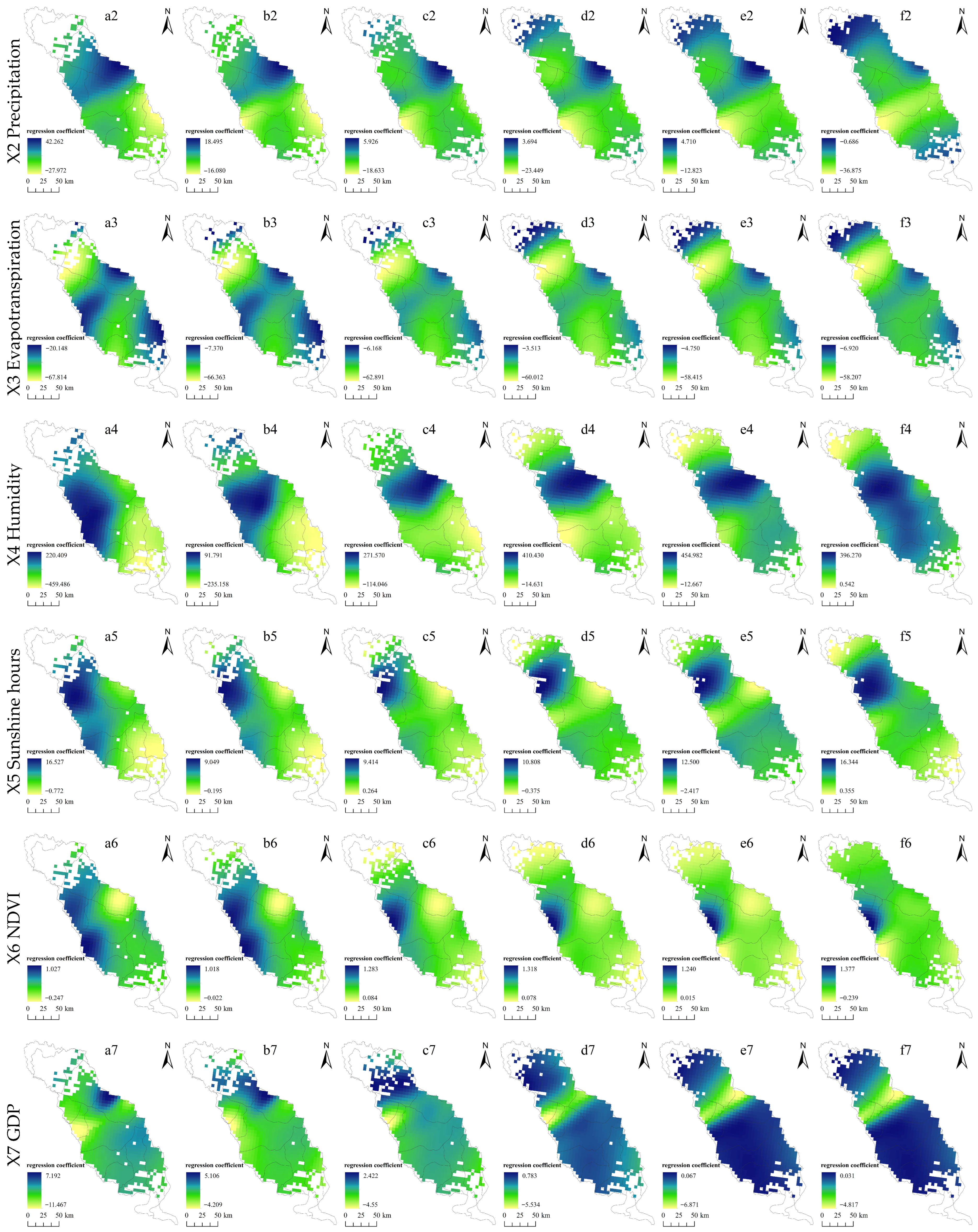
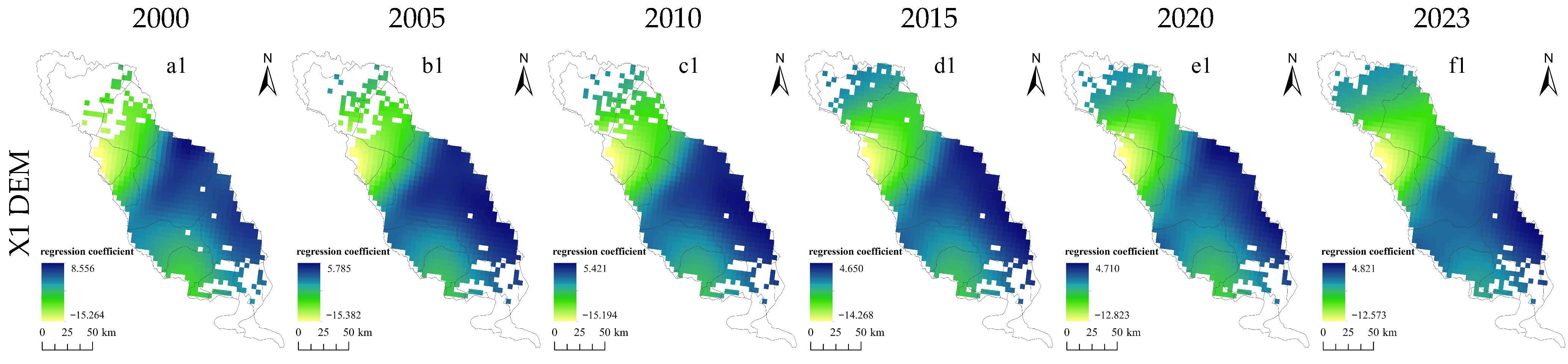
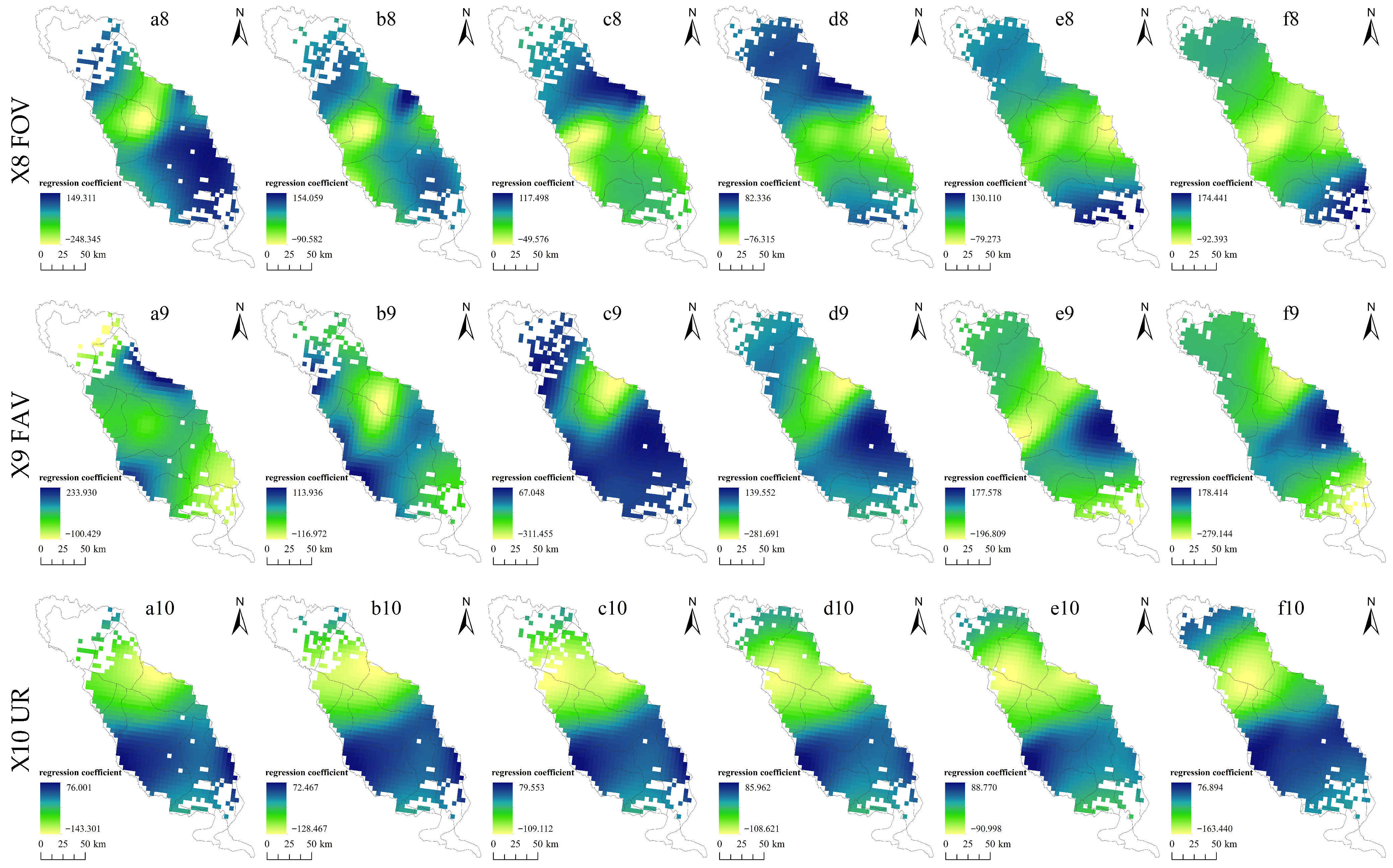
Plot the spatial distribution of the regression coefficients of various factors from 2000 to 2023 to reveal the spatial heterogeneity of the driving factors of the carbon sequestration service function of the forest ecosystem in the Beiluo River Basin (Figure 9).
From 2000 to 2023, the high-value areas of the DEM regression coefficient have been concentrated in the southern low-altitude, flat-terrain regions. This is because such regions have favorable conditions for vegetation growth, resulting in a sustained and stable positive promotional effect of DEM on carbon sequestration; while the northern high-altitude, complex terrain regions are low-value zones. Initially constrained by steep terrain and ecological fragility, DEM exerted a strong negative constraint on carbon sequestration. Over time, the negative coefficient gradient in low-value zones has contracted, particularly after 2015, with significant reductions in negative coefficients in northern marginal regions. This reflects the gradual weakening of high-altitude terrain’s inhibitory effect on carbon sequestration due to ecological restoration projects and natural vegetation adaptation.
From a time series perspective, the high-value regions for precipitation regression coefficients between 2000 and 2010 were concentrated in the central and southern parts of the basin. This region has relatively high initial vegetation coverage and relatively gentle terrain, allowing precipitation to replenish soil moisture, promote vegetation photosynthesis and growth, and exert a significant positive driving effect on carbon sequestration. In contrast, the northern part of the basin, characterized by sparse vegetation, experiences easy runoff or soil erosion, making it difficult to effectively support carbon sink gains, resulting in lower regression coefficients. From 2010 to 2020, high-value areas gradually expanded toward the central and northern regions. During this period, afforestation projects were continuously implemented in the central and northern regions, leading to a rapid increase in vegetation coverage. The newly restored vegetation communities enhanced their ability to utilize precipitation, which not only directly replenished water but also improved the local microclimate, promoting carbon sink accumulation and expanding the high-value areas of the regression coefficient in the central and northern regions. From 2020 to 2023, the spatial pattern of the regression coefficient tends to stabilize relatively.
From 2000 to 2023, the long-term regression coefficients for evapotranspiration were predominantly negative, with high negative values concentrated in the densely vegetated, water-intensive central forest regions, reflecting the strong inhibitory effect of evapotranspiration on carbon sequestration. From 2000 to 2010, there were significant differences in coefficients between the northern and southern regions. In the northern arid regions, the imbalance between evapotranspiration and water replenishment led to extreme negative coefficient values. Over time, the range of negative coefficients expanded gradually while the gradient narrowed. After 2015, the negative coefficients in the central and southern forest regions stabilized, and the negative values in the northern marginal regions also weakened due to vegetation adaptation.
From 2000 to 2015, high values of the humidity regression coefficient were concentrated in the central and southern regions with favorable moisture conditions, exerting a strong positive driving force on carbon sequestration, with significant differences in the north–south gradient. Over time, high-value areas gradually expanded into the central and northern regions. After 2015, the coefficients in the vast central and southern regions continued to rise, reflecting a shift in the ecosystem’s response to humidity from “local dependence” to “regional coordination”. Especially from 2020 to 2023, the coverage and intensity of high-value areas expanded, while low-value areas rapidly contracted, indicating that the promotional effect of humidity on carbon sequestration continued to strengthen with ecological restoration and climate regulation, highlighting the increasingly critical role of humidity in enhancing the carbon sequestration service function of forest ecosystems.
From 2000 to 2010, the high values of the regression coefficient for sunshine hours were concentrated in the northern regions with favorable light conditions, showing a significant positive promotion effect on carbon sequestration, with a distinct north–south gradient difference; Over time, the high-value zones gradually expanded toward the central and southern regions. After 2015, the coefficients in the central and southern regions continued to rise, reflecting improved efficiency in vegetation’s utilization of sunlight. Especially from 2020 to 2023, the coverage of high-value zones expanded, their intensity stabilized, low-value zones contracted, and their dispersion decreased, indicating that the promotional effect of sunshine duration on carbon sequestration continued to strengthen alongside vegetation succession and photosynthetic adaptation.
From 2000 to 2023, the NDVI regression coefficient remained positive over the long term, indicating that it continued to have a positive effect on carbon sequestration. From 2000 to 2010, high-value areas were concentrated in the central forest region with high vegetation coverage, and the coefficient gradient was clear, reflecting that the synergistic effect between NDVI and carbon sequestration was more significant in areas with good ecological conditions. Over time, the range of high-value areas has steadily expanded, with coefficients in the central and southern forest regions continuing to rise, while low-value areas have gradually contracted, indicating that NDVI’s driving effect on carbon sequestration has strengthened with ecosystem succession. From 2020 to 2023, the distribution of coefficients has become more homogeneous, with high-value areas showing increased coverage and stable intensity, highlighting NDVI’s role as a core ecological indicator in enhancing carbon sequestration services through a key and stable positive influence.
From 2000 to 2010, the GDP regression coefficients were predominantly negative, with high negative values concentrated in southern towns and plains with high levels of economic development, reflecting the crowding-out effect of urbanization and industrialization on carbon sequestration. Over time, the negative coefficients gradually contracted. After 2015, the coefficients in the central-northern forest areas and ecological conservation zones turned positive, and the high-value zones expanded into economic transition zones, indicating that the green development model gradually reversed the negative impact of GDP on carbon sequestration. From 2020 to 2023, the coverage of positive coefficients expanded, and the north–south gradient differences narrowed, highlighting the key role of eco-friendly economic development in enhancing carbon sequestration services.
From 2000 to 2023, the regression coefficient for forestry output remained positive over the long term and showed an overall upward trend, indicating that it continues to play a positive role in promoting carbon sequestration. From 2000 to 2010, high-value regions were concentrated in the central forest areas rich in forest resources, with a clear coefficient gradient, reflecting stronger synergy between forestry economic activities and carbon sequestration functions in regions with good ecological foundations. Over time, the scope of high-value regions gradually expanded, extending to the northern and southern forest areas, while low-value regions continued to shrink, indicating that the driving force of forestry industry development on carbon sequestration has continuously strengthened with the evolution of ecosystems.
From 2000 to 2010, the high-value regions for forestry value-added regression coefficients were concentrated in the central and southern parts of the watershed. This region had a relatively early start in forestry development, with active afforestation and forest management activities, resulting in a significant positive impact of forestry value-added on carbon sequestration. In contrast, the northern part of the watershed had low forestry development levels, with vegetation minimally affected by forestry economic activities, leading to lower regression coefficients. From 2010 to 2020, the high-value zones gradually expanded toward the central and northern regions. During this phase, ecological restoration and forestry industry upgrading were advanced in tandem. Increased forestry investment and optimized management models in the central and northern regions, coupled with enhanced responsiveness of newly restored vegetation communities to forestry economic inputs, led to an expansion of the high-value range of regression coefficients in these areas. From 2020 to 2023, the spatial pattern stabilized, with high-value zones consolidated in the central and southern regions and low-value zones persisting in areas with constrained forestry development. After long-term development, the northern and central regions established mature synergistic mechanisms between forestry economics and carbon sequestration, resulting in stable high-value regression coefficients.
From 2000 to 2010, the high negative values of the urbanization rate regression coefficient were concentrated in the densely urbanized southern plains, with a significant coefficient gradient, reflecting the squeeze on ecological space caused by the expansion of construction land; Over time, the range of negative coefficients remained generally stable, but the high-negative-value zones gradually contracted in the central and northern regions. After 2015, the intensity of negative coefficients in the southern core urban areas stabilized, while in the northern peripheral regions, negative values also weakened due to ecological restoration efforts. Overall, the negative impact of urbanization rates on carbon sequestration is driven by “urban spatial expansion”, highlighting the critical role of ecological space protection in mitigating the negative effects of urbanization.

4. Discussion

4.1. Temporal Evolution and Spatial Pattern Characteristics of Forest Carbon Sequestration Services

This study found that carbon sequestration in the forests of the Beiluo River basin has increased significantly, with notable regional and topographical differences. Specifically, the spatial pattern shows a “stable core in the middle reaches and significant increases in the upper reaches” characteristic, with a trend of “shifting southeastward and returning northwestward”. This outcome stems from the sustained implementation of ecological engineering projects such as the Grain-for-Green Program. In detail, in the upstream region, vegetation coverage has been rapidly enhanced through afforestation of slope farmland and barren mountains [53], while the middle reaches rely on the protection of natural forests to maintain carbon sink stability. Regional differences in topography and water-heat conditions have exacerbated carbon sequestration differentiation. Consistent with existing studies on the carbon sequestration promotion effects of afforestation on the Loess Plateau, the core conclusions validate the carbon sink effects of ecological engineering projects [54,55]. Additionally, research on the ecological restoration of the Loess Plateau indicates that carbon storage exhibits a phased characteristic of “rapid initial recovery followed by steady long-term increase” [56]. Building on this, this study further refines the regional differences in the Beiluo River Basin, highlighting the “explosive growth in the upstream region and steady improvement in the midstream region”, thereby addressing the limitations of macro-scale studies. Given these characteristics, it is recommended that the upstream region prioritize the promotion of drought-tolerant tree species such as Caragana and Pinus tabulaeformis, conduct vegetation carbon sink monitoring every five years to consolidate the achievements of afforestation, establish natural forest carbon sink monitoring stations in the middle reaches, and implement “logging bans plus replanting” measures; in the downstream region, designate a 200-m-wide riverbank ecological protection zone and strictly restrict the encroachment of urban and agricultural land.

4.2. Spatial Correlation of Forest Carbon Sequestration Services

The spatial positive correlation of forest carbon sequestration services in the Beiluo River basin is significant, with hotspots concentrated in rocky mountain forest areas and cold spots located in ecologically fragile or human activity-intensive regions. Specifically, this is because rocky mountain forest areas have complex terrain but high natural vegetation recovery potential, and the afforestation program has been prioritized in these areas, resulting in long-term leading carbon sequestration capacity [27]. In contrast, hilly and gully areas suffer from severe soil erosion, and terrace plains are disrupted by agricultural development, leading to weak carbon sequestration capacity [57]. Notably, existing studies on land use and ecological patterns have pointed out that “ecological engineering can strengthen spatial aggregation effects”. In line with this finding, this study aligns with this finding and further reveals the 23-year dynamic pattern of “hotspot expansion and coldspot contraction” [58,59]. Moreover, compared to studies on the Beiluo River basin, this study more clearly demonstrates the constraining effect of landform types on carbon sequestration aggregation [60]. In terms of policy implications, an “ecological compensation + carbon credit trading” mechanism should be established in the rocky mountain forest areas, with annual subsidies per acre of forest land allocated for vegetation management, while carbon credits are incorporated into local government performance evaluations. For hilly and gully areas, a “terracing + mixed forest-grassland planting” project should be implemented, accompanied by the construction of water diversion ditches to reduce soil erosion.

4.3. Dominance of Driving Factors for Forest Carbon Sequestration Services

Our findings indicate that natural ecological factors serve as the fundamental drivers of the spatiotemporal evolution of carbon sequestration services, while socioeconomic factors further modulate this process through synergistic enhancement. The results from the Geographic Detector interaction mechanism reveal that this synergistic effect primarily manifests through two pathways. First, socioeconomic activities amplify the natural factors’ promotion of carbon sequestration by improving water resource availability [61]. This study identifies significant interactions between GDP and evapotranspiration, as well as between forestry output and precipitation. The underlying mechanism involves regional economic development and increased forestry investment providing the economic and technical foundation for enhanced water resource management—such as constructing small-scale rainwater harvesting projects and promoting water-saving technologies like drip irrigation. These measures effectively alleviate water stress during the critical high-evapotranspiration period of the growing season, enabling vegetation to maintain high photosynthetic activity under favorable water-heat conditions without drought constraints. Thus, socioeconomic factors do not directly sequester carbon but enhance the positive effect of the natural coupling between evapotranspiration and NDVI on carbon sequestration by alleviating the key bottleneck of water limitation. Second, forestry economic activities directly drive vegetation cover changes, thereby regulating local water-heat processes [62]. The interaction between forestry value-added and NDVI indicates that economic activities aimed at increasing forestry output—such as afforestation and forest tending—directly enhance vegetation cover and health [63]. Changes in vegetation condition, in turn, influence surface processes. Higher NDVI values typically represent denser forest canopies, which increase local evapotranspiration through transpiration and regulate surface energy balance. Thus, socioeconomic factors indirectly regulate natural processes like evapotranspiration by altering NDVI, a key state variable. This creates a positive feedback loop: socioeconomic inputs drive NDVI increases, which in turn alter evapotranspiration processes, ultimately enhancing carbon sequestration capacity. Thus, the spatial heterogeneity of forest carbon sequestration services in the Beiluo River basin is shaped by the synergistic interplay between the foundational dominance of natural factors and the driving force of socioeconomic factors, reflecting a dual-driven mechanism combining natural substrate support and human activity regulation. Based on this understanding, it is recommended to construct small-scale rainwater harvesting and utilization projects within the watershed and install drip irrigation facilities in high-evapotranspiration forest areas. Concurrently, a dedicated forest carbon sink fund should be established, linking increases in forestry output value to subsidies for cultivating high-quality tree species. This approach would align GDP growth with enhanced carbon sink capacity, thereby implementing the strategic orientation of ecological management in practice.

4.4. Spatial and Temporal Heterogeneity of Factors Influencing Forest Carbon Sequestration Services

The effects of various factors on carbon sequestration exhibit significant spatiotemporal variations, such as the attenuation of the positive effect of precipitation and the positive-negative-4 changes in forestry value added, which are closely related to vegetation succession and the transformation of forestry management. Studies on the interactive effects of ecological factors have pointed out that the influence of factors is reconfigured over time [64], and this study confirms this, further refining the coupled patterns of precipitation-vegetation-economy in the Beiluo River basin. Studies on the impact of urbanization on carbon sinks have found that negative effects can be mitigated through management measures [65]. This study further proposes spatially and temporally differentiated management strategies. In the central-northern regions where precipitation influence is weakening, drought-tolerant tree species such as sea buckthorn and mountain apricot should be promoted, with 20% leguminous plants interplanted per acre of forest land to enhance soil fertility; In the upstream regions with negative forestry value-added effects, the under-forest cultivation + carbon sink forest model should be implemented, while restricting timber harvesting volumes; in the southern regions with high urbanization rates, for every additional square kilometer of urban area, 200 acres of ecological corridors should be constructed, using evergreen tree species such as Thuja orientalis to enhance carbon sequestration capacity around urban areas.

4.5. Research Limitations and Future Prospects

First, regarding limitations and validation of data sources. This study’s carbon stock assessment relies on benchmark carbon density values from Yellow River Basin literature and statistical models for spatial correction, rather than direct field measurements in the Beiluo River Basin. While using such indirect data sources introduces some uncertainty, the rigorous localization process significantly mitigates its impact on overall result accuracy. Similarly, when spatializing county-level socioeconomic statistics to the grid scale, the absence of actual grid-scale values for comparison prevents quantitative assessment of spatialization errors. Establishing a field verification system is a priority for future research. Future work could involve deploying a representative plot network in the Beiluo River basin to obtain localized, field-measured carbon density data. This would enable the natural deepening and extension of the research by building upon the identified macro-scale patterns through precise calibration and micro-mechanism interpretation.
Second, regarding model limitations and refinement pathways: Methodologically, while this study explored interactions among influencing factors using GTWR models, it has not fully elucidated the underlying causal mechanisms behind these relationships. Furthermore, model parameter optimization remains an area for improvement. Future research is recommended to employ causal analysis tools such as structural equation modeling to delve deeper into the interaction pathways and causal chains among drivers. This approach would transcend mere correlation descriptions to achieve an interpretation of ecosystem process mechanisms.
Finally, regarding limitations and prospects for expanding the research scale. This study focused on the North Luo River basin, and the applicability of its conclusions across other basins requires further validation. Concurrently, constrained by data temporal resolution, the study primarily revealed long-term trends while insufficiently capturing short-term dynamic mechanisms related to seasonal variations or sudden events within a year. Future research could pursue cross-basin comparative studies to analyze commonalities and differences in forest carbon sequestration services across distinct watersheds, providing references for broader ecological management. Furthermore, leveraging higher spatio-temporal resolution data on natural and socioeconomic factors holds promise for revealing short-term dynamic response mechanisms of forest carbon sinks at finer scales, offering valuable complementarity to the long-term conclusions of this study.

5. Conclusions

This study employed a spatiotemporal analysis framework, utilizing data from six representative time points between 2000 and 2023, to assess the evolution and drivers of forest carbon sequestration services in the Beiluo River Basin. The key findings confirm a significant positive development trend, with total carbon sequestration increasing by over 13% and spatial patterns becoming more balanced and clustered, underscoring the success of ecological restoration initiatives. The application of the GTWR model effectively quantified the non-stationary spatiotemporal effects of influencing factors, revealing that natural ecological conditions are the dominant force shaping spatial heterogeneity, while socioeconomic factors increasingly play a synergistic role by interacting with these natural processes.
The study’s marginal contributions are threefold. Firstly, it provides a refined watershed-scale assessment by leveraging long-term, high-resolution data. Secondly, it systematically elucidates the synergistic drivers across topographic, ecological, and socioeconomic dimensions, particularly highlighting the pivotal role of hydrotemperature-vegetation coupling. Finally, it demonstrates the practical utility of the GTWR model for capturing spatiotemporal non-stationarity, thereby providing a scientific basis for formulating targeted management strategies.
These findings imply that forest carbon sequestration management on the Loess Plateau should prioritize spatially differentiated strategies, adhere to the principle of natural recovery supplemented by artificial intervention, and establish policy incentives that align socioeconomic activities with carbon sink objectives.

Author Contributions

Conceptualization, L.D.; methodology, L.D. and H.W.; software, L.D. and H.W.; validation, L.D. and H.L.; formal analysis, L.D. and H.L.; investigation, L.D.; resources, L.D.; data curation, L.D.; writing—original draft preparation, L.D.; writing—review and editing, L.D., H.L., H.S.K. and Y.D.; visualization, L.D. and H.W.; supervision, H.L. and Y.D.; project administration, H.L.; funding acquisition, H.L. All authors have read and agreed to the published version of the manuscript.

Funding

This research was funded by the Ministry of Science and Technology’s 14th Five-Year Plan National Key R&D Program project “Integrated Management of Mountains, Waters, Forests, Fields, Lakes, Grasslands, and Sands in Small Watersheds of the Loess Plateau and Technologies for Synergistic Enhancement of Ecosystem Services and Demonstration”, specifically the sub-project “Soil Retention, Water Conservation, Carbon Sequestration, and Integrated Management Technologies for the Aeolian–Water Compound Erosion Watershed of the Beiluo River”. (Project Number: 2023YFF1305104).

Data Availability Statement

The data presented in this study are available in this article.

Conflicts of Interest

The authors declare no conflicts of interest.

References

  1. Feng, Q.; Yang, H.; Liu, Y.; Liu, Z.; Xia, S.; Wu, Z.; Zhang, Y. Interdisciplinary Perspectives on Forest Ecosystems and Climate Interplay: A Review. Environ. Rev. 2025, 33, 1–21. [Google Scholar] [CrossRef]
  2. Hui, D.; Deng, Q.; Tian, H.; Luo, Y. Climate Change and Carbon Sequestration in Forest Ecosystems. In Handbook of Climate Change Mitigation and Adaptation; Springer: New York, NY, USA, 2015; pp. 1–40. ISBN 978-1-4614-6431-0. [Google Scholar]
  3. Gao, L.; Li, H. Improving Carbon Sequestration Capacity of Forest Vegetation in China: Afforestation or Forest Management? Forests 2023, 14, 1077. [Google Scholar] [CrossRef]
  4. Li, C.; Song, Y. Government Response to Climate Change in China: A Study of Provincial and Municipal Plans. J. Environ. Plan. Manag. 2016, 59, 1679–1710. [Google Scholar] [CrossRef]
  5. Wang, C. Response to Climate Change by China’s Forestry and Vision of Forest Carbon Market. In Forest Carbon Practices and Low Carbon Development in China; Lu, Z., Zhang, X., Ma, J., Tang, C., Eds.; Springer: Singapore, 2019; pp. 47–69. ISBN 978-981-13-7364-0. [Google Scholar]
  6. Chen, B.; Liu, Y.; Li, Z.; Xu, C.; Hou, W. Spatiotemporal Carbon Sequestration by Forests among Counties and Grids in China. J. Clean. Prod. 2024, 468, 142971. [Google Scholar] [CrossRef]
  7. Liu, M.; Wang, Y.; Pei, H. The Changes of Land Use and Carbon Storage in the Northern Farming-Pastoral Ecotone under the Background of Returning Farmland to Forest (grass). J. Desert Res. 2021, 41, 174–182. [Google Scholar]
  8. Li, K.; Cao, J.; Adamowski, J.F.; Biswas, A.; Zhou, J.; Liu, Y.; Zhang, Y.; Liu, C.; Dong, X.; Qin, Y. Assessing the Effects of Ecological Engineering on Spatiotemporal Dynamics of Carbon Storage from 2000 to 2016 in the Loess Plateau Area Using the InVEST Model: A Case Study in Huining County, China. Environ. Dev. 2021, 39, 100641. [Google Scholar] [CrossRef]
  9. Ali, A. Linking Forest Ecosystem Processes, Functions and Services under Integrative Social–Ecological Research Agenda: Current Knowledge and Perspectives. Sci. Total Environ. 2023, 892, 164768. [Google Scholar] [CrossRef]
  10. Pan, Y.; Birdsey, R.A.; Phillips, O.L.; Houghton, R.A.; Fang, J.; Kauppi, P.E.; Keith, H.; Kurz, W.A.; Ito, A.; Lewis, S.L.; et al. The Enduring World Forest Carbon Sink. Nature 2024, 631, 563–569. [Google Scholar] [CrossRef]
  11. Zhou, R.; Zhang, Y.; Peng, M.; Jin, Y.; Song, Q. Effects of Climate Change on the Carbon Sequestration Potential of Forest Vegetation in Yunnan Province, Southwest China. Forests 2022, 13, 306. [Google Scholar] [CrossRef]
  12. Liang, C.; Wei, X.; Meng, J.; Chen, W. How to Improve Forest Carbon Sequestration Output Performance: An Evidence from State-Owned Forest Farms in China. Forests 2022, 13, 778. [Google Scholar] [CrossRef]
  13. Qiao, D.; Yuan, W.; Li, H. Regulation and Resilience: Panarchy Analysis in Forest Socio-Ecosystem of Northeast National Forest Region, China. J. Environ. Manag. 2024, 353, 120295. [Google Scholar] [CrossRef]
  14. Chen, J.; Qiao, X.; Hao, M.; Fan, C.; Wang, J.; Zhao, X.; Zhang, C. Climate Variability Modulates the Temporal Stability of Carbon Sequestration by Changing Multiple Facets of Biodiversity in Temperate Forests Across Scales. Glob. Change Biol. 2025, 31, e70212. [Google Scholar] [CrossRef] [PubMed]
  15. Cai, W.; Xu, L.; Li, M.; Li, O.J.; He, N. Imbalance of Inter-Provincial Forest Carbon Sequestration Rate from 2010 to 2060 in China and Its Regulation Strategy. J. Geogr. Sci. 2023, 33, 3–17. [Google Scholar] [CrossRef]
  16. Swetnam, T.L.; Brooks, P.D.; Barnard, H.R.; Harpold, A.A.; Gallo, E.L. Topographically Driven Differences in Energy and Water Constrain Climatic Control on Forest Carbon Sequestration. Ecosphere 2017, 8, e01797. [Google Scholar] [CrossRef]
  17. Farooqi, T.J.A.; Li, X.; Yu, Z.; Liu, S.; Sun, O.J. Reconciliation of Research on Forest Carbon Sequestration and Water Conservation. J. For. Res. 2020, 32, 7–14. [Google Scholar] [CrossRef]
  18. Taylor, P.G.; Cleveland, C.C.; Wieder, W.R.; Sullivan, B.W.; EDoughty, C.; Dobrowski, S.Z.; Townsend, A.R. Temperature and Rainfall Interact to Control Carbon Cycling in Tropical Forests. Ecol. Lett. 2017, 20, 779–788. [Google Scholar] [CrossRef] [PubMed]
  19. Meena, M.; Yadav, G.; Sonigra, P.; Nagda, A.; Mehta, T.; Swapnil, P.; Harish; Marwal, A.; Kumar, S. Multifarious Responses of Forest Soil Microbial Community Toward Climate Change. Microb. Ecol. 2022, 86, 49–74. [Google Scholar] [CrossRef]
  20. Chang, D.Y.; Jeong, S.; Shin, J. Assessing the Impact of Urbanization on Forest Carbon Stocks and Social Costs Using a Machine Learning Approach. Sci. Total Environ. 2024, 954, 176521. [Google Scholar] [CrossRef]
  21. Zhao, N.; Wang, K.; Yuan, Y. Toward the Carbon Neutrality: Forest Carbon Sinks and Its Spatial Spillover Effect in China. Ecol. Econ. 2023, 209, 107837. [Google Scholar] [CrossRef]
  22. Diao, J.; Liu, J.; Zhu, Z.; Wei, X.; Li, M. Active Forest Management Accelerates Carbon Storage in Plantation Forests in Lishui, Southern China. For. Ecosyst. 2022, 9, 100004. [Google Scholar] [CrossRef]
  23. Gutiérrez Rodríguez, L.; Hogarth, N.J.; Zhou, W.; Xie, C.; Zhang, K.; Putzel, L. China’s Conversion of Cropland to Forest Program: A Systematic Review of the Environmental and Socioeconomic Effects. Environ. Evid. 2016, 5, 21. [Google Scholar] [CrossRef]
  24. Chen, L.; Ren, C.; Zhang, B.; Wang, Z.; Xi, Y. Estimation of Forest Above-Ground Biomass by Geographically Weighted Regression and Machine Learning with Sentinel Imagery. Forests 2018, 9, 582. [Google Scholar] [CrossRef]
  25. Sheng, J.; Han, X.; Zhou, H. Spatially Varying Patterns of Afforestation/Reforestation and Socio-Economic Factors in China: A Geographically Weighted Regression Approach. J. Clean. Prod. 2017, 153, 362–371. [Google Scholar] [CrossRef]
  26. Wen, B.; Huang, C.; Zhou, C.; Zhang, H.; Yang, Q.; Li, M. Spatiotemporal Dynamics and Driving Factors of Soil Erosion in the Beiluo River Basin, Loess Plateau, China. Ecol. Indic. 2023, 155, 110976. [Google Scholar] [CrossRef]
  27. Xing, J.; Zhang, J.; Wang, J.; Li, M.; Nie, S.; Qian, M. Ecological Restoration in the Loess Plateau, China Necessitates Targeted Management Strategy: Evidence from the Beiluo River Basin. Forests 2023, 14, 1753. [Google Scholar] [CrossRef]
  28. Zhang, X.; Wu, Q.; Jiang, J.; Pei, Y. Pixel-Level Land Cover Change Detection in the Loess Plateau Based on Different Data. In Proceedings of the Fifth International Conference on Geoscience and Remote Sensing Mapping (ICGRSM 2023), Lianyungang, China, 13–15 October 2013; Available online: https://www.spiedigitallibrary.org/conference-proceedings-of-spie/12980/129800Z/Pixel-level-land-cover-change-detection-in-the-Loess-Plateau/10.1117/12.3020898.short (accessed on 6 September 2025).
  29. Zhou, X.; Wen, Z.; Wu, S. How Topographic Factors Regulate Vegetation Vigor in Reservoir Drawdown Zones with Different Levels of Hydrological Disturbances? Ecol. Indic. 2025, 178, 114006. [Google Scholar] [CrossRef]
  30. Dong, L.; Wang, X. Inconsistent Influence of Temperature, Precipitation, and CO2 Variations on the Plateau Alpine Vegetation Carbon Flux. npj Clim. Atmos. Sci. 2025, 8, 91. [Google Scholar] [CrossRef]
  31. Zheng, H.; Miao, C.; Li, X.; Kong, D.; Gou, J.; Wu, J.; Zhang, S. Effects of Vegetation Changes and Multiple Environmental Factors on Evapotranspiration Across China Over the Past 34 Years. Earth’s Future 2022, 10, e2021EF002564. [Google Scholar] [CrossRef]
  32. Zhao, W.; Zhu, Z. Exploring the Best-Matching Plant Traits and Environmental Factors for Vegetation Indices in Estimates of Global Gross Primary Productivity. Remote Sens. 2022, 14, 6316. [Google Scholar] [CrossRef]
  33. Gomaa, M.M. Macro-Level Factors Shaping Residential Location Choices: Examining the Impacts of Density and Land-Use Mix. Land 2023, 12, 748. [Google Scholar] [CrossRef]
  34. Yang, B.; Zhang, Y.; Xiong, K.; Huang, H.; Yang, Y. A Review of Eco-Product Value Realization and Eco-Industry with Enlightenment toward the Forest Ecosystem Services in Karst Ecological Restoration. Forests 2023, 14, 729. [Google Scholar] [CrossRef]
  35. Du, J.; Fu, Q.; Fang, S.; Wu, J.; He, P.; Quan, Z. Effects of Rapid Urbanization on Vegetation Cover in the Metropolises of China over the Last Four Decades. Ecol. Indic. 2019, 107, 105458. [Google Scholar] [CrossRef]
  36. Guo, B.; Zhang, J.; Meng, X.; Xu, T.; Song, Y. Long-Term Spatio-Temporal Precipitation Variations in China with Precipitation Surface Interpolated by ANUSPLIN. Sci. Rep. 2020, 10, 81. [Google Scholar] [CrossRef] [PubMed]
  37. Shan, T.; Guangchao, C.; Zhen, C.; Fang, L.; Meiliang, Z. A Comparative Study of Two Temperature Interpolation Methods: A Case Study of the Middle East of Qilian Mountain. IOP Conf. Ser. Mater. Sci. Eng. 2020, 780, 072038. [Google Scholar] [CrossRef]
  38. Zhao, M.; He, Z.; Du, J.; Chen, L.; Lin, P.; Fang, S. Assessing the Effects of Ecological Engineering on Carbon Storage by Linking the CA-Markov and InVEST Models. Ecol. Indic. 2019, 98, 29–38. [Google Scholar] [CrossRef]
  39. Yang, S.; Li, L.; Zhu, R.; Luo, C.; Lu, X.; Sun, M.; Xu, B. Assessing Land-Use Changes and Carbon Storage: A Case Study of the Jialing River Basin, China. Sci. Rep. 2024, 14, 15984. [Google Scholar] [CrossRef]
  40. Zafar, Z.; Zubair, M.; Zha, Y.; Mehmood, M.S.; Rehman, A.; Fahd, S.; Nadeem, A.A. Predictive Modeling of Regional Carbon Storage Dynamics in Response to Land Use/Land Cover Changes: An InVEST-Based Analysis. Ecol. Inform. 2024, 82, 102701. [Google Scholar] [CrossRef]
  41. Zhang, K.; Fang, B.; Zhang, Z.; Liu, T.; Liu, K. Exploring Future Ecosystem Service Changes and Key Contributing Factors from a “Past-Future-Action” Perspective: A Case Study of the Yellow River Basin. Sci. Total Environ. 2024, 926, 171630. [Google Scholar] [CrossRef]
  42. Alam, S.A.; Starr, M.; Clark, B.J.F. Tree Biomass and Soil Organic Carbon Densities across the Sudanese Woodland Savannah: A Regional Carbon Sequestration Study. J. Arid. Environ. 2013, 89, 67–76. [Google Scholar] [CrossRef]
  43. Luo, Q.; Hu, K.; Liu, W.; Wu, H. Scientometric Analysis for Spatial Autocorrelation-Related Research from 1991 to 2021. ISPRS Int. J. Geo-Inf. 2022, 11, 309. [Google Scholar] [CrossRef]
  44. Su, H.; Chen, Y.; Tan, H.; Zhou, A.; Chen, G.; Chen, Y. Estimating Regional PM2.5 Concentrations in China Using a Global-Local Regression Model Considering Global Spatial Autocorrelation and Local Spatial Heterogeneity. Remote Sens. 2022, 14, 4545. [Google Scholar] [CrossRef]
  45. Liang, J.; Peng, Y.; Zhu, Z.; Li, X.; Xing, W.; Li, X.; Yan, M.; Yuan, Y. Impacts of Changing Climate on the Distribution of Migratory Birds in China: Habitat Change and Population Centroid Shift. Ecol. Indic. 2021, 127, 107729. [Google Scholar] [CrossRef]
  46. Wang, M.; Hu, Z.; Wang, Y.; Zhao, W. Spatial Distribution Characteristics of Suitable Planting Areas for Pyrus Species under Climate Change in China. Plants 2023, 12, 1559. [Google Scholar] [CrossRef]
  47. Wang, J.; Xu, C. Geodetector: Principle and Prospective. Acta Geogr. Sin. 2017, 72, 116–134. [Google Scholar]
  48. Fotheringham, A.S.; Crespo, R.; Yao, J. Geographical and Temporal Weighted Regression (GTWR). Geogr. Anal. 2015, 47, 431–452. [Google Scholar] [CrossRef]
  49. He, J.; Yang, J. Spatial–Temporal Characteristics and Influencing Factors of Land-Use Carbon Emissions: An Empirical Analysis Based on the GTWR Model. Land 2023, 12, 1506. [Google Scholar] [CrossRef]
  50. Huang, B.; Wu, B.; Barry, M. Geographically and Temporally Weighted Regression for Modeling Spatio-Temporal Variation in House Prices: International. Int. J. Geogr. Inf. Sci. 2010, 24, 383–401. [Google Scholar] [CrossRef]
  51. Wang, Y.; Zhang, Z.; Chen, X. Quantifying Influences of Natural and Anthropogenic Factors on Vegetation Changes Based on Geodetector: A Case Study in the Poyang Lake Basin, China. Remote Sens. 2021, 13, 5081. [Google Scholar] [CrossRef]
  52. Liu, M.; Luo, X.; Qi, L.; Liao, X.; Chen, C. Simulation of the Spatiotemporal Distribution of PM2.5 Concentration Based on GTWR-XGBoost Two-Stage Model: A Case Study of Chengdu Chongqing Economic Circle. Atmosphere 2023, 14, 115. [Google Scholar] [CrossRef]
  53. Bullock, A.; King, B. Evaluating China’s Slope Land Conversion Program as Sustainable Management in Tianquan and Wuqi Counties. J. Environ. Manag. 2011, 92, 1916–1922. [Google Scholar] [CrossRef]
  54. Deng, L.; Shangguan, Z.P.; Sweeney, S. “Grain for Green” Driven Land Use Change and Carbon Sequestration on the Loess Plateau, China. Scientific Reports. Sci. Rep. 2014, 4, 7039. [Google Scholar] [CrossRef] [PubMed]
  55. Chang, R.; Fu, B.; Liu, G.; Liu, S. Soil Carbon Sequestration Potential for “Grain for Green” Project in Loess Plateau, China. Environ. Manag. 2011, 48, 1158–1172. [Google Scholar] [CrossRef]
  56. Liang, Y.; Hashimoto, S.; Liu, L. Integrated Assessment of Land-Use/Land-Cover Dynamics on Carbon Storage Services in the Loess Plateau of China from 1995 to 2050. Ecol. Indic. 2021, 120, 106939. [Google Scholar] [CrossRef]
  57. Xu, Q.; Chen, W.; Zhao, K.; Zhou, X.; Du, P.; Guo, C.; Ju, Y.; Pu, C. Effects of Land-Use Management on Soil Erosion: A Case Study in a Typical Watershed of the Hilly and Gully Region on the Loess Plateau of China. CATENA 2021, 206, 105551. [Google Scholar] [CrossRef]
  58. Yang, P.; Li, S.; Zhou, Z. Impacts of Ecological Engineering Interventions on Carbon Sequestration: Spatiotemporal Dynamics and Driving Mechanisms in Karst Rocky Desertification Control. Forests 2025, 16, 1361. [Google Scholar] [CrossRef]
  59. Xu, X.; Liu, J.; Jiao, F.; Zhang, K.; Ye, X.; Gong, H.; Lin, N.; Zou, C. Ecological Engineering Induced Carbon Sinks Shifting from Decreasing to Increasing during 1981–2019 in China. Sci. Total Environ. 2023, 864, 161037. [Google Scholar] [CrossRef]
  60. Li, J.; Zhang, Y.; Xia, L.; Wang, J.; Ye, H.; Liu, S.; Zhang, Z. Research on Zoning and Carbon Sink Enhancement Strategies for Ecological Spaces in Counties with Different Landform Types. Sustainability 2024, 16, 5700. [Google Scholar] [CrossRef]
  61. Boakye-Danquah, J.; Antwi, E.K.; Saito, O.; Abekoe, M.K.; Takeuchi, K. Impact of Farm Management Practices and Agricultural Land Use on Soil Organic Carbon Storage Potential in the Savannah Ecological Zone of Northern Ghana. J. Disaster Res. 2014, 9, 484–500. [Google Scholar] [CrossRef]
  62. Li, W.; Wang, W.; Chen, J.; Zhang, Z. Assessing Effects of the Returning Farmland to Forest Program on Vegetation Cover Changes at Multiple Spatial Scales: The Case of Northwest Yunnan, China. J. Environ. Manag. 2022, 304, 114303. [Google Scholar] [CrossRef] [PubMed]
  63. Doimo, I.; Masiero, M.; Gatto, P. Forest and Wellbeing: Bridging Medical and Forest Research for Effective Forest-Based Initiatives. Forests 2020, 11, 791. [Google Scholar] [CrossRef]
  64. Chen, K.; Li, T.; Yang, M.; Zhou, X.; Peng, C. The Effects of Environmental Factors and Plant Diversity on Forest Carbon Sequestration Vary between Eastern and Western Regions of China. J. Clean. Prod. 2024, 437, 140371. [Google Scholar] [CrossRef]
  65. Xu, Q.; Yang, R.; Dong, Y.-X.; Liu, Y.-X.; Qiu, L.-R. The Influence of Rapid Urbanization and Land Use Changes on Terrestrial Carbon Sources/Sinks in Guangzhou, China. Ecol. Indic. 2016, 70, 304–316. [Google Scholar] [CrossRef]
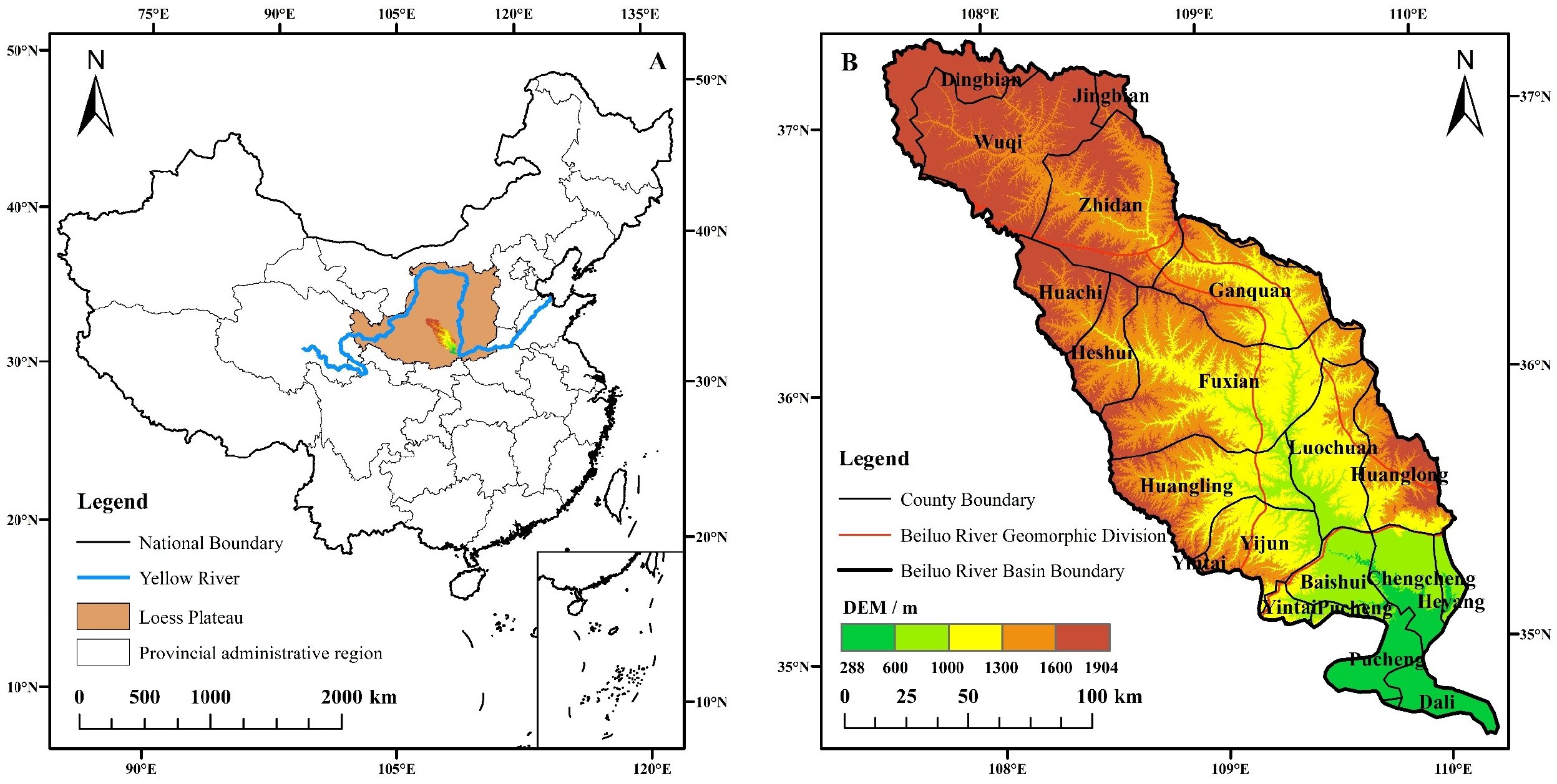
Figure 1. (A) Location of the Beiluo River and (B) Division of Counties and Landforms.
Forests 16 01719 g001
Figure 2. Factors affecting the carbon sequestration service function of the forest ecosystem in the Beiluo River Basin. Note: (a) DEM; (b) Slope; (c) Slope aspect; (d) Gully density; (e) Precipitation; (f) Temperature; (g) Evapotranspiration; (h) Humidity; (i) Sunshine hours; (j) NDVI; (k) GDP; (l) Population; (m) Forestry output value; (n) Forestry added value; (o) Afforestation area; (p) Urbanization rate.
Forests 16 01719 g002
Figure 3. Spatial distribution pattern of forest land in the Beiluo River Basin from 2000 to 2023.
Forests 16 01719 g003
Figure 4. Spatial distribution pattern of carbon sequestration service function of forest ecosystem in Beiluo River Basin from 2000 to 2023.
Forests 16 01719 g004
Figure 5. Evolution of the carbon sequestration service function of the forest ecosystem in the Beiluo River Basin from 2000 to 2023.
Forests 16 01719 g005
Figure 6. Hotspot evolution of the carbon sequestration service pattern of the forest ecosystem in the Beiluo River Basin.
Forests 16 01719 g006
Figure 7. Interaction detection results.
Forests 16 01719 g007
Figure 8. Time series evolution of GTWR regression coefficients of influencing factors. Note: — Median × Average.
Forests 16 01719 g008
Figure 9. Spatial distribution of GTWR model regression coefficients. Note: (a1) 2000DEM; (b1) 2005DEM; (c1) 2010DEM; (d1) 2015DEM; (e1) 2020DEM; (f1) 2023DEM; (a2) 2000Precipitation; (b2) 2005Precipitation; (c2) 2010Precipitation; (d2) 2015Precipitation; (e2) 2020Precipitation; (f2) 2023Precipitation; (a3) 2000Evapotranspiration; (b3) 2005Evapotranspiration; (c3) 2010Evapotranspiration; (d3) 2015Evapotranspiration; (e3) 2020Evapotranspiration; (f3) 2023Evapotranspiration; (a4) 2000Humidity; (b4) 2005Humidity; (c4) 2010Humidity; (d4) 2015Humidity; (e4) 2020Humidity; (f4) 2023Humidity; (a5) 2000Sunshine hours; (b5) 2005Sunshine hours; (c5) 2010Sunshine hours; (d5) 2015Sunshine hours; (e5) 2020Sunshine hours; (f5) 2023Sunshine hours; (a6) 2000NDVI; (b6) 2005NDVI; (c6) 2010NDVI; (d6) 2015NDVI; (e6) 2020NDVI; (f6) 2023NDVI; (a7) 2000GDP; (b7) 2005GDP; (c7) 2010GDP; (d7) 2015GDP; (e7) 2020GDP; (f7) 2023GDP; (a8) 2000FOV; (b8) 2005FOV; (c8) 2010FOV; (d8) 2015FOV; (e8) 2020FOV; (f8) 2023FOV; (a9) 2000FAV; (b9) 2005FAV; (c9) 2010FAV; (d9) 2015FAV; (e9) 2020FAV; (f9) 2023FAV; (a10) 2000UR; (b10) 2005UR; (c10) 2010UR; (d10) 2015UR; (e10) 2020UR; (f10) 2023UR.
Forests 16 01719 g009aForests 16 01719 g009bForests 16 01719 g009c
Table 1. Factors affecting the carbon sequestration service function of the forest ecosystem in the Beiluo River Basin.
Data TypeData NameYearData AccuracyData Source
Topographic factorsX1 DEM202030 mhttps://www.gscloud.cn
(accessed on 28 June 2025)
X2 Slope202030 mDEM
X3 Slope aspect202030 mDEM
X4 Gully density202030 mDEM
Natural ecological factorsX5 Precipitation2000–20231 kmhttps://data.cma.cn/
(accessed on 25 June 2025)
X6 Temperature2000–20231 kmhttps://data.cma.cn/
(accessed on 25 June 2025)
X7 Evapotranspiration2000–20231 kmhttps://data.cma.cn/
(accessed on 25 June 2025)
X8 Humidity2000–20231 kmhttps://data.cma.cn/
(accessed on 25 June 2025)
X9 Sunshine hours2000–20231 kmhttps://data.cma.cn/
(accessed on 25 June 2025)
X10 NDVI2000–202330 mhttps://www.resdc.cn/
(accessed on 27 June 2025)
Socioeconomic factorsX11 GDP2000–20201 kmhttps://www.resdc.cn/
(accessed on 27 June 2025)
X12 POP2000–20201 kmhttps://www.resdc.cn/
(accessed on 27 June 2025)
X13 Forestry output value2000–202330 m<Yan’an Statistical Yearbook>, <Weinan City Statistical Yearbook>, <Yulin City Statistical Yearbook>, <Qingyang City Statistical Yearbook>
X14 Forestry added value2000–202330 m
X15 Afforestation area2000–202330 m
X16 Urbanization rate2000–20231 km
Table 2. Carbon density of forest land in the Beiluo River Basin (t/hm2).
Land Use TypeAboveground Carbon DensityUnderground Carbon DensitySoil Carbon DensityDead Organic Matter Carbon Density
Forest Land15.7743.3759.504.00
Table 3. Carbon sequestration service capacity of forest ecosystem in Beiluo River Basin (104 t).
AreaArea (km2)200020052010201520202023IncreaseGrowth Rate (%)
Entire basin25,706.4413,193.1813,557.4813,398.0614,266.7514,540.5214,980.831787.6513.55
Upstream areaJingbian County235.211.081.351.64.355.316.865.78535.19
Dingbian County1074.900.010.010.210.240.730.73
Wuqi County3199.896.2612.6116.8100.82137237.34231.083691.37
Zhidan County2808.98696.3700.98693.13828.67919.181030.5334.2448.00
Huachi County1070.3645.35646.34632.03648.14665.89696.6751.327.95
Heshui County969.951153.11150.91139.41150.81159.71173.220.061.74
Total9359.232502.12512.2248327332887.33145.3643.2125.71
Midstream areaGanquan County2173.051732.21756.217581804.81841.91894.8162.679.39
Fu County4063.643897.53975.24048.44124.74196.24313.1415.6310.66
Luochuan County1650.34578.85641.01694.89723.7752.26775.22196.3733.92
Huanglong County1329.061245.712891294.41281.91264.21255.910.120.81
Huangling County2105.392147.62200.22251.22290.823232350.4202.799.44
Yijun County1257.9777.81848.22903.35901.44865.73822.0744.265.69
Total12,579.3810,38010,71010,95011,12711,24311,4121031.89.94
Downstream areaBaishui County881.3995.45107.55122.23130.91133.61141.8146.3648.57
Chengcheng County971.2112.1412.9813.8413.8110.838.92−3.22−26.52
Heyang County235.970.420.30.280.30.190.16−0.26−61.90
Yintai District, Tongchuan City234.2463.4771.6995109.56113119.2555.7887.88
Pucheng County770.129.611.517.7120.1720.2520.1210.52109.58
Dali County536.5600000.0100
Total3629.49181.08204.03249.07274.75277.89290.26109.1860.29
Landform typeHigh plateau gully area5110.012083.82305.72492.32623.527262847763.2536.63
Terraced plain area3638.52155.58177219.13243.26246.32257.67102.0965.62
Hilly and gully area6775.66279.97290.86299.82521.38645.73852.68572.71204.56
Rocky mountain forest area10,182.2510,67410,78410,80210,87910,92211,023349.613.28
Table 4. Statistics of the carbon sequestration service function of the forest ecosystem in the Beiluo River Basin.
YearCenter of Gravity
X CoordinateY CoordinateMoving Distance/mMoving Direction/°
20001,949,552.5614,100,079.1711073.963324.5288
20051,950,427.2044,099,455.9571227.114316.8478
20101,951,322.4324,098,616.6861590.207124.2673
20151,950,427.0584,099,930.8651091.284118.2904
20201,949,909.8544,100,891.8021840.905123.3128
20231,948,898.8114,102,430.218
Table 5. Global Moran’s I index of carbon sequestration service function of forest ecosystem in Beiluo River Basin.
Year200020052010201520202023
Moran’s I0.7640.7880.7910.8020.7470.783
Z648.609509.116518.316879.2961305.120987.472
P0.0000.0000.0000.0000.0000.000
Table 6. Geographical detection results of factors affecting the spatiotemporal evolution of carbon sequestration services in the Beiluo River Basin forest ecosystem from 2000 to 2023.
Independent Variable200020052010201520202023q-MeanExplanatory Power Ranking
X10.25250.20660.17230.15040.14230.34630.21177
X20.01010.01520.01710.02630.02710.15660.042114
X30.01820.01550.01560.01380.01220.07220.024615
X40.0110.0110.01110.01130.01090.00950.010816
X50.09140.14330.18940.2580.3990.44550.25444
X60.33410.25380.19680.16960.14970.18550.21496
X70.66220.63990.57670.6090.6030.25440.55751
X80.11450.18370.19990.32320.47250.43230.28773
X90.18010.16160.34420.41220.12080.22810.24115
X100.58160.62950.58760.53080.45470.3650.52492
X110.24570.18060.07020.24970.40640.09870.20858
X120.15040.11110.09860.06660.06630.02630.086612
X130.08920.0490.17060.15170.13710.20880.134410
X140.18970.06980.20430.21010.26290.20620.19059
X150.0560.07790.02090.21120.04310.07930.081413
X160.10560.07860.13410.22340.07510.0930.118311
Disclaimer/Publisher’s Note: The statements, opinions and data contained in all publications are solely those of the individual author(s) and contributor(s) and not of MDPI and/or the editor(s). MDPI and/or the editor(s) disclaim responsibility for any injury to people or property resulting from any ideas, methods, instructions or products referred to in the content.