Article

Reconciling Above- and Below-Ground Perspectives to Understand Ectomycorrhizal Community Diversity and Function

1
Department of Life Sciences, University of Siena, Via Mattioli 4, 53100 Siena, Italy
2
Department of Physical, Earth and Environmental Sciences, University of Siena, Via Mattioli 4, 53100 Siena, Italy
3
NBFC, National Biodiversity Future Centre, Piazza Marina 61, 90133 Palermo, Italy
*
Author to whom correspondence should be addressed.
Forests 2025, 16(11), 1712; https://doi.org/10.3390/f16111712
Submission received: 18 September 2025 / Revised: 5 November 2025 / Accepted: 6 November 2025 / Published: 10 November 2025
(This article belongs to the Special Issue Sustainable and Suitable Ecological Management of Forest Plantation)

Abstract

Forests sustain high levels of biodiversity and essential ecosystem services, yet the impact of management practices on below-ground functioning remains difficult to assess. A comprehensive evaluation of ectomycorrhizal (ECM) fungal diversity is, therefore, required to better understand ecosystem dynamics. This study, conducted within the SelpiBioLife project, examined ECM community structure in two Pinus nigra J.F. Arnold forests in central Italy by integrating above- and below-ground sampling. Across 108 plots, ECM fruiting bodies (EMFb) were recorded during one fruiting season, and 54 soil cores were collected to characterize ECM root tips (EMRt) through morpho-anatomical analyses and ITS sequencing. Species richness and community composition were compared using rarefaction, PERMANOVA, NMDS, Mantel tests, and SIMPER analysis. A total of 70 EMFb species and 54 EMRt morphotypes were identified, displaying significant differences between sites and sampling types. EMFb surveys revealed greater richness, whereas EMRt reached sampling saturation only at one site, suggesting additional hidden diversity. Distinct community patterns were detected in ordination space, and weak correlations emerged between EMFb and EMRt dissimilarities, indicating complementary ecological information. These findings show that single-method monitoring underrepresents ECM diversity. Combined above- and below-ground investigations provide a more accurate basis for evaluating silvicultural impacts and maintaining forest ecosystem resilience.

1. Introduction

Forests are among the most diverse terrestrial ecosystems, providing vital services such as carbon sequestration, climate regulation, and water and air purification. In the European Union, they absorb about 10% of annual greenhouse gas emissions while supporting biodiversity and moderating temperature extremes [1]. Yet, they face increasing pressures from land-use change and climate warming, threatening their resilience. One of the major challenges of forestry research lies in evaluating the costs and benefits of human activities for ecosystem functioning across different spatial and temporal scales. Addressing such complexity requires applied scientific research that undertakes experimentation and testing in order to develop new models capable of promoting economic progress, fostering technological advancements, contributing to healthcare solutions, and addressing environmental challenges.
Ectomycorrhizal (ECM) fungi form symbiotic associations with tree roots and play central roles in nutrient cycling, carbon storage, and tree health. They are estimated to receive \~9.07 Gt of CO2 equivalents annually from plants, highlighting their global significance in carbon dynamics [2,3]. Understanding ECM communities is, therefore, critical to predicting forest responses to environmental change.
Traditional studies relied on fruiting body surveys, but many ECM fungi produce few or sporadic fruiting bodies, limiting detection [4,5,6,7,8,9,10]. Root tip morphological analyses improved detection, while DNA-based methods now reveal both visible and cryptic species [11,12,13,14,15,16]. Integrating these approaches provides a full picture of ECM diversity and distribution, essential for assessing responses to environmental and management pressures [17,18].
The SelpiBioLife project (LIFE13 BIO/IT/000282) applies this integrative framework to black pine forests, evaluating the effects of innovative silvicultural treatments on soil biodiversity, including fungi, bacteria, mesofauna, nematodes, and microarthropods [19]. By combining molecular and traditional sampling, it establishes a robust baseline of ECM communities before treatment, enabling accurate tracking of changes following management interventions. This approach bridges fundamental ecological research with applied forest management, providing actionable insights for biodiversity conservation and ecosystem resilience.
In this contribution, we report the sampling criteria adopted in the SelPiBioLife project to comprehensively describe the composition of ectomycorrhizal communities above and below ground.

2. Materials and Methods

2.1. Study Areas

This research was conducted in two different Pinus nigra reforestations located in central Italy (Tuscany) in the following municipalities: Siena (Monte Amiata, Castiglion d’Orcia, lat 42°56′8″ N, long 11°38′13″ E, altitude 780 m a.s.l.) and Arezzo (Pratomagno, lat 43°35′55.3″N, long 11°42′33.9″E, altitude 960 m a.s.l.).
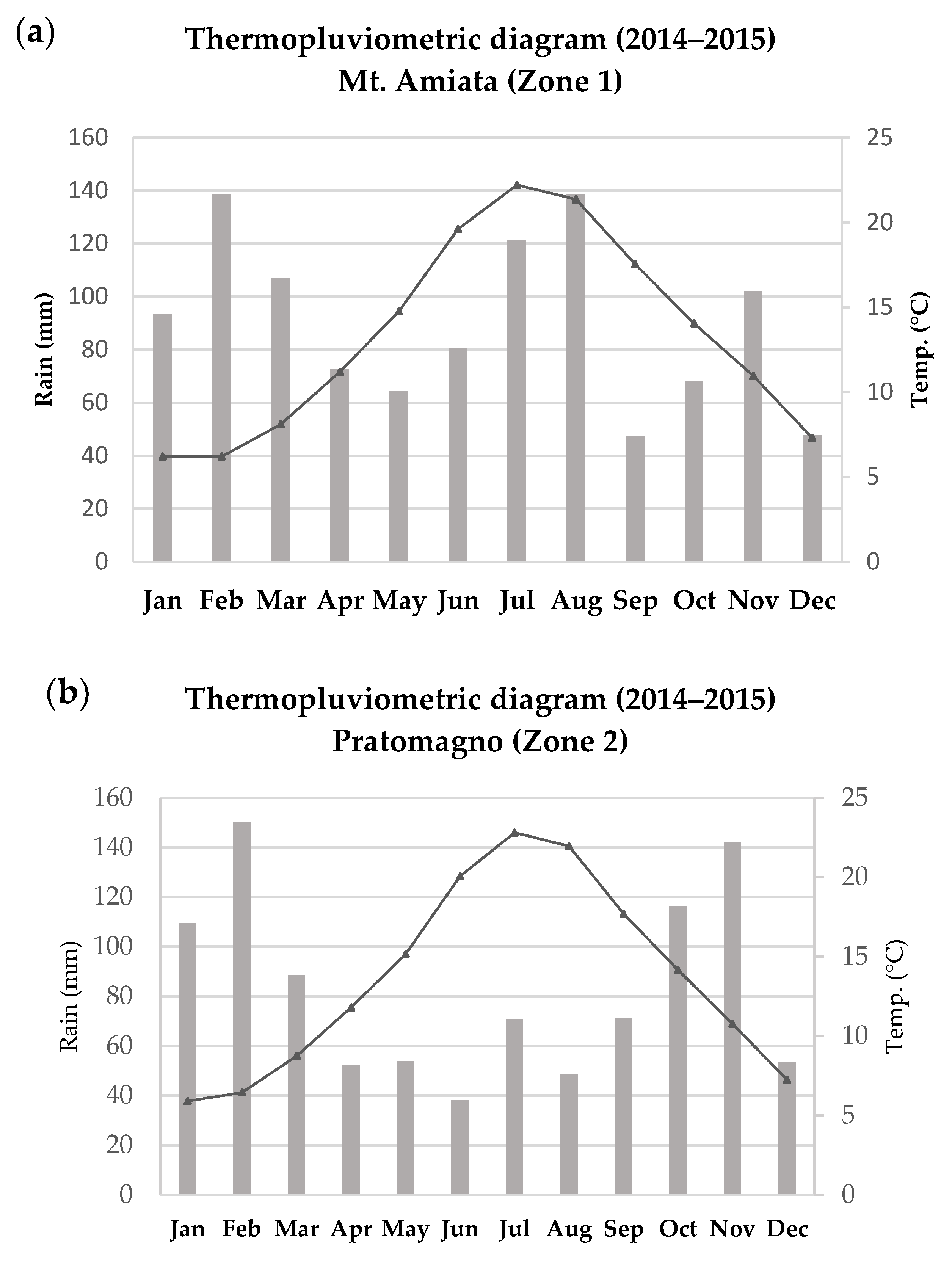
The Mt. Amiata area (zone 1) lies within the forest known as “Madonna delle Querce”. The dominant exposure is toward the northeast, with an average slope of about 15%. The site extends along a long, undulating hillside and features diverse geological substrates mainly composed of clay, including the so-called “Unità delle Argille a Palombini”. These formations comprise calcareous and marly facies, as well as fissile, silty, and marly clays. Rock outcrops and medium- to large-sized stones are occasionally present, while fine surface stoniness is common. No significant signs of erosion have been observed. The soils in the sampling area are deep and rich in organic matter within the A horizon. They are predominantly silty clay loam to clay in texture, slightly to moderately calcareous, and weakly alkaline, and they exhibit a high degree of base saturation. According to data from the Castiglion d’Orcia thermo-pluviometric station (516 m a.s.l.), provided by Regione Toscana (https://www.sir.toscana.it, accessed on 7 August 2025), the climate of the study area is classified as warm–temperate, characterized by markedly wetter winters than summers. In the Köppen–Geiger system, it corresponds to the Csb type. During the monitoring period (2014–2015), the average annual temperature was 13.3 °C, with July being the warmest month (mean 22.2 °C) and January–February the coldest (mean 6.2 °C). Total annual precipitation reached 1081.1 mm, with August registering the highest rainfall (138.4 mm) (Figure 1a). The forest composition is dominated by Pinus nigra, which accounts for over 90% of the tree population and is approximately 44 years old. Other species include Quercus cerris L., Q. pubescens Willd., and a few scattered deciduous oaks typical of mixed oak forests [20,21].
The Pratomagno area (zone 2) lies along a slope characterized by small “V”-shaped valleys facing southwest. The steepness varies from moderately steep in the upper section to very steep in the lower part. Geologically, the area is entirely dominated by the formation known as “Arenarie del Monte Falterona,” which forms the bedrock of the “Massiccio del Pratomagno”. From a lithological standpoint, this formation consists primarily of quartz–feldspar sandstones interbedded with siltstones and argillites. Regarding root penetration depth, the soils are generally moderately deep, though in some localized spots, they appear deeper due to intense erosion. The main limiting factor for root development is the presence of compact bedrock, together with a high number of coarse rock fragments—gravel, pebbles, and stones—further restricting soil depth. The area experiences a sub-mountain Apennine rainfall regime, with an average annual precipitation of 997 mm. Rainfall peaks in autumn, shows a secondary maximum in spring, and reaches its lowest levels in July. According to the Köppen–Geiger classification, the local climate corresponds to type Dfc, characterized by cool, humid winters and relatively dry summers—typical of sub-mountain environments in the northern and central Apennines. During the observation period (2014–2015), climatic data from the Pratomagno thermo-pluviometric station (695 m a.s.l.), provided by Regione Toscana (https://www.sir.toscana.it, accessed on 7 August 2025), recorded a mean annual temperature of 13.5 °C, with July being the warmest month (22.8 °C) and January the coldest (Figure 1b). The Pratomagno pine stand is approximately 57 years old and represents an even-aged, single-layered forest dominated almost exclusively by Pinus nigra. Small groups of Abies alba Mill. occur mainly at higher elevations, while scattered broadleaved species such as Cedrus libani A. Rich., Fagus sylvatica L., Fraxinus ornus L., and Quercus cerris contribute marginally to the forest composition [20,21].

2.2. Experimental Design

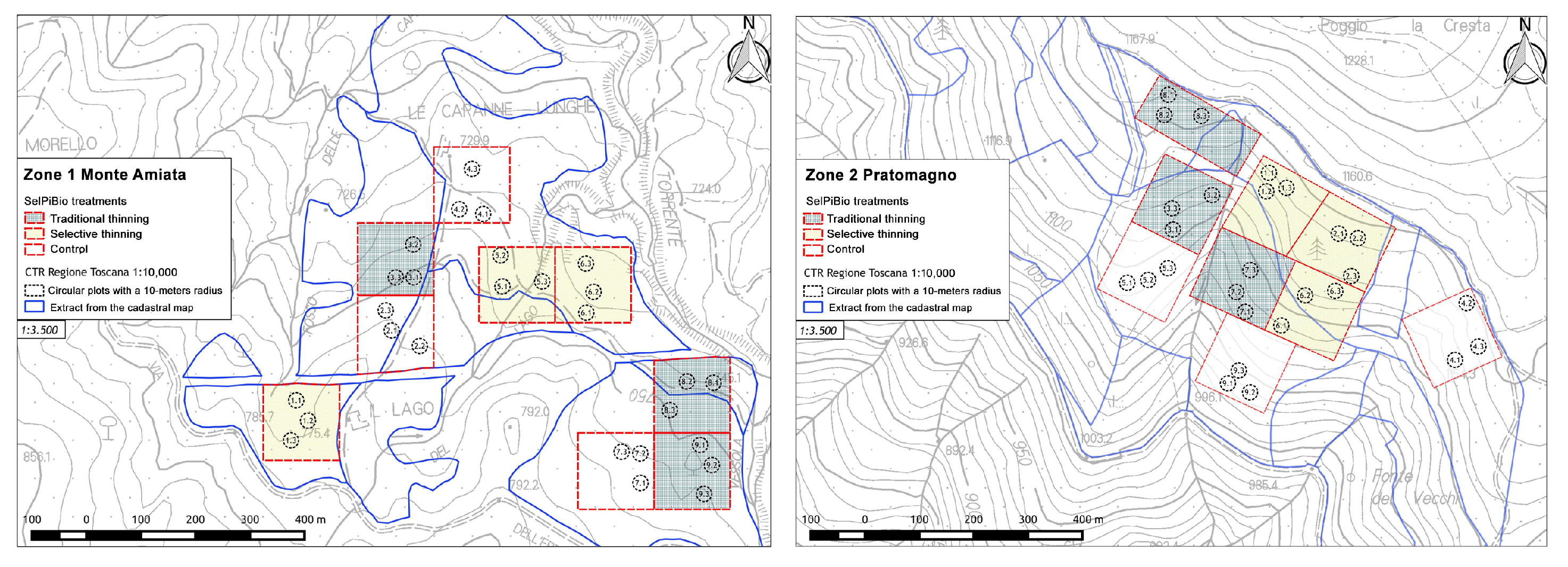
In autumn 2014, two experimental areas were delineated based on the most recent orthophotos provided by the Regional Administration of Tuscany through a Web Map Service (WMS). Each area, covering approximately 20 ha, was spatially stratified into nine 1 ha sectors. Within each sector, three circular sampling plots (10 m radius) were randomly established (Figure 2), resulting in a total of 27 plots. Further details on the sampling design and layout are reported in [21].
Since in each sampling plot ecto-mycorrhizal communities were analyzed both above (ecto-mycorrhizal fruiting body community, EMFb) and below (ecto-mycorrhizal root tips community, EMRt) ground, 54 plots were considered for analysis in each zone, for a total of 108 plots.

2.3. Analysis of Ecto-Mycorrhizal Fruiting Body (EMFb) Community

Observation of the ecto-mycorrhizal community, restricted to epigeous and hypogeous macromycetes, i.e., visible to the naked eye, larger than 1 mm [22], was performed every two weeks from September 2014 to December 2014. The spring fruiting season was sampled once (June 2015). The abundance and frequency of EM fruiting bodies (EMFb) in the whole plot were considered above ground and at the same time, with the help of truffle hunters and trained dogs, as well as below ground (EMFb). Species identification was carried out using standard morphological methods supported by general analytical keys and monographic references [23]. The exsiccata are preserved in the Herbarium Universitatis Senensis (SIENA). Fungal nomenclature follows the CABI Bioscience Database of Fungal Names, available on the internet, http://www.indexfungorum.org/Names/Names.asp, accessed on 9 September 2025.

2.4. Analysis of Ecto-Mycorrhizal Root Tips (EMRt) Community

A tree having the best vegetational conformation was selected [21]. The soil sampling was performed at a distance of 1 m south of the chosen tree. The collection point was marked for future samplings. After removing litter and the organic soil horizon, soil cores 30 cm in length and 6 cm in diameter were taken from 54 plots (27 in Mt. Amiata and 27 in the Pratomagno zone) before silvicultural treatments. Anatomical structures of the mantles, external elements (hyphae, rhizomorphs, and cystidia), and longitudinal and cross-sections of each morphotype were examined under a stereomicroscope (×12) and described according to Agerer [24,25]. EM root tips of each morphotype were counted, and then, morphotypes were molecularly identified using a direct PCR approach, as described by [26] and by [27]. After preliminary cleaning, a very small fragment of mantle was directly amplified with PCR, using the primer pair ITS1F-ITS4 [28,29] in a 50 µL final volume. In total, 2 µL of 20 mg/mL BSA solution (Thermo Scientific Scientific Inc., Waltham, MA, USA) was added to each reaction tube to prevent PCR inhibition. DNA from fresh and dried fruiting bodies (FBs) (25–100 mg) was isolated as described by [30]. The amplifications were carried out using the same primer pairs and the following cycling parameters: an initial denaturation at 94 °C for 2 min and 30 s; 25 cycles consisting of 30 s at 94 °C, 30 s at 55 °C, and 45 s at 72 °C; a final extension at 72 °C for 7 min. The product of each PCR reaction was checked on 1% agarose gel, purified, and then sequenced by Eurofins MWG Operon (Ebersberg, Germany). The sequences of the ITS-1, 5.8S, and ITS-2 regions of the nuclear rDNA obtained were compared with those present in the GenBank database (http://www.ncbi.nlm.nih.gov/BLAST/, accessed on 23 January 2016) and with those obtained from the FB using a BLASTN search [31]. Sequences of ECM fungi were regarded as belonging to Operational Taxonomic Units (OTUs) following the criteria cited in [32]. Fungi were identified as species if their ITS sequences matched a named sporocarp or voucher specimen with at least 97% sequence similarity over at least 500 base pairs with an 80% query coverage according to [12]. The same criterion was used to check undetermined OTUs belonging to the same genus clade. ITS sequences obtained in this study have been deposited in the GenBank database.

2.5. Statistical Analysis

Sample-based rarefaction curves [33,34,35,36] were used to estimate and compare species richness as a function of the number of sample plots in each fungal community type (EMRt and EMFb) for each zone (1, Mt. Amiata; 2, Pratomagno) separately. Analyses were performed both on the complete dataset and after excluding sporadic species (i.e., species occurring in fewer than two plots).
To investigate the effects of Zone (fixed at two levels: Zone 1—Mt. Amiata and Zone 2—Pratomagno), Plot (random 9 levels nested in zones), and Type (fixed at two levels, EMFb and EMRt) on community composition (presence/absence data), we used permutational analysis of variance (PERMANOVA). The advantage of the permutation approach is that the resulting test is “distribution free” and not constrained by many of the typical assumptions of parametric statistics. Type III SS was used. All tests were performed with 999 permutations of residuals under a reduced model. Factors or interactions were considered statistically significant if p < 0.05. Significant interactions of the zone x type terms were then investigated using a posteriori pairwise comparison with the PERMANOVA t statistic and 999 permutations.
Differences in community structure between zones were visualized with non-metric multidimensional scaling (hereafter NMDS) [37].
Similarity Percentage Analysis (SIMPER) was used to determine the percentage contribution of each species to the observed dissimilarity between EMRt and EMFb for each zone. The ratio of the average dissimilarity and standard deviation (diss/SD) is provided as a measure of how consistently the species contributes to the characterization of differences between communities. All the multivariate analyses were performed based on the Jaccard dissimilarity matrix.
Mantel’s test [38] was then used to evaluate the correspondence between composition dissimilarity matrices obtained by Gower’s distance on EMRt and EMFb abundance data, both using the original matrix and excluding sporadic species. Correlation in community structure was assessed using the whole EMRt and EMFb dataset, as well as for each zone separately. The tests were performed using Spearman’s rank correlation with p < 0.05 from 999 randomizations.
Analyses were performed using the PERMANOVA routine in the PRIMER v6 computer program, including the add-on package PERMANOVA+ [39], except for Mantel’s tests and rarefaction curves, which were computed using the vegan package in RStudio version 1.0.136 [40].

3. Results

The biweekly sampling of ectomycorrhizal fruiting body communities across the 54 sample plots in each zone was conducted during a single autumn season (September–December 2014), with an additional survey carried out in late spring (June 2015). This effort resulted in the identification of 70 fungal species (Supplementary Table S1), including 61 epigeous and 9 hypogeous taxa. Among these, 21 genera belonged to the Basidiomycota and 3 to the Ascomycota. The genus Inocybe had the highest number of species (13), followed by Russula with 9, Tuber and Tricholoma with 7 species each, Cortinarius and Lactarius with 4 species, Amanita and Hebeloma with 3, and others with 2 or a single species. Regarding the abundance in the whole area studied, Phellodon niger (Fr.) P.Karst. produced the highest number of fruiting bodies (660 EMFb), followed by Hydnellum ferrugineum (Fr.) P. Karst. (309 EMFb), while Chroogomphus rutilus (Schaeff.) O.K. Mill., found in 26 out of 54 plots, was the most frequent. The most abundant and frequent species in Zone 1 (Mt. Amiata) was Phellodon niger, and in Zone 2 (Pratomagno), it was Russula xerampelina (Schaeff.) Fr. (Supplementary Table S1). Among the species found in both zones, Inocybe geophylla P. Kumm. was the most abundant (194 EMFb).
The 2946 colonized root tips present in 54 soil cores were examined and assigned to 54 different EMRt according to their morpho-anatomical features (Supplementary Table S2).
Regarding their identities, 44 were Basidiomycota, 8 Ascomycota, and 2 uncultured ectomycorrhizal fungi. The most common family was Thelephoraceae with 11 different ectomycorrhizal morphotypes, 6 of which were identified at the genus level (Supplementary Table S2), followed by Atheliaceae with 7 different EMRt and Russulaceae and Inocybaceae with 5 (all of the genus Inocybe). Regarding relative abundance, Cenococcum geophilum Fr. had the largest number of colonized root tips (347), followed by R. xerampelina (253 root tips), Lactarius sanguifluus (Paulet) Fr. (241 root tips), Cenococcum sp. 1 (202 root tips), and Thelephoraceae sp. 1 (180 root tips).
In Zone 1 (Mt. Amiata), C. geophilum was again the most abundant, whereas in Zone 2 (Pratomagno), the most abundant species were R. xerampelina, with 253 colonized root tips, and Cenococcum sp. 1, with 202. The most frequent EMRt in both studied zones as a whole and in Zone 2 was R. xerampelina (13 plots), while in Zone 1, it was C. geophilum.
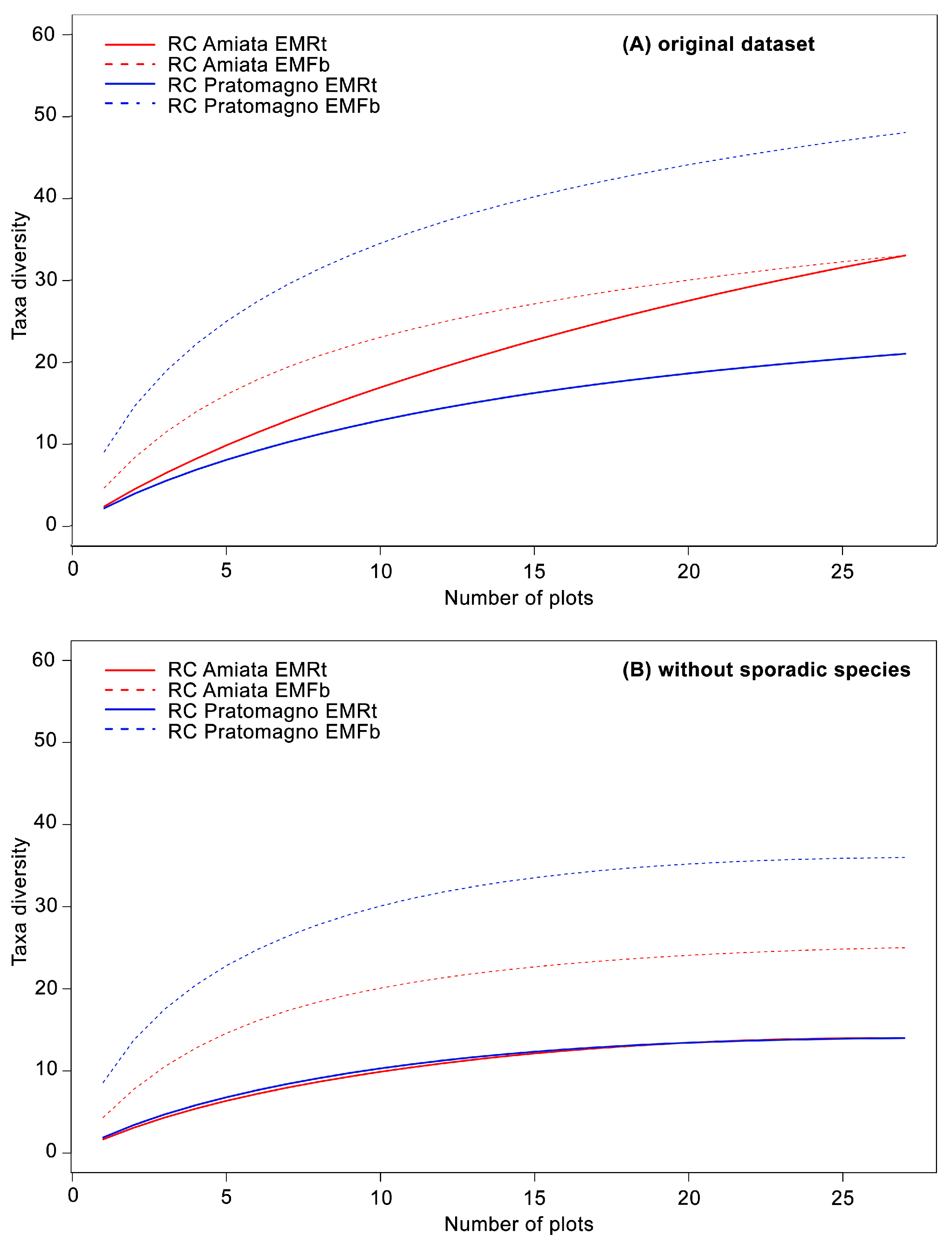
Rarefaction curves (Figure 3A) concerning variation in species richness among fungal communities (EMRt and EMFb) for each zone supported the lowest species richness in the EMRt with respect to the EMFb community. However, while EMRt in Pratomagno showed an asymptote, Mt. Amiata reached no saturation, indicating that the total number of species likely exceeded the number sampled. Concerning patterns inside the EMFb community, Mt. Amiata increased less steeply with respect to Pratomagno, which resulted in the highest estimates of richness at a given extent.
Excluding sporadic species (Figure 3B), the slope of all rarefaction curves became nearly asymptotic, supporting the efficiency of the sampling design. Furthermore, a complete overlay of EMRt rarefaction curves belonging to different zones was found, showing a comparable pattern in cumulative species richness between study areas.
Multivariate permutational analysis of variance revealed that the zone, plot, and type factors significantly affected community composition, as well as the interactions of zone × type and plot × type (Table 1).
The pairwise test showed significant differences between EMRt and EMFb for each Zone (Table 2). The exclusion of sporadic species showed comparable results (Table 3 and Table 4).
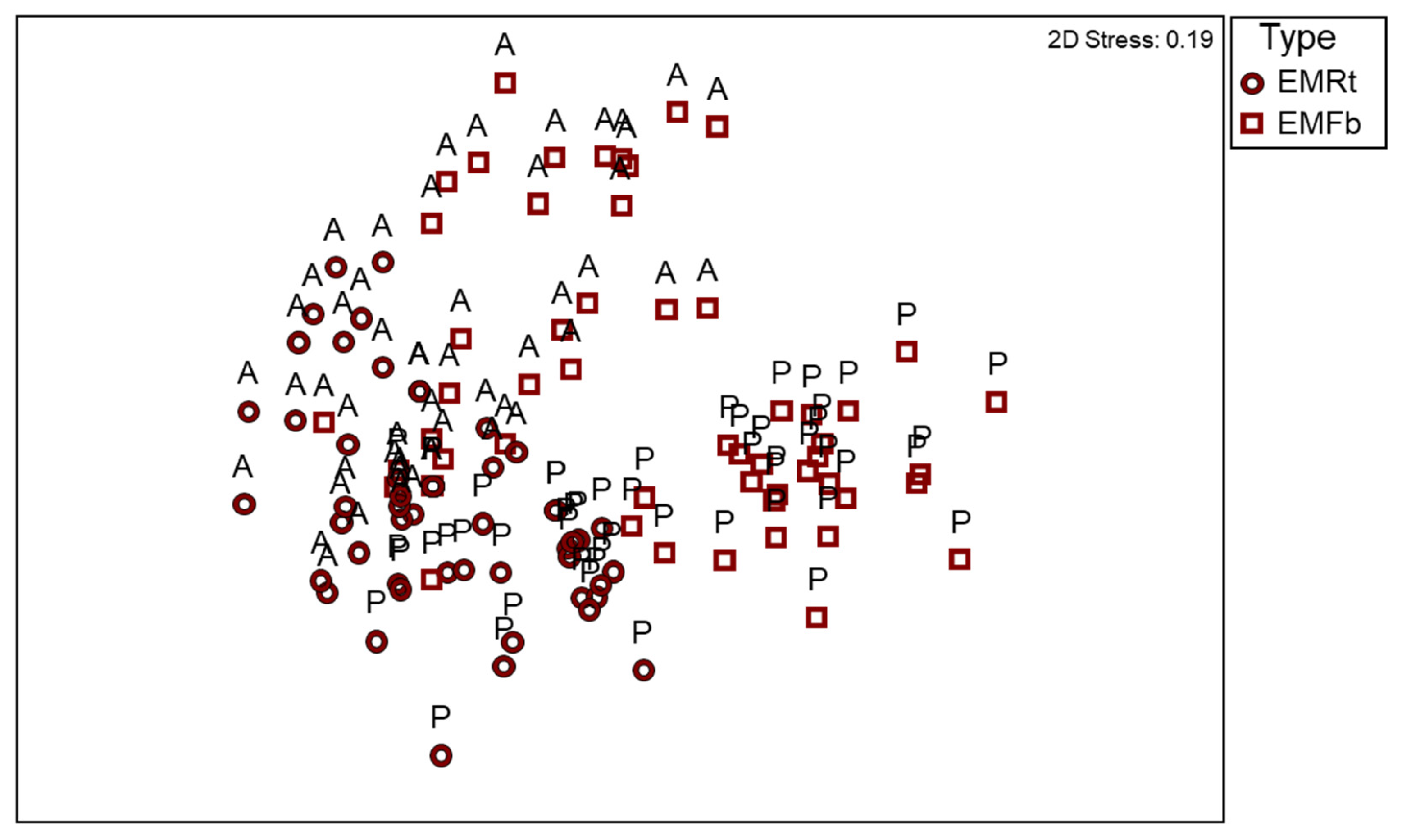
NMDS confirmed this trend (Figure 4), showing a clear separation between fungal community types in terms of species composition. Furthermore, Mantel’s test resulted in no correlation in the matrices of community structure, both considering the whole EMRt and EMFb original matrix (Mantel statistic: r 0.07187; p-value: 0.269), as well as each zone separately (Mt. Amiata: Mantel statistic—r −0.003167, p-value—0.512; Pratomagno: Mantel statistic—r 0.2569, p-value—0.082). No main difference was found in results when sporadic species were excluded (Mantel statistic—r 0.08222, p-value—0.257; Mt. Amiata: Mantel statistic—r 0.1111, p-value—0.287; Pratomagno: Mantel statistic—r 0.1122, p-value—0.244).
The SIMPER indicated that the average dissimilarity between the EMRt and EMFb communities was relevant in both zones, showing a higher value in Zone 1 (Mt. Amiata: average dissimilarity, 96.25%; Pratomagno: average dissimilarity, 88.22%). On Mt. Amiata, L. sanguifluus, P. niger, C. geophilum, Tricholoma psammopus (Kalchbr.) Quél, and Suillus luteus (L.) Roussel contributed the most to the within-group similarity and the between-group dissimilarities (Table 5), while in Pratomagno, I. geophylla, C. rutilus, R. xerampelina, Suillus granulatus (L.) Roussel, and Tricholoma portentosum (Fr.) Quél. made a higher contribution to average dissimilarity between the EMRt and EMFb communities (Table 6).

4. Discussion

This study provides an integrated view of ectomycorrhizal fungal communities, showing that both fruiting body and root tip assemblages are shaped by complex interactions among species, site characteristics, and host associations. Fruiting of ectomycorrhizal species is strongly influenced by seasonality [41,42,43], and a thorough understanding of fungal communities generally requires multiple years of sampling [44,45]. Nonetheless, the aim of this work was to evaluate whether combining above- and below-ground surveys can provide a more accurate basis for assessing silvicultural impacts and maintaining forest ecosystem resilience while reducing sampling effort, time, and costs. Accordingly, fruiting body sampling was conducted during a single productive season.
Clear differences in abundance, frequency, and species richness were observed between Mt. Amiata and Pratomagno, highlighting the influence of local environmental conditions and ecological processes on fungal community composition. These results indicate that ectomycorrhizal network dynamics cannot be fully captured by a single sampling approach, as fruiting bodies and root colonization patterns offer complementary insights into community diversity, habitat preferences, and functional potential [18].
The rarefaction analysis provided clear evidence of differences in species richness between the two ectomycorrhizal fungal communities examined—EMRt (ectomycorrhizal root tips communities) and EMFb (ectomycorrhizal fruiting bodies communities)—across forest sites. Specifically, EMRt communities consistently exhibited lower species richness compared to EMFb (Figure 3A), a pattern commonly reported in fungal diversity studies due to the detection limitations inherent to root tip sampling [46,47]. Despite this general trend, the EMRt in Pratomagno reached an asymptote, suggesting that most locally available taxa were likely sampled. In contrast, the EMRt curve in Mt. Amiata failed to reach saturation, implying a higher underlying diversity than captured in the current sampling effort. This discrepancy may reflect site-specific differences in soil microhabitats, host tree diversity, or seasonal dynamics affecting the detectability of root-associated taxa [48,49]. In the case of the EMFb, the rarefaction curves diverged between the studied zones. Pratomagno displayed a steeper and more continuous increase in richness than Mt. Amiata, ultimately yielding higher richness estimates at comparable sampling effort. This may be attributed to variability in fruiting phenology, microclimate conditions, or forest structure, which influence fruiting body production and detection [50,51,52]. In particular, the relatively flat curve on Mt. Amiata could result from suboptimal fruiting conditions during the survey period or from lower above-ground sporocarp productivity and some undetected fungi, often unrelated to below-ground diversity [53]. The exclusion of sporadic species (Figure 3B) notably caused the rarefaction curves to approach an asymptotic shape, reinforcing the idea that the sampling effort was sufficient to capture the core fungal community at each zone. This finding aligns with other studies suggesting that removal of rare taxa improves the interpretability of richness patterns and reduces noise caused by transient or misidentified occurrences [54]. Finally, the complete overlap of EMRt rarefaction curves between the zones highlights the high similarity in cumulative species richness of root-associated fungal communities across geographically distinct forests. This convergence suggests that EMRt communities might be shaped more by host tree identity and soil environment than by broader landscape-level factors, as also indicated in previous works [55,56].
The results of the multivariate permutational analysis of variance (PERMANOVA) revealed that zone site, plot, and type (EMRt vs. EMFb) all had significant effects on the composition of ectomycorrhizal fungal communities. In addition, the significant interactions between zone × type and plot × type indicate that the degree of dissimilarity between the EMRt and EMFb communities is not uniform across spatial scales. These findings are consistent with studies showing that ectomycorrhizal community composition is strongly shaped by both spatial heterogeneity and the type of sampling substrate [56,57,58].
The pairwise comparisons further confirmed significant differences in species composition between EMRt and EMFb within each zone, supporting the view that fruiting bodies and root tips capture distinct but complementary subsets of the ectomycorrhizal community [59,60]. This divergence likely reflects ecological and physiological differences in species’ fruiting capacities, root colonization strategies, and microhabitat preferences [14,18]. The consistency of the results after excluding sporadic species suggests that these differences are not driven by rare taxa, but rather by the core community composition, further strengthening the robustness of the pattern.
The NMDS ordination provided visual confirmation of these compositional differences, with clear separation between EMRt and EMFb samples in ordination space. Similar ordination-based findings have been reported in studies that compare different sampling methods or forest types [61], reinforcing the notion that sampling method significantly shapes the perceived fungal assemblage.
Mantel tests revealed no significant correlation between the EMRt and EMFb community distance matrices, neither at the full dataset level nor within individual zones. This indicates that species turnover between EMRt and EMFb is largely independent and that compositional dissimilarities observed in one dataset are not predictive of those in the other. The present result is particularly important given that Mantel tests are often used to detect shared spatial or ecological structuring between datasets [62]. The lack of correlation observed here aligns with recent findings showing that above- and below-ground ectomycorrhizal communities often respond differently to environmental gradients and stochastic factors [18,63].
Interestingly, this lack of correlation persisted even when sporadic species were removed, suggesting that it is not an artifact of rare taxa but rather a reflection of fundamental differences in community assembly processes between the two sampling approaches. While EMFb data tends to be influenced by macroclimatic and seasonal conditions affecting fruiting, EMRt data are more stable and closely tied to soil conditions and host tree root architecture [64].
The SIMPER analysis highlighted a significant average dissimilarity between the ectomycorrhizal (EM) communities associated with EMRt and EMFb soil types in both zones, with higher dissimilarity observed on Mt. Amiata (96.25%) compared to Pratomagno (88.22%). These findings suggest a stronger differentiation in EM community composition between the two soil types at Mt. Amiata, likely driven by site-specific environmental and edaphic factors that influence species distribution and competitive interactions among mycorrhizal fungi [65].
On Mt. Amiata, the species contributing most to the within- and between-group variability between the EMFb and EMRt communities—L. sanguifluus, P. niger, C. geophilum, T. psammopus, and S. luteus—represent a functional continuum from taxa showing that fruit abundantly and efficiently transfer nutrients to their hosts (L. sanguifluus, S. luteus) to persistent, stress-tolerant mycelial species (P. niger, C. geophilum) that enhance below-ground stability and ecosystem resilience. These patterns indicate complementary strategies between above- and below-ground compartments: EMFb communities are dominated by species involved in phosphorus and nitrogen mobilization under favorable conditions, whereas EMRt communities include long-lived, stress-resistant taxa ensuring continuous nutrient uptake and root protection [66]. In contrast, at Pratomagno, dissimilarities between the EMFb and EMRt were mainly driven by I. geophylla, C. rutilus, R. xerampelina, S. granulatus, and T. portentosum. These assemblages point to a below-ground community influenced by Inocybe and Russula, which are functionally diverse and contribute to nutrient cycling and symbiotic efficiency, coupled with above-ground-dominant taxa (Suillus, Tricholoma, Chroogomphus) that reflect high seasonal productivity and the tight ecological linkage typical of Chroogomphus–Suillus–Pinus associations [67]. Overall, the ectomycorrhizal communities from the two mountain systems display distinct but complementary functional strategies: Mt. Amiata is characterized by taxa associated with ecosystem resilience and drought tolerance, whereas Pratomagno hosts species that drive nutrient exchange networks and seasonal productivity, mirroring contrasts in soil traits, host composition, and microclimatic conditions [68].
These results underscore the importance of considering the species-specific composition of EM fungal communities in relation to local environmental characteristics, which modulate both diversity and ecological function [56]. The higher dissimilarity observed at Mt. Amiata could be related to differences in altitude, vegetation types, and climatic conditions compared to Pratomagno, all of which directly affect fungal distribution and plant–fungus interactions [69].
From an applied perspective, the integration of above- and below-ground data enhances the sensitivity of biodiversity assessment tools and supports more informed decision-making in forest management. Multi-method monitoring can improve early detection of ecological shifts driven by silvicultural practices, disturbance, or climate change and thus contributes to the design of management strategies aimed at maintaining soil functional integrity, supporting nutrient cycling, and promoting long-term forest resilience. This complementary approach is essential for conservation planning in complex forest ecosystems and should be increasingly incorporated into biodiversity-oriented monitoring frameworks.

Supplementary Materials

The following supporting information can be downloaded at: https://www.mdpi.com/article/10.3390/f16111712/s1, Table S1. Summary of the EMFb (ecto-mycorrhizal fruiting body community) sampling performed at the 54 plots (27 at Zone 1—Mt. Amiata and 27 at Zone 2—Pratomagno). Table S2. Summary of the EMRt (ecto-mycorrhizal root tips community) sampling performed at the 54 plots (27 at Zone 1—Mt. Amiata and 27 at Zone 2—Pratomagno).

Author Contributions

Conceptualization, E.S. and S.M.; methodology, E.S., D.B., P.L. and S.M.; software, D.B. and S.M.; formal analysis, D.B.; investigation, E.S., D.B. and P.L.; data curation, E.S., D.B., P.L., S.M. and C.P.; writing—original draft, E.S.; writing—review and editing, S.M. and C.P. All authors have read and agreed to the published version of the manuscript.

Funding

This research was supported by the EU’s LIFE+ “Nature and Biodiversity” Program through the SelPiBio LIFE Project (Innovative silvicultural treatments to enhance soil biodiversity in artificial black pine stands, i.e., LIFE13 BIO/IT/000282).

Data Availability Statement

The data is contained within the article and Supplementary Materials.

Acknowledgments

The authors gratefully acknowledge the administrative staff of the Unione dei Comuni Amiata Val d’Orcia and Unione dei Comuni del Pratomagno for their valuable support in facilitating the logistical and organizational aspects of this research.

Conflicts of Interest

The authors declare no conflicts of interest. The funders had no role in the design of the study; in the collection, analyses, or interpretation of the data; in the writing of the manuscript; or in the decision to publish the results.

References

  1. European Environment Agency. European Forests for Biodiversity, Climate Change Mitigation and Adaptation. Available online: https://climate-adapt.eea.europa.eu/en/metadata/publications/european-forests-for-biodiversity-climate-change-mitigation-and-adaptation (accessed on 8 August 2025).
  2. Hawkins, H.J.; Cargill, R.I.M.; Van Nuland, M.E.; Hagen, S.C.; Field, K.J.; Sheldrake, M.; Soudzilovskaia, N.A.; Kiers, E.T. Mycorrhizal mycelium as a global carbon pool. Curr. Biol. 2023, 33, R560–R573. [Google Scholar] [CrossRef] [PubMed]
  3. Bunn, R.A.; Corrêa, A.; Joshi, J.; Kaiser, C.; Lekberg, Y.; Prescott, C.E.; Sala, A.; Karst, J. What determines transfer of carbon from plants to mycorrhizal fungi? New Phytol. 2024, 244, 1199–1215. [Google Scholar] [CrossRef] [PubMed]
  4. De Dominicis, V.; Barluzzi, C. Coenological research on macrofungi in evergreen oakwoods in the hills near Siena (Italy). Vegetatio 1983, 54, 177–187. [Google Scholar] [CrossRef]
  5. Perini, C.; Barluzzi, C.; De Dominicis, V. Mycocoenological research on evergreen oak woods in the hills adjacent the Maremma coastline (NW of Grosseto, Italy). Phytocoenologia 1989, 17, 289–306. [Google Scholar] [CrossRef]
  6. Barluzzi, C.; Perini, C.; De Dominicis, V. Coenological research on macrofungi in chestnut coppices of Tuscany. Phytocoenologia 1992, 20, 449–465. [Google Scholar] [CrossRef]
  7. Laganà, A.; Salerni, E.; Barluzzi, C.; Perini, C.; De Dominicis, V. Mycocoenology and biomonitoring in Abies alba Miller woods of central-southern Tuscany (Italy). Acta Soc. Bot. Pol. 2000, 69, 293–298. [Google Scholar] [CrossRef]
  8. Dahlberg, A. Community ecology of ectomycorrhizal fungi: An advancing interdisciplinary field. New Phytol. 2000, 150, 555–562. [Google Scholar] [CrossRef]
  9. Salerni, E.; Laganà, A.; De Dominicis, V. Mycocoenological studies in deciduous oak woods of central-southern Tuscany (Italy). Cryptogam. Mycol. 2001, 22, 35–55. [Google Scholar] [CrossRef]
  10. Marmeisse, R.; Guidot, A.; Gay, G.; Lambilliotte, R.; Sentenac, H.; Combier, J.P.; Melayah, D.; Fraissinet-Tachet, L.; Debaud, J.C. Hebeloma cylindrosporum—A modelspecies to study ectomycorrhizals symbiosis from gene to ecosystem. New Phytol. 2004, 163, 481–498. [Google Scholar] [CrossRef]
  11. Anderson, I.C.; Cairney, J.W.G. Ectomycorrhizal fungi: Exploring the mycelial frontier. FEMS Microbiol. Rev. 2007, 31, 388–406. [Google Scholar] [CrossRef]
  12. Smith, M.E.; Douhan, G.W.; Rizzo, D.M. Ectomycorrhizal community structure in a xeric Quercus woodland based on rDNA sequence analysis of sporocarps and pooled roots. New Phytol. 2007, 174, 847–863. [Google Scholar] [CrossRef]
  13. Toju, H.; Tanabe, A.S.; Yamamoto, S.; Sato, H. High-Coverage ITS Primers for the DNA-Based Identification of Ascomycetes and Basidiomycetes in Environmental Samples. PLoS ONE 2012, 7, e40863. [Google Scholar] [CrossRef]
  14. Tedersoo, L.; Bahram, M.; Põlme, S.; Kõljalg, U.; Yorou, N.S.; Wijesundera, R.; Ruiz, L.V.; Vasco-Palacios, A.M.; Thu, P.Q.; Suija, A.; et al. Global diversity and geography of soil fungi. Science 2014, 346, 1256688. [Google Scholar] [CrossRef] [PubMed]
  15. Mello, A.; Balestrini, R. Recent Insights on Biological and Ecological Aspects of Ectomycorrhizal Fungi and Their Interactions. Front. Microbiol 2018, 9, 216. [Google Scholar] [CrossRef] [PubMed]
  16. Meidl, P.; Furneaux, B.; Tchan, K.I.; Kluting, K.; Ryberg, M.; Guissou, M.-L.; Soro, B.; Traoré, A.; Konomou, G.; Yorou, N.S. Rosling, Soil fungal communities of ectomycorrhizal dominated woodlands across West Africa. MycoKeys 2021, 81, 45–68. [Google Scholar] [CrossRef] [PubMed]
  17. Tóth, B.B.; Barta, Z. Ecological studies of ectomycorrhizal fungi: An analysis of survey methods. Fungal Divers. 2010, 45, 3–19. [Google Scholar] [CrossRef]
  18. Qi, M.; Suz, L.M.; Bidartondo, M.I.; Orme, C.D.L.; Delhaye, G.; Openshaw, I.; Tovar, C. Fruitbody and root data infer different environmental niches for ectomycorrhizal fungi. J. Biogeogr. 2024, 51, 2221–2236. [Google Scholar] [CrossRef]
  19. Maccherini, S.; Salerni, E.; Mocali, S.; Bianchetto, E.; Landi, S.; De Meo, I.; Di Salvatore, U.; Marchi, M.; Bacaro, G.; Tordoni, E.; et al. Silvicultural management does not affect biotic communities in conifer plantations in the short-term: A multi-taxon assessment using a BACI approach. For. Ecol. Manag. 2021, 493, 119257. [Google Scholar] [CrossRef]
  20. Cantiani, P. Il Diradamento Selettivo. Accrescere Stabilità e Biodiversità in Boschi Artificiali di Pino Nero; Manuale Tecnico SelPiBioLife; Compagnia delle Foreste: Arezzo, Italy, 2016. [Google Scholar]
  21. Cantiani, P.; Marchi, M. A spatial dataset of forest mensuration collected in black pine plantations in central Italy. Ann. For. Sci. 2017, 74, 50. [Google Scholar] [CrossRef]
  22. Arnolds, E. Ecology and coenology of macrofungi in grassland and moist heathland in Drenthe, The Netherlands. Bibl. Mycol. 1981, 90, 1–50. [Google Scholar]
  23. Salerni, E.; Perini, C. Macrofungal communities in Italian fir woods—Short-term effects of silviculture and its implication for conservation. Cryptogam. Mycol. 2010, 31, 251–283. [Google Scholar]
  24. Agerer, R. 1991—Characterization of ectomycorrhiza. In Techniques for the Study of Mycorrhiza. Methods in Microbiology; Norris, J.R., Read, D., Varma, A., Eds.; Academic Press: London, UK; Volume 23, pp. 25–73.
  25. Agerer, R. Colour Atlas of Ectomycorrhizas. Available online: https://www.nhbs.com/colour-atlas-of-ectomycorrhizae-parts-1-15-book (accessed on 7 August 2025).
  26. Iotti, M.; Zambonelli, A. A quick and precise technique for identifying ectomycorrhizas by PCR. Mycol. Res. 2006, 110, 60–65. [Google Scholar] [CrossRef]
  27. Leonardi, M.; Iotti, M.; Oddis, M.; Lalli, G.; Pacioni, G.; Leonardi, P.; Maccherini, S.; Perini, C.; Salerni, E.; Zambonelli, A. Assessment of ectomycorrhizal fungal communities in the natural habitats of Tuber magnatum (Ascomycota, Pezizales). Mycorrhiza 2013, 23, 349–358. [Google Scholar] [CrossRef]
  28. White, T.J.; Bruns, T.D.; Lee, S.; Taylor, J. Amplification and direct sequencing of fungal ribosomal RNA genes for phylogenetics. In PCR Protocols: A Guide to Methods and Applications; Innis, M.A., Gelfand, D.H., Sninsky, J.J., White, T.J., Eds.; Academic Press: San Diego, CA, USA, 1990; pp. 315–322. [Google Scholar]
  29. Gardes, M.; Bruns, T.D. ITS primers with enhanced specificity for basidiomycetes: Application to the identification of mycorrhizae and rusts. Mol. Ecol. 1993, 2, 113–118. [Google Scholar] [CrossRef]
  30. Paolocci, F.; Rubini, A.; Granetti, B.; Arcioni, S. Rapid molecular approach for a reliable identification of Tuber spp. ectomycorrhizas. FEMS Microbiol. Ecol. 1999, 28, 23–30. [Google Scholar] [CrossRef]
  31. Altschul, S.F.; Madden, T.L.; Schaffer, A.A.; Zhang, J.; Zhang, Z.; Miller, W.; Lipman, D.J. Gapped BLAST and PSI-BLAST: A new generation of protein database search programs. Nucleic Acids Res. 1997, 25, 3389–3402. [Google Scholar] [CrossRef] [PubMed]
  32. Landeweert, R.; Leeflang, P.; Kuyper, T.W.; Hoffland, E.; Rosling, A.; Wernars, K.; Smit, E. Molecular identification of ectomycorrhizal mycelium in soil horizons. Appl. Environ. Microbiol. 2003, 69, 327–333. [Google Scholar] [CrossRef] [PubMed]
  33. Gotelli, N.J.; Colwell, R.K. Quantifying biodiversity: Procedures and pitfalls in the measurement and comparison of species richness. Ecol. Lett. 2001, 4, 379–391. [Google Scholar] [CrossRef]
  34. Colwell, R.K.; Mao, C.X.; Chang, J. Interpolating, extrapolating, and comparing incidence-based species accumulation curves. Ecology 2004, 85, 2717–2727. [Google Scholar] [CrossRef]
  35. Chiarucci, A.; Bacaro, G.; Rocchini, D.; Ricotta, C.; Palmer, M.W.; Scheiner, S.M. Spatially constrained rarefaction: Incorporating the autocorrelated structure of biological communities into sample-based rarefaction. Community Ecol. 2009, 10, 209–214. [Google Scholar] [CrossRef]
  36. Chao, A.; Gotelli, N.J.; Hsieh, T.C.; Sander, E.L.; Ma, K.H.; Colwell, R.T.; Ellison, A.A. Rarefaction and extrapolation with Hill numbers: A framework for sampling and estimation in species diversity studies. Ecol. Monogr. 2014, 84, 45–67. [Google Scholar] [CrossRef]
  37. McCune, B.; Grace, J.B. Analysis of Ecological Communities; MjM Software Design: Gleneden Beach, OR, USA, 2002. [Google Scholar]
  38. Mantel, N. The detection of disease clustering and a generalized regression approach. Cancer Res. 1967, 27, 209–220. [Google Scholar] [PubMed]
  39. Anderson, M.J.; Gorley, R.N.; Clarke, K.R. PERMANOVA+ for PRIMER: Guide to Software and Statistical Methods; PRIMER-E Ltd.: Plymouth, UK, 2008. [Google Scholar]
  40. RStudio Team. RStudio: Integrated Development for R; RStudio, Inc.: Boston, MA, USA, 2016; Available online: http://www.rstudio.com (accessed on 20 October 2016).
  41. Salerni, E.; Laganà, A.; Perini, C.; Loppi, S.; De Dominicis, V. Effects of temperature and rainfall on fruiting of macrofungi in oak forests of the Mediterranean area. Isr. J. Plant Sci. 2002, 50, 189–198. [Google Scholar] [CrossRef]
  42. Salerni, E.; D’Aguanno, M.; Leonardi, P.; Perini, C. Ectomycorrhizal communities above and below ground and truffle productivity in a Tuber aestivum orchard. For. Syst. 2014, 23, 329–338. [Google Scholar] [CrossRef]
  43. Herrero, C.; Berraondo, I.; Bravo, F.; Pando, V.; Ordóñez, C.; Olaizola, J.; Martín-Pinto, P.; Oria de Rueda, J.A. Predicting Mushroom Productivity from Long-Term Field-Data Series in Mediterranean Pinus pinaster Ait. Forests in the Context of Climate Change. Forests 2019, 10, 206. [Google Scholar] [CrossRef]
  44. Alday, J.G.; Martínez de Aragón, J.; de-Miguel, S.; Bonet, J.A. Mushroom biomass and diversity are driven by different spatio-temporal scales along Mediterranean elevation gradients. Sci. Rep. 2017, 7, 45824. [Google Scholar] [CrossRef]
  45. Parladé, J.; Queralt, M.; Pera, J.; Bonet, J.A.; Castaño, C.; Martínez-Peña, F.; Piñol, J.; Senar, M.A.; De Miguel, A.M. Temporal dynamics of soil fungal communities after partial and total clear-cutting in a managed Pinus sylvestris stand. For. Ecol. Manag. 2019, 449, 117456. [Google Scholar] [CrossRef]
  46. Horton, T.R.; Bruns, T.D. The molecular revolution in ectomycorrhizal ecology: Peeking into the black-box. Mol. Ecol. 2001, 10, 1855–1871. [Google Scholar] [CrossRef]
  47. Tedersoo, L.; Nilsson, R.H.; Abarenkov, K.; Jairus, T.; Sadam, A.; Saar, I.; Bahram, M.; Bechem, E.; Chuyong, G.; Kõljalg, U. 454 Pyrosequencing and Sanger sequencing of tropical mycorrhizal fungi provide similar results but reveal substantial methodological biases. New Phytol. 2010, 188, 291–301. [Google Scholar] [CrossRef]
  48. Bahram, M.; Põlme, S.; Kõljalg, U.; Zarre, S.; Tedersoo, L. Regional and local patterns of ectomycorrhizal fungal diversity and community structure along an altitudinal gradient in the Hyrcanian forests of northern Iran. New Phytol. 2012, 193, 465–473. [Google Scholar] [CrossRef]
  49. Dickie, I.A. Host preference, niches and species richness: Understanding the diversity of ectomycorrhizal fungi. New Phytol. 2007, 174, 275–283. [Google Scholar] [CrossRef]
  50. Arnolds, E. The analysis and classification of fungal communities with special reference to macrofungi. In Fungi in Vegetation Science; Winterhoff, W., Ed.; Springer: Dordrecht, the Netherlands, 1992; pp. 7–48. [Google Scholar]
  51. Tedersoo, L.; Smith, M.E. Lineages of ectomycorrhizal fungi revisited: Foraging strategies and novel lineages revealed by sequences from belowground. Fungal Biol. Rev. 2013, 27, 83–99. [Google Scholar] [CrossRef]
  52. Collado, E.; Castaño, C.; Bonet, J.A.; Hagenbo, A.; de Aragón, J.M.; de-Miguel, S. Divergent above- and below-ground responses of fungal functional groups to forest thinning. Soil Biol. Biochem. 2020, 150, 108010. [Google Scholar] [CrossRef]
  53. Halme, P.; Kotiaho, J.S. The importance of timing and number of surveys in fungal biodiversity research. Biodivers. Conserv. 2012, 21, 205–219. [Google Scholar] [CrossRef]
  54. Nguyen, N.H.; Song, Z.; Bates, S.T.; Branco, S.; Tedersoo, L.; Menke, J.; Schilling, J.S.; Kennedy, P.G. FUNGuild: An open annotation tool for parsing fungal community datasets by ecological guild. Fungal Ecol. 2015, 20, 241–248. [Google Scholar] [CrossRef]
  55. Tedersoo, L.; Suvi, T.; Jairus, T.; Kõljalg, U. Forest microsite effects on community composition of ectomycorrhizal fungi on seedlings of Picea abies and Betula pendula. Environ. Microbiol. 2008, 10, 1189–1201. [Google Scholar] [CrossRef]
  56. van der Linde, S.; Suz, L.M.; Orme, C.D.L.; Cox, F.; Andreae, H.; Asi, E.; Atkinson, B.; Benham, S.; Carroll, C.; Cools, N.; et al. Environment and host as large-scale controls of ectomycorrhizal fungi. Nature 2018, 558, 243–248. [Google Scholar] [CrossRef]
  57. Smith, D.P.; Peay, K.G. Sequence depth, not PCR replication, improves ecological inference from next generation DNA sequencing. PLoS ONE 2014, 9, e90234. [Google Scholar] [CrossRef]
  58. Bahram, M.; Peay, K.G.; Tedersoo, L. Local-scale biogeography and spatiotemporal variability in communities of mycorrhizal fungi. New Phytol. 2015, 210, 1247–1259. [Google Scholar] [CrossRef]
  59. Taylor, D.L.; Walters, W.A.; Lennon, N.J.; Bochicchio, J.; Krohn, A.; Caporaso, J.G.; Pennanen, T. Accurate estimation of fungal diversity and abundance through improved lineage-specific primers optimized for Illumina amplicon sequencing. Appl. Environ. Microbiol. 2014, 82, 7217–7226. [Google Scholar] [CrossRef]
  60. Mujic, A.B.; Durall, D.M.; Spatafora, J.W.; Kennedy, P.G. Competitive avoidance not edaphic specialization drives vertical niche partitioning among sister species of ectomycorrhizal fungi. New Phytol. 2016, 209, 1174–1183. [Google Scholar] [CrossRef] [PubMed]
  61. Karst, J.; Erbilgin, N.; Pec, G.J.; Cigan, P.W.; Najar, A.; Simard, S.W.; Cahill, J.F. Ectomycorrhizal fungi mediate indirect effects of a bark beetle outbreak on secondary chemistry and establishment of pine seedlings. New Phytol. 2015, 208, 904–914. [Google Scholar] [CrossRef] [PubMed]
  62. Legendre, P.; Fortin, M.J. Comparison of the Mantel test and alternative approaches for detecting complex multivariate relationships in the spatial analysis of ecological data. Mol. Ecol. Resour. 2010, 10, 831–844. [Google Scholar] [CrossRef] [PubMed]
  63. Glassman, S.I.; Wang, I.J.; Bruns, T.D. Environmental filtering by pH and soil nutrients drives community assembly in fungi at fine spatial scales. Mol. Ecol. 2017, 26, 6960–6973. [Google Scholar] [CrossRef]
  64. Peay, K.; Kennedy, P.; Talbot, J. Dimensions of biodiversity in the Earth mycobiome. Nat. Rev. Microbiol. 2016, 14, 434–447. [Google Scholar] [CrossRef]
  65. Smith, S.E.; Read, D.J. Mycorrhizal Symbiosis, 3rd ed.; Academic Press: New York, NY, USA, 2008; pp. 1–787. [Google Scholar]
  66. Li, M.; Yuan, C.; Zhang Pang, W.; Zhang, P.; Xie, R.; Lian, C.; Zhang, T. The Transcriptional Responses of Ectomycorrhizal Fungus, Cenococcum geophilum, to Drought Stress. J. Fungi 2023, 9, 15. [Google Scholar] [CrossRef]
  67. Miller, O.K. The Gomphidiaceae revisited: A worldwide perspective. Mycologia 2003, 95, 176–183. [Google Scholar] [CrossRef]
  68. Yang, N.; Zhang, X.; Xu, T.; Chen, C.; Wang, W. Soil nutrients and plant diversity affect ectomycorrhizal fungal community structure and functional traits across three subalpine coniferous forests. Front. Microbiol. 2022, 13, 1016610. [Google Scholar] [CrossRef]
  69. Nilsson, R.H.; Larsson, K.-H.; Taylor, A.F.S.; Bengtsson-Palme, J.; Jeppesen, T.S.; Schigel, D.; Kennedy, P.; Picard, K.; Glöckner, F.O.; Tedersoo, L.; et al. The UNITE database for molecular identification of fungi: Handling dark taxa and parallel taxonomic classifications. Nucleic Acids Res. 2019, 47, D259–D264. [Google Scholar] [CrossRef]
Figure 1. Thermopluviometric diagrams of Mt. Amiata-Zone 1 (a) and Pratomagno-Zone 2 (b).
Forests 16 01712 g001
Figure 2. Experimental design of two zones (Zone 1—Mt. Amiata and Zone 2—Pratomagno). Each zone comprises nine rectangular sectors (1–9; red dashed outlines), each with three circular plots (1–3; black dashed lines) labeled using a decimal code (e.g., 4.2 = sector 4, plot 2).
Forests 16 01712 g002
Figure 3. Sample-based rarefaction curves of fungal communities, EMRt (ecto-mycorrhizal root tips community) and EMFb (ecto-mycorrhizal fruiting body community), for Mt. Amiata and Pratomagno zones for the whole dataset (A) and after the exclusion of sporadic species (B).
Forests 16 01712 g003
Figure 4. Two-dimensional non-metric multidimensional scaling (NMDS) ordination of ectomycorrhizal communities based on presence–absence data and Jaccard dissimilarities. Each point represents one sample. Squares (□) indicate ecto-mycorrhizal fruiting body communities (EMFb), and circles (○) represent ecto-mycorrhizal root tip communities (EMRt). Samples were collected at Mt. Amiata (A—Zone 1) and Pratomagno (P—Zone 2). Sites or communities that plot closer together share more similar species composition, whereas those farther apart are more dissimilar. Stress value indicates the goodness of fit of the ordination.
Forests 16 01712 g004
Table 1. PERMANOVA results for the whole presence/absence dataset in 108 plots for Mt. Amiata and Pratomagno zones.
Source of VariationdfMSF
Zone130,7978.5637 *
Type129,5198.3906 *
Plot (Zone)163596.21.4652 *
Zone × Type115,5834.4296 *
Plot (Zone) × Type163518.11.4334 *
Residual722454.4
Total107
* p < 0.05.
Table 2. Results of PERMANOVA pairwise test for Mt. Amiata and Pratomagno Zones for each pair of levels of factor “Type”: EMRt = ecto-mycorrhizal root tips community, EMFb = ecto-mycorrhizal fruiting body community.
TypeMt. AmiataPratomagno
tt
EMRt, EMFb2.1459 **2.8237 *
* p < 0.05; ** p < 0.01.
Table 3. PERMANOVA results for the whole presence/absence dataset in 108 plots for Mt. Amiata and Pratomagno zones after the exclusion of sporadic species.
Source of VariationdfMSF
Zone133,4099.7458 *
Type133,97010.305 *
Plot (Zone)1634281.5868 *
Zone × Type115,3014.6416 *
Plot (Zone) × Type163296.51.5259 *
Residual722160.4
Total107
* p < 0.05.
Table 4. Results of PERMANOVA pairwise test for Mt. Amiata and Pratomagno zones for each pair of levels of factor “type” after the exclusion of sporadic species. EMRt = ecto-mycorrhizal root tips community, EMFb = ecto-mycorrhizal fruiting body community.
TypeMt. AmiataPratomagno
tt
EMRt, EMFb2.4087 **2.9735 *
* p < 0.05; ** p < 0.01.
Table 5. Average density of several prominent taxa in EMRt (ecto-mycorrhizal root tips community) and EMFb (ecto-mycorrhizal fruiting body community) of Mt. Amiata Zone, including SIMPER results for contributions from the most important taxa to the Jaccard dissimilarity distinguishing these two groups without sporadic species.
TaxonAv. Density EMRtAv. Density EMFbAv. DissDiss/SDContrib%
Lac san0.330.269.320.579.65
Phe nig0.000.416.130.726.35
Cen geo0.300.005.850.546.06
Tr psa0.000.335.340.475.53
Sui lut0.070.305.590.605.80
Av = average, EMRt = ecto-mycorrhizal root tips community; EMFb = ecto-mycorrhizal fruiting body community, Av. Diss = average dissimilarity contribution of the most important taxa, Diss/SD = dissimilarity divided by the standard deviation of the contribution of each taxon across all pairs of samples, Contrib% = percentage of contribution of each taxon to the total of 96.25%. Taxa: Lac san = Lactarius sanguifluus, Phe nig = Phellodon niger, Cen geo = Cenococcum geophilum, Tr psa = Tricholoma psammopus, Sui lut = Suillus luteus.
Table 6. Average density of several prominent taxa in EMRt (ecto-mycorrhizal root tips community) and EMFb (ecto-mycorrhizal fruiting body community) of Pratomagno Zone, including SIMPER results for contributions from the most important taxa to the Jaccard dissimilarity distinguishing these two groups without sporadic species.
TaxonAv. Density EMRtAv. Density EMFbAv. DissDiss/SDContrib%
Ino geo0.000.706.901.227.82
Chr rut0.000.706.831.377.74
Ru xer0.480.936.210.807.04
Sui gra0.000.566.120.956.94
Tr por0.070.484.490.865.09
Av = average, EMRt = ecto-mycorrhizal root tips community, EMFb = ecto-mycorrhizal fruiting body communities, Av. diss = average dissimilarity contribution of the most important taxa, Diss/SD = dissimilarity divided by the standard deviation of the contribution of each taxon across all pairs of samples, Contrib% = percentage of contribution of each taxon to the total of 88.22%. Taxa: Ino geo = Inocybe geophylla, Chr rut = Chroogomphus rutilus, Ru xer = Russula xerampelina, Sui gra = Suillus granulatus, Tr por = Tricholoma portentosum.
Disclaimer/Publisher’s Note: The statements, opinions and data contained in all publications are solely those of the individual author(s) and contributor(s) and not of MDPI and/or the editor(s). MDPI and/or the editor(s) disclaim responsibility for any injury to people or property resulting from any ideas, methods, instructions or products referred to in the content.