Article

Morphological Plasticity of Ectomycorrhizal Symbiosis Promotes Adaptation of Faxon Fir (Abies fargesii var. faxoniana) to Altitudinal and Environmental Changes on Eastern Qinghai–Tibet Plateau


1
Institute of Botany, Chinese Academy of Sciences, Beijing 100093, China
2
Sichuan Wolong Forest Ecosystem Research Station, Sichuan Academy of Forestry, Wenchuan 623006, China
3
Sichuan Academy of Forestry, Ecological Restoration and Conservation for Forest and Wetland Key Laboratory of Sichuan Province, Chengdu 610081, China
4
College of Agricultural and Life Sciences, Kunming University, Kunming 650214, China
5
Key Laboratory of Forest Ecology and Environment of National Forestry and Grassland Administration, Ecology and Nature Conservation Institute, Chinese Academy of Forestry, Beijing 100091, China
6
Sichuan Miyaluo Forest Ecosystem Observation and Research Station, Aba 623100, China
*
Authors to whom correspondence should be addressed.
Forests 2025, 16(11), 1670; https://doi.org/10.3390/f16111670
Submission received: 28 July 2025 / Revised: 19 October 2025 / Accepted: 24 October 2025 / Published: 1 November 2025
(This article belongs to the Special Issue Forest Soil Microbiology and Biogeochemistry)

Abstract

Morphological plasticity (MP) is an essential strategy for plants in nutrient acquisition, disturbance alleviation, and community coexistence during environmental and climatic changes. However, to date, there has been little research concerning the MP for alpine–subalpine forests on the Qinghai–Tibet plateau. These forests are representative of the ectomycorrhizal (ECM) type, and morphological traits of these ECM roots, such as root tip lengths, diameters, and their adherent hyphal lengths and exploration types, have rarely been studied in the context of nutrient and environmental gradients. In this study, we examined the morphological traits of ECM roots for faxon fir (Abies fargesii var. faxoniana), which dominated in subalpine forests across nine elevations on the Eastern Qinghai–Tibet plateau. By quantifying ca. 90,000 root tips, the hyphal lengths of ectomycorrhizal extraradical mycelium (EEM, i.e., short- and long-distance exploration types) reached up to 1.1 × 106 cm/m3 in soil, which decreased significantly due to gradually increasing altitude. In contrast, the variability of ECM root traits (diameter, length, and superficial area) was highly conserved along the altitudinal gradients, yet the root tip lengths were positively associated with soil protease enzyme activity. The increase in diameter and length of ECM root tips was climate-independent yet significantly associated with increasing root N concentration. In the studied forests, a long-distance exploration type of ECM hyphae was controlled by precipitation (p < 0.05), whereas the short-distance one was controlled by precipitation and temperature simultaneously. The EEM lengths of short- and long-distance exploration types were associated with high C concentration and low N concentration in host tree root tissues. Our findings demonstrated that MP expression in nutrient-foraging strategies for the dominant coniferous trees facilitates the adaptation to changing environments by specialized hyphal structures. In conclusion, ECM root tips and hyphal structures are two dimensions of functional traits linked to root N concentration in opposite ways, and their MP collectively ensures the temporal stability and resistance of subalpine forests on the Qinghai–Tibet plateau. These results provide new insights into ECM morphological traits and their adaptation in changing environments, which is valuable for understanding responses of subalpine forests to climate change.

1. Introduction

The Qinghai–Tibet Plateau is one of the most climate-sensitive regions globally [1], where forest tree species face significant survival pressures and challenges in maintaining the stability of regional ecosystems. This area is typically nitrogen (N) limited and is predominantly dominated by coniferous tree species [2]. Faxon fir (Abies fargesii var. faxoniana) is the representative tree species on the Eastern Qinghai–Tibetan Plateau, and coexists with bamboo species that are a part of the diet of the Chinese Giant Panda (Ailuropoda melanoluca) in the Sichuan province, Southwest China. This tree species plays a crucial role in the functions and stability of the local forest ecosystem [3,4]. However, the escalation of global climate change may pose significant threats to the growth dynamics and resource acquisition strategies of Faxon fir, causing unpredictable repercussions for the stability and ecosystem service provisions of the regional forest communities.
After experiencing a long time of evolution, this tree species has become acclimated to, and survives in, alpine and subalpine ecosystems by exploiting crucial ectomycorrhizal (ECM) fungi to deliver nutrients [5]. These fungi are supposed to supply most of the annual N requirements (ca. 70%) for dark coniferous forests, and are mainly controlled by Faxon fir [6,7,8]. Specifically, the ECM fungi seek nutrients via multidimensional ways and decompose soil organic matter effectively, which enables their host trees to thrive in N-limited conditions [9,10,11]. However, the foraging-function traits of mycorrhizal symbionts have been explored less in the alpine–subalpine forests, and currently we know little about their morphological characteristics and the plasticity of ECM associations for the dominant species of Faxon fir on the plateau.
According to natural and experimental observations, the morphological structure of mycorrhizal mycelium is highly plastic, determined by the host plant’s below-ground carbon (C) allocation, which in turn controls the host’s nutrient acquisition strategy in the soil matrix [12,13,14]. For ECM hyphae, Agerer [15] classified their exploration types based on morphological diversity [15], followed by contact exploration type (few extra-radical mycelia), short-distance exploration type (frequent short hyphae), and medium-long-distance exploration type (rhizomorphs or cords extend to soil) [16,17,18]. In a forest ecosystem, the ectomycorrhizal extraradical mycelium (EEM) of non-contact exploration types can extend from centimeters to dozens of meters [15], which significantly enhances the nutrient exploration ranges in heterogeneous soil environments. In general, zones around EEM are treated as actively secreting areas of decomposed enzymes that benefit soil organic matter mining [19]. For example, Rineau et al. [20] found that trees in cold coniferous forests relied extensively on peptides produced when the protease secreted by the hyphae of short-distance fungal explorers acted on soil proteins. Conversely, others have reported that the ECM root tip surfaces of medium- and long-distance exploration types exhibit higher enzymatic activity than the short-distance ones [21,22]. Thus, the mantle surface function of ECM root tips may primarily involve chemical processes (e.g., enzyme secretion), while the roles of extended hyphae or rhizomorphs/cords may be largely physical (e.g., enhancing soil nutrient foraging space). This suggests that different ECM morphological structures serve distinct functional roles.
The details of the various ECM morphological structures (e.g., hyphal diameter, length, and differentiation status), and their ecological functions in terms of exploring the soil nutrient availability in changing environments, remain unclear. The EEM morphological plasticity significantly varies with changing environments [23]. For example, van der Linde et al. [24] showed that >30% of ECM species were morphologically highly plastic by differentiating different hyphal exploration types in response to environmental changes. A recent study also illustrated that ECM fungi have the potential to alter mycelial differentiation and nutrient-foraging distances in soil, depending on the mobility of the target resource [18]. These findings remind us that hyphal exploration types and morphological traits are the consequence of ECM fungal adaptation in specific environmental and resource conditions. Currently, the predominant method for identifying the exploration types of ectomycorrhizal hyphae involves DNA sequencing to obtain fungal taxonomic information. Most studies can only accurately identify fungi to the genus level. Subsequently, the morphological type of each fungal species is assigned by comparison with existing species morphology databases. However, this approach has significant limitations because a single fungal species may form multiple morphotypes. For example, species in the genus Russula may exhibit a contact type [25], short-range type [26], or long-distance type [14]. Therefore, hyphal foraging-function traits of ECM fungi require real-world observations in specific environments in order to exactly understand the hosts’ adaptation under global change.
As a reward for nutrient acquisition (mainly N) offered by EEM, the host plants usually provide carbohydrates to their symbiotic fungi through increasing investment in the functional roots. Indeed, the root C and N dynamics could reflect plants’ investments in assimilation, metabolic activity, and ecological adaptation [27,28]. Plant C and N dynamics differ among various root functional modules (i.e., ‘root order’) and mycorrhizal associations [29]. These nutrient dynamics are closely linked to fungal development and morphological differentiation, especially for the ECM fungi [30,31]. For example, the coarse and long rhizomorphs may impose a greater C cost on their hosts, and the occurrence frequency of these rhizomorphs is positively correlated with higher C content in roots [32]. On the other hand, the short hyphae could enhance N acquisition capabilities [22,33], and are expected to be associated with high root N nutrition in tree species. Therefore, quantification of ECM morphological traits, e.g., the types and lengths of external hyphae, and the diameter and lengths of ECM root tips, is key to our understanding of the associations between ECM fungi and plant C and N dynamics.
In this study, we first examined the nutrient-foraging strategies of Faxon fir across environmental gradients on the Eastern Qinghai–Tibet plateau by quantifying ECM morphological traits. In addition, the correlations between ECM host root C and N dynamics and morphological structures of EEM were determined. The purpose of this study was to determine (1) whether the ECM morphological traits and plasticity functionally shape the plant nutrient acquisition strategies under varying environmental conditions, and (2) whether ECM morphological differentiation is linked to root C and N concentrations. We hypothesized that (1) EEM would exhibit superior nutrient-foraging abilities compared to ECM root tips due to environmental changes because of greater flexibility and plasticity in EEM (H1), and (2) ECM morphological structures would be associated with decreases in the root C concentration and increases in the root N concentration because of the C requirement and N supplement for hosts (H2). By testing the hypotheses, we aim to fill the shortage of forest mycorrhizal ecology on the Eastern Qinghai–Tibet plateau and come to a conclusion on the importance of ECM morphological plasticity for predicting alpine–subalpine forest structural and functional dynamics under global climate change.

2. Materials and Methods

2.1. Study Sites

Sampling and field experiments were conducted in Wolong Nature Reserve (30°51′00″ N, 102°58′12″ E, WoL), Miyaluo Nature Reserve (31°42′00″ N, 102°46′00″ E, MiyL), and Wanglang Nature Reserve (33°00′00″ N, 104°01′00″ E, WaL) (Figure S1), where Faxon fir (Abies fargesii var. faxoniana) is continuously clustered and distributed in Sichuan Province of China [34]. Five continuously altitudinal sites (i.e., 2850, 3000, 3194, 3413, and 3593 m asl.) were selected in WoL, and two altitudinal sites of clustering and upper bound distribution were, respectively, selected in MiyL (i.e., 3077, 3600 m asl.) and WaL (i.e., 3070, 3150 m asl.). The latter two sites are high mountains with deep valleys, and Faxon fir populations predominantly occur in the area over 3000 m asl.
All these sites are located in the dark coniferous forests on the eastern flanks of the Qinghai–Tibetan plateau, characterized by dry, cold winters and wet, cool summers [35,36,37]. In WoL, the mean annual temperature is 4.06 °C, and the mean annual precipitation is about 1062.8 mm. The dominant coexisting tree species in the canopy consist of Faxon fir, Picea purpurea Mast, Betula albosinensis Burkill, and Betula platyphylla Suk. In MiyL, the mean annual temperature is 1.67 °C and the mean annual precipitation is 975.2 mm. The main tree species coexisting with Faxon fir are Picea purpurea Mast., and Picea asperata Mast in the canopy. In WaL, the mean annual temperature is 4.17 °C and the mean annual precipitation is 1021.8 mm. The dominant tree species consists of Faxon fir, Picea purpurea Mast, Sabina saltuaria, Sabina squamata, and Betula albosinensis Burkill.

2.2. Field Sampling and Processing

Roots and soil samples were collected at five elevations in WoL, two elevations in MiyL, and two elevations in WaL during June–August 2018. Using the point-centered quarter sampling method (Figure 1A(a)), eight focal trees (N = 8) per elevation in each study area were randomly and equidistantly selected as center points with a horizontal transect in ca. 100 m [38]. We selected four trees with a diameter at breast height of 35–60 cm in quarters at each center point for soil and root sampling. These trees were within a 10 m distance from the central point. Soil and root samples of each target tree were collected with a cubic soil block of 10 cm × 10 cm × 10 cm in a dimension near the lateral roots at 1 m away from each target tree (Figure 1A(b)). We obtained 32 soil blocks at each altitudinal site. There were 288 soil blocks in total for the nine elevations across the three study sites, i.e., 160 soil blocks for WoL, 64 for MiyL, and 64 for WaL. These samples were immediately placed in zip-lock plastic bags and stored in a cooler before being transported to the laboratory for later processing. Fine roots (<2 mm) [39] were carefully picked out from each soil block using a digital caliper and prepared for subsequent processing. They were easily distinguishable by their reddish-brown color and unique aromatic scent. We obtained a single composite soil sample by combining the four soil samples from the same target tree, resulting in a total of eight composite samples at each elevation on each site for subsequent chemical analysis.
In the laboratory, two random root samples at each center point were selected for ectomycorrhizal (ECM) identification, resulting in 16 root samples for eight points at each elevation. These roots were gently cleaned, washed with deionized water, and stored in 5% glycerin at −20 °C, following the method of Köhler et al. [40]. Root samples of the other two samples at each center point were oven-dried at 48 °C to constant weight for dry biomass and chemistry trait measurements. For the fresh soil samples at each center point, one part was naturally air-dried, and the other was frozen and stored at −20 °C, and preserved for subsequent determination of soil physico-chemical properties.

2.3. Classification and Measurements of ECM Root Traits

To identify the ECM morphological differentiation status and functional traits, we quantified the morphological traits, e.g., the ECM root tip diameter and length, as well as the EEM lengths of different hyphal exploration types (Figure 1B), to examine the nutrient-foraging strategy of ECM associations in Faxon fir across different environments.
For the root samples for ECM identification, fine roots were cut into 5 cm fragments for ECM morphological observation under a photographic stereoscopic microscope (Leica, M205FA, Leica Microsystems GmbH, Weztlar, Germany). Ectomycorrhiza was identified by the fungal mantles on root tips, and ECM root tips, amounting to at least 300 in number, were identified in each soil block. We determined the macroscopic and microscopic characteristics of the ectomycorrhizae based on Agerer [41] and the Information System for Characterization and Determination of Ectomycorrhizae (DEEMY) database (http://www.deemy.de, accessed on 1 December 2019), and morphological characteristics, including ECM system, color, mantle surface structure, cystidia, emanating hyphae, and rhizomorphs, were recorded. The morphotypes and the number of root tips of each type were recorded in each soil block.
To clarify the functional differences in the foraging scale among different ECM emanates and morphotypes, we categorized the ECM morphologies into contact exploration type with no emanates (hyphae-free), short-distance exploration type with short hyphae, and the long-distance exploration type with rhizomorphs and/or cords (including the medium-distance exploration type). During this process, we referred to Agerer [15] and the Information System for Characterization and Determination of Ectomycorrhizae (DEEMY) database (http://www.deemy.de) to assess and identify the hyphal exploration types of ECM morphologies. The colonization ratios of the three exploration types were calculated by dividing the number of root tips of each type by the total number of root tips in each soil block. We also calculated the number of root tips of each type per fine-root biomass.
To calculate and estimate the foraging space constructed by the ECM hyphae and ECM root tips, we selected three representative ECM root tips for each morphotype in each soil block. For the representative ECM root tips, diameter (d, mm) and length (l, mm) measurements of ECM unramified ends and maximum length (L, mm) measurements of the emanating hyphae/rhizomorphs of unramified ends were conducted with the photographic stereo-microscope (Figure 1B). The diameter (Dtips) and length (Lengthtips) of the ECM root distal tips were the average values of all ECM tips in each soil block. Additionally, the average maximum length of the ECM emanating from the root distal was measured with five replicates for each morphotype at the same elevation. The density of hyphae (Lengthshort) and rhizomorph (Lengthlong) length was calculated by the emanating length and related ECM root tip number in each soil block (10 × 10 × 10 cm3), as follows:
L e n g t h ( c m   m 3 ) = i = 1 N L i × n i × 10
where Li represents the maximum length of the hyphae or rhizomorphs of ECM morphotype i; ni represents the number of ECM root tips of morphotype i; and N represents the total number of ECM morphology types in each soil block (10 × 10 × 10 cm3).
The superficial area of ECM root tips (SAtips) was measured for the samples in each soil block (10 × 10 × 10 cm3) [34,42], with the root tips determined as the combination of the cylinder and hemisphere as follows:
S A t i p s ( m 2 m 3 ) = i = 1 N [ 2 π ( d i 2 ) 2 + π × d i ( l i d i ) × n i ] × 1000
where di represents the average diameter of the ECM root tips of morphotype i; li represents the average length of the ECM root tips of morphotype i; ni represents the number of ECM root tips of morphotype i, and N represents the total number of ECM morphology types.
The relative distance plasticity index (RDPI) was calculated for the ECM development and morphological traits as the ratio of the trait differences between the max and min value across the elevations, i.e., RDPI =1 − (min value/max value), as described in Valladares et al. [43].

2.4. Plant and Soil Chemistry

After grinding and milling (ball mixer-mill MM400, Retsch, Germany) the oven-dried fine-root samples, about 10 mg of root powder was prepared for analysis of root C and N concentrations using an elemental analyzer (Vario EL III, CHNOS Elemental Analyzer; Elementar Analysensysteme GmbH, Langenselbold, Germany).
An analysis of indicators related to soil N nutrients was conducted, including the Soil C: N ratio, soil available N content, and soil protease activity. The Soil C: N ratio was calculated as the soil organic C to total N (TN) content. The TN and soil organic C were analyzed in air-dried samples that were passed through a 2 mm mesh sieve. The TN content was analyzed using the Kjeldahl digestion procedure [44]. The soil organic C content was measured using the K2Cr2O7-H2SO4 calefaction method [45]. Fresh soil passed through a 2 mm mesh sieve was prepared for the measurements of soil enzyme activity and available N concentration. The soil protease activity (μmol g−1 soil h−1) was measured with 10 g of fresh soil, following the procedure described in Ladd and Butler [46]. Soil available N, including NH4+-N and NO3-N concentrations, was measured by extraction with 2 M KCl using 10 g of fresh soil [47] and was determined by a continuous flow analyzer (AA3, Seal analytical GmbH, Norderstedt, Germany).

2.5. Climatic Data

The mean annual temperature (MAT) and mean annual precipitation (MAP) for each altitudinal site were obtained. The climatic dataset (CN05.1) with a spatial resolution of 0.25° × 0.25°, for the study sites during 1997–2016, was constructed via the “anomaly approach” through interpolation with more than 2400 station observations in China [48,49]. In the “anomaly approach”, we first calculated a gridded climatology and obtained the final dataset by adding a gridded daily anomaly to the climatology. Based on the dataset we obtained, we used a topographic correction with an air temperature lapse rate of 0.65 °C (100 m)−1 to calculate the air temperature for each elevation [50].

2.6. Statistical Analyses

ECM variables, including Dtips, SAtips, Lengthshort, and Lengthlong, soil protease enzyme activity, and the fine-root C and N concentrations were tested for normality of distribution using the Lilliefors and Shapiro–Wilk tests, and the homogeneity of variance was tested using F and Levene’s tests in SPSS. 20.0. Descriptive statistical analyses of the changes in the root C and N and C:N ratios and ECM morphological traits were performed, and the coefficient of variation (CV) across different altitudinal sites of the three study sites was calculated.
One-way ANOVA was employed to assess the differences in the number of root tips per fine-root biomass among the three hyphal exploration types at the study areas, the differences in root C and N concentrations across the study areas, and the variation in ECM traits across the different study sites. These functional traits included the following: the colonization ratios of the three hyphal exploration types; the traits of ECM root tips, the diameter (Dtips), length (Lengthtips), and superficial area (SAtips) of ECM root tips; and the EEM traits, including the length of the ECM hyphae (Lengthshort) and rhizomorphs (Lengthlong). Multiple comparisons of the plant nutrient variables and ECM traits across different study sites were conducted by post hoc Tukey HSD test for unequal sample sizes with 95% confidence intervals. Principal components analysis (PCA) of the ECM morphological traits and root C and N concentrations among the different study sites and altitudinal gradients was also performed to examine the trait coordination.
By loading the R package ‘lme4’ 1.1-33 in Rstudio, a linear mixed-effects model was performed, taking the altitude as a random factor, to determine the effects of the environmental factors (including soil variables and climate factors) on ECM traits. Furthermore, the relationship of soil protease enzyme activity with ECM functional traits, and environmental factors with the first (PC1) and second (PC2) PCA axis scores in the PCA results, and fine-root C and N concentrations with the key traits of ECM root tips and EEM were conducted by linear regression analysis. We used R (4.3.1) for the statistical analyses and the generation of the Figures.

3. Results

3.1. Morphological Traits of ECM Associations in Changing Environments

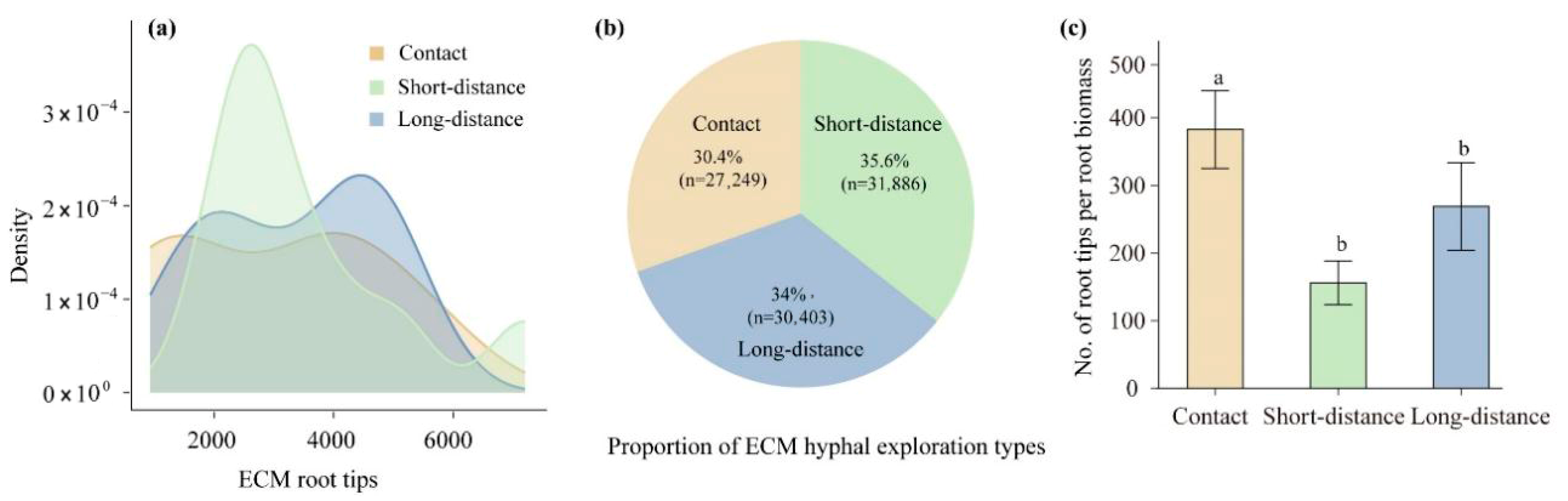
In total, 89,538 ectomycorrhizal root tips were sampled from the roots of 144 soil blocks across nine altitudinal sites within the three main distribution areas of Faxon fir (Figure 2). According to the morphological identification, nearly 70% of the ECM associations are hyphae-forming, including the short- and long-distance exploration types (Figure 2b).
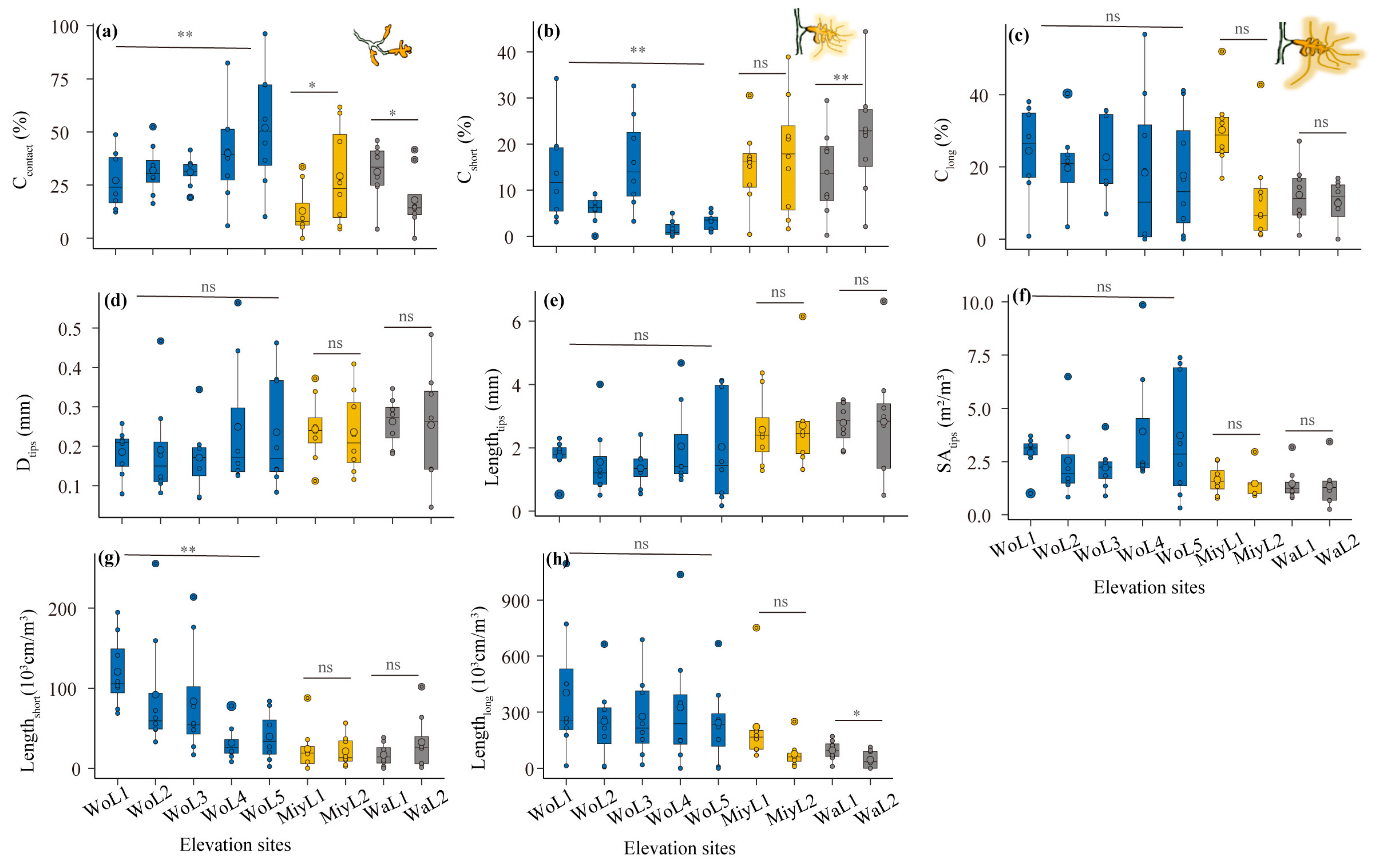
The morphological variation and plasticity in the EEM were greater than those in the ECM root tips. The RDPI values of the hyphae (Lengthshort) and rhizomorph length density (Lengthlong) were 0.86 and 0.89, respectively, whereas that of the ECM root tips (Lengthtips) was 0.35 (Table 1). The maximum value of the Lengthlong was up to 1.1 × 106 cm/m3 (Figure 3h). Lengthshort, Lengthlong, and Lengthtips were different across the study sites (Table 1, p < 0.05). Lengthshort significantly decreased with the elevation in WoL (Figure 3g, p < 0.01). In contrast, there were no significant changes in Dtips and Lengthtips along elevational gradients (Figure 3d,e, p > 0.05).
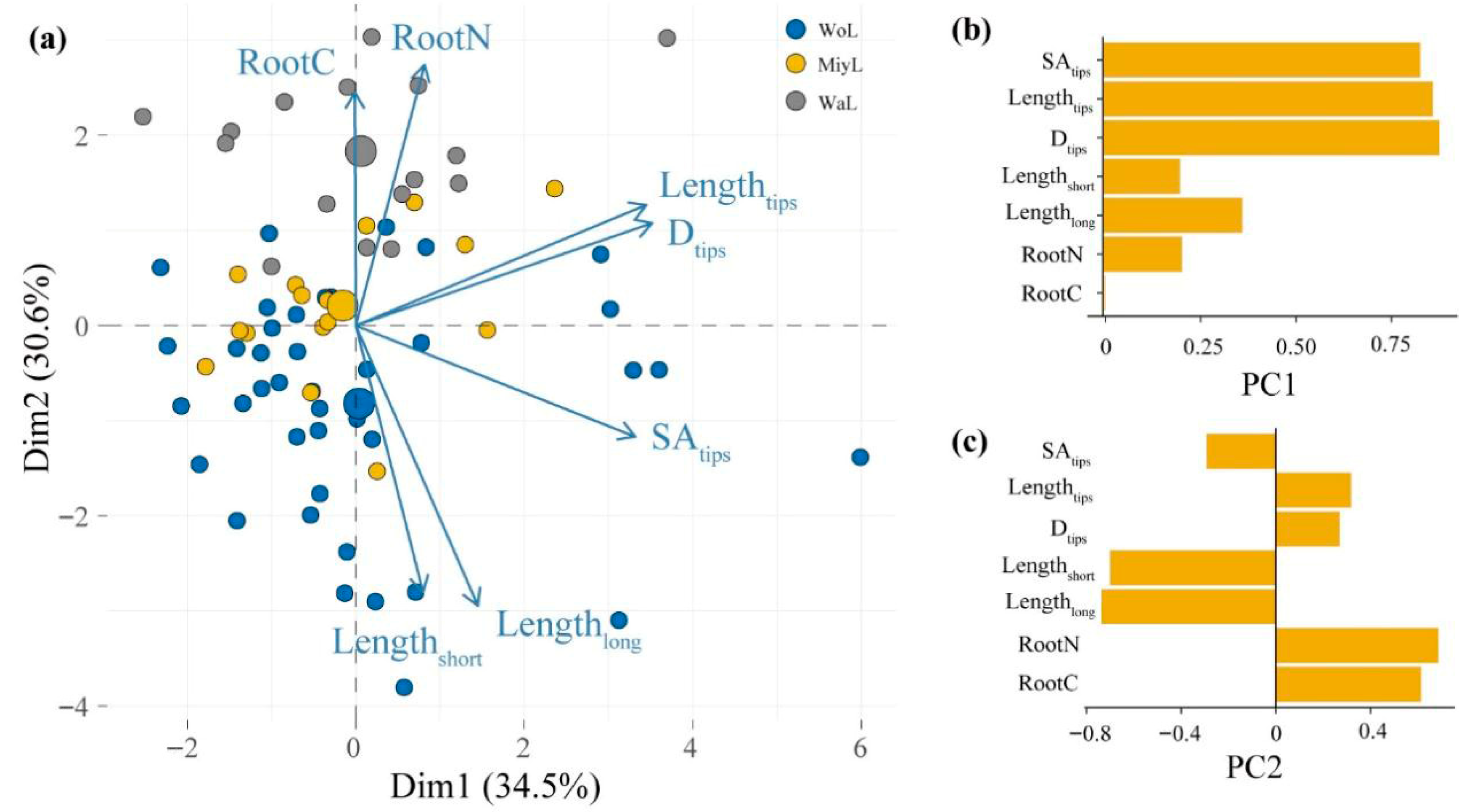
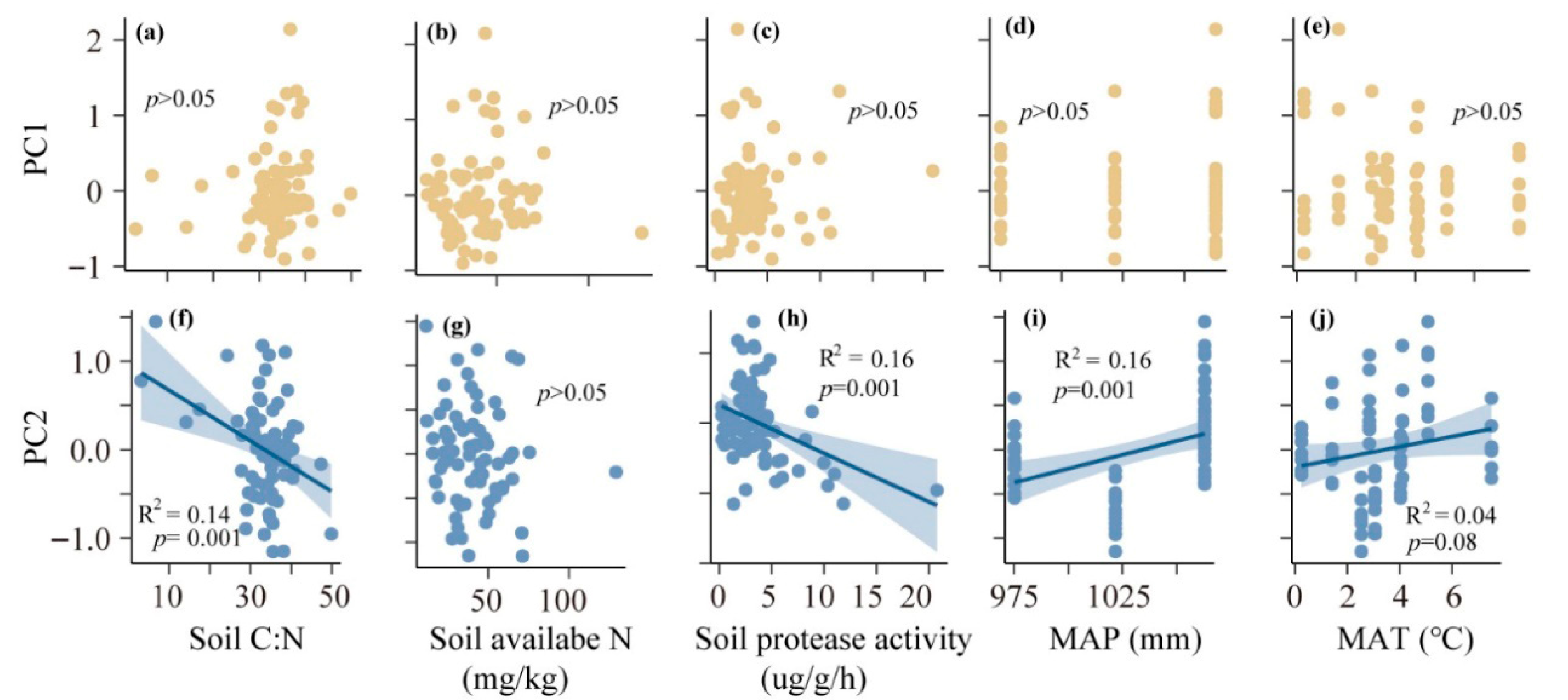
According to the PCA results, traits of ECM root tips were gathered at the PC1 axis by Lengthtips, Dtips, and SAtips, whilst Lengthshort and Lengthlong were gathered at the PC2 axis (Figure 4). The root C and N concentrations were gathered at PC2, opposite to the EEM traits. PC2 was negatively associated with the soil C:N ratio and soil protease activity, but positively related to the MAT and MAP (Figure 5).

3.2. Effects of Environmental Factors on ECM Morphological Traits

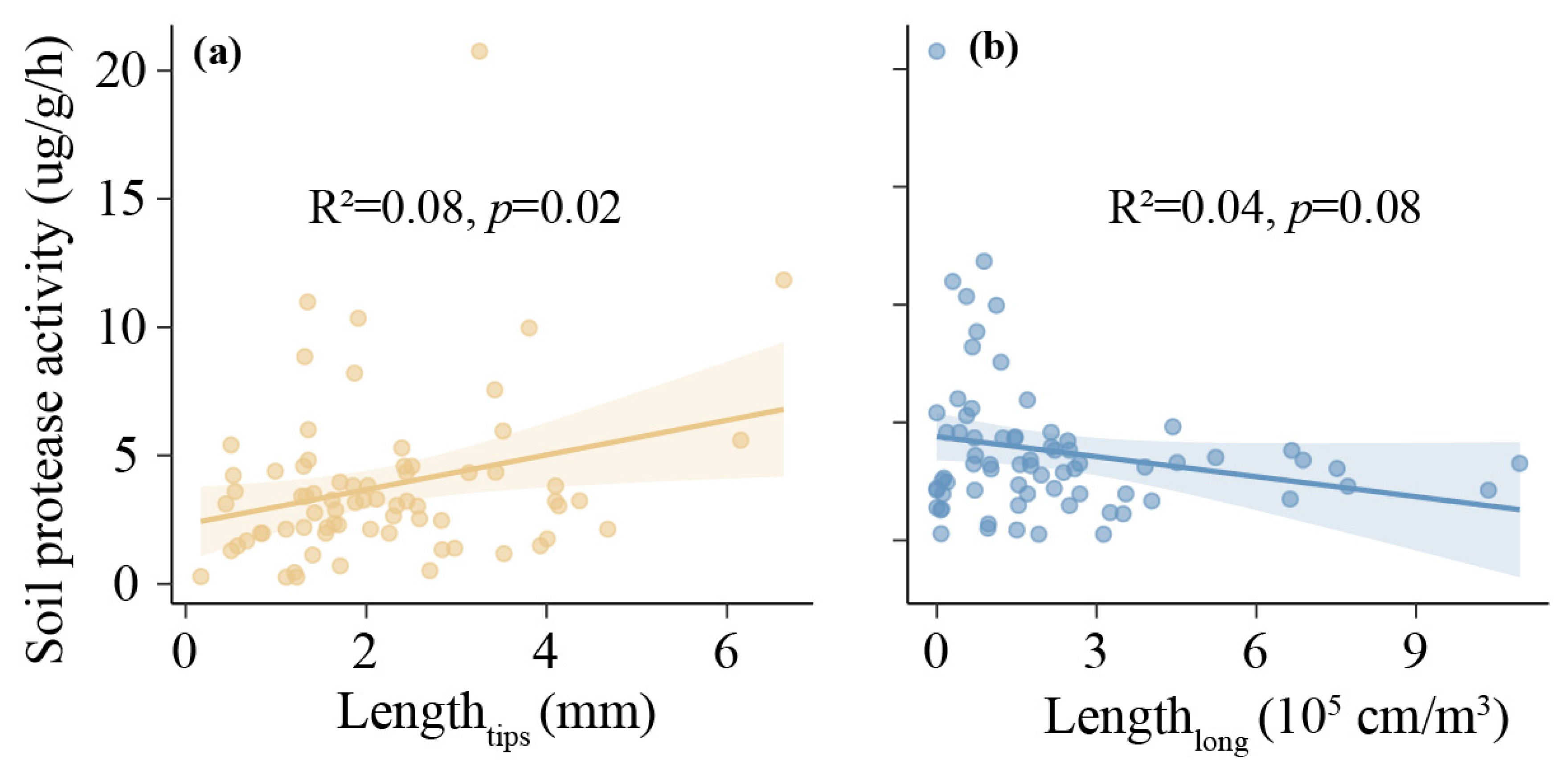
Generally, the soil protease activity, MAT, and MAP are three important factors associated with the EEM and ECM root traits (Table 2), and the EEM morphological traits were determined by MAT and MAP. Lengthlong was negatively related to the soil protease activity (p = 0.08, Figure 6b), whilst the Lengthtips was positively related to the soil protease activity (p = 0.02, Figure 6a).

3.3. Relationships of ECM Morphological Traits with Plant Root C and N Nutrients

The root N concentration was more variable than the root C concentration across the three study sites, as indicated by the CV values (Table 1). The root C and N concentrations were generally higher at the Wanglang Nature Reserve than at the other two sites (Wolong and Miyaluo Nature Reserve) (p < 0.001, Table 1).
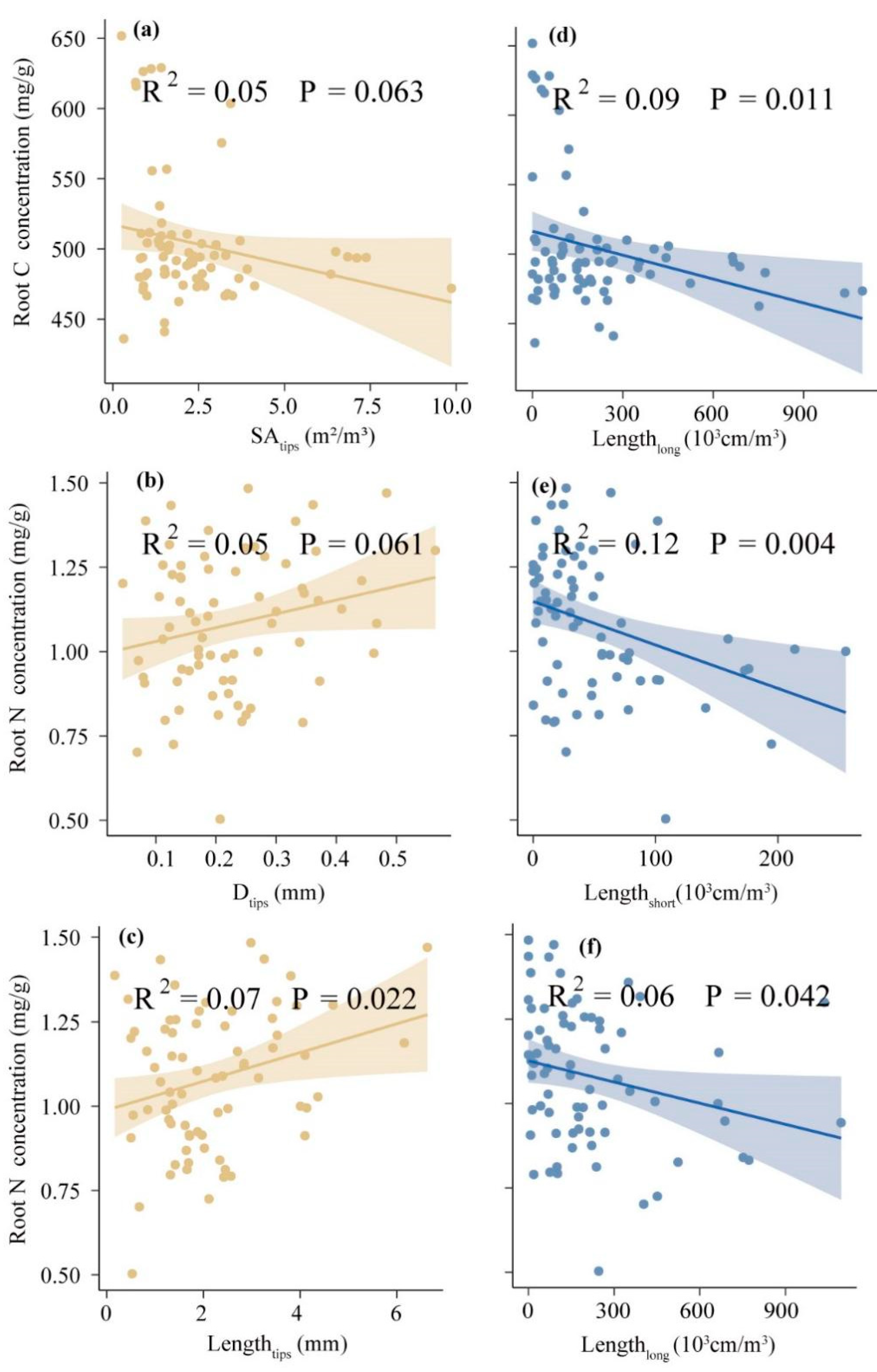
The root C concentration was negatively linked with SAtips (p = 0.06) and Lengthlong (p = 0.01) (Figure 7a,d). The trade-off relationships among the root C and root N concentrations and the EEM traits are exhibited in Figure 4. Properties related to EEM were negatively linked to the fine-root N concentration, such as Lengthshort (p = 0.004) and Lengthlong (p = 0.04) (Figure 7e,f). However, the morphological properties of hyphae-free ECM associations were positively related to the fine-root N concentration in general, as indicated by Dtips (p = 0.06) and Lengthtips (p = 0.02) (Figure 7b,c).

4. Discussion

The morphology plasticity (MP) of ECM symbionts reflects their adaptive strategies and nutrient-foraging mechanisms under specific environmental and resource conditions [51,52,53]. In this study, we focused on how the ECM morphological traits varied with the environmental conditions by observing ca. 90,000 ECM root tips of Faxon fir under a stereo-microscope. We obtained two key findings. First, the functional traits of the ECM extra-radical mycelium (EEM) and ECM root tips regulated the nutrient acquisition strategy in different ways (Figure 4 and Figure 6). While ECM root tips exhibited low morphological plasticity (Table 1), they were associated with high protease activity along environmental gradients (Figure 6a). In contrast, the EEM displayed extensive soil exploration, with hyphal densities reaching up to 1.1 × 106 cm/m3 from the root surface (Table 1; Figure 3h). Notably, EEM foraging length exhibited greater plasticity than ECM root tips across study sites (Table 1), supporting our first hypothesis. Second, we observed negative relationships between ECM root tip/EEM traits and root carbon (C) concentration. However, these traits differentially mediated fine-root nitrogen (N) nutrition in Faxon fir (Figure 7). Specifically, hyphae-forming exploration types (short- and long-distance) were associated with reduced root N concentrations—a finding that partially contradicts our second hypothesis.

4.1. Ectomycorrhizal Nutrient-Foraging Behavior of Host Tree by Morphological Traits

Our quantitative results demonstrated that extra-radical mycelium (EEM) extends nutrient exploration far beyond the rhizosphere (ca. 4 mm from the root surface) [54], with EEM lengths reaching up to 1.1 × 106 cm/m3 in soil (Figure 3). This exploration range significantly exceeds typical rhizospheric boundaries. Notably, a global estimate of ECM hyphal length density reported an average of 1.75 × 1011 cm/m3 [55]—substantially higher than our measurements—likely because our study specifically quantified EEM originating from roots, excluding dispersed soil hyphae. This is because we mainly focused on the EEM extending from the roots, excluding potential ECM hyphae in soil. Nutrient depletion zones usually form around the root tip, and NO3 and NH4+ are highly mobile in the rhizosphere [54], while the flexible EEM can cross these nutrient-depleted zones and increase the range of nutrient exploration. The EEM forages and translocates soil resources and colonizes root tips, representing an organ that is highly variable in its functional characteristics [56]. Our PCA results indicated that the morphological attributes of the EEM and ECM root tips were distinct traits with different dimensions (Figure 4a,b). Thus, EEM might compensate for the inability of the ECM root tips to forage for nutrients over a far distance in soil. These findings highlight the need to investigate trade-offs between EEM and root tip functional properties to advance our understanding of below-ground nutrient strategies in tree species.
Among the approximately 90,000 ECM root tips belonged to EEM-forming types (short- and long-distance exploration types; Figure 2), with EEM exhibiting high morphological plasticity (RDPI > 0.85) across environmental gradients (Table 1 and Table 2; Figure 5). Hyphal expansion and rhizomorphic formation could be facilitated by both warming and increased precipitation (Table 2; Figure 5). In subalpine ecosystems, warming likely enhances host tree carbon assimilation, potentially leading to greater carbon allocation to fungal symbionts [57]. This increased carbon availability may support the development of EEM-forming types, which typically require substantial carbon investment [32]. The proliferation of EEM-forming taxa could provide critical ecological advantages in N-limited subalpine ecosystems under climate change, enabling host plants to access distal nutrient sources and decompose recalcitrant organic matter [10,11]. Interestingly, our results contrast with studies reporting increased hyphal proliferation under drying conditions [58,59]. This discrepancy may arise because previous work primarily examined ECM colonization rates and fungal abundance, whereas we focused on morphological and functional traits. Importantly, ECM growth parameters (e.g., colonization rate and fungal abundance) and morphological characteristics may respond differently to environmental changes [18,24]. For example, while Russula species are typically classified as contact exploration types [26,52,60,61], they can exhibit short- or long-distance exploration strategies depending on host or environmental conditions [15,25,26]. However, most studies do not account for the morphological plasticity of ECM fungi in changing environments. Consequently, our findings demonstrating climate-induced enhancement of EEM length could be an important adaptation strategy and ecological function of ECM associations in Faxon fir.
The morphological traits of the ECM root tips in Faxon fir, such as the diameter, length, and superficial area, generally increased at higher elevation and latitudes, whereas those of the EEM decreased (Figure 3). This may be because the growth of active, energy-consuming ECM taxa is limited in high-altitude environments [52,62]. We suggest that Faxon fir relies more on ECM root tip attributes for nutrient capture at higher elevations in the Wolong Natural Reserve, and that the importance of the ECM root tips’ morphological attributes in nutrient capture by tree species increases as the habitat moves to higher latitudes. ECM taxa that are EEM-free (e.g., the contact exploration type) are more resilient in response to disturbances or other adverse conditions than EEM-forming fungi, because the former regenerate more readily than hyphal and/or rhizomorphic fungi [63]. This is because the structurally simple contact exploration type requires fewer plant photosynthesis products than the complex short- and long-distance exploration types, and it is more likely to grow in cold, low photosynthesis environments. Wang et al. [64] recently investigated the elevational adaptation mechanisms of Faxon fir in the southeastern Tibetan Plateau and also demonstrated that ectomycorrhizal fungal species with simple morphological structures (contact and short-distance exploration types) are more abundant in high-elevation environments. Argüelles-Moyao and Garibay-Orijel [62] also showed that the contact exploration type was dominant in Abies religiosa, growing at high altitudes (3000–3900 m asl.). Thus, ECM fungi with simple morphologies favor host adaptation to harsh environments at high altitudinal and latitudinal sites.
In wet and cold subalpine ecosystems, organic N is the main form of soil N [11,34]. As trees do not readily access organic N, ECM fungi locate and activate nutrients required for plant growth [11,65,66]. The ECM root tip length was significantly associated with high soil protease activity, and rhizomorph extension was linked to low activity (Figure 6). These results are not exactly what we expected. Traditional views hold that the extraradical mycelium is the primary structure for enzyme secretion in ECM fungi [20,33]. However, recent studies indicate that ECM root tips are the main sites of enzymatic activity [22]. Our findings support the latter perspective, as we observed a significant positive correlation between root tip functional traits and enzyme activities. Previous studies have reported that ECM taxa with rhizomorphs can very efficiently mobilize organic N from complex organics by producing relevant enzymes in response to low N conditions [14,22]. Our results do not support this finding, revealing the different foraging functions of ECM root tip and hyphae morphology traits [67]. We contend that long-distance explorers could explore soil resources for available N on a large scale from the root surface first, but that most enzymes are secreted onto the surfaces of the ECM root tips [19,68]. These results show that the EEM are dedicated to physical nutrient occupancy, whereas the root tips are a hotspot for degradative enzyme secretion, i.e., biochemical functional attributes [69,70]. These inconsistent findings suggest that greater consideration should be given to the functional differences among ECM fungal species and their distinct morphological structures. A study by Jörgensen et al. [18] in a Picea abies forest investigated the influence of nutrient conditions on morphological differentiation among ECM taxa, which demonstrated that soil resource availability primarily drives the expression of ECM fungal morphotypes. This morphological plasticity of ECM fungi is environmentally determined. Therefore, direct observation of ECM hyphal morphology and precise trait measurements are crucial for understanding their ecological functions.

4.2. ECM Morphological Traits Regulate Plant Nutrition Status in Different Ways

Our PCA results revealed trade-offs between the root nutrient levels and EEM on the second axis (PC2), which was negatively related to the soil C:N ratio and soil protease activity, suggesting that trade-offs were facilitated when the soil was N-limited, and this was associated with high soil protease activity. These trade-offs were also positively affected by climatic factors (Figure 5). Thus, environmental parameters control the relationships between the ECM functional traits and plant root nutrition.
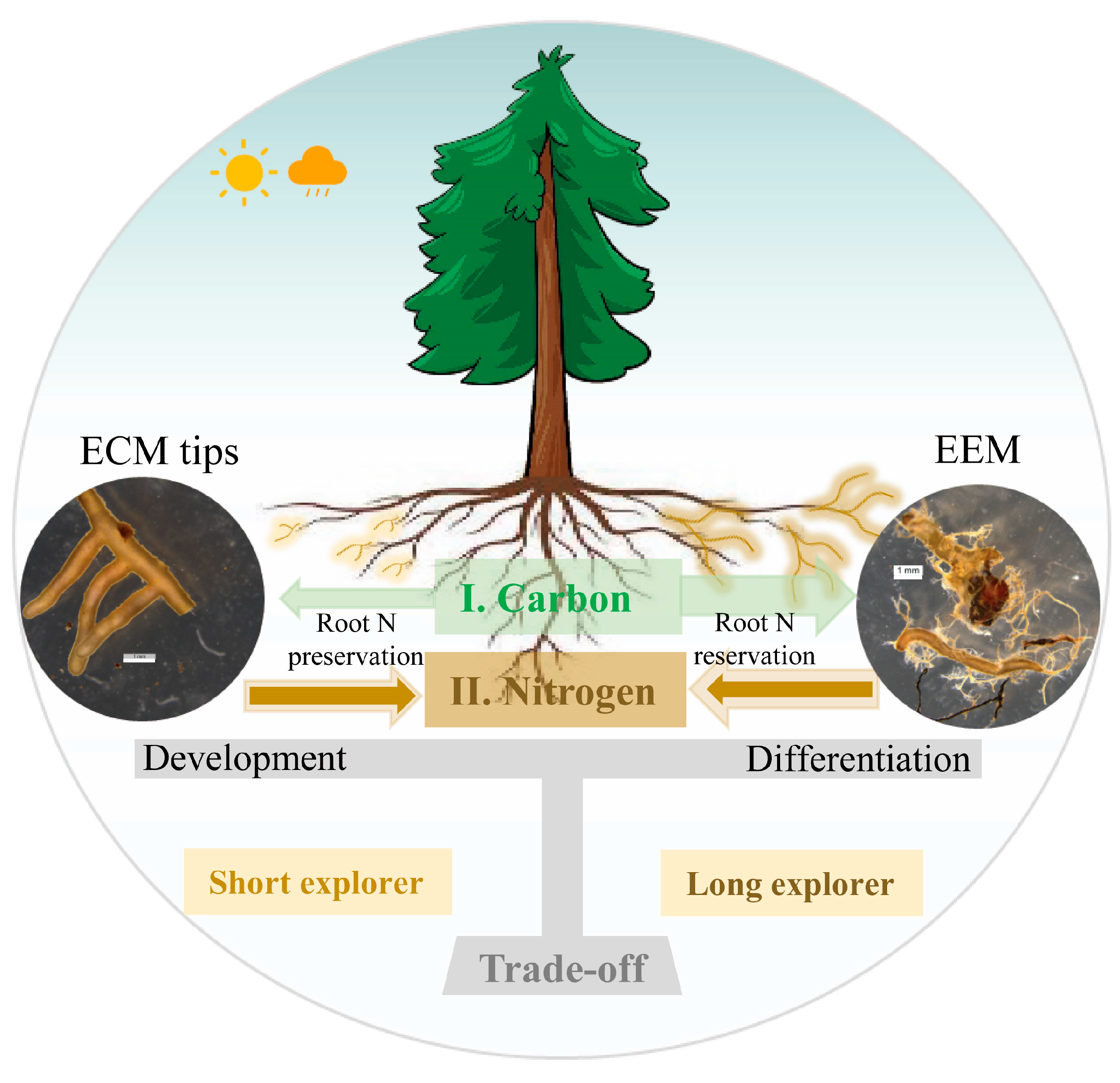
As expected, we detected negative relationships between ECM morphological traits and root C concentrations (Figure 7). It indicated that the morphological differentiation of ECM root tips and EEM reduced the root C nutrition in Faxon fir, as high C was allocated to ECM symbioses from trees in such N-limited subalpine forests [71]. We found that the ECM root tip traits tended to be positively associated with plant root N nutrition, whereas the EEM traits were negatively associated (Figure 4 and Figure 7), which contradicts our second hypothesis. The correlations between ECM exploration types and plant nutrients were not always positive [72,73]. The colonization proportions of contact exploration type and ECM root tip diameters generally increased at higher elevations (Figure 3a,d); ECM root tip thickening is a defense strategy used by trees growing in adverse environments [74,75]. In contrast to EEM, ECM root tips require less C and N for development and morphology differentiation, supporting the redundant N nutrition saved in hosts [75,76,77]. Moreover, it has been reported that ECM root tips have a stronger N enrichment capacity than EEM [66]. EEM exploring a greater distance and volume of the soil comes with a C cost that must be paid by the host trees [78,79], causing more N retention in ECM fungi for hyphal construction. This may be the reason that we did not observe a positive correlation between the EEM and tree N concentration in this study. Studies have confirmed that the proliferation and differentiation of ECM fungi could cause N depletion in hosts [32,71,78,80,81]. Accordingly, there may be an imbalance in C investment and N exchange between the hosts and EEM (Figure 8). In N-limited subalpine forests, EEM morphological differentiation may exacerbate host–ECM N nutrient competition (Figure 7 and Figure 8), leading to a more N-limited situation for tree species. The imbalance in investment and benefit in ectomycorrhizal symbioses and hosts can be a threat to the stability of subalpine forests, and more in-depth research into the mutualism for N-limited ecosystems is required.

5. Limitation

Although this study demonstrates that ECM morphotypes possess distinct functions, it argues that ECM morphological plasticity is an important strategy for tree species to cope with resource and environmental changes, and further hypothesizes that such plasticity might be independent of fungal species, we did not verify the decoupling relationship between fungal species and morphotypes through DNA sequencing. On the other hand, this study primarily focuses on how the soil C:N ratio shapes ECM morphological plasticity. However, in reality, soil physico-chemical properties such as texture, moisture content, and pH play critical roles in influencing ECM hyphal morphology and function. Therefore, future research should systematically investigate how soil biochemical environments shape ECM morphological traits.

6. Conclusions

According to our findings, we developed a conceptual model on the linkages of ECM functional traits and plant C and N nutrition. In summary, ECM fungi responded to environmental changes via the ECM root tips and the EEM. Nutrient acquisition trade-offs are apparent between the two modules in terms of nutrient space occupation, enzymatic secretion, and regulation of plant N assimilation. These complementary functional modules of ECM associations allow host trees to respond to changing environments. The morphologically complex ECM associations, e.g., the long-distance exploration type, may lead to a double reduction in root C and N concentrations, which may aggravate the nutrient limitations in the host tree of such N-limited subalpine forests. Our findings also allow us to reconsider the balance between carbon investment and nitrogen gain between host plants and symbiotic fungi. Future research on the environmental adaptation and conservation of subalpine conifer species should consider the roles played by the different functional modules of ECM fungi.

Supplementary Materials

The following supporting information can be downloaded at: https://www.mdpi.com/article/10.3390/f16111670/s1, Figure S1 Location of the study areas in Sichuan province, Southwest China.

Author Contributions

Conceptualization, methodology, investigation, and writing—original draft, L.C.; resources, methodology, and investigation, X.L.; supervision, methodology, and writing—original draft, Z.T.; supervision, funding support, investigation, and writing—review and revision, G.X. All authors have read and agreed to the published version of the manuscript.

Funding

This study was financially supported by the National Natural Science Foundation of China (Grant No. 32201321) and the scientific research project of Yunnan Zhaoling Technology Co., Ltd. (ZL20221110008).

Data Availability Statement

Data will be made available on request.

Acknowledgments

We thank Liangdong Guo and Songpo Wei for technical advice on ectomycorrhizal identification and classifications, and Baoming Ji for providing access to the microscopic facilities.

Conflicts of Interest

The authors declare no conflicts of interest.

Abbreviations

Ccontact: colonization ratio of contact exploration type; Cshort: colonization ratio of short-distance exploration type; Clong: colonization ratio of long-distance exploration type; Lengthhyphae: hyphae length density of the short-distance exploration type; Lengthrhizomorph: length density of the long-distance exploration type; Dtips: diameter of ECM root tips; Lengthtips: length of ECM root tips; SAtips: superficial area of ECM root tips; MAP: mean annual precipitation; MAT: mean annual temperature; RootN: fine-root N concentration; RootC: fine-root C concentration. WoL: Wolong Nature Reserve; WaL: Wanglang Nature Reserve; MiyL: Miyaluo Nature Reserve; WoL1: sampling at 2850 m asl. in WoL; WoL2: sampling at 3000 m asl. in WoL; WoL3: sampling at 3194 m asl. in WoL; WoL4: sampling at 3413 m asl. in WoL; WoL5: sampling at 3593 m asl. in WoL; MiyL1: sampling at 3077 m asl. in MiyL; MiyL2: sampling at 3150 m asl. in MiyL; WaL1: sampling at 3070 m asl. in WaL; WaL2: sampling at 3150 m asl. in WaL.

References

  1. Yuke, Z. Characterizing the spatio-temporal dynamics and variability in climate extremes over the Tibetan Plateau during 1960–2012. J. Resour. Ecol. 2019, 10, 397–414. [Google Scholar] [CrossRef]
  2. Zhang, Z.; Yuan, Y.; Liu, Q.; Yin, H. Plant nitrogen acquisition from inorganic and organic sources via root and mycelia pathways in ectomycorrhizal alpine forests. Soil Biol. Biochem. 2019, 136, 107517. [Google Scholar] [CrossRef]
  3. Chen, M.; Shi, Z.; Liu, S.; Xu, G.; Cao, X.; Chen, J.; Zhang, M.; Feng, Q.; Centritto, M.; Cao, J. Leaf functional traits have more contributions than climate to the variations of leaf stable carbon isotope of different plant functional types on the eastern Qinghai–Tibetan Plateau. Sci. Total Environ. 2023, 871, 162036. [Google Scholar] [CrossRef] [PubMed]
  4. Liu, S.; Xu, G.; Chen, H.; Zhang, M.; Cao, X.; Chen, M.; Chen, J.; Feng, Q.; Shi, Z. Contrasting responses of soil microbial biomass and extracellular enzyme activity along an elevation gradient on the eastern Qinghai-Tibetan Plateau. Front. Microbiol. 2023, 14, 974316. [Google Scholar] [CrossRef] [PubMed]
  5. Reithmeier, L.; Kernaghan, G. Availability of ectomycorrhizal fungi to black spruce above the present treeline in eastern Labrador. PLoS ONE 2013, 8, e77527. [Google Scholar]
  6. Hobbie, J.E.; Hobbie, E.A. 15N in symbiotic fungi and plants estimates nitrogen and carbon flux rates in Arctic tundra. Ecology 2006, 87, 816–822. [Google Scholar] [CrossRef]
  7. Van Der Heijden, M.G.; Bardgett, R.D.; Van Straalen, N.M. The unseen majority: Soil microbes as drivers of plant diversity and productivity in terrestrial ecosystems. Ecol. Lett. 2008, 11, 296–310. [Google Scholar] [CrossRef]
  8. Smith, S.E.; Read, D.J. Mycorrhizal Symbiosis; Academic Press: Cambridge, MA, USA, 2010. [Google Scholar]
  9. Perez-Moreno, J.; Read, D. Mobilization and transfer of nutrients from litter to tree seedlings via the vegetative mycelium of ectomycorrhizal plants. New Phytol. 2000, 145, 301–309. [Google Scholar] [CrossRef]
  10. Hobbie, E.A.; Agerer, R. Nitrogen isotopes in ectomycorrhizal sporocarps correspond to belowground exploration types. Plant Soil 2010, 327, 71–83. [Google Scholar]
  11. Pellitier, P.T.; Zak, D.R. Ectomycorrhizal fungal decay traits along a soil nitrogen gradient. New Phytol. 2021, 232, 2152–2164. [Google Scholar] [CrossRef]
  12. Kennedy, P.G.; Bruns, T.D. Priority effects determine the outcome of ectomycorrhizal competition between two Rhizopogon species colonizing Pinus muricata seedlings. New Phytol. 2005, 166, 631–638. [Google Scholar] [CrossRef]
  13. Bogar, L.M.; Tavasieff, O.S.; Raab, T.K.; Peay, K.G. Does resource exchange in ectomycorrhizal symbiosis vary with competitive context and nitrogen addition? New Phytol. 2022, 233, 1331–1344. [Google Scholar]
  14. Lilleskov, E.; Hobbie, E.A.; Horton, T. Conservation of ectomycorrhizal fungi: Exploring the linkages between functional and taxonomic responses to anthropogenic N deposition. Fungal Ecol. 2011, 4, 174–183. [Google Scholar] [CrossRef]
  15. Agerer, R. Exploration types of ectomycorrhizae: A proposal to classify ectomycorrhizal mycelial systems according to their patterns of differentiation and putative ecological importance. Mycorrhiza 2001, 11, 107–114. [Google Scholar]
  16. Genney, D.R.; Anderson, I.C.; Alexander, I.J. Fine-scale distribution of pine ectomycorrhizas and their extramatrical mycelium. New Phytol. 2006, 170, 381–390. [Google Scholar] [PubMed]
  17. Bahr, A.; Ellström, M.; Bergh, J.; Wallander, H. Nitrogen leaching and ectomycorrhizal nitrogen retention capacity in a Norway spruce forest fertilized with nitrogen and phosphorus. Plant Soil 2015, 390, 323–335. [Google Scholar] [CrossRef]
  18. Jörgensen, K.; Clemmensen, K.E.; Wallander, H.; Lindahl, B.D. Do ectomycorrhizal exploration types reflect mycelial foraging strategies? New Phytol. 2023, 237, 576–584. [Google Scholar] [PubMed]
  19. Tedersoo, L.; Bahram, M.; Toots, M.; Diedhiou, A.G.; Henkel, T.W.; Kjøller, R.; Morris, M.H.; Nara, K.; Nouhra, E.; Peay, K.G. Towards global patterns in the diversity and community structure of ectomycorrhizal fungi. Mol. Ecol. 2012, 21, 4160–4170. [Google Scholar] [CrossRef]
  20. Rineau, F.; Stas, J.; Nguyen, N.H.; Kuyper, T.W.; Carleer, R.; Vangronsveld, J.; Colpaert, J.V.; Kennedy, P.G. Ectomycorrhizal fungal protein degradation ability predicted by soil organic nitrogen availability. Appl. Environ. Microbiol. 2016, 82, 1391–1400. [Google Scholar] [CrossRef] [PubMed]
  21. Finlay, R.D. Ecological aspects of mycorrhizal symbiosis: With special emphasis on the functional diversity of interactions involving the extraradical mycelium. J. Exp. Bot. 2008, 59, 1115–1126. [Google Scholar] [CrossRef]
  22. Clemmensen, K.E.; Finlay, R.D.; Dahlberg, A.; Stenlid, J.; Wardle, D.A.; Lindahl, B.D. Carbon sequestration is related to mycorrhizal fungal community shifts during long-term succession in boreal forests. New Phytol. 2015, 205, 1525–1536. [Google Scholar] [CrossRef]
  23. Genre, A.; Lanfranco, L.; Perotto, S.; Bonfante, P. Unique and common traits in mycorrhizal symbioses. Nat. Rev. Microbiol. 2020, 18, 649–660. [Google Scholar] [CrossRef]
  24. van der Linde, S.; Suz, L.M.; Orme, C.D.L.; Cox, F.; Andreae, H.; Asi, E.; Atkinson, B.; Benham, S.; Carroll, C.; Cools, N. Environment and host as large-scale controls of ectomycorrhizal fungi. Nature 2018, 558, 243–248. [Google Scholar] [CrossRef]
  25. Fernandez, C.W.; Nguyen, N.H.; Stefanski, A.; Han, Y.; Hobbie, S.E.; Montgomery, R.A.; Reich, P.B.; Kennedy, P.G. Ectomycorrhizal fungal response to warming is linked to poor host performance at the boreal-temperate ecotone. Glob. Chang. Biol. 2017, 23, 1598–1609. [Google Scholar]
  26. Rambold, G.; Agerer, R. DEEMY–the concept of a characterization and determination system for ectomycorrhizae. Mycorrhiza 1997, 7, 113–116. [Google Scholar] [CrossRef]
  27. Zhang, J.; He, N.; Liu, C.; Xu, L.; Chen, Z.; Li, Y.; Wang, R.; Yu, G.; Sun, W.; Xiao, C. Variation and evolution of C: N ratio among different organs enable plants to adapt to N-limited environments. Glob. Change Biol. 2020, 26, 2534–2543. [Google Scholar] [CrossRef] [PubMed]
  28. Razaq, M.; Salahuddin; Shen, H.-l.; Sher, H.; Zhang, P. Influence of biochar and nitrogen on fine root morphology, physiology, and chemistry of Acer mono. Sci. Rep. 2017, 7, 5367. [Google Scholar] [CrossRef]
  29. You, C.; Li, J.; Yang, K.; Tan, B.; Yin, R.; Li, H.; Zhang, L.; Cui, X.; Liu, S.; Wang, L. Variations and patterns of C and N stoichiometry in the first five root branch orders across 218 woody plant species. New Phytol. 2023, 238, 1838–1848. [Google Scholar] [CrossRef] [PubMed]
  30. Phillips, R.P.; Brzostek, E.; Midgley, M.G. The mycorrhizal-associated nutrient economy: A new framework for predicting carbon–nutrient couplings in temperate forests. New Phytol. 2013, 199, 41–51. [Google Scholar] [CrossRef] [PubMed]
  31. Bergmann, J.; Weigelt, A.; van Der Plas, F.; Laughlin, D.C.; Kuyper, T.W.; Guerrero-Ramirez, N.; Valverde-Barrantes, O.J.; Bruelheide, H.; Freschet, G.T.; Iversen, C.M. The fungal collaboration gradient dominates the root economics space in plants. Sci. Adv. 2020, 6, eaba3756. [Google Scholar] [CrossRef]
  32. Hobbie, E.A.; Bendiksen, K.; Thorp, N.R.; Ohenoja, E.; Ouimette, A.P. Climate records, isotopes, and C: N stoichiometry reveal carbon and nitrogen flux dynamics differ between functional groups of ectomycorrhizal fungi. Ecosystems 2022, 25, 1207–1217. [Google Scholar] [CrossRef]
  33. Tedersoo, L.; Naadel, T.; Bahram, M.; Pritsch, K.; Buegger, F.; Leal, M.; Kõljalg, U.; Põldmaa, K. Enzymatic activities and stable isotope patterns of ectomycorrhizal fungi in relation to phylogeny and exploration types in an afrotropical rain forest. New Phytol. 2012, 195, 832–843. [Google Scholar] [CrossRef]
  34. Chen, L.; Wang, M.; Jiang, C.; Wang, X.; Feng, Q.; Liu, X.; Sun, O.J. Choices of ectomycorrhizal foraging strategy as an important mechanism of environmental adaptation in Faxon fir (Abies fargesii var. faxoniana). For. Ecol. Manag. 2021, 495, 119372. [Google Scholar] [CrossRef]
  35. Zhao, Z.; Eamus, D.; Yu, Q.; Li, Y.; Yang, H.; Li, J. Climate constraints on growth and recruitment patterns of Abies faxoniana over altitudinal gradients in the Wanglang Natural Reserve, eastern Tibetan Plateau. Aust. J. Bot. 2012, 60, 602–614. [Google Scholar] [CrossRef]
  36. Li, Z.; Liu, G.; Fu, B.; Zhang, Q.; Ma, K.; Pederson, N. The growth-ring variations of alpine shrub Rhododendron przewalskii reflect regional climate signals in the alpine environment of Miyaluo Town in Western Sichuan Province, China. Acta Ecol. Sin. 2013, 33, 23–31. [Google Scholar] [CrossRef]
  37. Li, Z.; Keyimu, M.; Fan, Z.; Wang, X. Climate sensitivity of conifer growth doesn’t reveal distinct low–high dipole along the elevation gradient in the Wolong National Natural Reserve, SW China. Dendrochronologia 2020, 61, 125702. [Google Scholar] [CrossRef]
  38. Mitchell, K. Quantitative analysis by the point-centered quarter method. arXiv 2010, arXiv:1010.3303. [Google Scholar]
  39. Pregitzer, K.S.; DeForest, J.L.; Burton, A.J.; Allen, M.F.; Ruess, R.W.; Hendrick, R.L. Fine root architecture of nine North American trees. Ecol. Monogr. 2002, 72, 293–309. [Google Scholar] [CrossRef]
  40. Köhler, J.; Yang, N.; Pena, R.; Raghavan, V.; Polle, A.; Meier, I.C. Ectomycorrhizal fungal diversity increases phosphorus uptake efficiency of European beech. New Phytol. 2018, 220, 1200–1210. [Google Scholar] [CrossRef]
  41. Agerer, R. Fungal relationships and structural identity of their ectomycorrhizae. Mycol. Prog. 2006, 5, 67–107. [Google Scholar] [CrossRef]
  42. Chen, L.; Jiang, C.; Wang, X.; Feng, Q.; Liu, X.; Tang, Z.; Sun, O.J. Nutrient trade-offs mediated by ectomycorrhizal strategies in plants: Evidence from an Abies species in subalpine forests. Ecol. Evol. 2021, 11, 5281–5294. [Google Scholar] [CrossRef]
  43. Valladares, F.; Sanchez-Gomez, D.; Zavala, M.A. Quantitative estimation of phenotypic plasticity: Bridging the gap between the evolutionary concept and its ecological applications. J. Ecol. 2006, 94, 1103–1116. [Google Scholar] [CrossRef]
  44. Gallaher, R.; Weldon, C.; Boswell, F. A semiautomated procedure for total nitrogen in plant and soil samples. Soil Sci. Soc. Am. J. 1976, 40, 887–889. [Google Scholar] [CrossRef]
  45. Nelson, D.A.; Sommers, L.E. Total carbon, organic carbon, and organic matter. Methods Soil Anal. Part 2 Chem. Microbiol. Prop. 1983, 9, 539–579. [Google Scholar]
  46. Ladd, J.; Butler, J. Short-term assays of soil proteolytic enzyme activities using proteins and dipeptide derivatives as substrates. Soil Biol. Biochem. 1972, 4, 19–30. [Google Scholar] [CrossRef]
  47. Maynard, D.; Kalra, Y.; Crumbaugh, J. Nitrate and exchangeable ammonium nitrogen. Soil Sampl. Methods Anal. 1993, 1, 25–38. [Google Scholar]
  48. New, M.; Hulme, M.; Jones, P. Representing twentieth-century space–time climate variability. Part II: Development of 1901–96 monthly grids of terrestrial surface climate. J. Clim. 2000, 13, 2217–2238. [Google Scholar] [CrossRef]
  49. Xu, Y.; Gao, X.; Shen, Y.; Xu, C.; Shi, Y.; Giorgi, A. A daily temperature dataset over China and its application in validating a RCM simulation. Adv. Atmos. Sci. 2009, 26, 763–772. [Google Scholar] [CrossRef]
  50. Zhao, T.; Guo, W.; Fu, C. Calibrating and evaluating reanalysis surface temperature error by topographic correction. J. Clim. 2008, 21, 1440–1446. [Google Scholar] [CrossRef]
  51. Wadud, M.A.; Nara, K.; Lian, C.; Ishida, T.A.; Hogetsu, T. Genet dynamics and ecological functions of the pioneer ectomycorrhizal fungi Laccaria amethystina and Laccaria laccata in a volcanic desert on Mount Fuji. Mycorrhiza 2014, 24, 551–563. [Google Scholar] [CrossRef]
  52. Rosinger, C.; Sandén, H.; Matthews, B.; Mayer, M.; Godbold, D.L. Patterns in ectomycorrhizal diversity, community composition, and exploration types in European beech, pine, and spruce forests. Forests 2018, 9, 445. [Google Scholar] [CrossRef]
  53. Arunrat, N.; Sansupa, C.; Sereenonchai, S.; Hatano, R. Short-term response of soil bacterial and fungal communities to fire in rotational shifting cultivation, northern Thailand. Appl. Soil Ecol. 2024, 196, 105303. [Google Scholar] [CrossRef]
  54. Kuzyakov, Y.; Razavi, B.S. Rhizosphere size and shape: Temporal dynamics and spatial stationarity. Soil Biol. Biochem. 2019, 135, 343–360. [Google Scholar] [CrossRef]
  55. See, C.R.; Keller, A.B.; Hobbie, S.E.; Kennedy, P.G.; Weber, P.K.; Pett-Ridge, J. Hyphae move matter and microbes to mineral microsites: Integrating the hyphosphere into conceptual models of soil organic matter stabilization. Glob. Change Biol. 2022, 28, 2527–2540. [Google Scholar] [CrossRef] [PubMed]
  56. Fernandez, C.W. The advancing mycelial frontier of ectomycorrhizal fungi. New Phytol. 2021, 230, 1296–1299. [Google Scholar] [CrossRef] [PubMed]
  57. Ekblad, A.; Wallander, H.; Godbold, D.L.; Cruz, C.; Johnson, D.; Baldrian, P.; Björk, R.; Epron, D.; Kieliszewska-Rokicka, B.; Kjøller, R. The production and turnover of extramatrical mycelium of ectomycorrhizal fungi in forest soils: Role in carbon cycling. Plant Soil 2013, 366, 1–27. [Google Scholar] [CrossRef]
  58. Fernandez, C.W.; Mielke, L.; Stefanski, A.; Bermudez, R.; Hobbie, S.E.; Montgomery, R.A.; Reich, P.B.; Kennedy, P.G. Climate change–induced stress disrupts ectomycorrhizal interaction networks at the boreal–temperate ecotone. Proc. Natl. Acad. Sci. USA 2023, 120, e2221619120. [Google Scholar] [CrossRef]
  59. Ding, J.; Yin, H.; Kong, D.; Liu, Q.; Zhang, Z.; Wang, Q.; Guo, W.; Valverde-Barrantes, O.J.; Wang, J.; Liu, Z. Precipitation, rather than temperature drives coordination of multidimensional root traits with ectomycorrhizal fungi in alpine coniferous forests. J. Ecol. 2023, 111, 1935–1949. [Google Scholar] [CrossRef]
  60. Brand, F. Ektomykorrhizen an Fagus sylvatica. In Charakter Isierung Und Identifizierung, ökologische Kennzeichnung Undunsterile Kultivierung; Libri Botanici; IHV-Verlag: Eching, Germany, 1991. [Google Scholar]
  61. Defrenne, C.E.; Philpott, T.J.; Guichon, S.H.; Roach, W.J.; Pickles, B.J.; Simard, S.W. Shifts in ectomycorrhizal fungal communities and exploration types relate to the environment and fine-root traits across interior Douglas-fir forests of western Canada. Front. Plant Sci. 2019, 10, 643. [Google Scholar] [CrossRef]
  62. Argüelles-Moyao, A.; Garibay-Orijel, R. Ectomycorrhizal fungal communities in high mountain conifer forests in central Mexico and their potential use in the assisted migration of Abies religiosa. Mycorrhiza 2018, 28, 509–521. [Google Scholar] [CrossRef] [PubMed]
  63. Tedersoo, L.; Smith, M.E. Lineages of ectomycorrhizal fungi revisited: Foraging strategies and novel lineages revealed by sequences from belowground. Fungal Biol. Rev. 2013, 27, 83–99. [Google Scholar] [CrossRef]
  64. Wang, G.; Yang, H.; Zhang, P.; Wang, Q.; Wang, D.; Feng, Q.; Yin, H. Shifts in ectomycorrhizal exploration types complement root traits in nutrient foraging of alpine coniferous forests along an elevation gradient. Plant Soil 2025, 1–14. [Google Scholar] [CrossRef]
  65. Haas, J.C.; Street, N.R.; Sjödin, A.; Lee, N.M.; Högberg, M.N.; Näsholm, T.; Hurry, V. Microbial community response to growing season and plant nutrient optimisation in a boreal Norway spruce forest. Soil Biol. Biochem. 2018, 125, 197–209. [Google Scholar] [CrossRef]
  66. Khokon, A.M.; Janz, D.; Polle, A. Ectomycorrhizal diversity, taxon-specific traits and root N uptake in temperate beech forests. New Phytol. 2023, 239, 739–751. [Google Scholar] [PubMed]
  67. Fernandez, C.W.; Langley, J.A.; Chapman, S.; McCormack, M.L.; Koide, R.T. The decomposition of ectomycorrhizal fungal necromass. Soil Biol. Biochem. 2016, 93, 38–49. [Google Scholar] [CrossRef]
  68. Rineau, F.; Garbaye, J. Does forest liming impact the enzymatic profiles of ectomycorrhizal communities through specialized fungal symbionts? Mycorrhiza 2009, 19, 493–500. [Google Scholar] [CrossRef]
  69. Jones, A.M.; Berkelmans, R.; van Oppen, M.J.; Mieog, J.C.; Sinclair, W. A community change in the algal endosymbionts of a scleractinian coral following a natural bleaching event: Field evidence of acclimatization. Proc. R. Soc. B Biol. Sci. 2008, 275, 1359–1365. [Google Scholar]
  70. Martínez-García, L.B.; De Deyn, G.B.; Pugnaire, F.I.; Kothamasi, D.; van der Heijden, M.G. Symbiotic soil fungi enhance ecosystem resilience to climate change. Glob. Change Biol. 2017, 23, 5228–5236. [Google Scholar]
  71. Högberg, M.N.; Högberg, P.; Wallander, H.; Nilsson, L.O. Carbon–nitrogen relations of ectomycorrhizal mycelium across a natural nitrogen supply gradient in boreal forest. New Phytol. 2021, 232, 1839–1848. [Google Scholar] [CrossRef]
  72. De Witte, L.; Rosenstock, N.; Van Der Linde, S.; Braun, S. Nitrogen deposition changes ectomycorrhizal communities in Swiss beech forests. Sci. Total Environ. 2017, 605, 1083–1096. [Google Scholar] [CrossRef]
  73. Guignabert, A.; Delerue, F.; Gonzalez, M.; Augusto, L.; Bakker, M.R. Effects of management practices and topography on ectomycorrhizal fungi of maritime pine during seedling recruitment. Forests 2018, 9, 245. [Google Scholar] [CrossRef]
  74. Kong, D.; Ma, C.; Zhang, Q.; Li, L.; Chen, X.; Zeng, H.; Guo, D. Leading dimensions in absorptive root trait variation across 96 subtropical forest species. New Phytol. 2014, 203, 863–872. [Google Scholar] [CrossRef] [PubMed]
  75. Pierick, K.; Link, R.M.; Leuschner, C.; Homeier, J. Elevational trends of tree fine root traits in species-rich tropical Andean forests. Oikos 2023, 2023, e08975. [Google Scholar] [CrossRef]
  76. Roumet, C.; Birouste, M.; Picon-Cochard, C.; Ghestem, M.; Osman, N.; Vrignon-Brenas, S.; Cao, K.F.; Stokes, A. Root structure–function relationships in 74 species: Evidence of a root economics spectrum related to carbon economy. New Phytol. 2016, 210, 815–826. [Google Scholar] [CrossRef]
  77. Weemstra, M.; Mommer, L.; Visser, E.J.; van Ruijven, J.; Kuyper, T.W.; Mohren, G.M.; Sterck, F.J. Towards a multidimensional root trait framework: A tree root review. New Phytol. 2016, 211, 1159–1169. [Google Scholar] [CrossRef]
  78. Hasselquist, N.J.; Metcalfe, D.B.; Inselsbacher, E.; Stangl, Z.; Oren, R.; Näsholm, T.; Högberg, P. Greater carbon allocation to mycorrhizal fungi reduces tree nitrogen uptake in a boreal forest. Ecology 2016, 97, 1012–1022. [Google Scholar] [CrossRef]
  79. Weigt, R.B.; Raidl, S.; Verma, R.; Agerer, R. Exploration type-specific standard values of extramatrical mycelium–a step towards quantifying ectomycorrhizal space occupation and biomass in natural soil. Mycol. Prog. 2012, 11, 287–297. [Google Scholar] [CrossRef]
  80. Näsholm, T.; Högberg, P.; Franklin, O.; Metcalfe, D.; Keel, S.G.; Campbell, C.; Hurry, V.; Linder, S.; Högberg, M.N. Are ectomycorrhizal fungi alleviating or aggravating nitrogen limitation of tree growth in boreal forests? New Phytol. 2013, 198, 214–221. [Google Scholar] [CrossRef]
  81. Anderson, I.C.; Genney, D.R.; Alexander, I.J. Fine-scale diversity and distribution of ectomycorrhizal fungal mycelium in a S cots pine forest. New Phytol. 2014, 201, 1423–1430. [Google Scholar] [CrossRef] [PubMed]
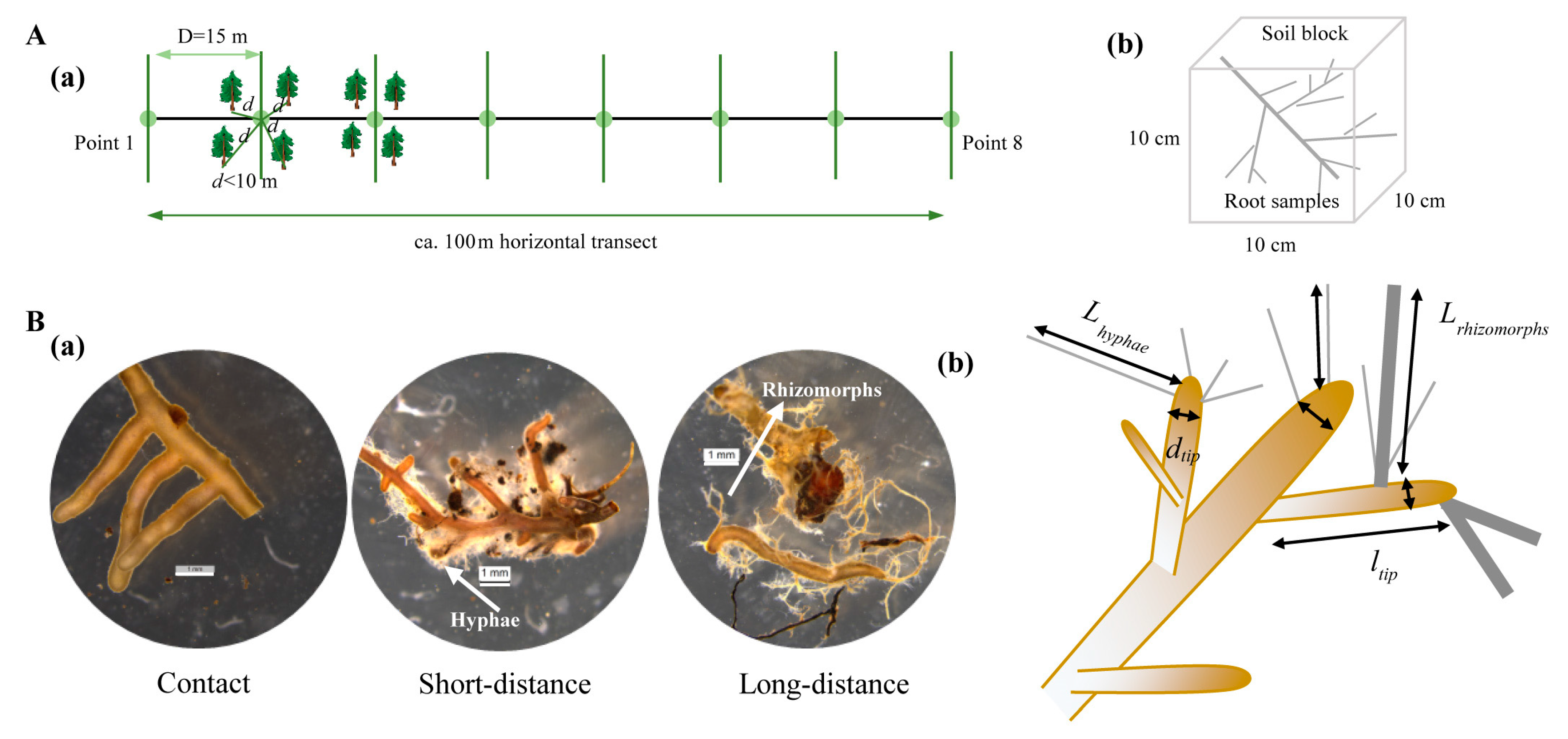
Figure 1. (A) Field survey and sampling methods. (a) Eight center points were selected at each elevation site, and four sub-replicates were surveyed per point; (b) A cubic soil block of 10 cm × 10 cm × 10 cm in a dimension was collected for each tree, resulting in 32 soil blocks at each elevation site. D: distance between two center points, d: distance of the sampling tree from the center point. (B) Conceptual model of the nutrient-foraging distances of ECM hyphal exploration types in soil. (a) Overview of hyphal exploration types. Contact exploration type (Contact): ECM root tips with no extra-radical mycelium. Short-distance exploration type (Short-distance): ECM root tips with abundant short hyphae. Long-distance exploration type (Long-distance): ECM root tips with rhizomorphs; (b) measurements of ECM root tips and extraradical mycelium. Lhyphae: the maximum length of the hyphae from the root tip; Lrhizomorphs: the maximum length of the rhizomorph from the root tip; dtip: the diameter of the ECM root distal tip; ltip: the length of the ECM root distal tip.
Forests 16 01670 g001
Figure 2. Pattern of occurrence of hyphal exploration types. (a) Density distribution of ECM root tips in different hyphal exploration types; (b) proportion of ECM root tips in different hyphal exploration types; (c) number of root tips per fine-root biomass by the three hyphal exploration types; different letters indicate significant differences, p < 0.05.
Forests 16 01670 g002
Figure 3. Variations in ECM morphological traits among different elevational sites. (a) Ccontact: colonization ratio of contact exploration type; (b) Cshort: colonization ratio of short-distance exploration type; (c) Clong: colonization ratio of long-distance exploration type; (d) Dtips: diameter of ECM root tips; (e) Lengthtips: length of ECM root tips; (f) SAtips: superficial area of ECM root tips; (g) Lengthshort: hyphae length density of short-distance exploration type; (h) Lengthlong: length density of long-distance exploration type. * p < 0.05; ** p < 0.01. WoL1: sampling at 2850 m asl. in WoL; WoL2: sampling at 3000 m asl. in WoL; WoL3: sampling at 3194 m asl. in WoL; WoL4: sampling at 3413 m asl. in WoL; WoL5: sampling at 3593 m asl. in WoL; MiyL1: sampling at 3077 m asl. in MiyL; MiyL2: sampling at 3150 m asl. in MiyL; WaL1: sampling at 3070 m asl. in WaL; WaL2: sampling at 3150 m asl. in WaL. Mean ± se.
Forests 16 01670 g003
Figure 4. (a) Biplot resulting from PCA, where point colors represent ECM morphological function traits following different study sites. The results are expressed as a biplot, where the distance and direction from the axis center have the same meaning for ECM variables; (b,c) barplot for the loadings of each variable on the retained PC1 (b) and PC2 (c). PC1 represents the trade-offs between root nutrients and ECM hyphal length, and PC2 was gathered by ECM root tip traits. Lengthshort: hyphae length density of short-distance exploration type, Lengthlong: length density of long-distance exploration type, Dtips: diameter of ECM root tips; Lengthtips: length of ECM root tips; SAtips: superficial area of ECM root tips; RootN: fine-root N concentration; RootC: fine-root C concentration.
Forests 16 01670 g004
Figure 5. Relationships between PCs (according to PCA results) and soil variables by linear regression. Relationships of PC1 with soil C:N (a), soil available N (b), soil protease activity (c), MAP (d), MAT (e); relationships of PC2 with soil C:N (f), soil available N (g), soil protease activity (h), MAP (i), MAT (j). Soil C:N: soil C to N ratio; MAP: mean annual precipitation; MAT: mean annual temperature.
Forests 16 01670 g005
Figure 6. Relationships of soil protease activity with the length of ectomycorrhizal root tips (a) and long-distance exploration type (b). Lengthlong: length density of long-distance exploration type; Lengthtips: length of ECM root tips.
Forests 16 01670 g006
Figure 7. The significant relationships among fine-root C and N concentrations and key ECM variables by linear regression analysis. (ac) relationships among fine-root C and N concentrations and traits of ECM root tips; (df) negative relationships of fine-root C and N concentrations with the traits of EEM; (a) regressions of fine-root C concentration and SAtips; (b) fine-root N concentration is positively linked to Dtips; (c) fine-root N concentration is positively linked to Lengthtips; (d) the regressions of fine-root C concentration and Lengthlong; (e) fine-root N concentration is negatively related to Lengthshort; (f) fine-root N concentration is negatively related to Lengthlong. Lengthshort: hyphae length density of short-distance exploration type; Lengthlong: length density of long-distance exploration type; Dtips: diameter of ECM root tips; Lengthtips: length of ECM root tips; SAtips: superficial area of ECM root tips.
Forests 16 01670 g007
Figure 8. A framework for the trade-off strategies between ECM root tips and EEM in the nutrient acquisition of Faxon fir. ECM: ectomycorrhizal; EEM: ectomycorrhizal extraradical mycelium. I: EEM requires more carbon (C) investment in large-scale nutrient exploration than the ECM tips from the hosts. II: Highly differentiated EEM feeds back a portion of the acquired nitrogen (N) to the plants, whereas the ECM root tips have a higher N-enrichment capacity for plants. The host trees expect the N nutrients to return from the EEM pathway through the investment of great C resources, but a portion of the N nutrients may be reserved in highly differentiated EEM. The EEM foraging pathway may cause imbalances in C–N exchange between hosts and ECM fungi.
Forests 16 01670 g008
Table 1. Descriptive statistics of root C and N nutrients, and ECM morphological traits in Faxon fir across the three study sites.
SitesStatistical ParameterRoot C
(mg/g)
Root N
(mg/g)
Root C:NLengthshort
(103 cm/m3)
Lengthlong
(103 cm/m3)
Dtips
(mm)
Lengthtips
(mm)
Wolong
Natural Reserve
N40404040404040
Mean485.910.448.9073.40300.060.211.74
SD17.02.112.4361.20267.870.121.13
CV3.5%19.9%25.4%83.4%89.3%58.1%65.0%
Miyaluo
Natural Reserve
N16161616161616
Mean484.410.049.7822.67149.120.242.64
SD16.61.68.0823.40175.880.091.28
CV3.4%15.9%16.2%103.2%117.9%38.3%48.6%
Wanglang
Natural Reserve
N16161616161616
Mean569.212.645.2224.6270.660.262.81
SD56.21.24.8326.7454.860.101.38
CV9.9%9.9%10.7%108.6%77.6%40.6%49.2%
RDPI 0.860.890.350.52
Significance among sitesp < 0.001p < 0.001p > 0.05p < 0.001p < 0.001p > 0.05p < 0.005
Lengthshort: hyphae length density of the short-distance exploration type; Lengthlong: length density of the long-distance exploration type; Dtips: diameter of ECM root tips; Lengthtips: length of ECM root tips; RDPI: relative distance plasticity index.
Table 2. Effect size of environmental factors on key root-ECM traits by linear mixed model.
FactorsSoilCNSoil Available NSoil ProteaseMATMAP
EstimatepEstimatepEstimatepEstimatepEstimatep
Lengthtips0.03>0.050.002>0.050.09<0.05−0.05>0.05−0.01>0.05
Dtips0.002>0.05−0.0003>0.050.005>0.05−0.006>0.05−0.0004>0.05
SAtips0.04>0.050.005>0.05−0.01>0.05−0.02>0.050.02<0.05
Ccontact0.0002>0.050.0008>0.05−0.02<0.001−0.04<0.010.000>0.05
Cshort−0.0003>0.050.0004>0.050.02<0.0010.01>0.05−0.0004>0.05
Clong−0.0008>0.05−0.001>0.05−0.004>0.050.03<0.050.0009>0.05
Lengthshort0.04>0.05−0.007>0.051.75>0.0514.18<0.011.12<0.001
Lengthlong −5.04>0.05−0.12>0.05−9.5>0.0525.14>0.052.42<0.05
Dtips: diameter of ECM root tips; Lengthtips: length of ECM root tips; SAtips: superficial area of ECM root tips; Ccontact: colonization ratio of contact exploration type; Cshort: colonization ratio of short-distance exploration type; Clong: colonization ratio of long-distance exploration type; Lengthshort: hyphae length density of the short-distance exploration type; Lengthlong: length density of the long-distance exploration type; SoilCN: soil C to N ratio; MAP: mean annual precipitation; MAT: mean annual temperature.
Disclaimer/Publisher’s Note: The statements, opinions and data contained in all publications are solely those of the individual author(s) and contributor(s) and not of MDPI and/or the editor(s). MDPI and/or the editor(s) disclaim responsibility for any injury to people or property resulting from any ideas, methods, instructions or products referred to in the content.