


Species Diversity of the Family Arecaceae: What Are the Implications of Their Biogeographical Representation? An Analysis in Amazonas, Northeastern Peru

 , , ,
, , ,  and
and 
Abstract
1. Introduction
2. Materials and Methods
2.1. Study Area
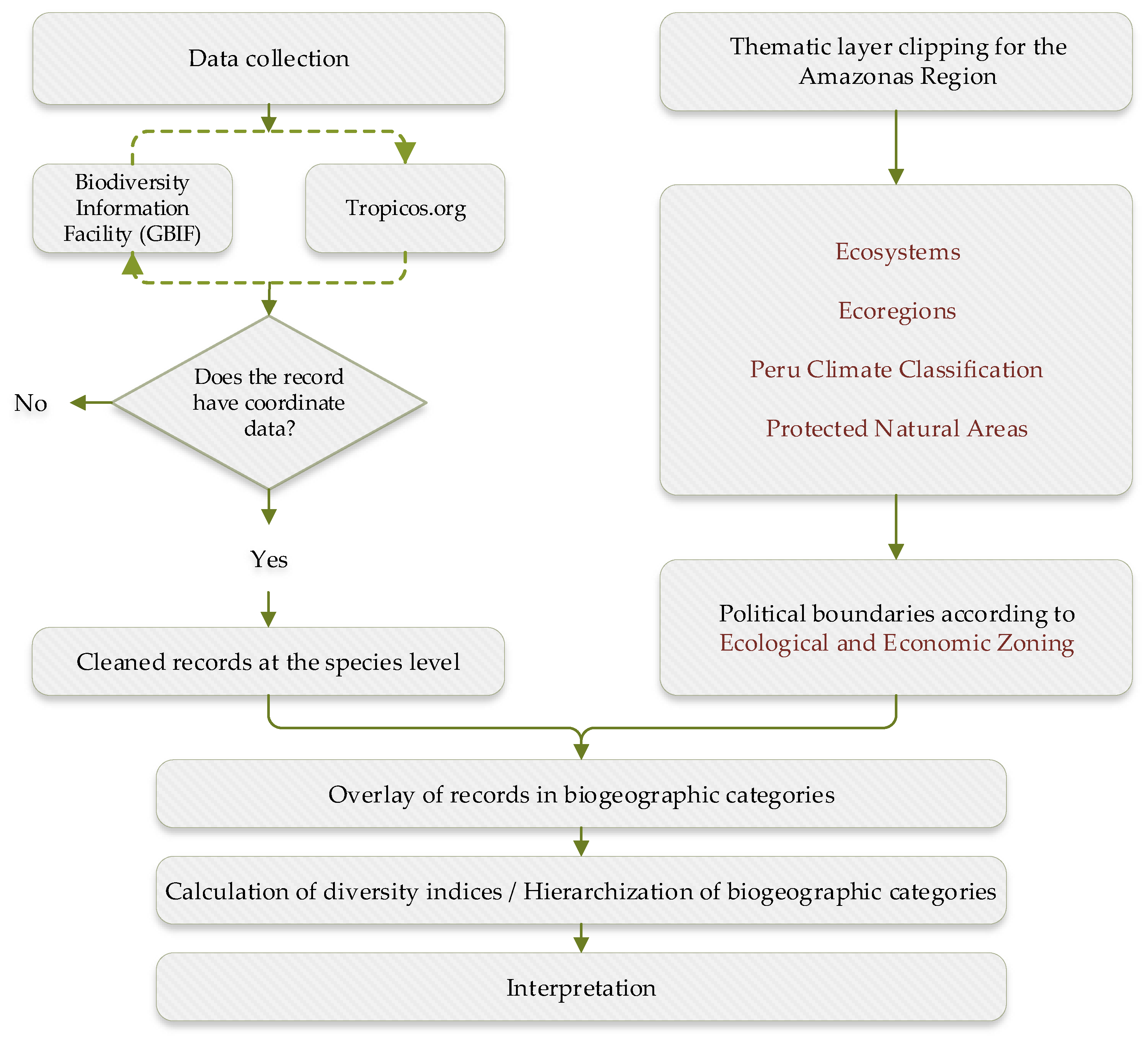
2.2. Data Collection and Cleaning
2.3. Representation of Species in Biogeographic Regions
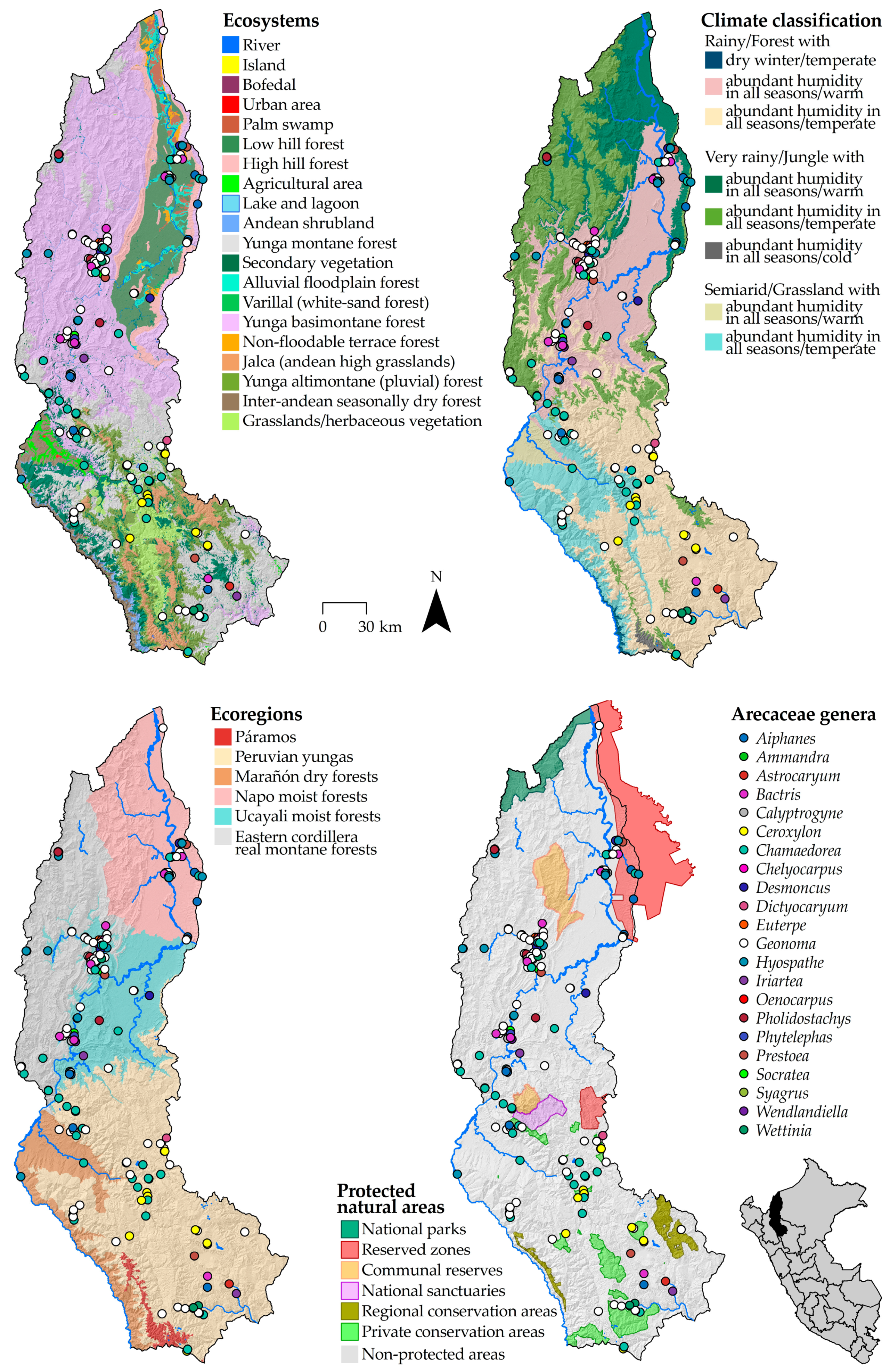
- National Map of Ecosystems of Peru [21,39], downloaded from the geoserver of the Ministry of Environment (https://geoservidor.minam.gob.pe/recursos/intercambio-de-datos/, accessed on 20 August 2024).
- Map of Ecoregions based on the classification of Olson et al., 2001 [40], obtained from the World Wildlife Fund (WWF, https://www.worldwildlife.org/publications/terrestrial-ecoregions-of-the-world, accessed on 20 August 2024) and adapted for Peru in the Analysis of the Ecological Cover of SINANPE [20].
- Climate Classification Map of Peru [41] (average 1981–2010) from the National Service of Meteorology and Hydrology of Peru (SENAMHI, https://idesep.senamhi.gob.pe/geonetwork/srv/spa/catalog.search#/home, accessed on 20 August 2024)
- Map of Protected Natural Areas, elaborated from the geographic viewer of the National Service of Natural Areas Protected by the State (SERNANP, https://geo.sernanp.gob.pe/visorsernanp/, accessed on 20 August 2024) and the Regional Conservation System (SICRE) of the department of Amazonas.
2.4. Estimation of Diversity Metrics
2.5. Data Analysis
3. Results
3.1. Biogeographic Representation of the Species of the Family Arecaceae in the Department of Amazonas
3.1.1. Brief Global, National and Departmental Overview
3.1.2. Biogeographic Distribution of Species in the Department of Amazonas
3.2. Diversity Indices According to Species Distribution
4. Discussion
4.1. Representation and Distribution of Species in Biogeographic Categories in the Department of Amazonas
4.2. Evaluation of the Use of Diversity Metrics According to Species Distribution
4.3. Relevance of Metrics in Diversity Studies
4.4. Implications of the Study in the Context of Peruvian Regulations
5. Conclusions
Author Contributions
Funding
Data Availability Statement
Conflicts of Interest
References
- Emilio, T.; Lamarque, L.J.; Torres-Ruiz, J.M.; King, A.; Charrier, G.; Burlett, R.; Conejero, M.; Rudall, P.J.; Baker, W.J.; Delzon, S. Embolism Resistance in Petioles and Leaflets of Palms. Ann. Bot. 2019, 124, 1173–1183. [Google Scholar] [CrossRef] [Scilit] [PubMed]
- Roncal, J.; Francisco-Ortega, J.; Asmussen, C.B.; Lewis, C.E. Molecular Phylogenetics of Tribe Geonomeae (Arecaceae) Using Nuclear DNA Sequences of Phosphoribulokinase and RNA Polymerase II. Syst. Bot. 2005, 30, 275–283. [Google Scholar] [CrossRef] [Scilit]
- de Souza, F.G.; de Araújo, F.F.; de Paulo Farias, D.; Zanotto, A.W.; Neri-Numa, I.A.; Pastore, G.M. Brazilian Fruits of Arecaceae Family: An Overview of Some Representatives with Promising Food, Therapeutic and Industrial Applications. Food Res. Int. 2020, 138, 109690. [Google Scholar] [CrossRef] [Scilit]
- Ayokun-nun Ajao, A.; Moteetee, A.N.; Sabiu, S. From Traditional Wine to Medicine: Phytochemistry, Pharmacological Properties and Biotechnological Applications of Raphia Hookeri G. Mann & H. Wendl (Arecaceae). S. Afr. J. Bot. 2021, 138, 184–192. [Google Scholar] [CrossRef] [Scilit]
- Eiserhardt, W.L.; Svenning, J.C.; Kissling, W.D.; Balslev, H. Geographical ecology of the palms (Arecaceae): Determinants of diversity and distributions across spatial scales. Ann. Bot. 2011, 108, 1391–1416. [Google Scholar] [CrossRef] [Scilit]
- Baker, W.J.; Savolainen, V.; Asmussen-Lange, C.B.; Chase, M.W.; Dransfield, J.; Forest, F.; Harley, M.M.; Uhl, N.W.; Wilkinson, M. Complete Generic-Level Phylogenetic Analyses of Palms (Arecaceae) with Comparisons of Supertree and Supermatrix Approaches. Syst. Biol. 2009, 58, 240–256. [Google Scholar] [CrossRef] [Scilit]
- Fadini, R.F.; Fleury, M.; Donatti, C.I.; Galetti, M. Effects of Frugivore Impoverishment and Seed Predators on the Recruitment of a Keystone Palm. Acta Oecologica 2009, 35, 188–196. [Google Scholar] [CrossRef] [Scilit]
- Maxwell, S.; Fuller, R.; Brooks, T.; Watson, J. The Ravages of Guns, Nets and Bulldozers; Macmillan Publishers Limited: London, UK, 2016. [Google Scholar]
- Pykälä, J. Habitat Loss and Deterioration Explain the Disappearance of Populations of Threatened Vascular Plants, Bryophytes and Lichens in a Hemiboreal Landscape. Glob. Ecol. Conserv. 2019, 18, e00610. [Google Scholar] [CrossRef] [Scilit]
- Reichgelt, T.; West, C.K.; Greenwood, D.R. The Relation between Global Palm Distribution and Climate. Sci. Rep. 2018, 8, 4721. [Google Scholar] [CrossRef] [Scilit] [PubMed]
- Roncal, J.; Borchsenius, F.; Asmussen-Lange, C.B.; Balslev, H. Divergence Times in the Tribe Geonomateae (Arecaceae) Coincide Qith Tertiary Geological Events. Divers. Phylogeny Evol. Monocoltiledons 2010, 245–265. [Google Scholar]
- Rodríguez del Castillo, Á.M.; Mejía Carhuanca, K.M.; Rojas-Fox, J.V.; Moraes Ramírez, M.; Sánchez-Márquez, M.d.F.; Pintaud, J.-C. Diversidad de Especies de Attalea (ARECACEAE) En El Perú, 1st ed.; Rodríguez del Castillo, Á.M., Ed.; Instituto de Investigaciones de la Amazonía Peruana: Tarapoto, Perú, 2018; ISBN 9786124372063. [Google Scholar]
- Boll, T.; Svenning, J.C.; Vormisto, J.; Normand, S.; Grández, C.; Balslev, H. Spatial Distribution and Environmental Preferences of the Piassaba Palm Aphandra Natalia (Arecaceae) along the Pastaza and Urituyacu Rivers in Peru. For. Ecol. Manag. 2005, 213, 175–183. [Google Scholar] [CrossRef] [Scilit]
- Tomlinson, P.B.; Horn, J.W.; Fisher, J.B. The Anatomy of Palms: Arecaceae—Palmae; Oxford University Press: Oxford, UK, 2011. [Google Scholar]
- Balslev, H.; Bernal, R.; Fay, M.F. Palms—Emblems of Tropical Forests. Bot. J. Linn. Soc. 2016, 182, 195–200. [Google Scholar] [CrossRef] [Scilit]
- Khan, M.A.; Hazra, M.; Mahato, S.; Spicer, R.A.; Roy, K.; Hazra, T.; Bandopadhaya, M.; Spicer, T.E.V.; Bera, S. A Cretaceous Gondwana Origin of the Wax Palm Subfamily (Ceroxyloideae: Arecaceae) and Its Paleobiogeographic Context. Rev. Palaeobot. Palynol. 2020, 283, 104318. [Google Scholar] [CrossRef] [Scilit]
- Bacon, C.D.; Feltus, F.A.; Paterson, A.H.; Bailey, C.D. Novel Nuclear Intron-Spanning Primers for Arecaceae Evolutionary Biology. Mol. Ecol. Resour. 2008, 8, 211–214. [Google Scholar] [CrossRef] [Scilit]
- León, B.; Pitman, N.; Roque, J. Introducción a Las Plantas Endémicas Del Perú. Rev. Peru. Biol. 2006, 13, 9–22. [Google Scholar] [CrossRef] [Scilit]
- MITECO, (Ministerio para la Transición Ecológica y el Reto Demográfico) Regiones Biogeográficas Terrestres y Regiones Marinas. Available online: https://www.miteco.gob.es/es/biodiversidad/servicios/banco-datos-naturaleza/informacion-disponible/regiones_biogeograficas_descargas.html (accessed on 13 August 2024).
- CDC-UNALM (Centro de Datos para la Conservación—Universidad Nacional Agraria La Molina); TNC (The Nature Conservancy). Análisis Del Recubrimiento Ecológico Del Sistema Nacional de Áreas Naturales Protegidas Por El Estado; CDC-UNALM/TNC: Lima, Perú, 2006. [Google Scholar]
- MINAM (Ministerio del Ambiente). Mapa Nacional de Ecosistemas Del Perú. Memoria Descriptiva, 1st ed.; MINAM: Lima, Perú, 2019.
- Torres Montenegro, L.A.; Ríos Paredes, M.A.; Pitman, N.C.A.; Vriesendorp, C.F.; Hensold, N.; Mesones Acuy, Í.; Dávila Cardozo, N.; Huamantupa, I.; Beltrán, H.W.; García-Villacorta, R.; et al. Sesenta y Cuatro Nuevos Registros Para La Flora Del Perú a Través de Inventarios Biológicos Rápidos En La Amazonía Peruana. Rev. Peru. Biol. 2019, 26, 379–392. [Google Scholar] [CrossRef] [Scilit]
- Santa Cruz, L.; Pintaud, J.-C.; Sanín, M.J.; Rodríguez Rodríguez, E.F. Nuevo Registro de Ceroxylon Parvum (Arecaceae) En El Perú. Arnaldoa 2018, 25, 471–480. [Google Scholar] [CrossRef] [Scilit]
- García-Pérez, A.; Rubio Rojas, K.B.; Meléndez Mori, J.B.; Corroto, F.; Rascón, J.; Oliva, M. Estudio Ecológico de Los Bosques Homogéneos En El Distrito de Molinopampa, Región Amazonas. Rev. Investig. Agroproducción Sustentable 2018, 2, 73–79. [Google Scholar] [CrossRef] [Scilit]
- Tropicos.org., (Missouri Botanical Garden). Available online: https://tropicos.org (accessed on 13 August 2024).
- Antwi, E.K.; Krawczynski, R.; Wiegleb, G. Detecting the Effect of Disturbance on Habitat Diversity and Land Cover Change in a Post-Mining Area Using GIS. Landsc. Urban Plan. 2008, 87, 22–32. [Google Scholar] [CrossRef] [Scilit]
- Kamilaris, A.; Kartakoullis, A.; Prenafeta-Boldú, F.X. A Review on the Practice of Big Data Analysis in Agriculture. Comput. Electron. Agric. 2017, 143, 23–37. [Google Scholar] [CrossRef] [Scilit]
- Karasov, O.; Vieira, A.A.B.; Külvik, M.; Chervanyov, I. Landscape Coherence Revisited: GIS-Based Mapping in Relation to Scenic Values and Preferences Estimated with Geolocated Social Media Data. Ecol. Indic. 2020, 111, 105973. [Google Scholar] [CrossRef] [Scilit]
- Mateo, R.G.; Felicísimo, Á.M.; Muñoz, J. Modelos de Distribución de Especies: Una Revisión Sintética. Rev. Chil. Hist. Nat. 2011, 84, 217–240. [Google Scholar] [CrossRef] [Scilit]
- Miller, J. Species Distribution Modeling. Geogr. Compass 2018, 4, 490–509. [Google Scholar] [CrossRef] [Scilit]
- Cotrina Sánchez, A.; Rojas Briceño, N.B.; Bandopadhyay, S.; Ghosh, S.; Torres Guzmán, C.; Oliva, M.; Guzman, B.K.; Salas López, R. Biogeographic Distribution of Cedrela spp. Genus in Peru Using Maxent Modeling: A Conservation and Restoration Approach. Diversity 2021, 13, 261. [Google Scholar] [CrossRef] [Scilit]
- Veneros, J.; Tonnang, H.E.Z.; Juarez, H.; Kroschel, J. Distribución Geográfica y Potencial de Phthorimaea Operculella (Zeller) (Lepidóptera: Gelechiidae) Usando CLIMEX. LIV Conv. Nac. Entomol. 2012, 1. [Google Scholar] [CrossRef] [Scilit]
- Ferrari, A. Biogeographical Units Matter. Aust. Syst. Bot. 2018, 30, 391–402. [Google Scholar] [CrossRef] [Scilit]
- Beraún Chaca, J.J.; Villanueva Fernández, H.S. Clasificación de las Regiones Naturales del Perú; COLEGIO DE GEÓGRAFOS DEL PERÚ: Lima, Perú, 2020. [Google Scholar]
- Henderson, A.; Galeano, G.; Bernal, R. Field Guide to the Palms of the Americas, 1st ed.; Princenton University Press: Princeton, NJ, USA, 1995; ISBN 9780691656120. [Google Scholar]
- MINAM (Ministerio del Ambiente). Mapa de Deforestación de La Amazonía Peruana 2000; Ministerio del Ambiente: Lima, Perú, 2009.
- Rojas Briceño, N.B.; Cotrina Sánchez, D.A.; Barboza Castillo, E.; Barrena Gurbillón, M.A.; Sarmiento, F.O.; Sotomayor, D.A.; Oliva, M.; Salas López, R. Current and Future Distribution of Five Timber Forest Species in Amazonas, Northeast Peru: Contributions towards a Restoration Strategy. Diversity 2020, 12, 305. [Google Scholar] [CrossRef] [Scilit]
- García, L.; Veneros, J.; Chavez, S.G.; Oliva, M.; Rojas-Briceño, N.B. World Historical Mapping and Potential Distribution of Cinchona spp. in Peru as a Contribution for Its Restoration and Conservation. J. Nat. Conserv. 2022, 70, 126290. [Google Scholar] [CrossRef] [Scilit]
- MINAM (Ministerio del Ambiente). Definiciones Conceptuales de Los Ecosistemas Del Perú; MINAM: Lima, Perú, 2018.
- Olson, D.M.; Dinerstein, E.; Wikramanayake, E.D.; Burgess, N.D.; Powell, G.V.N.; Underwood, E.C.; Amico, J.A.D.; Itoua, I.; Strand, H.E.; Morrison, J.C.; et al. Terrestrial Ecoregions of the World: A New Map of Life on Earth. Bioscience 2001, 51, 933–938. [Google Scholar] [CrossRef] [Scilit]
- SENAMHI (Servicio Nacional de Meteorología e Hidrología del Perú). Climas Del Perú. Mapa de La Clasificación Climática Nacional. Resumen Ejecutivo; SENAMHI: Lima, Perú, 2020. [Google Scholar]
- IIAP (Instituto de Investigaciones de la Amazonía Peruana); GRA (Gobierno Regional Amazonas). Zonificación Ecológica y Económica Del Departamento de Amazonas, 1st ed.; IIAP: Lima, Perú, 2010. [Google Scholar]
- Whittaker, R.H. Vegetation of the Siskiyou Mountains, Oregon and California. Ecol. Monogr. 1960, 30, 279–338. [Google Scholar] [CrossRef] [Scilit]
- Margalef, R. La Teoría de La Información En Ecología. Mem. La Real Acad. Cienc. Y Artes Barc. 1957, 3, 373–449. [Google Scholar]
- Ferriol Molina, M.; Merle Farinós, H.B. Los Componentes Alfa, Beta y Gamma de La Biodiversidad. Aplicación Al Estudio de Comunidades Vegetales; Universitat Politècnica de València: Valencia, Spain, 2012; p. 10. [Google Scholar]
- Shannon, C.E.; Weaver, W. The Mathematical Theory of Communication; University of Illinois Press: Champaign, IL, USA, 1949. [Google Scholar]
- Tukiainen, H.; Kiuttu, M.; Kalliola, R.; Alahuhta, J.; Hjort, J. Landforms Contribute to Plant Biodiversity at Alpha, Beta and Gamma Levels. J. Biogeogr. 2019, 46, 1699–1710. [Google Scholar] [CrossRef] [Scilit]
- Margalef, R. Homage to Evelyn Hutchinson, or Why There Is an Upper Limit to Diversity. Trans. Connect. Acad. Arts Sci. 1972, 44, 211–235. [Google Scholar]
- AECID (Agencia Española de Cooperación Internacional para el Desarrollo). Estimación e Interpretación de Indicadores de Biodiversidad Forestal Considerando La Información de Los Inventarios Forestales Nacionales, 1st ed.; Aguilar, I., Ed.; AECID: Madrid, Spain, 2023. [Google Scholar]
- GBIF (Global Biodiversity Information Facility). GBIF Occurrence Download. Available online: https://www.gbif.org/ (accessed on 13 August 2024).
- Montesinos-Tubée, D.B. Diversidad Florística En El Complejo Arqueológico La Bóveda, En El Sur Del Departamento Amazonas, Perú. Cienc. Amaz. 2020, 8, 31–52. [Google Scholar] [CrossRef] [Scilit]
- Magurran, A.E. Ecological Diversity and Its Measurement, 1st ed.; Springer Dordrecht: Bangor, ME, USA, 1988; ISBN 9789401573603. [Google Scholar]
- Somarriba, E. Diversidad Shannon. Agroforestería en las Américas 1999, 6, 72–74. [Google Scholar]
- Moreno, C.E. Métodos Para Medir La Biodiversidad, 1st ed.; CYTED/ORCYT-UNESCO/SEA: Zaragoza, Spain, 2001; ISBN 84-922495-2-8. [Google Scholar]
- Pérez Suárez, B. Composición y Diversidad Del Banco de Semillas Germinable En Un Núcleo Ecológico Urbano. Pérez-Arbelaezia 2021, 22, 5–29. [Google Scholar]
- Silva Soto, S.; Gacitúa Arias, S.; Hernández, J.; Montenegro Rojas, J.; Jiménez, I.; Silva Aranguiz, E. Biodiversidad y Obras de Conservación de Agua y Suelo (OCAS) Forestadas Con Especies Vegetales En Ecosistemas Áridos de La Región de Coquimbo. Cienc. Investig. For. 2021, 27, 51–68. [Google Scholar] [CrossRef] [Scilit]

| Geographical Range | Number of Genera | Number of Species | Number of Species Records |
|---|---|---|---|
| World | 251 | 2836 | 1,078,558 |
| Peru | 43 | 218 | 336,029 |
| (17.13%) | (7.69%) | (31.16%) | |
| Departmental (Amazonas) | 22 | 90 | 665 |
| (51.16%) | (41.28%) | (0.20%) |
| N° | Genera | Number of Species | Percentage of Species (%) | Number of Records | Percentage of Records (%) |
|---|---|---|---|---|---|
| 1 | Geonoma | 30 | 13.76 | 63,022 | 18.7549 |
| 2 | Bactris | 26 | 11.93 | 54,814 | 16.3123 |
| 3 | Astrocaryum | 18 | 8.26 | 26,855 | 7.9919 |
| 4 | Attalea | 18 | 8.26 | 28,344 | 8.4350 |
| 5 | Chamaedorea | 11 | 5.05 | 2930 | 0.8719 |
| 6 | Desmoncus | 11 | 5.05 | 4123 | 1.2270 |
| 7 | Ceroxylon | 8 | 3.67 | 234 | 0.0696 |
| 8 | Aiphanes | 7 | 3.21 | 504 | 0.1500 |
| 9 | Oenocarpus | 7 | 3.21 | 31,856 | 9.4801 |
| 10 | Wettinia | 6 | 2.75 | 3777 | 1.1240 |
| 11 | Euterpe | 5 | 2.29 | 20,264 | 6.0304 |
| 12 | Prestoea | 5 | 2.29 | 630 | 0.1875 |
| 13 | Chelyocarpus | 4 | 1.83 | 538 | 0.1601 |
| 14 | Hyospathe | 4 | 1.83 | 5773 | 1.7180 |
| 15 | Palmocarpon | 4 | 1.83 | 47 | 0.0140 |
| 16 | Socratea | 4 | 1.83 | 11,869 | 3.5321 |
| 17 | Dictyocaryum | 3 | 1.38 | 637 | 0.1896 |
| 18 | Elaeis | 3 | 1.38 | 201 | 0.0598 |
| 19 | Iriartella | 3 | 1.38 | 10,268 | 3.0557 |
| 20 | Mauritia | 3 | 1.38 | 3465 | 1.0312 |
| 21 | Mauritiella | 3 | 1.38 | 861 | 0.2562 |
| 22 | Phytelephas | 3 | 1.38 | 14,074 | 4.1883 |
| 23 | Syagrus | 3 | 1.38 | 83 | 0.0247 |
| 24 | Iriartea | 2 | 0.92 | 7225 | 2.1501 |
| 25 | Itaya | 2 | 0.92 | 256 | 0.0762 |
| 26 | Lepidocaryum | 2 | 0.92 | 35,908 | 10.6860 |
| 27 | Manicaria | 2 | 0.92 | 26 | 0.0077 |
| 28 | Phoenix | 2 | 0.92 | 6 | 0.0018 |
| 29 | Pholidostachys | 2 | 0.92 | 2995 | 0.8913 |
| 30 | Washingtonia | 2 | 0.92 | 8 | 0.0024 |
| 31 | Welfia | 2 | 0.92 | 21 | 0.0062 |
| 32 | Wendlandiella | 2 | 0.92 | 979 | 0.2913 |
| 33 | Adonidia | 1 | 0.46 | 1 | 0.0003 |
| 34 | Ammandra | 1 | 0.46 | 3 | 0.0009 |
| 35 | Aphandra | 1 | 0.46 | 3404 | 1.0130 |
| 36 | Calyptrogyne | 1 | 0.46 | 1 | 0.0003 |
| 37 | Caryota | 1 | 0.46 | 1 | 0.0003 |
| 38 | Cocos | 1 | 0.46 | 18 | 0.0054 |
| 39 | Iriartites | 1 | 0.46 | 1 | 0.0003 |
| 40 | Maximiliana | 1 | 0.46 | 4 | 0.0012 |
| 41 | Palmaepollenites | 1 | 0.46 | 1 | 0.0003 |
| 42 | Ptychosperma | 1 | 0.46 | 1 | 0.0003 |
| 43 | Sabal | 1 | 0.46 | 1 | 0.0003 |
| Total | 218 | 100 | 336,029 | 100 |
| N° | Genera | Number of Species | Percentage (%) | Number of Records | Percentage (%) |
|---|---|---|---|---|---|
| 1 | Geonoma | 18 | 20.0 | 262 | 39.4 |
| 2 | Bactris | 11 | 12.2 | 63 | 9.5 |
| 3 | Astrocaryum | 6 | 6.7 | 10 | 1.5 |
| 4 | Ceroxylon | 6 | 6.7 | 18 | 2.7 |
| 5 | Aiphanes | 5 | 5.6 | 24 | 3.6 |
| 6 | Chamaedorea | 5 | 5.6 | 108 | 16.2 |
| 7 | Desmoncus | 5 | 5.6 | 14 | 2.1 |
| 8 | Wettinia | 5 | 5.6 | 32 | 4.8 |
| 9 | Hyospathe | 4 | 4.4 | 40 | 6.0 |
| 10 | Prestoea | 4 | 4.4 | 24 | 3.6 |
| 11 | Socratea | 3 | 3.3 | 14 | 2.1 |
| 12 | Euterpe | 2 | 2.2 | 6 | 0.9 |
| 13 | Iriartea | 2 | 2.2 | 9 | 1.4 |
| 14 | Oenocarpus | 2 | 2.2 | 3 | 0.5 |
| 15 | Pholidostachys | 2 | 2.2 | 17 | 2.6 |
| 16 | Phytelephas | 2 | 2.2 | 6 | 0.9 |
| 17 | Syagrus | 2 | 2.2 | 8 | 1.2 |
| 18 | Wendlandiella | 2 | 2.2 | 2 | 0.3 |
| 19 | Ammandra | 1 | 1.1 | 1 | 0.2 |
| 20 | Calyptrogyne | 1 | 1.1 | 1 | 0.2 |
| 21 | Chelyocarpus | 1 | 1.1 | 2 | 0.3 |
| 22 | Dictyocaryum | 1 | 1.1 | 1 | 0.2 |
| Total | 90 | 100 | 665 | 100 |
| Biogeographic Unit by Category | Most Recorded Species | Altitude (masl) | A | R | ||
|---|---|---|---|---|---|---|
| Min | Max | Prom | ||||
| Ecosystems Map | 665 | 90 | ||||
| 1. Yunga Basimontane Forest | Geonoma stricta | 224 | 1519 | 555.7 | 339 | 59 |
| 2. Yunga Montane Forest | Chamaedorea linearis | 1492 | 2513 | 1837.3 | 116 | 35 |
| 3. High Hill Forest | Geonoma stricta | 218 | 747 | 313.7 | 52 | 22 |
| 4. Yunga Altimontane (Pluvial) Forest | Geonoma orbignyana | 2459 | 3161 | 2857.4 | 39 | 17 |
| 5. Secondary Vegetation | Bactris gasipaes | 182 | 2790 | 1271.8 | 26 | 15 |
| 6. Low Hill Forest | Geonoma macrostachys | 180 | 231 | 199.8 | 29 | 14 |
| 7. River | Geonoma stricta | 171 | 262 | 242.4 | 33 | 14 |
| 8. Grasslands/Herbaceous Vegetation | Chamaedorea linearis | 1729 | 2473 | 2124.9 | 10 | 6 |
| 9. Inter-Andean Seasonally Dry Forest (Marañón, Mantaro, Pampas, and Apurímac) | Geonoma macrostachys | 652 | 652 | 652.0 | 6 | 5 |
| 10. Alluvial Floodplain Forest | Geonoma stricta | 190 | 192 | 191.3 | 3 | 3 |
| 11. Island | Chamaedorea pauciflora | 180 | 180 | 180.0 | 4 | 3 |
| 12. Non-Floodable Terrace Forest | Chamaedorea pinnatifrons | 207 | 228 | 217.5 | 2 | 2 |
| 13. Jalca (Andean High Grasslands) | Geonoma lehmannii | 3314 | 3314 | 3314.0 | 1 | 1 |
| 14. Agricultural Area | Chamaedorea pinnatifrons | 492 | 492 | 492.0 | 4 | 1 |
| 15. Urban Area | Geonoma orbignyana | 903 | 903 | 903.0 | 1 | 1 |
| 16. Bofedal | - | - | - | - | - | - |
| 17. Lake and Lagoon | - | - | - | - | - | - |
| 18. Andean Shrubland | - | - | - | - | - | - |
| 19. Palm Swamp | - | - | - | - | - | - |
| 20. Varillal (White-Sand Forest) | - | - | - | - | - | - |
| Ecoregions Map | 665 | 90 | ||||
| 1. Ucayali Moist Forests | Geonoma stricta | 211 | 823 | 396.1 | 283 | 57 |
| 2. Eastern Cordillera Real Montane Forests | Hyospathe elegans | 541 | 1933 | 1287.4 | 125 | 36 |
| 3. Napo Moist Forests | Geonoma stricta | 171 | 1397 | 398.0 | 103 | 31 |
| 4. Peruvian Yungas | Chamaedorea linearis | 1057 | 3314 | 2196.0 | 143 | 31 |
| 5. Marañón Dry Forests | Chamaedorea pinnatifrons | 492 | 903 | 672.5 | 11 | 6 |
| 6. Páramos | - | - | - | - | - | - |
| Peru Climate Classification Map | 665 | 90 | ||||
| 1. Rainy/Forest with Abundant Humidity in All Seasons/Warm | Geonoma stricta | 180 | 903 | 381.4 | 366 | 62 |
| 2. Rainy/Forest with Abundant Humidity in All Seasons/Temperate | Geonoma sp | 1361 | 3314 | 2141.3 | 108 | 34 |
| 3. Very Rainy/Jungle with Abundant Humidity in All Seasons/Temperate | Hyospathe elegans | 788 | 1933 | 1358.9 | 105 | 29 |
| 4. Very Rainy/Jungle with Abundant Humidity in All Seasons/Warm | Aiphanes ulei | 171 | 747 | 442.0 | 27 | 16 |
| 5. Semiarid/Grassland with Abundant Humidity in All Seasons/Temperate | Chamaedorea pinnatifrons | 652 | 2473 | 1588.9 | 55 | 16 |
| 6. Semiarid/Grassland with Abundant Humidity in All Seasons/Warm | Chamaedorea pinnatifrons | 492 | 492 | 492.0 | 4 | 1 |
| 7. Rainy/Forest with Dry Winter/Temperate | - | - | - | - | - | - |
| 8. Very Rainy/Jungle with Abundant Humidity in All Seasons/Cold | - | - | - | - | - | - |
| Protected Natural Areas Map | 665 | 90 | ||||
| 1. Non-protected Areas (NPA) | Geonoma stricta | 171 | 3314 | 1003.9 | 607 | 86 |
| 2. Reserved Zones | Geonoma maxima | 218 | 1397 | 505.6 | 45 | 20 |
| 3. Private Conservation Areas | Geonoma undata | 2470 | 2727 | 2567.0 | 13 | 5 |
| 4. National Parks | - | - | - | - | - | - |
| 5. National Sanctuaries | - | - | - | - | - | - |
| 6. Communal Reserves | - | - | - | - | - | - |
| 7. Regional Conservation Areas | - | - | - | - | - | - |
| N° | Biogeographic Unit by Category | Index Margalef () | Valuation According to | Index Shannon-Wiener Diversity Index () | Valuation According to |
|---|---|---|---|---|---|
| Ecosystems Map | |||||
| 1 | Yunga Basimontane Forest | 9.9554 | High | 3.4476 | Average |
| 2 | Yunga Montane Forest | 7.1525 | High | 3.1318 | Average |
| 3 | High Hill Forest | 5.3148 | High | 2.8474 | Average |
| 4 | Yunga Altimontane (Pluvial) Forest | 4.3673 | Average | 2.6198 | Average |
| 5 | Secondary Vegetation | 4.2970 | Average | 2.5981 | Average |
| 6 | Low Hill Forest | 3.8607 | Average | 2.3664 | Average |
| 7 | River | 3.7180 | Average | 2.3546 | Average |
| 8 | Grasslands/Herbaceous Vegetation | 2.1715 | Average | 1.6094 | Low |
| 9 | Inter-Andean Seasonally Dry Forest (Marañón, Mantaro, Pampas, and Apurímac) | 2.2324 | Average | 1.5607 | Low |
| 10 | Alluvial Floodplain Forest | 1.8205 | Low | 1.0986 | Low |
| 11 | Island | 1.4427 | Low | 1.0397 | Low |
| 12 | Non-Floodable Terrace Forest | 1.4427 | Low | 0.6931 | Low |
| 13 | Jalca (Andean High Grasslands) | --- | --- | 0.0000 | Low |
| 14 | Agricultural Area | 0.0000 | Low | 0.0000 | Low |
| 15 | Urban Area | --- | --- | 0.0000 | Low |
| Ecoregions Map | |||||
| 1 | Ucayali Moist Forests | 9.9195 | High | 3.3673 | Average |
| 2 | Eastern Cordillera Real Montane Forests | 7.2489 | High | 3.1423 | Average |
| 3 | Napo Moist Forests | 6.4729 | High | 3.0957 | Average |
| 4 | Peruvian Yungas | 6.0449 | High | 2.8672 | Average |
| 5 | Marañón Dry Forests | 2.0852 | Average | 1.5403 | Low |
| Peru Climate Classification Map | |||||
| 1 | Rainy/Forest with Abundant Humidity in All Seasons/Warm | 10.3344 | High | 3.4172 | Average |
| 2 | Rainy/Forest with Abundant Humidity in All Seasons/Temperate | 7.0481 | High | 3.0895 | Average |
| 3 | Very Rainy/Jungle with Abundant Humidity in All Seasons/Temperate | 6.0164 | High | 3.0157 | Average |
| 4 | Very Rainy/Jungle with Abundant Humidity in All Seasons/Warm | 4.5512 | Average | 2.6409 | Average |
| 5 | Semiarid/Grassland with Abundant Humidity in All Seasons/Temperate | 3.7431 | Average | 2.3660 | Average |
| 6 | Semiarid/Grassland with Abundant Humidity in All Seasons/Warm | 0.0000 | Low | 0.0000 | Low |
| Protected Natural Areas Map | |||||
| 1 | Non-protected Areas | 13.2636 | High | 3.7054 | High |
| 2 | Reserved Zones | 4.9912 | Average | 2.8112 | Average |
| 3 | Private Conservation Areas | 1.5595 | Low | 1.4791 | Low |
Disclaimer/Publisher’s Note: The statements, opinions and data contained in all publications are solely those of the individual author(s) and contributor(s) and not of MDPI and/or the editor(s). MDPI and/or the editor(s) disclaim responsibility for any injury to people or property resulting from any ideas, methods, instructions or products referred to in the content. |
© 2025 by the authors. Licensee MDPI, Basel, Switzerland. This article is an open access article distributed under the terms and conditions of the Creative Commons Attribution (CC BY) license (https://creativecommons.org/licenses/by/4.0/).
Share and Cite
Miranda, F.; Coronel-Chugden, J.-W.; Veneros, J.; García, L.; Guadalupe, G.A.; Arellanos, E. Species Diversity of the Family Arecaceae: What Are the Implications of Their Biogeographical Representation? An Analysis in Amazonas, Northeastern Peru. Forests 2025, 16, 76. https://doi.org/10.3390/f16010076
Miranda F, Coronel-Chugden J-W, Veneros J, García L, Guadalupe GA, Arellanos E. Species Diversity of the Family Arecaceae: What Are the Implications of Their Biogeographical Representation? An Analysis in Amazonas, Northeastern Peru. Forests. 2025; 16(1):76. https://doi.org/10.3390/f16010076
Chicago/Turabian StyleMiranda, Freddy, José-Walter Coronel-Chugden, Jaris Veneros, Ligia García, Grobert A. Guadalupe, and Erick Arellanos. 2025. "Species Diversity of the Family Arecaceae: What Are the Implications of Their Biogeographical Representation? An Analysis in Amazonas, Northeastern Peru" Forests 16, no. 1: 76. https://doi.org/10.3390/f16010076
APA StyleMiranda, F., Coronel-Chugden, J.-W., Veneros, J., García, L., Guadalupe, G. A., & Arellanos, E. (2025). Species Diversity of the Family Arecaceae: What Are the Implications of Their Biogeographical Representation? An Analysis in Amazonas, Northeastern Peru. Forests, 16(1), 76. https://doi.org/10.3390/f16010076

