Article

Climate Change Threatens the Habitat of Pinus massoniana in China

1
Heihe Remote Sensing Experimental Research Station, Key Laboratory of Remote Sensing of Gansu Province, Northwest Institute of Eco-Environment and Resources, Chinese Academy of Sciences, Lanzhou 730000, China
2
School of Geography, Liaoning Normal University, Dalian 116029, China
3
Faculty of Geographical Science, Beijing Normal University, Beijing 100875, China
4
Qinghai Research and Design Institute of Environmental Science, Xining 810008, China
5
College of Eco-Environmental Engineering, Qinghai University, Xining 810016, China
*
Author to whom correspondence should be addressed.
These authors contributed equally to this work.
Forests 2024, 15(2), 323; https://doi.org/10.3390/f15020323
Submission received: 15 November 2023 / Revised: 8 January 2024 / Accepted: 30 January 2024 / Published: 8 February 2024
(This article belongs to the Section Forest Meteorology and Climate Change)

Abstract

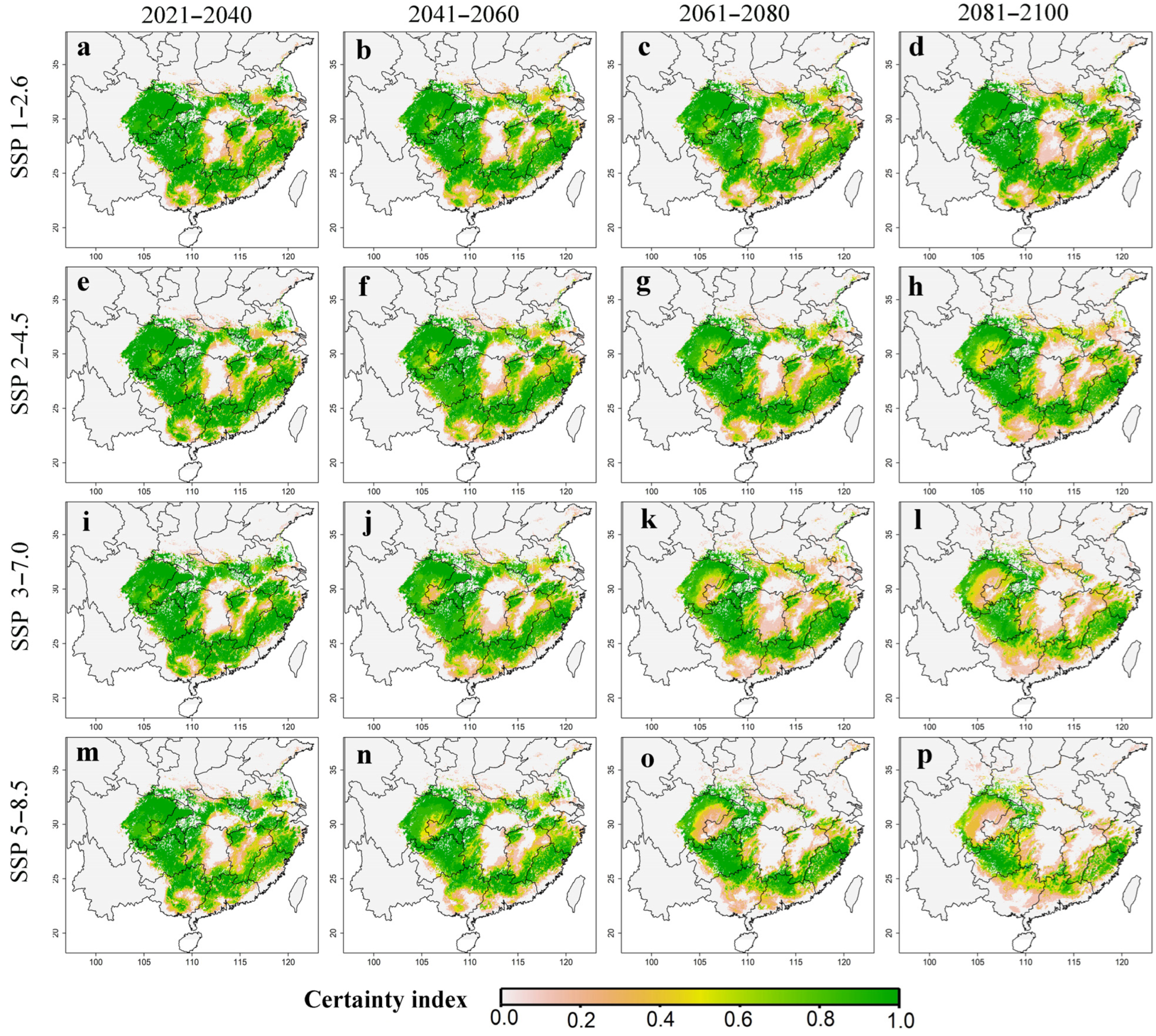
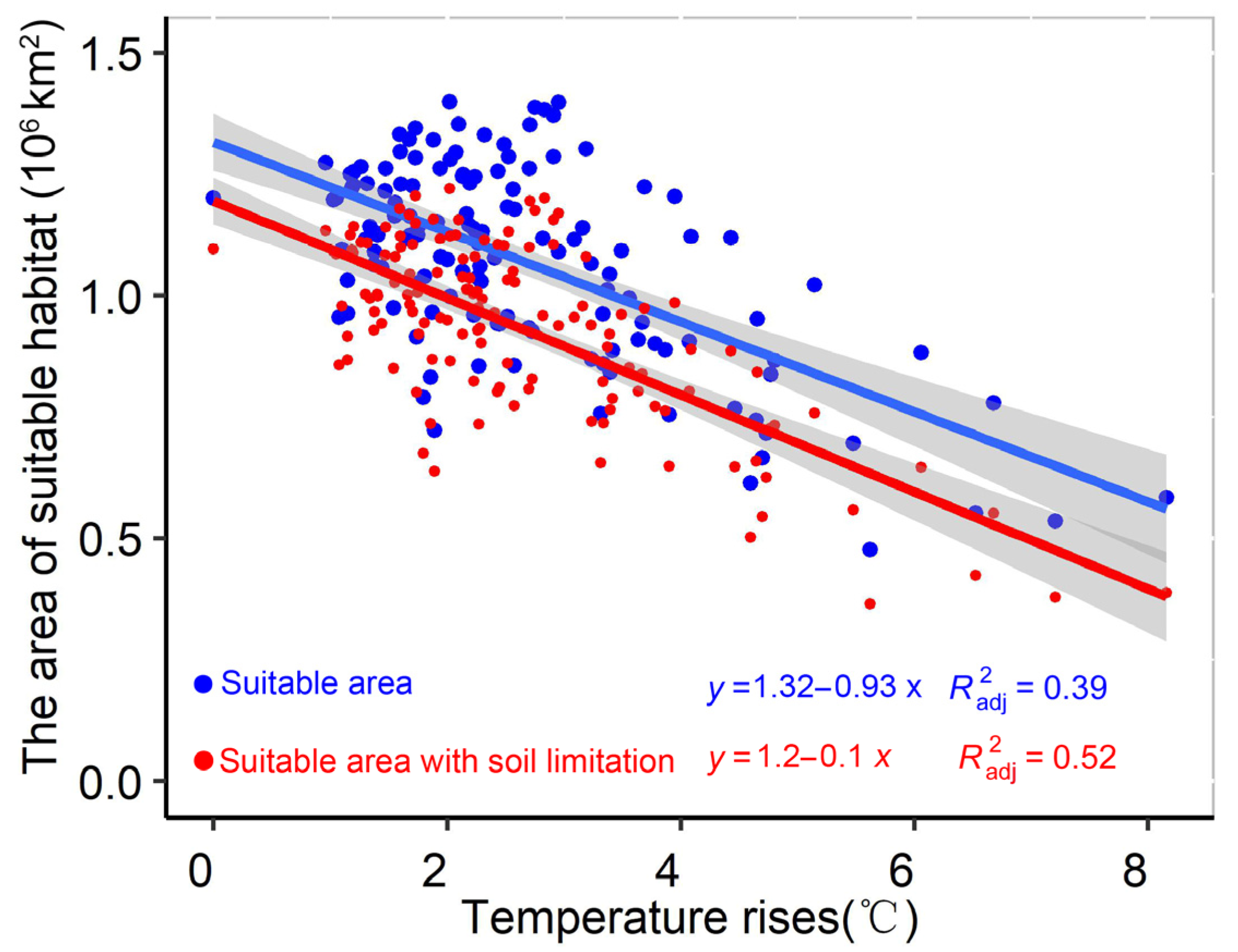
Pinus massoniana Lamb. is one of the main timber tree species. There is a large artificial planting area in South China, and this tree has important economic and ecological value. In this research, we built a comprehensive habitat suitability model based on 115 current data and 22 environmental variables to analyze the potential suitable habitat distribution of this species. Future climate change scenarios were defined as four shared socioeconomic pathways (SSPs): SSP 1–2.6, SSP 2–4.5, SSP 3–7.0, SSP 5–8.5) and four periods (including 2021–2040, 2041–2060, 2061–2080, and 2081–2100) based on nine global circulation model datasets. To fully consider the potential distribution of P. massoniana under specific climate change conditions and soil conditions, we constructed an ensemble model using four commonly used model algorithms. The results indicated that the current suitable habitat for P. massoniana covers approximately 1.10 × 10⁶ km2 in southeastern China. In the future, the model results showed that under different climate change scenarios and at different times, the change in suitable habitat for P. massoniana varied; moreover, under moderate climate change scenarios, the average temperature decreased by less than 3 °C and the suitable habitat area decreased slightly, with an area larger than 0.95 × 10⁶ km2. However, under intense warming scenarios, for which the average temperature increased above 3 °C, the suitable habitat for P. massoniana decreased. In the most severe warming scenario, the suitable habitat area for P. massoniana was reduced to 44% of the base climate conditions with severe habitat fragmentation, which should be fully considered in future planting initiatives and plant protection.
Keywords: Pinus massoniana Lamb.; ensemble model; ecological niche; climate change; species distribution Pinus massoniana Lamb.; ensemble model; ecological niche; climate change; species distribution