

Abstract
Wood rot fungi are an essential link in the forest ecosystem. The presented study aimed to determine the content of selected antioxidant active compounds of selected saprobionts commonly found in the European forests: Hypholoma fasciculare (Huds.) P. Kumm, Bjerkandera adusta (Willd.) P. Karst., Inonotus obliquus (Fr.) Pilát, Kuehneromyces mutabilis (Schaeff.) Singer & AH Sm., Trametes versicolor (L.) Lloyd, Pleurotus ostreatus (Jacq.) P. Kumm., Pholiota squarrosa (Vahl) P. Kumm. Chemical methods (HPLC determination, ABTS+ and FPA methods, and a saponification method by Acquity UPLC) were used to analyze active compounds. In the tested isolates, the presence of 13 phenolic acids has been observed, including p-coumaric, ferulic, chlorogenic, and sinapic acid, in high concentrations. The antioxidant activity was from 2.5 to 3.5 times higher in the isolates of I. obliquus, P. ostreatus, and H. fasciculare in comparison to P. squarrosa and B. adusta. All isolates were tested for β-carotene, lutein, zeaxanthin, and astaxanthin. High concentrations of flavonoids were observed in H. fasciculare and P. squarrosa. In addition, the observed concentration of naringenin, quercetin, and kaempferol above 21 mg/kg DM was found. The ergosterol was quantified in the saprobiont fungi cultures. A diversified content of bioactive compounds characterized the tested fungi, and the Chaga (I. obliquus) reported the highest content of tested compounds.
1. Introduction
Wood decay fungi are crucial links in the ecosystems of forests. As saprobionts, they decompose dead organic matter and release elements into circulation in nature. They are the main group of organisms—and often the only ones—capable of decomposing the high-molecular components of wood (cellulose, hemicellulose, lignin), which are the most complex and slowest natural substances to deteriorate in nature [1]. As a result of their decomposition, humus is formed. The direct way the soil humic compounds form is their synthesis from fragments, such as polyphenols, with the involvement of organically originated nitrogen. The polyphenol source may be the lignin decomposition processes and the transformation of the carbohydrates; many polyphenols are formed as the metabolites of various microorganisms [2].
The fungi lead to the polyphenols’ oxidation and the formation of the chinoid compound in subsequent stages. The aforementioned processes are observed in various fungi biological systems, indicating interesting studies using the saprotrophs fungi mycelium as an alternative source of polyphenols and other bioactive compounds [3,4,5].
Common edible wood-decay fungi include Kuehneromyces mutabilis (Schaeff.) Singer & A.H. Sm. and P. ostreatus (Jacq.) P. Kumm. Kuehneromyces mutabilis grows in large numbers in deciduous and mixed forests [6,7]; Pleurotus ostreatus is a fungus found in the wood of the deciduous species [8,9]. As edible mushrooms, they provide easily digestible protein, folic acid, vitamins (thiamin, riboflavin, and niacin) [7,10,11,12,13], minerals (potassium, magnesium, copper, calcium, phosphorus, iron, selenium) [14,15], and substances that lower blood cholesterol level (lovastatin) [16]. In addition, antioxidant, antidiabetic, antimicrobial, immunostimulating, and antitumor substances have been detected in the fruiting bodies of P. ostreatus [17,18].
Poisonous fungi commonly found in the forest environment include H. fasciculare (Huds.) P. Kumm. [19]. A compound with an antibiotic effect against Staphylococcus aureus was isolated from its fruiting bodies. The antagonistic activity of H. fasciculare against other soil fungi and antibacterial activity were also found in the case of Paraphaeosphaeria minitans (W.A. Campb.) Verkley, Göker & Stielow [20], Penicillium citrinum Thom [21], and Pleurotus tuber-regium (Fr.) Singer [21,22,23,24,25,26,27]. Another common saprobiont throughout Europe is T. versicolor (L.) Lloyd. The fruiting bodies can be found on the trunks or branches of dead shrubs and angiosperm and gymnosperm tree [28], which cause white rot in the wood [29]. In Europe, it is considered an inedible mushroom [19]; however, the mushrooms list prepared for the F.A.O. listed the mushroom as edible in China, Hong Kong, Laos, and Mexico [30]. Mycological and chemical research has proven the presence of many compound groups in T. versicolor fruiting bodies, which are responsible for many therapeutic effects, including polysaccharides, protein-polysaccharide complexes, polyphenolic compounds, and terpenes [31,32].
Another mushroom with healing properties is I. obliquus (Fr.) Pilát, which also causes white rot in wood. In Poland, I. obliquus occurs infrequently, and it is mainly found on birch and rarely on other deciduous trees; therefore, it is under partial species protection [6]. In Poland, the mushroom is considered inedible, while according to the F.A.O. list, it is an edible mushroom in Canada and Russia (Journal of Laws No. of 2014, item 1408) [33]. I. obliquus sclerotia (black, cracked, lumpy formations) from birch trunks are used for medicinal purposes. The results of contemporary studies of the metabolites isolated from I. obliquus sclerotia [34] indicate their broad biological activity and potential properties, including hypoglycemic [35], antiviral [36,37], antimutagenic [38], anticancer, and cytostatic characteristics [35,39,40,41,42,43,44,45,46], as well as strong antioxidative properties [45,47,48,49,50,51]. Common white rot fungi are: B. adusta (Willd.) P. Karst. and P. squarrosa (Vahl) P. Kumm.
The presented study aimed to determine the content of selected antioxidant active compounds (phenolic acids, flavonoids, carotenoids) of selected fungi (saprobionts) commonly found in the European forests: H. fasciculare, B. adusta., I. obliquus, K. mutabilis., T. versicolor, P. ostreatus., and P. squarrosa. The antioxidant activity measured by the ABTS radical and the free phenolic acids (FPA) content was also tested. In addition, the content of ergosterol, the main component of the fungal cell membrane, was determined.
2. Materials and Methods
2.1. Fungal Isolates
The saprobiont fungi came from the Department of Forest Entomology and Pathology collection at the Poznań University of Life Sciences (Table 1).
Table 1.
Fungal isolates.
2.2. The Extracts Preparation
Samples of 5 g the fungal mycelia from each wood decay fungus were collected for analyses of phenolic acids. The samples of all species were homogenized. Total phenolic acids were extracted with 80% MeOH (Sigma-Aldrich, Inc., St. Louis, MO, USA). After flooding with 100 mL MeOH, samples were placed in an ultrasound bath for 30 min in special flasks, and subsequently, the precipitate was collected in distillation flasks. The extraction process was repeated three times. Next, the combined extracts were evaporated to dryness in an evaporator (Laboratory Evaporators Cole-Parmer Rotary, Vernon Hills, IL, USA). Finally, phenolic acids were transferred quantitatively to a vial using MeOH and dried in a stream of nitrogen. An automated N1 system was used, which specializes in the rapid concentration of samples by PERLAN Technologies.
2.3. Chemical Analyzes
2.3.1. Determination of the Phenolic Compounds
Alkaline Hydrolysis
For analysis, the extracts were redissolved in 1 mL 80% MeOH. Next, they were placed in sealed 17 mL culture test tubes, where first alkaline and then acid hydrolyses were run. 1 mL distilled water and 4 mL 2 M aqueous sodium hydroxide (Sigma-Aldrich, Inc., St. Louis, MO, USA) were added to the test tubes to run alkaline hydrolysis. Tightly sealed test tubes were heated in a water bath at 95 °C for 30 min. After cooling (approx. 20 min), the test tubes were neutralized with 2 mL 6 M aqueous hydrochloric acid solution (Sigma-Aldrich, Inc., St. Louis, MO, USA) (pH = 2). Next, samples were cooled in water with ice. The flavonoids were extracted from the organic phase using diethyl ether (Sigma-Aldrich, Inc., St. Louis, MO, USA) (2 × 2 mL). The formed ether extracts were continuously transferred to 8 mL vials.
Acid Hydrolysis
Next, acid hydrolysis was run. For this purpose, the aqueous phase was supplemented with 3 mL 6 M aqueous hydrochloric acid solution. The tightly sealed test tubes were heated in a water bath at 95 °C for 30 min. After being cooled in water with ice, the samples were extracted with diethyl ether (2 × 2 mL for approx. 5 min). The produced ether extracts were continuously transferred to 8 mL vials, after which they were evaporated to dryness in a stream of nitrogen. An automated N1 system was used, which specializes in the rapid concentration of samples by PERLAN Technologies. Next, samples were dissolved in 1 mL methanol (Sigma-Aldrich, Inc., St. Louis, MO, USA). A phenolic compound analysis was performed using an Acquity H class UPLC system equipped with an Acquity P.D.A. detector (the ACQUITY UPLC Photodiode Array (P.D.A.) Detector) (Waters Corp, Milford, MA, USA). Chromatographic separation was performed on an Acquity UPLC® BEH C18 column (100 mm × 2.1 mm, particle size—1.7 µm) (Waters, Dublin, Ireland). The concentrations of phenolic compounds were determined using an internal standard at wavelengths of λ = 280 nm (phenolic acids), whereas the wavelength of flavonoids was λ = 320 nm, and finally expressed as mg/100 g DW of samples. The compounds were identified by comparing the analyzed peak retention time with the standard (Sigma-Aldrich, Inc., St. Louis, MO, USA) retention time, which added a specific standard to the analyzed samples, and repeating the analysis. The detection level was 1 µg/g [52].
2.3.2. Determination of the Free Phenolic Acids (FPA) and Antioxidant Activity (ABTS Method)
The free phenolic acids analysis was determined as described by Przybylska-Balcerek et al. [53].
For the ABTS generation from ABTS salt, 3 mM of K2S2O8 (Sigma-Aldrich, Inc., St. Louis, MO, USA) was reacted with 8 mM ABTS salt in distilled, deionized water for 16 h at room temperature in the dark. The ABTS solution was then diluted with a pH 7.4 phosphate buffer solution containing 150 mM NaCl (PBS) (Sigma-Aldrich, Inc., St. Louis, MO, USA) to obtain an initial absorbance of 1.5 at 730 nm. The fresh ABTS solution was prepared for each analysis. The kinetic reaction was determined over a 2 h period with readings every 15 min; the reactions were complete in 30 min. The samples and standards (100 μL) were reacted with the ABTS solution (2900 μL) for 30 min.
Trolox was used as a standard. The results were expressed in the ABTS (µmolTROLOX/g DM) sample [52].
2.3.3. Determination of the Carotenoids
Carotenoid isolation and quantification were performed in the fungi samples by the saponification method by an Acquity UPLC (Waters, Milford, MA, USA). First, the carotenoid extracts were obtained from the mycelia (0.4 mg) combined with an acetone and petroleum ether (1:1) mixture. Then, after separating the mycelia, the acetone and the hydrophilic fraction were removed from the extract by washing with water; as a result, the ether extract was obtained with a mixture of carotenoid pigments. The extract prepared was concentrated in a vacuum evaporator at 35 °C until an oily residue was obtained, then digested in 2 mL of methanol (Merck) and subjected to chromatographic analysis. The total carotenoids were determined using an Acquity UPLC (Waters, Milford, MA, USA) with a Waters Acquity P.D.A. detector (Waters, Milford, MA, USA). The chromatographic separation was performed on an Acquity UPLC BEH C18 column (100 mm × 2.1 mm, particle size 1.7 μm) (Waters, Dublin, Ireland). The column and samples were thermostated, the column temperature was 30 °C, and the test temperature was 10 °C. During the analysis, the solutions were degassed in a Waters device. The injection volume was 10 μL. The registration was carried out at a wavelength λ = 445 nm [54]. The compounds were identified by comparing the analyzed peak retention time with the standard (Sigma-Aldrich, Inc., St. Louis, MO, USA) retention time, adding a specific standard to the analyzed samples, and repeating the analysis.
2.3.4. Determination of the Ergosterol (ERG)
The ergosterol was determined by UPLC as described by Perkowski et al. [55] with some modifications. The samples (mycelia) were analyzed by an Acquity H class UPLC system equipped with a Waters Acquity P.D.A. detector (Waters, Milford, MA, USA). The chromatographic separation was performed on an Acquity UPLC® BEH C18 column (100 mm × 2.1 mm, particle size 1.7 µm) (Waters, Dublin, Ireland) and eluted with methanol/acetonitrile/water (85:10:5) at a 0.4 mL/min flow rate. The ergosterol was detected with a Waters Acquity P.D.A. detector (Waters, Milford, MA, USA) set at 282 nm. Ergosterol was identified by comparing the analyzed peak retention time with the standard (Sigma-Aldrich, Inc., St. Louis, MO, USA) retention time, adding a specific standard to the analyzed samples, and repeating the analysis.
2.4. Statistical Analysis
The chemical analyses were analyzed statistically using the STATISTICA v.8.0 software (Tibco software Inc., Palo Alto, CA, USA). Tukey’s multiple comparison procedure was used to compare the contents of individual metabolites: phenolic acids, flavonoids, carotenoids, antioxidant activity, and ergosterol content in the fungal isolates. The identical letters in rows or columns denote the lack of differences at a significance level of α = 0.05.
3. Results
3.1. Concentration of Phenolic Compounds
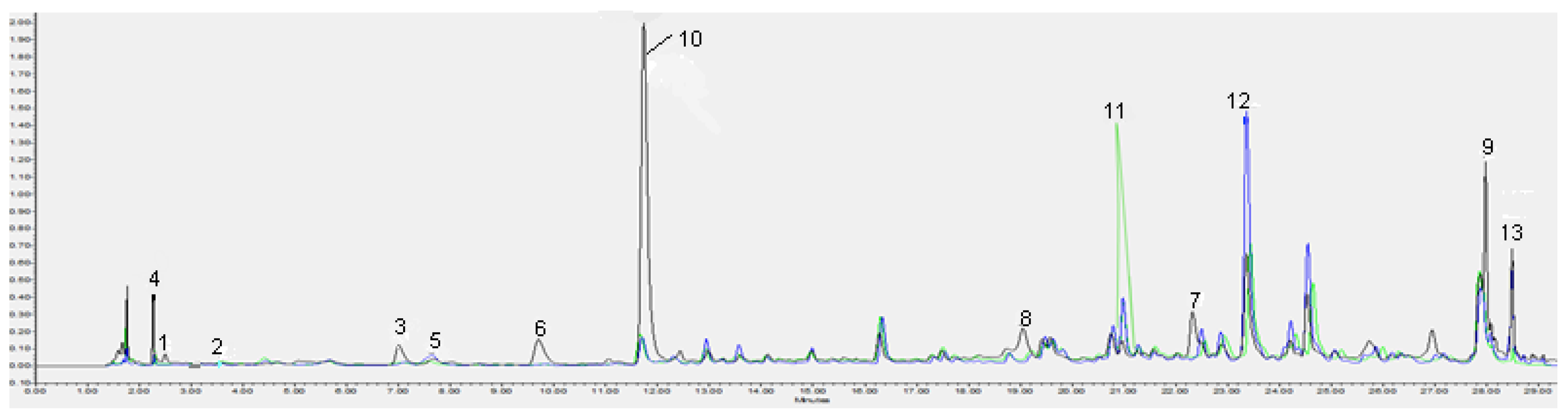
The highest sum of phenolic acid content was found in I. obliquus (Io) (435.52 mg/kg DM) and the lowest in P. squarrosa (Ps) (Table 2 and Figure 1). Among the analyzed acids, chlorogenic and sinapic acids were found in the highest concentrations in B. adusta (Ba) and P. ostreatus (Po), respectively. Conversely, pyroglutamic and pyruvic acids were present in low concentrations in all tested samples. Ferulic and coumaric acid in the three studied fungi (H. fasciculare (Hf), I. obliquus (Io), and K. mutabilis (Km) were present at a level above 84 mg/kg DM.
Table 2.
The phenolic acids concentration of 7 fungal isolates (mg/kg DM in mycelium).
Figure 1.
Comparison of phenolic acid (1—protocatechuic, 2—pyroglutamic, 3—pyruvic, 4—gallic, 5—2.5-dihydroxybenzoic, 6—4-hydroxybenzoic, 7—caffeic, 8—syringic, 9—p-coumaric, 10—ferulic, 11—chlorogenic, 12—sinapic, 13—t-cinnamic) UPLC chromatograms: Ps (green line), Km (black line), Io (blue line).
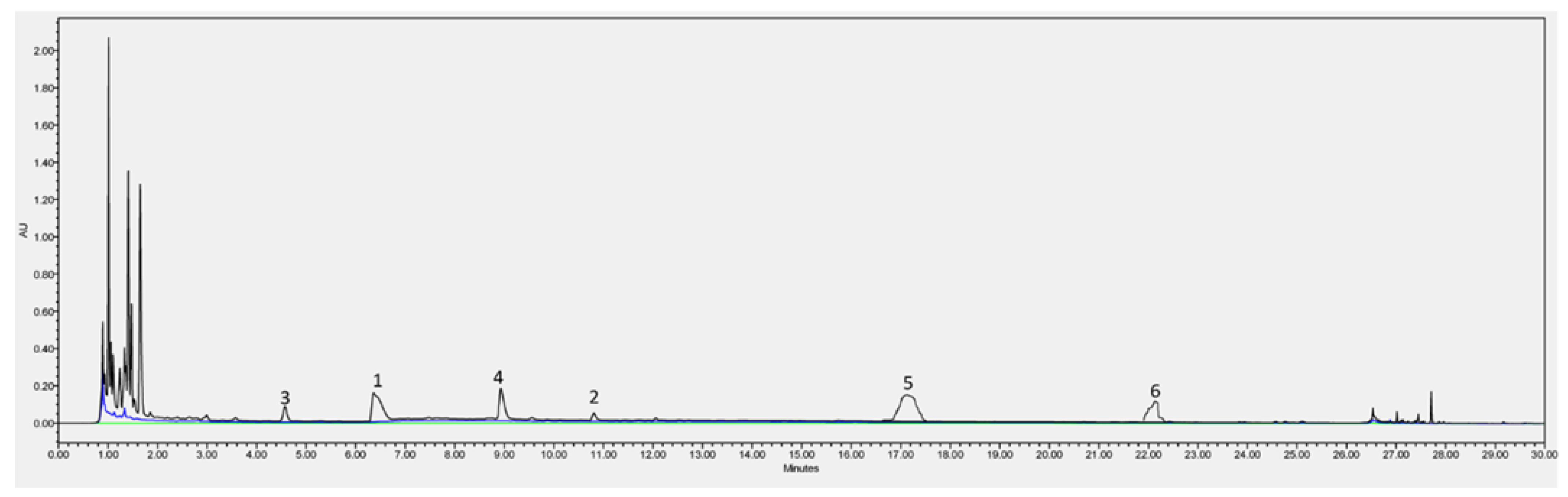
The research on the content of the selected flavonoids showed that the highest contents of these metabolites were observed in I. obliquus (Io)—114.5 mg/kg DM (sum of flavonoids), and the lowest in B. adusta (Ba)—0.07 mg/kg DM (sum of flavonoids) (Table 3 and Figure 2). High concentrations were also observed in H. fasciculare (Hf) and K. mutabilis (Km) (sum of flavonoids). In addition, high concentrations of naringenin, quercetin, and kaempferol (above 21 mg/kg DM) were found. Conversely, B. adusta (Ba) was characterized by the lowest concentration of flavonoids (0.07 mg/kg DM). P. squarrosa (Ps) and T. versicolor (Tv) were also poor in flavonoids.
Table 3.
The flavonoids concentration of 7 fungal isolates (mg/kg DM in mycelium).
Figure 2.
Comparison of flavonoids (1—naringenin, 2—vitexin, 3—rutin, 4—quercetin, 5—apigenin, 6—kaempferol) UPLC chromatograms: Ps (green line), Io (black line), Ba (blue line).
3.2. Antioxidant Activities of Mushroom Isolate Extracts
The ABTS+ radical neutralizing activity was measured for the methanol-water extracts obtained from the seven fungal mycelium isolates. Among the tested fungi, T. versicolor (Tv) was characterized by the highest antioxidant activity with a TEAC value of 908.56 μM/g and the highest concentration of FPA (195.52 mg GAE/g DM). Conversely, H. fasciculare (Hf) and B. adusta (Ba) had a radical scavenging capacity of 2 and 9 times lower, respectively, compared to T. versicolor (Tv). The mean values of the antioxidant activity were shown by the isolates of K. mutabilis (Km), P. ostreatus (Po), and I. obliquus (Io) (TEAC from 534.27 to 351.41 μM/g). The lowest antioxidant activity was observed in P. squarrosa (Ps). The lowest concentration of FPA was found for the B. adusta (Ba) isolate (102.97 mg GAE/g DM) (Table 4).
Table 4.
The antioxidant activities of methanol-water extracts of the obtained mushroom isolates measured by reaction with the radical ABTS cation and the free phenolic acids (FPA) content.
3.3. Concentration of Carotenoids
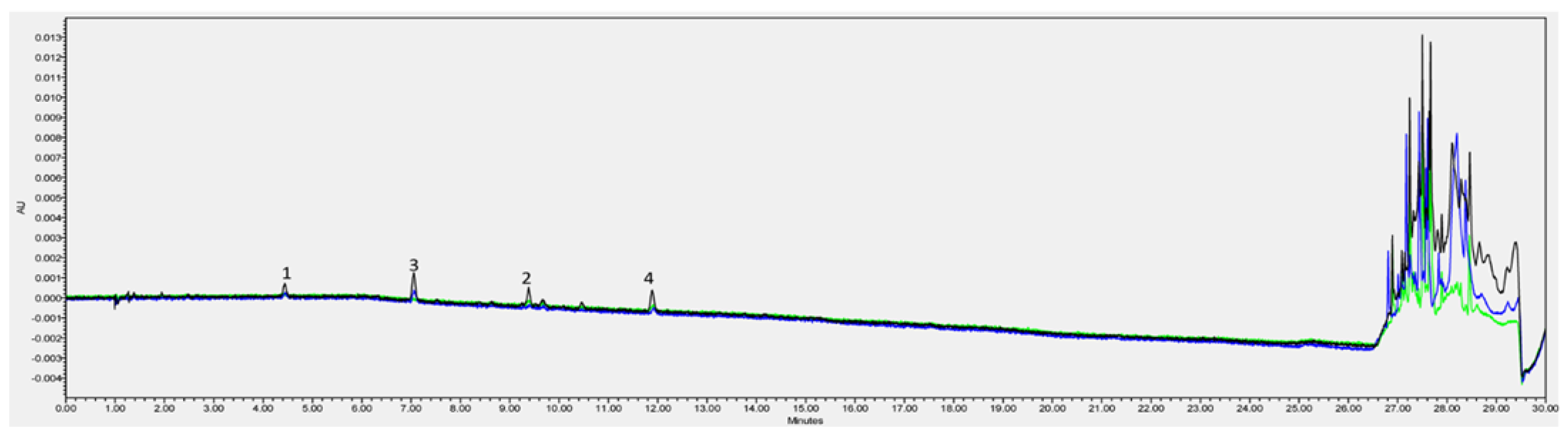
The highest carotenoid content was found in T. versicolor (Tv) and the lowest in P. squarrosa (Ps). In all tested isolates, β-carotene was present in the highest concentration. Similarly, zeaxanthin was found in the trace amounts in H. fasciculare (Hf), P. squarrosa (Ps), and K. mutabilis (Km) (Table 5 and Figure 3).
Table 5.
The carotenoids concentration (mg/kg) in 7 fungal isolates.
Figure 3.
Comparison of carotenoids (1-lutein, 2-zeaxanthin, 3-β-carotene, 4-astaxanthin) UPLC chromatograms: Io (green line), Po (black line), Ba (blue line).
3.4. Concentration of Ergosterol
The ergosterol (ERG) was quantified in the saprobiont fungi cultures. The highest ERG content was found in I. obliquus (Io) (863.33 mg/kg) and the lowest in T. versicolor (Tv) (223.30 mg/kg). The high concentration of this metabolite was also observed in H. fasciculare (Hf). The ERG content in the remaining isolates was above 300 mg/kg (Table 6).
Table 6.
The ergosterol (ERG) concentration (mg/kg) in 7 fungal isolates.
4. Discussion
The studied saprobiont fungi occurring in the various Polish forest habitats were characterized by a diversified content of the biologically active compounds. The first group of compounds analyzed in this study was phenolic acids, which included p-coumaric, ferulic, chlorogenic, and sinapic acids as the major components. Gallic, p-hydroxybenzoic, protocatechuic, vanillic, syringic, caffeic, ferulic, p-coumaric, and sinapic acids are the most common acids in the plant world [56]. In the tested isolates, the presence of 13 acids was observed, including the highest concentrations of p-coumaric, ferulic, chlorogenic, and sinapic acid. The greatest antioxidant capacity (protection of cells against hydrogen peroxide) is shown by the following acids: vanillic and caffeic acid [57]. The latter was present in all tested isolates, and the highest concentration was observed in H. fasciculare (Hf), I. obliquus (Io), and K. mutabilis (Km). The other acids determined in the isolates tested, which were characterized by in vitro and in vivo antioxidant, antibacterial, antiviral, and antifungal properties, are p-hydroxybenzoic, gallic, and protocatechuic acid [58].
A rich profile of phenolic acids in I. obliquus was presented in this study (Table 2) Numerous reports on the presence of phenolic acids in I. obliquus (Io) confirmed the presence of the following acids: gallic, protocatechuic, and p-hydroxybenzoic acid [34,50,59,60,61]. Ju et al. [62] isolated vanillic, protocatechuic, and 2.5-dihydroxyterephthalic acids.
Similar results were obtained by Janjušević et al. [63], who identified ten phenolic acids in T. versicolor (Tv) harvested in northwest Romania, six of which were confirmed in this study, among others: quinic, malic, vanillic, and caffeic acid. Other researchers found that the methanol extract of T. versicolor fruiting bodies showed the presence of three free phenolic acids: gallic (73 µg/g DM), protocatechuic (48 µg/g DM), and caffeic acid (154 µg/g DM) [58].
In the conducted analyses, six phenolic acids were determined in P. ostreatus (Table 1). Sinapic acid was present in a high concentration (100.72 mg/kg DM) with 141.82 mg/kg DM total acids content. Muszyńska et al. [64] found the presence of five acids in P. ostreatus: protocatechuic, p-hydroxybenzoic, p-coumaric, sinapic, vanillic, ferulic (1.28–21.38 mg/kg DM), and cinnamic acid (from 1.09 to 8.73 mg/kg DM). Similar results were obtained by Gąsecka et al. [65], but they did not measure sinapic acid. However, Kim et al. [66] noted a higher concentration of chlorogenic acids in the methanol extract of P. ostreatus. The study also quantified two other HBA derivatives and protocatechuic acids.
Badalyan et al. [67] determined the following acids in P. squarrosa and P. ostreatus: 4-hydroxybenzoic, 4-hydroxycinnamic, 4-hydroxy-3-methoxybenzoic, and 3,4-dihydroxyphenylacetic. Woldegiorgis et al. [68] also confirmed the presence of caffeic, gallic, and p-hydroxybenzoic acids in the methanolic extract of P. ostreatus cultivated in Ethiopia and determined that caffeic acid had the highest concentration among the phenolic acids. A different result was obtained by Palacious et al. [69], who found a low level of caffeic acid in P. ostreatus. Barros et al. [70] isolated the following acids from H. fasciculare: protocatechuic, p-hydroxybenzoic, and p-coumaric acids. In our research, we also quantified thirteen phenolic acids, and the highest concentration was observed for p-coumaric acid.
The carotenoids were another compound detected from the tested fungi. They belong to the group of chemicals that are synthesized in the organisms of bacteria, fungi, algae, and plants. Carotenoids containing 4-keto groups, monocyclic, and 13 double bonds in the structure, are characteristic of fungi [71,72]. The conjugated bonds are responsible for the distinctive color of these compounds (yellow, orange, or purple). These compounds protect against oxidative stress and exposure to visible light or UV radiation [73]. Moreover, carotenoids are intermediates in the biosynthesis of physiologically active apocarotenoids and their derivatives [74]. A large amount of reactive, conjugated double bonds present in the carotenoids causes the high activity of these compounds as antioxidants active against free radicals. These compounds stabilize cell membranes and act as photoreceptors.
All isolates were tested for β-carotene, lutein, zeaxanthin, and astaxanthin. The latter metabolite is characterized by 10-fold higher antioxidant activity than the other carotenoids: β-carotene, zeaxanthin, and lutein [75,76]. In our research, the highest concentration of this metabolite was observed in the T. versicolor (Tv) isolate. Other researchers confirmed the presence of β-carotene in P. ostreatus [77]. Jayakumar et al. [78] determined β-carotene in a 5-fold higher concentration than the present study. Robaszkiewicz et al. [79], Jaworska et al. [80], and Turfan et al. [81] found lycopene presence in addition to β-carotene. The latter was present at a much lower concentration in P. ostreatus. Mushroom species that contain β-carotene are Cantharellus cibarius Fr., Agaricus bisporus (J.E. Lange) Imbach, Boletus edulis Bull., Suillus bovinus (L.) Roussel, and Tricholoma equestre (L.) P. Kumm. Lycopene was found in the fruiting bodies of C. cibarius, A. bisporus, B. edulis, S. bovinus, and T. equestre. Lutein, α-carotene, and xanthotoxin were found in the fruiting bodies of C. cibarius, while γ-carotene, auroxanthin, and neurosporin was found in B. edulis. Barros et al. [82,83] spectrophotometrically proved that among the six Basidiomycota (Whittaker ex R.T. Moore) species collected in northeast Portugal, C. cibarius contains the highest amount of β-carotene, which was equal to 13.56 mg/g DM. For the other species, the content of this metabolite ranged from 1.95–12.77 mg/g DM [82,83].
Another group of active compounds isolated from the analyzed fungi is flavonoids. Today, more than 9000 different flavonoids are known, and the number continues to grow [84]. Flavonoids are polyphenolic chemical compounds of plant-based origins on the flavone skeleton. Their name comes from the Latin word flavus, meaning yellow. They occur mainly in the form of glycosides in the higher plants’ tissues and fungi. The antioxidant activity of the flavonoids depends on the conjugated double bonds in the C-2 and C-3 position, hydroxyl groups, and the carboxyl group in the C-4 position [85,86]. In the conducted analyses, the highest content of these metabolites was observed in I. obliquus (Io)—114.5 mg/kg DM. High concentrations were also observed in H. fasciculare (Hf) and P. squarrosa (Ps). In addition, a high concentration of naringenin, quercetin, and kaempferol above 21 mg/kg DM was found. Similar results were obtained by Zheng et al. [34], who also isolated quercetins, naringenins, and kaempferol from I. obliquus (Io). Conversely, B. adusta (Ba) (0.07 mg/kg DM) was characterized by containing the lowest concentration of flavonoids. P. squarrosa (Ps) and T. versicolor (Tv) were poor in flavonoids in our research. Janjušević et al. [63] obtained different results with T. versicolor (Tv) flavonoids content harvested from northwest Romania. The obtained profile was rich and included: flavones (6 compounds, e.g., apiin, vitexin, coumarins (2 compounds), flavanols (6 compounds, e.g., quercetin and rutin), isoflavonoids, and biflavonoids (amentoflavone). The flavonoid content was 67 mg/100 g DM. Other species with significant flavonoid amounts influencing their antioxidant value were: Lactarius deterrimus Gröger, Boletus edulis Bull. and Xerocomellus chrysenteron (Bull.) Šutara.
The compounds commonly found in mushrooms are sterols. The first reports of the presence of sterol in mushroom fruiting bodies date back to 1887. The typical mushroom sterols are distinguished by a high degree of unsaturation. Ergosterol is the main component of the fungal cell membrane and is strongly associated with cytoplasm; it is also a precursor to vitamin D2. Ergosterol can be converted to vitamin D2 through UV radiation. Finnish scientists determined the total sterol content in species of large-fruited mushrooms in the range of 625–774 mg/100 g DM [87]; a different ERG content characterized the analyzed fungi species. The highest ERG content was observed in I. obliquus (Io) (863.33 mg/kg). Kim et al. [66] and Shin et al. [88] determined ERG in I. obliquus, but not quantitatively. Alternatively, our research found that H. fasciculare (Hf) was characterized by a four-times lower ergosterol concentration compared with I. obliquus. Chemical composition studies of the edible mushroom species have shown that they are a rich source of ergosterol. After several years of storing the dried fruiting bodies, vitamin D2 content was high, averaging 1.43 μg/g DM in C. cibarius Fr. The differences in the ERG content were the results of the different sites of insolation from which the fruiting bodies came from [89]. Agaricus bisporus (J.E. Lange) Imbach contains an average of 61.5 mg/100 g of ergosterol. Research on the influence of UV-C radiation on the formation of vitamin D2, carried out by the Center for Plant and Food Science at the University of Western Australia, showed a high conversion rate of ergosterol to vitamin D2 after short-term exposure to the UV-C radiation of these species’ fruiting bodies during development. After UV-C radiation irradiating for 2.5, 5, and 10 min, the ergosterol concentrations were 6.6, 15.6, and 23.1 μg/g DM, respectively. Based on the Boletus edulis Bull. chemical analysis, it has been shown that the entire fruiting body contains approx. 200 mg of vitamin D2 per 100 g of DM 89].
In the conducted analyses, it was found that the antioxidant activity measured with the ABTS radical was 2.5–3.5 times higher in the isolates of I. obliquus (Io), P. ostreatus (Po), and H. fasciculare (HF) compared to P. squarrosa (Ps) and B. adusta (Ba). The highest antioxidant activity and the highest total phenolic acid content was found in T. versicolor (Tv) when compared to the other isolates. This relationship corroborates that the phenolic compounds’ content may affect the level of antioxidant activity. Matijašević et al. [90] investigated the total polyphenol content of the T. versicolor (Tv) isolate collected near Belgrade. The concentration of the FPA in the mushroom ethanol extract was 25.8 mg GAE/g. Those results were almost five times lower than the results determined in this study (Table 4). However, these results align with Vamanu and Voica’s [91] research, who investigated the total phenolics and antioxidant activity of the several mushrooms harvested from the Moldova region of Romania. In the different isolates of T. versicolor (Tv) variegated growths, significant differences were noted in FPA content, flavonoids, and antioxidant capacity. These significant differences can be explained by the genetic factors (different fungal isolates), harvest site and time, type of solvent, and extraction conditions. These compounds’ direct antioxidant mechanism captures the free oxygen radicals and reactive oxygen forms and limits their cell production by inhibiting the activity of the oxidizing enzymes (e.g., lipoxygenase) due to the easy hydrogen donation from the carboxyl group, which reduces peroxides and hydroxides.
5. Conclusions
In conclusion, it should be stated that differences in the qualitative and quantitative contents of active compounds may be the result of the different genetic properties and locations from which mushroom fruiting bodies are obtained. Significant qualitative and quantitative differences were found in the content of selected phenolic acids, flavonoids, sterols, and carotenoids.
Chaga (Inonotus obliquus) was characterized by the highest tested compound content among the studied mushrooms.
The antioxidant activity measured by the ABTS radical and the content of free phenolic acids (FPA) was also tested. It was found that the highest antioxidant activity and the highest total phenolic acid content were found in T. versicolor (Tv) compared to the other isolates. Chaga was also characterized by a high antioxidant value and a high total phenolic acid content. This dependence confirms that the content of phenolic compounds may affect the level of antioxidant activity. Results show that mushrooms are an excellent source of valuable antioxidant compounds, and the results presented in this study show the enormous potential of fungi as a potential source of bioactive compounds.
Author Contributions
Conceptualization, K.S.-S. and L.S.-M.; methodology, K.S.-S.; validation, K.S.-S.; formal analysis, L.S.-M.; investigation, L.S.-M.; resources, P.Ł.; data curation, M.K.; writing—original draft preparation, K.S.-S. and L.S.-M.; writing—review and editing, P.Ł.; visualization, M.K.; project administration, P.Ł.; funding acquisition, P.Ł. All authors have read and agreed to the published version of the manuscript.
Funding
This research was funded by the Polish Ministry of Science and Higher Education program ‘Regional Initiative of Excellence’ in years 2019–2022, Project No. 005/RID/2018/19.
Institutional Review Board Statement
Not applicable.
Informed Consent Statement
Not applicable.
Data Availability Statement
Not applicable.
Conflicts of Interest
The authors declare no conflict of interest. The funders had no role in the design of the study; in the collection, analyses, or interpretation of data; in the writing of the manuscript, or in the decision to publish the results.
References
- Wolna-Maruwka, A.; Piotrowska, M.; Niżewski, P. Zmiany liczebności grzybów pleśniowych oraz aktywności proteolitycznej osadu ściekowego kompostowanego w warunkach kontrolowanych. Nauka Przyr. Technol. 2010, 4, 6. [Google Scholar]
- Kulik, T.; Stuper-Szablewska, K.; Bilska, K.; Busko, M.; Ostrowska-Kołodziejczak, A.; Załuski, D.; Perkowski, J. Trans-Cinnamic and Chlorogenic Acids Affect the Secondary Metabolic Profiles and Ergosterol Biosynthesis by Fusarium culmorum and F. graminearum Sensu Stricto. Toxins 2017, 9, 198. [Google Scholar] [CrossRef] [PubMed]
- Wasser, S.P. Medicinal mushroom science: Current perspectives, advances, evidences and challenges. Biomed. J. 2014, 37, 345–356. [Google Scholar] [CrossRef] [PubMed]
- Chen, P.; Yong, Y.; Gu, Y.; Zhang, S.; Lu, L. Comparison of antioxidant and antiproliferation activities of polysaccharides from eight species of medicinal mushrooms. Int. J. Med. Mushrooms 2015, 17, 287–295. [Google Scholar] [CrossRef]
- Waktola, G.; Temesgen, T. Application of mushroom as food and medicine. Adv. Biotechnol. Microbiol. 2018, 11, 555817. [Google Scholar]
- Wu, F.; Zhou, L.W.; Vlasák, J.; Dai, Y.C. Global diversity and systematics of Hymenochaetaceae with poroid hymenophore. Fungal Divers. 2022, 113, 1–192. [Google Scholar] [CrossRef]
- Wojewoda, W. Checklist of Polish Larger Basidiomycetes. In Krytyczna Lista Wielkoowocnikowych Grzybów Podstawkowych Polski; Szafer Institute of Botany, Polish Academy of Sciences: Kraków, Poland, 2003; ISBN 83-89648-09-1. [Google Scholar]
- Zadrazil, F.; Kurtzman, R.H. The Biology of Pleurotus Cultivation in the Tropics in Tropical Mushrooms; Chang, S.T., Quimio, T.H., Eds.; The Chinese Press: Hong Kong, China, 1982; Volume 493, pp. 277–298. [Google Scholar]
- Gerhardt, E. Grzyby: Wielki Ilustrowany Przewodnik: Ponad 1000 Opisanych Gatunków; Łukomski, S., Ed.; Bauer-Weltbild Media: Warsaw, Poland, 2006; ISBN 83-7404-513-2. [Google Scholar]
- Sturion, G.L.; Oetterer, M. Composição química de cogumelos comestíveis (Pleurotus spp.) originados de cultivos em diferentes substratos. Ciência Tecnol. Aliment. 1995, 15, 189–193. [Google Scholar]
- Justo, M.B.; Guzmán, G.A.; Mejía, E.G.; Díaz, C.L.G.; Martínez, G.; Corona, E.B. Composition química de tres cepas mexicanas de setas (Pleurotus ostreatus). Arch. Latinoam. Nutr. 1998, 48, 359–363. [Google Scholar]
- Manzi, P.; Gambelli, L.; Marconi, S.; Vivanti, V.; Pizzoferrato, L. Nutrients in edible mushrooms: An inter-species comparative study. Food Chem. 1999, 65, 477–482. [Google Scholar] [CrossRef]
- Sadler, M. Nutritional properties of edible fungi. Br. Nutr. Found. Nutr. Bull. 2003, 28, 305–308. [Google Scholar] [CrossRef]
- Khan, M.A.; Amin, S.M.R.; Uddin, M.N.; Tania, M.; Alam, N. Comparative study of the nutritional composition of oyster mushrooms cultivated in Bangladesh. Bangladesh J. Mushroom 2008, 2, 9–14. [Google Scholar]
- Chihara, G. Immunopharmacology of lentinan, a polysaccharide isolated from Lentinus edodes: Its application as a host defense potentiator. Int. J. Orient. Med. 1992, 17, 55–77. [Google Scholar]
- Wu, F.; Zhou, L.W.; Yang, Z.L.; Bau, T.; Li, T.H.; Dai, Y.C. Resource diversity of Chinese macrofungi: Edible, medicinal and poisonous species. Fungal Divers. 2019, 98, 1–76. [Google Scholar] [CrossRef]
- Cohen, R.; Persky, L.; Hadar, Y. Biotechnological applications and potential of wood-degrading mushrooms of the genus Pleurotus. Appl. Microbiol. Biotechnol. 2002, 58, 582–594. [Google Scholar] [CrossRef] [PubMed]
- Bobek, P.; Galbavy, S. Effect of pleuran (beta-glucan from Pleurotus ostreatus) on the antioxidant status of the organism and on dimethylhydrazine-induced precancerous lesions in rat colon. Br. J. Biomed. Sci. 2001, 58, 164–168. [Google Scholar]
- Gumińska, B.; Wojewoda, W. Grzyby I Ich Oznaczanie; PWRiL: Warszawa, Poland, 1985; ISBN 83-09-00714-0. [Google Scholar]
- McQuilken, M.P.; Gemmell, J.; Whipps, J.M. Some Nutritional Factors Affecting Production of Biomass and Antifungal Metabolites of Coniothyrium minitans. Biocontrol Sci. Technol. 2010, 12, 443–454. [Google Scholar] [CrossRef]
- Sabat, J.; Gupta, N. Nutritional factors affecting the antifungal activity of Penicillium steckii of mangrove origin. Afr. J. Microbiol. Res. 2010, 4, 126–135. [Google Scholar]
- Manjunathan, J.; Kaviyarasan, V. Optimization of mycelia growth and antimicrobial activity of new edible mushroom, Lentinus tuberregium (Fr.). Tamil Nadu, India. Int. J. PharmTech Res. 2011, 3, 497–504. [Google Scholar]
- Nicolotti, G.; Varese, G. Screening of antagonistic fungi against air-borne infection by Heterobasidion annosum on Norway spruce. For. Ecol. Manag. 1996, 88, 249–257. [Google Scholar] [CrossRef]
- Łakomy, P.; Świdkiewicz, T.; Zieniewicz, J. Different influence of Hypholoma fasciculare (Huds: Fr.) Kummer on the growth of Armillaria ostoyae (Romagnesi) Herink in vitro. Phytopathol. Pol. 1999, 17, 91–98. [Google Scholar]
- Nicolotti, G.; Gonthier, P.; Varese, G.C. Effectiveness of some biocontrol and chemical treatments against Heterobasidion annosum on Norway spruce stumps. For. Pathol. 1999, 29, 339–346. [Google Scholar] [CrossRef]
- Woods, C.M.; Woodward, S.; Redfern, D.B. In vitro interactions in artificial and wood-based media between fungi colonizing stumps of Sitka spruce. For. Pathol. 2005, 35, 213–229. [Google Scholar] [CrossRef]
- de Boer, W.; Folman, L.B.; Gunnewiek, P.J.K.; Svensson, T.; Bastviken, D.; Öberg, G.; del Rio, J.C.; Boddy, L. Mechanism of antibacterial activity of the white-rot fungus Hypholoma fasciculare colonizing wood. Can. J. Microbiol. 2010, 56, 380–388. [Google Scholar] [CrossRef] [PubMed]
- Dai, Y.C. Polypore diversity in China with an annotated checklist of Chinese polypores. Mycoscience 2012, 53, 49–80. [Google Scholar] [CrossRef]
- Łakomy, P.; Kwaśna, H. Atlas Hub; Multico: Warszawa, Poland, 2008; pp. 142–143. [Google Scholar]
- Kamperidou, V. The Biological Durability of Thermally-and Chemically-Modified Black Pine and Poplar Wood Against Basidiomycetes and Mold Action. Forests 2019, 10, 1111. [Google Scholar] [CrossRef]
- Staszczak, M.; Zdunek, E.; Leonowicz, A. Studies on the role of proteases in the white-rot fungus Trametes versicolor: Effect of PMSF and chloroquine on ligninolytic enzymes activity. J. Basic Microbiol. 2000, 40, 1. [Google Scholar] [CrossRef]
- Binion, D.E.; Stephenson, S.L.; Roody, W.C.; Burdsall, H.H.; Vasilyeva, L.N.; Miller, O.K. Macrofungi Associated with Oaks of Eastern North America; West Virginia University Press: Morgantown, WV, USA, 2008. [Google Scholar]
- Journal of Laws, No. of 2014, Item 1408. Available online: https://pbsociety.org.pl/journals/index.php/am/article/view/am.1094 (accessed on 2 July 2022).
- Zheng, W.; Zhang, M.; Zhao, Y.; Wang, Y.; Miao, K.; Wei, Z. Accumulation of antioxidant phenolic constituents in submerged cultures of Inonotus obliquus. Bioresour. Technol. 2009, 100, 1327–1335. [Google Scholar] [CrossRef]
- Mizuno, T.; Zhuang, C.; Abe, K.; Okamoto, H.; Kiho, T.; Ukai, S.; Meijer, L. Antitumor and hypoglycemic activities of polysaccharides from the sclerotia and mycelia of Inonotus obliquus (Pers.: Fr.) Pil. (Aphyllophoromycetideae). Int. J. Med. Mushrooms 1999, 1, 301–316. [Google Scholar] [CrossRef]
- Kahlos, K.; Lesnau, A.; Lange, W.; Lindequist, U. Preliminary tests of antiviral activity of two Inonotus obliquus strains. Fitoterapia 1996, 67, 344–347. [Google Scholar]
- Ichimura, T.; Watanabe, O.; Maruyama, S. Inhibition of HIV-1 Protease by Water-Soluble Lignin-Like Substance from an Edible Mushroom, Fuscoporia obliqua. Biosci. Biotechnol. Biochem. 1998, 62, 575–577. [Google Scholar] [CrossRef]
- Ham, S.-S.; Kim, S.-H.; Moon, S.-Y.; Chung, M.J.; Cui, C.-B.; Han, E.-K.; Chung, C.-K.; Choe, M.S.; Kim, S.-H.; Moon, S.-Y.; et al. Antimutagenic effects of subfractions of Chaga mushroom (Inonotus obliquus) extract. Mutat. Res. Toxicol. Environ. Mutagen. 2009, 672, 55–59. [Google Scholar] [CrossRef] [PubMed]
- Kahlos, K.; Kangas, L.; Hiltunen, R. Antitumor activity of some compounds and fractions from an n-hexane extract of Inonotus obiquus. Acta Pharm. Fenn. 1987, 96, 33–40. [Google Scholar]
- Jarosz, A.; Skórska, M.; Rzymowska, J.; KochmańSka-Rdest, J.; Malarczyk, E. Effect of the extracts from fungus Inonotus obliquus on catalase level in HeLa and nocardia cells. Acta Biochim. Pol. 1990, 37, 149–151. [Google Scholar] [PubMed]
- Kahlos, K. Inonotus obliquus (Chaga Fungus): In vitro culture and the production of inotodiol, sterols, and other secondary metabolites. In Medicinal and Aromatic Plants VI; Springer: Berlin/Heidelberg, Germany, 1994; pp. 179–198. [Google Scholar]
- Burczyk, J.; Gawron, A.; Slotwinska, M.; Smietana, B.; Terminska, K. Antimitotic activity of aqueous extracts of Inonotus obliquus. Boll. Chim. Farm. 1996, 135, 306–309. [Google Scholar]
- Rzymowska, J. The effect of aqueous extracts from Inonotus obliquus on the mitotic index and enzyme activities. Boll. Chim. Farm. 1998, 137, 13–15. [Google Scholar]
- Jiang, O.P.; Don, Y.; Feng, Y.J.; Bondartseva, M.A.; Gao, T.H.; Chen, F.M. The antitumor activity and M.D.R. reversal properties of constituents from Inoxotus obliquus. Микoлoгия Фитoпатoлoгия 2007, 41, 455–460. [Google Scholar]
- Song, Y.; Hui, J.; Kou, W.; Xin, R.; Jia, F.; Wang, N.; Hu, F.; Zhang, H.; Liu, H. Identification of Inonotus obliquus and Analysis of Antioxidation and Antitumor Activities of Polysaccharides. Curr. Microbiol. 2008, 57, 454–462. [Google Scholar] [CrossRef]
- Chung, M.J.; Chung, C.-K.; Jeong, Y.; Ham, S.-S. Anticancer activity of subfractions containing pure compounds of Chaga mushroom (Inonotus obliquus) extract in human cancer cells and in Balbc/c mice bearing Sarcoma-180 cells. Nutr. Res. Pr. 2010, 4, 177–182. [Google Scholar] [CrossRef]
- Dai, Y.C.; Yang, Z.L.; Cui, B.K.; Yu, C.J.; Zhou, L.W. Species diversity and utilization of medicinal mushrooms and fungi in China. Int J. Med. Mushrooms 2009, 11, 287–302. [Google Scholar] [CrossRef]
- Cui, Y.; Kim, D.-S.; Park, K.-C. Antioxidant effect of Inonotus obliquus. J. Ethnopharmacol. 2005, 96, 79–85. [Google Scholar] [CrossRef]
- Nakajima, Y.; Nishida, H.; Matsugo, S.; Konishi, T. Cancer Cell Cytotoxicity of Extracts and Small Phenolic Compounds from Chaga [Inonotus obliquus (persoon) Pilat]. J. Med. Food 2009, 12, 501–507. [Google Scholar] [CrossRef] [PubMed]
- Nakajima, Y.; Sato, Y.; Konishi, T. Antioxidant Small Phenolic Ingredients in Inonotus obliquus (persoon) Pilat (Chaga). Chem. Pharm. Bull. 2007, 55, 1222–1226. [Google Scholar] [CrossRef] [PubMed]
- Kawashte, G.; Sonawane, H.; Mittal, S.; Borde, M. Medicinal Fungi: A Natural Source of Pharmacologically Important Metabolites. In Recent Developments in Microbial Technologies; Springer: Singapore, 2021; pp. 379–394. ISBN 978-981-15-4439-2. [Google Scholar]
- Stuper-Szablewska, K.; Kurasiak-Popowska, D.; Nawracała, J.; Perkowski, J. Response of non enzymatic antioxidative mechanisms to stress caused by infection with Fusarium fungi and chemical protection in different wheat genotypes. Chem. Ecol. 2017, 33, 949–962. [Google Scholar] [CrossRef]
- Przybylska-Balcerek, A.; Frankowski, J.; Stuper-Szablewska, K. The influence of weather conditions on bioactive compound content in sorghum grain. Eur. Food Res. Technol. 2020, 246, 13–22. [Google Scholar] [CrossRef]
- Kurasiak-Popowska, D.; Ryńska, B.; Stuper-Szablewska, K. Analysis of Distribution of Selected Bioactive Compounds in Camelina sativa from Seeds to Pomace and Oil. Agronomy 2019, 9, 168. [Google Scholar] [CrossRef]
- Perkowski, J.; Buśko, M.; Stuper-Szablewska, K.; Kostecki, M.; Matysiak, A.; Szwajkowska-Michałek, L. Concentration of ergosterol in small-grained naturally contaminated and inoculated cereals. Biologia 2008, 63, 542–547. [Google Scholar] [CrossRef]
- Bravo, L. Polyphenols: Chemistry, dietary, sources, metabolism and nutrional significance. Nutr. Rev. 1998, 56, 317–333. [Google Scholar] [CrossRef]
- Mansouri, A.; Makris, D.P.; Kefalas, P. Determination of hydrogen peroxide scavenging activity of cinnamic and benzoic acids employing a highly sensitive peroxyoxalate chemiluminescence-based assay: Structure–activity relationships. J. Pharm. Biomed. Anal. 2005, 39, 22–26. [Google Scholar] [CrossRef]
- Karaman, M.; Jovin, E.; Malbaša, R.; Matavuly, M.; Popović, M. Medicinal and edible lignicolous fungi as natural sources of antioxidative and antibacterial agents. Phytotherapy Res. 2010, 24, 1473–1481. [Google Scholar] [CrossRef]
- Szymański, M.; Smolibowska, J.; Szymański, A. An investigation into the relationships between antioxidant activity and chemical elements as well as polyphenolics in fungal fruiting bodies growing on Betula L. J. Elem. 2019, 24, 1. [Google Scholar] [CrossRef]
- Glamočlija, J.; Ćirić, A.; Nikolić, M.; Fernandes, A.; Barros, L.; Calhelha, R.C.; Ferreira, I.C.F.R.; Soković, M.; van Griensven, L.J.L.D. Chemical characterization and biological activity of Chaga (Inonotus obliquus), a medicinal “mushroom”. J. Ethnopharmacol. 2015, 162, 323–332. [Google Scholar] [CrossRef] [PubMed]
- Stojkovic, D.; Smiljkovic, M.; Ciric, A.; Glamoclija, J.; van Griensven, L.; Ferreira, I.C.F.R.; Sokovic, M. An insight into antidiabetic properties of six medicinal and edible mushrooms: Inhibition of α-amylase and α-glucosidase linked to type-2 diabetes. S. Afri. J. Bot. 2019, 120, 100–103. [Google Scholar] [CrossRef]
- Ju, H.K.; Chung, H.W.; Hong, S.S.; Park, J.H.; Lee, J.; Kwon, S.W. Effect of steam treatment on soluble phenolic content and antioxidant activity of the Chaga mushroom (Inonotus obliquus). Food Chem. 2010, 119, 619–625. [Google Scholar] [CrossRef]
- Janjušević, L.; Karaman, M.; Šibul, F.; Tommonaro, G.; Iodice, C.; Jakovljević, D.; Pejin, B. The lignicolous fungus Trametes versicolor (L.) Lloyd (1920): A promising natural source of antiradical and AChE inhibitory agents. J. Enzym. Inhib. Med. Chem. 2017, 32, 355–362, PMCID:PMC6010034. [Google Scholar] [CrossRef] [PubMed]
- Muszyńska, B.; Sułkowska-Ziaja, K.; Ekiert, H. Phenolic acids in selected edible Basidiomycotaspecies: Armillaria mellea, Boletus badius, Boletus edulis, Cantharellus cibarius, Lactarius deliciosus, and Pleurotus ostreatus. Acta Sci. Pol. Hortorum Cultus. 2013, 12, 12. [Google Scholar]
- Gąsecka, M.; Mleczek, M.; Siwulski, M.; Niedzielski, P. Phenolic composition and antioxidant properties of Pleurotus ostreatus and Pleurotus eryngii enriched with selenium and zinc. Eur. Food Res. Technol. 2015, 226, 737–743. [Google Scholar] [CrossRef]
- Kim, M.-Y.; Seguin, P.; Ahn, J.-K.; Kim, J.-J.; Chun, S.-C.; Kim, E.-H.; Seo, S.-H.; Kang, E.-Y.; Kim, S.-L.; Park, Y.-J.; et al. Phenolic Compound Concentration and Antioxidant Activities of Edible and Medicinal Mushrooms from Korea. J. Agric. Food Chem. 2008, 56, 7265–7270. [Google Scholar] [CrossRef]
- Badalyan, S.M. Edible and medicinal higher basidiomycete mushrooms as a source of natural antioxidants. Int. J. Med. Mushrooms. 2003, 5, 153–162. [Google Scholar] [CrossRef]
- Woldegiorgis, A.Z.; Abate, D.; Haki, G.D.; Ziegler, G.R. Antioxidant property of edible mushrooms collected from Ethiopia. Food Chem. 2014, 157, 30–36. [Google Scholar] [CrossRef]
- Palacios, I.; Lozano, M.; Moro, C.; D’Arrigo, M.; Rostagno, M.A.; Martínez, J.A.; García-Lafuente, A.; Guillamón, E.; Villares, A. Antioxidant properties of phenolic compounds occurring in edible mushrooms. Food Chem. 2011, 128, 674–678. [Google Scholar] [CrossRef]
- Barros, L.; Dueñas, M.; Ferreira, I.C.; Baptista, P.; Santos-Buelga, C. Phenolic acids determination by HPLC–D.A.D.–ESI/MS in sixteen different Portuguese wild mushrooms species. Food Chem. Toxicol. 2009, 47, 1076–1079. [Google Scholar] [CrossRef] [PubMed]
- Ferreira, I.C.; Barros, L.; Abreu, R.M. Antioxidants in wild mushrooms. Curr. Med. Chem. 2009, 16, 1543–1560. [Google Scholar] [CrossRef] [PubMed]
- Sandmann, G.; Misawa, N. Fungal Carotenoids. In Industrial Applications. The Mycota (A Comprehensive Treatise on Fungi as Experimental Systems for Basic and Applied Research); Osiewacz, H.D., Ed.; Springer: Berlin/Heidelberg, Germany, 2002; Volume 10. [Google Scholar] [CrossRef]
- Morris, S.A.C.; Subden, R.E. Effects of ultraviolet radiation on carotenoid containing and albino strains of Neurospora crassa. Mutat. Res. Mol. Mech. Mutagen. 1974, 22, 105–109. [Google Scholar] [CrossRef]
- Avalos, J.; Limón, M.C. Biological roles of fungal carotenoids. Curr. Genet. 2014, 61, 309–324, EPUB 2014 Paź 5. [Google Scholar] [CrossRef] [PubMed]
- Skibsted, L.H. Carotenoids in Antioxidant Networks. Colorants or Radical Scavengers. J. Agric. Food Chem. 2012, 60, 2409–2417. [Google Scholar] [CrossRef] [PubMed]
- Martin, H.D.; Jaeager, C.; Ruck, C.; Schmidt, M.; Walsh, R.; Paust, J.J. Astaxanthin uptake in domestic dogs and cats. ESPEN 1999, 52, 1–8. [Google Scholar]
- Mishra, K.K.; Pal, R.S.; Arunkumar, R. Antioxidant activities and bioactive compound determination from caps and stipes of specialty medicinal mushrooms Calocybe indica and Pleurotus sajor-caju (higher Basidiomycetes) from India. Int. J. Med. Mushrooms 2014, 16, 555–567. [Google Scholar] [CrossRef]
- Jayakumar, T.; Thomas, P.A.; Geraldine, P. In vitro antioxidant activities of an ethanolic extract of the oyster mushroom, Pleurotus ostreatus. Innov. Food Scien. Emerg. Technol. 2009, 10, 228–234. [Google Scholar] [CrossRef]
- Robaszkiewicz, A.; Bartosz, G.; Lawrynowicz, M.; Soszynski, M. The role of polyphenols, β-carotene, and lycopene in the antioxidative action of the extract of dried edible mushrooms. J. Nutr. Metabol. 2010, 11, 173–274. [Google Scholar] [CrossRef]
- Jaworska, G.; Pogoń, K.; Bernaś, E.; Duda-Chodak, A. Nutraceuticals and Antioxidant Activity of Prepared for Consumption Commercial Mushrooms Agaricus bisporus and Pleurotus ostreatus. J. Food Qual. 2015, 38, 111–122. [Google Scholar] [CrossRef]
- Turfan, N.; Ayan, S.; Pekşen, A.; Akin, S. Antioxidant Enzyme Activities of Some Wild and Cultivated Edible Mushrooms in Turkey. Uluslararası Tarım Yaban Hayatı Bilimleri Derg. 2020, 6, 202–206. [Google Scholar] [CrossRef]
- Barros, L.; Cruz, T.; Baptista, P.; Estevinho, L.M.; Ferreira, I.C. Wild and commercial mushrooms as source of nutrients and nutraceuticals. Food Chem. Toxicol. 2008, 46, 2742–2747. [Google Scholar] [CrossRef] [PubMed]
- Barros, L.; Venturini, B.A.; Baptista, P.; Estevinho, L.M.; Ferreira, I.C. Chemical composition and biological properties of Portuguese wild mushrooms: A comprehensive study. J. Agric. Food Chem. 2008, 56, 3856–3862. [Google Scholar] [CrossRef] [PubMed]
- Havsteen, B. The biochemistry and medical significance of the flavonoids. Pharmacol. Ther. 2002, 96, 67–202. [Google Scholar]
- Pietta, P.-G. Flavonoids as antioxidants. J. Nat. Prod. 2000, 63, 1035–1042. [Google Scholar] [CrossRef]
- Balasundram, N.; Sundram, K.; Samman, S. Phenolic compounds in plants and agri-industrial by-products: Antioxidant activity, occurrence, and potential uses. Food Chem. 2006, 99, 191–203. [Google Scholar] [CrossRef]
- Mattila, P. Sterol and vitamin D2 contents in some wild and cultivated mushrooms. Food Chem. 2002, 76, 293–298. [Google Scholar] [CrossRef]
- Shin, Y.; Tamai, Y.; Terazawa, M. Chemical Constituents of Inonotus obliquus: Triterpene and Steroids from Cultured Mycelia. Eurasian J. For. Res. 2001, 2, 27–30. [Google Scholar]
- Akanmu, D.; Cecchini, R.; Aruoma, O.I.; Halliwell, B. The antioxidant action of ergothioneine. Arch. Biochem. Biophys. 1991, 288, 10–16. [Google Scholar] [CrossRef]
- Matijašević, D.; Pantić, M.; Raskovic, B.; Pavlović, V.; Duvnjak, D.; Sknepnek, A.; Nikšić, M. The Antibacterial Activity of Coriolus versicolor Methanol Extract and Its Effect on Ultrastructural Changes of Staphylococcus aureus and Salmonella Enteritidis. Front. Microbiol. 2016, 7, 1226. [Google Scholar] [CrossRef]
- Vamanu, E.; Voica, A. Total phenolic analysis, antimicrobial and antioxidant activity of some mushroom tinctures from medicinal and edible species, by in vitro and in vivo tests. Sci. Bulletin. Ser. F. Biotechnol. 2017, 21, 318–324. [Google Scholar]
Publisher’s Note: MDPI stays neutral with regard to jurisdictional claims in published maps and institutional affiliations. |
© 2022 by the authors. Licensee MDPI, Basel, Switzerland. This article is an open access article distributed under the terms and conditions of the Creative Commons Attribution (CC BY) license (https://creativecommons.org/licenses/by/4.0/).