Abstract
Sika deer (Cervus nippon) populations have damaged habitats, agricultural crops, and commercial forests in many parts of the world, including Asia, Europe, northern America, and New Zealand. Population management of sika deer is an important task in those areas. To better understand large-scale management and improve management efficiency, the authors estimated spatio-temporal changes of density distribution and population dynamics of a managed population of sika deer on Kyushu Island (approximately 36,750 km2), Japan. The authors estimated these changes by using fecal pellet count surveys conducted from 1995 to 2019 and results from a vector autoregressive spatio-temporal model. No decreasing trend of populations were observed at the island and prefectural scales, even though the management goal has been to reduce the population by half, and harvesting on the island increased annually until it reached about 110,000 sika deer in 2014. A possible explanation for the stable population dynamics is that the population used to determine the harvest number under the prefectural management plan was originally underestimated. This study highlights not only the difficulties of wide-area management of sika deer but also three important factors for successful management: reducing the risk of management failure, using an adaptive management approach, and appropriate management scale.
1. Introduction
Overbrowsing by abundant large herbivores is considered to be detrimental to both natural and anthropogenic environments [1,2,3]. For example, as plants are repeatedly browsed by herbivores year after year, progressively smaller individuals are generated from belowground resources, and fewer flowering plants are produced [4]. Long-lasting overbrowsing by deer has been observed to cause recruitment failure of tree species and inhibit natural regeneration in forests [3,5,6]. In addition, vegetational ground cover does not increase over a long period, a legacy effect of overbrowsing [7,8]. Furthermore, herbivores that browse field crops, sown grasslands, and planted tree seedlings have been shown to be destructive and cause economic damages [9,10]. Thus, measures are needed to decrease browsing damage from both the ecological and economic sustainability points of view. Population management is used to decrease browsing damage by herbivores in many parts of the world, including Europe [10,11], North America [12], and Asia [13].
Sika deer (Cervus nippon) natively ranges in eastern Asia and has been widely introduced into many parts of the world, such as Europe, northern America, and New Zealand [13]. In some areas, populations have increased in number and have damaged habitats, agricultural crops, and commercial forests. Therefore, population management of sika deer is an important task in those areas [13,14]. In Japan, to manage the sika deer population, a national policy to rapidly increase the harvests of sika deer was implemented. For example, on Kyushu Island, the third largest of Japan’s four main islands, the harvest number increased approximately 6-fold from 2000 through 2015 and has exceeded 110,000 each year since 2014. Constant monitoring of density fluctuations is usually necessary to adequately manage resources, as is using a management system that can adapt to the results of the monitoring [15,16,17,18]. However, despite the large effort to control the sika deer population, the population dynamics for Kyushu Island have not been previously estimated.
On Kyushu Island, each prefectural government manages the deer population. Thus, the population dynamics need to be estimated in each prefecture. However, animals often move across multiple environments to track resources [19,20,21], and this movement should be considered during management planning [22]. Thus, it is also necessary to estimate spatial changes of the density distribution and large-scale population dynamics across multiple management units. However, it is difficult to estimate population dynamics across Kyushu Island because the population estimation surveys in each prefecture include temporal differences. In this study, therefore, we resolve this problem by using a state-of-the-art spatio-temporal model that can incorporate the different survey designs. The authors first clarified spatio-temporal changes of sika deer density on Kyushu Island, and second, estimated the population dynamics of the deer for the island as a whole and for each prefecture based on spatio-temporal changes of the deer density.
Clarified spatio-temporal changes of sika deer density on Kyushu Island were obtained by using a state-of-the-art spatio-temporal model that can incorporate the different survey designs, and the authors estimated the population dynamics of the deer for the island as a whole and for each prefecture based on spatio-temporal changes of the deer density.
2. Methods
2.1. Study Areas
Our study site, Kyushu Island (approximately 36,750 km2), is located in southwestern Japan. Natural forest vegetation on Kyushu Island splits into in two main zones with a boundary at an altitude of 800–1000 m: an evergreen broad-leaf forest (Castanopsis sieboldii, C. cuspidate, and broad-leaved Quercus spp.) zone at low altitudes and a deciduous broad-leaf forest (Quercus crispula and Carpinus spp.) zone at high altitudes. In addition, plantations comprising Japanese cedar (Cryptomeria japonica) and Japanese cypress (Chamaecyparis obtusa) cover 56% of forests on the island. In recent years, as harvests on these plantations have increased, Japanese cedar cuttings and/or Japanese cypress seedlings have been planted in the clear-cut areas.
The other large herbivore species on Kyushu Island is the Japanese serow (Capricornis crispus). Faeces of sika deer and serow are very similar and difficult to distinguish. However, the serow population is rapidly declining on the island, and only approximately 200 individuals are estimated to inhabit the island. Thus, the authors considered that the serow had no effect on deer density estimation in this study because of their few fecal pellets. As a major carnivore, the wolf (Canis lupus) has been absent for over 100 years on Kyushu Island, and there is no predator of the deer on Kyushu Island. Therefore, harvests can be viewed as the only top-down effect on populations of the deer.
2.2. Fecal Pellet Count Method
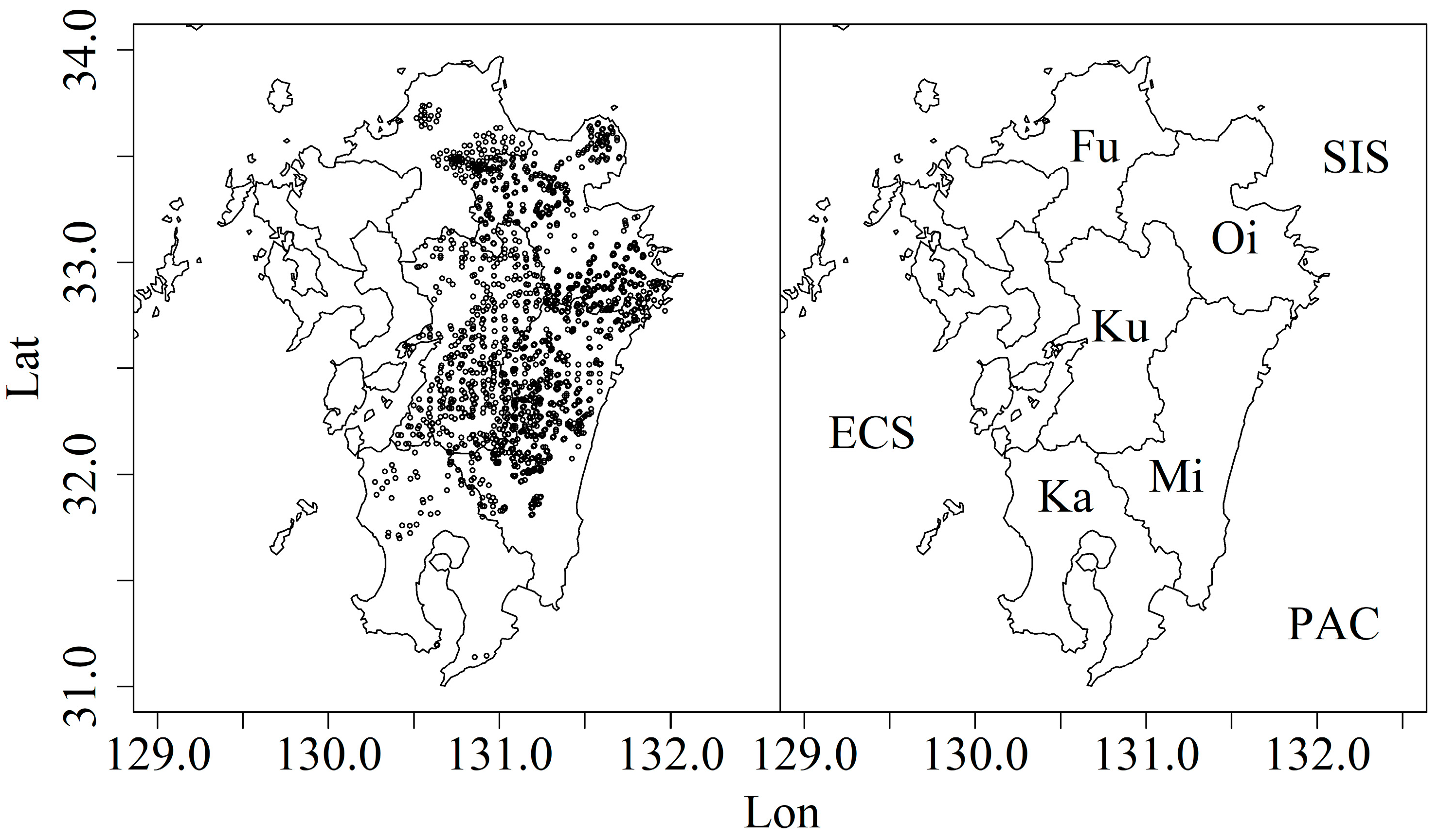
The study area included five prefectures (Fukuoka, Oita, Kumamoto, Miyazaki, and Kagoshima) on the island (Figure 1). The sika deer densities per square kilometer were estimated by the fecal pellet count method (FPCM) [23] in surveys conducted by each prefectural government. In the current study, an improved FPCM [24] that accounted for seasonal changes in the decay rate of pellets according to the climate of Kyushu Island. Fecal pellets were surveyed 3279 times at 1587 sites (Table 1, Figure 1, and Figure S1) in forest areas during various seasons from 1995 through 2019 (the Japanese fiscal year, from April to the next March, was used). The size of each site was 1 km2 and the number of survey plots at each site was 110 (1 × 1 m). Fecal pellets were found in 2770 surveys, and there were no fecal pellets in the remaining 509 surveys. The number of sites with fecal pellets was 1380.
Figure 1.
All survey sites from 1995 to 2019 (left) and the location of surveyed prefectures (right). Fu, Oi, Ku, Mi, and Ka indicate the Fukuoka, Oita, Kumamoto, Miyazaki, and Kagoshima prefectures, respectively. ECS and SIS indicate East China and the Seto Inland Seas, respectively. PAC is the Pacific Ocean.
Table 1.
Number of sites and surveys of the fecal pellet count in each prefecture.
2.3. Spatio-Temporal Changes of Deer Density and Population Dynamics
Although FPCM can be used to estimate sika deer density by considering seasonal changes in the decay rate of fecal pellets, the density for the entire island cannot be directly predicted from the sum of the number of fecal pellets calculated from the FPCM data for two reasons. The first is that the survey areas varied among years because the surveys were not conducted annually, and the survey year differed among the prefectures. The second is that the surveyed locations are spatially heterogeneous because there are more data from easily accessed locations than from inaccessible locations. These problems introduce estimation bias into any calculation of sika deer density.
To estimate changes in sika deer density over Kyushu Island considering the spatial heterogeneity of survey design, the authors used the vector autoregressive spatio-temporal (VAST) model [25,26]. This model is based on spatio-temporal, generalized, linear mixed-modelling techniques [27] and is designed to estimate spatial changes of density and total abundance for a target species [28]. Spatial and spatio-temporal variations are approximated by decaying correlations in spatial variation [29]. The model can account for spatio-temporal changes in survey design and accurately estimate relative local density at high resolution, so it can partially overcome the challenges of estimating the sika deer density on Kyushu Island given the existing data. Previous studies have mainly applied the VAST model to marine organisms to clarify distributions [30], shifts in fish spawning grounds associated with climate change [31], and the spatio-temporal dynamics of fisheries [32,33]. Ours is the first application of the VAST model to a terrestrial organism (i.e., sika deer). Expected deer densities for each sample were estimated using a log-linked linear predictor and a lognormal distribution with the following formula:
where is the intercept for year , and and are spatial and spatio-temporal random effects for year t and location s (latitude and longitude). The probability density function of is a multivariate normal distribution , where the variance-covariance matrix is a Matérn correlation function. The probability density function of is
The authors set under the assumption that the year was independent. For computational reasons, the authors used a k-means algorithm, minimizing the total distance between the locations [27] in sampling data by using R-INLA software [34] to approximate as being piecewise constant at a fine spatial scale. The number of the locations termed “knots” controls the accuracy of the piecewise-constant approximation. The authors identified 200 knots based on both the accuracy and computational speed.
Parameters in the VAST model were estimated in the VAST package (https://github.com/James-Thorson-NOAA/VAST, accessed on 24 February 2020). The model was run in R 3.5.2 [35]. From the model, we estimated the deer abundance in year at location , deer density indexes (DDIs) in year on Kyushu Island, and prefectural DDIs in year at prefecture as follows:
where is the average function.
3. Results
3.1. Spatio-Temporal Changes of Deer Density
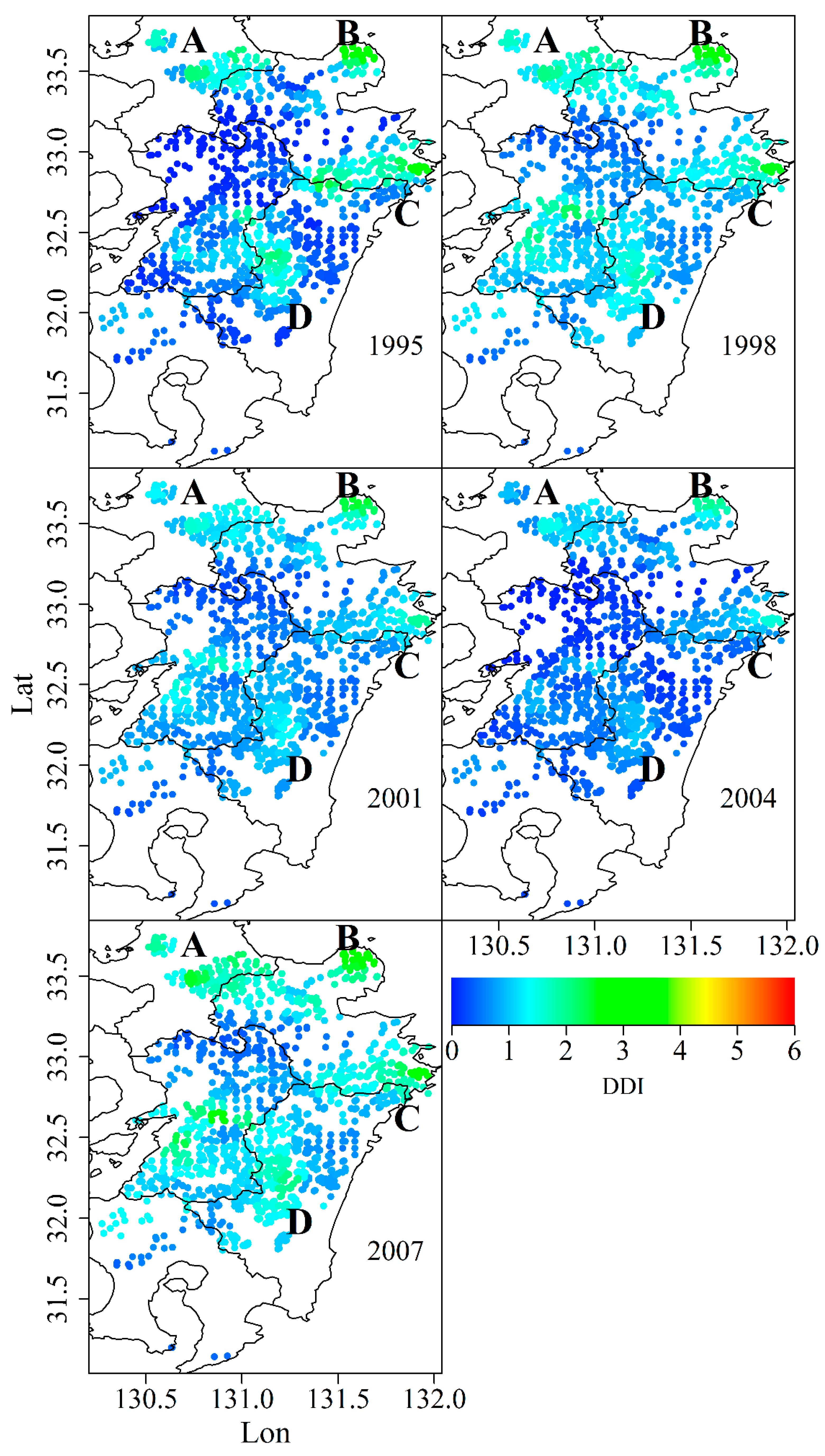
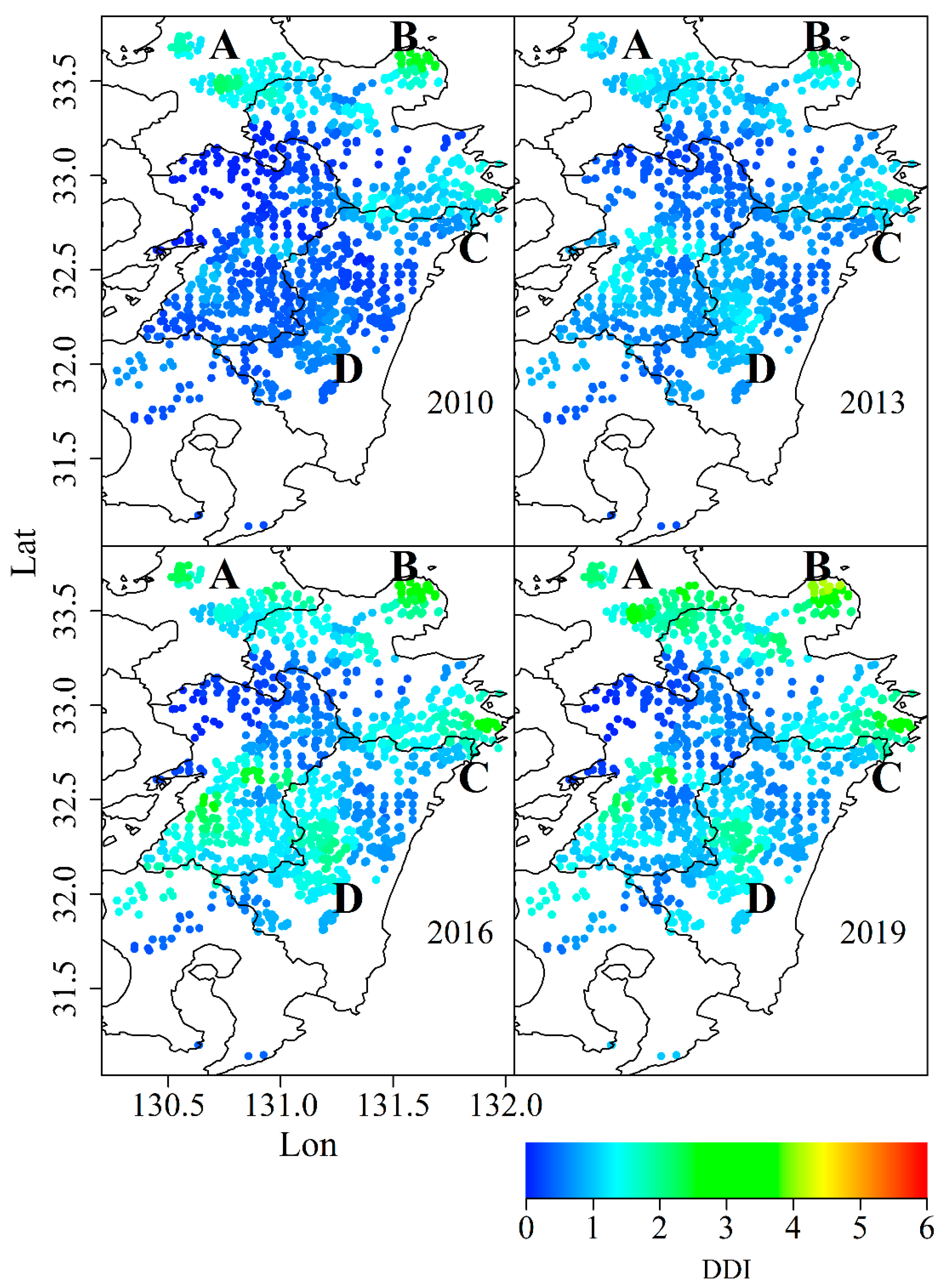
The summary of deer density estimated by FPCM and the annual number of deer harvested are indicated in Table A1. Figure 2 presents spatio-temporal changes of deer density according to the VAST model estimates. In 1995, the first survey year, four high-density (≥1.5) core areas were identified: core areas A and B in the northwestern and northeastern areas, respectively, around 33.5° N; area C in the middle eastern area around 33.0° N; and area D in the southern area around 32.5° N (Figure 2). Three core areas were located across multiple prefectures: area A was in Fukuoka and Oita prefectures; area C was in Oita and Miyazaki prefectures; and area D was in Kumamoto, Miyazaki, and Kagoshima prefectures. Basically, the location of core areas did not change throughout the study period. Core areas A and B kept high density, but the densities of core area C and D relatively largely fluctuated. Since 2016, high densities were maintained in all core areas.

Figure 2.
Spatio-temporal changes of deer density at survey sites from 1995 to 2019. A to D indicate the locations of core areas with high deer density.
3.2. Population Dynamics of Sika Deer
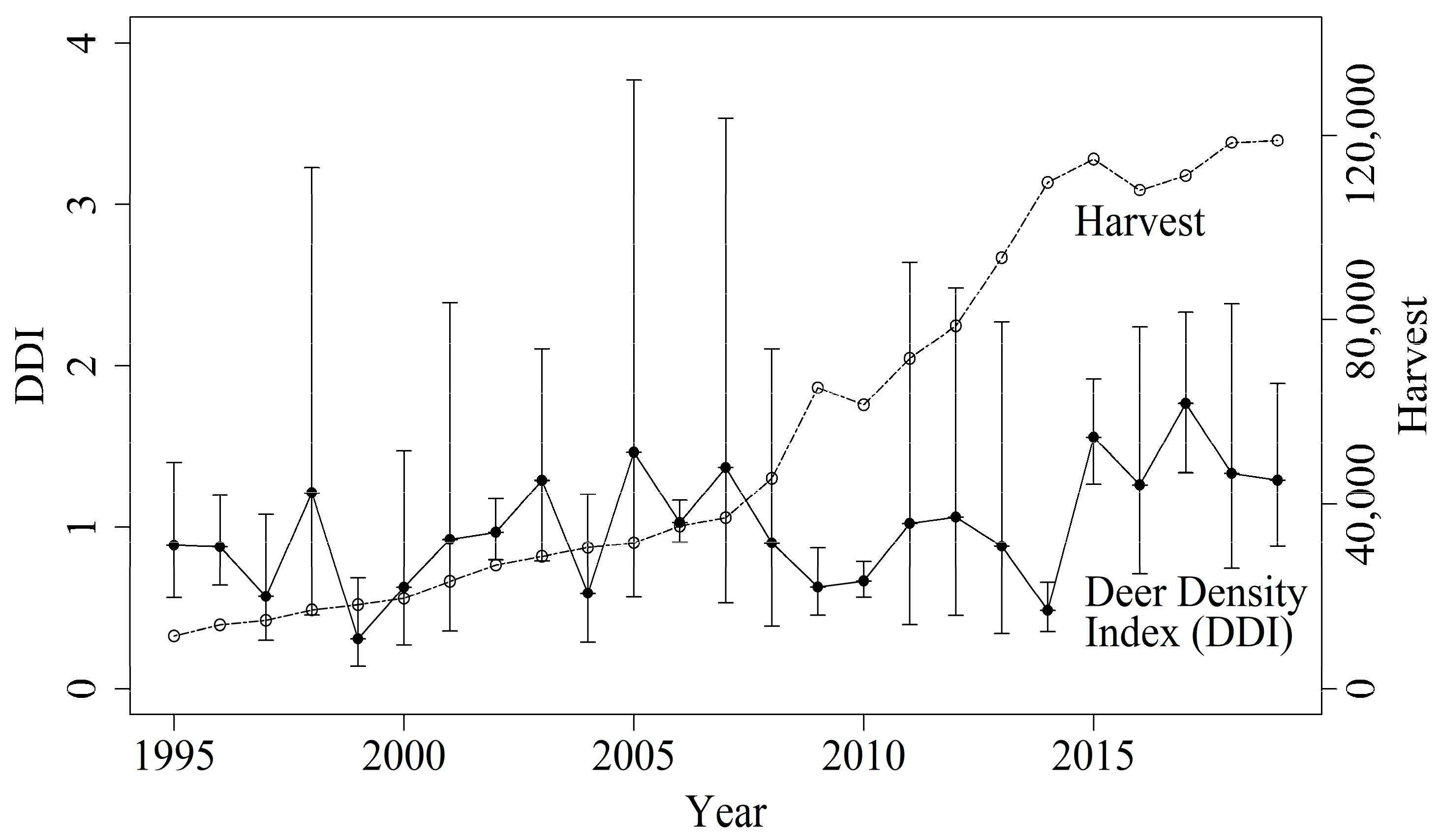
Although the DDI estimated from VAST for Kyushu Island fluctuated interannually (Figure 3), the population on the island was relatively stable, and there was no increasing or decreasing trend over time. Since 2015, when the harvest number stabilized at a high value (Figure 3), the density remained at a higher value than the average density during the study period, although the confidence intervals are relatively large.
Figure 3.
Annual deer density index (DDI) and harvests in the entire study area during the study period. DDI and error bars (95% CI) were estimated from the VAST model discussed in the text.
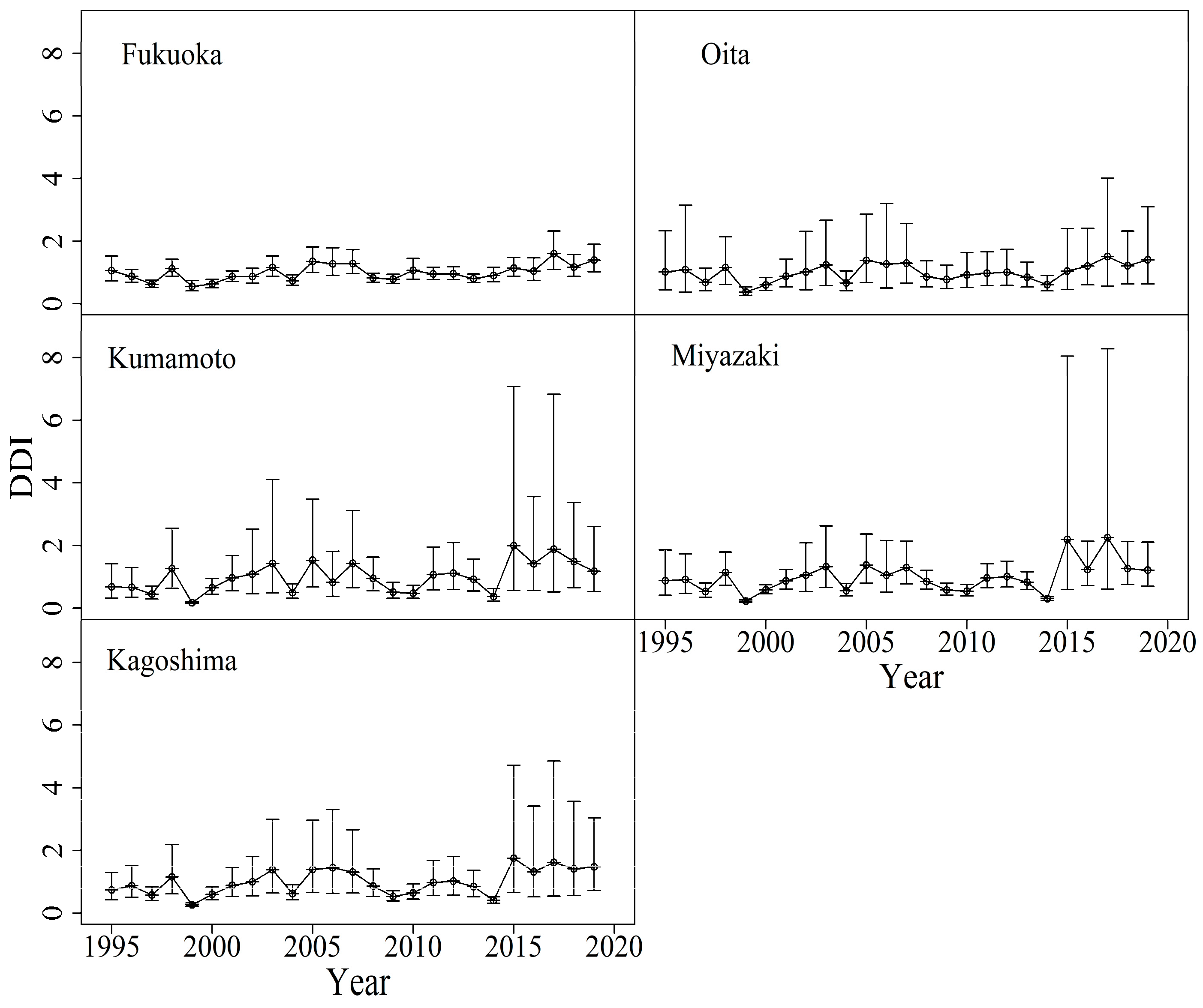
In addition, DDIs were relatively stable in each prefecture throughout the study period (Figure 4). DDIs rapidly increased from 2014 to 2015 in Kumamoto, Miyazaki and Kagoshima prefectures, and the density appeared to remain high after 2015. However, once again, the confidence intervals were large, and the estimation accuracies were lower than they were before 2014.
Figure 4.
Deer density index (DDI) fluctuation in each prefecture. DDIs and error bars (95% CI) were estimated from the VAST model described in the text.
4. Discussion
In this study, we clarified spatio-temporal changes of sika deer density on Kyushu Island and estimated the population dynamics of the deer by using the VAST model. Continuous large-scale estimations of the density of large herbivores are usually both costly and labor-intensive, and spatio-temporal data gaps often occur as a result of differences in the budget and management enthusiasm of each management unit. Use of the VAST model resolved these problems by accounting for spatio-temporal differences in the survey design.
However, the confidence intervals were relatively large in some years (Figure 3). This may have been a result of the small number of survey sites in those years (Figure S1). In contrast, in Fukuoka Prefecture, where the surveys have been continuous, albeit only in some areas, the confidence interval was narrow throughout the survey period (Figure 4). Thus, it is important to conduct continuous surveys every year, even if only in a small number of survey sites, to increase the accuracy of the estimation.
4.1. Spatio-Temporal Changes of Deer Density
High levels of browsing damages were observed in core areas A, C, and D [36,37]. Browsing damage increases with increased herbivore density [38], which indicates that our results relatively accurately show the spatial distributions of sika deer on Kyushu Island.
These core areas were located on prefecture borders, and wildlife can often move across management area boundaries [19,20,21]. Although this movement can be a limiting factor for appropriate management [39], it is often not considered [40]. Localized management is known to be effective in large herbivores [41,42,43]. Therefore, the authors believe that it is important to first identify high-density core areas, and then it may be more efficient for the relevant prefectures to work together to manage the population in those areas. Creating this type of cooperative system among prefectural governments is a future task.
4.2. Population Dynamics of Sika Deer
The estimated deer population was relatively stable during the 25-year study period on Kyushu Island. In contrast, the number of deer harvested increased in the first 20 years of the period, and approximately 110,000 sika deer were harvested annually from 2014 through 2019 (Figure 3). The lack of population decline despite these increased harvests may be due to the fact that the deer were only harvested to the extent that they were included in the natural mortality of the deer. In addition, yearly recruitment successes in this latter 5-year period likely averaged 110,000 or even more. Kaji et al. [44] reported an annual rate of increase of 16–21% for sika deer; at this rate, it is possible that approximately 520,000 to 690,000 sika deer inhabit the study area.
In 2013, the Ministry of the Environment and the Ministry of Agriculture, Forestry, and Fisheries proposed a policy to halve the deer population in the current decade by harvesting [45]. Although each prefectural government increased the harvesting number year by year (Table A1), the results of this paper showed no population decline by 2019 (Figure 3 and Figure 4). The Ministry of the Environment estimated the sika deer population in the 5 prefectures of Kyushu Island to be less than 400,000 in 2012 [46], and the harvests were determined in a scenario analysis based on this estimate. In contrast, our results show that, even in 2014, when the DDI was relatively small, the sika deer population probably exceeded 520,000 because DDI increased in the following year even though approximately 110,000 sika deer were harvested. It is therefore likely that the sika deer population in 2012 (when the DDI was greater than that of 2014) also exceeded 520,000. Thus, it is plausible that the sika deer population has not declined because the original management decisions were based on an underestimation of the population.
The cause of this type of management failure has often been shown in large herbivore management [47,48,49]. Because stock assessment errors can lead to population management failures [50], choosing a more pessimistic population scenario (i.e., a higher initial population within a confidence interval) would be more robust against uncertainty and reduce the risk of management failure. In addition, using an adaptive management approach, which includes cycles of design, management, monitoring, and adaptation in an iterative feedback loop, is essential to managing natural resources that include extreme uncertainty, such as the sika deer in this study [51,52,53]. To successfully manage this deer population, the authors recommend a reorganization of the deer management plan on Kyushu Island from the present inflexible plan based on a fixed harvest number to an adaptive one that incorporates current population estimates and uncertainty.
In addition, previous studies have shown that initial censuses of large herbivore populations tend to underestimate the actual size, especially in large populations [10,11], and recent studies of management strategies have emphasized the importance of an appropriate spatial scale [54,55]. In Kumamoto Prefecture, although there was no population decline throughout the prefecture, density decline by harvesting was shown on a regional scale, such as 25 km2 [56]. So, at smaller spatial scales, the population can be reduced by harvesting. Thus, the authors consider that managing in smaller units will lead to successful management because both the Kyushu Island and the prefecture-based management units are too large for deer management. Even if management goals are set on a prefecture-base, it is important to define harvesting targets in each region of the prefecture.
5. Conclusions
In this study, the authors found relative stable population dynamics of sika deer on Kyushu Island, Japan, even though a national policy to rapidly increase the harvests of sika deer was implemented to manage the deer population. This study highlights not only the difficulties of wide-area management of sika deer but also three important factors for successful management: reducing the risk of management failure as well as using an adaptive management approach and appropriate management scale.
Supplementary Materials
The following supporting information can be downloaded at: www.mdpi.com/xxx/s1/, Figure S1: Survey plots of fecal pellet count methods from 1995 to 2019.
Author Contributions
Conceptualization: K.K.S., M.Y., and T.O.; methodology: K.K.S., Y.K. (Yuki Kanamori), and Y.K. (Yohei Kawauchi); software: K.K.S.; validation: K.K.S., Y.K. (Yuki Kanamori), and Y.K. (Yohei Kawauchi); formal analysis: K.K.S., Y.K. (Yuki Kanamori), and Y.K. (Yohei Kawauchi); data curation: Y.K. (Yasumitsu Kuwano), Y.U., and H.K.; writing—original draft preparation: K.K.S.; writing—review and editing: all authors; visualization: K.K.S.; supervision: T.O.; project administration: T.O. All authors have read and agreed to the published version of the manuscript.
Funding
This study is funded by research grant #202205 of the Forestry and Forest Products Research Institute.
Data Availability Statement
The data that support the findings of this study are available from each prefectural government, but restrictions apply to the availability of these data, which were used under license for the current study, and are thus not publicly available. Data, however, are available from the corresponding author upon reasonable request and with permission of each prefectural government.
Acknowledgments
The authors particularly thank the Kumamoto, Miyazaki, Oita, Fukuoka, and Kagoshima prefectural governments for providing the pellet count survey data. The authors also thank members of the Forestry and Forest Products Research Institute for their helpful comments.
Conflicts of Interest
The authors declare no conflict of interest.
Appendix A
Table A1.
Sika deer density estimated by fecal pellet count method (ED) and number of harvesting of sika deer (NH) in each prefecture. NA indicates nonapplicable data.
Table A1.
Sika deer density estimated by fecal pellet count method (ED) and number of harvesting of sika deer (NH) in each prefecture. NA indicates nonapplicable data.
| Year | Fukuoka | Oita | Kumamoto | Miyazaki | Kagoshima | |||||
|---|---|---|---|---|---|---|---|---|---|---|
| ED | NH | ED | NH | ED | NH | ED | NH | ED | NH | |
| 1995 | 21.9 | 255 | NA | 2867 | NA | 2078 | 16.9 | 4163 | NA | 2130 |
| 1996 | 21.5 | 365 | 30.5 | 3231 | NA | 2897 | 21.3 | 5057 | NA | 2303 |
| 1997 | 15.8 | 517 | NA | 3640 | NA | 3153 | 11.5 | 5178 | NA | 2328 |
| 1998 | 33.7 | 699 | NA | 4167 | NA | 3825 | NA | 5792 | NA | 2602 |
| 1999 | 14.5 | 791 | NA | 4516 | NA | 4335 | NA | 6050 | NA | 2951 |
| 2000 | 19.3 | 842 | NA | 5241 | NA | 5381 | NA | 4914 | NA | 3634 |
| 2001 | 18.5 | 961 | NA | 6150 | NA | 6837 | NA | 6465 | NA | 3334 |
| 2002 | 24.1 | 1241 | 29.3 | 8288 | 21.5 | 8266 | 16.3 | 5999 | NA | 3546 |
| 2003 | 21.9 | 1289 | NA | 6905 | 25.7 | 9775 | NA | 7422 | NA | 3848 |
| 2004 | 19.2 | 1297 | NA | 6935 | NA | 10,703 | NA | 8125 | NA | 4142 |
| 2005 | 29.3 | 1891 | NA | 6981 | NA | 10,608 | NA | 8112 | NA | 4558 |
| 2006 | 33.3 | 2237 | 33.0 | 8015 | 11.1 | 11,404 | 18.9 | 9197 | NA | 5012 |
| 2007 | 27.6 | 2485 | NA | 9389 | NA | 12,967 | NA | 7985 | NA | 4836 |
| 2008 | 23.5 | 2768 | NA | 12,910 | NA | 16,052 | NA | 9254 | NA | 5160 |
| 2009 | 19.2 | 3242 | NA | 19,723 | 7.2 | 16,730 | NA | 20,195 | NA | 6057 |
| 2010 | 37.2 | 3426 | 19.3 | 23,651 | 6.1 | 14,401 | NA | 13,705 | NA | 8522 |
| 2011 | 20.4 | 3914 | NA | 27,811 | NA | 14,952 | NA | 17,525 | NA | 10,381 |
| 2012 | 28.1 | 4315 | NA | 30,597 | NA | 16,073 | NA | 18,923 | NA | 13,951 |
| 2013 | 17.6 | 6539 | NA | 33,417 | NA | 17,762 | NA | 25,298 | NA | 15,944 |
| 2014 | 24.1 | 9077 | NA | 40,963 | 6.2 | 19,249 | NA | 27,992 | NA | 19,638 |
| 2015 | 18.7 | 9555 | 21.6 | 41,092 | NA | 19,470 | 34.7 | 28,467 | 22.4 | 24,212 |
| 2016 | 30.7 | 9273 | NA | 39,285 | NA | 17,427 | NA | 27,200 | 17.5 | 21,580 |
| 2017 | 32.2 | 10,166 | NA | 41,137 | NA | 17,360 | 35.2 | 26,467 | 19.1 | 21,819 |
| 2018 | 35.9 | 11,590 | NA | 41,576 | NA | 20,554 | NA | 28,932 | 23.4 | 22,244 |
| 2019 | NA | 10,932 | NA | 43,054 | 15.3 | 21,524 | NA | 27,537 | 14.7 | 23,019 |
References
- Gill, R.M.A. A review of damage by mammals in north temperate forests: 1. Deer. Forestry 1992, 65, 145–169. [Google Scholar] [CrossRef] [Green Version]
- Côté, S.D.; Rooney, T.P.; Tremblay, J.P.; Dussault, C.; Waller, D.M. Ecological impacts of deer overabundance. Annu. Rev. Ecol. Evol. Syst. 2004, 35, 113–147. [Google Scholar] [CrossRef] [Green Version]
- Putman, R.; Langbein, J.; Green, P.; Watson, P. Identifying threshold densities for wild deer in the UK above which negative impacts may occur. Mamm. Rev. 2011, 41, 175–196. [Google Scholar] [CrossRef]
- Anderson, R.C. Height of white-flowered trillium (Trillium grandiflorum) as an index of deer browsing intensity. Ecol. Appl. 1994, 4, 104–109. [Google Scholar] [CrossRef]
- Whigham, D.F. Ecology of woodland herbs in temperate deciduous forests. Annu. Rev. Ecol. Evol. Syst. 2004, 35, 583–621. [Google Scholar] [CrossRef] [Green Version]
- Ramirez, J.I.; Jansen, P.A.; Poorter, L. Effects of wild ungulates on the regeneration, structure and functioning of temperate forests: A semi-quantitative review. For. Ecol. Manag. 2018, 424, 406–419. [Google Scholar] [CrossRef]
- Tanentzap, A.J.; Burrows, L.E.; Lee, W.G.; Nugent, G.; Maxwell, J.M.; Coomes, D.A. Landscape-level vegetation recovery from herbivory: Progress after four decades of invasive red deer control. J. Appl. Ecol. 2009, 46, 1064–1072. [Google Scholar] [CrossRef]
- Harada, K.; Ann, J.A.M.; Suzuki, M. Legacy effects of sika deer overpopulation on ground vegetation and soil physical properties. For. Ecol. Manag. 2020, 474, 118346. [Google Scholar] [CrossRef]
- Putman, R.J.; Moore, N. Impact of deer in lowland Britain on agriculture, forestry and conservation habitats. Mamm. Rev. 1998, 28, 141–164. [Google Scholar] [CrossRef]
- Putman, R.J.; Apollonio, M.; Andersen, R. Ungulate Management in Europe: Problems and Practices; Cambridge University Press: Cambridge, UK, 2011. [Google Scholar]
- Apollonio, M.; Andersen, R.; Putman, R. European Ungulates and Their Management in the 21st Century; Cambridge University Press: Cambridge, UK, 2010. [Google Scholar]
- Hewitt, D.G. Biology and Management of White-Tailed Deer; CRC Press: Boca Raton, FL, USA, 2011. [Google Scholar]
- McCullough, D.R.; Takatsuki, S.; Kaji, K. Sika Deer: Biology and Management of Native and Introduced Populations; Springer: Tokyo, Japan, 2009. [Google Scholar]
- Pérez-Espona, S.; Pemberton, J.M.; Putman, R. Red and sika deer in the British Isles, current management issues and management policy. Mammal. Biol. 2009, 74, 247–262. [Google Scholar] [CrossRef]
- Walters, C.J.; Hilborn, R. Ecological optimization and adaptive management. Annu. Rev. Ecol. Evol. Syst. 1978, 9, 157–188. [Google Scholar] [CrossRef]
- Shea, K.; the NCEAS Working Group on Population Management. Management of populations in conservations, harvesting and control. Trends Ecol. Evol. 1998, 13, 371–375. [Google Scholar] [CrossRef]
- Westgate, M.J.; Likens, G.E.; Lindenmayer, D.B. Adaptive management of biological systems: A review. Biol. Conserv. 2013, 158, 128–139. [Google Scholar] [CrossRef]
- Vicente, J.; Apollonio, M.; Blanco-Aguiar, J.A.; Borowik, T.; Brivio, F.; Casaer, J.; Croft, S.; Ericsson, G.; Ferroglio, E.; Gavier-Widen, D.; et al. Science-based wildlife disease response. Science 2019, 364, 943–944. [Google Scholar] [CrossRef] [PubMed]
- Bhat, M.G.; Huffaker, R.G. Management of a transboundary wildlife population: A self–enforcing cooperative agreement with renegotiation and variable transfer payments. J. Environ. Econ. Manag. 2007, 53, 54–67. [Google Scholar] [CrossRef]
- Nathan, R.; Getz, W.M.; Revilla, E.; Holyak, M.; Kadmon, R.; Saltz, D.; Smouse, P.E. A movement ecology paradigm for unifying organismal movement research. Proc. Natl. Acad. Sci. USA 2008, 105, 19052–19059. [Google Scholar] [CrossRef] [Green Version]
- Abrahms, B.; Aikens, E.O.; Armstrong, J.B.; Deacy, W.W.; Kauffman, M.J.; Merkle, J.A. Emerging perspectives on resource tracking and animal movement ecology. Trends Ecol. Evol. 2021, 36, 308–320. [Google Scholar] [CrossRef]
- Allen, A.M.; Singh, N.J. Linking movement ecology with wildlife management and conservation. Front. Ecol. Evol. 2016, 3, 155. [Google Scholar] [CrossRef] [Green Version]
- Taylor, R.H.; Williams, R.M. The use of pellet counts for estimating the density of populations of the wild rabbit (Oryctolagus cuniculus L.). N. Z. J. Sci. Technol. B 1956, 38, 236–256. [Google Scholar]
- Iwamoto, T.; Sakata, T.; Nakazono, T.; Utaoka, H.; Ikeda, K.; Nishishita, Y.; Tsuneda, K.; Doi, T. Improvement of the pellet count method for the estimation of Sika deer density. Mammal. Sci. 2000, 40, 1–17. (In Japanese) [Google Scholar]
- Thorson, J.T.; Barnett, L.A.K. Comparing estimates of abundance trends and distribution shifts using single- and multispecies models of fishes and biogenic habitat. ICES J. Mar. Sci. 2017, 74, 1311–1321. [Google Scholar] [CrossRef]
- Thorson, J.T. Guidance for decisions using the Vector Autoregressive Spatio-Temporal (VAST) package in stock, ecosystem, habitat and climate assessments. Fish. Res. 2019, 210, 143–161. [Google Scholar] [CrossRef]
- Thorson, J.T.; Shelton, A.O.; Ward, E.J.; Skaug, H.J. Geostatistical delta-generalized linear mixed models improve precision for estimated abundance indices for West Coast groundfishes. ICES J. Mar. Sci. 2015, 72, 1297–1310. [Google Scholar] [CrossRef]
- James-Thorson-NOAA/VAST. Available online: https://github.com/James-Thorson-NOAA/VAST (accessed on 8 April 2022).
- Thorson, J.T.; Skaug, H.J.; Kristensen, K.; Shelton, A.O.; Ward, E.J.; Harms, J.H.; Benante, J.A. The importance of spatial models for estimating the strength of density dependence. Ecology 2014, 96, 1202–1212. [Google Scholar] [CrossRef] [PubMed]
- Brodie, S.J.; Thorson, J.T.; Carroll, G.; Hazen, E.L.; Bograd, S.; Haltuch, M.A.; Holsman, K.K.; Kotwicki, S.; Samhouri, J.F.; Willis-Norton, E.; et al. Trade-offs in covariate selection for species distribution models: A methodological comparison. Ecography 2020, 43, 11–24. [Google Scholar] [CrossRef] [Green Version]
- Kanamori, Y.; Takasuka, A.; Nishijima, S.; Okamura, H. Climate change shifts the spawning ground northward and extends the spawning period of chub mackerel in the western North Pacific. Mar. Ecol. Prog. Ser. 2019, 624, 155–166. [Google Scholar] [CrossRef] [Green Version]
- Dolder, P.J.; Thorson, J.T.; Minto, C. Spatial separation of catches in highly mixed fisheries. Sci. Rep. 2018, 8, 13886. [Google Scholar] [CrossRef]
- Xu, H.; Lennert-Cody, C.E.; Maunder, M.; Minte-Vera, C.V. Spatiotemporal dynamics of the dolphin-associated purse-seine fishery for yellowfin tuna (Thunnus albacares) in the eastern Pacific Ocean. Fish. Res. 2019, 213, 121–131. [Google Scholar] [CrossRef]
- Lindgren, F. Continuous domain spatial models in R-INLA. ISBA Bull. 2012, 19, 14–20. [Google Scholar]
- The R Project for Statistical Computing. Available online: https://www.R-project.org/ (accessed on 8 April 2022).
- Ohashi, H.; Yoshikawa, M.; Oono, K.; Tanaka, N.; Hatase, Y.; Murakami, Y. The impact of sika deer on vegetation in Japan: Setting management priorities on a national scale. Environ. Manag. 2014, 54, 631–640. [Google Scholar] [CrossRef]
- Suzuki, K.K.; Watanabe, Y.; Kubota, T.; Kuwano, Y.; Kawauchi, Y.; Yamagawa, H.; Yasuda, M.; Kondoh, H.; Nomiya, H.; Oka, T. Large-scale spatial distribution of deer browsing damage to young tree plantations. iForest 2021, 14, 34–40. [Google Scholar] [CrossRef]
- Ward, A.I.; White, P.C.L.; Walker, N.J.; Critchley, C.H. Conifer leader browsing by roe deer in English upland forests: Effects of deer density and understory vegetation. For. Ecol. Manag. 2008, 256, 1333–1338. [Google Scholar] [CrossRef]
- Ijima, H.; Fujimaki, A.; Ohta, U.; Yamamura, K.; Yokomizo, H.; Uno, H.; Matsuda, H. Efficient management for the Hokkaido population of sika deer Cervus nippon in Japan: Accounting for migration and management cost. Popul. Ecol. 2015, 57, 397–408. [Google Scholar] [CrossRef]
- Yamamura, K.; Matsuda, H.; Yokomizo, H.; Kaji, K.; Uno, H.; Tamada, K.; Kurumada, T.; Saitoh, T.; Hirakawa, H. Harvest-based Bayesian estimation of sika deer populations using state-space models. Popul. Ecol. 2008, 50, 131–144. [Google Scholar] [CrossRef]
- Kilpatrick, H.J.; Walter, W.D.A. Controlled archery deer hunt in a residential community: Cost, effectiveness, and deer recovery rates. Wildl. Soc. Bull. 1999, 27, 115–123. [Google Scholar]
- Hagen, R.; Hayden, A.; Suchant, R. Estimating red deer (Cervus elaphus) population size in the Southern Black Forest: The role of hunting in population control. Eur. J. Wildl. Res. 2018, 64, 42. [Google Scholar] [CrossRef]
- Mizuki, I.; Itô, H.; Yamasaki, M.; Fukumoto, S.; Okamoto, Y.; Katsuki, M.; Fukushima, K.; Sakai, M.; Sakaguchi, S.; Fujiki, D.; et al. Seasonal and annual fluctuations of deer populations estimated by a Bayesian state–space model. PLoS ONE 2020, 15, e0225872. [Google Scholar] [CrossRef]
- Kaji, K.; Okada, H.; Yamanaka, M.; Matsuda, H.; Yabe, T. Irruption of a colonizing sika deer population. J. Wildl. Manag. 2004, 68, 889–899. [Google Scholar] [CrossRef]
- Drastic Measures to Strengthen the Capture of Birds and Animals. Available online: https://www.env.go.jp/nature/choju/effort/effort9/kyouka.pdf (accessed on 8 April 2022).
- Data 1-2 Results of Estimation and Prediction of Sika Deer Population. Available online: https://www.env.go.jp/press/files/jp/26912.pdf (accessed on 8 April 2022).
- Matsuda, H.; Uno, H.; Tamada, K.; Kaji, K.; Saitoh, T.; Hirakawa, H.; Kurumada, T.; Fujimoto, T. Harvest-based estimation of population size for sika deer on Hokkaido Island, Japan. Wildl. Soc. Bull. 2002, 30, 1160–1171. [Google Scholar]
- Giles, B.G.; Findlay, C.S. Effectiveness of a selective harvest system in regulating deer populations in Ontario. J. Wildl. Manag. 2004, 68, 266–277. [Google Scholar] [CrossRef]
- Bengsen, A.J.; Forsyth, D.M.; Harris, S.; Latham, A.D.M.; McLeod, S.R.; Pople, A. A systematic review of ground-based shooting to control overabundant mammal populations. Wildl. Res. 2020, 47, 197–207. [Google Scholar] [CrossRef]
- Walters, C.; Maguire, J.-J. Lessons for stock assessment from the northern cod collapse. Rev. Fish Biol. Fish. 1996, 6, 125–137. [Google Scholar] [CrossRef]
- Adaptive Management: A Tool for Conservation Practitioners. Biodiversity Support Program. Available online: https://fosonline.org/library/am-tool/ (accessed on 8 April 2022).
- Kaji, K.; Saitoh, T.; Uno, H.; Matsuda, H.; Yamamura, K. Adaptive management of sika deer populations in Hokkaido, Japan: Theory and practice. Popul. Ecol. 2010, 52, 373–387. [Google Scholar] [CrossRef]
- Williams, B.K. Adaptive management of natural resources—Framework and issues. J. Environ. Manag. 2011, 92, 1346–1353. [Google Scholar] [CrossRef]
- Fattorini, N.; Lovari, S.; Watson, P.; Putman, R. The scale-dependent effectiveness of wildlife management: A case study on British deer. J. Environ. Manag. 2020, 276, 111303. [Google Scholar] [CrossRef] [PubMed]
- Swihart, R.K.; Caudell, J.N.; Brook, J.M.; Ma, Z. A flexible model-based approach to delineate wildlife management unit. Wildl. Soc. Bull. 2020, 44, 77–85. [Google Scholar] [CrossRef]
- Suzuki, K.K.; Yasuda, M.; Sonoda, M. Spatially biased reduction of browsing damage by sika deer through culling. J. Wildl. Manag. 2022, in press. [CrossRef]
Publisher’s Note: MDPI stays neutral with regard to jurisdictional claims in published maps and institutional affiliations. |
© 2022 by the authors. Licensee MDPI, Basel, Switzerland. This article is an open access article distributed under the terms and conditions of the Creative Commons Attribution (CC BY) license (https://creativecommons.org/licenses/by/4.0/).