Brief Report

Evidence of Pheromone Use in a Fulgorid, Spotted Lanternfly

1
Forest Pest Methods Laboratory, USDA-APHIS-PPQ, 1398 W. Truck Rd., Buzzards Bay, MA 02542, USA
2
Tropical Research and Education Center, Entomology and Nematology Department, University of Florida, 18905 SW 280th St., Homestead, FL 33031, USA
*
Author to whom correspondence should be addressed.
Forests 2022, 13(10), 1639; https://doi.org/10.3390/f13101639
Submission received: 14 September 2022 / Revised: 3 October 2022 / Accepted: 5 October 2022 / Published: 7 October 2022
(This article belongs to the Special Issue Applied Chemical Ecology of Forest Insects)

Abstract

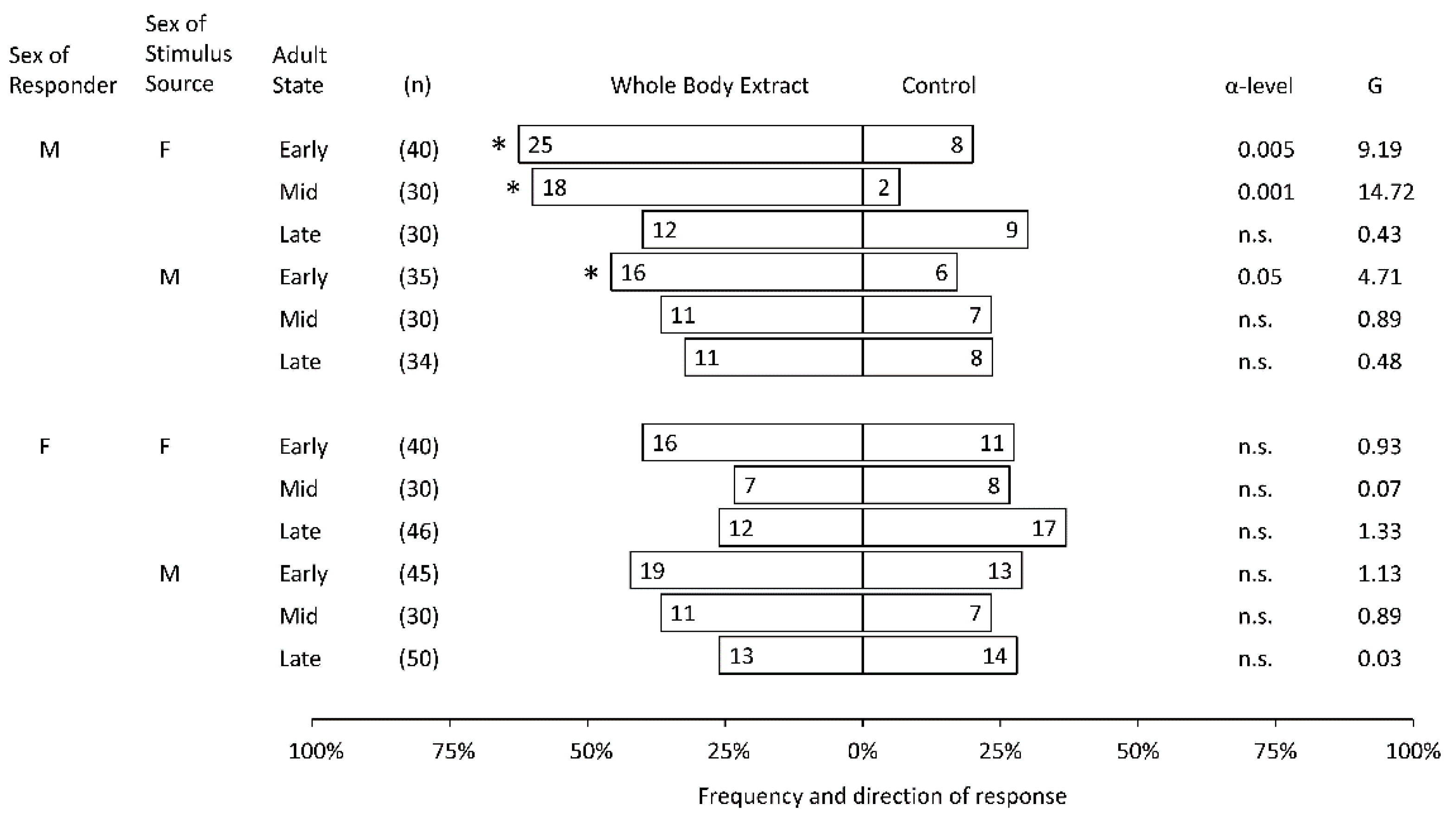
The spotted lanternfly, Lycorma delicatula (Hemiptera: Fulgoridae) is a polyphagous, phloem-feeding invasive forest, agricultural, and nuisance pest that is rapidly spreading through the U.S. Little is known about how fulgorids locate each other to mate. To determine if conspecific semiochemicals such as pheromones occur, whole body extracts (WBE) of adult spotted lanternflies from different physiological states were tested for attraction in a dual-choice olfactometer. In olfactometer assays, prior to mating, males were oriented to WBE from males and females. During their mating period, males were attracted to WBE of females, but not to that of males. After mating and oviposition had taken place, males were not attracted to either male or female extracts. Conversely, females did not orient to any WBE from either sex during any physiological state. These behavioral responses by males but not females to WBE from conspecifics in different physiological states suggest the possible presence of an aggregation-sex pheromone in the spotted lanternfly.
Keywords: Lycorma delicatula; pheromone; attraction; bioassay; olfactometer; semiochemicals Lycorma delicatula; pheromone; attraction; bioassay; olfactometer; semiochemicals