Article

Whole-Tree Harvest Effects on Macronutrients in an Oak-Dominated System after Seven Years

1
College of Forest Resources and Environmental Science, Michigan Technological University, U.J. Noblet Building, 1400 Townsend Drive, Houghton, MI 49931, USA
2
U.S. Forest Service-Northern Research Station, 410 MacInnes Drive, Houghton, MI 49931, USA
3
U.S. Forest Service-Northern Research Station, 5985 Highway K, Rhinelander, WI 54501, USA
4
U.S. Forest Service-Northern Research Station, 1831 Hwy 169 East, Grand Rapids, MN 55744, USA
*
Author to whom correspondence should be addressed.
Forests 2022, 13(10), 1532; https://doi.org/10.3390/f13101532
Submission received: 17 August 2022 / Revised: 16 September 2022 / Accepted: 17 September 2022 / Published: 20 September 2022
(This article belongs to the Section Forest Ecology and Management)

Abstract

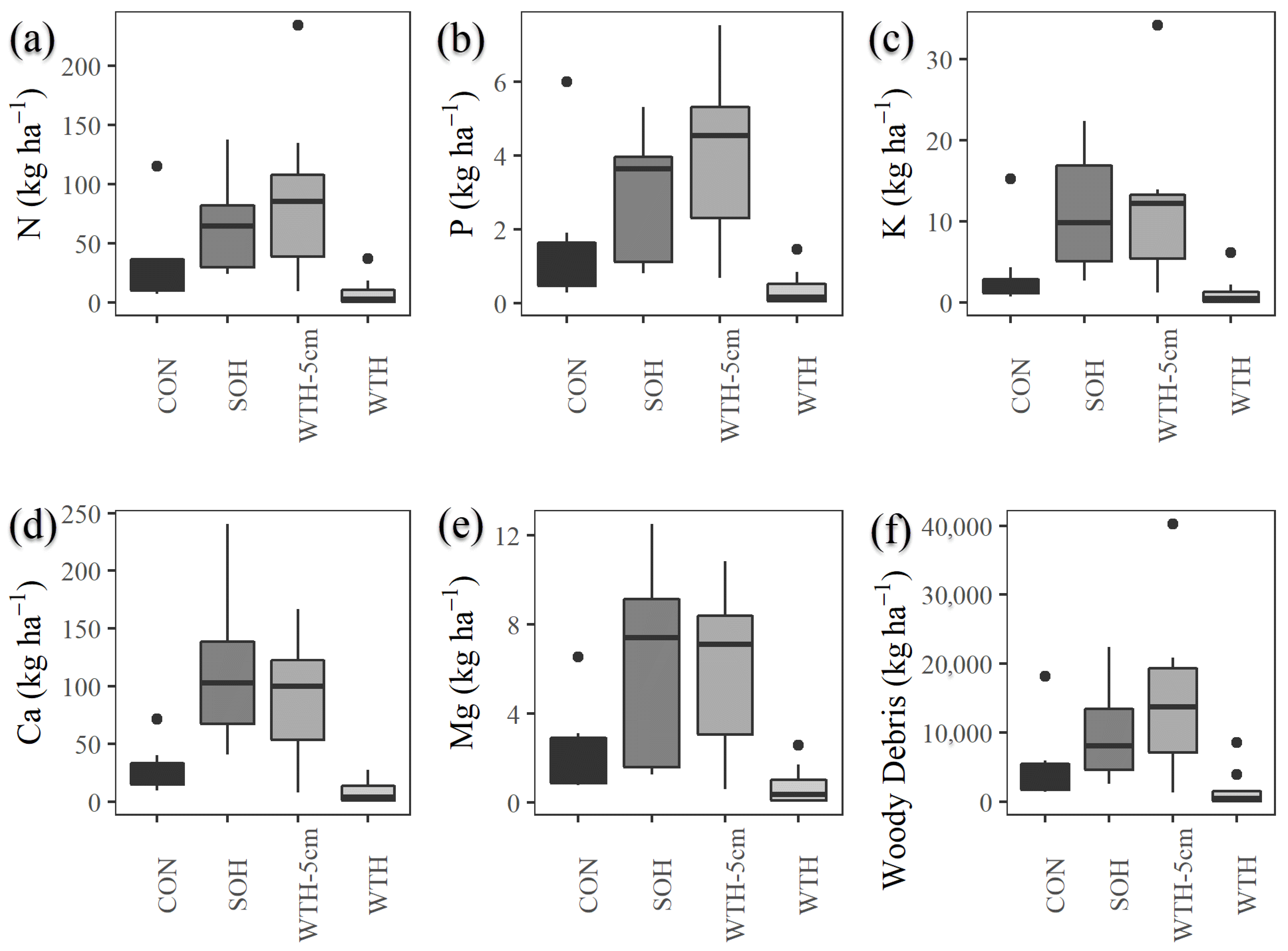
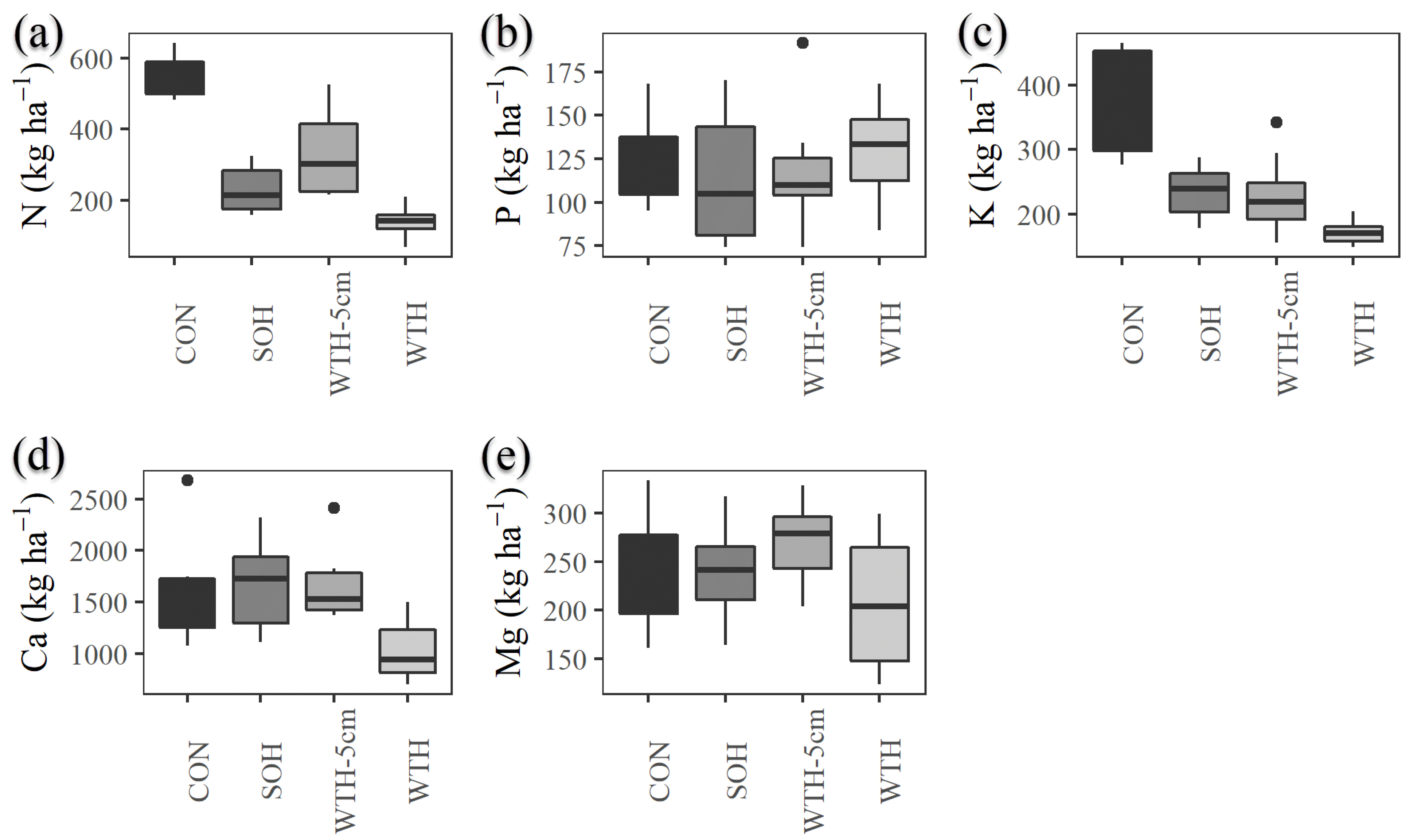
This study assesses the impacts of whole-tree harvesting (WTH) versus stem-only harvest (SOH) on two oak-dominated stands located in Northern Wisconsin. Specifically, our study follows up on an experiment designed to better understand the impacts of WTH and whether stands are at risk of long-term nutrient losses, which could contribute to declines in productivity. The original study assessed: (i) full biomass removal (referred to as WTH), (ii) partial biomass removal (removal to 5 cm diameter bole), (iii) a traditional SOH (removal to 10 cm bole), and (iv) no harvest (control). Our data were collected 93 months after harvest and showed significant decreases (α = 0.05) in the total (soil, woody debris, litter, and tree) Ca between WTH and SOH and for N and K from all harvest types. P and Mg were not significantly different between any of the treatment types. The woody debris was significantly decreased in the WTH in comparison to the SOH across P, K, Ca, Mg, but not N. The differences in the woody debris were initially detected, but a nutrient budget modeling exercise did not show significant declines for the ecosystem. The nutrient budget model assumptions and scale of input terms are discussed. Revisiting the sites at 93 months post-harvest versus the original 1.75 years allowed for the detection of the differences in total N, K, and Ca pool sizes.
Keywords: whole-tree harvesting; nutrient budget; outwash soils; harvest intensity; ecological modeling whole-tree harvesting; nutrient budget; outwash soils; harvest intensity; ecological modeling