Article

Is This Flight Necessary? The Aviation Use Summary (AUS): A Framework for Strategic, Risk-Informed Aviation Decision Support
by
Crystal S. Stonesifer
1,*,
David E. Calkin
1,
Matthew P. Thompson
2 and
Erin J. Belval
2
1
Rocky Mountain Research Station, United States Department of Agriculture Forest Service, 800 East Beckwith Avenue, Missoula, MT 59801, USA
2
Rocky Mountain Research Station, United States Department of Agriculture Forest Service, Fort Collins, CO 80526, USA
*
Author to whom correspondence should be addressed.
Forests 2021, 12(8), 1078; https://doi.org/10.3390/f12081078
Submission received: 27 May 2021 / Revised: 5 August 2021 / Accepted: 5 August 2021 / Published: 12 August 2021
(This article belongs to the Special Issue Decision Support System Development of Wildland Fire)

Abstract

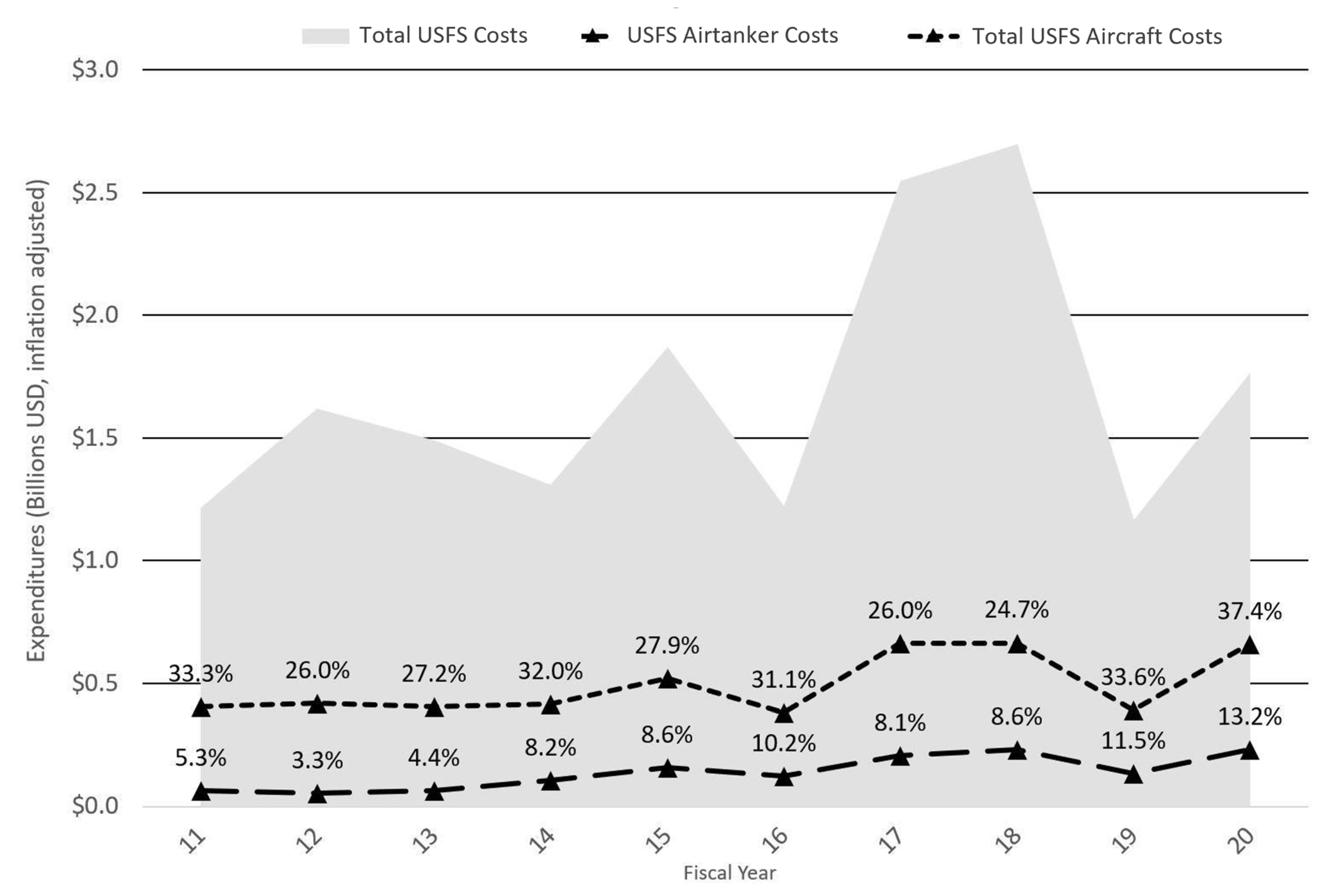
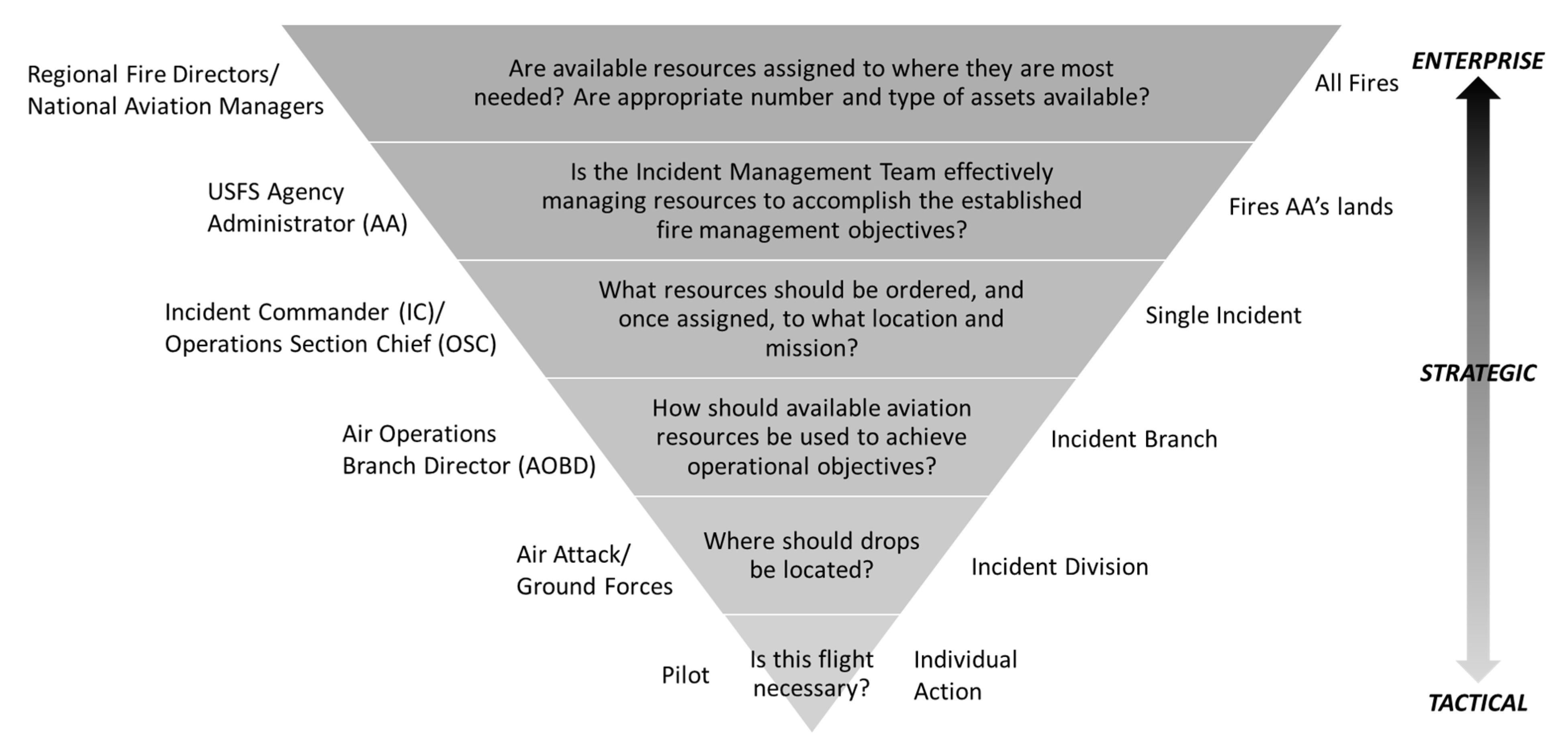
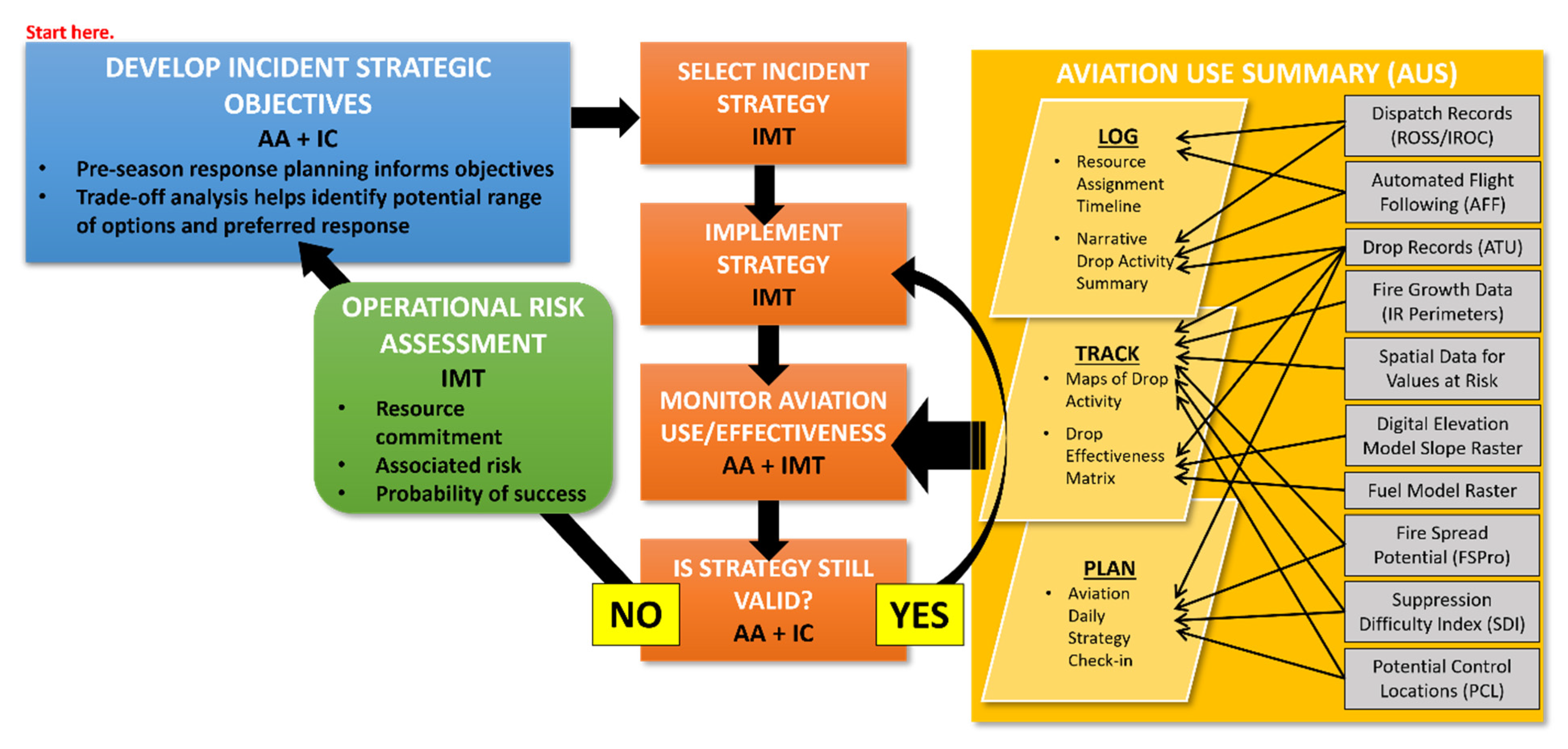
Across the globe, aircraft that apply water and suppressants during active wildfires play key roles in wildfire suppression, and these suppression resources can be highly effective. In the United States, US Department of Agriculture Forest Service (USFS) aircraft account for a substantial portion of firefighting expense and higher fatality rates compared to ground resources. Existing risk management practices that are fundamental to aviation safety (e.g., routinely asking, “Is this flight necessary?”) may not be appropriately scaled from a risk management perspective to ensure that the tactical use of aircraft is in clear alignment with a wildfire’s incident strategy and with broader agency and interagency fire management goals and objectives. To improve strategic risk management of aviation assets in wildfire suppression, we present a framework demonstrating a risk-informed strategic aviation decision support system, the Aviation Use Summary (AUS). This tool utilizes aircraft event tracking data, existing geospatial datasets, and emerging analytics to summarize incident-scale aircraft use and guide decision makers through a strategic risk management process. This information has the potential to enrich the decision space of the decision maker and supports programmatic transparency, enhanced learning, and a broader level of accountability.
Keywords: decision support system; aviation; airtankers; suppression; fire management; risk management; risk-informed decision making decision support system; aviation; airtankers; suppression; fire management; risk management; risk-informed decision making