


Abstract
The aim of this study was to investigate the occurrence, diversity, and distribution of Phytophthora species in Protected Natural Areas (PNAs), including forest stands, rivers, and riparian ecosystems, in Sicily (Italy), and assessing correlations with natural vegetation and host plants. Fifteen forest stands and 14 rivers in 10 Sicilian PNAs were studied. Phytophthora isolations from soil and stream water were performed using leaf baitings. Isolates were identified using both morphological characters and sequence analysis of the internal transcribed spacer (ITS) region. A rich community of 20 Phytophthora species from eight phylogenetic clades, including three new Phytophthora taxa, was recovered (17 species in rhizosphere soil from forest stands and 12 species in rivers). New knowledge about the distribution, host associations, and ecology of several Phytophthora species was provided.
1. Introduction
Due to its location in the central Mediterranean Sea and its vast area of 25.708 km2, Sicily is one of the most important biodiversity areas in Europe and in the Mediterranean basin [1,2] harboring more than 3000 plant species [3], 321 of which are endemic to Sicily [4]. Sicily’s outstanding floristic and ecological diversity was acknowledged by the establishment of numerous Protected Natural Areas (PNAs; Italian National Law 394/91), including three Regional Parks, 72 Regional Natural Reserves and 223 Sites of Community Importance (Habitats Directive 92/43/EEC).
During a recent monitoring of the health conditions of oak and beech trees in forests of the Etna, Madonie, and Nebrodi Regional Parks in Sicily (southern Italy), severe symptoms of crown decline were observed, indicating fine root losses caused by soilborne pathogens from the genus Phytophthora [5]. With more than 150 described species grouped in twelve multigenic phylogenetic Clades [6], this oomycete genus comprises some of the most aggressive plant pathogens of forests and other natural ecosystems [7,8,9,10,11,12,13,14,15,16]. Several studies highlighted the diversity of Phytophthora species in native vegetation and their potential impact on natural ecosystems [17,18,19,20,21,22,23,24,25,26]. The presence of exotic, potentially invasive Phytophthora species often represents a threat for the survival of native plant species and may alter the stability of the entire ecosystem. In Sardinia, a survey in the National Park of the La Maddalena archipelago demonstrated the involvement of exotic Phytophthora species in the widespread mortality of Quercus ilex trees and Mediterranean maquis vegetation [25,27,28]. Outplanting of infected nursery stock is considered a primary pathway for the introduction of non-native Phytophthora species into forest ecosystems [10,29,30,31,32,33,34,35,36]. In recent years, great attention has been paid to surface water as a source of Phytophthora inoculum in natural ecosystems. Surveys of rivers, streams, and riparian ecosystems in several continents have revealed a huge diversity of Phytophthora species, including primarily aquatic species which are considered as opportunistic pathogens, but also soilborne and airborne primary pathogens [8,20,21,37,38,39,40,41]. However, all Phytophthora species have the potential to be disturbance factors in natural ecosystems, in particular, those of exotic origin, provided that the environmental conditions are conducive to disease development [9,10,32]. The number of species known in the genus Phytophthora has increased dramatically during the past decade, mainly due to extensive surveys in previously unexplored ecosystems such as natural forests, riparian ecosystems, streams, and irrigation systems [6,20,21,25,42,43]. The ecological role of most of these new species and their distribution in natural ecosystems are still largely unknown, although the knowledge of the Phytophthora community and its potential impact on native vegetation is a prerequisite for proper management of PNAs. Despite the large number of Phytophthora species reported from nurseries and agricultural crops in Sicily, their occurrence and ecology in natural environments have received little attention. The aims of this study were to examine (i) the diversity and distribution of Phytophthora species in forest stands and river systems of Sicilian PNAs and (ii) their association with natural vegetation and potential host plants.
2. Materials and Methods
2.1. Sampling and Phytophthora Isolation
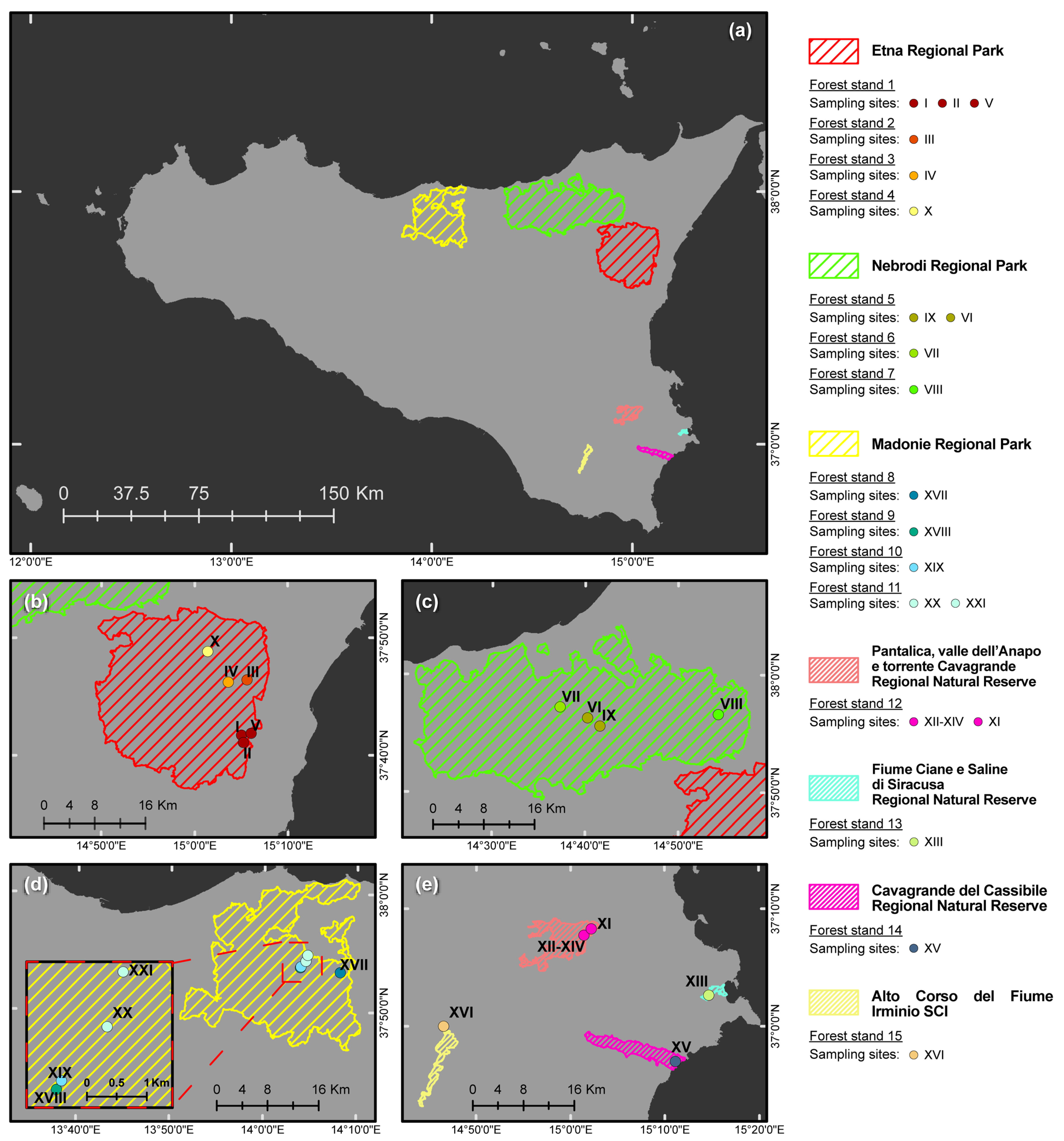
Ten PNAs in northern and eastern Sicily, including the three Regional Parks (RP), five Regional Nature Reserves (RNR), and two Sites of Community Importance (SCI), characterized by different ecological conditions were included in this study (Table S1, Figure S1). Twenty sites in 15 characteristic Sicilian forest stands (FS) in seven PNAs and 14 rivers running through nine PNAs were included in the survey of distribution and diversity of Phytophthora species (Table 1 and 2, Figure 1 and Figure 2). Sampling activities were carried out during the spring of 2013 and 2015.
Table 1.
Vegetation, geological substrate, municipality, geographic coordinates, and altitude of the 15 forest stands sampled in seven Protected Natural Areas in Sicily, tree species sampled and Phytophthora taxa isolated.
Figure 1.
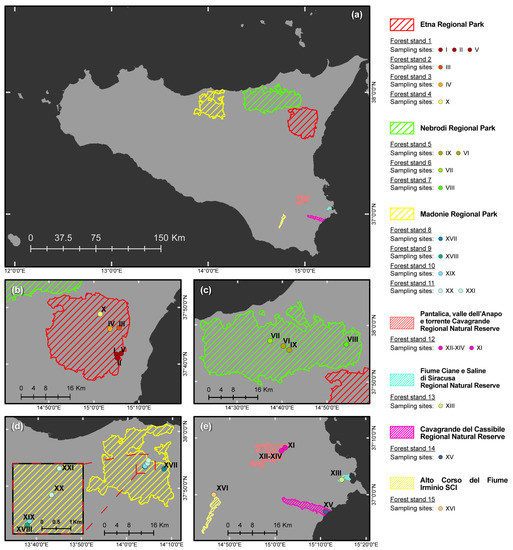
Geographical location of the 15 forest stands and the seven Protected Natural Areas included in the Phytophthora survey of natural forests in Sicily, projected using the Universal Transverse Mercator (UTM) (a). Location of the sampled forest sites within the Etna (b), Nebrodi (c), and Madonie (d) Regional Parks; and in the “Pantalica, valle dell’Anapo e torrente Cavagrande”, “Fiume Ciane e Saline di Siracusa”, “Cavagrande del Cassibile” Regional Natural Reserves and the “ITA080002—Alto Corso del Fiume Irminio” Site of Community Importance (SCI) (e).
Figure 2.
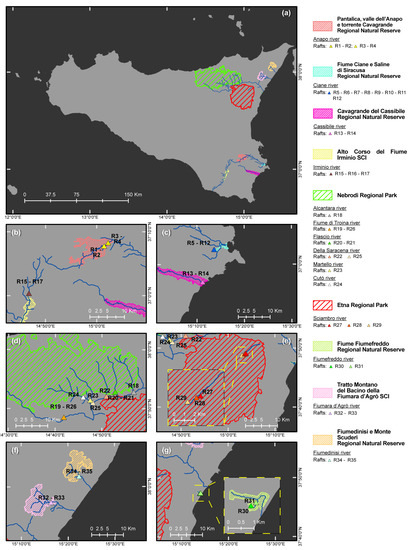
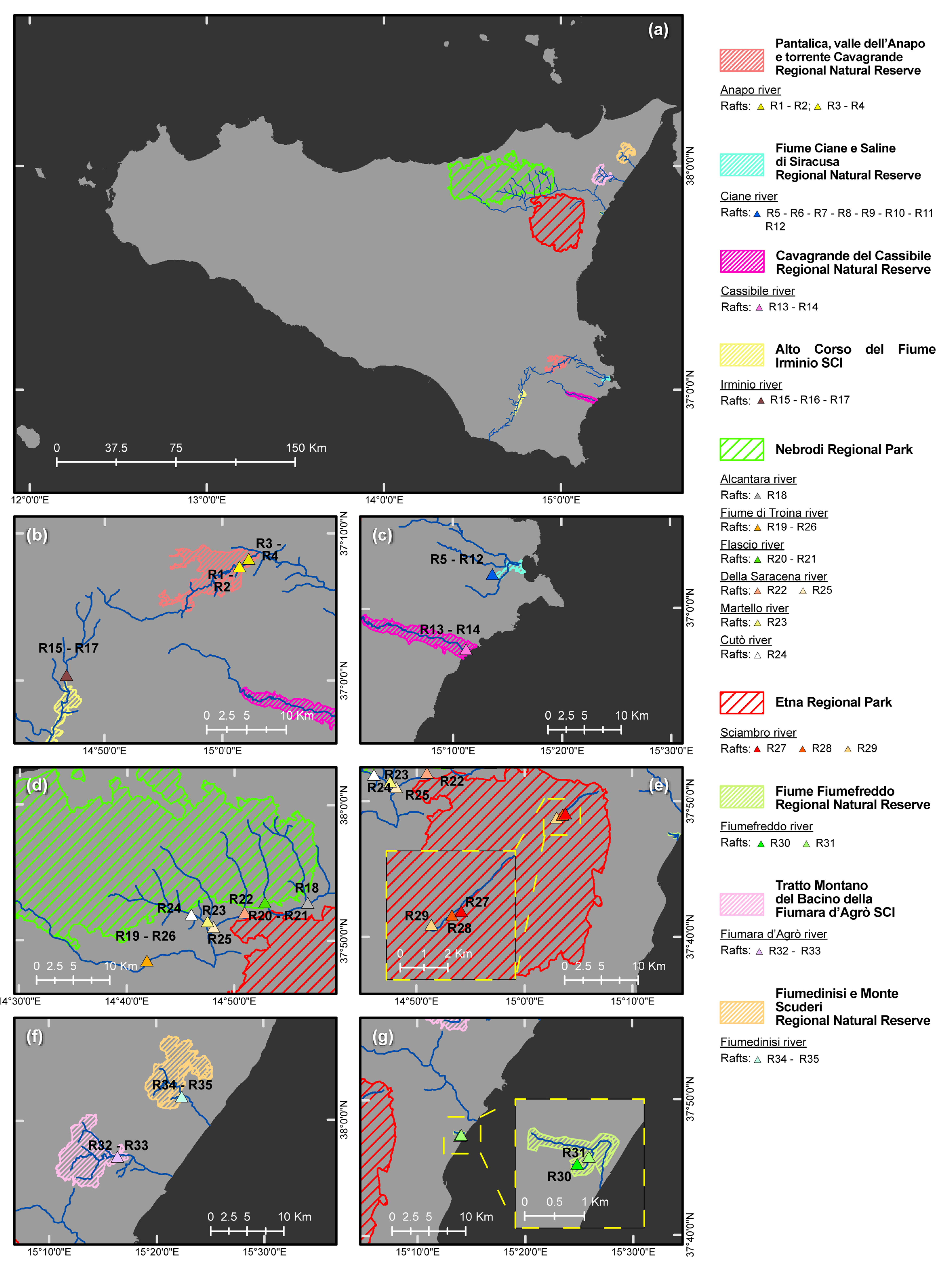
Geographical location of the nine Protected Natural Areas and the 14 river systems included in the Phytophthora survey of rivers in Sicily, projected using the Universal Transverse Mercator (UTM) (a). Riparian sampling sites (R) along the river systems running through: “Pantalica, valle dell’Anapo e Torrente Cavagrande” Regional Natural Reserve (RNR) and “ITA080002—Alto Corso del Fiume Irminio” Site of Community Importance (SCI) (b); “Fiume Ciane e Saline di Siracusa” and “Cavagrande del Cassibile” RNRs (c); “Nebrodi” (d) and “Etna” (e) Regional Parks; “ITA030019—Tratto Montano del Bacino della Fiumara d’Agrò” SCI and “Fiumedinisi e Monte Scuderi” RNR (f); and “Fiume Fiumefreddo” RNR (g).
In total, 83 rhizosphere soil samples from mature specimens of 17 tree species were collected in the 15 forest stands (Table 1). Soil sampling and isolation methodologies were performed according to Jung [9]. Subsamples of ca. 200 mL soil were used for baiting tests at 18–20 °C in a walk-in growth chamber with 12 h natural daylight. Young leaves of native species (mainly Ceratonia siliqua and Quercus spp.) were used as baits floated over flooded soil. Necrotic segments (2 × 2 mm) from Infected leaves were plated onto selective PARPNH-agar [11]. Petri dishes were incubated at 20 °C in the dark. Outgrowing Phytophthora hyphae were transferred onto V8-juice agar (V8A) under the stereomicroscope. Phytophthora isolations from rivers were performed using an in situ baiting technique [21]. At each site, 10 non-wounded young leaves of C. siliqua, Quercus spp. and Citrus spp. were placed in a mesh-bag styrofoam raft (25 × 30 cm) [21] rigged to float on the water surface. In total 35 rafts were placed in 14 rivers (Table 2, Figure 2) and collected after 3–5 days. Isolations from necrotic leaf lesions were carried out as described before. All obtained isolates were maintained on V8A and stored at 6 °C in the dark.
Table 2.
Vegetation and geological features of drainage basins of 14 rivers surveyed in nine Protected Natural Areas in Sicily; location of sites with baiting rafts, and Phytophthora taxa isolated.
2.2. Morphological Characterization of Isolates
Seven-days-old cultures grown at 20 °C in the dark on V8A were used to group all obtained isolates into morphotypes on the basis of their colony growth patterns. In addition, morphological features of sporangia, oogonia, antheridia, chlamydospores, hyphal swellings, and aggregations were examined [20,42] and compared with species descriptions in the literature.
2.3. Molecular Identification of Isolates
Molecular analyses were performed with 387 (184 from soil and 203 from rivers) of the 841 obtained isolates, representative of all morphotypes, soil samples, and baiting rafts. DNA was extracted from pure cultures grown on V8A using the PowerPlant® Pro DNA Isolation Kit (MO BIO Laboratories, Inc., Carlsbad, CA, USA), following the manufacturer’s protocol. DNA was stored at −20 °C until further use.
The identification of Phytophthora species was performed by sequence analysis of the internal transcribed spacer (ITS) region of ribosomal DNA (rDNA). For amplification, forward primers ITS6 or ITS1 [44] and reverse primer ITS4 were used [45]. The PCR amplification mix and thermocycler conditions were as in [44]. PCR products were purified and sequenced by Macrogen Europe (Amsterdam, The Netherlands) in both directions with the primers used for amplification. Sequences were analyzed using FinchTV v.1.4.0 (https://digitalworldbiology.com/FinchTV). For species identification, blast searches in GenBank (http://www.ncbi.nlm.nih.gov/BLAST/) and in a local database containing sequences of ex-type or key isolates from published studies were performed. Isolates were assigned to a species when their sequences were at least 99% identical to a reference isolate. ITS sequences from representative isolates of this study were deposited at GenBank (www.ncbi.nlm.nih.gov/genbank; accession numbers are given in Table S2).
3. Results
Morphological and ITS sequence analyses revealed the occurrence of multiple Phytophthora species in each of the sampled PNAs. ITS sequence analyses showed that 351 of the 387 (90.7%) analyzed isolates (162 from forest soils and 189 from rivers) matched with 99–100% identity reference sequences of 16 known Phytophthora species and the designated Phytophthora sp. kelmania [46]. Nine isolates belonged to two species recently described as Phytophthora vulcanica and Phytophthora tyrrhenica [6] from Clade 7a, and to a new, yet undescribed species from Clade 2, while 27 isolates (7.0%) were assigned to other oomycete genera (Table 1 and Table 2).
3.1. Phytophthora Diversity and Distribution in Forest Stands
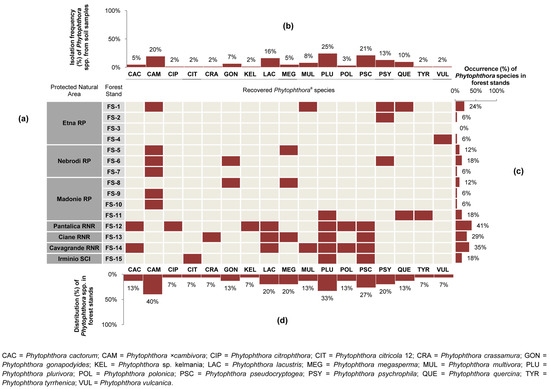
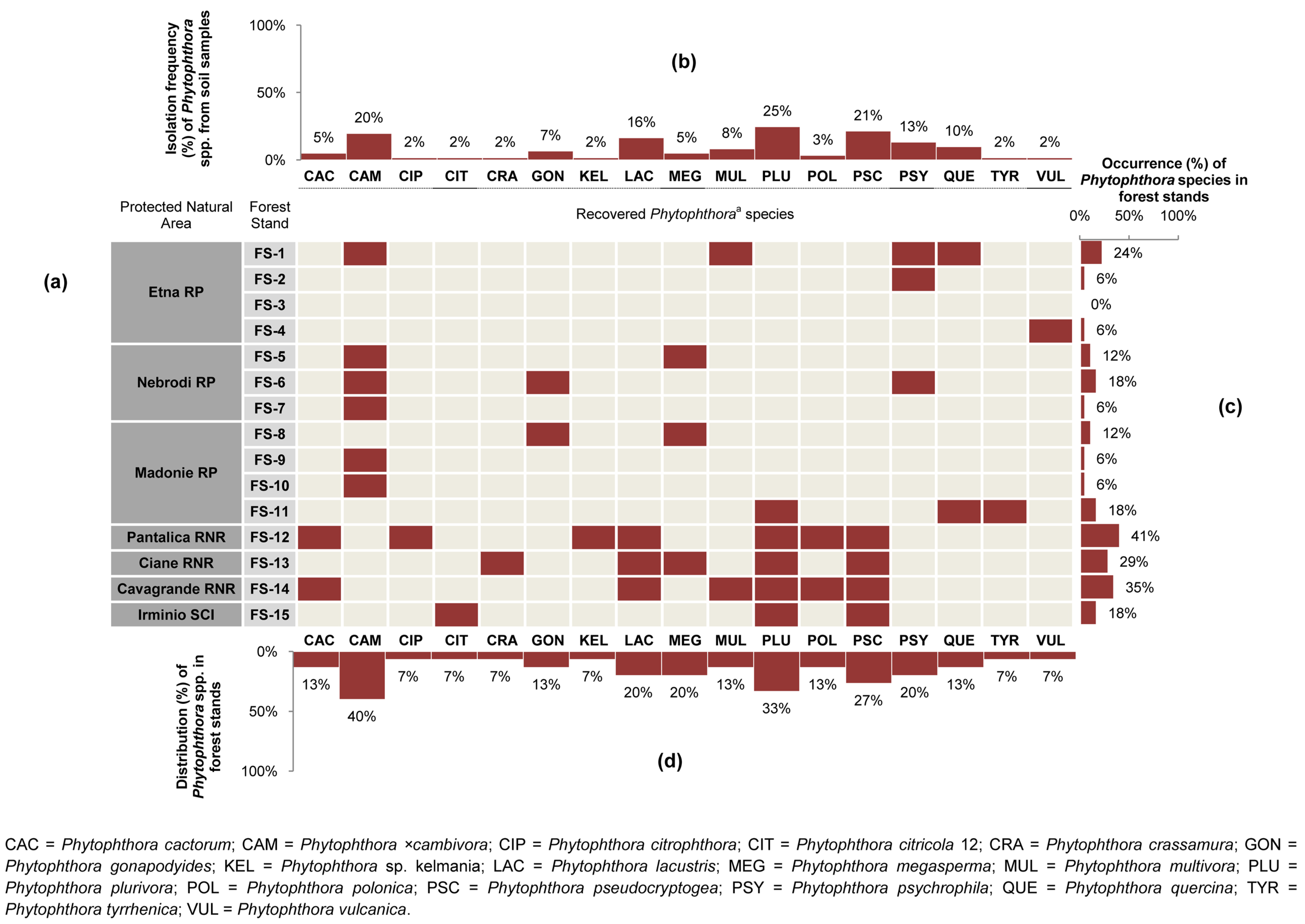
In all oak and beech forests sampled, the majority of trees showed disease symptoms including thinning and dieback of crowns, fine root losses and, in some cases, bleeding stem cankers, whereas in riparian forests diseased trees had a scattered distribution. Noteworthy, in the riparian forest FS-13 along the Ciane river, is the fact that almost all Fraxinus oxycarpa Bieb. trees showed severe dieback and mortality. Overall, in all seven selected PNAs, Phytophthora species were found in 14 of 15 sampled forest stands (93.3%). In total, 17 Phytophthora species from eight of the 12 known phylogenetic clades [6] were isolated from 61 of the 83 (73.5%) soil samples collected from 16 of the 17 tree species sampled (94%) (Table 1, Figure 3a,c, Figure 4a,b, and Figure S2a,c,e). Only in one forest stand (FS-3) could no Phytophthora isolates be obtained from the only tested tree species Betula aetnensis Raf.
Figure 3.
Distribution and diversity of Phytophthora species in sampled forest stands from Protected Natural Areas in Sicily. (a) Etna RP = Etna Regional Park; Nebrodi RP = Nebrodi Regional Park; Madonie RP = Madonie Regional Park; Pantalica RNR = Pantalica, Valle dell’Anapo e Torrente Cavagrande Regional Natural Reserve (RNR); Ciane RNR = Fiume Ciane e Saline di Siracusa RNR; Cavagrande RNR = Cavagrande del Cassibile RNR; Irminio SCI = ITA080002—Alto corso del Fiume Irminio Site of Community Importance (SCI), (b) isolation frequency (%) of Phytophthora species from Phytophthora-positive soil samples, (c) occurrence (%) of Phytophthora species in sampled forest stands, (d) distribution (%) of Phytophthora species in the sampled forest stands.
Figure 4.
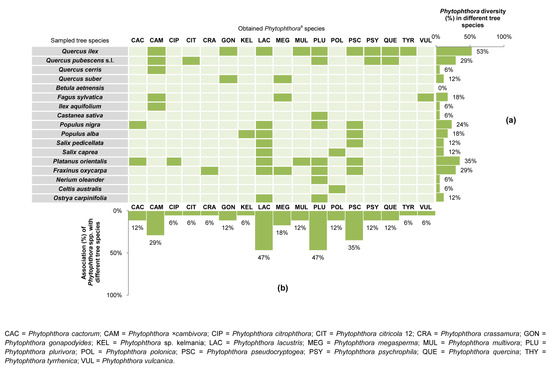
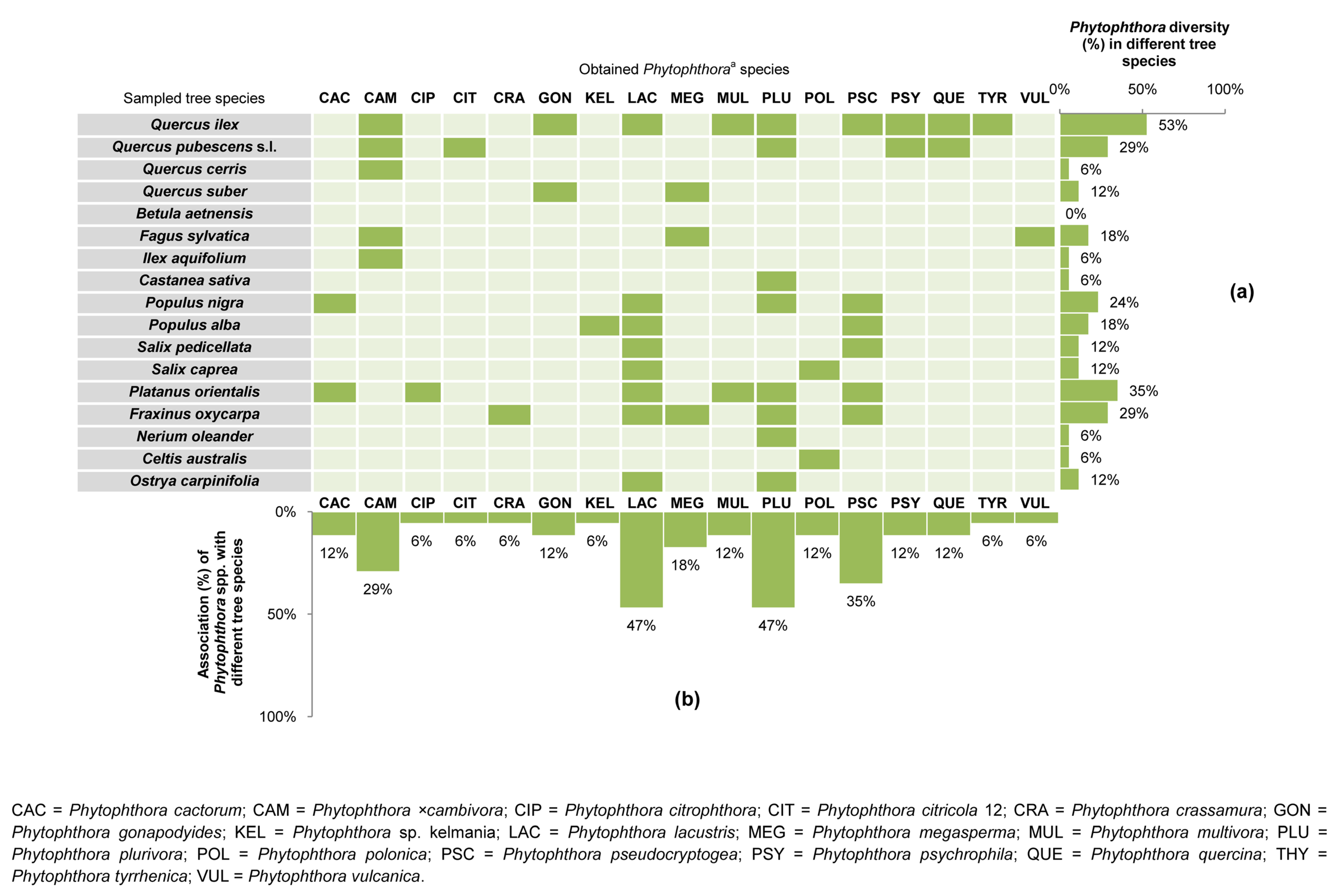
Association of Phytophthora species with different tree species in Protected Natural Areas in Sicily. Dark-green color represents a Phytophthora—host tree association, (a) diversity of Phytophthora species in different tree species (in % of all Phytophthora species found), (b) association of Phytophthora species with the sampled tree species (in % of all tree species sampled).
Species from Clade 7, i.e., Phytophthora ×cambivora (previously P. cambivora), Phytophthora vulcanica, and Phytophthora tyrrhenica, were isolated from 53% of the sampled forest stands (Figure 3 and Figure S2b) in three of the seven protected natural areas (Etna, Nebrodi, and Madonie RPs) (Table 1, Figure 3a, and Figure S2a,d). Phytophthora ×cambivora was isolated from all sampled meso-, and supra-Mediterranean forest stands: In the Etna RP (FS-1) from Quercus pubescens Willd. sensu latu (s.l.); in the Nebrodi RP from Fagus sylvatica L., Quercus cerris L., Quercus ilex L., and Q. pubescens s.l. and all sampled forest stands (FS-5 to FS-7); and in the Madonie RP (FS-9, FS-10) from Ilex aquifolium L. and Q. pubescens s.l. (Table 1, Figure 3a,b,d, and Figure 4). Phytophthora ×cambivora occurred in an altitude range between 660 and 1780 m above sea level (a.s.l.). Phytophthora vulcanica and P. tyrrhenica were recovered from F. sylvatica in FS-4 and from Q. ilex in FS-11, respectively (Table 1).
Four Clade 6 species, Phytophthora gonapodyides, Phytophthora megasperma, Phytophthora lacustris, and Phytophthora crassamura, were found in 40% of the sampled forest stands in five PNAs (Figure 3 and Figure S2b). Phytophthora gonapodyides occurred between 700 and 1000 m a.s.l. in the rhizosphere of Q. ilex and Quercus suber L. in meso-Mediterranean evergreen (FS-6) and cork oak (FS-8) woodlands, respectively (Table 1, Figure 4). Phytophthora megasperma was isolated from supra-, meso-, and thermo-Mediterranean forest stands in three PNAs: In the Nebrodi RP from F. sylvatica (FS-5); in the Madonie RP from Q. suber (FS-8); and in the Fiume Ciane e Saline di Siracusa RNR (Ciane RNR) from Fraxinus oxycarpa (FS-13). This Phytophthora species inhabited a wide altitudinal range between 4 and 1450 m a.s.l. (Table 1, Figure 3a,b,d, and Figure 4). Phytophthora lacustris was isolated from the rhizosphere of eight different tree species between 4 and 236 m a.s.l. in three thermo-Mediterranean riparian forest stands (FS-12 to FS-14) located in three PNAs (Table 1, Figure 3a,b,d, and Figure 4). Phytophthora crassamura only occurred in the rhizosphere of F. oxycarpa in the Ciane RNR (FS-13) (Table 1, Figure 4).
Species from Phytophthora Clade 2 were present in six of the seven monitored PNAs (Figure S2a,b,d). Phytophthora plurivora was most widespread, occurring in 25% of the Phytophthora-positive soil samples taken from eight different tree species in 33% of the sampled forest stands (FS-11 to FS-15) and in five PNAs (Table 1, Figure 3a,b,d, and Figure 4). Interestingly, this pathogen was recovered from seven trees species in the riparian thermo-Mediterranean plane tree stand (FS-12) of the Pantalica RNR. The altitudinal distribution of P. plurivora ranged from an altitude of 4 to 850 m a.s.l. Phytophthora multivora was associated with Q. ilex in the Etna RP (FS-1) and with Platanus orientalis L. in the Cassibile RNR (FS-14) (Table 1, Figure 3a,b,d). Phytophthora citrophthora was only found in the rhizosphere of P. orientalis in FS-12 (Table 1). A previously unknown species from the ‘Phytophthora citricola complex’, informally designated here as P. citricola 12, was recovered from the rhizosphere of Q. pubescens s.l. in riparian stand FS-15 in Irminio SCI (Table 1).
The Clade 1 species Phytophtora cactorum occurred in two riparian thermo-Mediterranean plane tree forests in two PNAs (Table 1, Figure S2a,b,d, and Figure 3a,b,d). In the Pantalica RNR (FS-12) and the Cassibile RNR (FS-14), P. cactorum was associated with P. orientalis and Populus nigra L., respectively (Figure 4).
The Clade 3 species Phytophthora psychrophila was found associated with Q. pubescens s.l. in two forest stands (FS-1, FS-2) of the Etna RP and with Q. ilex in stand FS-6 of the Nebrodi RP. The altitudinal distribution ranged from 890 to 1345 m a.s.l. (Table 1).
Phytophthora pseudocryptogea from Clade 8 was frequently isolated at an altitude between 4 and 240 m from rhizosphere soil of six different tree species in four riparian thermo-Mediterranean forest stands (FS-12 to FS-15) located in four distinct PNAs (Table 1, Figure 3a,b,d). Another Clade 8 taxon, Phytophthora sp. kelmania, was detected in only one soil sample from Populus alba L. in stand FS-12 (Table 1, Figure 4).
3.2. Phytophthora Diversity and Distribution in Rivers within PNAs
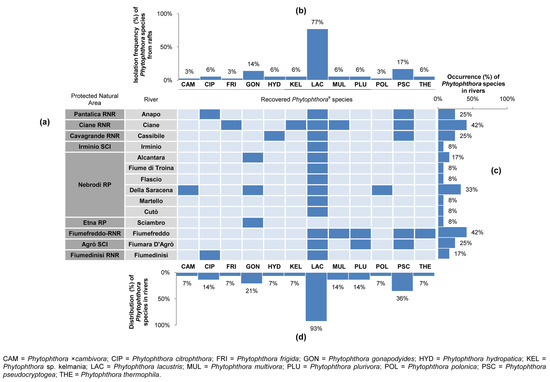
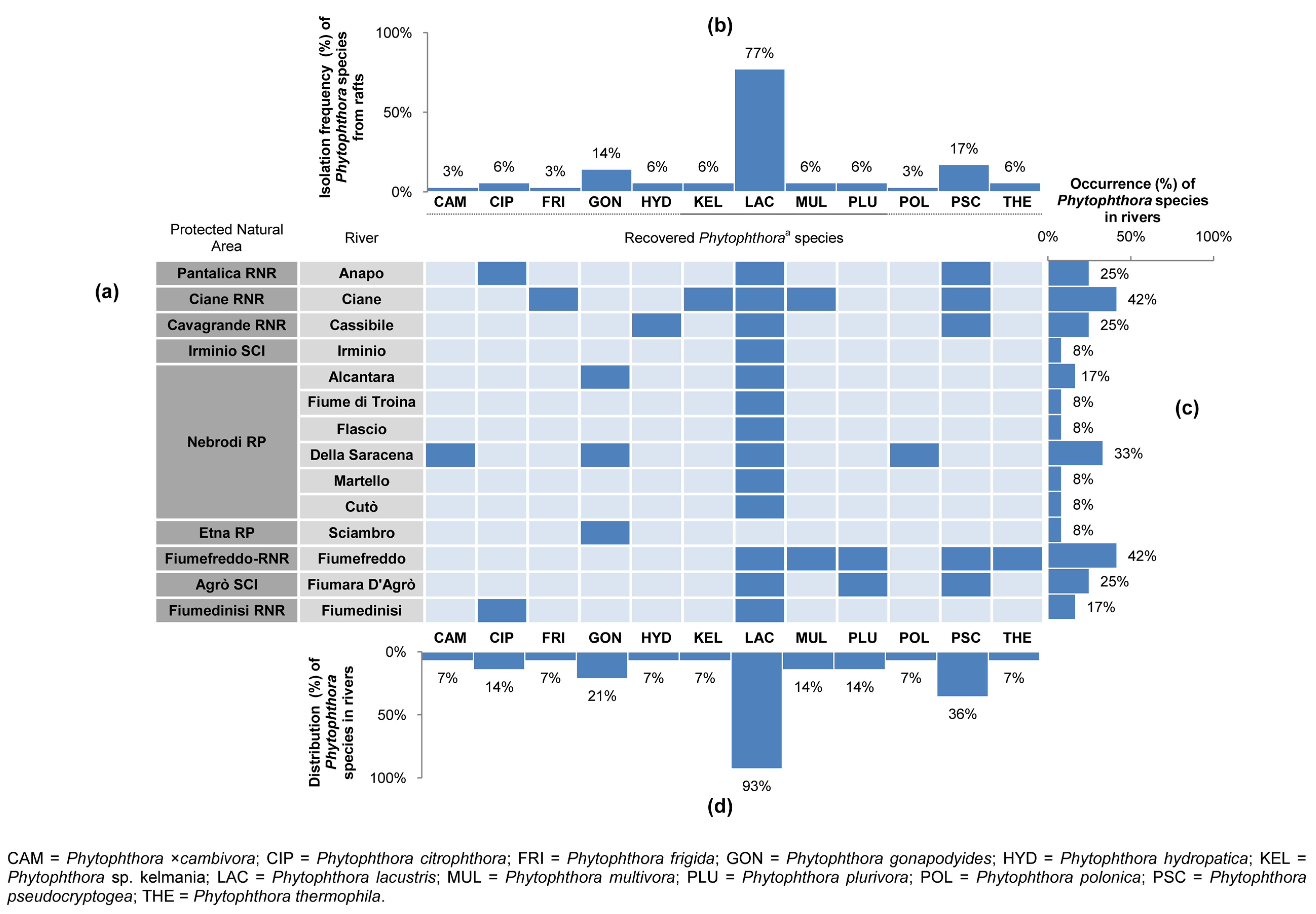
In total 12 Phytophthora species from five phylogenetic clades were detected in all monitored rivers running through all nine selected PNAs (Table 2, Figure 5a,c, and Figure S3a–f); 29 of the 35 baiting rafts (83%) were Phytophthora-positive.
Figure 5.
Distribution and diversity of Phytophthora species in sampled rivers from Protected Natural Areas in Sicily. (a) Etna RP = Etna Regional Park; Nebrodi RP = Nebrodi Regional Park; Madonie RP = Madonie Regional Park; Pantalica RNR = Pantalica, Valle dell’Anapo e Torrente Cavagrande Regional Natural Reserve (RNR); Ciane RNR = Fiume Ciane e Saline di Siracusa RNR; Cavagrande RNR = Cavagrande del Cassibile RNR; Fiumedinisi RNR = Fiume Fiumedinisi e Monte Scuderi RNR; Agrò SCI = ITA030019—Tratto Montano del Bacino della Fiumara di Agrò—Site of Community Importance (SCI); Irminio SCI = ITA080002—Alto corso del Fiume Irminio SCI, (b) isolation frequency (%) of Phytophthora species from Phytophthora-positive baiting rafts, (c) occurrence (%) of Phytophthora species in sampled rivers, (d) distribution (%) of Phytophthora species in the sampled rivers.
Most common were mainly aquatic Phytophthora species from ITS Clade 6 that were recovered from all monitored river systems and PNAs (Figure S3a,d,e). Phytophthora lacustris occurred between 4 and 850 m a.s.l. in 77% of the baiting rafts and in all watercourses except for the Sciambro river (Table 2, Figure 5a,b,d), a torrential high altitude stream, which only flows seasonally during snowmelt. In five rivers, P. lacustris was the only Phytophthora species detected. Phytophthora gonapodyides was found in an altitudinal range between ca. 700 and 1700 m a.s.l. in the Alcantara and Della Saracena rivers (Nebrodi RP) and in the Sciambro river (Etna RP); in the latter it was the only Phytophthora species isolated (Table 2, Figure 5a,b,d). The third mainly aquatic Clade 6 species, Phytophthora thermophila, was exclusively found in the Fiumefreddo river (Table 2, Figure 5a,b,d).
The Clade 2 species, P. plurivora, P. multivora, P. citrophthora, and P. frigida, were isolated from 36% of the rivers in five PNAs at lowland sites ranging from 6 to 220 m a.s.l. (Table 2, Figure 5a,b,d and Figure S3a,d,e). While P. frigida was only found in Ciane river, each of the other species of Clade 2 occurred in two rivers: P. plurivora in the Fiumara d’Agrò and Fiumefreddo rivers, P. multivora in the Fiumefreddo and Ciane rivers, and P. citrophthora in the Anapo and Fiumedinisi rivers (Table 2, Figure 5).
Phytophthora ×cambivora from Clade 7 and P. polonica from Clade 9 were both exclusively detected in the Della Saracena river in the Nebrodi RP (Table 2, Figure 5).
Two species from Clade 8 were found in five watercourses running through five PNAs (Table 2, Figure S3a,d,e). Phytophthora pseudocryptogea was widespread, occurring between 4 and 220 m a.s.l. in the Anapo, Ciane, Cassibile, Fiumefreddo, and Fiumara d’Agrò rivers, whereas P. sp. kelmania was exclusively isolated from the Ciane river (Table 2, Figure 5a,b,d).
4. Discussion
This is the first study of Phytophthora diversity in Europe using conventional isolation methods and covering both a wide range of natural forest types and watercourses crossing these areas. Previously, the only surveys of Phytophthora diversity in both forests and rivers within the same region in Europe used only a metabarcoding approach which is based on DNA identification technologies and high-throughput DNA sequencing. In Spain, 13 and 35 Phytophthora phylotypes were detected in forest soils and streams, respectively [37]. Using a different molecular method, a survey in Scotland demonstrated the presence of 10 and 9 Phytophthora phylotypes in soil and water samples, respectively [47]. The present survey unveiled a rich community of 20 Phytophthora species in the Sicilian PNAs studied. With 17 different species from 8 of the 12 known phylogenetic clades, including the two newly described species P. tyrrhenica and P. vulcanica [6], Phytophthora diversity in 15 natural forest stands was higher than in previous broadleaved forest surveys in Europe using similar isolation methods. In oak forests across Italy, northeastern France, Austria, and Turkey, and in oak and beech forests in Bavaria 11, 8, 5, 7, and 13 Phytophthora species, respectively, were found [9,13,17,48,49]. However, the lower Phytophthora diversity in these surveys may partly be due to the limited number of tree species and forest types included. With nine Phytophthora species from four phylogenetic clades the diversity found in 14 rivers in Sicily was almost as high as in previous surveys in Australia, the USA, and South Africa which covered much larger areas and a higher numbers of rivers [40,50,51,52], but lower than in Taiwan where four described Phytophthora species and 14 previously unknown Phytophthora taxa were discovered in 19 rivers [21].
The high diversity of Phytophthora species in natural forests and rivers in Sicily is particularly impressive considering the relatively small area of less than 10,000 km2 covered by this survey. This may be explained by the diversity of forest types and altitudinal zones surveyed and Sicily’s long and changing history of human colonization and the introduction of non-native horticultural plants. Thirteen of the 20 Phytophthora species occurring in the sampled Sicilian ecosystems are considered introduced pathogens: P. cactorum, P. ×cambivora, P. citricola 12, P. citrophthora, P. crassamura, P. frigida, P. hydropathica, P. multivora, P. plurivora, P. polonica, P. pseudocryptogea, P. thermophila, and P. sp. kelmania [21,25,32,42,53,54]. In contrast, P. psychrophila, P. quercina, P. tyrrhenica, and P. vulcanica are considered endemic to Europe resulting from species radiation following adaptation to different Fagaceae species [6].
Amongst the 17 Phytophthora species obtained from forest stands, P. ×cambivora, P. plurivora, and P. pseudocryptogea were the most widespread whereas the other species had a more scattered or even punctual distribution. The allopolyploid hybrid pathogen P. ×cambivora was most common, occurring in the majority of meso- and supra-Mediterranean forest stands sampled in the Nebrodi, Etna, and Madonie Regional Parks. In a previous study, P. ×cambivora was also found in Corleone near Palermo [49]. Although the recovery from I. aquifolium extended the known host range of P. ×cambivora, this pathogen was mainly associated with known susceptible host species like Quercus spp. and F. sylvatica [9,13,42,49]. In most cases, oak and beech trees showed typical disease symptoms like thinning and dieback of crowns, fine root losses, and in some cases bleeding stem cankers, all indicative of Phytophthora infections. Due to the high aggressiveness of P. ×cambivora to oaks and beech [6,11,42,55] it seems likely that this pathogen is associated with the widespread decline and dieback of oak and beech stands recently reported in Sicily [5]. The results of this work confirm previous studies in Germany and Italy demonstrating that P. ×cambivora preferentially occurs in acidic and clayey soils [9,11,13,49,56]. Of note, P. ×cambivora was not isolated from riparian thermo-Mediterranean forests in Sicily. Compared to P. ×cambivora, P. plurivora showed an opposite distribution pattern, being the most common species in riparian thermo-Mediterranean forest stands dominated by willows, poplars, plane, and ash trees. However, it was only infrequently isolated from seasonally dry, meso- and supra-Mediterranean forests. This distribution is most likely caused by the thin oospore walls which make P. plurivora susceptible to droughts [53]. Although P. plurivora was already reported from more than 80 woody host species including Castanea sativa Mill., F. sylvatica, Fraxinus spp., Quercus spp., and Salix spp. [10,11,13,14,21,32,53,57,58,59,60,61], the recoveries from rhizosphere soil of P. nigra, P. orientalis, Nerium oleander L., and Ostrya carpinifolia Scop. in the present study constituted first-time records for this wide host range pathogen. Interestingly, P. plurivora showed a similar upper limit of vertical distribution as in the Bavarian Alps (ca. 870 m a.s.l.) [53]. Despite being an aggressive beech pathogen across Europe and in the USA [9,14,32,60,62,63], P. plurivora did not occur in the rhizosphere of F. sylvatica forests in Sicily, which at this southern latitude grow at altitudes above ca. 1400 m a.s.l. However, in contrast to Bavaria, in Sicily this vertical limit is most likely caused by extremely dry summers, causing desiccation of the thin-walled oospores [53], rather than by deep winter temperatures. In Taiwan, P. plurivora occurs at altitudes around 2000 m in regions with mild winters and humid summers [21]. Phytophthora multivora, the second species from the ‘Phytophthora citricola complex’ found in this survey, was less common than P. plurivora, being isolated only from Q. ilex and P. orientalis in each one of the meso-Mediterranean evergreen oak and riparian thermo-Mediterranean forest stand, respectively, and in the Ciane and Fiumefreddo rivers. Due to its particularly thick oospore walls, P. multivora has adapted perfectly to severe summer droughts in Mediterranean regions such as Western Australia and South Africa, where it is widespread in both native vegetation and urban environments [51,64,65,66]. In Europe, P. multivora was recently introduced and is currently spreading through the nursery sector and in young plantings [32,67]. Prior to this study, it had only been occasionally recovered from the wider environment [60,68]. Hitherto, P. frigida from Clade 2 was only known from Eucalyptus plantations in South Africa and from rainforests in eastern Australia [54,69]. The number of known species of Clade 2 is rapidly increasing; besides P. plurivora and P. multivora it includes numerous other aggressive Phytophthora species. Many Clade 2 species pose serious threats to natural ecosystems across the world [10,43,53,70,71]. The findings of P. frigida and the new species P. citricola 12, and the widespread occurrence of P. plurivora and P. multivora in Sicilian PNAs are of serious concern.
In the present study, P. pseudocryptogea from Clade 8 was frequently recovered from six tree species in riparian thermo-Mediterranean forest stands and from five rivers. It is the first report of this species in Sicily. While P. pseudocryptogea was previously not reported from Sicily, its close relative P. cryptogea commonly causes damage to several non-native ornamentals in nurseries and tomato crops under plastic-houses [72,73,74,75,76]. Phytophthora cryptogea has a scattered, but widespread, distribution in periodically dry Mediterranean natural ecosystems [25,56,58]. In Europe, P. cryptogea is an established exotic pathogen, whereas P. pseudocryptogea and the phylogenetically close taxon P. sp. kelmania [46], are considered as recently introduced emerging pathogens [32].
In accord with previous studies in other areas of the world [38,39,41,50], Clade 6 species prevailed in rivers, indicating their adaptation to aquatic environments. Interestingly, two mainly aquatic opportunistic pathogens from Clade 6, P. gonapodyides and P. lacustris, which often co-occur in river systems in temperate regions of North America, Europe, and Asia [40,77,78,79], showed opposite distribution patterns in Sicily. Phytophthora gonapodyides occurred exclusively at altitudes above 620 m, where it was mainly associated with meso-Mediterranean oak stands on acidic non-calcareous soils and with rivers running through oak stands. In previous studies, P. gonapodyides was also often found in oak stands and on acidic sites [11,13,49,77]. In contrast, in this study, P. lacustris was only isolated below 850 m altitude from Salix-dominated riparian forests on both silica-rich acidic and calcareous alkaline sites, and from rivers running through these forests. Both Phytophthora species co-occurred only in three rivers in a transition zone between 624 and 811 m a.s.l. The different altitudinal preferences of both species reflect their different cardinal temperatures for growth [79]. In this survey, two other species, P. hydropathica and P. thermophila from Clade 9, were exclusively detected in rivers confirming their mainly aquatic lifestyle. Prior to the present study, P. hydropathica was found in rivers and irrigation reservoirs in the Eastern USA [80,81,82] and in rivers in Galicia, Spain [83]. In Italy, this species was only reported from ornamental plants in commercial nurseries [84]. Phytophthora thermophila was previously exclusively detected in streams and native forests of Eucalyptus and Banksia spp. in Australia [20] and, hence, the finding in the Fiumefreddo river constitutes the first-time report for Europe. The presence of both a nursery and a young Eucalyptus plantation close to the Fiumefreddo River suggests an introduction via infested nursery plants.
Phytophthora quercina is commonly occurring across Europe, causing chronic fine root losses in different oak species which, in interaction with climatic extremes and secondary pests and pathogens, lead to decline, dieback, and mortality of oak forests [10,13,14,17,32,49,85,86,87]. The present findings in Sicily extend the known distribution of this pathogen to the southern oak stands of Europe.
Two previously unknown Phytophthora species, which have been recently described as P. vulcanica and P. tyrrhenica, were isolated from a beech stand on Mount Etna and a Q. ilex stand in the Madonie mountains, respectively. In a multigene phylogenetic study, both species were placed in Clade 7, closely related to P. uliginosa, a cryptic species which seems to be restricted to Europe [6,55]. Phytophthora tyrrhenica was also detected in oak stands in Sardinia [6] whereas P. vulcanica was recovered in Sicily for the first time. Since decline symptoms in the infested stands were only mild and both species showed limited aggressiveness to their respective host species in pathogenicity tests; they are considered as endemic species in Europe resulting from species radiation driven by adaptation to different Fagaceae hosts [6].
With 11 Phytophthora species from five phylogenetic clades, the four thermo-Mediterranean riparian forest stands located at altitudes between ca. 4 and 430 m a.s.l. showed the highest Phytophthora diversity. In contrast, despite the higher number of 11 sampled forest stands and the wide altitudinal range between ca. 700 and 1900 m a.s.l., the meso- and supra-Mediterranean forests contained only seven Phytophthora species from three clades. Interestingly, only three Phytophthora species, P. megasperma, P. multivora, and P. plurivora, occurred in both categories of forest stands. Similar to the La Maddalena archipelago in Sardinia [25], also in Sicily Q. ilex trees hosted with nine Phytophthora species the highest diversity of all tree species tested. The presence of a rich community of six Phytophthora species in the rhizosphere of P. orientalis trees was surprising and warrants further investigations of their potential involvement in the decline of Sicilian plane trees, in particular, in stands with the absence of the canker and wilt pathogen Ceratocystis fimbriata [88]. With five Phytophthora species, diversity in the rhizosphere of F. oxycarpa trees in Sicily was similar to Fraxinus excelsior forests in Denmark and Poland, where five Phytophthora species had also been recovered [26,61].
Analogous to the forest stands, altitude also had a strong influence on the diversity and composition of the Phytophthora populations in the rivers. While rivers below 400 m a.s.l. contained nine Phytophthora species from four phylogenetic clades, only two Phytophthora species, P. gonapodyides, and P. lacustris, from Clade 6 and, in one river, P. ×cambivora and P. polonica from Clades 7 and 9, respectively, could be recovered from rivers above 600 m altitude. Eight of the 12 Phytophthora species recovered from rivers, P. citrophthora, P. gonapodyides, P. lacustris, P. multivora, P. plurivora, P. polonica, P. pseudocryptogea, and P. sp. kelmania, were also found in rhizosphere soil of the thermo-Mediterranean riparian forest stands. In contrast, only four of the nine Phytophthora species found in non-flooded meso- and supra-Mediterranean forests, P. gonapodyides, P. megasperma, P. multivora, and P. plurivora, also occur in rivers. These results indicate that the mutual exchange of Phytophthora inoculum between river water and forest soils is largely dependent on seasonal or episodic flooding. The results also show that several typical forest Phytophthora species, in particular, P. cactorum, P. crassamura, P. quercina, and P. psychrophila, cannot establish in aquatic ecosystems. Similar results were found in forests and rivers in Taiwan [21].
5. Conclusions
This study demonstrated that in ecological and environmental studies the combined use of an efficient leaf baiting technique and a reliable molecular identification method is an efficient approach for studying the diversity and distribution of Phytophthora species in diverse protected natural ecosystems. Eleven of the 18 known Phytophthora species found in this survey, including P. crassamura, P. frigida, P. hydropathica, P. polonica, P. pseudocryptogea, P. quercina, P. thermophila, and P. sp. kelmania, were detected for the first time in Sicily. The findings of P. frigida, P. thermophila and the three new species P. vulcanica, P. tyrrhenica, and P. citricola 12 are first-time records for Europe. Another four species, P. cactorum, P. citrophthora, P. megasperma, and P. multivora, were previously only recorded in Sicily from nurseries or ornamental and horticultural plantings, but not from natural environments [32,67,75,89,90]. Phytophthora cactorum, P. plurivora, P. multivora, and P. ×cambivora are exotic, invasive wide-host-range pathogens with high aggressiveness to many native European tree species. Since their widespread occurrence in protected natural areas in Sicily poses a serious threat to the long-term stability of the infested ecosystems, management concepts are urgently required to prevent further spread of these pathogens to non-infested areas and to increase tree vigor and ecosystem stability.
Supplementary Materials
The following are available online at https://www.mdpi.com/1999-4907/10/3/259/s1. Table S1: Geographic location, geomorphological features, land area covered and ecological features of the 10 Protected Natural Areas included in the Phytophthora survey in Sicily; Table S2: Isolate details and GenBank accession numbers of Phytophthora isolates obtained during the Phytophthora survey of forest stands and river systems in 10 Protected Natural Areas in Sicily; Figure S1: Geographical location of Protected Natural Areas included in the Phytophthora survey of forest stands and river systems in Sicily, projected using the Universal Transverse Mercator (UTM); Figure S2: Distribution of phylogenetic Phytophthora Clades in sampled forest stands and protected natural areas in Sicily. Brown color represents the presence of a clade. (a) Etna RP = Etna Regional Park; Nebrodi RP = Nebrodi Regional Park; Madonie RP = Madonie Regional Park; Pantalica RNR = Pantalica, Valle dell’Anapo e Torrente Cavagrande Regional Natural Reserve (RNR); Ciane RNR = Fiume Ciane e Saline di Siracusa RNR; Cavagrande RNR = Cavagrande del Cassibile RNR; Irminio SCI = ITA080002—Alto corso del Fiume Irminio Site of Community Importance (SCI), (b) proportion (%) of forest stands in which individual Phytophthora Clades were present, (c) proportion (%) of Phytophthora Clades present in individual sampled forest stands, (d) proportion (%) of protected natural areas in which individual Phytophthora Clades were present, (e) proportion (%) of Phytophthora Clades present in individual protected natural areas. Figure S3: Distribution of phylogenetic Phytophthora Clades in baited river systems and protected natural areas in Sicily. (a) Etna RP = Etna Regional Park; Nebrodi RP = Nebrodi Regional Park; Madonie RP = Madonie Regional Park; Pantalica RNR = Pantalica, Valle dell’Anapo e Torrente Cavagrande Regional Natural Reserve (RNR); Ciane RNR = Fiume Ciane e Saline di Siracusa RNR; Cavagrande RNR = Cavagrande del Cassibile RNR; Fiumedinisi RNR = Fiume Fiumedinisi e Monte Scuderi RNR; Agrò SCI = ITA030019—Tratto Montano del Bacino della Fiumara di Agrò—Site of Community Importance (SCI); Irminio SCI = ITA080002—Alto corso del Fiume Irminio SCI, (b) isolation frequency (%) of phylogenetic Phytophthora Clades from baiting rafts, (c) proportion (%) of Phytophthora Clades present in individual baited rivers, (d) proportion (%) of rivers from which phylogenetic Phytophthora Clades were isolated, (e) proportion (%) of natural protected areas from which phylogenetic Phytophthora Clades were isolated, (f) proportion (%) of Phytophthora Clades present in rivers of individual protected natural areas.
Author Contributions
Conceptualization: T.J., S.O.C., G.M.d.S.L.; data curation: T.J., F.L.S., M.H.J., S.O.C., B.S., L.S.; formal analysis: T.J., S.O.C., M.H.J., F.L.S., I.P., L.S.; investigation: T.J., C.R., R.F., M.E., F.L.S, A.P., F.A.; methodology: S.O.C., T.J., A.P.; project administration: A.P.; resources: A.P., G.M.d.S.L., S.O.C., T.J.; Supervision: S.O.C.; writing—original draft: F.L.S., S.O.C., T.J.; writing—review and editing: S.O.C., T.J., B.S., F.L.S., G.M.d.S.L.
Funding
Data assessment and sequence analyses were co-funded by the Czech Ministry for Education, Youth and Sports and the European Regional Development Fund via the Project Phytophthora Research Centre Reg. No. CZ.02.1.01/0.0/0.0/15_003/0000453.
Acknowledgments
The authors are grateful to the Regional Forestry Board Agency (DRAFT—Dipartimento Regionale Azienda Foreste Demaniali), Luca Ferlito (Commissioner of Nebrodi Regional Park; formerly Head of the Provincial Operational Center) and Giovanni Granata for their invaluable professional assistance during surveys. The authors also warmly thank the Sicilian forest rangers for their qualified support and Ann Davies for the English revision.
Conflicts of Interest
The authors declare no conflict of interest.
References
- Martino, A.D.; Raimondo, F.M. Biological and chorological survey of the Sicilian Flora. Webbia 1979, 34, 309–335. [Google Scholar] [CrossRef] [Scilit]
- Schönfelder, I.; Schönfelder, P. La Flora Mediterranea; Istituto Geografico De Agostini: Novara, Italy, 1996. [Google Scholar]
- Giardina, G.; Raimondo, F.M.; Spadaro, V. A Catalogue of Plants Growing in Sicily; Bocconea: Palermo, Italy, 2007; Volume 20, ISBN 9788879150224. [Google Scholar]
- Conti, F.; Abbate, G.; Alessandrini, A.; Blasi, C.; Bonacquisti, S.; Scassellati, E. La flora vascolare italiana: Ricchezza e originalità a livello nazionale e regionale. In Stato Delle Conoscenze Sulla Flora Vascolare D’italia; Scoppola, A., Blasi, C., Eds.; Palombi Editori: Rome, Italy, 2005; pp. 18–22. [Google Scholar]
- Rizza, C.; Scibetta, S.; Pane, A.; Maetzke, F.; La Mela Veca, D.S.; Culotta, S.; Granata, G.; La Spada, F.; Aloi, F.; Faedda, R.; et al. A new approach in the monitoring of the phytosanitary conditions of forests: The case of oak and beech stands in the Sicilian Regional Parks. Italian J. Mycol. 2016, 45, 29–46. [Google Scholar]
- Jung, T.; Horta Jung, M.; Cacciola, S.O.; Cech, T.; Bakonyi, J.; Seress, D.; Mosca, S.; Schena, L.; Seddaiu, S.; Pane, A.; et al. Multiple new cryptic pathogenic Phytophthora species from Fagaceae forests in Austria, Italy and Portugal. IMA Fungus 2017, 8, 219–244. [Google Scholar] [CrossRef] [Scilit]
- Erwin, D.C.; Ribeiro, O.K. Phytophthora Diseases Worldwide; American Phytopathological Society (APS Press): St. Paul, MN, USA, 1996. [Google Scholar]
- Hansen, E.M.; Reeser, P.W.; Sutton, W. Phytophthora Beyond Agriculture. Annu. Rev. Phytopathol. 2012, 50, 359–378. [Google Scholar] [CrossRef] [Scilit] [PubMed]
- Jung, T. Beech decline in Central Europe driven by the interaction between Phytophthora infections and climatic extremes. For. Pathol. 2009, 39, 73–94. [Google Scholar] [CrossRef] [Scilit]
- Jung, T.; Pérez-Sierra, A.; Durán, A.; Jung, M.H.; Balci, Y.; Scanu, B. Canker and decline diseases caused by soil- and airborne Phytophthora species in forests and woodlands. Persoonia Mol. Phylogeny Evolut. Fungi 2018, 40, 182–220. [Google Scholar] [CrossRef] [Scilit] [PubMed]
- Jung, T.; Blaschke, H.; Neumann, P. Isolation, identification and pathogenicity of Phytophthora species from declining oak stands. Eur. J. For. Pathol. 1996, 26, 253–272. [Google Scholar] [CrossRef] [Scilit]
- Frisullo, S.; Lima, G.; Magnano di San Lio, G.; Camele, I.; Melissano, L.; Puglisi, I.; Pane, A.; Agosteo, G.E.; Prudente, L.; Cacciola, S.O. Phytophthora cinnamomi Involved in the Decline of Holm Oak (Quercus ilex) Stands in Southern Italy. For.Sci. 2018, 64, 290–298. [Google Scholar] [CrossRef] [Scilit]
- Jung, T.; Blaschke, H.; Oßwald, W. Involvement of soilborne Phytophthora species in Central European oak decline and the effect of site factors on the disease. Plant Pathol. 2000, 49, 706–718. [Google Scholar] [CrossRef] [Scilit]
- Jung, T.; Vettraino, A.M.; Cech, T.; Vannini, A. The impact of invasive Phytophthora species on European forests. In Phytophthora: A Global Perspective; Lamour, K., Ed.; CABI: Wallingford, UK, 2013; pp. 146–158. [Google Scholar]
- Ristaino, J.B.; Gumpertz, M.L. New frontiers in the study of dispersal and spatial analysis of epidemics caused by species in the Genus Phytophthora. Annu. Rev. Phytopathol. 2000, 38, 541–576. [Google Scholar] [CrossRef] [Scilit]
- Rizzo, D.M.; Garbelotto, M.; Hansen, E.M. Phytophthora ramorum: Integrative research and management of an emerging pathogen in California and Oregon forests. Annu. Rev. Phytopathol. 2005, 43, 309–335. [Google Scholar] [CrossRef] [Scilit]
- Balcì, Y.; Halmschlager, E. Phytophthora species in oak ecosystems in Turkey and their association with declining oak trees. Plant Pathol. 2003, 52, 694–702. [Google Scholar] [CrossRef] [Scilit]
- Balci, Y.; Balci, S.; Mac Donald, W.L.; Gottschalk, K.W. Pathogenicity of Phytophthora species isolated from rhizosphere soil in the eastern United States. In Proceedings of the Sudden Oak Death Third Science Symposium; Frankel, S.J., Kliejunas, J.T., Palmieri, K.M., Eds.; Department of Agriculture, Forest Service, Pacific Southwest Research Station: Albany, CA, USA, 2008; pp. 225–226. [Google Scholar]
- Cooke, D.E.L.; Schena, L.; Cacciola, S.O. Tools to detect, identify and monitor Phytophthora species in natural ecosystems. J. Plant Pathol. 2007, 89, 13–28. [Google Scholar]
- Jung, T.; Stukely, M.J.C.; Hardy, G.E.S.J.; White, D.; Paap, T.; Dunstan, W.A.; Burgess, T.I. Multiple new Phytophthora species from ITS Clade 6 associated with natural ecosystems in Australia: Evolutionary and ecological implications. Persoonia Mol. Phylogeny Evolut. Fungi 2011, 26, 13–39. [Google Scholar] [CrossRef] [Scilit]
- Jung, T.; Chang, T.T.; Bakonyi, J.; Seress, D.; Pérez-Sierra, A.; Yang, X.; Hong, C.; Scanu, B.; Fu, C.H.; Hsueh, K.L.; et al. Diversity of Phytophthora species in natural ecosystems of Taiwan and association with disease symptoms. Plant Pathol. 2017, 66, 194–211. [Google Scholar] [CrossRef] [Scilit]
- Pérez-Sierra, A.; López-García, C.; León, M.; García-Jiménez, J.; Abad-Campos, P.; Jung, T. Previously unrecorded low-temperature Phytophthora species associated with Quercus decline in a Mediterranean forest in eastern Spain. For. Pathol. 2013, 43, 331–339. [Google Scholar] [CrossRef] [Scilit]
- Rea, A.J.; Burgess, T.I.; Hardy, G.E.S.J.; Stukely, M.J.C.; Jung, T. Two novel and potentially endemic species of Phytophthora associated with episodic dieback of Kwongan vegetation in the south-west of Western Australia. Plant Pathol. 2011, 60, 1055–1068. [Google Scholar] [CrossRef] [Scilit]
- Ruano-Rosa, D.; Schena, L.; Agosteo, G.E.; Magnano di San Lio, G.; Cacciola, S.O. Phytophthora oleae sp. nov. causing fruit rot of olive in southern Italy. Plant Pathol. 2018, 67, 1362–1373. [Google Scholar] [CrossRef] [Scilit]
- Scanu, B.; Linaldeddu, B.T.; Deidda, A.; Jung, T. Diversity of Phytophthora Species from Declining Mediterranean Maquis Vegetation, including Two New Species, Phytophthora crassamura and P. ornamentata sp. nov. PLoS ONE 2015, 10, e0143234. [Google Scholar] [CrossRef] [Scilit]
- Tkaczyk, M.; Nowakowska, J.A.; Oszako, T. Phytophthora species isolated from ash stands in Białowieża Forest nature reserve. Forest Pathol. 2016, 46, 660–662. [Google Scholar] [CrossRef] [Scilit]
- Linaldeddu, B.T.; Scanu, B.; Maddau, L.; Franceschini, A. Diplodia corticola and Phytophthora cinnamomi: The main pathogens involved in holm oak decline on Caprera Island (Italy). For. Pathol. 2014, 44, 191–200. [Google Scholar] [CrossRef] [Scilit]
- Scanu, B.; Hunter, G.C.; Linaldeddu, B.T.; Franceschini, A.; Maddau, L.; Jung, T.; Denman, S. A taxonomic re-evaluation reveals that Phytophthora cinnamomi and P. cinnamomi var. parvispora are separate species. For. Pathol. 2014, 44, 1–20. [Google Scholar]
- Abad, Z.G.; Abad, J.A.; Cacciola, S.O.; Pane, A.; Faedda, R.; Moralejo, E.; Pérez-Sierra, A.; Abad-Campos, P.; Alvarez-Bernaola, L.A.; Bakonyi, J.; et al. Phytophthora niederhauserii sp. nov., a polyphagous species associated with ornamentals, fruit trees and native plants in 13 countries. Mycologia 2014, 106, 431–447. [Google Scholar] [CrossRef] [Scilit] [PubMed]
- Brasier, C.M. The biosecurity threat to the UK and global environment from international trade in plants. Plant Pathol. 2008, 57, 792–808. [Google Scholar] [CrossRef] [Scilit]
- Jung, T.; Blaschke, M. Phytophthora root and collar rot of alders in Bavaria: Distribution, modes of spread and possible management strategies. Plant Pathol. 2004, 53, 197–208. [Google Scholar] [CrossRef] [Scilit]
- Jung, T.; Orlikowski, L.; Henricot, B.; Abad-Campos, P.; Aday, A.G.; Aguín Casal, O.; Bakonyi, J.; Cacciola, S.O.; Cech, T.; Chavarriaga, D.; et al. Widespread Phytophthora infestations in European nurseries put forest, semi-natural and horticultural ecosystems at high risk of Phytophthora diseases. For. Pathol. 2016, 46, 134–163. [Google Scholar] [CrossRef] [Scilit]
- Migliorini, D.; Ghelardini, L.; Tondini, E.; Luchi, N.; Santini, A. The potential of symptomless potted plants for carrying invasive soilborne plant pathogens. Divers. Distrib. 2015, 21, 1218–1229. [Google Scholar] [CrossRef] [Scilit]
- Pérez-Sierra, A.; Jung, T. Phytophthora in woody ornamental nurseries. In Phytophthora: A Global Perspective; Lamour, K., Ed.; CABI: Wallingford, UK, 2013; pp. 166–177. [Google Scholar]
- Prigigallo, M.I.; Mosca, S.; Cacciola, S.O.; Cooke, D.E.L.; Schena, L. Molecular analysis of Phytophthora diversity in nursery-grown ornamental and fruit plants. Plant Pathol. 2015, 64, 1308–1319. [Google Scholar] [CrossRef] [Scilit]
- Prigigallo, M.I.; Abdelfattah, A.; Cacciola, S.O.; Faedda, R.; Sanzani, S.M.; Cooke, D.E.L.; Schena, L. Metabarcoding analysis of Phytophthora diversity using genus-specific primers and 454 pyrosequencing. Phytopathology 2016, 106, 305–313. [Google Scholar] [CrossRef] [Scilit]
- Català, S.; Pérez-Sierra, A.; Abad-Campos, P. The use of genus-specific amplicon pyrosequencing to assess Phytophthora species diversity using eDNA from soil and water in northern spain. PLoS ONE 2015, 10, e0119311. [Google Scholar] [CrossRef] [Scilit]
- Dunstan, W.A.; Howard, K.; Stj. Hardy, G.E.; Burgess, T.I. An overview of Australia’s Phytophthora species assemblage in natural ecosystems recovered from a survey in Victoria. IMA Fungus 2016, 7, 47–58. [Google Scholar] [CrossRef] [Scilit] [PubMed]
- Nagel, J.H.J.H.; Slippers, B.; Wingfield, M.J.M.J.J.; Gryzenhout, M. Multiple Phytophthora species associated with a single riparian ecosystem in South Africa. Mycologia 2015, 107, 915–925. [Google Scholar] [CrossRef] [Scilit]
- Reeser, P.W.; Sutton, W.; Hansen, E.M.; Remigi, P.; Adams, G.C. Phytophthora species in forest streams in Oregon and Alaska. Mycologia 2011, 103, 22–35. [Google Scholar] [CrossRef] [Scilit]
- Stamler, R.A.; Sanogo, S.; Goldberg, N.P.; Randall, J.J. Phytophthora species in rivers and streams of the Southwestern United sStates. Appl. Environ. Microbiol. 2016, 82, 4696–4704. [Google Scholar] [CrossRef] [Scilit]
- Jung, T.; Horta Jung, M.; Scanu, B.; Seress, D.; Kovács, G.M.; Maia, C.; Pérez-Sierra, A.; Chang, T.T.; Chandelier, A.; Heungens, K.; et al. Six new Phytophthora species from ITS Clade 7a including two sexually functional heterothallic hybrid species detected in natural ecosystems in Taiwan. Persoonia Mol. Phylogeny Evolut. Fungi 2017, 38, 100–135. [Google Scholar] [CrossRef] [Scilit] [PubMed]
- Yang, X.; Tyler, B.M.; Hong, C. An expanded phylogeny for the genus Phytophthora. IMA Fungus 2017, 8, 355–384. [Google Scholar] [CrossRef] [Scilit]
- Cooke, D.E.; Drenth, A.; Duncan, J.M.; Wagels, G.; Brasier, C.M. A molecular phylogeny of Phytophthora and related oomycetes. Fungal Genet. Biol. 2000, 30, 17–32. [Google Scholar] [CrossRef] [Scilit]
- White, T.J.; Bruns, T.; Lee, S.; Taylor, J.W. Amplification and direct sequencing of fungal ribosomal RNA genes for phylogenetics. In PCR Protocols: A Guide to Methods and Applications; Innis, M.A., Gelfand, D.H., Sninsky, J.J., White, T.J., Eds.; Academic Press, Inc.: San Diego, CA, USA, 1990; Volume 18, pp. 315–322. [Google Scholar]
- Safaiefarahani, B.; Mostowfizadeh-Ghalamfarsa, R.; Hardy, G.E.S.J.; Burgess, T.I. Re-evaluation of the Phytophthora cryptogea species complex and the description of a new species, Phytophthora pseudocryptogea sp. nov. Mycol. Prog. 2015, 14, 1–12. [Google Scholar] [CrossRef] [Scilit]
- Scibetta, S.; Schena, L.; Chimento, A.; Cacciola, S.O.; Cooke, D.E.L. A molecular method to assess Phytophthora diversity in environmental samples. J. Microbiol. Methods 2012, 88, 356–368. [Google Scholar] [CrossRef] [Scilit]
- Hansen, E.; Delatour, C. Phytophthora species in oak forests of north-east France. Ann. For. Sci. 1999, 56, 539–547. [Google Scholar] [CrossRef] [Scilit]
- Vettraino, A.M.; Barzanti, G.P.; Bianco, M.C.; Ragazzi, A.; Capretti, P.; Paoletti, E.; Luisi, N.; Anselmi, N.; Vannini, A. Occurrence of Phytophthora species in oak stands in Italy and their association with declining oak trees. Forest Pathology 2002, 32, 19–28. [Google Scholar] [CrossRef] [Scilit]
- Hüberli, D.; Hardy, G.E.S.J.; White, D.; Williams, N.; Burgess, T.I. Fishing for Phytophthora from Western Australia’s waterways: A distribution and diversity survey. Australasian Plant Pathol. 2013, 42, 251–260. [Google Scholar] [CrossRef] [Scilit]
- Oh, E.; Gryzenhout, M.; Wingfield, B.D.; Wingfield, M.J.; Burgess, T.I. Surveys of soil and water reveal a goldmine of Phytophthora diversity in South African natural ecosystems. IMA Fungus 2013, 4, 123–131. [Google Scholar] [CrossRef] [Scilit]
- Shrestha, S.K.; Zhou, Y.; Lamour, K. Oomycetes baited from streams in Tennessee 2010-2012. Mycologia 2013, 105, 1516–1523. [Google Scholar] [CrossRef] [Scilit] [PubMed]
- Jung, T.; Burgess, T.I. Re-evaluation of Phytophthora citricola isolates from multiple woody hosts in Europe and North America reveals a new species, Phytophthora plurivora sp. nov. Persoonia 2009, 22, 95–110. [Google Scholar] [CrossRef] [Scilit] [PubMed]
- Maseko, B.; Burgess, T.I.; Coutinho, T.A.; Wingfield, M.J. Two new Phytophthora species from South African Eucalyptus plantations. Mycol. Res. 2007, 111, 1321–1338. [Google Scholar] [CrossRef] [Scilit]
- Jung, T.; Hansen, E.M.; Winton, L.; Oswald, W.; Delatour, C. Three new species of Phytophthora from European oak forests. Mycol. Res. 2002, 106, 397–411. [Google Scholar] [CrossRef] [Scilit]
- Scanu, B.; Vannini, A.; Franceschini, A.; Vettraino, A.M.; Ginetti, B.; Moricca, S. Phytophthora spp. in Mediterranean forests. In Proceedings of the Second International Congress of Silviculture, Florence, Italy, 26–29 November 2014; Ciancio, O., Ed.; Accademia Italiana di Scienze Forestali: Florence, Italy, 2014; pp. 402–407. [Google Scholar]
- Vettraino, A.M.; Natili, G.; Anselmi, N.; Vannini, A. Recovery and pathogenicity of Phytophthora species associated with a resurgence of ink disease in Castanea sativa in Italy. Plant Pathol. 2001, 50, 90–96. [Google Scholar] [CrossRef] [Scilit]
- Vettraino, A.M.; Morel, O.; Perlerou, C.; Robin, C.; Diamandis, S.; Vannini, A. Occurrence and distribution of Phytophthora species in European chestnut stands, and their association with Ink Disease and crown decline. Eur. J. Plant Pathol. 2005, 111, 169. [Google Scholar] [CrossRef] [Scilit]
- Jung, T.; Hudler, G.W.; Jensen-Tracy, S.L.; Griffiths, H.M.; Fleischmann, F.; Osswald, W. Involvement of Phytophthora species in the decline of European beech in Europe and the USA. Mycologist 2005, 19, 159–166. [Google Scholar] [CrossRef] [Scilit]
- Mrázková, M.; Černý, K.; Tomšovský, M.; Strnadová, V.; Gregorová, B.; Holub, V.; Pánek, M.; Havrdová, L.; Hejná, M. Occurrence of Phytophthora multivora and Phytophthora plurivora in the Czech Republic. Plant Protect. Sci. 2013, 49, 155–164. [Google Scholar] [CrossRef] [Scilit]
- Orlikowski, L.B.; Ptaszek, M.; Rodziewicz, A.; Nechwatal, J.; Thinggaard, K.; Jung, T. Phytophthora root and collar rot of mature Fraxinus excelsior in forest stands in Poland and Denmark. Forest Pathol. 2011, 41, 510–519. [Google Scholar] [CrossRef] [Scilit]
- Jung, T.; Blaschke, H. Phytophthora root rot in declining forest trees. Phyton (Austria) 1996, 36, 95–102. [Google Scholar]
- Weiland, J.E.; Nelson, A.H.; Hudler, G.W. Aggressiveness of Phytophthora cactorum, P. citricola I, and P. plurivora from European Beech. Plant Dis. 2010, 94, 1009–1014. [Google Scholar] [CrossRef] [Scilit]
- Barber, P.A.; Paap, T.; Burgess, T.I.; Dunstan, W.; Hardy, G.E.S.J. A diverse range of Phytophthora species are associated with dying urban trees. Urban For. Urban Green. 2013, 12, 569–575. [Google Scholar] [CrossRef] [Scilit]
- Burgess, T.I.; White, D.; McDougall, K.M.; Garnas, J.; Dunstan, W.A.; Català, S.; Carnegie, A.J.; Worboys, S.; Cahill, D.; Vettraino, A.M.; et al. Distribution and diversity of Phytophthora across Australia. Pac. Conserv. Biol. 2017, 23, 150–162. [Google Scholar] [CrossRef] [Scilit]
- Scott, P.M.; Burgess, T.I.; Barber, P.A.; Shearer, B.L.; Stukely, M.J.C.; Hardy, G.E.S.J.; Jung, T. Phytophthora multivora sp. nov., a new species recovered from declining Eucalyptus, Banksia, Agonis and other plant species in Western Australia. Persoonia 2009, 22, 1–13. [Google Scholar] [CrossRef] [Scilit]
- Pane, A.; Granata, G.; Cacciola, S.O.; Puglisi, I.; Evoli, M.; Aloi, F.; La Spada, F.; Magnano di San Lio, G.; Zambounis, A. First Report of Root Rot of White Mulberry Caused by Simultaneous Infections of Phytophthora megasperma and P. multivora in Italy. Plant Dis. 2017, 101, 260. [Google Scholar] [CrossRef] [Scilit]
- Szabó, I.; Lakatos, F.; Sipos, G. Occurrence of soilborne Phytophthora species in declining broadleaf forests in Hungary. Eur. J. Plant Pathol. 2013, 137, 159–168. [Google Scholar] [CrossRef] [Scilit]
- Scarlett, K.; Daniel, R.; Shuttleworth, L.A.; Roy, B.; Bishop, T.F.A.; Guest, D.I. Phytophthora in the Gondwana Rainforests of Australia World Heritage Area. Australasian Plant Pathol. 2015, 44, 335–348. [Google Scholar] [CrossRef] [Scilit]
- Crous, P.W.; Wingfield, M.J.; Burgess, T.I.; Hardy, G.E.S.J.; Barber, P.A.; Alvarado, P.; Barnes, C.W.; Buchanan, P.K.; Heykoop, M.; Moreno, G.; et al. Fungal Planet description sheets. Persoonia Mol. Phylogeny Evolut. Fungi 2017, 558–624. [Google Scholar] [CrossRef] [Scilit]
- Puglisi, I.; De Patrizio, A.; Schena, L.; Jung, T.; Evoli, M.; Pane, A.; Van Hoa, N.; Van Tri, M.; Wright, S.; Ramstedt, M.; et al. Two previously unknown Phytophthora species associated with brown rot of Pomelo (Citrus grandis) fruits in Vietnam. PLoS ONE 2017, 12, e0172085. [Google Scholar] [CrossRef] [Scilit]
- Cacciola, S.O.; Pane, A.; Raudino, F.; Davino, S. First Report of Root and Crown Rot of Sage Caused by Phytophthora cryptogea in Italy. Plant Dis. 2002, 86, 1176. [Google Scholar] [CrossRef] [Scilit]
- Cacciola, S.O.; Chimento, A.; Pane, A.; Cooke, D.E.L.; Magnano di San Lio, G. Root and Foot Rot of Lantana Caused by Phytophthora cryptogea. Plant Dis. 2005, 89, 909. [Google Scholar] [CrossRef] [Scilit]
- Pane, A.; Agosteo, G.E.; Cacciola, S.O. Phytophthora species causing crown and root rot of tomato in southern Italy. EPPO Bull. 2000, 30, 251–255. [Google Scholar] [CrossRef] [Scilit]
- Pane, A.; Faedda, R.; Cacciola, S.O.; Rizza, C.; Scibetta, S.; Magnano di San Lio, G. Root and Basal Stem Rot of Mandevillas Caused by Phytophthora spp. in Eastern Sicily. Plant Dis. 2010, 94, 1374. [Google Scholar] [CrossRef] [Scilit]
- Pane, A.; Faedda, R.; Granata, G.; Puglisi, I.; Aloi, F.; La Spada, F.; Evoli, M.; Stracquadanio, C.; Cacciola, S.O. First Report of Root and Basal Stem Rot Caused by Phytophthora cryptogea and P. inundata on Dwarf Banana in Italy. Plant Dis. 2018, 102, 684. [Google Scholar] [CrossRef] [Scilit]
- Brasier, C.M.; Cooke, D.E.L.; Duncan, J.M.; Hansen, E.M. Multiple new phenotypic taxa from trees and riparian ecosystems in Phytophthora gonapodyides-P. megasperma ITS Clade 6, which tend to be high-temperature tolerant and either inbreeding or sterile. Mycol. Res. 2003, 107, 277–290. [Google Scholar] [CrossRef] [Scilit]
- Huai, W.X.; Tian, G.; Hansen, E.M.; Zhao, W.X.; Goheen, E.M.; Grünwald, N.J.; Cheng, C. Identification of Phytophthora species baited and isolated from forest soil and streams in northwestern Yunnan province, China. Forest Pathol. 2013, 43, 87–103. [Google Scholar] [CrossRef] [Scilit]
- Nechwatal, J.; Bakonyi, J.; Cacciola, S.O.; Cooke, D.E.L.; Jung, T.; Nagy, Z.Á.; Vannini, A.; Vettraino, A.M.; Brasier, C.M. The morphology, behaviour and molecular phylogeny of Phytophthora taxon Salixsoil and its redesignation as Phytophthora lacustris sp. nov. Plant Pathol. 2013, 62, 355–369. [Google Scholar] [CrossRef] [Scilit]
- Copes, W.E.; Yang, X.; Hong, C. Phytophthora Species Recovered From Irrigation Reservoirs in Mississippi and Alabama Nurseries and Pathogenicity of Three New Species. Plant Dis. 2015, 99, 1390–1395. [Google Scholar] [CrossRef] [Scilit] [PubMed]
- Hong, C.X.; Gallegly, M.E.; Richardson, P.A.; Kong, P.; Moorman, G.W.; Lea-Cox, J.D.; Ross, D.S. Phytophthora hydropathica, a new pathogen identified from irrigation water, Rhododendron catawbiense and Kalmia latifolia. Plant Pathol. 2010, 59, 913–921. [Google Scholar] [CrossRef] [Scilit]
- Hulvey, J.; Gobena, D.; Finley, L.; Lamour, K. Co-occurrence and genotypic distribution of Phytophthora species recovered from watersheds and plant nurseries of eastern Tennessee. Mycologia 2010, 102, 1127–1133. [Google Scholar] [CrossRef] [Scilit]
- Pintos, C.; Rial, C.; Aguín, O.; Ferreiroa, V.; Mansilla, J.P. First report of Phytophthora hydropathica in river water associated with riparian alder in Spain. New Dis. Rep. 2016, 33, 25. [Google Scholar]
- Vitale, S.; Luongo, L.; Galli, M.; Belisario, A. First Report of Phytophthora hydropathica Causing Wilting and Shoot Dieback on Viburnum in Italy. Plant Dis. 2014, 98, 1582. [Google Scholar] [CrossRef] [Scilit] [PubMed]
- Jönsson, U.; Lundberg, L.; Sonesson, K.; Jung, T. First records of soilborne Phytophthora species in Swedish oak forests. Forest Pathol. 2003, 33, 175–179. [Google Scholar] [CrossRef] [Scilit]
- Jonsson, U.; Jung, T.; Sonesson, K.; Rosengren, U. Relationships between health of Quercus robur, occurrence of Phytophthora species and site conditions in southern Sweden. Plant Pathol. 2005, 54, 502–511. [Google Scholar] [CrossRef] [Scilit]
- Jung, T.; Cooke, D.E.L.; Blaschke, H.; Duncan, J.M.; Oßwald, W. Phytophthora quercina sp. nov., causing root rot of European oaks. Mycol. Res. 1999, 103, 785–798. [Google Scholar] [CrossRef] [Scilit]
- Granata, G.; Pennisi, A.M. Estese morie di platani orientali in forestazioni naturali causate da Ceratocystis fimbriata (Ell. Et. Halst.) Davidson f. platani Walter. Inf. Fitopatol. 1989, 12, 59–61. [Google Scholar]
- Cacciola, S.O.; Pane, A.; Cooke, D.E.L.; Raudino, F.; Magnano di San Lio, G. First Report of Brown Rot and Wilt of Fennel Caused by Phytophthora megasperma in Italy. Plant Dis. 2006, 90, 110. [Google Scholar] [CrossRef] [Scilit]
- Cacciola, S.O.; Scibetta, S.; Pane, A.; Faedda, R.; Rizza, C. Callistemon citrinus and Cistus salvifolius, Two New Hosts of Phytophthora taxon niederhauserii in Italy. Plant Dis. 2009, 93, 1075. [Google Scholar] [CrossRef] [Scilit] [PubMed]

© 2019 by the authors. Licensee MDPI, Basel, Switzerland. This article is an open access article distributed under the terms and conditions of the Creative Commons Attribution (CC BY) license (http://creativecommons.org/licenses/by/4.0/).