
An Edge Computing-Enabled UAV-Based Image Mosaicing System Using a Novel B-SIFT-ILS Algorithm

 ,
, 
Abstract
1. Introduction
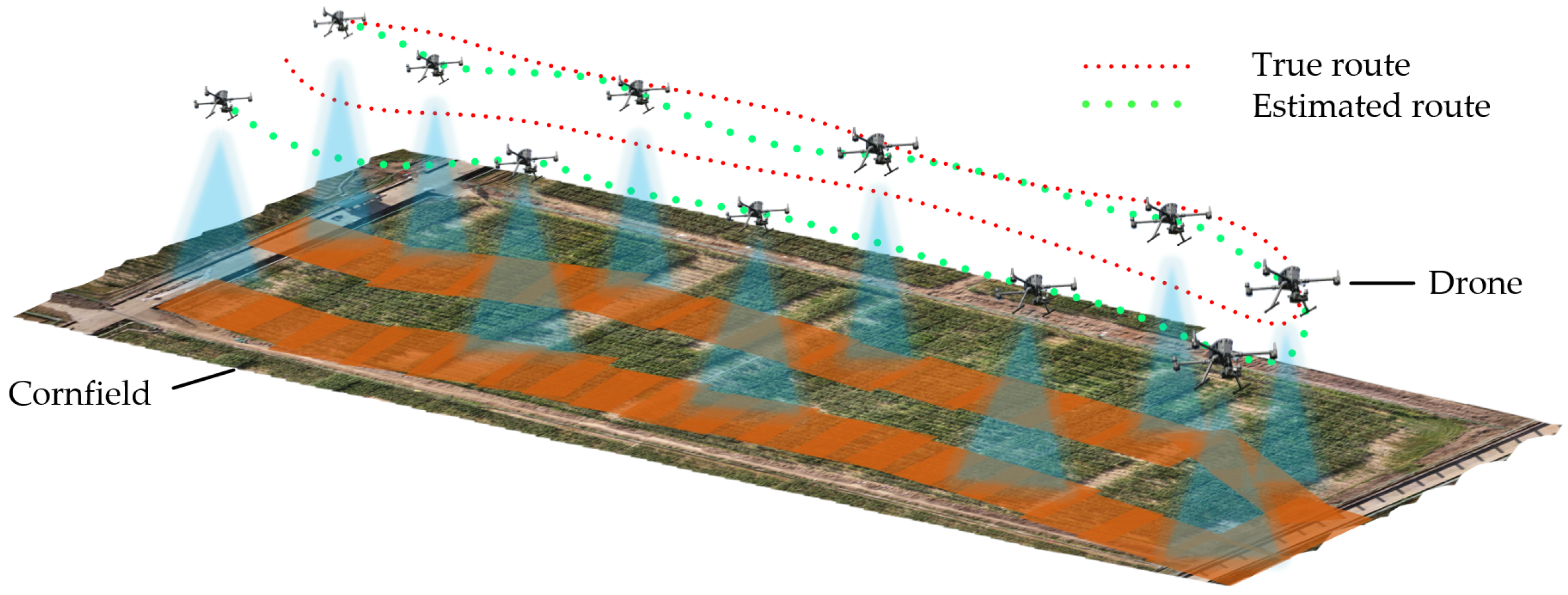
- We propose an improved homography estimation method. By optimizing the homography estimation process with the Normalized Direct Linear Transformation (NDLT) algorithm and directly calculating the homography between the new image and the reference image, rather than relying on the accumulation of pairwise homography estimates, we effectively reduce error accumulation. This approach minimizes image drift and improves mosaicing accuracy;
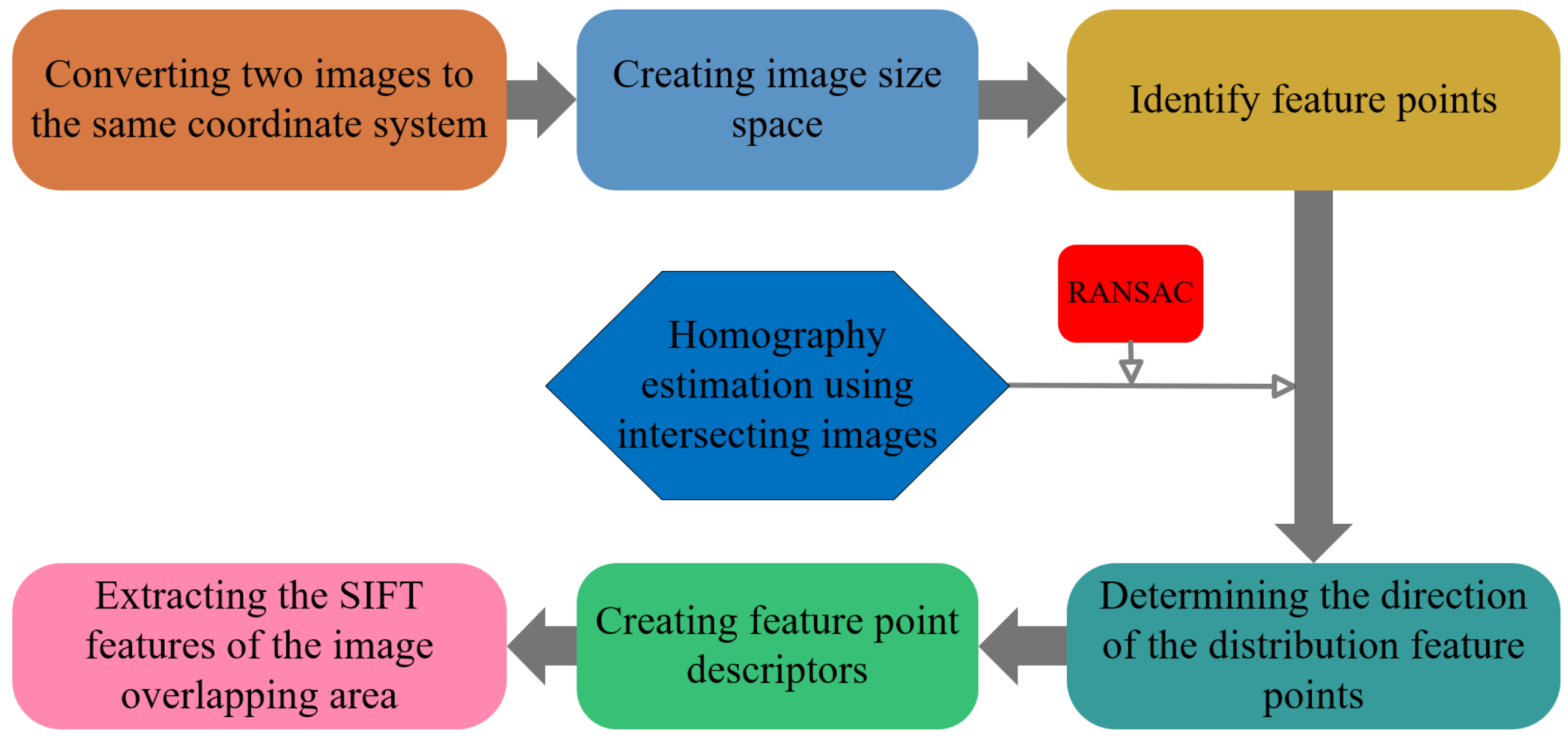
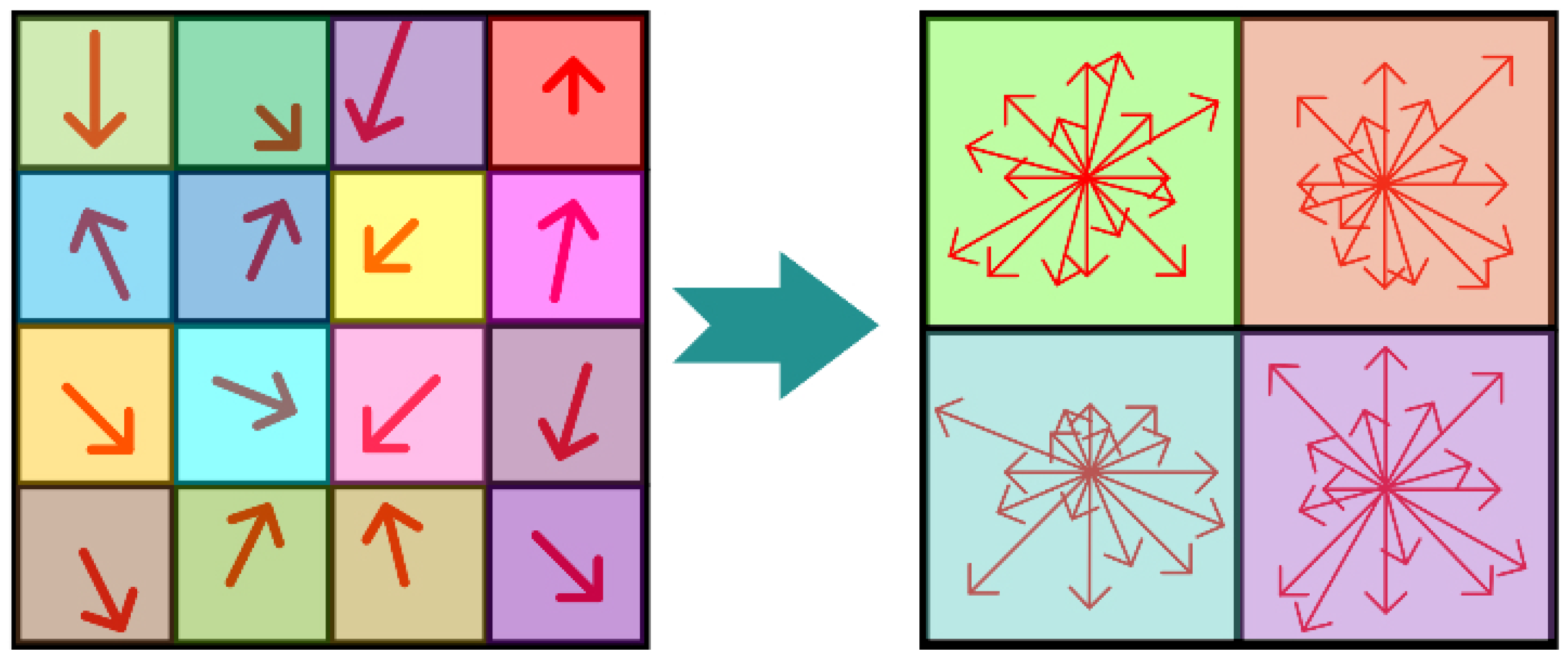
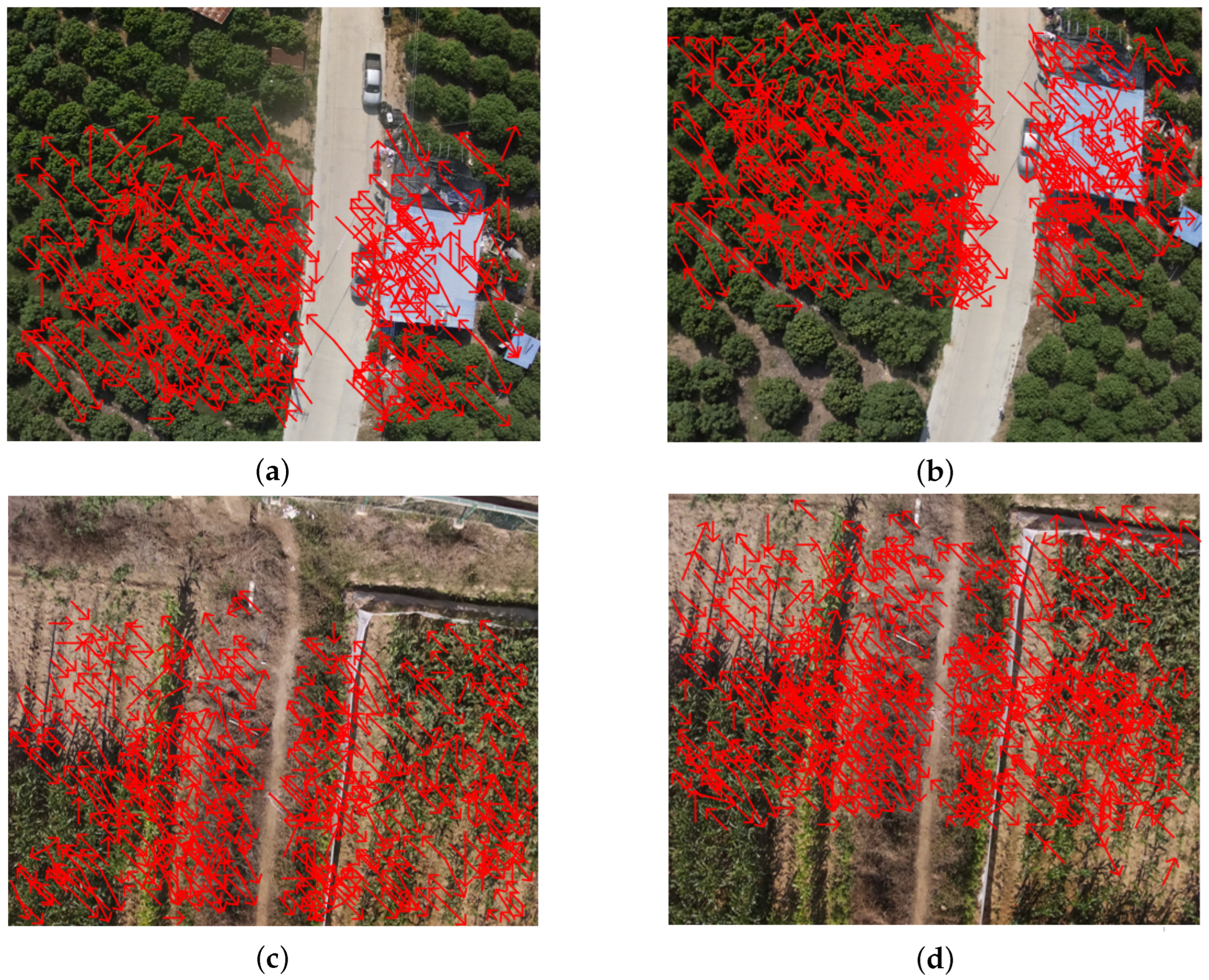
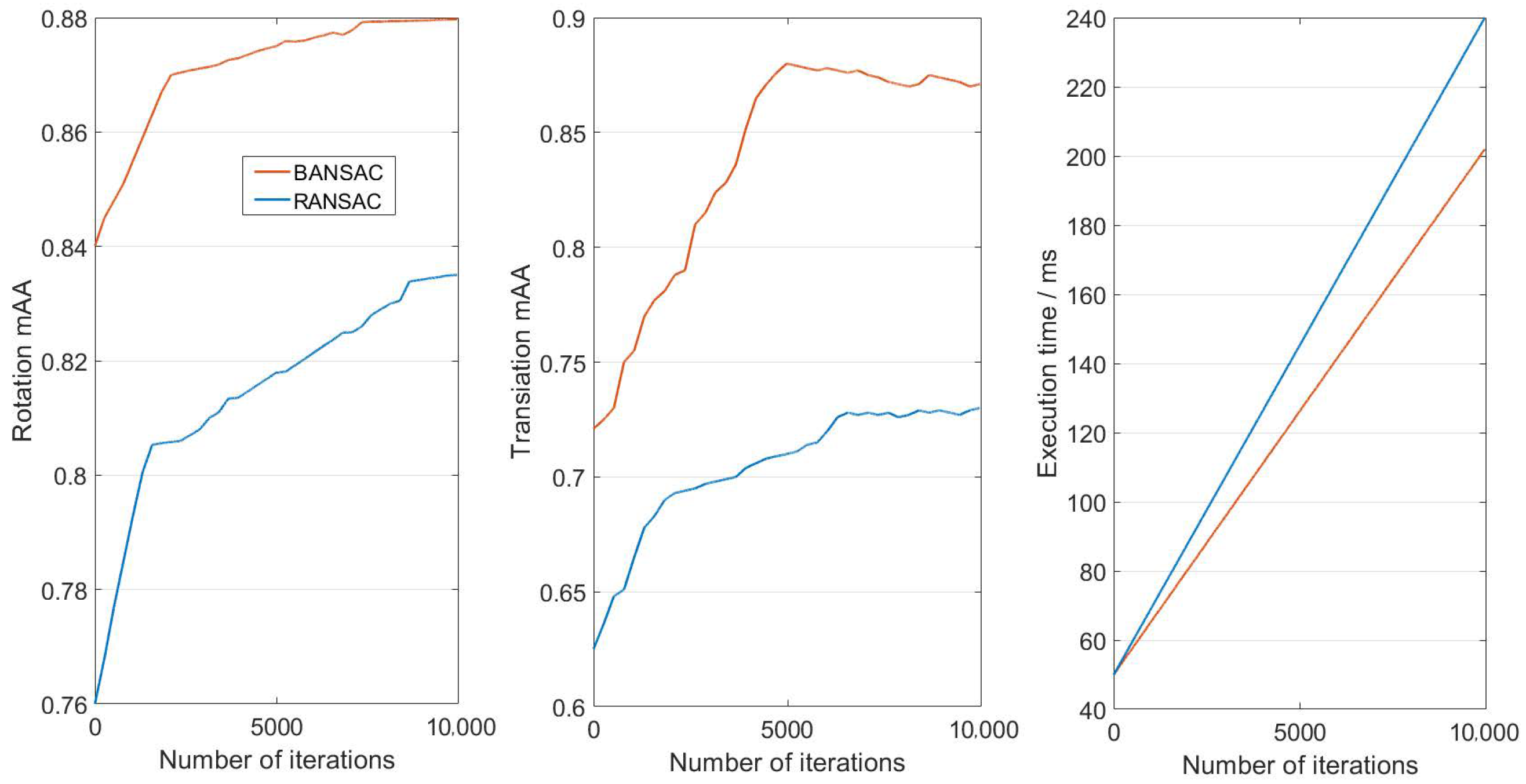
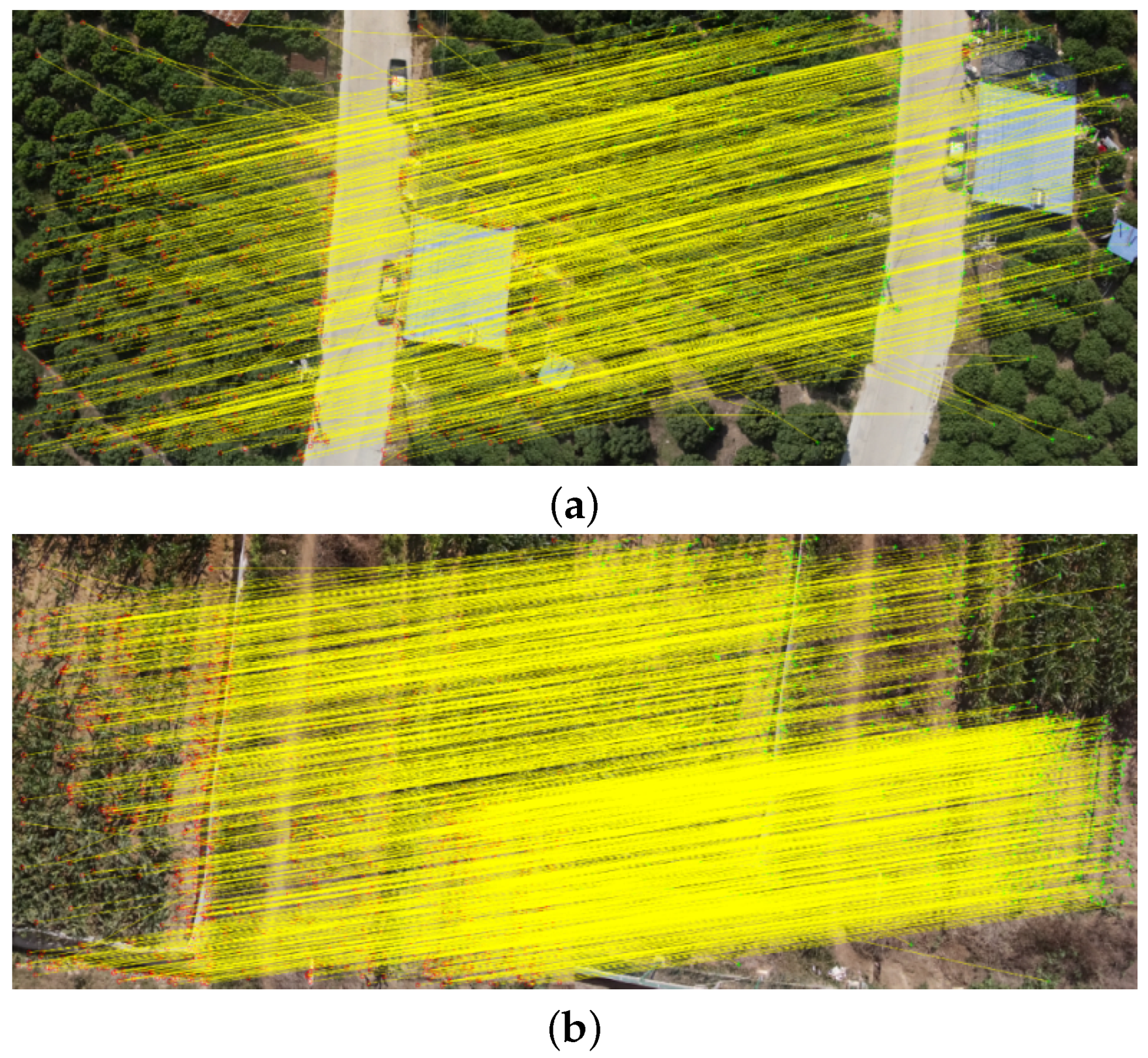
- We introduce an improved SIFT algorithm for feature extraction and image registration. The conventional SIFT method effectively identifies features that are invariant to scale changes; it may be affected by noise and complex scenes when processing UAV remote sensing images. By incorporating BANSAC, we enhance the accuracy and robustness of feature point extraction in the SIFT algorithm. Our experiments demonstrate that the improved SIFT algorithm achieves rotation and translation sampling accuracies of 0.879 and 0.877, respectively, outperforming the traditional RANSAC algorithm;
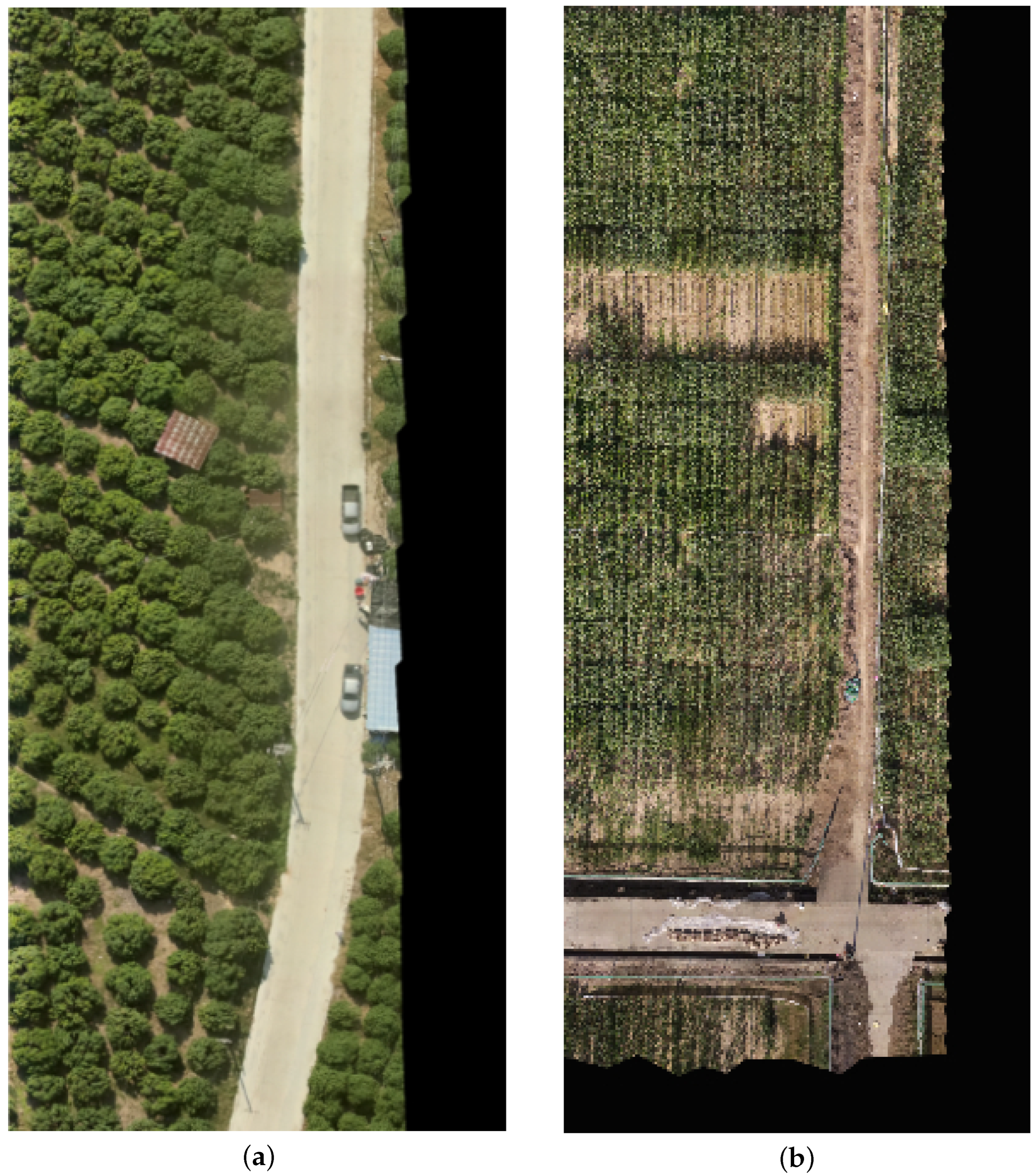
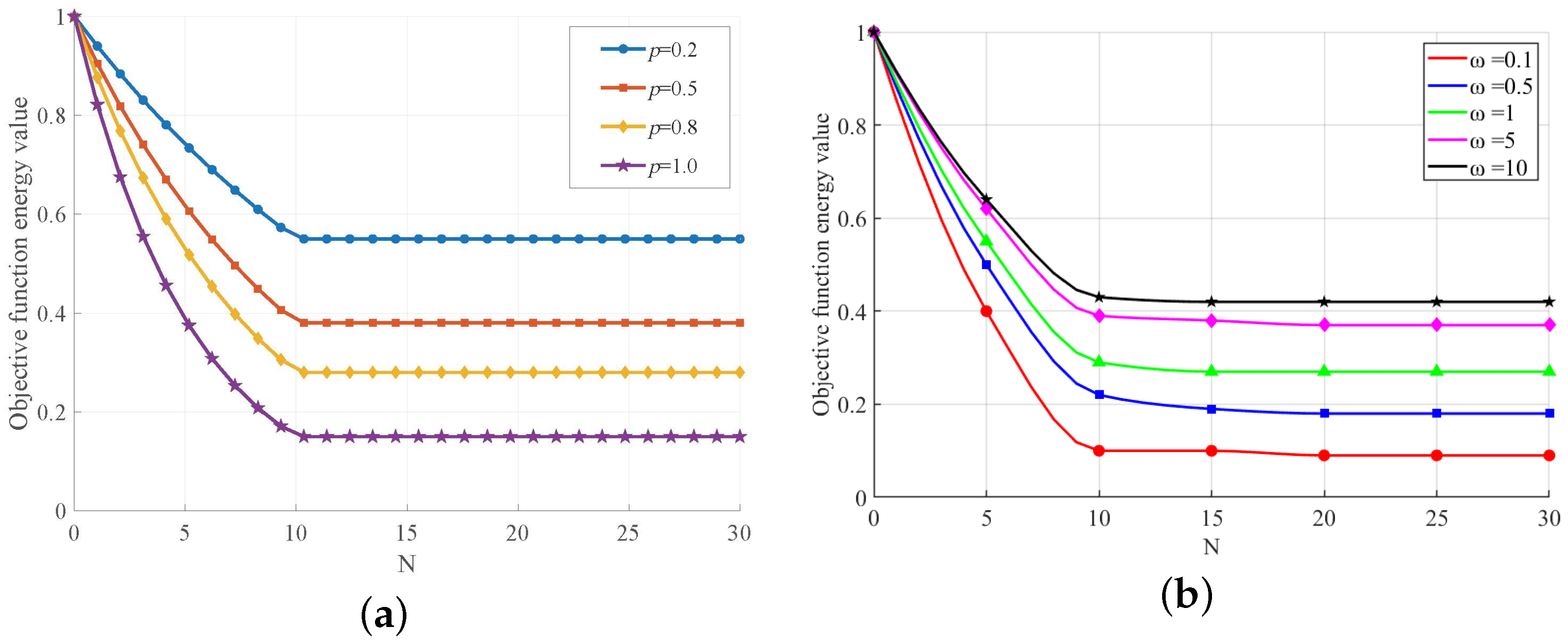
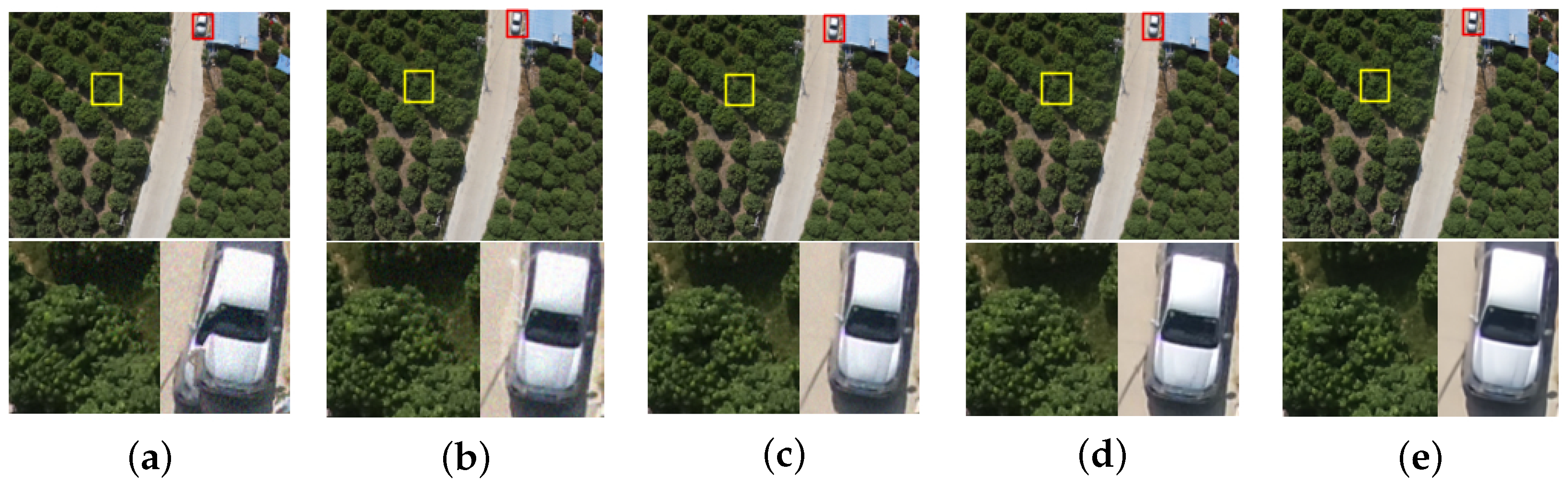
- In terms of image smoothing, we proposed an Iterative Least Squares (ILS) method to minimize the objective function for achieving global fast optimization, leveraging the computational advantages of Least Squares in image gradient calculation. This method achieved a significant reduction in the objective function energy with relatively few iterations, with a maximum decrease of up to 72%. The smoothing effect completely eliminated noise and ghosting artifacts without any gradient reversal phenomena. The proposed method demonstrated superior performance compared to traditional direct averaging and Gaussian distribution methods across key metrics including information entropy, standard deviation, spatial frequency, average gradient, signal-to-noise ratio (SNR), and peak signal-to-noise ratio (PSNR). Furthermore, it outperformed deep learning approaches in terms of computational speed.
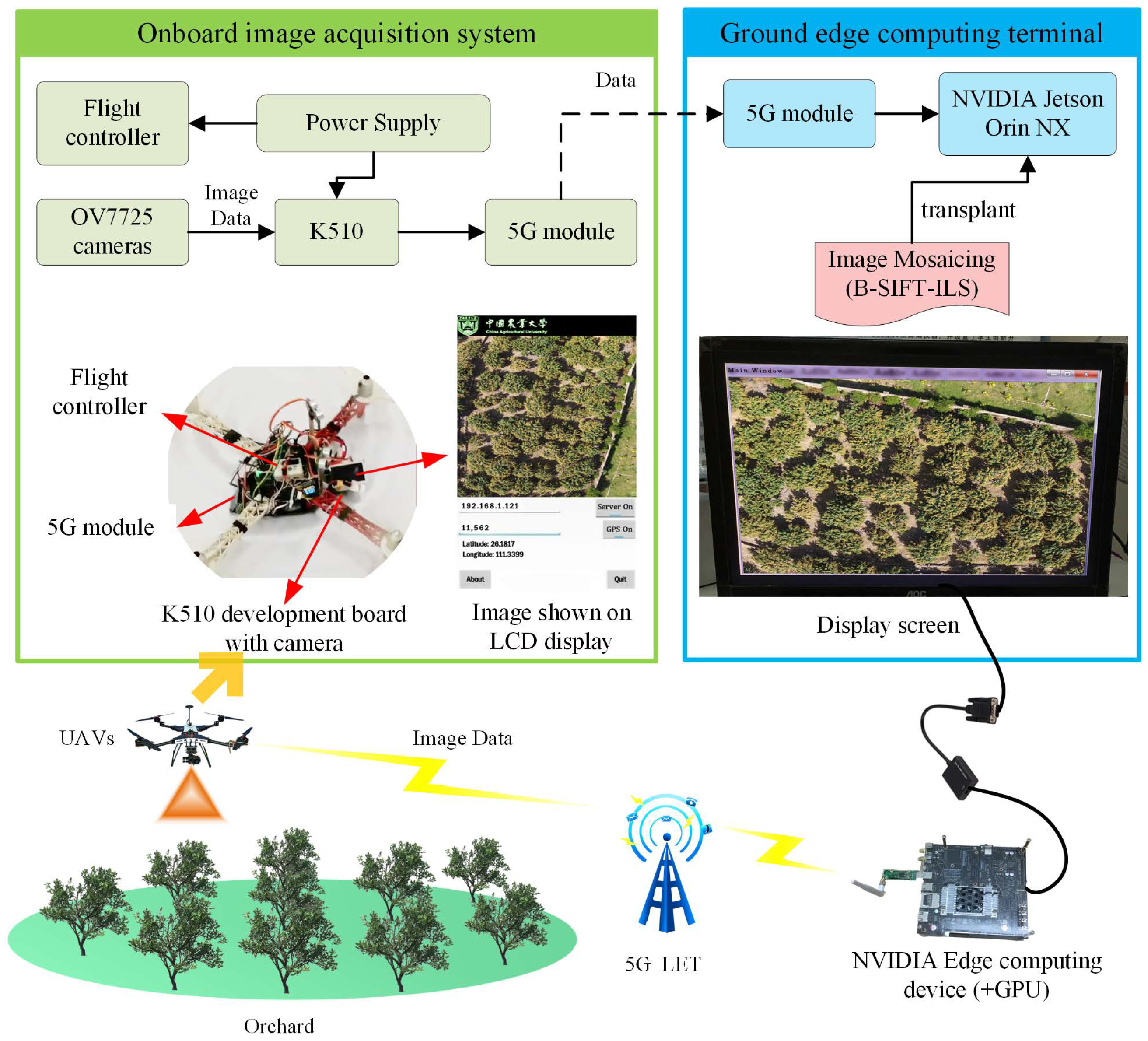
- We implement real-time image mosaicing using edge computing systems. By incorporating our novel B-SIFT-ILS algorithm into NVIDIA Jetson Orin NX, we enable real-time creation of high-resolution stitched images from disorganized aerial footage.
2. Materials and Methods
2.1. System Setup
2.2. Data Collection
2.3. Image Mosaicing
2.3.1. Reference-Based Homography Estimation for UAV Image Mosaicing
2.3.2. Reproducibility Protocol
- Step 1: Frame Extraction. Every fifth frame was extracted from raw MP4 footage (29 fps, 1920 × 1080) using FFmpeg v4.4, with the command flag ‘-vf select = not(mod(n,5))’.
- Step 2: Preprocessing. Each extracted frame was converted to grayscale and resized to 640 × 480 pixels using ‘cv2.resize()’ function with the ‘INTER_LINEAR’ argument.
- Step 3: Calculation of geographical overlap. For each pair of images, the geographic overlap was calculated based on the GPS coordinates stored in the image metadata.
- Step 4: Matching of features with BANSAC. BANSAC was applied using the following fixed parameters: max_iterations = 4000, confidence = 0.99, and threshold = 3.0 pixels.
- Step 5: Sequential processing pipeline. Further processing, including homography estimation, feature refinement, and iterative least squares smoothing, was conducted exactly as described in Section 2.4, ensuring that each step can be independently repeated.
2.4. Proposed Mosaicing Approach
2.4.1. Geometric Correction of Image Distortion
2.4.2. Image Matching
| Algorithm 1 BANSAC algorithm. |
| Input: Matched feature points(R_X,R_Y), maximum iteration number K, |
| initial conditional probability table . |
| Output: Optimal homography model *, and optimal inlier set C*. |
| Initialize k ← 1, ← 0.5, * ← NULL, C* ← NULL; |
| while k < K do |
| ← weight_sampling((R_Xk,R_Yk), ) |
| ← hypothesis(); |
| ← model_evaluation((R_Xk,R_Yk),); |
| if better than previous best: |
| , ← best_model(,); |
| ← update_probabilities(,(R_Xk,R_Yk)0:k−1); |
| if stopping_criteria() |
| break; |
| k ← k + 1; |
| end |
2.4.3. Image Smoothing
2.5. Edge Computing Deployment
3. Results
3.1. SIFT Feature Extraction Results in Image Overlap Region
3.2. Analysis of ILS-Based Image Smoothing Iteration Results
3.3. Comparative Analysis of Different Smoothing Algorithms
4. Discussion
5. Conclusions
Author Contributions
Funding
Institutional Review Board Statement
Informed Consent Statement
Data Availability Statement
Acknowledgments
Conflicts of Interest
References
- Mamabolo, E.; Mashala, M.J.; Mugari, E.; Mogale, T.E.; Mathebula, N.; Mabitsela, K.; Ayisi, K.K. Application of precision agriculture technologies for crop protection and soil health. Smart Agric. Technol. 2025, 12, 101270. [Google Scholar] [CrossRef]
- Bablu, T.A.; Rashid, M.T. Edge computing and its impact on real-time data processing for IoT-driven applications. J. Adv. Comput. Syst. 2025, 5, 26–43. [Google Scholar]
- Zhou, Z.; Abawajy, J.; Chowdhury, M.; Hu, Z.; Li, K.; Cheng, H.; Alelaiwi, A.A.; Li, F. Minimizing SLA violation and power consumption in Cloud data centers using adaptive energy-aware algorithms. Future Gener. Comput. Syst. 2018, 86, 836–850. [Google Scholar] [CrossRef]
- Zhou, Z.; Shojafar, M.; Alazab, M.; Abawajy, J.; Li, F. AFED-EF: An energy-efficient VM allocation algorithm for IoT applications in a cloud data center. IEEE Trans. Green Commun. Netw. 2021, 5, 658–669. [Google Scholar] [CrossRef]
- Satyanarayanan, M. The emergence of edge computing. Computer 2017, 50, 30–39. [Google Scholar] [CrossRef]
- Bonomi, F.; Milito, R.; Zhu, J.; Addepalli, S. Fog computing and its role in the internet of things. In MCC ’12: Proceedings of the First Edition of the MCC Workshop on Mobile Cloud Computing; ACM Digital Library: New York, NY, USA, 2012; pp. 13–16. [Google Scholar]
- Yi, S.; Li, C.; Li, Q. A survey of fog computing: Concepts, applications and issues. In Mobidata ’15: Proceedings of the 2015 Workshop on Mobile Big Data; ACM Digital Library: New York, NY, USA, 2015; pp. 37–42. [Google Scholar]
- Gai, K.; Qiu, M.; Zhao, H.; Tao, L.; Zong, Z. Dynamic energy-aware cloudlet-based mobile cloud computing model for green computing. J. Netw. Comput. Appl. 2016, 59, 46–54. [Google Scholar] [CrossRef]
- Zhou, Z.; Abawajy, J. Reinforcement learning-based edge server placement in the intelligent internet of vehicles environment. In IEEE Transactions on Intelligent Transportation Systems; IEEE: New York, NY, USA, 2025. [Google Scholar]
- Otterness, N.; Yang, M.; Rust, S.; Park, E.; Anderson, J.H.; Smith, F.D.; Berg, A.; Wang, S. An evaluation of the NVIDIA TX1 for supporting real-time computer-vision workloads. In 2017 IEEE Real-Time and Embedded Technology and Applications Symposium (RTAS); IEEE: New York, NY, USA, 2017; pp. 353–364. [Google Scholar]
- Reddy, B.; Kim, Y.H.; Yun, S.; Seo, C.; Jang, J. Real-time Driver drowsiness detection for embedded system using model compression of deep neural networks. In IEEE Conference on Computer Vision and Pattern Recognition Workshops; IEEE: New York, NY, USA, 2017; pp. 121–128. [Google Scholar]
- Kekec, T.; Yildirim, A.; Unel, M. A new approach to real-time mosaicing of aerial images. Robot. Auton. Syst. 2014, 62, 1755–1767. [Google Scholar] [CrossRef]
- Patil, H.; Sharma, S.; biswas, S. A Robust Image Mosaicing Using Improved SIFT Technique. In International Conference on Advances in Data-Driven Computing and Intelligent Systems; Springer: Berlin/Heidelberg, Germany, 2023; pp. 457–468. [Google Scholar]
- Lucas, B.D.; Kanade, T. An iterative image registration technique with an application to stereo vision. In IJCAI’81: 7th International Joint Conference on Artificial Intelligence; ACM Digital Library: New York, NY, USA, 1981; Volume 2, pp. 674–679. [Google Scholar]
- Baker, S.; Matthews, I. Lucas-kanade 20 years on: A unifying framework. Int. J. Comput. Vis. 2004, 56, 221–255. [Google Scholar] [CrossRef]
- Kang, E.Y.; Cohen, I.; Medioni, G. A graph-based global registration for 2d mosaics. In 15th International Conference on Pattern Recognition. ICPR-2000; IEEE: New York, NY, USA, 2000; Volume 1, pp. 257–260. [Google Scholar]
- Fusiello, A.; Aprile, M.; Marzotto, R.; Murino, V. Mosaic of a video shot with multiple moving objects. In 2003 International Conference on Image Processing (Cat. No. 03CH37429); IEEE: New York, NY, USA, 2003; Volume 2, p. II-307. [Google Scholar]
- Pfingsthorn, M.; Birk, A.; Schwertfeger, S.; Bülow, H.; Pathak, K. Maximum likelihood mapping with spectral image registration. In 2010 IEEE International Conference on Robotics and Automation; IEEE: New York, NY, USA, 2010; pp. 4282–4287. [Google Scholar]
- Steder, B.; Grisetti, G.; Stachniss, C.; Burgard, W. Visual SLAM for flying vehicles. IEEE Trans. Robot. 2008, 24, 1088–1093. [Google Scholar] [CrossRef]
- Botterill, T.; Mills, S.; Green, R. Real-time aerial image mosaicing. In 2010 25th International Conference of Image and Vision Computing New Zealand; IEEE: New York, NY, USA, 2010; pp. 1–8. [Google Scholar]
- Lin, Y.; Medioni, G. Map-enhanced UAV image sequence registration and synchronization of multiple image sequences. In 2007 IEEE Conference on Computer Vision and Pattern Recognition; IEEE: New York, NY, USA, 2007; pp. 1–7. [Google Scholar]
- Marburg, A.; Hayes, M.P. Smartpig: Simultaneous mosaicking and resectioning through planar image graphs. In 2015 IEEE International Conference on Robotics and Automation (ICRA); IEEE: New York, NY, USA, 2015; pp. 5767–5774. [Google Scholar]
- Ullah, S.; Kim, D.H. Benchmarking Jetson platform for 3D point-cloud and hyper-spectral image classification. In 2020 IEEE International Conference on Big Data and Smart Computing (BigComp); IEEE: New York, NY, USA, 2020; pp. 477–482. [Google Scholar]
- Li, L.; Hong, H. SAR image geometry correction technology based on block parallel signal processing. In SSPS ’23: Proceedings of the 2023 5th International Symposium on Signal Processing Systems; ACM Digital Library: New York, NY, USA, 2023; pp. 38–43. [Google Scholar]
- Wang, L.; Yue, X.; Wang, H.; Ling, K.; Liu, Y.; Wang, J.; Hong, J.; Pen, W.; Song, H. Dynamic inversion of inland aquaculture water quality based on UAVs-WSN spectral analysis. Remote Sens. 2020, 12, 402. [Google Scholar] [CrossRef]
- Gong, L.H.; Luo, H.X. Dual color images watermarking scheme with geometric correction based on quaternion FrOOFMMs and LS-SVR. Opt. Laser Technol. 2023, 167, 109665. [Google Scholar] [CrossRef]
- Yuan, Y.; Chu, J.; Leng, L.; Miao, J.; Kim, B.G. A scale-adaptive object-tracking algorithm with occlusion detection. EURASIP J. Image Video Process. 2020, 2020, 7. [Google Scholar] [CrossRef]
- Piedade, V.; Miraldo, P. Bansac: A dynamic bayesian network for adaptive sample consensus. In IEEE/CVF International Conference on Computer Vision; IEEE: New York, NY, USA, 2023; pp. 3738–3747. [Google Scholar]
- Fischler, M.A.; Bolles, R.C. Random sample consensus: A paradigm for model fitting with applications to image analysis and automated cartography. Commun. ACM 1981, 24, 381–395. [Google Scholar] [CrossRef]
- Gastal, E.S.; Oliveira, M.M. Adaptive manifolds for real-time high-dimensional filtering. ACM Trans. Graph. (TOG) 2012, 31, 1–13. [Google Scholar] [CrossRef]
- Mazumdar, A.; Alaghi, A.; Barron, J.T.; Gallup, D.; Ceze, L.; Oskin, M.; Seitz, S.M. A hardware-friendly bilateral solver for real-time virtual reality video. In HPG ’17: Proceedings of High Performance Graphics; ACM Digital Library: New York, NY, USA, 2017; pp. 1–10. [Google Scholar]
- Gharbi, M.; Chen, J.; Barron, J.T.; Hasinoff, S.W.; Durand, F. Deep bilateral learning for real-time image enhancement. ACM Trans. Graph. (TOG) 2017, 36, 1–12. [Google Scholar] [CrossRef]
- Geman, D.; Yang, C. Nonlinear image recovery with half-quadratic regularization. IEEE Trans. Image Process. 1995, 4, 932–946. [Google Scholar] [CrossRef] [PubMed]
- Rabbani, M.B.A.; Musarat, M.A.; Alaloul, W.S.; Rabbani, M.S.; Maqsoom, A.; Ayub, S.; Bukhari, H.; Altaf, M. A comparison between seasonal autoregressive integrated moving average (SARIMA) and exponential smoothing (ES) based on time series model for forecasting road accidents. Arab. J. Sci. Eng. 2021, 46, 11113–11138. [Google Scholar] [CrossRef]
- He, J.; Peng, B.; Feng, Z.; Zhong, S.; He, B.; Wang, G. A Gaussian mixture unscented Rauch–Tung–Striebel smoothing framework for trajectory reconstruction. IEEE Trans. Ind. Inform. 2024, 20, 7481–7491. [Google Scholar] [CrossRef]
- Liu, W.; Zhang, Z.; Li, X.; Hu, J.; Luo, Y.; Du, J. Enhancing recommendation systems with GNNs and addressing over-smoothing. In 2024 4th International Conference on Electronic Information Engineering and Computer Communication (EIECC); IEEE: New York, NY, USA, 2024; pp. 1184–1189. [Google Scholar]



| Type | K510 | NVIDIAJetsonOrinNX |
|---|---|---|
| Parameters | CPU: 64-Bit, RISC-V | CPU: 64-Bit Cortex-A78AE |
| Calculate peak capacity: 2.5 T flops | GPU: 1024-core with 1024 CUDA cores | |
| Memory: 512 M | Calculate peak capacity: 157 T flops | |
| Storage: 8 GB | Memory: 16 GB | |
| Power: 1.8 W | Storage: 64 GB | |
| OS: FreeRTOS | Power: 7.5 W/15 W | |
| Camera: OV7725 | OS: Linux |
| Index | SmoothingAlgorithm | |||
|---|---|---|---|---|
| ILS | DA | GD | DL | |
| Information entropy | 5.7005 | 5.8641 | 5.8922 | 5.6142 |
| Standard deviation | 34.1321 | 29.4862 | 29.8901 | 33.9875 |
| Spatial frequency (Hz) | 3.6358 | 2.9841 | 3.8672 | 4.2153 |
| Average gradient | 7.5102 | 5.7823 | 6.0125 | 7.8542 |
| SNR (dB) | 37.5684 | 21.5846 | 31.6249 | 39.1524 |
| Peak SNR (dB) | 46.5461 | 44.5713 | 44.5712 | 46.9852 |
| Index | SmoothingAlgorithm | |||
|---|---|---|---|---|
| ILS | DA | GD | DL | |
| Total matches | 610,150 | 610,150 | 610,150 | 610,150 |
| RMS (pix) | 2.3478 | 4.2301 | 3.4859 | 2.0055 |
| Mosaic time on NVIDIA Jetson Orin NX (ms) | 1015 | 1550 | 2224 | 3165 |
Disclaimer/Publisher’s Note: The statements, opinions and data contained in all publications are solely those of the individual author(s) and contributor(s) and not of MDPI and/or the editor(s). MDPI and/or the editor(s) disclaim responsibility for any injury to people or property resulting from any ideas, methods, instructions or products referred to in the content. |
© 2026 by the authors. Licensee MDPI, Basel, Switzerland. This article is an open access article distributed under the terms and conditions of the Creative Commons Attribution (CC BY) license.
Share and Cite
Wang, L.; Liu, Z.; Yang, Y.; Chen, L.; Zhou, Z.; Zeng, M.; Tan, Y. An Edge Computing-Enabled UAV-Based Image Mosaicing System Using a Novel B-SIFT-ILS Algorithm. Algorithms 2026, 19, 489. https://doi.org/10.3390/a19060489
Wang L, Liu Z, Yang Y, Chen L, Zhou Z, Zeng M, Tan Y. An Edge Computing-Enabled UAV-Based Image Mosaicing System Using a Novel B-SIFT-ILS Algorithm. Algorithms. 2026; 19(6):489. https://doi.org/10.3390/a19060489
Chicago/Turabian StyleWang, Linhui, Zhizhuang Liu, Yu Yang, Lizhi Chen, Zhenqi Zhou, Mengyu Zeng, and Yonghong Tan. 2026. "An Edge Computing-Enabled UAV-Based Image Mosaicing System Using a Novel B-SIFT-ILS Algorithm" Algorithms 19, no. 6: 489. https://doi.org/10.3390/a19060489
APA StyleWang, L., Liu, Z., Yang, Y., Chen, L., Zhou, Z., Zeng, M., & Tan, Y. (2026). An Edge Computing-Enabled UAV-Based Image Mosaicing System Using a Novel B-SIFT-ILS Algorithm. Algorithms, 19(6), 489. https://doi.org/10.3390/a19060489