
Multi-Objective Harris Hawks Optimization: Principles, Variants, Applications, and Future Directions

 ,
,  , , and
Abstract
1. Introduction
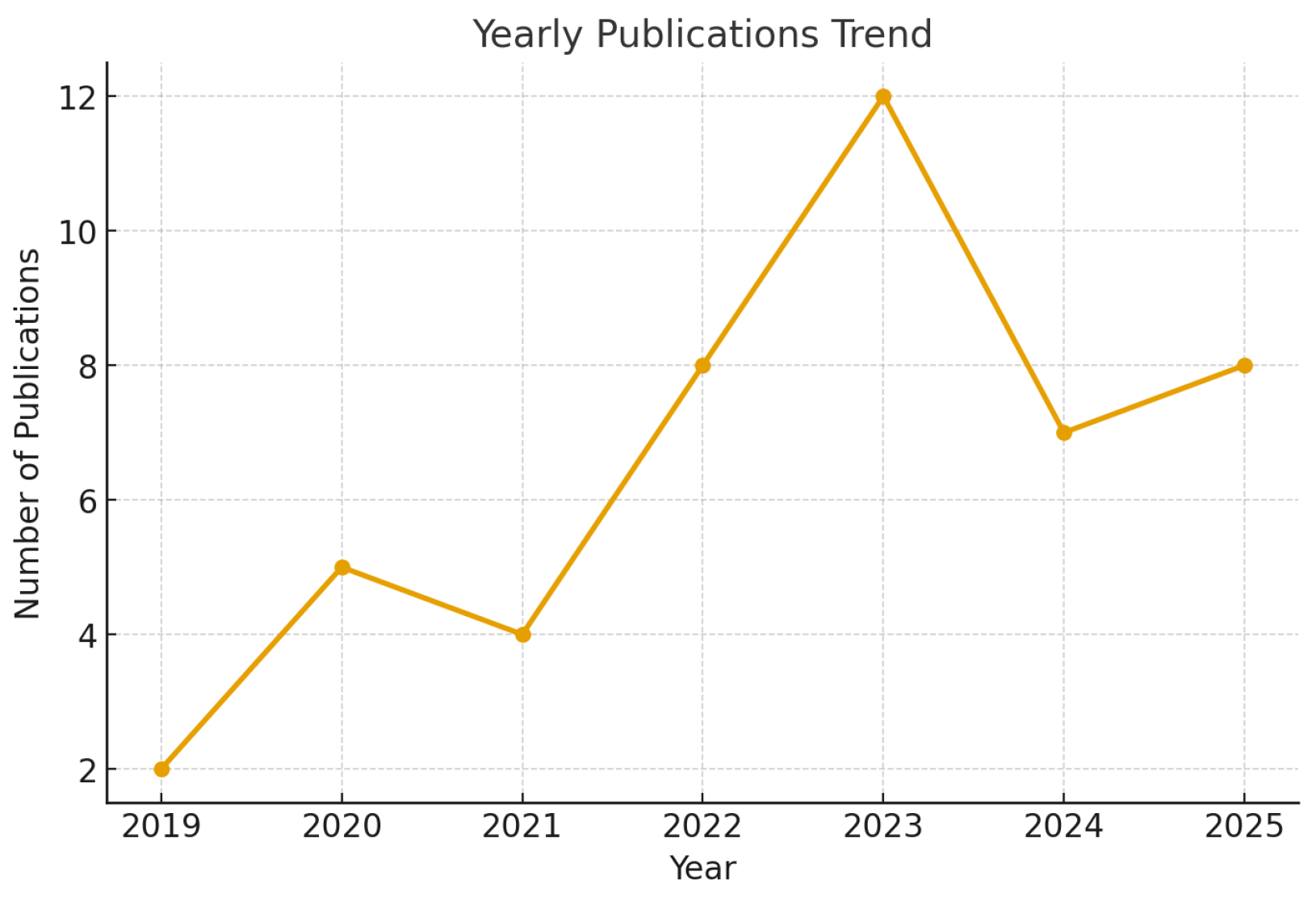
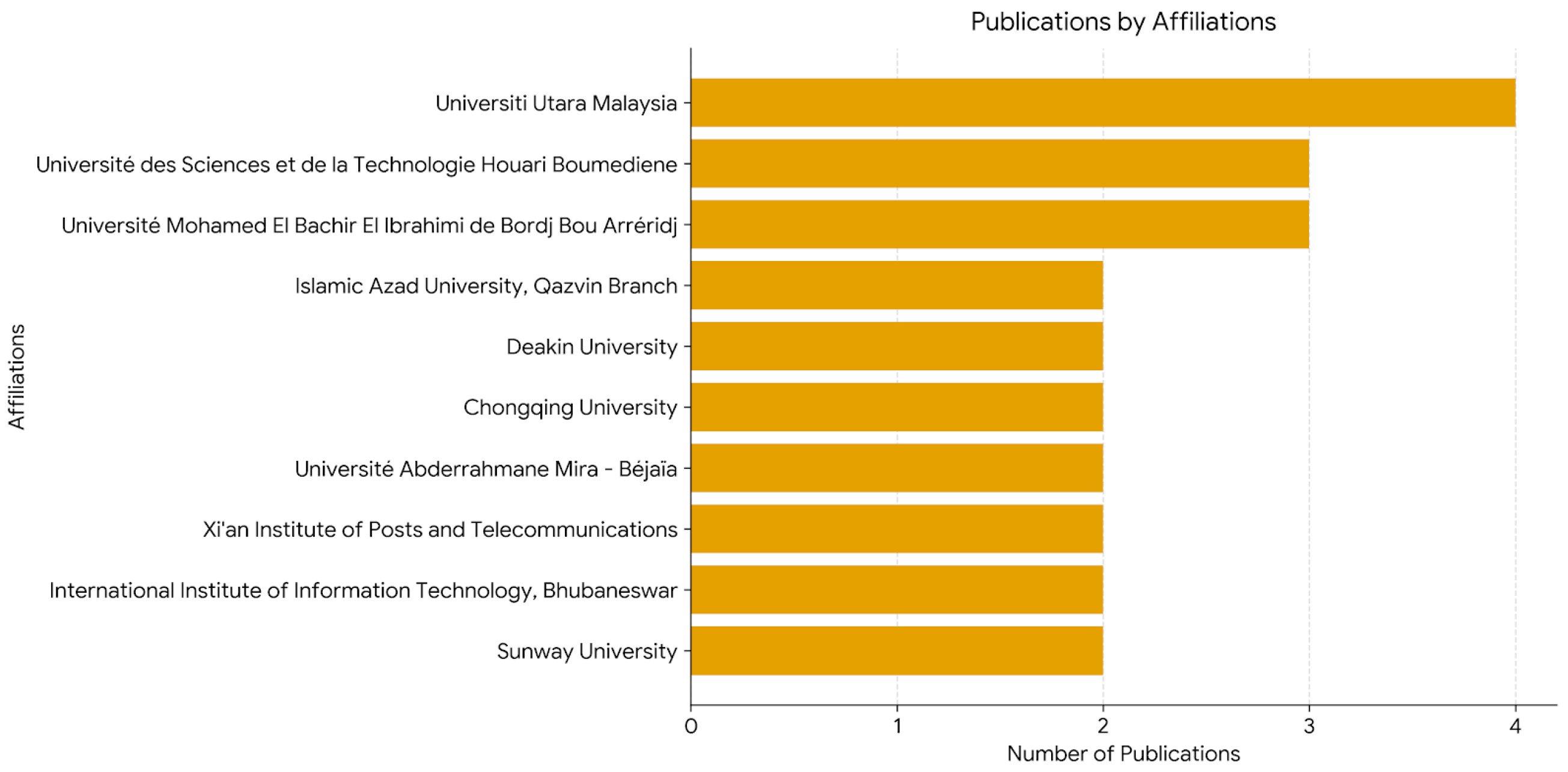
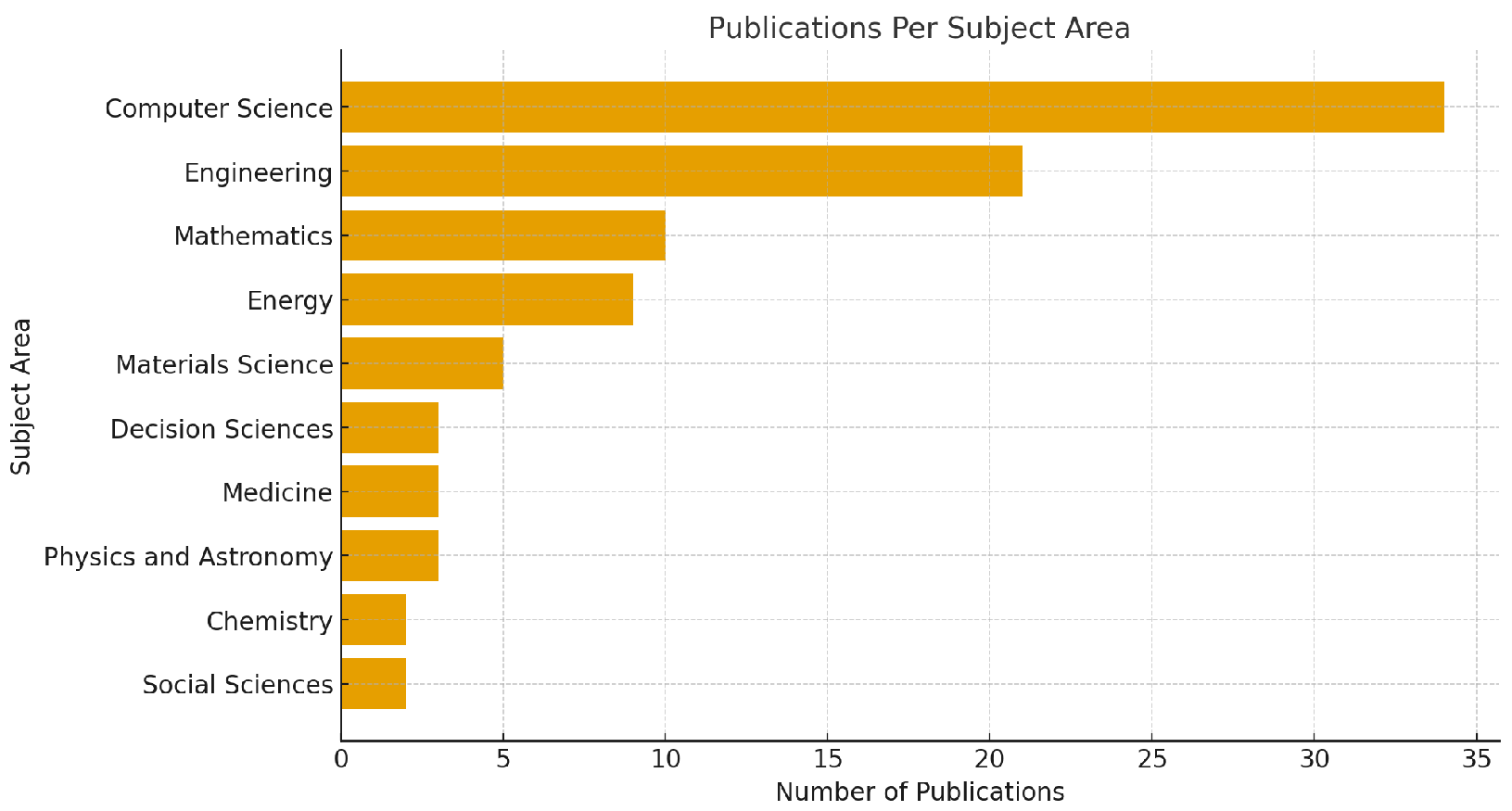
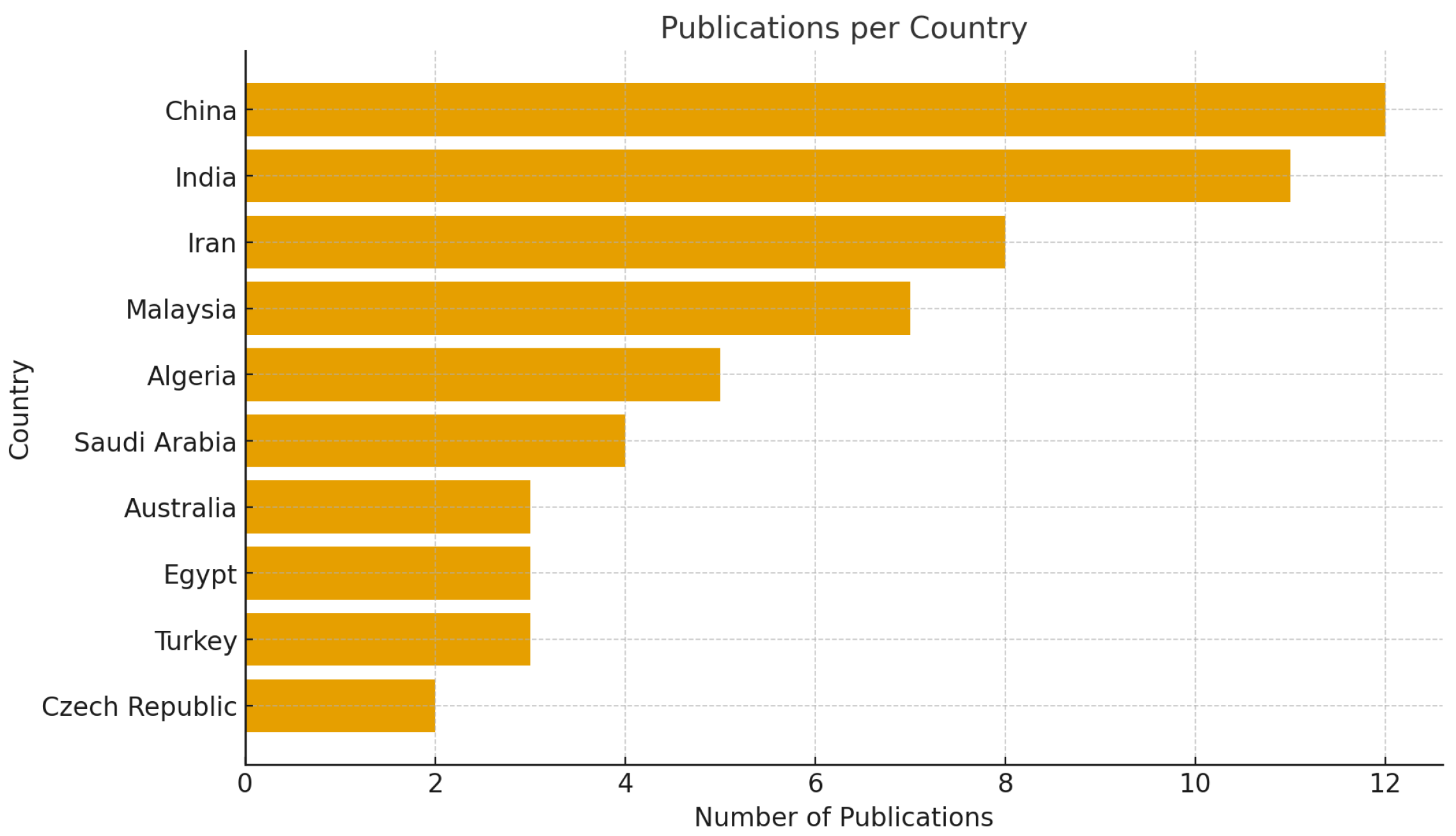
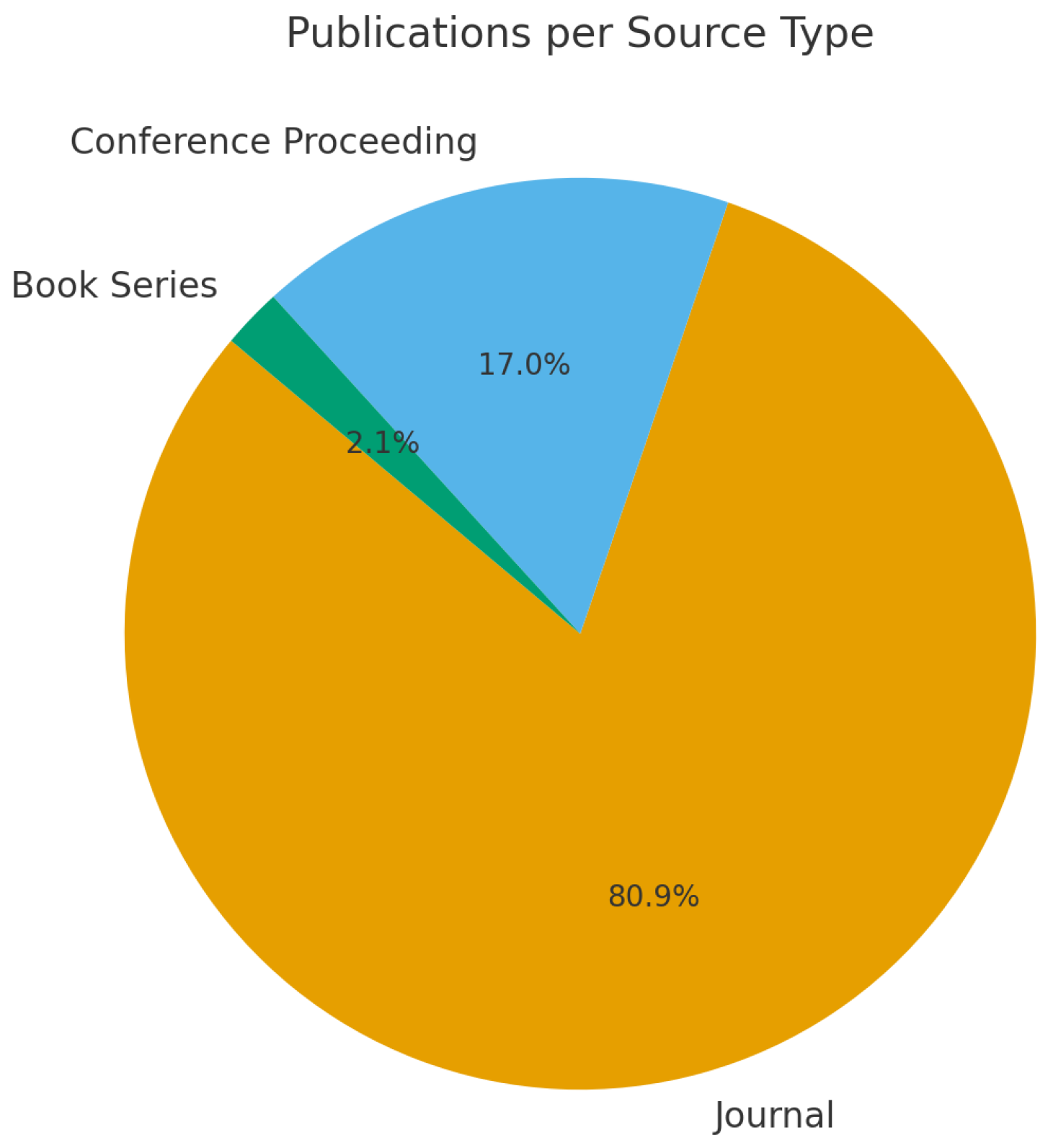
- Provides the first bibliometric mapping of MHHO research (publication growth, subject areas, affiliations, countries, and source types), to establish an empirical basis for tracking the field’s maturation.
- Introduces a taxonomic classification of MHHO contributions into original, modified, and hybridized variants, and uses this taxonomy to compare design choices.
- Performs a critical comparative analysis that identifies recurring enhancement mechanisms and the targeted problem characteristics, and the trade-offs.
- Extracts cross-cutting methodological patterns and pitfalls of MHHO theory, including premature convergence, scalability under many-objective settings, parameter sensitivity, and constraint-handling weaknesses.
2. The Growth of Multi-Objective Harris Hawks Optimization
3. Basic Concepts of Multi-Objective Harris Hawks Optimization
3.1. Multi-Objective Optimization
- Dominance and partial ordering: Unlike single-objective settings, where candidates can be totally ordered by a scalar value, MO relies on a partial order induced by Pareto dominance. For two feasible solutions , we can say that y (strictly) dominates x, written , ifIn words, y is at least as good as x in every objective and strictly better in at least one objective. This relation provides a principled way to compare solutions without collapsing multiple criteria into a single aggregate score.
- Pareto optimality, set, and front: A feasible solution is Pareto-optimal if there exists no other such that . The Pareto-optimal set (also called the set of non-dominated solutions) isand its image in the objective space,is the Pareto front. Practical algorithms therefore aim to (i) discover non-dominated solutions that approximate and (ii) preserve diversity along to represent the trade-offs among conflicting objectives. These principles underpin the design of our MHHO procedure described in Section 3.2.
- In constrained MOPs, MHHO variants commonly employ several constraint-handling techniques to ensure solution feasibility during the search process. The most frequently used approaches include penalty functions, feasibility rules, repair operators, epsilon-constraint methods, and constraint-domination mechanisms. Penalty-based methods incorporate constraint violations into the objective evaluation process, while repair operators adjust infeasible solutions to satisfy problem constraints. Constraint-handling strategies in MHHO can generally be categorized into soft and hard approaches. Soft constraint handling allows infeasible solutions to participate in the search process through penalty-based evaluation, thereby promoting exploration near constraint boundaries. In contrast, hard constraint handling strictly enforces feasibility by rejecting infeasible solutions or applying repair mechanisms during the optimization process. Hard approaches are frequently employed in highly constrained engineering applications where violating operational or safety limits is unacceptable. In several engineering and power-system applications, adaptive penalty strategies and feasibility-preserving operators were integrated with archive management and non-dominated sorting to improve convergence toward feasible Pareto-optimal regions. Nevertheless, effective constraint handling in large-scale and highly constrained optimization problems remains an open challenge for MHHO research.
3.2. Harris Hawks Optimization (HHO)
3.2.1. Exploration Phase
3.2.2. Transition from Exploration to Exploitation
3.2.3. Exploitation Phase
- 1.
- Soft besiege:When and , the prey still retains enough energy to flee. The hawks tighten the encirclement to drain this energy before striking:whereandmodels a stochastic step of the prey during escape. J denotes the random jump strength of the prey.
- 2.
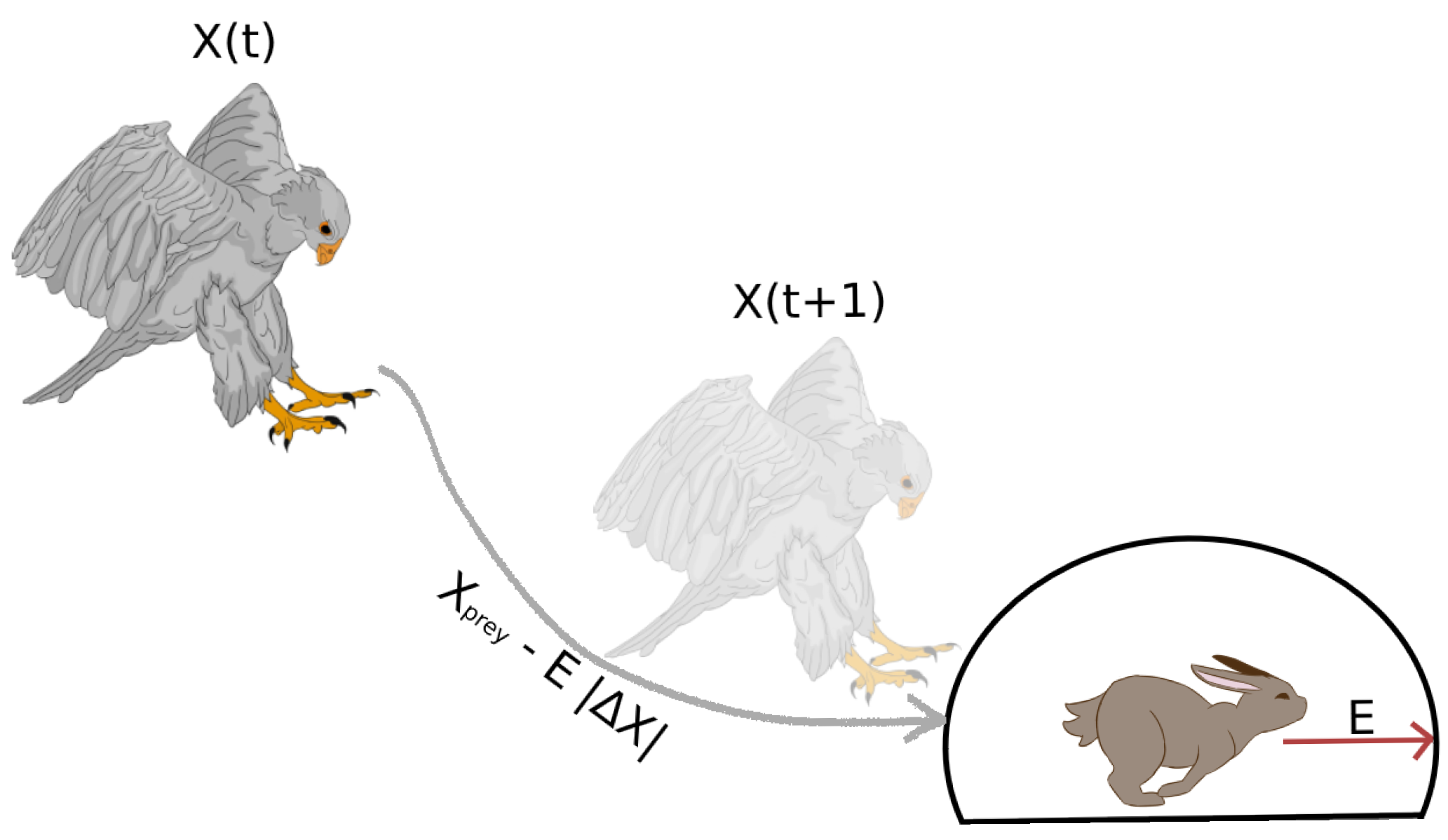
- Hard besiegeIf but , the prey is fatigued and cannot effectively escape. The hawks contract the ring aggressively:Figure 6 illustrates the hard besiege behavior, where the hawks aggressively shrink the search region around the prey once its escaping energy becomes weak.
- 3.
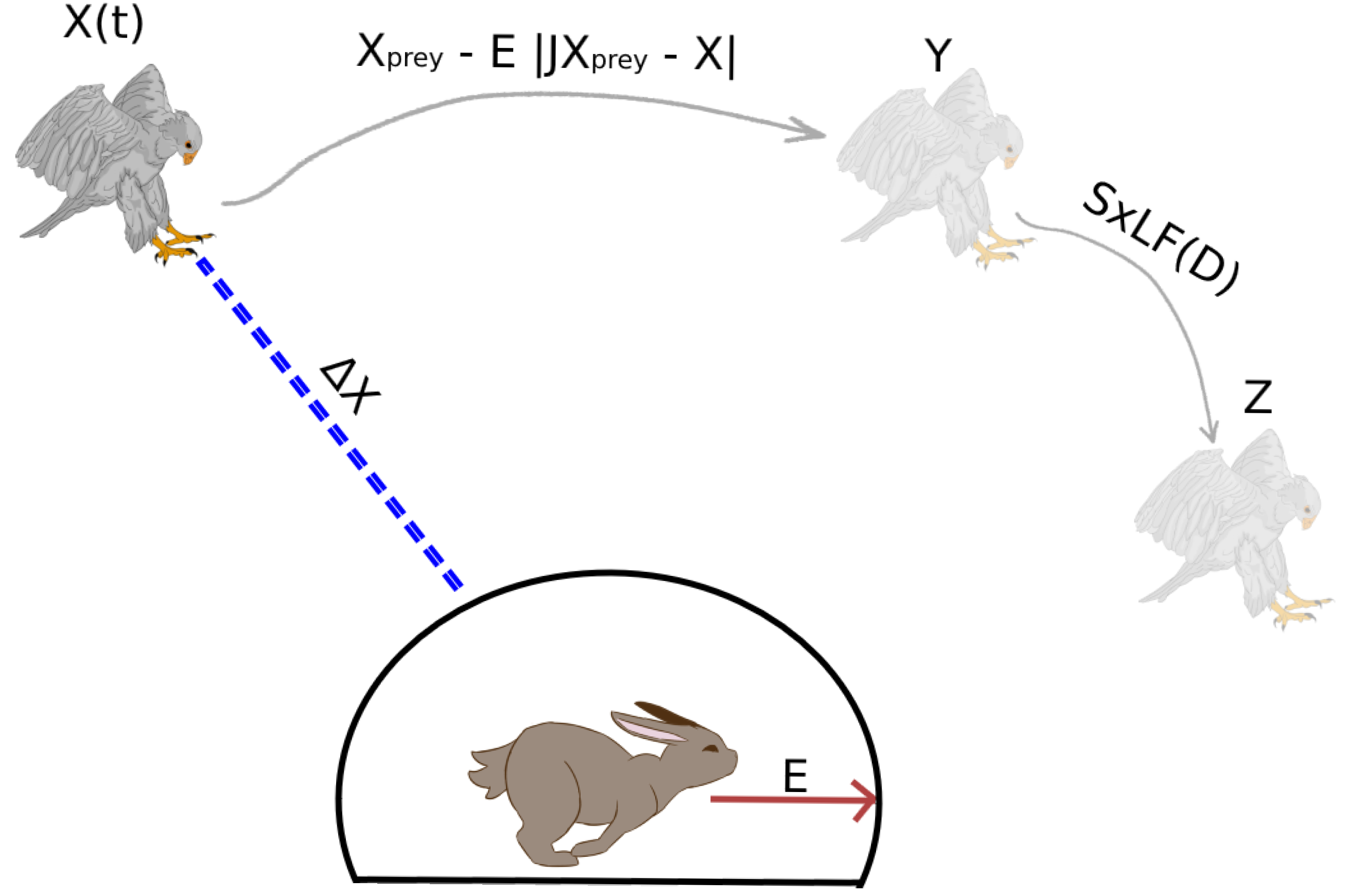
- Soft besiege with progressive rapid divesWhen and , a soft besiege is maintained but augmented with rapid, irregular dives to counter the prey’s zigzag escape. First, a candidate move is evaluated:If this move is not promising, the team performs Lévy-flight-based (LF) dives:where D is the problem dimension and is a random vector. The Lévy flight iswith and . The update accepts the better of the two candidates:Figure 7 demonstrates the soft besiege strategy combined with progressive rapid dives, where Lévy-flight perturbations enhance exploration around the prey location and help the algorithm escape local optima.
- 4.
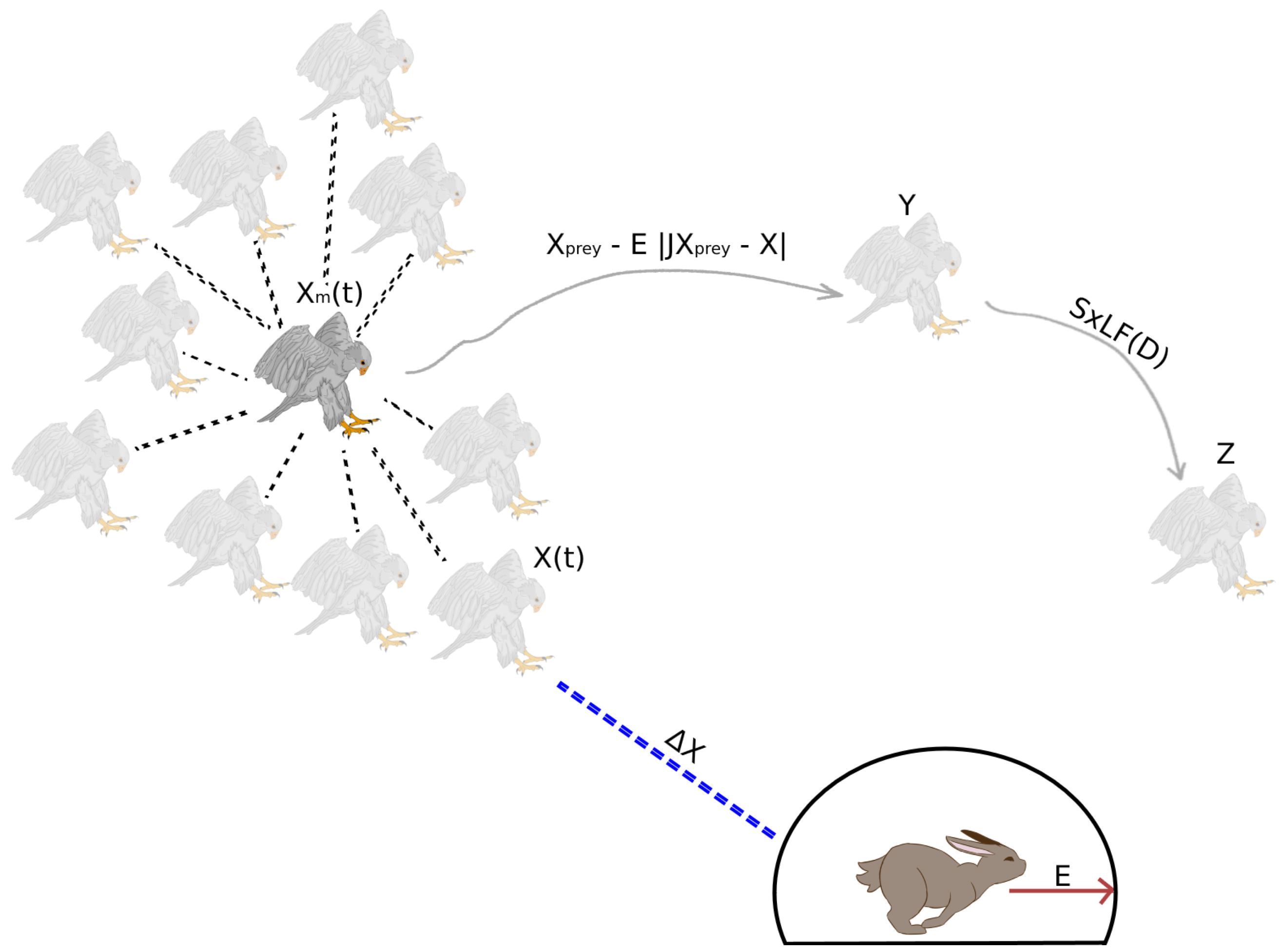
- Hard besiege with progressive rapid divesFinally, when and , the prey is largely exhausted. The hawks enforce a hard besiege and apply rapid dives to finalize the capture. The acceptance rule mirrors (19):withFigure 8 presents the hard besiege with progressive rapid dives, where exploitation and stochastic dives are simultaneously employed to accelerate convergence toward high-quality solutions while preserving limited search diversity.
4. Recent Variants of Multi-Objective Harris Hawks Optimization
4.1. Original Multi-Objective Harris Hawks Optimization
4.2. Modified Multi-Objective Harris Hawks Optimization
4.3. Hybridized Multi-Objective Harris Hawks Optimization
4.4. Critical Comparative Analysis of MHHO Variants
5. Applications of Multi-Objective Harris Hawks Optimization
6. Critical Analysis of Multi-Objective Harris Hawks Optimization Theory
7. Conclusions and Future Work
- Algorithmic Efficiency and Scalability: With an increase in objectives and population size, the computational cost of the MHHO method rises because of the need for non-dominated sorting, density estimation, and archive management. Future work should consider more efficient dominance measures, approximate ranking, and surrogate-assisted selection to reduce runtime complexity. In large engineering problems, particularly those with thousands of decision variables, parallel, distributed, and GPU-based approaches may provide significant opportunities for enhancing the scalability of MHHO.
- Adaptive Parameter Control: MHHO’s performance is influenced by its specific parameter settings pertaining to energy schedules, archive size, grid granularity, and mutation rates. Although adaptive or nonlinear strategies have shown improvements in robustness, these strategies are still dependent on problem-specific configurations. Future work should seek to enhance MHHO’s ability to self-tune its parameters dynamically through the use of reinforcement learning, fuzzy logic, and evolutionary control systems.
- Scalability to Many-objective Problems: With an increasing number of objectives, the discriminatory ability of Pareto dominance diminishes, making it harder to differentiate between solutions. While enhanced dominance measures, indicator-based methods, and decomposition methods have been investigated, such measures remain non-standardized in MHHO. The focus of research should be on hybrid selection mechanisms that integrate dominance, indicators, and reference vectors.
- Constraint-Handling Mechanisms: One of the most challenging aspects of applying MHHO to real engineering problems is the satisfaction of the problem’s constraints. Typical approaches utilize penalties, feasibility criteria, or repair operators that are specific to each problem, and thus may limit the generality of their methods. Instead, research should aim to develop more unified and generic constraint-handling methods that can complement MHHO’s movement strategies. For binary, mixed-integer, and combinatorial optimization problems, methods such as feasibility-preserving encodings, adaptive penalties, and multi-phase repair techniques appear promising.
- Decision-Making and Solution Selection: Selecting an appropriate solution from a Pareto set remains an unsolved problem for practitioners. VIKOR, TOPSIS, and compromise programming are post-optimization decision-making methods, and while they are commonly utilized, additional development is needed to achieve greater transparency and reliability in safety-critical domains such as healthcare, power systems, and environmental protection. There is also a need for research on the integration of explainability and sensitivity analysis into the solution selection process.
- Hybridization with Other Metaheuristics: While the MHHO algorithm can be further improved through hybridization using DE, PSO, chaotic strategies, or opposition-based learning approaches, the specific contributions of these hybrid components remain unclear. This calls for systematic ablation studies to assess the effects of these mechanisms in isolation.
Author Contributions
Funding
Data Availability Statement
Acknowledgments
Conflicts of Interest
References
- Sanjalawe, Y.; Al-E’mari, S.; Abualhaj, M.; Makhadmeh, S.N.; Alsharaiah, M.A.; Hijazi, D.H. Recent advances in secretary bird optimization algorithm, its variants and applications. Evol. Intell. 2025, 18, 65. [Google Scholar] [CrossRef]
- Andréasson, N.; Evgrafov, A.; Patriksson, M. An Introduction to Optimization: Foundations and Fundamental Algorithms; Chalmers University of Technology Press: Gothenburg, Sweden, 2005; Volume 1, pp. 1–205. [Google Scholar]
- Marler, R.T.; Arora, J.S. Survey of multi-objective optimization methods for engineering. Struct. Multidiscip. Optim. 2004, 26, 369–395. [Google Scholar] [CrossRef]
- Rangaiah, G.P.; Feng, Z.; Hoadley, A.F. Multi-objective optimization applications in chemical process engineering: Tutorial and review. Processes 2020, 8, 508. [Google Scholar] [CrossRef]
- Wu, H. Multi-objective decision-making for mobile cloud offloading: A survey. IEEE Access 2018, 6, 3962–3976. [Google Scholar] [CrossRef]
- Sissodia, R.; Rauthan, M.M.S.; Naithani, K. A Survey on Multi-Objective Tasks and Workflow Scheduling Algorithms in Cloud Computing. Int. J. Cloud Appl. Comput. (IJCAC) 2022, 12, 1–16. [Google Scholar] [CrossRef]
- Freitas, A.A. A critical review of multi-objective optimization in data mining: A position paper. ACM SIGKDD Explor. Newsl. 2004, 6, 77–86. [Google Scholar] [CrossRef]
- Bandaru, S.; Ng, A.H.; Deb, K. Data mining methods for knowledge discovery in multi-objective optimization: Part A-Survey. Expert Syst. Appl. 2017, 70, 139–159. [Google Scholar] [CrossRef]
- Yenisey, M.M.; Yagmahan, B. Multi-objective permutation flow shop scheduling problem: Literature review, classification and current trends. Omega 2014, 45, 119–135. [Google Scholar] [CrossRef]
- Lei, D. Multi-objective production scheduling: A survey. Int. J. Adv. Manuf. Technol. 2009, 43, 926–938. [Google Scholar] [CrossRef]
- Ferreira, J.C.; Steiner, M.T.A.; Canciglieri, O., Jr. Multi-objective optimization for the green vehicle routing problem: A systematic literature review and future directions. Cogent Eng. 2020, 7, 1807082. [Google Scholar] [CrossRef]
- Fei, Z.; Li, B.; Yang, S.; Xing, C.; Chen, H.; Hanzo, L. A survey of multi-objective optimization in wireless sensor networks: Metrics, algorithms, and open problems. IEEE Commun. Surv. Tutor. 2016, 19, 550–586. [Google Scholar] [CrossRef]
- Cui, Y.; Geng, Z.; Zhu, Q.; Han, Y. Multi-objective optimization methods and application in energy saving. Energy 2017, 125, 681–704. [Google Scholar] [CrossRef]
- Guo, K.; Zhang, L. Multi-objective optimization for improved project management: Current status and future directions. Autom. Constr. 2022, 139, 104256. [Google Scholar] [CrossRef]
- Handl, J.; Kell, D.B.; Knowles, J. Multiobjective optimization in bioinformatics and computational biology. IEEE/ACM Trans. Comput. Biol. Bioinform. 2007, 4, 279–292. [Google Scholar] [CrossRef]
- Konak, A.; Coit, D.W.; Smith, A.E. Multi-objective optimization using genetic algorithms: A tutorial. Reliab. Eng. Syst. Saf. 2006, 91, 992–1007. [Google Scholar] [CrossRef]
- Balachandran, M.; Gero, J. A comparison of three methods for generating the Pareto optimal set. Eng. Optim. 1984, 7, 319–336. [Google Scholar] [CrossRef]
- Bechikh, S.; Datta, R.; Gupta, A. Recent Advances in Evolutionary Multi-Objective Optimization; Springer: Cham, Switzerland, 2016; Volume 20. [Google Scholar]
- Zhou, A.; Qu, B.Y.; Li, H.; Zhao, S.Z.; Suganthan, P.N.; Zhang, Q. Multiobjective evolutionary algorithms: A survey of the state of the art. Swarm Evol. Comput. 2011, 1, 32–49. [Google Scholar] [CrossRef]
- Heidari, A.A.; Mirjalili, S.; Faris, H.; Aljarah, I.; Mafarja, M.; Chen, H. Harris hawks optimization: Algorithm and applications. Future Gener. Comput. Syst. 2019, 97, 849–872. [Google Scholar] [CrossRef]
- Dougaheh, M.P.; Ashofteh, P.S. Development of multi-objective Harris hawks optimization (MOHHO) algorithm in low-impact development systems considering the effects of climate change. Phys. Chem. Earth 2025, 137, 103816. [Google Scholar] [CrossRef]
- Gogula, S.; Vakula, V.S. Multi-objective Harris Hawks optimization algorithm for selecting best location and size of distributed generation in radial distribution system. Int. J. Cogn. Comput. Eng. 2024, 5, 436–452. [Google Scholar] [CrossRef]
- Khennak, I.; Drias, H.; Khelfa, C.; Drias, Y.; Bourouhou, N.e.H.; Zafoune, I. Multi-objective Harris Hawks Optimization for Optimal Emergency Vehicle Dispatching During a Pandemic. In Proceedings of the 14th International Conference on Soft Computing and Pattern Recognition (SoCPaR 2022); Lecture Notes in Networks and Systems; Springer: Cham, Switzerland, 2023; Volume 648, pp. 852–861. [Google Scholar]
- Hossain, M.A.; Noor, R.M.; Yau, K.L.A.; Azzuhri, S.R.; Z’Abar, M.R.; Ahmedy, I.; Jabbarpour, M.R. Multi-Objective Harris Hawks Optimization Algorithm Based 2-Hop Routing Algorithm for CR-VANET. IEEE Access 2021, 9, 58230–58242. [Google Scholar] [CrossRef]
- Babu, P.V.K.; Swarnasri, K.; Vijetha, P. Multi-Objective Optimal planning of Renewable Energy Sources & Electric Vehicle Charging Stations in Unbalanced Radial Distribution Systems using Harris Hawk Optimization Algorithm. Int. J. Renew. Energy Res. 2022, 12, 58–69. [Google Scholar] [CrossRef]
- Wang, L.; Chang, X.; Li, X.; Huang, W.; Jiao, Y. Power Grid Frequency Regulation Strategy for Photovoltaic Plant Based on Multi-Objective Harris Hawks Optimization. Front. Energy Res. 2021, 9, 806263. [Google Scholar] [CrossRef]
- Choo, Y.H.; Le, V.; Johnstone, M.; Creighton, D.; Jindal, H.; Tan, K. Optimisation of Multi-Objective Rolling Stock Maintenance Scheduling with Harris’ Hawk Optimiser. In Proceedings of the 2023 IEEE International Conference on Industry 4.0, Artificial Intelligence, and Communications Technology (IAICT), Online, 13–15 July 2023; Institute of Electrical and Electronics Engineers Inc.: Piscataway, NJ, USA, 2023; pp. 59–65. [Google Scholar]
- Islam, M.Z.; Wahab, N.I.A.; Veerasamy, V.; Hizam, H.; Mailah, N.F.; Guerrero, J.M.; Mohd Nasir, M.N. A Harris Hawks optimization based single and multi-objective optimal power flow considering environmental emission. Sustainability 2020, 12, 5248. [Google Scholar] [CrossRef]
- DeBruyne, A.S.; Kaur, B.D. Harris’s Hawk Multi-Objective Optimizer for Reference Point Problems; CSREA Press: Las Vegas, NV, USA, 2016; pp. 287–292. [Google Scholar]
- Pop, C.; Cioara, T.; Chifu, V.; Anghel, I.; Bellesini, F. Electric vehicles coordination for grid balancing using multi-objective Harris Hawks Optimization. Energy Rep. 2024, 12, 2483–2497. [Google Scholar] [CrossRef]
- Piri, J.; Mohapatra, P. An analytical study of modified multi-objective Harris Hawk Optimizer towards medical data feature selection. Comput. Biol. Med. 2021, 135, 104558. [Google Scholar] [CrossRef]
- Dabba, A.; Tari, A.; Meftali, S. A new multi-objective binary Harris Hawks optimization for gene selection in microarray data. J. Ambient Intell. Humaniz. Comput. 2023, 14, 3157–3176. [Google Scholar] [CrossRef]
- Cai, J.; Ai, X.; Zhang, J. The application of Multi-objective Harris Hawks Optimization in many-objective optimal power flow. In Proceedings of the 2022 China Automation Congress (CAC), Xiamen, China, 25–27 November 2022; Institute of Electrical and Electronics Engineers Inc.: Piscataway, NJ, USA, 2022; pp. 4415–4420. [Google Scholar]
- Yan, Z.; Jin, Q.; Zhang, Y.; Wang, Z.; Li, Z. An Improved Multi-Objective Harris Hawk Optimization with Blank Angle Region Enhanced Search. Symmetry 2022, 14, 967. [Google Scholar] [CrossRef]
- Liu, X.; Jiang, L. Service Composition in Internet of Vehicle Environment Using multi-Objective Harris Hawk Optimization Algorithm. In Proceedings of the 2022 IEEE 8th International Conference on Computer and Communications (ICCC), Chengdu, China, 9–12 December 2022; Institute of Electrical and Electronics Engineers Inc.: Piscataway, NJ, USA, 2022; pp. 852–861. [Google Scholar]
- Jangir, P.; Heidari, A.A.; Chen, H. Elitist non-dominated sorting Harris hawks optimization: Framework and developments for multi-objective problems. Expert Syst. Appl. 2021, 186, 115747. [Google Scholar] [CrossRef]
- Emara, F.A.; Gad-Elrab, A.A.A.; Sobhi, A.; Alsharkawy, A.S.; Embabi, M.E.; El-Baky, M.A.A. Multi-objective task scheduling algorithm for load balancing in cloud computing based on improved Harris hawks optimization. J. Supercomput. 2025, 81, 790. [Google Scholar] [CrossRef]
- Poshtyafteh, M.; Barati, H.; Falehi, A.D. Optimal placement of distribution network-connected microgrids on multi-objective energy management with uncertainty using the modified Harris Hawk optimization algorithm. IET Gener. Transm. Distrib. 2024, 18, 809–833. [Google Scholar] [CrossRef]
- Yasear, S.A.; Ku-Mahamud, K.R. Improved Harris’s Hawk Multi-objective Optimizer Using Two-steps Initial Population Generation Method. In Proceedings of the 2019 IEEE 13th International Conference on Application of Information and Communication Technologies (AICT), Azerbaijan, Baku, 23–25 October 2019; Institute of Electrical and Electronics Engineers Inc.: Piscataway, NJ, USA, 2019. [Google Scholar]
- Yasear, S.A.; Ku-Mahamud, K.R. Enhanced Non-dominated Sorting Harris’s Hawk Multi-objective Optimizer. In Proceedings of the 2020 3rd International Conference on Advancements in Computational Sciences (ICACS), Lahore, Pakistan, 17–19 February 2020; Institute of Electrical and Electronics Engineers Inc.: Piscataway, NJ, USA, 2020. [Google Scholar]
- Zhu, Y.; Zhang, W.; Wang, H.; Hou, J.; Wang, H.; Wang, M. An Improved Chaotic Quantum Multi-Objective Harris Hawks Optimization Algorithm for Emergency Centers Site Selection Decision Problem. Comput. Mater. Contin. 2025, 82, 2177–2198. [Google Scholar] [CrossRef]
- Amer, D.A.; Attiya, G.; Zeidan, I.; Nasr, A.A. Elite learning Harris hawks optimizer for multi-objective task scheduling in cloud computing. J. Supercomput. 2022, 78, 2793–2818. [Google Scholar] [CrossRef]
- Uddin, M.P.; Majumder, A.; Barma, J.D.; Mirjalili, S. An Improved Multi-Objective Harris Hawks Optimization Algorithm for Solving EDM Problems. Arab. J. Sci. Eng. 2025, 50, 12403–12448. [Google Scholar] [CrossRef]
- Dokeroglu, T. A new parallel multi-objective Harris hawk algorithm for predicting the mortality of COVID-19 patients. PeerJ Comput. Sci. 2023, 9, e1430. [Google Scholar] [CrossRef] [PubMed]
- Ghasemi, A. MOHHO: Multi-objective Harris hawks optimization algorithm for service placement in fog computing. J. Supercomput. 2024, 80, 25004–25028. [Google Scholar] [CrossRef]
- Alsokhiry, F. Leveraging Harris Hawks Optimization for Enhanced Multi-Objective Optimal Power Flow in Complex Power Systems. Energies 2025, 18, 18. [Google Scholar] [CrossRef]
- Hashemi, M.; Kalantar, M. Optimal PMUs placement considering measurement Redundancy & Zero Injection Bus (ZIB) using multi-objective Harris Hawks optimization algorithm. Iran. J. Electr. Electron. Eng. 2025, 21, 1. [Google Scholar]
- Choo, Y.H.; Cai, Z.; Le, V.; Johnstone, M.; Creighton, D.; Lim, C.P. Enhancing the Harris’ Hawk optimiser for single- and multi-objective optimisation. Soft Comput. 2023, 27, 16675–16715. [Google Scholar] [CrossRef]
- Pandey, A.K.; Jadoun, V.K.; Jayalakshmi. Real-time and day-ahead risk averse multi-objective operational scheduling of virtual power plant using modified Harris Hawk’s optimization. Electr. Power Syst. Res. 2023, 220, 109285. [Google Scholar] [CrossRef]
- Allou, L.; Zouache, D.; Amroun, K.; Got, A. A novel epsilon-dominance Harris Hawks optimizer for multi-objective optimization in engineering design problems. Neural Comput. Appl. 2022, 34, 17007–17036. [Google Scholar] [CrossRef]
- Selim, A.; Kamel, S.; Alghamdi, A.S.; Jurado, F. Optimal Placement of DGs in Distribution System Using an Improved Harris Hawks Optimizer Based on Single- And Multi-Objective Approaches. IEEE Access 2020, 8, 52815–52829. [Google Scholar] [CrossRef]
- Tian, F.; Wang, J.; Chu, F.; Zhou, L. Multi-Strategy Improved Multi-Objective Harris Hawk Optimization Algorithm with Elite Opposition-Based Learning; Association for Computing Machinery: Times Square, NY, USA, 2023; pp. 148–153. [Google Scholar]
- Zouache, D.; Got, A.; Drias, H. An external archive guided Harris Hawks optimization using strengthened dominance relation for multi-objective optimization problems. Artif. Intell. Rev. 2023, 56, 2607–2638. [Google Scholar] [CrossRef]
- Yasear, S.A.; Ku-Mahamud, K.R. Non-dominated sorting Harris’s hawk multi-objective optimizer based on reference point approach. Indones. J. Electr. Eng. Comput. Sci. 2019, 15, 1603–1614. [Google Scholar] [CrossRef]
- Yasear, S.A.; Ku-Mahamud, K.R. Non-dominated Sorting Harris’s Hawk Multi-Objective Optimizer based on the Flush-and-Ambush Tactic. Int. J. Adv. Sci. Eng. Inf. Technol. 2020, 10, 2311–2319. [Google Scholar] [CrossRef]
- Boumaza, F.; Benyamina, A.E.H.; Zouache, D.; Abualigah, L.; Alsayat, A. An Improved Harris Hawks Optimization Algorithm Based on Bi-Goal Evolution and Multi-Leader Selection Strategy for Multi-Objective Optimization. Ing. Syst. D’Information 2023, 28, 1135–1150. [Google Scholar] [CrossRef]
- Dokeroglu, T.; Kucukyilmaz, T. Multi-objective Harris Hawk metaheuristic algorithms for the diagnosis of Parkinson’s disease. Expert Syst. Appl. 2025, 270, 126503. [Google Scholar] [CrossRef]
- Wang, M.; Wang, J.S.; Song, H.M.; Zhang, M.; Zhang, X.Y.; Zheng, Y.; Zhu, J.H. Hybrid multi-objective Harris Hawk optimization algorithm based on elite non-dominated sorting and grid index mechanism. Adv. Eng. Softw. 2022, 172, 103218. [Google Scholar] [CrossRef]
- Haris, M.; Zubair, S. Mantaray modified multi-objective Harris hawk optimization algorithm expedites optimal load balancing in cloud computing. J. King Saud Univ.-Comput. Inf. Sci. 2022, 34, 9696–9709. [Google Scholar] [CrossRef]
- Vijayaraj, A.R.; Pasupathi, S. MO-hHHO: Multi-Objective Hybrid Harris Hawks Optimization for Prediction of Coronary Artery Disease. Adv. Intell. Syst. 2025, 7, 2500172. [Google Scholar] [CrossRef]
- Yang, N.; Tang, Z.; Cai, X.; Chen, L.; Hu, Q. Cooperative multi-population Harris Hawks optimization for many-objective optimization. Complex Intell. Syst. 2022, 8, 3299–3332. [Google Scholar] [CrossRef]
- Wang, Y.; Wang, S.; Yang, W.; Shen, C.; Li, J. A digital-twin-based adaptive multi-objective Harris Hawks Optimizer for dynamic hybrid flow green scheduling problem with dynamic events. Appl. Soft Comput. 2023, 143, 110274. [Google Scholar] [CrossRef]
- Saranya, M.; Pabitha, P. Hybrid Multi-objective Harris-Hawks and Moth-Flame Optimization Algorithm for Efficient Task Offloading strategy in IoT-Based Fog Computing Applications. In Proceedings of the 2024 International Conference on Knowledge Engineering and Communication Systems (ICKECS), Chikkaballapur, India, 18–19 April 2024; Institute of Electrical and Electronics Engineers Inc.: Piscataway, NJ, USA, 2024. [Google Scholar]
- Kuanr, M.; Mohapatra, P. A recommender system with multi-objective hybrid Harris Hawk optimization for feature selection and disease diagnosis. Healthc. Anal. 2025, 7, 100384. [Google Scholar] [CrossRef]
- Saemi, B.; Hosseinabadi, A.A.R.; Khodadadi, A.; Mirkamali, S.; Abraham, A. Solving Task Scheduling Problem in Mobile Cloud Computing Using the Hybrid Multi-Objective Harris Hawks Optimization Algorithm. IEEE Access 2023, 11, 125033–125054. [Google Scholar] [CrossRef]
- Gharehchopogh, F.S.; Abdollahzadeh, B.; Barshandeh, S.; Arasteh, B. A multi-objective mutation-based dynamic Harris Hawks optimization for botnet detection in IoT. Internet Things 2023, 24, 100952. [Google Scholar] [CrossRef]
- Zhou, B.; Bian, J. Multi-mechanism-based modified bi-objective Harris Hawks optimization for sustainable robotic disassembly line balancing problems. Eng. Appl. Artif. Intell. 2022, 116, 105479. [Google Scholar] [CrossRef]
- Yan, X.; Fang, Y.; Peng, W. Multi-objective Harris Hawk optimization algorithm based on adaptive Gaussian mutation. J. Beijing Univ. Aeronaut. Astronaut. 2024, 50, 2636–2645. [Google Scholar]
- Du, P.; Wang, J.; Hao, Y.; Niu, T.; Yang, W. A novel hybrid model based on multi-objective Harris hawks optimization algorithm for daily PM2.5 and PM10 forecasting. Appl. Soft Comput. J. 2020, 96, 106620. [Google Scholar] [CrossRef]



| Study | Variant | Objectives | Advantages | Limitations |
|---|---|---|---|---|
| Dougaheh and Ashofteh [21] | MHHO + SWMM | Basin outflow; LID implementation and maintenance costs | Wider solution dispersion and lower runtime than NSGA-II | Restricted to Tehran sub-basins and given climate scenarios |
| Gogula and Vakula [22] | MHHO | Active power loss; environmental impact; voltage profile | Reduced active power loss by 68.78%; improved voltage stability | Tested only on 69-bus and 118-bus systems |
| Khennak et al. [23] | MHHO | Treatment case sufficiency; travel distance | Better solution quality and response time than enhanced PSO | Validated on two synthetic datasets only |
| Hossain et al. [24] | MHHO (2-hop routing) | Route stability; data dissemination; forwarder selection | Improvements in throughput, PDR, latency, packet loss, and overhead | Simulation-only validation (OMNeT++/SUMO) |
| Babu et al. [25] | HHO | Active/reactive power losses; voltage profile | Loss reduction and improved system stability | Tested only on IEEE 25-bus network |
| Wang et al. [26] | MHHO + VIKOR | PV output maximization vs. frequency regulation | Captures Pareto trade-offs; VIKOR-based compromise selection | Specific to PV–storage case studies |
| Choo et al. [27] | MHHO | Rolling stock maintenance scheduling | Integration with Industry 4.0 sensor and automation data | Limited benchmarking against alternatives |
| Islam et al. [28] | HHO (SO/MO) | Fuel cost; power losses; emissions | Reduced losses and emissions; competitive scalar performance vs. WOA/SSA/MFO/GWO | Weighted-sum aggregation; IEEE 30-bus only |
| DeBruyne and Kaur [29] | MHHO (reference-point) | Reference-point-based MOPs | Predator–prey model; improved convergence behavior | Early-stage implementation; limited applications |
| Pop et al. [30] | MHHO | EV charging/ discharging for grid stabilization | Competitive convergence, Pareto diversity, and load-balancing | Tested only in specific evaluation scenarios |
| Study | Variant | Objectives | Advantages | Limitations |
|---|---|---|---|---|
| Piri and Mohapatra [31] | MOQBHHO | Feature selection; accuracy | Binary encoding; KNN wrapper; crowding distance | Tested on medical datasets only |
| Dabba et al. [32] | MOBHHO | Gene minimization; classification accuracy | Dual SVM/KNN fitness; high accuracy on microarrays | Limited to microarray data |
| Cai et al. [33] | Modified MHHO | Many-objective OPF | Elimination mechanism for >5 objectives | Tested only on IEEE 30-bus |
| Yan et al. [34] | BARES-MHHO | Benchmark MOPs | Chaotic init; adaptive archive; blank-angle search | Validated only on benchmarks |
| Liu and Jiang [35] | Improved MHHO | QoS in IoV service composition | Modified energy curve; stagnation avoidance | Domain-specific to IoV |
| Jangir et al. [36] | NSHHO | Engineering design MOPs | Elitist non-dominated sorting; crowding distance | Higher computational cost |
| Emara et al. [37] | Improved MHHO | Cloud task scheduling | Solution characterization; mutation in exploitation | Simulation-only validation |
| Poshtyafteh et al. [38] | Modified MHHO | Cost; emissions; losses in microgrids | Fuzzy decision-making; IGDT uncertainty modeling | Computationally intensive |
| Yasear and Ku-Mahamud [39] | Two-step Init. MHHO | Benchmark MOPs | R-sequence with partial opposition-based learning | Benchmark-only validation |
| Yasear and Ku-Mahamud [40] | ENDSHHO | Benchmark MOPs | Non-linear convergence parameter adjustment | Limited test scope |
| Zhu et al. [41] | CQ-MHHO | Urgency, economic, and transport costs | Chaotic quantum search; fuzzy defuzzification | Increased algorithmic complexity |
| Amer et al. [42] | ELHHO | Cloud scheduling: length, cost, utilization | Elite opposition-based learning; MCT initialization | Validated only in CloudSim |
| Uddin et al. [43] | Improved MHHO | EDM process optimization | Exponential energy update; fast non-dominated sort | Limited to EDM cases |
| Dokeroglu [44] | Parallel MHHO | Feature count; accuracy (COVID-19) | Parallel implementation; high accuracy | Dataset-specific results |
| Ghasemi [45] | Modified MHHO | Energy; end-to-end delay (fog) | Decomposition into single-objective subproblems | May lose Pareto trade-offs |
| Alsokhiry [46] | MHHO (MaO-OPF) | Cost, emissions, losses, voltage | Self-adaptive constraints; dynamic balance | Limited to IEEE 30-bus |
| Hashemi and Kalantar [47] | MOBHHO/R | PMU count; system observability | Binary encoding; region selection; archive repository | Limited to IEEE 14/30-bus |
| Choo et al. [48] | Enhanced MHHO | SOP and MOP benchmarks | Nonlinear exploration; DE diversity; chaotic mutation | Higher parameter complexity |
| Pandey et al. [49] | Modified MHHO | VPP scheduling: profit, environment | CVaR risk handling; renewable integration | Specific to virtual power plants |
| Allou et al. [50] | -MHHO | Engineering design MOPs | -dominance; multi-leader selection; archive | parameter sensitivity |
| Selim et al. [51] | IHHO/MOIHHO | DG placement: losses, stability | Rabbit-location updates; grey relation analysis | Limited test systems |
| Tian et al. [52] | MO-EMHHO | Benchmark MOPs | Sobol init; elite opposition; adaptive grid | Multiple mechanisms increase complexity |
| Zouache et al. [53] | MHHO-SRD | Bi/tri-objective benchmarks | Strengthened dominance; external archive | Tested only on ≤3 objectives |
| Yasear and Ku-Mahamud [54] | NDSHHO | Benchmark MOPs | Fast non-dominated sort; Pareto stratification | Benchmark-only validation |
| Yasear and Ku-Mahamud [55] | FA-NDSHHMO | 10 multi-objective problems | Flush-and-ambush update; non-dominated sort | Limited problem set |
| Boumaza et al. [56] | GMHHO | Multi-objective benchmarks | Archive; multi-leader; Bi-Goal Evolution | Complexity of BiGE framework |
| Dokeroglu and Kucukyilmaz [57] | Binary MHHO | Parkinson’s diagnosis: features, accuracy | Adaptive KNN; tailored operators; MPI parallel | Domain-specific dataset |
| Study | Variant | Objectives | Advantages | Limitations |
|---|---|---|---|---|
| Wang et al. [58] | Hybrid MHHO (elite NDS + grid index) | 22 benchmark functions and 4 engineering problems | Elite non-dominated sorting combined with grid indexing | Mostly benchmark-driven evaluation |
| Haris and Zubair [59] | Manta Ray-Modified MHHO | Cost; response time; throughput | Cooperative HHO–MRFO search; improved load distribution | CloudSim simulation only |
| Vijayaraj and Pasupathi [60] | MO-hHHO | Feature count; classifier hyperparameters | Best reported accuracy with the fewest features | Validated on a single heart-disease dataset |
| Yang et al. [61] | CMPMO-HHO | Multi- and many-objective benchmarks | Subpopulation–objective mapping; logistic chaos; dual elite selection | Benchmark-focused validation |
| Wang et al. [62] | AMODHHO + digital twin | Dynamic hybrid flow shop with green objectives | Digital-twin encoding; GA crossover; adaptive scheduling | Domain-specific to HFSP |
| Saranya and Pabitha [63] | HMHMFOA (HHO + MFO) | Latency; energy; resource utilization | MFO exploration combined with HHO exploitation | Restricted to fog computing context |
| Kuanr and Mohapatra [64] | Genetic HHO + TPOT AutoML | Feature selection; disease forecasting | Improved accuracy and interpretability for healthcare data | Compared only against PCA, SVD, and autoencoder baselines |
| Saemi et al. [65] | Hybrid MHHO | Completion time; energy consumption (MCC) | Layered task distribution across mobile/cloud nodes | MCC-specific evaluation |
| Gharehchopogh et al. [66] | Multi-objective dynamic HHO + mutation | Feature selection for KNN, SVM, MLP, DT | Improved accuracy with lower computational cost | Limited to five botnet datasets |
| Zhou and Bian [67] | Bi-objective HHO | Robotic disassembly: time and energy | Opposition-based learning, DE, and Gaussian mutation; energy-driven renewal | Application-specific |
| Yan et al. [68] | MHHO + Gaussian mutation | Multi-objective optimization (general) | Adaptive Gaussian mutation; grid-based prey localization | Improvements bound to specific test problems |
| Du et al. [69] | MHHO-tuned ELM | PM2.5/PM10 forecasting | Time-series decomposition; MHHO-based hyperparameter tuning | Restricted to air-pollution datasets |
| Domain | Problem | Variant | Ref. |
|---|---|---|---|
| Power & Energy Systems | Optimal power flow (OPF) | Original | [28] |
| Many-objective OPF (up to 5 objectives) | Modified | [33] | |
| MaO-OPF with constraint handling and dynamic exploration–exploitation | Modified | [46] | |
| DG placement in radial distribution systems | Original | [22] | |
| DG placement with grey relation analysis | Modified | [51] | |
| Energy management of multiple microgrids under uncertainty | Modified | [38] | |
| PV plant frequency regulation with storage (VIKOR decision) | Original | [26] | |
| Real-time/day-ahead scheduling of virtual power plant (risk-averse CVaR) | Modified | [49] | |
| PMU placement considering redundancy & ZIB | Modified | [47] | |
| EV fleet coordination for grid balancing | Original | [30] | |
| Cloud & Edge Computing | Task scheduling & VM allocation in cloud | Modified | [37] |
| Load balancing in cloud (MRFO–MHHO hybrid) | Hybridized | [59] | |
| Multi-objective task scheduling in cloud | Modified | [42] | |
| Service placement in fog computing | Modified | [45] | |
| Task offloading in IoT-based fog computing | Hybridized | [63] | |
| Task scheduling in mobile cloud computing (MCC) | Hybridized | [65] | |
| Healthcare & Bioinformatics | Coronary artery disease prediction (feature selection + HPO) | Hybridized | [60] |
| Medical feature selection (binary/quadratic) | Modified | [31] | |
| Gene selection on microarray datasets | Modified | [32] | |
| COVID-19 mortality prediction (parallel wrapper) | Modified | [44] | |
| Parkinson’s disease diagnosis (binary MHHO + MPI) | Modified | [57] | |
| Health recommender & disease diagnosis (GA–MHHO) | Hybridized | [64] | |
| Industrial Engineering & Manufacturing | Hybrid flow shop green scheduling with dynamic events (digital twin) | Hybridized | [62] |
| Electrical Discharge Machining (EDM) process optimization | Modified | [43] | |
| Engineering design optimization (epsilon-dominance, multi-leader) | Modified | [50] | |
| Robotic disassembly line balancing (cycle time & energy) | Hybridized | [67] | |
| Rolling stock maintenance scheduling | Original | [27] | |
| Networking & Communication | 2-hop routing in CR-VANET | Original | [24] |
| Service composition in Internet of Vehicles (IoV) | Modified | [35] | |
| IoT botnet detection (feature selection) | Hybridized | [66] | |
| Environmental & Water Resources | Low-Impact Development (LID) planning under climate change | Original | [21] |
| Air pollution forecasting (PM2.5/PM10) | Hybridized | [69] | |
| Emergency resource center site selection (uncertainty) | Modified | [41] | |
| Emergency vehicle dispatching during pandemics | Original | [23] | |
| Benchmark & Algorithmic Developments | BARES-MHHO: chaotic init, archive/grid symmetry, blank-angle search | Modified | [34] |
| H-MHHO: elite non-dominated sorting + grid indexing | Hybridized | [58] | |
| NSHHO: elitist non-dominated sorting with crowding distance | Modified | [36] | |
| CMPMO-HHO: cooperative multi-population with dual elite selection | Hybridized | [61] | |
| NDSHHMO: fast non-dominated sorting | Modified | [54] | |
| ENDSHHHO: improved convergence parameter strategy | Modified | [40] | |
| FA-NDSHHMO: flush-and-ambush update + non-dominated sorting | Modified | [55] | |
| MHHO-SRD: strengthened dominance with external archive | Modified | [53] | |
| HHMO: reference point-based multi-objective optimizer | Original | [29] | |
| Adaptive Gaussian mutation with grid-based prey location | Modified | [68] | |
| MO-EHHO: nonlinear exploration, DE/chaos, crowding distance | Modified | [48] | |
| MO-EMHHO: Sobol init, elite opposition, adaptive archive, Gaussian var. | Modified | [52] | |
| GMHHO: Bi-Goal Evolution, archive, multi-leader guidance | Modified | [56] |
Disclaimer/Publisher’s Note: The statements, opinions and data contained in all publications are solely those of the individual author(s) and contributor(s) and not of MDPI and/or the editor(s). MDPI and/or the editor(s) disclaim responsibility for any injury to people or property resulting from any ideas, methods, instructions or products referred to in the content. |
© 2026 by the authors. Licensee MDPI, Basel, Switzerland. This article is an open access article distributed under the terms and conditions of the Creative Commons Attribution (CC BY) license.
Share and Cite
Makhadmeh, S.N.; Sanjalawe, Y.; Al-Betar, M.A.; Sawalmeh, A.H.; Aladaileh, M. Multi-Objective Harris Hawks Optimization: Principles, Variants, Applications, and Future Directions. Algorithms 2026, 19, 453. https://doi.org/10.3390/a19060453
Makhadmeh SN, Sanjalawe Y, Al-Betar MA, Sawalmeh AH, Aladaileh M. Multi-Objective Harris Hawks Optimization: Principles, Variants, Applications, and Future Directions. Algorithms. 2026; 19(6):453. https://doi.org/10.3390/a19060453
Chicago/Turabian StyleMakhadmeh, Sharif Naser, Yousef Sanjalawe, Mohammed Azmi Al-Betar, Ahmad H. Sawalmeh, and Mohammad Aladaileh. 2026. "Multi-Objective Harris Hawks Optimization: Principles, Variants, Applications, and Future Directions" Algorithms 19, no. 6: 453. https://doi.org/10.3390/a19060453
APA StyleMakhadmeh, S. N., Sanjalawe, Y., Al-Betar, M. A., Sawalmeh, A. H., & Aladaileh, M. (2026). Multi-Objective Harris Hawks Optimization: Principles, Variants, Applications, and Future Directions. Algorithms, 19(6), 453. https://doi.org/10.3390/a19060453