Article

A Multi-Scenario Approach of Emergency Rescuer Training and Dispatching Integration with Knowledge Accumulation Function for Large-Scale Emergencies


1
School of Safety Science and Emergency Management, Wuhan University of Technology, Wuhan 430070, China
2
China Research Center for Emergency Management, Wuhan University of Technology, Wuhan 430070, China
*
Author to whom correspondence should be addressed.
Algorithms 2026, 19(6), 446; https://doi.org/10.3390/a19060446
Submission received: 1 March 2026 / Revised: 13 May 2026 / Accepted: 19 May 2026 / Published: 1 June 2026
(This article belongs to the Special Issue Transportation and Traffic Engineering)

Abstract

In responses to large-scale emergencies, emergency rescuers often face inadequate professional competence and critical personnel shortages caused by decentralized management and insufficient specialized training, which compromise self-protection and rescue performance. The current literature largely treats training and dispatching as isolated processes, overemphasizes personnel allocation while underrating training evaluation, and commonly assumes sufficient qualified rescuers, thus failing to resolve capability gaps and multi-scenario shortages. To bridge these research gaps, this paper develops a multi-scenario integrated approach for emergency rescuer training and dispatching with knowledge accumulation. The methodology integrates centralized pre-dispatch training and dynamic multi-scenario dispatching, establishes a training evaluation model based on knowledge accumulation and capability utility functions, adopts time-dependent task penalty variables to assess shortage impacts, and employs the SEVIR model for emergency medical demand prediction. A multi-objective optimization model is formulated and solved by particle swarm optimization (PSO) and the greedy algorithm for comparison. The contributions are threefold: (1) proposing a training–dispatching integration framework to break traditional separation; (2) realizing quantifiable training evaluation via knowledge accumulation; (3) validating the approach through emergency medical missions, showing that PSO achieves lower penalties and higher utility. This integrated method effectively boosts rescue capacity, mitigates shortage risks, and improves emergency response efficiency.

1. Introduction

In recent years, frequently occurring large-scale disasters have accelerated the development of emergency rescue teams. Many grassroots rescuers are scattered in enterprises and public institutions for routine work, regularly accepting basic daily training, and are temporarily organized and dispatched by relevant departments when emergencies occur. However, the seriousness and complexity of large-scale emergencies make emergency tasks more difficult and require a series of skills to accomplish; the daily training mainly intended for routine operation is not exhaustive and specialized sufficiently for complicated emergency tasks. Reviewing past emergency response cases, a well-designed training and dispatching mechanism can play a crucial compensatory role, enabling rescuers to perform at their best [1,2,3]. In contrast, the absence of scientific training and deployment may lead to critical failures and even tragic consequences. Therefore, we proposed that the training progress and dispatching progress of emergency rescuers should be regarded as integrated rather than separated. In this paper, we proposed a multi-scenario approach of emergency rescuer training and dispatching integration to fix the existing issue, comprehensively considering the utility of rescue training and the performance of emergency rescue tasks, so as to improve the self-protection ability and overall scheduling efficiency of rescuers.
Although studies on dispatching competent rescuers have yielded substantial results, the value of their training and evaluation has not been fully recognized, as evidenced by the fact that most existing studies primarily focus on the training of corporate employees [4,5]. The research on rescuer dispatching can generally be categorized into three major aspects. The first aspect emphasizes the natural and societal attributes of humans, aiming to illustrate the distinctions between personnel dispatching and material distribution. For example, emergency rescuers are characterized by natural attributes such as skill levels, willingness preferences, timetables, and response times, as well as societal attributes such as internal connections and collaborative modes [6,7,8]. In the existing literature, many scholars focus on the skill levels and response times of rescuers, while others highlight the heterogeneity of personnel, including the personal will of humanitarian volunteers, the work pressure on medical workers, and psychological factors such as volunteer fatigue and satisfaction during emergency operations [9,10,11]. The second aspect concerns the rescue tasks themselves, including task design and allocation strategies. Due to the presence of uncertain information, rescue tasks tend to be complex and highly emergency-oriented, such as managing multiple tasks simultaneously or clearing rubble after earthquakes [12,13]. Allocation strategies are generally based on efficiency, task–skill matching, and response time, with some studies proposing online allocation and routing under uncertain operation times and road conditions, while others prioritize tasks to account for urgency and dispersion [14,15]. Additionally, numerous studies have acknowledged the challenges posed by complex emergency environments, including multiple disaster zones, varied rescue demands, uncertain information conditions, and bounded rationality among disaster-affected populations [16,17,18,19]. Some studies further address such uncertainty through fuzzy task durations and ambiguous rescue processing times, which significantly complicate allocation and scheduling decisions [20]. Several works have also emphasized the importance of optimizing routing and road reconstruction to enhance the distribution and evacuation efficiency of rescuers [21]. In summary, existing studies prefer to assume that there is a sufficient quantity of competent rescuers available for dispatching in specific constrained emergency environments. Unfortunately, large-scale disasters may result in various emergencies occurring simultaneously in multiple regions, which places higher demands on the number and skills of rescuers, leading to a shortage of rescuers. To this end, rescuers need to enhance their knowledge accumulation during emergency training and the dispatch process in order to achieve their tasks.
The objective of this paper is to propose a multi-scenario approach of emergency rescuer training and dispatching integration, through which rescuers can be trained enough to protect themselves and complete their tasks. Specifically, we propose integrating the training and dispatching processes of emergency rescuers to address the problem of their insufficiency by implementing rapid and centralized rescue training before dispatching. In particular, to mitigate the impact of rescuer shortages, we operate a second dispatching of outstanding rescuers for the next scenario after accomplishing the current task, which is defined as redispatch. Many methodologies of risk evaluation and casualty prediction are used to evaluate the impact of rescuer shortages and various emergencies on victims and society in an effort to establish the integration model in multi-scenario and varied emergencies. Further, the multi-scenario emergency rescuer training and dispatching integration model is constructed, which comprises the training evaluation model based on knowledge accumulation function, several methods for forecasting task demands and evaluating the impact of various emergencies, the main integration model, and its solving algorithms.
The rest of this paper is arranged as follows. Section 2 gives the problem description of training and dispatching integration, depicting the knowledge accumulation function, capability utility function and the evaluation methods of shortage impact. Section 3 proposes the multi-scenario approach of emergency rescuer training and dispatching integration, including the construction of the integration model and solution with varying algorithms. Section 4 makes the numerical case analysis of the integration model with the case in detail, verifying the effectiveness and practicality of the multi-scenario approach. Section 5 concludes the paper.

2. Description of the Problem

2.1. Description of Training and Dispatching Integration

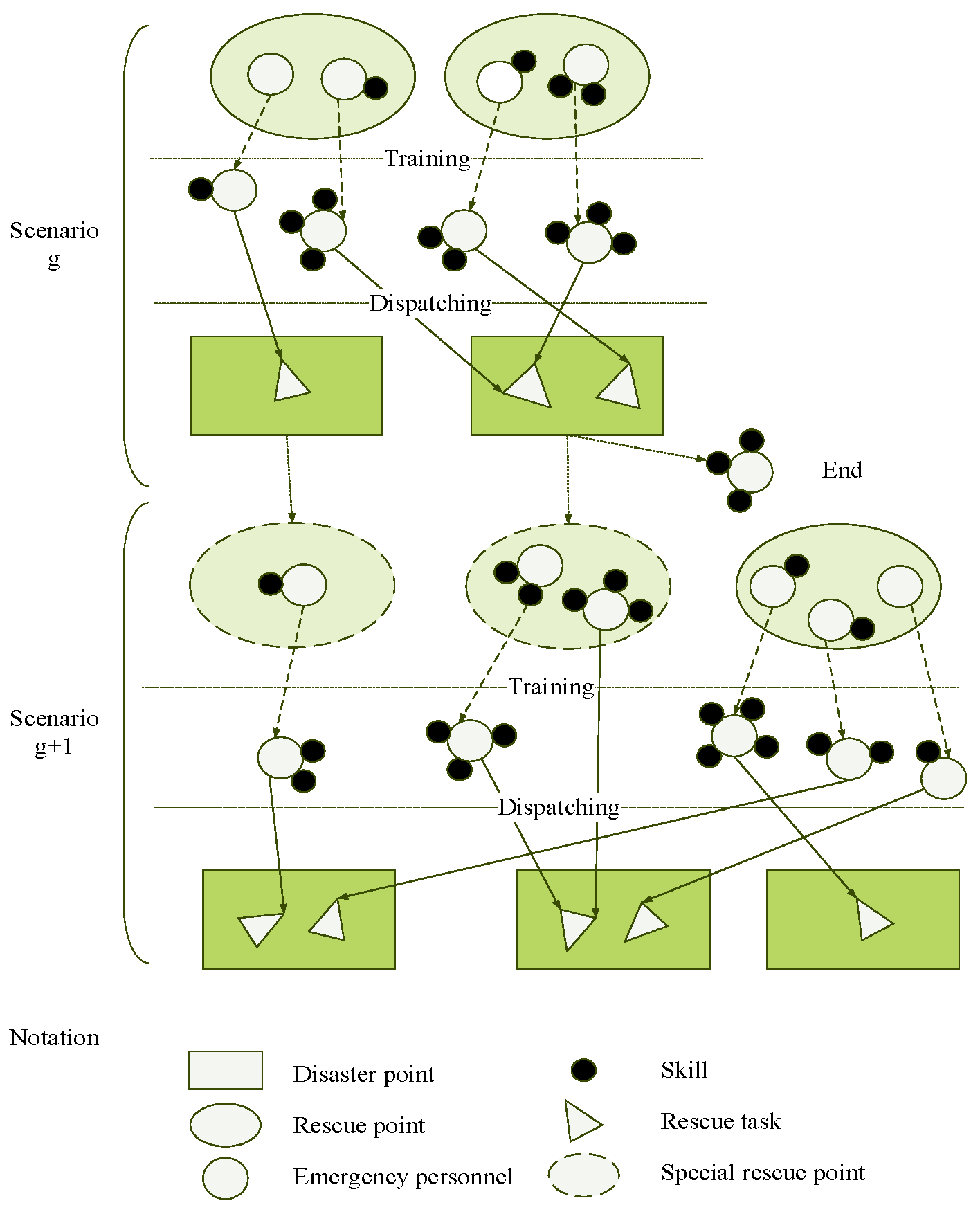
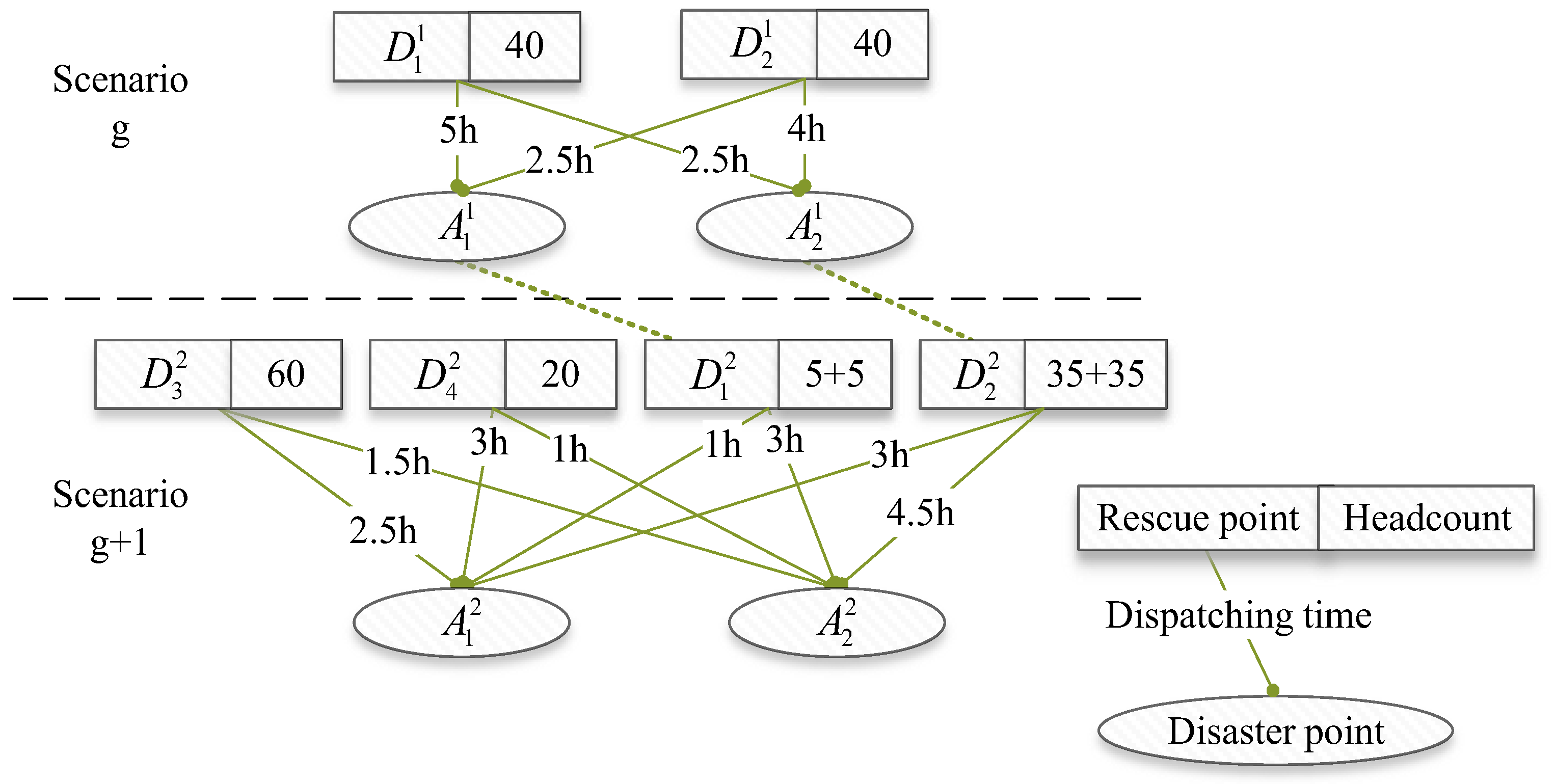
Due to the growable nature of human capacity, emergency rescuers can be trained to complement their missing skills, so that they can better protect themselves and complete their tasks in emergency response. Therefore, we suggest the training and dispatching integration of emergency rescuers in multiple scenarios, with the goal of improving their rescue and self-protection abilities by implementing rapid and centralized rescue training ahead of dispatching. Large-scale emergency management is divided into several scenarios. Each scenario requires simultaneously enhancing the training effectiveness and controlling the risk propagation. The operation process from any scenario g to its next scenario g + 1 is shown in Figure 1. Specifically, the rescue training may be carried out through knowledge courses and cooperative learning, with an emphasis on the required rescue skills, such as infection control and protection in emergency medical missions. On the basis of the thought of integration, the knowledge accumulation function is used to describe and estimate the training schedule required, and the capability utility function is suggested to establish the training evaluation model for emergency rescuers.

2.1.1. Knowledge Accumulation Function

The learning curve proposed by Wright in 1936 depicts the process that producers continuously improve their work efficiency through learning and accumulation of experience, that is, the production efficiency of the product increases with the increase in the cumulative number of products, while the growth rate of the production efficiency is on a downward trend [22]. The learning curve has been widely extended and applied to the study of production operation management and knowledge management, and some scholars have proposed the knowledge accumulation function based on it. We combined the proposed knowledge accumulation function to obtain the skill level of rescuers after a training time t, as shown in Equation (1), and its notations are provided in Table 1. According to the integrated learning index τ calculated via Equation (2), the training time t for the rescuer to reach the required skill level L t can be determined by Equation (3).
L i = ( 1 L 0 ) × ( 1 ρ τ t ) + L 0
τ = φ × ( 1 + N 0 N )
t = 1 τ log ρ ( 1 L t L 0 1 L 0 )

2.1.2. Capability Utility Function

The utility function is frequently utilized and well-known as the rule of diminishing marginal utility, which is suitable for the training evaluation of emergency rescuers [23,24]. We define capability utility as the improvement of rescue skills after a training period, and marginal utility is defined as the improvement in utility per unit of training cost expended in the training process. While the marginal utility may drop due to physical and mental exhaustion, the capability utility of the rescuer is increasing as more and more expenses are incurred, still meeting the rule. Assuming that the total number of rescuers is Q and the total number of skills in the training process is h, the total training utility of the kth rescuer is depicted in Equation (4). The training time required t can be determined by Equation (5), and the notations are presented in Table 2. With the weight coefficient to indicate the significance of each rescuer based on their competency, we evaluate the capability utility of all rescuers in Equation (6), and the total cost of training is determined by Equation (7). As a result, we are able to allocate the limited quantity of training expenses properly among several rescuers and accomplish training evaluation based on the capability utility function.
u ^ k = l = 1 h ( L l L 0 ) × ρ = l = 1 h ( 1 L 0 ) × ( 1 ρ τ t ) × ρ
t = b k b 0
U = k = 1 Q θ k u ^ k
b = k = 1 Q b k

2.2. Description of Shortage Impact Evaluation

After addressing the issue of insufficient capability by integration of training and dispatching, we propose the task vacancy evaluation in order to address the issue of rescuer shortage in multiple scenarios. Task vacancies happen when qualified rescuers cannot be dispatched in a timely manner or their quantity is inadequate for them to fulfill the demand for the task. Response time is defined as the sum of training time for the rescuer to acquire the standard level of skills and dispatching time. We specify the response time of each rescuer should be less than the maximum response time predetermined, otherwise it will be regarded as a response failure and a task vacancy. To fully comprehend the vacancy status, the demand for rescue task must be thoroughly analyzed including the number of rescuers required, the levels of rescue skills necessary, and the maximum response time, which can be assessed through the number of casualties at the disaster points and the vital degree of this emergency by utilizing existing data and methods. Then, the task penalty variable is proposed to evaluate the negative impact of diverse response times, which can be further categorized into the task perform penalty variable and the task vacancy penalty variable based on the success or failure of the response. Ultimately, we calculate the value of variables and evaluate the impact of shortages by the task penalty function. The following takes emergency medical missions as the research object to explore the precise implementation process.
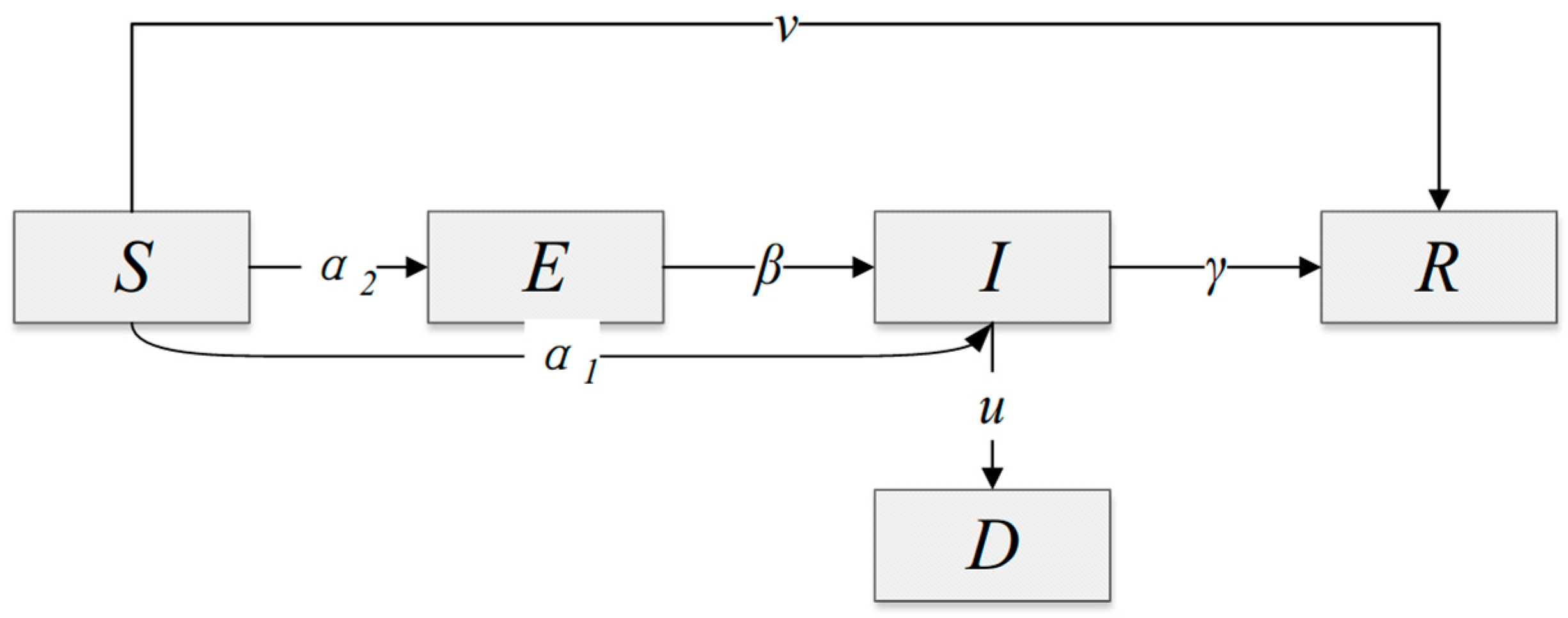
Emergency medical missions have sparked intense study and considerable societal concern as a specific sort of emergency mission. The SEVIR model with vaccination is presented for the rescuer shortage evaluation without considering the inflow and outflow of individuals as well as the rate of birth and death. We make the assumption that vaccinations can protect individuals from illness and prevent them from spreading it to others (S to v to R) by inducing immunity, while ignoring interventions, vaccine distribution plans, and environmental factors. The specific progress of the SEVIR model can be shown in Figure 2, which has demonstrated global stability [25]. As shown in Table 3, the parameters α1 and α2 indicate the differing probabilities of suspected people transmitting to exposed or infected people, respectively.
The system of differential equations related to the schematic diagram is as follows:
d S d t = ( α I + v ) × S N
d E d t = α I S N β E
d I d t = β E ( γ + μ ) I
d R d t = γ I + v S
d D e d t = μ I
S ( t ) , E ( t ) , D e ( t ) , I ( t ) , R ( t ) are the fractions of several possible state populations in time t . Therefore, for each state population, our model comprises:
S ( t + 1 ) = S t α 1 × I t × δ × S t N α 2 × E t × δ × S t N v × S ( t )
E ( t + 1 ) = E ( t ) + α 1 × I ( t ) × δ × S ( t ) N + α 2 × E ( t ) × δ × S ( t ) N β × E ( t )
I t + 1 = β × E t + I t ( γ + μ ) × I ( t )
D e ( t + 1 ) = D e t + μ × I ( t )
The population of affected individuals in several possible states can be calculated utilizing this model in order to judge the casualties and vital degree of this emergency. The particular demand for rescue tasks and their vital degree can be obtained via investigation and empirical judgment. Some researchers believe that there exist some linear relationships between the number of casualties and the number of rescuers that task required, such as one patient with two doctors. Therefore, by determining their mathematical connection based on the available data, it is possible to determine the number of rescuers that are required. Then, the task penalty variable R F t may be calculated by supplying some appropriate functions in relation to these vital degrees and outcomes of the SEVIR model, as shown below. As a result, the negative impact of rescuer shortage can be evaluated with the task penalty variable and vacancy status. A common equation template for calculating the task penalty variable is shown in Equation (17), and each scenario can have its own specific calculation equation.
R F t = Ψ ( D e ( t ) , V E M E R , V T A S K , E ( t ) , I ( t ) )

3. Construction and Solution of Integration Model

3.1. Model Construction

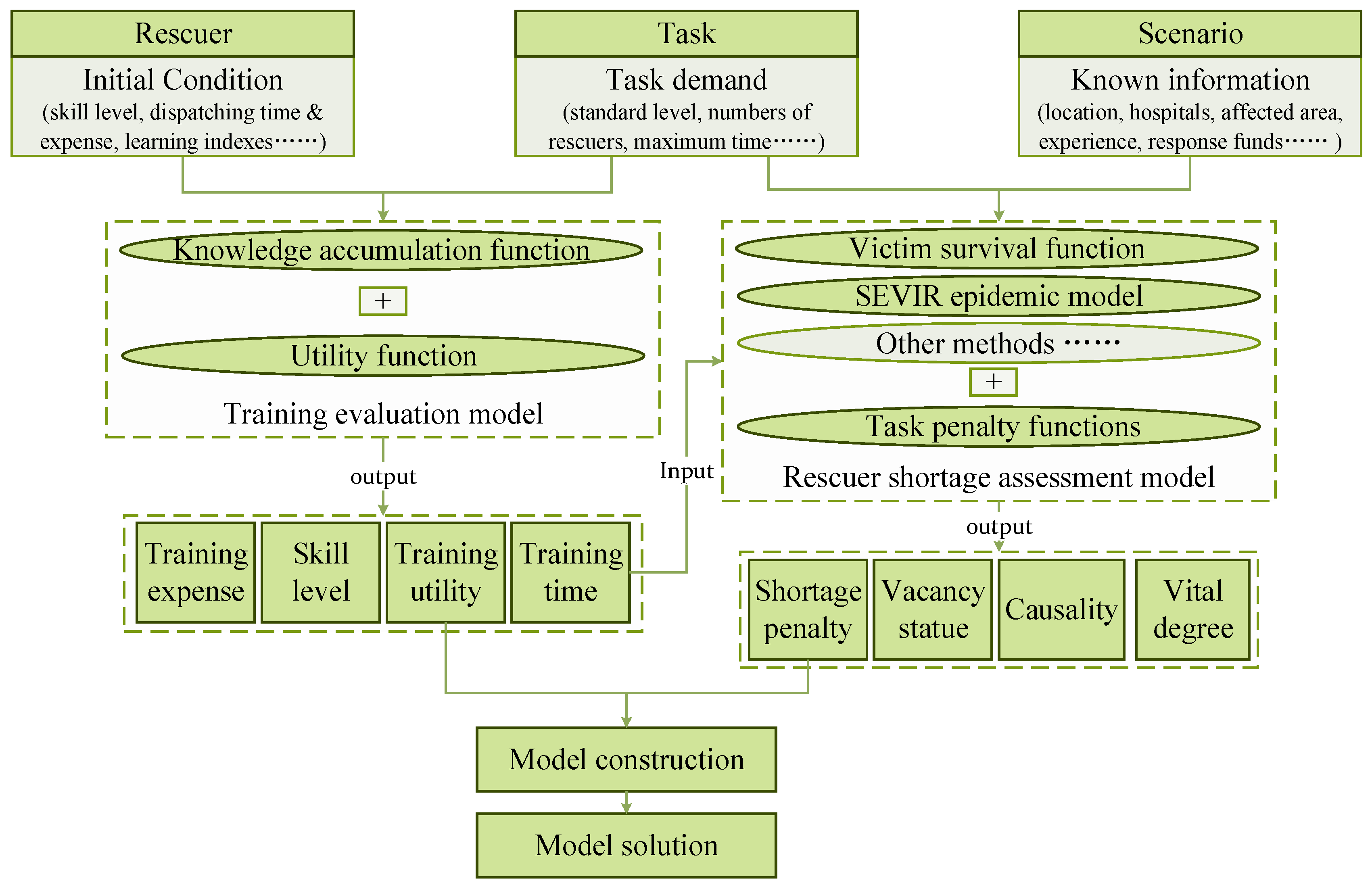
The multi-scenario training and dispatching integration model of emergency rescuers is established with the objectives of penalty-minimizing and utility-maximizing. The resolution procedure of this integration model is depicted in Figure 3 with its notations shown in Table 4. On the one hand, a training process and schedule can be quickly formulated based on the complexity of tasks and the current condition of rescuers. On the other hand, the potential losses caused by the spread of risks due to rescuer shortage can be determined according to the scenario environment and the urgency of the task. Subsequently, an attempt is made to construct and solve the integration model of training and dispatching. To facilitate its solution within a mathematical model, some fundamental assumptions are proposed as follows.
  • The overall demand for emergency rescuers in disaster points is more than the whole supply of emergency rescuers in rescue points.
  • Rescue tasks are independent of each other.
  • Only emergency rescuers whose levels of rescue skill all reach the standard level will be dispatched to the disaster point.
  • Emergency rescuers are dispatched simultaneously from the same rescue point to the same disaster point.
  • After completing their respective tasks, emergency rescuers can decide whether to be dispatched in the next scenario.
  • In the same scenario, emergency rescuers are only capable of carrying out one rescue task.
  • Prior to completing the tasks in the previous scenario, the next scenario will not be taken into account.
In the following, we will discuss the constraints and solutions after presenting the model.
min Z 1 = g = 1 q i = 1 m k = 1 n k = 1 d i g e = 1 p R   F i j k g x i j k g e + g = 1 q j = 1 n e = 1 p ( w w j e g i = 1 m k = 1 d i g x i j k g e ) × R F j e g
max Z 2 = g = 1 q i = 1 m j = 1 n k = 1 d i g e = 1 p u i k g x i j k g e
e = 1 p x i j k g e 1 , i = 1 , , m ; j = 1 , , n ; k ¯ = 1 , , d i g ¯ ; g = 1 , , q
i = 1 m k = 1 d i g e = 1 p x i j k g e i = 1 m k = 1 d i g y i j k g a j g
i = 1 m k = 1 d i g e = 1 p x i j k g e a j g , j = 1 , , n ; g = 1 , , q
g = 1 q j = 1 n k = 1 d i g b i k g b
y i j k g = 1 , p i k g   c a n   b e   d i s p a t c h e d   f o r   t a s k   W j e g 0 , p i k g   n o t   w i l l i n g   t o   b e   d i s p a t c h e d   f o r   t a s k   W j e g
x i j k g e = 1 , p i k g   w i l l   b e   d i s p a t c h e d   f o r   W j e g   t a s k   a f t e r   t r a i n i n g 0 , p i k g   w i l l   n o t   b e   d i s p a t c h e d   f o r   W j e g   t a s k   a f t e r   t r a i n i n g
Equation (18), which incorporates the task response penalty variable and task vacancy penalty variable, includes objective functions of penalty-minimizing. It indicates the minimization of risk propagation due to the shortage of emergency rescuers. Equation (19) include objective functions of utility-maximizing. It indicates the maximization of the training utility of emergency rescues. On the one hand, training all emergency rescuers as soon as possible can indeed prevent personnel shortages, but it will increase training costs and reduce training utility. On the other hand, improving the training utility of emergency rescuers means limiting the number of participants and increasing the risk of emergency rescuer shortages.
Equations (20)–(25) are constraints related to the fundamental assumptions. Constraint (20) emphasizes the fact that one emergency rescuer can only perform one task in the same scenario. Constraints (21) and (22) indicate that the number of emergency rescuers available for dispatching is limited, so the total number in each scenario or at each rescue point should not exceed the restrictions. Constraint (23) points out that the training process is constrained by expense. Constraints (24) and (25) represent the values of the decision variables, revealing that redispatch decisions should be in accordance with the willingness of emergency rescuers.

3.2. Model Solution

The matrices of the objective function have to be standardized into Z 1 and Z 2 in Equations (26) and (27) due to the varied dimensional levels and attribute matrices. Then, using Equation (28), where the parameters ξ 1 and ξ 2 are weight coefficients, the two objective function matrices may be merged into a single objective matrix. Additionally, the optimal solution of the training and dispatching integration model for emergency rescuers will be attained by utilizing suitable algorithms in software programs. Due to the presence of multiple stepwise and non-linear computational processes, this problem belongs to the NP-hard problem. Up to now, no polynomial-time algorithm has been found to obtain the optimal solution for this type of issue. Thus, the heuristic algorithms, such as the greedy algorithm and particle swarm optimization algorithm (PSO), are recommended for solving our model to obtain the satisfactory solutions.
Z 1 = Z 1 m a x Z 1 Z 1 m a x Z 1 m i n
Z 2 = Z 2 Z 2 m i n Z 2 m a x Z 2 m i n
max Z = g = 1 q i = 1 m j = 1 n k = 1 d i g e = 1 p Z x i j k g e = g = 1 q i = 1 m j = 1 n k = 1 d i g e = 1 p ( ξ 1 × Z 1 + ξ 2 × Z 2 ) x i j k g e
The greedy algorithm believes the global optimal solution can be obtained ultimately by adhering to the greedy criterion of choice for each input, which is easily bound to the local optimum. The local optimal solution obtained is similar to the overall optimal solution, and the global optimal solution can even be obtained many times. The greedy algorithm also has several advantages, including convenient implementation and easy debugging. Due to its simplicity and efficiency, the greedy algorithm is frequently used for optimization problems including the knapsack problem and job scheduling, and to compare with the results of other algorithms or as an auxiliary algorithm.
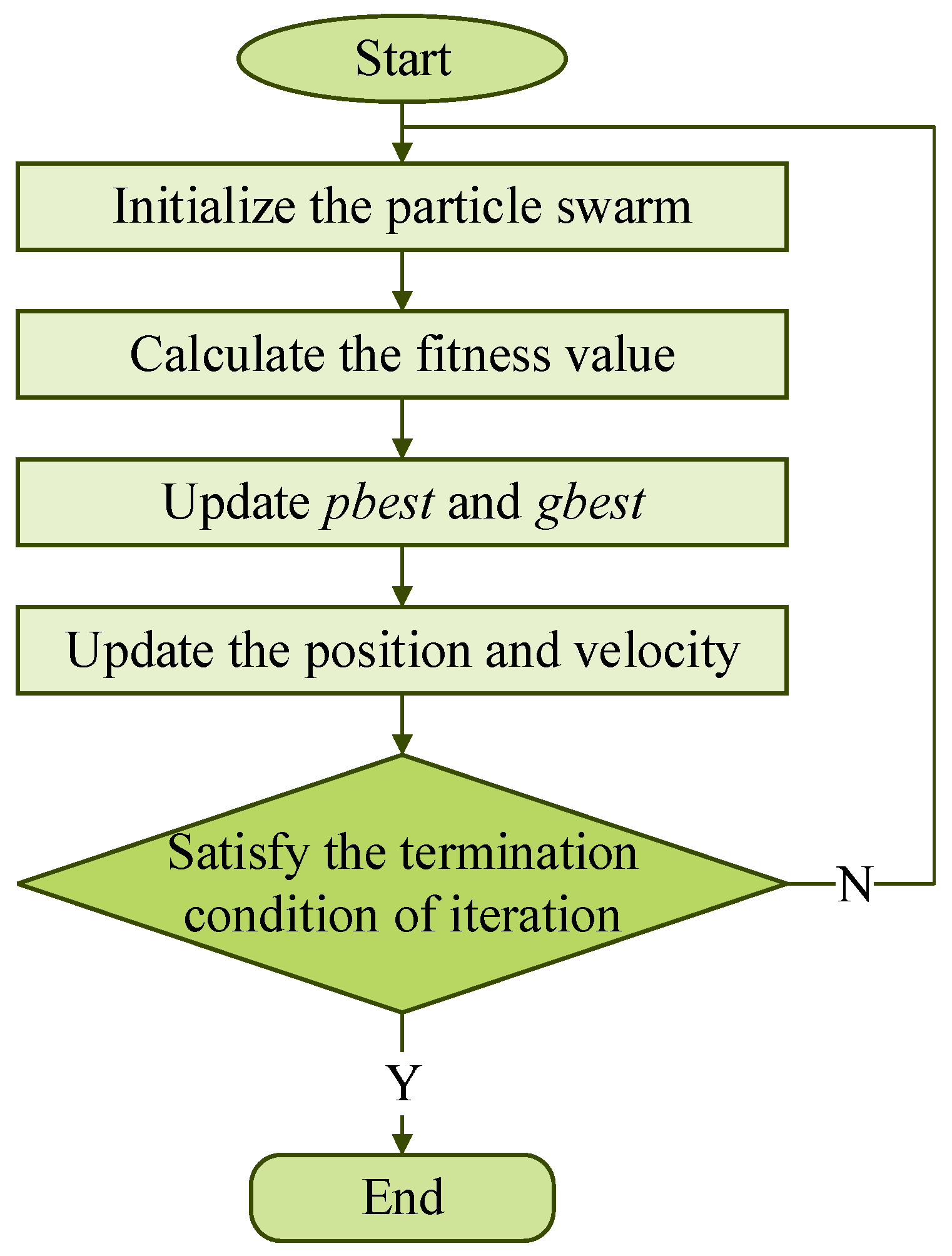
The PSO algorithm is a relatively recent heuristic with few parameters and simple implementation, which is effective in handling a wide range of optimization tasks with a rapid rate of convergence [25]. The flow chart for the PSO algorithm is broken down into five sections, as illustrated in Figure 4, where the parameter P b e s t represents the best location one particle has ever held and G b e s t is a value retrieved from the repository. A significant number of particles representing the operation schemes will be created randomly and stored in cells as matrices to cope with our model. After setting the value of the objective function to the fitness value, the speed and position of each particle will be updated until the optimal solution is found.
Furthermore, the velocity and the position of the particle i are defined by
v 0 ( t + 1 ) = w v 0 ( t ) + c 1 × r a n d 1 ( ) ( p b e s t 0 ( t ) x 0 ( t ) ) + c 2 × r a n d 2 ( ) ( g b e s t 0 ( t ) x 0 ( t ) ) x 0 ( t + 1 ) = x 0 ( t ) + v 0 ( t + 1 )
where v 0 ( t ) and x 0 ( t ) represent the velocity and position of the particle i at the t-th iteration respectively. The parameters r a n d 1 ( ) , r a n d 2 ( ) are the random numbers between 0 and 1, while w is the inertia weight. There are two types of learning factors: self-cognitive learning factor ( c 1 ) and group-cognitive learning factor ( c 2 ).

4. Numerical Case Analysis

4.1. Case Description

As shown in Table 5, we assume that there are different degrees of cluster medical events in the several disaster-stricken areas, selecting two disaster points and two rescue points for each scenario. Eighty and 160 emergency rescuers will be dispatched individually to carry out rescue tasks in two scenarios, in which five and 35 rescuers at disaster points A 1 1 and A 2 1 will be dispatched in the scenario g + 1   to realize the redispatch. Figure 5 displays the quantity and dispatching time required of emergency rescuers available at the rescue points.
We assume four distinct rescue tasks with rescue skills required, including logistics support ( W 1 ), nursing observation ( W 2 ), diagnosis and treatment ( W 3 ), expert consultation ( W 4 ), practical operation of equipment ( H 1 ), psychological adjustment ( H 2 ), infection control and protection ( H 3 ), as well as expertise and experience ( H 4 ). The notation about rescue skill training and the pre-training capability evaluation matrix of partial emergency rescuers are provided in Table 6 and Table 7. We assign an equal weight coefficient θ k of the capability utility function to each rescuer.

4.2. Computational Experiment

Even if the train of thought is offered for shortage impact evaluation in emergencies, when it comes to specific cases, the suitable approaches for the evaluation and solving model have to be proposed in detail. Once the parameter values have been set, shown in Table 8, the SEVIR model is applied with the initial data to predict the emergency medical mission evolution of disaster points in Table 9. We assume that the maximum response time is seven days and the time for training and working of each emergency rescuer is limited to eight hours per day. Then, we make an empirical analysis to deduct the linear relationships between the number of casualties and emergency rescuers required to determine task demand and rescuer shortage. For the convenience of data collection, we assume that emergency rescuers are divided into four types: managers, nurses, doctors, and experts, which correspond to four tasks in sequence.
Specifically, for patients in severe or critical condition, a total of 172 rescuers from the medical team treated 44 patients with serious conditions. The rescuers to patients ratio stands at 3.91:1, and 800 beds for severe cases and 2900 rescuers were provided in the First Group, for a ratio of 3.63:1. For patients with mild symptoms, the ratio of allocated rescuers to these patients is between 0.63 and 1.37 in the Second Group responsible for their treatment. For example, a total of 694 rescuers treated 960 patients at the Third Group, which is a ratio of 0.72:1, and 1013 rescuers treated 780 patients, which is a ratio of 1.3:1. On the basis of our findings, the demand for emergency rescuers is very different between patients in severe or critical conditions, patients with mild symptoms and others. We regard the population of Infected and Dead as the number of the patients, assuming 19.9% of them will develop into severe cases. Hence, we suggest that four rescuers should be assigned to each patient with serious conditions, one for patients with mild symptoms and one manager for ten people in quarantine. The linear relationships between the number of casualties and the number of various emergency rescuers required in the disaster points can be summarized as shown in Table 10. Under the guidance of these linear relationships, the number of emergency rescuers required can be calculated in Table 11, depicting that there exists around a 27% rescuer shortage and task vacancy in each scenario.
We consider utilizing the results of the SEVIR model and assigning them reasonable weights to estimate task penalty variable R F t and assess the impact of task vacancy. In addition, we are convinced that the population of several possible states can depict the differences in varying emergencies and disaster points, similar to the role of V E M E R and V T A S K . Therefore, the task penalty functions for R F t can be calculated by Equation (30), while the calculation result is shown in Table 12.
R F t = 0.5 × D ( t ) + 0.3 × I ( t ) + 0.2 × E ( t )
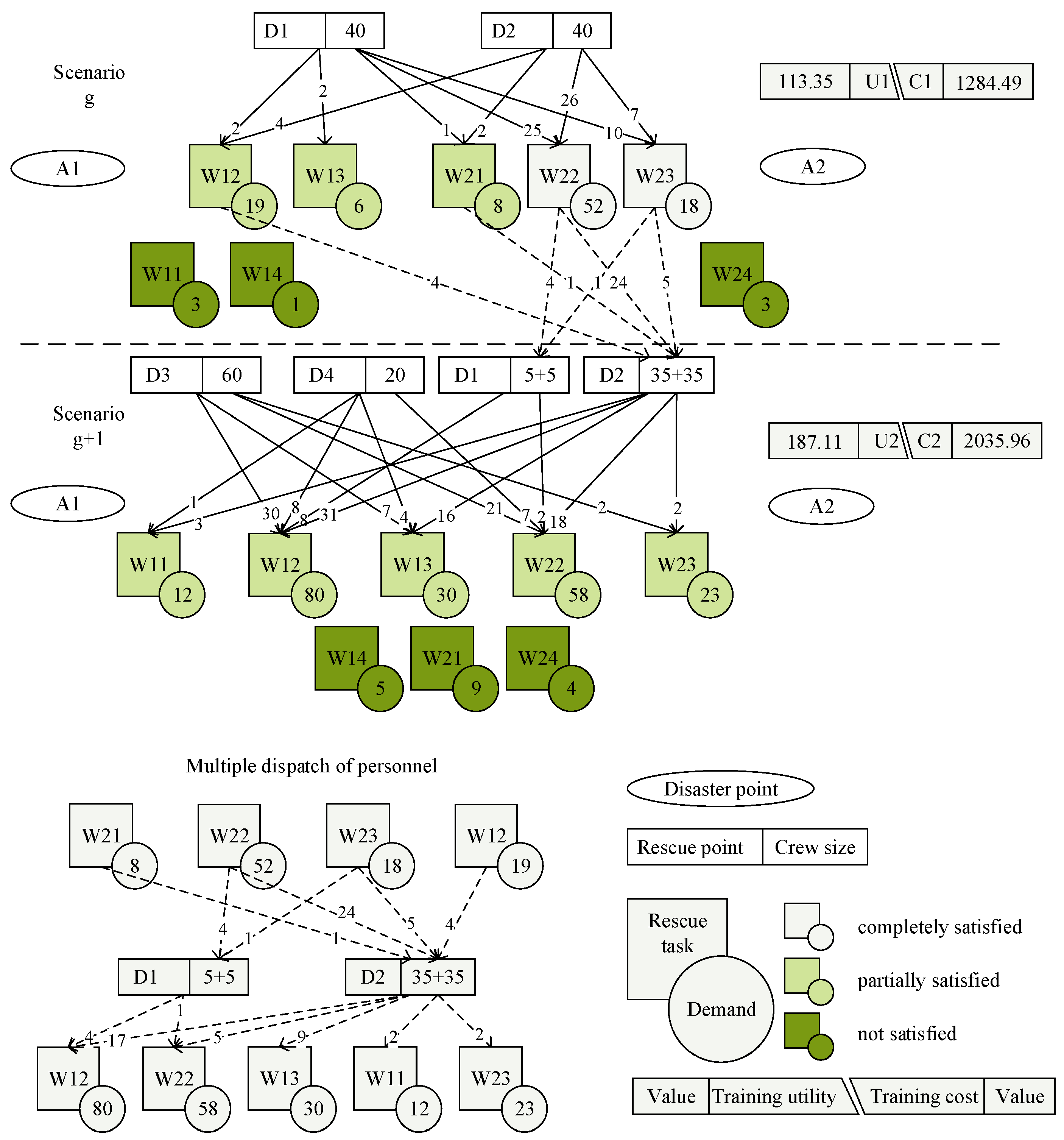
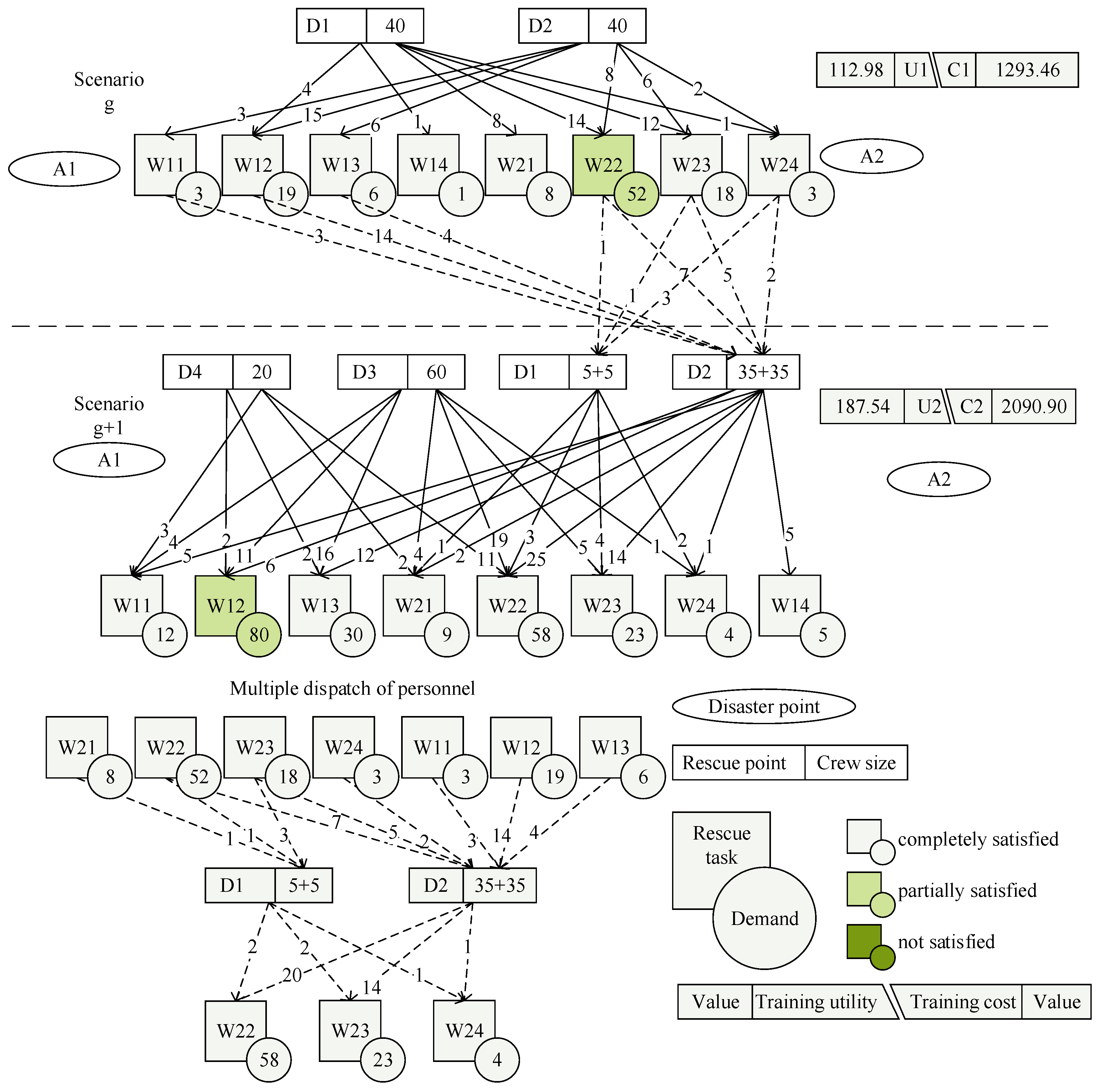
Considering that task vacancy is always prioritized by emergency decision makers, the parameters ξ 1 and ξ 2 will be assigned values of 0.6 and 0.4. The greedy algorithm and PSO algorithm are utilized to seek the optimal solution for the illustrative example, and the solutions obtained are compared from four aspects. The PSO algorithm is used for calculation, setting the population size to 10,000 and the maximum iteration time to 1000 with c 1 = c 2 = 1.49618 ,   w = 0.7298 . As described in Table 13, we briefly show the results of the two algorithms, including the optimal fitness, the total risk of performing task R F z g , the total risk of task vacancies R F k g , the training expense C g and utility U g , while the dispatching diagrams of solutions are shown in Figure 6 and Figure 7. We also calculate the comparative optimization degree of two algorithms, dividing their difference by the value of the greedy solution.

4.3. Contrastive Analysis

For short, we named the solution solved by the PSO algorithm as solution P, and that of the greedy algorithm as solution G. And a comparative analysis from four aspects is conducted to highlight the superiority of our model and algorithm.
Judging by the task vacancy, there exist a lot of vacancies in solution P, mainly concentrated on the tasks W 1 and W 4 with less demand or a high-level standard. To fill in the gaps the limited rescuer inevitably brings, the local volunteers should be gathered to play a role in W 1 , while the diagnostic accuracy in remote expert consultation by using standard video-conference technology has been proved, which can apply in W 4 . For solution G, all the tasks are completely satisfied except task W 2 , which was nearly half vacant at the greatest disaster point ( A 2 1 , A 1 2 ), where that is 57.7% in scenario g and 76.3% in g + 1 . Considering the important role of W 2 in rescue progress, we may have reason to believe that the gaps will widen as the pandemic becomes severe, leading to overload or even shutdown of the health system. The reason for this phenomenon is that the task with a low penalty value and high capability utility is given priority to satisfy, so these areas ( A 2 1 , A 1 2 ) will be vacant due to the high risk and large demand.
Judging by the shortage impact, the total task penalty score of solution P(166.61) is higher than solution G(163.28), which means the former can induce the impact of task vacancy by more reasonable scheduling. Specifically, these standardized scores are converted into the actual values of the task penalty variables calculated in Table 13. Solution P has an actual value of 8174.20 for task perform penalty, higher than solution G(7206.90), and an actual value of 4217.30 for task vacancy penalty, lower than solution G(5613.80). These figures indicate that attention should be paid to the training and dispatching of rescuers in severe disaster points, as the gaps are more likely to have immeasurable effects.
Judging by the capability utility, the capability utility generated by each rescue skill after training unit time (one hour) can be sorted in ascending order like H 1 < H 2 < H 3 < H 4 . Solution G gives priority to training rescuers generating high utility and a low task penalty, while solution P prefers to focus on training rescuers for critical tasks W 1 and W 3 . The reason why the two solutions have similar values in capability utility might be the little difference in the settings of the standard level and quality index. Moreover, we assume that a relative cost represents 100 yuan and convert it into training expenses, and solution G requires an additional cost of 6391.02 yuan.
Judging by the rescuer redispatch, we have assumed that 40 rescuers can be dispatched again for scenario g + 1 after completing their rescue task assigned in g , reducing the training time and cost. To further evaluate the degree of optimization, we assume that they skip the training process in g , initializing their skill levels to the original average levels and keeping the dispatching plan unchanged. As is shown in Table 14, there will be around 800 relative training costs and more than 600 h of training time without rescuer redispatch.
Overall, the multi-scenario approach of training and dispatching integration we proposed is verified. The computational experiment demonstrates the implementation of the approach to deal with the rescuer dispatching issue with insufficient capability and rescuer shortages in large-scale emergencies. The contrastive analysis produces evidence that the PSO algorithm may be more conducive and suitable to the application of the approach than the greedy algorithm. As mentioned earlier, it improves optimal fitness by 4.02 percent and shortage impact by 2.04 percent in the final result. From the perspective of rescuer redispatch, it can reduce training costs and time for dispatching, with 24.18 percent of the total training expense in two scenarios.

5. Conclusions

In this paper, we propose the multi-scenario approach of training and dispatching integration with a knowledge accumulation function for rescue response to large-scale emergencies. To improve the self-protection ability and rescue skills of emergency rescuers, we emphasize the interaction and inseparability of rescuer training and dispatching progress and propose the thought of training and dispatching integration. In light of the integration thought, we stress the skill learning ability of rescuers during the response period and their capability can be enhanced by temporary training centralized to make up for the incompetence issue. Then, the knowledge accumulation function and the capability utility function are proposed to establish the training evaluation model for emergency rescuers. Another issue is the rescuer shortage for large-scale emergencies with multiple scenarios. After assessing the number and skill level of rescuers required and their response time, we define the task penalty variables to estimate the impact of different response times and rescue task vacancy. Then, we explore the implementation of task penalty functions for the variables in varied emergencies and present an example of emergency medical mission. Ultimately, we establish a multi-objective optimization model of training and dispatching integration model for large-scale emergencies with rescuer shortage and multiple scenarios. The validity of this model is verified through the computational experiment and contrastive analysis between two solutions obtained by particle swarm optimization and the greedy algorithm.
This study proposes an integrated framework of training and multi-scenario dispatching, offering the following implications for emergency management. First, a dynamic capability accumulation mechanism should be established, where a knowledge accumulation function quantifies skill growth over time, thereby supporting “redispatch” decisions. Second, task penalty-driven optimization enables flexible adjustment of dispatching schemes based on response time and vacancy status. Third, the joint optimization of training and dispatching aligns training content with actual demand, reducing overall penalties. The model outputs quantify casualties and task coverage, assisting commanders in prioritizing critical tasks under resource constraints and providing early warnings of skill gaps. Applicable to various emergency scenarios such as medical response, firefighting, and engineering rescue, the framework can be rapidly deployed using particle swarm optimization or greedy algorithms, effectively alleviating the challenges of insufficient personnel and inadequate skills while improving rescue efficiency.
Although the approach we proposed handles the dispatching issue with insufficient skills and rescuer shortage, it still requires further investigation. In this work, the integration of training and dispatching is built without consideration for the content design of training and dispatching for various kinds of rescuers, downplaying the complexity and diversity of emergency rescue forces and diminishing the credibility of centralized training. Despite our depiction of the task penalty variables and a specific implementation of emergency medical mission, the methods for the task penalty function remain in need of additional studies and explorations. Additionally, the number of computational experiments in this study is not sufficient. Further, we expect that the significance of training and dispatching integration for emergency rescuers can be given substantial emphasis and recognition as research continues. To reflect the diversity of emergency rescuers, we will focus on the content design of the training and dispatching integration process after analyzing their characteristics, such as professional background and subjective will. Ultimately, by utilizing some technological methods like machine learning, we will attempt to make a more precise assessment of training outcomes and shortage impacts.

Author Contributions

Conceptualization, Z.W.; Methodology, Z.W.; Validation, M.T.; Investigation, M.T.; Data curation, M.T.; Writing—original draft, X.K.; Writing—review and editing, X.Z.; Supervision, Z.W.; Project administration, Z.W.; Funding acquisition, Z.W. All authors have read and agreed to the published version of the manuscript.

Funding

This research was funded by National Science Foundation Grant of China grant number No. 71501151, and the Humanities and Social Sciences Research Foundation Grant of the Ministry of Education No. 20YJC630154.

Institutional Review Board Statement

Not applicable.

Informed Consent Statement

Not applicable.

Data Availability Statement

The original contributions presented in this study are included in the article. Further inquiries can be directed to the corresponding author.

Conflicts of Interest

The authors declare no conflict of interest.

References

  1. Temitayo, A.; Delva, S.; Chiu, A.C.; Wolf, C.; Baptiste, D.-L. An integrative review of community health volunteer-led training to improve water, sanitation, and hygiene practices in Haiti. Public Health Nurs. 2026, 43, 885–895. [Google Scholar]
  2. Praditporn, P.; Chulalak, K.; Pilaiporn, S.; Aranya, R. Effect of a community-based enhancement program on emergency assistance and marine patient transfer coordination competency among community health volunteers on the remote islands of southern Thailand: Quasi-experimental study. Asian Pac. Isl. Nurs. J. 2026, 10, e80195. [Google Scholar]
  3. Chen, N.; Wang, H.Y.; Hu, Y.T.; Zhang, R.F.; Zhang, Z.P. Development and preliminary validation of an immersive virtual reality serious game for subway fire emergency plan training. Comput. Animat. Virtual Worlds 2026, 37, e70102. [Google Scholar] [CrossRef]
  4. Salleh, K.M.; Khalid, N.H.; Sulaiman, N.L.; Mohamad, M.M.; Sern, L.C. Competency of adult learners in learning: Application of the iceberg competency model. Procedia-Soc. Behav. Sci. 2015, 204, 326–334. [Google Scholar] [CrossRef]
  5. Meduri, Y. Personnel needs assessment in times of crisis: A focus on management of disasters. RAUSP Manag. J. 2021, 56, 390–407. [Google Scholar] [CrossRef]
  6. Hossain, L.; Hamra, J.; Wigand, R.T.; Carlsson, S. Exponential random graph modeling of emergency collaboration networks. Knowl. Based Syst. 2015, 77, 68–79. [Google Scholar] [CrossRef]
  7. Sung, I.; Lee, T. Optimal allocation of emergency medical resources in a mass casualty incident: Patient prioritization by column generation. Eur. J. Oper. Res. 2016, 252, 623–634. [Google Scholar] [CrossRef]
  8. Çakırgil, S.; Yücel, E.; Kuyzu, G. An integrated solution approach for multi-objective, multi-skill workforce scheduling and routing problems. Comput. Oper. Res. 2020, 118, 104908. [Google Scholar] [CrossRef]
  9. Mayorga, M.E.; Lodree, E.J.; Wolczynski, J. The optimal assignment of spontaneous volunteers. J. Oper. Res. Soc. 2017, 68, 1106–1116. [Google Scholar] [CrossRef]
  10. Abualkhair, H.; Lodree, E.J.; Davis, L.B. Managing volunteer convergence at disaster relief centers. Int. J. Prod. Econ. 2020, 220, 107399. [Google Scholar] [CrossRef]
  11. Ren, Z.; Zhang, Q. Volunteer dispatch considering fatigue effect and satisfaction in emergency situation. Discov. Appl. Sci. 2024, 6, 14. [Google Scholar] [CrossRef]
  12. Chen, W.; Zhang, H.B.; Comfort, L.K.; Tao, Z.G. Exploring complex adaptive networks in the aftermath of the 2008 Wenchuan earthquake in China. Saf. Sci. 2020, 125, 104607. [Google Scholar] [CrossRef]
  13. Sahin, H.; Kara, B.Y.; Karasan, O.E. Debris removal during disaster response: A case for Turkey. Socio-Econ. Plan. Sci. 2016, 53, 49–59. [Google Scholar] [CrossRef]
  14. Shiri, D.; Akbari, V.; Salman, F.S. Online routing and scheduling of search-and-rescue teams. OR Spectr. 2020, 42, 755–784. [Google Scholar] [CrossRef]
  15. Liang, W.; Huang, Y.; Wang, J. Emergency response system combining the internal and external domains (ERSCIED). J. Circuits Syst. Comput. 2022, 31, 2250281. [Google Scholar] [CrossRef]
  16. Li, M.Y.; Zhao, X.J.; Fan, Z.P.; Cao, P.P.; Qu, X.N. A model for assignment of rescuers considering multiple disaster areas. Int. J. Disaster Risk Reduct. 2019, 38, 101201. [Google Scholar] [CrossRef]
  17. Duan, Z.; Huang, Y.; Huang, P.; Guo, J.; Yang, F.; Fu, L. Model and solution of complex emergency dispatch by multiple rescue centers with limited capacity to different disaster areas. Symmetry 2020, 12, 1138. [Google Scholar] [CrossRef]
  18. Grogan, S.; Pellerin, R.; Gamache, M. Using tornado-related weather data to route unmanned aerial vehicles to locate damage and victims. OR Spectr. 2021, 43, 905–939. [Google Scholar] [CrossRef]
  19. Sun, W.; Zhu, C.; Li, H. Evolutionary game analysis of emergency rescuer dispatching under bounded rationality. Int. J. Disaster Risk Reduct. 2023, 96, 103837. [Google Scholar] [CrossRef]
  20. Srivastava, G.; Singh, A. An evolutionary approach comprising tailor-made variation operators for rescue unit allocation and scheduling with fuzzy processing times. Eng. Appl. Artif. Intell. 2023, 123, 106172. [Google Scholar] [CrossRef]
  21. Shin, Y.; Kim, S.; Moon, I. Integrated optimal scheduling of repair crew and relief vehicle after disaster. Comput. Oper. Res. 2019, 105, 237–247. [Google Scholar] [CrossRef]
  22. Wright, T.P. Factors affecting the cost of airplanes. J. Aeronaut. Sci. 1936, 3, 122–128. [Google Scholar] [CrossRef]
  23. Sun, M.; Trudel, R. The effect of recycling versus trashing on consumption: Theory and experimental evidence. J. Mark. Res. 2017, 54, 293–305. [Google Scholar] [CrossRef]
  24. Melnychuk, M.C.; Young, E.G.; Anderson, L.E.; Hilborn, R. Trading off retained daily catch for longer seasons to maximize angler benefits in recreational fisheries management. ICES J. Mar. Sci. 2021, 78, 1650–1662. [Google Scholar] [CrossRef]
  25. Bratton, D.; Kennedy, J. Defining a standard for particle swarm optimization. In Proceedings of the 2007 IEEE Swarm Intelligence Symposium, Honolulu, HI, USA, 1–5 April 2007; pp. 120–127. [Google Scholar]
Figure 1. Training and dispatching integration of emergency rescuer.
Algorithms 19 00446 g001
Figure 2. Schematic diagram of SEVIR model.
Algorithms 19 00446 g002
Figure 3. The resolution procedure of training and dispatching integration model.
Algorithms 19 00446 g003
Figure 4. Flow chart of the PSO algorithm.
Algorithms 19 00446 g004
Figure 5. The schematic diagram of the dispatching process.
Algorithms 19 00446 g005
Figure 6. Dispatching diagram by PSO algorithm.
Algorithms 19 00446 g006
Figure 7. Dispatching diagram by the greedy algorithm.
Algorithms 19 00446 g007
Table 1. Notation of the knowledge accumulation function.
Variables/ParametersDefinition
L 0 Skill level of rescuer before training
L t Skill level of rescuer after a training time t
t Training time required
ρ Learning difficulty coefficient of the skill
τ Integrated learning index
φ Occupational skill levels
N 0 Number of previous rescue practices
N Number of optimal rescue practices
Table 2. Notation of capability utility function.
Variables/ParametersDefinition
U All utility
b All expense
b 0 The unit cost of skill H l learning
H l Rescue skill, l = 1 , , h .
b k Training expense of rescuer k
u ^ k Capability utility of rescuer k
Table 3. Notation of SEVIR model.
Variables/ParametersDefinition
N Number of human population
S Number of suspected population
E Number of exposed population
I Number of infected population
R Number of recovered population
D e Number of dead population death by emergency medical mission
α 1 Rate of transmission for S to I
α 2 Rate of transmission for S to E
β Incubation rate
v Vaccination rate
δ Number of contacts per person per day, related to control policies
γ Probability of recovery
μ Rate of death population by the disease
Table 4. Notations of the training and dispatching model.
Scenario number B g Emergency rescue scenario g , g = 1 , , q .
Rescuer point parameters D i g Rescue point i in the scenario g , i = 1 , , m .
d i g Number   of   emergency   rescuers   at   rescue   point   D i g
P i k g The k - th emergency rescuer at rescue point D i g , k = 1 , , d i g .
Q g Total number of emergency rescuers available in the scenario g
Disaster point parameters A j g Disaster point j in the scenario g , j = 1 , , n .
a j g Rescuer   demand   for   the   disaster   point   A j g
W j e g Rescue task e at disaster point j in the scenario g , e = 1 , , p .
w w j e g Rescuer demand for rescue task W j e g
Rescuer parameters t i j k g Dispatching   time   of   emergency   rescuer   P i k g   from   rescue   point   D i g to disaster point A j g .
H l Rescue skill l   that   emergency   rescuer   required ,   l = 1 , , h .
L i k l g Initial   skill   H l   level   of   emergency   rescuer   P i k g before the training
L i k l g Rescue   skill   H l   level   of   emergency   rescuer   P i k g after the training
w e l The   standard   level   of   skill   H l   for   rescue   task   W j e g
t i k l g Training   time   of   emergency   rescuer   P i k g   to   meet   the   standard   level   of   rescue   skill   H l
c l Relative cost for rescue training of skills H l at the unit time
u ^ i k g Capability   utility   of   emergency   rescuer   P i k g
b i k g Training   expense   of   emergency   rescuer   P i k g
T g Total training time in the scenario g
C g Total training expense in the scenario g
U g Total capability utility in the scenario g
b General budget
Task response parameters R F i j k g Task   response   penalty   variable   for   dispatching   rescuer   P i k g   to   disaster   point   A j g .
R F z g Total task response penalty variable in the scenario g
R F j e g Task   vacancy   penalty   variable   for   task   W j e g . If the demand is entirely satisfied, R F j e g = 0 .
R F k g Total task vacancy penalty variable in the scenario g
x i j k g e Variable   x i j k g e   indicates   whether   emergency   rescuer   P i k g   will   be   dispatched   to   disaster   point   A j g . If   it   is   1 ,   P i k g will   be   dispatched   for   task   W j e g after training.
y i j k g Variable   y i j k g   indicates   whether   emergency   rescuer   P i k g   would   like   to   be   dispatched   to   disaster   point   A j g . If   it   is   1 ,   P i k g can be   dispatched   for   task   W j e g .
Table 5. Initial data for each disaster point.
A j g PopulationInitial Data
(t = 0)
D ( t ) I ( t ) E ( t )
A 1 1 886,5470108
A 2 1 5,260,95103017
A 1 2 1,158,6400550
A 2 2 2,469,0790401
Table 6. Notation about rescue skill training.
H l H 1 H 2 H 3 H 4
c l 1.5111.5
ρ 0.70.60.50.8
w e l W 1 0.800.800.800.80
W 2 0.850.900.900.85
W 3 0.900.850.850.90
W 4 0.950.950.950.95
Table 7. Pre-training capability evaluation matrix of partial emergency rescuers.
P i k 1 N 0 φ τ L i k 1 1 L i k 2 1 L i k 3 1 L i k 4 1
P 11 1 21.410.30.20.30.2
P 12 1 11.210.20.40.30.2
P 13 1 11.210.30.20.30.3
P 14 1 12.420.60.40.40.3
P 21 1 12.420.50.40.40.5
P 22 1 22.820.50.40.20.5
P 23 1 33.220.50.40.30.5
P 24 1 21.410.30.20.20.5
Table 8. Values of SEVIR model parameters.
ParametersValue
α 1 0.157
α 2 0.787
β 1/7
v 50%
δ 10
γ 1/14
μ 0.03
Table 9. Evaluation data of disaster points.
A j g PopulationDay1Day2Day3Day4Day5Day6Day7
A 1 1 D ( t ) 0111233
I ( t ) 10121518202122
E ( t ) 23272827252220
A 2 1 D ( t ) 1234679
I ( t ) 29354350556063
E ( t ) 62767976706355
A 1 2 D ( t ) 235791215
I ( t ) 49576777869397
E ( t ) 871131191161079684
A 2 2 D ( t ) 12457911
I ( t ) 36424957636871
E ( t ) 64838885787062
Table 10. The linear relationships between the number of casualties and rescuers.
Doctor, nurse,
and expert
Total demand ( D e ( t ) + I ( t ) ) × 80.1 % + ( D e ( t ) + I ( t ) ) × 19.9 % × 4
The ratio of doctors to nurses1:2.5
The ratio of doctors to experts6:1
ManagerTotal demand E ( t ) /10
Table 11. The evaluation of emergency rescuers required (based on prediction data on day 3).
A j g Total Demand W 1 W 2 W 3 W 4
A 1 1 2919613
A 2 1 81521838
A 1 2 1278030512
A 2 2 94582349
Table 12. Calculation result of task penalty variable.
Response TimeDay1
(t < 8 h)
Day2
(8 < t < 16 h)
Day3
(16 < t < 24 h)
Day4
(24 < t < 32 h)
Maximum
(t > 32 h)
A 1 1 6.69.611.713.415.9
A 2 1 18.427.233.338.245.2
A 1 2 27.542.55258.869.8
A 2 2 20.231.138.243.351.2
Table 13. Solutions that two algorithms obtained.
AlgorithmPSOGreedyDegree
Optimal Fitness150.48144.664.02%
Standardized
scores
R F k 1 7.5902.04%
R F k 2 12.750
R F z 1 40.9647.44
R F z 2 105.31115.85
U 1 39.5739.230
U 2 77.1677.50
Actual values R F k 1 740.701356.003.35%
R F k 2 3476.604257.80
R F z 1 2222.101784.90
R F z 2 5952.105422.00
U 1 113.35112.980.02%
U 2 187.11187.54
C 1 1284.491293.461.89%
C 2 2035.962090.90
Table 14. Costs and schedule of training for 40 people under hypothetical conditions.
Average Initial LevelsPSO AlgorithmGreedy Algorithm
W 1 W 2 W 3 Total W 2 W 3 W 4 Total
2271122162
C 2 W 1 15.0130.02802.760848.58
W 2 19.60529.2431.2
W 3 22.14243.54354.24
W 4 31.57063.14
T 2 W 1 11.2222.44604.190635.42
W 2 14.93403.11328.46
W 3 16.24178.64259.84
W 4 23.56047.12
Disclaimer/Publisher’s Note: The statements, opinions and data contained in all publications are solely those of the individual author(s) and contributor(s) and not of MDPI and/or the editor(s). MDPI and/or the editor(s) disclaim responsibility for any injury to people or property resulting from any ideas, methods, instructions or products referred to in the content.